Washington DC: U.S. Government Printing Office 1955. Presumed first edition/first printing. Wraps. Good. No dust jacket as issued. Cover has some wear and soiling. ix 100 p. Includes illustrations. Statistical tables. Harold E. Stassen was the Director Foreign Operations Administration when this report was submitted. This report in order to explain Moscow's objectives and actions reviewed recent developments in SOviet-bloc foreign economics activities especially it action in underdeveloped countries and its attempts at economic penetration. U.S. Government Printing Office paperback
Washington DC: U. S. Government Printing Office 1966. Presumed First Edition First printing. Wraps. Good. iv 277 3 pages. Tables. Figures. Fold-out. Index. This hearing has wear and soiling. Front and back pages creased. Considers Space Nuclear Auxiliary Power program and plans for utilization of isotopic reactor or solar powered space electric power systems. Includes "Preliminary SNAPSHOT-1 Performance Summary" AEC report p. 135-230.<br /> Witnesses from the Air Force Atomic Energy Commission Atomics International General Atomic Lockheed Missiles & Space Company and the National Aeronautics and Space Administration testified. Nuclear power in space is the use of nuclear power in outer space typically either small fission systems or radioactive decay for electricity or heat. One common type is a radioisotope thermoelectric generator which has been used on many space probes and on manned lunar missions and another is small fission reactors for Earth observation satellites such as the TOPAZ nuclear reactor. A radioisotope heater unit provides heat from radioactive decay of a material and can potentially produce heat for decades. The United States tested a nuclear reactor in space for 43 days in 1965. While not yet tested in space the test of the Demonstration Using Flattop Fission DUFF on September 13 2012 was the first test of a nuclear reactor power system for space since then. Examples of nuclear power for space propulsion systems include nuclear electric rocket radioisotope rocket and radioisotope electric propulsion. One of the more explored is the nuclear thermal rocket which was tested in the NERVA program. U. S. Government Printing Office paperback
Washington DC: Department of the Army Headquarters 1963. Presumed First printing thus supersedes prior guidance. Wraps. Good. Three-hole punched with one staple on the left side. 163 5 pages illustrations Figures and Tables. Footnotes. Ink notations on spine and bottom edge. Stapled on left side and three hole punched. Soe cover wear and soiling. This manual together with FM 101-31-1 1 February 1963 and FM 101-31-1 1 February 1963 and FM 101-31-3 1 February 1963 supersedes FM 101-31 20 July 1959 including C 1 29 Jun 2 1961; FM 101-31 modified 15 September 1960; DA Pam 39-1 20 May 1959; and DA Training Circular 101-1 8 December 1958 including C 2 14 June 1060. The contents include: Introduction Initial Effects of Nuclear Weapons Target Analysis Command Responsibilities Staff Procedures and Techniques of Employment Operations in Residual Radiation Areas; Protective Measures Appendices and Index. This manual provides guidance to commanders and staff officers in the operational and logistical aspects of nuclear weapons employment in combat operations. The doctrine presented in this manual is concerned with nuclear weapons employment with the field army. When the manual discusses special ammunition logistics vulnerability analyses and the employment of nuclear weapons in such areas as air defense the scope is extended to include the theater of operations. In addition some portions of this manual are applicable to Continental United States air defense. The complete manual includes the following information: 1 The U.S. Army doctrine for employment of nuclear weapons. 2 The effects expected from nuclear weapons. 3 Techniques of target analysis. 4 Command and staff procedures in nuclear weapons employment. 5 Guidance for conducting tactical operations in a nuclear environment. 6 Defensive measures individual and unit to reduce the effects of enemy delivered weapons. 7 Tabular information concerning target response and troop safety for a family of hypothetical weapons and for stockpile weapons. This manual is divided into three separate manuals. FM 101-31-1 provides specific doctrine concerning those facets of tactical operations which are applicable to active nuclear warfare. It contains the U.S. Army concepts for nuclear weapons employment and the command and staff actions required to carry out those concepts. Appendixes to this volume present detailed technical procedures concerning target analysis. FM 101-31-2 contains classified defense information concerning the nuclear weapons in the U.S. stockpile. FM 101-31-1 provides data concerning a family of hypothetical nuclear weapons. Department of the Army, Headquarters paperback
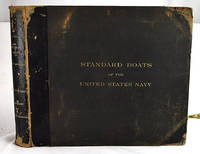
Govt. Print. Off. Washington 1900. First Edition. Hardcover. Good. Oblong folio 34 x 39 cm. 96 leaves frontispiece 222 plates. Bound in publisher's 1/4 leather over black boards. Hardcover. Good binding. Rubbing wear to cover edges. Clean unmarked pages. Equipment Office Boston Naval Yard stamps. This is an oversized or heavy book which requires additional postage for international delivery outside the US. Govt. Print. Off., Washington hardcover
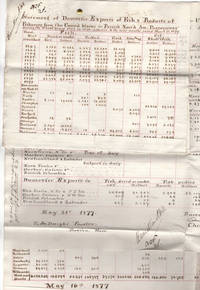
Washington. D.C. Bureau of Statistics. 1877. folio. 4 sheets clipped together: 23x 27cm/ 22x 27cm / 47x 39cm / 44x 59cm/ folded to : 30x 12cm on stiff vellum finished lined paper several blind-stamps "Aflred D. Foster Boston Mass - Notary Public Suffoak Co." two short tears along fold on the largest document black ink fine sgc. ~ Very detailed manuscripts from 1867 with entries each year to 1877 with type of fish and whale oil outlined in very neat handwriting. Addresses to the Hon. Dwight Forster with the blind-stamp of Alfred D. Forster Boston Mass . Notary Public Suffolk Co. Washington. D.C. Bureau of Statistics. 1877 unknown
Boston: D.P. Butler 1862. 16vo. 62pp 1 advts. 3 blank pp. Original brown cloth with gilt vignette of eagle and flags on front board light wear spine ends chipped binding lightly shaken. Lightly age toned Good. D.P. Butler unknown