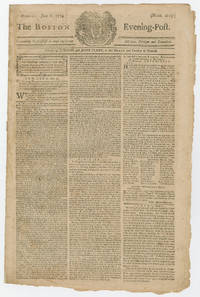
<p>Early report in the local Boston newspaper on implementation of Parliament's Boston Port Act the first of the Intolerable Acts and the reaction to it in Massachusetts and beyond. Taking effect on June 1 1774 rather than punishing individuals the Act besieged the entire city until the colonists paid for the tea destroyed in the Tea Party December 16 1773.</p><p>"<i>the Act of Parliament for blocking up the Port of Boston is now in all its Parts carrying into Execution with the greatest Severity many Vessels being already prevented from coming in and Fishing boats and other small Craft strictly search'd; so that we have reason to expect that in a little time this Town will be in a truly distressed and melancholy Situation.</i>" p3/c1</p> <b>BOSTON PORT ACT.</b>Newspaper. <i>The Boston Evening-Post</i> June 6 1774 No. 2019. Boston: Thomas and John Fleet. 4 pp. 9¾ x 15⅜ in.<p><br /></p><p>The majority of this paper is devoted to patriotic content. The front page features a series of Questions and Answers from New York "<i>being conceived in some measure calculated to advance the cause of freedom in the present critical situation of affairs.</i>" It goes on to note that "<i>A Congress of Deputies from the several Colonies is thought to be absolutely necessary to devise means of restoring harmony between Great Britain and the Colonies and prevent matters from com</i>ing <i>to extremities</i>" p1/c1-2.</p><p>"<i>A Friend to Mankind</i>" wrote to the publishers "<i>When I first read the barbarous Act for shutting up the port of Boston; an act made with the pious design to starve the poor; make the industrious idle; the happy miserable; and as an entering wedge to the horrid purpose of enslaving America although I was transported beyond measure I could not help reflecting that bitter as it was for the present it would absolutely be of happy tendency to America in the result.</i>" p2/c1.</p><p>This issue prints a May 25 address from 33 Marblehead loyalists congratulating Massachusetts Gov. Thomas Hutchinson on his administration and wishing him a safe return trip to Great Britain p1/c3. On the other hand a public meeting in Marblehead denounced the address and declared Hutchinson "<i>an inveterate Enemy to the Liberties of the Province</i>" p2/c3.</p><p>This issue also announces from Boston "<i>the Corporation of <b>Harvard College</b>have voted that considering the present dark Aspect of our public Affairs—There be no public Commencement this Year—and that the Candidates for the first and second Degrees shall receive their Degrees in a general Diploma</i>" p3/c1. On May 1 1775 less than two weeks after the Battles of Lexington and Concord the faculty of Harvard dismissed the undergraduates early for the summer vacation again without a public commencement. Classes did not resume until October in Concord twenty miles away where students boarded with local residents and college courses were held in a deserted grammar school the courthouse and the First Parish meetinghouse. Meanwhile the five buildings of the college's campus in Cambridge housed 1600 American soldiers. After the British surrendered Boston in March 1776 and the American troops moved south to defend New York the college was permitted to reoccupy its buildings in June. Of 190 freshmen entering between 1775 and 1778 only 30 left prior to graduation.</p><p>An advertisement is included for a just-published pamphlet <i>Observations on the Act of Parliament commonly called the Boston Port Bill with Thoughts on Civil Society and Standing Armies</i>p2/c1. From September 1774 to March 1775 Josiah Quincy II 1744-1775 was in England arguing the American cause to sympathetic British politicians. He died of tuberculosis on the return voyage within sight of Massachusetts.</p><p><b>Historic Background</b></p><p>Relief for Boston was sent from as far away as South Carolina and the First Continental Congress convened in Philadelphia three months later to coordinate a colonial response to the Intolerable Acts.</p><p>Parliament finally repealed the Boston Port Act in 1783 after fighting ceased in the American Revolutionary War but before the Treaty of Paris officially ended the war and recognized American independence.</p><p><b>Condition</b></p><p>Near fine; several professional mends to gutter margin. A bright and attractive issue of an important colonial newspaper.</p> Thomas and John Fleet books

 ?????????
 ?????PDF???
 RSS feed
 ??
??