|
Marinus Simon Baljon, Johannes
Encyclopedie der Christelijke Theologie
hardcover. Good. Access codes and supplements are not guaranteed with used items. May be an ex-library book. hardcover
Référence libraire : 1020889829.G ISBN : 1020889829 9781020889820

|
|
|
Mario SIMON - Andre-Edouard WOODRUFF - Paul POIRET
Croquis de mode : Croquis de mode d'été par Mario Simon Croquis La Gazette du Bon ton 1920 n°3. - Les modes en l'an de grâce Mil neuf cent vingt un Croquis La Gazette du Bon ton 1921 n°3 - Pour la Riviera. Robes garnies de fleurs naturelles dans la mesure où l'on en a et où l'on ne préfère pas d'employer moins coûteuses les fleurs artificielles Croquis La Gazette du Bon ton 1921 n°10. - Costumes tailleur de fantaisie ornés de colifichets Croquis La Gazette du Bon ton 1922 n°4. - Fashion sketches: Summer fashion sketches by Mario Simon Sketches La Gazette du Bon ton 1920 no. 3. Fashions in the Year of Grace Nineteen Twenty-One Sketches La Gazette du Bon ton 1921 no. 3. For the Riviera. Dresses trimmed with
Paris: Lucien Vogel éditeur 1920. Fine. Lucien Vogel éditeur Paris 1920-1922 18 x 24 cm relié FASHION POIRET Paul & WORTH Charles Frederick & BEER & DOEUILLET Georges & LANVIN Jeanne & SIMON Mario & WOODRUFF André-Edouard. Croquis de mode Lucien Vogel éditeur Paris 1920-1922 18 x 24 cm bound Set of 24 original lithographs in color on vergé paper: Croquis de mode d'été par Mario Simon Croquis La Gazette du Bon ton 1920 n° 3. Les modes en l'an de grâce Mil neuf cent vingt un Croquis La Gazette du Bon ton 1921 n° 3 Pour la Riviera. Robes garnies de fleurs naturelles dans la mesure où l'on en a et où l'on ne préfère pas d'employer moins coûteuses les fleurs artificielles Croquis La Gazette du Bon ton 1921 n° 10. Costumes tailleur de fantaisie ornés de colifichets Croquis La Gazette du Bon ton 1922 n° 4. Original prints used to illustrate the Gazette du Bon ton one of the most attractive and influential 20th century fashion magazines featuring the talents of French artists and other contributors from the burgeoning Art Deco movement. A celebrated fashion magazine established in 1912 by Lucien Vogel la Gazette du Bon ton appeared until 1925 with a hiatus from 1915 to 1920 due to the war the editor-in-chief having been called up for service. It consisted of 69 issues printed in only 2000 copies each and notably illustrated with 573 color plates and 148 sketches of the models of the great designers. Right from the start this sumptuous publication was aimed at bibliophiles and fashionable society Françoise Tétart-Vittu La Gazette du Bon ton in Dictionnaire de la mode 2016 and was printed on fine vergé paper using a type cut specially for the magazine by Georges Peignot known as Cochin later used in 1946 by Christian Dior. The prints were made using stencils heightened in colors some highlightened in gold or palladium. The story began in 1912 when Lucien Vogel a man of the world involved in fashion he had already been part of the fashion magazine Femina decided with his wife Cosette de Brunhoff the sister of Jean creator of Babar to set up the Gazette du Bon ton subtitled at the time: Art fashion frivolities. Georges Charensol noted the reasoning of the editor-in-chief: In 1910' he observed there was no really artistic fashion magazine nothing representative of the spirit of the time. My dream was therefore to make a luxury magazine with truly modern artists
I was assured of success because when it comes to fashion no country on earth can compete with France. Un grand éditeur d'art. Lucien Vogel in Les Nouvelles littéraires n° 133 May 1925. The magazine was immediately successful not only in France but also in the United States and Latin America. At first Vogel put together a team of seven artists: André-Édouard Marty and Pierre Brissaud followed by Georges Lepape and Dammicourt as well as eventually his friends from school and the School of Fine Arts like George Barbier Bernard Boutet de Monvel and Charles Martin. Other talented people soon came flocking to join the team: Guy Arnoux Léon Bakst Benito Boutet de Monvel Umberto Brunelleschi Chas Laborde Jean-Gabriel Domergue Raoul Dufy Édouard Halouze Alexandre Iacovleff Jean Émile Laboureur Charles Loupot Chalres Martin Maggie Salcedo. These artist mostly unknown when Lucien Vogel sought them out later became emblematic and sought-after artistic figures. It was also they who worked on the advertising drawings for the Gazette. The plates put the spotlight on and celebrate dresses by seven designers of the age: Lanvin Doeuillet Paquin Poiret Worth Vionnet and Doucet. The designers provided exclusive models for each issue. Nonetheless some of the illustrations are not based on real models but simply on the illustrator's conception of the fashion of the day. The Gazette du Bon ton was an important step in the history of fashion. Combining aesthetic demands with the physical whole it brought toge Lucien Vogel éditeur unknown
Référence libraire : 55409

|
|
|
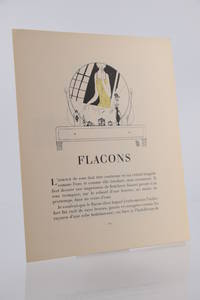
Mario SIMON - Marcel ASTRUC
La Citröen et les sports - L'aviation 10 HP. Torpédo-sports La Gazette du Bon ton 1922 n°10
Paris: Lucien Vogel éditeur 1922. Fine. Lucien Vogel éditeur Paris 1922 19.50 x 24.50 cm une feuille Text ""Flacons"" on double page by Marcel Astruc illustrated with five original colored drawings in the text by Mario Simon. Original print by Mario Simon on the last page of the double sheet. La Gazette du bon ton one of the most beautiful and influential fashion magazines of the 20th century celebrating the talent of French creators and artists at the height of the Art Deco movement. Famous fashion magazine founded in 1912 by Lucien Vogel La Gazette du bon ton was published until 1925 with an interruption during the War from 1915 to 1920 due to the mobilization of its editor-in-chief. It consists of 69 issues printed in only 2000 copies and is illustrated notably with 573 color plates and 148 sketches representing models by great couturiers. From their publication these luxurious publications ""were aimed at bibliophiles and worldly aesthetes"" Françoise Tétart-Vittu ""La Gazette du bon ton"" in Dictionnaire de la mode 2016. Printed on fine laid paper they use a typeface specially created for the magazine by Georges Peignot the Cochin character adopted in 1946 by Christian Dior. The prints are created using the metal stencil technique heightened in colors and some outlined in gold or palladium. The adventure begins in 1912 when Lucien Vogel a man of the world and fashion - he had already participated in the magazine Femina - decides to found with his wife Cosette de Brunhoff sister of Jean the father of Babar the Gazette du bon ton whose subtitle was then ""Art modes et frivolités"". Georges Charensol reports the words of the editor-in-chief: ""In 1910 he observes there existed no fashion journal that was truly artistic and representative of the spirit of its time. I therefore thought of creating a luxury magazine with truly modern artists . I was certain of success because for fashion no country can rival France."" ""Un grand éditeur d'art. Lucien Vogel"" in Les Nouvelles littéraires n°133 May 1925. The success of the magazine is immediate not only in France but also in the United States and South America. Originally Vogel thus brings together a group of seven artists: André-Édouard Marty and Pierre Brissaud followed by Georges Lepape and Dammicourt; and finally his friends from the École des beaux-arts who are George Barbier Bernard Boutet de Monvel or Charles Martin. Other talents quickly come to join the team: Guy Arnoux Léon Bakst Benito Boutet de Monvel Umberto Brunelleschi Chas Laborde Jean-Gabriel Domergue Raoul Dufy Édouard Halouze Alexandre Iacovleff Jean Émile Laboureur Charles Loupot Charles Martin Maggie Salcedo. These artists mostly unknown when Lucien Vogel calls upon them will subsequently become emblematic and sought-after artistic figures. These same illustrators create the drawings for the Gazette's advertisements. The plates highlight and sublimate the dresses of seven creators of the period: Lanvin Doeuillet Paquin Poiret Worth Vionnet and Doucet. The couturiers provide exclusive models for each issue. Nevertheless some of the illustrations feature no real model but only the illustrator's idea of contemporary fashion. La Gazette du bon ton is a decisive step in the history of fashion. Combining aesthetic demand and plastic unity it brings together for the first time the great talents of the world of arts letters and fashion and imposes through this alchemy a completely new image of woman slender independent and audacious also carried by the new generation of couturiers Coco Chanel Jean Patou Marcel Rochas. Taken over in 1920 by Condé Montrose Nast the Gazette du bon ton would largely inspire the new composition and aesthetic choices of the ""dying little journal"" that Nast had bought a few years earlier: Vogue magazine. Lucien Vogel éditeur unknown
Référence libraire : 84837
|
|
|
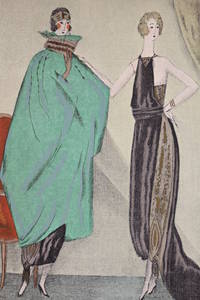
Mario SIMON - (Gustave BEER)
Les Deux Soeurs. Manteau et robe pour le soir de Beer pl.54 La Gazette du Bon ton 1920 n°7
Paris: Lucien Vogel éditeur 1920. Fine. Lucien Vogel éditeur Paris Septembre 1920 18 x 24 cm une feuille Original color print printed on vergé paper signed in the plate. An original print used to illustrate the Gazette du bon ton one of the most attractive and influential 20th century fashion magazines featuring the talents of French artists and other contributors from the burgeoning Art Deco movement. A celebrated fashion magazine established in 1912 by Lucien Vogel La Gazette du bon ton appeared until 1925 with a hiatus from 1915 to 1920 due to the war the editor-in-chief having been called up for service. It consisted of 69 issues printed in only 2000 copies each and notably illustrated with 573 color plates and 148 sketches of the models of the great designers. Right from the start this sumptuous publication was aimed at bibliophiles and fashionable society Françoise Tétart-Vittu La Gazette du bon ton in Dictionnaire de la mode 2016 and was printed on fine vergé paper using a type cut specially for the magazine by Georges Peignot known as Cochin later used in 1946 by Christian Dior. The prints were made using stencils heightened in colors some highlighted in gold or palladium. The story began in 1912 when Lucien Vogel a man of the world involved in fashion he had already been part of the fashion magazine Femina decided with his wife Cosette de Brunhoff the sister of Jean creator of Babar to set up the Gazette du bon ton subtitled at the time: Art fashion frivolities. Georges Charensol noted the reasoning of the editor-in-chief: In 1910 he observed there was no really artistic fashion magazine nothing representative of the spirit of the time. My dream was therefore to make a luxury magazine with truly modern artists
I was assured of success because when it comes to fashion no country on earth can compete with France. Un grand éditeur dart. Lucien Vogel in Les Nouvelles littéraires no. 133 May 1925. The magazine was immediately successful not only in France but also in the United States and Latin America. At first Vogel put together a team of seven artists: André-Édouard Marty and Pierre Brissaud followed by Georges Lepape and Dammicourt as well as eventually his friends from school and the School of Fine Arts like George Barbier Bernard Boutet de Monvel and Charles Martin. Other talented people soon came flocking to join the team: Guy Arnoux Léon Bakst Benito Boutet de Monvel Umberto Brunelleschi Chas Laborde Jean-Gabriel Domergue Raoul Dufy Édouard Halouze Alexandre Iacovleff Jean Émile Laboureur Charles Loupot Chalres Martin Maggie Salcedo. These artist mostly unknown when Lucien Vogel sought them out later became emblematic and sought-after artistic figures. It was also they who worked on the advertising drawings for the Gazette. The plates put the spotlight on and celebrate dresses by seven designers of the age: Lanvin Doeuillet Paquin Poiret Worth Vionnet and Doucet. The designers provided exclusive models for each issue. Nonetheless some of the illustrations are not based on real models but simply on the illustrators conception of the fashion of the day. The Gazette du bon ton was an important step in the history of fashion. Combining aesthetic demands with the physical whole it brought together for the first time the great talents of the artistic literary and fashion worlds; and imposed through this alchemy a completely new image of women: slender independent and daring which was shared by the new generation of designers including Coco Chanel Jean Patou Marcel Rochas and so on
Taken over in 1920 by Condé Montrose Nast the Gazette du bon ton was an important influence on the new layout and aesthetics of that little dying paper that Nast had bought a few years earlier: Vogue. Lucien Vogel éditeur unknown
Référence libraire : 54796
|
|
|
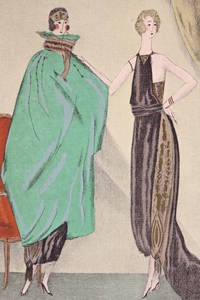
Mario SIMON - (Gustave BEER)
Les Deux Soeurs. Manteau et robe pour le soir de Beer pl.54 La Gazette du Bon ton 1920 n°7
Paris: Lucien Vogel éditeur 1920. Fine. Lucien Vogel éditeur Paris Septembre 1920 18 x 24 cm une feuille original print in color printed on laid paper signed enhaut left of the board. Original content produced for the illustration of The Gazette fashionable one of the finest and most influential twentieth century fashion magazines celebrating the talent of creators and artists French burgeoning art deco. Famous fashion magazine founded in 1912 by Lucien Vogel The Gazette fashionable appeared until 1925 with an interruption during the War of 1915 to 1920 due to mobilization of its editor. She is 69 Deliveries from just 2000 copies and is illustrated including 573 color plates and 148 sketches depicting models of fashion designers. Upon publication these luxury publications ""are for bibliophiles and worldly aesthetes"" Françoise Tétart-Vittu ""good Gazette of tone"" in the fashion dictionary 2016. Printed on fine laid paper they use a typeface created specifically for the magazine by Georges Peignot the Cochin character taken in 1946 by Christian Dior. The prints are made with the technique of metal stencil enhanced color and some outlined in gold or palladium. The adventure began in 1912 when Lucien Vogel man of the world and fashion - it has already participated in Femina magazine - decided to found with his wife Cosette de Brunhoff John's sister the father of Babar Gazette good tone in which the subtitle is then ""Art fashions and frivolities."" Georges Charensol quotes the editor: ""In 1910 he observed there was no truly artistic fashion magazine and representative of the spirit of his time. So I thought of making a glossy magazine with truly modern artists . I was certain of success because no country for fashion can compete with France. """" A great art editor. Lucien Vogel ""in Literary News No. 133 May 1925. The success of the magazine is immediate not only in France but also the US and South America. Originally Vogel therefore brings together a group of seven artists: André-Édouard Marty and Pierre Brissaud followed by Georges Lepape and Dammicourt; and finally his friends from the School of Fine Arts as are George Barbier Bernard Boutet de Monvel or Charles Martin. Other talents come quickly reach the equipped Guy Arnoux Léon Bakst Benito Boutet de Monvel Umberto Brunelleschi Chas Laborde Jean-Gabriel Domergue Raoul Dufy Edward Halouze Alexander Iacovleff Jean Emile Laboureur Charles Loupot Charles Martin Maggie Salcedo. These artists mostly unknown when Lucien Vogel appealed to them will eventually become iconic figures and artistic sought. These are the same illustrators who make the drawings advertisements Gazette. The boards highlight the dresses and sublime seven artists of the time: Lanvin Doeuillet Paquin Poiret Worth Vionnet and Doucet. The designers provide for each number of exclusive models. Nevertheless some of Illustrations contained no real model but only the idea that the illustrator is done in the fashion of the day. Gazette fashionable is a milestone in the history of fashion. Combining the aesthetic requirement and plastic unit it brings together for the first time the great talents of the world of arts literature and fashion and imposed by this alchemy a new image of women slender independent and bold also driven by the new generation of designers Coco Chanel Jean Patou Rochas Marcel . Recovery in 1920 by Condé Montrose Nast Gazette fashionable modeled for the new composition and the aesthetic choices of the ""little dying newspaper"" that Nast had bought a few years ago: the Vogue magazine. Lucien Vogel éditeur hardcover
Référence libraire : 57572
|
|
|
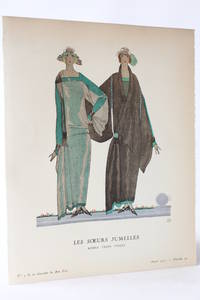
Mario SIMON
Les Soeurs jumelles. Robes trois voiles pl.34 La Gazette du Bon ton 1922 n°5
Paris: Lucien Vogel éditeur 1922. Fine. Lucien Vogel éditeur Paris 1922 18 x 24 cm une feuille Original color print printed on vergé paper signed in the plate. An original print used to illustrate the Gazette du bon ton one of the most attractive and influential 20th century fashion magazines featuring the talents of French artists and other contributors from the burgeoning Art Deco movement. A celebrated fashion magazine established in 1912 by Lucien Vogel La Gazette du bon ton appeared until 1925 with a hiatus from 1915 to 1920 due to the war the editor-in-chief having been called up for service. It consisted of 69 issues printed in only 2000 copies each and notably illustrated with 573 color plates and 148 sketches of the models of the great designers. Right from the start this sumptuous publication was aimed at bibliophiles and fashionable society Françoise Tétart-Vittu La Gazette du bon ton in Dictionnaire de la mode 2016 and was printed on fine vergé paper using a type cut specially for the magazine by Georges Peignot known as Cochin later used in 1946 by Christian Dior. The prints were made using stencils heightened in colors some highlighted in gold or palladium. The story began in 1912 when Lucien Vogel a man of the world involved in fashion he had already been part of the fashion magazine Femina decided with his wife Cosette de Brunhoff the sister of Jean creator of Babar to set up the Gazette du bon ton subtitled at the time: Art fashion frivolities. Georges Charensol noted the reasoning of the editor-in-chief: In 1910 he observed there was no really artistic fashion magazine nothing representative of the spirit of the time. My dream was therefore to make a luxury magazine with truly modern artists
I was assured of success because when it comes to fashion no country on earth can compete with France. Un grand éditeur dart. Lucien Vogel in Les Nouvelles littéraires no. 133 May 1925. The magazine was immediately successful not only in France but also in the United States and Latin America. At first Vogel put together a team of seven artists: André-Édouard Marty and Pierre Brissaud followed by Georges Lepape and Dammicourt as well as eventually his friends from school and the School of Fine Arts like George Barbier Bernard Boutet de Monvel and Charles Martin. Other talented people soon came flocking to join the team: Guy Arnoux Léon Bakst Benito Boutet de Monvel Umberto Brunelleschi Chas Laborde Jean-Gabriel Domergue Raoul Dufy Édouard Halouze Alexandre Iacovleff Jean Émile Laboureur Charles Loupot Chalres Martin Maggie Salcedo. These artist mostly unknown when Lucien Vogel sought them out later became emblematic and sought-after artistic figures. It was also they who worked on the advertising drawings for the Gazette. The plates put the spotlight on and celebrate dresses by seven designers of the age: Lanvin Doeuillet Paquin Poiret Worth Vionnet and Doucet. The designers provided exclusive models for each issue. Nonetheless some of the illustrations are not based on real models but simply on the illustrators conception of the fashion of the day. The Gazette du bon ton was an important step in the history of fashion. Combining aesthetic demands with the physical whole it brought together for the first time the great talents of the artistic literary and fashion worlds; and imposed through this alchemy a completely new image of women: slender independent and daring which was shared by the new generation of designers including Coco Chanel Jean Patou Marcel Rochas and so on
Taken over in 1920 by Condé Montrose Nast the Gazette du bon ton was an important influence on the new layout and aesthetics of that little dying paper that Nast had bought a few years earlier: Vogue. Lucien Vogel éditeur unknown
Référence libraire : 54988
|
|
|
Mario SIMON - (Paul POIRET)
Mirage. Robe du soir de Paul Poiret pl.31 La Gazette du Bon ton 1920 n°4
Paris: Lucien Vogel éditeur 1920. Fine. Lucien Vogel éditeur Paris Mai 1920 18 x 24 cm une feuille Original color print heightened with palladium printed on vergé paper signed in plate. An original print used to illustrate the Gazette du bon ton one of the most attractive and influential 20th century fashion magazines featuring the talents of French artists and other contributors from the burgeoning Art Deco movement. A celebrated fashion magazine established in 1912 by Lucien Vogel La Gazette du bon ton appeared until 1925 with a hiatus from 1915 to 1920 due to the war the editor-in-chief having been called up for service. It consisted of 69 issues printed in only 2000 copies each and notably illustrated with 573 color plates and 148 sketches of the models of the great designers. Right from the start this sumptuous publication was aimed at bibliophiles and fashionable society Françoise Tétart-Vittu La Gazette du bon ton in Dictionnaire de la mode 2016 and was printed on fine vergé paper using a type cut specially for the magazine by Georges Peignot known as Cochin later used in 1946 by Christian Dior. The prints were made using stencils heightened in colors some highlighted in gold or palladium. The story began in 1912 when Lucien Vogel a man of the world involved in fashion he had already been part of the fashion magazine Femina decided with his wife Cosette de Brunhoff the sister of Jean creator of Babar to set up the Gazette du bon ton subtitled at the time: Art fashion frivolities. Georges Charensol noted the reasoning of the editor-in-chief: In 1910 he observed there was no really artistic fashion magazine nothing representative of the spirit of the time. My dream was therefore to make a luxury magazine with truly modern artists
I was assured of success because when it comes to fashion no country on earth can compete with France. Un grand éditeur dart. Lucien Vogel in Les Nouvelles littéraires no. 133 May 1925. The magazine was immediately successful not only in France but also in the United States and Latin America. At first Vogel put together a team of seven artists: André-Édouard Marty and Pierre Brissaud followed by Georges Lepape and Dammicourt as well as eventually his friends from school and the School of Fine Arts like George Barbier Bernard Boutet de Monvel and Charles Martin. Other talented people soon came flocking to join the team: Guy Arnoux Léon Bakst Benito Boutet de Monvel Umberto Brunelleschi Chas Laborde Jean-Gabriel Domergue Raoul Dufy Édouard Halouze Alexandre Iacovleff Jean Émile Laboureur Charles Loupot Chalres Martin Maggie Salcedo. These artist mostly unknown when Lucien Vogel sought them out later became emblematic and sought-after artistic figures. It was also they who worked on the advertising drawings for the Gazette. The plates put the spotlight on and celebrate dresses by seven designers of the age: Lanvin Doeuillet Paquin Poiret Worth Vionnet and Doucet. The designers provided exclusive models for each issue. Nonetheless some of the illustrations are not based on real models but simply on the illustrators conception of the fashion of the day. The Gazette du bon ton was an important step in the history of fashion. Combining aesthetic demands with the physical whole it brought together for the first time the great talents of the artistic literary and fashion worlds; and imposed through this alchemy a completely new image of women: slender independent and daring which was shared by the new generation of designers including Coco Chanel Jean Patou Marcel Rochas and so on
Taken over in 1920 by Condé Montrose Nast the Gazette du bon ton was an important influence on the new layout and aesthetics of that little dying paper that Nast had bought a few years earlier: Vogue. Lucien Vogel éditeur unknown
Référence libraire : 54770
|
|
|
Mario SIMON
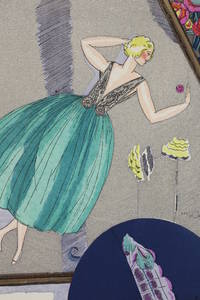
Les Deux Soeurs. Manteau et robe pour le soir, de Beer (pl.54, La Gazette du Bon ton, 1920 n°7)
Lucien Vogel éditeur | Paris Septembre 1920 | 18 x 24 cm | une feuille
Référence libraire : 54796
|
|
|
Mario SIMON
Les Deux Soeurs. Manteau et robe pour le soir, de Beer (pl.54, La Gazette du Bon ton, 1920 n°7)
Lucien Vogel éditeur | Paris Septembre 1920 | 18 x 24 cm | une feuille
Référence libraire : 57572
|
|
|
Mario SIMON
Les Soeurs jumelles. Robes trois voiles (pl.34, La Gazette du Bon ton, 1922 n°5)
Lucien Vogel éditeur | Paris 1922 | 18 x 24 cm | une feuille
Référence libraire : 54988
|
|
|
Mario SIMON
Mirage. Robe du soir, de Paul Poiret (pl.31, La Gazette du Bon ton, 1920 n°4)
Lucien Vogel éditeur | Paris Mai 1920 | 18 x 24 cm | une feuille
Référence libraire : 54770
|
|
|
Mario SIMON - André-Edouard WOODRUFF - Paul POIRET
Croquis de mode : Croquis de mode d'été par Mario Simon (Croquis, La Gazette du Bon ton, 1920 n°3). - Les modes en l'an de grâce Mil neuf cent vingt un (Croquis, La Gazette du Bon ton, 1921 n°3) - Pour la Riviera. Robes garnies de fleurs naturelles, dans la mesure où l'on en a et où l'on ne préfère pas d'employer, moins coûteuses, les fleurs artificielles (Croquis, La Gazette du Bon ton, 1921 n°10). - Costumes tailleur de fantaisie ornés de colifichets (Croquis, La Gazette du Bon ton, 1922 n°4). -
Lucien Vogel éditeur | Paris 1920-1922 | 18 x 24 cm | relié
Référence libraire : 55409
|
|
|
Mario SIMON - Marcel ASTRUC
La Citröen et les sports - L'aviation 10 HP. Torpédo-sports (La Gazette du Bon ton, 1922 n°10)
Lucien Vogel éditeur | Paris 1922 | 19.50 x 24.50 cm | une feuille
Référence libraire : 84837
|
|
|
Mariot-Didieux, Simon
Le chasseur médecin ou Traité complet sur les maladies du chien. 3e édition French Edition
paperback. Good. Access codes and supplements are not guaranteed with used items. May be an ex-library book. paperback
Référence libraire : 2329264852.G ISBN : 2329264852 9782329264851

|
|
|
Maris, Simon
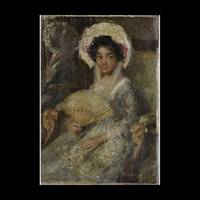
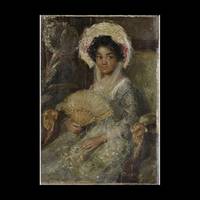
Young woman with fan Photo Rag 308 A2
Contentum Ltd. Loose sheet. New. High-quality art print based on an original work from the Rijksmuseum. Created in the 20th century 1906. Professionally printed on premium fine-art paper Photo Rag 308 in size A2. The artwork is printed with a white border museum-style presentation. Contentum Ltd. unknown
Référence libraire : 3595848
|
|
|
Maris, Simon
Young woman with fan Museum Etching Museum Quality A2
Contentum Ltd. Loose sheet. New. High-quality art print based on an original work from the Rijksmuseum. Created in the 20th century 1906. Professionally printed on premium fine-art paper Museum Etching museum quality in size A2. The artwork is printed with a white border museum-style presentation. Contentum Ltd. unknown
Référence libraire : 3595850
|
|
|
Maris, Simon
Young woman with fan Photo Rag Bright White Premium Quality A2
Contentum Ltd. Loose sheet. New. High-quality art print based on an original work from the Rijksmuseum. Created in the 20th century 1906. Professionally printed on premium fine-art paper Photo Rag Bright White premium quality in size A2. The artwork is printed with a white border museum-style presentation. Contentum Ltd. unknown
Référence libraire : 3595849
|
|
|
Maris, Simon
Young woman with fan Museum Etching Museum Quality A3
Contentum Ltd. Loose sheet. New. High-quality art print based on an original work from the Rijksmuseum. Created in the 20th century 1906. Professionally printed on premium fine-art paper Museum Etching museum quality in size A3. The artwork is printed with a white border museum-style presentation. Contentum Ltd. unknown
Référence libraire : 3595847
|
|
|
MARIUS Simon 1573 1624 ZINNER Ernst 1886 1970.
"Zur Ehrenrettung des Simon Marius."
Offprint from:: Vierteljahrsschrift der Astronomischen Gesellschaft 1942. 1942. 77. Jahrgang. I. Heft. . . 8vo. 53 pp. Embossed library stamp on front cover with a few additional markings. Printed wrappers; spine rubbed. Very good. RARE. "Simon Marius latinized from German Simon Mayr January 10 1573 – December 26 1624 was a German astronomer. He was born in Gunzenhausen near Nuremberg but he spent most of his life in the city of Ansbach." Wikipedia. Vierteljahrsschrift der Astronomischen Gesellschaft, 1942. unknown books
Référence libraire : Z1923
|
|
|
Marius U. - Simon Lambert - Henri U.
Partition de la chanson : J'ai la dingue Marius U. le transformatiste Extra Rapide
Partitions sur la Santé et médecine La renaissance Musicale 1920
Référence libraire : 97592

|
|
|
Marjot, Thomas (Editor) / McGregor, Colleen (Editor) / Ambrose, Tim (Editor) / Travis, Simon (Consultant Editor) / Cobbold, Jere
Best of Five MCQS for the European Specialty Examination in Gastroenterology and Hepatology Oxford Higher Specialty Training
Oxford University Press 2021. Paperback. New. 2nd edition. 384 pages. 6.10x9.20x0.90 inches. Oxford University Press paperback
Référence libraire : __0198834373 ISBN : 0198834373 9780198834373

|
|
|
Marjot, Thomas (Editor) / McGregor, Colleen (Editor) / Ambrose, Tim (Editor) / Travis, Simon (Consultant Editor) / Cobbold, Jere
Best of Five MCQS for the European Specialty Examination in Gastroenterology and Hepatology Oxford Higher Specialty Training
Oxford University Press 2021. Paperback. New. 2nd edition. 384 pages. 6.10x9.20x0.90 inches. Oxford University Press paperback
Référence libraire : 2-0198834373 ISBN : 0198834373 9780198834373
|
|
|
Mark A Simon
Living to the Praise of God's Glory
Hardback. New. hardcover
Référence libraire : A9781725299672 ISBN : 1725299674 9781725299672

|
|
|
Mark A Simon
Living to the Praise of God's Glory
Hardcover. New. New Book; Fast Shipping from UK; Not signed; Not First Edition; The letter to the Ephesians is missional to its core. It effectively exhorts its readers to understand support and participate in God's mission to rescue humanity and all creation from the damage and distortion of sin and so bring ab hardcover
Référence libraire : ria9781725299672_inp ISBN : 1725299674 9781725299672

|
|
|
Mark A Simon
Living to the Praise of God's Glory
Hardback. New. hardcover
Référence libraire : B9781725299672 ISBN : 1725299674 9781725299672

|
|
|
Mark Armstrong/ Simon Cowan/ John Vickers
Regulatory Reform – Economic Analysis & British Experience Paper
Mit Pr 1994. Paperback. New. 406 pages. 8.75x6.00x0.75 inches. Mit Pr paperback
Référence libraire : 2-0262510790 ISBN : 0262510790 9780262510790
|
|
|
Mark AS Blackburn, David N Dumville, James Booth, Michael Bonser, Michael David Metcalf, Paul Bibire, Simon D Keynes, Thomas Cha
Kings Currency and Alliances: History and Coinage of Southern England in the Ninth Century Studies in Anglo-Saxon History 9
Boydell Press 1998. New/New. <p><strong>Author:</strong> Mark A.S. Blackburn David N. Dumville James Booth Michael Bonser Michael David Metcalf Paul Bibire Simon D Keynes Thomas Charles-Edwards</p><p><strong>Publisher:</strong> Boydell Press</p><p><strong>ISBN:</strong> 9780851155982</p><p><strong>Release Date:</strong> 1998</p><p><strong>Languages:</strong> English</p><p><strong>Binding:</strong> Hardcover</p><p><strong>Number Of Pages:</strong> 282</p><p><strong>Details:</strong> This book is from H. E. Manville’s library. Harry Manville worked for the US Diplomatic service. His collection was dedicated to the Coinage of the British Isles. In the late 1970’s he found himself based in Washington and he retired in early 1980. In mid-1970s he wrote the Encyclopaedia of British Numismatics. From 1986 through to 2014 five volumes were published. He had one of the most remarkable numismatic libraries dedicated to the coinages of England Scotland Ireland and UK. Douglas Saville decided to sell this collection. Some items are highly values in monetary terms but others fell within the budgets of even the most modest of individuals and are not only highly interesting but are also rarely offered. Some 30 buyers including institutions as well as private individuals have purchased books from the library Ancient Art is one of them. Editorial Reviews About the Author MARK BLACKBURN is Keeper of Coins and Medals at the Fitzwilliam Museum Cambridge; DAVID DUMVILLE is Professor of Palaeography and Cultural History in the University of Cambridge and a Fellow of Girton College.</p> Boydell Press hardcover
Référence libraire : 0851155987 ISBN : 0851155987 9780851155982

|
|
|
Mark Bryant, Simon Heneage,
Dictionary Of British Cartoonists and Caricaturists
new. unknown
Référence libraire : 43663261-n ISBN : 1032194944 9781032194943

|
|
|
Mark Bryant, Simon Heneage,
Dictionary Of British Cartoonists and Caricaturists
like new. unknown
Référence libraire : 43663261 ISBN : 1032194944 9781032194943
|
|
|
Mark Bryant, Simon Heneage
Dictionary of British Cartoonists and Caricaturists 1730-1980
Scolar Press 1994. Soft Cover. Fine. Volume: 1 Scolar Press paperback
Référence libraire : 2091202133205910
|
|
|
Mark Elmslie/ Simon Portman
Intellectual Property: The Lifeblood of Your Company
Chandos Pub 2006. Paperback. New. 164 pages. 8.75x5.75x0.25 inches. Chandos Pub paperback
Référence libraire : 2-1843341352 ISBN : 1843341352 9781843341352

|
|
|
Mark Garnett/Simon Mabon/Robert Smith
British Foreign Policy since 1945
USA Edition . New. Brand New! Fast Delivery US Edition and ship within 24-48 hours. Deliver by FedEx and Dhl & Aramex UPS & USPS and we do accept APO and PO BOX Addresses. Order can be delivered worldwide within 6-10 days and we do have flat rate for up to 2LB. Extra shipping charges will be requested if the Book weight is more than 5 LB. This Item May be shipped from India United states & United Kingdom. Depending on your location and availability. unknown
Référence libraire : AT 9781138821293 ISBN : 1138821292 9781138821293

|
|
|
Mark Garnett; Simon Mabon
British Foreign Policy since 1945
Routledge 2018. Paperback. New. Routledge paperback
Référence libraire : Atlantic-9781138821293 ISBN : 1138821292 9781138821293
|
|
|
Mark Garnett; Simon Mabon
British Foreign Policy since 1945
Routledge 2018. Paperback. New. Routledge paperback
Référence libraire : Atlantic-9781138821293 ISBN : 1138821292 9781138821293
|
|
|
Mark Hansom
Sorcerer's Chessmen
hardcover. Good. Access codes and supplements are not guaranteed with used items. May be an ex-library book. hardcover
Référence libraire : 1605433438.G ISBN : 1605433438 9781605433431

|
|
|
Mark Hansom
The Beasts of Brahm
Midnight House hardcover Midnight House 2001 A reprint of a classic novel of 1940 that blended the whodunnit and horror genres. One of 450 copies. No remainder mark not price-clipped not bumped. Comes in a Brodart protective cover. All books are bubble-wrapped and placed in a sturdy shipping box when mailed. Tracking number supplied on domestic orders.
Référence libraire : 001461 ISBN : 0970734921 9780970734921

|
|
|
Mark J Edwards, Martin Goodman, Simon Price, Chris Rowland
Apologetics in the Roman Empire: Pagans Jews and Christians
Clarendon Press 1999. New/New. <p><strong>Author:</strong> Mark J. Edwards Martin Goodman Simon Price Chris Rowland</p><p><strong>Publisher:</strong> Clarendon Press</p><p><strong>ISBN:</strong> 9780198269861</p><p><strong>Release Date:</strong> 1999</p><p><strong>Languages:</strong> English</p><p><strong>Binding:</strong> Hardcover</p><p><strong>Number Of Pages:</strong> 326</p><p><strong>Details:</strong> This book is a comprehensive survey of the dialogue between pagans Jews and Christians in the Roman empire up to the time when Constantine declared himself a Christian. Each chapter is written by a distinguished scholar and is devoted to a single text or group of texts with the aim of identifying the probable audience the literary milieu and the circumstances that led to this form of writing. About the Author Mark J. Edwards is at Christ Church College Oxford. Martin Goodman is at Wolfson College Oxford.</p> Clarendon Press hardcover
Référence libraire : 0198269862 ISBN : 0198269862 9780198269861

|
|
|
Mark Lawrence [Editor]; Mykola Pawluk [Editor]; Beryl Vertue [Producer]; Julian Meers [Producer]; Simon Nye [Writer];
Men Behaving Badly - Season 4 British TV Series
BBC Worldwide 2006-01-10. DVD. Like New. DVD plays perfectly & the case looks good. BBC Worldwide unknown
Référence libraire : 2138170925014
|
|
|
Mark Saunders Simon Gaisford
Essentials of Pharmaceutical Preformulation
John Wiley & Sons pp. 268 . Papeback. New. John Wiley & Sons unknown
Référence libraire : 645351498 ISBN : 0470976365 9780470976364

|
|
|
Mark Shepherd; Ellen Kushner; Lisa S Sliverthorne; Simon Sheppard; Robin Wayne Bailey; Jessica Amanda Salmonson; Don Bassingthwa
Bending the Landscape: Fantasy
White Wolf Publishing 1997-03-01. Hardcover. New. In shrink wrap. Looks like an interesting title! White Wolf Publishing hardcover
Référence libraire : Q-1565048369 ISBN : 1565048369 9781565048362

|
|
|
Mark Simon
An Introduction to PHP: Learn PHP 8 to Create Dynamic Websites
Paperback / softback. New. Beginning-Intermediate user level paperback
Référence libraire : B9798868801761 ISBN : 9798868801763 9798868801

|
|
|
Mark Simon
An Introduction to PHP : Learn PHP 8 to Create Dynamic Websites
Paperback. New. New Book; Fast Shipping from UK; Not signed; Not First Edition; Use PHP to enhance your web pages. This book shows you how PHP programming works and how to write and organize PHP code. The book starts with steps to download and install a setup for a sample website that will form the basis for upcom paperback
Référence libraire : ria9798868801761_inp ISBN : 9798868801763 9798868801

|
|
|
Mark Simon
Getting Started with SQL and Databases : Managing and Manipulating Data with SQL
Paperback. New. New Book; Fast Shipping from UK; Not signed; Not First Edition; Learn the basics of writing SQL scripts. Using Standard SQL as the starting point this book teaches writing SQL in various popular dialects including PostgreSQL MySQL/MariaDB Microsoft SQL Server Oracle and SQLite.The book starts paperback
Référence libraire : ria9781484294925_inp ISBN : 1484294920 9781484294925

|
|
|
Mark Simon
Getting Started with SQL and Databases : Managing and Manipulating Data with SQL
N/A. New. New Book; Fast Shipping from UK; Not signed; Not First Edition; N/A unknown
Référence libraire : ria9781484294949_inp ISBN : 1484294947 9781484294949

|
|
|
Mark Simon
Getting Started with SQL and Databases Mark Simon
Apress 2023. 2023. Softcover. Getting Started with SQL and Databases <br/><br/>Getting Started with SQL and Databases Mark Simon Apress paperback
Référence libraire : BN234089 ISBN : 1484294920 9781484294925

|
|
|
Mark Simon
JavaScript for Web Developers: Understanding the Basics
Paperback / softback. New. Beginning user level paperback
Référence libraire : A9781484297735 ISBN : 1484297733 9781484297735

|
|
|
Mark Simon
JavaScript for Web Developers : Understanding the Basics
Paperback. New. New Book; Fast Shipping from UK; Not signed; Not First Edition; Learn the basics of JavaScript to enhance your web pages. This book focuses on modern JavaScript programming and encourages a well-organized approach to programming in general. JavaScript for Web Developers explains each foundati paperback
Référence libraire : ria9781484297735_inp ISBN : 1484297733 9781484297735

|
|
|
Mark Simon
JavaScript for Web Developers: Understanding the Basics
Apress 2023. 1. Paperback. New. Apress paperback
Référence libraire : Atlantic-9781484297735 ISBN : 1484297733 9781484297735

|
|
|
Mark Simon
JavaScript for Web Developers: Understanding the Basics
Apress 2023. 1. Paperback. New. Apress paperback
Référence libraire : Atlantic-9781484297735 ISBN : 1484297733 9781484297735
|
|
|
Mark Simon
Leveling Up with SQL : Advanced Techniques for Transforming Data into Insights
Paperback. New. New Book; Fast Shipping from UK; Not signed; Not First Edition; Learn to write SQL queries to select and analyze data and improve your ability to manipulate data. This book will help you take your existing skills to the next level. Author Mark Simon kicks things off with a quick review of basic SQL paperback
Référence libraire : ria9781484296844_inp ISBN : 1484296842 9781484296844

|
|

 Recevoir par e-mail
 Télécharger en PDF
 Flux RSS
 Lien permanent


