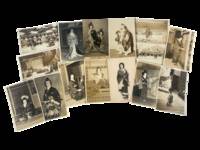
1910. Cross dressing Japan Kabuki Cross-dressing scenes and portraits of Onnagata actors photo archive Japan ca. 1910s-1920s documents the visual culture of Japanese theater at a pivotal moment when modern photographic media intersected with longstanding traditions of gendered performance. Produced during the TaishÅ and early ShÅwa periods these images preserve Kabuki's stylized theatrics and the centrality of onnagata male actors specializing in female roles to social constructions of femininity in Japan. Following the 1629 prohibition on women performing on the Kabuki stage male actors developed the onnagata tradition involving stringent rules of gesture comportment and dress which in turn informed the performance of gender beyond the theater.<br /> Collection of 15 original silver gelatin and collotype photographs Japan ca. 1910s-1920s. The photographs each measuring approximately 4 x 6 inches include both full-stage production scenes and studio portraits of celebrated performers in costume. Several bear Japanese captions and publisher imprints in the margins and some identify specific plays and characters including an example labeled "花ã®å¹‡é–“" Hana no Taiko. Performance images depict painted scenic backdrops including maritime settings elaborately dressed actors captured mid-scene and musicians seated as part of the nagauta ensemble while studio portraits center onnagata figures in heavy white oshiroi makeup elaborate coiffures and richly embroidered kimono. Iconic theatrical gestures such as the mie the climactic stylized pose are represented underscoring the physical vocabulary that defined Kabuki theater. These photographs reflect the ways in which social concepts of femininity informed Kabuki performance and how Kabuki conversely informed societal gender presentation. Such material illuminates the role of onnagata in shaping and exporting images of Japanese femininity during a period of expanding international cultural exchange. Minor edge wear and light toning otherwise crisp and clean. Overall very good condition. An evocative photographic record of Kabuki performance and gendered theatricality in the early 1900s. unknown
Japan/Mission Viejo CA: Japan Karatedo Federation 2001. Paper Back. Fine/Fine. 4to - over 9¾" - 12" tall. 213pp.; SC white w/blk.; fine condition w/cleantight pgs. DJ blk.w/white; fine. Teaching book for 8 Shitei Kata according to WKF rules. illus. in English & Japanese. <br/> <br/> Japan Karatedo Federation unknown
Chicago: Charles H. Kerr 1918. First Edition. 12mo; deep yellow cloth boards; 147pp. Mild overall soil to boards spine cloth a trifle darkened still perfectly legible; faint crease to endpaper; Very Good. Katayama 1859-1933 was born in Japan emigrated to the United States in the 1880s and converted to socialism while a divinity student at Yale in 1894. He was a founding member of both the U.S. and Japanese Communist parties. This is one of the scarcer Kerr publications of the period. Charles H. Kerr unknown books
Japan Kennel Club Publishing -. Paperback. Very Good. May have limited writing in cover pages. Pages are unmarked. ~ ThriftBooks: Read More Spend Less.Dust jacket quality is not guaranteed. Japan Kennel Club Publishing - paperback
Japan Traditional Crafts Exhibition Steering Committee 1995. Soft Cover. Fine. Number of books: 1 book Japan Traditional Crafts Exhibition Steering Committee paperback

 Получить результаты поиска по электронной почте
 Загрузить результаты в формате PDF
  RSS-канал
 Постоянная ссылка