|
Hiroshige, Utagawa
Fifty-Three Stages of the Tokaido - Tokaido Harimaze-Zue - One Hundred Famous View of Edo
Tokai Bank. VG. Oversize paperback / Boxed / Text: English & Japanese / Commemorating the Tokai Bank's 50th Anniversary Tokai Bank paperback
Riferimento per il libraio : 85550
|
|
|
Hiroshige, Utagawa; Kondo, Ichitaro
Fifty-Three Stages of the Tokaido
hardcover. Good. Access codes and supplements are not guaranteed with used items. May be an ex-library book. hardcover
Riferimento per il libraio : 0824800257.G ISBN : 0824800257 9780824800253
|
|
|
HIROSHIGE, Ichiryusai III
FUJI SANJU ROKKEI & EDO YONJU HAKKEI: THE THIRTY-SIX VIEWS OF MT. FUJI & FORTY-E
Edo 1891. A brocade silk covered album Oban size all edge gilt with a total of 65 fine color prints including 2 title pages one dedication printbook size 24.5 x 35.5 cm. 4.15 cm. thick. A stunning group famous sights. R A R E ! . . . A STUNNING EXAMPLE WITH A SIXTY-FIVE . . . COLOR WOODBLOCK BLOCK PRINTS . . . BY THE MASTER OF JAPANESE LANDSCAPE . . Hiroshige II 1826-1869 and III 1843-1894: Were one in the same a pupil of the most famous and great master of landscape & composition Ando Hiroshige I. . Using his master's name plus his old name Ichiryusai he was the adopted son of Hiroshige I and was a very skilled painter who actually painted alongside & with the master until his master's death in 1858. . After that Ichiryusai specialized in Japan's modernization railroad prints depicting these new innovations recently imported from the West around Yokohama as well as issuing many series of beautiful landscape views and scenery. . In his later years he executed a most beautiful and exquisite set of his own interpretation of his master's most well-known series of prints showing Mt. Fuji and the celebrated places around Edo. This was not done to merely copy the master's works but rather as a sincere Confucian tribute to his adopted father & now father-in-law and master. He married his master's daughter. . He took each of the master's views & repainted them in pastel colors with great control & precision. Some of the more delicate places such as rainbows and clouds behind a flock of birds were actually brushed on by hand a technique rarely ever done. The woodblocks used were of the highest quality a majority of which were center cuts & these have left a most beautiful wood-pattern in the print. This example shows 28 prints from the Fuji Sanju Rokkei and 35 from the Edo Yonju Hakkei series with the title page from each present. . There is a dedication & memorial print to Hiroshige I from his faithful son and pupil. This print is most similar to one found as the frontispiece to the book by E. F. Strange: THE COLOR PRINTS OF HIROSHIGE London 1925. . It's clear that this print by Kunisada who is Toyokuni I was used as a model by Ichiryusai as it differs in what the master is holding. Kunisada shows him holding his rosary beads while Ichiryusai shows the master with his Fude brush pen and paper in hand. Ichiryusai and Kunisada had collaborated to issue a series of 36 prints: EDO JIMAN or THIRTY-SIX PLACES OF WHICH YEDO IS PROUD. . Ichiryusai has taken much care to represent the most wonderful views of Mt. Fuji & Edo with great skill. A majority of these prints are certainly well-known to the art world at large as well as by Japanese print collectors. . Many of these prints show up in the usual reference books. Some of the more famous Edo views are showing a falcon in winter rain on the river bridge storks cat view in Asakusa busy street scenes Asakusa temple & lantern in snow river scenes &c. . Some Mt. Fuji views show many snow scenes seasonal views cherry blossoms a majority show water and mountains a very charming set of prints. . Alternate title is MEISHO EDO HYAKKEI. . THE BINDING: This stunning album is beautifully bound in traditional silk-gilt brocade with prints on both sides of an accordion folded album. . Color photos are posted to our website. . REFERENCES: . L. Roberts: A DICTIONARY OF JAPANESE PRINTS ARTISTS p.44-45 for background on Hiroshige III & III. E. F. Strange: THE COLOR PRINTS OF HIROSHIGE R. Lane: IMAGES FROM THE FLOATING WORLD p.232-254 most all of the prints in this album are listed under Hiroshige I's series: MEISHO EDO HYAKKEI: ONE HUNDRED FAMOUS VIEWS OF EDO. . . unknown
Riferimento per il libraio : 99001601

|
|
|
Hiroshige, Utagawa
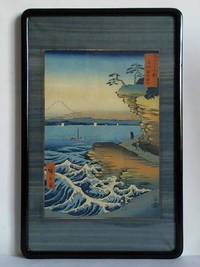
Fuji seen from the sea at Honmaki Musashi - Colorierter Holzstich
Tsutaya Kichizo Japan 1858. Maße: ca. 192 x 278 cm mit Stempel unten rechts im Motiv auf colorierten Stoff gezogen hinter Glas in schwarzer Holzleiste mit abgerundeten Ecken Leiste gering berieben/rückseitig zwei Papierschilder. - Japanische Kunst - unknown
Riferimento per il libraio : 6a375
|
|
|
HIROSHIGE, Ando I [Utagawa]
HAKONE KOSUI NO ZU: HAKONE VIEW OF THE LAKE FROM THE THE TOKAIDO GOJUSAN TSUGI
Edo 1841-42 Takenouchi. Color Oban woodblock printsigned in block 34.2 x 21.8 cm. edges trimmed five small verso old mends now solid excellent impression & registry a bit dusty very good reprint example sold "as is." . . . . . HAKONE KOSUI NO ZU: HAKONE -VIEW OF THE LAKE . . . ONE OF THE MOST ICONIC & FAMOUS VIEWS OF THE SERIES . . . THE FIFTY-THREE STAGES OF THE TOKAIDO HIGHWAY . . This is one of the most famous and iconic prints of the series showing great composition and excellent use of multiple colors. The mountain which faces Mt. Fuji showing "respect" as well as "pointing" to the most" Sacred" mountain of Japan. The blue lake to the left of the mountain completes a classic view. This is print number 11 of the series. Per Forrer this print is the exact print discussed and illustrated with the exact three cinnabar Hanko seals/chops. It was published by Takenouchi Magohachi Hoeido ca. 1831-4 Signed Hiroshige Ga with censor seal Kiwame. See Forrer below. . We believe this is a later but undated reprint of the above example. . CONDITION: The print surface is soiled dusty with four mends on the verso corners plus a few other mends. Some usual but minor color toning with trimmed margins sold "as is." Nevertheless this still remains a very famous and stunning woodblock color print. . TERMS OF SALE: This print is sold "as is" and is NOT returnable. By ordering this item you agree to the above terms. Please view color photos posted to our website prior to ordering. . REFERENCES: . LANE Richard.: IMAGES FROM THE FLOATING WORLD: THE JAPANESE PRINT INCLUDING AN ILLUSTRATED DICTIONARY OF UKIYO-E pp.229 172-184231-233 #80 showing Hiroshige signature as ca. 1832 in this print. FORRER Matthi. et al.: HIROSHIGE: PRINTS AND DRAWINGS see #18 & opposite page color print our exact example published by Takenouchi Magohachi Hoeido ca. 1831-34 with Kiwame censor seal. . This work is cited in several of the standard bibliographies. . . unknown
Riferimento per il libraio : 32072801

|
|
|
Hiroshige, Ando & Bryan Holme
Hiroshige A Shoal of Fishes
Metropolitan Museum of Art. Very Good in Very Good dust jacket. 1981. Hardcover. 0870992376 . The overall condition of the book is excellent. The binding is an accordion facsimile bound in red cloth boards. The fold-out pages are in great condition. The pages are clean and unmarked apart from a gift inscription on the first page. The cover is in very good condition with minor blemishes and shelving wear. The slip case is in excellent condition with minor shelving wear. Please support an independent bookstore. ; 10.60 x 7.60 x .75 "; 0 pages . Metropolitan Museum of Art hardcover
Riferimento per il libraio : 37620 ISBN : 0870992376 9780870992377

|
|
|
Hiroshige, Utagawa
Hiroshige Wood Block Prints: A Collection of Hiroshige's Masterpieces. Ukiyo-E Landscape. 6 Prints a set with Explanation
Kyoto Hanga-In. Hardcover. Very Good/No Jacket. Set of 6 woodblock prints each mounted in a cream overlay. Housed in a brown rice papered card stock string-tied portfolio. Includes explanations of each print in English and Japanese. Titles include: 1. Snow of Kambara at Night; 2. Hakone; 3. One Hundred Scenes of Edo Atagoshita Yabukoji; 4. Mt. Haruna in Kozuke Province; 5. Moon at Irozaki Point; 6. Beautiful Woman in Snow. // No date or edition stated. The cardboard covering is a little shelf rubbed and a tear along the spine. Our orders are shipped using tracked courier delivery services. Kyoto Hanga-In hardcover
Riferimento per il libraio : 6ramp
|
|
|
Hiroshige, Utagawa (Ando)
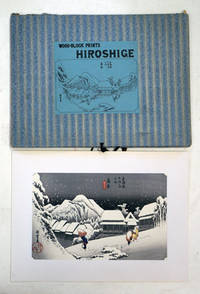
Hiroshige - Wood-Block Prints. 6 Prints.
o. Angaben o. Vlg. . 38 x 28 cm 6 lose Blätter 22 x 32 cm unter Passepartout 1 gefalzt. Textblatt. Flügelmappe m Schnurrverschluss m. losen Blättern unter Passepartout Mappe a. Rücken lädiert etwas berieben Blätter tadell. Text: engl./ jap.- Ando Hiroshige 1797–1858 war ein berühmter japanischer Ukiyo-e-Holzschnittkünstler bekannt für seine atmosphärischen Landschaftsdrucke die oft das tägliche Leben und berühmte Orte Japans darstellten insbesondere mit Serien wie den "53 Stationen des T kaid " und den "100 berühmten Ansichten von Edo" die auch den europäischen Impressionismus stark beeinflussten. Sein korrekter Name war Utagawa Hiroshige da er Schüler der Utagawa-Schule war aber "And Hiroshige" ist gebräuchlich.- Set of 6 woodblock prints each mounted in a cream overlay. Housed in a brown rice papered card stock string-tied portfolio. Includes explanations of each print in English and Japanese. Titles include: 1. Snowfall of Kambara; 2. Sudden shower at Shono; 3. Moon light by river Tama; 4. Stage-Town Nagakubo; 5.Asakusa Kinryuzan Temple; 6. Sudden Rain-Storm at Atake. 010 o. Angaben, o. Vlg., unknown
Riferimento per il libraio : 106705
|
|
|
HIROSHIGE, UTAGAWA
HIROSHIGE - VISTAS DEL MONTE FUJI
NEW. NEW. Enviamos a todo el mundo por USPS. UPS o DHL. 100% garantia en su compra. We ship worldwide. unknown
Riferimento per il libraio : SBS26604 ISBN : 8412601580 9788412601589
|
|
|
Hiroshige, Ando; Et Al
Hiroshige : Da Edo a Kyoto -- Vedute Celebri Del Giappone - with CD-ROM
Marsilio Editori. New. 2014. Paperback. 8831720120 . FREE UPGRADE to Courier/Priority Shipping Upon Request - IN STOCK AND IMMEDIATELY AVAILABLE FOR SHIPMENT - Flawless copy brand new pristine never opened - Text in Italian. -- with a bonus offer-- . Marsilio Editori paperback
Riferimento per il libraio : 111804 ISBN : 8831720120 9788831720120
|
|
|
Hiroshige, Ando; Matthi Forrer; Et Al
Hiroshige : L'Art Du Voyage
Museum; Et Al. New. 2012. Hardcover. 2353401449 . FREE UPGRADE to Courier/Priority Shipping Upon Request - IN STOCK AND IMMEDIATELY AVAILABLE FOR SHIPMENT - Flawless copy brand new pristine never opened -- Text in French. 176 pages; many color illustrations. -- with a bonus offer-- . Museum; Et Al hardcover
Riferimento per il libraio : 104138 ISBN : 2353401449 9782353401444
|
|
|
Hiroshige, Ando
Hiroshige A Shoal of Fishes
Metropolitan Museum of Art 1981. Hardcover. Near Fine. red hardcover in Near Fine condition with slipcase in Near Fine condition Metropolitan Museum of Art hardcover
Riferimento per il libraio : 436 ISBN : 0870992376 9780870992377
|
|
|
Hiroshige, Utagawa
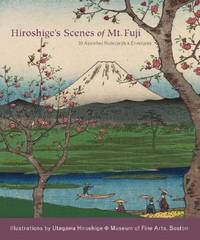
Hiroshige's Scenes of Mt. Fuji Notecards
paperback. Good. Access codes and supplements are not guaranteed with used items. May be an ex-library book. paperback
Riferimento per il libraio : 0811848507.G ISBN : 0811848507 9780811848503
|
|
|
Hiroshige, Ichiryusai & Chiba, Reiko - Editor
Hiroshige's Tokaido in Print and Poetry
Rutland VT: Charles Tuttle & Co. 1959. 1st. Softcover. Near Fine/Near Fine. Illustrated cloth boards with binding secured by string. Booklet is tight square sharp-cornered and free of flaws or markings inside and out. All of the beautiful full color woodcuts are present - tipped in to text next to poems. Very thin wood veneer affixed to endpapers. Near Fine. Illustrated slipcase also near fined with just one spot of mild rubbing. A ""tokaido"" or trip in English from Tokyo to Kyota taken by Ichiryusai Hiroshige in 1832. The trip comprised of 53 stopping spots along the way each a day apart during which Hiroshige sketched. These paintings are the tipped in woodcuts. First edition Third Printing. Charles Tuttle & Co. paperback
Riferimento per il libraio : blb04114
|
|
|
Hiroshige, Ando
Hiroshige: A Shoal of Fishes
New. New. Satisfaction Guaranteed or your money back. unknown
Riferimento per il libraio : 0870992376 ISBN : 0870992376 9780870992377
|
|
|
Hiroshige, Ando
Hiroshige: A Shoal of Fishes
hardcover. Good. Access codes and supplements are not guaranteed with used items. May be an ex-library book. hardcover
Riferimento per il libraio : 0870992376.G ISBN : 0870992376 9780870992377
|
|
|
Hiroshige, Ando; Holme, Bryan [Illustrator]
Hiroshige: A Shoal of Fishes A Studio book
Metropolitan Museum of Art 1981-06-01. Hardcover. New. In shrink wrap. Looks like an interesting title! Metropolitan Museum of Art hardcover
Riferimento per il libraio : Q-0870992376 ISBN : 0870992376 9780870992377
|
|
|
Hiroshige, Harry D Smith, Ando
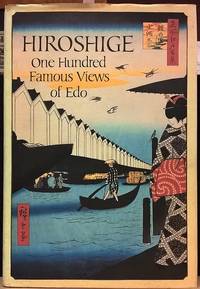
Hiroshige: One Hundred Famous Views of Edo
New York: George Braziller Incorporated 1986. 1st. Hardcover. Fair/Good. 256 pages. Hardcover with dust jacket. Clean tight copy. Color pictures throughout. landscapes. Hiroshige's One Hundred Famous Views of Edo actually composed of 118 splendid woodblock landscape and genre scenes of mid-nineteenth century Tokyo is one of the greatest achievements of Japanese art. The series contains many of Hiroshige's best-loved and most extraordinary prints. Like Venice and Florence in the 14th and 15th centuries or Paris in the age of the Impressionists the city of Edo with its superb landmarks and its festive display of elegant urban life exerts a special and compelling fascination. Hiroshige revealed the panorama of his city's activities with subtle and vivid visual anecdotes: fireworks seen from the river fashionable geishas on parade the kabuki district at night intimate moments in the gardens and teahouses. It is a tour de force of artistic vision and printmaking craftsmanship. This edition has been reproduced from an exceptionally fine first-edition set in the Brooklyn Museum of Art to insure maximum fidelity to the original prints. Henry Smith ex-plains the world of Edo in its twilight before the Meiji Restoration and the beginnings of a modern urban society. Each plate is accompanied by a commentary that discusses its artistic and cultural interest in detail. For anyone interested in Japan the One Hundred Famous Views of Edo is perhaps the finest guide and one of the greatest legacies imaginable. Record # 369104 George Braziller Incorporated hardcover
Riferimento per il libraio : 369104
|
|
|
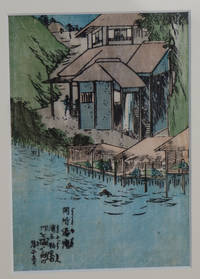
HIROSHIGE, Ando (1797-1858)
Japanese Woodblock Picture. "Relaxing by the Water".
<p>HIROSHIGE Ando 1797-1858. Relaxing by the Water. Original woodblock from the series "Ehon Edo Miyage" published by Kikuya Kozaburo Volume 3 printed in Japan 1850-68. 295 x 210mm. This original print is delivered to you in its <strong>unframed</strong> state carefully protected in a solid cardboard tube.</p><p>Utagawa Hiroshige born AndÅ TokutarŠ安藤 徳太郎; 1797 – 12 October 1858 was a Japanese ukiyo-e artist considered the last great master of that tradition.<br />Hiroshige is best known for his horizontal-format landscape series The Fifty-three Stations of the TÅkaidÅ and for his vertical-format landscape series One Hundred Famous Views of Edo. The subjects of his work were atypical of the ukiyo-e genre whose typical focus was on beautiful women popular actors and other scenes of the urban pleasure districts of Japan's Edo period 1603–1868. The popular series Thirty-six Views of Mount Fuji by Hokusai was a strong influence on Hiroshige's choice of subject though Hiroshige's approach was more poetic and ambient than Hokusai's bolder more formal prints. Subtle use of color was essential in Hiroshige's prints often printed with multiple impressions in the same area and with extensive use of bokashi color gradation both of which were rather labor-intensive techniques.<br />For scholars and collectors Hiroshige's death marked the beginning of a rapid decline in the ukiyo-e genre especially in the face of the westernization that followed the Meiji Restoration of 1868. Hiroshige's work came to have a marked influence on western European painting towards the close of the 19th century as a part of the trend in Japonism. Western European artists such as Manet and Monet collected and closely studied Hiroshige's compositions: Vincent van Gogh for instance painted copies of some Hiroshige prints.</p><p><br />Japanese woodblock prints known as ukiyo-e<br />Produced in their many thousands and hugely popular during the Edo period 1615 – 1868 these colourful woodblock prints known as ukiyo-e depicted scenes from everyday Japan. Ukiyo-e literally means 'pictures of the floating world'. The 'floating world' referred to the licensed brothel and theatre districts of Japan's major cities during the Edo period. Inhabited by prostitutes and Kabuki actors Kabuki is a traditional Japanese form of theatre these were the playgrounds of the newly wealthy merchant class. Despite their low status in the strict social hierarchy of the time actors and courtesans became the style icons of their day and their fashions spread to the general population via inexpensive woodblock prints.<br />The ukiyo-e style was developed in 1765 and remained popular until the closing decades of the Meiji period 1868 – 1912. While only the wealthy could afford paintings by the artists of the day ukiyo-e prints were enjoyed by a wide audience because they could be produced quite cheaply and in large numbers.<br />The production process<br />The earliest woodblock prints were simple black and white prints taken from a single block. Sometimes they were coloured by hand but this process was expensive. In the 1740s additional woodblocks were used to print the colours pink and green but it wasn't until 1765 that the technique of using multiple colour woodblocks was perfected. The glorious full-colour prints that resulted were known as nishiki-e or 'brocade pictures'.<br />The team involved in the production of ukiyo-e was known as the 'ukiyo-e quartet'. It comprised the publisher who usually had overall control of the process the designer/artist the block cutter and the printer.<br />The artist would draw the design on paper. Once complete an exact copy was made and placed face-down on a cherry wood block. Cherry wood was favoured due to the fine even grain and consistent density. The block cutter then carved directly through the copy to produce what is known as the 'key-block'.<br />The printer used the key-block to produce a number of black and white prints from which further blocks could be made for each colour needed in the final print. Known as 'key-block proofs' these prints feature registration marks: small rectangles outside the area of the picture. When the colour blocks were carved these marks were used to create stops so that the printer could line up the separate colours precisely.</p>
Riferimento per il libraio : X14
|
|
|
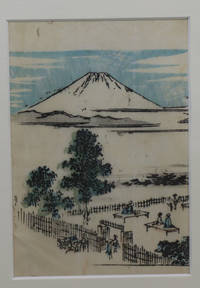
HIROSHIGE, Ando (1797-1858)
Japanese Woodblock Picture. 'Sipping Tea Viewing Mount Fuji'.
<p>Sipping Tea Viewing Mount Fuji. Original woodblock from the series "Ehon Edo Miyage" published by Kikuya Kozaburo Volume 3 printed in Japan 1850-68. 295 x 210 mm. This original print is delivered to you in its <strong>unframed</strong> state carefully protected in a solid cardboard tube.</p><p>Utagawa Hiroshige born AndÅ TokutarŠ安藤 徳太郎; 1797 – 12 October 1858 was a Japanese ukiyo-e artist considered the last great master of that tradition.</p><p>Hiroshige is best known for his horizontal-format landscape series The Fifty-three Stations of the TÅkaidÅ and for his vertical-format landscape series One Hundred Famous Views of Edo. The subjects of his work were atypical of the ukiyo-e genre whose typical focus was on beautiful women popular actors and other scenes of the urban pleasure districts of Japan's Edo period 1603–1868. The popular series Thirty-six Views of Mount Fuji by Hokusai was a strong influence on Hiroshige's choice of subject though Hiroshige's approach was more poetic and ambient than Hokusai's bolder more formal prints. Subtle use of color was essential in Hiroshige's prints often printed with multiple impressions in the same area and with extensive use of bokashi color gradation both of which were rather labor-intensive techniques.</p><p>For scholars and collectors Hiroshige's death marked the beginning of a rapid decline in the ukiyo-e genre especially in the face of the westernization that followed the Meiji Restoration of 1868. Hiroshige's work came to have a marked influence on western European painting towards the close of the 19th century as a part of the trend in Japonism. Western European artists such as Manet and Monet collected and closely studied Hiroshige's compositions: Vincent van Gogh for instance painted copies of some Hiroshige prints.</p><p>Japanese woodblock prints known as ukiyo-e</p><p>Produced in their many thousands and hugely popular during the Edo period 1615 – 1868 these colourful woodblock prints known as ukiyo-e depicted scenes from everyday Japan. Ukiyo-e literally means 'pictures of the floating world'. The 'floating world' referred to the licensed brothel and theatre districts of Japan's major cities during the Edo period. Inhabited by prostitutes and Kabuki actors Kabuki is a traditional Japanese form of theatre these were the playgrounds of the newly wealthy merchant class. Despite their low status in the strict social hierarchy of the time actors and courtesans became the style icons of their day and their fashions spread to the general population via inexpensive woodblock prints.</p><p>The ukiyo-e style was developed in 1765 and remained popular until the closing decades of the Meiji period 1868 – 1912. While only the wealthy could afford paintings by the artists of the day ukiyo-e prints were enjoyed by a wide audience because they could be produced quite cheaply and in large numbers.</p><p>The production process</p><p>The earliest woodblock prints were simple black and white prints taken from a single block. Sometimes they were coloured by hand but this process was expensive. In the 1740s additional woodblocks were used to print the colours pink and green but it wasn't until 1765 that the technique of using multiple colour woodblocks was perfected. The glorious full-colour prints that resulted were known as nishiki-e or 'brocade pictures'.</p><p>The team involved in the production of ukiyo-e was known as the 'ukiyo-e quartet'. It comprised the publisher who usually had overall control of the process the designer/artist the block cutter and the printer.</p><p>The artist would draw the design on paper. Once complete an exact copy was made and placed face-down on a cherry wood block. Cherry wood was favoured due to the fine even grain and consistent density. The block cutter then carved directly through the copy to produce what is known as the 'key-block'.</p><p>The printer used the key-block to produce a number of black and white prints from which further blocks could be made for each colour needed in the final print. Known as 'key-block proofs' these prints feature registration marks: small rectangles outside the area of the picture. When the colour blocks were carved these marks were used to create stops so that the printer could line up the separate colours precisely.</p>
Riferimento per il libraio : X16
|
|
|
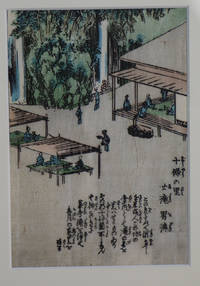
HIROSHIGE, Ando (J 797-1858).
Japanese Woodblock Picture. "Waterfall at Jujyo No Sata."
<p>HIROSHIGE Ando J 797-1858. Waterfall at Jujyo No Sato. Original woodblock from the series "Ehon Edo Miyage" published by Kikuya Kozaburo Volume 3 printed in Japan 1850-68. 295 x 210 mm.</p><p>This original print is delivered to you in its <strong>unframed</strong> state carefully protected in a solid cardboard tube.</p><p>Utagawa Hiroshige born AndÅ TokutarŠ安藤 徳太郎; 1797 – 12 October 1858 was a Japanese ukiyo-e artist considered the last great master of that tradition.</p><p>Hiroshige is best known for his horizontal-format landscape series The Fifty-three Stations of the TÅkaidÅ and for his vertical-format landscape series One Hundred Famous Views of Edo. The subjects of his work were atypical of the ukiyo-e genre whose typical focus was on beautiful women popular actors and other scenes of the urban pleasure districts of Japan's Edo period 1603–1868. The popular series Thirty-six Views of Mount Fuji by Hokusai was a strong influence on Hiroshige's choice of subject though Hiroshige's approach was more poetic and ambient than Hokusai's bolder more formal prints. Subtle use of color was essential in Hiroshige's prints often printed with multiple impressions in the same area and with extensive use of bokashi color gradation both of which were rather labor-intensive techniques.</p><p>For scholars and collectors Hiroshige's death marked the beginning of a rapid decline in the ukiyo-e genre especially in the face of the westernization that followed the Meiji Restoration of 1868. Hiroshige's work came to have a marked influence on western European painting towards the close of the 19th century as a part of the trend in Japonism. Western European artists such as Manet and Monet collected and closely studied Hiroshige's compositions: Vincent van Gogh for instance painted copies of some Hiroshige prints.</p><p>Japanese woodblock print known as <strong>ukiyo-e</strong> were produced in their many thousands and hugely popular during the Edo period 1615 – 1868</p><p>These colourful woodblock prints depicted scenes from everyday Japan. Ukiyo-e literally means 'pictures of the floating world'. The 'floating world' referred to the licensed brothel and theatre districts of Japan's major cities during the Edo period. Inhabited by prostitutes and Kabuki actors Kabuki is a traditional Japanese form of theatre these were the playgrounds of the newly wealthy merchant class. Despite their low status in the strict social hierarchy of the time actors and courtesans became the style icons of their day and their fashions spread to the general population via inexpensive woodblock prints.</p><p>The ukiyo-e style was developed in 1765 and remained popular until the closing decades of the Meiji period 1868 – 1912. While only the wealthy could afford paintings by the artists of the day ukiyo-e prints were enjoyed by a wide audience because they could be produced quite cheaply and in large numbers.</p><p>The production process</p><p>The earliest woodblock prints were simple black and white prints taken from a single block. Sometimes they were coloured by hand but this process was expensive. In the 1740s additional woodblocks were used to print the colours pink and green but it wasn't until 1765 that the technique of using multiple colour woodblocks was perfected. The glorious full-colour prints that resulted were known as nishiki-e or 'brocade pictures'.</p><p>The team involved in the production of ukiyo-e was known as the 'ukiyo-e quartet'. It comprised the publisher who usually had overall control of the process the designer/artist the block cutter and the printer.</p><p>The artist would draw the design on paper. Once complete an exact copy was made and placed face-down on a cherry wood block. Cherry wood was favoured due to the fine even grain and consistent density. The block cutter then carved directly through the copy to produce what is known as the 'key-block'.</p><p>The printer used the key-block to produce a number of black and white prints from which further blocks could be made for each colour needed in the final print. Known as 'key-block proofs' these prints feature registration marks: small rectangles outside the area of the picture. When the colour blocks were carved these marks were used to create stops so that the printer could line up the separate colours precisely.</p>
Riferimento per il libraio : X13
|
|
|
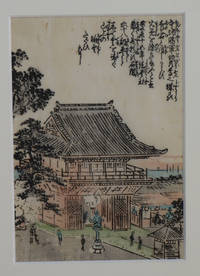
HIROSHIGE, Ando (1797-1858).
Japanese Woodblock Picture. "Visiting the Temple."
<p>HIROSHIGE Ando 1797-1858. Visiting the Temple. Original woodblock from the series "Ehon Edo Miyage" published by Kikuya Kozaburo Volume 3 printed in Japan 1850-68. 295 x 210 mm. This original print is delivered to you in its <strong>unframed</strong> state carefully protected in a solid cardboard tube.</p><p>Utagawa Hiroshige born AndÅ TokutarŠ安藤 徳太郎; 1797 – 12 October 1858 was a Japanese ukiyo-e artist considered the last great master of that tradition.<br />Hiroshige is best known for his horizontal-format landscape series The Fifty-three Stations of the TÅkaidÅ and for his vertical-format landscape series One Hundred Famous Views of Edo. The subjects of his work were atypical of the ukiyo-e genre whose typical focus was on beautiful women popular actors and other scenes of the urban pleasure districts of Japan's Edo period 1603–1868. The popular series Thirty-six Views of Mount Fuji by Hokusai was a strong influence on Hiroshige's choice of subject though Hiroshige's approach was more poetic and ambient than Hokusai's bolder more formal prints. Subtle use of color was essential in Hiroshige's prints often printed with multiple impressions in the same area and with extensive use of bokashi color gradation both of which were rather labor-intensive techniques.<br />For scholars and collectors Hiroshige's death marked the beginning of a rapid decline in the ukiyo-e genre especially in the face of the westernization that followed the Meiji Restoration of 1868. Hiroshige's work came to have a marked influence on western European painting towards the close of the 19th century as a part of the trend in Japonism. Western European artists such as Manet and Monet collected and closely studied Hiroshige's compositions: Vincent van Gogh for instance painted copies of some Hiroshige prints.</p><p>Japanese woodblock prints known as <strong>ukiyo-e</strong> were<br />produced in their many thousands and hugely popular during the Edo period 1615 – 1868 these colourful woodblock prints known as ukiyo-e depicted scenes from everyday Japan. Ukiyo-e literally means 'pictures of the floating world'. The 'floating world' referred to the licensed brothel and theatre districts of Japan's major cities during the Edo period. Inhabited by prostitutes and Kabuki actors Kabuki is a traditional Japanese form of theatre these were the playgrounds of the newly wealthy merchant class. Despite their low status in the strict social hierarchy of the time actors and courtesans became the style icons of their day and their fashions spread to the general population via inexpensive woodblock prints.<br />The ukiyo-e style was developed in 1765 and remained popular until the closing decades of the Meiji period 1868 – 1912. While only the wealthy could afford paintings by the artists of the day ukiyo-e prints were enjoyed by a wide audience because they could be produced quite cheaply and in large numbers.<br />The production process<br />The earliest woodblock prints were simple black and white prints taken from a single block. Sometimes they were coloured by hand but this process was expensive. In the 1740s additional woodblocks were used to print the colours pink and green but it wasn't until 1765 that the technique of using multiple colour woodblocks was perfected. The glorious full-colour prints that resulted were known as nishiki-e or 'brocade pictures'.<br />The team involved in the production of ukiyo-e was known as the 'ukiyo-e quartet'. It comprised the publisher who usually had overall control of the process the designer/artist the block cutter and the printer.<br />The artist would draw the design on paper. Once complete an exact copy was made and placed face-down on a cherry wood block. Cherry wood was favoured due to the fine even grain and consistent density. The block cutter then carved directly through the copy to produce what is known as the 'key-block'.<br />The printer used the key-block to produce a number of black and white prints from which further blocks could be made for each colour needed in the final print. Known as 'key-block proofs' these prints feature registration marks: small rectangles outside the area of the picture. When the colour blocks were carved these marks were used to create stops so that the printer could line up the separate colours precisely.</p>
Riferimento per il libraio : X15
|
|
|
HIROSHIGE, Ando I [Utagawa]
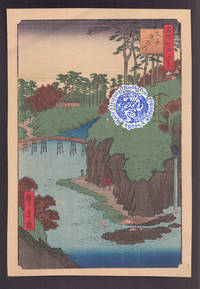
MEISHO EDO HYAKKEI: ONE HUNDRED FAMOUS VIEWS OF EDO. #88 TAKINOGAWA RIVER IN OJ
Tokyo n.d. ca 1920's.A color Oban woodblock print sheet: 20.6 x 30 cm. print: 18.4 x 28 cm. multi-colors excellent impression and registry UNUSED old fine exaple reprint. RARE ORIGINAL COLOR WOODBLOCK PRINT . . . MEISHO EDO HYAKKEI: ONE HUNDRED FAMOUS VIEWS OF EDO. . . . A PRINT FROM THE SERIES OF 119 VIEWS . . . A SUPERB VIEW OF TAKINOGAWA IN OJI # 88 IN THE SERIES . . A bright view of the Takinogawa river hills & forests Matsubashi foot bridge cliffs waterfall bathers tea house Kongoji temple & Benten Shinto shrine. All located in Kita Oji north Oji. Edo is the old name of Tokyo. . The red title cartouche in upper right corner reads: MEISHO EDO HYAKKEI HYAKKEI. . Left to that is an orange series title: "Takinogawa in Oji." In block signed inside the red cartouche in lower left corner: "HIROSHIGE GA" i.e. "drawn by Hiroshige." Originally issued in 1856. . The scene is in the colors of autumn the original orange color has turned brownish-black due to oxidation over time. . The series was depicted using major landmarks that appear in the print listed in order of increasing distance from the viewer. . THE ARTIST: UTAGAWA Hiroshige 1797-1858: He was a Japanese Ukiyo-e artist considered the last great master of that tradition. . The orignal series was published from 1856-1858. This being a 20th century high-quality original color woodblock printed reprint edition. No date or publisher's seal as usual. . Color photos are posted to our website. . CONDITION: . The print is in superb UNUSED condition brilliantly colored with superb impression & registry. By and lager about as good as it can get. . Ready for framing and display. . REFERENCE: . See Wikipedia for comprehensive info on Hiroshige and One Hundred Famous Views of Edo. . . unknown
Riferimento per il libraio : 44025601
|
|
|
HIROSHIGE, Ando I [Utagawa]
NIHON BASHI: TOKAIDO GO JU SAN TSUGI: NIHON BASHI FROM THE SERIES: THE FIFTY-THR
Tokyo circa 1920-30's. Oban color woodblock print a bit dusty artist signature and red seal in block sheet: 36.7 x 24.3 cm print: 23 x 34.8 excellent registry & impression pastel colors print #1 of the series corner mended. . . . A REPRINT OF THE MID-19TH CENTURY FAMOUS SERIES . .TOKAIDO GOJU SAN TSUGI: THE 53 STAGES OF THE TOKAIDO HIGHWA . . PRINT NUMBER 1 THE START OF THE HIGHWAY . . AT NIHON BASHI OLD EDO TOKYO . . A COLOR WOODBLOCK PRINT This is a very good color woodblock reprint of the original series. Colors are in pastels nicely executed with scene title and the artist's signature and red cinnabar Hanko in the lower right corner. . The lively scene is the first stage on the famous THE FIFTY-THREE STAGES OF THE TOKAIDO HIGHWAY the Nihon Bashi bridge. . It shows a large group of all manner of people animals coolies. pilgrims merchants haulers beggars children women and the devout people either coming or going on the Tokaido Eastern Highway. A Lord's procession is just visible at the top of the bride with two large Pompom bearers at the very top. . The busy scene is typical of the Edo period when "Shanks Mare" was the usual method of travel for commoners. . This was one of Hiroshige's most famous series consisting of 55 prints in all covering the 53 stations of the highway. Each day's walk ended at a new 'station' where people rested overnight then proceeded the next day. Usually it took a person 53 days to walk from Edo to Kyoto. . CONDITION: The work is with excellent registry and impression. There is some of the usual minor rubbing to the front and back sides. There is a mend in the upper right corner margin this does not affect the print whatsoever and can be matted out easily. . Otherwise the print is firm and solid ready for matting and display. . Please review photos posted to our website. . NOTE: Color scans are posted to our website. . . unknown
Riferimento per il libraio : 39040901

|
|
|
HIROSHIGE, Ando I [Utagawa]
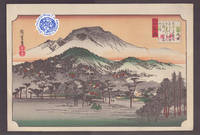
OMI HAKKEI: MII NO BANSHO: THE EIGHT VIEWS OF OMI: # 5 MII TEMPLE EVENING BELL
Tokyo n.d. ca. 1920's. Horizontal Oban color woodblock print sheet: 37.4 x 25.5 cm.; print: 35 x 23.5 cm. a very brightcleanUNUSED example pristine registry & impression about as good as it can get. RARE & SUPERB EXAMPLE . . . A STUNNING VIEW OF MIIDERA TEMPLE . . . BUILT IN THE 8TH CENTURY . . . DAWN SEEN AS THE SUN RISES OVER THE MOUNTAINS & VALLEY . Miidera temple was built in the 8th century. Its bell is one of the "Three bells of Japan" . This is a superb view of the sunrise over the tall mountains forest and hidden temple & shrines. . Color photos are posted to our website. . CONDITION: This is a superb example pristine condition stunning impression & registry no issues UNUSED example. Verso likewise clean without issues. About as goos as it can get. . RARE example seldom found if ever even more so in such superb condition. . . unknown
Riferimento per il libraio : 44026301
|
|
|
HIROSHIGE, Ando I [Utagawa] & TOYOKUNI, Utagawa
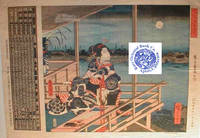
OTSUKI MI: MOON WATCHING. Landscape By Hiroshige; Woman By Toyokuni
Tokyo 1927 Asahi. Large Kawaraban broadside a Dai-Oban color woodblock print sheet:45.4 x 39.4 cm.;print: 51.6 cm. 3 old folds now flat 4 tiny corner pin holes mendec small scuff to upper left corner else clean solid. RARE EXAPLE . . . MOON-GAZING AT TANABATA FESTIVAL ON THE TAMAGAWA RIVER . . . AUGUST DREAM OF A LOST LOVER . . . A NOSTALGIC VIEW OF THE MOON . . . A JOINT COLLABORATION OF THE TWO MASTER ARTISTS . . . HIROSHIGE DREW THE LANDSCAPE TOYOKUNI DREW THE WOMAN . . . A RARE EXAMPLE THE FIRST ONE WE HAVE SEEN SINCE 1967 ! . This is the Tanabata festival also known as the "Star Festival." It is a Japanese festival originating from the Chinese Qixi Festival. It celebrates the meeting of the deities Orihime and Hikobosh. It is celebrated by lovers longing for their separated partners. . According to legend the Milky Way separates these lovers and they are allowed to meet only once a year on the seventh day of the seventh lunar month of the luni-solar calendar. The date of Tanabata varies by region of the country but the first festivities begin on 7 July. The celebration is observed between July and August. . THE PRINT TITLE: The title is found at the top right of the print in a red cartouche box alas it is unread. However the title most likely would be something like "Otsuki-mi" "Moon Watching". . The work was printed by NIHON MOKUHAN INSATSU in Tabata To yo. . THE RARE DOUBLE-OBAN WOODBLOCK COLOR PRINT FORMAT: . This unusual format Deluxe print size was seldom executed as it was extremely hard to find cherry wood with such wide ad large dimensions. Also such large woodblocks were easily warped and checked rendering prints of poor quality. . This double or Dai-Oban print was probably an insert in the Asahi morning newspaper "KALANDA" "CALENDAR" it has a chart listing all of the year's holidays at the left margin. . The scene is of a typical Edo period Bijin Japanese beauty on a veranda the Tamagawa river wearing a summer cotton Kimono gazing at the moon & stars. She longs for her distant lover. . . Her poetry paper bamboo brush pen & Sumi ink are placed is on her desk awaiting inspiration to write a poem or letter to her lover. There is a blue paper-covered book and another open to double-text as inspiration. . This is an excellent Shin Hanga Deluxe print. Produced in 1927 long after the two artist's death nevertheless a nostalgic look at the fond past and a revisit to the superb art work of two great masters of the Edo epoch. . Color photos are posted to our website. . CONDITION: . This is an original color woodblock printed example from Showa 2nd. year 1927. . It is contained in a modern black mat with a Mylar dust protector. The mat is merely a good protector and has wear to the edges mostly on the lower edge. We leave the print inside the matted folder to keep it flat. . The print has been well-preserved and the three old mild vertical folds have been pressed out and fully opened flat for decades. . It was issued with tree vertical folds ca. 14 x 39 cm. to fit into a newspaper in the distant past. The old mild folds still remain but are now greatly reduced and quite flat. . SHIPPING OPTIONS: . The buyer has two shipping options: a. We refold the print back to its original size which accompanied the Asahi Morning newspaper. It folds down to be ca. 27 x 39.5 cm. . b. We ship it in the mat which is overall ca. 60 x 46 cm. opened flat in its current state therefore additional shipping packing costs will apply. . . unknown
Riferimento per il libraio : 23016901
|
|
|
HIROSHIGE, Ando I [Utagawa]
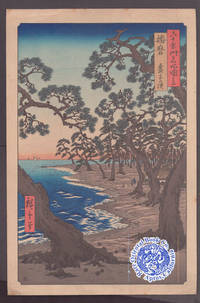
ROKUJU YOSHU MEISHO ZU: HARIMA MAIKO NO HAMA. #45 FAMOUS VIEWS OF THE SIXTY-OD
Tokyo n.d. ca 9120's. Vertical color woodblock print in very bright condition superb impression & registry sheet: 25.2x 37.8 cm.; print: 22.4 x 35.5 cm. Watanabe square seal in lower left corner also there is a small bump. RARE . . . STUNNING SUNSET ON THE BAY FROM THE PINE FOREST . . . VIEW OF HARIMA AT MAIKO NO HAMA: MAIKO BEACH . . This is an excellent example. It shows the shore of the bay with the tide coming in. The view is of the sunset three tiny sailing vessels are on the horizon. The view is from the thick pine forest along the shoreline with three people and a teahouse in the mid-ground. A classic view by Japan's master of landscape scenery. . THE SERIES: ROKUJUYOSHU MEISHO ZUE is a series of Ukiyo-e color woodblock prints by the eminent Japanese master landscape artist Hiroshige 1797-1858: . The series consists of a 70 prints of famous views from each of the 68 provinces of Japan plus a print of Edo the capital and a contents page for a total of 70 prints. The prints were first published in serialized form by Koshimuraya Heisuke in 1853-56. . This charming example represents one of the best from that series. It is printed on an oversized large Oban size sheet . Color photos are posted to our website. . THE PUBLISHER: This print was published by Takemura a woodblock printing & publishing house in Tokyo of the period. . CONDITION: In excellent condition superb impression & registry strong colors no fading. Verso blank with two tiny old glassing hinges at top edge. Lower left & right corners mildly bumped now pressed flat very minor impression. . There are two tiny paper defects in the lower margin They are so small that our scanner could not pick them up they can be matted out when framed very minor issue. . . unknown
Riferimento per il libraio : 44026201
|
|
|
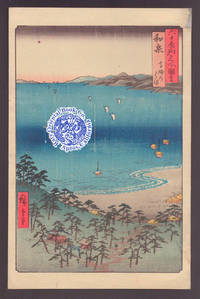
HIROSHIGE, Ando I [Utagawa]
ROKUJU YOSHU MEISHO ZU: IZUMI TAKASHI NO HAMA: FAMOUS VIEWS OF THE SIXTY-ODD PR
Tokyo n.d. ca. 1920's. Oban color woodblock print superb copy excellent impression & registry vertical formatsheet size:19.8 x 30.3 cm.; print:18.1 x 26.7 small mend to upper right corner & right edge else superb. RARE EXAMPLE . . . A STUNNING VIEW OF THE THE BAY FROM THE PINE FOREST . . . . VIEW OF HARIMA AT MAIKO NO HAMA MAIKO BEACH . . . #4 OF THE SERIES OF 69 PRINTS IN ALL . This is an excellent example. It shows the shore of the bay with the tide coming in. The view is of the sunset three tiny sailing vessels are on the horizon. The view is from the thick pine forest along the shoreline with three people and a teahouse in the mid-ground. A classic view by Japan's master of landscape scenery. . THE SERIES: ROKUJUYOSHU MEISHO ZUE is a series of Ukiyo-e color woodblock prints by the eminent Japanese master landscape artist Hiroshige 1797-1858: . The series consists of a 70 prints of famous views from each of the 68 provinces of Japan plus a print of Edo the capital and a contents page for a total of 70 prints. The prints were first published in serialized form by Koshimuraya Heisuke in 1853-56. . This charming example represents one of the best from that series. It is printed on an oversized large Oban size sheet . Color photos are posted to our website. . CONDITION: In excellent condition superb impression & registry strong colors no fading. Verso blank with a small mend from the back side at the top right corner and lower right edge margins not major can be matted out. . There is a purple stamp in the lower right corner: Made in Japan." . . unknown
Riferimento per il libraio : 44026601
|
|
|
HIROSHIGE, Utagawa
Summer Moon at Ryogoku Bridge 両国之月
Tokyo: N.P C1930. A beautiful woodblock print reproducing one of Hiroshige's famous illustrations. Although undated it is likely from the 1930's. Although a reproduction it is a genuine woodblock copy not a modern digital or lithographic print. In excellent clean condition it is loosely tipped onto a card backing sheet and has a stiff car folder with it. A humorous poem by Hachijintei written at the top of this painting. Shortly after completing "The Fifty-Three Stations of the TÅkaidÅ" Hiroshige published "Famous Places of Edo in the Four Seasons" a set of four prints: "Moon over RyÅgoku" "Snow over the Sumida River" "Flowers over Gotenyama" and "Red Maple Trees at KaimÅji Temple." Each of these works skillfully combines composition and color in a long-haired style and despite being small pieces from Hiroshige's prime they are considered one of his masterpiece series. There are no publisher details to the work. Overall in excellent condition with just a touch of staining from the original process to the right hand edge. Print is 44.5cm x 15.5cm. backing card and folder are 44.5cm x 31cm. . Une magnifique estampe sur bois reproduisant l'une des célèbres illustrations d'Hiroshige. Bien qu'elle ne porte pas de date elle date probablement des années 1930. Bien qu'il s'agisse d'une reproduction c'est une véritable estampe sur bois et non une impression numérique ou lithographique moderne. En excellent état elle est légèrement collée sur une feuille de carton et est accompagnée d'un étui rigide. Un poème humoristique de Hachijintei est inscrit en haut de cette estampe. Peu après avoir achevé « Les cinquante-trois stations du TÅkaidŠ» Hiroshige publia « Les lieux célèbres d'Edo au fil des quatre saisons » un ensemble de quatre estampes : « La lune sur RyÅgoku » « La neige sur la rivière Sumida » « Les fleurs sur Gotenyama » et « Les érables rouges au temple KaimÅji ». Chacune de ces Å“uvres combine habilement composition et couleur dans un style « à poils longs » et bien qu'il s'agisse de petites pièces datant de l'apogée de Hiroshige elles sont considérées comme l'une de ses séries de chefs-d'Å“uvre. Il n'y a aucune mention de l'éditeur sur l'Å“uvre. Dans un excellent état général avec juste une légère tache due au procédé d'impression d'origine sur le bord droit. L'estampe mesure 445 cm x 155 cm. Le carton de support et le dossier mesurent 445 cm x 31 cm. N.P unknown
Riferimento per il libraio : 5608
|
|
|
Hiroshige, Ando Utagawa (1797-1858)
Ten Beautiful Sceneries in Kyoto 1 missing
Portfolio. Condition: Fine. Unanimous Japan 1992. Beautifully colored drawings. Only 9 of 10 paintings 13 x 9.5. Nice Firm Clean copies ! Contents: 1. Willow Trees at Shimabara Gate 2. Summer Shower at Tadasu-River 3. The Snowfall at Gion Shrine 4. People Enjoying Evening Breezes at Shijoh-Kawara 5. Kiyomizu Temple ·6. Ferry oat at Yodo River 7. Cherry Blossom at Arashi-Yama 8. The Gold Pavilion Temple MISSING 9. Village of Yase 10. Maple Trees at Tsuten Bridge. Size: 13 x 9.25. Original wood block prints painted by Hiroshige Ando Utagawa 1797-1858. One of the most prominent painters' in the late Edo Era. Particularly good at painting the sceneries at quiet and poetic tone. The Substrate Toray's 'Axter' spun-bonded polyester is used as a substrate material. Art::Painting by Artist Art::Asia History::Japan 6329L unknown
Riferimento per il libraio : 126650
|
|
|
Hiroshige, Ando
The Fifty-Three Stages of the Tokaido. Hoeido Miniature Edition
Tokyo : Takamizawa Ukiyoe circa 1960s. Oblong accordion format with miniature woodcuts pasted on pages. 13 x 19.5 cm. Red brocade silk covered cloth in buckram slipcase. OCLC Number: 893642632 Tokyo : Takamizawa Ukiyoe, circa 1960s hardcover
Riferimento per il libraio : 51-2009

|
|
|
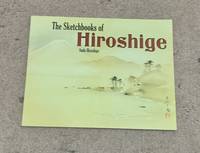
Hiroshige, Ando
The Sketchbooks of Hiroshige
Dover Publications 2007. 1st Edition 1st Printing. Soft cover. Very Good. About the book: Softcover. First Printing. Book is in very good condition with moderate wear to all edges. Additional photos available upon requiest. <br/> <br/> Dover Publications paperback
Riferimento per il libraio : 002968 ISBN : 0486460479 9780486460475
|
|
|
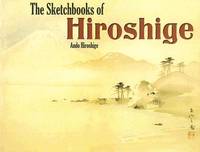
Hiroshige, Ando
The Sketchbooks of Hiroshige Pictorial Archive Series
paperback. Good. Access codes and supplements are not guaranteed with used items. May be an ex-library book. paperback
Riferimento per il libraio : 0486460479.G ISBN : 0486460479 9780486460475
|
|
|
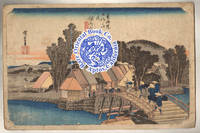
HIROSHIGE, Ando I [Utagawa]
TOKAIDO GO JU SAN TSUGI NO UCHI: HODOGAYA SHIMACHI-BASHI: THE FIFTY-THREE STATIO
Tokyo n.d. ca 1920's. An Oban horizontal color woodblock print:33.8 x 22.6 cm. sheet: 35.2 x 25.4.8 cm. with superb impression and registry UNUSED excellent example seldom found. RARE EARLY EDITION . . . SUPERB COMPOSITION LANDSCAPE BY JAPAN'S MOST ICONIC . . . LANDSCAPE ARTIST & PRINTMAKER . . . HIROSHIGE . . . FROM THE SERIES: . . . TOKAIDO GO JU SAN TSUGI NO UCHI: . . . NO. 5 IN "THE 53 STATIONS OF THE TOKAIDO HIGHWAY" . . SHINMACHI-BASHI: NEW TOWN BRIDGE . . THE ARTIST: ANDO Hiroshige 1797-1858 was the last major master of the Ukiyo-e school. In 1811 he entered the studio of Utagawa Toyohiro soon given the 'nom d'artiste' "Hiroshige." . He published his first color woodblock printed book in 1818. He was greatly influenced by Hokusai's series of landscape prints including this series TOKAIDO GO JU SAN TSUGI. Being impressed Hiroshige set out to do his own impressions of the Tokaido highway series. . . Hiroshige soon distinguished himself as the landscape master of Japan during this period. He made a large contribution to the development of the landscape color print as well as the traditional "Kacho" "Bird & Flower" prints with a tendency to the Kyoto Shijo School. . He remained the master of impressionist creating poetic views of nature and remained the best-loved of all Japanese artists. See Lane below p.229. With signature samples by dates. . FAMOUS PRINT FROM THE FAMOUS TOKAIDO HIGHWAY SERIES: . This famous series by Ando Hiroshige I TOKAIDO GOJU SAN TSUGI NO UCHI: THE FIFTY-THREE STAGES OF THE TOKAIDO HIGHWAY has been a standard and famous series of 54 prints since its issue in 1833-34. This is stop #5 showing Hodogaya Shin Machi Bashi New Bridge over the Katabira river. . Published by Takenouchi Magohachi Hoeidô and Tsuruya Kiemon Senkakudô circa 1833-34 Tenpo 4-5th. years with the red Hanko seal/chop of both Hoeido and Senkakudo. . CONDITION: . NOTES ON SPECIFIC COPIES: . Copy 1.: This is the original FIRST EDITION of the print. It was published circa 1833-34. The front surface is rubbed dusty the back side is re-backed with some Japanese calligraphy paper. . The impression & registry are excellent the colors are strong. . There are some neat restorations to the back side of the print using Washi handmade Japanese mulberry fiber paper when the item was re-backed in the distant past. . The white borders intact and perhaps a tiny bit trimmed. . The front side as usual a bit dusty rubbed with minor soil a feint discoloration above the trees on the left 1/3. Regardless the image & coloring are strong & impressive. . The print has been 're-backed' some time in its distant past using some old Washi paper which appears to have been an old signature samples sheet with other Fude bamboo brush & Sumi black ink writing. There are 2 small pin/tiny holes which are mended by the backing. . This was a common practice in the early 19th century. The work is now quite firm & solid. The backing paper is not visible from the front side. . Given the fact that is print is about 187 years old it is in better than the average condition. Please review the photos prior to ordering. . edition. It is in pristine condition excellent registry & impression about as good as it can get. . Copy 2: This is a circa 1920's reprint of the original edition. A pristine example UNUSED with superb impression and registry about as good as it can get. Ready for framing and display. . Color photos are posted to our website. . REFERENCES: . This print was exhibited at Le Musée National des Arts Asiatiques Guimet July-October 2019. This print was offered at Sotheby's London: see Sothebys 2020/fine-japanese-art/utagawa- iroshige-i-1797-1858-four-prints-hodogaya This link shows our Hodogaya print as the top left example. Their estimate was about $993 per print in a group of 4. LANE Richard: IMAGES FROM THE FLOATING WORLD: THE JAPANESE PRINT: see p.229 for an excellent biography of Hiroshige PRINT INCLUDING AN ILLUSTRATED DICTIONARY OF UKIYO-E: see p.232 #1 he cites: "55 Oban prints ca. 1833-34 publishers Hoeidoh & Senkakudoh." This print being #5 of the Tokaido series cited as #74 page 232 & illustration. See his p.230-31 for a map of the Tokaido station series. Wikipedia: Hiroshige I: TOKAIDO GOJU SAN TSUGI: See wikipedia for more info on 53 Stations of the Tokaido. unknown
Riferimento per il libraio : 42023902
|
|
|
HIROSHIGE, Ando I [Utagawa]
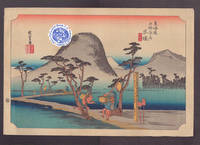
TOKAIDO GO JU SAN TSUGI NO UCHI: #8: HIRATSUKA NAWATA MICHI:THE FIFTY-THREE STAT
Tokyo n.d. ca 1920's. An Oban horizontal color woodblock print:35 x 22.8 cm. sheet: 38.1 x 22.3 cm. with superb impression and registry UNUSED excellent example seldom found. RARE EARLY EDITION . . . SUPERB COMPOSITION LANDSCAPE BY JAPAN'S MOST ICONIC . . . LANDSCAPE ARTIST & PRINTMAKER . . . HIROSHIGE . . . FROM THE SERIES: . . . TOKAIDO GO JU SAN TSUGI NO UCHI: . . . NO. 8 IN "THE 53 STATIONS OF THE TOKAIDO HIGHWAY" . . HIRATSUKA NAWATA MICHI: HIRATSUKA NAWATA ROAD . . THE ARTIST: ANDO Hiroshige 1797-1858 was the last major master of the Ukiyo-e school. In 1811 he entered the studio of Utagawa Toyohiro soon given the 'nom d'artiste' "Hiroshige." . He published his first color woodblock printed book in 1818. He was greatly influenced by Hokusai's series of landscape prints including this series TOKAIDO GO JU SAN TSUGI. Being impressed Hiroshige set out to do his own impressions of the Tokaido highway series. . . Hiroshige soon distinguished himself as the landscape master of Japan during this period. He made a large contribution to the development of the landscape color print as well as the traditional "Kacho" "Bird & Flower" prints with a tendency to the Kyoto Shijo School. He remained the master of impressionist creating poetic views of nature and remained the best-loved of all Japanese artists. See Lane below p.229. With signature samples by dates. . This is a circa 1920's reprint of the original edition. A pristine example UNUSED with superb impression and registry about as good as it can get. Ready for framing and display. . Color photos are posted to our website. . . unknown
Riferimento per il libraio : 44025701
|
|
|
HIROSHIGE, Ando I [Utagawa]
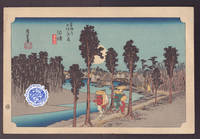
TOKAIDO GOJUSAN TSUGI NO UCHI: NUMAZU: #13 THE FIFTY-THREE STAGES OF THE TOKAID
Tokyo n.d. ca 1920's.Oban horizontal color woodblock print sheet: 38.4 x 25.6 cm.; print: 35 x 22 cm. a pristine copy superb registry and impressionnearly flawless verso clean bright & solid example seldom found. RARE EXAMPLE . . . A FLAWLESS & SUPERB EXAMPLE ! . . .HIROSHIGE: TOKAIDO GOJU-SAN TSUGI: 53 STAGES OF THE TOKAIDO . . . THIS IS PRINT NUMBER 13 MUMAZU . . . PILGRIMS ON THE PATH TO THE LODGING INN AT NUMAZU . A superb and stunning example with the artist's signature in lower left corner in block. With exceptionally vivid colors superb detail immaculate without flaw! . A The classic Ukiyo-e print by the master of landscape. The scene depicts three pilgrim travelers walking along a tree-lined river bank towards Numazu-shuku inn under a huge full moon in a deep blue sky. One of the travelers is wearing the white robes of a pilgrim and he is carrying a huge Tengu see below for definition mask on his back. This indicates his destination is the famed Shinto shrine of Konpira on Shikoku island. When he arrives there he will donate the mask to the shrine in an act of gaining 'merit.' . HIROSHIGE I 1797-1858: He was the last major master of the Ukiyo-E school. Studied under the eminent Toyohiro published book illustrations and several series of prints of actors warriors girls and landscapes. He and Hokusai are the two most eminent and celebrated artists of the Japanese woodblock genre. See Lane below for more details . . TENGU: An animial with a very long nose. Tengu are a type of legendary creature found in Shinto belief. They are considered a type of Yokai supernatural beings or Shinto Kami Gods or spirits. . CONDITION: A stunningly superb example flawless brilliantly executed. Superior color impression & registry. Seldom found in such pristine condition about as good as it can get. . There is a tiny mend on the right upper margin done in the distant past almost imperceptible of no impact and does not show up on our scan of the back side see spine.jpg photo on our website. . Color photos are posted to our website. . REFERENCE: . LANE Richard: IMAGES OF THE FLOATING WORLD see Tokaido map on p.230-231 Hiroshige biography p.229 list of Hiroshige signatures & dates page 229 pp.174-178 see p.233 for this print details. . . unknown
Riferimento per il libraio : 44027001
|
|
|
HIROSHIGE, Ando I [Utagawa]
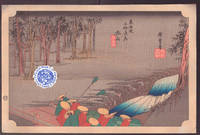
TOKAIDO GOJUSAN TSUGI NO UCHI TSUCHIYAMA #50: THE FIFTY-THREE STAGES OF THE TO
Tokyo n.d. ca 1920's.Oban horizontal color woodblock print sheet: 37.8 x 25.1 cm.; print:34.9 x 22.4 cm. a very superb example fine impression & registry2 old tiny mends on back top corners else extra clean firm & solid. RARE EXAMPLE . . . A FLAWLESS & SUPERB EXAMPLE ! . . .HIROSHIGE: TOKAIDO GOJU-SAN TSUGI: 53 STAGES OF THE TOKAIDO . . . THIS IS PRINT NUMBER 50. TSUCHIYAMA . . SHOGUN'S PROCESSION HEADING FOR TSUCHIYAMA JUKU LODGING . This classic by the master shows a Darmyo's procession of Samurai leading the way through "Haru same" "sudden spring shower." The procession rushes to shelter at the next Juku inn to take shelter. . Tsuchiyama-juku Tsuchiyama mountain inn is located on the main route from Kyoto to the Ise Grand Shrine and developed from the Heian period as a good location for travelers to pause before attempting the steep Suzuka Pass. . This kind of procession was part of the z"Sankin-kotai system." . The purpose was to strengthen central control over the d Daimyos who were major feudal lords. It required feudal lords Daimyo to alternate living for a year in their own domain and in Edo the capital. . HIROSHIGE I 1797-1858: He was the last major master of the Ukiyo-E school. Studied under the eminent Toyohiro published book illustrations and several series of prints of actors warriors girls and landscapes. He and Hokusai are the two most eminent and celebrated artists of the Japanese woodblock genre. See Lane below for more details. . Color photos are posted to our website. . CONDITION: . A stunningly superb example brilliantly executed with analine-blue indigo river. The impression & registry are fine seldom foud in such pristine condition about as good as it can get. . There are two tiny old mends on the verso back top edge. There is also the feint inperceptible hint of a minor bend to the lower corners our scanner can not pick these up. Of little impact. These can always be matted out when framing. See spine.jpg photo on our website. . REFERENCE: . LANE Richard: IMAGES OF THE FLOATING WORLD see Tokaido map on p.230-231 Hiroshige biography p.229 list of Hiroshige signatures & dates page 229 pp.174-178 see p.236 for this print details. . . . unknown
Riferimento per il libraio : 44027101
|
|
|
HIROSHIGE, Ando I [Utagawa]
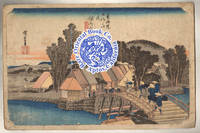
TOKAIDO GO JU SAN TSUGI NO UCHI: HODOGAYA SHIMACHI-BASHI: THE FIFTY-THREE STATIO
Edo 1833-34 Takenouchi. A single Oban horizontal color woodblock print: 35.7 x 23 cm. sheet:37.5 x 34.8 cm.dusty excellent impression and registry a bit of old 'rubbing' to surface else solid & firm. RARE EARLY EDITION . . . SUPERB COMPOSITION LANDSCAPE BY JAPAN'S MOST ICONIC . . . LANDSCAPE ARTIST & PRINTMAKER . . . HIROSHIGE . . . FROM THE SERIES: . . . TOKAIDO GO JU SAN TSUGI NO UCHI: . . . NO. 5 IN "THE 53 STATIONS OF THE TOKAIDO HIGHWAY" . . SHINMACHI-BASHI: NEW TOWN BRIDGE . . THE ARTIST: ANDO Hiroshige 1797-1858 was the last major master of the Ukiyo-e school. In 1811 he entered the studio of Utagawa Toyohiro soon given the 'nom d'artiste' "Hiroshige." . He published his first color woodblock printed book in 1818. He was greatly influenced by Hokusai's series of landscape prints including this series TOKAIDO GO JU SAN TSUGI. Being impressed Hiroshige set out to do his own impressions of the Tokaido highway series. . . Hiroshige soon distinguished himself as the landscape master of Japan during this period. He made a large contribution to the development of the landscape color print as well as the traditional "Kacho" "Bird & Flower" prints with a tendency to the Kyoto Shijo School. . He remained the master of impressionist creating poetic views of nature and remained the best-loved of all Japanese artists. See Lane below p.229. With signature samples by dates. . FAMOUS PRINT FROM THE FAMOUS TOKAIDO HIGHWAY SERIES: . This famous series by Ando Hiroshige I TOKAIDO GOJU SAN TSUGI NO UCHI: THE FIFTY-THREE STAGES OF THE TOKAIDO HIGHWAY has been a standard and famous series of 54 prints since its issue in 1833-34. This is stop #5 showing Hodogaya Shin Machi Bashi New Bridge over the Katabira river. . Published by Takenouchi Magohachi Hoeidô and Tsuruya Kiemon Senkakudô circa 1833-34 Tenpo 4-5th. years with the red Hanko seal/chop of both Hoeido and Senkakudo. . CONDITION: . NOTES ON SPECIFIC COPIES: . Copy 1.: This is the original FIRST EDITION of the print. It was published circa 1833-34. The front surface is rubbed dusty the back side is re-backed with some Japanese calligraphy paper. . The impression & registry are excellent the colors are strong. . There are some neat restorations to the back side of the print using Washi handmade Japanese mulberry fiber paper when the item was re-backed in the distant past. . The white borders intact and perhaps a tiny bit trimmed. . The front side as usual a bit dusty rubbed with minor soil a feint discoloration above the trees on the left 1/3. Regardless the image & coloring are strong & impressive. . The print has been 're-backed' some time in its distant past using some old Washi paper which appears to have been an old signature samples sheet with other Fude bamboo brush & Sumi black ink writing. There are 2 small pin/tiny holes which are mended by the backing. . This was a common practice in the early 19th century. The work is now quite firm & solid. The backing paper is not visible from the front side. . Given the fact that is print is about 187 years old it is in better than the average condition. Please review the photos prior to ordering. . edition. It is in pristine condition excellent registry & impression about as good as it can get. . Copy 2: This is a circa 1920's reprint of the original edition. A pristine example UNUSED with superb impression and registry about as good as it can get. Ready for framing and display. . Color photos are posted to our website. . REFERENCES: . This print was exhibited at Le Musée National des Arts Asiatiques Guimet July-October 2019. This print was offered at Sotheby's London: see Sothebys 2020/fine-japanese-art/utagawa- iroshige-i-1797-1858-four-prints-hodogaya This link shows our Hodogaya print as the top left example. Their estimate was about $993 per print in a group of 4. LANE Richard: IMAGES FROM THE FLOATING WORLD: THE JAPANESE PRINT: see p.229 for an excellent biography of Hiroshige PRINT INCLUDING AN ILLUSTRATED DICTIONARY OF UKIYO-E: see p.232 #1 he cites: "55 Oban prints ca. 1833-34 publishers Hoeidoh & Senkakudoh." This print being #5 of the Tokaido series cited as #74 page 232 & illustration. See his p.230-31 for a map of the Tokaido station series. Wikipedia: Hiroshige I: TOKAIDO GOJU SAN TSUGI: See wikipedia for more info on 53 Stations of the Tokaido. unknown
Riferimento per il libraio : 42023901
|
|
|
HIROSHIGE, Ando I [Utagawa]
TOTO YUKIMI HYAKKEI: SUMIDA GAWA TSUTSUMI NO KEI: EIGHT SNOW VIEWS OF EASTERN CA
Japan n.d. ca. 1920's. Oban sheet color woodblock printed sheet: 38 x 25.5 cm. print size: 34.5 x 22 cm. an unusually clean bright copy excellent registry and color a superbly executed example far and above average. . . . . A LOVELY DUSK SNOW SCENE ALONG THE SUMIDA RIVER . . This is a RARE reprint of the original nicely done the colors are true to the original. . A lovely & tender snow scene. The sun has just set its dusk snowing two coolies and two other people scurry along the snow-covered road. . Elongated flowing style clouds adorn the lower edge. This is typical Hiroshige style. With print title cartouche at upper left and Hiroshige's signature with Kiwame censor seal at upper right corner. . HIROSHIGE I: 1797-1858. Master of Japanese scenery illustrates his superb skill in the winter scene of a snowy dusk along the Sumida river. . A horizontal format print from the series of eight titled: TOTO YUKIMI HYAKKEI: VIEW OF EDO SNOW ALONG THE SUMIDA RIVER . Color photos are posted to our website. . CONDITION: The print is flawless no issues pristine clean firm and Solid in "collector's condition." . The colors are vivid with excellent impression & registry. As good as it can get ! Seldom found in such stunning condit on. . A superb example of fine color woodblock printing. . . unknown
Riferimento per il libraio : 41045801

|
|
|
Hiroshige, Utagawa
Uozukushi
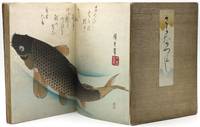
Tokyo: Daikokuya 1911. Second-hand hardcover. <p>Hiroshige Utagawa artist Uozukushi Every Variety of Fish. Reprint Daikokuya: Tokyo Meji 44 1911. 240x175mm cloth bds lepperollo oblong colour wood block prints 240x350mm In Japanese. Near Fine</p> <p><br /> <br /> æŒå·åºƒé‡ HIROSHIGE Utagawa born AndÅ TokutarŠ安藤 徳太郎 1797-1858<br /> <br /> ã•ã‹ãªã¤ãã— Uo Zukushi Shoal of Fishes<br /> <br /> Tokyo : 大黒屋 Daikokuya Meji 44 1911. First and only edition thus; illustrations first published TenpÅ 3-4 1832-3 and TenpÅ 11-13 1840-42<br /> <br /> 240x175mm tatami mat style boards illustrated colour title label accordion or lepperello folding horizontal chÅ«ban album cream handmade paper seven nishiki-e woodblock engraved illustrations with kirazuri silver mica decoration. Boards faintly soiled edges lightly frayed; hinges fragile first fold neatly split; remnants of bookseller ticket to front paste-down; faint age toning and soiling not affecting the illustrations.<br /> <br /> ¶ Hiroshige is widely considered the last of the grand master printers of the Ukiyo-e tradition. In 1832-4 TenpÅ 3-4 he produced a series of ten illustrations of fish with accompanying culinary herbs and vegetables together with poems published by Eijudo. A decade later a series of a further ten illustrations were produced by Yamasho. The illustrations were then reproduced commercially bearing publisher and censor stamps. Together the two untitled series are known as "Large Fish" or "Shoal of Fishes" or "Every Variety of Fish". <br /> <br /> The illustrations here are a selection from both series: Carp Koi swimming amongst reeds circa 1840-42 TenpÅ 11-13 poem by Makuzu; Abalone Awabi or Tokobushi Needlefish Sayori and Peach Blossoms circa 1832-3 TenpÅ 3-4 poems by Kumogaki Fujimi and Miwagaki Mimiki; Black Sea Bream Kurodai Small Sea Bream Kodai Asparagus shoots and Japanese Peppercorns Sansho circa 1832-33 TenpÅ 3-4 poems by Tomigaki Uchiyasu and Echigo Kawabukuro Kaôan hôshi Kaôan hôshi from Kawabukuro in Echigo Province; Lobster Ise ebi and Prawn Ama ebi circa 1832-33 TenpÅ 3-4 poems by Shimotsuke Edozaki Ryokujuen Motoari Ryokujuen Motoari from Edozaki in Shimotsuke Province and Nen'an Machikado; Flying fish Tobiuo White Croaker Ishimochi Guchi or Shiroguchi and a lily circa 1840-42 TenpÅ 11-13 poem by Toshigaki Maharu; Gurnard Kanagashira Right-Eye Flounder Konoa-garei and Bamboo Grass Sasa circa 1832-33 TenpÅ 3-4 poems by Shimotsuke Edozaki Ryokujuen Motoari Ryokujuen Motoari from Edozaki in Shimotsuke Province and Jakuyakutei Chikuson; and Japanese Sea Perch Suzuki and Red Bream Kaneme-tai and shiso leaves circa 1840-42 TenpÅ 11-13 poem by Atsugaki. <br /> <br /> To the front paste down is a calligraphic inscription 御ã†ã¤ãã—ã¿ã®æ³¢ Waves of Imperial Beauty by Maresuke Nogi 1859-1912 a Meiji era career military man in the Japanese Imperial Army. A general in the first Sino-Japanese War 1894-5 the invasion of Taiwan and the Russo-Japanese War 1904-5 he was feted as a national hero for his role in the capture of Port Arthur. He was also a man of letters and a renowned Kanshi poet a form of Han Chinese poetry popular amongst the Japanese elite during his life. Several of his poems were very popular during the early decades of the Twentieth century. In 1912 Nogi and his wife committed ritual suicide by seppuku shortly after the death of Emperor Meiji in accordance with the samurai practice of following one's master into death. At the time Nogi became a public symbol of loyalty and sacrifice and there are several Shinto shrines to his memory in Tokyo and Kyoto.<br /> <br /> Daikokuya was a multi-generational publisher of ukiyo-e prints illustrations and later illustrated books from 1764-1931 in Edo/Tokyo. Artists published during the nineteenth century include Utagawa Hiroshige. Daikokuya were quite successful during the late Meji era publishing many illustrated works relating to the Russo-Japanese War; perhaps explaining the inscription by Nogi.<br /> <br /> Rare. A lovely copy.<br /> <br /> § OCLC records no holdings. NIJL holds one copy.<br /> <br /> </p> Daikokuya unknown
Riferimento per il libraio : 10476
|
|
|
Hiroshige, Ando // Introduction Bryan Holme
Hiroshige: A Shoal of Fishes.
London, Thames and Hudson / The Metropolitan Museum of Art, 1980. 3 S. + 20 Bildtafeln (Leporello); (27x19,5 cm) Leinen im Schuber / gebundene Ausgabe
Riferimento per il libraio : 52630 ISBN : 500012490
|
|
|
HIROSHIGE, Utagawa.
Bird's-eye view of Komagata Temple & Azuma Bridge???????? 100 famous Views of Edo ????????
Tokyo Yuyudo C1930 Une magnifique estampe sur bois reproduisant l'une des célèbres illustrations d'Hiroshige issues de la collection « Cent vues célèbres d'Edo ». Cette estampe représente le temple Komagata-do et le pont Azuma. Publiée à l'origine par Uoei en 1857, cette reproduction est l'uvre de Yuyudo. Bien qu'elle ne porte pas de date, elle date probablement des années 1930. Bien qu'il s'agisse d'une reproduction, il s'agit d'une véritable copie sur bois (et non d'une impression numérique ou lithographique moderne). En excellent état, elle est simplement collée dans un passe-partout, mais peut être retirée pour être encadrée. Le temple Komagata-do est situé sur un terrain triangulaire près du pont Komagata, dans le quartier de Kaminarimon 2-chome, arrondissement de Taito. À l'origine, il s'agissait d'un temple de style entrepôt situé sur les berges de la rivière à Komagata 1-chome, abritant un Bato Kannon (Kannon à tête de cheval). Les habitants d'Edo prononcent le nom du temple Komagata-do « Komando ». L'illustration, peut-être inspirée du célèbre poème de la geisha Takao, « Tu es maintenant près de Komagata, chantant le coucou », représente un coucou volant dans le ciel. La reproduction du ciel pluvieux de mai est magnifique et met en valeur le talent de l'imprimeur. L'image montre le pont Azuma depuis le toit du temple Komagata-do, représentant les maisons sur la rive de la rivière Honjo de l'autre côté. Le mur blanc appartient à la résidence inférieure de Hosokawa Notonokami. Un drapeau rouge est visible au premier plan. Il s'agit du drapeau-enseigne d'un magasin général appelé « Hyakusuke », situé en face du Komagata-do, qui vendait du rouge à lèvres et de la poudre pour le visage. Il était conçu pour être visible de loin, mettant en avant le rouge à lèvres qu'ils vendaient. C'était une enseigne très accrocheuse à l'époque. 34 cm x 23 cm. Le passe-partout mesure 49 cm x 34 cm.
Riferimento per il libraio : 5585
|
|
|
HIROSHIGE, Utagawa.
Summer Moon at Ryogoku Bridge ????
Tokyo N.P C1930 Une magnifique estampe sur bois reproduisant l'une des célèbres illustrations d'Hiroshige. Bien qu'elle ne porte pas de date, elle date probablement des années 1930. Bien qu'il s'agisse d'une reproduction, c'est une véritable estampe sur bois (et non une impression numérique ou lithographique moderne). En excellent état, elle est légèrement collée sur une feuille de carton et est accompagnée d'un étui rigide. Un poème humoristique de Hachijintei est inscrit en haut de cette estampe. Peu après avoir achevé « Les cinquante-trois stations du Tokaido », Hiroshige publia « Les lieux célèbres d'Edo au fil des quatre saisons », un ensemble de quatre estampes : « La lune sur Ryogoku », « La neige sur la rivière Sumida », « Les fleurs sur Gotenyama » et « Les érables rouges au temple Kaimoji ». Chacune de ces uvres combine habilement composition et couleur dans un style « à poils longs », et bien qu'il s'agisse de petites pièces datant de l'apogée de Hiroshige, elles sont considérées comme l'une de ses séries de chefs-d'uvre. Il n'y a aucune mention de l'éditeur sur l'uvre. Dans un excellent état général, avec juste une légère tache due au procédé d'impression d'origine sur le bord droit. L'estampe mesure 44,5 cm x 15,5 cm. Le carton de support et le dossier mesurent 44,5 cm x 31 cm.
Riferimento per il libraio : 5608
|
|
|
HIROSHIGE.
One Hundred Famous Views of Edo.
2007 Couverture rigide Paris, George Braziller, 2007. In-folio (25x37cm), reliure d'éditeur pleine toile, jaquette à rabats illustrée en couleurs, titre en rouge au dos, quelques marques d'usage au verso de la jaquette. 256 pages. Le livre se compose de 119 gravures sur bois en couleurs, illustrant des paysages ou des scènes de genre de la ville d'Edo au milieu du XIXème siècle. Chaque planche est accompagnée d'un texte descriptif en regard, en anglais. Publié pour la première fois en 1986, l'ouvrage a connu plusieurs réimpressions. Notre exemplaire fait partie du 6ème tirage (2007). Etat intérieur excellent, bel exemplaire.
Riferimento per il libraio : 979

|
|
|
Hiroshige. Gaines Ruth
TREASURE FLOWER. A Child of Japan
NY: Dutton 1916. Blue cloth binding with gilt lettering & decorations. Buff printed dust jacket with design repeating that of the binding. VG slt lean/faint old dampstain at lower base of ffep extends through few of preliminary leaves/unobtrusive abrasion hole in ffep. 205 pp. 12 full page inserted illustrations on coated paper 4. 9 by Hiroshige. 8vo. <br/><br/> Dutton hardcover books
Riferimento per il libraio : 15730

|
|
|
Hiroshige. Introduction et commentaires de Serge Elisséef
Tôkaidô.
Paris, Editions du Crédit Lyonnais, 1960, in-4, en feuilles sous étui dépliant toilé avec fermoirs, Très légères rousseurs sur le 4e plat de l'étui. Bel exemplaire. 55 planches couleurs de toute fraîcheur.
Riferimento per il libraio : 26662

|
|
|
Hiroshige: Amsden Dora and JS. Harper J. S.
THE HERITAGE OF HIROSHIGE
San Francisco: Paul Elder and Company 1912. Morocco-grained cloth stamped in blind. Frontis and plates. Headlines printed in red. First edition. A very good copy. Paul Elder and Company hardcover books
Riferimento per il libraio : WRCLIT64853
|
|
|
Hiroshige; Melanie Trede & Lorenz Bichler
Hiroshige
Köln: Taschen 2009. First printing thus. Publisher's full printed silk. Gentle shelf wear still fine. 13" x 10 Taschen unknown
Riferimento per il libraio : 239967
|
|
|
Hiroshige; Shiko Munakata; Yoshitomo Nara; Akira Yamaguchi; Kazuyuki Takezaki
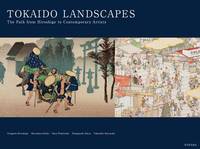
Tokaido Landscapes - The Path from Hiroshige to Contemporary Artists
Nohara Co. Ltd. New. 2012. Hardcover. 490425709X . FREE UPGRADE to Courier/Priority Shipping Upon Request - IN STOCK AND IMMEDIATELY AVAILABLE FOR SHIPMENT - Flawless copy brand new pristine never opened -- Text in Japanese and English. 200 pp. ; 194 illustrations most in color. -- with a bonus offer-- . Nohara Co. Ltd. hardcover
Riferimento per il libraio : 99743 ISBN : 490425709X 9784904257098
|
|
|
Hiroshige; Shigeki Goto
Ukiyo-e Series Volume 17: Famous Places of Edo 100 Views
Shueisha Co. Ltd. 1976. Hardcover. Like New. . Japanese language text. Profusely illustrated. Full page full color plates. Shueisha Co. Ltd. hardcover
Riferimento per il libraio : mon0003427031
|
|

 Ricevere i risultati per e-mail
 Scaricare i risultati in PDF
 RSS feed
 Link
Link


