|
Louis ANQUETIN
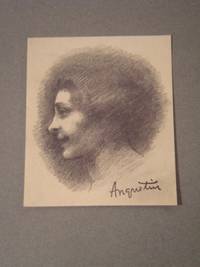
Profil de femme
1899. Fine. Fin XIXème - Début XXème 9.50 x 12 cm Original pencil drawing mounted on board. Artist's signature stamp in the lower right corner of the work and atelier signature stamp on verso. Very fine condition. Provenance: from the artist's studio referenced in the catalogue Atelier Louis Anquetin Thierry de Maigret 28/11/08. Louis Anquetin born in Étrépagny in 1861 and died in Paris in 1932 is an important French painter. He began his career alongside avant-garde painters such as Vincent Van Gogh and Henri de Toulouse-Lautrec. With Émile Bernard he was the inventor of Cloisonnism. From 1884 to 1893 Louis Anquetin continuously explored the new possibilities offered by the liberation introduced by Impressionism into French painting. From 1893 onwards following a long confrontation with the ""masters of old"" he adopted a pictorial stance that would place him on the margins of the general art movement and distance him from his friends. Dazzled by Baroque art and its creative vigor he then believed that his childhood friends had embarked on a path that would lead to the death of painting. He believed in a ""perfect painting"" that was embodied in remembering the lessons of Michelangelo and Rubens in particular. His work thus became more classical; he advocated a return to craftsmanship proposing to reflect on the a priori conditions of any possible art form while respecting the rules of perspective and anatomy as practiced by the masters of the 16th and 17th centuries. Leaving only a few works that can be described as monumental Anquetin proved prolific through his numerous studies and sketches he who considered drawing to be ""an all-powerful means of expression"" the obligatory foundation of all plastic arts. By deliberately working against the grain of his era Louis Anquetin made possible the existence of an original modern figuration. Through his obstinacy and passion for painting he indeed prevented the path of the great Western tradition from being completely blocked. His works can be admired in numerous prestigious museums such as the Musée d'Orsay and the Louvre in Paris in San Francisco and Detroit at the Hermitage Museum in Saint Petersburg at the National Gallery and the Tate in London etc. unknown
Referencia librero : 25813
|
|
|
Louis ANQUETIN
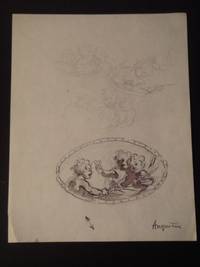
Projets pour le plafond de Chambon : Étude 1
1899. Fine. Fin XIXème - Début XXème 21 x 27 cm Original pencil drawing heightened with ink mixed technique. Artist's signature stamp in the lower right corner of the work and studio stamp signature on verso. A minute corner fold and two small inconsequential stains otherwise very fine condition. Provenance: artist's studio catalogued in Atelier Louis Anquetin Thierry de Maigret 28/11/08. Louis Anquetin born in Étrépagny in 1861 and died in Paris in 1932 was an important French painter. He began his career alongside avant-garde painters such as Vincent Van Gogh and Henri de Toulouse-Lautrec. Together with Émile Bernard he invented Cloisonnism. From 1884 to 1893 Louis Anquetin continuously explored the new possibilities offered by the liberation introduced by Impressionism in French painting. From 1893 onwards following a lengthy confrontation with the ""masters of old"" he adopted a pictorial stance that would place him on the margins of the general art movement and distance him from his friends. Dazzled by Baroque art and its creative vigor he then believed that his youthful friends had embarked on a path that would lead to the death of painting. He believed in a ""perfect painting"" embodied in remembering the lessons of Michelangelo and Rubens in particular. His work thus became more classical; he advocated a return to craftsmanship proposing reflection on the a priori conditions of any possible form of art while respecting the rules of perspective and anatomy as practiced by the masters of the 16th and 17th centuries. Leaving only a few works that can be described as monumental Anquetin proved prolific through his numerous studies and sketches considering drawing to be ""an all-powerful means of expression"" the essential foundation of all plastic arts. By deliberately working against the grain of his era Louis Anquetin made possible the existence of an original modern figuration. Through his obstinacy and passion for painting he prevented the complete obstruction of the path to the great Western tradition. His works can be admired in numerous prestigious museums such as the Musée d'Orsay and the Louvre in Paris in San Francisco and Detroit at the Hermitage Museum in Saint Petersburg at the National Gallery and the Tate in London etc. unknown
Referencia librero : 25639
|
|
|
Louis ANQUETIN
Projets pour le plafond de Chambon : Étude 2
1899. Fine. Fin XIXème - Début XXème 21 x 27 cm Original pencil drawing heightened with ink mixed technique. Artist's signature stamp in the lower right corner of the work and studio stamp signature on verso. A minute corner fold otherwise very fine condition. Provenance: artist's studio catalogued in Atelier Louis Anquetin Thierry de Maigret 28/11/08. Louis Anquetin born in Étrépagny in 1861 and died in Paris in 1932 was an important French painter. He began his career alongside avant-garde painters such as Vincent Van Gogh and Henri de Toulouse-Lautrec. Together with Émile Bernard he invented Cloisonnism. From 1884 to 1893 Louis Anquetin continuously explored the new possibilities offered by the liberation introduced by Impressionism in French painting. From 1893 onwards following a lengthy confrontation with the ""masters of old"" he adopted a pictorial stance that would place him on the margins of the general art movement and distance him from his friends. Dazzled by Baroque art and its creative vigor he then believed that his youthful friends had embarked on a path that would lead to the death of painting. He believed in a ""perfect painting"" embodied in remembering the lessons of Michelangelo and Rubens in particular. His work thus became more classical; he advocated a return to craftsmanship proposing reflection on the a priori conditions of any possible form of art while respecting the rules of perspective and anatomy as practiced by the masters of the 16th and 17th centuries. Leaving only a few works that can be described as monumental Anquetin proved prolific through his numerous studies and sketches considering drawing to be ""an all-powerful means of expression"" the essential foundation of all plastic arts. By deliberately working against the grain of his era Louis Anquetin made possible the existence of an original modern figuration. Through his obstinacy and passion for painting he prevented the complete obstruction of the path to the great Western tradition. His works can be admired in numerous prestigious museums such as the Musée d'Orsay and the Louvre in Paris in San Francisco and Detroit at the Hermitage Museum in Saint Petersburg at the National Gallery and the Tate in London etc. unknown
Referencia librero : 25640
|
|
|
Louis ANQUETIN
Projets pour le plafond de Chambon : Étude 5 - Crayon sur papier
1899. Fine. Fin XIXème - Début XXème 21 x 27 cm Original pencil drawing. Stamp signature of the artist in the lower right corner of the work and stamp signature of the studio on the verso. A tiny corner crease otherwise very fine condition. Provenance: from the artist's studio referenced in the catalogue Atelier Louis Anquetin Thierry de Maigret 28/11/08. Louis Anquetin born in Étrépagny in 1861 and died in Paris in 1932 was an important French painter. He began his career alongside avant-garde painters such as Vincent Van Gogh and Henri de Toulouse-Lautrec. With Émile Bernard he invented Cloisonnism. From 1884 to 1893 Louis Anquetin continuously explored the new possibilities offered by the liberation introduced by Impressionism in French painting. From 1893 onwards following a long confrontation with the ""masters of old"" he adopted a pictorial stance that would place him on the margins of the general art movement and distance him from his friends. Dazzled by Baroque art and its creative vigor he then believed that his youthful friends had embarked on a path that would lead to the death of painting. He believed in a ""perfect painting"" embodied in the remembrance of the lessons of Michelangelo and Rubens in particular. His work thus became more classical; he advocated a return to craftsmanship proposing to reflect on the a priori conditions of any possible form of art while respecting the rules of perspective and anatomy as practiced by the masters of the 16th and 17th centuries. Leaving only a few works that could be called monumental Anquetin proved prolific through his numerous studies and sketches he who considered that drawing was ""an all-powerful means of expression"" the obligatory foundation of all plastic arts. By deliberately working against his era Louis Anquetin made possible the existence of an original modern figuration. Through his obstinacy and passion for painting he indeed prevented the path of the great Western tradition from being completely blocked. His works can be admired in numerous prestigious museums such as the Musée d'Orsay and the Louvre in Paris in San Francisco and Detroit at the Hermitage Museum in St. Petersburg at the National Gallery and the Tate in London etc. unknown
Referencia librero : 25644
|
|
|
Louis ANQUETIN
Projets pour le plafond de Chambon : Étude 4 - Crayon sur papier
1899. Fine. Fin XIXème - Début XXème 21 x 27 cm Original pencil drawing. Artist's signature stamp in the lower right corner of the work and studio signature stamp on verso. A minimal corner fold otherwise very fine condition. Provenance: from the artist's studio referenced in the catalogue Atelier Louis Anquetin Thierry de Maigret 28/11/08. Louis Anquetin born in Étrépagny in 1861 and died in Paris in 1932 was an important French painter. He began his career alongside avant-garde painters such as Vincent Van Gogh and Henri de Toulouse-Lautrec. With Émile Bernard he was the inventor of Cloisonnism. From 1884 to 1893 Louis Anquetin continuously explored the new possibilities offered by the liberation introduced by Impressionism in French painting. From 1893 onwards following a long confrontation with the ""masters of the past"" he adopted a pictorial stance that would place him on the margins of the general movement of art and distance him from his friends. Dazzled by Baroque art and its creative vigor he then believed that his youthful friends had embarked on a path that would lead to the death of painting. He believed in a ""perfect painting"" that was embodied in the remembrance of the lessons of Michelangelo and Rubens in particular. His work therefore became more classical; he advocated a return to craftsmanship proposing to reflect on the a priori conditions of any possible form of art while respecting the rules of perspective and anatomy as practiced by the masters of the 16th and 17th centuries. Leaving only a few works that could be described as monumental Anquetin proved prolific through his numerous studies and sketches he who considered that drawing was ""an all-powerful means of expression"" the obligatory foundation of all plastic arts. By deliberately working against the grain of his era Louis Anquetin made possible the existence of an original modern figuration. Through his obstinacy and his passion for painting he indeed prevented the complete obstruction of the path of the great Western tradition. His works can be admired in numerous and prestigious museums such as the Musée d'Orsay or the Louvre in Paris in San Francisco or Detroit at the Hermitage Museum in Saint Petersburg at the National Gallery and the Tate in London etc. unknown
Referencia librero : 25642
|
|
|
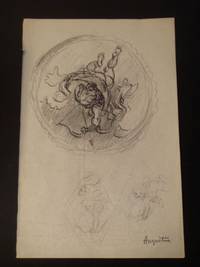
Louis ANQUETIN
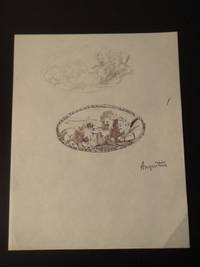
Projets pour le plafond de Chambon : Étude 6
1899. Fine. Fin XIXème - Début XXème 27 x 31 cm Original pencil drawing heightened with ink mixed media on a recto-verso sheet. Stamp signature of the artist in the lower right corner of the work and stamp signature of the studio on the verso. A small tear in the left margin not touching the drawing 2 cm otherwise very fine condition. Provenance: from the artist's studio referenced in the catalogue Atelier Louis Anquetin Thierry de Maigret 28/11/08. Louis Anquetin born in Étrépagny in 1861 and died in Paris in 1932 was an important French painter. He began his career alongside avant-garde painters such as Vincent Van Gogh and Henri de Toulouse-Lautrec. With Émile Bernard he invented Cloisonnism. From 1884 to 1893 Louis Anquetin continuously explored the new possibilities offered by the liberation introduced by Impressionism in French painting. From 1893 onwards following a long confrontation with the ""masters of old"" he adopted a pictorial stance that would place him on the margins of the general art movement and distance him from his friends. Dazzled by Baroque art and its creative vigor he then believed that his youthful friends had embarked on a path that would lead to the death of painting. He believed in a ""perfect painting"" embodied in the remembrance of the lessons of Michelangelo and Rubens in particular. His work thus became more classical; he advocated a return to craftsmanship proposing to reflect on the a priori conditions of any possible form of art while respecting the rules of perspective and anatomy as practiced by the masters of the 16th and 17th centuries. Leaving only a few works that could be called monumental Anquetin proved prolific through his numerous studies and sketches he who considered that drawing was ""an all-powerful means of expression"" the obligatory foundation of all plastic arts. By deliberately working against his era Louis Anquetin made possible the existence of an original modern figuration. Through his obstinacy and passion for painting he indeed prevented the path of the great Western tradition from being completely blocked. His works can be admired in numerous prestigious museums such as the Musée d'Orsay and the Louvre in Paris in San Francisco and Detroit at the Hermitage Museum in St. Petersburg at the National Gallery and the Tate in London etc. unknown
Referencia librero : 25648
|
|
|
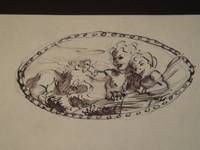
Louis ANQUETIN
Projets pour le plafond de Chambon : Étude 3
1899. Fine. Fin XIXème - Début XXème 21 x 27 cm Original pencil drawing heightened with ink mixed technique. Artist's signature stamp in the lower right corner of the work and studio signature stamp on verso. Very fine condition. Provenance: from the artist's studio referenced in the catalogue Atelier Louis Anquetin Thierry de Maigret 28/11/08. Louis Anquetin born in Étrépagny in 1861 and died in Paris in 1932 was an important French painter. He began his career alongside avant-garde painters such as Vincent Van Gogh and Henri de Toulouse-Lautrec. With Émile Bernard he was the inventor of Cloisonnism. From 1884 to 1893 Louis Anquetin continuously explored the new possibilities offered by the liberation introduced by Impressionism in French painting. From 1893 onwards following a long confrontation with the ""masters of the past"" he adopted a pictorial stance that would place him on the margins of the general movement of art and distance him from his friends. Dazzled by Baroque art and its creative vigor he then believed that his youthful friends had embarked on a path that would lead to the death of painting. He believed in a ""perfect painting"" that was embodied in the remembrance of the lessons of Michelangelo and Rubens in particular. His work therefore became more classical; he advocated a return to craftsmanship proposing to reflect on the a priori conditions of any possible form of art while respecting the rules of perspective and anatomy as practiced by the masters of the 16th and 17th centuries. Leaving only a few works that could be described as monumental Anquetin proved prolific through his numerous studies and sketches he who considered that drawing was ""an all-powerful means of expression"" the obligatory foundation of all plastic arts. By deliberately working against the grain of his era Louis Anquetin made possible the existence of an original modern figuration. Through his obstinacy and his passion for painting he indeed prevented the complete obstruction of the path of the great Western tradition. His works can be admired in numerous and prestigious museums such as the Musée d'Orsay or the Louvre in Paris in San Francisco or Detroit at the Hermitage Museum in Saint Petersburg at the National Gallery and the Tate in London etc. unknown
Referencia librero : 25641
|
|
|
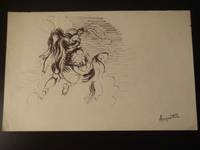
Louis ANQUETIN
Projets pour le plafond de Chambon : Étude 7 - Encre sur papier
1899. Fine. Fin XIXème - Début XXème 27 x 31 cm Original ink drawing. Stamped signature of the artist in the lower right corner of the work and studio stamp signature on verso. A tiny lack to the edge of the right margin otherwise very fine condition. Provenance: from the artist's studio catalogued in Atelier Louis Anquetin Thierry de Maigret 28/11/08. Louis Anquetin born in Étrépagny in 1861 and died in Paris in 1932 was an important French painter. He began his career alongside avant-garde painters such as Vincent Van Gogh and Henri de Toulouse-Lautrec. With Émile Bernard he invented Cloisonnism. From 1884 to 1893 Louis Anquetin continuously explored the new possibilities offered by the liberation introduced by Impressionism in French painting. From 1893 onwards following a lengthy confrontation with the ""masters of old"" he adopted a pictorial approach that would place him on the margins of the general movement of art and distance him from his friends. Dazzled by baroque art and its creative vigour he then believed that his youthful friends had embarked on a path that would lead to the death of painting. He believed in a ""perfect painting"" embodied in the remembrance of the lessons of Michelangelo and Rubens in particular. His work therefore became more classical; he advocated a return to craftsmanship proposing to reflect on the a priori conditions of any possible form of art while respecting the rules of perspective and anatomy as practiced by the masters of the 16th and 17th centuries. Leaving only a few works that could be described as monumental Anquetin proved prolific through his numerous studies and sketches considering as he did that drawing was ""an all-powerful means of expression"" the essential foundation of all plastic arts. By deliberately working against the grain of his era Louis Anquetin made possible the existence of an original modern figuration. Through his obstinacy and passion for painting he indeed prevented the complete obstruction of the path to the great Western tradition. His works can be admired in numerous prestigious museums such as the Musée d'Orsay and the Louvre in Paris in San Francisco and Detroit at the Hermitage Museum in St. Petersburg at the National Gallery and the Tate in London etc. unknown
Referencia librero : 25650
|
|
|
Louis ANQUETIN
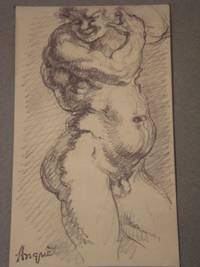
Satyre
1899. Fine. Fin XIXème - Début XXème 14 x 18 cm Original pencil drawing mounted on tab on cardboard. Artist's stamp signature in the lower left corner of the work and workshop stamp signature on verso. Very fine condition. Provenance: artist's studio referenced in the catalogue Atelier Louis Anquetin Thierry de Maigret 28/11/08. Louis Anquetin born in Étrépagny in 1861 and died in Paris in 1932 was an important French painter. He began his career alongside avant-garde painters such as Vincent Van Gogh and Henri de Toulouse-Lautrec. With Émile Bernard he invented Cloisonnism. From 1884 to 1893 Louis Anquetin continuously explored the new possibilities offered by the liberation introduced by Impressionism in French painting. From 1893 onwards following a long confrontation with the ""old masters"" he adopted a pictorial stance that would place him on the margins of the general art movement and distance him from his friends. Dazzled by baroque art and its creative vigor he then believed that his youthful friends had embarked on a path that would lead to the death of painting. He believed in ""perfect painting"" embodied in the remembrance of the lessons of Michelangelo and Rubens among others. His work therefore became more classical; he advocated a return to craft proposing to reflect on the a priori conditions of any possible form of art while respecting the rules of perspective and anatomy as practiced by the masters of the 16th and 17th centuries. Leaving only a few works that can be described as monumental Anquetin proved prolific through his numerous studies and sketches as he considered drawing to be ""an all-powerful means of expression"" the obligatory foundation of all plastic arts. By deliberately working against the grain of his era Louis Anquetin made possible the existence of an original modern figuration. Through his obstinacy and passion for painting he indeed prevented the complete obstruction of the path of the great Western tradition. His works can be admired in numerous prestigious museums such as the Musée d'Orsay and the Louvre in Paris in San Francisco and Detroit at the Hermitage Museum in Saint Petersburg at the National Gallery and the Tate in London etc. unknown
Referencia librero : 25809
|
|
|
Louis ANQUETIN
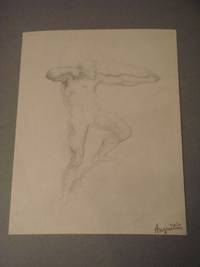
Tireur à l'arc
1899. Fine. Fin XIXème - Début XXème 21 x 27 cm Original pencil drawing mounted on board. Artist's signature stamp in the lower right corner of the work and atelier signature stamp on verso. Very fine condition. Provenance: from the artist's studio referenced in the catalogue Atelier Louis Anquetin Thierry de Maigret 28/11/08. Louis Anquetin born in Étrépagny in 1861 and died in Paris in 1932 is an important French painter. He began his career alongside avant-garde painters such as Vincent Van Gogh and Henri de Toulouse-Lautrec. With Émile Bernard he was the inventor of Cloisonnism. From 1884 to 1893 Louis Anquetin continuously explored the new possibilities offered by the liberation introduced by Impressionism into French painting. From 1893 onwards following a long confrontation with the ""masters of old"" he adopted a pictorial stance that would place him on the margins of the general art movement and distance him from his friends. Dazzled by Baroque art and its creative vigor he then believed that his childhood friends had embarked on a path that would lead to the death of painting. He believed in a ""perfect painting"" that was embodied in remembering the lessons of Michelangelo and Rubens in particular. His work thus became more classical; he advocated a return to craftsmanship proposing to reflect on the a priori conditions of any possible art form while respecting the rules of perspective and anatomy as practiced by the masters of the 16th and 17th centuries. Leaving only a few works that can be described as monumental Anquetin proved prolific through his numerous studies and sketches he who considered drawing to be ""an all-powerful means of expression"" the obligatory foundation of all plastic arts. By deliberately working against the grain of his era Louis Anquetin made possible the existence of an original modern figuration. Through his obstinacy and passion for painting he indeed prevented the path of the great Western tradition from being completely blocked. His works can be admired in numerous prestigious museums such as the Musée d'Orsay and the Louvre in Paris in San Francisco and Detroit at the Hermitage Museum in Saint Petersburg at the National Gallery and the Tate in London etc. unknown
Referencia librero : 25817
|
|
|
Louis ANQUETIN
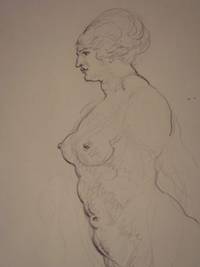
Étude de nu féminin 1
1899. Fine. Fin XIXème - Début XXème 23 x 36 cm Original pencil drawing. Stamp signature of the artist in the lower right corner of the work and stamp signature of the studio on verso. Light fold marks two tiny tears in left margin 1 cm and right margin 0.5 cm otherwise very fine condition. Provenance: artist's studio referenced in the catalogue Atelier Louis Anquetin Thierry de Maigret 28/11/08. Louis Anquetin born in Étrépagny in 1861 and died in Paris in 1932 is an important French painter. He began his career alongside avant-garde painters such as Vincent Van Gogh or Henri de Toulouse-Lautrec. With Émile Bernard he invented Cloisonnism. From 1884 to 1893 Louis Anquetin continuously explored the new possibilities offered by the liberation introduced by Impressionism in French painting. From 1893 onwards following a long confrontation with the ""old masters"" he adopted a pictorial stance that would place him on the margins of the general art movement and distance him from his friends. Dazzled by baroque art and its creative vigor he then thought that his youthful friends had embarked on a path that would lead to the death of painting. He believed in a ""perfect painting"" embodied in the remembrance of the lessons of Michelangelo and Rubens in particular. His work thus became more classical; he advocated a return to craftsmanship proposing to reflect on the a priori conditions of any possible form of art while respecting the rules of perspective and anatomy as practiced by the masters of the 16th and 17th centuries. Leaving only a few works that could be qualified as monumental Anquetin proved prolific through his numerous studies and sketches he who considered drawing to be ""an all-powerful means of expression"" the obligatory foundation of all plastic arts. By deliberately working against his era Louis Anquetin made possible the existence of an original modern figuration. Through his obstinacy and passion for painting he indeed prevented the complete obstruction of the path of the great Western tradition. His works can be admired in numerous and prestigious museums such as the Musée d'Orsay or the Louvre in Paris in San Francisco or Detroit at the Hermitage Museum in Saint Petersburg at the National Gallery and the Tate in London etc. unknown
Referencia librero : 25795
|
|
|
Louis Antoine Hameral, Jean Claude Marc Baraguey, Gregoire Baraguay, Jean Francois Arnois
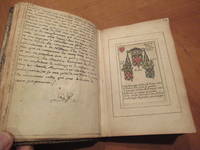
Les Armes Des Roys Et Princes De L'europe Original Bound Manuscript Of Heraldry With Elaborately Colored And Gilt
Dieppe: Pensionnaires Du College De Dieppe 1775. Original Manuscript . Hardcover. Good. 140 4. Full Calf Five Raised Bands Morocco Spine Label Covers With Gilt Borders And Corner DecorationsEdges And Turns Gilt Page Edges Gilt. Dedication To Le Marquis De Manneville Gouvernour Des Villes Et Chateaux De Dieppe Et D'arques. Four Uncolored Coats Of Arms On Front Endpaper Four On Rear Endpaper Another Larger Folding Plate Bound In Between Pages 8 And 9; Gilt And Colored Title Page And 47 Colored And Gilt Coats Of Arms Mounted With Text On Facing Pages. Lacking Pp 13-18 Which Have Been Excised Possibly An Introduction Immediately Following The Title Page. Rebacked Old On New Conditioned Corners Repaired Furbished New Morocco Spine Label. <br/> <br/> Pensionnaires Du College De Dieppe hardcover
Referencia librero : 039648
|
|
|
Louis Antoine de BOUGAINVILLE
Voyage autour du monde par la fregate du roi La Boudeuse et la flûte L'Etoile ; en 1766 1767 1768 & 1769 Voyage Around the World by the Kings Frigate La Boudeuse and the Store-Ship LÉtoile; in 1766 1767 1768 & 1769
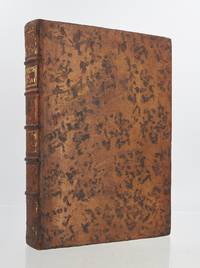
Paris: Chez Saillant & Nyon 1771. Fine. Chez Saillant & Nyon Paris 1771 19 x 26 cm relié First edition with 18 engraved maps et 5 folding engraved plates. Contemporary tan calf skillfully restored tear to the first folding map some marginal restorations to the map Troisième division - Archipel des navigateurs. Falkland Islands map expertly rebacked on the outer margin as well as the Magellan Strait map. Map of the Buton Strait with a small marginal tear and a second restored with a strip of paper. Bougainville undertook the first official French circumnavigation and scientific expedition. Starting from Nantes in November 1766 he sailed to the Falklands made a stopover in Buenos Aires and then crossed the Magellan Strait and the Pacific through the East Indies. The expedition visited the Samoan Islands Tahiti the New Hebrides. 300-word glossary of Polynesian language Tahiti in-fine. He first went to Paraguay to the main Portuguese settlement and gives engaging geographical and commercial descriptions. Details on the Falkland Islands and on Brazil are also instructive. The reader is pleasantly surprised to find . the delicious picture of the island of Tahiti. Sailing away from this blessed island the traveler visited several other islands . He stopped over in New Britain finally entered the Indian Sea visited the main islands such as Celebes Java Moluccas. Boucher de la Richarderie Bibliothèque universelle des voyages. Chez Saillant & Nyon unknown
Referencia librero : 82474
|
|
|
Louis ARAGON
" L'homme libre que je suis "" Original manuscript of a Chronicle of Rain and Fine Weather
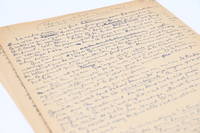
1948. Fine. ""Pour moi l'amitié des assasins n'est pas l'amitié . tant pis si l'on me juge esclave et qu'on me juge sans coeur !"" For me the friendship of assassins is not friendship . too bad if I am judged a slave and judged heartless! s. d. 1948 21 x 30 cm 8 pages et demi sur 9 feuillets Exceptional autograph manuscript by Louis Aragon entitled ""Chronique de la pluie et du beau temps pour Europe mai"". 8 and a half pages in blue ink on 9 uniformly browned leaves. Numerous deletions and rewritings. Published in Europe no 29 May 1948 and does not appear in the book collecting these chronicles E.F.R. 1979. Superb nine-page militant profession of faith published in the anti-fascist literary review Europe. Aragon finds himself courted after the war in the name of ""friendship"" and ""freedom"" by various reviews but categorically refuses to publish alongside writers with Pétainist tendencies. The writer delivers his impressions after a radio interview in Belgium and meditates on ""two abstract monsters: freedom and friendship"" perverted at will in this early Cold War period when Sovietism becomes - to his great dismay - the new fascism. Very attached to the unified discourse advocated by communism which he calls ""national truth"" this notion serves as the guiding thread of his chronicle. Aragon writes in the midst of the Kravchenko affair and remains convinced by Sovietism which remains for him the great victor over Nazism. As a great literary witness to the suffering endured during the Occupation he is alarmed by the editorial choices of reviews seeking to obtain contributions from him: one shamelessly publishes a text by Montherlant totally oblivious to the Parisian martyrs during the war while the other affectionately justifies the allegiances of many French people to Marshal Pétain. It is also the occasion for a long and beautiful analysis of the idea of nation by Aragon who is unquestionably the national poet of this century. We find there in his inspired tirades the Aragonian ideal of healthy emulation among nations turned toward progress. Beautiful pages by Aragon in the midst of the crystallization of the Eastern and Western blocs. Aragon's ambition is to honor the memory of the Resistance by choosing to ""trust words when they are used for peace"". ""La Nation qui me paraît aujourd'hui encore être le groupe le plus étendu qui puisse se porter garant d'une vérité . la radio peut et doit transmettre à son public la vérité nationale . 'Qu'entendez-vous concrètement par vérité nationale ' Me demande-t-il comme il m'aurait sûrement demandé : qu'entendez-vous en disant qu'il fait grand jour en plein midi si je l'avais dit. C'est là le mécanisme des interviews. J'ai donc pris deux exemples concrets pour expliquer à quoi sert le maniement des abstractions. Deux cas récents où j'ai eu à me mesurer avec deux monstres abstraits : la liberté et l'amitié. La liberté d'abord. On sait comment les pires ennemis de la liberté font usage d'un livre qui s'appelle : J'ai choisi la liberté donnant le bénéfice d'un préjugé favorable de ce mot à tous ceux qui trahissent leur pays quand c'est pour choisir le système capitaliste . . Une revue qui s'édite à Montréal m'avait récemment écrit pour me demander ma collaboration. Son directeur littéraire faisait appel à l'homme libre l'italique est sienne que je suis. Cette façon de distinguer par la typographie en moi la possibilité d'être parfois un homme libre parfois non m'avait un peu inquiété. J'ai voulu voir sa revue . Mon Dieu le fait que ce numéro s'ouvre par un texte de M. de Montherlant me laisse libre de ne pas parler du contexte. On sait et j'imagine que M. Victor Barbeau de Montréal n'ignore pas que M. de Montherlant est sur la liste des écrivains avec lesquels les membres du Comité National des Ecrivains se refusent à collaborer. Ce qui doit sans doute m'expliquer pourquoi M. Barbeau s'adresse en moi à l'homme libre : c'est- unknown
Referencia librero : 87160
|
|
|
Louis ARAGON
Anicet ou le panorama
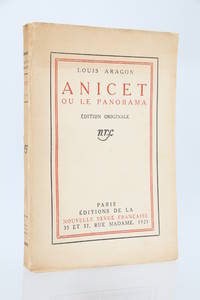
Paris: Nrf 1921. Fine. Nrf Paris 1921 13 x 19 cm broché First edition one of 940 numbered copies on wove paper the only deluxe copies with 120 reimposed. Spine and boards very slightly sunned as often some minor foxing. Nrf hardcover
Referencia librero : 87382
|
|
|
Louis ARAGON
Anicet ou le panorama
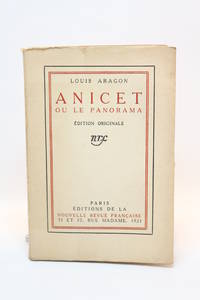
Paris: Nrf 1921. Fine. Nrf Paris 1921 13 x 19 cm broché First edition one of 940 numbered copies on pure thread the only deluxe copies with 120 reimposed. Spine and covers very marginally sunned as often. Nrf unknown
Referencia librero : 72673
|
|
|
Louis ARAGON
Anicet ou le panorama
Paris: Nrf 1921. Fine. Nrf Paris 1921 13 x 19 cm broché First edition one of 940 numbered copies on pure laid paper the only deluxe copies along with 120 reimposed. Spine and boards marginally sunned as often small tears at head and foot of spine as well as in margins of boards. Nrf hardcover
Referencia librero : 64382

|
|
|
Louis ARAGON
Anicet ou le panorama
Paris: Nrf 1921. Fine. Nrf Paris 1921 13 x 19 cm broché First edition one of 940 numbered copies on pur fil the only deluxe copies with 120 reimposed. Scattered foxing. Nrf unknown
Referencia librero : 17138
|
|
|
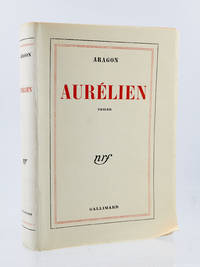
Louis ARAGON
Aurélien
Paris: Gallimard 1944. Fine. Gallimard Paris 1944 14.50 x 21 cm broché First edition one of 88 numbered copies on pur fil paper deluxe copies after 13 on Holland paper. Rare and very handsome copy. Gallimard unknown
Referencia librero : 79256
|
|
|
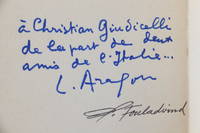
Louis ARAGON - Hamid FOULADVIND - Alecos FASSIANOS
Aux abords de Rome - Elégie à Romano n the Outskirts of Rome Elegy for Romano
Paris: Les Editeurs Français Réunis 1980. Fine. Les Editeurs Français Réunis Paris 1980 10.50 x 13.50 cm reliure de l'éditeur First collected edition of which there were no deluxe copies. Publisher's full beige cloth binding smooth spine green paper endpapers and pastedowns. Work illustrated with drawings by Alexandre-Alecos Fassianos. Handsome copy. Autograph inscription signed by Louis Aragon to Christian Giudicelli: ""A Christian Giudicelli de la part de deux amis de l'Italie."" ""To Christian Giudicelli from two friends of Italy."" enriched with the signature of Hamid Foulâdvind. Les Editeurs Français Réunis hardcover
Referencia librero : 81311
|
|
|
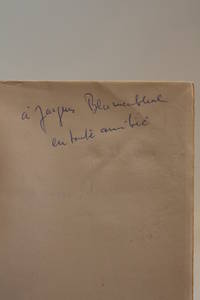
Louis ARAGON
Blanche ou l'oubli
Paris: Gallimard 1967. Fine. Gallimard Paris 1967 14.50 x 21 cm broché First edition one of 160 numbered copies on pur fil the only deluxe copies with 60 on Holland paper. Handsome copy despite some worming to the spine. Unsigned autograph inscription from Louis Aragon to Jacques Blumenthal. Gallimard unknown
Referencia librero : 74631
|
|
|
Louis ARAGON
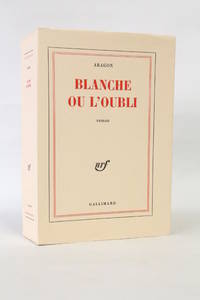
Blanche ou l'oubli
Paris: Gallimard 1967. Fine. Gallimard Paris 1967 14 x 21 cm broché First edition one of 60 numbered copies on Hollande deluxe issue. Minor insignificant spotting to the spine. A handsome copy. Gallimard unknown
Referencia librero : 66840
|
|
|
Louis ARAGON - Georges SADOUL - Alain RESNAIS
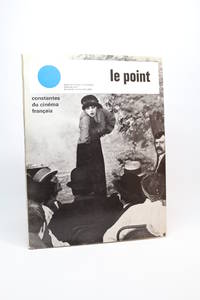
Constantes du cinéma français in Le Point N°LIX
Souillac: Le Point 1962. Fine. Le Point Souillac 1962 19.50 x 25.50 cm broché First edition illustrated with photographs Handsome copy. Texts by Louis Aragon ""Du décor"" ""On Decor"" Georges Sadoul ""A la recherche de quelques fils conducteurs"" ""In Search of Some Connecting Threads"" Boisyvon ""L'exemplaire de René Clair"" ""René Clair's Copy"" Alain Resnais ""Les serpents et les caducées"" ""The Serpents and the Caducei"". Le Point unknown
Referencia librero : 73422
|
|
|
Louis ARAGON - Georges SADOUL - Alain RESNAIS
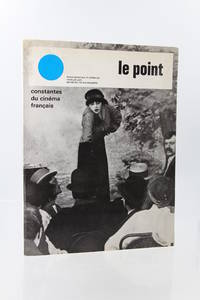
Constantes du cinéma français in Le Point N°LIX
Souillac: Le Point 1962. Fine. Le Point Souillac 1962 19.50 x 25.50 cm broché First edition illustrated with photographs Handsome copy. Texts by Louis Aragon ""Du décor"" Georges Sadoul ""A la recherche de quelques fils conducteurs"" Boisyvon ""L'exemplaire de René Clair"" Alain Resnais ""Les serpents et les caducées"". Le Point unknown
Referencia librero : 82900
|
|
|
Louis ARAGON
Distiques pour une carmagnole de la Honte Autograph poem : ""Distichs for a Carmagnole of Shame
1945. Fine. s. d. 1944-1945 19.80 x 26.50 cm une feuille sous étui-chemise Exceptionally rare autograph satirical poem by Louis Aragon entitledDistiques pour une Carmagnole de la Honte written between September 1944 and February 1945. 26 lines penned in black ink on a single leaf with a note from the author in blue ink at the foot of the page. Our manuscript belongs to a group of thirteen poems composed during the first half of 1945 intended for publication in a poetry anthology Aragon published by Pierre Seghers in Paris Collection Poètes daujourdhui no. 2 20 July 1945. It was sent by Aragon as a working copy to his editor and friend Claude Roy. This autograph poem is the only known manuscript of the Distiques with neither manuscript nor proofs held in the extensive Triolet-Aragon archives at the Bibliothèque nationale de France. The autograph poem is housed in a midnight blue half-morocco folder with patterned paper boards beige lambskin doublures and a matching morocco-edged slipcase. Binding signed by Thomas Boichot. A true historical document and scathing indictment of the collaborators who sought refuge in Sigmaringen Aragons Distiques were composed during the winter of 19441945 following the publication of Musée Grévin. A quintessential example of Aragons resistance poetry this octosyllabic and ten-line verse composition denounces in no uncertain terms the leaders of the Vichy regime and their most ardent supporters. Sarcasm insult and invective fuel a vengeful poetry reminiscent of the fiery tone of Front Rouge which marked his break with surrealism. Yet the poems tone remains brisk and lively: the residents of Sigmaringen castle sing dance and play and Aragon concludes with a rousing quatrain: «Ah ça ira ça ira Les Pétain Laval tous à la lanterne Ah ça ira ça ira ça ira Les Pétain Laval tous on les pendra» borrowed from the revolutionary anthem «Ah ça ira ça ira ça ira Les aristocrates à la lanterne. Ah! ça ira ça ira ça ira! Les aristocrates on les pendra.» Despite numerous appeals to flee France at the outbreak of war Aragon chose to remain going underground with Elsa Triolet after serving bravely during the German offensive. The Occupation marked a period of intense activity for the writer who clandestinely published his collections of resistance poetry Le Crève-cur 1941 Les Yeux dElsa 1942 Le Musée Grévin 1943 La Diane française 1944 and under various pseudonyms poems and responses to collaborationists in the Lettres Françaises. At the same time he was commissioned by the Communist Party to rally writers and intellectuals in the southern zone where he founded a branch of the Comité National des Écrivains bringing together Stanislas Fumet Auguste Anglès Henry Malherbe and Jean Prévost. Aragons example proved that in times of war poetry could itself be a form of resistance a refusal to yield. As Claude Roy recipient of the manuscript later remarked: «La parole dAragon sélevait avec une violence et une aisance qui se répercutaient dun bout de la France à lautre.» «Ça doit avoir de la dégaine/Le château de Siegmaringen/On sy retrouve entre félons/Sous les lustres du grand salon» Aragon wrote two poems about Sigmaringen the former Swabian stronghold of the Hohenzollern family which hosted Pétain and his entourage after their flight from Vichy and Belfort. As Allied forces advanced and on orders from the Reich the Marshal and his supporters set up a puppet government there in September 1944 later replaced by the Gouvernemental Delegation for the Defence of French Interests in Germany during the wars final months. Aragon dedicates a distich to Laval who had been ousted from power by this new structure: «Laval a lair bien embêté / Dêtre en disponibilité». Notably Aragon adds an e to Sigmaringen likely a sardonic play on the Nazi salute Sieg Heil. For nearly eight months until April 1945 this extraterritorial enclave shelter hardcover
Referencia librero : 64157

|
|
|
Louis ARAGON - Henri-Georges ADAM
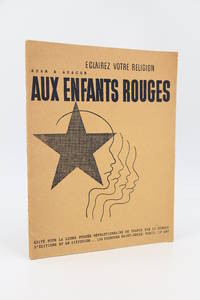
Eclairez votre religion - Aux enfants rouges Enlighten your Religion - To the Red Children
Paris: Bureau d'Éditions et de Diffusion 1932. Fine. Bureau d'Éditions et de Diffusion Paris 1932 18 x 23.50 cm agrafé First edition. Illustrated with 16 drawings by Georges Adam. A superb copy of this rare booklet by Louis Aragon a true ""anti-clerical anti-capitalist anti-colonialist anti-patriotic"" Pierre Juquin catechism for the children of the exploited working masses. ""On June 25 1932 the Imprimerie centrale completed printing for the Bureau des éditions et de diffusion 132 Faubourg Saint-Denis Paris a beautiful pamphlet now a bibliophilic rarity . On the cover a large red star - an important and recurrent image in Aragon's work - appears imprinted on children's brains. Sixteen quatrains droll and didactic punctuated for ease of reading alternate with drawings by Georges Adam whose nearly expressionist mockery reminiscent of Rouault's paintings overturns taboos and myths."" Aragon. Un destin français 1897-1939 After breaking with the Surrealists Aragon threw himself wholeheartedly into the Journal de la lutte antireligieuse. He wrote this pamphlet from Moscow and published it on the Party's presses to ignite the fervor of proletarian youth. French poet Jacques Prévert would later follow a similar path with his play Émasculée conception. Anticlerical activism within French Communist associations was in full swing at the time: every symbol and events of religious life were reinterpreted through the lens of class struggle. ""Red baptisms"" were organised forming a community of ""Godless"" children drawing their name from the Association of Godless Workers who corresponded with their Soviet counterparts. Aragon contributed to these new rituals with this particularly radical children's book deemed excessively antipatriotic by Maurice Thorez which he would later disavow at the end of his life. Bureau d'Éditions et de Diffusion unknown
Referencia librero : 86460
|
|
|
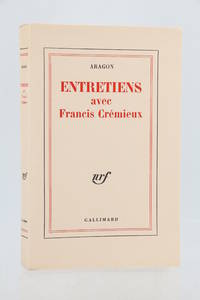
Louis ARAGON - Francis CREMIEUX
Entretiens avec Francis Crémieux
Paris: Gallimard 1964. Fine. Gallimard Paris 1964 12 x 19 cm broché First edition one of 43 numbered copies on Holland paper deluxe copies. Very fine copy. Gallimard unknown
Referencia librero : 84241
|
|
|
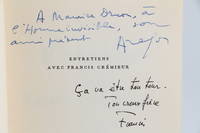
Louis ARAGON - Francis CREMIEUX
Entretiens avec Francis Crémieux
Paris: Gallimard 1964. Fine. Gallimard Paris 1964 12 x 19 cm broché First edition on ordinary paper. Handsome copy. Precious and fine autograph inscription signed by Louis Aragon to Maurice Druon: ""A Maurice Druon à l'homme invisible son ami présent. Aragon"" ""To Maurice Druon to the invisible man his present friend. Aragon"" with an additional autograph inscription signed by Francis Crémieux: ""Ca va être ton tour. Ton creux frère. Francis."" ""It's going to be your turn. Your hollow brother. Francis."" Gallimard unknown
Referencia librero : 80808
|
|
|
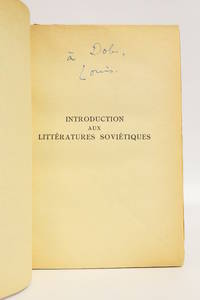
Louis ARAGON - (inscribed to Charles DOBZINSKI [Charles DOBZYNSKI])
Introduction aux littératures soviétiques Introduction to Soviet Literatures
Paris: Gallimard 1964. Fine. Gallimard Paris 1964 12 x 19 cm broché First collective edition for which no deluxe paper copies were issued one of the press service copies. Preface by Louis Aragon. Precious autograph inscription signed by Louis Aragon to his friend Charles Dobzynski whose wedding witness he was along with Elsa Triolet: ""A Dob Louis.""  Gallimard unknown
Referencia librero : 61503
|
|
|
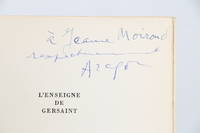
Louis ARAGON
L'enseigne de Gersaint
Neuchâtel & Paris: Ides et Calendes 1946. Fine. Ides et Calendes Neuchâtel & Paris 1946 16.50 x 22.50 cm broché First edition one of the numbered copies on vellum the only issue with 60 Ingres. The work illustrated with plates by Watteau. Handsome copy. Signed autograph inscription from Louis Aragon to Jeanne Moirond. Ides et Calendes hardcover
Referencia librero : 84233
|
|
|
Louis ARAGON
L'enseigne de Gersaint
Neuchâtel & Paris: Ides & Calendes 1946. Fine. Ides & Calendes Neuchâtel & Paris 1946 16.50 x 22.50 cm broché First edition one of the numbered copies on vellum the only deluxe issue with 60 on Ingres. Handsome copy. Ides & Calendes hardcover
Referencia librero : 23090
|
|
|
Louis ARAGON
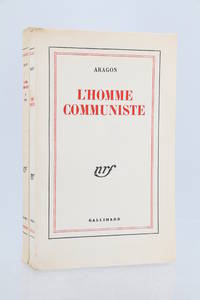
L'homme communiste - L'homme communiste II 1953 - Complet en deux volumes The Communist Man The Communist Man II 1953 Complete in two volumes
Paris: Gallimard 1946. Fine. Gallimard Paris 1946-1953 12 x 19 cm 2 volumes brochés First edition one of 55 numbered copies on vellum for each volume deluxe copies. Spines very lightly sunned without detriment handsome set. Gallimard hardcover
Referencia librero : 84242
|
|
|
Louis ARAGON
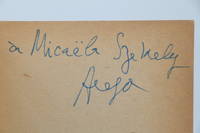
La culture et les hommes
Paris: Editions sociales 1947. Fine. Editions sociales Paris 1947 12 x 15.50 cm broché The first edition of which there were no deluxe copies. Spine and boards marginally and lightly sunned otherwise handsome copy. Autograph inscription signed by Louis Aragon to Micaëla Szekely. Editions sociales hardcover
Referencia librero : 80657
|
|
|
Louis ARAGON
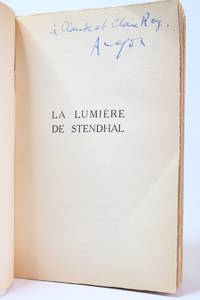
La lumière de Stendhal
Paris: Denoël 1954. Fine. Denoël Paris 1954 12 x 19 cm broché First edition one of the review copies. A crease affecting the upper corner of the rear cover and the final leaves an annotation by the recipient in pink ink at the top of the colophon page. A pleasing copy complete with the publishers announcement slip. Inscribed and signed by Louis Aragon to his friends Claude and Claire Roy. Denoël unknown
Referencia librero : 74307
|
|
|
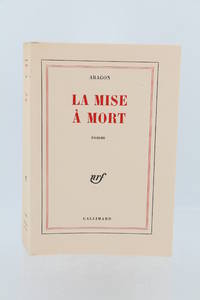
Louis ARAGON
La mise à mort The Execution
Paris: Gallimard 1965. Fine. Gallimard Paris 1965 14 x 20.50 cm broché First edition one of 50 numbered copies on Holland vellum paper deluxe issue. A very fine copy. Gallimard hardcover
Referencia librero : 84238
|
|
|
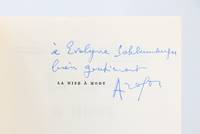
Louis ARAGON
La mise à mort
Paris: Gallimard 1965. Fine. Gallimard Paris 1965 14 x 20.50 cm broché First edition a Service de Presse advance copy. Spine very slightly sunned and creased without gravity small stains on the second cover. Signed autograph inscription from Louis Aragon to the journalist Evelyne Schlumberger. Gallimard unknown
Referencia librero : 84814
|
|
|
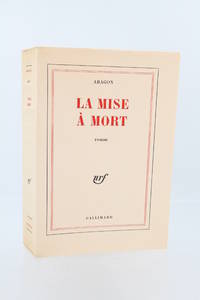
Louis ARAGON
La mise à mort
Paris: Gallimard 1965. Fine. Gallimard Paris 1965 14 x 20.50 cm broché First edition one of 50 numbered copies on Holland paper deluxe copy. A very handsome copy. Gallimard unknown
Referencia librero : 85122
|
|
|
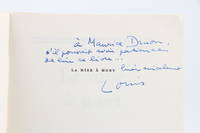
Louis ARAGON
La mise à mort
Paris: Gallimard 1965. Fine. Gallimard Paris 1965 14 x 20.50 cm broché First edition a Service de Presse advance copy. Handsome copy. Precious and fine autograph inscription signed by Louis Aragon: ""A Maurice Druon s'il pouvait avoir patience de lire ce livre. Louis"" ""To Maurice Druon if he could have the patience to read this book. Louis"". Gallimard unknown
Referencia librero : 82054
|
|
|
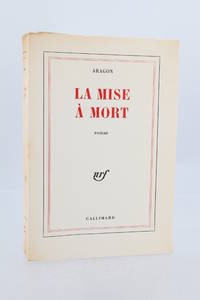
Louis ARAGON
La mise à mort
Paris: Gallimard 1965. Fine. Gallimard Paris 1965 14 x 20.50 cm broché First edition one of 145 numbered copies on pur fil paper the only deluxe copies after 50 on Holland paper. Spine lightly sunned final endpaper shadowed due to the presence of press clippings otherwise handsome copy. Gallimard unknown
Referencia librero : 83583
|
|
|
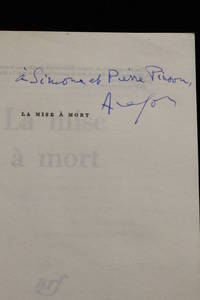
Louis ARAGON
La mise à mort
Paris: Gallimard 1965. Fine. Gallimard Paris 1965 14 x 20.50 cm broché First edition on ordinary paper. Autograph inscription from Louis Aragon to Simone and Pierre Pinson. A good copy. Gallimard unknown
Referencia librero : 52221
|
|
|
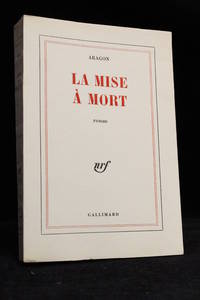
Louis ARAGON
La mise à mort
Paris: Gallimard 1965. Fine. Gallimard Paris 1965 14 x 20.50 cm broché First edition one of 145 numbered copies on pur fil the only deluxe copies after 50 on Holland paper. Marginal scratches with small paper losses to the back board otherwise a handsome copy. Gallimard unknown
Referencia librero : 52788
|
|
|
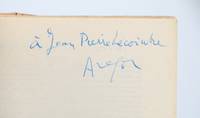
Louis ARAGON
Le musée Grévin et autres poèmes
Paris: Les Editeurs Français Réunis 1946. Fine. Les Editeurs Français Réunis Paris 1946 12 x 17.50 cm broché New edition. Handsome copy. Autograph inscription signed by Louis Aragon to Jean-Pierre Lecointre. Les Editeurs Français Réunis unknown
Referencia librero : 86653
|
|
|
Louis ARAGON
Le paysan de Paris chante
Souillac: In Le Point 1939. Fine. In Le Point Souillac 1939 18 x 24.50 cm broché First edition. Iconography. Spine and covers lightly and marginally sunned without consequence endpapers lightly and partially shaded handsome interior condition. In Le Point unknown
Referencia librero : 39370
|
|
|
Louis ARAGON - (Missak MANOUCHIAN)
Le roman inachevé L'affiche rouge
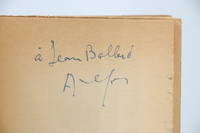
Paris: Gallimard 1956. Fine. Gallimard Paris 1956 14 x 19.50 cm broché First edition a Service de Presse advance copy. Spine sunned with two small lacks at head and foot boards marginally sunned. This collection of poems contains the famous ""Strophes pour se souvenir"" a poem paying tribute to the members of the F.T.P. - M.O.I. of Missak Manouchian shot at Mont Valérien on February 21 1944. This moving poem would be set to music and performed in 1959 by Léo Ferré under the title ""L'affiche rouge"" referring to the ignominious red poster displayed by the Vichy regime depicting the F.T.P.-M.O.I. as vulgar and criminal foreign terrorists. Autograph inscription signed by Louis Aragon to Jean Ballard who was the director of the literary review Les Cahiers du Sud. Gallimard hardcover
Referencia librero : 85467
|
|
|
Louis ARAGON - (inscribed to Maurice DRUON)
Le voyage en Hollande et autres poèmes The Journey to Holland and Other Poems
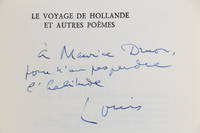
Paris: Pierre Seghers 1965. Fine. Pierre Seghers Paris 1965 13 x 19 cm broché First collective edition on ordinary paper. Pleasing copy. Valuable presentation copy signed by Louis Aragon: ""A Maurice Druon pour n'en pas perdre l'habitude. Louis.""  Pierre Seghers unknown
Referencia librero : 80850
|
|
|
Louis ARAGON (pref) - Iouri IANOVSKI
Les cavaliers
Paris: Gallimard 1957. Fine. Gallimard Paris 1957 14.50 x 21.50 cm broché New edition of the French translation for which it was not drawn from great papers mention of third edition. Back and flat slightly and marginally discolored and insolated without gravity. Presentation of Louis Aragon. Signed autograph of Louis Aragon to Julian Garavito. Gallimard unknown
Referencia librero : 63161

|
|
|
Louis ARAGON - (inscribed to Maurice DRUON)
Les collages - Exemplaire de Maurice Druon The Collages Maurice Druon's copy
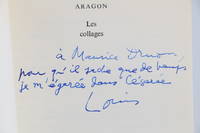
Paris: Hermann 1965. Fine. Hermann Paris 1965 11 x 21 cm broché First edition with no deluxe-paper copies printed. Illustrations. A handsome copy despite the slightly faded spine. Precious and fine signed presentation copy from Louis Aragon to Maurice Druon: ""A Maurice Druon pour qu'il sache que de temps je m'égarée dans Césarée. sic Louis"". Hermann unknown
Referencia librero : 80810
|
|
|
Louis ARAGON
Les communistes
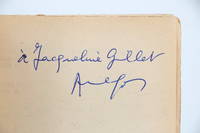
Paris: La bibliothèque française 1949. Fine. La bibliothèque française Paris 1949-1951 11.50 x 18.50 cm 6 volumes brochés First edition on ordinary paper for each of the volumes. Complete set in 6 volumes. Handsome copy despite small corner lacks of no consequence to the boards considering the poor quality of this paper. On the first volume autograph inscription signed by Louis Aragon to Jacqueline Gillet enriched with the manuscript signatures of Yves Robert and Daniel Delorme. La bibliothèque française hardcover
Referencia librero : 87699
|
|
|
Louis ARAGON
Les communistes Mars-Mai 1940
Paris: La Bibliothèque Française 1950. Fine. La Bibliothèque Française Paris 1950 12 x 19 cm broché First edition one of 535 numbered copies on pur fil the only deluxe copies. Light sunning partially affecting the spine otherwise a handsome copy. La Bibliothèque Française unknown
Referencia librero : 25234
|
|
|
Louis ARAGON
Les lendemains qui chantent. Autobiographie de Gabriel Péri présentée par Aragon
Paris: Editions sociales 1947. Fine. Editions sociales Paris 1947 12 x 15 cm broché First edition. A photograph of Gabriel Péri as frontispiece. Editions sociales unknown
Referencia librero : 63183
|
|

 Recibir por correo electrónico
 Descargar en documento PDF
 Flujo RSS
 Link permanente


