|
Maurice BLANCHOT - (Jean-Paul SARTRE)
Les romans de Sartre. Manuscrit autographe Sartres Novels. Autograph Manuscript
1945. Fine. 1945 - 19 pages 1/2 in-8 Autograph manuscript of the author of 19 pages and a half in-8 published in the October issue No. 10 of L'Arche Complete two-sided manuscript very dense writing with many erasures corrections and additions. Since the 1930s Maurice Blanchot regularly devotes articles to Jean-Paul Sartre and especially to his novels. The publication of the first two volumes of the trilogy The paths of freedom was to give rise to the almost simultaneous publication of a rather short chronicle in Dimanche paysage No. 19 October 21 1945 and this large study entitled ""The Novels of Sartre "". This one which goes beyond the circumscribed frame of the literary news intends to analyze what makes the specificity of these works namely the use of the ""thesis"": ""One can wonder why the thesis novel has bad reputation"" . Grievances seem as numerous on the side of the thesis as on the side of the novel; the theoretical affirmation complains of the adventure to which it is committed and from which it derives an additional truth. . In a novel of this kind we reproach the characters for being lifeless but it is ""the idea"" that is lifeless: it only looks like itself it has only its own sense . . "" Therefore Blanchot salutes Sartre's meeting of exceptional philosophical as well as literary capacities while underlining that it is also the fruit of his time: ""It is true that fiction works are more and more besieged by theoretical aims and that theoretical works are more and more a call to problems that require a complete expression. Existentialists or not novelists and philosophers pursue similar experiments and research . . "" Moreover he praises Sartre's ability to make his novels both an experience in itself and ""the story of an experience"" an essential concept for Blanchot and which had emerged as one of the central themes of his first critical collection False Pas 1943. And it is this same quality that he lends by the way to Simone de Beauvoir's Guest a ""remarkable work"" . Thus at the end of a reflection which reveals the admiration of Blanchot for the Sartrean novel and particularly for Nausea composed at the same time as his Thomas the Obscure he concludes: ""In short could not it be possible not that the novel was much less the enemy of the thesis than it is said ""The manuscript and multiple deletions and additions then reflects the hesitation of Blanchot in formulating the end of his demonstration yet clear in the finished text"" This only: to respect the status of bad faith that is its morality it to recognize a power of transformation of crystallization by the transparency of discovery through exposure which is its reality and finally having formed of its substance existing only by its duration to triumph by disappearing according to the movement proper to art to recover in affirmation and to fulfill itself in failure - which is its truth. "" The text will be repeated with some corrections in La Part du Feu 1949. unknown
Bookseller reference : 48343

|
|
|
Maurice BLANCHOT
Les treize formes d'un roman. Manuscrit autographe et tapuscrit complets.
s. l. Paris: S. n. Journal des débats 1943. Fine. S. n. Journal des débats s. l. Paris s. d. 1943 13.50 x 21.50 cm 4 1/2 pages in-8 Autograph manuscript by the author of 2½ pages in-4 published in the May 26 1943 issue of Journal des Débats. Complete manuscript with very dense handwriting containing numerous deletions corrections and additions. The complete typescript is included. Each chapter of Roland Cailleux's novel Saint-Genès ou la vie brève presents a different narrative form. This gives Blanchot the opportunity to return to the interest of this literary audacity initiated a few years earlier by Joyce: ""The novel showed itself there with all its possibilities it metamorphosed into everything it could be."" Between April 1941 and August 1944 Maurice Blanchot published 173 articles on recently published books in the ""Chronique de la vie intellectuelle"" of Journal des Débats. In half a newspaper page about seven octavo pages the young author of ""Thomas l'obscur"" takes his first steps in the field of literary criticism and thus inaugurates a theoretical work that he would later develop in his numerous essays from ""La Part du feu"" to ""L'Entretien infini"" and ""L'Écriture du désastre"". From his first articles Blanchot demonstrates an analytical acuity far exceeding the literary current events that motivated their writing. Oscillating between classics and moderns first-rate writers and minor novelists he establishes in his chronicles the foundations of a critical thought that would mark the second half of the 20th century. Transformed by writing and by the war Blanchot breaks through a thought exercised ""in the name of the other"" with the violent Maurrassian certainties of his youth. Not without paradox he then transforms literary criticism into a philosophical act of intellectual resistance to barbarism at the very heart of an ""openly Maréchaliste"" newspaper: ""To burn a book to write one are the two acts between which culture inscribes its contrary oscillations"" Le Livre In Journal des Débats January 20 1943. In 2007 the Cahiers de la NRF brought together under the direction of Christophe Bident all the literary chronicles not yet published in volumes with this pertinent analysis of Blanchot's critical work: ""novels poems essays give rise to a singular reflection ever more sure of its own rhetoric delivered more to the echo of the impossible or to the sirens of disappearance. . Not without contradictions or sidesteps and in the feverish certainty of a work that begins . these articles reveal the genealogy of a critic who transformed the occasion of the chronicle into necessity of thought."" C. Bident. Autograph manuscripts by Maurice Blanchot are extremely rare. S. n.[ Journal des débats] unknown
Bookseller reference : 44964

|
|
|
Maurice BLANCHOT
Lettre tapuscrite à Sartre
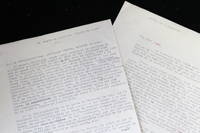
1960. Fine. 2 décembre 1960 26.70 x 20.90 cm 5 feuillets in-4 Draft typescript of letter to Jean-Paul Sartre with autograph corrections and with a second version of the first page and typescript with autograph corrections of ""Le monde en question Cours du monde"" project for La Revue internationale Set of five typescript leaves rectos only with the exception of one leaf recto-verso with corrections in red and black ballpoint pen in Maurice Blanchot's hand. This important collection bears witness to the exchanges between Maurice Blanchot and Jean-Paul Sartre around the famous ""Déclaration sur le droit à l'insoumission dans la guerre d'Algérie"" and the publication project that resulted from it La Revue internationale. Known as the ""Manifeste des 121"" this declaration signed by numerous intellectuals and artists and published on September 6 1960 had been drafted by Dionys Mascolo and Jean Schuster assisted by Maurice Blanchot in anticipation of the trial of the Jeanson network a group of French militants supporting the FLN and with the aim of informing public opinion about the protest movement against the Algerian War and its anti-democratic excesses. Among the signatories was of course Sartre. The manifesto had made many personalities aware of the influence they could exercise in public debate even in the course of History. It was in this context that in autumn 1960 Maurice Blanchot Dionys Mascolo and Elio Vittorini decided to create a review that would be not literary but critical whose purpose would be to continue this action. They sought the help of Jean-Paul Sartre whose extraordinary aura would benefit the publication favorably. In his letter to Sartre Blanchot attempts to convince the philosopher to join the project: ""Vous m'avez rappelé ce que j'ai dû dire quelquefois et que j'ai toujours intimement pensé : que la Déclaration ne trouverait son vrai sens que si elle était le commencement de quelque chose."" ""You reminded me of what I must have said sometimes and what I have always intimately thought: that the Declaration would only find its true meaning if it were the beginning of something."" "". Je voudrais dire mon sentiment propre : je crois que si nous voulons représenter comme il faut sans équivoque le changement dont nous avons les uns et les autres le pressentiment si nous voulons le rendre plus réel et l'approfondir dans sa présence mouvante c'est seulement à partir d'un organe nouveau que nous pourrons le faire. A partir de là si l'on voit Sartre et d'autres avec lui parmi les 121 décider de s'exprimer en cette forme choisie délibérément comme nouvelle chacun "" ""I would like to express my own feeling: I believe that if we want to represent as we should unequivocally the change that we all have a premonition of if we want to make it more real and deepen it in its moving presence it is only from a new organ that we will be able to do so. From there if we see Sartre and others with him among the 121 decide to express themselves in this form deliberately chosen as new everyone"" "". comprendra que vraiment nous entrons dans une nouvelle phase et que quelque chose de décisif a lieu qui cherche à s'affirmer."" ""will understand that we are truly entering a new phase and that something decisive is taking place that seeks to assert itself."" But Sartre would refuse to commit to the review. However during the first six months of 1961 Blanchot devoted himself body and soul to the project hoping it would come to fruition. The typescript included here ""Le monde en question Cours du monde"" reveals the table of contents he envisioned for the first issue: texts on destalinization the situation of the German press intellectual compartmentalization in France and Italy hunger strikes and the Berlin Wall and utopia. The review would never see the light of day to the great despair of Blanchot who was deeply enthusiastic about the idea of collective and international writi unknown
Bookseller reference : 48321
|
|
|
Maurice BLANCHOT - (Ernest HEMINGWAY)
Manuscrit autographe sur Hemingway intitulé traduit de . Autograph manuscript on Hemingway
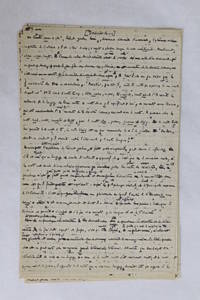
1946. Fine. 1946 13.50 x 21 cm en feuilles HEMINGWAY BLANCHOT Maurice. Autograph manuscript on Hemingway 1946 16 pages 1/2 in-8 135 x 21 cm loose leaves Author's autograph manuscript 16 and a half 8vo pages published in number 17 of L'Arche July 1946 and reprinted with slight modifications in La Part du Feu 1949. Complete manuscript written recto-verso very densely spaced with numerous deletions corrections and additions. In order to examine the problems related to the translation of a literary text into another language Maurice Blanchot looks at the contemporary American novel and its perception in Europe. Many good critics complain about American literature: they find it less than original and of middling interest for a culture that moved over fifty years ago beyond naturalism. They make fun of young writers who think they're being modern by imitating Faulkner Dos Passos or Steinbeck while for Americans themselves these writers are more of yesterday than tomorrow. Thus the critic for whom the oddities of language particular to any literary work survive translation takes the example of a novel by Ernest Hemingway. In For Whom the Bell Tolls Robert Jordan discovering the importance of the moment he is living repeats the word now' in several languages. Maintenant ahora now heute. But he is somewhat disappointed by the mediocrity of this vocabulary and looks for other words.
. He tries to find in language links between these words and what they mean for him his meeting with Maria who is also his meeting with his final hour his meeting with death.
The word Todt seems to him the most dead of all the word Krieg the one that resembles war most closely. Or is it just that he knew German less well than the other languages This reflection fascinates Blanchot: This impression of Robert Jordan's can give us food for thought. If it's true that a language seems more expressive and more real to us when we know it less if words need a certain ignorance to keep their virtue from being revealed this paradox should hardly surprise us since translators come across it all the time and it represents both one of the principal challenges and one of the foremost riches of all translation. An inspired look at the work of Ernest Hemingway and the problem of translation. unknown
Bookseller reference : 48346
|
|
|
Maurice BLANCHOT - (Claude ROY)
Nouvelles et récits. Manuscrit autographe et tapuscrit complets
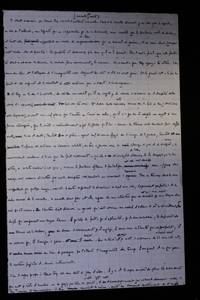
s. l. Paris: S. n. Journal des débats 1944. Fine. S. n. Journal des débats s. l. Paris s. d. 1944 13.50 x 21.50 cm 2 1/2 pages in-8 Autograph manuscript by the author of 2 and a half octavo pages published in the April 20 1944 issue of Journal des Débats. Complete manuscript with very dense writing containing numerous strikethroughs corrections and additions. Literary chronicle on the work of Claude Roy. The complete typescript is included. This critique of La Mer à boire by Claude Roy is at once a detailed analysis of each short story and a poetic hymn to the poet's writing: ""Le style de Claude Roy répond à merveille à ce jeu de nuances : il est lui aussi plein d'échos qui s'évanouissent de mots qui se répercutent: il est libre discipliné tout en inventions et fidèle à la réalité qu'il décrit."" ""Claude Roy's style responds marvelously to this play of nuances: it too is full of echoes that fade away of words that reverberate: it is free disciplined full of inventions and faithful to the reality it describes."" Between April 1941 and August 1944 Maurice Blanchot published 173 articles on recently published books in the ""Chronique de la vie intellectuelle"" of Journal des Débats. In half a page of newspaper about seven octavo pages the young author of ""Thomas l'obscur"" takes his first steps in the field of literary criticism and thus inaugurates a theoretical work that he would later develop in his numerous essays from ""La Part du feu"" to ""L'Entretien infini"" and ""L'Écriture du désastre."" From the first articles Blanchot demonstrates an analytical acuity far exceeding the literary current events that motivate their writing. Oscillating between classics and moderns first-rate writers and minor novelists he establishes in his chronicles the foundations of a critical thought that would mark the second half of the twentieth century. Transformed by writing and by war Blanchot breaks through a thought exercised ""in the name of the other"" with the violent Maurrassian certainties of his youth. Not without paradox he then transforms literary criticism into a philosophical act of intellectual resistance to barbarism at the very heart of an ""openly Maréchaliste"" newspaper: ""To burn a book to write one these are the two acts between which culture inscribes its contrary oscillations"" Le Livre In Journal des Débats January 20 1943. In 2007 the Cahiers de la NRF brought together under the direction of Christophe Bident all the literary chronicles not yet published in volumes with this pertinent analysis of Blanchot's critical work: ""novels poems essays give rise to a singular reflection always more confident in its own rhetoric delivered more to the echo of the impossible or to the sirens of disappearance. . Not without contradictions or sidesteps and in the feverish certainty of a work that begins . these articles reveal the genealogy of a critic who transformed the occasion of the chronicle into the necessity of thought."" C. Bident. The autograph manuscripts of Maurice Blanchot are extremely rare. S. n.[ Journal des débats] unknown
Bookseller reference : 44934
|
|
|
Maurice BLANCHOT - (Andre BRETON)
Reflexions sur le surréalisme - Manuscrit autographe complet
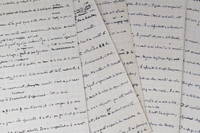
1945. Fine. 1945 22 x 11.50 cm 8 feuillets foliotés Autograph manuscript by the author of 16 octavo pages published in number 8 August 1945 of L'Arche under the title: Some Reflections on Surrealism. Complete recto-verso manuscript with very dense writing containing numerous deletions corrections and additions. Some Reflections on Surrealism forms the first important text that Maurice Blanchot devoted to André Breton's movement. He rehabilitates surrealism which placed at the center of its activity the question of language and experience - aspects that could not leave Blanchot indifferent - without forgetting to make the following observations: it carries within it a part of failure and its ""situation . remains ambiguous"". Now increasingly asserting his aesthetic positions Blanchot fully recognizes the poetic and experimental value of automatic writing for its very radicalism: ""Automatic writing is . a war machine against reflection and language. It is destined to humiliate human pride particularly in the form that traditional culture has given it. But in reality it is itself a proud aspiration to a mode of knowledge and it has opened to words a new unlimited credit."" Blanchot continues his reflection and insists on the questionings of surrealist writers and poets regarding discourse: ""Surrealism was haunted by this idea: that there was that there had to be a moment . when language was not discourse but reality itself without however ceasing to be the proper reality of language . The surrealists drew brilliant literary consequences from this 'discovery' but for language the effects are more ambiguous and more varied. In this domain they still seem above all to be destroyers. They are unleashed against discourse; they withdraw from it the right to signify something; as a means of social of precise designation they break it ferociously. Language appears somewhat alone annihilated or sacrificed but humiliated. In reality it is a matter of something quite different and even the contrary: language disappears as instrument but that is because it has become subject. Through automatic writing it has benefited from the highest promotion ."" The text would be reprinted in The Work of Fire 1949 not without Blanchot having taken care to attenuate the reservations he expressed in the initial article. First important monographic study devoted by Maurice Blanchot to the question of surrealist language. unknown
Bookseller reference : 48352
|
|
|
Maurice BLANCHOT
Romans nouveaux. Manuscrit autographe et tapuscrit complets
s. l. Paris: S. n. Journal des débats 1942. Fine. S. n. Journal des débats s. l. Paris s. d. 1942 13.50 x 21.50 cm 4 1/2 pages in-8 Autograph manuscript by the author of 4½ pages octavo published in the December 23 1942 issue of Journal des Débats. Complete recto-verso manuscript very densely written with numerous deletions corrections and additions. The complete typescript is included. Chronicle published on the occasion of the publication of four new novels: Les Hommes forts by Georges Magnane Le Vent se lève by Marius Grout Clément by Maurice Toesca and Si le ciel tombe by Roger de Lafforest. At the end of 1942 Maurice Blanchot reviews current literary events and provides uncompromising criticism of four novels by Georges Magnane Marius Grout Prix Goncourt winner in 1943 Maurice Toesca and Roger de Lafforest: « On voit qu'à ces quatre ouvrages la monotonie des moyens l'élusion du temps la sobriété du ton et surtout le caractère théorique du thème principal donnent l'apparence d'un conte d'une longue nouvelle qui se montre ou qui se cache sous la figure d'un roman. M. Georges Magnane n'a pu faire que son livre ne paraisse peu de chose au regard des descriptions sportives dont il l'a enrichi : l'histoire qu'il raconte ne s'impose pas ; elle reste vide ; elle s'efface. De même chez M. Toesca et M. de Lafforest il y a comme une absence d'âme qui rend inutile le jeu intellectuel dont ils ont soigneusement tendu les fils. L'esprit ne retient que l'intention qui comme telle lui paraît assez insignifiante ; à quoi bon un livre si l'art ne se rend pas inséparable de la pensée par le style dont il la marque Il y a plus de secret dans le récit de M. Marius Grout et c'est ce poids lourd ce silence grave ce plus indiscernable qui malgré toutes les explications que l'auteur a cru bon nous donner s'ajoutent à son uvre comme la vérité qui ne peut être dite et l'empêchent de n'être plus rien lorsque le lecteur en a découvert la conclusion. » ""We see that these four works through the monotony of their means the evasion of time the sobriety of tone and especially the theoretical character of their main theme take on the appearance of a tale of a long short story that shows itself or hides under the guise of a novel. M. Georges Magnane could not prevent his book from appearing insignificant compared to the sporting descriptions with which he enriched it: the story he tells does not impose itself; it remains empty; it fades away. Similarly in M. Toesca and M. de Lafforest there is something like an absence of soul that renders useless the intellectual game whose threads they have carefully woven. The mind retains only the intention which as such seems quite insignificant to it; what good is a book if art does not make itself inseparable from thought through the style with which it marks it There is more mystery in M. Marius Grout's narrative and it is this heavy weight this grave silence this more indiscernible element that despite all the explanations the author thought fit to give us add to his work like truth that cannot be told and prevent it from becoming nothing when the reader has discovered its conclusion."" Between April 1941 and August 1944 Maurice Blanchot published 173 articles on recently published books in the ""Chronicle of Intellectual Life"" in Journal des Débats. In half a newspaper page about seven octavo pages the young author of ""Thomas l'obscur"" takes his first steps in the field of literary criticism and thus inaugurates a theoretical work that he would later develop in his numerous essays from ""La Part du feu"" to ""L'Entretien infini"" and ""L'Écriture du désastre"". From the first articles Blanchot demonstrates an acuity of analysis far exceeding the literary current events that motivate their writing. Oscillating between classics and moderns first-rate writers and minor novelists he establishes in his chronicles the foundations of critical thought that would mark the second half of the 20th century. T S. n.[ Journal des débats] unknown
Bookseller reference : 44943

|
|
|
Maurice BLANCHOT
Sade ou le Royaume de l'Unique Quelques remarques sur Sade - Manuscrit autographe complet
s. l.: S. n. 1946. Fine. S. n. s. l. S.d 1946 - en feuilles Complete autograph manuscript of 12 pages on 6 octavo leaves with a title difficult to decipher perhaps: ""Sade or the Kingdoms of the Unique"" and which would appear under the title ""Some Remarks on Sade"" in Critique no. 3-4 of August-September 1946. Manuscript with very dense writing containing numerous deletions corrections and additions. ""It is Sade's thought that pushes Blanchot's to its fulfillment and it is also Blanchot's that fulfills that of Sade."" Georges Bataille Bataille's writing and friendship are undoubtedly not unrelated to the importance that Blanchot would attach throughout his life to this tutelary figure of his philosophical reflection. These Some Remarks on Sade are nonetheless the first study that Blanchot devoted to this writer whom he had until then almost never mentioned. In this first impartial and sometimes severe analysis Blanchot emphasizes the weaknesses of Sade's literary posture and his relative immorality within a post-revolutionary society shaped by ideological contradictions. However beneath the artifice of extreme expression Blanchot reveals a philosophy far more disconcerting and subversive than these ""great extravagances"". With singular acuity he draws the portrait of a unique mind embracing all the great ideals of his time but inflicting upon them the filter of his nihilistic singularity: ""Freedom in his eyes is nothing but the prohibition made to any person from being anything other than what he wants that is to say nothing."" Under Blanchot's pen Sadism is then no longer the enjoyment of violence inflicted on others but the expression of ""the infinite solitude of the individual"" in a world ""where the relationships between beings the general forms of life and even language everything is already consumed in universal destruction""; ""and henceforth all particular cruelties are no longer destined . except to bring to the Unique the pleasant proofs of his existence in the midst of nothing."" If as Bataille emphasizes more than a fresh perspective Blanchot's reading of Sade reveals a community of thought it is undoubtedly through the conclusion of this first major study that Blanchot the solitary most clearly testifies to his attachment to Sade the Unique: ""And then one comes to think: if circumstances made Sade a man forever reduced to the misery of an eternal prison he himself knew how to make his prison the image of the solitude of the universe over which reigns his sole glory forever all-powerful. This prison does not hinder him it is his work it is commensurate with the world over which he has more rights than God himself for not only does he reign there as master but he has banished and excluded all creatures from it. Such is the advantage of the Destroyer over the Creator. This atheist is more God than God. Thus he is called divine."" S. n. unknown
Bookseller reference : 48355

|
|
|
Maurice BLANCHOT
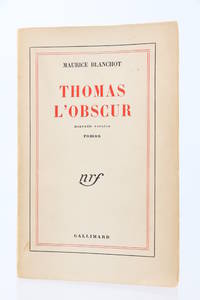
Thomas l'obscur
Paris: Gallimard 1950. Fine. Gallimard Paris 1950 12 x 19 cm broché Edition with some parts in first edition of which there were no deluxe copies a Service de Presse advance copy. Paper yellowed as usual. Gallimard unknown
Bookseller reference : 79914
|
|
|
Maurice BLANCHOT
Thomas l'obscur
Paris: Gallimard 1941. Fine. Gallimard Paris 1941 14 x 20.50 cm broché First edition an advance service de presse copy. Handsome fine autograph inscription from Maurice Blanchot to Gaston Gallimard on ffep: ""On ne s'arrête plus aux tables des heureux puisqu'on est mort. Charles Cros / A Gaston Gallimard ce livre destiné à écarter tout lecteur One doesn’t stop any more at the table of the joyous for one is dead. Charles Cros / To Gaston Gallimard this book destined to drive away every reader."" Two repaired tears to head of spine slightly sunned one tiny scratch to head of upper cover paper yellowed at edges of some pages as usual ffep repaired with small lack at foot. Gallimard unknown
Bookseller reference : 44721

|
|
|
Maurice BLANCHOT
Tradition et surréalisme. Manuscrit autographe et tapuscrit complets Tradition and Surrealism. Complete Autograph Manuscript and Typescript
s. l. Paris: S. n. Journal des débats 1943. Fine. S. n. Journal des débats s. l. Paris s. d. 1943 13.50 x 21.50 cm 2 1/2 pages in-8 Autograph manuscript by the author of 2 and a half quarto pages published in the December 23 1943 issue of Journal des Débats. Complete manuscript in very dense handwriting with numerous deletions corrections and additions. The complete typescript is included. This article one of the rare pieces to appear on the journal's front page is an audacious critique of the traditionalist vision of Art which arguing for the necessary adequacy between Art and Truth condemns Modernity. With implacable intellectual rigor Blanchot demonstrates how this conception of ""authentic Art"" ""joins exactly that of the surrealists"" and cites one of the major principles of Surrealism as perfect demonstration of Hourticq's remarks. In a France obsessed with rejecting Degenerate Art Blanchot reveals the contradictions of traditionalists: ""they admit that art in general precedes science and it is in the name of past science . that they condemn new movements in art."" Blanchot under the guise of literary criticism once again questions his era: . It would still be good to research whether precisely modern science does not recognize itself in the ""deformed decomposed obsolete universe that art has made familiar to our eyes."" Between April 1941 and August 1944 Maurice Blanchot published in the ""Chronicle of intellectual life"" of Journal des Débats 173 articles on recently published books. In half a newspaper page approximately seven octavo pages the young author of ""Thomas l'obscur"" takes his first steps in the field of literary criticism and thus inaugurates a theoretical work that he will later develop in his numerous essays from ""La Part du feu"" to ""L'Entretien infini"" and ""L'Écriture du désastre"". From the first articles Blanchot demonstrates an analytical acuity far exceeding the literary current events that motivate their writing. Oscillating between classics and moderns first-rate writers and minor novelists he establishes in his chronicles the foundations of critical thinking that will mark the second half of the 20th century. Transformed by writing and by war Blanchot breaks through thinking exercised ""in the name of the other"" with the violent Maurrassian certainties of his youth. Not without paradox he then transforms literary criticism into a philosophical act of intellectual resistance to barbarity at the very heart of an ""openly Pétainist"" journal: ""To burn a book to write one are the two acts between which culture inscribes its contrary oscillations"" Le Livre In Journal des Débats January 20 1943. In 2007 the Cahiers de la NRF brought together under the direction of Christophe Bident all the literary chronicles not yet published in volumes with this pertinent analysis of Blanchot's critical work: ""novels poems essays give rise to singular reflection ever more confident in its own rhetoric delivered more to the echo of the impossible or to the sirens of disappearance. . Not without contradictions or sidesteps and in the feverish certainty of a work beginning . these articles reveal the genealogy of a critic who transformed the occasion of the chronicle into the necessity of thought."" C. Bident. Autograph manuscripts by Maurice Blanchot are extremely rare. S. n.[ Journal des débats] unknown
Bookseller reference : 44960

|
|
|
Maurice BLANCHOT - (Alfred JARRY)
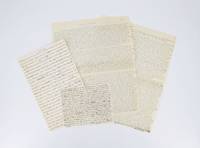
Un roman de Jarry. Manuscrit autographe et tapuscrit signé complets
s. l. Paris: S. n. Journal des débats 1944. Fine. S. n. Journal des débats s. l. Paris s. d. 1944 13.50 x 21.50 cm 2 1/2 pages in-8 Autograph manuscript by the author 2½ pages octavo published in the April 13 1944 issue of the Journal des Débats. Complete recto-verso manuscript in very dense handwriting with numerous deletions corrections and additions. Together with the complete signed typescript. Chronicle published on the occasion of the publication of Jarry's posthumous novel La Dragonne. In this chronicle devoted to Alfred Jarry and Père Ubu Maurice Blanchot was interested in the confusion between one and the other and its consequences: « . on peut penser que Jarry en s'entêtant à être le Père Ubu a pendant sa vie gaspillé une partie de ses ressources d'écrivain et après sa mort égaré le jugement littéraire sur sa véritable valeur. » "". one can think that Jarry by persisting in being Père Ubu wasted during his lifetime part of his resources as a writer and after his death misled literary judgment about his true value."" Yet this confusion testifies to the author's coherence: « Chez Jarry le choix d'un masque aussi peu flatteur a un sens fort clair. Il y a d'abord une volonté de mettre à mal tout sérieux et particulièrement cette volonté même ; il n'est pas question de tracer des frontières au ridicule ; on rit d'abord de soi on en rit parce que ce rire n'est qu'un écho du vide. Et puis ce double grotesque que l'auteur revendique comme une représentation dont il est fier affirme sa complicité pleine de défi avec les travers qu'il caricature. » ""In Jarry the choice of such an unflattering mask has a very clear meaning. There is first a will to undermine all seriousness and particularly this very will; there is no question of drawing boundaries to the ridiculous; one first laughs at oneself one laughs at it because this laughter is only an echo of the void. And then this grotesque double that the author claims as a representation of which he is proud affirms his complicity full of defiance with the flaws he caricatures."" La Dragonne the last work by Ubu's father that Gallimard was then publishing would therefore surprise Blanchot for « le sérieux avec lequel Jarry a accepté son métier de romancier » ""the seriousness with which Jarry accepted his profession as novelist"" who would also praise « les soudains mouvements d'imagination poétique qui dérangent le plan » ""the sudden movements of poetic imagination that disrupt the plan"". The only monographic text devoted by Blanchot to Jarry. Between April 1941 and August 1944 Maurice Blanchot published 173 articles on recently published books in the ""Chronique de la vie intellectuelle"" of the Journal des Débats. In half a page of newspaper about seven octavo pages the young author of ""Thomas l'obscur"" took his first steps in the field of literary criticism and thus inaugurated a theoretical work that he would later develop in his numerous essays from ""La Part du feu"" to ""L'Entretien infini"" and ""L'Écriture du désastre"". From the first articles Blanchot demonstrated an acuity of analysis far exceeding the literary current events that motivated their writing. Oscillating between classics and moderns first-rate writers and minor novelists he established in his chronicles the foundations of a critical thought that would mark the second half of the 20th century. Transformed by writing and by war Blanchot broke through thought exercised ""in the name of the other"" with the violent Maurrassian certainties of his youth. Not without paradox he then transformed literary criticism into a philosophical act of intellectual resistance to barbarism at the very heart of an ""openly Maréchaliste"" newspaper: ""Brûler un livre en écrire sont les deux actes entre lesquels la culture inscrit ses oscillations contraires"" ""To burn a book to write one are the two acts between which culture inscribes its contrary oscillations"" Le Livre In Journal des Débats January 20 1943. S. n.[ Journal des débats] unknown
Bookseller reference : 82298
|
|
|
Maurice BLANCHOT - (Alfred JARRY)
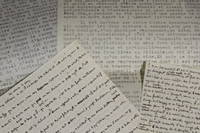
Un roman de Jarry. - Manuscrit autographe et tapuscrit signé complets A Novel by Jarry Complete Autograph Manuscript and Signed Typescript
s. l. Paris: S. n. Journal des débats 1944. Fine. S. n. Journal des débats s. l. Paris s. d. 1944 13.50 x 21.50 cm 2 1/2 pages in-8 Autograph manuscript by the author two and a half pages in octavo published in the issue of April 13 1944 of the Journal des Débats. Complete recto-verso manuscript in a very dense hand with numerous deletions corrections and additions. Accompanied by the complete signed typescript. A review published on the occasion of the posthumous release of Jarrys novel La Dragonne. In this review devoted to Alfred Jarry and Père Ubu Maurice Blanchot examines the confusion between the two and its consequences: « . on peut penser que Jarry en s'entêtant à être le Père Ubu a pendant sa vie gaspillé une partie de ses ressources d'écrivain et après sa mort égaré le jugement littéraire sur sa véritable valeur. » Yet this confusion testifies to the coherence of the author: « Chez Jarry le choix d'un masque aussi peu flatteur a un sens fort clair. Il y a d'abord une volonté de mettre à mal tout sérieux et particulièrement cette volonté même ; il n'est pas question de tracer des frontières au ridicule ; on rit d'abord de soi on en rit parce que ce rire n'est qu'un écho du vide. Et puis ce double grotesque que l'auteur revendique comme une représentation dont il est fier affirme sa complicité pleine de défi avec les travers qu'il caricature. » La Dragonne Jarrys final work then issued by Gallimard would therefore strike Blanchot for « le sérieux avec lequel Jarry a accepté son métier de romancier » while he also praised « les soudains mouvements d'imagination poétique qui dérangent le plan ». The only monographic text Blanchot devoted to Jarry. Between April 1941 and August 1944 Maurice Blanchot published in the ""Chronique de la vie intellectuelle"" of the Journal des Débats 173 articles on newly released books. In a half page of newspaper around seven octavo pages the young author of Thomas l'obscur made his first steps in literary criticism thereby inaugurating the theoretical work he would later develop in numerous essays from La Part du feu to L'Entretien infini and L'Écriture du désastre. From the very first articles Blanchot displayed an acuity of analysis far surpassing the literary news that occasioned his writing. Oscillating between classics and moderns major writers and minor novelists his reviews laid the foundations of a critical thought that would shape the second half of the 20th century. Transformed by writing and by the war Blanchot gradually broke through a thinking exercised ""in the name of the other"" with the violent Maurrassian certainties of his youth. Not without paradox he turned literary criticism into a philosophical act of intellectual resistance to barbarism at the very heart of a newspaper ""ouvertement maréchaliste"": ""Brûler un livre en écrire sont les deux actes entre lesquels la culture inscrit ses oscillations contraires"" Le Livre in Journal des Débats January 20 1943. In 2007 the Cahiers de la NRF gathered under the direction of Christophe Bident all the literary reviews not yet collected in volume form along with this perceptive analysis of Blanchots critical work: ""romans poèmes essais donnent lieu à une réflexion singulière toujours plus sûre de sa propre rhétorique livrée davantage à l'écho de l'impossible ou aux sirènes de la disparition. . Non sans contradictions ni pas de côté et dans la certitude fiévreuse d'une uvre qui commence . ces articles révèlent la généalogie d'un critique qui a transformé l'occasion de la chronique en nécessité de la pensée."" C. Bident. Autograph manuscripts by Maurice Blanchot are of the utmost rarity. S. n.[ Journal des débats] unknown
Bookseller reference : 44930
|
|
|
Maurice BLANCHOT
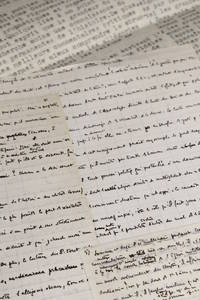
Une étude sur l'Apocalypse. Manuscrit autographe et tapuscrit complets
s. l. Paris: S. n. Journal des débats 1945. Fine. S. n. Journal des débats s. l. Paris s. d. 1945 13.50 x 21 cm 4 1/2 pages in-8 Autograph manuscript by the author of 4 and a half pages in-8 published in the issue of November 3 1943 of Journal des Débats. Complete recto-verso manuscript in very dense handwriting with numerous deletions corrections and additions. The complete typescript is included. Chronicle published on the occasion of the publication of L'Apocalypse de St Jean vision chrétienne de l'histoire by Father H.M. Féret. From the outset Maurice Blanchot doing his job as a critic praises the seriousness of the study conducted by Father Féret. But what interests him more than this careful orthodoxy are the powerful echoes of L'Apocalypse in the terrible hours the world was then going through: « Dans les périodes troublées les esprits qui ne supportent pas l'incertitude de l'avenir ont besoin de prophètes. Mais ces prophètes ils les demandent au passé et plus l'oracle est ancien - et redoutable - plus ils y voient des correspondances avec l'histoire qu'ils voudraient connaître. L'Apocalypse de St Jean doit en partie à la sublimité du langage à l'autorité de l'écrivain à l'étendue de la révélation une curiosité que des siècles d'étude n'ont pas réussi à épuiser. Mais elle doit aussi son prestige auprès d'esprits qui ne sont pas toujours pieux à l'antiquité de la réponse et à son caractère terrifiant. Qui n'est pas prêt à croire que la fin des temps est proche et que le pire va être vécu Chacun a le désir secret d'associer sa propre fin qu'il entrevoie à celle du monde dont il est moins sûr. » ""In troubled periods minds that cannot bear the uncertainty of the future need prophets. But these prophets they seek them in the past and the more ancient - and fearsome - the oracle the more they see correspondences with the history they would like to know. The Apocalypse of St. John owes partly to the sublimity of language to the authority of the writer to the extent of the revelation a curiosity that centuries of study have not managed to exhaust. But it also owes its prestige among minds that are not always pious to the antiquity of the answer and to its terrifying character. Who is not ready to believe that the end of times is near and that the worst will be lived Each has the secret desire to associate his own end that he glimpses with that of the world of which he is less certain."" The biblical text thus awakens his interest for its literary and mythological qualities but also in an almost political approach for its sense of History. Furthermore if religion does not of course pose itself in terms of belief for Blanchot it nevertheless reveals his attention to the question of God particularly sensitive through Judaism notably and joins that decisive in his eyes of the writer's interior experience. Finally the analysis of L'Apocalypse that Blanchot delivers here constitutes a first in-depth reflection on the question of Evil: « . ce qui est propre au message inspiré c'est le rôle qu'il fait jouer au démon dans la vie collective et le mouvement de l'histoire. Saint Jean ne dévoile pas l'action du mal dans les âmes ; il se borne à montrer quelle maîtrise les puissances démoniaques peuvent exercer sur les réalités collectives par quelles voies elles agissent . et quelle défaite mettra un terme à leur empire. » "". what is proper to the inspired message is the role it makes the demon play in collective life and the movement of history. Saint John does not unveil the action of evil in souls; he confines himself to showing what mastery demonic powers can exercise over collective realities by what paths they act . and what defeat will put an end to their empire."" These links between the Apocalypse History and Evil would be questioned again by Blanchot in ""L'Apocalypse déçoit"" 1964 and ""Penser l'Apocalypse"" 1988. First foundational text by Blanchot on Evil and History. Between April 1941 and Augus S. n.[ Journal des débats] unknown
Bookseller reference : 44925
|
|
|
Maurice BLANCHOT
Voyages de Montesquieu. Manuscrit autographe et tapuscrit complets. Montesquieus Travels. Complete autograph manuscript and typescript
s. l. Paris: S. n. Journal des débats 1943. Fine. S. n. Journal des débats s. l. Paris s. d. 1943 13.50 x 21.50 cm 4 1/2 pages in-8 Autograph manuscript by the author of 4½ pages in-8 published in the September 8 1943 issue of Journal des Débats. Complete manuscript with very dense handwriting containing numerous deletions corrections and additions. The complete typescript is included. Literary chronicle published on the occasion of the publication of Les Voyages de Montesquieu prefaced by Marcel Arland. This artificial collection of Montesquieu's travel notebooks gives Blanchot the opportunity to praise a form of ""natural"" writing ""pure of all concern for readership"". These intimate notes indeed testify to an art of ""concision which delivers facts to us naked pressed by the meaning that illuminates them"" and which from ""considerable material drew only a small book discreetly reduced to the essential."" Between April 1941 and August 1944 Maurice Blanchot published 173 articles on recently published books in the ""Chronique de la vie intellectuelle"" of Journal des Débats. In half a newspaper page about seven octavo pages the young author of ""Thomas l'obscur"" takes his first steps in the field of literary criticism and thus inaugurates a theoretical work that he would later develop in his numerous essays from ""La Part du feu"" to ""L'Entretien infini"" and ""L'Écriture du désastre"". From his first articles Blanchot demonstrates an analytical acuity far exceeding the literary current events that motivated their writing. Oscillating between classics and moderns first-rate writers and minor novelists he establishes in his chronicles the foundations of a critical thought that would mark the second half of the 20th century. Transformed by writing and by the war Blanchot breaks through a thought exercised ""in the name of the other"" with the violent Maurrassian certainties of his youth. Not without paradox he then transforms literary criticism into a philosophical act of intellectual resistance to barbarism at the very heart of an ""openly Maréchaliste"" newspaper: ""To burn a book to write one are the two acts between which culture inscribes its contrary oscillations"" Le Livre In Journal des Débats January 20 1943. In 2007 the Cahiers de la NRF brought together under the direction of Christophe Bident all the literary chronicles not yet published in volumes with this pertinent analysis of Blanchot's critical work: ""novels poems essays give rise to a singular reflection ever more sure of its own rhetoric delivered more to the echo of the impossible or to the sirens of disappearance. . Not without contradictions or sidesteps and in the feverish certainty of a work that begins . these articles reveal the genealogy of a critic who transformed the occasion of the chronicle into necessity of thought."" C. Bident. Autograph manuscripts by Maurice Blanchot are extremely rare. S. n.[ Journal des débats] unknown
Bookseller reference : 44963

|
|
|
Maurice BOUTET DE MONVEL
Claude et sa soeur. Pelisse et Douillette pl.10 La Gazette du Bon ton 1912-1913 n°2
Paris: Lucien Vogel éditeur 1912. Fine. Lucien Vogel éditeur Paris 1912-1913 19 x 24.50 cm une feuille Original color print printed on vergé paper signed in the plate. An original print used to illustrate the Gazette du bon ton one of the most attractive and influential 20th century fashion magazines featuring the talents of French artists and other contributors from the burgeoning Art Deco movement. A celebrated fashion magazine established in 1912 by Lucien Vogel La Gazette du bon ton appeared until 1925 with a hiatus from 1915 to 1920 due to the war the editor-in-chief having been called up for service. It consisted of 69 issues printed in only 2000 copies each and notably illustrated with 573 color plates and 148 sketches of the models of the great designers. Right from the start this sumptuous publication was aimed at bibliophiles and fashionable society Françoise Tétart-Vittu La Gazette du bon ton in Dictionnaire de la mode 2016 and was printed on fine vergé paper using a type cut specially for the magazine by Georges Peignot known as Cochin later used in 1946 by Christian Dior. The prints were made using stencils heightened in colors some highlighted in gold or palladium. The story began in 1912 when Lucien Vogel a man of the world involved in fashion he had already been part of the fashion magazine Femina decided with his wife Cosette de Brunhoff the sister of Jean creator of Babar to set up the Gazette du bon ton subtitled at the time: Art fashion frivolities. Georges Charensol noted the reasoning of the editor-in-chief: In 1910 he observed there was no really artistic fashion magazine nothing representative of the spirit of the time. My dream was therefore to make a luxury magazine with truly modern artists
I was assured of success because when it comes to fashion no country on earth can compete with France. Un grand éditeur dart. Lucien Vogel in Les Nouvelles littéraires no. 133 May 1925. The magazine was immediately successful not only in France but also in the United States and Latin America. At first Vogel put together a team of seven artists: André-Édouard Marty and Pierre Brissaud followed by Georges Lepape and Dammicourt as well as eventually his friends from school and the School of Fine Arts like George Barbier Bernard Boutet de Monvel and Charles Martin. Other talented people soon came flocking to join the team: Guy Arnoux Léon Bakst Benito Boutet de Monvel Umberto Brunelleschi Chas Laborde Jean-Gabriel Domergue Raoul Dufy Édouard Halouze Alexandre Iacovleff Jean Émile Laboureur Charles Loupot Chalres Martin Maggie Salcedo. These artist mostly unknown when Lucien Vogel sought them out later became emblematic and sought-after artistic figures. It was also they who worked on the advertising drawings for the Gazette. The plates put the spotlight on and celebrate dresses by seven designers of the age: Lanvin Doeuillet Paquin Poiret Worth Vionnet and Doucet. The designers provided exclusive models for each issue. Nonetheless some of the illustrations are not based on real models but simply on the illustrators conception of the fashion of the day. The Gazette du bon ton was an important step in the history of fashion. Combining aesthetic demands with the physical whole it brought together for the first time the great talents of the artistic literary and fashion worlds; and imposed through this alchemy a completely new image of women: slender independent and daring which was shared by the new generation of designers including Coco Chanel Jean Patou Marcel Rochas and so on
Taken over in 1920 by Condé Montrose Nast the Gazette du bon ton was an important influence on the new layout and aesthetics of that little dying paper that Nast had bought a few years earlier: Vogue. Lucien Vogel éditeur unknown
Bookseller reference : 54491

|
|
|
Maurice BOUCHOR
Contes parisiens en vers
Paris: Charpentier 1880. Fine. Charpentier Paris 1880 11.50 x 18.50 cm relié First edition one of 10 copies on Hollande paper the only large paper copies. Jansenist red morocco binding by Marius Michel spine in five compartments date to foot marbled endpapers and pastedowns red morocco frame to pastedowns with seven gilt fillets covers preserved all edges gilt. This copy is enriched with two autograph letters by the author of 3 and 2 pages length respectively. A fine copy in a superb binding by Marius Michel. Provenance : collection of Marius Michel with his ex libris pasted onto one of the endpapers. Charpentier unknown
Bookseller reference : 27133

|
|
|
Maurice BOISSAIS - Jacques DELEPLANQUE
Le livre à gravures au dix-huitième siècle suivi d'un essai de bibliographie
Paris: Librairie Gründ 1948. Fine. Librairie Gründ Paris 1948 16.50 x 23.50 cm broché First edition on ordinary paper. Illustrated with 12 plates plus 40 head- and tailpieces. Spine very slightly faded adhesive traces at head and foot of endpapers otherwise a handsome copy. Librairie Gründ unknown
Bookseller reference : 36420

|
|
|
Maurice BOUCHOR
Les symboles
Paris: Charpentier & Cie 1888. Fine. Charpentier & Cie Paris 1888 12 x 19 cm broché First edition on ordinary paper. Handsome autograph inscription from Maurice Bouchor to José Maria de Heredia. A little light spotting principally to covers. Charpentier & Cie unknown
Bookseller reference : 44162

|
|
|
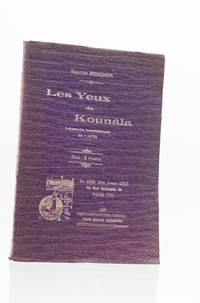
Maurice BOUCHOR
Les yeux de Kounâla légende bouddhique en 5 actes
Paris: Simon Siné 1905. Fine. Simon Siné Paris 1905 13 x 19 cm broché First separate edition for which no mention is made of deluxe copies. Handsome copy despite the unlettered spine and covers slightly and marginally faded. Simon Siné unknown
Bookseller reference : 75539
|
|
|
Maurice BOUVIER-AJAM
Recherches sur la genèse et la date d'apparition des corporations médiévales en France
Paris: R. Pichon & R. Durand-Auzias 1978. Fine. R. Pichon & R. Durand-Auzias Paris 1978 15 x 20.50 cm broché The first edition of which there were no deluxe copies. Signed autograph inscription from Maurice Bouvier-Ajam to Madame Bastiel. Handsome copy complete with publisher's slip. R. Pichon & R. Durand-Auzias unknown
Bookseller reference : 51411

|
|
|
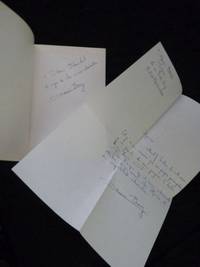
Maurice BOURG
Saisons qui portez tout
Paris: Editions Saint-Germain-des-Prés 1974. Fine. Editions Saint-Germain-des-Prés Paris 1974 12 x 18.50 cm broché First edition of which there were no deluxe copies. Precious autograph inscription signed by Maurice Bourg to Maurice Blanchot. Our copy is enhanced with an autograph letter signed by the author also addressed to Maurice Blanchot. Minor worming to boards. Editions Saint-Germain-des-Prés hardcover
Bookseller reference : 44388
|
|
|
Maurice BRANSIET
La vie et les amours tourmentées de Sacher-Masoch le père du 'masochisme'
s. l.: Quignon 1930. Fine. Quignon s. l. s. d. circa 1930 12 x 19 cm broché First edition of which there were no deluxe copies false statement of edition. A very small repaired tear at the head of one joint marginal worming to the front board. Quignon unknown
Bookseller reference : 10290

|
|
|
Maurice CAREME
Complaintes
Paris: Fernand Nathan 1975. Fine. Fernand Nathan Paris 1975 20 x 27 cm broché First edition. Signed autograph inscription from the author to Jean Guéhenno. Work illustrated by Félix de Boeck. Handsome copy. Fernand Nathan unknown
Bookseller reference : 40859

|
|
|
Maurice CAREME
De feu et de cendre
Paris: Fernand Nathan 1974. Fine. Fernand Nathan Paris 1974 9.50 x 13.50 cm broché First edition. Signed autograph inscription from Maurice Careme to Jean Guéhenno. Handsome copy. Fernand Nathan unknown
Bookseller reference : 40858

|
|
|
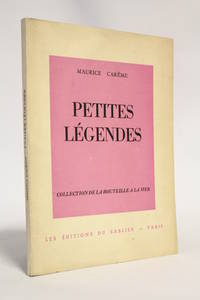
Maurice CAREME
Petites légendes
Paris: Editions du Sablier 1949. Fine. Editions du Sablier Paris 1949 14 x 19 cm broché First edition one of 700 numbered copies on alfa paper the only deluxe copies after 100 on pure thread paper. Handsome copy. Editions du Sablier unknown
Bookseller reference : 57349
|
|
|
Maurice CHEVALIER
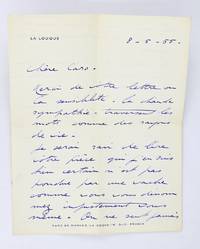
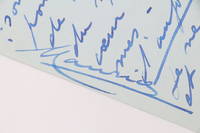
". Puis je vais chanter quatre semaines. en afrique du sud. pour goualer une dernière fois en angliche avant New York en septembre prochain."" Signed autograph letter addressed to Alice Rim
Marnes-la-Coquette: S. n. 1955. Fine. S. n. Marnes-la-Coquette 8 Mai 1955 21.50 x 27.50 cm une feuille Autograph letter signed and dated by Maurice Chevalier from his property ""La Louque"" in Marnes-la-Coquette to Alice Rim 34 lines in blue ink envelope included praising the sensitivity of his correspondent who compares herself to a cow. He also writes to her about savoring his freedom to be independent and manage his career alone. Fold mark inherent to the mailing. The letter is addressed to Caro Canaille pen name of Alice Rim Carlo's wife: ""5 - 5- 55 Dear Caro thank you for your letter where sensitivity - warm sympathy - passes through the words like rays of life. I will be delighted to read your play which I am quite certain is not laid by a cow as you unjustly call yourself. One never feels the heart of real cows - one simply feels their kindness. I will be in Marnes for three weeks starting from the 16th of this month. Then I will sing for four weeks. in South Africa. to croon one last time in English before New York next September. The more I go on the more I relish my independence as a singing craftsman and the responsibilities that I face - alone - working in my room. Very truly yours. Maurice"". Carlo Rim was a Provençal writer author of ""Ma belle Marseille"" a caricaturist a filmmaker and was notably the friend of Fernandel Raimu and Marcel Pagnol but also of Max Jacob and André Salmon whom he met in Sanary. S. n. unknown
Bookseller reference : 83190
|
|
|
Maurice CHEVALIER
"Je ne compte pas ce que j'ai fait et continue de faire pour de vieux copains dans le malheur. Votre radin et ami Maurice"" Humorous Signed Autograph Letter Addressed to Alice Rim
Marnes-la-Coquette: S. n. 1954. Fine. S. n. Marnes-la-Coquette 12 Décembre 1954 21 x 13.50 cm une feuille une enveloppe Autograph letter dated and signed by Maurice Chevalier addressed from his property ""La Louque"" in Marnes-la-Coquette to Alice Rim 20 lines in blue ink envelope included. Fold mark inherent to envelope insertion. The letter is addressed to Caro Canaille pen name of Alice Rim Carlo's wife: ""12 - 12- 54 Chère Caro Pour ne pas qu'il y ait d'obscurités dans ce que vous me proposez si affectueusement de faire savoir au public - vous pouvez absolument dire que ""entre ce que j'ai gagné par mes concours aux galas que j'organisais - entre ce que j'ai obtenu d'amis généreux - entre ce que j'ai souvent versé de ma propre poche pour - la maison de retraite de Ris Orangis - le dispensaire du spectacle - et le comité du coeur de la Sacem - nous en sommes - et facilement - à cent millions d'aujourd'hui en 1954. Je ne compte pas ce que j'ai fait et continue de faire pour de vieux copains dans le malheur. Votre radin et ami Maurice"". Carlo Rim was a Provençal writer author of ""Ma belle Marseille"" a caricaturist a filmmaker and was notably the friend of Fernandel Raimu and Marcel Pagnol but also of Max Jacob and André Salmon whom he met in Sanary. S. n. unknown
Bookseller reference : 81941
|
|
|
Maurice CHAPELAIN
Amoralités familières
Paris: Grasset 1964. Fine. Grasset Paris 1964 12 x 18.50 cm broché First edition one of 37 numbered copies on Holland paper deluxe copy. A small tear of no consequence at the foot of the spine. Grasset unknown
Bookseller reference : 73258
|
|
|
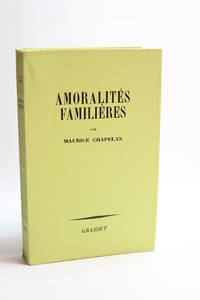
Maurice CHAPELAN
Amoralités familières
Paris: Grasset 1964. Fine. Grasset Paris 1964 12 x 19 cm broché First edition one of 37 numbered copies on Holland paper deluxe copy. Full-page autograph inscription signed by the author to Mathieu Galey. Fine copy. Grasset unknown
Bookseller reference : 42981

|
|
|
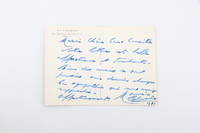
Maurice CHEVALIER
Carte postale autographe dédicacée de Maurice Chevalier adressée à l'écrivain Caro Canaille la femme de Carlo Rim
1971. Fine. 1971 14 x 10.50 cm une carte postale Autograph signed photographic postcard with 9 lines by Maurice Chevalier addressed to his friend Caro Canaille wife of the Provençal writer filmmaker and caricaturist Carlo Rim. Handsome copy. The postcard represents Maurice Chevalier's property in the Paris region at Marles-la-Coquette with a photograph of him in a medallion in the upper left corner of the card. ""Merci chère Caro Canaille. Votre lettre est belle affectueuse et touchante. Bien des années se sont passées sans devoir changer la sympathie qui nous avait rapprochés. Affectueusement. Maurice Chevalier 1971."" ""Thank you dear Caro Canaille. Your letter is beautiful affectionate and touching. Many years have passed without having to change the sympathy that brought us together. Affectionately. Maurice Chevalier 1971."" unknown
Bookseller reference : 80358
|
|
|
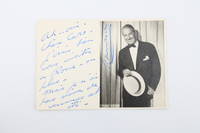
Maurice CHEVALIER
Carte postale autographe photographique dédicacée de Maurice Chevalier adressée à l'écrivain Caro Canaille la femme de Carlo Rim
1950. Fine. s. d. circa 1950 14.50 x 10.50 cm une carte postale Autograph picture postcard signed by Maurice Chevalier with 10 lines addressed to his friend Caro Canaille wife of the Provencal writer filmmaker and caricaturist Carlo Rim. Handsome copy. Maurice Chevalier is depicted facing forward and smiling in a tuxedo with his famous hat in his right hand. ""Ah. oui. Chère Caro. J'irais bien vous visiter à Rome - en plus. Mais je n'ai pas même de vacances cet été. Maurice."" ""Ah. yes. Dear Caro. I would very much like to visit you in Rome - moreover. But I don't even have holidays this summer. Maurice."" unknown
Bookseller reference : 80357
|
|
|
Maurice CHEVALIER
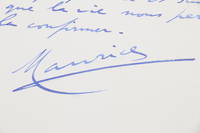
Carte postale photographique dédicacée à Alice Rim représentant sa propriété ""La Louque"" à Marnes-la-Coquette
Marnes-la-Coquette: S. n. 1954. Fine. S. n. Marnes-la-Coquette 10 Octobre 1954 10.50 x 10.50 cm une feuille Photographic postcard inscribed by Maurice Chevalier to Alice Rim depicting his property ""La Louque"" at Marnes-la-Coquette: ""Chère Caro"" ""Dear Caro"" le pseudonyme de plume d'Alice Rim était Caro Canaille ""the pen name of Alice Rim was Caro Canaille"" vous savez que je suis surchargé de travail et qu'en plus je ne pas très bien le bonhomme des cocktails ou expositions ou autres signatures. Je n'y suis jamais à l'aise. Je suis très heureux de notre nouvelle sympathie et suis certain que la vie nous permettra de le confirmer."" ""you know that I am overloaded with work and that furthermore I am not very good at being the fellow for cocktails or exhibitions or other signings. I am never comfortable there. I am very happy about our new friendship and am certain that life will allow us to confirm it."" S. n. unknown
Bookseller reference : 81596
|
|
|
Maurice CHEVALIER
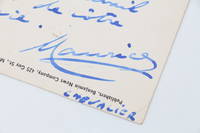
Carte postale photographique dédicacée à Alice Rim représentant un policier de la garde royale montée canadienne
Montréal Montreal: S. n. 1956. Fine. S. n. Montréal Montreal 2 Avril 1956 9 x 14 cm une feuille Photographic postcard inscribed by Maurice Chevalier to Alice Rim depicting a Canadian Mounted Police guard. The postcard is addressed from Montreal to Caro Canaille pen name of Alice Rim Carlo's wife. Carlo Rim was a Provençal writer author of ""Ma belle Marseille"" a caricaturist a filmmaker and was notably the friend of Fernandel Raimu and Marcel Pagnol but also of Max Jacob and André Salmon whom he met in Sanary. S. n. unknown
Bookseller reference : 81617
|
|
|
Maurice CHEVALIER
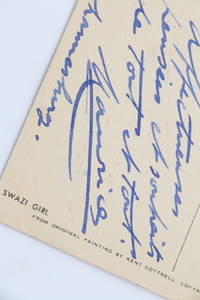
Carte postale photographique dédicacée à Alice Rim représentant une femme du Swaziland peinte par Kent Cottrell
Johannesburg 1955. Fine. Johannesburg 15 Juin 1955 10.50 x 14.50 cm une feuille Photographic postcard inscribed by Maurice Chevalier to Alice Rim depicting a woman from Swaziland painted by Kent Cottrell. The postcard is addressed from Johannesburg to Caro Canaille pen name of Alice Rim Carlo's wife. Carlo Rim was a Provençal writer author of ""Ma belle Marseille"" a caricaturist a filmmaker and was notably the friend of Fernandel Raimu and Marcel Pagnol but also of Max Jacob and André Salmon whom he met in Sanary. unknown
Bookseller reference : 81618
|
|
|
Maurice CHEVALIER
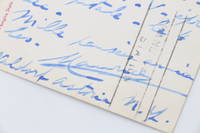
Carte postale photographique dédicacée à Alice Rim représentant l'Empire State Building à New York
New York: S. n. 1955. Fine. S. n. New York 17 Octobre 1955 9.50 x 14 cm une feuille Photographic postcard inscribed by Maurice Chevalier to Alice Rim showing the imposing Empire State Building in New York. The postcard is addressed from New York in telegraphic form to Caro Canaille pen name of Alice Rim Carlo's wife: ""Première manche - la scène - gagnée - Il reste la TV - épreuve capitale - le 4 Déc. Mille pensées amicales. Maurice. Waldorf Astoria N.Y."" ""First round - the stage - won - TV remains - crucial test - Dec 4th. A thousand friendly thoughts. Maurice. Waldorf Astoria N.Y."" Carlo Rim was a Provençal writer author of ""Ma belle Marseille"" a caricaturist a filmmaker and was notably the friend of Fernandel Raimu and Marcel Pagnol but also of Max Jacob and André Salmon whom he met in Sanary. S. n. unknown
Bookseller reference : 81923
|
|
|
Maurice CHEVALIER
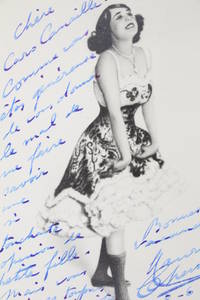
Carte postale photographique dédicacée à Alice Rim représentant Mistinguett en 1903
La cité des livres 1963. Fine. La cité des livres 8 Juin 1963 10.50 x 14.50 cm une feuille Photographic postcard inscribed by Maurice Chevalier to Alice Rim whose pen name was Caro Canaille depicting Mistinguett in 1903. ""Chère Caro Canaille comme vous êtes généreuse de vous donner le mal de me faire savoir une si touchante opinion de petite fille. Mais vous m'avez toujours montré votre amitié. Bonnes vacances. Maurice Chevalier. 8.6.63."" ""Dear Caro Canaille how generous you are to take the trouble to let me know such a touching opinion from a little girl. But you have always shown me your friendship. Happy holidays. Maurice Chevalier. 8.6.63."" Carlo Rim was a Provençal writer author of ""Ma belle Marseille"" a caricaturist a filmmaker and was notably the friend of Fernandel Raimu and Marcel Pagnol but also of Max Jacob and André Salmon whom he met in Sanary. La cité des livres unknown
Bookseller reference : 81831
|
|
|
Maurice CHEVALIER
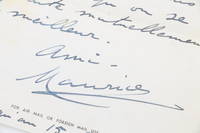
Lettre autographe datée et signée adressée à Alice Rim depuis le Waldorf Astoria de New York
New York: S. n. 1955. Fine. S. n. New York 15 Novembre 1955 18.50 x 26.50 cm une feuille Autograph letter dated and signed by Maurice Chevalier addressed to Alice Rim from the prestigious Waldorf Astoria hotel in New York 15 lines in blue ink. Fold marks inherent to the original mailing. ""15 - 11 - 55 Chère Amie j'espère que votre travail vous donne les joies qu'une aussi sincère créatrice mérite. On ne s'écrit pas beaucoup parce que on est trop dans ce qu'on fait mais on sait bien qu'on se souhaite mutuellement le meilleur. Ami Maurice. ici jusqu'au 15 décembre"" Dear Friend I hope your work brings you the joy that such a sincere creator deserves. We don't write much because we are too absorbed in what we do but we know we wish each other the best. Friend Maurice. here until December 15th. S. n. unknown
Bookseller reference : 87849
|
|
|
Maurice CHEVALIER
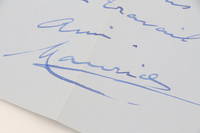
Lettre autographe signée adressée à Alice Rim lui présentant ses voeux pour l'année 1955
Marnes-la-Coquette: S. n. 1955. Fine. S. n. Marnes-la-Coquette 3 Janvier 1955 21 x 27 cm une feuille une enveloppe Autograph letter dated and signed by Maurice Chevalier addressed from his property ""La Louque"" in Marnes-la-Coquette to Alice Rim 10 lines in blue ink envelope included. Crease mark inherent to folding for mailing letter with letterhead featuring Maurice Chevalier's famous boater hat in upper left corner. The letter is addressed to Caro Canaille pen name of Alice Rim Carlo's wife: ""3 - 1- 55 Chère Caro merci de la pensée. J'arrive de Londres où j'ai fonctionné à la T.V. et me prépare à roucouler içi - la - et la bas sic Que 1955 vous apporte santé - travail - amour. Ami. Chevalier"". ""Dear Caro thank you for the thought. I'm coming from London where I worked on T.V. and am preparing to coo here - there - and over there. May 1955 bring you health - work - love. Friend. Chevalier"" Carlo Rim was a Provençal writer author of ""Ma belle Marseille"" a caricaturist a filmmaker and was notably the friend of Fernandel Raimu and Marcel Pagnol but also of Max Jacob and André Salmon whom he met in Sanary. S. n. unknown
Bookseller reference : 81924
|
|
|
Maurice CHEVALIER
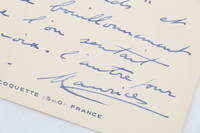
Lettre autographe signée adressée à Alice Rim
Marnes-la-Coquette: S. n. 1956. Fine. S. n. Marnes-la-Coquette 27 juin 1956 21 x 13.50 cm une feuille Autograph letter dated and signed by Maurice Chevalier from his property ""La Louque"" in Marnes-la-Coquette to Alice Rim 7 lines in blue ink. Fold marks inherent to postal handling. The letter is addressed to Caro Canaille pen name of Alice Rim Carlo's wife: ""27 - 6- 56 Chère Caro merci pour les ""Truands"" et bravo pour ce bouillonnement de joie que l'on sentait dans votre voix l'autre jour au téléphone. Maurice"". ""27 - 6- 56 Dear Caro thank you for the 'Truands' and bravo for that bubbling joy we could feel in your voice the other day on the phone. Maurice"" Carlo Rim was a Provençal writer author of ""Ma belle Marseille"" a caricaturist a filmmaker and was notably the friend of Fernandel Raimu and Marcel Pagnol but also of Max Jacob and André Salmon whom he met in Sanary. S. n. unknown
Bookseller reference : 83375
|
|
|
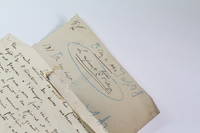
Maurice CHABAS
manifeste sur l'admission des oeuvres modernes aux expositions d'art français à l'étranger Unpublished autograph manuscript
1897. Fine. s. d. 17.70 x 22.80 cm Deux feuillets et un papillon encollé Unpublished autograph manuscript signed by the symbolist painter Maurice Chabas on ""the admission of modern works to French art exhibitions abroad"". Two leaves and a slip pasted on the first page. Crossed-out passages fold marks and small marginal tears not affecting text. Fascinating manifesto for the promotion of living artists and the avant-garde by Chabas who devoted himself to total abstraction in the 1920s. ""A great meeting will take place shortly on the subject of admitting modern works to French art exhibitions abroad. . Now until this moment the great art movement that has been manifesting itself for several years so interesting in its intensity and variety is not integrally represented in the exhibitions. By design the league of the impersonal crushes the personalities who alone count in art . We do not wish in any way to prevent the past schools which in sum have been interesting from uttering their last cry in the arena. But let no obstacle be made to highlighting the true artists with proud souls who always look higher magnetized towards the superior spheres of Beauty goodness and Truth! . Let us not forget our current radiance throughout the entire world and the ever-growing attraction of intellectuals from all countries towards the beacon of light that is France . Maurice Chabas hors-concours'"" unknown
Bookseller reference : 71909
|
|
|
Maurice CHEVALIER
Môme à cheveux blancs
Paris: Presses de la Cité 1969. Fine. Presses de la Cité Paris 1969 13.50 x 20.50 cm reliure de l'éditeur The first edition of which there were no deluxe copies. Publisher's full dark blue boards with the illustrated dust jacket complete showing three small spots of discoloration of no consequence. Signed and inscribed by Maurice Chevalier to Florence Gould. Iconography preface by Marcel Pagnol. Handsome copy. Presses de la Cité hardcover
Bookseller reference : 40480

|
|
|
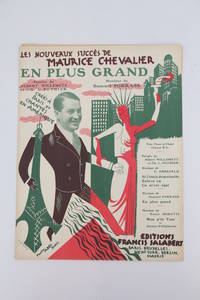
Maurice CHEVALIER
Partition piano et chant ""Les Nouveaux Succès de Maurice Chevalier en plus grand""
Paris: Editions Francis Salabert 1928. Fine. Editions Francis Salabert Paris s. d. 1928 27.10 x 35 cm Une feuille rempliée et une volante First edition of this score titled ""Les Nouveaux Succès de Maurice Chevalier en plus grand"" illustrated on the first page with a beautiful polychrome illustration consisting of a photo montage of the singer striding across the Seine - Eiffel Tower under his arm - reaching the Statue of Liberty and New York skyscrapers. Very fine condition. Editions Francis Salabert unknown
Bookseller reference : 79325
|
|
|
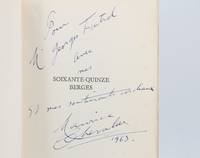
Maurice CHEVALIER
Soixante-quinze berges
Paris: Julliard 1963. Fine. Julliard Paris 1963 14 x 21.50 cm broché First edition one of 30 numbered copies on pure wove paper the only deluxe copies along with some hors commerce copies. Some light foxing to endpapers and edges. Autograph inscription dated and signed by Maurice Chevalier to Georges Feutrel. Julliard unknown
Bookseller reference : 84454
|
|
|
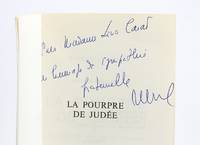
Maurice CLAVEL
La pourpre de Judée ou les délices du genre humain
Paris: Christian Bourgois 1967. Fine. Christian Bourgois Paris 1967 12 x 20 cm broché First edition printed on ordinary paper. Handsome copy. Autograph inscription signed by Maurice Clavel to Lina Caral. Christian Bourgois unknown
Bookseller reference : 84055
|
|
|
Maurice CLAVEL
La pourpre de Judée ou les délices du genre humain
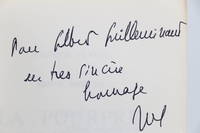
Paris: Christian Bourgois 1967. Fine. Christian Bourgois Paris 1967 12 x 20 cm broché First edition on ordinary paper. Fine copy. Autograph inscription signed by Maurice Clavel to Gilbert Guilleminault. Christian Bourgois unknown
Bookseller reference : 82492
|
|
|
Maurice CLAVEL
La terrasse de midi
Paris: Gallimard 1949. Fine. Gallimard Paris 1949 12 x 19 cm broché First edition one of 13 numbered copies on pure linen paper the only deluxe copies. Handsome copy. Gallimard unknown
Bookseller reference : 28373

|
|
|
Maurice CLAVEL
Le jardin de Djemila
Paris: Julliard 1963. Fine. Julliard Paris 1963 14.50 x 19.50 cm broché First edition one of 20 numbered copies on pur fil du Marais paper ours one of the few unnumbered hors commerce copies but justified at the foot of the second cover the only deluxe copies. Handsome copy. Julliard unknown
Bookseller reference : 24618

|
|
|
Maurice CLAVEL
Une fille pour l'été
Paris: Julliard 1957. Fine. Julliard Paris 1957 12 x 19 cm broché First edition one of 30 numbered copies on Corvol l'orgueilleux paper the only deluxe copies. Handsome copy. Julliard unknown
Bookseller reference : 69519

|
|
|
Maurice CONSTANTIN-WEYER
Du Sang sur la Neige
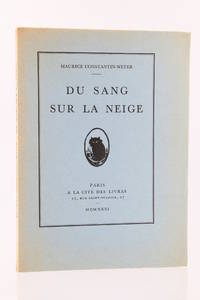
Paris: A la Cité des Livres 1931. Fine. A la Cité des Livres Paris 1931 15 x 21 cm broché First edition one of 10 numbered copies on Japan paper deluxe copy. Spine and covers slightly and marginally lightened as is generally the case. A la Cité des Livres unknown
Bookseller reference : 78177
|
|

 Receive by email
 Download as PDF document
 RSS feed
 Permanent link


