|
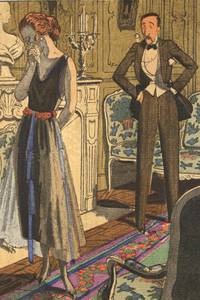
Pierre BRISSAUD - (Charles-Frederick WORTH)
Enfin ! Qu'avez-vous chère amie . ou Les nerfs. Robe de dîner de Worth pl.60 La Gazette du Bon ton 1920 n°8
Paris: Lucien Vogel éditeur 1920. Fine. Lucien Vogel éditeur Paris 1920 18 x 24 cm une feuille Original color print printed on vergé paper signed in the plate. An original print used to illustrate the Gazette du bon ton one of the most attractive and influential 20th century fashion magazines featuring the talents of French artists and other contributors from the burgeoning Art Deco movement. A celebrated fashion magazine established in 1912 by Lucien Vogel La Gazette du bon ton appeared until 1925 with a hiatus from 1915 to 1920 due to the war the editor-in-chief having been called up for service. It consisted of 69 issues printed in only 2000 copies each and notably illustrated with 573 color plates and 148 sketches of the models of the great designers. Right from the start this sumptuous publication was aimed at bibliophiles and fashionable society Françoise Tétart-Vittu La Gazette du bon ton in Dictionnaire de la mode 2016 and was printed on fine vergé paper using a type cut specially for the magazine by Georges Peignot known as Cochin later used in 1946 by Christian Dior. The prints were made using stencils heightened in colors some highlighted in gold or palladium. The story began in 1912 when Lucien Vogel a man of the world involved in fashion he had already been part of the fashion magazine Femina decided with his wife Cosette de Brunhoff the sister of Jean creator of Babar to set up the Gazette du bon ton subtitled at the time: Art fashion frivolities. Georges Charensol noted the reasoning of the editor-in-chief: In 1910 he observed there was no really artistic fashion magazine nothing representative of the spirit of the time. My dream was therefore to make a luxury magazine with truly modern artists
I was assured of success because when it comes to fashion no country on earth can compete with France. Un grand éditeur dart. Lucien Vogel in Les Nouvelles littéraires no. 133 May 1925. The magazine was immediately successful not only in France but also in the United States and Latin America. At first Vogel put together a team of seven artists: André-Édouard Marty and Pierre Brissaud followed by Georges Lepape and Dammicourt as well as eventually his friends from school and the School of Fine Arts like George Barbier Bernard Boutet de Monvel and Charles Martin. Other talented people soon came flocking to join the team: Guy Arnoux Léon Bakst Benito Boutet de Monvel Umberto Brunelleschi Chas Laborde Jean-Gabriel Domergue Raoul Dufy Édouard Halouze Alexandre Iacovleff Jean Émile Laboureur Charles Loupot Chalres Martin Maggie Salcedo. These artist mostly unknown when Lucien Vogel sought them out later became emblematic and sought-after artistic figures. It was also they who worked on the advertising drawings for the Gazette. The plates put the spotlight on and celebrate dresses by seven designers of the age: Lanvin Doeuillet Paquin Poiret Worth Vionnet and Doucet. The designers provided exclusive models for each issue. Nonetheless some of the illustrations are not based on real models but simply on the illustrators conception of the fashion of the day. The Gazette du bon ton was an important step in the history of fashion. Combining aesthetic demands with the physical whole it brought together for the first time the great talents of the artistic literary and fashion worlds; and imposed through this alchemy a completely new image of women: slender independent and daring which was shared by the new generation of designers including Coco Chanel Jean Patou Marcel Rochas and so on
Taken over in 1920 by Condé Montrose Nast the Gazette du bon ton was an important influence on the new layout and aesthetics of that little dying paper that Nast had bought a few years earlier: Vogue. Lucien Vogel éditeur unknown
Referencia librero : 54803
|
|
|
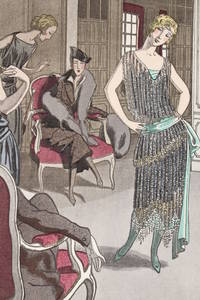
Pierre BRISSAUD - (Georges DOEUILLET)
Faites-moi celle-ci. Robe du soir de Doeuillet pl.56 La Gazette du Bon ton 1921 n°7
Paris: Lucien Vogel éditeur 1921. Fine. Lucien Vogel éditeur Paris 1921 18 x 24 cm une feuille Original color print printed on vergé paper signed in the plate. An original print used to illustrate the Gazette du bon ton one of the most attractive and influential 20th century fashion magazines featuring the talents of French artists and other contributors from the burgeoning Art Deco movement. A celebrated fashion magazine established in 1912 by Lucien Vogel La Gazette du bon ton appeared until 1925 with a hiatus from 1915 to 1920 due to the war the editor-in-chief having been called up for service. It consisted of 69 issues printed in only 2000 copies each and notably illustrated with 573 color plates and 148 sketches of the models of the great designers. Right from the start this sumptuous publication was aimed at bibliophiles and fashionable society Françoise Tétart-Vittu La Gazette du bon ton in Dictionnaire de la mode 2016 and was printed on fine vergé paper using a type cut specially for the magazine by Georges Peignot known as Cochin later used in 1946 by Christian Dior. The prints were made using stencils heightened in colors some highlighted in gold or palladium. The story began in 1912 when Lucien Vogel a man of the world involved in fashion he had already been part of the fashion magazine Femina decided with his wife Cosette de Brunhoff the sister of Jean creator of Babar to set up the Gazette du bon ton subtitled at the time: Art fashion frivolities. Georges Charensol noted the reasoning of the editor-in-chief: In 1910 he observed there was no really artistic fashion magazine nothing representative of the spirit of the time. My dream was therefore to make a luxury magazine with truly modern artists
I was assured of success because when it comes to fashion no country on earth can compete with France. Un grand éditeur dart. Lucien Vogel in Les Nouvelles littéraires no. 133 May 1925. The magazine was immediately successful not only in France but also in the United States and Latin America. At first Vogel put together a team of seven artists: André-Édouard Marty and Pierre Brissaud followed by Georges Lepape and Dammicourt as well as eventually his friends from school and the School of Fine Arts like George Barbier Bernard Boutet de Monvel and Charles Martin. Other talented people soon came flocking to join the team: Guy Arnoux Léon Bakst Benito Boutet de Monvel Umberto Brunelleschi Chas Laborde Jean-Gabriel Domergue Raoul Dufy Édouard Halouze Alexandre Iacovleff Jean Émile Laboureur Charles Loupot Chalres Martin Maggie Salcedo. These artist mostly unknown when Lucien Vogel sought them out later became emblematic and sought-after artistic figures. It was also they who worked on the advertising drawings for the Gazette. The plates put the spotlight on and celebrate dresses by seven designers of the age: Lanvin Doeuillet Paquin Poiret Worth Vionnet and Doucet. The designers provided exclusive models for each issue. Nonetheless some of the illustrations are not based on real models but simply on the illustrators conception of the fashion of the day. The Gazette du bon ton was an important step in the history of fashion. Combining aesthetic demands with the physical whole it brought together for the first time the great talents of the artistic literary and fashion worlds; and imposed through this alchemy a completely new image of women: slender independent and daring which was shared by the new generation of designers including Coco Chanel Jean Patou Marcel Rochas and so on
Taken over in 1920 by Condé Montrose Nast the Gazette du bon ton was an important influence on the new layout and aesthetics of that little dying paper that Nast had bought a few years earlier: Vogue. Lucien Vogel éditeur unknown
Referencia librero : 54894
|
|
|
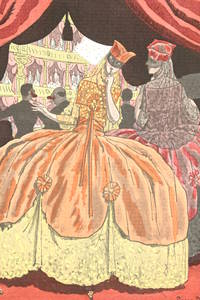
Pierre BRISSAUD - (Jeanne LANVIN)
Ils ne m'ont pas reconnue. Travesti de Jeanne Lanvin pl.52 La Gazette du Bon ton 1921 n°7
Paris: Lucien Vogel éditeur 1921. Fine. Lucien Vogel éditeur Paris 1921 18 x 24 cm une feuille Pierre BRISSAUD Jeanne LANVIN Ils ne m'ont pas reconnue. Travesti de Jeanne Lanvin Original color print from La Gazette du Bon ton Lucien Vogel éditeur Paris 1921 18 x 24 cm one leaf Original print in color printed on laid paper signed lower right of the board. Original print used to illustrate the Gazette du Bon ton one of the most attractive and influential 20th century fashion magazines featuring the talents of French artists and other contributors from the burgeoning Art Deco movement. Lucien Vogel éditeur unknown
Referencia librero : 57585
|
|
|
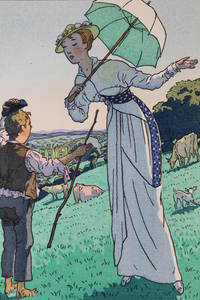
Pierre BRISSAUD - (Louise CHERUIT)
Je suis perdue. Robe d'été de Chéruit pl.4 La Gazette du Bon ton 1913 n°8
Paris: Lucien Vogel éditeur 1913. Fine. Lucien Vogel éditeur Paris Juin 1913 19 x 24.50 cm une feuille Original color print printed on vergé paper signed in the plate. An original print used to illustrate the Gazette du bon ton one of the most attractive and influential 20th century fashion magazines featuring the talents of French artists and other contributors from the burgeoning Art Deco movement. A celebrated fashion magazine established in 1912 by Lucien Vogel La Gazette du bon ton appeared until 1925 with a hiatus from 1915 to 1920 due to the war the editor-in-chief having been called up for service. It consisted of 69 issues printed in only 2000 copies each and notably illustrated with 573 color plates and 148 sketches of the models of the great designers. Right from the start this sumptuous publication was aimed at bibliophiles and fashionable society Françoise Tétart-Vittu La Gazette du bon ton in Dictionnaire de la mode 2016 and was printed on fine vergé paper using a type cut specially for the magazine by Georges Peignot known as Cochin later used in 1946 by Christian Dior. The prints were made using stencils heightened in colors some highlighted in gold or palladium. The story began in 1912 when Lucien Vogel a man of the world involved in fashion he had already been part of the fashion magazine Femina decided with his wife Cosette de Brunhoff the sister of Jean creator of Babar to set up the Gazette du bon ton subtitled at the time: Art fashion frivolities. Georges Charensol noted the reasoning of the editor-in-chief: In 1910 he observed there was no really artistic fashion magazine nothing representative of the spirit of the time. My dream was therefore to make a luxury magazine with truly modern artists
I was assured of success because when it comes to fashion no country on earth can compete with France. Un grand éditeur dart. Lucien Vogel in Les Nouvelles littéraires no. 133 May 1925. The magazine was immediately successful not only in France but also in the United States and Latin America. At first Vogel put together a team of seven artists: André-Édouard Marty and Pierre Brissaud followed by Georges Lepape and Dammicourt as well as eventually his friends from school and the School of Fine Arts like George Barbier Bernard Boutet de Monvel and Charles Martin. Other talented people soon came flocking to join the team: Guy Arnoux Léon Bakst Benito Boutet de Monvel Umberto Brunelleschi Chas Laborde Jean-Gabriel Domergue Raoul Dufy Édouard Halouze Alexandre Iacovleff Jean Émile Laboureur Charles Loupot Chalres Martin Maggie Salcedo. These artist mostly unknown when Lucien Vogel sought them out later became emblematic and sought-after artistic figures. It was also they who worked on the advertising drawings for the Gazette. The plates put the spotlight on and celebrate dresses by seven designers of the age: Lanvin Doeuillet Paquin Poiret Worth Vionnet and Doucet. The designers provided exclusive models for each issue. Nonetheless some of the illustrations are not based on real models but simply on the illustrators conception of the fashion of the day. The Gazette du bon ton was an important step in the history of fashion. Combining aesthetic demands with the physical whole it brought together for the first time the great talents of the artistic literary and fashion worlds; and imposed through this alchemy a completely new image of women: slender independent and daring which was shared by the new generation of designers including Coco Chanel Jean Patou Marcel Rochas and so on
Taken over in 1920 by Condé Montrose Nast the Gazette du bon ton was an important influence on the new layout and aesthetics of that little dying paper that Nast had bought a few years earlier: Vogue. Lucien Vogel éditeur unknown
Referencia librero : 54542
|
|
|
Pierre BRISSAUD - (Louise CHERUIT)
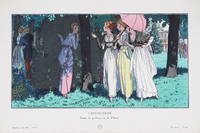
L'Indiscrète. Robes de garden-party de Chéruit pl.59 La Gazette du Bon ton 1914 n°6
Paris: Lucien Vogel éditeur 1914. Fine. Lucien Vogel éditeur Paris Juin 1914 36.50 x 24 cm une feuille Original double color print printed on laid paper signed at lower left of the plate. Original engraving created for the illustration of La Gazette du bon ton one of the most beautiful and influential fashion magazines of the 20th century celebrating the talent of French creators and artists in the full flowering of Art Deco. Famous fashion magazine founded in 1912 by Lucien Vogel La Gazette du bon ton was published until 1925 with an interruption during the War from 1915 to 1920 due to the mobilization of its editor-in-chief. It consists of 69 issues printed in only 2000 copies and is illustrated notably with 573 color plates and 148 sketches representing designs by great couturiers. From their publication these luxurious publications ""were addressed to bibliophiles and sophisticated aesthetes"" Françoise Tétart-Vittu ""La Gazette du bon ton"" in Dictionnaire de la mode 2016. Printed on fine laid paper they use a typeface specially created for the magazine by Georges Peignot the Cochin typeface adopted in 1946 by Christian Dior. The prints are created using the metal stencil technique heightened in colors and some highlighted with gold or palladium. The adventure began in 1912 when Lucien Vogel man of the world and fashion - he had already participated in the magazine Femina - decided to found with his wife Cosette de Brunhoff sister of Jean the father of Babar the Gazette du bon ton whose subtitle was then ""Art modes et frivolités"". Georges Charensol reports the words of the editor-in-chief: ""En 1910 observe-t-il il n'existait aucun journal de mode véritablement artistique et représentatif de l'esprit de son époque. Je songeais donc à faire un magazine de luxe avec des artistes véritablement modernes . J'étais certain du succès car pour la mode aucun pays ne peut rivaliser avec la France."" ""In 1910 he observed there was no fashion journal that was truly artistic and representative of the spirit of its time. I was therefore thinking of making a luxury magazine with truly modern artists . I was certain of success because for fashion no country can rival France."" ""Un grand éditeur d'art. Lucien Vogel"" in Les Nouvelles littéraires n°133 May 1925. The success of the magazine was immediate not only in France but also in the United States and South America. Originally Vogel therefore assembled a group of seven artists: André-Édouard Marty and Pierre Brissaud followed by Georges Lepape and Dammicourt; and finally his friends from the École des beaux-arts who were George Barbier Bernard Boutet de Monvel and Charles Martin. Other talents quickly joined the team: Guy Arnoux Léon Bakst Benito Boutet de Monvel Umberto Brunelleschi Chas Laborde Jean-Gabriel Domergue Raoul Dufy Édouard Halouze Alexandre Iacovleff Jean Émile Laboureur Charles Loupot Charles Martin Maggie Salcedo. These artists unknown for the most part when Lucien Vogel called upon them would later become emblematic and sought-after artistic figures. It was these same illustrators who created the drawings for the Gazette's advertisements. The plates highlight and sublimate the dresses of seven creators of the time: Lanvin Doeuillet Paquin Poiret Worth Vionnet and Doucet. The couturiers provided exclusive designs for each issue. Nevertheless some of the illustrations do not feature any real design but only the idea that the illustrator had of contemporary fashion. La Gazette du bon ton was a decisive step in fashion history. Combining aesthetic demands and artistic unity it brought together for the first time the great talents of the worlds of arts letters and fashion and imposed through this alchemy a completely new image of woman slender independent and audacious also carried by the new generation of couturiers Coco Chanel Jean Patou Marcel Rochas. Taken over in 1920 by Condé Montrose Nast La Gazette du bon ton would largely inspir Lucien Vogel éditeur unknown
Referencia librero : 84761
|
|
|
Pierre BRISSAUD
L'indiscrète. Robes de garden-party de Chéruit. La Gazette du Bon ton n°6. Juin 1914 - Planche 59:
Paris: Lucien Vogel éditeur 1914. Fine. Lucien Vogel éditeur Paris 1914 38.10 x 24.50 cm une feuille Original color print printed on vergé paper signed in the plate. An original print used to illustrate the Gazette du bon ton one of the most attractive and influential 20th century fashion magazines featuring the talents of French artists and other contributors from the burgeoning Art Deco movement. A celebrated fashion magazine established in 1912 by Lucien Vogel La Gazette du bon ton appeared until 1925 with a hiatus from 1915 to 1920 due to the war the editor-in-chief having been called up for service. It consisted of 69 issues printed in only 2000 copies each and notably illustrated with 573 color plates and 148 sketches of the models of the great designers. Right from the start this sumptuous publication was aimed at bibliophiles and fashionable society Françoise Tétart-Vittu La Gazette du bon ton in Dictionnaire de la mode 2016 and was printed on fine vergé paper using a type cut specially for the magazine by Georges Peignot known as Cochin later used in 1946 by Christian Dior. The prints were made using stencils heightened in colors some highlighted in gold or palladium. The story began in 1912 when Lucien Vogel a man of the world involved in fashion he had already been part of the fashion magazine Femina decided with his wife Cosette de Brunhoff the sister of Jean creator of Babar to set up the Gazette du bon ton subtitled at the time: Art fashion frivolities. Georges Charensol noted the reasoning of the editor-in-chief: In 1910 he observed there was no really artistic fashion magazine nothing representative of the spirit of the time. My dream was therefore to make a luxury magazine with truly modern artists
I was assured of success because when it comes to fashion no country on earth can compete with France. Un grand éditeur dart. Lucien Vogel in Les Nouvelles littéraires no. 133 May 1925. The magazine was immediately successful not only in France but also in the United States and Latin America. At first Vogel put together a team of seven artists: André-Édouard Marty and Pierre Brissaud followed by Georges Lepape and Dammicourt as well as eventually his friends from school and the School of Fine Arts like George Barbier Bernard Boutet de Monvel and Charles Martin. Other talented people soon came flocking to join the team: Guy Arnoux Léon Bakst Benito Boutet de Monvel Umberto Brunelleschi Chas Laborde Jean-Gabriel Domergue Raoul Dufy Édouard Halouze Alexandre Iacovleff Jean Émile Laboureur Charles Loupot Chalres Martin Maggie Salcedo. These artist mostly unknown when Lucien Vogel sought them out later became emblematic and sought-after artistic figures. It was also they who worked on the advertising drawings for the Gazette. The plates put the spotlight on and celebrate dresses by seven designers of the age: Lanvin Doeuillet Paquin Poiret Worth Vionnet and Doucet. The designers provided exclusive models for each issue. Nonetheless some of the illustrations are not based on real models but simply on the illustrators conception of the fashion of the day. The Gazette du bon ton was an important step in the history of fashion. Combining aesthetic demands with the physical whole it brought together for the first time the great talents of the artistic literary and fashion worlds; and imposed through this alchemy a completely new image of women: slender independent and daring which was shared by the new generation of designers including Coco Chanel Jean Patou Marcel Rochas and so on
Taken over in 1920 by Condé Montrose Nast the Gazette du bon ton was an important influence on the new layout and aesthetics of that little dying paper that Nast had bought a few years earlier: Vogue. Lucien Vogel éditeur unknown
Referencia librero : 51296

|
|
|
Pierre BRISSAUD - (Louise CHERUIT)
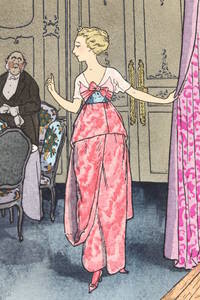
L'Utile Recommandation. Robe de dîner de Cheruit pl.2 La Gazette du Bon ton 1912-1913 n°1
Paris: Lucien Vogel éditeur 1912. Fine. Lucien Vogel éditeur Paris 1912-1913 19 x 24.50 cm une feuille Original color print printed on vergé paper signed in the plate. An original print used to illustrate the Gazette du bon ton one of the most attractive and influential 20th century fashion magazines featuring the talents of French artists and other contributors from the burgeoning Art Deco movement. A celebrated fashion magazine established in 1912 by Lucien Vogel La Gazette du bon ton appeared until 1925 with a hiatus from 1915 to 1920 due to the war the editor-in-chief having been called up for service. It consisted of 69 issues printed in only 2000 copies each and notably illustrated with 573 color plates and 148 sketches of the models of the great designers. Right from the start this sumptuous publication was aimed at bibliophiles and fashionable society Françoise Tétart-Vittu La Gazette du bon ton in Dictionnaire de la mode 2016 and was printed on fine vergé paper using a type cut specially for the magazine by Georges Peignot known as Cochin later used in 1946 by Christian Dior. The prints were made using stencils heightened in colors some highlighted in gold or palladium. The story began in 1912 when Lucien Vogel a man of the world involved in fashion he had already been part of the fashion magazine Femina decided with his wife Cosette de Brunhoff the sister of Jean creator of Babar to set up the Gazette du bon ton subtitled at the time: Art fashion frivolities. Georges Charensol noted the reasoning of the editor-in-chief: In 1910 he observed there was no really artistic fashion magazine nothing representative of the spirit of the time. My dream was therefore to make a luxury magazine with truly modern artists
I was assured of success because when it comes to fashion no country on earth can compete with France. Un grand éditeur dart. Lucien Vogel in Les Nouvelles littéraires no. 133 May 1925. The magazine was immediately successful not only in France but also in the United States and Latin America. At first Vogel put together a team of seven artists: André-Édouard Marty and Pierre Brissaud followed by Georges Lepape and Dammicourt as well as eventually his friends from school and the School of Fine Arts like George Barbier Bernard Boutet de Monvel and Charles Martin. Other talented people soon came flocking to join the team: Guy Arnoux Léon Bakst Benito Boutet de Monvel Umberto Brunelleschi Chas Laborde Jean-Gabriel Domergue Raoul Dufy Édouard Halouze Alexandre Iacovleff Jean Émile Laboureur Charles Loupot Chalres Martin Maggie Salcedo. These artist mostly unknown when Lucien Vogel sought them out later became emblematic and sought-after artistic figures. It was also they who worked on the advertising drawings for the Gazette. The plates put the spotlight on and celebrate dresses by seven designers of the age: Lanvin Doeuillet Paquin Poiret Worth Vionnet and Doucet. The designers provided exclusive models for each issue. Nonetheless some of the illustrations are not based on real models but simply on the illustrators conception of the fashion of the day. The Gazette du bon ton was an important step in the history of fashion. Combining aesthetic demands with the physical whole it brought together for the first time the great talents of the artistic literary and fashion worlds; and imposed through this alchemy a completely new image of women: slender independent and daring which was shared by the new generation of designers including Coco Chanel Jean Patou Marcel Rochas and so on
Taken over in 1920 by Condé Montrose Nast the Gazette du bon ton was an important influence on the new layout and aesthetics of that little dying paper that Nast had bought a few years earlier: Vogue. Lucien Vogel éditeur unknown
Referencia librero : 54472
|
|
|
Pierre BRIZON - Ernest POISSON
La coopération
Paris: Aristide Quillet 1913. Fine. Aristide Quillet Paris 1913 13.50 x 19.50 cm reliure de l'éditeur First edition published under the technical direction of Compère-Morel. Publisher's binding in full burgundy flexible boards smooth spine with minor rubbing small tears and marginal rubbing to first and second covers handsome interior condition. Illustrated. From the series: Encyclopédie socialiste syndicale coopérative de l'internationale ouvrière. Aristide Quillet hardcover
Referencia librero : 26258
|
|
|
Pierre BRISSAUD
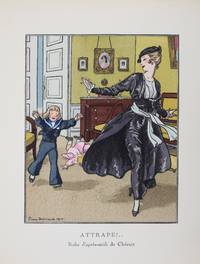
La Gazette du Bon ton n°3. Année 1914 - Planche 23 : ""Attrape!. Robe d'après-midi de Chéruit.""
Paris: Lucien Vogel éditeur 1914. Fine. Lucien Vogel éditeur Paris 1914 19.50 x 25 cm une feuille Original color print on laid paper signed at bottom left of the plate. Original engraving created for the illustration of La Gazette du bon ton one of the most beautiful and influential fashion magazines of the 20th century celebrating the talent of French designers and artists during the flourishing of Art Deco. Famous fashion magazine founded in 1912 by Lucien Vogel La Gazette du bon ton was published until 1925 with an interruption during the War from 1915 to 1920 due to the mobilization of its editor-in-chief. It consists of 69 issues printed in only 2000 copies and is illustrated notably with 573 color plates and 148 sketches representing models by great couturiers. From their publication these luxurious publications ""address bibliophiles and worldly aesthetes"" Françoise Tétart-Vittu ""La Gazette du bon ton"" in Dictionnaire de la mode 2016. Printed on fine laid paper they use a typeface specially created for the magazine by Georges Peignot the Cochin character adopted in 1946 by Christian Dior. The prints are created using the metal stencil technique heightened in colors and some highlighted with gold or palladium. The adventure begins in 1912 when Lucien Vogel a man of society and fashion - he had already participated in the magazine Femina - decides to found with his wife Cosette de Brunhoff sister of Jean father of Babar La Gazette du bon ton whose subtitle was then ""Art modes et frivolités"". Georges Charensol reports the editor-in-chief's words: ""In 1910 he observes there was no truly artistic fashion journal representative of the spirit of its time. I therefore thought of creating a luxury magazine with truly modern artists . I was certain of success because in fashion no country can rival France."" ""Un grand éditeur d'art. Lucien Vogel"" in Les Nouvelles littéraires no. 133 May 1925. The magazine's success was immediate not only in France but also in the United States and South America. Originally Vogel assembled a group of seven artists: André-Édouard Marty and Pierre Brissaud followed by Georges Lepape and Dammicourt; and finally his friends from the École des beaux-arts who were George Barbier Bernard Boutet de Monvel or Charles Martin. Other talents quickly joined the team: Guy Arnoux Léon Bakst Benito Boutet de Monvel Umberto Brunelleschi Chas Laborde Jean-Gabriel Domergue Raoul Dufy Édouard Halouze Alexandre Iacovleff Jean Émile Laboureur Charles Loupot Charles Martin Maggie Salcedo. These artists mostly unknown when Lucien Vogel called upon them would later become emblematic and sought-after artistic figures. These same illustrators created the drawings for La Gazette's advertisements. The plates highlight and sublimate the dresses of seven designers of the era: Lanvin Doeuillet Paquin Poiret Worth Vionnet and Doucet. The couturiers provided exclusive models for each issue. Nevertheless some of the illustrations feature no real model but only the illustrator's idea of contemporary fashion. La Gazette du bon ton is a decisive step in fashion history. Combining aesthetic excellence and visual unity it brought together for the first time the great talents of the worlds of arts letters and fashion and imposed through this alchemy a completely new image of woman slender independent and bold also carried by the new generation of couturiers Coco Chanel Jean Patou Marcel Rochas. Taken over in 1920 by Condé Montrose Nast La Gazette du bon ton would largely inspire the new composition and aesthetic choices of the ""dying little journal"" that Nast had purchased a few years earlier: Vogue magazine. Lucien Vogel éditeur unknown
Referencia librero : 84757
|
|
|
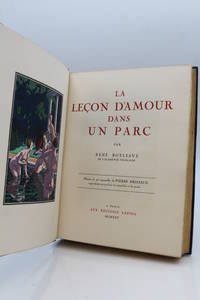
Pierre BRISSAUD - Rene BOYLESVE
La leçon d'amour dans un parc
Paris: Editions Lapina 1925. Fine. Editions Lapina Paris 1925 21 x 28 cm relié sous étui Edition illustrated with 45 original watercolors in colors by Pierre Brissaud reproduced by pochoir one of 403 numbered copies on Holland paper. Bradel binding in half navy blue morocco with corners smooth spine decorated with two compartments of red mosaicked morocco date and place gilt at foot marbled paper boards endpapers and pastedowns of moiré effect paper covers and spine preserved top edge gilt slipcase edged with navy blue morocco boards covered with two different marbled papers marked by a red morocco division elegant unsigned binding. Handsome copy pleasantly established. Editions Lapina hardcover
Referencia librero : 75040
|
|
|
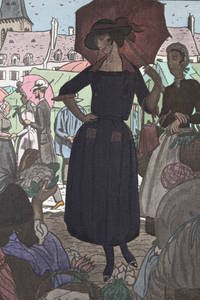
Pierre BRISSAUD - (Georges DOEUILLET)
La Ménagère accomplie. Petite robe de Doeuillet pl.44 La Gazette du Bon ton 1921 n°6
Paris: Lucien Vogel éditeur 1921. Fine. Lucien Vogel éditeur Paris 1921 18 x 24 cm une feuille Original color print printed on vergé paper signed in the plate. An original print used to illustrate the Gazette du bon ton one of the most attractive and influential 20th century fashion magazines featuring the talents of French artists and other contributors from the burgeoning Art Deco movement. A celebrated fashion magazine established in 1912 by Lucien Vogel La Gazette du bon ton appeared until 1925 with a hiatus from 1915 to 1920 due to the war the editor-in-chief having been called up for service. It consisted of 69 issues printed in only 2000 copies each and notably illustrated with 573 color plates and 148 sketches of the models of the great designers. Right from the start this sumptuous publication was aimed at bibliophiles and fashionable society Françoise Tétart-Vittu La Gazette du bon ton in Dictionnaire de la mode 2016 and was printed on fine vergé paper using a type cut specially for the magazine by Georges Peignot known as Cochin later used in 1946 by Christian Dior. The prints were made using stencils heightened in colors some highlighted in gold or palladium. The story began in 1912 when Lucien Vogel a man of the world involved in fashion he had already been part of the fashion magazine Femina decided with his wife Cosette de Brunhoff the sister of Jean creator of Babar to set up the Gazette du bon ton subtitled at the time: Art fashion frivolities. Georges Charensol noted the reasoning of the editor-in-chief: In 1910 he observed there was no really artistic fashion magazine nothing representative of the spirit of the time. My dream was therefore to make a luxury magazine with truly modern artists
I was assured of success because when it comes to fashion no country on earth can compete with France. Un grand éditeur dart. Lucien Vogel in Les Nouvelles littéraires no. 133 May 1925. The magazine was immediately successful not only in France but also in the United States and Latin America. At first Vogel put together a team of seven artists: André-Édouard Marty and Pierre Brissaud followed by Georges Lepape and Dammicourt as well as eventually his friends from school and the School of Fine Arts like George Barbier Bernard Boutet de Monvel and Charles Martin. Other talented people soon came flocking to join the team: Guy Arnoux Léon Bakst Benito Boutet de Monvel Umberto Brunelleschi Chas Laborde Jean-Gabriel Domergue Raoul Dufy Édouard Halouze Alexandre Iacovleff Jean Émile Laboureur Charles Loupot Chalres Martin Maggie Salcedo. These artist mostly unknown when Lucien Vogel sought them out later became emblematic and sought-after artistic figures. It was also they who worked on the advertising drawings for the Gazette. The plates put the spotlight on and celebrate dresses by seven designers of the age: Lanvin Doeuillet Paquin Poiret Worth Vionnet and Doucet. The designers provided exclusive models for each issue. Nonetheless some of the illustrations are not based on real models but simply on the illustrators conception of the fashion of the day. The Gazette du bon ton was an important step in the history of fashion. Combining aesthetic demands with the physical whole it brought together for the first time the great talents of the artistic literary and fashion worlds; and imposed through this alchemy a completely new image of women: slender independent and daring which was shared by the new generation of designers including Coco Chanel Jean Patou Marcel Rochas and so on
Taken over in 1920 by Condé Montrose Nast the Gazette du bon ton was an important influence on the new layout and aesthetics of that little dying paper that Nast had bought a few years earlier: Vogue. Lucien Vogel éditeur unknown
Referencia librero : 54882
|
|
|
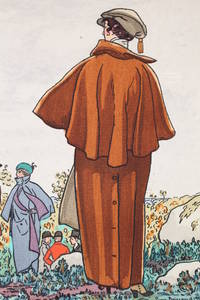
Pierre BRISSAUD - (Louise CHERUIT)
Le ""Meet"". Manteau de voiture de Chéruit pl.7 La Gazette du Bon ton 1913 n°12
Paris: Lucien Vogel éditeur 1913. Fine. Lucien Vogel éditeur Paris Octobre 1913 19 x 24.50 cm une feuille Original color print printed on vergé paper signed in the plate. An original print used to illustrate the Gazette du bon ton one of the most attractive and influential 20th century fashion magazines featuring the talents of French artists and other contributors from the burgeoning Art Deco movement. A celebrated fashion magazine established in 1912 by Lucien Vogel La Gazette du bon ton appeared until 1925 with a hiatus from 1915 to 1920 due to the war the editor-in-chief having been called up for service. It consisted of 69 issues printed in only 2000 copies each and notably illustrated with 573 color plates and 148 sketches of the models of the great designers. Right from the start this sumptuous publication was aimed at bibliophiles and fashionable society Françoise Tétart-Vittu La Gazette du bon ton in Dictionnaire de la mode 2016 and was printed on fine vergé paper using a type cut specially for the magazine by Georges Peignot known as Cochin later used in 1946 by Christian Dior. The prints were made using stencils heightened in colors some highlighted in gold or palladium. The story began in 1912 when Lucien Vogel a man of the world involved in fashion he had already been part of the fashion magazine Femina decided with his wife Cosette de Brunhoff the sister of Jean creator of Babar to set up the Gazette du bon ton subtitled at the time: Art fashion frivolities. Georges Charensol noted the reasoning of the editor-in-chief: In 1910 he observed there was no really artistic fashion magazine nothing representative of the spirit of the time. My dream was therefore to make a luxury magazine with truly modern artists
I was assured of success because when it comes to fashion no country on earth can compete with France. Un grand éditeur dart. Lucien Vogel in Les Nouvelles littéraires no. 133 May 1925. The magazine was immediately successful not only in France but also in the United States and Latin America. At first Vogel put together a team of seven artists: André-Édouard Marty and Pierre Brissaud followed by Georges Lepape and Dammicourt as well as eventually his friends from school and the School of Fine Arts like George Barbier Bernard Boutet de Monvel and Charles Martin. Other talented people soon came flocking to join the team: Guy Arnoux Léon Bakst Benito Boutet de Monvel Umberto Brunelleschi Chas Laborde Jean-Gabriel Domergue Raoul Dufy Édouard Halouze Alexandre Iacovleff Jean Émile Laboureur Charles Loupot Chalres Martin Maggie Salcedo. These artist mostly unknown when Lucien Vogel sought them out later became emblematic and sought-after artistic figures. It was also they who worked on the advertising drawings for the Gazette. The plates put the spotlight on and celebrate dresses by seven designers of the age: Lanvin Doeuillet Paquin Poiret Worth Vionnet and Doucet. The designers provided exclusive models for each issue. Nonetheless some of the illustrations are not based on real models but simply on the illustrators conception of the fashion of the day. The Gazette du bon ton was an important step in the history of fashion. Combining aesthetic demands with the physical whole it brought together for the first time the great talents of the artistic literary and fashion worlds; and imposed through this alchemy a completely new image of women: slender independent and daring which was shared by the new generation of designers including Coco Chanel Jean Patou Marcel Rochas and so on
Taken over in 1920 by Condé Montrose Nast the Gazette du bon ton was an important influence on the new layout and aesthetics of that little dying paper that Nast had bought a few years earlier: Vogue. Lucien Vogel éditeur unknown
Referencia librero : 54609
|
|
|
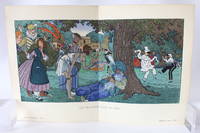
Pierre BRISSAUD
Les Travestis dans le parc pl.1 La Gazette du Bon ton 1913 n°11
Paris: Lucien Vogel éditeur 1913. Fine. Lucien Vogel éditeur Paris Septembre 1913 36.50 x 24 cm une feuille Pierre BRISSAUD Les Travestis dans le parc Original color print from La Gazette du Bon ton Lucien Vogel éditeur Paris September 1913 36.5 x 24 cm one leaf Double original color print printed on vergé paper signed in the plate. An original print used to illustrate the Gazette du bon ton one of the most attractive and influential 20th century fashion magazines featuring the talents of French artists and other contributors from the burgeoning Art Deco movement. Lucien Vogel éditeur unknown
Referencia librero : 54583
|
|
|
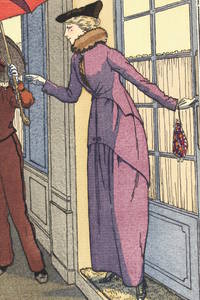
Pierre BRISSAUD - (Louise CHERUIT)
Ma voiture ! Robe de ville de Chéruit pl.9 La Gazette du Bon ton 1912-1913 n°3
Paris: Lucien Vogel éditeur 1912. Fine. Lucien Vogel éditeur Paris 1912-1913 19 x 24.50 cm une feuille Original color print printed on vergé paper signed in the plate. An original print used to illustrate the Gazette du bon ton one of the most attractive and influential 20th century fashion magazines featuring the talents of French artists and other contributors from the burgeoning Art Deco movement. A celebrated fashion magazine established in 1912 by Lucien Vogel La Gazette du bon ton appeared until 1925 with a hiatus from 1915 to 1920 due to the war the editor-in-chief having been called up for service. It consisted of 69 issues printed in only 2000 copies each and notably illustrated with 573 color plates and 148 sketches of the models of the great designers. Right from the start this sumptuous publication was aimed at bibliophiles and fashionable society Françoise Tétart-Vittu La Gazette du bon ton in Dictionnaire de la mode 2016 and was printed on fine vergé paper using a type cut specially for the magazine by Georges Peignot known as Cochin later used in 1946 by Christian Dior. The prints were made using stencils heightened in colors some highlighted in gold or palladium. The story began in 1912 when Lucien Vogel a man of the world involved in fashion he had already been part of the fashion magazine Femina decided with his wife Cosette de Brunhoff the sister of Jean creator of Babar to set up the Gazette du bon ton subtitled at the time: Art fashion frivolities. Georges Charensol noted the reasoning of the editor-in-chief: In 1910 he observed there was no really artistic fashion magazine nothing representative of the spirit of the time. My dream was therefore to make a luxury magazine with truly modern artists
I was assured of success because when it comes to fashion no country on earth can compete with France. Un grand éditeur dart. Lucien Vogel in Les Nouvelles littéraires no. 133 May 1925. The magazine was immediately successful not only in France but also in the United States and Latin America. At first Vogel put together a team of seven artists: André-Édouard Marty and Pierre Brissaud followed by Georges Lepape and Dammicourt as well as eventually his friends from school and the School of Fine Arts like George Barbier Bernard Boutet de Monvel and Charles Martin. Other talented people soon came flocking to join the team: Guy Arnoux Léon Bakst Benito Boutet de Monvel Umberto Brunelleschi Chas Laborde Jean-Gabriel Domergue Raoul Dufy Édouard Halouze Alexandre Iacovleff Jean Émile Laboureur Charles Loupot Chalres Martin Maggie Salcedo. These artist mostly unknown when Lucien Vogel sought them out later became emblematic and sought-after artistic figures. It was also they who worked on the advertising drawings for the Gazette. The plates put the spotlight on and celebrate dresses by seven designers of the age: Lanvin Doeuillet Paquin Poiret Worth Vionnet and Doucet. The designers provided exclusive models for each issue. Nonetheless some of the illustrations are not based on real models but simply on the illustrators conception of the fashion of the day. The Gazette du bon ton was an important step in the history of fashion. Combining aesthetic demands with the physical whole it brought together for the first time the great talents of the artistic literary and fashion worlds; and imposed through this alchemy a completely new image of women: slender independent and daring which was shared by the new generation of designers including Coco Chanel Jean Patou Marcel Rochas and so on
Taken over in 1920 by Condé Montrose Nast the Gazette du bon ton was an important influence on the new layout and aesthetics of that little dying paper that Nast had bought a few years earlier: Vogue. Lucien Vogel éditeur unknown
Referencia librero : 54500
|
|
|
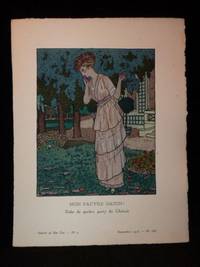
Pierre BRISSAUD
Mon pauvre gazon ! Robe de garden party de Chéruit. La Gazette du Bon ton n°11 Année 1913 - Planche VIII
Paris: Lucien Vogel éditeur 1913. Fine. Lucien Vogel éditeur Paris 1913 19.50 x 25 cm une feuille Original color print printed on vergé paper signed in the plate. An original print used to illustrate the Gazette du bon ton one of the most attractive and influential 20th century fashion magazines featuring the talents of French artists and other contributors from the burgeoning Art Deco movement. A celebrated fashion magazine established in 1912 by Lucien Vogel La Gazette du bon ton appeared until 1925 with a hiatus from 1915 to 1920 due to the war the editor-in-chief having been called up for service. It consisted of 69 issues printed in only 2000 copies each and notably illustrated with 573 color plates and 148 sketches of the models of the great designers. Right from the start this sumptuous publication was aimed at bibliophiles and fashionable society Françoise Tétart-Vittu La Gazette du bon ton in Dictionnaire de la mode 2016 and was printed on fine vergé paper using a type cut specially for the magazine by Georges Peignot known as Cochin later used in 1946 by Christian Dior. The prints were made using stencils heightened in colors some highlighted in gold or palladium. The story began in 1912 when Lucien Vogel a man of the world involved in fashion he had already been part of the fashion magazine Femina decided with his wife Cosette de Brunhoff the sister of Jean creator of Babar to set up the Gazette du bon ton subtitled at the time: Art fashion frivolities. Georges Charensol noted the reasoning of the editor-in-chief: In 1910 he observed there was no really artistic fashion magazine nothing representative of the spirit of the time. My dream was therefore to make a luxury magazine with truly modern artists
I was assured of success because when it comes to fashion no country on earth can compete with France. Un grand éditeur dart. Lucien Vogel in Les Nouvelles littéraires no. 133 May 1925. The magazine was immediately successful not only in France but also in the United States and Latin America. At first Vogel put together a team of seven artists: André-Édouard Marty and Pierre Brissaud followed by Georges Lepape and Dammicourt as well as eventually his friends from school and the School of Fine Arts like George Barbier Bernard Boutet de Monvel and Charles Martin. Other talented people soon came flocking to join the team: Guy Arnoux Léon Bakst Benito Boutet de Monvel Umberto Brunelleschi Chas Laborde Jean-Gabriel Domergue Raoul Dufy Édouard Halouze Alexandre Iacovleff Jean Émile Laboureur Charles Loupot Chalres Martin Maggie Salcedo. These artist mostly unknown when Lucien Vogel sought them out later became emblematic and sought-after artistic figures. It was also they who worked on the advertising drawings for the Gazette. The plates put the spotlight on and celebrate dresses by seven designers of the age: Lanvin Doeuillet Paquin Poiret Worth Vionnet and Doucet. The designers provided exclusive models for each issue. Nonetheless some of the illustrations are not based on real models but simply on the illustrators conception of the fashion of the day. The Gazette du bon ton was an important step in the history of fashion. Combining aesthetic demands with the physical whole it brought together for the first time the great talents of the artistic literary and fashion worlds; and imposed through this alchemy a completely new image of women: slender independent and daring which was shared by the new generation of designers including Coco Chanel Jean Patou Marcel Rochas and so on
Taken over in 1920 by Condé Montrose Nast the Gazette du bon ton was an important influence on the new layout and aesthetics of that little dying paper that Nast had bought a few years earlier: Vogue. Lucien Vogel éditeur unknown
Referencia librero : 43236
|
|
|
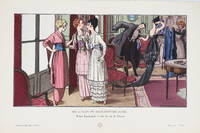
Pierre BRISSAUD - (Jacques DOUCET)
On aurait pu nous inviter aussi. Robes d'après-midi et robe du soir de Doucet pl.61 La Gazette du Bon ton 1914 n°6
Paris: Lucien Vogel éditeur 1914. Fine. Lucien Vogel éditeur Paris Juin 1914 36.50 x 24 cm une feuille Original double color print printed on laid paper signed at lower right of plate. Original engraving created for the illustration of La Gazette du bon ton one of the most beautiful and influential fashion magazines of the 20th century celebrating the talent of French creators and artists during the flowering of Art Deco. Famous fashion magazine founded in 1912 by Lucien Vogel La Gazette du bon ton appeared until 1925 with an interruption during the War from 1915 to 1920 due to the mobilization of its editor-in-chief. It consists of 69 issues printed in only 2000 copies and is illustrated notably with 573 color plates and 148 sketches representing models by great couturiers. From their publication these luxurious publications ""addressed bibliophiles and worldly aesthetes"" Françoise Tétart-Vittu ""La Gazette du bon ton"" in Dictionnaire de la mode 2016. Printed on fine laid paper they used a typeface specially created for the magazine by Georges Peignot the Cochin character adopted in 1946 by Christian Dior. The prints were created using the metal stencil technique heightened in colors and some highlighted in gold or palladium. The adventure began in 1912 when Lucien Vogel man of society and fashion - he had already participated in the magazine Femina - decided to found with his wife Cosette de Brunhoff sister of Jean father of Babar the Gazette du bon ton whose subtitle was then ""Art modes et frivolités."" Georges Charensol reports the editor-in-chief's words: ""En 1910 observe-t-il il n'existait aucun journal de mode véritablement artistique et représentatif de l'esprit de son époque. Je songeais donc à faire un magazine de luxe avec des artistes véritablement modernes . J'étais certain du succès car pour la mode aucun pays ne peut rivaliser avec la France."" ""In 1910 he observed there existed no fashion journal that was truly artistic and representative of the spirit of its time. I was therefore thinking of creating a luxury magazine with truly modern artists . I was certain of success because for fashion no country can rival France."" ""Un grand éditeur d'art. Lucien Vogel"" in Les Nouvelles littéraires n°133 May 1925. The magazine's success was immediate not only in France but also in the United States and South America. Originally Vogel thus assembled a group of seven artists: André-Édouard Marty and Pierre Brissaud followed by Georges Lepape and Dammicourt; and finally his friends from the École des beaux-arts who were George Barbier Bernard Boutet de Monvel or Charles Martin. Other talents quickly joined the team: Guy Arnoux Léon Bakst Benito Boutet de Monvel Umberto Brunelleschi Chas Laborde Jean-Gabriel Domergue Raoul Dufy Édouard Halouze Alexandre Iacovleff Jean Émile Laboureur Charles Loupot Charles Martin Maggie Salcedo. These artists mostly unknown when Lucien Vogel called upon them would subsequently become emblematic and sought-after artistic figures. These same illustrators created the drawings for the Gazette's advertisements. The plates highlighted and sublimated the dresses of seven creators of the time: Lanvin Doeuillet Paquin Poiret Worth Vionnet and Doucet. The couturiers provided exclusive models for each issue. Nevertheless some of the illustrations featured no real model but only the illustrator's idea of contemporary fashion. La Gazette du bon ton was a decisive step in fashion history. Combining aesthetic excellence and visual unity it brought together for the first time the great talents of the worlds of arts letters and fashion and imposed through this alchemy a completely new image of woman slender independent and bold also carried by the new generation of couturiers Coco Chanel Jean Patou Marcel Rochas. Taken over in 1920 by Condé Montrose Nast the Gazette du bon ton would largely inspire the new composition and aesthetic choices of the ""dying little journal"" Lucien Vogel éditeur unknown
Referencia librero : 84751
|
|
|
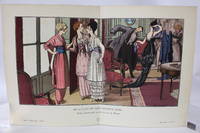
Pierre BRISSAUD - (Jacques DOUCET)
On aurait pu nous inviter aussi. Robes d'après-midi et robe du soir de Doucet pl.61 La Gazette du Bon ton 1914 n°6
Paris: Lucien Vogel éditeur 1914. Fine. Lucien Vogel éditeur Paris Juin 1914 36.50 x 24 cm une feuille Double original color print printed on vergé paper signed in the plate. An original print used to illustrate the Gazette du bon ton one of the most attractive and influential 20th century fashion magazines featuring the talents of French artists and other contributors from the burgeoning Art Deco movement. A celebrated fashion magazine established in 1912 by Lucien Vogel La Gazette du bon ton appeared until 1925 with a hiatus from 1915 to 1920 due to the war the editor-in-chief having been called up for service. It consisted of 69 issues printed in only 2000 copies each and notably illustrated with 573 color plates and 148 sketches of the models of the great designers. Right from the start this sumptuous publication was aimed at bibliophiles and fashionable society Françoise Tétart-Vittu La Gazette du bon ton in Dictionnaire de la mode 2016 and was printed on fine vergé paper using a type cut specially for the magazine by Georges Peignot known as Cochin later used in 1946 by Christian Dior. The prints were made using stencils heightened in colors some highlighted in gold or palladium. The story began in 1912 when Lucien Vogel a man of the world involved in fashion he had already been part of the fashion magazine Femina decided with his wife Cosette de Brunhoff the sister of Jean creator of Babar to set up the Gazette du bon ton subtitled at the time: Art fashion frivolities. Georges Charensol noted the reasoning of the editor-in-chief: 'In 1910' he observed there was no really artistic fashion magazine nothing representative of the spirit of the time. My dream was therefore to make a luxury magazine with truly modern artists
I was assured of success because when it comes to fashion no country on earth can compete with France.' Un grand éditeur d'art. Lucien Vogel in Les Nouvelles littéraires no. 133 May 1925. The magazine was immediately successful not only in France but also in the United States and Latin America. At first Vogel put together a team of seven artists: André-Édouard Marty and Pierre Brissaud followed by Georges Lepape and Dammicourt as well as eventually his friends from school and the School of Fine Arts like George Barbier Bernard Boutet de Monvel and Charles Martin. Other talented people soon came flocking to join the team: Guy Arnoux Léon Bakst Benito Boutet de Monvel Umberto Brunelleschi Chas Laborde Jean-Gabriel Domergue Raoul Dufy Édouard Halouze Alexandre Iacovleff Jean Émile Laboureur Charles Loupot Chalres Martin Maggie Salcedo. These artist mostly unknown when Lucien Vogel sought them out later became emblematic and sought-after artistic figures. It was also they who worked on the advertising drawings for the Gazette. The plates put the spotlight on and celebrate dresses by seven designers of the age: Lanvin Doeuillet Paquin Poiret Worth Vionnet and Doucet. The designers provided exclusive models for each issue. Nonetheless some of the illustrations are not based on real models but simply on the illustrator's conception of the fashion of the day. The Gazette du bon ton was an important step in the history of fashion. Combining aesthetic demands with the physical whole it brought together for the first time the great talents of the artistic literary and fashion worlds; and imposed through this alchemy a completely new image of women: slender independent and daring which was shared by the new generation of designers including Coco Chanel Jean Patou Marcel Rochas and so on
Taken over in 1920 by Condé Montrose Nast the Gazette du bon ton was an important influence on the new layout and aesthetics of that little dying paper that Nast had bought a few years earlier: Vogue. Lucien Vogel éditeur unknown
Referencia librero : 54682
|
|
|
Pierre BRISSAUD
On aurait pu nous inviter aussi.Robes d'après-midi et robe du soir de Doucet. La Gazette du Bon ton n°6. Juin 1914 - Planche 61
Paris: Lucien Vogel éditeur 1914. Fine. Lucien Vogel éditeur Paris 1914 38.20 x 24.50 cm une feuille Original color print printed on vergé paper signed in the plate. An original print used to illustrate the Gazette du bon ton one of the most attractive and influential 20th century fashion magazines featuring the talents of French artists and other contributors from the burgeoning Art Deco movement. A celebrated fashion magazine established in 1912 by Lucien Vogel La Gazette du bon ton appeared until 1925 with a hiatus from 1915 to 1920 due to the war the editor-in-chief having been called up for service. It consisted of 69 issues printed in only 2000 copies each and notably illustrated with 573 color plates and 148 sketches of the models of the great designers. Right from the start this sumptuous publication was aimed at bibliophiles and fashionable society Françoise Tétart-Vittu La Gazette du bon ton in Dictionnaire de la mode 2016 and was printed on fine vergé paper using a type cut specially for the magazine by Georges Peignot known as Cochin later used in 1946 by Christian Dior. The prints were made using stencils heightened in colors some highlighted in gold or palladium. The story began in 1912 when Lucien Vogel a man of the world involved in fashion he had already been part of the fashion magazine Femina decided with his wife Cosette de Brunhoff the sister of Jean creator of Babar to set up the Gazette du bon ton subtitled at the time: Art fashion frivolities. Georges Charensol noted the reasoning of the editor-in-chief: 'In 1910' he observed there was no really artistic fashion magazine nothing representative of the spirit of the time. My dream was therefore to make a luxury magazine with truly modern artists
I was assured of success because when it comes to fashion no country on earth can compete with France.' Un grand éditeur d'art. Lucien Vogel in Les Nouvelles littéraires no. 133 May 1925. The magazine was immediately successful not only in France but also in the United States and Latin America. At first Vogel put together a team of seven artists: André-Édouard Marty and Pierre Brissaud followed by Georges Lepape and Dammicourt as well as eventually his friends from school and the School of Fine Arts like George Barbier Bernard Boutet de Monvel and Charles Martin. Other talented people soon came flocking to join the team: Guy Arnoux Léon Bakst Benito Boutet de Monvel Umberto Brunelleschi Chas Laborde Jean-Gabriel Domergue Raoul Dufy Édouard Halouze Alexandre Iacovleff Jean Émile Laboureur Charles Loupot Chalres Martin Maggie Salcedo. These artist mostly unknown when Lucien Vogel sought them out later became emblematic and sought-after artistic figures. It was also they who worked on the advertising drawings for the Gazette. The plates put the spotlight on and celebrate dresses by seven designers of the age: Lanvin Doeuillet Paquin Poiret Worth Vionnet and Doucet. The designers provided exclusive models for each issue. Nonetheless some of the illustrations are not based on real models but simply on the illustrator's conception of the fashion of the day. The Gazette du bon ton was an important step in the history of fashion. Combining aesthetic demands with the physical whole it brought together for the first time the great talents of the artistic literary and fashion worlds; and imposed through this alchemy a completely new image of women: slender independent and daring which was shared by the new generation of designers including Coco Chanel Jean Patou Marcel Rochas and so on
Taken over in 1920 by Condé Montrose Nast the Gazette du bon ton was an important influence on the new layout and aesthetics of that little dying paper that Nast had bought a few years earlier: Vogue. Lucien Vogel éditeur unknown
Referencia librero : 51293
|
|
|
Pierre BRISSAUD - (Jeanne LANVIN)
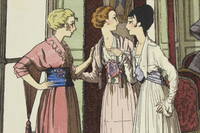
On t'attend ! Robe d'organdi et manteau d'enfant de Jeanne Lanvin pl.44 La Gazette du Bon ton 1920 n°6
Paris: Lucien Vogel éditeur 1920. Fine. Lucien Vogel éditeur Paris Juillet 1920 18 x 24 cm une feuille Original color print printed on laid paper signed in the lower right of the plate. Original engraving created for the illustration of La Gazette du bon ton one of the most beautiful and influential fashion magazines of the 20th century celebrating the talent of French creators and artists during the height of the Art Deco movement. Famous fashion magazine founded in 1912 by Lucien Vogel La Gazette du bon ton was published until 1925 with an interruption during the War from 1915 to 1920 due to the mobilization of its editor-in-chief. It comprises 69 issues printed in only 2000 copies and is illustrated notably with 573 color plates and 148 sketches representing models by great couturiers. From their publication these luxurious publications ""address bibliophiles and worldly aesthetes"" Françoise Tétart-Vittu ""La Gazette du bon ton"" in Dictionnaire de la mode 2016. Printed on fine laid paper they use a typeface specially created for the magazine by Georges Peignot the Cochin typeface adopted in 1946 by Christian Dior. The prints are created using the metallic stencil technique heightened in colors and some highlighted with gold or palladium. The adventure begins in 1912 when Lucien Vogel man of the world and fashion - he had already participated in the magazine Femina - decides to found with his wife Cosette de Brunhoff sister of Jean the father of Babar the Gazette du bon ton whose subtitle was then ""Art modes et frivolités"". Georges Charensol reports the words of the editor-in-chief: ""En 1910 observe-t-il il n'existait aucun journal de mode véritablement artistique et représentatif de l'esprit de son époque. Je songeais donc à faire un magazine de luxe avec des artistes véritablement modernes . J'étais certain du succès car pour la mode aucun pays ne peut rivaliser avec la France."" ""In 1910 he observes there was no fashion journal that was truly artistic and representative of the spirit of its time. I therefore thought of making a luxury magazine with truly modern artists . I was certain of success because for fashion no country can rival France."" ""Un grand éditeur d'art. Lucien Vogel"" in Les Nouvelles littéraires n°133 May 1925. The success of the magazine is immediate not only in France but also in the United States and South America. Originally Vogel thus brings together a group of seven artists: André-Édouard Marty and Pierre Brissaud followed by Georges Lepape and Dammicourt; and finally his friends from the École des beaux-arts such as George Barbier Bernard Boutet de Monvel or Charles Martin. Other talents quickly join the team: Guy Arnoux Léon Bakst Benito Boutet de Monvel Umberto Brunelleschi Chas Laborde Jean-Gabriel Domergue Raoul Dufy Édouard Halouze Alexandre Iacovleff Jean Émile Laboureur Charles Loupot Charles Martin Maggie Salcedo. These artists mostly unknown when Lucien Vogel calls upon them will subsequently become emblematic and sought-after artistic figures. These same illustrators create the drawings for the Gazette's advertisements. The plates highlight and sublimate the dresses of seven creators of the period: Lanvin Doeuillet Paquin Poiret Worth Vionnet and Doucet. The couturiers provide exclusive models for each issue. Nevertheless some of the illustrations show no real model but only the illustrator's idea of contemporary fashion. La Gazette du bon ton is a decisive step in the history of fashion. Combining aesthetic excellence and plastic unity it brings together for the first time the great talents from the worlds of arts letters and fashion and establishes through this alchemy a completely new image of woman slender independent and audacious also carried by the new generation of couturiers Coco Chanel Jean Patou Marcel Rochas. Taken over in 1920 by Condé Montrose Nast La Gazette du bon ton will largely inspire the new composition and aesthetic choices of Lucien Vogel éditeur unknown
Referencia librero : 77353
|
|
|
Pierre BRISSAUD - (Georges DOEUILLET)
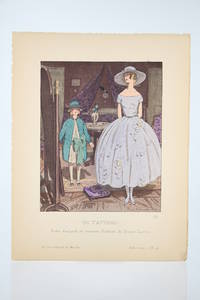
Pas de promenade Tom.il pleut. Robe d'après-midi de Doeuillet pl.19 La Gazette du Bon ton 1921 n°3
Paris: Lucien Vogel éditeur 1921. Fine. Lucien Vogel éditeur Paris 1921 18 x 24 cm une feuille Original color print printed on vergé paper non signed. An original print used to illustrate the Gazette du bon ton one of the most attractive and influential 20th century fashion magazines featuring the talents of French artists and other contributors from the burgeoning Art Deco movement. A celebrated fashion magazine established in 1912 by Lucien Vogel La Gazette du bon ton appeared until 1925 with a hiatus from 1915 to 1920 due to the war the editor-in-chief having been called up for service. It consisted of 69 issues printed in only 2000 copies each and notably illustrated with 573 color plates and 148 sketches of the models of the great designers. Right from the start this sumptuous publication was aimed at bibliophiles and fashionable society Françoise Tétart-Vittu La Gazette du bon ton in Dictionnaire de la mode 2016 and was printed on fine vergé paper using a type cut specially for the magazine by Georges Peignot known as Cochin later used in 1946 by Christian Dior. The prints were made using stencils heightened in colors some highlighted in gold or palladium. The story began in 1912 when Lucien Vogel a man of the world involved in fashion he had already been part of the fashion magazine Femina decided with his wife Cosette de Brunhoff the sister of Jean creator of Babar to set up the Gazette du bon ton subtitled at the time: Art fashion frivolities. Georges Charensol noted the reasoning of the editor-in-chief: In 1910 he observed there was no really artistic fashion magazine nothing representative of the spirit of the time. My dream was therefore to make a luxury magazine with truly modern artists
I was assured of success because when it comes to fashion no country on earth can compete with France. Un grand éditeur dart. Lucien Vogel in Les Nouvelles littéraires no. 133 May 1925. The magazine was immediately successful not only in France but also in the United States and Latin America. At first Vogel put together a team of seven artists: André-Édouard Marty and Pierre Brissaud followed by Georges Lepape and Dammicourt as well as eventually his friends from school and the School of Fine Arts like George Barbier Bernard Boutet de Monvel and Charles Martin. Other talented people soon came flocking to join the team: Guy Arnoux Léon Bakst Benito Boutet de Monvel Umberto Brunelleschi Chas Laborde Jean-Gabriel Domergue Raoul Dufy Édouard Halouze Alexandre Iacovleff Jean Émile Laboureur Charles Loupot Chalres Martin Maggie Salcedo. These artist mostly unknown when Lucien Vogel sought them out later became emblematic and sought-after artistic figures. It was also they who worked on the advertising drawings for the Gazette. The plates put the spotlight on and celebrate dresses by seven designers of the age: Lanvin Doeuillet Paquin Poiret Worth Vionnet and Doucet. The designers provided exclusive models for each issue. Nonetheless some of the illustrations are not based on real models but simply on the illustrators conception of the fashion of the day. The Gazette du bon ton was an important step in the history of fashion. Combining aesthetic demands with the physical whole it brought together for the first time the great talents of the artistic literary and fashion worlds; and imposed through this alchemy a completely new image of women: slender independent and daring which was shared by the new generation of designers including Coco Chanel Jean Patou Marcel Rochas and so on
Taken over in 1920 by Condé Montrose Nast the Gazette du bon ton was an important influence on the new layout and aesthetics of that little dying paper that Nast had bought a few years earlier: Vogue. Lucien Vogel éditeur unknown
Referencia librero : 54855
|
|
|
Pierre BRISSAUD
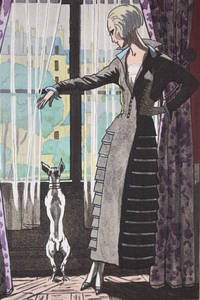
Pour les pauvres. Robe d'après-midi et robe de petite fille de Jeanne Lanvin. La Gazette du Bon ton n°3. Avril 1920 - Planche 23:
Paris: Lucien Vogel éditeur 1920. Fine. Lucien Vogel éditeur Paris 1920 19 x 24.50 cm une feuille Original color print printed on vergé paper signed in the plate. An original print used to illustrate the Gazette du bon ton one of the most attractive and influential 20th century fashion magazines featuring the talents of French artists and other contributors from the burgeoning Art Deco movement. A celebrated fashion magazine established in 1912 by Lucien Vogel La Gazette du bon ton appeared until 1925 with a hiatus from 1915 to 1920 due to the war the editor-in-chief having been called up for service. It consisted of 69 issues printed in only 2000 copies each and notably illustrated with 573 color plates and 148 sketches of the models of the great designers. Right from the start this sumptuous publication was aimed at bibliophiles and fashionable society Françoise Tétart-Vittu La Gazette du bon ton in Dictionnaire de la mode 2016 and was printed on fine vergé paper using a type cut specially for the magazine by Georges Peignot known as Cochin later used in 1946 by Christian Dior. The prints were made using stencils heightened in colors some highlighted in gold or palladium. The story began in 1912 when Lucien Vogel a man of the world involved in fashion he had already been part of the fashion magazine Femina decided with his wife Cosette de Brunhoff the sister of Jean creator of Babar to set up the Gazette du bon ton subtitled at the time: Art fashion frivolities. Georges Charensol noted the reasoning of the editor-in-chief: In 1910 he observed there was no really artistic fashion magazine nothing representative of the spirit of the time. My dream was therefore to make a luxury magazine with truly modern artists
I was assured of success because when it comes to fashion no country on earth can compete with France. Un grand éditeur dart. Lucien Vogel in Les Nouvelles littéraires no. 133 May 1925. The magazine was immediately successful not only in France but also in the United States and Latin America. At first Vogel put together a team of seven artists: André-Édouard Marty and Pierre Brissaud followed by Georges Lepape and Dammicourt as well as eventually his friends from school and the School of Fine Arts like George Barbier Bernard Boutet de Monvel and Charles Martin. Other talented people soon came flocking to join the team: Guy Arnoux Léon Bakst Benito Boutet de Monvel Umberto Brunelleschi Chas Laborde Jean-Gabriel Domergue Raoul Dufy Édouard Halouze Alexandre Iacovleff Jean Émile Laboureur Charles Loupot Chalres Martin Maggie Salcedo. These artist mostly unknown when Lucien Vogel sought them out later became emblematic and sought-after artistic figures. It was also they who worked on the advertising drawings for the Gazette. The plates put the spotlight on and celebrate dresses by seven designers of the age: Lanvin Doeuillet Paquin Poiret Worth Vionnet and Doucet. The designers provided exclusive models for each issue. Nonetheless some of the illustrations are not based on real models but simply on the illustrators conception of the fashion of the day. The Gazette du bon ton was an important step in the history of fashion. Combining aesthetic demands with the physical whole it brought together for the first time the great talents of the artistic literary and fashion worlds; and imposed through this alchemy a completely new image of women: slender independent and daring which was shared by the new generation of designers including Coco Chanel Jean Patou Marcel Rochas and so on
Taken over in 1920 by Condé Montrose Nast the Gazette du bon ton was an important influence on the new layout and aesthetics of that little dying paper that Nast had bought a few years earlier: Vogue. Lucien Vogel éditeur unknown
Referencia librero : 51304
|
|
|
Pierre BRISSAUD - (Louise CHERUIT)
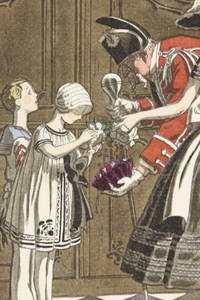
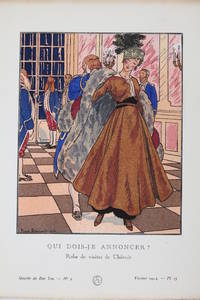
Qui dois-je annoncer Robe de visites de Chéruit pl.15 La Gazette du Bon ton 1914 n°2
Paris: Lucien Vogel éditeur 1914. Fine. Lucien Vogel éditeur Paris Février 1914 19 x 24.50 cm une feuille Original color print printed on laid paper signed at the bottom left of the plate. Original engraving created for the illustration of La Gazette du bon ton one of the most beautiful and influential fashion magazines of the 20th century celebrating the talent of French creators and artists in the full flowering of Art Deco. This famous fashion magazine founded in 1912 by Lucien Vogel was published until 1925 with an interruption during the War from 1915 to 1920 due to the mobilization of its editor-in-chief. It consists of 69 issues printed in only 2000 copies and is illustrated notably with 573 color plates and 148 sketches representing models by great couturiers. From their publication these luxurious publications ""address bibliophiles and worldly aesthetes"" Françoise Tétart-Vittu ""La Gazette du bon ton"" in Dictionnaire de la mode 2016. Printed on beautiful laid paper they use a typeface specially created for the magazine by Georges Peignot the Cochin character adopted in 1946 by Christian Dior. The prints are made using the metal stencil technique heightened in colors and some highlighted in gold or palladium. The adventure began in 1912 when Lucien Vogel a man of society and fashion - he had already participated in the magazine Femina - decided to found with his wife Cosette de Brunhoff sister of Jean the father of Babar the Gazette du bon ton whose subtitle was then ""Art modes et frivolités"". Georges Charensol reports the words of the editor-in-chief: ""In 1910 he observes there existed no fashion journal truly artistic and representative of the spirit of its time. I was therefore thinking of making a luxury magazine with truly modern artists . I was certain of success because for fashion no country can rival France."" ""Un grand éditeur d'art. Lucien Vogel"" in Les Nouvelles littéraires n°133 May 1925. The success of the magazine was immediate not only in France but also in the United States and South America. Originally Vogel therefore brought together a group of seven artists: André-Édouard Marty and Pierre Brissaud followed by Georges Lepape and Dammicourt; and finally his friends from the École des beaux-arts who were George Barbier Bernard Boutet de Monvel or Charles Martin. Other talents quickly came to join the team: Guy Arnoux Léon Bakst Benito Boutet de Monvel Umberto Brunelleschi Chas Laborde Jean-Gabriel Domergue Raoul Dufy Édouard Halouze Alexandre Iacovleff Jean Émile Laboureur Charles Loupot Charles Martin Maggie Salcedo. These artists mostly unknown when Lucien Vogel called upon them would subsequently become emblematic and sought-after artistic figures. These same illustrators created the drawings for the Gazette's advertisements. The plates highlight and sublimate the dresses of seven creators of the time: Lanvin Doeuillet Paquin Poiret Worth Vionnet and Doucet. The couturiers provided exclusive models for each issue. Nevertheless some of the illustrations featured no real model but only the illustrator's idea of the fashion of the day. La Gazette du bon ton is a decisive stage in the history of fashion. Combining aesthetic demands and plastic unity it brought together for the first time the great talents of the world of arts letters and fashion and imposed through this alchemy a completely new image of woman slender independent and audacious also carried by the new generation of couturiers Coco Chanel Jean Patou Marcel Rochas. Taken over in 1920 by Condé Montrose Nast the Gazette du bon ton would largely inspire the new composition and aesthetic choices of the ""dying little journal"" that Nast had bought a few years earlier: Vogue magazine. Lucien Vogel éditeur unknown
Referencia librero : 84680
|
|
|
Pierre BRISSAUD
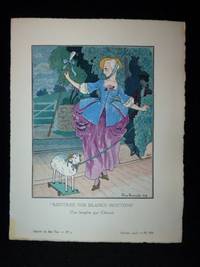
Rentrez vos blancs moutons. Une bergère par Chéruit. La Gazette du Bon ton n°4 Année 1913 - Planche VIII
Paris: Lucien Vogel éditeur 1913. Fine. Lucien Vogel éditeur Paris 1913 19.50 x 25 cm une feuille Original color print printed on vergé paper signed in the plate. An original print used to illustrate the Gazette du bon ton one of the most attractive and influential 20th century fashion magazines featuring the talents of French artists and other contributors from the burgeoning Art Deco movement. A celebrated fashion magazine established in 1912 by Lucien Vogel La Gazette du bon ton appeared until 1925 with a hiatus from 1915 to 1920 due to the war the editor-in-chief having been called up for service. It consisted of 69 issues printed in only 2000 copies each and notably illustrated with 573 color plates and 148 sketches of the models of the great designers. Right from the start this sumptuous publication was aimed at bibliophiles and fashionable society Françoise Tétart-Vittu La Gazette du bon ton in Dictionnaire de la mode 2016 and was printed on fine vergé paper using a type cut specially for the magazine by Georges Peignot known as Cochin later used in 1946 by Christian Dior. The prints were made using stencils heightened in colors some highlighted in gold or palladium. The story began in 1912 when Lucien Vogel a man of the world involved in fashion he had already been part of the fashion magazine Femina decided with his wife Cosette de Brunhoff the sister of Jean creator of Babar to set up the Gazette du bon ton subtitled at the time: Art fashion frivolities. Georges Charensol noted the reasoning of the editor-in-chief: In 1910 he observed there was no really artistic fashion magazine nothing representative of the spirit of the time. My dream was therefore to make a luxury magazine with truly modern artists
I was assured of success because when it comes to fashion no country on earth can compete with France. Un grand éditeur dart. Lucien Vogel in Les Nouvelles littéraires no. 133 May 1925. The magazine was immediately successful not only in France but also in the United States and Latin America. At first Vogel put together a team of seven artists: André-Édouard Marty and Pierre Brissaud followed by Georges Lepape and Dammicourt as well as eventually his friends from school and the School of Fine Arts like George Barbier Bernard Boutet de Monvel and Charles Martin. Other talented people soon came flocking to join the team: Guy Arnoux Léon Bakst Benito Boutet de Monvel Umberto Brunelleschi Chas Laborde Jean-Gabriel Domergue Raoul Dufy Édouard Halouze Alexandre Iacovleff Jean Émile Laboureur Charles Loupot Chalres Martin Maggie Salcedo. These artist mostly unknown when Lucien Vogel sought them out later became emblematic and sought-after artistic figures. It was also they who worked on the advertising drawings for the Gazette. The plates put the spotlight on and celebrate dresses by seven designers of the age: Lanvin Doeuillet Paquin Poiret Worth Vionnet and Doucet. The designers provided exclusive models for each issue. Nonetheless some of the illustrations are not based on real models but simply on the illustrators conception of the fashion of the day. The Gazette du bon ton was an important step in the history of fashion. Combining aesthetic demands with the physical whole it brought together for the first time the great talents of the artistic literary and fashion worlds; and imposed through this alchemy a completely new image of women: slender independent and daring which was shared by the new generation of designers including Coco Chanel Jean Patou Marcel Rochas and so on
Taken over in 1920 by Condé Montrose Nast the Gazette du bon ton was an important influence on the new layout and aesthetics of that little dying paper that Nast had bought a few years earlier: Vogue. Lucien Vogel éditeur unknown
Referencia librero : 43239
|
|
|
Pierre BRISSAUD
Respirons un peu. Robes du soir de Beer. La Gazette du Bon ton n°3. Avril 1920 - Planche 21
Paris: Lucien Vogel éditeur 1920. Fine. Lucien Vogel éditeur Paris 1920 19 x 24.70 cm une feuille Original color print printed on vergé paper signed in the plate. An original print used to illustrate the Gazette du bon ton one of the most attractive and influential 20th century fashion magazines featuring the talents of French artists and other contributors from the burgeoning Art Deco movement. A celebrated fashion magazine established in 1912 by Lucien Vogel La Gazette du bon ton appeared until 1925 with a hiatus from 1915 to 1920 due to the war the editor-in-chief having been called up for service. It consisted of 69 issues printed in only 2000 copies each and notably illustrated with 573 color plates and 148 sketches of the models of the great designers. Right from the start this sumptuous publication was aimed at bibliophiles and fashionable society Françoise Tétart-Vittu La Gazette du bon ton in Dictionnaire de la mode 2016 and was printed on fine vergé paper using a type cut specially for the magazine by Georges Peignot known as Cochin later used in 1946 by Christian Dior. The prints were made using stencils heightened in colors some highlighted in gold or palladium. The story began in 1912 when Lucien Vogel a man of the world involved in fashion he had already been part of the fashion magazine Femina decided with his wife Cosette de Brunhoff the sister of Jean creator of Babar to set up the Gazette du bon ton subtitled at the time: Art fashion frivolities. Georges Charensol noted the reasoning of the editor-in-chief: In 1910 he observed there was no really artistic fashion magazine nothing representative of the spirit of the time. My dream was therefore to make a luxury magazine with truly modern artists
I was assured of success because when it comes to fashion no country on earth can compete with France. Un grand éditeur dart. Lucien Vogel in Les Nouvelles littéraires no. 133 May 1925. The magazine was immediately successful not only in France but also in the United States and Latin America. At first Vogel put together a team of seven artists: André-Édouard Marty and Pierre Brissaud followed by Georges Lepape and Dammicourt as well as eventually his friends from school and the School of Fine Arts like George Barbier Bernard Boutet de Monvel and Charles Martin. Other talented people soon came flocking to join the team: Guy Arnoux Léon Bakst Benito Boutet de Monvel Umberto Brunelleschi Chas Laborde Jean-Gabriel Domergue Raoul Dufy Édouard Halouze Alexandre Iacovleff Jean Émile Laboureur Charles Loupot Chalres Martin Maggie Salcedo. These artist mostly unknown when Lucien Vogel sought them out later became emblematic and sought-after artistic figures. It was also they who worked on the advertising drawings for the Gazette. The plates put the spotlight on and celebrate dresses by seven designers of the age: Lanvin Doeuillet Paquin Poiret Worth Vionnet and Doucet. The designers provided exclusive models for each issue. Nonetheless some of the illustrations are not based on real models but simply on the illustrators conception of the fashion of the day. The Gazette du bon ton was an important step in the history of fashion. Combining aesthetic demands with the physical whole it brought together for the first time the great talents of the artistic literary and fashion worlds; and imposed through this alchemy a completely new image of women: slender independent and daring which was shared by the new generation of designers including Coco Chanel Jean Patou Marcel Rochas and so on
Taken over in 1920 by Condé Montrose Nast the Gazette du bon ton was an important influence on the new layout and aesthetics of that little dying paper that Nast had bought a few years earlier: Vogue. Lucien Vogel éditeur unknown
Referencia librero : 51303
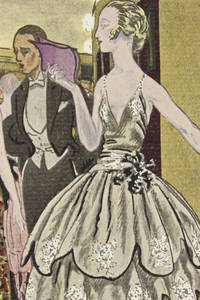
|
|
|
Pierre BRISSAUD - (Jeanne LANVIN)
Sais-tu ta leçon Costumes tailleur de fantaisie de Jeanne Lanvin pl.46 La Gazette du Bon ton 1914 n°5
Paris: Lucien Vogel éditeur 1914. Fine. Lucien Vogel éditeur Paris Mai 1914 19 x 24.50 cm une feuille Original color print on laid paper signed in the lower right of the plate. Original engraving created for the illustration of La Gazette du bon ton one of the most beautiful and influential fashion magazines of the 20th century celebrating the talent of French creators and artists during the flourishing of Art Deco. Famous fashion magazine founded in 1912 by Lucien Vogel La Gazette du bon ton was published until 1925 with an interruption during the War from 1915 to 1920 due to the mobilization of its editor-in-chief. It consists of 69 issues printed in only 2000 copies and is illustrated notably with 573 color plates and 148 sketches representing models by great couturiers. From their publication these luxurious publications ""addressed bibliophiles and worldly aesthetes"" Françoise Tétart-Vittu ""La Gazette du bon ton"" in Dictionnaire de la mode 2016. Printed on fine laid paper they used a typeface specially created for the magazine by Georges Peignot the Cochin character adopted in 1946 by Christian Dior. The prints were created using the metal stencil technique heightened in colors and some highlighted in gold or palladium. The adventure began in 1912 when Lucien Vogel a man of society and fashion - he had already participated in the magazine Femina - decided to found with his wife Cosette de Brunhoff sister of Jean the father of Babar the Gazette du bon ton whose subtitle was then ""Art modes et frivolités"". Georges Charensol reported the words of the editor-in-chief: ""En 1910 observe-t-il il n'existait aucun journal de mode véritablement artistique et représentatif de l'esprit de son époque. Je songeais donc à faire un magazine de luxe avec des artistes véritablement modernes . J'étais certain du succès car pour la mode aucun pays ne peut rivaliser avec la France."" ""In 1910 he observed there was no truly artistic fashion journal representative of the spirit of its time. I therefore thought of making a luxury magazine with truly modern artists . I was certain of success because for fashion no country can rival France."" ""Un grand éditeur d'art. Lucien Vogel"" in Les Nouvelles littéraires n°133 May 1925. The magazine's success was immediate not only in France but also in the United States and South America. Originally Vogel therefore assembled a group of seven artists: André-Édouard Marty and Pierre Brissaud followed by Georges Lepape and Dammicourt; and finally his friends from the École des beaux-arts such as George Barbier Bernard Boutet de Monvel or Charles Martin. Other talents quickly joined the team: Guy Arnoux Léon Bakst Benito Umberto Brunelleschi Chas Laborde Jean-Gabriel Domergue Raoul Dufy Édouard Halouze Alexandre Iacovleff Jean Émile Laboureur Charles Loupot Maggie Salcedo. These artists mostly unknown when Lucien Vogel called upon them would later become emblematic and sought-after artistic figures. These same illustrators created the drawings for the Gazette's advertisements. The plates highlight and sublimate the dresses of seven creators of the era: Lanvin Doeuillet Paquin Poiret Worth Vionnet and Doucet. The couturiers provided exclusive models for each issue. Nevertheless some of the illustrations featured no real model but only the illustrator's idea of the fashion of the day. La Gazette du bon ton is a decisive step in the history of fashion. Combining aesthetic excellence and plastic unity it brought together for the first time the great talents from the worlds of arts letters and fashion and imposed through this alchemy a completely new image of woman slender independent and audacious also carried by the new generation of couturiers Coco Chanel Jean Patou Marcel Rochas. Taken over in 1920 by Condé Montrose Nast the Gazette du bon ton would largely inspire the new composition and aesthetic choices of the ""dying little journal"" that Nast had bought a few years earlie Lucien Vogel éditeur unknown
Referencia librero : 84732
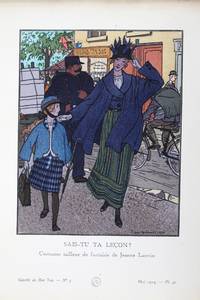
|
|
|
Pierre BRISSON
Sycorax
Paris: Gallimard 1953. Fine. Gallimard Paris 1953 12.50 x 19 cm broché First edition one of 17 numbered copies on pur fil paper the tirage de tête. Spine and covers very slightly and marginally faded as usual otherwise a good copy. Gallimard unknown
Referencia librero : 42958

|
|
|
Pierre BRISSAUD - (Jeanne LANVIN)
Ta maman va bien Tailleur du matin et robe de fillette de Jeanne Lanvin pl.37 La Gazette du Bon ton 1914 n°4
Paris: Lucien Vogel éditeur 1914. Fine. Lucien Vogel éditeur Paris Avril 1914 19 x 24.50 cm une feuille Original color print on laid paper signed at lower right of the plate. Original engraving created for the illustration of La Gazette du bon ton one of the most beautiful and influential fashion magazines of the 20th century celebrating the talent of French creators and artists at the height of the Art Deco movement. The famous fashion magazine founded in 1912 by Lucien Vogel La Gazette du bon ton was published until 1925 with an interruption during the War from 1915 to 1920 due to the mobilization of its editor-in-chief. It consisted of 69 issues printed in only 2000 copies and was illustrated notably with 573 color plates and 148 sketches representing models by great couturiers. From their publication these luxurious publications ""were aimed at bibliophiles and worldly aesthetes"" Françoise Tétart-Vittu ""La Gazette du bon ton"" in Dictionnaire de la mode 2016. Printed on fine laid paper they used a typeface specially created for the magazine by Georges Peignot the Cochin character adopted in 1946 by Christian Dior. The prints were created using the metal stencil technique enhanced in colors and some highlighted in gold or palladium. The adventure began in 1912 when Lucien Vogel a man of society and fashion - he had already participated in the magazine Femina - decided to found with his wife Cosette de Brunhoff sister of Jean the father of Babar the Gazette du bon ton whose subtitle was then ""Art modes et frivolités."" Georges Charensol reports the editor-in-chief's words: ""In 1910 he observed there was no truly artistic fashion journal representative of the spirit of its time. I was therefore thinking of creating a luxury magazine with truly modern artists . I was certain of success because for fashion no country can rival France."" ""Un grand éditeur d'art. Lucien Vogel"" in Les Nouvelles littéraires n°133 May 1925. The magazine's success was immediate not only in France but also in the United States and South America. Originally Vogel assembled a group of seven artists: André-Édouard Marty and Pierre Brissaud followed by Georges Lepape and Dammicourt; and finally his friends from the École des beaux-arts including George Barbier Bernard Boutet de Monvel and Charles Martin. Other talents quickly joined the team: Guy Arnoux Léon Bakst Benito Umberto Brunelleschi Chas Laborde Jean-Gabriel Domergue Raoul Dufy Édouard Halouze Alexandre Iacovleff Jean Émile Laboureur Charles Loupot Maggie Salcedo. These artists mostly unknown when Lucien Vogel called upon them would subsequently become emblematic and sought-after artistic figures. These same illustrators created the drawings for the Gazette's advertisements. The plates highlighted and sublimated the dresses of seven creators of the period: Lanvin Doeuillet Paquin Poiret Worth Vionnet and Doucet. The couturiers provided exclusive models for each issue. Nevertheless some of the illustrations featured no real model but only the illustrator's idea of contemporary fashion. La Gazette du bon ton was a decisive step in the history of fashion. Combining aesthetic demands and plastic unity it brought together for the first time the great talents of the worlds of arts letters and fashion and imposed through this alchemy an entirely new image of woman elegant independent and bold also carried by the new generation of couturiers Coco Chanel Jean Patou Marcel Rochas. Taken over in 1920 by Condé Montrose Nast La Gazette du bon ton would largely inspire the new composition and aesthetic choices of the ""dying little journal"" that Nast had purchased a few years earlier: Vogue magazine. Lucien Vogel éditeur unknown
Referencia librero : 84720
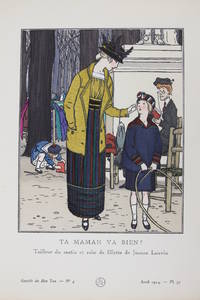
|
|
|
Pierre BRISSAUD - (Jeanne LANVIN)
Tu diras bonjour.Robes de jeunes filles et d'enfant pour l'après-midi de Jeanne Lanvin pl.26 La Gazette du Bon ton 1914 n°3
Paris: Lucien Vogel éditeur 1914. Fine. Lucien Vogel éditeur Paris Mars 1914 19 x 24.50 cm une feuille Original color print printed on laid paper signed at the bottom right of the plate. Original engraving created for the illustration of La Gazette du bon ton one of the most beautiful and influential fashion magazines of the 20th century celebrating the talent of French creators and artists during the flourishing of Art Deco. The famous fashion magazine founded in 1912 by Lucien Vogel La Gazette du bon ton was published until 1925 with an interruption during the War from 1915 to 1920 due to the mobilization of its editor-in-chief. It consists of 69 issues printed in only 2000 copies and is illustrated notably with 573 color plates and 148 sketches representing models by great couturiers. From their publication these luxurious publications ""were addressed to bibliophiles and worldly aesthetes"" Françoise Tétart-Vittu ""La Gazette du bon ton"" in Dictionnaire de la mode 2016. Printed on fine laid paper they use a typeface specially created for the magazine by Georges Peignot the Cochin character taken up in 1946 by Christian Dior. The prints are created using the metal stencil technique heightened in colors and for some highlighted in gold or palladium. The adventure begins in 1912 when Lucien Vogel a man of the world and fashion - he had already participated in the magazine Femina - decides to found with his wife Cosette de Brunhoff sister of Jean the father of Babar La Gazette du bon ton whose subtitle was then ""Art modes et frivolités"". Georges Charensol reports the words of the editor-in-chief: ""In 1910 he observes there existed no fashion journal that was truly artistic and representative of the spirit of its time. I was therefore thinking of making a luxury magazine with truly modern artists . I was certain of success because for fashion no country can rival France."" ""Un grand éditeur d'art. Lucien Vogel"" in Les Nouvelles littéraires n°133 May 1925. The success of the magazine is immediate not only in France but also in the United States and South America. Originally Vogel therefore brings together a group of seven artists: André-Édouard Marty and Pierre Brissaud followed by Georges Lepape and Dammicourt; and finally his friends from the École des beaux-arts who are George Barbier Bernard Boutet de Monvel or Charles Martin. Other talents quickly come to join the team: Guy Arnoux Léon Bakst Benito Umberto Brunelleschi Chas Laborde Jean-Gabriel Domergue Raoul Dufy Édouard Halouze Alexandre Iacovleff Jean Émile Laboureur Charles Loupot Maggie Salcedo. These artists mostly unknown when Lucien Vogel calls upon them will subsequently become emblematic and sought-after artistic figures. These same illustrators create the drawings for the Gazette's advertisements. The plates highlight and sublime the dresses of seven creators of the time: Lanvin Doeuillet Paquin Poiret Worth Vionnet and Doucet. The couturiers provide exclusive models for each issue. Nevertheless some of the illustrations feature no real model but only the idea that the illustrator has of the fashion of the day. La Gazette du bon ton is a decisive step in the history of fashion. Combining aesthetic requirement and plastic unity it brings together for the first time the great talents of the world of arts letters and fashion and imposes through this alchemy a completely new image of woman slender independent and audacious also carried by the new generation of couturiers Coco Chanel Jean Patou Marcel Rochas. Taken over in 1920 by Condé Montrose Nast La Gazette du bon ton will largely inspire the new composition and aesthetic choices of the ""dying little journal"" that Nast had bought a few years earlier: Vogue magazine. Lucien Vogel éditeur unknown
Referencia librero : 84756
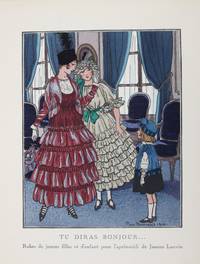
|
|
|
Pierre BRISSAUD - (Jeanne LANVIN)
Tu diras bonjour.Robes de jeunes filles et d'enfant pour l'après-midi de Jeanne Lanvin pl.26 La Gazette du Bon ton 1914 n°3
Paris: Lucien Vogel éditeur 1914. Fine. Lucien Vogel éditeur Paris Mars 1914 19 x 24.50 cm une feuille Original color print printed on vergé paper signed in the plate. An original print used to illustrate the Gazette du bon ton one of the most attractive and influential 20th century fashion magazines featuring the talents of French artists and other contributors from the burgeoning Art Deco movement. A celebrated fashion magazine established in 1912 by Lucien Vogel La Gazette du bon ton appeared until 1925 with a hiatus from 1915 to 1920 due to the war the editor-in-chief having been called up for service. It consisted of 69 issues printed in only 2000 copies each and notably illustrated with 573 color plates and 148 sketches of the models of the great designers. Right from the start this sumptuous publication was aimed at bibliophiles and fashionable society Françoise Tétart-Vittu La Gazette du bon ton in Dictionnaire de la mode 2016 and was printed on fine vergé paper using a type cut specially for the magazine by Georges Peignot known as Cochin later used in 1946 by Christian Dior. The prints were made using stencils heightened in colors some highlighted in gold or palladium. The story began in 1912 when Lucien Vogel a man of the world involved in fashion he had already been part of the fashion magazine Femina decided with his wife Cosette de Brunhoff the sister of Jean creator of Babar to set up the Gazette du bon ton subtitled at the time: Art fashion frivolities. Georges Charensol noted the reasoning of the editor-in-chief: 'In 1910' he observed there was no really artistic fashion magazine nothing representative of the spirit of the time. My dream was therefore to make a luxury magazine with truly modern artists
I was assured of success because when it comes to fashion no country on earth can compete with France.' Un grand éditeur d'art. Lucien Vogel in Les Nouvelles littéraires no. 133 May 1925. The magazine was immediately successful not only in France but also in the United States and Latin America. At first Vogel put together a team of seven artists: André-Édouard Marty and Pierre Brissaud followed by Georges Lepape and Dammicourt as well as eventually his friends from school and the School of Fine Arts like George Barbier Bernard Boutet de Monvel and Charles Martin. Other talented people soon came flocking to join the team: Guy Arnoux Léon Bakst Benito Boutet de Monvel Umberto Brunelleschi Chas Laborde Jean-Gabriel Domergue Raoul Dufy Édouard Halouze Alexandre Iacovleff Jean Émile Laboureur Charles Loupot Chalres Martin Maggie Salcedo. These artist mostly unknown when Lucien Vogel sought them out later became emblematic and sought-after artistic figures. It was also they who worked on the advertising drawings for the Gazette. The plates put the spotlight on and celebrate dresses by seven designers of the age: Lanvin Doeuillet Paquin Poiret Worth Vionnet and Doucet. The designers provided exclusive models for each issue. Nonetheless some of the illustrations are not based on real models but simply on the illustrator's conception of the fashion of the day. The Gazette du bon ton was an important step in the history of fashion. Combining aesthetic demands with the physical whole it brought together for the first time the great talents of the artistic literary and fashion worlds; and imposed through this alchemy a completely new image of women: slender independent and daring which was shared by the new generation of designers including Coco Chanel Jean Patou Marcel Rochas and so on
Taken over in 1920 by Condé Montrose Nast the Gazette du bon ton was an important influence on the new layout and aesthetics of that little dying paper that Nast had bought a few years earlier: Vogue. Lucien Vogel éditeur unknown
Referencia librero : 54640
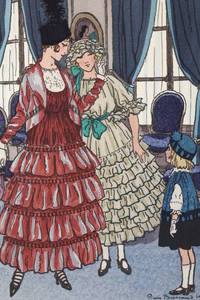
|
|
|
Pierre BRISSAUD - (Jeanne LANVIN)
Voyons cette révérence. Robe d'après-midi et robe d'enfant de Jeanne Lanvin pl.37 La Gazette du Bon ton 1920 n°5
Paris: Lucien Vogel éditeur 1920. Fine. Lucien Vogel éditeur Paris Juin 1920 18 x 24 cm une feuille Original color print printed on vergé paper signed in the plate. An original print used to illustrate the Gazette du bon ton one of the most attractive and influential 20th century fashion magazines featuring the talents of French artists and other contributors from the burgeoning Art Deco movement. A celebrated fashion magazine established in 1912 by Lucien Vogel La Gazette du bon ton appeared until 1925 with a hiatus from 1915 to 1920 due to the war the editor-in-chief having been called up for service. It consisted of 69 issues printed in only 2000 copies each and notably illustrated with 573 color plates and 148 sketches of the models of the great designers. Right from the start this sumptuous publication was aimed at bibliophiles and fashionable society Françoise Tétart-Vittu La Gazette du bon ton in Dictionnaire de la mode 2016 and was printed on fine vergé paper using a type cut specially for the magazine by Georges Peignot known as Cochin later used in 1946 by Christian Dior. The prints were made using stencils heightened in colors some highlighted in gold or palladium. The story began in 1912 when Lucien Vogel a man of the world involved in fashion he had already been part of the fashion magazine Femina decided with his wife Cosette de Brunhoff the sister of Jean creator of Babar to set up the Gazette du bon ton subtitled at the time: Art fashion frivolities. Georges Charensol noted the reasoning of the editor-in-chief: In 1910 he observed there was no really artistic fashion magazine nothing representative of the spirit of the time. My dream was therefore to make a luxury magazine with truly modern artists
I was assured of success because when it comes to fashion no country on earth can compete with France. Un grand éditeur dart. Lucien Vogel in Les Nouvelles littéraires no. 133 May 1925. The magazine was immediately successful not only in France but also in the United States and Latin America. At first Vogel put together a team of seven artists: André-Édouard Marty and Pierre Brissaud followed by Georges Lepape and Dammicourt as well as eventually his friends from school and the School of Fine Arts like George Barbier Bernard Boutet de Monvel and Charles Martin. Other talented people soon came flocking to join the team: Guy Arnoux Léon Bakst Benito Boutet de Monvel Umberto Brunelleschi Chas Laborde Jean-Gabriel Domergue Raoul Dufy Édouard Halouze Alexandre Iacovleff Jean Émile Laboureur Charles Loupot Chalres Martin Maggie Salcedo. These artist mostly unknown when Lucien Vogel sought them out later became emblematic and sought-after artistic figures. It was also they who worked on the advertising drawings for the Gazette. The plates put the spotlight on and celebrate dresses by seven designers of the age: Lanvin Doeuillet Paquin Poiret Worth Vionnet and Doucet. The designers provided exclusive models for each issue. Nonetheless some of the illustrations are not based on real models but simply on the illustrators conception of the fashion of the day. The Gazette du bon ton was an important step in the history of fashion. Combining aesthetic demands with the physical whole it brought together for the first time the great talents of the artistic literary and fashion worlds; and imposed through this alchemy a completely new image of women: slender independent and daring which was shared by the new generation of designers including Coco Chanel Jean Patou Marcel Rochas and so on
Taken over in 1920 by Condé Montrose Nast the Gazette du bon ton was an important influence on the new layout and aesthetics of that little dying paper that Nast had bought a few years earlier: Vogue. Lucien Vogel éditeur unknown
Referencia librero : 54777
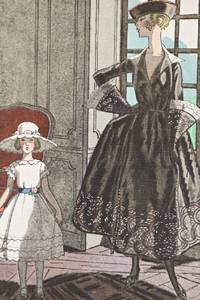
|
|
|
Pierre BRISSAUD - (Louise CHERUIT)
Zut !. Il pleut !!. Petite robe de promenade de Chéruit pl.6 in La Gazette du Bon ton 1912-1913 n°6
Paris: Lucien Vogel éditeur 1913. Fine. Lucien Vogel éditeur Paris Avril 1913 19 x 24.50 cm une feuille Original color print printed on vergé paper signed in the plate. An original print used to illustrate the Gazette du bon ton one of the most attractive and influential 20th century fashion magazines featuring the talents of French artists and other contributors from the burgeoning Art Deco movement. A celebrated fashion magazine established in 1912 by Lucien Vogel La Gazette du bon ton appeared until 1925 with a hiatus from 1915 to 1920 due to the war the editor-in-chief having been called up for service. It consisted of 69 issues printed in only 2000 copies each and notably illustrated with 573 color plates and 148 sketches of the models of the great designers. Right from the start this sumptuous publication was aimed at bibliophiles and fashionable society Françoise Tétart-Vittu La Gazette du bon ton in Dictionnaire de la mode 2016 and was printed on fine vergé paper using a type cut specially for the magazine by Georges Peignot known as Cochin later used in 1946 by Christian Dior. The prints were made using stencils heightened in colors some highlighted in gold or palladium. The story began in 1912 when Lucien Vogel a man of the world involved in fashion he had already been part of the fashion magazine Femina decided with his wife Cosette de Brunhoff the sister of Jean creator of Babar to set up the Gazette du bon ton subtitled at the time: Art fashion frivolities. Georges Charensol noted the reasoning of the editor-in-chief: In 1910 he observed there was no really artistic fashion magazine nothing representative of the spirit of the time. My dream was therefore to make a luxury magazine with truly modern artists
I was assured of success because when it comes to fashion no country on earth can compete with France. Un grand éditeur dart. Lucien Vogel in Les Nouvelles littéraires no. 133 May 1925. The magazine was immediately successful not only in France but also in the United States and Latin America. At first Vogel put together a team of seven artists: André-Édouard Marty and Pierre Brissaud followed by Georges Lepape and Dammicourt as well as eventually his friends from school and the School of Fine Arts like George Barbier Bernard Boutet de Monvel and Charles Martin. Other talented people soon came flocking to join the team: Guy Arnoux Léon Bakst Benito Boutet de Monvel Umberto Brunelleschi Chas Laborde Jean-Gabriel Domergue Raoul Dufy Édouard Halouze Alexandre Iacovleff Jean Émile Laboureur Charles Loupot Chalres Martin Maggie Salcedo. These artist mostly unknown when Lucien Vogel sought them out later became emblematic and sought-after artistic figures. It was also they who worked on the advertising drawings for the Gazette. The plates put the spotlight on and celebrate dresses by seven designers of the age: Lanvin Doeuillet Paquin Poiret Worth Vionnet and Doucet. The designers provided exclusive models for each issue. Nonetheless some of the illustrations are not based on real models but simply on the illustrators conception of the fashion of the day. The Gazette du bon ton was an important step in the history of fashion. Combining aesthetic demands with the physical whole it brought together for the first time the great talents of the artistic literary and fashion worlds; and imposed through this alchemy a completely new image of women: slender independent and daring which was shared by the new generation of designers including Coco Chanel Jean Patou Marcel Rochas and so on
Taken over in 1920 by Condé Montrose Nast the Gazette du bon ton was an important influence on the new layout and aesthetics of that little dying paper that Nast had bought a few years earlier: Vogue. Lucien Vogel éditeur unknown
Referencia librero : 54523
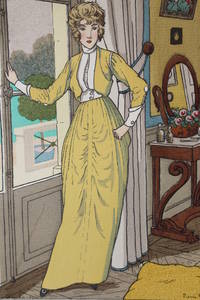
|
|
|
Pierre BRUNET
L'introduction des théories de Newton en France avant 1738
Genève Geneva: Slatkine reprints 1970. Fine. Slatkine reprints Genève Geneva 1970 15.50 x 23 cm reliure de l'éditeur New edition. Publisher's dark green paper boards sapin. A very good copy. Slatkine reprints hardcover
Referencia librero : 41128

|
|
|
Pierre BULLIARD
Histoire des plantes vénéneuses et suspectes de la France
Paris: A.J. Dugour 1798. Fine. A.J. Dugour Paris An VI 1798 12.50 x 21 cm relié Second edition. Full mustard paper boards smooth spine decorated with wide double gilt fillets red sheep title-label one tear with slight paper loss just below the latter yellow edges. Light foxing mainly at end of volume. A.J. Dugour hardcover
Referencia librero : 36249
|
|
|
Pierre CAMO
Le jardin de la sagesse
Paris: Floury 1906. Fine. Floury Paris 1906 12 x 18.50 cm broché First edition. Inscription by Pierre Camo addressed to M. Pierre Edmond Lévy ""to complete his collection of rarities"" on the half-title page. Covers and spine marginally and slightly faded two tiny corner lacks at head of first endpaper. Floury unknown
Referencia librero : 29295
|
|
|
Pierre CAMO
Poésies
Paris: Albert Messeins 1936. Fine. Albert Messeins Paris 1936 Pet. in 8 Un Vol. broché First collected edition on wove paper. There were 10 copies on Arches paper. In original wrappers. Pristine copy unopened. NB: This work is available at the bookstore upon request within 48 hours. Albert Messeins unknown
Referencia librero : 25010
|
|
|
Pierre Carlet de Chamblain de MARIVAUX
L'Isle des esclaves comédie en un acte The Island of Slaves a One-Act Comedy
Paris: Noël PissotPierre DelormelFrançois Flahaut 1725. Fine. Noël Pissot Pierre Delormel François Flahaut Paris 1725 9.50 x 16 cm relié Rare first edition of L'Ile des esclaves. Nineteenth-century Bradel binding in half beige cloth smooth spine uniformly soiled faded long title label gilt date at foot cat's eye pebbled paper boards all edges red. Binding signed Lemardeley. Scattered foxing. ""Vous avez été leurs maîtres et vous en avez mal agi ; ils sont devenus les vôtres et ils vous pardonnent ; faites vos réflexions là-dessus."" ""You have been their masters and you have acted badly; they have become yours and they forgive you; reflect upon this."" Trivelin final scene Noël PissotPierre DelormelFrançois Flahaut hardcover
Referencia librero : 82831
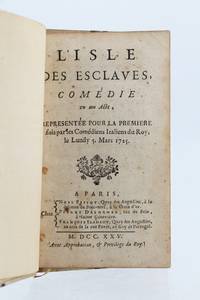
|
|
|
Pierre Carlet de Chamblain de MARIVAUX
Le paysan parvenu
à La Haye The Hague: Chez Henri Scheurleer 1756. Fine. Chez Henri Scheurleer à La Haye The Hague 1756 9 x 16 cm 8 parties reliées en 2 volumes New édition. The 8 parts each have a title page. Title pages of the first part and the fifth in red and black. Novel first published between 1734 and 1736 the last three parts are apocryphal and appear here at Scheurleer in first edition. Contemporary full brown calf bindings. Raised band spines ornate with fleurons and stars. Red morocco title labels and brown morocco volume labels. Restorations to joints and headcaps. Scattered browning. Good copy. Like La vie de Marianne Le Paysan parvenu is based on memoirs and the rise of a handsome young man of great wit but poor and of peasant extraction. His qualities which will make him appealing in women's eyes will allow him to make his way in the bourgeoisie and achieve success. Marivaux uses the devices of the picaresque novel throwing his character from one adventure to another. At the end of the fifth part Marivaux tells his reader what awaits him in the sixth but the author will return to writing la vie de Marianne of which Le paysan parvenu seems to be the masculine parallel and the last three parts will be completed by an unknown author. Chez Henri Scheurleer unknown
Referencia librero : 52114
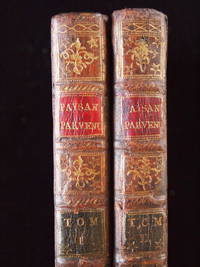
|
|
|
Pierre CARRIER-BELLEUSE
Lettre autographe signée à propos d'un pastel intitulé ""Etude de Nu""
1899. Fine. 20 mai 1899 13 x 20.70 cm une feuille Autograph letter signed by the painter Pierre Carrier-Belleuse on a folded sheet to a potential buyer: "". un pastel emporté au Salon du Champs de Mars sur le n°1628 est encore à vendre et le dernier prix est de 3500 francs. . Je dois vous dire que la commission d'achats de la ville de Paris sur une première visite a retenu mon pastel et m'en a fait demander le prix ."" "". a pastel taken to the Salon du Champs de Mars under number 1628 is still for sale and the final price is 3500 francs. . I must tell you that the purchasing commission of the city of Paris on a first visit selected my pastel and asked me for the price ."" unknown
Referencia librero : 71491
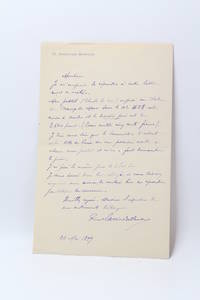
|
|
|
Pierre CARRIER-BELLEUSE
Lettre autographe signée pour croquer la classe de danse de l'Opéra
1887. Fine. 20 octobre 1887 11.80 x 18 cm une feuille Autograph letter signed by the painter Pierre Carrier-Belleuse author of numerous portraits of Opera dancers. In this letter he asks the director for permission to attend lessons: ""à la classe de danse de Melle Théodore. Je serais désireux de prendre quelques croquis pour un tableau que je désire faire pour le Salon prochain. Je ne dérangerai aucunement la leçon ."" ""in Mlle Théodore's dance class. I would be eager to make some sketches for a painting I wish to create for the next Salon. I will not disturb the lesson in any way ."". It was probably thanks to these visits to Mlle Théodore's class that his painting A la barre was born. unknown
Referencia librero : 71489
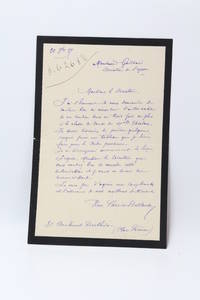
|
|
|
Pierre CARRIER-BELLEUSE
Lettre autographe signée à propos d'une aquarelle
1898. Fine. 18 mai 1898 12.50 x 20.10 cm une feuille Autograph letter signed by the painter Pierre Carrier-Belleuse on a folded sheet: "". Très surmené en ce moment je n'ai pu m'occuper de la petite aquarelle que je vous ai promise pour l'édition artistique du Aventures de ma Ve . unknown
Referencia librero : 71490
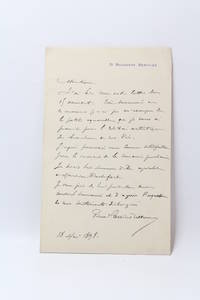
|
|
|
Pierre Carlet de Chamblain de MARIVAUX
Oeuvres complettes de Marivaux
A Paris: Chez La veuve Duchesne 1781. Fine. Chez La veuve Duchesne A Paris 1781 12.50 x 20 cm 12 volumes reliés First collected edition complete of the works of Marivaux. A portrait by Saint Aubin in a frame by Marillier as frontispiece. Publisher's bindings in full contemporary blonde marbled calf. Spines with raised bands decorated in gilt compartments gilt rolls at foot. Title and volume labels in tawny morocco. Triple gilt rule framing the boards. In the first volume the tissue guard has caused browning to the first third of the title page opposite and to the second leaf. Lower joint of volume 1 narrowly split at head and foot small lack at foot. Volume II: lack to lower joint at head lack at foot. Volume III: joints split at head. Volume IV: lacks at head and foot. Volume VII: small split to upper joint at head and a lack at head. Volume IX: lack at head. Volume X: small split to upper joint at head. Volume XII: small lack at foot. Evidence of rubbing particularly to corners and some corners slightly bumped but overall fine set with relatively fresh paper with some signatures slightly more yellowed. The only early edition bringing together the theatrical and narrative works. As indicated by Tchemerzine VII 437-438 the 1825-1830 edition is less complete only one other text by Marivaux not included in this edition will be published as supplement in 1922: La Provinciale; moreover the 1825 edition does not reproduce all the works contained in the 12th volume. This edition brings together rare fictional works: Les Effets surprenants de la sympathie Le Spectateur françois L'Indigent philosophe Le Cabinet du philosophe Homère travesti Le Don Quichotte moderne L'Éducation d'un prince Le Miroir La Voiture embourbée Le Télémaque travesti. The edition brings together 51 texts by the author including the entirety of his theatrical works. Chez La veuve Duchesne hardcover
Referencia librero : 85543
|
|
|
Pierre Carlet de Chamblain de MARIVAUX
Oeuvres diverses
à Paris: Chez Duchesne 1765. Fine. Chez Duchesne à Paris 1765 9.50 x 16.80 cm 4 volumes reliés The rather rare first collected edition of these various works. Contemporary binding in full marbled and glazed sheep. Decorated smooth spine. Havana morocco title and volume labels. Lacks to joints at head of volume I. Lack to upper joint at head of volume II and lacks at foot. Upper joint split at foot of volume II. Rubbing to joints headcaps edges and corners. This edition contains Don Quixote moderne L'Homère travestie ou L'Iliade en vers burlesques L'éducation d'un prince La voiture embourbée Le miroir Refléxions sur l'esprit humain etc. Chez Duchesne unknown
Referencia librero : 81719
|
|
|
Pierre Carlet de Chamblain de MARIVAUX
Théâtre complet volume II
Paris: Gallimard Bibliothèque de La Pléiade 1994. Fine. Gallimard Bibliothèque de La Pléiade Paris 1994 10.50 x 18 cm reliure de l'éditeur sous étui souple et cartonné Bibliothèque de La Pléiade edition printed on Bible paper. Publisher's full blue grained sheepskin binding blue top edge smooth spine decorated with gilt fillets. Handsome copy complete with its cellophane wrapper and slipcase. Gallimard, Bibliothèque de La Pléiade unknown
Referencia librero : 79819
|
|
|
Pierre CHAMPION
Bonjour Françoise
Paris: Les Amis d'Edouard 1925. Fine. Les Amis d'Edouard Paris 1925 12.50 x 16.50 cm relié First edition printed in 200 copies ours one of the 194 numbered copies on Arches paper. Full burgundy morocco binding spine with 6 raised bands decorated with gilt fillets gilt letter and collection number at head and foot pastedowns lined with burgundy box calf and morocco frame endpapers lined with burgundy box calf original wrappers and spine preserved minimal scratches of no importance to the edges top edge gilt retaining its deckled edges binding signed Charles Benoit. Handsome copy perfectly executed. Les Amis d'Edouard hardcover
Referencia librero : 32962

|
|
|
Pierre CHAVEGRIN
De la protection de la fortune mobilière des mineurs en droit comparé
Paris: Lib. Gale de droit et de jurisprudence 1907. Fine. Lib. Gale de droit et de jurisprudence Paris 1907 16.50 x 25.50 cm broché First edition of this thesis submitted to obtain a doctorate in law at the University of Paris. Two small lacks to head and foot of spine handsome interior condition. Lib. Gale de droit et de jurisprudence unknown
Referencia librero : 17873
|
|
|
Pierre CHARRON
De la sagesse trois livres
Paris: Chez Barrois l'aînéDe l'imprimerie de Didot l'aîné 1789. Fine. Chez Barrois l'aîné De l'imprimerie de Didot l'aîné Paris 1789 10 x 16 cm 2 volumes reliés New edition the original dating from 1601 at Bordeaux. Later late 19th century bindings in full blonde calf. Spine with five raised bands decorated with grotesque-style compartments as well as red and green morocco title and volume labels. Triple gilt fillet on boards. Gilt fillet on leading edges and headcaps. Gilt decorative board-edges framing the pastedowns. All edges gilt. Some rubbing otherwise handsome copy. Fine printing from the Didot press of this classic of philosophy which reproduces the complete text of the original. Chez Barrois l'aînéDe l'imprimerie de Didot l'aîné hardcover
Referencia librero : 49564

|
|
|
Pierre CHAUNU
L'historien en cet instant
Paris: Hachette 1985. Fine. Hachette Paris 1985 14 x 22.50 cm broché The first edition of which there were no deluxe copies. Handsome copy. Signed autograph inscription by Pierre Chaunu for ""Lu"" magazine. Hachette unknown
Referencia librero : 76158
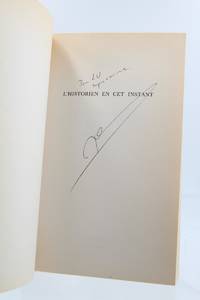
|
|
|
Pierre CHAINE
Les commentaires de Ferdinand suite des Mémoires d'un rat
Paris: Dan Niestlé 1921. Fine. Dan Niestlé Paris 1921 15.50 x 23.50 cm relié sous étui Edition illustrated with original illustrations by T. Polat one of 50 copies on Arches paper deluxe copies after 30 on Japan paper. Spine with four raised bands set with black fillets decorated with undulating black fillets representing barbed wire and a poilu helmet enriched with an inlaid piece of brown morocco boards enhanced with a pattern of black fillets representing barbed wire and poilu helmets in the corners and centers enriched with inlaid pieces of brown morocco black fillet on the leading edges frame of red morocco listel and double gilt fillets with gilt poilu helmets in the corners on the pastedowns endpapers and pastedowns of gray watered silk following endpapers of handmade paper covers and spine preserved top edge gilt; slipcase bordered with the same morocco and covered with handmade paper brown felt interior superb contemporary binding signed René Kieffer. Work illustrated with 38 etchings an original frontispiece and an original hors-texte by T. Polat. Like all copies of the deluxe issue our copy is complete with its duplicate suite of the frontispiece and hors-texte on China paper. Manuscript signatures of the author and publisher on the justification page. Fine copy perfectly executed by René Kieffer. Dan Niestlé hardcover
Referencia librero : 43274
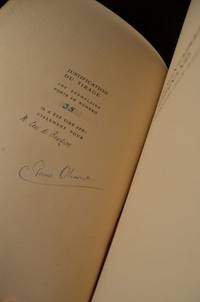
|
|
|
Pierre CHARRON
Les trois veritez
à Bourdeaus Bordeaux: Par S. Millanges 1595. Fine. Par S. Millanges à Bourdeaus Bordeaux 1595 10.50 x 16 cm relié Third edition after the original published in Bordeaux in 1593 and a second Parisian edition in 1594. The copy mentions the second edition because it is the second to be published in Bordeaux. Extremely rare handwritten presentation signed by the author on the page of the endpaper: Pour Monsieur de Rives en memoire de moy. A Caors ce iiij 4 may 1595. Charron. For Monseiur de Rives in memory of me. In Caors this iiij 4 May 1595. Charron. It is without doubt about Jean III de Rieu Lord of Rives who belonged to the family of Antoine Hébrard de Saint-Sulpice bishop of Cahors. Pierre Charron had been called theological by this same bishop of Cahors and became his curate for six years. Bound in calf vellum with contemporary yapp edges blank spine. Extensive yellowing of the endpaper page until page 30 then lessening in the middle of the page throughout the first part and until page 120 of the second part. This yellowing resumes from page 760 until the end. Pierre Charron's first writing who in this controversial work regarding Protestantism develops three great vérités truths: religion is necessary Christianity is revealed and only the Roman Church is the true Church. It is this last point in particular that the author tries to demonstrate. This third part is so important that it has its own title page and takes up two-thirds of the book. In Bordeaux Pierre Charron met Montaigne whose ideas spread through his works and his thoughts. They bonded with such a deep friendship that Montaigne designated Charron as heir to his house coat of arms. The handwritten ex-donos or presentations of the great humanists of the 16th century are an exceptional rarity. Par S. Millanges hardcover
Referencia librero : 71963
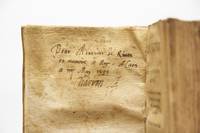
|
|
|
Pierre Charles Fournier de SAINT-AMANT
Voyages en Californie et dans l'Orégon
Paris: L. Maison 1854. Fine. L. Maison Paris 1854 17 x 25 cm broché sous étui First edition. With two maps. Spine cracked with small lacks principally at head upper cover detached small angular lacks to covers a little foxing. A rare copy housed in a protective case. L. Maison unknown
Referencia librero : 31094
|
|

 Recibir por correo electrónico
 Descargar en documento PDF
 Flujo RSS
 Link permanente


