|
Pierre MORTIER
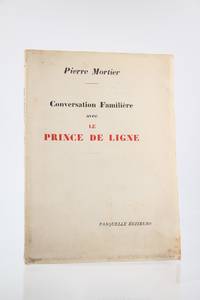
Conversation familière avec le Prince de ligne
Paris: Fasquelle 1953. Fine. Fasquelle Paris 1953 14.50 x 19.50 cm broché First edition of this speech delivered in Brussels on the occasion of the bicentenary of the birth of the Prince de Ligne one of 15 numbered copies on Holland paper the only deluxe copies. Three small dampstains at foot of front cover and head of back cover some light interior foxing. Fasquelle unknown
Referencia librero : 76393
|
|
|
Pierre MOREL
Petite histoire du Languedoc
Grenoble & Paris: B. Arthaud 1941. Fine. B. Arthaud Grenoble & Paris 1941 13 x 19.50 cm broché First edition. Signed autograph inscription by Pierre Morel. Work illustrated with photographs and complete with its folding map at rear. A light pale stain on front cover otherwise handsome copy. B. Arthaud unknown
Referencia librero : 38116

|
|
|
Pierre MOURGUE - (LARSEN)
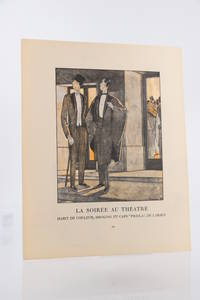
"La soirée au théâtre"" Smoking et cape ""Priola"" de Larsen pl.57 La Gazette du Bon ton 1922 n°9
Paris: Lucien Vogel éditeur 1922. Fine. Lucien Vogel éditeur Paris 1922 18 x 24 cm une double page Original color print printed on laid paper signed at the bottom right of the plate. La Gazette du bon ton one of the most beautiful and influential fashion magazines of the 20th century celebrating the talent of French creators and artists in the full bloom of Art Deco. Famous fashion magazine founded in 1912 by Lucien Vogel La Gazette du bon ton was published until 1925 with an interruption during the War from 1915 to 1920 due to the mobilization of its editor-in-chief. It consists of 69 issues printed in only 2000 copies and is illustrated notably with 573 color plates and 148 sketches representing models by great couturiers. From their publication these luxurious publications ""addressed bibliophiles and worldly aesthetes"" Françoise Tétart-Vittu ""La Gazette du bon ton"" in Dictionnaire de la mode 2016. Printed on fine laid paper they use a typeface specially created for the magazine by Georges Peignot the Cochin character adopted in 1946 by Christian Dior. The prints are created using the metal stencil technique heightened in colors and some outlined in gold or palladium. The adventure began in 1912 when Lucien Vogel a man of society and fashion - he had already participated in the magazine Femina - decided to found with his wife Cosette de Brunhoff sister of Jean the father of Babar the Gazette du bon ton whose subtitle was then ""Art modes et frivolités"". Georges Charensol reports the words of the editor-in-chief: ""In 1910 he observed there existed no fashion journal that was truly artistic and representative of the spirit of its time. I was therefore thinking of making a luxury magazine with truly modern artists . I was certain of success because for fashion no country can rival France."" ""Un grand éditeur d'art. Lucien Vogel"" in Les Nouvelles littéraires n°133 May 1925. The success of the magazine was immediate not only in France but also in the United States and South America. Originally Vogel thus brought together a group of seven artists: André-Édouard Marty and Pierre Brissaud followed by Georges Lepape and Dammicourt; and finally his friends from the École des beaux-arts who were George Barbier Bernard Boutet de Monvel or Charles Martin. Other talents quickly joined the team: Guy Arnoux Léon Bakst Benito Boutet de Monvel Umberto Brunelleschi Chas Laborde Jean-Gabriel Domergue Raoul Dufy Édouard Halouze Alexandre Iacovleff Jean Émile Laboureur Charles Loupot Charles Martin Maggie Salcedo. These artists mostly unknown when Lucien Vogel called upon them would subsequently become emblematic and sought-after artistic figures. These same illustrators created the drawings for the Gazette's advertisements. The plates highlighted and sublimated the dresses of seven creators of the time: Lanvin Doeuillet Paquin Poiret Worth Vionnet and Doucet. The couturiers provided exclusive models for each issue. Nevertheless some of the illustrations featured no real model but only the idea that the illustrator had of the fashion of the day. La Gazette du bon ton was a decisive step in the history of fashion. Combining aesthetic excellence and visual unity it brought together for the first time the great talents of the worlds of arts letters and fashion and imposed through this alchemy a completely new image of woman slender independent and audacious also carried by the new generation of couturiers Coco Chanel Jean Patou Marcel Rochas. Taken over in 1920 by Condé Montrose Nast the Gazette du bon ton would largely inspire the new composition and aesthetic choices of the ""dying little journal"" that Nast had bought several years earlier: Vogue magazine. Before the illustration on the last page of the double sheet text by Caylus ""Le bois dans la mode"". Lucien Vogel éditeur unknown
Referencia librero : 84825
|
|
|
Pierre MOURGUE - (Paul POIRET)
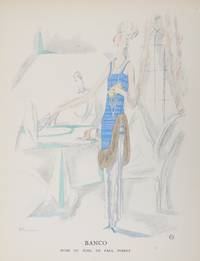
Banco. Robe du soir de Paul Poiret pl.49 La Gazette du Bon ton 1922 n°7
Paris: Lucien Vogel éditeur 1922. Fine. Lucien Vogel éditeur Paris 1922 18 x 24 cm une feuille Original color print finely heightened with palladium printed on laid paper signed at the upper left of the plate. La Gazette du bon ton one of the most beautiful and influential fashion magazines of the 20th century celebrating the talent of French creators and artists at the height of the Art Deco movement. The famous fashion magazine founded in 1912 by Lucien Vogel La Gazette du bon ton was published until 1925 with an interruption during the War from 1915 to 1920 due to the mobilization of its editor-in-chief. It consists of 69 issues printed in only 2000 copies and is illustrated notably with 573 color plates and 148 sketches representing models by great couturiers. From their publication these luxurious publications ""were aimed at bibliophiles and worldly aesthetes"" Françoise Tétart-Vittu ""La Gazette du bon ton"" in Dictionnaire de la mode 2016. Printed on fine laid paper they used a typeface specially created for the magazine by Georges Peignot the Cochin character adopted in 1946 by Christian Dior. The prints were created using the metallic stencil technique heightened in colors and some highlighted with gold or palladium. The adventure began in 1912 when Lucien Vogel a man of the world and fashion - he had already participated in the magazine Femina - decided to found with his wife Cosette de Brunhoff sister of Jean the father of Babar the Gazette du bon ton whose subtitle was then ""Art modes et frivolités."" Georges Charensol reports the words of the editor-in-chief: ""En 1910 observe-t-il il n'existait aucun journal de mode véritablement artistique et représentatif de l'esprit de son époque. Je songeais donc à faire un magazine de luxe avec des artistes véritablement modernes . J'étais certain du succès car pour la mode aucun pays ne peut rivaliser avec la France."" ""In 1910 he observed there existed no fashion journal that was truly artistic and representative of the spirit of its time. I therefore thought of making a luxury magazine with truly modern artists . I was certain of success because for fashion no country can rival France."" ""Un grand éditeur d'art. Lucien Vogel"" in Les Nouvelles littéraires n°133 May 1925. The magazine's success was immediate not only in France but also in the United States and South America. Originally Vogel therefore assembled a group of seven artists: André-Édouard Marty and Pierre Brissaud followed by Georges Lepape and Dammicourt; and finally his friends from the École des beaux-arts who were George Barbier Bernard Boutet de Monvel or Charles Martin. Other talents quickly joined the team: Guy Arnoux Léon Bakst Benito Boutet de Monvel Umberto Brunelleschi Chas Laborde Jean-Gabriel Domergue Raoul Dufy Édouard Halouze Alexandre Iacovleff Jean Émile Laboureur Charles Loupot Charles Martin Maggie Salcedo. These artists mostly unknown when Lucien Vogel called upon them would later become emblematic and sought-after artistic figures. These same illustrators created the drawings for the Gazette's advertisements. The plates highlight and sublimate the dresses of seven creators of the period: Lanvin Doeuillet Paquin Poiret Worth Vionnet and Doucet. The couturiers provided exclusive models for each issue. Nevertheless some of the illustrations featured no real model but only the idea that the illustrator had of the fashion of the day. La Gazette du bon ton was a decisive stage in the history of fashion. Combining aesthetic demands and plastic unity it brought together for the first time the great talents of the worlds of arts letters and fashion and imposed through this alchemy a completely new image of woman slender independent and audacious also carried by the new generation of couturiers Coco Chanel Jean Patou Marcel Rochas. Taken over in 1920 by Condé Montrose Nast La Gazette du bon ton would largely inspire the new composition and aesthetic choices of the Lucien Vogel éditeur unknown
Referencia librero : 84723
|
|
|
Pierre MOURGUE - (Gustave BEER)
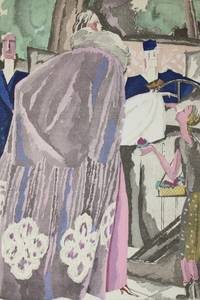
Bouquet de violettes. Manteau du soir de Beer pl.69 La Gazette du Bon ton 1921 n°9
Paris: Lucien Vogel éditeur 1921. Fine. Lucien Vogel éditeur Paris 1921 18 x 24 cm une feuille Original color print printed on vergé paper signed in the plate. An original print used to illustrate the Gazette du bon ton one of the most attractive and influential 20th century fashion magazines featuring the talents of French artists and other contributors from the burgeoning Art Deco movement. A celebrated fashion magazine established in 1912 by Lucien Vogel La Gazette du bon ton appeared until 1925 with a hiatus from 1915 to 1920 due to the war the editor-in-chief having been called up for service. It consisted of 69 issues printed in only 2000 copies each and notably illustrated with 573 color plates and 148 sketches of the models of the great designers. Right from the start this sumptuous publication was aimed at bibliophiles and fashionable society Françoise Tétart-Vittu La Gazette du bon ton in Dictionnaire de la mode 2016 and was printed on fine vergé paper using a type cut specially for the magazine by Georges Peignot known as Cochin later used in 1946 by Christian Dior. The prints were made using stencils heightened in colors some highlighted in gold or palladium. The story began in 1912 when Lucien Vogel a man of the world involved in fashion he had already been part of the fashion magazine Femina decided with his wife Cosette de Brunhoff the sister of Jean creator of Babar to set up the Gazette du bon ton subtitled at the time: Art fashion frivolities. Georges Charensol noted the reasoning of the editor-in-chief: In 1910 he observed there was no really artistic fashion magazine nothing representative of the spirit of the time. My dream was therefore to make a luxury magazine with truly modern artists
I was assured of success because when it comes to fashion no country on earth can compete with France. Un grand éditeur dart. Lucien Vogel in Les Nouvelles littéraires no. 133 May 1925. The magazine was immediately successful not only in France but also in the United States and Latin America. At first Vogel put together a team of seven artists: André-Édouard Marty and Pierre Brissaud followed by Georges Lepape and Dammicourt as well as eventually his friends from school and the School of Fine Arts like George Barbier Bernard Boutet de Monvel and Charles Martin. Other talented people soon came flocking to join the team: Guy Arnoux Léon Bakst Benito Boutet de Monvel Umberto Brunelleschi Chas Laborde Jean-Gabriel Domergue Raoul Dufy Édouard Halouze Alexandre Iacovleff Jean Émile Laboureur Charles Loupot Chalres Martin Maggie Salcedo. These artist mostly unknown when Lucien Vogel sought them out later became emblematic and sought-after artistic figures. It was also they who worked on the advertising drawings for the Gazette. The plates put the spotlight on and celebrate dresses by seven designers of the age: Lanvin Doeuillet Paquin Poiret Worth Vionnet and Doucet. The designers provided exclusive models for each issue. Nonetheless some of the illustrations are not based on real models but simply on the illustrators conception of the fashion of the day. The Gazette du bon ton was an important step in the history of fashion. Combining aesthetic demands with the physical whole it brought together for the first time the great talents of the artistic literary and fashion worlds; and imposed through this alchemy a completely new image of women: slender independent and daring which was shared by the new generation of designers including Coco Chanel Jean Patou Marcel Rochas and so on
Taken over in 1920 by Condé Montrose Nast the Gazette du bon ton was an important influence on the new layout and aesthetics of that little dying paper that Nast had bought a few years earlier: Vogue. Lucien Vogel éditeur unknown
Referencia librero : 54925
|
|
|
Pierre MOURGUE
Eveil. Robe d'après-midi garnie de ruban pl.2 La Gazette du Bon ton 1921 n°1
Paris: Lucien Vogel éditeur 1921. Fine. Lucien Vogel éditeur Paris 1921 18 x 24 cm une feuille Original color print printed on vergé paper signed in the plate. An original print used to illustrate the Gazette du bon ton one of the most attractive and influential 20th century fashion magazines featuring the talents of French artists and other contributors from the burgeoning Art Deco movement. A celebrated fashion magazine established in 1912 by Lucien Vogel La Gazette du bon ton appeared until 1925 with a hiatus from 1915 to 1920 due to the war the editor-in-chief having been called up for service. It consisted of 69 issues printed in only 2000 copies each and notably illustrated with 573 color plates and 148 sketches of the models of the great designers. Right from the start this sumptuous publication was aimed at bibliophiles and fashionable society Françoise Tétart-Vittu La Gazette du bon ton in Dictionnaire de la mode 2016 and was printed on fine vergé paper using a type cut specially for the magazine by Georges Peignot known as Cochin later used in 1946 by Christian Dior. The prints were made using stencils heightened in colors some highlighted in gold or palladium. The story began in 1912 when Lucien Vogel a man of the world involved in fashion he had already been part of the fashion magazine Femina decided with his wife Cosette de Brunhoff the sister of Jean creator of Babar to set up the Gazette du bon ton subtitled at the time: Art fashion frivolities. Georges Charensol noted the reasoning of the editor-in-chief: In 1910 he observed there was no really artistic fashion magazine nothing representative of the spirit of the time. My dream was therefore to make a luxury magazine with truly modern artists
I was assured of success because when it comes to fashion no country on earth can compete with France. Un grand éditeur dart. Lucien Vogel in Les Nouvelles littéraires no. 133 May 1925. The magazine was immediately successful not only in France but also in the United States and Latin America. At first Vogel put together a team of seven artists: André-Édouard Marty and Pierre Brissaud followed by Georges Lepape and Dammicourt as well as eventually his friends from school and the School of Fine Arts like George Barbier Bernard Boutet de Monvel and Charles Martin. Other talented people soon came flocking to join the team: Guy Arnoux Léon Bakst Benito Boutet de Monvel Umberto Brunelleschi Chas Laborde Jean-Gabriel Domergue Raoul Dufy Édouard Halouze Alexandre Iacovleff Jean Émile Laboureur Charles Loupot Chalres Martin Maggie Salcedo. These artist mostly unknown when Lucien Vogel sought them out later became emblematic and sought-after artistic figures. It was also they who worked on the advertising drawings for the Gazette. The plates put the spotlight on and celebrate dresses by seven designers of the age: Lanvin Doeuillet Paquin Poiret Worth Vionnet and Doucet. The designers provided exclusive models for each issue. Nonetheless some of the illustrations are not based on real models but simply on the illustrators conception of the fashion of the day. The Gazette du bon ton was an important step in the history of fashion. Combining aesthetic demands with the physical whole it brought together for the first time the great talents of the artistic literary and fashion worlds; and imposed through this alchemy a completely new image of women: slender independent and daring which was shared by the new generation of designers including Coco Chanel Jean Patou Marcel Rochas and so on
Taken over in 1920 by Condé Montrose Nast the Gazette du bon ton was an important influence on the new layout and aesthetics of that little dying paper that Nast had bought a few years earlier: Vogue. Lucien Vogel éditeur unknown
Referencia librero : 54838

|
|
|
Pierre MOURGUE - (RODIER)
La Petite Mademoiselle. Tailleur XVIIe en perllaine de Rodier pl.1 La Gazette du Bon ton 1922 n°1
Paris: Lucien Vogel éditeur 1922. Fine. Lucien Vogel éditeur Paris 1922 18 x 24 cm une feuille Original color print printed on vergé paper signed in the plate. An original print used to illustrate the Gazette du bon ton one of the most attractive and influential 20th century fashion magazines featuring the talents of French artists and other contributors from the burgeoning Art Deco movement. A celebrated fashion magazine established in 1912 by Lucien Vogel La Gazette du bon ton appeared until 1925 with a hiatus from 1915 to 1920 due to the war the editor-in-chief having been called up for service. It consisted of 69 issues printed in only 2000 copies each and notably illustrated with 573 color plates and 148 sketches of the models of the great designers. Right from the start this sumptuous publication was aimed at bibliophiles and fashionable society Françoise Tétart-Vittu La Gazette du bon ton in Dictionnaire de la mode 2016 and was printed on fine vergé paper using a type cut specially for the magazine by Georges Peignot known as Cochin later used in 1946 by Christian Dior. The prints were made using stencils heightened in colors some highlighted in gold or palladium. The story began in 1912 when Lucien Vogel a man of the world involved in fashion he had already been part of the fashion magazine Femina decided with his wife Cosette de Brunhoff the sister of Jean creator of Babar to set up the Gazette du bon ton subtitled at the time: Art fashion frivolities. Georges Charensol noted the reasoning of the editor-in-chief: 'In 1910' he observed there was no really artistic fashion magazine nothing representative of the spirit of the time. My dream was therefore to make a luxury magazine with truly modern artists
I was assured of success because when it comes to fashion no country on earth can compete with France.' Un grand éditeur d'art. Lucien Vogel in Les Nouvelles littéraires no. 133 May 1925. The magazine was immediately successful not only in France but also in the United States and Latin America. At first Vogel put together a team of seven artists: André-Édouard Marty and Pierre Brissaud followed by Georges Lepape and Dammicourt as well as eventually his friends from school and the School of Fine Arts like George Barbier Bernard Boutet de Monvel and Charles Martin. Other talented people soon came flocking to join the team: Guy Arnoux Léon Bakst Benito Boutet de Monvel Umberto Brunelleschi Chas Laborde Jean-Gabriel Domergue Raoul Dufy Édouard Halouze Alexandre Iacovleff Jean Émile Laboureur Charles Loupot Chalres Martin Maggie Salcedo. These artist mostly unknown when Lucien Vogel sought them out later became emblematic and sought-after artistic figures. It was also they who worked on the advertising drawings for the Gazette. The plates put the spotlight on and celebrate dresses by seven designers of the age: Lanvin Doeuillet Paquin Poiret Worth Vionnet and Doucet. The designers provided exclusive models for each issue. Nonetheless some of the illustrations are not based on real models but simply on the illustrator's conception of the fashion of the day. The Gazette du bon ton was an important step in the history of fashion. Combining aesthetic demands with the physical whole it brought together for the first time the great talents of the artistic literary and fashion worlds; and imposed through this alchemy a completely new image of women: slender independent and daring which was shared by the new generation of designers including Coco Chanel Jean Patou Marcel Rochas and so on
Taken over in 1920 by Condé Montrose Nast the Gazette du bon ton was an important influence on the new layout and aesthetics of that little dying paper that Nast had bought a few years earlier: Vogue. Lucien Vogel éditeur unknown
Referencia librero : 54950
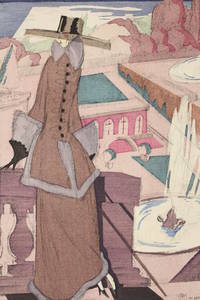
|
|
|
Pierre MOURGUE
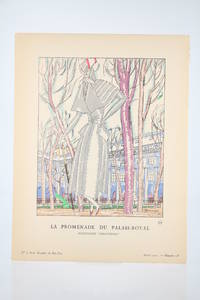
La Promenade au Palais-Royal. Redingote ""Directoire"" pl.18 La Gazette du Bon ton 1921 n°3
Paris: Lucien Vogel éditeur 1921. Fine. Lucien Vogel éditeur Paris 1921 18 x 24 cm une feuille Original color print heightened with palladium printed on laid paper signed at the bottom right of the plate. Original engraving created for the illustration of La Gazette du bon ton one of the most beautiful and influential fashion magazines of the 20th century celebrating the talent of French creators and artists at the height of the Art Deco movement. Famous fashion magazine founded in 1912 by Lucien Vogel La Gazette du bon ton was published until 1925 with an interruption during the War from 1915 to 1920 due to the mobilization of its editor-in-chief. It consists of 69 issues printed in only 2000 copies and is illustrated notably with 573 color plates and 148 sketches representing models by great couturiers. From their publication these luxurious publications ""addressed bibliophiles and worldly aesthetes"" Françoise Tétart-Vittu ""La Gazette du bon ton"" in Dictionnaire de la mode 2016. Printed on fine laid paper they used a typeface specially created for the magazine by Georges Peignot the Cochin character adopted in 1946 by Christian Dior. The prints were created using the metal stencil technique heightened in colors and some highlighted in gold or palladium. The adventure began in 1912 when Lucien Vogel a man of society and fashion - he had already participated in the magazine Femina - decided to found with his wife Cosette de Brunhoff sister of Jean the father of Babar the Gazette du bon ton whose subtitle was then ""Art modes et frivolités."" Georges Charensol reported the words of the editor-in-chief: ""In 1910 he observed there existed no fashion journal that was truly artistic and representative of the spirit of its time. I therefore thought of creating a luxury magazine with truly modern artists . I was certain of success because for fashion no country can rival France."" ""Un grand éditeur d'art. Lucien Vogel"" in Les Nouvelles littéraires no. 133 May 1925. The magazine's success was immediate not only in France but also in the United States and South America. Originally Vogel thus assembled a group of seven artists: André-Édouard Marty and Pierre Brissaud followed by Georges Lepape and Dammicourt; and finally his friends from the École des beaux-arts who were George Barbier Bernard Boutet de Monvel or Charles Martin. Other talents quickly joined the team: Guy Arnoux Léon Bakst Benito Boutet de Monvel Umberto Brunelleschi Chas Laborde Jean-Gabriel Domergue Raoul Dufy Édouard Halouze Alexandre Iacovleff Jean Émile Laboureur Charles Loupot Charles Martin Maggie Salcedo. These artists mostly unknown when Lucien Vogel called upon them would later become emblematic and sought-after artistic figures. These same illustrators created the drawings for the Gazette's advertisements. The plates highlighted and sublimated the dresses of seven creators of the time: Lanvin Doeuillet Paquin Poiret Worth Vionnet and Doucet. The couturiers provided exclusive models for each issue. Nevertheless some of the illustrations featured no real model but only the illustrator's idea of the fashion of the day. La Gazette du bon ton was a decisive step in the history of fashion. Combining aesthetic excellence and plastic unity it brought together for the first time the great talents from the worlds of arts letters and fashion and imposed through this alchemy a completely new image of women slender independent and bold also carried by the new generation of couturiers Coco Chanel Jean Patou Marcel Rochas. Taken over in 1920 by Condé Montrose Nast the Gazette du bon ton would largely inspire the new composition and aesthetic choices of the ""dying little journal"" that Nast had purchased a few years earlier: Vogue magazine. Lucien Vogel éditeur unknown
Referencia librero : 77346
|
|
|
Pierre MOURGUE
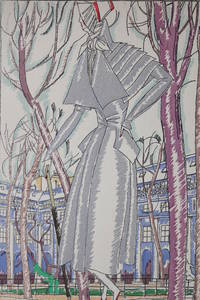
La Promenade au Palais-Royal. Redingote ""Directoire"" pl.18 La Gazette du Bon ton 1921 n°3
Paris: Lucien Vogel éditeur 1921. Fine. Lucien Vogel éditeur Paris 1921 18 x 24 cm une feuille Original color print heightened with palladium printed on vergé paper signed in the plate. An original print used to illustrate the Gazette du bon ton one of the most attractive and influential 20th century fashion magazines featuring the talents of French artists and other contributors from the burgeoning Art Deco movement. A celebrated fashion magazine established in 1912 by Lucien Vogel La Gazette du bon ton appeared until 1925 with a hiatus from 1915 to 1920 due to the war the editor-in-chief having been called up for service. It consisted of 69 issues printed in only 2000 copies each and notably illustrated with 573 color plates and 148 sketches of the models of the great designers. Right from the start this sumptuous publication was aimed at bibliophiles and fashionable society Françoise Tétart-Vittu La Gazette du bon ton in Dictionnaire de la mode 2016 and was printed on fine vergé paper using a type cut specially for the magazine by Georges Peignot known as Cochin later used in 1946 by Christian Dior. The prints were made using stencils heightened in colors some highlighted in gold or palladium. The story began in 1912 when Lucien Vogel a man of the world involved in fashion he had already been part of the fashion magazine Femina decided with his wife Cosette de Brunhoff the sister of Jean creator of Babar to set up the Gazette du bon ton subtitled at the time: Art fashion frivolities. Georges Charensol noted the reasoning of the editor-in-chief: 'In 1910' he observed there was no really artistic fashion magazine nothing representative of the spirit of the time. My dream was therefore to make a luxury magazine with truly modern artists
I was assured of success because when it comes to fashion no country on earth can compete with France.' Un grand éditeur d'art. Lucien Vogel in Les Nouvelles littéraires no. 133 May 1925. The magazine was immediately successful not only in France but also in the United States and Latin America. At first Vogel put together a team of seven artists: André-Édouard Marty and Pierre Brissaud followed by Georges Lepape and Dammicourt as well as eventually his friends from school and the School of Fine Arts like George Barbier Bernard Boutet de Monvel and Charles Martin. Other talented people soon came flocking to join the team: Guy Arnoux Léon Bakst Benito Boutet de Monvel Umberto Brunelleschi Chas Laborde Jean-Gabriel Domergue Raoul Dufy Édouard Halouze Alexandre Iacovleff Jean Émile Laboureur Charles Loupot Chalres Martin Maggie Salcedo. These artist mostly unknown when Lucien Vogel sought them out later became emblematic and sought-after artistic figures. It was also they who worked on the advertising drawings for the Gazette. The plates put the spotlight on and celebrate dresses by seven designers of the age: Lanvin Doeuillet Paquin Poiret Worth Vionnet and Doucet. The designers provided exclusive models for each issue. Nonetheless some of the illustrations are not based on real models but simply on the illustrator's conception of the fashion of the day. The Gazette du bon ton was an important step in the history of fashion. Combining aesthetic demands with the physical whole it brought together for the first time the great talents of the artistic literary and fashion worlds; and imposed through this alchemy a completely new image of women: slender independent and daring which was shared by the new generation of designers including Coco Chanel Jean Patou Marcel Rochas and so on
Taken over in 1920 by Condé Montrose Nast the Gazette du bon ton was an important influence on the new layout and aesthetics of that little dying paper that Nast had bought a few years earlier: Vogue. Lucien Vogel éditeur unknown
Referencia librero : 54854
|
|
|
Pierre MOURGUE
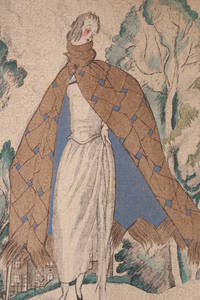
La Visite à l'Ermitage. Cape en ruban pl.49 La Gazette du Bon ton 1921 n°7
Paris: Lucien Vogel éditeur 1921. Fine. Lucien Vogel éditeur Paris 1921 18 x 24 cm une feuille Original color print printed on vergé paper signed in the plate. An original print used to illustrate the Gazette du bon ton one of the most attractive and influential 20th century fashion magazines featuring the talents of French artists and other contributors from the burgeoning Art Deco movement. A celebrated fashion magazine established in 1912 by Lucien Vogel La Gazette du bon ton appeared until 1925 with a hiatus from 1915 to 1920 due to the war the editor-in-chief having been called up for service. It consisted of 69 issues printed in only 2000 copies each and notably illustrated with 573 color plates and 148 sketches of the models of the great designers. Right from the start this sumptuous publication was aimed at bibliophiles and fashionable society Françoise Tétart-Vittu La Gazette du bon ton in Dictionnaire de la mode 2016 and was printed on fine vergé paper using a type cut specially for the magazine by Georges Peignot known as Cochin later used in 1946 by Christian Dior. The prints were made using stencils heightened in colors some highlighted in gold or palladium. The story began in 1912 when Lucien Vogel a man of the world involved in fashion he had already been part of the fashion magazine Femina decided with his wife Cosette de Brunhoff the sister of Jean creator of Babar to set up the Gazette du bon ton subtitled at the time: Art fashion frivolities. Georges Charensol noted the reasoning of the editor-in-chief: In 1910 he observed there was no really artistic fashion magazine nothing representative of the spirit of the time. My dream was therefore to make a luxury magazine with truly modern artists
I was assured of success because when it comes to fashion no country on earth can compete with France. Un grand éditeur dart. Lucien Vogel in Les Nouvelles littéraires no. 133 May 1925. The magazine was immediately successful not only in France but also in the United States and Latin America. At first Vogel put together a team of seven artists: André-Édouard Marty and Pierre Brissaud followed by Georges Lepape and Dammicourt as well as eventually his friends from school and the School of Fine Arts like George Barbier Bernard Boutet de Monvel and Charles Martin. Other talented people soon came flocking to join the team: Guy Arnoux Léon Bakst Benito Boutet de Monvel Umberto Brunelleschi Chas Laborde Jean-Gabriel Domergue Raoul Dufy Édouard Halouze Alexandre Iacovleff Jean Émile Laboureur Charles Loupot Chalres Martin Maggie Salcedo. These artist mostly unknown when Lucien Vogel sought them out later became emblematic and sought-after artistic figures. It was also they who worked on the advertising drawings for the Gazette. The plates put the spotlight on and celebrate dresses by seven designers of the age: Lanvin Doeuillet Paquin Poiret Worth Vionnet and Doucet. The designers provided exclusive models for each issue. Nonetheless some of the illustrations are not based on real models but simply on the illustrators conception of the fashion of the day. The Gazette du bon ton was an important step in the history of fashion. Combining aesthetic demands with the physical whole it brought together for the first time the great talents of the artistic literary and fashion worlds; and imposed through this alchemy a completely new image of women: slender independent and daring which was shared by the new generation of designers including Coco Chanel Jean Patou Marcel Rochas and so on
Taken over in 1920 by Condé Montrose Nast the Gazette du bon ton was an important influence on the new layout and aesthetics of that little dying paper that Nast had bought a few years earlier: Vogue. Lucien Vogel éditeur unknown
Referencia librero : 54887
|
|
|
Pierre MOURGUE
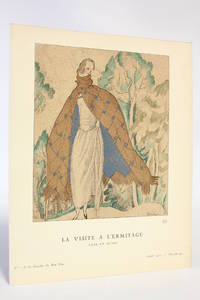
La Visite à l'Ermitage. Cape en ruban pl.49 La Gazette du Bon ton 1921 n°7
Paris: Lucien Vogel éditeur 1921. Fine. Lucien Vogel éditeur Paris 1921 18 x 24 cm une feuille original print in color printed on laid paper signed lower right of the board. The Gazette has good taste one of the finest and most influential twentieth century fashion magazines celebrating the talent of creators and artists French burgeoning art deco. Famous fashion magazine founded in 1912 by Lucien Vogel The Gazette fashionable appeared until 1925 with an interruption during the War of 1915 to 1920 due to mobilization of its editor. She is 69 Deliveries from just 2000 copies and is illustrated including 573 color plates and 148 sketches depicting models of fashion designers. Upon publication these luxury publications ""are for bibliophiles and worldly aesthetes"" Françoise Tétart-Vittu ""good Gazette of tone"" in the fashion dictionary 2016. Printed on fine laid paper they use a typeface created specifically for the magazine by Georges Peignot the Cochin character taken in 1946 by Christian Dior. The prints are made with the technique of metal stencil enhanced color and some outlined in gold or palladium. The adventure began in 1912 when Lucien Vogel man of the world and fashion - it has already participated in Femina magazine - decided to found with his wife Cosette de Brunhoff John's sister the father of Babar Gazette good tone in which the subtitle is then ""Art fashions and frivolities."" Georges Charensol quotes the editor: ""In 1910 he observed there was no truly artistic fashion magazine and representative of the spirit of his time. So I thought of making a glossy magazine with truly modern artists . I was certain of success because no country for fashion can compete with France. """" A great art editor. Lucien Vogel ""in Literary News No. 133 May 1925. The success of the magazine is immediate not only in France but also the US and South America. Originally Vogel therefore brings together a group of seven artists: André-Édouard Marty and Pierre Brissaud followed by Georges Lepape and Dammicourt; and finally his friends from the School of Fine Arts as are George Barbier Bernard Boutet de Monvel or Charles Martin. Other talents come quickly reach the equipped Guy Arnoux Léon Bakst Benito Boutet de Monvel Umberto Brunelleschi Chas Laborde Jean-Gabriel Domergue Raoul Dufy Edward Halouze Alexander Iacovleff Jean Emile Laboureur Charles Loupot Charles Martin Maggie Salcedo. These artists mostly unknown when Lucien Vogel appealed to them will eventually become iconic figures and artistic sought. These are the same illustrators who make the drawings advertisements Gazette. The boards highlight the dresses and sublime seven artists of the time: Lanvin Doeuillet Paquin Poiret Worth Vionnet and Doucet. The designers provide for each number of exclusive models. Nevertheless some of Illustrations contained no real model but only the idea that the illustrator is done in the fashion of the day. Gazette fashionable is a milestone in the history of fashion. Combining the aesthetic requirement and plastic unit it brings together for the first time the great talents of the world of arts literature and fashion and imposed by this alchemy a new image of women slender independent and bold also driven by the new generation of designers Coco Chanel Jean Patou Rochas Marcel . Recovery in 1920 by Condé Montrose Nast Gazette fashionable modeled for the new composition and the aesthetic choices of the ""little dying newspaper"" that Nast had bought a few years ago: the Vogue magazine. Lucien Vogel éditeur hardcover
Referencia librero : 57579
|
|
|
Pierre MOURGUE - (Camille ROGER)
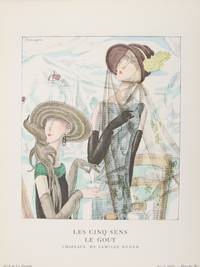
Les Cinq sens. Le Goût. Chapeaux de Camille Roger pl.56 La Gazette du Bon ton 1922 n°8
Paris: Lucien Vogel éditeur 1922. Fine. Lucien Vogel éditeur Paris 1922 18 x 24 cm une feuille Original color print printed on laid paper signed in the top left of the plate. La Gazette du bon ton one of the most beautiful and influential fashion magazines of the twentieth century celebrating the talent of French creators and artists in the full bloom of Art Deco. The famous fashion magazine founded in 1912 by Lucien Vogel La Gazette du bon ton was published until 1925 with an interruption during the War from 1915 to 1920 due to the mobilization of its editor-in-chief. It consists of 69 issues printed in only 2000 copies and is illustrated notably with 573 color plates and 148 sketches representing models by great couturiers. From their publication these luxurious publications ""address bibliophiles and worldly aesthetes"" Françoise Tétart-Vittu ""La Gazette du bon ton"" in Dictionnaire de la mode 2016. Printed on fine laid paper they use a typeface specially created for the magazine by Georges Peignot the Cochin character adopted in 1946 by Christian Dior. The prints are created using the metallic stencil technique enhanced with colors and some highlighted with gold or palladium. The adventure begins in 1912 when Lucien Vogel a man of society and fashion - he had already participated in the magazine Femina - decides to found with his wife Cosette de Brunhoff sister of Jean the father of Babar the Gazette du bon ton whose subtitle was then ""Art modes et frivolités"". Georges Charensol reports the words of the editor-in-chief: ""In 1910 he observes there existed no fashion journal that was truly artistic and representative of the spirit of its time. I was therefore thinking of creating a luxury magazine with truly modern artists . I was certain of success because for fashion no country can rival France."" ""Un grand éditeur d'art. Lucien Vogel"" in Les Nouvelles littéraires no.133 May 1925. The magazine's success is immediate not only in France but also in the United States and South America. Originally Vogel therefore assembled a group of seven artists: André-Édouard Marty and Pierre Brissaud followed by Georges Lepape and Dammicourt; and finally his friends from the École des beaux-arts who were George Barbier Bernard Boutet de Monvel or Charles Martin. Other talents quickly joined the team: Guy Arnoux Léon Bakst Benito Boutet de Monvel Umberto Brunelleschi Chas Laborde Jean-Gabriel Domergue Raoul Dufy Édouard Halouze Alexandre Iacovleff Jean Émile Laboureur Charles Loupot Charles Martin Maggie Salcedo. These artists unknown for the most part when Lucien Vogel called upon them would subsequently become emblematic and sought-after artistic figures. These same illustrators created the drawings for the Gazette's advertisements. The plates highlight and sublimate the dresses of seven creators of the period: Lanvin Doeuillet Paquin Poiret Worth Vionnet and Doucet. The couturiers provided exclusive models for each issue. Nevertheless some of the illustrations feature no real model but only the illustrator's idea of the fashion of the day. La Gazette du bon ton is a decisive stage in fashion history. Combining aesthetic excellence and plastic unity it brought together for the first time the great talents from the worlds of arts letters and fashion and imposed through this alchemy a completely new image of woman slender independent and audacious also carried by the new generation of couturiers Coco Chanel Jean Patou Marcel Rochas. Taken over in 1920 by Condé Montrose Nast the Gazette du bon ton would largely inspire the new composition and aesthetic choices of the ""dying little journal"" that Nast had bought a few years earlier: Vogue magazine. Lucien Vogel éditeur unknown
Referencia librero : 84790
|
|
|
Pierre MOURGUE - (RODIER)
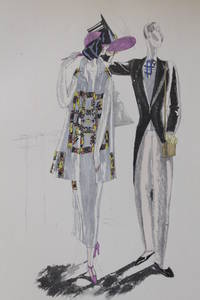
Les Courses ou Gagneront-ils Robe d'après-midi en ""carrés roumécla"" de Rodier pl.48 La Gazette du Bon ton 1924 n°9
Paris: Lucien Vogel éditeur 1924. Fine. Lucien Vogel éditeur Paris 1924 18 x 24 cm une feuille Original color print printed on vergé paper signed in the plate. An original print used to illustrate the Gazette du bon ton one of the most attractive and influential 20th century fashion magazines featuring the talents of French artists and other contributors from the burgeoning Art Deco movement. A celebrated fashion magazine established in 1912 by Lucien Vogel La Gazette du bon ton appeared until 1925 with a hiatus from 1915 to 1920 due to the war the editor-in-chief having been called up for service. It consisted of 69 issues printed in only 2000 copies each and notably illustrated with 573 color plates and 148 sketches of the models of the great designers. Right from the start this sumptuous publication was aimed at bibliophiles and fashionable society Françoise Tétart-Vittu La Gazette du bon ton in Dictionnaire de la mode 2016 and was printed on fine vergé paper using a type cut specially for the magazine by Georges Peignot known as Cochin later used in 1946 by Christian Dior. The prints were made using stencils heightened in colors some highlighted in gold or palladium. The story began in 1912 when Lucien Vogel a man of the world involved in fashion he had already been part of the fashion magazine Femina decided with his wife Cosette de Brunhoff the sister of Jean creator of Babar to set up the Gazette du bon ton subtitled at the time: Art fashion frivolities. Georges Charensol noted the reasoning of the editor-in-chief: 'In 1910' he observed there was no really artistic fashion magazine nothing representative of the spirit of the time. My dream was therefore to make a luxury magazine with truly modern artists
I was assured of success because when it comes to fashion no country on earth can compete with France.' Un grand éditeur d'art. Lucien Vogel in Les Nouvelles littéraires no. 133 May 1925. The magazine was immediately successful not only in France but also in the United States and Latin America. At first Vogel put together a team of seven artists: André-Édouard Marty and Pierre Brissaud followed by Georges Lepape and Dammicourt as well as eventually his friends from school and the School of Fine Arts like George Barbier Bernard Boutet de Monvel and Charles Martin. Other talented people soon came flocking to join the team: Guy Arnoux Léon Bakst Benito Boutet de Monvel Umberto Brunelleschi Chas Laborde Jean-Gabriel Domergue Raoul Dufy Édouard Halouze Alexandre Iacovleff Jean Émile Laboureur Charles Loupot Chalres Martin Maggie Salcedo. These artist mostly unknown when Lucien Vogel sought them out later became emblematic and sought-after artistic figures. It was also they who worked on the advertising drawings for the Gazette. The plates put the spotlight on and celebrate dresses by seven designers of the age: Lanvin Doeuillet Paquin Poiret Worth Vionnet and Doucet. The designers provided exclusive models for each issue. Nonetheless some of the illustrations are not based on real models but simply on the illustrator's conception of the fashion of the day. The Gazette du bon ton was an important step in the history of fashion. Combining aesthetic demands with the physical whole it brought together for the first time the great talents of the artistic literary and fashion worlds; and imposed through this alchemy a completely new image of women: slender independent and daring which was shared by the new generation of designers including Coco Chanel Jean Patou Marcel Rochas and so on
Taken over in 1920 by Condé Montrose Nast the Gazette du bon ton was an important influence on the new layout and aesthetics of that little dying paper that Nast had bought a few years earlier: Vogue. Lucien Vogel éditeur unknown
Referencia librero : 55094
|
|
|
Pierre MOURGUE - (LARSEN)
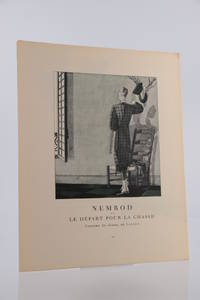
Nemrod ou le départ pour la chasse Costume de chasse de Larsen La Gazette du Bon ton 1922 n°8
Paris: Lucien Vogel éditeur 1922. Fine. Lucien Vogel éditeur Paris 1922 18 x 24 cm une double page Original color print on laid paper signed lower right of the plate. La Gazette du bon ton one of the most beautiful and influential fashion magazines of the 20th century celebrating the talent of French creators and artists at the height of the Art Deco movement. Famous fashion magazine founded in 1912 by Lucien Vogel La Gazette du bon ton was published until 1925 with an interruption during the War from 1915 to 1920 due to the mobilization of its editor-in-chief. It consists of 69 issues printed in only 2000 copies and is notably illustrated with 573 color plates and 148 sketches representing models by great couturiers. From their publication these luxurious publications ""were addressed to bibliophiles and worldly aesthetes"" Françoise Tétart-Vittu ""La Gazette du bon ton"" in Dictionnaire de la mode 2016. Printed on fine laid paper they use a typeface specially created for the magazine by Georges Peignot the Cochin character adopted in 1946 by Christian Dior. The prints are made using the metal stencil technique heightened in colors and some highlighted with gold or palladium. The adventure begins in 1912 when Lucien Vogel a man of society and fashion - he had already participated in the magazine Femina - decides to found with his wife Cosette de Brunhoff sister of Jean the father of Babar the Gazette du bon ton whose subtitle was then ""Art modes et frivolités"". Georges Charensol reports the words of the editor-in-chief: ""En 1910 observe-t-il il n'existait aucun journal de mode véritablement artistique et représentatif de l'esprit de son époque. Je songeais donc à faire un magazine de luxe avec des artistes véritablement modernes . J'étais certain du succès car pour la mode aucun pays ne peut rivaliser avec la France."" ""In 1910 he observes there was no truly artistic fashion journal representative of the spirit of its time. So I was thinking of making a luxury magazine with truly modern artists . I was certain of success because for fashion no country can rival France."" ""Un grand éditeur d'art. Lucien Vogel"" in Les Nouvelles littéraires n°133 May 1925. The success of the magazine was immediate not only in France but also in the United States and South America. Originally Vogel brought together a group of seven artists: André-Édouard Marty and Pierre Brissaud followed by Georges Lepape and Dammicourt; and finally his friends from the École des beaux-arts who were George Barbier Bernard Boutet de Monvel or Charles Martin. Other talents quickly joined the team: Guy Arnoux Léon Bakst Benito Boutet de Monvel Umberto Brunelleschi Chas Laborde Jean-Gabriel Domergue Raoul Dufy Édouard Halouze Alexandre Iacovleff Jean Émile Laboureur Charles Loupot Charles Martin Maggie Salcedo. These artists mostly unknown when Lucien Vogel called upon them would later become emblematic and sought-after artistic figures. These same illustrators created the drawings for the Gazette's advertisements. The plates highlight and sublimate the dresses of seven creators of the era: Lanvin Doeuillet Paquin Poiret Worth Vionnet and Doucet. The couturiers provided exclusive models for each issue. Nevertheless some of the illustrations feature no real model but only the illustrator's idea of the fashion of the day. La Gazette du bon ton marks a decisive stage in the history of fashion. Combining aesthetic demands and plastic unity it brought together for the first time the great talents from the worlds of arts letters and fashion and imposed through this alchemy a completely new image of woman slender independent and audacious also carried by the new generation of couturiers Coco Chanel Jean Patou Marcel Rochas. Taken over in 1920 by Condé Montrose Nast La Gazette du bon ton would largely inspire the new composition and aesthetic choices of the ""dying little journal"" that Nast had bought a few years earlier: Vogue magazine Lucien Vogel éditeur unknown
Referencia librero : 84835
|
|
|
Pierre MOURGUE - (MARTIAL & ARMAND)
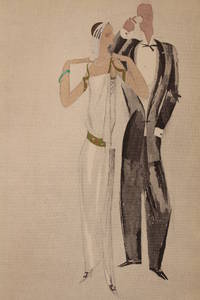
Soir de Paris. Robe du soir de Martial et Armand pl.5 La Gazette du Bon ton 1922 n°1
Paris: Lucien Vogel éditeur 1922. Fine. Lucien Vogel éditeur Paris 1922 18 x 24 cm une feuille Original color print printed on vergé paper signed in the plate. An original print used to illustrate the Gazette du bon ton one of the most attractive and influential 20th century fashion magazines featuring the talents of French artists and other contributors from the burgeoning Art Deco movement. A celebrated fashion magazine established in 1912 by Lucien Vogel La Gazette du bon ton appeared until 1925 with a hiatus from 1915 to 1920 due to the war the editor-in-chief having been called up for service. It consisted of 69 issues printed in only 2000 copies each and notably illustrated with 573 color plates and 148 sketches of the models of the great designers. Right from the start this sumptuous publication was aimed at bibliophiles and fashionable society Françoise Tétart-Vittu La Gazette du bon ton in Dictionnaire de la mode 2016 and was printed on fine vergé paper using a type cut specially for the magazine by Georges Peignot known as Cochin later used in 1946 by Christian Dior. The prints were made using stencils heightened in colors some highlighted in gold or palladium. The story began in 1912 when Lucien Vogel a man of the world involved in fashion he had already been part of the fashion magazine Femina decided with his wife Cosette de Brunhoff the sister of Jean creator of Babar to set up the Gazette du bon ton subtitled at the time: Art fashion frivolities. Georges Charensol noted the reasoning of the editor-in-chief: In 1910 he observed there was no really artistic fashion magazine nothing representative of the spirit of the time. My dream was therefore to make a luxury magazine with truly modern artists
I was assured of success because when it comes to fashion no country on earth can compete with France. Un grand éditeur dart. Lucien Vogel in Les Nouvelles littéraires no. 133 May 1925. The magazine was immediately successful not only in France but also in the United States and Latin America. At first Vogel put together a team of seven artists: André-Édouard Marty and Pierre Brissaud followed by Georges Lepape and Dammicourt as well as eventually his friends from school and the School of Fine Arts like George Barbier Bernard Boutet de Monvel and Charles Martin. Other talented people soon came flocking to join the team: Guy Arnoux Léon Bakst Benito Boutet de Monvel Umberto Brunelleschi Chas Laborde Jean-Gabriel Domergue Raoul Dufy Édouard Halouze Alexandre Iacovleff Jean Émile Laboureur Charles Loupot Chalres Martin Maggie Salcedo. These artist mostly unknown when Lucien Vogel sought them out later became emblematic and sought-after artistic figures. It was also they who worked on the advertising drawings for the Gazette. The plates put the spotlight on and celebrate dresses by seven designers of the age: Lanvin Doeuillet Paquin Poiret Worth Vionnet and Doucet. The designers provided exclusive models for each issue. Nonetheless some of the illustrations are not based on real models but simply on the illustrators conception of the fashion of the day. The Gazette du bon ton was an important step in the history of fashion. Combining aesthetic demands with the physical whole it brought together for the first time the great talents of the artistic literary and fashion worlds; and imposed through this alchemy a completely new image of women: slender independent and daring which was shared by the new generation of designers including Coco Chanel Jean Patou Marcel Rochas and so on
Taken over in 1920 by Condé Montrose Nast the Gazette du bon ton was an important influence on the new layout and aesthetics of that little dying paper that Nast had bought a few years earlier: Vogue. Lucien Vogel éditeur unknown
Referencia librero : 54954
|
|
|
Pierre MOURGUE - (MARTIAL & ARMAND)
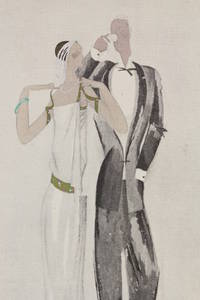
Soir de Paris. Robe du soir de Martial et Armand pl.5 La Gazette du Bon ton 1922 n°1
Paris: Lucien Vogel éditeur 1922. Fine. Lucien Vogel éditeur Paris 1922 18 x 24 cm une feuille original print in color printed on laid paper signed upper left of the board. The Gazette has good taste one of the finest and most influential twentieth century fashion magazines celebrating the talent of creators and artists French burgeoning art deco. Famous fashion magazine founded in 1912 by Lucien Vogel The Gazette fashionable appeared until 1925 with an interruption during the War of 1915 to 1920 due to mobilization of its editor. She is 69 Deliveries from just 2000 copies and is illustrated including 573 color plates and 148 sketches depicting models of fashion designers. Upon publication these luxury publications ""are for bibliophiles and worldly aesthetes"" Françoise Tétart-Vittu ""good Gazette of tone"" in the fashion dictionary 2016. Printed on fine laid paper they use a typeface created specifically for the magazine by Georges Peignot the Cochin character taken in 1946 by Christian Dior. The prints are made with the technique of metal stencil enhanced color and some outlined in gold or palladium. The adventure began in 1912 when Lucien Vogel man of the world and fashion - it has already participated in Femina magazine - decided to found with his wife Cosette de Brunhoff John's sister the father of Babar Gazette good tone in which the subtitle is then ""Art fashions and frivolities."" Georges Charensol quotes the editor: ""In 1910 he observed there was no truly artistic fashion magazine and representative of the spirit of his time. So I thought of making a glossy magazine with truly modern artists . I was certain of success because no country for fashion can compete with France. """" A great art editor. Lucien Vogel ""in Literary News No. 133 May 1925. The success of the magazine is immediate not only in France but also the US and South America. Originally Vogel therefore brings together a group of seven artists: André-Édouard Marty and Pierre Brissaud followed by Georges Lepape and Dammicourt; and finally his friends from the School of Fine Arts as are George Barbier Bernard Boutet de Monvel or Charles Martin. Other talents come quickly reach the equipped Guy Arnoux Léon Bakst Benito Boutet de Monvel Umberto Brunelleschi Chas Laborde Jean-Gabriel Domergue Raoul Dufy Edward Halouze Alexander Iacovleff Jean Emile Laboureur Charles Loupot Charles Martin Maggie Salcedo. These artists mostly unknown when Lucien Vogel appealed to them will eventually become iconic figures and artistic sought. These are the same illustrators who make the drawings advertisements Gazette. The boards highlight the dresses and sublime seven artists of the time: Lanvin Doeuillet Paquin Poiret Worth Vionnet and Doucet. The designers provide for each number of exclusive models. Nevertheless some of Illustrations contained no real model but only the idea that the illustrator is done in the fashion of the day. Gazette fashionable is a milestone in the history of fashion. Combining the aesthetic requirement and plastic unit it brings together for the first time the great talents of the world of arts literature and fashion and imposed by this alchemy a new image of women slender independent and bold also driven by the new generation of designers Coco Chanel Jean Patou Rochas Marcel . Recovery in 1920 by Condé Montrose Nast Gazette fashionable modeled for the new composition and the aesthetic choices of the ""little dying newspaper"" that Nast had bought a few years ago: the Vogue magazine. Lucien Vogel éditeur hardcover
Referencia librero : 57524
|
|
|
Pierre MOUILLEFERT
Traité des arbres et des arbrisseaux forestiers industriels et d'ornement cultivés ou exploités en Europe et plus particulièrement en France donnant la description et l'utilisation de plus de 2400 espèces et 2000 variétés
Paris: Paul Klincksieck 1892. Fine. Paul Klincksieck Paris 1892-1898 15.50 x 23 cm 2 volumes brochés & 1 en feuilles sous chemise First edition. First text volume: ranunculaceae to leguminosae Second text volume: terebinthaceae to gramineae. Spines sunned spine of the second volume cracked and with two tears at foot. Our set is complete with its atlas presented in loose sheets under chemises with flaps which contains 195 plates including 40 hand-colored 144 phototypes of tree habits and 11 elements of tree botany. Handsome and very rare set. Paul Klincksieck unknown
Referencia librero : 37463
|
|
|
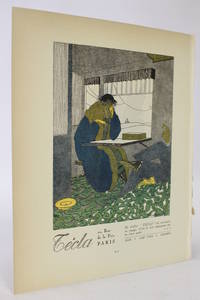
Pierre MOURGUE - (TECLA) - Jeanne LANVIN
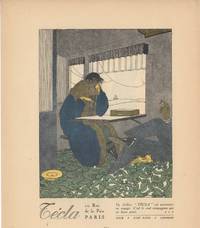
Un collier Técla Publicité Volume 1 La Gazette du Bon ton 1920 n°2 suivi de Robes du soir de Jeanne Lanvin
Paris: Lucien Vogel éditeur 1920. Fine. Lucien Vogel éditeur Paris 1920 18 x 24 cm une feuille Original color print created by Pierre Mourgue printed on laid paper signed at bottom right of the plate. Advertising plate for dresses by Jeanne Lanvin on verso. Original engraving created for the illustration of La Gazette du bon ton one of the most beautiful and influential fashion magazines of the 20th century celebrating the talent of French creators and artists in the full bloom of Art Deco. Famous fashion magazine founded in 1912 by Lucien Vogel La Gazette du bon ton was published until 1925 with an interruption during the War from 1915 to 1920 due to the mobilization of its editor-in-chief. It consists of 69 issues printed in only 2000 copies and is illustrated notably with 573 color plates and 148 sketches representing models by great couturiers. From their publication these luxurious publications ""addressed bibliophiles and worldly aesthetes"" Françoise Tétart-Vittu ""La Gazette du bon ton"" in Dictionnaire de la mode 2016. Printed on fine laid paper they use a typeface specially created for the magazine by Georges Peignot the Cochin character adopted in 1946 by Christian Dior. The prints are created using the metal stencil technique heightened in colors and some highlighted in gold or palladium. The adventure begins in 1912 when Lucien Vogel a man of society and fashion - he had already participated in the magazine Femina - decides to found with his wife Cosette de Brunhoff sister of Jean the father of Babar the Gazette du bon ton whose subtitle was then ""Art modes et frivolités"". Georges Charensol reports the words of the editor-in-chief: ""In 1910 he observes there existed no fashion journal truly artistic and representative of the spirit of its time. I was therefore thinking of making a luxury magazine with truly modern artists . I was certain of success because for fashion no country can rival France."" ""Un grand éditeur d'art. Lucien Vogel"" in Les Nouvelles littéraires n°133 May 1925. The magazine's success is immediate not only in France but also in the United States and South America. Originally Vogel thus assembled a group of seven artists: André-Édouard Marty and Pierre Brissaud followed by Georges Lepape and Dammicourt; and finally his friends from the École des beaux-arts who are George Barbier Bernard Boutet de Monvel or Charles Martin. Other talents quickly join the team: Guy Arnoux Léon Bakst Benito Boutet de Monvel Umberto Brunelleschi Chas Laborde Jean-Gabriel Domergue Raoul Dufy Édouard Halouze Alexandre Iacovleff Jean Émile Laboureur Charles Loupot Charles Martin Maggie Salcedo. These artists mostly unknown when Lucien Vogel calls upon them will later become emblematic and sought-after artistic figures. These same illustrators create the drawings for the Gazette's advertisements. The plates highlight and sublimate the dresses of seven creators of the time: Lanvin Doeuillet Paquin Poiret Worth Vionnet and Doucet. The couturiers provide exclusive models for each issue. Nevertheless some of the illustrations feature no real model but only the idea that the illustrator has of the fashion of the day. La Gazette du bon ton is a decisive stage in the history of fashion. Combining aesthetic demands and visual unity it brings together for the first time the great talents of the worlds of arts letters and fashion and imposes through this alchemy a completely new image of woman slender independent and bold also carried by the new generation of couturiers Coco Chanel Jean Patou Marcel Rochas. Taken over in 1920 by Condé Montrose Nast the Gazette du bon ton would largely inspire the new composition and aesthetic choices of the ""petit journal mourant"" that Nast had bought a few years earlier: Vogue magazine. Lucien Vogel éditeur unknown
Referencia librero : 73135
|
|
|
Pierre MOURGUE - (TECLA) - Jeanne LANVIN
Un collier Técla Publicité Volume 1 La Gazette du Bon ton 1920 n°2 suivi de Robes du soir de Jeanne Lanvin
Paris: Lucien Vogel éditeur 1920. Fine. Lucien Vogel éditeur Paris 1920 18 x 24 cm une feuille original print in color printed on laid paper signed lower right of the board. advertising board for Jeanne Lanvin dresses overleaf. Trained at the School of Fine Arts in the studio of Fernand Cormon André Édouard Marty works in the Gazette du Bon tone from the start of the review; it is then known for his elegant style in which often stand a whimsical or humorous touch. In a decidedly Art Deco inspiration he draws Poiret dresses alongside Lepape but also those of Lanvin or to Doeuillet. This is particularly illustrating the dresses of the latter trait that reveals a multifaceted: fun in silent my heart . where a young Cupid aims his arrow of a young woman falsely frightened!. The Taste bucolic in the garden where little girls dresses with carefully placed serve their mother dressed in a stylish dress. Melancholic perhaps in The Secret pretty where we see two girls shyly confide any thought. Like his colleagues in the Gazette Marty also works with other fashion magazines such as Vogue and Harper's Bazaar yet two competing magazines for which he will be one of the few illustrators to work on it together. In parallel fashion illustrations Marty also designs scenes for literary works such mythological scenes Henry Regnier or The Songs of Bilitis by Pierre Louÿs in 1937. The eclecticism of his style reached its peak in 1943 when he realizes a cartoon Callisto little nymph of Diana ""setting in motion ultimate feminine silhouettes that he composed for the Gazette. Original content produced for the illustration of The Gazette fashionable one of the finest and most influential twentieth century fashion magazines celebrating the talent of creators and artists French burgeoning art deco. Famous fashion magazine founded in 1912 by Lucien Vogel The Gazette fashionable appeared until 1925 with an interruption during the War of 1915 to 1920 due to mobilization of its editor. She is 69 Deliveries from just 2000 copies and is illustrated including 573 color plates and 148 sketches depicting models of fashion designers. Upon publication these luxury publications ""are for bibliophiles and worldly aesthetes"" Françoise Tétart-Vittu ""good Gazette of tone"" in the fashion dictionary 2016. Printed on fine laid paper they use a typeface created specifically for the magazine by Georges Peignot the Cochin character taken in 1946 by Christian Dior. The prints are made with the technique of metal stencil enhanced color and some outlined in gold or palladium. The adventure began in 1912 when Lucien Vogel man of the world and fashion - it has already participated in Femina magazine - decided to found with his wife Cosette de Brunhoff John's sister the father of Babar Gazette good tone in which the subtitle is then ""Art fashions and frivolities."" Georges Charensol quotes the editor: ""In 1910 he observed there was no truly artistic fashion magazine and representative of the spirit of his time. So I thought of making a glossy magazine with truly modern artists . I was certain of success because for any fashion country can compete with France. """" A great art editor. Lucien Vogel ""in literary News No. 133 May 1925. The success of the magazine is immediate not only in France but also the US and South America. Originally Vogel therefore brings together a group of seven artists: André-Édouard Marty and Pierre Brissaud followed by Georges Lepape and Dammicourt; and finally his friends from the School of Fine Arts as are George Barbier Bernard Boutet de Monvel or Charles Martin. Other talents come quickly reach the equipped Guy Arnoux Léon Bakst Benito Boutet de Monvel Umberto Brunelleschi Chas Laborde Jean-Gabriel Domergue Raoul Dufy Edward Halouze Alexander Iacovleff Jean Emile Laboureur Charles Loupot Charles Martin Maggie Salcedo. These artists mostly unknown when Lucien Vogel appealed to them will eventually become iconic figures and artist Lucien Vogel éditeur unknown
Referencia librero : 55372
|
|
|
Pierre NAVILLE
Les reines de la main gauche
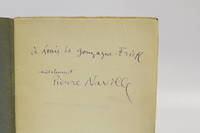
Alençon: Imprimerie Alençonnaise 1924. Fine. Imprimerie Alençonnaise Alençon 1924 13.50 x 18.50 cm agrafé First Edition printed in small numbers. Rare and precious autograph dedication signed by Pierre Naville to Louis de Gonzague-Frick. Back and flat slightly and marginally insolated as generally. Imprimerie Alençonnaise unknown
Referencia librero : 61534
|
|
|
Pierre NAVILLE
Les reines de la main gauche
Alençon: Imprimerie Alençonnaise 1924. Fine. Imprimerie Alençonnaise Alençon 1924 13.50 x 18.50 cm agrafé First edition of petit nombre. Rare handsome inscription dated September 1924 and signed by Pierre Naville to Raymond Queneau. Spine and covers slightly and marginally sunned as usual. Imprimerie Alençonnaise unknown
Referencia librero : 48294

|
|
|
Pierre NAVILLE
Les reines de la main gauche
s. l.: S. n. 1924. Fine. S. n. s. l. s. d. 1924 13.50 x 18.50 cm agrafé First edition printed to a very small number of copies. Covers very slightly and marginally faded a very good and rare copy. S. n. unknown
Referencia librero : 16241

|
|
|
Pierre NERON - Estienne GIRARD
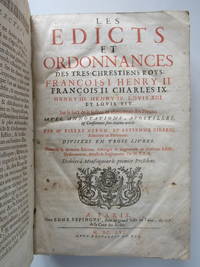
Les edicts et ordonnances des tres-chrestien roys François I. Henri II. François II. Charles IX. Henry III. Henri IV. Louis XIII. et Louis XIV. sur le faict de la justice & abreuiation des procez. Avec annotations apostilles & conferences sous chacun article
à Paris: Chez Edme Pépingué 1656. Fine. Chez Edme Pépingué à Paris 1656 24 x 36 cm In-folio relié New edition. Imprint for this new edition completed on December 1st 1655. Very worn contemporary full brown sheep binding. Spine with raised bands decorated with grotesques leafy designs dots and fleur-de-lys. Brown sheep title label. Headcaps torn with large lacks to first and last compartments. Joints cracked at head and foot with leather lacks. Corners cut and worn bare. Overall very rubbed. First text leaf with browning some following leaves affected. Foxing to index. Lacks lower right corner of page 1043. 19th-century armorial bookplate of Bellaigne de Bughas. Continuously reprinted and augmented since 1620 the Néron et Girard enjoyed lasting success until the 18th century. The collection classifies royal laws for the first time in chronological order and its usability is enhanced by an extensive table of contents. Dictionnaire historique des juristes français 2007 p. 588. Chez Edme Pépingué hardcover
Referencia librero : 68135
|
|
|
Pierre NOEL DE LA HOUSSAYE
Le bocage des Valois
Paris: Lucien Petitot 1927. Fine. Lucien Petitot Paris 1927 19.50 x 25.50 cm broché First Edition printed 300 copies numbered on laid Arches paper and justified by the author. autograph dedication of the author autograph dated 1951 and signed Christmas from La Houssaye to André Frank ending in quatrain. Nice copy. Lucien Petitot unknown
Referencia librero : 61425

|
|
|
Pierre NORD
Bombe à l'O.T.A.N.
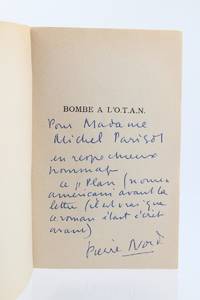
Paris: Arthème Fayard 1959. Fine. Arthème Fayard Paris 1959 12 x 19 cm broché First edition printed on ordinary paper. A scratch on the first cover. Signed and inscribed by Pierre Nord to Madame Michel Parisot: "". ce plan roman américain avant la lettre il est vrai que le romanétait écrit avant"" "". this American novel plan before the letter it is true that the novel was written before"". Arthème Fayard unknown
Referencia librero : 76245
|
|
|
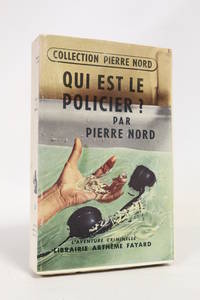
Pierre NORD
Qui est le policier
Paris: A. Fayard 1957. Fine. A. Fayard Paris 1957 12 x 19 cm broché First edition one of 30 numbered copies on Alfa paper only large papers. Beautiful illustrated cover. A. Fayard unknown
Referencia librero : 70113
|
|
|
Pierre OKOKO
La guerre civile dans la poésie espagnole contemporaine 1936-1956
Paris: Université de Paris-Sorbonne 1983. Fine. Université de Paris-Sorbonne Paris 1983 21 x 29.50 cm broché First edition of this thesis defended in November to obtain the degree of third-cycle doctor. Rare and handsome copy. Université de Paris-Sorbonne unknown
Referencia librero : 39363
|
|
|
Pierre OSTER
La grande année
Paris: Gallimard 1964. Fine. Gallimard Paris 1964 14.50 x 21 cm broché New edition one of numbered copies on bulky paper the only issue with 20 on pur fil. Autograph inscription from the author. Spine slightly faded. Gallimard unknown
Referencia librero : 29176

|
|
|
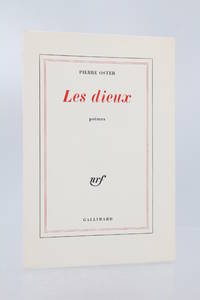
Pierre OSTER
Les dieux
Paris: Gallimard 1970. Fine. Gallimard Paris 1970 14.50 x 21.50 cm broché First edition one of 25 numbered copies on wove paper deluxe copy. Two bookplates pasted on an endpaper. Handsome copy. Gallimard unknown
Referencia librero : 83734
|
|
|
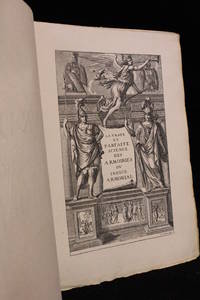
Pierre PALLIOT
La vraye et parfaite science des armoiries ou l'Indice armorial de feu Maistre Louvan Geliot advocat au parlement de Bourgogne
Paris: Edouard Rouveyre 1895. Fine. Edouard Rouveyre Paris 1895 25.50 x 37 cm 2 volumes en feuilles New edition printed on laid paper in facsimile of the 1660 Paris edition. Work illustrated with numerous plates folding tables and in-text figures. Slipcases missing handsome copy. Edouard Rouveyre unknown
Referencia librero : 52250
|
|
|
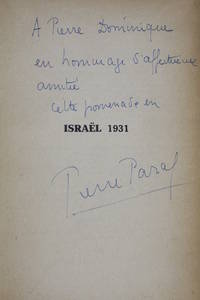
Pierre PARAF
Israël 1931
Paris: Librairie Valois 1931. Fine. Librairie Valois Paris 1931 12 x 19 cm broché First edition an advance service de presse copy. Autograph inscription from Pierre Paraf to Pierre Dominique Librairie Valois unknown
Referencia librero : 56410
|
|
|
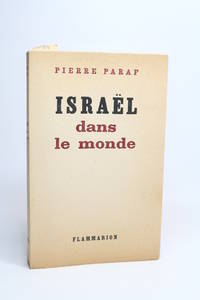
Pierre PARAF
Israël dans le monde
Paris: Flammarion 1947. Fine. Flammarion Paris 1947 12 x 19 cm broché First edition one of 56 numbered copies on alfa paper the only deluxe copies. Foxing to margins of covers and spine a slight tear without loss at foot of rear cover otherwise a handsome copy. Flammarion unknown
Referencia librero : 73495
|
|
|
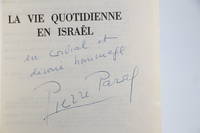
Pierre PARAF
Vies quotidiennes contemporaines en Israël
Paris: Hachette 1971. Fine. Hachette Paris 1971 13 x 20 cm broché The first edition of which there were no deluxe copies. Signed autograph inscription by Pierre Paraf: ""A mes amis Les Etudiants Juifs de France en cordial et dévoué hommage. Pierre Paraf."" ""To my friends the Jewish Students of France with cordial and devoted homage. Pierre Paraf."" Provenance: from the library of the Jewish Students of France with the printed stamp on the verso of the first cover. Hachette unknown
Referencia librero : 77085
|
|
|
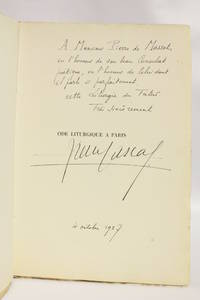
Pierre PASCAL - Maxime REAL DEL SARTE
Ode liturgique à Paris citadelle des justes arche de paix capitale du roy aimé
Paris: Editions du trident 1937. Fine. Editions du trident Paris 1937 19.50 x 28.50 cm broché First edition one of 300 numbered copies on laid ""pur-fil"" paper ours specially numbered and justified by Pierre Pascal for Pierre de Massot. Some small foxing mainly affecting the slices of some leaves nice copy. Illustrated book with a frontispiece by Maxime Real del Sarte engraved by Pierre Pascal. Signed autograph of Pierre Pascal to Pierre de Massot: "". in honor of his beautiful consulate pöetique in whose honor he speaks so perfectly this liturgy of the future."" Editions du trident unknown
Referencia librero : 62175
|
|
|
Pierre PASCAL - Maxime REAL DEL SARTE
Odes liturgique à Paris citadelle des justes arche de paix capitale du roy aimé
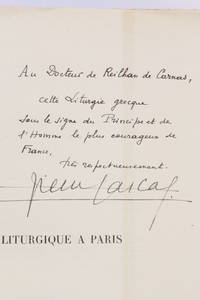
Paris: Editions du trident 1937. Fine. Editions du trident Paris 1937 19.50 x 28.50 cm broché First edition one of 47 numbered copies on laid ""pur-fil"" paper ours one of 12 with the names of the 12 months of the year this copy ""October"" specially numbered and justified by Pierre Pascal for the doctor of Reilhan Carnas. Back slightly insolated partially guarded and slightly shaded. Illustrated book with a frontispiece by Maxime Real del Sarte engraved by Pierre Pascal. Signed autograph of Pierre Pascal to the doctor of Reilhan de Carnas: "". this Greek liturgy under the sign of the Principle and the most courageous man in France."" Editions du trident unknown
Referencia librero : 62174
|
|
|
Pierre PERRET - LOUP
Les grandes pointures de l'histoire
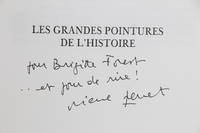
Paris: Plon 1993. Fine. Plon Paris 1993 15.50 x 24.50 cm reliure de l'éditeur First edition of which there were no deluxe copies. Handsome copy. Publisher's full white paper boards smooth spine illustrated front cover. Work illustrated with humorous drawings by Loup. Signed and inscribed by Pierre Perret to Brigitte Forest. Plon hardcover
Referencia librero : 82392
|
|
|
Pierre PETIT
Photographie d'Alexandre Dumas
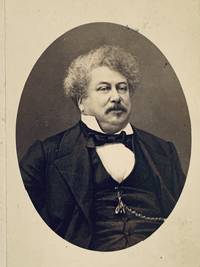
Paris 1860. Fine. Paris 1860 6.10 x 10.50 cm une photographie Original albumen photograph mounted on card by Pierre Petit showing Alexandre Dumas in medallion format mustachioed at about 60 years of age. Deep blacks and fine contrast. Photograph mounted on heavy paper. Very fine condition. On verso the author's name in manuscript and a stamp: Paris. Besançon. Pierre Petit. Photographe. 31 Place Cadet. Paris. It was in 1858 that Pierre Petit established his photographic studio at Place Cadet and the following year he began his gallery of famous men of the era. The portrait of Alexandre Dumas certainly forms part of this series. unknown
Referencia librero : 71702
|
|
|
Pierre PEUCHMAURD
L'embellie roturière
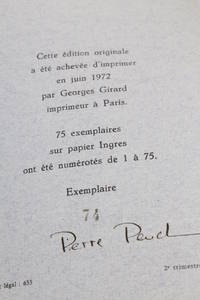
Paris: Editions Maintenant 1972. Fine. Editions Maintenant Paris 1972 10.50 x 15 cm en feuilles First edition one of 75 numbered copies on Ingres only leading copies. Nice and rare copy. Handwritten signature of Pierre Peuchmaurd to the colophon. . Editions Maintenant unknown
Referencia librero : 61991
|
|
|
Pierre PEUCHMAURD
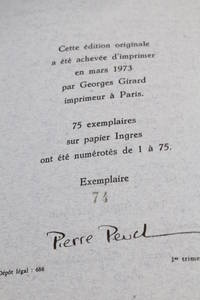
L'entretien des haies
Paris: Editions Maintenant 1973. Fine. Editions Maintenant Paris 1973 10.50 x 15 cm en feuilles First edition one of 75 numbered copies on Ingres only leading copies. Nice and rare copy. Handwritten signature of Pierre Peuchmaurd to the colophon. . Editions Maintenant unknown
Referencia librero : 61990
|
|
|
Pierre PIC
Les heures libres : gaillardises et curiosités historiques des temps passés
Paris: G. Steinheil 1908. Fine. G. Steinheil Paris 1908 13 x 19 cm broché First edition. Work illustrated with 80 reproductions of antique portraits. Covers lightly soiled handsome interior condition. G. Steinheil unknown
Referencia librero : 15465
|
|
|
Pierre PONTRAMIER - Claude AVELINE - Jules Leon PERRICHON
J.-L. Perrichon
Paris: Henry Babou 1933. Fine. Henry Babou Paris 1933 20.50 x 26.50 cm en feuilles First edition one of 750 numbered copies on white laid paper the only deluxe copies after 50 Japan and 50 hors commerce. Work decorated with a self-portrait of the artist as well as illustrations hors-texte letter-preface by Claude Aveline. Endpapers lightly shadowed. Henry Babou unknown
Referencia librero : 58330

|
|
|
Pierre PORTAIL
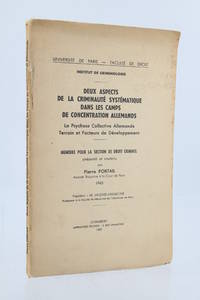
Deux aspects de la criminalité systématique dans les camps de concentration allemands : La psychose collective allemande - Terrain et facteurs de développement
Chambéry: Imprimeries réuniesUniversité de Paris - Faculté de Droit 1947. Fine. Imprimeries réunies Université de Paris - Faculté de Droit Chambéry 1947 14 x 22.50 cm broché First edition of this thesis defended by Pierre Portail. Two small repaired tears on the lightly sunned spine. Rare. Moving and precious autograph inscription signed by Pierre Portail to Frédéric-Henry Manhès known as Colonel Manhès who was Jean Moulin's deputy then arrested by the French police and deported to Buchenwald: ""Au colonel Manhès Président de la F.N.D.I.P."" ""To Colonel Manhès President of the F.N.D.I.P."" avec mes sentiments respectueux. P. Portail. Février 1948."" ""with my respectful sentiments. P. Portail. February 1948."" After the war Colonel Manhès was president of the National Federation of Deported and Interned Resistance Fighters and Patriots F.N.D.I.P. Imprimeries réuniesUniversité de Paris - Faculté de Droit unknown
Referencia librero : 82154
|
|
|
Pierre PUTTEMANS
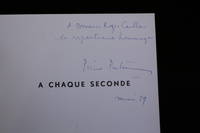
A chaque seconde
s. l.: S. n. 1959. Fine. S. n. s. l. s. d. 1959 17 x 13 cm broché First edition one of 300 numbered copies the only issue with 10 deluxe copies. Precious dated autograph inscription signed by Pierre Puttemans to Roger Caillois "". en respectueux hommage."" Covers slightly and marginally sunned handsome interior condition. S. n. unknown
Referencia librero : 46384
|
|
|
Pierre PUVIS DE CHAVANNES
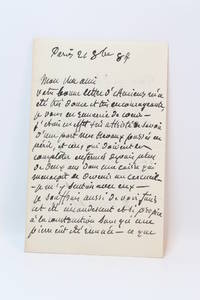
"dans une caisse qui menaçait de devenir un cercueil"" Autograph letter signed on his paintings
Paris 1884. Fine. Paris 21 octobre 1884 11.40 x 17.80 cm une feuille Moving autograph letter signed by the painter Pierre Puvis de Chavannes two pages on a folded leaf lamenting the fate of his paintings stored at the Amiens Museum while awaiting exhibition. The painter addresses a recipient probably connected with the Musée de Picardie in Amiens who had given him news of his works kept in the museum still undergoing expansion: ""J'étais en effet très attristé de savoir d'une part mes tableaux en péril et ceux qui doivent les compléter enfermés depuis plus de deux ans dans une caisse qui menaçait de devenir un cerceuil - je m'y sentais avec eux - je souffrais aussi de voir fuir cet été incandescent et si propice à la construction sans qu'une pierre eût été posée ce que vous dites me rassure pour l'avenir."" He also mentions his friend Charles Borély the first curator of the Musée de Picardie who did not live to see the museum completed: ""Puisse Dieu me porter vie et me permettre de voir s'achever ce monument - mon pauvre ami Borély si dévoué à son musée n'aura pas eu cette joie"". unknown
Referencia librero : 71462
|
|
|
Pierre PUVIS DE CHAVANNES - Armand DAYOT
"L'espérance"" - Lithographie originale sur Japon - L'Estampe Moderne
Paris: Imprimerie Champenoispour CH. MassonH. Piazza 1898. Fine. Imprimerie Champenois pour CH. Masson H. Piazza Paris Avril 1898 20.30 x 27 cm une feuille et une serpente Rare original lithograph in crayon manner executed by Pierre Puvis de Chavannes for LEstampe Moderne dated 1 August 1869 from series no. 12 issued in April 1898. One of 50 deluxe proofs printed on japon paper with wide margins on vellum laid down on japon paper signed and dated in the plate with the publishers blindstamp of a childs profile in the lower margin and numbered stamp of the deluxe issue on verso. A faint dark stain to one corner with slight offsetting of the preceding plate. Preceded by a tissue guard bearing the artists name title an excerpt of text and a short presentation of the engraving; with an additional blank tissue guard. Lithograph inspired by an excerpt from Armand Dayot reproduced on the tissue guard of the print. Magnificent French monthly publication issued between May 1897 and April 1899 LEstampe Moderne consists of original chromolithographs which unlike other journals such as Les Maîtres de lAffiche and as stated on the tissue guards were created expressly for the magazine by each artist. A total of 100 prints were issued reflecting the major artistic movements of the late 19th century: Symbolism Art Nouveau the Pre-Raphaelites Orientalism and the Belle Époque. Each instalment of four prints was published in 2000 copies priced at 3.50 francs with 100 on japon paper offered at 10 francs. Henri Piazza also planned an extremely limited de luxe printing: 50 copies on large-margined japon and 50 in black on china paper at the considerable price of 30 francs. This large-format plate is superbly printed on the most prestigious of papers: japon. Thick silky satiny and pearly it makes each sheet a work in its own right. Its ink absorption and affinity with colour also make it the ideal support for these magnificent lithographs. French collectors enthusiasm for artistic posters increased in the early 1890s. Octave Uzanne to describe this fervour coined the term affichomanie. The poster originally popular and pasted in the streets of Paris was elevated to the status of art object its ephemeral medium transformed into something precious and destined for preservation. Piazzas ambition was to detach the poster from its advertising function and raise it to the rank of an art form in its own right on a par with the luxury illustrated book. He thus composed a prestigious collection of entirely original works by the most celebrated European artists of the day: Georges de Feure Eugène Grasset Henri Detouche Émile Berchmans Louis Rhead Gaston de Latenay Lucien Lévy-Dhurmer Gustave-Max Stevens Charles Doudelet Hans Christiansen Henri Fantin-Latour Steinlen Ibels Engels Willette Henri Meunier Evenepoël Bellery-Desfontaines Charles Léandre and others. A fine example in the artists Symbolist manner. Imprimerie Champenoispour CH. MassonH. Piazza hardcover
Referencia librero : 74379
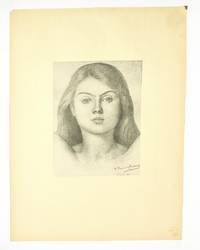
|
|
|
Pierre PUVIS DE CHAVANNES - (Armand DAYOT)
"L'espérance"" - Lithographie originale sur Chine - L'Estampe Moderne
Paris: Imprimerie Champenoispour CH. MassonH. Piazza 1898. Fine. Imprimerie Champenois pour CH. Masson H. Piazza Paris Avril 1898 20.30 x 27 cm une feuille Rare original lithograph executed by Pierre Puvis de Chavannes for L'Estampe Moderne series number 12 published in April 1898. One of 50 deluxe proofs printed on China paper with wide margins artist's signature in the plate publisher's dry stamp representing a child's profile in lower margin mounted on a sheet of laid paper with numbered stamp of the deluxe edition on verso pale marginal foxing small dark dampstain in corner light trace of the stamp from the previous engraving on recto. Lithograph inspired by an extract from Jeux du cirque written by Hugues Le Roux. Magnificent French monthly publication edited between May 1897 and April 1899 L'Estampe moderne consists of original chromolithographs which unlike other periodicals such as Les Maîtres de l'Affiche and as stipulated on the tissue guards were created specially by each artist for the magazine. Thus 100 prints appeared in total covering the major artistic movements of the late 19th century: Symbolism Art Nouveau Pre-Raphaelites Orientalists and Belle Époque. Each issue of four prints was published in 2000 copies sold at 3.50F and 100 on Japan paper offered at 10F. Henri Piazza also planned a very confidential deluxe printing: 50 copies on Japan paper with wide margins and 50 in black on China paper at the considerable price of 30F. This print in a handsome format is superbly printed on one of the most prestigious papers: China. ""Despite all its qualities China paper too inconsistent owes its reputation not to its own beauty but to its particular affinities with printing ink. Its texture smooth and soft at the same time is more apt than any other to receive a fine printing. This property makes China paper sought after for printing engravings."" Anatole France. French collectors' interest in artistic posters intensified in the early 1890s. Octave Uzanne to describe this fever invented the term ""affichomanie."" The poster originally popular and pasted in the streets of the capital then became an art object and its ephemeral support became precious and destined for preservation. Piazza decided to remove the poster from its advertising purpose and elevate it to the rank of a complete work of art on the same level as the illustrated deluxe book. He thus composed a prestigious collection of entirely original works by the most prominent European artists of the moment: Georges de Feure Eugène Grasset Henri Detouche Emile Berchmans Louis Rhead Gaston de Latenay Lucien Lévy-Dhurmer Gustave-Max Stevens Charles Doudelet Hans Christiansen Henri Fantin-Latour Steinlen Ibels Engels Willette Henri Meunier Evenepoël Bellery-Desfontaines Charles Léandre etc. Handsome copy in the artist's symbolist style. Imprimerie Champenoispour CH. MassonH. Piazza unknown
Referencia librero : 74380
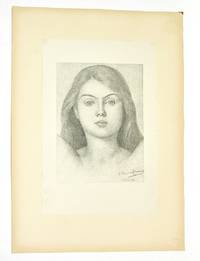
|
|
|
Pierre PUVIS DE CHAVANNES
Autograph letter signed to engraver Emile Boilvin
Paris 1895. Fine. Paris 16 mars 1895 11.10 x 14 cm une feuille Autograph letter card signed by the painter Pierre Puvis de Chavannes to the engraver Emile Boilvin. The painter addresses a resigning member of the Société nationale des beaux-arts which Puvis de Chavannes had founded and was in charge of the Salon du Champ de Mars a dissident event from the official Salon des artistes français: ""Cher Monsieur Boilvin c'est avec le plus vif regret que je vous vois vous séparer d'une société où vous ne comptiez que des admirateurs et des amis. Qu'il soit fait selon votre désir mais encore une fois votre démission nous cause à tous un réel chagrin. Cordialement P. Puvis de Chavannes"" ""Dear Mr. Boilvin it is with the deepest regret that I see you parting from a society where you had only admirers and friends. Let it be as you wish but once again your resignation causes us all genuine sorrow. Sincerely P. Puvis de Chavannes"" unknown
Referencia librero : 71463
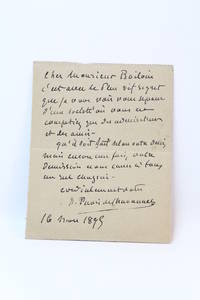
|
|
|
Pierre PUVIS DE CHAVANNES
Carte autographe signée
Paris 1883. Fine. Paris 23 avril 1883 11.70 x 8.90 cm une carte autographe Autograph card signed by Pierre Puvis de Chavannes addressed to an unknown recipient written in black ink with the painter's monogram and address at the head. Some minor soiling and traces of glue on the verso. One perforation on the monogram. ""Madame j'accepte avec infiniment de reconnaissance et de plaisir votre si aimable invitation pour mercredi et vous prie d'agréer l'hommage de mes sentiments respectueux et dévoués."" ""Madam I accept with infinite gratitude and pleasure your kind invitation for Wednesday and beg you to accept the tribute of my respectful and devoted sentiments."" unknown
Referencia librero : 78143
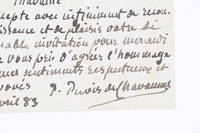
|
|
|
Pierre PUVIS DE CHAVANNES
Empathique lettre autographe signée adressée à un ami affecté par une pénible nouvelle
Paris 1895. Fine. Paris s. d. ca 1895 11.50 x 18 cm une feuille Autograph letter signed by the painter Pierre Puvis de Chavannes 12 lines in black ink. The painter sympathizes with his friend's sadness overwhelmed by an unfortunate event: "". je vous plains de tout mon coeur car j'ai toujours entendu dire que ces heures là étaient très douloureuses."" I feel for you with all my heart as I have always heard that such times are very painful even though he hopes to meet him soon: "". c'est entendu pour samedi au lieu de vendredi - prévenez Durand."" it is agreed for Saturday instead of Friday - let Durand know unknown
Referencia librero : 86541
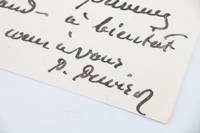
|
|
|
Pierre PUVIS DE CHAVANNES - Leon DUVAUCHEL
Le tourbier moeurs picardes
Paris: Albert Savine 1889. Fine. Albert Savine Paris 1889 11 x 18 cm relié First edition. Half cloth contemporary binding signed by Cabry. Illustrated with a drawing by Pierre Puvis de Chavannes as frontispiece. Occasional foxing. Rare. Albert Savine hardcover
Referencia librero : 45604
|
|

 Recibir por correo electrónico
 Descargar en documento PDF
 Flujo RSS
 Link permanente


