|
Victor LENEPVEU - (Louis LEPINE)
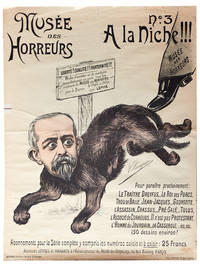
Musée des horreurs - Affiche originale lithographiée en couleurs - n°3 ""A la niche !"" true Museum of Horrors - Original Color Lithograph Poster - No. 3 'To the Doghouse!'
Paris: Imprimerie Lenepveu 1899. Fine. Imprimerie Lenepveu Paris s. d. octobre 1899 49.80 x 65.20 cm une affiche Original lithographed color poster representing Louis Lépine as a dog. Behind him is drawn an imposing sign on which is indicated: ""Liberté ! Egalité ! Fraternité !!! Ordre d'arrêter et de conduire immédiatement au poste tous les vendeurs du Musée des horreurs"" ""Liberty! Equality! Fraternity!!! Order to arrest and immediately conduct to the station all sellers of the Musée des horreurs"" in reference to the arrests of street vendors selling the publication. Transverse folds one tear without loss to left margin partially filled by a paper stamp. Distributed between October 1899 and December 1900 in a France inflamed by the Dreyfus Affair these immense colored satirical portraits are the work of Victor Lenepveu who announced the publication of 150 then 200 drawings and finally produced only about fifty. Despite the press freedom law of 1881 allowing the distribution of politically subversive imagery the publication of this nightmarish pantheon was interrupted by order of the Ministry of the Interior. The fragility of the paper and the imposing format of these very violent posters as well as their almost immediate seizure by the police contributed to the disappearance of these caricatures which nevertheless strongly marked public opinion. On October 1st 1899 L'Intransigeant announced the publication of the Musée des horreurs in its columns: « Un dessinateur de beaucoup d'esprit au coup de crayon d'un comique intense M. V. Lenepveu a eu l'heureuse idée d'inaugurer une série de portraits des vendus les plus célèbres de la tourbe dreyfusarde. Le titre de cette série « Musée des Horreurs » est suffisamment suggestif et indique bien ce qu'il promet. . C'est la maison Hayard qui mettra en vente à partir d'aujourd'hui le numéro 1 de cette désopilante série. » ""A very witty draftsman with an intensely comic pencil stroke M. V. Lenepveu has had the happy idea of inaugurating a series of portraits of the most famous sellouts of the Dreyfusard mob. The title of this series 'Musée des Horreurs' is sufficiently suggestive and clearly indicates what it promises. . It is the Hayard house that will put on sale starting today number 1 of this hilarious series."" First a street vendor then bookseller-publisher Napoléon Hayard known as Léon Hayard specialized in the commercialization of anti-Dreyfusard and antisemitic ephemera and broadsides. These horreurs benefited from wide promotion by antisemitic newspapers which announced a fantasized print run of 300000 copies thus insinuating the success of antisemitic ideas in the population. However only very rare copies in fine condition of these pamphlet caricatures that participated in the social and political fracture of France survive today. Published at the height of the written press boom - at the same time as Emile Zola's famous ""J'accuse !"" - these propaganda documents notably had a significant impact on young generations and prefigured the ideological violence of the 20th century. Imprimerie Lenepveu unknown
Referentie van de boekhandelaar : 80328
|
|
|
Victor LEROQUAIS
Un livre d'heures manuscrit à l'usage de Mâcon collection Siraudin
Mâcon: Annales de l'Académie de Mâcon 1935. Fine. Annales de l'Académie de Mâcon Mâcon 1935 16.50 x 24.50 cm broché First edition published in a small number of copies of this offprint. On the spine the title of the work has been circled with a ballpoint pen a lack on the half-title page where there was presumably an autograph inscription from the author. Iconography at the end. Annales de l'Académie de Mâcon unknown
Referentie van de boekhandelaar : 11165

|
|
|
Victor LHUER
Costumes parisiens. Robe de linon à double tunique de tulle brodé. Petite casaque à revers de satin pl.102 Journal des Dames et des Modes 1913 n°45
Paris: S. n. 1913. Fine. S. n. Paris 1913 14 x 22.50 cm une feuille original print in color printed on laid paper signed lower right of the board. One of the first French fashion magazines published a few days before the famous Gazette fashionable and bringing together the greatest French artists of the Art Deco movement. The Journal ladies and modes is a trimensuelle illustrated French fashion magazine created in 1797. Its publication was stopped in 1839 before being taken in June 1912 under the leadership of Tommaso Antongini secretary friend and biographer of Gabriele 'Annunzio. It will disappear in August 1914 on the eve of the First World War. The review was drawn to 1279 copies making it for the time a relatively confidential publication. The 186 plates with great finesse are engraved on strong paper and colored stencil. They represent the majority of the time women but also men and children. The models are not unlike those of the Gazette fashionable whose publication will be launched a few months later those renowned couturiers but are the fruit of the imagination of the illustrators themselves. The stencils are mostly executed by George Barbier but other artists collaborating on the magazine: Léon Bakst B. Berty Bernard Boutet de Monvel Roger Broders Jan van Brock Umberto Brunelleschi H. Robert Dammy Etienne Drian Abel Faivre Marie-Madeleine Franc-Nohain Xavier Gosé Paul Iribe Kriegck Victor Lhuer Pierre Legrain Charles Martin Fernand Simeon Ismael Smith Armand Vallee and Gerda Wegener. Many of these illustrators will also be involved in The Gazette fashionable. Their work emblematic of the Art Deco movement emphasize the influence of Orientalism and costumes of the Ballets Russes while registering in the daily activities of affluent French of the time. From the preface of the first issue of 1912 Anatole France said: ""After seventy-five years he is reborn. He is reborn through the efforts of a few ingenious minds and artists. He is reborn for the curious if there is that do not simply modes newspaper fired several thousand and illustrated by photography. And if publishers make us very exactly in its format with its paper printing its processes of etching and coloring the old classic patterns of the past is that they intend to continue the pleasantly and become charming classic fashion of today and tomorrow. "" S. n. unknown
Referentie van de boekhandelaar : 57659

|
|
|
Victor LHUER
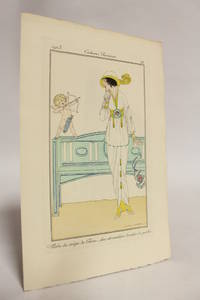
Costumes parisiens. Robe de crêpe de Chine. Sac et ceinture brodés de perles pl.79 Journal des Dames et des Modes 1913 n°36
Paris: S. n. 1913. Fine. S. n. Paris 1913 14 x 22.50 cm une feuille original print in color printed on laid paper signed lower right of the board. One of the first French fashion magazines published a few days before the famous Gazette fashionable and bringing together the greatest French artists of the Art Deco movement. The Journal ladies and modes is a trimensuelle illustrated French fashion magazine created in 1797. Its publication was stopped in 1839 before being taken in June 1912 under the leadership of Tommaso Antongini secretary friend and biographer of Gabriele 'Annunzio. It will disappear in August 1914 on the eve of the First World War. The review was drawn to 1279 copies making it for the time a relatively confidential publication. The 186 plates with great finesse are engraved on strong paper and colored stencil. They represent the majority of the time women but also men and children. The models are not unlike those of the Gazette fashionable whose publication will be launched a few months later those renowned couturiers but are the fruit of the imagination of the illustrators themselves. The stencils are mostly executed by George Barbier but other artists collaborating on the magazine: Léon Bakst B. Berty Bernard Boutet de Monvel Roger Broders Jan van Brock Umberto Brunelleschi H. Robert Dammy Etienne Drian Abel Faivre Marie-Madeleine Franc-Nohain Xavier Gosé Paul Iribe Kriegck Victor Lhuer Pierre Legrain Charles Martin Fernand Simeon Ismael Smith Armand Vallee and Gerda Wegener. Many of these illustrators will also be involved in The Gazette fashionable. Their work emblematic of the Art Deco movement emphasize the influence of Orientalism and costumes of the Ballets Russes while registering in the daily activities of affluent French of the time. From the preface of the first issue of 1912 Anatole France said: ""After seventy-five years he is reborn. He is reborn through the efforts of a few ingenious minds and artists. He is reborn for the curious if there is that do not simply modes newspaper fired several thousand and illustrated by photography. And if publishers make us very exactly in its format with its paper printing its processes of etching and coloring the old classic patterns of the past is that they intend to continue the pleasantly and become charming classic fashion of today and tomorrow. "" S. n. unknown
Referentie van de boekhandelaar : 57651
|
|
|
Victor MABILLE
Les cigarettes poésies
Paris: Garnier frères 1853. Fine. Garnier frères Paris 1853 10 x 16.50 cm relié First edition. Half bottle-green sheep binding faded spine with four raised bands decorated with gilt floral motifs a light scratch with a small paper loss to the front board contemporary binding. Scattered foxing. Garnier frères hardcover
Referentie van de boekhandelaar : 19125

|
|
|
Victor MARGUERITTE
Brins de lilas
Paris: Paul Schmidt 1883. Fine. Paul Schmidt Paris 1883 14 x 20.50 cm broché First edition printed in only 59 copies ours one of 10 on Holland paper the deluxe copies after 9 Japan. Handsome and rare copy despite two shadows on the endpapers. Paul Schmidt unknown
Referentie van de boekhandelaar : 5031

|
|
|
Victor MARGUERITTE
Visions de guerre. Coulommiers Soisson Senlis. Extrait de la Revue des Deux Mondes
s. l. Paris: Extrait de La Revue des deux mondes 1914. Fine. Extrait de La Revue des deux mondes s. l. Paris 1914 15.50 x 25 cm agrafé First edition. Plain paper cover. Rare. Extrait de La Revue des deux mondes unknown
Referentie van de boekhandelaar : 19742

|
|
|
Victor MAURICE-VERNE - Robert HAARDT
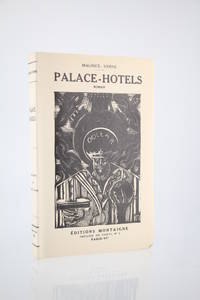
Palace-Hôtels
Paris: Editions Montaigne 1882. Fine. Editions Montaigne Paris 1882 12 x 19 cm broché First edition one of 150 numbered copies on pure laid paper deluxe issue. Work illustrated with original woodcuts by Robert Haardt including the cover. Fine copy. Editions Montaigne unknown
Referentie van de boekhandelaar : 76751
|
|
|
Victor MERIC
Les milieux anarchistes. Les bandits tragiques
Paris: Simon Kra 1926. Fine. Simon Kra Paris 1926 12 x 19 cm broché The first edition of which there were no deluxe copies. Handsome copy. Beautiful illustrated cover. Simon Kra unknown
Referentie van de boekhandelaar : 74402

|
|
|
Victor MEUSY - Eugene RAPP
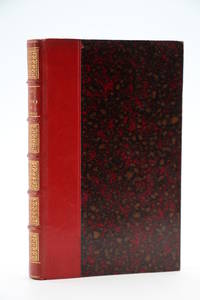
Chansons d'Hier & d'Aujourd'hui. Répertoire du Chat Noir. - Ière Série
Paris: J.B. Ferreyrol 1891. Fine. J.B. Ferreyrol Paris 1891 11.50 x 18.50 cm relié New edition one of 25 numbered copies on Japan paper justified by the publisher the only deluxe copies. Half red shagreen binding spine with five raised bands set with gilt dots and decorated with double gilt compartments enhanced with gilt wavy fillets marbled paper boards pebbled paper endpapers and pastedowns illustrated covers preserved red top edge contemporary binding. Work illustrated by Eugène Rapp music by Paul Delmet. Preface by Coquelin-Cadet. Handsome copy pleasantly bound. J.B. Ferreyrol hardcover
Referentie van de boekhandelaar : 77833
|
|
|
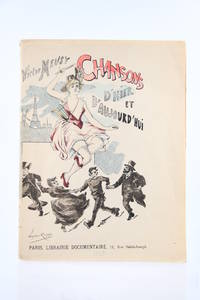
Victor MEUSY - Eugene RAPP
Chansons d'Hier & d'Aujourd'hui.
Paris: Librairie documentaire 1889. Fine. Librairie documentaire Paris 1889 17 x 23 cm broché First edition. Beautiful illustrated cover by Eugène Rapp. Work adorned with illustrations by Rapp Joanon-Mairer. Preface by Coquelin-Cadet. Some foxing on the first endpaper endpapers partially darkened otherwise handsome copy. Librairie documentaire unknown
Referentie van de boekhandelaar : 77998
|
|
|
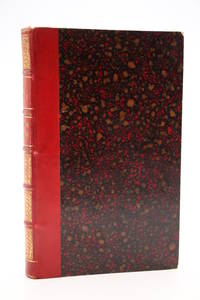
Victor MEUSY - Fernand FAU
Chansons modernes. Répertoire du Chat Noir. - IIème Série
Paris: J.B. Ferreyrol 1891. Fine. J.B. Ferreyrol Paris 1891 11 x 18 cm relié New edition one of 25 numbered copies on Japan paper justified by the publisher the only deluxe copies. Half red shagreen binding spine with five fine raised bands set with gilt dots and decorated with double gilt compartments enhanced with gilt wavy fillets marbled paper boards pebbled paper endpapers and pastedowns illustrated covers preserved contemporary binding. Work illustrated by Fernand Fau. Handsome copy pleasantly bound. J.B. Ferreyrol hardcover
Referentie van de boekhandelaar : 77834
|
|
|
Victor NEKRASSOV
Carnets d'un badaud
Paris: Julliard 1976. Fine. Julliard Paris 1976 13.50 x 20.50 cm broché First edition in French of which there were no deluxe copies. Rare autograph inscription signed by Victor Nekrassov in Russian to Nathalie Sarraute with the translator's signature. Handsome copy. Julliard unknown
Referentie van de boekhandelaar : 39864

|
|
|
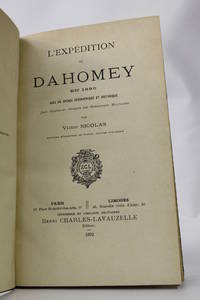
Victor NICOLAS
L'expédition du Dahomey en 1890 avec un aperçu géographique et historique
Paris & Limoges: Henri Charles-Lavauzelle 1892. Fine. Henri Charles-Lavauzelle Paris & Limoges 1892 13.50 x 22 cm relié First edition. Half dark green sheep binding smooth discolored spine decorated with double gilt fillets traces of rubbing to one joint marbled paper boards speckled edges contemporary binding. Work illustrated with seven maps or sketches of military operations. Some minor foxing of no consequence. Henri Charles-Lavauzelle hardcover
Referentie van de boekhandelaar : 53590
|
|
|
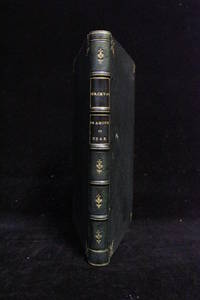
Victor PERCEVAL
Un amour de Czar
Paris: Alexandre Cadot 1866. Fine. Alexandre Cadot Paris s. d. 1866 11.50 x 17.50 cm relié First edition. Half black shagreen binding spine with five raised bands set with gilt dots decorated with gilt fleurons one joint very slightly cracked at foot boards decorated at corners with gilt floral motifs a small trace of white wax on first cover gilt roulettes on headcaps frame of double gilt fillet on pastedowns marbled endpapers and pastedowns. Some light foxing. Rare. Alexandre Cadot hardcover
Referentie van de boekhandelaar : 49014
|
|
|
Victor RAULIN
Sur l'âge des formations d'eau douce de la portion de l'Aquitaine située à l'est de la Garonne
Bordeaux: In recueil des actes de l'académie impériale de Bordeaux 1860. Fine. In recueil des actes de l'académie impériale de Bordeaux Bordeaux s. d. circa 1860 13.50 x 20.50 cm broché First edition printed in a small number of copies of this offprint. Brochure presented in plain temporary wrappers slight lacks at head and foot of the unlettered spine author's name written in ink on the front cover small corner lacks to covers copy almost free of foxing. In recueil des actes de l'académie impériale de Bordeaux unknown
Referentie van de boekhandelaar : 23749

|
|
|
Victor RENDU
Les animaux de la France
Paris: Hachette & Cie 1875. Fine. Hachette & Cie Paris 1875 15.50 x 24 cm reliure de l'éditeur Edition illustrated with 258 engravings in text and full-page. Half red shagreen binding spine with five thin raised bands decorated with triple gilt compartments embellished with gilt floral and typographical motifs slight rubbing traces on joints triple blind-ruled frames on red paper boards cream watered silk endpapers and pastedowns all edges gilt. Some foxing printed library stamp on one endpaper. Hachette & Cie hardcover
Referentie van de boekhandelaar : 35993

|
|
|
Victor RENDU
Rapport fait par M. Rendu le 16 Mars 1836 au nom de la commission chargée d'indiquer à la société les moyens les plus efficaces pour la destruction du ver blanc et du hanneton
Paris: Madame Huzard 1836. Fine. Madame Huzard Paris 1836 14.50 x 22.50 cm broché First edition published in a small number of copies. Foxing to covers. Printed stamp serving as bookplate at head of front cover. Rare pamphlet presented in original wrappers as issued. Madame Huzard unknown
Referentie van de boekhandelaar : 38437

|
|
|
Victor SCHOELCHER
Le deux Décembre à Paris
Paris: Bibliothèque Démocratique 1874. Fine. Bibliothèque Démocratique Paris 1874 9.50 x 14 cm broché First edition of which there were no deluxe copies. Some foxing affecting the covers and first leaves. Very rare. Bibliothèque Démocratique unknown
Referentie van de boekhandelaar : 3889

|
|
|
Victor SCHOELCHER
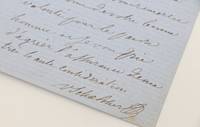
Lettre autographe signée à Alfred Boucher-Cadart
1879. Fine. 12 mars 1879 10.20 x 13.30 cm une page sur un bifeuillet et une enveloppe Autograph letter signed by Victor Schoelcher one page written in black ink on a bifolium of blue paper bearing the monogram and address of the politician addressed to minister Alfred Boucher-Cadart director of the general security service at the Ministry of the Interior. The envelope containing this letter has been pasted onto the second leaf. Central fold inherent to the mailing. ""There is nothing more to be done for the worker Cauchare. He was forced to serve his 10 days in prison while the Ministry of Justice was changing his sentence. I nonetheless thank you for your goodwill toward the poor man and I ask you to accept the assurance of my highest consideration."" unknown
Referentie van de boekhandelaar : 84164
|
|
|
Victor SEGALEN
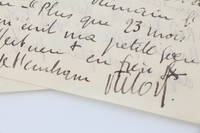
". ma sexualité est infiniment occupée par ma vorace Israélite."" Double signed autograph letter the last sent from San Francisco addressed to Emile Mignard
San Francisco 1903. Fine. San Francisco jeudi 8 et samedi 11 janvier 1903 13 x 20 cm 6 pages sur 3 feuillets Double autograph letter signed by Victor Segalen addressed to Emile Mignard six pages written in black ink on three sheets of white paper. Transverse folds inherent to posting. Traces of white paper tabs. Emile Mignard 1878-1966 also a doctor from Brest was one of Segalen's closest childhood friends whom he met at the Jesuit college Notre-Dame-de-Bon-Secours in Brest. The writer maintained with this comrade an abundant and very regular correspondence in which he described with humor and intimacy his daily life in the four corners of the globe. It was at Mignard's wedding on February 15 1905 that Segalen met his wife Yvonne Hébert. Segalen who departed from Le Havre on October 11 1902 bound for Tahiti saw his journey interrupted by contracting typhoid fever which would ultimately immobilize him for two months in San Francisco. This convalescence which lasted until early January 1903 was an opportunity for Segalen to discover China Town. In this letter the last that the doctor would address to his friend from California it is time for assessment: « Je laisse ici à défaut d'Amis nom que je ne prodigue plus de très bons camarades et de très bienveillants patrons. . Je ne quitte pas sans une pointe de tristesse une ville amusante et trouble et quelques braves gens. Je promets des retours auxquels je ne crois pas et des souvenirs dont plusieurs s'effaceront. » ""I leave here lacking Friends a name I no longer lavish very good comrades and very benevolent bosses. . I do not leave without a hint of sadness an amusing and troubled city and some good people. I promise returns in which I do not believe and memories of which several will fade."" Segalen nevertheless returns to his American conquest already mentioned in his letter from late December: « Je n'omets pas dans le protocole des adieux une séance opératoire soignée sur mon sujet Miss Rachel qui m'est restée bien amusante pendant mon mois supplémentaire. Quel joli petit animal ! Je me suis donné le malin plaisir de réunir en un même dîner plusieurs compétiteurs de ce très succulent morceau. » ""I do not omit from the farewell protocol a careful operative session on my subject Miss Rachel who remained quite amusing to me during my additional month. What a pretty little animal! I gave myself the mischievous pleasure of bringing together at the same dinner several competitors for this very succulent morsel."" We discover here that he did not limit himself to this single sensual relationship: « Ayant satisfait aux lois de l'esthétique en la personne de ma petite Juive vraiment tentante j'ai trouvé intéressant et bon de m'occuper de son extrême parmi la cohorte des nurses ; une petite béarnaise échouée ici laide sans trop d'une laideur suffisante pour l'isoler la priver de sortie à deux. Je lui donne volontiers de longues heures de causeries et l'illusion brève d'épanchements nouveaux ; sans plus d'ailleurs car ma sexualité est infiniment occupée par ma vorace Israélite. » ""Having satisfied the laws of aesthetics in the person of my little Jewess truly tempting I found it interesting and good to occupy myself with her extreme among the cohort of nurses; a little Béarnaise stranded here ugly but not too much with an ugliness sufficient to isolate her deprive her of going out as a pair. I willingly give her long hours of conversation and the brief illusion of new confidences; nothing more moreover because my sexuality is infinitely occupied by my voracious Israelite."" This is here for Segalen the opportunity to engage in an anthropological account of the American woman: « La « girl » est ici cet être américain qui peut être millionnaire ou employée de téléphone noceuse ou rigide. Pas de catégories tranchées comme en France. Elle est souvent de bonne humeur mange bien boit plus encore et s'enivre carrément. » ""The 'girl' is here this American being who c unknown
Referentie van de boekhandelaar : 80856
|
|
|
Victor SEGALEN
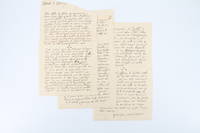
"Complètement affranchi des Tahitiennes j'ai trouvé bien plus intelligent au lieu de m'asservir au sexe faible de m'en servir sans plus de sentimentalité."" Double signed autograph letter addressed to Emile Mignard
Tahiti Tahiti 1903. Fine. Tahiti Tahiti 7 & 9 novembre 1903 12 x 19.80 cm 6 pages sur 3 feuillets Double autograph letter signed by Victor Segalen addressed to Emile Mignard. Six pages written in black ink on three lined sheets. Transverse folds inherent to the mailing angular tear to the first sheet without loss of text some restorations using paper strips. Emile Mignard 1878-1966 also a doctor and native of Brest was one of Segalen's closest childhood friends whom he met at the Jesuit college Notre-Dame-de-Bon-Secours in Brest. The writer maintained an abundant and very regular correspondence with this friend in which he described with humor and intimacy his daily life in all four corners of the globe. It was at Mignard's wedding on February 15 1905 that Segalen met his wife Yvonne Hébert. Fine letter on love conjugated in past present and future tenses. Segalen announces to his friend the marriage of a past acquaintance: « Une se marie qui nous eût été chère mon cher petit. Car c'est d'elle que tu voulais me parler n'est-ce pas : Alice épouse ou épousera un juge de Châteaulin. Pendant ma fièvre à San Francisco m'avait obsédé l'idée qu'elle serait peut-être un jour ma femme ; alors qu'au départ nous étions certes sans une arrière-pensée. » ""One is marrying who would have been dear to us my dear little one. For it is of her that you wanted to speak to me isn't it: Alice marries or will marry a judge from Châteaulin. During my fever in San Francisco I was obsessed with the idea that she might perhaps one day be my wife; whereas at the outset we were certainly without any ulterior motive."" Despite his currently unstable sentimental life he declares solemnly: « J'ai confiance forcément pour nous en l'avenir. Elle viendra cette Désirée que nous attendons tous les deux. Alors nous serons plus forts plus dignes d'Elle. Chaque « mieux » constaté en moi-même je le leur reporte en offrande. » ""I have confidence necessarily for us in the future. She will come this Desired One that we both await. Then we will be stronger more worthy of Her. Each 'better' that I note in myself I offer to them as an offering."" This ""Desired One"" Victor would find in the person of Yvonne Hébert precisely met through Emile Mignard and whom he would marry on June 2 1905. A few weeks after their meeting he would offer her a copy of his thesis inscribed with a very fine autograph inscription that echoes our letter: ""For my beloved fiancée my Yvonne. For the one I have always sought. In gratitude for Her and in certainty of infinite affection. April 5 1905"". But let us return to Tahiti where Dr. Segalen after having lived several quasi-marital relationships has made resolutions: « Complètement affranchi des Tahitiennes j'ai trouvé bien plus intelligent au lieu de m'asservir au sexe faible de m'en servir sans plus de sentimentalité. Je dois avouer que Tahiti ne m'offre à vrai dire aucun type de femme vraiment et totalement désirable. » ""Completely freed from Tahitian women I found it much more intelligent instead of enslaving myself to the weaker sex to use them without further sentimentality. I must admit that Tahiti truly offers me no type of woman really and totally desirable."" He is even indignant at the behavior of newly arrived Europeans: « C'est ainsi d'ailleurs que le comprend mon médecin de division le Dr Michel du Protet le croiseur qui nous gère. Sitôt débarqué il m'a demandé « des femmes ». J'ai pu noter de sang froid et repu moi-même les ruts terribles et comiques d'un état-major qui vient de faire 15 jours de mer. Papeete n'ayant pas de ces Maisons Hospitalières que. ils ont failli violer quantité d' « honnêtes femmes ». Ainsi de même étions-nous sans nous en rendre compte à notre arrivée à Nouméa. » ""This is moreover how my division doctor understands it Dr. Michel from the Protet the cruiser that manages us. As soon as he disembarked he asked me for 'women'. I was able to note coldly and sated mys unknown
Referentie van de boekhandelaar : 79583
|
|
|
Victor SEGALEN
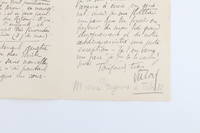
"Elles seraient parfaites ces filles brunes à longs cheveux lisses . si au lieu d'un siège en règle de pourparlers et d'atermoiements elles vous suivaient d'un geste ainsi qu'autrefois elles s'exécutaient."" Double signed autograph letter addressed to Emile Mignard
Tahiti Tahiti 1903. Fine. Tahiti Tahiti 20 & 25 juillet 1903 10 x 15.50 cm 7 pages sur 2 doubles feuillets Autograph letter signed by Victor Segalen addressed to Emile Mignard. Seven pages written in black ink on two double sheets. Transverse folds inherent to mailing. Emile Mignard 1878-1966 also a physician from Brest was one of Segalen's closest childhood friends whom he met at the Jesuit college Notre-Dame-de-Bon-Secours in Brest. The writer maintained an abundant and regular correspondence with this friend in which he described with humor and intimacy his daily life in the four corners of the globe. It was at Mignard's wedding on February 15 1905 that Segalen met his wife Yvonne Hébert. Long letter describing July 14th in Tahiti and the amorous customs of Tahitian women. « Ce n'est pas un 14 Juillet qu'on célèbre aussi ; mais cette mémorable journée dure 8 jours. C'est horriblement Européanisé ; n'importe c'est un prétexte à s'extérioriser et pendant de longues promenades de garden-party à se frôler à des tas de jeunes corps souples légèrement ambrés de par leur hérédité semi-canaque. » ""It's not just a July 14th that we celebrate; but this memorable day lasts 8 days. It's horribly Europeanized; no matter it's a pretext to express oneself and during long walks garden parties to brush against heaps of young bodies supple lightly amber-colored through their semi-Kanaka heredity."" Here we detect the importance of racial purity ideas in Victor Segalen who would extend in Les Immémoriaux and in his novella entitled La Marche du feu his theories concerning miscegenation according to him the final fruit of colonial conquest. He does not however seem to apply to himself the ethnographic principles he develops and expands as is his habit on his sexual adventures with the natives: « Car j'ai quitté pour un temps la Vahiné Tahitienne pur-sang comme beaucoup trop lointaine de notre race. » ""For I have left for a time the pure-blooded Tahitian Vahiné as much too distant from our race."" Since his arrival in Tahiti in January 1903 Segalen had indeed maintained a relationship with a young Tahitian named Mara. Their relationship had come to an end: « Ma première épouse » ""My first wife"" Mara « ayant été expédiée dans son île - et y étant restée - j'ai hospitalisé durant une quinzaine une petite fille perdue noceuse éreintée de spasmes d'alcool et de phtisie prochaine. . Puis je l'ai elle aussi expédiée aux Pomotou où elle avait comme maîtresse de négociant une situation beaucoup plus stable à posséder. » ""having been sent to her island - and having remained there - I gave shelter for a fortnight to a lost little girl dissolute exhausted by spasms alcohol and impending consumption. . Then I too sent her to the Pomotou where she had as a merchant's mistress a much more stable situation to possess."" This passage also proves to be a precious document concerning the sexual customs of Tahitian women: « Je n'ai trouvé qu'une seule fois en rentrant chez elle un canaque couché dans son lit. Je lui en ai fait doucement l'observation : elle m'a répondu que j'avais une demi-heure de retard qu'elle était persuadée que je l'avais moi aussi trompée et tenait à me le rendre immédiatement ; et qu'enfin elle ne s'était pas mise nue pour se donner à lui mais avait gardé sa chemise ce qui est ici une marque de haute décence. Je n'avais donc absolument rien à dire. » ""I found only once upon returning to her place a Kanaka lying in her bed. I gently made the observation to her: she replied that I was half an hour late that she was convinced I had also deceived her and wanted to return it to me immediately; and that finally she had not undressed to give herself to him but had kept her chemise which is here a mark of high decency. I therefore had absolutely nothing to say."" Segalen nevertheless deplores the lack of docility and the emancipation of the local female population made possible by the presence of co unknown
Referentie van de boekhandelaar : 79530
|
|
|
Victor SEGALEN
"Faire comprendre à Mlle D. qu'il me serait extrêmement pénible de répondre à ses lettres qui ne pourraient être que de condoléances.autant celles d'amis comme toi me seraient apaisantes autant des consolations féminines même bien intentionnées je n'en doute pas me seraient insupportables."" Autograph letter dated and signed sent from Brest and addressed to his childhood friend Emile Mignard
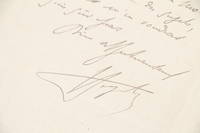
Brest 1899. Fine. Brest 3 Octobre 1899 11 x 17 cm 1 page et demi sur un feuillet double Autograph letter dated and signed by Victor Segalen addressed to Emile Mignard one and a half pages 24 lines written in black ink on a double sheet. Traces of transverse folds inherent to postal delivery. Trace of white paper tab. Emile Mignard 1878-1966 also a doctor from Brest was one of Segalen's closest childhood friends whom he met at the Jesuit college Notre-Dame-de-Bon-Secours in Brest. The writer maintained with this companion an abundant and regular correspondence in which he described with humor and intimacy his daily life in the four corners of the globe. It was at Mignard's wedding on February 15 1905 that Segalen met his wife Yvonne Hébert. It was in 1899 that Victor Segalen's first nervous disorders manifested themselves which would only worsen as he advanced in age. Worried about his already failing health his friends and relatives wanted to hear news of him which sometimes exasperated him: ""Faire comprendre à Mlle D. qu'il me serait extrêmement pénible de répondre à ses lettres qui ne pourraient être que de condoléances.autant celles d'amis comme toi me seraient apaisantes autant des consolations féminines même bien intentionnées je n'en doute pas me seraient insupportables."" Make Miss D. understand that it would be extremely painful for me to respond to her letters which could only be of condolence.while those from friends like you would be soothing to me feminine consolations even well-intentioned I have no doubt would be unbearable to me. Victor Segalen thus declares his profound intimacy with Emile Mignard with whom he had undertaken that same year a cycling tour in Brittany and to whom he confided fully. Fleeing certain relationships he desired to maintain despite his illness his privileged friendship with the latter: "". ne reviendrai qu'après un détour dont je ne prévois pas la durée. Mais j'ai le temps et le désir d'avoir de tes nouvelles."" .will only return after a detour whose duration I cannot foresee. But I have the time and desire to hear from you. Knowing his friend to be understanding and respectful of his reserve the convalescent Victor Segalen did not wish to elaborate further on the illness that was already consuming him: ""Tu sens que je ne puis en écrire plus long n'ayant en ce moment pas le choix des sujets mais tu ne m'en voudras j'en suis sûr pas."" You feel that I cannot write at greater length not having at this moment a choice of subjects but you will not hold it against me I am sure. Autograph letters by Victor Segalen are extremely rare. unknown
Referentie van de boekhandelaar : 85096
|
|
|
Victor SEGALEN
"J'aurais été fort triste de ne plus revoir Tahiti. Le départ de cette île a cela de spécial qu'il est définitif et qu'il n'y a guère pour les sympathies qu'on laisse là-bas derrière soi de valable Au Revoir."" Signed autograph letter addressed to Emile Mignard
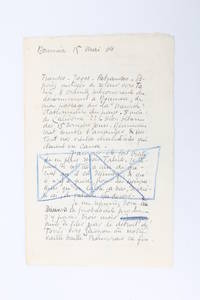
Nouméa 1904. Fine. Nouméa 15 mai 1904 11.50 x 17.80 cm 4 pages sur un double feuillet Autograph letter signed by Victor Segalen addressed to Emile Mignard. Four pages written in black ink and blue colored pencil on a double sheet. Cross fold inherent to the sending. Emile Mignard 1878-1966 also a doctor from Brest was one of Segalen's closest childhood friends whom he met at the Jesuit college of Notre-Dame-de-Bon-Secours in Brest. The writer maintained an abundant and regular correspondence with this friend in which he described with humor and intimacy his daily life in the four corners of the globe. It was at Mignard's wedding on February 15 1905 that Segalen met his wife Yvonne Hébert. Segalen has been in Nouméa a city he abhors since early April 1904. He attended the health council that annually brings together doctors from ships of the French Pacific division to decide on convalescences leaves and transfers. For more than two weeks a mechanical problem has prevented the Durance from leaving Nouméa. It had even been considered as Segalen relates in a letter written to Mignard on May 10 1904 to decommission the aging ship in Saigon without stops in Tahiti. However he has just learned that he will be able to return to his island for a few months before his return to France: ""Anxiety. Joy. Re-anxiety. Mixed hopes of returning to Tahiti and subconscious fear of decommissioning in Nouméa of my transfer to the Meurthe stationed in the country. Eight months in Caledonia!!! My assessment of the last 15 days. Nevertheless everything seems to be working out especially our old boilers which were at issue. I would have been very sad not to see Tahiti again."" For a reason that remains unknown a very beautiful passage concerning Tahiti was crossed out in blue colored pencil: ""I would have been very sad not to see Tahiti again. The departure from this island has this special quality that it is final and that there is hardly for the sympathies one leaves behind there a valid farewell."" This Nouméan exile allows Segalen to continue writing his Immémoriaux which would finally appear in 1907 at Mercure de France under the pseudonym Max-Anély Max in homage to Max Prat and Anély one of his wife's first names Segalen not being authorized in his capacity as a military doctor to sign a fictional work with his own name: ""The crossed-out pages accumulate; I hope to return with 2/3 'composed' . I would like to have submitted the proofs before my next campaign; so as to close at the same time a large piece of intense life to be prepared for new spectacles re-sensitized for new races and new suns."" unknown
Referentie van de boekhandelaar : 79615
|
|
|
Victor SEGALEN
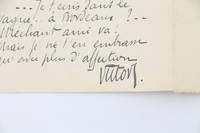
"Je pars dans quelques jours pour Nouméa corvée annuelle."" Signed autograph letter addressed to Emile Mignard
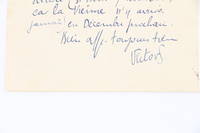
Papeete 1904. Fine. Papeete 1er avril 1904 11.40 x 17.40 cm 4 pages sur un double feuillet Autograph letter signed by Victor Segalen addressed to Emile Mignard. Four pages written in black ink on a double sheet. Transverse fold inherent to the mailing. Emile Mignard 1878-1966 also a doctor from Brest was one of Segalen's closest childhood friends whom he met at the Jesuit college Notre-Dame-de-Bon-Secours in Brest. The writer maintained with this companion an abundant and sustained correspondence in which he described with humor and intimacy his daily life in the four corners of the globe. It was at Mignard's wedding on February 15 1905 that Segalen met his wife Yvonne Hébert. Segalen laments a new voyage to New Caledonia: ""Je pars dans quelques jours pour Nouméa corvée annuelle. Serai de retour dans un mois ½ donc ne rien changer à mon adresse. Comme toujours je quitte à regret Papeete où j'ai une vie tiède active confortable et pécuniairement très avantageuse."" ""I leave in a few days for Nouméa annual chore. Will be back in a month and a half so don't change my address. As always I leave Papeete with regret where I have a comfortable active pleasant life and financially very advantageous."" The health council indeed brought together each year in Nouméa the doctors of the ships of the French Pacific division to decide on convalescences leaves and transfers. Doctor Segalen contemplates through this letter his professional future which will be quite different from his predictions: ""Un projet « possible » entre autres amusant à dessiner dans la fumée : dans 4 ans parler anglais un an de chirurgie à Paris revenir à San Francisco métropole d'avenir qui va doubler en 10 ans le chiffre d'habitants et exercer comme médecin français à diplômes français oiseaux rares là-bas."" ""A possible project among others amusing to sketch in smoke: in 4 years speak English one year of surgery in Paris return to San Francisco metropolis of the future which will double its population in 10 years and practice as a French doctor with French diplomas rare birds over there."" In a nearer future he envisages his return to France: ""Retour de Nouméa vers Juin. Départ probable en Septembre pour Brest et arrivée si nous y arrivons car la Vienne n'y arriva jamais en Décembre prochain."" ""Return from Nouméa around June. Probable departure in September for Brest and arrival if we get there as the Vienne never made it next December."" If the departure will indeed take place on September 1 1904 the Durance will be somewhat delayed and will not reach Toulon until February 1905. unknown
Referentie van de boekhandelaar : 79604
|
|
|
Victor SEGALEN
"Je souhaite la garder longtemps car eu égard aux vahinés des camarades soûlardes tarées phtisiques c'est une excellente acquisition."" Double signed autograph letter addressed to Emile Mignard and embellished with a small drawing representing the horizon of the Pomotou
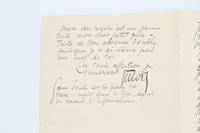
Manga-Reva Mangareva & Tahiti Tahiti 1903. Fine. Manga-Reva Mangareva & Tahiti Tahiti 22 février & 1er mars 1903 11.20 x 17.70 cm 6 pages 1/2 sur 2 doubles feuillets Autograph letter signed by Victor Segalen addressed to Emile Mignard. Six and a half pages written in black ink on two double leaves. Transverse folds inherent to postal transmission. Emile Mignard 1878-1966 also a doctor from Brest was one of Segalen's closest childhood friends whom he met at the Jesuit college Notre-Dame-de-Bon-Secours in Brest. The writer maintained an abundant and very regular correspondence with this comrade in which he described with humor and intimacy his daily life in the four corners of the globe. It was at Mignard's wedding on February 15 1905 that Segalen met his wife Yvonne Hébert. Fine letter relating the discovery of Manga-Reva and Segalen's Polynesian pleasures. Returning from the rescue mission to the Pomotou Islands devastated by a cyclone Segalen discovers new Polynesian lands notably the Gambier archipelago and the island of Manga-Reva: ""Manga-Reva my dear Emile is the capital island of the Gambier group. Finally it's a change after our funereal journey through the devastated Pomotou to see trees that are still standing and intact huts: then for the natives of the Low Islands that we have on board it's astonishing to perceive a mountain undulating horizon lines. Indeed: diagram of the Pomotou:"" a small drawing by Segalen's hand depicting a plain and coconut palms ""Manga-Reva on the contrary raises two peaks of 400 m almost the Menez Hom!"" One of the highest points in Brittany with its 330 meters altitude "" at the base of which we anchored yesterday."" Segalen seems enchanted by the discovery of this new territory ""No colleagues in these paradoxical lands; the indigenous clients are numerous; docile and respectful."" and the resources it abounds in: ""This tiny little place doesn't lack charm. A very temperate climate and fruits in superabundance. Bananas. Mangoes. Oranges. Pineapples. I supply the wardroom with abundant desserts fees from my consultations."" But the young European has become passionate about another Polynesian wealth: ""A new passion: Pearls. In France they seem dead pale. Here one handles them kneads them caresses them with a certain voluptuousness. One knows them like people the beautiful Pearls of the colony. They have their stages their lines of purchasers; their own life too for some die literally. I was fortunate for my beginnings; I bought for 15 Chilean piastres that is 30 f a pretty little one-carat pearl that was estimated to me at Paris rates at least 150 f. It's basically a way of not badly investing one's money. But that one and its future companions I will probably not part with them. It will be very sweet upon return to finally have this mounted at friend Lalique's. Or again to entrust to the Hamms brothers a large opalescent mother-of-pearl to mount in pewter as a fruit bowl."" In the second part of this letter written from Tahiti where he has returned Segalen describes his days after this return to calm: ""Have definitively settled ashore. Until now not yet the colonial lethargy: I'm finishing for the Governor who intends it for Armée et Marine an account of the cyclone and the tour of the Durance."" On April 12 1903 a long article indeed appeared entitled ""Vers les sinistrés - Cyclone des Îles Tuamotou 7 janvier 1903"" ""Towards the disaster victims - Cyclone of the Tuamotou Islands January 7 1903"" and here is an excerpt: ""Thus stay-at-home Europe will learn that the Pomotou islands exist since they have just been devastated; that people live there since one counts in a single one of them nearly four hundred dead; that pearl and mother-of-pearl fishing was fruitful there since the fisheries are silted up ruined for a long time."" ""Ainsi l'Europe casanière apprendra que les îles Pomotou existent puisqu'elles viennent d'être dévastées ; que des gens y habitent puisque l'on com unknown
Referentie van de boekhandelaar : 79461
|
|
|
Victor SEGALEN
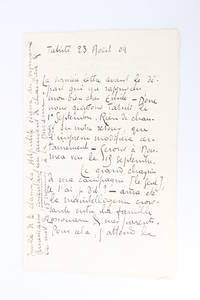
"La dernière lettre avant le départ qui me rapproche mon bien cher Emile. Donc nous quittons Tahiti le 1er Septembre."" Signed autograph letter addressed to Emile Mignard
Tahiti Tahiti 1904. Fine. Tahiti Tahiti 23 août 1904 11.50 x 18.10 cm 4 pages sur un double feuillet Autograph letter signed by Victor Segalen addressed to Emile Mignard. Four pages written in black ink on a double sheet. Transverse fold inherent to mailing. Emile Mignard 1878-1966 also a doctor from Brest was one of Segalen's closest childhood friends whom he met at the Jesuit college Notre-Dame-de-Bon-Secours in Brest. The writer maintained with this companion an abundant and very regular correspondence in which he described with humor and intimacy his daily life in the four corners of the globe. It was at Mignard's wedding on February 15 1905 that Segalen met his wife Yvonne Hébert. Last letter from Tahiti that Segalen sent to his friend: ""La dernière lettre avant le départ qui me rapproche mon bien cher Emile. Donc nous quittons Tahiti le 1er Septembre. Rien de changé en notre retour que l'imprévu modifiera certainement. Serons à Nouméa vers le 13 Septembre."" ""The last letter before departure that brings me closer my dear Emile. So we are leaving Tahiti on September 1st. Nothing changed in our return which the unexpected will certainly modify. We will be in Nouméa around September 13th."" This final letter is an opportunity for Segalen to take stock quite surprisingly sober when one knows with what crudity he revealed his carnal adventures to his friend: ""L'une des choses qui me laisseront ici le plus de regrets sont les « possibilités chirurgicales » quittées. Je m'étais mis en ces temps derniers aux yeux ; et les cataractes indigènes sont matières à cures bénévoles. Cela me fera sourire plus tard d'être quatrième sous-fifre en un hôpital maritime à une ouverture d'abcès."" ""One of the things that will leave me here with the most regrets are the abandoned 'surgical possibilities.' I had recently taken up eye surgery; and indigenous cataracts provide material for charitable treatments. It will make me smile later to be fourth underling in a naval hospital at an abscess opening."" This Nouméan exile allows Segalen to continue writing his Immémoriaux which finally appeared in 1907 at Mercure de France under the pseudonym Max-Anély Max in homage to Max Prat and Anély one of his wife's given names Segalen not being authorized in his capacity as military doctor to sign a fictional work with his patronymic: ""Le scénario de mon livre est bâti. J'aurai à mon retour un mois de travail très dur puis le laisserai mûrir pour reprendre mon Esthétique des Idées-Malades. J'ai besoin de deux ans d'Europe."" ""The scenario of my book is built. I will have on my return a month of very hard work then will let it ripen to resume my Aesthetics of Sick Ideas. I need two years of Europe."" On January 29 1902 Segalen had defended his thesis whose title was Medical observation among naturalist writers and dealt with neuroses in contemporary literature. Under the influence of Gourmont and Fleury he planned to deepen his subject and publish the work mentioned in this letter; this publication would never see the light of day. unknown
Referentie van de boekhandelaar : 79657
|
|
|
Victor SEGALEN
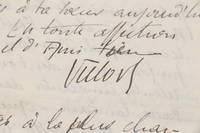
"Ledit sujet est une petite juive de 18 ans métissée de Mexicain avec une pointe d'origine Allemande. Le résultat de ces croisements invraisemblables est purement exquis."" Double signed autograph letter sent from San Francisco addressed to Emile Mignard
San Francisco 1902. Fine. San Francisco dimanche 28 et lundi 29 décembre 1902 13 x 20 cm 8 pages sur 2 feuillets doubles Autograph letter signed by Victor Segalen addressed to Emile Mignard eight pages written in black ink on two double sheets of white paper. Transverse creases inherent to mailing. Trace of white paper tab. A small stain in the lower margin of the last sheet. Emile Mignard 1878-1966 also a doctor from Brest was one of Segalen's closest childhood friends whom he met at the Jesuit college Notre-Dame-de-Bon-Secours in Brest. The writer maintained an abundant and sustained correspondence with this friend in which he described with humor and intimacy his daily life in the four corners of the globe. It was at Mignard's wedding on February 15 1905 that Segalen met his wife Yvonne Hébert. Segalen who left Le Havre on October 11 1902 bound for Tahiti saw his journey interrupted by contracting typhoid fever which ultimately immobilized him for two months in San Francisco. This convalescence which lasted until early January 1903 gave Segalen the opportunity to discover Chinatown. At the time he wrote this long letter to Mignard in which he shared premonitory dreams that mutual friends had about his illness: ""I received 24 hours apart the following two accounts: from Max Prat: dreamed on the night of November 26-27 about me - saw me with my head wrapped in bandages. Nightmare and persistent unpleasant impression. Learned that very day through a card from my family who had received the news on the evening of the 26th of my illness. From Madame Varenne; dreamed obsessively about me from approximately December 1st to 4th. . On the 5th I believe she received notice of my typhoid incident."" Very rationally Segalen concludes: ""All this just for the record because it lacks rigor. The telepathic dreams would have coincided rather with the news of my illness than with the exacerbation of my fever itself."" Now completely recovered from his illness the young doctor continues: ""My Franciscan stay continues to be most 'comfortable' and complete. I ride horses in the Park lift weights and swim at the Olympic club ."" He also indulges in a much more carnal sport and ""performs practical work on the person of an American subject selected before his departure from the hospital among the very appetizing 'nurses'"". Not sparing with details he expands on this new conquest: ""Said subject is a little 18-year-old Jewish girl mixed with Mexican with a touch of German origin. The result of these improbable crossings is purely exquisite. . Average height very supple eyes and hair of an improbable black very affectionate and very spirited. That's all. Nothing underneath and in this heart clothed in such a pretty coat of flesh an absolute void of our most elementary feelings. She's a complete mistress-companion type. Our embraces are necessarily polyglot: she spices our spasms with a Hebrew 'che t'aime' very prettily murmured. And I respond with words of love gleaned in the morning from Tennyson or from my memories. I have her at hand at the desired hours. She smokes enormously adores pure seltzer water ! and contorts herself at my Franco-American jokes and my audacious flights in the language of President Roosevelt."" Autograph letters by Victor Segalen are extremely rare. hardcover
Referentie van de boekhandelaar : 80854
|
|
|
Victor SEGALEN
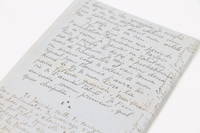
"Manga Reva aux Gambier ce fut la honte de la mission catholique."" Double signed autograph letter addressed to Emile Mignard
Îles Pomotou Îles Pomotou 1904. Fine. Îles Pomotou Îles Pomotou 2 & 21 janvier 1904 11.50 x 15.40 cm 4 pages sur un double feuillet Double autograph letter signed by Victor Segalen addressed to Emile Mignard. Four pages written in black ink on a double sheet. Transverse folds inherent to mailing a tiny tear without loss of text at the fold of the first sheet. Emile Mignard 1878-1966 also a doctor from Brest was one of Segalen's closest childhood friends whom he met at the Jesuit college Notre-Dame-de-Bon-Secours in Brest. The writer maintained with this comrade an abundant and very regular correspondence in which he described with humor and intimacy his daily life in the four corners of the globe. It was at Mignard's wedding on February 15 1905 that Segalen met his wife Yvonne Hébert. Letter written at sea while Dr. Segalen was preparing to undertake a new medical tour of the Pomotou Islands and was returning from the Gambier archipelago: ""We have just spent my dear Emile five days in the Gambiers; a more temperate climate due to the lower latitude and the immutable trade winds. I am on these tours the great independent of the ship cherished by the land-dwellers who need me as there is no doctor and free from the boat my twenty minutes of visits over. Every morning a horse awaits me on land; a strange and sturdy knock-kneed horse short muzzle small and round with a gait unknown in Tahiti and which takes me with incredible courage and sure-footedness through the mountains. Amazed I ask about its ancestry: it is a beast from Easter Island formerly from Chile a true prairie 'mustang.'"" Segalen evokes in this letter the evangelization of the Gambiers in the middle of the 19th century: ""Manga Reva in the Gambiers was the shame of the Catholic mission. And the inquisitorial despotism of the first missionaries Fathers Laval and Caret Picpucians sic left deep marks there. Even now the religious element there is dubious."" The Picpucians were sent by the Vatican to rid the Polynesians of Protestant pastor influence. In Mangareva they established a despotic theocracy whose last flames still burned during Segalen's visit: ""And I had to warned by the resident proceed to remove aboard the Durance under medical cover a nun who was bullied starved exhausted by her superior."" Apart from his medical tours Dr. Segalen continues to devote himself to composing his Immémoriaux: ""I have finished with my Polynesian incubation period. Sometimes I practice thinking in Tahitian. Then I verify the degree of probability on the natives. I am going to have two months of tranquility and will give it a serious push. Upon my departure for Nouméa I will have completed 1/3 of my book the festive warlike truly Maori part of ancient Tahiti. I will send you as a preview a few chapters."" Segalen is also about to send the article requested by Saint-Pol-Roux in his letter of October 15 1903 ""Oh tell us something about this unfortunate of Destiny who was often a great artist and in his way a Master. How is it that you have not sent some account of this death to the Mercure de France which would have welcomed it with enthusiasm."": ""From now until tomorrow not a moment; I am obliged to manage simultaneously: a little article to send to the Mercure on Gauguin my correspondence and an interminable delivery that steals my nights."" An apologetic article entitled ""Gauguin dans son dernier décor"" would indeed appear in June 1904 in the Mercure de France. Segalen describes the painter's last days in his Maison du Jouir. unknown
Referentie van de boekhandelaar : 79600
|
|
|
Victor SEGALEN
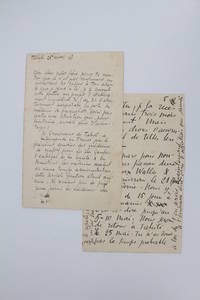
"Mon cher petit frère pour te montrer que ce n'est pas seulement en noircissant du papier à ton adresse que je pense à toi je te soumets entre autres un projet d'établissement immédiat."" Double autograph letter addressed to Emile Mignard
Tahiti Tahiti 1903. Fine. Tahiti Tahiti 25 mars & 5 avril 1903 11.20 x 17.60 cm 6 pages sur un double feuillet et 1 feuillet simple Autograph letter signed by Victor Segalen addressed to Emile Mignard. Six pages written in black ink on a double sheet and a single sheet. Transverse folds inherent to the sending. Emile Mignard 1878-1966 also a doctor from Brest was one of Segalen's closest childhood friends whom he met at the Jesuit college Notre-Dame-de-Bon-Secours in Brest. The writer maintained with this comrade an abundant and very regular correspondence in which he described with humor and intimacy his daily life in the four corners of the globe. It was at Mignard's wedding on February 15 1905 that Segalen met his wife Yvonne Hébert. Moving letter from the young doctor to his ""little brother"" in which he tries to get him to come join him. Segalen has now been in Polynesia for two months. Although he enjoys Tahitian pleasures he misses his best friend and urges him to come join him: ""Mon cher petit frère pour te montrer que ce n'est pas seulement en noircissant du papier à ton adresse que je pense à toi je te soumets entre autres un projet d'établissement immédiat. . Le Gouverneur de Tahiti a demandé en France par le précédent courrier des médecins de renfort pour les îles Gambier l'archipel de la Société et les Pomotous. Ces médecins seraient en même temps administrateurs. . Ils seraient pris de préférence parmi les médecins des colonies ou de la marine mais aussi - avec demande du gouverneur et ce serait le cas pour toi - parmi le civil. Solde : celle d'un médecin des colonies à 2 galons soit 5000 et quelques je crois plus le logement. Engagement 4 ou 5 ans. Aux Pomotous 5 f en plus par jour mais la localité est invraisemblable ! Voyage d'aller et de retour par l'Amérique. Climat des plus sains. Vie oisive béate. Je te la déconseille. Néanmoins ne serait-ce que comme pis-aller j'ai voulu t'indiquer ce débouché. Tu serais sur une lettre du gouverneur à qui j'ai parlé de toi pris haut la main et logé probablement à Raïatea avec balades dans tout l'archipel de la Société. Si par hasard le projet t'intéressait télégraphie-moi un mot à Nouméa ACCEPTE par exemple car je pars pour la Nouvelle Calédonie ."". ""My dear little brother to show you that it's not only by blackening paper addressed to you that I think of you I submit to you among other things a plan for immediate establishment. . The Governor of Tahiti has asked France by the previous mail for reinforcement doctors for the Gambier islands the Society archipelago and the Tuamotus. These doctors would be administrators at the same time. . They would be taken preferably from among colonial or naval doctors but also - with the governor's request and this would be the case for you - from civilians. Pay: that of a colonial doctor with 2 stripes about 5000 and some I believe plus lodging. Contract 4 or 5 years. In the Tuamotus 5 francs more per day but the locality is unbelievable! Round trip via America. Very healthy climate. Idle blissful life. I advise against it. Nevertheless if only as a last resort I wanted to point out this opportunity to you. You would on a letter from the governor to whom I spoke of you be taken with flying colors and probably lodged at Raiatea with trips throughout the Society archipelago. If by chance the project interested you telegraph me a word to Nouméa ACCEPT for example because I'm leaving for New Caledonia ."". To our knowledge Mignard never accepted Segalen's proposition despite their immense friendship: ""Je te répète écris-moi en total abandon. Tu m'as initié à ta notion spéciale de l'amitié. A toi de t'en servir maintenant."" ""I repeat write to me in total abandon. You initiated me into your special notion of friendship. It's up to you to use it now."" A letter from Segalen sent from Nouméa on May 3 1903 informs us of the project's failure: ""Je devais t'avertir mon bien cher E unknown
Referentie van de boekhandelaar : 79472
|
|
|
Victor SEGALEN
"Pendant mes quinze jours de mer je vais avancer ma documentation pour pouvoir dès mon arrivée à Tahiti me mettre à l'ouvrage."" Signed autograph letter addressed to Emile Mignard evoking the Immemorials
Nouméa 1903. Fine. Nouméa 3 & 6 mai 1903 9.20 x 12.20 cm 4 pages sur une carte lettre Autograph letter signed by Victor Segalen addressed to Emile Mignard. Four pages written in black ink on a letter card. Monogram of Victor Segalen created by him and drawn in his hand at the bottom left of the address. Emile Mignard 1878-1966 also a doctor from Brest was one of Segalen's closest childhood friends whom he met at the Jesuit college Notre-Dame-de-Bon-Secours in Brest. The writer maintained with this comrade an abundant and very regular correspondence in which he described with humor and intimacy his daily life in the four corners of the globe. It was at Mignard's wedding on February 15 1905 that Segalen met his wife Yvonne Hébert. In a letter of March 25 1903 Segalen had spoken to Mignard about the probable creation of a doctor's position in Polynesia: ""Le Gouverneur de Tahiti a demandé en France par le précédent courrier des médecins de renfort pour les îles Gambier l'archipel de la Société et les Pomotous. Ces médecins seraient en même temps administrateurs."" ""The Governor of Tahiti has requested from France by the previous mail reinforcement doctors for the Gambier Islands the Society archipelago and the Pomotous. These doctors would be administrators at the same time."" This new letter written a little more than a month later informs us of the failure of this project: ""Je devais t'avertir mon bien cher Emile des débouchés possibles. Je l'ai fait ; en te les déconseillant sous la forme de fonctions d'administrateur colonial. Je t'en dissuade d'autant plus maintenant que l'on m'apprend le rappel en France du Gouverneur de Tahiti. Avec lui sombrera sans doute son projet. Tu n'as pas à le regretter."" ""I had to warn you my very dear Emile of the possible opportunities. I did so; by advising you against them in the form of colonial administrator functions. I dissuade you all the more now that I am informed of the recall to France of the Governor of Tahiti. With him will undoubtedly sink his project. You need not regret it."" Segalen present in Polynesia since the end of January 1903 is now well integrated with the colonists and natives with whom he now practices hunting: ""Pourtant je te dirai avoir pris quelque plaisir à chasser sur un grand pied le cerf. Comme rabatteurs : des chiens des gendarmes des canaques. Comme armes : des mousquetons Lebel dont nous avions limé les balles pour les transformer en dum-dum balle destinée à s'écraser dans le corps de l'animal sans le traverser Comme gibier une dizaine de cerfs acculés dans une presqu'île."" ""Yet I will tell you that I took some pleasure in hunting deer on a grand scale. As beaters: dogs gendarmes Kanakas. As weapons: Lebel carbines whose bullets we had filed to transform them into dum-dum bullet intended to crush in the animal's body without going through it As game about ten deer cornered on a peninsula."" Despite these very picturesque leisure activities Segalen still thinks about fictional creation: ""Néanmoins j'ai besoin de moins de remue-ménage pour m'attaquer à ce qui me hante. Et mon Promeneur de nuit m'obsède. Pendant mes quinze jours de mer je vais avancer ma documentation pour pouvoir dès mon arrivée à Tahiti me mettre à l'ouvrage."" ""Nevertheless I need less commotion to tackle what haunts me. And my Promeneur de nuit obsesses me. During my fifteen days at sea I will advance my documentation to be able as soon as I arrive in Tahiti to get to work."" The work will finally bear the title Les Immémoriaux and will appear in 1907 at Mercure de France under the pseudonym Max-Anély Max in homage to Max Prat and Anély one of his wife's first names Segalen not being authorized in his capacity as military doctor to sign a fictional work with his patronymic name. For the time being Segalen is ready for all sacrifices to devote himself to this work that obsesses him: ""Je liquide ma femme comme trop absorbante et pas assez maorie : j'ai cha unknown
Referentie van de boekhandelaar : 79496
|
|
|
Victor SEGALEN
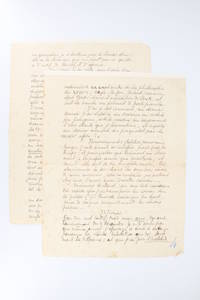
"T'ai-je dit comment au dernier courrier j'ai expédié au Mercure un article sur Gauguin article ponctué des vagissements d'une cliente que j'accouchais et expédié au dernier moment au paquebot par le mari affolé "" Double autograph letter addressed to Emile Mignard
Papeete 1904. Fine. Papeete 10-20 & 23 février 1904 20.70 x 27 cm 4 pages sur 2 feuillets Autograph double letter from Victor Segalen to Emile Mignard. Two pages written in black ink on two leaves. Horizontal folds from mailing scattered foxing. Emile Mignard 1878-1966 also a physician from Brest was one of Segalens closest childhood friends whom he first met at the Jesuit Collège Notre-Dame-de-Bon-Secours in Brest. The writer maintained with him a prolific and sustained correspondence in which he described with humor and intimacy his daily life across the globe. It was at Mignards wedding on 15 February 1905 that Segalen met his future wife Yvonne Hébert. Returning from a medical tour of the Gambier and Pomotou Islands Segalen was back in Papeete where he devoted most of his time to surgery: ""By force of circumstances I found myself the only doctor on the island with any surgical training my last two months in Toulon so that from the outset my hesitations disappeared. Since no one else was willing to operate I did so at first for lack of others now because I enjoy it and because I have had the benefit of a few lucky and successful cases. . Little by little then I set to it and now I have a small clinic of my own my operating room at home! and without pride I am sent the difficult cases !""This intense practice of medicine reveals some of the racial prejudices characteristic of the period: ""I must state first of all that the native or even half-white population provides the ideal ground for bloody operations by virtue of their particular aptitude for healing surgical wounds even septic ones."" Segalen then goes on at length and in detail about the operations he was called upon to perform: ""In this way I have operated with the help of my colleagues or assisting them closely: a strangulated hernia in a half-white man of 50 cured; removal of numerous suspicious lymph nodes cured of lipomas of occupational serous bursae an orbital osteosarcoma that naturally recurs a cured popliteal fossa lipoma a cataract uncertain result a huge abscess of the abdominal wall."" The most substantial account remains that of a urological procedure: "".and finally took part in the removal of an elephantine scrotal tumor of 30 kg. The operation was carried out at my home with my equipment by the newly arrived doctor for the Gambier. A new sheath was made for the penis and a new scrotum; four hours of work until the last suture which is progressing well."" Despite the relentless rhythm of consultations the writer did not neglect his literary endeavors and the creation of his Immémoriaux: ""Amid all this inevitably my literary projects stall somewhat. At first I tried to set aside my mornings for writing the thankless task of fixing the Imaginary of realizing; I would turn out five or six pages; but this had to be preceded by a nocturnal gestation that leaned towards surgical times; I am counting on twelve days in the Leeward Islands to make progress. I have two chapters completed."" The work would eventually appear in 1907 at the Mercure de France under the pseudonym Max-Anély Max in homage to Max Prat and Anély one of his wifes given names Segalen as a military physician not being authorized to sign a work of fiction with his own name. The letter also reveals that the article on Gauguin requested by Saint-Pol-Roux letter of 15 October 1903 « Oh dites-nous quelque chose sur ce malheureux de la Destinée qui fut souvent un grand artiste et à sa manière un Maître. Comment se fait-il que vous n'ayez pas adressé quelque relation sur cette mort au Mercure de France qui l'eût accueillie avec enthousiasme . » had at last been dispatched to France in extraordinary circumstances: ""Have I told you how in the last mail I sent off to the Mercure an article on Gauguin an article punctuated by the cries of a patient I was delivering and dispatched at the last moment unknown
Referentie van de boekhandelaar : 79603
|
|
|
Victor SEGALEN
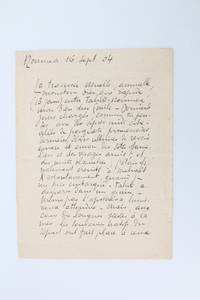
"Tahiti a disparu dans un grain. Même pas l'apothéose lumineuse attendue."" Signed autograph letter addressed to Emile Mignard
Nouméa 1904. Fine. Nouméa 16 septembre 1904 12.20 x 16.40 cm 3 pages 1/2 sur un double feuillet Autograph letter signed by Victor Segalen addressed to Emile Mignard. Three and a half pages written in black ink on a double sheet. Transverse fold inherent to the mailing. Emile Mignard 1878-1966 also a doctor and from Brest was one of Segalen's closest childhood friends whom he met at the Jesuit college Notre-Dame-de-Bon-Secours in Brest. The writer maintained with this companion an abundant and closely followed correspondence in which he described with humor and intimacy his daily life in the four corners of the globe. It was at Mignard's wedding on February 15 1905 that Segalen met his wife Yvonne Hébert. Segalen's last Polynesian letter written from Nouméa: « La traversée usuelle monotone bien que rapide 13 jours entre Tahiti-Nouméa mon bien cher Emile. » ""The usual monotonous crossing though rapid 13 days between Tahiti-Nouméa my dear Emile."" He relates his last moments on Tahitian soil: « Derniers jours chargés comme tu penses avec des après-midi échevelés de paquets promenades dernières désirs ultimes de revoir encore et encore des sites familiers et des visages amis ; et des nuits blanches ; j'étais finalement éreinté à souhait et volontairement quand je me suis embarqué. » ""Last busy days as you can imagine with frantic afternoons of packing final walks ultimate desires to see again and again familiar sites and friendly faces; and sleepless nights; I was finally exhausted as desired and voluntarily when I embarked."" After almost two years on the island Segalen does not seem to feel sorrow at the idea of returning to his metropolitan life: « Tahiti a disparu dans un grain. Même pas l'apothéose lumineuse attendue. Mais aux cours des longues siestes à la mer le souvenirs hâtifs du départ ont fait place à ceux exquis et lents des deux années mortes. Maintenant dispos et en train j'inhume après embaumement mes souvenirs figés ; je flaire et désire au retour une vie très très active. » ""Tahiti disappeared in a squall. Not even the expected luminous apotheosis. But during the long naps at sea the hasty memories of departure have given way to the exquisite and slow ones of the two dead years. Now alert and in good form I bury after embalming my frozen memories; I scent and desire upon return a very very active life."" unknown
Referentie van de boekhandelaar : 79663
|
|
|
Victor SEGALEN
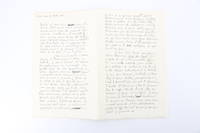
"Tahiti est bien loin mon cher Emile Brest aussi ; tout est loin reculé encore par la grisaille Nouméenne.L'attente.l'incertitude."" Signed autograph letter addressed to Emile Mignard
Nouméa 1904. Fine. Nouméa 10 mai 1904 11.50 x 18.10 cm 4 pages sur un double feuillet Autograph letter signed by Victor Segalen addressed to Emile Mignard. Four pages written in black ink and blue colored pencil on a double sheet. Cross fold inherent to the sending. Emile Mignard 1878-1966 also a doctor from Brest was one of Segalen's closest childhood friends whom he met at the Jesuit college of Notre-Dame-de-Bon-Secours in Brest. The writer maintained an abundant and regular correspondence with this friend in which he described with humor and intimacy his daily life in the four corners of the globe. It was at Mignard's wedding on February 15 1905 that Segalen met his wife Yvonne Hébert. A mechanical problem prevents the Durance from leaving Nouméa; Segalen finds himself there after attending the annual health council that brings together each year the doctors from ships of the French Pacific division to decide on convalescences leaves and transfers: ""Tahiti est bien loin mon cher Emile Brest aussi ; tout est loin reculé encore par la grisaille Nouméenne.L'attente.l'incertitude. Voici quinze jours de jeu de balançoire : retournerons-nous à Tahiti Nos chaudières sont agonisantes les répartitions se compliquent. Désarmement à Saïgon Cap-Horn à la voile !!.Mystère."" ""Tahiti is very far my dear Emile Brest too; everything is far pushed back further by Nouméan greyness.The wait.the uncertainty. Here are fifteen days of seesaw game: will we return to Tahiti Our boilers are dying the distributions are getting complicated. Decommissioning in Saigon Cape Horn under sail !!.Mystery."" He languishes for Tahiti: ""Cela me ferait une vraie peine de manquer ce retour à Tahiti. Ce faux départ cet adieu hémiplégique me navrerait. J'ai quitté mon île avec la certitude du retour et néanmoins en faisant matériellement comme si je ne devais jamais y revenir. L'adieu à ce pays a ceci de spécial que c'est un adieu définitif irrémédiable non pas au pays peut-être bien que les chances d'y repasser soient bien minimes mais aux être aimés que l'on retrouvera plus tard vieillis déformés."" ""It would cause me real pain to miss this return to Tahiti. This false departure this hemiplegic farewell would grieve me. I left my island with the certainty of return and nevertheless acting materially as if I should never return. The farewell to this country has this special quality that it is a final irremediable farewell not to the country perhaps although the chances of passing through again are very slim but to loved ones whom one will find later aged deformed."" This forced stop allows him to devote himself to writing his Immémoriaux which would finally appear in 1907 at Mercure de France under the pseudonym Max-Anély Max in homage to Max Prat and Anély one of his wife's first names Segalen not being authorized in his capacity as a military doctor to sign a fictional work with his own name: ""Je profite de cet interminable séjour en une ville insipide pour rédiger rédiger à outrance toutes les notes vécues intensément à Tahiti."" ""I take advantage of this interminable stay in an insipid city to write write excessively all the notes intensely lived in Tahiti."" These notes are found for the most part in the manuscript of Immémoriaux and in the Journal des Îles. unknown
Referentie van de boekhandelaar : 79614
|
|
|
Victor SEGALEN
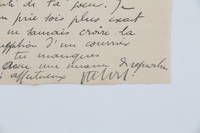
"Tu ne saurais croire la déception d'un courrier où tu manques."" Signed autograph letter addressed to Emile Mignard
s. l. Tahiti Tahiti 1903. Fine. s. l. Tahiti Tahiti 20 juin 1903 11.40 x 17.50 cm 1 page sur un feuillet Autograph letter signed by Victor Segalen addressed to Emile Mignard. One page written in black ink on a leaf. Transverse fold inherent to the mailing. Emile Mignard 1878-1966 also a doctor and native of Brest was one of Segalen's closest childhood friends whom he met at the Jesuit college Notre-Dame-de-Bon-Secours in Brest. The writer maintained with this comrade an abundant and very regular correspondence in which he described with humor and intimacy his daily life to the four corners of the globe. It was at Mignard's wedding on February 15 1905 that Segalen met his wife Yvonne Hébert. Segalen regrets not having news from his ""dear little one"": ""Pas un mot de toi par les deux derniers courriers . Comme ta dernière lettre était plutôt énigmatique et courte tu vois qu'il y a près de quatre mois que je suis sans nouvelles directes de toi. Quant aux indirectes elles sont peu gaies ; ma soeur m'écrit ta visite chez moi et tes craintes au sujet de la santé de ta soeur. Je t'en prie sois plus exact. Tu ne saurais croire la déception d'un courrier où tu manques. Avec une nuance de reproche très affectueux - Victor"" ""Not a word from you through the last two mail deliveries . As your last letter was rather enigmatic and short you see that it's been nearly four months since I've had direct news from you. As for indirect news it's not very cheerful; my sister writes to me about your visit to my place and your fears about your sister's health. Please be more punctual. You cannot believe the disappointment of a mail delivery where you are missing. With a shade of reproach very affectionately - Victor"" unknown
Referentie van de boekhandelaar : 79515
|
|
|
Victor SEGALEN
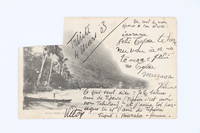
"Tépéva est mon nom"" Signed autograph postcard sent from Tahiti and addressed to Emile Mignard
Tahiti Tahiti 1903. Fine. Tahiti Tahiti 4 mars 1903 14 x 9 cm une carte postale ""Tépéva is my name"". Handwritten postcard signed sent from Tahiti and addressed to Émile Mignard Tahiti 4 March 1903 14 x 9 cm one postcard Handwritten signed postcard from Victor Segalen sent from Tahiti and addressed to émile Mignard. A few lines written in black ink around the black and white photographic reproduction of a view of Bora-Bora correspondent's address handwritten on the verso. Some minor stains a cut corner likely due to the removal of the stamp. Doctor Segalen seems to have taken a wife: A word from my wife to you: written by the hand of said wife iaorana fetii Tepeva te here neivou ia se no te mea e fetii no Tapeva Maraéa Vahine. Written by Segalen again Which means: I greet you friend of Tépéva Tépéva is my name in Tahitian and I love you because you are a friend of Tépéva. signed Maraéa-wife. Segalen's biography makes no mention of this exotic wife. Emile Mignard 1878-1966 also a doctor and Brest-born was one of Segalen's closest childhood friends whom he met at the Jesuit Notre-Dame-de-Bon-Secours School. The writer interacted with this comrade in an abundant and closely followed correspondence in which he described with humor and intimacy his daily life in all corners of the world. It was at Mignard's wedding on 15 February 1905 that Segalen met his wife Yvonne Hébert. unknown
Referentie van de boekhandelaar : 79067
|
|
|
Victor SEGALEN
"une nurse attachée à ma personne me baignant me lotionnant me frictionnant de mains adroites couchant en long peignoir bleu et les cheveux défaits dans ma chambre"" Signed autograph letter sent from San Francisco to Emile Mignard
San Francisco 1902. Fine. San Francisco dimanche 22 novembre 1902 13.70 x 18 cm 4 pages sur un feuillet double Autograph letter signed by Victor Segalen addressed to Emile Mignard four pages written in black ink on a double sheet of blue letter paper. Transverse creases inherent to the sending. Trace of white paper hinge. Emile Mignard 1878-1966 also a doctor and from Brest was one of Segalen's closest childhood friends whom he met at the Jesuit college Notre-Dame-de-Bon-Secours in Brest. The writer maintained with this schoolmate an abundant and very sustained correspondence in which he described with humor and intimacy his daily life in the four corners of the globe. It was at Mignard's wedding on February 15 1905 that Segalen met his wife Yvonne Hébert. Segalen who left Le Havre on October 11 1902 bound for Tahiti saw his voyage interrupted by contracting typhoid fever which would ultimately immobilize him for two months in San Francisco: ""Pleine convalescence mon cher Emile. . Aucune complication. Ma fièvre aura été de type « ambulant » car j'ai promené tout mon premier septénaire en sleeping. . J'ai renoncé à prendre le paquebot du 6 Décembre. Une rechute à bord et je ferais immanquablement connaissance avec les bas-fonds du Pacifique. Je partirai seulement le 11 Janvier. L'hiver est très doux à San Francisco. Dans 10 à 12 jours je m'installerai en ville. . New-York m'eût été infâme pour un séjour d'un mois. San Francisco m'agrée."" ""Full convalescence my dear Emile. . No complications. My fever was of the 'ambulatory' type as I spent my entire first week in the sleeping car. . I've given up taking the steamer of December 6th. A relapse on board and I would inevitably make acquaintance with the depths of the Pacific. I will only leave on January 11th. The winter is very mild in San Francisco. In 10 to 12 days I will settle in town. . New York would have been dreadful for a month's stay. San Francisco suits me."" After sharing with his correspondent his feelings when approaching a possible death "". je cherche à définir mon état d'esprit quand lucide j'ai appris que j'avais 41° et plus la réaction de Vidal et des taches rosées lenticulaires. J'ai envisagé froidement l'éventualité d'une issue fatale. Au point de vue religieux siccité absolue. Tout s'est reporté sur mes parents mes amis."" "". I seek to define my state of mind when lucid I learned that I had 41° and more Vidal's reaction and lenticular rose spots. I coldly considered the eventuality of a fatal outcome. From a religious point of view absolute dryness. Everything was transferred to my parents my friends."" Segalen - always very interested in womankind - gives his doctor friend details about the hospital nurses: ""Etonnement de trouver un Hôpital Français en ce répertoire cosmopolite du Grand Océan. Etonnement d'y voir comme personnel une quarantaine de « nurses » 20 à 25 ans jolies parfois toutes munies de brevets littéraires « graduées » comme on dit ici dont une attachée à ma personne me baignant me lotionnant me frictionnant de mains adroites couchant en long peignoir bleu et les cheveux défaits dans ma chambre me parlant de Rudyard Kipling Tennyson écrivant entre deux bains froids à ses « amis »."" ""Astonishment at finding a French Hospital in this cosmopolitan directory of the Great Ocean. Astonishment at seeing as staff about forty 'nurses' 20 to 25 years old sometimes pretty all equipped with literary certificates 'graduates' as they say here one of whom was assigned to my person bathing me lotioning me rubbing me with skillful hands sleeping in a long blue robe with her hair undone in my room speaking to me of Rudyard Kipling Tennyson writing between two cold baths to her 'friends'."" This convalescence which would last until early January 1903 would be an opportunity for Segalen to discover China Town. Autograph letters by Victor Segalen are of great rarity. unknown
Referentie van de boekhandelaar : 80848
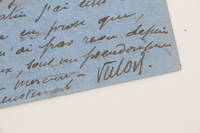
|
|
|
Victor SEGALEN
Carte postale autographe signée envoyée depuis Nouméa et adressée à Emile Mignard War pirogue. Handwritten signed postcard sent from Noumea and addressed to Emile Mignard
Nouméa 1904. Fine. Nouméa 15 juin 1904 14.10 x 9.60 cm une carte postale War pirogue. Handwritten signed postcard sent from Nouméa and addressed to Émile MignardNouméa 15 June 1904 141 x 96 cm one postcard Handwritten signed postcard from Victor Segalen sent from Nouméa and addressed to émile Mignard. A few lines written in black ink in the corner of the black and white photographic reproduction of a war pirogue in the Solomon Islands handwritten address on the verso. Some minor stains and folding. Nouméa 15 juin 1904 Affect.mt. Victor Seg. Nouméa 15 June 1904 Affect.ly Victor Seg. In 1904 Segalen took advantage of a short stay in Nouméa to continue the writing of Les Immémoriaux a novel denouncing the agony of the Maori civilization decimated by the European presence which was published under the pseudonym Max-Anély in 1907. unknown
Referentie van de boekhandelaar : 78598
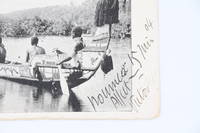
|
|
|
Victor SEGALEN
Carte postale autographe signée envoyée depuis Chicago et adressée à Emile Mignard Autograph signed postcard sent from Chicago and addressed to Emile Mignard
Chicago 1902. Fine. Chicago 23 octobre 1902 14 x 8.80 cm une carte postale Autograph signed postcard sent from Chicago and addressed to Émile Mignard Chicago 23 October 1902 14 x 88 cm one postcard Handwritten signed postcard from Victor Segalen sent from Chicago and addressed to Emile Mignard. A few lines written in pencil in the corner of the black and white photographic reproduction of a view of South Water Street in Chicago handwritten address on the verso. Some minor stains and folding. Emile Mignard 1878-1966 also a doctor and Brest-born was one of Segalen's closest friends of youth whom he met at the Jesuit Notre-Dame-de-Bon-Secours School in Brest. The writer interacted with this comrade in an abundant and closely followed correspondence in which he described with humour and intimacy his daily life in all corners of the world. It was at Mignard's wedding on 15 February 1905 that Segalen met his wife Yvonne Hébert. This postcard had been addressed by Segalen to his friend from Chicago as he travelled to Tahiti via San Francisco. It is the first time that the Breton has been to the United States and his impressions are rather pessimistic: Chicago. The deplorable pinnacle of acute budding Americanism. Imagine a mass of sandstone that has crystallised following the Cubic system. A childlike museum: close to the Apollo Belvedere a reproduction of the Hôtel des Postes. I leave tonight for a straight through journey to San Francisco where I will be on Tuesday at 4am. unknown
Referentie van de boekhandelaar : 78605
|
|
|
Victor SEGALEN
Carte postale autographe signée envoyée depuis Nouméa et adressée à Emile Mignard Double sail pirogue. Handwritten signed postcard sent from Noumea and addressed to Emile Mignard
Nouméa 1904. Fine. Nouméa 15 juillet 1904 13.90 x 9 cm une carte postale Double sail pirogue. Handwritten signed postcard sent from Nouméa and addressed to Émile Mignard Nouméa 15 July 1904 139 x 9 cm one postcard Handwritten signed postcard from Victor Segalen sent from Nouméa and addressed to Émile Mignard. A few lines written in black ink in the corner of the black and white photographic reproduction of a pirogue in New Caledonia handwritten address on the verso. Some minor stains and folding. Nouméa 15 7.04 Affectueusement. Victor Segalen Nouméa 15 7.04 Affectionately. Victor Segalen. In 1904 Segalen took advantage of a short stay in Nouméa to continue the writing of Les Immémoriaux a novel denouncing the agony of the Maori civilization decimated by the European presence which was published under the pseudonym Max-Anély in 1907. unknown
Referentie van de boekhandelaar : 78599
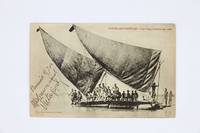
|
|
|
Victor SEGALEN
Carte postale autographe signée envoyée depuis Nouméa et adressée à Emile Mignard War dance. Handwritten signed postcard sent from Noumea and addressed to Emile Mignard: "".on demand naturally""
Nouméa 1904. Fine. Nouméa 15 juin 1904 14 x 9 cm une carte postale War dance. Handwritten signed postcard sent from Nouméa and addressed to Émile Mignard: "".on demand naturally""Nouméa 15 June 1904 14 x 9 cm one postcard Handwritten signed postcard from Victor Segalen sent from Nouméa and addressed to Émile Mignard. A few lines written in black ink below the black and white photographic reproduction of a war dance scene in the New Hebrides handwritten address on the verso. Some minor stains. With humor Segalen completes the caption of this post card: War dance .on demand naturally. Affectionately Victor Segalen Nouméa 15 June 1904. In 1904 Segalen took advantage of a short stay in Nouméa to continue the writing of Immémoriaux a novel denouncing the agony of the Maori civilization decimated by the European presence which was published under the pseudonym Max-Anély in 1907. unknown
Referentie van de boekhandelaar : 78594
|
|
|
Victor SEGALEN
Dans un monde sonore. In Mercure de France n°243 à n°244
Paris: Mercure de France 1907. Fine. Mercure de France Paris août 1907 15 x 23 cm First edition. Full grey mouse-colored soft cardboard binding original wrappers preserved contemporary binding. Contributions by E. Masson ""Walt Whitman ouvrier et poète"" H. Potez F. Caussy ""La Leçon de Versailles"" R. de gourmont P. Quillard Rachilde P. Lasserre ""Un Destructeur de légendes: Edmond Biré"" A. Spire M. Réja ""L'Art chez les fous"" E. Maynial ""L'Episode de la Charpillon dans les Mémoires de Casanova"" Max-Anély "" Dans un monde sonore"". Handsome interior condition. The 'Mercure de France' is originally a French magazine founded in the 17th century under the name 'Mercure Galant' which evolved to become in the 20th century a publishing house. Under the impetus of Rémy de Gourmont and Alfred Jarry a literary magazine took up the name 'Mercure de France' in 1890 and offered symbolist texts notably by Jean Moréas Ernest Raynaud Jules Renard Louis Dumur. Gradually gaining recognition this magazine published both the greatest Parnassians Baudelaire Rimbaud Verlaine Mallarmé Heredia etc. and witnessed the emergence of Jarry's Pataphysics. The publishing house was born in its wake. It notably published the first works of Gide and Claudel of Colette of Apollinaire of Georges Duhamel Mercure de France unknown
Referentie van de boekhandelaar : 26744

|
|
|
Victor SEGALEN
Double autograph letter to Mignard about Gauguin's engravings
Papeete 1903. Fine. Papeete 7 & 15 décembre 1903 11.30 x 15.40 cm 9 pages et quelques lignes sur 2 feuillets doubles et un feuillet simple Double autograph letter signed by Victor Segalen to Emile Mignard. Nine pages and a few lines written in black ink on two bifolia and one single leaf. Horizontal folds from mailing. Emile Mignard 1878-1966 also a physician from Brest was one of Segalens closest childhood friends whom he met at the Jesuit college Notre-Dame-de-Bon-Secours in Brest. The writer maintained with this companion a prolific and steady correspondence in which he described with humor and intimacy his daily life across the globe. It was at Mignards wedding on 15 February 1905 that Segalen first met his future wife Yvonne Hébert. Lengthy letter discussing the progress of Les Immémoriaux and a woodcut by Paul Gauguin. Segalen was continuing the writing of his great fiction Les Immémoriaux which would be published in 1907 by Mercure de France under the pseudonym Max-Anély Max in homage to Max Prat and Anély one of his wifes given names as Segalen a military doctor was not permitted to sign a fictional work under his own name. ""I have now decidedly set myself to the active part of my work. Here again though the sources abound I lack the sympathetic and discerning listener to whom I might submit page by page my copy. If I bring it to a successful end I shall have every reason to be pleased with my campaign having resisted the predicted intellectual bogging down. . At last will I manage to complete something to draw from myself something more than a wild desire to create I am beginning to believe so. I am leaving on a three-week tour quiet in lands already known with a formidable Polynesian library; I may perhaps return with a quarter materially finished. I have less than before the obsession with the word and I write with greater calm."" But it was not only the writing of Les Immémoriaux that occupied Segalen. In October 1903 he had also acquired works and objects belonging to Paul Gauguin who had just died in the Marquesas. In a letter of 2 October 1903 he wrote to Emile Mignard: « Je viens de gagner 450f dont 250 pour un accouchement assez ennuyeux. Sur ces 450 j'en ai consacré 200f à l'achat de toiles bois sculptés croquis album du peintre Paul Gauguin l'un des meilleurs Impressionnistes qui réfugié aux Marquises vient d'y mourir. J'ai acquis à bas prix à la vente publique d'admirables choses : deux portraits de lui une grande toile où défilent des Tahitiens des bois sculptés dont je ferai tirer des épreuves des croquis des notes. Je m'étais fait son champion ici car très ingrat très isolé haineux même il était généralement détesté dans la colonie. » The auction of Gauguins possessions and works left behind in his Maison du Jouir after his death took place in the autumn of 1903. One of the rare buyers present at this liquidation was Victor Segalen who thereby rescued several of the painters key works that might otherwise have been destroyed in general indifference. Segalen who had hoped to arrive in time to meet Gauguin honored his memory by attemptingdespite his modest salaryto acquire as many works of his late mentor as possible. He even mentions here a woodcut by the painter: ""I am sending you in connection with Gauguins death simply a woodcut of his in duplicate one of them for our friend Max Prat . It is a monstrous and replete idol set against a storm-tossed sky above the break of a great Tahitian valley. The word ""Maruru"" pronounced: Maoorooroo means: thank you I am content."" egalen indeed owned several proofs of this woodcut representing the goddess Hina; a fragment of one of them was affixed to the flyleaf of his travel journal and the same silhouette of the idol appears on the cover of the manuscript of Les Immémoriaux. This reverence for Gauguin is also evident in another project the drafting of an article paying him homage: ""I am wr unknown
Referentie van de boekhandelaar : 79585
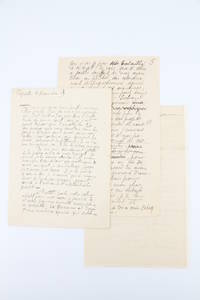
|
|
|
Victor SEGALEN
Le Fils du Ciel. Chroniques des Jours souverains The Son of Heaven. Chronicles of the Sovereign Days
Paris: Flammarion 1975. Fine. Flammarion Paris 1975 16.50 x 25 cm broché First edition one of 35 numbered copies on alfa paper the only deluxe copies. Spine and front cover slightly and marginally yellowed otherwise a handsome and rare copy. Flammarion unknown
Referentie van de boekhandelaar : 78884

|
|
|
Victor SEGALEN
Lettre autographe signée envoyée depuis San Francisco adressée à Emile Mignard sur papier bois asiatique Signed handwritten letter sent from San Francisco addressed to Emile Mignard on Asian wood paper
San Francisco 1902. Fine. San Francisco jeudi 10 décembre 1902 11.20 x 17 cm 2 pages sur un feuillet Signed handwritten letter sent from San Francisco addressed to Emile Mignard on Asian wood paper San Francisco Thursday 10 December 1902 11.2 x 17 cm 2 pages on one leaf Handwritten signed letter from Victor Segalen addressed to Emile Mignard two pages written in black ink on a leaf of Asian wood letter paper printed in the margin with blue Asian silhouettes and landscapes. Emile Mignard 1878-1966 also a doctor and Brest-born was one of Segalen's closest friends of youth whom he met at the Jesuit Notre-Dame-de-Bon-Secours School in Brest. The writer interacted with this comrade in an abundant and closely followed correspondence in which he described with humour and intimacy his daily life in all corners of the world. It was at Mignard's wedding on 15 February 1905 that Segalen met his wife Yvonne Hébert. Segalen who left Le Havre on 11 October 1902 for Tahiti had his journey interrupted by contracting typhoid fever which kept him in San Francisco for two months. This was the opportunity for the young man to discover China Town the Asian quarter that he mentions in this letter: Je t'ai déniché chez un petit singe à figure jaune du quartier japonais un petit porte-carte qui aura toujours à défaut d'autre chose l'intérêt de «venir de loin» et de son authenticité.et aussi peut-être celui d'être donné avec la plus profonde affection que je puisse dédier à un Ami. I have unearthed you in a little yellow-faced monkey in the Japanese quarter a little card wallet that will always have in the absence of anything else the interest of coming from afar and its authenticity.and also perhaps that of being given with the deepest affection that I can dedicate to a Friend. Segalen left San Francisco for Tahiti on 11 January 1903. Handwritten letters from Victor Segalen are very rare. unknown
Referentie van de boekhandelaar : 78611
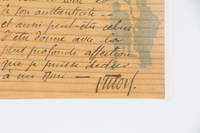
|
|
|
Victor SEGALEN
Lettre autographe signée adressée à Emile Mignard : ""Nouméa a cecy de morne : que c'est une stupide ville.""
Nouméa 1904. Fine. Nouméa 15 juin 1904 12.20 x 16.40 cm 3 pages 1/2 sur un double feuillet Autograph letter signed by Victor Segalen addressed to Emile Mignard. Three and a half pages written in black ink on a folded sheet. Transverse fold inherent to the mailing. Emile Mignard 1878-1966 also a doctor from Brest was one of Segalen's closest childhood friends whom he met at the Jesuit college Notre-Dame-de-Bon-Secours in Brest. The writer maintained with this friend an abundant and very regular correspondence in which he described with humor and intimacy his daily life in the four corners of the globe. It was at Mignard's wedding on February 15 1905 that Segalen met his wife Yvonne Hébert. Segalen has been in Nouméa a city he loathes since early April 1904: ""Nouméa a cecy de morne : que c'est une stupide ville."" ""Nouméa has this dullness: that it is a stupid city."" He attended the health council that annually brings together the doctors from the ships of the French Pacific division to decide on convalescences leave and transfers. For a month a mechanical problem has prevented the Durance from leaving Nouméa: ""Nous préparons imperturbablement notre départ mon cher Emile depuis un mois et toujours « pour la semaine prochaine ». La ville se tord. On retape. On essaie. On retape - finalement peut-être serons-nous en mer Dimanche et à Tahiti pour le 1er Juillet."" ""We have been imperturbably preparing our departure my dear Emile for a month and always 'for next week'. The city twists. We patch. We try. We patch - finally perhaps we will be at sea Sunday and in Tahiti for July 1st."" Segalen relieves boredom as he can: "". j'y ai découvert une troublante jeune fille triste aux pâles yeux pers désabusée et frêle. Nous nous écrivons des choses désolées et préparons notre adieu."" "". I discovered there a disturbing sad young girl with pale greenish eyes disillusioned and frail. We write desolate things to each other and prepare our farewell."" In addition to these amorous letters he continues writing his Immémoriaux still lamenting the lack of time to devote to it: ""Ponctuellement je « couvre » cinq pages en 24 heures. Je vais plus vite depuis l'entraînement sérieux du mois dernier. Dire que cet élément métier chronométrique et mesquin est nécessaire pour que la rêverie se réalise et que l'idée se revête de Forme."" ""Punctually I 'cover' five pages in 24 hours. I go faster since the serious training of last month. To think that this craft element chronometric and petty is necessary for the reverie to be realized and for the idea to be clothed in Form."" The work would finally appear in 1907 at Mercure de France under the pseudonym Max-Anély Max in homage to Max Prat and Anély one of his wife's first names Segalen not being authorized in his capacity as military doctor to sign a fictional work with his patronymic name. hardcover
Referentie van de boekhandelaar : 79656
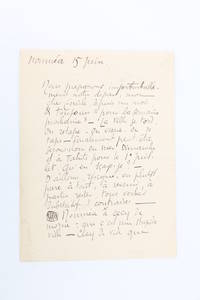
|
|
|
Victor SEGALEN
Stèles
Pei-King Beijing: Presses de Pei-T'ang Beitang 1912. Fine. Presses de Pei-T'ang Beitang Pei-King Beijing 1912 14.50 x 19.50 cm en accordéon sous chemise et étui First edition strictly hors-commerce one of 200 copies printed on glassine vellum or European paper only print after 81 imperial Korean paper. Our copy is complete with its overlay cover the colour and decorative motifs often vary and the white glassine paper label bearing the title Stèles printed in Chinese on the first part of the cover the latter being folded into three parts. Our copy is presented in a blueish paper chemise and slipcase navy blue morocco spine name of the author title and date in palladium slipcase in blueish paper all signed Devauchelle in palladium. Presses de Pei-T'ang[ Beitang] hardcover
Referentie van de boekhandelaar : 81287
|
|
|
Victor STOHR
La lumière du coeur poésies
Paris: S. n. 1930. Fine. S. n. Paris s. d. circa 1930 15 x 21.50 cm agrafé First edition published in a small number of copies. A small minor stain on the first cover a pale dampstain to the margin of the second cover otherwise a rare and handsome copy. S. n. unknown
Referentie van de boekhandelaar : 14491

|
|
|
Victor Terras (Editor), And 106 Specialists
Handbook Of Russian Literature A Biographical Dictionary Of Russian Writers With Bibilographies Of Works And Criticism
Yale University Press 1985. 1st Edition 1st Printing. Hardcover. Fine/Fine. Xix 558 Pp. Blue Cloth Spine Lettered In Red And Gilt. First Printing. 1985. Fine In Fine Dust Jacket. <br/> <br/> Yale University Press hardcover
Referentie van de boekhandelaar : 056781 ISBN : 0300031556 9780300031553
|
|

 De zoekresultaten per email ontvangen
 Zoekresultaten downloaden als PDF
 RSS feed
 Permanente link


