|
Alois SCHREIBER
Nouvel itinéraire portatif des bords du Rhin depuis Schaffhouse jusqu'en Hollande à Bade à la vallée de la Murg et à la Forêt Noire aux principaux environs et aux bains de ces contrées
Paris: Didier 1834. Fine. Didier Paris 1834 8.50 x 14 cm relié New edition. Half hazelnut sheep binding smooth spine with triple gilt fillets and showing traces of rubbing marbled paper boards marbled endpavers and pastedowns contemporary binding. Our copy is complete with the 5 folding panoramic plates but unfortunately lacks its map. Light scattered foxing. Rare. Didier hardcover
Référence libraire : 29091

|
|
|
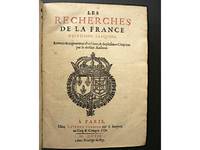
Etienne PASQUIER
Les recherches de la France
à Paris: Chez Laurent Sonnius 1607. Fine. Chez Laurent Sonnius à Paris 1607 17 x 23.60 cm relié Edition with some parts in first edition expanded with Book VII a table of contents numerous additions and a portrait of Pasquier by Thomas de Leu. This portrait had been created in 1583 in Troyes and had never been integrated into the editions. This is the last edition published during the author's lifetime. Contemporary full calf binding. Spine with raised bands richly decorated. A lack to head. A lack of leather to the last compartment. Upper joint cracked at foot and head. Wormholes to part of the upper board. Encyclopedic and highly celebrated work Les recherches de la France stands out among all works of this kind for its radical novelty. Pasquier can be considered as the father of modern history History then emerging as a discipline and departing from legend and literature. Chapter VII quite different from the others since those focused on research into the Antiquity of France examines the formation of the French language; a section is devoted to the Pléiade of which Pasquier was a member. Chapter VI already dealt with the origin of French poetry. Chez Laurent Sonnius hardcover
Référence libraire : 29364
|
|
|
Pierre DRIEU LA ROCHELLE
Doriot ou la vie d'un ouvrier français
Saint-Denis: Les éditions populaires françaises 1936. Fine. Les éditions populaires françaises Saint-Denis 1936 13.50 x 18 cm agrafé First edition on ordinary paper. Covers slightly and marginally faded and foxed without consequence. Handsome copy considering the poor quality of this paper. Les éditions populaires françaises unknown
Référence libraire : 28917

|
|
|
COLLECTIF
Départ Arts & lettres N°1
Bourges: Départ 1945. Fine. Départ Bourges Octobre 1945 16 x 24 cm agrafé First edition one of 58 numbered copies on Montgolfier paper the only deluxe copies. Contributions by P. Seghers C. Jaby H. Gillet V. Blasco del Vilo on F. Garcia Lorca. Spine and front cover partially faded handsome interior condition. Départ unknown
Référence libraire : 29570

|
|
|
Pierre GASCAR
Aujourd'hui la Chine
Lausanne: La guilde du livre 1955. Fine. La guilde du livre Lausanne 1955 22 x 28 cm broché First edition one of the numbered copies the only printing with 30 other copies reserved for members of La guilde du livre. Work illustrated with photographs by Ergy Landau. A fine copy. La guilde du livre unknown
Référence libraire : 29243

|
|
|
Auguste BATAILLER
Les persécutés auto-accusateurs
Paris: Henri Jouve 1897. Fine. Henri Jouve Paris 1897 16 x 25 cm broché First edition. Autograph inscription by Auguste Batailler. Two slight lacks at head and foot of spine three minute marginal lacks to boards. Rare. Henri Jouve hardcover
Référence libraire : 29565

|
|
|
Remy de GOURMONT - COLLECTIF
Vers et prose N°25 & 26 de la 7ème année
Paris: Vers et Prose 1911. Fine. Vers et Prose Paris Avril-Septembre 1911 16.50 x 25 cm broché First edition. Contributions by R. de Gourmont with ""histoire tragique de la princesse Phénissa"" A. Suarès F. Jammes M. Barrès L.P. Fargue C. van Lerberghe P. Fort T. de Visan. Spine lightly faded second cover lacking small corner losses to front cover handsome interior condition. Vers et Prose unknown
Référence libraire : 29319

|
|
|
COLLECTIF
La revue blanche N°6 de la nouvelle série
Paris: La Revue Blanche 1892. Fine. La Revue Blanche Paris 25 Mars 1892 14 x 23 cm broché First edition. Contributions by P. Adam R. Coolus H. de Régnier O. Raquin. Minor marginal spots to covers without significance. La Revue Blanche unknown
Référence libraire : 29310

|
|
|
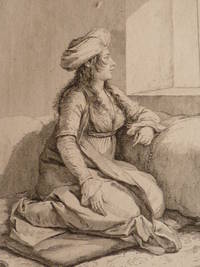
Dominique VIVANT DENON - PREVOST (sculpsit) - DUPARC (sculpsit)
Voyage dans la Basse et Haute Egypte : 1. Femme d'Egypte dans le Harem. 2. Roche de granit. Planche 74.<br />
Paris: Didot 1803. Fine. Didot Paris 1803 40 x 54 cm une feuille Original unshaved full-page etching from the Imperial edition of the Description de l'Égypte or Recueil des observations et recherches faites en Égypte pendant l'expédition française publié par les ordres de Sa Majesté l'Empereur Napoléon le Grand A Collection of the observations and research carried out in Egypt during the French expedition published on the orders of his Majesty the Emperor Napoleon the Great'.Produced between February 1802 and 1830 on the orders of Naopleon Bonaparte and published between 1809 and 1828 1000 copies were printed and distributed to institutions on vergé paper with an 'Égypte ancienne et moderne' watermark visible when held up to the light. Light marginal spotting not touching image otherwise in very fresh fine condition. An engraving from the Description de l'Egypte one of the masterpieces of French printing and the birth of a new field: Egyptology. A gigantic survey of Egypt at the time of Bonaparte's conquests in 1798 and 1799 the work is divided into 13 volumes of engravings making up 892 plates of which 72 colored as well as presenting the splendors of the Egypt of the Pharaohs in 9 volumes. The other volumes discuss natural history and present a fascinating portrait of Coptic and Islamic Egypt as it was seen by Bonaparte's Eastern Armies. The Egyptian campaign' militarily a disaster demonstrates through the engravings of the Description d'Egypte the scientific success it nonetheless became thanks to the 167 expert members of the Commission of the Sciences and Arts of the Institut d'Egypte Egyptian Institute who followed Napoleon's army. The Institut gathered together in Egypt the mathematician Monge the chemist Berthollet the naturalist Geoffroy Saint-Hilaire as well as numerous artists engineers architects and doctors. They were tasked with re-discovering modern and ancient Egypt and displaying its natural treasures as well as the know-how of its inhabitants.This edition the so-called Imperial edition of the plates for the Description de l'Egypte was printed in four large formats two of which were specially created for it and christened Moyen-Egypte and Grand-Egypte. A special press was built to print it the process extending over 20 years from 1809 to 1829. The Imperial edition proved so popular that a second edition this time in black and white and without the Egypte ancienne et moderne watermark known as the Royal Edition was published during the Restoration by the printing house of C.-L.-F. Panckoucke Paris.The engravings of the Description d'Egypte owe a great deal to Baron Dominique-Vivant Denon illustrator diplomat collector and later Director of the Musée Napoléon the Louvre. His exploration of the South of Egypt gave Bonaparte the idea of sending the experts of the Institut there thus creating a faithful and complete portrait of the area. This was the research gathered together from 1802 in the mammoth Description de L'Egypte.Denon embarked on this story of archeological exploration at the age of 51 reaching first Alexandria and then Cairo before exploring Upper Egypt. Along with the members of the Institut d'Egypte the Natural History Museum's painter H.J. Redouté brother of Pierre-Joseph Redouté author of Roses the mineralogist Dolomiue and the draughtsman Joly Denon then explored the Nile Delta and Lower Egypt. When however he joined the 21st Light Infantry Regiment as it marched across Upper Egypt in pursuit of the retreating Mameluks in November 1798 he found himself the only civilian. In the very midst of the battle itself he reeled off sketches of the works of art that peppered his path right up to the threshold of the Sudan. He said that he had crossed a country that is apart from its name entirely unknown to Europeans and therefore everything was worth describing Voyages dans la Basse et la Haute Egypte pendant les campagnes de Bonaparte en 1798 e Didot unknown
Référence libraire : 29710
|
|
|
Jean-Francois d' AUBUISSON DE VOISINS
Traité d'hydraulique
Paris & Strasbourg: F.G. Levrault 1834. Fine. F.G. Levrault Paris & Strasbourg 1834 12.50 x 21 cm relié First edition. Half navy sheep binding smooth spine decorated with quadruple gilt fillets traces of rubbing on headcaps and light scratches on spine marbled paper boards endpapers and pastedowns of marbled paper contemporary binding. Complete with its 4 folding plates at rear. Scattered foxing a lack to center of title page caused by the scissors of a former owner of the work. F.G. Levrault hardcover
Référence libraire : 29058

|
|
|
Charles MOULIN
Les propos interrompus
Paris: Les Editions de la Nouvelle France 1946. Fine. Les Editions de la Nouvelle France Paris 1946 12 x 19 cm broché First edition one of 230 numbered copies on white vellum the only deluxe copies. Work illustrated with a frontispiece and headpieces engraved on wood by Jean Mohler. A shadow on the justification page otherwise a handsome copy. Les Editions de la Nouvelle France hardcover
Référence libraire : 29179

|
|
|
Alfred JARRY
L'objet aimé
Paris: Arcanes 1953. Fine. Arcanes Paris 1953 14 x 19.50 cm broché First edition one of 100 numbered copies on Arches paper deluxe copies after 57 hors commerce. Illustrations by Rodolphe Töpffer. Handsome copy despite light and partial shadows on the endpapers. Arcanes unknown
Référence libraire : 4411

|
|
|
COLLECTIF
Ile de Gorée Inauguration du monument élevé à la mémoire des officiers du corps de santé de la marine morts pendant l'épidémie de 1878
Saint-Louis: Imp. du gouvernement 1881. Fine. Imp. du gouvernement Saint-Louis 1881 17.50 x 26 cm broché First edition printed under the auspices of the French government. One joint slightly cracked at head a light stain of no significance at head of first cover occasional light foxing. Rare pamphlet. Imp. du gouvernement unknown
Référence libraire : 29506

|
|
|
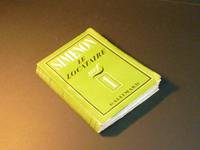
Georges SIMENON
Le locataire
Paris: Gallimard 1934. Fine. Gallimard Paris 1934 12 x 19 cm broché First edition one of 47 numbered copies on pur fil paper the only large paper copies. Spine slightly warped tiny traces of marginal tears to covers with tiny lacks not serious rare spots mostly affecting endpapers. A rare large paper copy. Gallimard unknown
Référence libraire : 29517
|
|
|
COLLECTIF
Mélanges à la mémoire de Jean Sarrailh
Paris: Centre de recherches hispaniques 1966. Fine. Centre de recherches hispaniques Paris 1966 16.50 x 25 cm 2 volumes brochés sous étui First edition. Spine slightly sunned otherwise good copies. Centre de recherches hispaniques unknown
Référence libraire : 29261

|
|
|
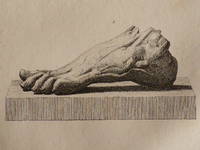
Dominique VIVANT DENON - GOUNOT (sculpsit)
Voyage dans la Basse et Haute Egypte : Antiquités Egyptiennes. Planche 100.<br />
Paris: Didot 1803. Fine. Didot Paris 1803 40.50 x 54 cm une feuille Original unshaved full-page etching from the Imperial edition of the Description de l'Égypte or Recueil des observations et recherches faites en Égypte pendant l'expédition française publié par les ordres de Sa Majesté l'Empereur Napoléon le Grand A Collection of the observations and research carried out in Egypt during the French expedition published on the orders of his Majesty the Emperor Napoleon the Great'.Produced between February 1802 and 1830 on the orders of Naopleon Bonaparte and published between 1809 and 1828 1000 copies were printed and distributed to institutions on vergé paper with an 'Égypte ancienne et moderne' watermark visible when held up to the light. Light marginal spotting not touching image otherwise in very fresh fine condition. An engraving from the Description de l'Egypte one of the masterpieces of French printing and the birth of a new field: Egyptology. A gigantic survey of Egypt at the time of Bonaparte's conquests in 1798 and 1799 the work is divided into 13 volumes of engravings making up 892 plates of which 72 colored as well as presenting the splendors of the Egypt of the Pharaohs in 9 volumes. The other volumes discuss natural history and present a fascinating portrait of Coptic and Islamic Egypt as it was seen by Bonaparte's Eastern Armies. The Egyptian campaign' militarily a disaster demonstrates through the engravings of the Description d'Egypte the scientific success it nonetheless became thanks to the 167 expert members of the Commission of the Sciences and Arts of the Institut d'Egypte Egyptian Institute who followed Napoleon's army. The Institut gathered together in Egypt the mathematician Monge the chemist Berthollet the naturalist Geoffroy Saint-Hilaire as well as numerous artists engineers architects and doctors. They were tasked with re-discovering modern and ancient Egypt and displaying its natural treasures as well as the know-how of its inhabitants.This edition the so-called Imperial edition of the plates for the Description de l'Egypte was printed in four large formats two of which were specially created for it and christened Moyen-Egypte and Grand-Egypte. A special press was built to print it the process extending over 20 years from 1809 to 1829. The Imperial edition proved so popular that a second edition this time in black and white and without the Egypte ancienne et moderne watermark known as the Royal Edition was published during the Restoration by the printing house of C.-L.-F. Panckoucke Paris.The engravings of the Description d'Egypte owe a great deal to Baron Dominique-Vivant Denon illustrator diplomat collector and later Director of the Musée Napoléon the Louvre. His exploration of the South of Egypt gave Bonaparte the idea of sending the experts of the Institut there thus creating a faithful and complete portrait of the area. This was the research gathered together from 1802 in the mammoth Description de L'Egypte.Denon embarked on this story of archeological exploration at the age of 51 reaching first Alexandria and then Cairo before exploring Upper Egypt. Along with the members of the Institut d'Egypte the Natural History Museum's painter H.J. Redouté brother of Pierre-Joseph Redouté author of Roses the mineralogist Dolomiue and the draughtsman Joly Denon then explored the Nile Delta and Lower Egypt. When however he joined the 21st Light Infantry Regiment as it marched across Upper Egypt in pursuit of the retreating Mameluks in November 1798 he found himself the only civilian. In the very midst of the battle itself he reeled off sketches of the works of art that peppered his path right up to the threshold of the Sudan. He said that he had crossed a country that is apart from its name entirely unknown to Europeans and therefore everything was worth describing Voyages dans la Basse et la Haute Egypte pendant les campagnes de Bonaparte en 179 Didot unknown
Référence libraire : 29749
|
|
|
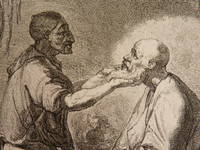
Dominique VIVANT DENON - MALBESTE (sculpsit)
Voyage dans la Basse et Haute Egypte : 1. Un Cheykh. 2. Barbier Egyptien. Planche 92.<br />
Paris: Didot 1803. Fine. Didot Paris 1803 39.50 x 54 cm une feuille Original unshaved full-page etching from the Imperial edition of the Description de l'Égypte or Recueil des observations et recherches faites en Égypte pendant l'expédition française publié par les ordres de Sa Majesté l'Empereur Napoléon le Grand A Collection of the observations and research carried out in Egypt during the French expedition published on the orders of his Majesty the Emperor Napoleon the Great'.Produced between February 1802 and 1830 on the orders of Naopleon Bonaparte and published between 1809 and 1828 1000 copies were printed and distributed to institutions on vergé paper with an 'Égypte ancienne et moderne' watermark visible when held up to the light. Light marginal spotting not touching image otherwise in very fresh fine condition. An engraving from the Description de l'Egypte one of the masterpieces of French printing and the birth of a new field: Egyptology. A gigantic survey of Egypt at the time of Bonaparte's conquests in 1798 and 1799 the work is divided into 13 volumes of engravings making up 892 plates of which 72 colored as well as presenting the splendors of the Egypt of the Pharaohs in 9 volumes. The other volumes discuss natural history and present a fascinating portrait of Coptic and Islamic Egypt as it was seen by Bonaparte's Eastern Armies. The Egyptian campaign' militarily a disaster demonstrates through the engravings of the Description d'Egypte the scientific success it nonetheless became thanks to the 167 expert members of the Commission of the Sciences and Arts of the Institut d'Egypte Egyptian Institute who followed Napoleon's army. The Institut gathered together in Egypt the mathematician Monge the chemist Berthollet the naturalist Geoffroy Saint-Hilaire as well as numerous artists engineers architects and doctors. They were tasked with re-discovering modern and ancient Egypt and displaying its natural treasures as well as the know-how of its inhabitants.This edition the so-called Imperial edition of the plates for the Description de l'Egypte was printed in four large formats two of which were specially created for it and christened Moyen-Egypte and Grand-Egypte. A special press was built to print it the process extending over 20 years from 1809 to 1829. The Imperial edition proved so popular that a second edition this time in black and white and without the Egypte ancienne et moderne watermark known as the Royal Edition was published during the Restoration by the printing house of C.-L.-F. Panckoucke Paris.The engravings of the Description d'Egypte owe a great deal to Baron Dominique-Vivant Denon illustrator diplomat collector and later Director of the Musée Napoléon the Louvre. His exploration of the South of Egypt gave Bonaparte the idea of sending the experts of the Institut there thus creating a faithful and complete portrait of the area. This was the research gathered together from 1802 in the mammoth Description de L'Egypte.Denon embarked on this story of archeological exploration at the age of 51 reaching first Alexandria and then Cairo before exploring Upper Egypt. Along with the members of the Institut d'Egypte the Natural History Museum's painter H.J. Redouté brother of Pierre-Joseph Redouté author of Roses the mineralogist Dolomiue and the draughtsman Joly Denon then explored the Nile Delta and Lower Egypt. When however he joined the 21st Light Infantry Regiment as it marched across Upper Egypt in pursuit of the retreating Mameluks in November 1798 he found himself the only civilian. In the very midst of the battle itself he reeled off sketches of the works of art that peppered his path right up to the threshold of the Sudan. He said that he had crossed a country that is apart from its name entirely unknown to Europeans and therefore everything was worth describing Voyages dans la Basse et la Haute Egypte pendant les campagnes de Bonaparte en 179 Didot unknown
Référence libraire : 29742
|
|
|
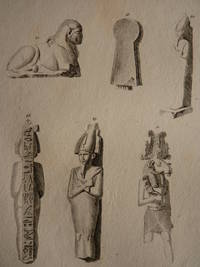
Dominique VIVANT DENON - GALIEN (sculpsit)
Voyage dans la Basse et Haute Egypte : Divinités Egyptiennes. Planche 96.<br />
Paris: Didot 1803. Fine. Didot Paris 1803 40 x 54 cm une feuille Original unshaved full-page etching from the Imperial edition of the Description de l'Égypte or Recueil des observations et recherches faites en Égypte pendant l'expédition française publié par les ordres de Sa Majesté l'Empereur Napoléon le Grand A Collection of the observations and research carried out in Egypt during the French expedition published on the orders of his Majesty the Emperor Napoleon the Great'.Produced between February 1802 and 1830 on the orders of Naopleon Bonaparte and published between 1809 and 1828 1000 copies were printed and distributed to institutions on vergé paper with an 'Égypte ancienne et moderne' watermark visible when held up to the light. Light marginal spotting not touching image otherwise in very fresh fine condition. An engraving from the Description de l'Egypte one of the masterpieces of French printing and the birth of a new field: Egyptology. A gigantic survey of Egypt at the time of Bonaparte's conquests in 1798 and 1799 the work is divided into 13 volumes of engravings making up 892 plates of which 72 colored as well as presenting the splendors of the Egypt of the Pharaohs in 9 volumes. The other volumes discuss natural history and present a fascinating portrait of Coptic and Islamic Egypt as it was seen by Bonaparte's Eastern Armies. The Egyptian campaign' militarily a disaster demonstrates through the engravings of the Description d'Egypte the scientific success it nonetheless became thanks to the 167 expert members of the Commission of the Sciences and Arts of the Institut d'Egypte Egyptian Institute who followed Napoleon's army. The Institut gathered together in Egypt the mathematician Monge the chemist Berthollet the naturalist Geoffroy Saint-Hilaire as well as numerous artists engineers architects and doctors. They were tasked with re-discovering modern and ancient Egypt and displaying its natural treasures as well as the know-how of its inhabitants.This edition the so-called Imperial edition of the plates for the Description de l'Egypte was printed in four large formats two of which were specially created for it and christened Moyen-Egypte and Grand-Egypte. A special press was built to print it the process extending over 20 years from 1809 to 1829. The Imperial edition proved so popular that a second edition this time in black and white and without the Egypte ancienne et moderne watermark known as the Royal Edition was published during the Restoration by the printing house of C.-L.-F. Panckoucke Paris.The engravings of the Description d'Egypte owe a great deal to Baron Dominique-Vivant Denon illustrator diplomat collector and later Director of the Musée Napoléon the Louvre. His exploration of the South of Egypt gave Bonaparte the idea of sending the experts of the Institut there thus creating a faithful and complete portrait of the area. This was the research gathered together from 1802 in the mammoth Description de L'Egypte.Denon embarked on this story of archeological exploration at the age of 51 reaching first Alexandria and then Cairo before exploring Upper Egypt. Along with the members of the Institut d'Egypte the Natural History Museum's painter H.J. Redouté brother of Pierre-Joseph Redouté author of Roses the mineralogist Dolomiue and the draughtsman Joly Denon then explored the Nile Delta and Lower Egypt. When however he joined the 21st Light Infantry Regiment as it marched across Upper Egypt in pursuit of the retreating Mameluks in November 1798 he found himself the only civilian. In the very midst of the battle itself he reeled off sketches of the works of art that peppered his path right up to the threshold of the Sudan. He said that he had crossed a country that is apart from its name entirely unknown to Europeans and therefore everything was worth describing Voyages dans la Basse et la Haute Egypte pendant les campagnes de Bonaparte en 1798 e Didot unknown
Référence libraire : 29746
|
|
|
Cecil TAVELET SIR
Recette pour s'élever promptement sans travail et sans mérite au-dessus de la multitude parisienne
s. l.: S. n. 1950. Fine. S. n. s. l. s. d. 11 x 14 cm broché First edition of the second version of the French translation established by Bérot de l'Arvette and printed on fine paper. Rare inscription from Sir Cecil Tavelet. S. n. unknown
Référence libraire : 29101

|
|
|
Gaston CAMUS
La technique des hélices aériennes : notions élémentaires sur le tracé l'utilisation et la construction des hélices aériennes
Paris: Lib. des sciences aéronautiques F. Louis Vivien 1909. Fine. Lib. des sciences aéronautiques F. Louis Vivien Paris 1909 16.50 x 25.50 cm broché First edition. Pamphlet illustrated with figures in the text. A small loss to the head of the spine which also has a slight tear at the foot handsome interior condition. Lib. des sciences aéronautiques F. Louis Vivien unknown
Référence libraire : 29455

|
|
|
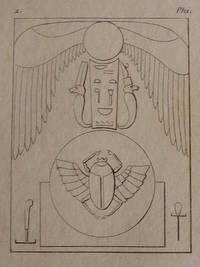
Dominique VIVANT DENON - GALIEN (sculpsit)
Voyage dans la Basse et Haute Egypte : Planche 122. Figures de divinités et autres bas-reliefs.<br />
Paris: Didot 1803. Fine. Didot Paris 1803 40.50 x 54 cm une feuille Original unshaved full-page etching from the Imperial edition of the Description de l'Égypte or Recueil des observations et recherches faites en Égypte pendant l'expédition française publié par les ordres de Sa Majesté l'Empereur Napoléon le Grand A Collection of the observations and research carried out in Egypt during the French expedition published on the orders of his Majesty the Emperor Napoleon the Great'.Produced between February 1802 and 1830 on the orders of Naopleon Bonaparte and published between 1809 and 1828 1000 copies were printed and distributed to institutions on vergé paper with an 'Égypte ancienne et moderne' watermark visible when held up to the light. Light marginal spotting not touching image otherwise in very fresh fine condition. An engraving from the Description de l'Egypte one of the masterpieces of French printing and the birth of a new field: Egyptology. A gigantic survey of Egypt at the time of Bonaparte's conquests in 1798 and 1799 the work is divided into 13 volumes of engravings making up 892 plates of which 72 colored as well as presenting the splendors of the Egypt of the Pharaohs in 9 volumes. The other volumes discuss natural history and present a fascinating portrait of Coptic and Islamic Egypt as it was seen by Bonaparte's Eastern Armies. The Egyptian campaign' militarily a disaster demonstrates through the engravings of the Description d'Egypte the scientific success it nonetheless became thanks to the 167 expert members of the Commission of the Sciences and Arts of the Institut d'Egypte Egyptian Institute who followed Napoleon's army. The Institut gathered together in Egypt the mathematician Monge the chemist Berthollet the naturalist Geoffroy Saint-Hilaire as well as numerous artists engineers architects and doctors. They were tasked with re-discovering modern and ancient Egypt and displaying its natural treasures as well as the know-how of its inhabitants.This edition the so-called Imperial edition of the plates for the Description de l'Egypte was printed in four large formats two of which were specially created for it and christened Moyen-Egypte and Grand-Egypte. A special press was built to print it the process extending over 20 years from 1809 to 1829. The Imperial edition proved so popular that a second edition this time in black and white and without the Egypte ancienne et moderne watermark known as the Royal Edition was published during the Restoration by the printing house of C.-L.-F. Panckoucke Paris.The engravings of the Description d'Egypte owe a great deal to Baron Dominique-Vivant Denon illustrator diplomat collector and later Director of the Musée Napoléon the Louvre. His exploration of the South of Egypt gave Bonaparte the idea of sending the experts of the Institut there thus creating a faithful and complete portrait of the area. This was the research gathered together from 1802 in the mammoth Description de L'Egypte.Denon embarked on this story of archeological exploration at the age of 51 reaching first Alexandria and then Cairo before exploring Upper Egypt. Along with the members of the Institut d'Egypte the Natural History Museum's painter H.J. Redouté brother of Pierre-Joseph Redouté author of Roses the mineralogist Dolomiue and the draughtsman Joly Denon then explored the Nile Delta and Lower Egypt. When however he joined the 21st Light Infantry Regiment as it marched across Upper Egypt in pursuit of the retreating Mameluks in November 1798 he found himself the only civilian. In the very midst of the battle itself he reeled off sketches of the works of art that peppered his path right up to the threshold of the Sudan. He said that he had crossed a country that is apart from its name entirely unknown to Europeans and therefore everything was worth describing Voyages dans la Basse et la Haute Egypte pendant les campagnes de Bonaparte en 179 Didot unknown
Référence libraire : 29783
|
|
|
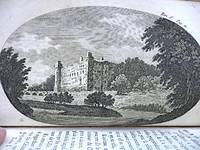
William GILPIN
Observations Pittoresques sur différentes parties de l'Angleterre particulièrement sur les montagnes et les lacs du Cumberland et du Westmoreland. Traduit de l'anglais sur la troisième édition par M. Guedon de Berchere
à Paris: Chez Defer de Maisonneuve 1789. Fine. Chez Defer de Maisonneuve à Paris 1789 12 x 19.30 cm 2 volumes reliés French first edition very rare. Illustrated with 28 plates including 2 containing two figures in Volume 2 15 for volume I and 13 for volume II as announced by the description of figures at the beginning of the work. Most of these plates are in aquatint and were drawn by the author. Some maps. One copy at the Bibliothèque Nationale de France nothing in French or English catalogues. The second French edition appeared in 1801. Contemporary full wine-colored sheep binding. Smooth spine with romantic tooling along the length uniformly sunned. Boards stamped with a large romantic plate in blind. Joints cracked. Institution Chapusot stamped at foot. Rubbing. This journey to England is the work of painter William Gilpin 1724-1804 who focused particularly on describing English landscapes by comparing them to other European countries. According to Larousse he was the first to travel through England as a true artist and who gave an exact description of the country's picturesque sites. To the faithfulness of the picture he adds the richness of color qualities which are not always found in those who have followed in his footsteps"" Larousse. Chez Defer de Maisonneuve hardcover
Référence libraire : 28995
|
|
|
COLLECTIF
L'Occident N°83
Paris: L'Occident 1908. Fine. L'Occident Paris Octobre 1908 16.50 x 25 cm agrafé First edition. Contributions by F. Fagus T. de Visan M. Griveau A. Cloüart. Light marginal worming to the second cover otherwise a handsome copy. L'Occident unknown
Référence libraire : 29323

|
|
|
COLLECTIF
Poésie cahiers mensuels illustrés N° de Mars 1929
Paris: Imprimerie d'art Le croquis 1929. Fine. Imprimerie d'art Le croquis Paris Mars 1929 22.50 x 28.50 cm agrafé First edition. Contributions by T. Klingsor E. Vitta P. Lebesgue O. Charpentier V. Margueritte. Issue illustrated with a self-portrait by T. Klingsor and an autograph facsimile. Imprimerie d'art Le croquis unknown
Référence libraire : 29368

|
|
|
Amedee JAUBERT
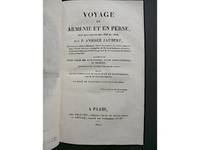
Voyage en Arménie et en Perse fait dans les années 1805 et 1806 par P. Amédée Jaubert
à Paris: Chez Pelicieret Nepveu 1821. Fine. Chez Pelicier et Nepveu à Paris 1821 12.50 x 20.50 cm relié First edition rare illustrated with a very large folding map of the regions between Constantinople and Tehran and 9 lithographs by Aubry Vernet. and a frontispiece portrait of the Persian prince Albas Mirza. Restoration period half light brown sheep binding. Smooth spine decorated with fillets and tools; roulette at foot. Marbled edges. Rubbing to boards but handsome copy with perfectly fresh paper. Amédé Jaubert orientalist was first taken by Napoleon to Egypt where he served as interpreter; in 1805 he was entrusted with an important diplomatic mission to Iran where he was to negotiate with the Shah to establish France's position in that region. During his journey he was imprisoned by the Pasha of Bayazid and thrown into a cistern for three months. The travel account describes many regions that had never been visited by Europeans. Chez Pelicieret Nepveu hardcover
Référence libraire : 29739
|
|
|
Theophile GAUTIER
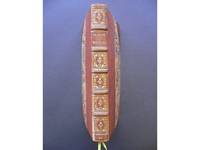
Militona
Paris: Librairie Conquet 1887. Fine. Librairie Conquet Paris 1887 14.50 x 21.50 cm relié First edition illustrated with a portrait and ten fine engravings by Adrien Moreau eight of which are full-page engraved by A. Lamothe. Limited to 500 copies numbered 160 one of 349 on petit papier Velin du marais. The first 150 copies are on Grand Velin or Japan paper. Contemporary half brown glazed morocco binding with corners signed David. Spine with raised bands handsomely decorated date at foot. Orange covers preserved. At the end of the work is bound the prospectus comprising one engraving and one page of text. Foxing on the half-title and portrait thereafter a perfectly fresh copy. Carteret IV-178 ""Esteemed and sought-after publication"". Librairie Conquet hardcover
Référence libraire : 29083
|
|
|
COLLECTIF
Poésie cahiers mensuels illustrés N°de Septembre 1927 de la 6ème année
Paris: Imprimerie d'art Le croquis 1927. Fine. Imprimerie d'art Le croquis Paris Septembre 1927 22.50 x 28.50 cm agrafé First edition. Contributions by E. Guérin O. Charpentier G.A. d'Orfou G. Bonnamour. Issue illustrated with a portrait of A. de Musset by A. Margat and a facsimile autograph. Handsome copy. Imprimerie d'art Le croquis unknown
Référence libraire : 29371

|
|
|
Oscar ZEBROWSKI
Essai sur les principes fondamentaux de la cosmologie
Paris & Toulouse: LeiberWoynicz 1866. Fine. Leiber Woynicz Paris & Toulouse 1866 14.50 x 22 cm broché First edition. Work illustrated with figures in the text. Two tiny lacks at head and foot of spine minimal marginal tears without loss to boards handsome interior condition. Rare. LeiberWoynicz hardcover
Référence libraire : 29490

|
|
|
Dominique VIVANT DENON - DUPARC (sculpsit)
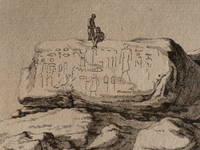
Voyage dans la Basse et Haute Egypte : 1. Blocs de granit. 2. Carrières de granit. Planche 68.<br />
Paris: Didot 1803. Fine. Didot Paris 1803 40 x 54 cm une feuille Original unshaved full-page etching from the Imperial edition of the Description de l'Égypte or Recueil des observations et recherches faites en Égypte pendant l'expédition française publié par les ordres de Sa Majesté l'Empereur Napoléon le Grand A Collection of the observations and research carried out in Egypt during the French expedition published on the orders of his Majesty the Emperor Napoleon the Great'.Produced between February 1802 and 1830 on the orders of Naopleon Bonaparte and published between 1809 and 1828 1000 copies were printed and distributed to institutions on vergé paper with an 'Égypte ancienne et moderne' watermark visible when held up to the light. Light marginal spotting not touching image otherwise in very fresh fine condition. An engraving from the Description de l'Egypte one of the masterpieces of French printing and the birth of a new field: Egyptology. A gigantic survey of Egypt at the time of Bonaparte's conquests in 1798 and 1799 the work is divided into 13 volumes of engravings making up 892 plates of which 72 colored as well as presenting the splendors of the Egypt of the Pharaohs in 9 volumes. The other volumes discuss natural history and present a fascinating portrait of Coptic and Islamic Egypt as it was seen by Bonaparte's Eastern Armies. The Egyptian campaign' militarily a disaster demonstrates through the engravings of the Description d'Egypte the scientific success it nonetheless became thanks to the 167 expert members of the Commission of the Sciences and Arts of the Institut d'Egypte Egyptian Institute who followed Napoleon's army. The Institut gathered together in Egypt the mathematician Monge the chemist Berthollet the naturalist Geoffroy Saint-Hilaire as well as numerous artists engineers architects and doctors. They were tasked with re-discovering modern and ancient Egypt and displaying its natural treasures as well as the know-how of its inhabitants.This edition the so-called Imperial edition of the plates for the Description de l'Egypte was printed in four large formats two of which were specially created for it and christened Moyen-Egypte and Grand-Egypte. A special press was built to print it the process extending over 20 years from 1809 to 1829. The Imperial edition proved so popular that a second edition this time in black and white and without the Egypte ancienne et moderne watermark known as the Royal Edition was published during the Restoration by the printing house of C.-L.-F. Panckoucke Paris.The engravings of the Description d'Egypte owe a great deal to Baron Dominique-Vivant Denon illustrator diplomat collector and later Director of the Musée Napoléon the Louvre. His exploration of the South of Egypt gave Bonaparte the idea of sending the experts of the Institut there thus creating a faithful and complete portrait of the area. This was the research gathered together from 1802 in the mammoth Description de L'Egypte.Denon embarked on this story of archeological exploration at the age of 51 reaching first Alexandria and then Cairo before exploring Upper Egypt. Along with the members of the Institut d'Egypte the Natural History Museum's painter H.J. Redouté brother of Pierre-Joseph Redouté author of Roses the mineralogist Dolomiue and the draughtsman Joly Denon then explored the Nile Delta and Lower Egypt. When however he joined the 21st Light Infantry Regiment as it marched across Upper Egypt in pursuit of the retreating Mameluks in November 1798 he found himself the only civilian. In the very midst of the battle itself he reeled off sketches of the works of art that peppered his path right up to the threshold of the Sudan. He said that he had crossed a country that is apart from its name entirely unknown to Europeans and therefore everything was worth describing Voyages dans la Basse et la Haute Egypte pendant les campagnes de Bonaparte en 1798 e Didot unknown
Référence libraire : 29705
|
|
|
Dominique VIVANT DENON - Hyacinthe LEGRAND (sculpsit) - Jean DUPLESSIS-BERTAUX
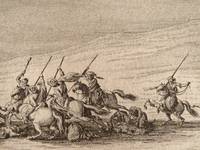
Voyage dans la Basse et Haute Egypte : 1. Tombeaux des Khalyfes près du Caire. 2. Attaque d'Arabes près les murs du Caire. Planche 24.<br />
Paris: Didot 1803. Fine. Didot Paris 1803 40.50 x 54 cm une feuille Original unshaved full-page etching from the Imperial edition of the Description de l'Égypte or Recueil des observations et recherches faites en Égypte pendant l'expédition française publié par les ordres de Sa Majesté l'Empereur Napoléon le Grand A Collection of the observations and research carried out in Egypt during the French expedition published on the orders of his Majesty the Emperor Napoleon the Great'.Produced between February 1802 and 1830 on the orders of Naopleon Bonaparte and published between 1809 and 1828 1000 copies were printed and distributed to institutions on vergé paper with an 'Égypte ancienne et moderne' watermark visible when held up to the light. Light marginal spotting not touching image otherwise in very fresh fine condition. An engraving from the Description de l'Egypte one of the masterpieces of French printing and the birth of a new field: Egyptology. A gigantic survey of Egypt at the time of Bonaparte's conquests in 1798 and 1799 the work is divided into 13 volumes of engravings making up 892 plates of which 72 colored as well as presenting the splendors of the Egypt of the Pharaohs in 9 volumes. The other volumes discuss natural history and present a fascinating portrait of Coptic and Islamic Egypt as it was seen by Bonaparte's Eastern Armies. The Egyptian campaign' militarily a disaster demonstrates through the engravings of the Description d'Egypte the scientific success it nonetheless became thanks to the 167 expert members of the Commission of the Sciences and Arts of the Institut d'Egypte Egyptian Institute who followed Napoleon's army. The Institut gathered together in Egypt the mathematician Monge the chemist Berthollet the naturalist Geoffroy Saint-Hilaire as well as numerous artists engineers architects and doctors. They were tasked with re-discovering modern and ancient Egypt and displaying its natural treasures as well as the know-how of its inhabitants.This edition the so-called Imperial edition of the plates for the Description de l'Egypte was printed in four large formats two of which were specially created for it and christened Moyen-Egypte and Grand-Egypte. A special press was built to print it the process extending over 20 years from 1809 to 1829. The Imperial edition proved so popular that a second edition this time in black and white and without the Egypte ancienne et moderne watermark known as the Royal Edition was published during the Restoration by the printing house of C.-L.-F. Panckoucke Paris.The engravings of the Description d'Egypte owe a great deal to Baron Dominique-Vivant Denon illustrator diplomat collector and later Director of the Musée Napoléon the Louvre. His exploration of the South of Egypt gave Bonaparte the idea of sending the experts of the Institut there thus creating a faithful and complete portrait of the area. This was the research gathered together from 1802 in the mammoth Description de L'Egypte.Denon embarked on this story of archeological exploration at the age of 51 reaching first Alexandria and then Cairo before exploring Upper Egypt. Along with the members of the Institut d'Egypte the Natural History Museum's painter H.J. Redouté brother of Pierre-Joseph Redouté author of Roses the mineralogist Dolomiue and the draughtsman Joly Denon then explored the Nile Delta and Lower Egypt. When however he joined the 21st Light Infantry Regiment as it marched across Upper Egypt in pursuit of the retreating Mameluks in November 1798 he found himself the only civilian. In the very midst of the battle itself he reeled off sketches of the works of art that peppered his path right up to the threshold of the Sudan. He said that he had crossed a country that is apart from its name entirely unknown to Europeans and therefore everything was worth describing Voyages dans la Basse et la Haute Egypte pendant les campagnes de Bonaparte en 179 Didot unknown
Référence libraire : 29647
|
|
|
Dominique VIVANT DENON - BERTHAULT (sculpsit)
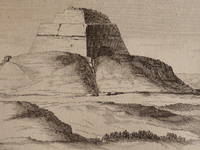
Voyage dans la Basse et Haute Egypte : 1. Pyramide d'Ellahoun. 2. Vue de la Pyramide de Méïdoum. 3. Pyramide de Méïdoum. 4. Pyramide de Ssakarah. Planche 26.<br />
Paris: Didot 1803. Fine. Didot Paris 1803 40.50 x 54 cm une feuille Original unshaved full-page etching from the Imperial edition of the Description de l'Égypte or Recueil des observations et recherches faites en Égypte pendant l'expédition française publié par les ordres de Sa Majesté l'Empereur Napoléon le Grand A Collection of the observations and research carried out in Egypt during the French expedition published on the orders of his Majesty the Emperor Napoleon the Great'.Produced between February 1802 and 1830 on the orders of Naopleon Bonaparte and published between 1809 and 1828 1000 copies were printed and distributed to institutions on vergé paper with an 'Égypte ancienne et moderne' watermark visible when held up to the light. Light marginal spotting not touching image otherwise in very fresh fine condition. An engraving from the Description de l'Egypte one of the masterpieces of French printing and the birth of a new field: Egyptology. A gigantic survey of Egypt at the time of Bonaparte's conquests in 1798 and 1799 the work is divided into 13 volumes of engravings making up 892 plates of which 72 colored as well as presenting the splendors of the Egypt of the Pharaohs in 9 volumes. The other volumes discuss natural history and present a fascinating portrait of Coptic and Islamic Egypt as it was seen by Bonaparte's Eastern Armies. The Egyptian campaign' militarily a disaster demonstrates through the engravings of the Description d'Egypte the scientific success it nonetheless became thanks to the 167 expert members of the Commission of the Sciences and Arts of the Institut d'Egypte Egyptian Institute who followed Napoleon's army. The Institut gathered together in Egypt the mathematician Monge the chemist Berthollet the naturalist Geoffroy Saint-Hilaire as well as numerous artists engineers architects and doctors. They were tasked with re-discovering modern and ancient Egypt and displaying its natural treasures as well as the know-how of its inhabitants.This edition the so-called Imperial edition of the plates for the Description de l'Egypte was printed in four large formats two of which were specially created for it and christened Moyen-Egypte and Grand-Egypte. A special press was built to print it the process extending over 20 years from 1809 to 1829. The Imperial edition proved so popular that a second edition this time in black and white and without the Egypte ancienne et moderne watermark known as the Royal Edition was published during the Restoration by the printing house of C.-L.-F. Panckoucke Paris.The engravings of the Description d'Egypte owe a great deal to Baron Dominique-Vivant Denon illustrator diplomat collector and later Director of the Musée Napoléon the Louvre. His exploration of the South of Egypt gave Bonaparte the idea of sending the experts of the Institut there thus creating a faithful and complete portrait of the area. This was the research gathered together from 1802 in the mammoth Description de L'Egypte.Denon embarked on this story of archeological exploration at the age of 51 reaching first Alexandria and then Cairo before exploring Upper Egypt. Along with the members of the Institut d'Egypte the Natural History Museum's painter H.J. Redouté brother of Pierre-Joseph Redouté author of Roses the mineralogist Dolomiue and the draughtsman Joly Denon then explored the Nile Delta and Lower Egypt. When however he joined the 21st Light Infantry Regiment as it marched across Upper Egypt in pursuit of the retreating Mameluks in November 1798 he found himself the only civilian. In the very midst of the battle itself he reeled off sketches of the works of art that peppered his path right up to the threshold of the Sudan. He said that he had crossed a country that is apart from its name entirely unknown to Europeans and therefore everything was worth describing Voyages dans la Basse et la Haute Egypte pendant les campagnes de Bonaparte en 179 Didot unknown
Référence libraire : 29648
|
|
|
Edmond JABES
Le parcours
Paris: Gallimard 1985. Fine. Gallimard Paris 1985 15 x 22 cm broché First edition one of 22 numbered copies on vélin d'Arches the only large paper copies. Two small traces of sunning not serious to head and to foot of spine a good copy. Gallimard unknown
Référence libraire : 29424

|
|
|
Marcel ACHARD
Je ne vous aime pas. - La femme silencieuse
Paris: Nrf 1926. Fine. Nrf Paris 1926 12 x 19 cm broché First edition one of 894 numbered copies on pur fil the only deluxe copies with 109 reimposed. Handsome copy. Nrf unknown
Référence libraire : 29288

|
|
|
Dominique VIVANT DENON - REVILLE (sculpsit)
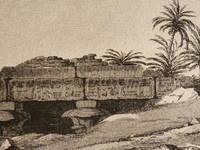
Voyage dans la Basse et Haute Egypte : 1. Ruines d'un temple à Syéné. 3. Ruines d'un des temples de l'isle Eléphantine. Planche 66.<br />
Paris: Didot 1803. Fine. Didot Paris 1803 40.50 x 54 cm une feuille Original unshaved full-page etching from the Imperial edition of the Description de l'Égypte or Recueil des observations et recherches faites en Égypte pendant l'expédition française publié par les ordres de Sa Majesté l'Empereur Napoléon le Grand A Collection of the observations and research carried out in Egypt during the French expedition published on the orders of his Majesty the Emperor Napoleon the Great'.Produced between February 1802 and 1830 on the orders of Naopleon Bonaparte and published between 1809 and 1828 1000 copies were printed and distributed to institutions on vergé paper with an 'Égypte ancienne et moderne' watermark visible when held up to the light. Light marginal spotting not touching image otherwise in very fresh fine condition. An engraving from the Description de l'Egypte one of the masterpieces of French printing and the birth of a new field: Egyptology. A gigantic survey of Egypt at the time of Bonaparte's conquests in 1798 and 1799 the work is divided into 13 volumes of engravings making up 892 plates of which 72 colored as well as presenting the splendors of the Egypt of the Pharaohs in 9 volumes. The other volumes discuss natural history and present a fascinating portrait of Coptic and Islamic Egypt as it was seen by Bonaparte's Eastern Armies. The Egyptian campaign' militarily a disaster demonstrates through the engravings of the Description d'Egypte the scientific success it nonetheless became thanks to the 167 expert members of the Commission of the Sciences and Arts of the Institut d'Egypte Egyptian Institute who followed Napoleon's army. The Institut gathered together in Egypt the mathematician Monge the chemist Berthollet the naturalist Geoffroy Saint-Hilaire as well as numerous artists engineers architects and doctors. They were tasked with re-discovering modern and ancient Egypt and displaying its natural treasures as well as the know-how of its inhabitants.This edition the so-called Imperial edition of the plates for the Description de l'Egypte was printed in four large formats two of which were specially created for it and christened Moyen-Egypte and Grand-Egypte. A special press was built to print it the process extending over 20 years from 1809 to 1829. The Imperial edition proved so popular that a second edition this time in black and white and without the Egypte ancienne et moderne watermark known as the Royal Edition was published during the Restoration by the printing house of C.-L.-F. Panckoucke Paris.The engravings of the Description d'Egypte owe a great deal to Baron Dominique-Vivant Denon illustrator diplomat collector and later Director of the Musée Napoléon the Louvre. His exploration of the South of Egypt gave Bonaparte the idea of sending the experts of the Institut there thus creating a faithful and complete portrait of the area. This was the research gathered together from 1802 in the mammoth Description de L'Egypte.Denon embarked on this story of archeological exploration at the age of 51 reaching first Alexandria and then Cairo before exploring Upper Egypt. Along with the members of the Institut d'Egypte the Natural History Museum's painter H.J. Redouté brother of Pierre-Joseph Redouté author of Roses the mineralogist Dolomiue and the draughtsman Joly Denon then explored the Nile Delta and Lower Egypt. When however he joined the 21st Light Infantry Regiment as it marched across Upper Egypt in pursuit of the retreating Mameluks in November 1798 he found himself the only civilian. In the very midst of the battle itself he reeled off sketches of the works of art that peppered his path right up to the threshold of the Sudan. He said that he had crossed a country that is apart from its name entirely unknown to Europeans and therefore everything was worth describing Voyages dans la Basse et la Haute Egypte pendant les campagnes de Bonaparte en 179 Didot unknown
Référence libraire : 29703
|
|
|
Richard WAGNER
Lettres à Emile Heckel
Paris: Charpentier 1929. Fine. Charpentier Paris 1929 12 x 19 cm broché First edition on ordinary paper of the French translation established by Louis Schneider. Signed autograph inscription by the translator. Small lacks to head of spine which also has a small tear at foot. Charpentier unknown
Référence libraire : 29005

|
|
|
Julien GRACQ
Le roi pêcheur
Paris: José Corti 1948. Fine. José Corti Paris 1948 & 1990-1991 12.50 x 19 cm broché & trois feuillets First edition one of 60 numbered copies on pure thread paper the only deluxe copies along with 45 Marais. We include with our copy three autograph letters signed by the author regarding the theatrical performances of ""Le Roi Pêcheur"" one page each and dated respectively July 26 1990 December 28 1990 and August 2 1991 Saint Florent le Vieil. The letters addressed to the administration of the Théâtre des Célestins concern the theatrical performance of Le Roi Pêcheur Julien Gracq's sole and only play written in 1942-1943. In the first letter the author gives his agreement regarding the conditions set by the Theatre concerning his rights on the performances but declares himself ""hostile to the exclusive authorization for all of France requested by the Théâtre des Célestins until December 31 1993."" In the second letter he requests a copy of the contract he signed with M. Lucet then director of the Théâtre des Célestins. In the third Julien Gracq requests a modification of this contract on the clause concerning the duration of exclusive authorization and provides practical indications regarding the payment of his rights. Date stamps from the administration. Manuscript notes in another hand in the margins of the last two letters secretary. Important manuscript correspondence concerning the first theatrical performances of this play since the failure of its creation in 1949. Exceptional ensemble. José Corti unknown
Référence libraire : 29282

|
|
|
Dominique VIVANT DENON - REVILLE (sculpsit)
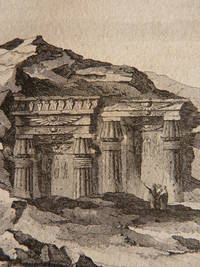
Voyage dans la Basse et Haute Egypte : 1. Tombeaux dans les Carrieres de Silsilis. 2. 3. et 4. Figures sculptées dans les tombeaux. Planche 76.<br />
Paris: Didot 1803. Fine. Didot Paris 1803 40 x 54 cm une feuille Original unshaved full-page etching from the Imperial edition of the Description de l'Égypte or Recueil des observations et recherches faites en Égypte pendant l'expédition française publié par les ordres de Sa Majesté l'Empereur Napoléon le Grand A Collection of the observations and research carried out in Egypt during the French expedition published on the orders of his Majesty the Emperor Napoleon the Great'.Produced between February 1802 and 1830 on the orders of Naopleon Bonaparte and published between 1809 and 1828 1000 copies were printed and distributed to institutions on vergé paper with an 'Égypte ancienne et moderne' watermark visible when held up to the light. Light marginal spotting not touching image otherwise in very fresh fine condition. An engraving from the Description de l'Egypte one of the masterpieces of French printing and the birth of a new field: Egyptology. A gigantic survey of Egypt at the time of Bonaparte's conquests in 1798 and 1799 the work is divided into 13 volumes of engravings making up 892 plates of which 72 colored as well as presenting the splendors of the Egypt of the Pharaohs in 9 volumes. The other volumes discuss natural history and present a fascinating portrait of Coptic and Islamic Egypt as it was seen by Bonaparte's Eastern Armies. The Egyptian campaign' militarily a disaster demonstrates through the engravings of the Description d'Egypte the scientific success it nonetheless became thanks to the 167 expert members of the Commission of the Sciences and Arts of the Institut d'Egypte Egyptian Institute who followed Napoleon's army. The Institut gathered together in Egypt the mathematician Monge the chemist Berthollet the naturalist Geoffroy Saint-Hilaire as well as numerous artists engineers architects and doctors. They were tasked with re-discovering modern and ancient Egypt and displaying its natural treasures as well as the know-how of its inhabitants.This edition the so-called Imperial edition of the plates for the Description de l'Egypte was printed in four large formats two of which were specially created for it and christened Moyen-Egypte and Grand-Egypte. A special press was built to print it the process extending over 20 years from 1809 to 1829. The Imperial edition proved so popular that a second edition this time in black and white and without the Egypte ancienne et moderne watermark known as the Royal Edition was published during the Restoration by the printing house of C.-L.-F. Panckoucke Paris.The engravings of the Description d'Egypte owe a great deal to Baron Dominique-Vivant Denon illustrator diplomat collector and later Director of the Musée Napoléon the Louvre. His exploration of the South of Egypt gave Bonaparte the idea of sending the experts of the Institut there thus creating a faithful and complete portrait of the area. This was the research gathered together from 1802 in the mammoth Description de L'Egypte.Denon embarked on this story of archeological exploration at the age of 51 reaching first Alexandria and then Cairo before exploring Upper Egypt. Along with the members of the Institut d'Egypte the Natural History Museum's painter H.J. Redouté brother of Pierre-Joseph Redouté author of Roses the mineralogist Dolomiue and the draughtsman Joly Denon then explored the Nile Delta and Lower Egypt. When however he joined the 21st Light Infantry Regiment as it marched across Upper Egypt in pursuit of the retreating Mameluks in November 1798 he found himself the only civilian. In the very midst of the battle itself he reeled off sketches of the works of art that peppered his path right up to the threshold of the Sudan. He said that he had crossed a country that is apart from its name entirely unknown to Europeans and therefore everything was worth describing Voyages dans la Basse et la Haute Egypte pendant les campagnes de Bonaparte en 1798 e Didot unknown
Référence libraire : 29714
|
|
|
ANONYME
Iconographie de la faïence dictionnaire illustré de planches reproduisant en couleurs la note dominante des principales fabriques le nom des artistes céramistes et les localités où ils ont travaillé; enfin les marques qui se rencontrent le plus ordinairement sous les faïences de tous les pays et les font mieux reconnaître
Paris: Lib. Dorbon ainé 1935. Fine. Lib. Dorbon ainé Paris s. d. 14 x 18.50 cm reliure de l'éditeur First edition. Publisher's full vellum-style cardboard binding small lacks to head and foot of spine corners bumped and edges rubbed rear board rubbed pleasant interior condition. Work illustrated with 13 unpublished colored drawings by Mareschal. Light dampstain to foot of some pages. Rare. Lib. Dorbon ainé hardcover
Référence libraire : 29474

|
|
|
(Leopold Sedar SENGHOR) - Genevieve LEBAUD
Léopold Sédar Senghor ou la poésie du royaume de l'enfance
Dakar & Abidjan: Les Nouvelles Editions Africaines 1976. Fine. Les Nouvelles Editions Africaines Dakar & Abidjan 1976 13.50 x 21 cm broché First edition of which there were no deluxe copies. Autograph inscription signed by Léopold Sédar Senghor with an additional fine inscription by Geneviève Lebaud. Some reading marks in black ink in the text photographic cover. Les Nouvelles Editions Africaines unknown
Référence libraire : 28973

|
|
|
COLLECTIF
L'Occident N°15
Paris: L'Occident 1903. Fine. L'Occident Paris Février 1903 16.50 x 25 cm broché First edition. Contributions by A. Le Braz J.A.D. Ingres with unpublished letters J. Laforgue ""Unpublished Correspondence"" F. Viélé-Griffin the marquis. Minor spotting of no consequence to second cover pleasant copy. L'Occident unknown
Référence libraire : 29324

|
|
|
Abbe Laurent BORDELON
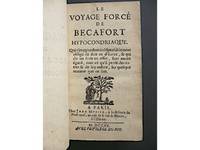
Le voyage forcé de Becafort hypocondriaque. Qui s'imagine être indispensablement obligé de dire ou d'écrire & qui dit ou écrit en effet sans aucun égard tout ce qu'il pense des autres & de lui-même sur quelque matière que ce soit
à Paris: Chez Jean Musier 1709. Fine. Chez Jean Musier à Paris 1709 9 x 16 cm relié The rare first edition. Modern cream parchment paper boards binding. Black sheep title label. Like all satirical works by Abbé Bordelon this is a curious and unclassifiable work in which a narrator travels in the company of Becafort relating his thoughts speeches and dialogues; the work teems with criticisms and reflections on social progress women's independence the occult sciences. It is a journey without any consideration for the journey itself warns the narrator. Chez Jean Musier hardcover
Référence libraire : 29675
|
|
|
Emmanuel COSQUIN
La légende du page de Sainte Elisabeth de Portugal et les nouveaux documents orientaux
Paris: Aux bureaux de la Revue des questions historiques 1912. Fine. Aux bureaux de la Revue des questions historiques Paris 1912 16.50 x 25.50 cm broché The first edition published in a small number of copies of this offprint. Autograph inscription by Emmanuel Cosquin at the head of the title page. Boards detached with some lacks handsome interior condition. Aux bureaux de la Revue des questions historiques hardcover
Référence libraire : 29544

|
|
|
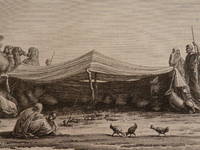
Dominique VIVANT DENON - BALTARD (sculpsit)
Voyage dans la Basse et Haute Egypte : 1. Tente d'Arabes. 2. Plan du Portique. 3. Portique du temple de Latopolis à Esné. Planche 54.<br />
Paris: Didot 1803. Fine. Didot Paris 1803 40.50 x 54 cm une feuille Original unshaved full-page etching from the Imperial edition of the Description de l'Égypte or Recueil des observations et recherches faites en Égypte pendant l'expédition française publié par les ordres de Sa Majesté l'Empereur Napoléon le Grand A Collection of the observations and research carried out in Egypt during the French expedition published on the orders of his Majesty the Emperor Napoleon the Great'.Produced between February 1802 and 1830 on the orders of Naopleon Bonaparte and published between 1809 and 1828 1000 copies were printed and distributed to institutions on vergé paper with an 'Égypte ancienne et moderne' watermark visible when held up to the light. Light marginal spotting not touching image otherwise in very fresh fine condition. An engraving from the Description de l'Egypte one of the masterpieces of French printing and the birth of a new field: Egyptology. A gigantic survey of Egypt at the time of Bonaparte's conquests in 1798 and 1799 the work is divided into 13 volumes of engravings making up 892 plates of which 72 colored as well as presenting the splendors of the Egypt of the Pharaohs in 9 volumes. The other volumes discuss natural history and present a fascinating portrait of Coptic and Islamic Egypt as it was seen by Bonaparte's Eastern Armies. The Egyptian campaign' militarily a disaster demonstrates through the engravings of the Description d'Egypte the scientific success it nonetheless became thanks to the 167 expert members of the Commission of the Sciences and Arts of the Institut d'Egypte Egyptian Institute who followed Napoleon's army. The Institut gathered together in Egypt the mathematician Monge the chemist Berthollet the naturalist Geoffroy Saint-Hilaire as well as numerous artists engineers architects and doctors. They were tasked with re-discovering modern and ancient Egypt and displaying its natural treasures as well as the know-how of its inhabitants.This edition the so-called Imperial edition of the plates for the Description de l'Egypte was printed in four large formats two of which were specially created for it and christened Moyen-Egypte and Grand-Egypte. A special press was built to print it the process extending over 20 years from 1809 to 1829. The Imperial edition proved so popular that a second edition this time in black and white and without the Egypte ancienne et moderne watermark known as the Royal Edition was published during the Restoration by the printing house of C.-L.-F. Panckoucke Paris.The engravings of the Description d'Egypte owe a great deal to Baron Dominique-Vivant Denon illustrator diplomat collector and later Director of the Musée Napoléon the Louvre. His exploration of the South of Egypt gave Bonaparte the idea of sending the experts of the Institut there thus creating a faithful and complete portrait of the area. This was the research gathered together from 1802 in the mammoth Description de L'Egypte.Denon embarked on this story of archeological exploration at the age of 51 reaching first Alexandria and then Cairo before exploring Upper Egypt. Along with the members of the Institut d'Egypte the Natural History Museum's painter H.J. Redouté brother of Pierre-Joseph Redouté author of Roses the mineralogist Dolomiue and the draughtsman Joly Denon then explored the Nile Delta and Lower Egypt. When however he joined the 21st Light Infantry Regiment as it marched across Upper Egypt in pursuit of the retreating Mameluks in November 1798 he found himself the only civilian. In the very midst of the battle itself he reeled off sketches of the works of art that peppered his path right up to the threshold of the Sudan. He said that he had crossed a country that is apart from its name entirely unknown to Europeans and therefore everything was worth describing Voyages dans la Basse et la Haute Egypte pendant les campagnes de Bonaparte en 179 Didot unknown
Référence libraire : 29691
|
|
|
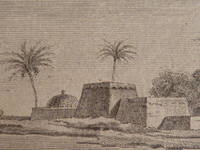
Dominique VIVANT DENON - L CROUTELLE (sculpsit)
Voyage dans la Basse et Haute Egypte : Vues de divers villages de la Basse-Egypte. Planche 18.<br />
Paris: Didot 1803. Fine. Didot Paris 1803 40.50 x 54 cm une feuille Original unshaved full-page etching from the Imperial edition of the Description de l'Égypte or Recueil des observations et recherches faites en Égypte pendant l'expédition française publié par les ordres de Sa Majesté l'Empereur Napoléon le Grand A Collection of the observations and research carried out in Egypt during the French expedition published on the orders of his Majesty the Emperor Napoleon the Great'.Produced between February 1802 and 1830 on the orders of Naopleon Bonaparte and published between 1809 and 1828 1000 copies were printed and distributed to institutions on vergé paper with an 'Égypte ancienne et moderne' watermark visible when held up to the light. Light marginal spotting not touching image otherwise in very fresh fine condition. An engraving from the Description de l'Egypte one of the masterpieces of French printing and the birth of a new field: Egyptology. A gigantic survey of Egypt at the time of Bonaparte's conquests in 1798 and 1799 the work is divided into 13 volumes of engravings making up 892 plates of which 72 colored as well as presenting the splendors of the Egypt of the Pharaohs in 9 volumes. The other volumes discuss natural history and present a fascinating portrait of Coptic and Islamic Egypt as it was seen by Bonaparte's Eastern Armies. The Egyptian campaign' militarily a disaster demonstrates through the engravings of the Description d'Egypte the scientific success it nonetheless became thanks to the 167 expert members of the Commission of the Sciences and Arts of the Institut d'Egypte Egyptian Institute who followed Napoleon's army. The Institut gathered together in Egypt the mathematician Monge the chemist Berthollet the naturalist Geoffroy Saint-Hilaire as well as numerous artists engineers architects and doctors. They were tasked with re-discovering modern and ancient Egypt and displaying its natural treasures as well as the know-how of its inhabitants.This edition the so-called Imperial edition of the plates for the Description de l'Egypte was printed in four large formats two of which were specially created for it and christened Moyen-Egypte and Grand-Egypte. A special press was built to print it the process extending over 20 years from 1809 to 1829. The Imperial edition proved so popular that a second edition this time in black and white and without the Egypte ancienne et moderne watermark known as the Royal Edition was published during the Restoration by the printing house of C.-L.-F. Panckoucke Paris.The engravings of the Description d'Egypte owe a great deal to Baron Dominique-Vivant Denon illustrator diplomat collector and later Director of the Musée Napoléon the Louvre. His exploration of the South of Egypt gave Bonaparte the idea of sending the experts of the Institut there thus creating a faithful and complete portrait of the area. This was the research gathered together from 1802 in the mammoth Description de L'Egypte.Denon embarked on this story of archeological exploration at the age of 51 reaching first Alexandria and then Cairo before exploring Upper Egypt. Along with the members of the Institut d'Egypte the Natural History Museum's painter H.J. Redouté brother of Pierre-Joseph Redouté author of Roses the mineralogist Dolomiue and the draughtsman Joly Denon then explored the Nile Delta and Lower Egypt. When however he joined the 21st Light Infantry Regiment as it marched across Upper Egypt in pursuit of the retreating Mameluks in November 1798 he found himself the only civilian. In the very midst of the battle itself he reeled off sketches of the works of art that peppered his path right up to the threshold of the Sudan. He said that he had crossed a country that is apart from its name entirely unknown to Europeans and therefore everything was worth describing Voyages dans la Basse et la Haute Egypte pendant les campagnes de Bonaparte en 179 Didot unknown
Référence libraire : 29639
|
|
|
Roger MARTIN DU GARD
Vieille France
Paris: Gallimard 1933. Fine. Gallimard Paris 1933 12 x 19 cm broché First edition one of 647 numbered copies on pur fil paper the only deluxe copies with 49 reimposed. A small stain at the foot of the front cover handsome copy. Gallimard unknown
Référence libraire : 28989

|
|
|
Rene JULLIAN
Caravage
Lyon & Paris: I.A.C. 1961. Fine. I.A.C. Lyon & Paris 1961 20.50 x 26 cm reliure de l'éditeur First edition one of the numbered copies on alfa paper the only deluxe copies. Signed autograph inscription by René Jullian. Publisher's full cardboard binding smooth spine illustrated front cover. Iconography and illustrations. Two joints slightly pinched otherwise handsome copy. I.A.C. unknown
Référence libraire : 29398

|
|
|
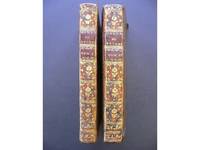
Nicolas BOINDIN
Oeuvres
à Paris: Chez Prault 1753. Fine. Chez Prault à Paris 1753 9.50 x 17 cm 2 volumes reliés First edition. Illustrated with two folding maps in the second volume showing the states of Roman tribes. Full grained calf binding. Smooth spine decorated. Red morocco title label and volume labels. A small lack to the cover of volume I. Pale and light yellow dampstain at beginning of work. Handsome copy. These works contain a memoir on the life of Boindin by Boindin himself his theatrical pieces volume II containing various studies and research by the author: on the sounds of language phonetic studies on Roman names on Roman tribes and finally on ancient theatre. Boindin was an essential figure in 18th-century intellectual life one of the central figures at café Procope where he was one of the principal debaters. His comedies enjoyed some success the first was written in collaboration with Houdar de la Motte; the various memoirs that compose volume II were presented by the author when he joined the Royal Academy of Inscriptions and Medals. Chez Prault unknown
Référence libraire : 29330
|
|
|
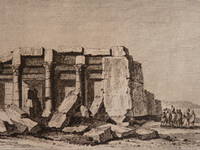
Dominique VIVANT DENON - COINY (sculpsit)
Voyage dans la Basse et Haute Egypte : 1. Temple voisin d'Esné ou Latopolis. 2. Djébéléïn ou les deux montagnes. Planche 52.<br />
Paris: Didot 1803. Fine. Didot Paris 1803 39.50 x 54 cm une feuille Original unshaved full-page etching from the Imperial edition of the Description de l'Égypte or Recueil des observations et recherches faites en Égypte pendant l'expédition française publié par les ordres de Sa Majesté l'Empereur Napoléon le Grand A Collection of the observations and research carried out in Egypt during the French expedition published on the orders of his Majesty the Emperor Napoleon the Great'.Produced between February 1802 and 1830 on the orders of Naopleon Bonaparte and published between 1809 and 1828 1000 copies were printed and distributed to institutions on vergé paper with an 'Égypte ancienne et moderne' watermark visible when held up to the light. Light marginal spotting not touching image otherwise in very fresh fine condition. An engraving from the Description de l'Egypte one of the masterpieces of French printing and the birth of a new field: Egyptology. A gigantic survey of Egypt at the time of Bonaparte's conquests in 1798 and 1799 the work is divided into 13 volumes of engravings making up 892 plates of which 72 colored as well as presenting the splendors of the Egypt of the Pharaohs in 9 volumes. The other volumes discuss natural history and present a fascinating portrait of Coptic and Islamic Egypt as it was seen by Bonaparte's Eastern Armies. The Egyptian campaign' militarily a disaster demonstrates through the engravings of the Description d'Egypte the scientific success it nonetheless became thanks to the 167 expert members of the Commission of the Sciences and Arts of the Institut d'Egypte Egyptian Institute who followed Napoleon's army. The Institut gathered together in Egypt the mathematician Monge the chemist Berthollet the naturalist Geoffroy Saint-Hilaire as well as numerous artists engineers architects and doctors. They were tasked with re-discovering modern and ancient Egypt and displaying its natural treasures as well as the know-how of its inhabitants.This edition the so-called Imperial edition of the plates for the Description de l'Egypte was printed in four large formats two of which were specially created for it and christened Moyen-Egypte and Grand-Egypte. A special press was built to print it the process extending over 20 years from 1809 to 1829. The Imperial edition proved so popular that a second edition this time in black and white and without the Egypte ancienne et moderne watermark known as the Royal Edition was published during the Restoration by the printing house of C.-L.-F. Panckoucke Paris.The engravings of the Description d'Egypte owe a great deal to Baron Dominique-Vivant Denon illustrator diplomat collector and later Director of the Musée Napoléon the Louvre. His exploration of the South of Egypt gave Bonaparte the idea of sending the experts of the Institut there thus creating a faithful and complete portrait of the area. This was the research gathered together from 1802 in the mammoth Description de L'Egypte.Denon embarked on this story of archeological exploration at the age of 51 reaching first Alexandria and then Cairo before exploring Upper Egypt. Along with the members of the Institut d'Egypte the Natural History Museum's painter H.J. Redouté brother of Pierre-Joseph Redouté author of Roses the mineralogist Dolomiue and the draughtsman Joly Denon then explored the Nile Delta and Lower Egypt. When however he joined the 21st Light Infantry Regiment as it marched across Upper Egypt in pursuit of the retreating Mameluks in November 1798 he found himself the only civilian. In the very midst of the battle itself he reeled off sketches of the works of art that peppered his path right up to the threshold of the Sudan. He said that he had crossed a country that is apart from its name entirely unknown to Europeans and therefore everything was worth describing Voyages dans la Basse et la Haute Egypte pendant les campagnes de Bonaparte en 179 Didot unknown
Référence libraire : 29689
|
|
|
Marcel JOUHANDEAU
De l'abjection
Paris: Gallimard 1939. Fine. Gallimard Paris 1939 14.50 x 19.50 cm broché First edition published anonymously printed in 1240 copies on châtaignier paper a Service de Presse advance copy. Marginal worming to front cover. Gallimard unknown
Référence libraire : 29067

|
|
|
Aime CESAIRE
Cadastre
Paris: Seuil 1961. Fine. Seuil Paris 1961 13.50 x 20.50 cm broché First collected edition one of 15 numbered copies on pur fil paper the only large paper copies. A very good copy. Rare. Seuil unknown
Référence libraire : 28893

|
|

 Recevoir par e-mail
 Télécharger en PDF
 Flux RSS
 Lien permanent


