Il sito di sole librerie professionali

‎Physique‎

Main

Numero di risultati : 18.395 (368 pagina/e)

Prima pagina Pagina precedente 1 ... 20 21 22 [23] 24 25 26 ... 74 122 170 218 266 314 362 ... 368 Pagina successiva Ultima pagina

‎"BEGUELIN, (N.).‎

‎Remarques et Observations sur les Couleurs Prismatiques et sur L'Analyse Physique, et Metaphysique de la Sensation des Couleurs en Général.‎

‎(Berlin, Haude et Spener, 1766). 4to. No wrappers, as issued in ""Mémoires de l'Academie Royale des Sciences et Belles-Lettres"", tome XX, pp. 297-363 and 3 folded engraved plates.‎

‎Together with: Premontval, de la Psychocratie ou de l'Empire et du Gouvernement...dans le Corps est composé (and) Formey, Nouvelles Considerations sur L'Union des deux Substances dans L'Homme...pp. 364-414.‎

Riferimento per il libraio : 31086

Livre Rare Book

Herman H. J. Lynge & Son
Copenhagen Denmark Dinamarca Dinamarca Danemark
[Books from Herman H. J. Lynge & Son]

€ 67,15 Informazioni/Compera

‎"BELL, ALEXANDER GRAHAM. - ""THE GREATEST INVENTION I HAVE EVER MADE"": THE PHOTOPHONE.‎

‎On the Production and Reproduction of Sound by Light. (Read before the American Association for the Advancement of Science, in Boston, August 27, 1880).‎

‎(New Haven), 1880. 8vo. Modern plain wrappers. In: American Journal of Science"", Third series, Vol. XX, No. 118, October 1880. Frontispiece-plate. Pp. 257-352 (entire issue offered). Bell's paper: pp. 305-324 and 11 textillustrations. A small stamp to verso of plate and the first leaf.‎

‎"BELL, ALEXANDER GRAHAM. - ""THE GREATEST INVENTION I HAVE EVER MADE"": THE PHOTOPHONE.‎

‎On the Production and Reproduction of Sound by Light. (Read before the American Association for the Advancement of Science, in Boston, August 27, 1880).‎

‎(New Haven), 1880. 8vo. Modern plain wrappers. In: American Journal of Science"", Third series, Vol. XX, No. 118, October 1880. Frontispiece-plate. Pp. 257-352 (entire issue offered). Bell's paper: pp. 305-324 and 11 textillustrations. A small stamp to verso of plate and the first leaf.‎

‎First printing of this important paper in which Bell describes his and Charles Sumner Tainter's, his assistent, invention of the Photophone or Radiophone, THE PROGENITOR OF MODERN FIBER OPTICS. This invention made possible the world's FIRST WIRELESS TELEPHONE MESSAGE, and the first call was sent from the Franklin Scool to the window of Bell's laboratory, some 213 meter away.""On June 3, 1880, Alexander Graham Bell transmitted the first wireless telephone message on his newly invented ""photophone."" Bell believed the photophone was his most important invention. The device allowed for the transmission of sound on a beam of light. Of the eighteen patents granted in Bell's name alone, and the twelve he shared with his collaborators, four were for the photophone. Bell's photophone worked by projecting voice through an instrument toward a mirror. Vibrations in the voice caused similar vibrations in the mirror. Bell directed sunlight into the mirror, which captured and projected the mirror's vibrations. The vibrations were transformed back into sound at the receiving end of the projection. The photophone functioned similarly to the telephone, except the photophone used light as a means of projecting the information, while the telephone relied on electricity."" (Mary Bellis).The first successful attempts were based upon the properties of selenium: ""The electric resistance of which varies with the degree of illumination to which it is exposed. Hence, given a transmitting instrument, such as a flexible mirror, by which the vibrations of a sound could throw into vibrations a beam of light, a receiver, consisting of sensitive selenium, forming part of an electric circuit with a battery and a telephone, should suffice to translate the varying intensities of light into corresponding varying intensities of electric current, and finally into vibrations of the telephone disk audible once more as sound."" (Prescott, George. Bell's Electric Speaking Telephone. 313 p.).‎

Riferimento per il libraio : 46951

Livre Rare Book

Herman H. J. Lynge & Son
Copenhagen Denmark Dinamarca Dinamarca Danemark
[Books from Herman H. J. Lynge & Son]

€ 1.141,55 Informazioni/Compera

‎"BELL, ALEXANDRE (ALEXANDER) GRAHAM. - BELL, ALEXANDER GRAHAM. - ""THE GREATEST INVENTION I HAVE EVER MADE"": THE PHOTOPHONE.‎

‎De la Production et de la Reproduction du Son par la Lumière. Mémoire lu à l'Association américaine pour l'avancement des Sciences, au Congrès de Boston, le 27 août 1880. (+) Les Récepteurs photophoniques de Sélénium. (Cette Note fait suite au M´wem...‎

‎Paris, G. Masson, 1880. 8vo. Contemp. hcalf, raised bands, gilt spine. Light wear along edges. Small stamps on verso of titlepage. In: ""Annales de Chimie et de Physique"", 5e Series, Tome 21. 576 pp. and 2 folded engraved plates. (Entire volume offered). Bell's paper: 399-430. With 11 fine textillustrations (showing the apparatus). Clean and fine.‎

‎"BELL, ALEXANDRE (ALEXANDER) GRAHAM. - BELL, ALEXANDER GRAHAM. - ""THE GREATEST INVENTION I HAVE EVER MADE"": THE PHOTOPHONE.‎

‎De la Production et de la Reproduction du Son par la Lumière. Mémoire lu à l'Association américaine pour l'avancement des Sciences, au Congrès de Boston, le 27 août 1880. (+) Les Récepteurs photophoniques de Sélénium. (Cette Note fait suite au M´wem...‎

‎Paris, G. Masson, 1880. 8vo. Contemp. hcalf, raised bands, gilt spine. Light wear along edges. Small stamps on verso of titlepage. In: ""Annales de Chimie et de Physique"", 5e Series, Tome 21. 576 pp. and 2 folded engraved plates. (Entire volume offered). Bell's paper: 399-430. With 11 fine textillustrations (showing the apparatus). Clean and fine.‎

‎First French version of ""On the Production and Reproduction of Sound by Light"" (the French version published in November and the English in October 1880) of this importent paper in which Bell describes his and Charles Sumner Tainter's, his assistent, invention of the Photophone or Radiophone, THE PROGENITOR OF MODERN FIBER OPTICS. This invention made possible the world's FIRST WIRELESS TELEPHONE MESSAGE, and the first call was sent from the Franklin Scool to the window of Bell's laboratory, some 213 meter away.Also with Breguet's importent paper on the Selenium used in the technology.""On June 3, 1880, Alexander Graham Bell transmitted the first wireless telephone message on his newly invented ""photophone."" Bell believed the photophone was his most important invention. The device allowed for the transmission of sound on a beam of light. Of the eighteen patents granted in Bell's name alone, and the twelve he shared with his collaborators, four were for the photophone. Bell's photophone worked by projecting voice through an instrument toward a mirror. Vibrations in the voice caused similar vibrations in the mirror. Bell directed sunlight into the mirror, which captured and projected the mirror's vibrations. The vibrations were transformed back into sound at the receiving end of the projection. The photophone functioned similarly to the telephone, except the photophone used light as a means of projecting the information, while the telephone relied on electricity."" (Mary Bellis).The first successful attempts were based upon the properties of selenium: ""The electric resistance of which varies with the degree of illumination to which it is exposed. Hence, given a transmitting instrument, such as a flexible mirror, by which the vibrations of a sound could throw into vibrations a beam of light, a receiver, consisting of sensitive selenium, forming part of an electric circuit with a battery and a telephone, should suffice to translate the varying intensities of light into corresponding varying intensities of electric current, and finally into vibrations of the telephone disk audible once more as sound."" (Prescott, George. Bell's Electric Speaking Telephone. 313 p.).‎

Riferimento per il libraio : 48149

Livre Rare Book

Herman H. J. Lynge & Son
Copenhagen Denmark Dinamarca Dinamarca Danemark
[Books from Herman H. J. Lynge & Son]

€ 671,50 Informazioni/Compera

‎"BELL, M. A. GRAHAM.‎

‎De la production du son par l'energie radiante. - [FIRST FRENCH PUBLICATION OF BELL'S PHOTOPHONE]‎

‎Paris, Imprimerie Gauthier-Villars, 1881. 8vo. Contemporary half calf, raised bands, gilt spine. Light wear along edges. Two small stamps on verso of title-page, and one on verso of last plate. In ""Annales de Chimie et de Physique"", Cinquiéme Series - Tome XXIII. 576 pp. + 3 plates. G. Bell's paper: pp. 397-432, pp. and 14 figures of experimental apparatus etc. The entiree volume offered. Fine and clean copy.‎

‎"BELL, M. A. GRAHAM.‎

‎De la production du son par l'energie radiante. - [FIRST FRENCH PUBLICATION OF BELL'S PHOTOPHONE]‎

‎Paris, Imprimerie Gauthier-Villars, 1881. 8vo. Contemporary half calf, raised bands, gilt spine. Light wear along edges. Two small stamps on verso of title-page, and one on verso of last plate. In ""Annales de Chimie et de Physique"", Cinquiéme Series - Tome XXIII. 576 pp. + 3 plates. G. Bell's paper: pp. 397-432, pp. and 14 figures of experimental apparatus etc. The entiree volume offered. Fine and clean copy.‎

‎First publication of the first French translation of Bell's ""On the Production and Reproduction of Sound by Light: the Photophone"", originally published in 1880. The device allowed for the transmission of sound on a beam of light, and Bell himself regarded this, not the telephone, to be his most important invention.""In the importance of the principles involved, I regard the photophone as the greatest invention I have ever made"" greater than the telephone."" Bell said in a 1921 interview. The photophone was the world's first wireless telephone communication and thereby anticipated Marconi's invention with several years.The first successful attempts were based upon the properties of selenium: ""The electric resistance of which varies with the degree of illumination to which it is exposed. Hence, given a transmitting instrument, such as a flexible mirror, by which the vibrations of a sound could throw into vibrations a beam of light, a receiver, consisting of sensitive selenium, forming part of an electric circuit with a battery and a telephone, should suffice to translate the varying intensities of light into corresponding varying intensities of electric current, and finally into vibrations of the telephone disk audible once more as sound."" (Prescott, George. Bell's Electric Speaking Telephone. 313 p.).Bell was so excited by his invention and its possibilities that he proposed that his second daughter should bear the name of the invention: Photophone. Fortunately for her, her mother was not quite as enthusiastic about the invention.‎

Riferimento per il libraio : 43072

Livre Rare Book

Herman H. J. Lynge & Son
Copenhagen Denmark Dinamarca Dinamarca Danemark
[Books from Herman H. J. Lynge & Son]

€ 382,75 Informazioni/Compera

‎"BELL, R. E. (+) M. H. JØRGENSEN.‎

‎Mean Lives of Positrons in Aluminum and the Alkali Metals.‎

‎(Montreal), 1960. 8vo. In the original yellow printed stapled wrappers. Offprint from ""Canadian Journal of Physics"", no. 38, 652, 1960. Very fine and clean. Pp. (2), 653-664.‎

‎"BELL, R. E. (+) M. H. JØRGENSEN.‎

‎Mean Lives of Positrons in Aluminum and the Alkali Metals.‎

‎(Montreal), 1960. 8vo. In the original yellow printed stapled wrappers. Offprint from ""Canadian Journal of Physics"", no. 38, 652, 1960. Very fine and clean. Pp. (2), 653-664.‎

‎Offprint of Bell and Jørgensen's important paper in which they observed complex decay in both alkali metals and aluminum.‎

Riferimento per il libraio : 51347

Livre Rare Book

Herman H. J. Lynge & Son
Copenhagen Denmark Dinamarca Dinamarca Danemark
[Books from Herman H. J. Lynge & Son]

€ 107,44 Informazioni/Compera

‎"BERNOULLI, (JACOB). - A NEW ERA IN THE MECHANICS OF ELASTICAL BODIES.‎

‎Veritable Hypothêse de la Résistance des Solides, Avec la Démonstration de la Coubure des corps qui sont Ressort. Lettre du 12. Mars 1705.‎

‎Paris, Jean Boudot, 1706. 4to. Without wrappers. Extracted from ""Mémoires de l'Academie des Sciences. Année 1705"". Pp. 176-186 and 1 folded engraved plate.‎

‎"BERNOULLI, (JOHANN). (+) NICOLAS (NIKOLAUS) BERNOULLI. - VIS-VIVA CONTROVERSY‎

‎Extrait D'une Lettre de M. Bernoulli, écrite de Basle 10. Janvier 1711, touchant la maniere de trouver les forces centrales dans des milieux resistans en raisons composée de leurs densites & des puissances quelques des vitesses du mobile. (+) Addition...‎

‎(Paris, L'Imprimerie Royale, 1714). 4to. Without wrappers. Extracted from ""Mémoires de l'Academie des Sciences. Année 1711"". Pp. 47-53 a. pp. 53-56 (Nicolas).‎

‎"BERNOULLI, (JOHANN). (+) NICOLAS (NIKOLAUS) BERNOULLI. - VIS-VIVA CONTROVERSY‎

‎Extrait D'une Lettre de M. Bernoulli, écrite de Basle 10. Janvier 1711, touchant la maniere de trouver les forces centrales dans des milieux resistans en raisons composée de leurs densites & des puissances quelques des vitesses du mobile. (+) Addition...‎

‎(Paris, L'Imprimerie Royale, 1714). 4to. Without wrappers. Extracted from ""Mémoires de l'Academie des Sciences. Année 1711"". Pp. 47-53 a. pp. 53-56 (Nicolas).‎

‎First appearance of an importent paper in mathematical physics. Bernoulli had shown that the principle of virtual velocities could be shown in analytical form. The principle can be derived from the energy principle and he applied this principle several times to mechanical systems of central forces. For these forces he applied the vis viva equation to the inverse two-body problem. For the corresponding problem of centrally accelerated motion in resisting medium he solved the differential equations and determined the central force in accordance with the Huygens formula(in the paper offered). - The Addenda by his his nephew, Nicolas Bernoulli, best known for the fundamental work ""Ars Conjectandi"" from 1713.‎

Riferimento per il libraio : 44748

Livre Rare Book

Herman H. J. Lynge & Son
Copenhagen Denmark Dinamarca Dinamarca Danemark
[Books from Herman H. J. Lynge & Son]

€ 201,45 Informazioni/Compera

‎"BERNOULLI, DANIEL. - CONSERVATION OF 'VIS VIVA'‎

‎Remarques sur le Principe de la Conservation des Forces Vives pris dans un sens General.‎

‎(Berlin, Haude et Spener, 1750). 4to. No wrappers, as issued in ""Mémoires de l'Academie Royale des Sciences et Belles-Lettres"", 1748, tome IV, Titlepage to the volume in red/black with engraved titlevignette a. pp. 356-364. A stamp on titlepage.c‎

‎First printing of this memoir. In various connections Bernoulli used the principle of the coservation of 'Vis Viva' within the main areas of mechanics. ""Similarly, in an essay (1747) on the motion of a heavenly body and the three-body problem he worked out from the first integral of Newton’s second law, which related the square of its velocity to, in effect, its level of potential under attraction. In a sequel study (1750, the paper offered) on the generality of the principle he included the case where the body was acted upon by more than one centre of force. This was a most unusual way of working within celestial mechanics"" Newton had rarely invoked energy equations or relationships, although he had also found results about external attraction and equipotential surfaces.""(I. Grattan-Guiness).‎

Riferimento per il libraio : 46428

Livre Rare Book

Herman H. J. Lynge & Son
Copenhagen Denmark Dinamarca Dinamarca Danemark
[Books from Herman H. J. Lynge & Son]

€ 201,45 Informazioni/Compera

‎"BERNOULLI, DANIEL. - CONSERVATION OF 'VIS VIVA'‎

‎Remarques sur le Principe de la Conservation des Forces Vives pris dans un sens General.‎

‎(Berlin, Haude et Spener, 1750). 4to. No wrappers, as issued in ""Mémoires de l'Academie Royale des Sciences et Belles-Lettres"", 1748, tome IV, Titlepage to the volume in red/black with engraved titlevignette a. pp. 356-364. A stamp on titlepage.c‎

‎"BERNOULLI, DANIEL. - CONSERVATION OF FORCES.‎

‎Nouveau Probleme de Mecanique resolu.‎

‎(Berlin, Haude et Spener, 1746). 4to. No wrappers, as issued in ""Mémoires de l'Academie Royale des Sciences et Belles-Lettres"", 1745, tome I. Pp. 54-70 and with halftitlepage to the section.‎

‎"BERNOULLI, DANIEL. - CONSERVATION OF FORCES.‎

‎Nouveau Probleme de Mecanique resolu.‎

‎(Berlin, Haude et Spener, 1746). 4to. No wrappers, as issued in ""Mémoires de l'Academie Royale des Sciences et Belles-Lettres"", 1745, tome I. Pp. 54-70 and with halftitlepage to the section.‎

‎First printing of an importent papeer in which Bernoulli gives his solution of the problem of a mass point constrained to slide within a rigid rotating body. His solution was obtained from other principles than Euler, who gave a solution at the same time, obtaining the same result. This paper was translated into German and reprinted in Ostwald’s Klassiker der Exacten Wissenschaften, no. 191.""The principle of areas and an extended version of the principle concerning the conservation of live force, both of which furnished integrals of Newton’s basic equations, were published by Bernoulli, probably with Euler’s assistance, in the Berlin Mémoires in 1745 and 1748. The principle of areas was used and clearly formulated almost simultaneously by Bernoulli and Euler in their treatments of the problem involving the movement of a tube rotating around a fixed point and containing freely moving bodies.!(DSB).The Bernoulli paper comes together with LEONHARD EULER ""De la Force de Percussion et de sa veritable Mesure. Traduit de Latin"" (Percussion and its true measurement), pp. 21-53, but lacking the plate. (Enestroem: E 82). An importent on the forces of percussions.‎

Riferimento per il libraio : 46463

Livre Rare Book

Herman H. J. Lynge & Son
Copenhagen Denmark Dinamarca Dinamarca Danemark
[Books from Herman H. J. Lynge & Son]

€ 201,45 Informazioni/Compera

‎"BERNOULLI, DANIEL. - ESTABLISHING THE FLUID EQUATION.‎

‎Theorema de Motu curuilineo corporum, quae resistentiam patiuntur velocitatis suae quadrato proportionalem una cum solutione problematis in Act. Lips: M: Nou 1728 propositi. (+) Experimenta Coram Societate Instituta in Confirmationem Theoriae Pression...‎

‎Petropoli, St. Petersburg, Typis Academiae, 1735. 4to. No wrappers. In: ""Classes Secunda continens Physica. Commentarii Academiae Scientiarum Imperialis Petropolitanae"", Tomus IV ad Annum 1729. The whole section of ""Physica""offered. And with the title-page to Tomus IV. With an engraved vignette. Pp. 119-283 pp., and 19 engraved plates. Bernoullis's papers: pp. 136-143, 1 engraved plate and pp. 194-201, 1 engraved plate. A small stamp on foot of titlepage.‎

‎"BERNOULLI, DANIEL. - THE HYDRODYNAMICS OF OCEAN CURRENTS.‎

‎Sur la nature et la Cause des Courans, et la meilleure Maniére de les déterminer. Pièce qui a remporté le Prix double, proposé par L'Academie Royale des Sciences, pour les années 1749 & 1751.‎

‎(Paris, 1769). 4to. Uncut in contemp. blue blank wrappers, inserted in later boards. Some fraying to margins and small tears to margin of titlepage. A punched stamp to titlepage ""Franklin Institute"" and a large paperlabel from the Institute pasted on the lower blank part of titlepage. 108 pp.‎

‎"BERNOULLI, JEAN.‎

‎Sur la Cohérence des Corps, Second (- Troisieme) Mémoire. (I. Problemes sur la Force et la Courbure des Lames élastiques. II. Problemes sur la Résistance des Poutres.).‎

‎(Berlin, Haude et Spener, 1768). 4to. No wrappers. Extracted from ""Mémoires de l'Academie Royale des Sciences et Belles-Lettres"", tome XXII, pp. 99-107 a. 1 folded engraved plate + pp. 108-116 a. 2 folded engraved plates.‎

‎"BERNOULLI, JEAN.‎

‎Sur la Cohérence des Corps, Second (- Troisieme) Mémoire. (I. Problemes sur la Force et la Courbure des Lames élastiques. II. Problemes sur la Résistance des Poutres.).‎

‎(Berlin, Haude et Spener, 1768). 4to. No wrappers. Extracted from ""Mémoires de l'Academie Royale des Sciences et Belles-Lettres"", tome XXII, pp. 99-107 a. 1 folded engraved plate + pp. 108-116 a. 2 folded engraved plates.‎

‎First appearance of two importent papers in the theory of elasticity of materials in which Bernoulli gives, for the first time, the solution to a main problem, and stating a formula which expresses the shape of the loaded beam without reference to the load acting or to the elastic properties of the materials.‎

Riferimento per il libraio : 45443

Livre Rare Book

Herman H. J. Lynge & Son
Copenhagen Denmark Dinamarca Dinamarca Danemark
[Books from Herman H. J. Lynge & Son]

€ 161,16 Informazioni/Compera

‎"BERRY, M.V. (MICHAEL VICTOR) - THE DISCOVERY OF THE ""BERRY-PHASE""‎

‎Quantal phase factors accompanying adiabatic changes.‎

‎London, Royal Society, 1984. Royal8vo. Full buckram, gilt lettering to spine.In: ""Proceedings of the Royal Society of London"", Series A, vol. 392. IV,478 pp. (Entire volume offered). Berry's paper: pp. 45-57. Clean and fine.‎

‎"BETHE, H.‎

‎Zur Theorie der Metalle. - [THE BETHE ANSATZ]‎

‎Berlin, Springer, 1931. 8vo. Bound in contemporary half cloth with gilt lettering, In ""Zeitschrift für Physik"", Band 71, 1931. Entire issue offered. Library stamp to title page and a three cm tear to upper front hindge, otherwise fine. Pp. 205-226. [Entire volume : VII, (1), 823 pp.].‎

‎"BETHE, H.‎

‎Zur Theorie der Metalle. - [THE BETHE ANSATZ]‎

‎Berlin, Springer, 1931. 8vo. Bound in contemporary half cloth with gilt lettering, In ""Zeitschrift für Physik"", Band 71, 1931. Entire volume offered. Library stamp to title page and a three cm tear to upper front hindge, otherwise fine. Pp. 205-226. [Entire volume : VII, (1), 823 pp.].‎

‎"BETHE, H.‎

‎Zur Theorie der Metalle. - [THE BETHE ANSATZ]‎

‎Berlin, Springer, 1931. 8vo. Bound in contemporary half cloth with gilt lettering, In ""Zeitschrift für Physik"", Band 71, 1931. Entire issue offered. Library stamp to title page and a three cm tear to upper front hindge, otherwise fine. Pp. 205-226. [Entire volume : VII, (1), 823 pp.].‎

‎First appearance of Bethe's paper containing his famous and much used method for finding the exact solutions of certain one-dimensional quantum many-body models. Bethe here found the exact eigenvalues and eigenvectors of the one-dimensional antiferromagnetic Heisenberg model Hamiltonian. Since then the method has been extended to other models in one dimension: Bose gas, Hubbard model, etc.‎

Riferimento per il libraio : 49052

Livre Rare Book

Herman H. J. Lynge & Son
Copenhagen Denmark Dinamarca Dinamarca Danemark
[Books from Herman H. J. Lynge & Son]

€ 295,46 Informazioni/Compera

‎"BETHE, H.‎

‎Zur Theorie der Metalle. - [THE BETHE ANSATZ]‎

‎Berlin, Springer, 1931. 8vo. Bound in contemporary half cloth with gilt lettering, In ""Zeitschrift für Physik"", Band 71, 1931. Entire volume offered. Library stamp to title page and a three cm tear to upper front hindge, otherwise fine. Pp. 205-226. [Entire volume : VII, (1), 823 pp.].‎

‎First appearance of Bethe's paper containing his famous and much used method for finding the exact solutions of certain one-dimensional quantum many-body models. Bethe here found the exact eigenvalues and eigenvectors of the one-dimensional antiferromagnetic Heisenberg model Hamiltonian. Since then the method has been extended to other models in one dimension: Bose gas, Hubbard model, etc.‎

Riferimento per il libraio : 49253

Livre Rare Book

Herman H. J. Lynge & Son
Copenhagen Denmark Dinamarca Dinamarca Danemark
[Books from Herman H. J. Lynge & Son]

€ 295,46 Informazioni/Compera

‎"BETHE, H. A.‎

‎Range-Energy Relation for Slow Alpha-Particles and Protons in Air.‎

‎Lancaster, American Physical Society, 1950. Lex8vo. Entire volume in the original printed orange wrappers. Minor miscolouring to front wrapper, otherwise a fine and clean copy. [Bethe:] Pp. 212-19. [Entire issue: 119-219 pp].‎

‎"BETHE, H. A.‎

‎Range-Energy Relation for Slow Alpha-Particles and Protons in Air.‎

‎Lancaster, American Physical Society, 1950. Lex8vo. Entire volume in the original printed orange wrappers. Minor miscolouring to front wrapper, otherwise a fine and clean copy. [Bethe:] Pp. 212-19. [Entire issue: 119-219 pp].‎

‎First printing of Bethe's much used paper which sums the research within Slow Alpha-Particles. In an interview Bethe was asked:""INTERVIEWER: It[The present paper] is certainly bringing every- thing up to date and making some corrections, and also it apparently is the first Reviews of Modern Physics paper since the three articles in the thirties. So it is significant in that double sense. I would like to ask if I am right in my interpretation of this kind of mediating service role, and whether you were conscious about playing that role, and what led up to this 1950 version of it?BETHE: I was very conscious of it and I think I had become even more conscious at Los Alamos where this was a very essential function to perform, to give something to the experimenters that was really useful and derived from the theory. I have felt that all the time. I felt also the obligation of keeping things somewhat organized in the scientific sense, that when people go off on tangents and do something that obviously is not very closely related to the subject, to reemphasize what is the important point in the subject. I think up to the middle of the fifties I was conscious of that role and to some extent was able to do so. Since then, I know I haven't, certainly not in particle physics."" (Interview with Hans A. Bethe by Charles Weiner at Cornell University, May 8, 1972).""Bethe was one of the great physicists of the twentieth century. After the advent of quantum mechanics, in two classic articles published in 1933 in the Handbuch der Physik he detailed the applications of the new quantum theory to atomic and solid state physics. After the discovery of the neutron in 1932 in a series of articles in the Reviews of Modern Physics, he did the same for nuclear physics. In 1938 he formulated the nuclear physics responsible for energy production in stars. During World War II he contributed importantly to the development of radar and of atomic weapons. Because of his involvement in making A- and H-bombs possible, he subsequently devoted considerable efforts in limiting further developments of atomic weaponry and bringing about international agreements for the reduction of extant nuclear weapons and the curtailment of their production and design. He made Cornell University, his base of operation from 1935 until his death, an outstanding center of theoretical physics and a model research community in all branches of physics."" (DSB).‎

Riferimento per il libraio : 44887

Livre Rare Book

Herman H. J. Lynge & Son
Copenhagen Denmark Dinamarca Dinamarca Danemark
[Books from Herman H. J. Lynge & Son]

€ 107,44 Informazioni/Compera

‎"BETHE, H. A.‎

‎The Electromagnetic Shift of Energy Levels.‎

‎Lancaster, American Physical Society, 1947. Lex8vo. Entire volume offered in the original blue wrappers. With small stamp to front wrapper. In ""The Physical Review"" Volume 72, August 15, No. 4, 1947 of , Second Series. Spine lacking (but leaves still firmly attached). Holes near spine after hanving being stapled. Internally fine and clean. Pp. 339-341. [Entire volume: Pp. 263-356].‎

‎"BETHE, H. A.‎

‎The Electromagnetic Shift of Energy Levels.‎

‎Lancaster, American Physical Society, 1947. Lex8vo. Entire volume offered in the original blue wrappers. With small stamp to front wrapper. In ""The Physical Review"" Volume 72, August 15, No. 4, 1947 of , Second Series. Spine lacking (but leaves still firmly attached). Holes near spine after hanving being stapled. Internally fine and clean. Pp. 339-341. [Entire volume: Pp. 263-356].‎

‎First printing of Bethe's famous paper on electromagnetic shift of energy levels which gave the first indication of a possible way out of the unequivocally exposed discrepancies of Lamb shift and magnetic moments.Bethe completed the first non-relativistic computation of the shift of the lines of the hydrogen atom as measured by Lamb and Retherford. Despite the limitations of the computation, agreement was excellent. Based on Bethe's intuition and fundamental papers on the subject by Sin-Itiro Tomonaga Julian Schwinger Richard Feynman it was finally possible to get fully covariant formulations that were finite at any order in a perturbation series of quantum electrodynamics.‎

Riferimento per il libraio : 46570

Livre Rare Book

Herman H. J. Lynge & Son
Copenhagen Denmark Dinamarca Dinamarca Danemark
[Books from Herman H. J. Lynge & Son]

€ 161,16 Informazioni/Compera

‎"BETHE, H. A.‎

‎Theorie der beugung von elektronen an kristallen. - [BETHE'S DOCTORAL THESIS]‎

‎Leipzig, Ambrosius Barth, 1928. 8vo. In contemporary full cloth with gilt lettering to spine. In ""Annalen der Physik"", Vierte Folge, Band 87. Entire volume offered. Library labels pasted on the pasted down front free end paper. Stamp to title page, othrewise a fine copy. Pp. 55-129 [Entire volume: (1), 736, VII pp.].‎

‎"BETHE, H. A.‎

‎Theorie der beugung von elektronen an kristallen. - [BETHE'S DOCTORAL THESIS]‎

‎Leipzig, Ambrosius Barth, 1928. 8vo. In contemporary full cloth with gilt lettering to spine. In ""Annalen der Physik"", Vierte Folge, Band 87. Entire volume offered. Library labels pasted on the pasted down front free end paper. Stamp to title page, othrewise a fine copy. Pp. 55-129 [Entire volume: (1), 736, VII pp.].‎

‎First appearance of Bethe's important doctoral thesis on the theory electron diffraction by nickel crystals which remains of fundamental value in understanding observational data. ""Bethe obtained his doctorate-summa cum laude-in 1928 with a thesis that analyzed and explained the results that Clinton Joseph Davisson and Lester Germer had obtained in their experiments on electron diffraction by nickel crystals. When the de Broglie wave length of electrons is comparable to the lattice spacings of a crystal they diffract in a manner similar to x-rays. Bethe made use of the methods that von Laue and Ewald had formulated for x-ray diffraction by crystals and found that their results could readily and successfully be adapted to the electron case."" (DSB).""Bethe was one of the great physicists of the twentieth century. After the advent of quantum mechanics, in two classic articles published in 1933 in the Handbuch der Physik he detailed the applications of the new quantum theory to atomic and solid state physics. After the discovery of the neutron in 1932 in a series of articles in the Reviews of Modern Physics, he did the same for nuclear physics. In 1938 he formulated the nuclear physics responsible for energy production in stars. During World War II he contributed importantly to the development of radar and of atomic weapons. Because of his involvement in making A- and H-bombs possible, he subsequently devoted considerable efforts in limiting further developments of atomic weaponry and bringing about international agreements for the reduction of extant nuclear weapons and the curtailment of their production and design. He made Cornell University, his base of operation from 1935 until his death, an outstanding center of theoretical physics and a model research community in all branches of physics."" (DSB).‎

Riferimento per il libraio : 50283

Livre Rare Book

Herman H. J. Lynge & Son
Copenhagen Denmark Dinamarca Dinamarca Danemark
[Books from Herman H. J. Lynge & Son]

€ 376,04 Informazioni/Compera

‎"BETHE, H. A. & E. E. SALPETER.‎

‎Relativistic Equation for Bound-State Problems. - [THE BETHE-SALPETER EQUATION]‎

‎Lancaster, American Institute of Physics, 1951. Lex8vo. Volume 84, December 15, No. 6, 1951 of ""The Physical Review"", Second Series. Entire volume offered in the original printed blue wrappers. Previous owner's stamp to front wrapper. Minor wear to extremities and a bit of discolouring to spine and extremities. Front wrapper with light tie-markings after having been bundled and tied. Fine and clean. Pp. 1232-1242. [Entire issue: Pp. 1079-1286, iii-x].‎

‎"BETHE, H. A. & E. E. SALPETER.‎

‎Relativistic Equation for Bound-State Problems. - [THE BETHE-SALPETER EQUATION]‎

‎Lancaster, American Institute of Physics, 1951. Lex8vo. Volume 84, December 15, No. 6, 1951 of ""The Physical Review"", Second Series. Entire volume offered in the original printed blue wrappers. Previous owner's stamp to front wrapper. Minor wear to extremities and a bit of discolouring to spine and extremities. Front wrapper with light tie-markings after having been bundled and tied. Fine and clean. Pp. 1232-1242. [Entire issue: Pp. 1079-1286, iii-x].‎

‎First publication of the influential and groundbreaking description (the detailed description including the derivation) of the Bethe-Salpeter equation. Due to its generality, it has been used in nearly all branches of theoretical physics and has been presented in many different forms. In general, the theory describes the bound states of a two-body quantum field theoretical system in a relativistically covariant formalism. In Early 1951, Bethe and Salpeter published a paper in which they introduced the concept of the Bethe-Salpeter equation but had not made the final calculations and derivations. This paper presents the theory including the derivation and is therefore known as the first documented publication of the theory.‎

Riferimento per il libraio : 43546

Livre Rare Book

Herman H. J. Lynge & Son
Copenhagen Denmark Dinamarca Dinamarca Danemark
[Books from Herman H. J. Lynge & Son]

€ 188,02 Informazioni/Compera

‎"BETHE, H. A. (+) J. R. OPPENHEIMER (+) G. M. VOLKOFF (+) RICHARD TOLMAN.‎

‎Energy Production in Stars (+) On Massive Neutron Cores (+) Neutron Stars and the Tolman-Oppenheimer-Volkov Limit. - [HANS BETHE'S NOBEL PRIZE WINNING PAPER AND GENERAL RELATIVISTIC THEORY OF STELLAR STRUCTURE]‎

‎[Lancaster], American Institute of Physics, 1939. Royal8vo. Bound in contemporary full red cloth with gilt lettering to spine. Entire volume of ""The Physical Review"", Volume 55, Second Series, January 1 - June 15, 1939. ""Development Department"" in small gilt lettering to lower part of spine. A very fine and clean copy. [Bethe:] Pp. 434-456. [Oppenheimer & Volkoff:] Pp. 374-381. [Entire volume: 1300 pp.].‎

‎"BETHE, H. A. (+) J. R. OPPENHEIMER (+) G. M. VOLKOFF (+) RICHARD TOLMAN.‎

‎Energy Production in Stars (+) On Massive Neutron Cores (+) Neutron Stars and the Tolman-Oppenheimer-Volkov Limit. - [HANS BETHE'S NOBEL PRIZE WINNING PAPER AND GENERAL RELATIVISTIC THEORY OF STELLAR STRUCTURE]‎

‎[Lancaster], American Institute of Physics, 1939. Royal8vo. Bound in contemporary full red cloth with gilt lettering to spine. Entire volume of ""The Physical Review"", Volume 55, Second Series, January 1 - June 15, 1939. ""Development Department"" in small gilt lettering to lower part of spine. A very fine and clean copy. [Bethe:] Pp. 434-456. [Oppenheimer & Volkoff:] Pp. 374-381. [Entire volume: 1300 pp.].‎

‎First printing of ""ENERGY PRODUCTION IN STARS"", Hans Bethe's seminal Nobel Prize winning paper on neucleosynthesis. It was the first time an astrophysical subject was recognized by the Nobel Committee. Bethe's work on nuclear reactions led him to discover the reactions that supply the energy in stars. In this paper, Bethe shows that ""the most important source of energy in ordinary stars is the reactions of carbon and nitrogen with protons"" (Bethe, Energy Production in Stars). Bethe began by analyzing the different possibilities for reactions by which hydrogen is fused into helium. He showed two processes to be the sources of energy generation capable of keeping stars hot. The first, the proton-proton chain, is the dominant energy source in stars with masses up to about the mass of the Sun. The second, the carbon-nitrogen-oxygen cycle, is the most important in more massive stars. ""ON MASSIVE NEUTRON CORES"" and NEUTRON STARS AND THE TOLMAN-OPPENHEIMER-VOLKOV LIMIT, two landmark papers which ""for the first time laid a general relativistic theory of stellar structure"" (Pais, Subtle is the Lord), thereby proving Einstein wrong in his conclusion that no star could collapse indefinitely.In the paper they addressed the question that Landau's paper, and also Oppenheimer and Serber's, had failed to consider: what is the maximum mass for stable neutron-star? This paper applied Tolman's method to calculate the gravitational equilibrium of a neutron star and predict the conditions under which it will continue collapsing into a black hole (the Tolman-Oppenheimer-Volkov Limit). The issue contain several other papers of interest: 1. Tolman, Richard. ""Static Solutions of Einstein's Field Equations for Spheres of Fluid"" - This paper developed a method for applying Einstein's field equations to static spheres of fluid in such a manner as to facilitate the development of exact solutions using known analytic functions)"" Jenkins and Segre's ""Quadratic Zeeman Effect"" and ""Zeeman Effect of the Forbidden Lines of Potassium"" .2. Gamow & Teller. ""On the Origin of Great Nebulae"". 3. Seaborg & Segre. ""Nuclear Isomerism in Element 43"" 4. Gentner & Segre. ""Appendix on the Calibration of the Ionization Chamber"". 5. Bethe. ""On the Absence of Polarization in Electron Scattering"" & ""Meson Theory of Nuclear Forces.""‎

Riferimento per il libraio : 46901

Livre Rare Book

Herman H. J. Lynge & Son
Copenhagen Denmark Dinamarca Dinamarca Danemark
[Books from Herman H. J. Lynge & Son]

€ 1.047,54 Informazioni/Compera

‎"BETHE, H. A. (+) J. S. LEVINGER.‎

‎Dipole Transitions in the Nuclear Photo-Effect.‎

‎Lancaster, American Physical Society, 1950. Lex8vo. Entire volume offered in the original blue wrappers with previous owner´s stamps [C. Møller, Danish physician] to front wrapper. In ""The Physical Review"" Volume 78, April 15, No. 2, 1950 of , Second Series. A fine and clean copy. Pp. 115-29. [Entire volume: Pp. 95-187].‎

‎"BETHE, H. A. (+) J. S. LEVINGER.‎

‎Dipole Transitions in the Nuclear Photo-Effect.‎

‎Lancaster, American Physical Society, 1950. Lex8vo. Entire volume offered in the original blue wrappers with previous owner´s stamps [C. Møller, Danish physician] to front wrapper. In ""The Physical Review"" Volume 78, April 15, No. 2, 1950 of , Second Series. A fine and clean copy. Pp. 115-29. [Entire volume: Pp. 95-187].‎

‎First printing of Bethe's paper on the Nuclear Photo-Effect.‎

Riferimento per il libraio : 46568

Livre Rare Book

Herman H. J. Lynge & Son
Copenhagen Denmark Dinamarca Dinamarca Danemark
[Books from Herman H. J. Lynge & Son]

€ 94,01 Informazioni/Compera

‎"BETHE, HANS (+) M. LEON.‎

‎Negative meson absorption in liquid hydrogen.‎

‎Lancaster PA, American Physical Society, 1962. Royal8vo. In the original blue printed wrappers. In ""The Physical Review"", Volume 127, Second Series, Number 2, July 15. A very fine and clean copy. Pp. 636-647. [Entire issue: Pp. 335-670].‎

‎"BETHE, HANS (+) M. LEON.‎

‎Negative meson absorption in liquid hydrogen.‎

‎Lancaster PA, American Physical Society, 1962. Royal8vo. In the original blue printed wrappers. In ""The Physical Review"", Volume 127, Second Series, Number 2, July 15. A very fine and clean copy. Pp. 636-647. [Entire issue: Pp. 335-670].‎

‎First printing of Bethe's paper on negative meson absorption in liquid hydrogen.‎

Riferimento per il libraio : 49047

Livre Rare Book

Herman H. J. Lynge & Son
Copenhagen Denmark Dinamarca Dinamarca Danemark
[Books from Herman H. J. Lynge & Son]

€ 114,15 Informazioni/Compera

‎"BIOT, JEAN BAPTISTE. (ET AL.). - MATHEMATICAL TREATMENT OF VOLTA'S CONTACT FORCE.‎

‎Rapport sur les Expériences du Citoyen Volta. Au nom d'une commission composée des citoyens Laplace, Coulomb, Hallé, Monge, Fourcroy, Vaugelin, Pelletan, Charles, Brisson, Sabatier, Guyton et Biot. (+) Notes relatives au rapport...‎

‎(Paris, Baudouin, AN XII (1804)). 4to. Without wrappers. Uncut. Extracted from ""Mémoires de L'Institut National des Sciences et Arts"", Tome Cinquieme. Pp. 195-22.‎

‎"BIOT, JEAN BAPTISTE. (ET AL.). - MATHEMATICAL TREATMENT OF VOLTA'S CONTACT FORCE.‎

‎Rapport sur les Expériences du Citoyen Volta. Au nom d'une commission composée des citoyens Laplace, Coulomb, Hallé, Monge, Fourcroy, Vaugelin, Pelletan, Charles, Brisson, Sabatier, Guyton et Biot. (+) Notes relatives au rapport...‎

‎(Paris, Baudouin, AN XII (1804)). 4to. Without wrappers. Uncut. Extracted from ""Mémoires de L'Institut National des Sciences et Arts"", Tome Cinquieme. Pp. 195-22.‎

‎First printing of this early rapport on the Voltaic Pile in which Biot quantizises Volta's Contact Theory.In the first part of the rapport Biot asserted the priority of Coulomb's notions over the entire science of electricity, while in the second part he introduces a mathematical model of the battery that established no link with Coulomb's Law.Wheeler Gift: No. 668.‎

Riferimento per il libraio : 45704

Livre Rare Book

Herman H. J. Lynge & Son
Copenhagen Denmark Dinamarca Dinamarca Danemark
[Books from Herman H. J. Lynge & Son]

€ 134,30 Informazioni/Compera

‎"BLOCH, FELIX.‎

‎Zur Theorie des Ferromagnetismus. - [THE INTRODUCTION OF MAGNONS]‎

‎Berlin, Springer, 1930. 8vo. In contemporary half cloth with gilt lettering to spine. In ""Zeitschrift für Physik"", Bd. 61, 1930. Entire volume offered. Stamp to title page and light wear to extremities, otherwise fine and clean. VIII, 878 pp.‎

‎"BLOCH, FELIX.‎

‎Zur Theorie des Ferromagnetismus. - [THE INTRODUCTION OF MAGNONS]‎

‎Berlin, Springer, 1930. 8vo. In contemporary half cloth with gilt lettering to spine. In ""Zeitschrift für Physik"", Bd. 61, 1930. Entire volume offered. Stamp to title page, otherwise fine and clean. VIII, 878 pp.‎

‎"BLOCH, FELIX.‎

‎Zur Theorie des Ferromagnetismus. - [THE INTRODUCTION OF MAGNONS]‎

‎Berlin, Springer, 1930. 8vo. In contemporary half cloth with gilt lettering to spine. In ""Zeitschrift für Physik"", Bd. 61, 1930. Entire volume offered. Stamp to title page and light wear to extremities, otherwise fine and clean. VIII, 878 pp.‎

‎First appearance of Bloch's seminal paper in which he introduced the concept of magnons as the elementary excitations in ferromagnetic crystals. The concept of Magnon was introduced in order to explain the reduction of the spontaneous magnetization in a ferromagnet. At absolute zero temperature, a ferromagnet reaches the state of lowest energy, in which all of the atomic spins (and hence magnetic moments) point in the same direction. As the temperature increases, more and more spins deviate randomly from the common direction, thus increasing the internal energy and reducing the net magnetization. If one views the perfectly magnetized state at zero temperature as the vacuum state of the ferromagnet, the low-temperature state with a few spins out of alignment can be viewed as a gas of quasiparticles, in this case magnons.‎

Riferimento per il libraio : 49119

Livre Rare Book

Herman H. J. Lynge & Son
Copenhagen Denmark Dinamarca Dinamarca Danemark
[Books from Herman H. J. Lynge & Son]

€ 335,75 Informazioni/Compera

‎"BLOCH, FELIX.‎

‎Zur Theorie des Ferromagnetismus. - [THE INTRODUCTION OF MAGNONS]‎

‎Berlin, Springer, 1930. 8vo. In contemporary half cloth with gilt lettering to spine. In ""Zeitschrift für Physik"", Bd. 61, 1930. Entire volume offered. Stamp to title page, otherwise fine and clean. VIII, 878 pp.‎

‎First appearance of Bloch's seminal paper in which he introduced the concept of magnons as the elementary excitations in ferromagnetic crystals. The concept of Magnon was introduced in order to explain the reduction of the spontaneous magnetization in a ferromagnet. At absolute zero temperature, a ferromagnet reaches the state of lowest energy, in which all of the atomic spins (and hence magnetic moments) point in the same direction. As the temperature increases, more and more spins deviate randomly from the common direction, thus increasing the internal energy and reducing the net magnetization. If one views the perfectly magnetized state at zero temperature as the vacuum state of the ferromagnet, the low-temperature state with a few spins out of alignment can be viewed as a gas of quasiparticles, in this case magnons.‎

Riferimento per il libraio : 49250

Livre Rare Book

Herman H. J. Lynge & Son
Copenhagen Denmark Dinamarca Dinamarca Danemark
[Books from Herman H. J. Lynge & Son]

€ 349,18 Informazioni/Compera

‎"BLOCHINZEV, D.‎

‎Zur Theorie der anomalen magnetischen und thermoelektrischen Effekte in Metallen.‎

‎Berlin, Springer, 1933. 8vo. In contemporary halv cloth with gilt lettering to spine. In ""Zeitschrift für Physik"", Bd. 84, 1933. Entire volume offered. Stamp to front free end-paper and titlepage, Extremities with light wear. Pp. 168-194. [Entire volume: VIII, 816 pp.].‎

‎"BLOCHINZEV, D.‎

‎Zur Theorie der anomalen magnetischen und thermoelektrischen Effekte in Metallen.‎

‎Berlin, Springer, 1933. 8vo. In contemporary halv cloth with gilt lettering to spine. In ""Zeitschrift für Physik"", Bd. 84, 1933. Entire volume offered. Stamp to front free end-paper and titlepage, Extremities with light wear. Pp. 168-194. [Entire volume: VIII, 816 pp.].‎

‎First appearance of Blochinzev's paper in which he demonstrated, the electron mass was no longer the intrinsic characteristic of an individual particle, but varied depending on other particles and interactions - became ""effective"" or ""apparent"" mass.‎

Riferimento per il libraio : 49211

Livre Rare Book

Herman H. J. Lynge & Son
Copenhagen Denmark Dinamarca Dinamarca Danemark
[Books from Herman H. J. Lynge & Son]

€ 161,16 Informazioni/Compera

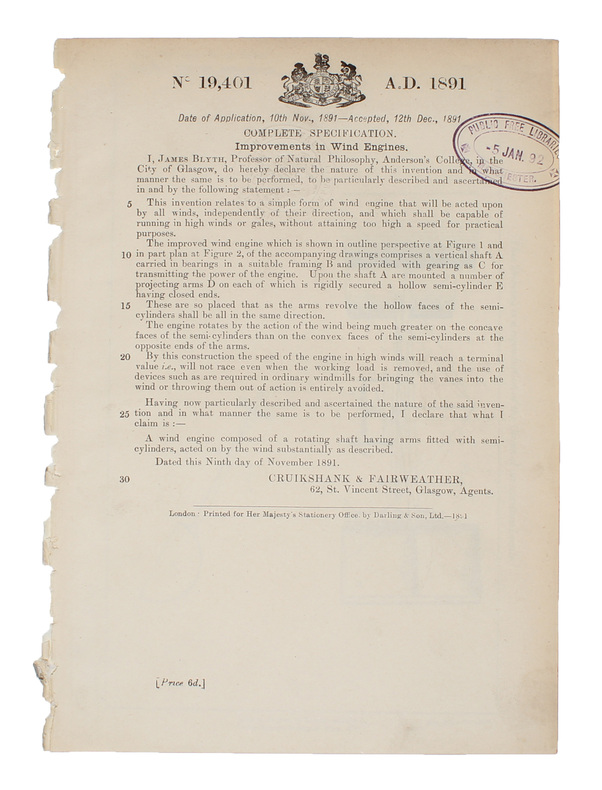
‎"BLYTH, JAMES.‎

‎Improvements in Wind Engines. [British Patent] Number: 19,401. A.D. [Date of Application, 10th Nov., 1891 - Accepted, 12th Dec., 1891]. - [THE WORLD'S FIRST POWER-GENERATING WIND-MILL]‎

‎London, Darling & Son, 1891. 8vo. Disbound. Stamp to p. 1. 1 .p + 1 plate.‎

‎"BLYTH, JAMES.‎

‎Improvements in Wind Engines. [British Patent] Number: 19,401. A.D. [Date of Application, 10th Nov., 1891 - Accepted, 12th Dec., 1891]. - [THE WORLD'S FIRST POWER-GENERATING WIND-MILL]‎

‎London, Darling & Son, 1891. 8vo. Disbound. Stamp to p. 1. 1 .p + 1 plate.‎

‎Scarce original printed patent for the world's first energy-generating wind-mill, the ""Blyth Turbine"", being the first wind turbine used to convert wind energy into power.Blyth's seminal invention marked the dawn of wind turbine development. Although previously credited with being the first to use a wind powered machine to generate electricity, it is now an accepted fact that the American inventor Charles Brush came second to Blyth and his wind mill. There were, of course wind mills before the time of Blyth, but these were used to pump water or grind grain, and Blyth's groundbreaking invention, described and patented for the first time here, is the first used to convert wind energy into power. Blyth experimentend, prompted by his friend Lord Kelvin, with three different turbine designs, which ultimately resulted in a 10-meter-high, cloth-sailed wind turbine, which was installed in the garden of his holiday cottage at Marykirk in Kincardineshire. He used the electricity it produced to charge accumulators, and the stored electricity was used to power the lights in his cottage, which thus became the first house in the world to be powered by wind-generated electricity. The wind turbine in Blyth's garden is said to have operated for 25 years.""The first person to harness the wind to produce electricity was a Scotsman, James Blyth ('America reaps the wind harvest', 21 August). He first consulted his colleague, Lord Kelvin, about the possibility of using a windmill for the purpose. Kelvin thought it would be possible and urged Blyth to set up a large horizontal windmill at his holiday home in Marykirk near Montrose in 1888. Blyth lit his own house and offered to light the streets of Marykirk, but his offer was not accepted because the villagers thought electricity was the work of the devil. He did, however, provide emergency power for the local asylum."" (Price, Trevor J.: James Blyth - Britain's first modern wind power pioneer, Wind Engineering, Volume 29, Number 3, May 2005 , pp. 191-200(10)).‎

Riferimento per il libraio : 48964

Livre Rare Book

Herman H. J. Lynge & Son
Copenhagen Denmark Dinamarca Dinamarca Danemark
[Books from Herman H. J. Lynge & Son]

€ 20.145,00 Informazioni/Compera

‎"BOHR, A.‎

‎Elementary Modes of Nuclear Excitations and Their Coupling‎

‎Paris, Anatole-France, 1964. 8vo. In the original printed wrappers. Offprint from ""Comptes Rendus dy Congrès International de Physique Nucléaire"". 30. Anniversaire de la découverte de la radioactivité artificielle. Pp. 487-492.‎

Numero di risultati : 18.395 (368 pagina/e)

Prima pagina Pagina precedente 1 ... 20 21 22 [23] 24 25 26 ... 74 122 170 218 266 314 362 ... 368 Pagina successiva Ultima pagina