|
Albert Einstein
Cum vad eu lumea
Used. For more details please contact me unknown
Bookseller reference : 145886
|
|
|
Albert Einstein
Cum vad eu lumea
Used. For more details please contact me unknown
Bookseller reference : feb45764
|
|
|
Albert Einstein
Cuvinte memorabile culese si adn.
Used. For more details please contact me unknown
Bookseller reference : feb43256
|
|
|
Albert Einstein; Evelyn Einstein [Foreword]; Alice Calaprice [Editor];
Dear Professor Einstein: Albert Einstein's Letters to and from Children Albert Einstein's Letters to and from Children
Barnes & Noble 2002-01-01. Hardcover. New. New. In shrink wrap. Looks like an interesting title! Barnes & Noble hardcover
Bookseller reference : Q-1567316263 ISBN : 1567316263 9781567316261
|
|
|
Albert Einstein
During the War Albert Einstein Assists an Old Friend and Relative to Get a Visa to Leave Europe and Immigrate to Mexico
20/12/1941. <p>Brigitte Kaufmann was born in Germany but when the Nazis came to power in 1933 she fled to Paris. In France Kaufmann worked as an actress under the name of Brigitte Châtel and translated documents. She met her future husband Alfred Alexander-Katz in Paris and they married in 1939; the following day her husband was taken to an internment camp. He was given the choice of being interned in a labor camp or joining the Foreign Legion and chose the latter. Alexander was then sent to Clermont in Vichy France and the family relocated there.</p><p>Dr. Walter Rudlin was a social science professor at Sarah Lawrence College in New York and actively involved in anti-fascist activities. He was the author of “The Growth of Fascism in Great Britainâ€. In September 1942 he left his position and joined the U.S. Board of Economic Welfare whose chair was Vice President Henry Wallace. His wife Eryl was interested in bringing Jews in Europe out of harm’s way and she knew the Alexander-Katz family.</p><p>So Eryl sought to get Brigitte and her family safely out of Europe to Mexico and sought Einstein’s help. On March 12 1941 Einstein responded noting that Brigitte is his relative. “Thank you very much for your letter of March 11th. I am very gratified indeed to learn that our mutual friends Fred and Brigitte Alexander-Katz have some prospect to receive a visa into Mexico. I am certainly willing to vouch for their reliability and integrity both personal and political. I have known Mrs. Brigitte Alexander-Katz - whose family is related to mine - since she was a little girl. Her husband a very able engineer will certainly be useful to any country which receives him. If you will send me the address of the proper Mexican authority I shall gladly send any letter of recommendation desired.†This was a warm letter indeed expressing true concern and friendship for the Alexander-Katz family.</p><p>On April 3 1941 Einstein again wrote Rudlin noting “Enclosed I am sending you the requested letters in the hope that they may be successful.†But there were delays and no visa so Rudlin wrote Einstein seven months later asking him to take the matter up with the Mexican government.</p><p><strong>Typed letter signed</strong> on his blind-embossed letterhead Princeton December 20 1941 to Mrs. Eryl Rudlin saying that he expects the visa to be granted but does not feel he ought to approach the Mexican government directly. <em>“The Mexican authorities know that I am interested in the case of the Alexander-Katz family; they have kept me informed about the whole development of the matter. I have no doubt that admission to Mexico will be granted as it has been granted to hundreds of people in the same situation. I can give Mr. Alexander-Katz a recommendation but it is out of the question that I ask the Minister of Education to send him an official invitation. I have already done what could be done without intrusion.â€</em></p><p>Despite what he writes here to calm Mrs. Rudlin Einstein might have exerted some gentle pressure on Mexico by contacting the Mexican ambassador to the U.S. Gilberto Bosques; or the Alexander-Katz visas may have already being granted at that moment. The Einstein Archives is silent on this subject. But soon after Einstein soon wrote this letter in 1942 a telegram to the young Alexander-Katz family arrived stating that Einstein and Rudolph Uhlman a lawyer in New York had secured visas through Ambassador Bosques for them to escape to Veracruz Mexico aboard the ship San Thomé.</p><p>In Mexico Brigitte she became a noted author actress director and translator. She became the first woman in Mexico to produce and direct television programs. Speaking five languages she also worked as a translator for UNESCO and Amnesty International. Her daughter Susana and granddaughter Sophie also became actors.</p> unknown
Bookseller reference : 21425

|
|
|
Albert Einstein, Ronald Clark (Biography)
Einstein Four Volume Set The Evolution of Physics Ideas and Opinions The Meaning of Relativity Einstein: The Life and Times
The Easton Press. Hardcover. Fine. Typical Easton binding. All four books have unused bookplates laid in. Trivial gilt nicks. A Fine copy. The Easton Press hardcover
Bookseller reference : 315800
|
|
|
Albert Einstein
Einstein Letter Emergency Committee of Atomic Scientists
Emergency Committee of Atomic Scientists 1947. Paper Back. Very Good. Letterhead of Emergency Committee of Atomic Scientists on two sheets soliciting contributions to the Committee. Dated August 6 1947 the second anniversary of the Hiroshima bombing. An original typed letter with a facsimile Einstein signature in blue ink. Emergency Committee of Atomic Scientists unknown
Bookseller reference : 316757
|
|
|
Albert Einstein Mileva Maric Translated by Masako Onuki
einstein love letter
Iwanamishoten N.A. Soft Cover. Fine. Number of books: 1 Iwanamishoten paperback
Bookseller reference : 2091502133539294
|
|
|
Albert Einstein
Einstein on Peace
Paperback / softback. New. paperback
Bookseller reference : A9781258115357 ISBN : 1258115352 9781258115357

|
|
|
Albert Einstein; Otto Nathan [Editor]; Heinz Norden [Editor]; Bertrand Russell [Foreword];
Einstein on Peace
Random House Value Publishing 1988-12-12. Hardcover. New. New. In shrink wrap. Looks like an interesting title! Random House Value Publishing hardcover
Bookseller reference : Q-0517345803 ISBN : 0517345803 9780517345801

|
|
|
Albert Einstein
Einstein on Peace
Paperback / softback. New. paperback
Bookseller reference : B9781258115357 ISBN : 1258115352 9781258115357

|
|
|
Albert Einstein
Einstein Quarterly. volumes 4; 6-7. 1997-2000
1997-2000. volumes 4; 6-7. 1997-2000. partly bound library markings textually clean & tight PRICE IS FOR THE LOT. - If you are reading this this item is actually physically in our stock and ready for shipment once ordered. We are not bookjackers. Buyer is responsible for any additional duties taxes or fees required by recipient's country. unknown
Bookseller reference : ZB393849
|
|
|
Albert Einstein; Alan Harris, translator
Einstein The World As I See It
Philosophical Library 1949. Hardcover. very good/Good - considerable wear. Hardcover very good condition typical reader wear. Gift inscription inside front cover DJ very good but considerable wear. Philosophical Library hardcover
Bookseller reference : 160919012
|
|
|
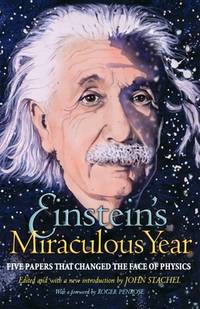
Albert Einstein Roger Penrose John Stachel
Einstein's Miraculous Year: Five Papers That Changed the Face of Physics
Princeton Univ Dept of Art & 1998. Hardcover. New. illustrated edition. 198 pages. 8.75x6.00x0.75 inches. Princeton Univ Dept of Art & hardcover
Bookseller reference : 1-0691059381 ISBN : 0691059381 9780691059389
|
|
|
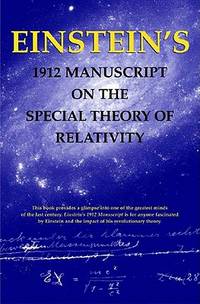
Albert Einstein; Hanoch Gutfreund
Einstein's 1912 Manuscript on the Special Theory of Relativity
George Braziller Inc 2004-05-17. Paperback. New. In shrink wrap. Looks like an interesting title! George Braziller Inc paperback
Bookseller reference : Q-0807615323 ISBN : 0807615323 9780807615324
|
|
|
Albert Einstein
Einstein: My Work in Relativity Supplanted Newtonian Mechanics and Changed Our Notion of Space and Time Forever
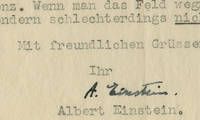
9/9/54. <blockquote><p>The fullest summation we have seen by Einstein comparing relativity to Newtonian concepts of space and time</p></blockquote><p>Immanuel Kant took both Euclidean geometry and the Newtonian laws of motion to be synthetic a priori principles which from Kant’s point of view function as necessary presuppositions for applying our fundamental concepts of space time matter and motion to our sensible experience of the natural world meaning they are fixed necessary conditions. This idea rested on the absolute nature of space and time the work of Newton and the relationship between geometry and physics.</p><p>In 1905 while a young patent clerk and physicist in Bern Switzerland Albert Einstein obtained his doctorate and published a paper that explained his newly developed Special Theory of Relativity. This unlocked many mysteries of the universe and introduced the world to ""e=mc2"" equating mass and the speed of light with energy. It established that time and space are not fixed and in fact change to maintain a constant speed of light regardless of the relative motions of sources and observers. Just 10 years later in 1915 Einstein published his General Theory of Relativity which described the universe as a four-dimensional continuum with time added as the fourth dimension where gravitational effects are explained by the warping of space-time. In this theory Einstein incorporated gravity as a geometric property of space-time.</p><p>The impact of Einstein's work between 1905 and 1915 challenged many principles of physics that had been accepted for centuries. In 1921 he won the Nobel Prize for his work. Time Magazine named him the Person of the Century for the 20th century for his discoveries in relativity and space-time. Einstein is the most important scientist since Isaac Newton and probably the most famous in history.</p><p>Space and time were considered relativistic more subjective and not the fixed a priori notions that had long permeated the mathematical and scientific worlds.</p><p>Max Fischler was a California scientist who was interested in the implications of this distinction: were space and time now to be studied together in this context only or were the nature of space and the nature of time different</p><p>In special relativity what appears simultaneous to one person might not to another - they are relative. You cannot separate space and time; they occur subjectively and semi-dependently but are not tied to the content of that space.</p><p>With General Relativity space-time remains but matter warps it. It's a field like the sheet of a trampoline but reacts to matter. One needs all four dimensions of space-time and without them the others don't exist. You need matter for space.</p><p>On September 5 1954 he wrote to Einstein: "".Can anything in your theory of Relativity be said to throw new light on the nature of space and time themselves Or must we rest satisfied with the purely new logical treatment of these conceptions In other words does the new view of space and time as space-time carry any new meaning ontologically beyond the purely mathematical and logical relationship between the two. Or to put it differently: When Minkowski in his famous words said 'Space by itself and time by itself must not sink into the mere shadows and only a kind of union of the two can preserve an independent existence' did he not attach some new real meaning to the 'spacetime' which the old independent notions of space and time could not convey If so in what does this new meaning consist.""</p><p>Four days later Einstein replied in this letter:</p><p><strong>Typed letter signed</strong> in German on his personal blind embossed letterhead Princeton September 9 1954 to Max Fishler. <em>""The expression cited in the second paragraph only signifies the wish for logical clarity in the formal expressions. De facto the justification for concepts lies in their ability to comprehend the empirically given.</em></p><p><em>""In classical mechanics space and time were completed existences which had to be presupposed as real a priori in order to give meaning to the laws of motion. It was a reality in the same sense as the reality of matter; even governing the latter. In this sense Kant was entirely wrong.</em></p><p><em>""The case was the same as regards the Special Theory of Relativity only that an objective separation of space and time was abandoned in the sense that there could no longer be any objective simultaneity. Here too the four dimensional space is a reality independently of the physical content of space.</em></p><p><em>""Regarding the General Theory of Relativity however this is principally different. What we call ""space"" is here only an extension of a Field dimensionality hence no longer independent of the content of space. It is real in the same sense as matter but has no real existence independently of matter. When the field is taken away there does not remain any space but just nothing.â€</em></p><p>Letters of Einstein directly relating to relativity are increasingly uncommon and this is one of the finest such letters we have had.</p> unknown
Bookseller reference : 18402
|
|
|
Albert Einstein
Essays in Humanism
New York: Philosophical Library 1950. First Edition. Hardcover with Dust Jacket. Rare VG First Edition. DJ is in VG condition and has the original $3.00 price. In an acetate. Moderate foxing through the book but unmarked with VG binding. . Philosophical Library hardcover
Bookseller reference : 50104
|
|
|
Albert Einstein
Essays in Humanism
Literary Licensing LLC 2011. Hardcover. New/New. <p><strong>Author:</strong> Albert Einstein</p><p><strong>Publisher:</strong> Literary Licensing LLC</p><p><strong>Binding:</strong> Hardcover</p><p><strong>ISBN:</strong> 9781258113438</p><p><strong>Release Date:</strong> 2011</p><p><strong>Number Of Pages:</strong> 128</p><p><strong>Details:</strong> In this thought-provoking collection renowned physicist Albert Einstein explores the philosophical underpinnings of humanism providing insights that resonate with both scholars and curious minds alike. The essays delve into the relationship between science and human values emphasizing the importance of ethical reasoning in a rapidly changing world. Readers will appreciate how Einstein articulates the need for a moral framework that supports scientific advancement making this edition a compelling read for anyone interested in the intersection of science philosophy and society.<br /><br />This edition not only showcases Einstein's eloquent writing style but also addresses key topics such as the role of education in fostering humanistic values the significance of personal responsibility and the impact of culture on science. Students and professionals alike will benefit from Einstein's unique perspective which encourages critical thinking and a deeper understanding of what it means to be human in an age of technological progress. Whether you are studying philosophy sociology or the sciences this book offers valuable insights that are still relevant today.</p> Literary Licensing, LLC hardcover
Bookseller reference : 9781258113438-2025 ISBN : 1258113430 9781258113438

|
|
|
Albert Einstein
Essays in humanism
Philosophical Library 1983. Hardcover. New/New. <p><strong>Author:</strong> Albert Einstein</p><p><strong>Publisher:</strong> Philosophical Library</p><p><strong>Binding:</strong> Hardcover</p><p><strong>ISBN:</strong> 9780802224170</p><p><strong>Release Date:</strong> 1983</p><p><strong>Number Of Pages:</strong> 122</p><p><strong>Details:</strong> Book by Einstein Albert</p> Philosophical Library hardcover
Bookseller reference : 9780802224170-2025 ISBN : 0802224172 9780802224170

|
|
|
Albert Einstein
Essays in humanism
Philosophical Library 1983. Hardcover. New/New. <p><strong>Author:</strong> Albert Einstein</p><p><strong>Publisher:</strong> Philosophical Library</p><p><strong>Binding:</strong> Hardcover</p><p><strong>ISBN:</strong> 9780802224170</p><p><strong>Release Date:</strong> 1983</p><p><strong>Number Of Pages:</strong> 122</p><p><strong>Details:</strong> Book by Einstein Albert</p> Philosophical Library hardcover
Bookseller reference : 9780802224170-2025 ISBN : 0802224172 9780802224170
|
|
|
Albert Einstein
Essays in Humanism
Literary Licensing LLC 2011. Hardcover. New/New. <p><strong>Author:</strong> Albert Einstein</p><p><strong>Publisher:</strong> Literary Licensing LLC</p><p><strong>Binding:</strong> Hardcover</p><p><strong>ISBN:</strong> 9781258113438</p><p><strong>Release Date:</strong> 2011</p><p><strong>Number Of Pages:</strong> 128</p><p><strong>Details:</strong> In this thought-provoking collection renowned physicist Albert Einstein explores the philosophical underpinnings of humanism providing insights that resonate with both scholars and curious minds alike. The essays delve into the relationship between science and human values emphasizing the importance of ethical reasoning in a rapidly changing world. Readers will appreciate how Einstein articulates the need for a moral framework that supports scientific advancement making this edition a compelling read for anyone interested in the intersection of science philosophy and society.<br /><br />This edition not only showcases Einstein's eloquent writing style but also addresses key topics such as the role of education in fostering humanistic values the significance of personal responsibility and the impact of culture on science. Students and professionals alike will benefit from Einstein's unique perspective which encourages critical thinking and a deeper understanding of what it means to be human in an age of technological progress. Whether you are studying philosophy sociology or the sciences this book offers valuable insights that are still relevant today.</p> Literary Licensing, LLC hardcover
Bookseller reference : 9781258113438-2025 ISBN : 1258113430 9781258113438
|
|
|
Albert Einstein
Essays in Physics
Hardback. New. hardcover
Bookseller reference : B9781258003166 ISBN : 1258003163 9781258003166

|
|
|
Albert Einstein
Essays in Humanism
Philosophical Library. Hardcover. Very Good. Very good condition with dust jacket. Few tears. Philosophical Library hardcover
Bookseller reference : 67-01046
|
|
|
Albert Einstein
Fleeing the Nazis After Hitler's Rise Einstein Rushes to Save Two of his Closest Scientific Colleagues
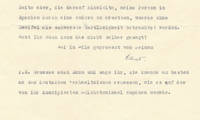
5/5/33. <blockquote><p>Germany as an island of intellectuals is no longer possible he writes blaming the fall of his country and exile of his colleagues on poor education a vestige of Bismarck</p><p> </p><p><em>""I am almost collapsing under all my responsibilities."" </em></p><p> </p><p>A glimpse into the tragic end to the scientific flowering of pre-Nazi Germany along with Einstein's explanation for why it all happened</p><p> </p><p>A rare letter from a brief but consequential period in Einstein's life: after he left Germany but before he arrived in America</p></blockquote><p>Einstein had long been a revered scientist and member of the Prussian Academy of Sciences and was employed by Berlin University. At the beginning of March 1932 he returned to Germany from a visit to the United States where he had discussed heading the soon-to-open Institute for Advanced Study in Princeton New Jersey. He determined to accept and to spend half the year in Berlin and half the year in Princeton. But that year the Nazis were on the rise. It was becoming increasingly obvious to Einstein that his life was in danger. A Nazi organization published a magazine with Einstein’s picture and the caption “Not Yet Hanged†on the cover. There was even a price on his head.</p><p>In December 1932 Einstein again left Germany to be a visiting professor at CalTech in Pasadena California. When Hitler was appointed German chancellor on January 30 1933 the physicist had just arrived in New York on his way to California to lecture on his theory of relativity. Nazi persecution of Jews in Germany was now open swift and often violent. Prominent Jews were denounced by Nazi officials attacked in the media and subjected to violence and arrest. As a vocal opponent of Nazism and a staunch advocate of pacifism Einstein was a particularly attractive target. Fortunately at the time Hitler came to power Einstein was already in the United States. Nonetheless the Nazis publicly agitated against Einstein as a symbol of “Jewish degeneracy†and accused him of spreading “atrocity propaganda.†In February and March 1933 the Gestapo repeatedly raided his family’s apartment in Berlin.</p><p>Despite his own March 15 1933 declaration of self-imposed exile from Nazi Germany as well as warnings from friends that it was too dangerous to return Einstein and his wife decided to travel back to Germany intending to visit their summer cottage. At the end of March they arrived in Antwerp on the SS Belgenland owned by the shipping company Red Star Line. There they learned that Nazis had ransacked their cottage in Caputh at which point they decided that re-entering Germany was unwise.</p><p>In April 1933 Einstein discovered that the new German government had passed laws barring Jews from holding any official positions including teaching at universities. Thousands of Jewish scientists were suddenly forced to give up their university positions and their names were removed from the rolls of institutions where they were employed. Einstein was now without a permanent home unsure where he would live and work and equally worried about the fate of countless other scientists still in Germany. He rented a house in De Haan Belgium where he lived for a few months. In late July 1933 he went to England for about six weeks where he was introduced to Winston Churchill. Einstein asked Churchill to help bring Jewish scientists out of Germany. British historian Martin Gilbert notes that Churchill responded immediately and sent his friend physicist Frederick Lindemann to Germany to seek out Jewish scientists and place them in British universities. In October 1933 Einstein returned to the US and took up his position at the Institute for Advanced Study. He had already revoked his German citizenship in Brussels and handed in his notice at Berlin University. He would never return to Germany.</p><p>Michele Angelo Besso was a Swiss/Italian engineer. A Sephardic Jew by birth he was a close friend of Einstein during his years at the Federal Polytechnic Institute in Zurich and then at the patent office in Bern where Einstein helped him to get a job. Einstein called Besso ""the best sounding board in Europe"" for scientific ideas. In Einstein's original paper on special relativity he ended the paper stating ""In conclusion let me note that my friend and colleague M. Besso steadfastly stood by me in my work on the problem here discussed and that I am indebted to him for many a valuable suggestion.""</p><p>After his resignation in 1890 Otto von Bismarck was venerated as unified Germany’s founding father not only during the remaining twenty-eight years of the monarchy but also albeit less emphatically in the Weimar Republic in Nazi Germany and in the Federal Republic. Throughout Germany numerous Bismarck statues are testament to the admiration. Hamburg has three. His memorialisation even went beyond Germany; the capital of the US state of North Dakota for example is named after him. Einstein was evidently not a proponent of the erstwhile unifier of Germany. As Einstein wrote of Bismarck’s influence ""The characteristic feature of this mentality is that people place the importance of what Bertrand Russell so tellingly terms “naked power†far above all other factors which affect the relations between peoples. The Germans misled by Bismarck’s successes in particular underwent just such a transformation of their mentality—in consequence of which they were entirely ruined in less than a hundred years.""</p><p>In this letter he encourages Besso to let him have his suggestions for saving Hermann Weyl from the regime – through substituting him for Einstein on a proposed trip to Spain would seem disastrously tactless. He sends his regards to Anna Besso with the rueful remark that the German example bodes ill for an intellectual utopia which she had proposed. Weyl would go on work with him at Princeton.</p><p>These two men were among Einstein's closest friends and colleague - Jewish or closely tied to Jewish relatives. He is rushing to get them out.</p><p><strong>Typed letter signed</strong> in German Le Coq-sur-mer Belgium May 5th 1933 to Besso. <em>""Dear Michele! I was not affected personally but just about everybody else who is kind of close to me was. Bismarck’s dismal education policy is wreaking havoc again with the German people.</em></p><p><em>""I would love to follow your suggestion regarding Weyl if I saw any possibility at all especially since I am almost collapsing under all my responsibilities. Even the slightest attempt to replace me with someone else in Spain would without a doubt be perceived as extremely upsetting. Have you not thought of that</em></p><p><em>""Rushed greetings to you Albert.""</em></p><p>He writes a postscript: <em>""Greetings to Anna from me and tell her she can judge herself based on the current German conditions what her concept of 'island of intellectuals' would look like.""<br /></em></p><p>In July 1933 upon Einstein’s request a committee of 51 American artists intellectuals and political leaders came together to form the International Relief Association. Among them were the philosopher John Dewey the writer John Dos Passos and the theologian Reinhold Niebuhr. Other prominent citizens including First Lady Eleanor Roosevelt soon joined the effort. Its mission as The New York Times reported on July 24 1933 was to “assist Germans suffering from the policies of the Hitler regime.â€</p><p>But Einstein did much more. He tried to persuade political leaders in the United States and Europe to take action to help the Jewish populations at risk particularly those of his colleagues in Germany's scientific community which was very hard hit. He worked tirelessly to help Jewish refugees escape the Nazis and to find them places of refuge and employment. Many immigrants to the United States during the mid to late 1930s were Jewish between 1939 and 1940 more than half of all immigrants were Jews most of them refugees fleeing persecution in Europe.</p><p><img class=""alignnone wp-image-22732 size-post-window"" src=""https://cdn.raabcollection.com/wp-content/uploads/20231204162353/Folder-site-1600x1327.jpg"" alt="""" width=""1600"" height=""1327"" /></p> unknown
Bookseller reference : 22568
|
|
|
Albert Einstein
Friedrich Wilhelm Foerster und Albert Einstein: Briefwechsel von 1935 bis 1954
ibidem-Verlag 2001. Paperback. New. 134 pages. German language. 8.11x5.67x0.39 inches. ibidem-Verlag paperback
Bookseller reference : 1-3898211681 ISBN : 3898211681 9783898211680
|
|
|
Albert Einstein
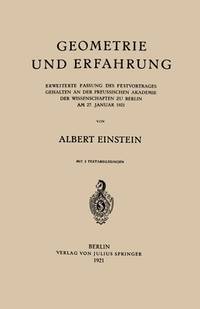
Geometrie und Erfahrung: Erweiterte Fassung des Festvortrages Gehalten an der Preussischen Akademie der Wissenschaften zu Berlin am 27. Januar 1921
new. unknown
Bookseller reference : 43483586-n ISBN : 3642496113 9783642496110
|
|
|
Albert Einstein
Geometrie und Erfahrung: Erweiterte Fassung des Festvortrages Gehalten an der Preussischen Akademie der Wissenschaften zu Berlin am 27. Januar 1921
like new. unknown
Bookseller reference : 43483586 ISBN : 3642496113 9783642496110
|
|
|
Albert Einstein
German Essays on Science in the 20th Century: Albert Einstein Werner Heisenberg Max Planck and OT
Paperback. New. New Book; Fast Shipping from UK; Not signed; Not First Edition; N/A paperback
Bookseller reference : ria9780826407474_inp ISBN : 0826407471 9780826407474

|
|
|
Albert Einstein
Grundzüge der Relativitätstheorie
Paperback. New. New Book; Fast Shipping from UK; Not signed; Not First Edition; N/A paperback
Bookseller reference : ria9783540878469_inp ISBN : 3540878467 9783540878469
|
|
|
Albert Einstein
Grundzüge der Relativitätstheorie Albert Einstein
Grundzüge der Relativitätstheorie <br/><br/>Grundzüge der Relativitätstheorie Albert Einstein unknown
Bookseller reference : BN303257 ISBN : 3528160586 9783528160586
|
|
|
ALBERT EINSTEIN
IDEAS AND OPINIIONS
Norwalk CT: The Easton Press 2004. The Easton Press. Hardcover. Fine. A fine clean and tight copy bound in full leather. Collector's Edition with silk moire end papers with ribbon. No bumped corners to book. No rubbing to leather binding. No bookplates no signatures. Gold gilt edges are clean and bright with just a couple of mild marks. A very nice copy. The Easton Press hardcover
Bookseller reference : 003292EE

|
|
|
Albert Einstein
Ideas and Opinions
London: The Folio Society 2010. 1st Thus. Hardcover. As New/No Dust Jacket. Octavo. pp XVIII 370. 1st printing. An unread book in a fine condition slipcase showing slight use. The Folio Society hardcover
Bookseller reference : 042673
|
|
|
Albert Einstein
Ideas and Opinions
Crown Publishers 1954. 1st Edition 1st Printing. Hardcover. Very Good/Good. Very good clean tight condition. First American edition first printing. Jacket price $4.00 has tape and edge wear. Jacket in mylar cover. Previous owners name on bookplate and on top of closed pages. Text free of marks. Professional book dealer since 1999. All orders are processed promptly and carefully packaged. <br/> <br/> Crown Publishers hardcover
Bookseller reference : 096396
|
|
|
Albert Einstein
IDEAS AND OPINIONS
New York: Crown Publishers 1954. First Edition; First Printing. Hardcover. Very Good in boards. Crown Publishers hardcover
Bookseller reference : 215859

|
|
|
Albert Einstein
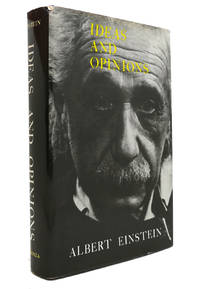
IDEAS AND OPINIONS
New York: Bonanza Books 1954. Reprint; Fourteenth Printing. Hardcover. Very Good in a Very Good dust jacket. Foxing on top text block edge. 1/4 inch open tear at top of rear flap fold.; 8.1 X 5.6 X 1.3 inches; 384 pages. Bonanza Books hardcover
Bookseller reference : 146349 ISBN : 0517003937 9780517003930
|
|
|
Albert Einstein
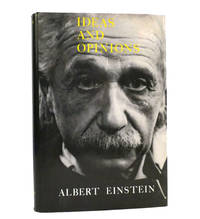
IDEAS AND OPINIONS
New York: Bonanza Books 1988. Hardcover. Near Fine in a Near Fine dust jacket. Light crease on front flap.; 8.1 X 5.6 X 1.3 inches; 384 pages. Bonanza Books hardcover
Bookseller reference : 154135 ISBN : 0517003937 9780517003930
|
|
|
Albert Einstein; Carl Seelig [Editor]; Sonja Bargmann [Translator];
Ideas and Opinions
Crown Publishers 1985-12-13. Paperback. New. In shrink wrap. Looks like an interesting title! Crown Publishers paperback
Bookseller reference : Q-0517556014 ISBN : 0517556014 9780517556016

|
|
|
Albert Einstein
IDEAS AND OPINIONS
New York: Bonanza Books 1988. Hardcover. Very Good in a Very Good dust jacket. ; 8.1 X 5.6 X 1.3 inches; 384 pages. Bonanza Books hardcover
Bookseller reference : 124910 ISBN : 0517003937 9780517003930

|
|
|
Albert Einstein
Ideas and Opinions
Crown Publishers January 1954. First Edition. Hardcover. Very Good. Very Good in a Good dustjacket. Corners and spine ends of the binding are bumped but not rubbed p.o. inscription at the top of the front free enpaper some foxing to the top edge of the text block a lengthy note on the verso of the rear free endpaper. The jacket has a few problems: the entire length of the front and rear panels is creased there is shallow chipping at the top of the spine just barely affecting the name and a larger triangular chip at the top right of the rear panel. All in all a presentable copy of a scarce first edition with jacket. Crown Publishers hardcover
Bookseller reference : 196390
|
|
|
Albert Einstein
In a Detailed and Unpublished Letter on Classical and Quantum Physics Albert Einstein Issues a Treatise – a Scientific Explanation – Underpinning His Belief That the Universe Cannot Be Random
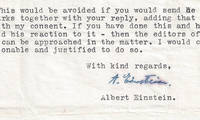
17/02/1953. <blockquote><p>In this letter from Einstein to David Bohm Einstein discusses the importance of connecting a key principle of the relatively new theory of quantum mechanics the “Born interpretation†to physical quantities that can be measured in the real world. To him it is essential that mathematical theories be connected to measurable quantities. In this letter Einstein’s uneasiness with quantum mechanics is apparent saying that validation of the seemingly random quantum mechanics “…can only be done on the basis of classical mechanics.†Without this validation quantum theory has essentially “no controllable meaning.â€</p><p> </p><p><img class=""alignnone wp-image-22637 size-post-window"" src=""https://cdn.raabcollection.com/wp-content/uploads/20231204163327/Einstein-born-2-e1639117238988-1600x656.jpg"" alt="""" width=""1600"" height=""656"" /></p></blockquote><p>Max Born was a renowned physicist who was crucial for the development of quantum mechanics and also the Ph.D. supervisor of many important physicists including J. Robert Oppenheimer. Quantum mechanics describes the weird behavior of tiny subatomic particles. It’s also the guiding theory that led to critical technologies like nuclear power MRI machines and transistors in computers and phones. One of Born’s biggest contributions to quantum mechanics was the interpretation of the probability density which is a mathematical operation performed on the “psi-function†in Einstein’s words to predict the most probable physical quantities of a quantum particle. Einstein believed that probabilities only make sense if you can determine the values that they predict independently by measurement. This is easy to do in classical Newtonian mechanics the physics of big things in everyday life. But Einstein said we can’t measure it for something like a “bound electron†i.e. an electron in an atom. In order to interpret Born’s probability density function you need to connect the mathematics to real values. Einstein’s correspondence with Born on this subject is published and famous.</p><p>To Einstein the universe is observable and measurable.</p><p>When confronted with one of the principle tenets of Quantum Mechanics Einstein remarked now famously “Quantum mechanics is very imposing. But an inner voice tells me that it is not the real McCoy. The theory delivers a lot but hardly brings us closer to the secret of the Old One God. I for one am convinced that He does not throw dice.†This statement was made in one of those significant letters to Born. What he meant here is that rules of science cannot be random and in the rolling of dice we would have to accept unknown variables and therefore be unable to predict precisely via objective measurements. Therefore in Quantum Mechanics as in gambling an uncertainty of measurement exists. And to Einstein the universe is observable and measurable. He did not object to Quantum Mechanics per se; indeed he made notable contributions. But he eschewed any reliance on what was not observable and knowable.</p><p><img class=""alignnone wp-image-22634 size-post-window"" src=""https://cdn.raabcollection.com/wp-content/uploads/20231204163356/Einstein-born-5-e1639117103621-1600x616.jpg"" alt="""" width=""1600"" height=""616"" /></p><p>David Joseph Bohm was an American scientist who has been described as one of the most significant theoretical physicists of the 20th century and who contributed unorthodox ideas to quantum theory neuropsychology and the philosophy of mind. His first book Quantum Theory published in 1951 was well received by Einstein among others. But Bohm became dissatisfied with the orthodox interpretation of quantum theory he had written about in that book.Bohm’s aim was not to set out a deterministic mechanical viewpoint but to show that it was possible to attribute properties to an underlying reality in contrast to the conventional approach. He began to develop his own interpretation the De Broglie–Bohm theory also called the Pilot wave theory the predictions of which agreed perfectly with the non-deterministic quantum theory. He initially referred to his approach as a hidden variable theory. Bohm originally hoped that hidden variables could provide a local causal objective description that would resolve or eliminate many of the paradoxes of Quantum Mechanics the measurement problem and the collapse of the wavefunction. However Bell’s theorem complicates this hope as it demonstrates that there can be no local hidden variable theory that is compatible with the predictions of Quantum Mechanics. The Bohmian interpretation is causal but not local. Albert Einstein who had suggested that Bohm search for a realist alternative to the prevailing Copenhagen approach did not consider Bohm’s interpretation to be a satisfactory answer to the quantum question.</p><p>The Copenhagen interpretation is an expression of the meaning of Quantum Mechanics that was largely devised in the years 1925 to 1927 by Niels Bohr and Werner Heisenberg. It remains one of the most commonly taught interpretations of Quantum Mechanics. According to the Copenhagen interpretation physical systems generally do not have definite properties prior to being measured and Quantum Mechanics can only predict the probabilities that measurements will produce certain results. The act of measurement affects the system causing the set of probabilities to reduce to only one of the possible values immediately after the measurement.</p><p>In classical mechanics a particle has at every moment an exact position and an exact momentum. These values change deterministically as the particle moves according to Newton’s laws. Under the Copenhagen interpretation of Quantum Mechanics particles do not have exactly determined properties and when they are measured the result is randomly drawn from a probability distribution. The Schrödinger equation predicts what the probability distributions are but fundamentally cannot predict the exact result of each measurement.</p><p><img class=""alignnone wp-image-22633 size-post-window"" src=""https://cdn.raabcollection.com/wp-content/uploads/20231204163406/Einstein-born-e1639117155596-1600x360.jpg"" alt="""" width=""1600"" height=""360"" /></p><p><strong>Typed letter signed</strong> on his blind embossed letterhead February 17 1953 Professor Bohm. <em>“Dear Bohm: I thank you very much for the prompt reaction to my little article. I did of course not expect that you would agree with me. For scarcely anyone is inclined to abandon an enterprise in which le has invested a great deal of work.</em></p><p><em>“I do not want to answer your letter in detail although it deserves it very much. Only a short remark concerning the interpretation of Born’s standpoint:</em></p><p><em>“According to Born the physical meaning of the psi-function follows: it determines probabilities f.i. for the value of impulses. this makes sense only if the impulse is defined independently of the mathematical theory by some feasible measurement. This can only be done on the basis of classical mechanics. F.i. if one has calculated the impulse of a bound electron on the basis of a psi-function then this result has no controllable meaning. For there is no possibility to measure such a thing not even approximately. However if one has to do with a makro-object which is at least temporarily approximately free then one is able to determine experimentally at least approximately its impulsef.i. through two successive snapshots or through radar. If it is at all possible to attribute meaning to Born’s interpretation then the impulse the probability of which appears in the theory has to be put equal to the impulse thus measured. Classical approxi_mate measurement of the impulse is however in my example very well feasible without first removing the walls and then waiting some time. Born’s probability therefore has to be interpreted as relative to the impulse thus measured if this probability is to have any meaning at all.</em></p><p><em>“The vanishing of position-probability for the nodes offers no difficulty though it is true that this fact excludes the interpretation of the process as a motion in the strict sense of the word. For the factual process will only approximately be describable as a motion as f.i. the action of a gas upon a small part of the wall is describable only approximately by the concept of pressure.</em></p><p><em>“With regard to the publication of your remarks in the Born volume I have some scruples the reason for which you will readily understand. I have sent a copy of my article to you but not to de Broglie because this would have seemed to me somewhat pretentious. If therefore your answer would be published together with my remarks without de Broglie having had the possibility to do the same he might feel it as an unkindness from my side.</em></p><p><em>“This would be avoided if you would send De Broglie my remarks together with your reply adding that you do this with my consent. If you have done this and have received his reaction to it – then the editors of the Born volume can be approached in the matter. I would consider it as reasonable and justified to do so.â€</em></p><p><img class=""alignnone wp-image-22636 size-post-window"" src=""https://cdn.raabcollection.com/wp-content/uploads/20231204163341/Einstein-born-3-1-e1639117201589-1600x672.jpg"" alt="""" width=""1600"" height=""672"" /></p><p>This is a remarkably detailed scientific letter mentioning numerous significant physicists containing a hand-drawn symbol and directly relating to his important theories. It is also in a sense his defense of his own work including relativity.</p><p><span style=""color: #222222; font-family: arial sans-serif; font-size: 12.800000190734863px;""> </span></p> unknown
Bookseller reference : 15362
|
|
|
Albert Einstein
Investigations on the Theory of the Brownian Movement
Dover Publications. Paperback. Good. Good condition with wear and marking. Dover Publications paperback
Bookseller reference : 61-03237
|
|
|
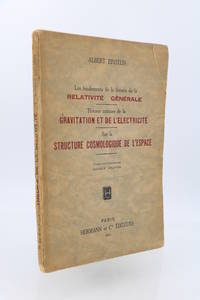
Albert EINSTEIN
Les fondements de la théorie de la relativité générale - Théorie unitaire de la gravitation et de l'électricité - Sur la structure cosmologique de l'espace Foundations of the Theory of General Relativity Unified Theory of Gravitation and Electricity On the Cosmological Structure of Space
Paris: Hermann & Cie 1933. Fine. Hermann & Cie Paris 1933 16 x 25 cm Broché First edition of the French translation illustrated with a photographic portrait of Albert Einstein as frontispiece. A small loss at the foot of the spine which also shows rubbing along the joints upper right corner of the front board starting to come loose a slight marginal tear just below pleasant internal condition manuscript bookplate at the head of a flyleaf. Annotations and markings in red pen on pages 8 and 9. Work illustrated with figures in the text. Hermann & Cie unknown
Bookseller reference : 91965
|
|
|
Albert Einstein et al
Living Philosophies
Simon and Schuster 1931. Hardcover. Good. New York 1931; black boards with gold cover titles and spine titles; mild corner and edge wear; some discoloration at edges; orange dust jacket with black cover titles and spine titles; light chipping at jacket edges; parts of jacket edges taped over; 8vo - over 7 3/4" to 9 3/4" tall; "ex libris" sticker on front pastedown; rest of interior is clean and unmarked. 333 pages. Simon and Schuster hardcover
Bookseller reference : SKU1139774
|
|
|
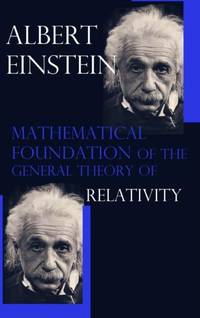
Albert Einstein
Mathematical Foundation of the General Theory of Relativity
Hardcover. New. New Book; Fast Shipping from UK; Not signed; Not First Edition; The theory which is sketched in the following pages forms the most wide-going generalization conceivable of what is at present known as "the theory of Relativity;" this latter theory I differentiate from the former "Special Relativity t hardcover
Bookseller reference : ria9781006727146_inp ISBN : 1006727140 9781006727146
|
|
|
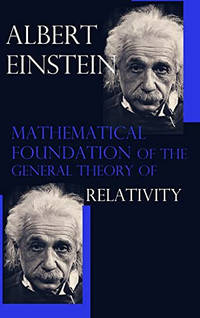
Albert Einstein
Mathematical Foundation of the General Theory of Relativity
Hardback. New. hardcover
Bookseller reference : B9781006727146 ISBN : 1006727140 9781006727146
|
|
|
Albert Einstein
Mathematische Annalen Volume 45
Hardback. New. hardcover
Bookseller reference : A9781345555813 ISBN : 1345555814 9781345555813

|
|
|
Albert Einstein
Mathematische Annalen; Volume 9
Hardback. New. hardcover
Bookseller reference : B9781020098475 ISBN : 1020098473 9781020098475

|
|
|
Albert Einstein
Mathematische Annalen; Volume 29
Hardback. New. hardcover
Bookseller reference : B9781020331084 ISBN : 1020331089 9781020331084

|
|
|
Albert Einstein
Mathematische Annalen; Volume 6
Hardback. New. hardcover
Bookseller reference : B9781020352256 ISBN : 1020352256 9781020352256

|
|
|
Albert Einstein
Mathematische Annalen; Volume 44
Hardback. New. hardcover
Bookseller reference : B9781021110886 ISBN : 1021110884 9781021110886

|
|

 Receive by email
 Download as PDF document
 RSS feed
 Permanent link


