|
Der Deutsche Tischlermeister. Illustriertes Fachblatt für Möbel- und Bautischlerei und den Möbelhandel. Nummer 11 (März 1928) bis Nummer 48 (November 1928).
Berlin 1928. Späterer HLn.-Einband. Über 300 S. Mit sehr zahlreichen Abbildungenvon Möbeln bzw. Inneneinrichtungen
Bookseller reference : 23830
|
|
|
Ein tief gegründet Herz. Der Briefwechsel Felix Mendelssohn-Bartholdys mit Johann Gustav Droysen. Herausgegeben von Carl Wehmer.
Heidelberg, Lambert Schneider, 1959. 118 S., 1 Bl. Mit montiertem Porträt. 8° (19 x 11,5 cm). Original-Leinwand mit Schutzumschlag.
Bookseller reference : 22063

|
|
|
Erinnerungen an Felix Mendelssohn Bartholdy.
Lpz., Offizin Andersen Nexö, 1984. 5,5 cm x 5,5 cm. Goldgepr. OGanzlederbd. in OPp.-Schuber. 335 SS., 3 Bll. mit Frontispiz und 16 Tafeln im Anhang.
Bookseller reference : 30124
|
|
|
Erinnerungen an Felix Mendelssohn Bartholdy.
Leipzig, Offizin Andersen Nexö, 1984. Ca. 5,5 x 5,5 cm. 335 (35) Seiten, mit zahlreichen Illustrationen. Brauner Original-Lederband im Schuber.
Bookseller reference : 29721A
|
|
|
Erinnerungen an Felix Mendelssohn-Bartholdy. (Aus zeitgenössischen Beiträgen zusammengestellt [und] Nachbemerkung von Irene Hempel).
Leipzig, Offizin Andersen Nexö, 1984. 5,3 x 5,3 cm. 335 und [35] S. mit s/w Abb. Brauner Original-Lederband mit goldgeprägtem Rückentitel in OSchuber.
Bookseller reference : 122245AB
|
|
|
Hochmuth kommt vor dem Fall; oder: Moses Mendelssohn und Pylades. <Der Ordensnamen eines verstorbenen Illuminaten.> Ein Gespräch im Reiche der Todten über das Illuminaten-System, Freymäurerey und geheime Gesellschaften.
München [d.i. Frankfurt a. M., Esslinger], 1787. 8°. Gest. Frontispiz, 116 S. Kartonage d. Zt., Rücken überklebt.
Bookseller reference : 2948
|
|
|
Monatschrift für Gottesdienst und kirchliche Kunst. 2 Hefte. In Verbindung mit Rudolf Günther, Paul Graff, Mendelssohn und Wilhelm Stählin herausgegeben von Richard Gölz. Heft 1/2: Januar/Februar, 40. Jahrgang, 1935. - Heft 3/4: März/April, 40. Jahrgang, 1935. 4 Hefte in 2 Heften.
Göttingen: Vandenhoeck & Ruprecht 1935. 116 Seiten. Frakturdruck. 8° (17,5-22,5 cm). Orig.-Broschuren. [Softcover / Paperback].
Bookseller reference : 87071

|
|
|
Väter und Sohne - Zwölf biographische Porträts
Berlin (Rowohlt Berlin) 1996 (= Erste Ausgabe). 8°, Originalkarton mit illustriertem Originalumschlag (Hardcover) 430 S., Abbildungen, ISBN 3 87134 273 4 1
Bookseller reference : V29950
|
|
|
"[JACOBI, FRIEDRICH HEINRICH]. & BRUNO, MENDELSSOHN, ETC.
Ueber die Lehre des Spinoza in Briefen an den Herrn Moses Mendelssohn. Neue vermehrte Auflage. - [THE FIRST EVER TRANSLATION OF BRUNO'S ""DE UNO ET CAUSA""...]
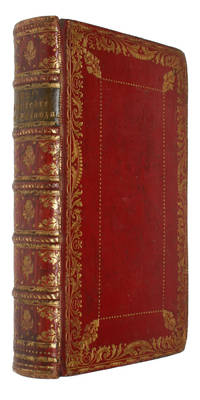
Breslau, Gottl. Löwe, 1789, 8vo. Very beautiful contemporary red full calf binding with five raised bands and gilt green leather title-label to richly gilt spine. elaborate gilt borders to boards, inside which a ""frame"" made up of gilt dots, with giltcorner-ornamentations. Edges of boards gilt and inner gilt dentelles. All edges gilt. Minor light brownspotting. Marginal staining to the last leaves. Engraved frontispiece-portrait of Spinoza, engraved title-vignette (double-portrait, of Lessing and Mendelssohn), engraved end-vignette (portrait of Jacobi). Frontispiece, title-page, LI, (1, -errata), 440 pp. Magnificent copy.
Bookseller reference : 45724
|
|
|
"Mendelssohn, Kurt"
The Riddle of the Pyramids
New York: Praeger 1974. Reprint. Hardcover. Fine/Fine. Yellow Cloth Covers with gilt lettering to spine; White Endpapers; free front endpaper has some light erasure marks at top corner; Book interior is clean and tight; illustrated in black-and-white and color; small 4to; 224 pages; dustjacket is protected by a mylar wrapper and has very light rubbing to some corners <br/><br/>1.91#; P3; Acq 8/94 Praeger hardcover
Bookseller reference : 20030860

|
|
|
( Disques - Madame D'Aulnoy ) - Mendelssohn - Claire Maurier – Michèle Caplin - Michel Provence - Berthe d'Yd - Michel Brothier -Denise Chabot
La Belle et La Bête. ( Disque 33 tours ).
Disque Musidisc-Europe PP 72 / Collection enfantine " Le Petit Poucet " sans date. 33 tours au format 30 cm avec superbe couverture illustrée par Denise Chabot. Adaptation d'après Madame D'Aulnoy, racontée par Claire Maurier avec le concours de Michèle Caplin, Michel Provence, Berthe d'Yd et Michel Brothier. Musique de Mendelssohn. Pochette et disque en état magnifique, proche du neuf. Disque en état parfait, jamais écouté. Rare premier pressage.
Bookseller reference : 26668

|
|
|
(Duse, Eleonora). Segantini, Bianca; and von Mendelssohn, Francesco; compilers & editors.
ELEONORA DUSE. Bildnisse und Worte gesammelt ubersetzt und herausgegeben von Bianca Segantini und Francesco von Mendelssohn.
Berlin: Rudolf Kaemmerer Verlag 1926. 1926. Very good. - Squarish octavo 9-1/2"x7'1/2" three-quarters brown cloth & marbled brown & tan paper covered boards titled in black on the spine. The boards are rubbed especially along the front edges. 168 & 3 pages. Illustrated in black & white with tipped-in title page portrait tipped-in full-page plates & tipped-in plates in the text. 3 of the plates in the text are lacking. The endpapers are darkened & there is occasional soiling & staining. Ex-library with stamps & handwritten notations on the front pastedown title & 1 page of the text. As is. <p>The text which is drawn from various sources is in German. Berlin: Rudolf Kaemmerer Verlag, 1926. hardcover
Bookseller reference : 3940
|
|
|
(ed.)
First Concert Pieces by Master Composers ; The Great Sheet Music Collection For Piano (4 Volume Set )
Four volume set is in excellent condition, about 145 pages per book in slipcase. Bindings are solid and square, covers have sharp corners, exteriors show no blemishes, text/interior are clean and free of marking of any kind. Book one features Pachelbel, Purcell, Scalratti, Telemann, Bach, Haendel - Book two contains scores from: Haydn, Clementi, Mozart, Weber, Kuhlau, Czerny, Beethoven - Book three includes: Schubert, Liszt, Wagner, Mendelssohn, Chopin, Gounod, Gurlitt, Franck, Saint-Saens, Iljitsch, Brahms - Book four: Robert Schuhmann--Authentic Masterpieces "Album for the Young" & "Scenes from Childhood". Slipcase is banged up some at corners and edges, taped, still sturdy.

|
|
|
(Edicion bilingue) Introduccion, traduccion y notas de Jose Monter Perez Moses Mendelssohn
Jerusalem o Acerca de poder religioso y judaÃsmo
Ed. Anthropos 01/01/1991. La perspectiva de Mendelssohn para hacer valer la integración plena de los judÃos en la sociedad civil no es otra que la ilustrada es decir la razón y la libertad como propiedad inalienable de. New. Ed. Anthropos unknown
Bookseller reference : 9788476582602 ISBN : 8476582609 9788476582602

|
|
|
(Felix Mendelssohn Bartholdy) Paul Meldelssohn Bartholdy and Dr. Carl Nendelssohn Bartholdy (eds.) ; Julius Rietz (compiler)
Letters of Felix Mendelssohn Bartholdy fron 1833 to 1847 with A Catalogue of All His Musical Compositions
New York: Leypold and Holt 1868. Hardcover. Very Good. Hardcover in original maroon cloth titled in gilt. 421 pp. About very good slight fade to the spine strip and a bit ragged at the spine extremities. Leypold and Holt hardcover
Bookseller reference : E28121

|
|
|
(Felix Mendelssohn)
Mendelssohn's Werke für Clavier. Sämmtliche Lieder ohne Worte. Volksausgabe.
Berlin: N. Simrock, o. J. (ca. 1870). Format: 19 x 27,5 cm. (Reihe: Mendelssohns Werke für Pianoforte allein. In sechs Bänden. Erster Band). 65 Seiten. Fest gebunden in roten, stark skulpierten, üpppig ziergeprägten Orig. Leinen mit goldgepr. Deckeltitel und flächigem goldenem Deckelporträt. Getönte, gelackte (leicht altersspurige) Vorsätze. Kleiner Tuschefleck am fl. Vorsatz. Durchaus vom Alter gestreiftes, insg. jedoch gutes Exemplar.
Bookseller reference : 26858
|
|
|
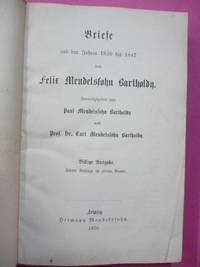
(Mendelssohn) Mendelssohn Bartholdy, Paul y Carl
BRIEFE AUS DEN JAHREN 1830 BIS 1847 VON FELIX MENDELSSOHN BARTHOLDY Herausgegeben von
Liepzig: Herman Mendelssohn 1878. 12.2x18.3. Bonita encuadernación de época en media piel puntas con nervios y tejuelo. 2 tomos en 1 vol. iv 269pp. y iv . ilus. con partituras. Herman Mendelssohn unknown
Bookseller reference : 17.72
|
|
|
(Mendelssohn, Felix). Jacob, Heinrich Eduard.
FELIX MENDELSSOHN AND HIS TIMES. Translated from the German by Richard and Clara Winston.
Englewood Cliffs NJ: Prentice-Hall Inc. 1963. 1963. Very good. - Octavo cloth in a dust wrapper. The covers are lightly bumped with a tiny white stain to the front cover. The dust jacket is chipped with a small piece out of the tail of its spine. The jacket spine & extremities are darkened. vi 1 leaf & 356 pages. The fore-edge & top & bottom edges are foxed. Black-and-white illustrations & music staves. Very good in a good dust wrapper. <p>First American edition. Englewood Cliffs, NJ: Prentice-Hall, Inc., (1963). hardcover
Bookseller reference : 10838
|
|
|
(Mendelssohn Moses)
Kitve odesh : nidpasim me- adash u-mehudarim be-tosafot rabot . Bd 1-5: Sefer Ne ivot ha-shalom : e-hu ibur kolel ameshet umshe Torah im targum ashkenazi u-ve ur / me-et Mosheh mi-Desoy
Wien: Schmid 1818. Boards. Good. 435 pp. frontispeice portrait of Mendelssohn tipped in and illustration on title page new blue boards and new endpapers and hinges some dog eared pages Sepher Nethivoth Hashalom more commonly known as the Bi'ur is Moses Mendelssohn's revolutionary translation of the Pentateuch. Mendelsson translated the Pentateuch into German using Hebrew characters while the commentary was composed in Hebrew. The commentary aimed to explain the translation choices made by Mendelssohn and drew heavily on traditional medieval Jewish Bible commentators.Kestenbaum entry Was originally published in 1783 OCLC Number: 937074293 Schmid hardcover
Bookseller reference : 278783
|
|
|
(Mendelssohn, Felix) Werner, Eric
Mendelssohn; Leben und Werk in neuer Sicht
Zürich: Atlantis 1980. First German edition. Ownership inscription; letter taped to front pastedown; very good in a rubbed dust jacket with a couple of small chips. 8vo 635pp; blue cloth. The author's own copy of his definitive work on the great composer originally published in a shorter English language version in 1963. Inscribed on the first leaf: "Nr. 1 Eric Werner Zürich 1. July 1980." In addition Werner has taped to the front pastedown a 1949 typed letter he received from the great musicologist Alfred Einstein referring to Franz Schubert and his treatment of a psalm text. Atlantis unknown
Bookseller reference : 205716

|
|
|
(Mendelssohn, Felix) Benedict, Jules
The Life and Works of the Late Felix Mendelssohn Bartholdy
London: John Murray 1853. Second edition. 66 2 pp. 1 vols. 8vo. Bound in full tan polished contemporary calf. Prize Binding. Fine. Second edition. 66 2 pp. 1 vols. 8vo. <br/><br/> John Murray unknown
Bookseller reference : 225037

|
|
|
(Xt) Mendelssohn, Moses; Friedländer, David; Loewe, Joel; Aharon Yoresh; Rezel; Euchel, Isaac Abraham; Shpits, Avraham Segal; Rashi; Loewe, Joel
SEFER ZEMIROT YISRAEL : KOLEL SEFER TEHILIM IM PERUSH RASHI ; VE-IM TARGUM ASHKENAZI VEHA-BEUR ASHER NIDPAS BE-K"K. BERLIN 348. [BOOKS 3, 4, AND 5 BOUND IN ONE VOLUME]
Period boards. 8vo, xxxiv, 462 pages, 26 cm. Title translates into English as "Hymns of Israel: including the book of pslams with Rashi Translation." SUBJECTS: Hebrew literature -- History and criticism. Hebrew literature. Judentum. 5 pts. In 2 volumes. Less than 30 copies listed on OCLC. Ex-library with usual markings. Pages are warped with some water stainsing. Repair done to spine, otherwise Good Condition. (MUSIC-1-2A)

|
|
|
-Bartholdy, Felix Mendelssohn
Reisebriefe von Felix Mendelssohn Bartholdy aus des Jahren 1830 bis 1832 Classic Reprint German Edition
hardcover. Good. Access codes and supplements are not guaranteed with used items. May be an ex-library book. hardcover
Bookseller reference : 0666346941.G ISBN : 0666346941 9780666346940

|
|
|
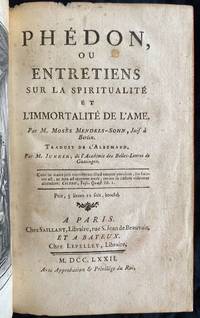
14. 1st French Edition of One of Mendelssohn's Most Famout Works Mendelssohn Moses. Moses Mendels Sohn Translated from the Germ
PHÉDON OU ENTRETIENS SUR LA SPIRITUALITÉ ET L’IMMORTALITÉ DE L’AME
Paris et Bayeux chez Saillant et Lepelley 1772. 1st French-language edition. Period full leather binding with gilt spine and red edges with original marbled endpapers 8vo. Includes frontis copperplate etching. XXIV 342 1 pages. “Traduit de l’Allemand par M. Junker de l’Académie des Belles-Lettres de Goettingen.â€<br> This first French edition appeared 5 years after the first German edition of 1767<br> <br> "Phaedon or On the Immortality of the Soul" Phaedon Oder Ueber Die Unsterblichkeit Der Seele In Drey Gespraechen is one of Mendelssohn's 1729-1786 most famous publications establishing his reputation as the "German Socrates of Berlin." It is a philosophical interpretation of the Platonic dialogue "Phaedo" and is preceded by a biography on "The Life and Character of Socrates." The important German-Jewish philosopher was one of the most important representatives of the Enlightenment in Prussia and throughout Germany.<br> <br> Mendelssohn's Phaedon is a “classic of rational psychology on the immortality of the human soul a defining work by this leading enlightenment philosopher who launched the Jewish thinking of the modern age" with his tribute to Socrates modeled on Plato's dialogue the Phaedo.<br> Mendelssohn used Plato's famous dialogue the Phaedo as a model to publish Phädon oder über die Unsterblichkeit der Seele. With this seminal work "he reached the heights of fame" Wigoder Dictionary of Jewish Biography 342. <br> The work unites Mendelssohn's "paean to Socrates with an elaboration of the dreadful personal moral and political implications if a person's life is her 'highest good'… <br> This 'classic of rational psychology' as Dilthey put it also contains an argument for the simplicity and immortality of the human soul explicitly singled out for criticism by Kant in the 2nd edition of the Critique of Pure Reason. Mendelssohn supports the notion that the soul is simple and thus indestructible by noting that certain features of the soul namely the unifying character of consciousness and the identity of self-consciousness cannot be derived from anything composite whether those composite parts be capable or not of thinking… <br> As for the human soul's fate after death Mendelssohn appeals to divine goodness and providence which perhaps explains why following the publication of the Phaedo he finds himself needing to revisit the proofs for God's existence" Stanford Encyclopedia.<br> According to Mendelssohn’s modern biographer Alexander Altmann “The work that would establish Mendelssohn's world-wide renown and win him the title 'the German Socrates' was the dialogue Phaedon which was published in 1767. In this work he presented Socratic wisdom from the mouth of the ancient philosopher but in the language of the Enlightenment that is in his own words as a modern philosopher. <br> The work drew both praise and criticism but was on the whole popular in intellectual circles. It demonstrates Mendelssohn's unique ability as a Jew to be comfortable in the realm of both classical and enlightened philosophy not to mention languages. David Sorkin remarks ‘What is ironic is that Mendelssohn was known and revered as much for the quality of his prose as for his thought.†<br> Mendelssohn was himself often referred to as the German Plato or the German Socrates. <br> And “As a Jew living in Germany Moses Mendelssohn 1729-1786 stands at a pivotal point in the history of Jewish emancipation in Europe. There were Jews before him who had access to the corridors of power in Germany and elsewhere in Europe but Mendelssohn represents the first to be socially accepted to a significant extent within enlightened German culture without converting. <br> He not only conformed to the culture of the German Enlightenment in many ways but also helped shape the culture through his philosophical contributions. At the same time Mendelssohn refused to turn away from traditional Judaism. He attempted to become a full- fledged member of society during the emergence of modern Europe while remaining a proponent of Judaism as a revealed religion. Moreover he sought to use his place of influence to encourage Jewish acculturation in Germany and to speak on behalf of the emancipation of Jewish people…. <br> The traditional mentality of the European Jews prior to Mendelssohn's time included a kind of resignation to the incompatibility of Jewish learning and 'worldly' philosophy. This resignation contributed to Jewish cultural isolation. Alfred Jospe describes the conundrum in which a Jew found himself if he wished to enter the culture of the non-Jewish world: The Jew could gain access to the culture of the world only by rebelling against the traditional repudiation of all mundane wisdom. <br> It is just at this point that Mendelssohn broke the mold. He not only acquired modern German culture but did so by means of his understanding of and contributions to the philosophy that shaped that culture. In his monumental biographical study Alexander Altmann focuses as much on Mendelssohn's philosophy and his answers to contemporary critics as he does on the details of the events and influences of his life. Altmann states with appropriate admiration that “Considering the state of degradation in which the Jewish population lived in eighteenth-century Germany. Mendelssohn's rise to fame and his acceptance into the republic of letters was an amazing feat of personal achievement.†<br> The amazing feature of Mendelssohn's achievement is that he accomplished it as an avowedly traditional Jew. Mendelssohn has been rightly described as a rabbinic scholar but he made his reputation in non-Jewish intellectual circles as a literary critic and philosopher….with the help of both Gotthold Lessing and the Berlin publisher Friedrich Nicolai he was accepted into the inner circle of the Berlin Aufklärung. <br> His essays reviews and translations earned him tremendous status among German intellectuals. <br> The favorable comparison made by Lessing between the quintessential German poet Goethe and Mendelssohn is a mark of the esteem in which he was held. ‘Lessing told Friedrich Heinrich Jacobi that once Goethe regained his reason he would be hardly more than an ordinary man. At the very same time he said of Mendelssohn that he was the most lucid thinker the most excellent philosopher and the best literary critic of the century’" Clark 2005. P. 57-58. <br> OCLC: 19939219. <br> Very light edgewear to front endpapers touch of spotting a gorgeous copy in the original leather binding with tooled gilt spine with raised bands and leather label. Beautiful and scarce. B KH-10-30-RLB-’e. Paris et Bayeux, chez Saillant et Lepelley unknown
Bookseller reference : 43257
|
|
|
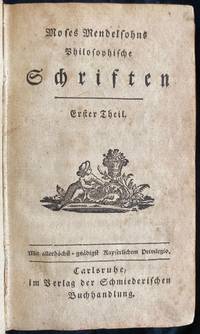
15. [18th Century Edition of Mendelssohn's Second Work] Mendelssohn, Moses
PHILOSOPHISCHE SCHRIFTEN. COMPLETE IN 2 VOLUMES BOUND TOGETHER AS ISSUED
Carlsruhe: im Verlag der Schmiederischen Buchhandlung 1780. No Date 1780s. Period laquered boards with leather spine label. 12mo. XXIV 278; 283 pages. In German. Title translates as “Writings.†Includes 2 different title vignettes 1 on each title page.<br> <br> Goedeke IV 1 488 6. Meyer 108; Dorn 105-107; Holzmann/Bohatta Deutsches Anomymen-Lexikon IV no. 1559. <br> <br> Early printing of Mendelssohn’s second work in which he "began his formulation of a new psychological theory that stressed the autonomy of aesthetics logic and ethics relative to each other." Merriam-Webster's Encyclopedia of World Religions p. 710. <br> <br> Contents:<br> <br> Vol. 1. Vorrede. <br> I. Ueber die Empfindungen.<br> II. Gespräche; <br> <br> Vol. 2. I. Rhapsodie oder Zusätze zu den Briefen über die Empfindungen. <br> II. Ueber die Hauptgrundsätze der schönen Künste und Wissenschaften. <br> III. Ueber das Erhabene und Naive in den schönen Wissenschaften. <br> IV. Ueber die Wahrscheinlichkeit. <br> <br> Also includes bibliographical references.<br> <br> Included within these is a series of writings on aesthetics which influenced Lessing and Schiller with Lessing noting“We have to thank him Mendelssohn for the true theory of mixed sensations.â€<br> <br> Moses Mendelssohn Moses of Dessau; 1729–1786 was a philosopher of the German Enlightenment in the pre-Kantian period early Maskil and a renowned Jewish figure in the 18th century. Mendelssohn was fluent in German and Hebrew and learned Latin Greek English French and Italian. His early teachers were young broadly educated Jews and he met the writer and dramatist G.E. Lessing 1754 and a deep and lifelong friendship developed between them. Throughout his life he worked as a merchant while carrying out his literary activities and widespread correspondence in his free time. In 1754 Mendelssohn began to publish – at first with the assistance of Lessing – philosophical writings and later also literary reviews. <br> He also started a few literary projects for example the short-lived periodical Kohelet Musar in order to enrich and change Jewish culture and took part in the early Haskalah. In 1763 he was awarded the first prize of the Prussian Royal Academy of Sciences for his work Abhandlung über die Evidenz in metaphysischen Wissenschaften "Treatise on Evidence in Metaphysical Knowledge". However when the academy elected him as a member in 1771 King Frederick II refused to ratify its decision. <br> <br> In 1769 he became embroiled in a dispute on the Jewish religion and from then on he confined most of his literary activity to the sphere of Judaism. His most notable and enduring works in this area included the translation into German and commentary on the Pentateuch Sefer Netivot ha-Shalom "Book of the Paths of Peace" 1780–83 and his Jerusalem: oder Ueber religiöse Macht und Judenthum "Jerusalem or On Religious Power and Judaism" 1783 this work the first polemical defense of Judaism in the German language and one of the pioneering works of modern Jewish philosophy. <br> <br> An active intermediary on behalf of his own people in difficult times and a participant in their struggle for equal rights he was at the same time a forceful defender of the Enlightenment against the opposition to it which gained strength toward the end of his life. In the midst of a literary battle against one of the leading figures of the counter-Enlightenment he died in 1786 EJ. <br> <br> SUBJECTS: Philosophy -- Early works to 1800. Philosophie -- Ouvrages avant 1800. Philosophy. OCLC: 1352546328. <br> <br> Light wear to original boards more so at spine but solid and attractive light spotting as expected About Very Good- Condition an attractive 18th Century copy. B KH-10-31. Carlsruhe: im Verlag der Schmiederischen Buchhandlung unknown
Bookseller reference : 43258
|
|
|
1729 1786 Mendelssohn Moses
Jerusalem; a Treatise on Ecclesiastical Authority and Judaism Volume
paperback. Good. Access codes and supplements are not guaranteed with used items. May be an ex-library book. paperback
Bookseller reference : 1024505383.G ISBN : 1024505383 9781024505382

|
|
|
1729 1786 Mendelssohn Moses
Schriften Zur Philosophie Aesthetik Und Apologetik: Mit Einleitungen Anmerkungen Und Einer Biographisch-Historischen Charakteristik Mendelssohn's Volume 2 German Edition
paperback. Good. Access codes and supplements are not guaranteed with used items. May be an ex-library book. paperback
Bookseller reference : 1314367536.G ISBN : 1314367536 9781314367539
|
|
|
1729-1786, Mendelssohn Moses
Die Hauptschriften Zum Pantheismusstreit Zwischen Jacobi Und Mendelssohn; German Edition
paperback. Good. Access codes and supplements are not guaranteed with used items. May be an ex-library book. paperback
Bookseller reference : 1015565816.G ISBN : 1015565816 9781015565814

|
|
|
1729-1786, Mendelssohn Moses
Die Hauptschriften Zum Pantheismusstreit Zwischen Jacobi Und Mendelssohn; German Edition
hardcover. Good. Access codes and supplements are not guaranteed with used items. May be an ex-library book. hardcover
Bookseller reference : 1015560547.G ISBN : 1015560547 9781015560543

|
|
|
1729-1786, Mendelssohn Moses
Jerusalem; a Treatise on Ecclesiastical Authority and Judaism Volume
hardcover. Good. Access codes and supplements are not guaranteed with used items. May be an ex-library book. hardcover
Bookseller reference : 1024500772.G ISBN : 1024500772 9781024500776

|
|
|
1729-1786, Mendelssohn Moses
Jerusalem; a Treatise on Ecclesiastical Authority and Judaism Volume; Volume 2
paperback. Good. Access codes and supplements are not guaranteed with used items. May be an ex-library book. paperback
Bookseller reference : 1022608975.G ISBN : 1022608975 9781022608979

|
|
|
1729-1786, Mendelssohn Moses
Jerusalem; a Treatise on Ecclesiastical Authority and Judaism Volume; Volume 2
hardcover. Good. Access codes and supplements are not guaranteed with used items. May be an ex-library book. hardcover
Bookseller reference : 1021034770.G ISBN : 1021034770 9781021034779

|
|
|
1729-1786, Mendelssohn Moses
Jerusalem; A Treatise on Ecclesiastical Authority and Judaism Volume V.1
paperback. Good. Access codes and supplements are not guaranteed with used items. May be an ex-library book. paperback
Bookseller reference : 1247435830.G ISBN : 1247435830 9781247435831

|
|
|
1809-1847, Mendelssohn-Bartholdy Felix
Felix Mendelssohn Barthodly English and German Edition
paperback. Good. Access codes and supplements are not guaranteed with used items. May be an ex-library book. paperback
Bookseller reference : 1246000830.G ISBN : 1246000830 9781246000832

|
|
|
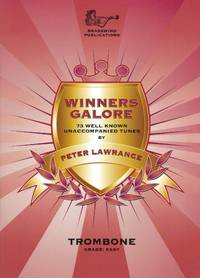
19 composers including Mozart, Beethoven, Vivaldi and Mendelssohn, Arr: Lawrance, Ed: Lawr
Winners Galore for Trombone Bass Clef Part only
Paperback. Very Good. paperback
Bookseller reference : GOR008467004
|
|
|
7 composers including Mendelssohn Gruber Wade and Kirkpatrick Arr: Goddard
Flute Carols: Easy to play Christmas Carols
Spartan Press 1998-08-24. Sheet music. Good. in x in x in. NOT an ex-library book. Clean copy in good condition. Spartan Press unknown
Bookseller reference : mon0000301775 ISBN : 0579995046 9780579995044
|
|
|
[EGYPTE] - MENDELSSOHN (Kurt) -
Das ratsel der pyramiden.
London, Thames & hudson, s.d. ; in-8, 268 pp., cartonnage de l'éditeur. Avec jaquette.
Bookseller reference : 201302389
|
|
|
[JACOBI, FRIEDRICH HEINRICH]. & BRUNO, MENDELSSOHN, ETC.
Ueber die Lehre des Spinoza in Briefen an den Herrn Moses Mendelssohn. Neue vermehrte Auflage. - THE FIRST EVER TRANSLATION OF BRUNO'S "DE UNO ET CAUSA".
Breslau Gottl. Löwe 1789 8vo. Very beautiful contemporary red full calf binding with five raised bands and gilt green leather title-label to richly gilt spine. elaborate gilt borders to boards inside which a "frame" made up of gilt dots with giltcorner-ornamentations. Edges of boards gilt and inner gilt dentelles. All edges gilt. Minor light brownspotting. Marginal staining to the last leaves. Engraved frontispiece-portrait of Spinoza engraved title-vignette double-portrait of Lessing and Mendelssohn engraved end-vignette portrait of Jacobi. Frontispiece title-page LI 1 -errata 440 pp. Magnificent copy. <br/><br/><em>First edition thus being the seminal second edition the "neue vermehrte Auflage" new and expanded edition which has the hugely important 180 pp. of "Beylage" for the first time which include the first translation into any language of any part of Giordano Bruno's "de Uno et Causa." pp. 261-306 as well as several other pieces of great importance to the "Pantheismusstreit" and to the interpretation of the philosophy of Spinoza and Leibniz here for the first time in print. The present translation of Bruno seems to be the earliest translation of any of Bruno's works into German and one of the earliest translations of Bruno at all - as far as we can establish the second only preceded by an 18th century translation into English of "Spaccio della bestia trionfante". It is with the present edition of Jacobi's work that the interest in Bruno is founded and with which Bruno is properly introduced to the modern world. Jacobi not only provides what is supposedly the second earliest translation of any of Bruno's works ever to appear he also establishes the great influence that Bruno had on two of our greatest thinkers Spinoza and Leibnitz. It is now generally accepted that Spinoza founds his ethical thought upon Bruno and that Lebnitz has taken his concept of the "Monads" from him. It is Jacobi who with the second edition of his "Letters on Spinoza." for the first time ever puts Bruno where he belongs and establishes his position as one of the key figures of modern philosophy and thought. Bruno's works the first editions of which are all of the utmost scarcity were not reprinted in their time and new editions of them did not begin appearing until the 19th century. For three centuries his works had been hidden away in libraries where only few people had access to them. Thus as important as his teachings were thinkers of the ages to come were largely reliant on more or less reliable renderings and reproductions of his thoughts. As Jacobi states in the preface to the second edition of his "Letters on Spinoza." "There appears in this new edition under the title of Appendices "Beylage" different essays of which I will here first give an account. The first Appendix is an excerpt from the extremely rare book "De la causa principio et Uno" by Jordan Bruno. This strange man was born one knows not in which year in Nola in the Kingdom of Naples; and died on February 17th 1600 in Rome on the stake. With great diligence Brucker has been gathering information on him but in spite of that has only been able to deliver fragments not in translation. For a long time his works were partly neglected due to their obscurity partly not respected due to the prejudice against the new opinions and thoughts expressed in them and partly loathed and suppressed due to the dangerous teachings they could contain. On these grounds the current scarcity of his works is easily understood. Brucker could only get to see the work "De Minimo" La Croce only had the book "De Immenso et Innumerabilibus" in front of him or at least he only provides excerpts from this also not in translation as Heumann does only from the "Physical Theorems" also small fragments not in translation; also Bayle had of Bruno's metaphysical works himself also merely read this work of which I here provide an excerpt." Vorrede pp. VII-VIII - own translation from the German. Jacobi continues by stating that although everyone complains about the obscurity of Bruno's teachings and thoughts some of the greatest thinkers such as Gassendi Descartes "and our own Leibnitz" p. IX have taken important parts of their theorems and teachings from him. "I will not discuss this further and will merely state as to the great obscurity "grossen Dunkelheit" of which people accuse Bruno that I have found this in neither his book "de la Causa" nor in "De l'Infinito Universo et Mondi" of which I will speak implicitly on another occasion. As to the first book my readers will be able to judge for themselves from the sample "Probe" that I here present. My excerpt can have become a bit more comprehensible due to the fact that I have only presented the System of Bruno himself the "Philosophia Nolana" which he himself calls it in its continuity. My main purpose with this excerpt is by uniting Bruno with Spinoza at the same time to show and explain the "Summa of Philosophy" "Summa der Philosophie" of "En kai Pan" in Greek characters - meaning "One and All". . It is very difficult to outline "Pantheism" in its broader sense more purely and more beautifully than Bruno has done." Vorrede pp. IX-XI - own translation from the German. So not only does Jacobi here provide this groundbreaking piece of Bruno's philosophy in the first translation ever and not only does he provide one of the most important interpretations of Spinoza's philosophy and establishes the importance of Bruno to much of modern thought he also presents Bruno as the primary exponent of "pantheism" thereby using Bruno to change the trajectory of modern thought and influencing all philosophy of the decades to come. After the second edition of Jacobi's "Ueber die Lehre des Spinoza" no self-respecting thinker could neglect the teachings of Bruno; he could no longer be written off as having "obscure" and insignificant teachings and one could no longer read Spinoza nor Leibnitz without thinking of Bruno. It is with this edition that the world rediscovers Bruno never to forget him again.WITH THE FIRST EDITION OF "UEBER DIE LEHRE DES SPINOZA" 1785 JACOBI BEGINS THE FAMOUS "PATHEISMUSSTREIT" which focused attention on the apparent conflict between human freedom and any systematic philosophical interpretation of reality. In 1780 Jacobi 1743-1819 famous for coining the term nihilism advocating "belief" and "revelation" instead of speculative reason thereby anticipating much of present-day literature and for his critique of the Sturm-und-Drang-era had a conversation with Lessing in which Lessing stated that the only true philosophy was Spinozism. This led Jacobi to a protracted and serious study of Spinoza's works. After Lessing's death in 1783 Jacobi began a lengthy letter-correspondende with Mendelssohn a close friend of Lessing on the philosophy of Spinoza. These letters with commentaries by Jacobi are what constitute the first edition of "Ueber die lehre des Spinoza" as well as the first part of the second edition. The second edition is of much greater importance however due to greatly influential Appendices. The work caused great furor and the enmity of the Enlightenment thinkers. Jacobi was ridiculed by his contemporaries for attempting to reintroduce into philosophy belief instead of reason was seen as an enemy of reason and Enlightenment as a pietist and as a Jesuit. But the publication of the work not only caused great furor in wider philosophical circles there was also a personal side to the scandal which has made it one of the most debated books of the period: "Mendelssohn enjoyed as noted at the outset a lifelong friendship with G. E. Lessing. Along with Mendelssohn Lessing embraced the idea of a purely rational religion and would endorse Mendelssohn's declaration: "My religion recognizes no obligation to resolve doubt other than through rational means; and it commands no mere faith in eternal truths" Gesammelte Schriften Volume 3/2 p. 205. To pietists of the day such declarations were scandalous subterfuges of an Enlightenment project of assimilating religion to natural reason. While Mendelssohn skillfully avoided that confrontation he found himself reluctantly unable to remain silent when after Lessing's death F. H. Jacobi contended that Lessing embraced Spinoza's pantheism and thus exemplified the Enlightenment's supposedly inevitable descent into irreligion.Following private correspondence with Jacobi on the issue and an extended period when Jacobi in personal straits at the time did not respond to his objections Mendelssohn attempted to set the record straight about Lessing's Spinozism in "Morning Hours". Learning of Mendelssohn's plans incensed Jacobi who expected to be consulted first and who accordingly responded by publishing without Mendelssohn's consent their correspondence - "On the Teaching of Spinoza in Letters to Mr. Moses Mendelssohn" - a month before the publication of "Morning Hours". Distressed on personal as well as intellectual levels by the controversy over his departed friend's pantheism Mendelssohn countered with a hastily composed piece "To the Friends of Lessing: an Appendix to Mr. Jacobi's Correspondence on the Teaching of Spinoza". According to legend so anxious was Mendelssohn to get the manuscript to the publisher that forgetting his overcoat on a bitterly cold New Year's eve he delivered the manuscript on foot to the publisher. That night he came down with a cold from which he died four days later prompting his friends to charge Jacobi with responsibility for Mendelssohn's death.The sensationalist character of the controversy should not obscure the substance and importance of Mendelssohn's debate with Jacobi. Jacobi had contended that Spinozism is the only consistent position for a metaphysics based upon reason alone and that the only solution to this metaphysics so detrimental to religion and morality is a leap of faith that salto mortale that poor Lessing famously refused to make. Mendelssohn counters Jacobi's first contention by attempting to demonstrate the metaphysical inconsistency of Spinozism. He takes aim at Jacobi's second contention by demonstrating how the "purified Spinozism" or "refined pantheism" embraced by Lessing is in the end only nominally different from theism and thus a threat neither to religion nor to morality." SEP.The Beylagen which are not included in the 1785 first edition and only appear with the 1789 second edition include: I. Auszug aus Jordan Bruno von Nola. Von der Ursache dem Princip und dem Einen p. 261-306 II. Diokles an Diotime über den Atheismus p. 307-327 translation of Lettre . sur l'Athéisme by F. Hemsterhuis. </em> hardcover
Bookseller reference : 45724
|
|
|
[MENDELSSOHN]. Thomas, Mathias
Das Instrumentalwerk Felix Mendelssohn-Bartholdys; Eine systematisch-theoretische Untersuchung unter besonderer Berücksichtigung der zeitgenössischen Musiktheorie
Göttingen: Göttinger Musikwissenschaftliche Arbeiten 1972. Octavo. Original publisher's dark pink wrappers. 267 pp. With occasional annotations in both pencil and ink. Slightly worn; uniformly browned. Band 4. Göttinger Musikwissenschaftliche Arbeiten unknown
Bookseller reference : 36468
|
|
|
[MENDELSSOHN]. Hensel, Sebastian
Die Familie Mendelssohn 1729-1847 nach briefen und Tagebuchern
Leipzig: Insel 1924. 2 volumes. Octavo. Full blue cloth. 417; 432 pp. With illustrative plates. Insel unknown
Bookseller reference : 36386
|
|
|
[MENDELSSOHN]. Stresemann, Wolfgang
Eine Lanze für Felix Mendelssohn
Berlin: Stapp 1984. Octavo. Full light gray cloth with titling in black to spine. 231 pp. With illustrations in text. Stapp unknown
Bookseller reference : 36411
|
|
|
[MENDELSSOHN]. Selden-Goth, G., ed
Felix Mendelssohn Letters . With 33 Illustrations
New York: Pantheon 1945. Large octavo. Original publisher's cloth-backed decorative boards. 372 pp. With occasional illustrative plates and musical examples in text. Binding slightly worn. Uniform light browning. Pantheon unknown
Bookseller reference : 36401
|
|
|
[MENDELSSOHN]. Worbs, Hans Christoph
Felix Mendelssohn Bartholdy: Wesen und Wirken im Spiegel von Selbstzeugnissen und Berichten der Zeitgenossen
Leipzig: Koehler & Amelang 1958. Octavo. Original publisher's full linen with decorative device gilt to upper titling to spine. 255 pp. With occasional illustrative plates. Binding slightly worn; upper hinge reinforced with clear tape; dustjacket worn. Koehler & Amelang unknown
Bookseller reference : 36446
|
|
|
[MENDELSSOHN]. Sutermeister, Peter
Felix Mendelssohn Bartholdy Briefe einer Reise durch Deutschland Italien und die Schweiz und Lebensbild von Peter Sutermesiter. Mit Aquarellen und Zeichnungen aus Mendelssohns Reiseskizzenbüchern
Zürich: Max Niehans Verlag 1958. Octavo. Full linen with titling gilt to spine. 384 pp. With occasional illustrative plates in color tipped-in and illustrations in text. Max Niehans Verlag unknown
Bookseller reference : 36456
|
|
|
[MENDELSSOHN]. Sutermeister, Peter
Felix Mendelssohn Bartholdy Briefe einer Reise durch Deutschland Italien und die Schweiz und Lebensbild von Peter Sutermesiter. Mit Aquarellen und Zeichnungen aus Mendelssohns Reiseskizzenbüchern
Zürich: Max Niehans Verlag 1958. Octavo. Full light linen cloth with titling gilt to spine. 384 pp. With occasional illustrative plates in color tipped-in and illustrations in text. Binding slightly bumped; minor wear to endpapers. Occasional pencilling. Max Niehans Verlag unknown
Bookseller reference : 36459
|
|
|
[MENDELSSOHN]. Schmidt, Christian Martin, ed
Felix Mendelssohn Bartholdy Kongreß-Bericht Berlin 1994
Wiesbaden: Breitkopf & Härtel 1997. Hardcover. Very Good. Octavo. Original publisher's green boards. 351 pp. With occasional illustrations and musical examples. Breitkopf & Härtel hardcover
Bookseller reference : 34819
|
|
|
[MENDELSSOHN]. Worbs, Hans Christoph
Felix Mendelssohn Bartholdy mit Selbstzeugnissen und Bilddokumenten
Reinbek bei Hamburg: Rowohlt 1974. Paperback. Very Good. Octavo. Original publisher's illustrated wrappers. 152 pp. Illustrated. Rowohlt paperback
Bookseller reference : 34813
|
|
|
[MENDELSSOHN]. Schneider, Max F., ed
Felix Mendelssohn Bartholdy: Denkmal in Wort und Bild
Basel: Amerbach-Verlag 1947. Hardcover. Very Good. Quarto. Original publisher's red printed boards with facsimile of Mendelssohn's signature gilt to upper and titling gilt to spine. 150 pp. 8ff. facsimiles. With tipped-in illustrations within text including portraits and facsimiles of autograph musical manuscripts. Binding slightly worn. Amerbach-Verlag hardcover
Bookseller reference : 34829
|
|
|
[MENDELSSOHN]. Lampadius, WA. W. A.
Felix Mendelssohn Bartholdy: Ein Gesammtbild seines Lebens und Wirkens . Mit dem Portrait und einem facsimilirten Briefe Felix Mendelssohn Barthholdy's
Leipzig: F.E.C. Leuckart 1886. Paperback. Good. Original publisher's printed wrappers with bust-length portrait of the composer to upper. 379 pp. Unopened. Wrappers slightly worn and soiled; several chips to edges with minor loss not affecting text; split at spine. F.E.C. Leuckart paperback
Bookseller reference : 34831
|
|
|
[MENDELSSOHN]. Erskine, John
Felix Mendelssohn Bartholdy: Musik-Konzepte 14/15
Paperback. Good. Octavo. Original publisher's printed wrappers. 176 pp. With contributions by Wulf Konold Hans Mayer Gerd Zacher Friedhelm Krummacher Richard Hauser Heinz-Klaus Metzger Robert Schumann and Rainer Riehn. With musical examples. Slightly worn. Small bookseller's label to verso of upper wrapper. paperback
Bookseller reference : 34824
|
|

 Receive by email
 Download as PDF document
 RSS feed
 Permanent link
