|
Geoffroy, Auguste
La Somnambule roman d'actualité
Paris: E. Dentu 1890. Livre. Assez bon. broché. Dédicacé par l'auteur. Edition originale. Grand In-16. Paris E. Dentu 1890. 17 x 11 cm grand in-16 370 pp. broché couverture jaune imprimée. Mention probablement fictive de 3e édition. Bel et long ENVOI autographe signé de l'auteur sur ce roman populaire très rare absent du CCFr comme du KvK. Auguste Geoffroy 1856-1929 publiciste publia un bon nombre de romans populaires souvent appelés "romans d'actualité" certains sous le nom de Camille Descamps Geoffroy de La Mothe ou Armand de Lanrose. Rousseurs sur papier blanc petite perte de papier au faux-titre. E. Dentu Paperback
Bookseller reference : 3109

|
|
|
Georg der Bärtige, Herzog von Sachsen (1471-1539).
Ausschnitt mit eigenh. U. Dresden, 18. XII. 1535.
4 Zeilen. Ca. 310:96 mm. Auf Karton montierte Titulatur, Datierung, Unterschrift und papiergedecktes Siegel eines Briefes des kunstsinnigen Herzogs. - Leicht angeschmutzt. Mit Sammlernotiz in Bleistift.
|
|
|
Georg I., der Fromme, Landgraf von Hessen-Darmstadt (1547-1596).
Dokument mit eigenh. U. Darmstadt, 1. I. 1583.
2¼ SS. auf Doppelblatt. Folio. Mit papiergedecktem Siegel (Faltbrief). Bestallungsurkunde für Johann von Windhausen als "Diener von Haus aus" mit detaillierten Pflichtenregelungen: "Wir George vonn Gotts Gnadenn Lanndtgrave zu Hessenn, Grave zu Catzenelnbogenn, Dietz, Ziegennhainn unnd Nidda etc., thun kundt, hieran offenntlich bekennende, das wir dem vestenn unnserenn liebenn getrewenn, Johann vonn Windthausenn, zu unnserm Dienner von Haus aus, bestelt, uff- und angenommen habenn. Bestellenn, unnd nehmenn ihnenn auch dartzu uff unnd an, jegenwertiglich, in unnd mit Crafft dieses briefes, also unnd dergestalt, das er Unnser bestelter Diener vonn Haus aus- unnd Unns gewertig seinn, auch uff unnser erfordern es sei gleich anhero zu Unnser Hoffhaltung, oder wohinn wir seiner sonnstenn bedurftig, mit dreienn Pferdenn gehorsamblich erscheinen, Sich forters zu alle demjenigenn, darzu wir seiner vonnöthenn habenn, unnd er qualificirt ist, gebrauchenn lassenn, unnd dasselbe seines bestenn verstandes und vermögenns verrichtenn soll [...]". - Mit minimalen Wasserflecken. Leicht brüchig im Falz.
|
|
|
Georg II., der Gelehrte, Landgraf von Hessen-Darmstadt (1605-1661).
Dekret mit eigenh. U. Kranichstein, 15. IX. 1660.
½ S. Folio. Mit Lacksiegel. Zur Zollbefreiung einer Weinlieferung an Graf Johann Martin zu Stolberg: "Nachdem von Gottens gnaden uns Georgen Landgrafen zu Hessen, Fürsten zu Hersfeld, Grafen zu Cazenelnbogen [...] etc., der Wohlgeborne, unser lieber Neve und besonder, Hanß Marttin Graf zu Stolberg etc. zu erkennen gegeben, welchermaßen Er zu behuef seiner Hofhaltung, in Franckhen, dreyßig fuder wein erhandeln lassen, und dieselbe nacher Stolberg uberbringen zu lassen, Verordnung getan hatte, und uns deshalben umb Zollbefreyung ersucht, welche wir dann gewilliget. So befehlen wir allen und ieden Unseren Zöllnern so hiermit belangt werden, daß Sie bemelte Anzahl gemeine dreyßig fuder wein zu unseren Antheil allenthalben Zoll- und Licentenfrey durch und vorüber Paßiren lassen [...]". - An den Rändern minimal angeschmutzt. Wohlerhalten.
|
|
|
Georg II., Herzog von Sachsen-Meiningen (1826-1914).
Eigenh. Brief mit U. Liebenstein, 16. X. 1879.
2½ SS. auf Doppelblatt. 8vo. An einen k. k. Staatsminister in Wien mit einer Empfehlung des Wiener Gastspiels des berühmten Meininger Hoftheaterensembles und seines Intendanten Ludwig Chronegk: "Ich kann unmöglich die 'Meininger' in Wien wissen, ohne von Seinem fürnehmsten Kunstmäcen ein gütiges Interesse für dieselben zu erbitten und den Director Chronegk seiner Gnade zu empfehlen. Es würde mir eine ganz besondere Freude sein zu hören, daß Euer Excellenz eine oder die andere Vorstellung mit ihrem Besuche ausgezeichnet hätten! Gleichzeitig wiederhole ich meinen verbindlichsten Dank für die so wirksame Unterstützung, welche Sie meinem Ersuchen, die Bluthochzeit für Prag zu gestatten, angedeihen ließen. [...]". - Der liberale Herzog Georg II. von Sachsen-Meiningen ging nicht zuletzt als Theatermäzen und Reformer in die Geschichte ein. Gemeinsam mit dem Regisseur und Intendanten des Meininger Hoftheaters Ludwig Chronegk arbeitete er die sogenannten Meininger Prinzipien aus, die Generationen von Theatermachern beeinflussen sollten. Durch zahllose Tourneen des Meininger Hoftheaters mit 81 Gastspielen in 39 Städten von 1874 bis 1890 verbreiteten sich die Reformideen des Herzogs in ganz Europa, und die "Meininger" feierten große Erfolge. - Leicht braunfleckig bzw. angestaubt. Schönes Zeugnis der Theaterbegeisterung Georgs II.
|
|
|
Georg IV., König des Vereinigten Königreichs von Großbritannien und Irland und König von Hannover (1762-1830).
Briefausschnitt mit eigenh. U. ("George R"). O. O. u. D.
1 S. Qu.-32mo. Alt auf Trägerpapier montiert.

|
|
|
Georg Wilhelm, Fürst von Schaumburg-Lippe (1784-1860).
Eigenh. Brief mit U. Nachod, 2. X. 1857.
1½ SS. auf Doppelblatt. Gr.-4to. An einen Feldzeugmeister in Wien mit der Empfehlung seines Sohnes Wilhelm für den Eintritt in das Regiment von Oberst Hugo von Weckbecker als Oberleutnant, unter besonderer Hervorhebung von Wilhelms Erfahrungen, Kenntnissen und Dienstwünschen sowie mit der Bitte um Instruktion, wie diese Karriere einzuleiten wäre: "Er wünscht in den drei Waffengattungen zu dienen und möchte zuerst etwa Ein Jahr bei den Jägern eintreten [...] Wilhelm wird [...] eine kurze Reise nach Ungarn machen, vielleicht auch über Wien reisen und in diesem Falle die Gelegenheit benutzen sich Ew. Excellenz vorzustellen [...]". - Im selben Jahr übertrug Georg Wilhelm seinem Sohn die Herrschaft Nachod als Sekundogenitur. Sohn Wilhelm trat zwei Jahre später in die österreichische Armee ein, beendete die im vorliegenden Schreiben angestrebte Militärlaufbahn jedoch bereits 1861, um sich der Bewirtschaftung seiner Güter zu widmen. - Leicht braunfleckig.
|
|
|
Georg Wilhelm, Herzog zu Braunschweig-Lüneburg (1624-1705).
Gedr. Mandat mit eigenh. U. Hannover, 9. IX. 1658.
¾ S. auf Doppelblatt (Faltbrief). Mit hs. Adresse und papiergedecktem Siegel. An Johann Hildebrandt und die Ständevertreter der Stadt Gladebeck zur Einberufung einer Ständeversammlung: "Demnach wir eine notwendigkeit zu seyn erachtet Uns mit unser getrewen Landschafft über verschiedene wichtige angelegenheiten in gnaden zu vernemen und dahero entschlossen auff den Mittwochen nach Francisci, ist der 6. Monahtstag Octobris, derobehueff einen offenen Landtag auszuschreiben und zuhalten. So begehren wir in euch hiermit gnediglich Ihr wolltet Dienstags zuvorhero gegend Abend in Person allhie einkommen und darauff folgenden Tages an dem Ort welchen Wir darzu werden ernennen lassen nebst andern erforderten Landständen, die alsdan abgehende proposition mit anhören, darauff den vorgehenden deliberationibus mit beywohnen und dabey ewer unterthäniges votum und gutachten als getrewe patrioten eröffnen [...]". - Brüchig entlang der Faltlinien.
|
|
|
Georg, Manfred, Schriftsteller und Journalist (1893-1965).
Ms. Sentenz mit eigenh. U. und eh. ausgefülltem Formularteil. Berlin, 22. IX. 1928.
1 S. Folio (223:282 mm). Albumblatt mit gedruckter dreiseitiger Bordüre, gedr. Fußzeile "Beitrag zum Selbstschriftenalbum 'Deutschlands Zukunft'" und gedr. Formular für biograph. Daten, aufgezogen auf einen Bogen Pergamentpapier (ca. 330:344 mm). Die eh. U. und eh. Daten in Bleistift. "Deutschlands Zukunft liegt in der Abkehr von jeder Phrase. Und in der Erkenntnis, dass der Unterschied von arm und reich, also der Klassengegensatz, nicht zu verleugnen oder ideologisch zu verkleistern ist, sondern zur Grundlage einer Sozialpolitik gemacht werden muss, die altes Unrecht mit neuem Recht heilt [...]". Geschrieben als Beitrag für die von Friedrich Koslowsky im Berliner Eigenbrödler-Verlag herausgegebene Faksimile-Anthologie "Deutschlands Köpfe der Gegenwart über Deutschlands Zukunft" (1928). - Manfred Georg war Pazifist, Zionist, Mitglied der "Deutschen Liga für Menschenrechte", der "Nie-wieder-Krieg-Bewegung" und Mitbegründer der Republikanischen Partei. Er arbeitete als liberaler Journalist, Korrespondent und Redaktionsleiter für unterschiedliche Formate wie den Ullstein und Mosse Verlag sowie für die "Berliner Morgenpost" u. a. m. - Das Albumblatt am oberen Rand beschnitten. Koslowsky 304.
|
|
|
Georg, Rita, Sängerin (1900-1973).
Albumblatt mit eigenh. U. O. O., 28. IV. 1932.
½ S. Qu.-8vo. Auf etwas größerem Trägerpapier montiert. In Bleistift. Rita Georg, als junge Sängerin von dem Komponisten Franz Lehár entdeckt und gefördert, hatte ihre erste Filmrolle in dem Stummfilm "Das Gebot der Liebe" (1919). Sie war 1926 am Wiener Burgtheater in Karl Farkas' Revue "Journal der Liebe" und als erste Sonja an der Seite von Richard Tauber in Lehárs 1927 uraufgeführtem "Zarewitsch" zu sehen. Größere Bekanntheit erlangte sie als Mary in Emmerich Kálmáns "Die Herzogin von Chicago" im Theater an der Wien. Ab 1933 verlegte sie ihre Wirkungsstätte nach Frankreich und später in die Niederlande.
|
|
|
Georg,, Großherzog von Mecklenburg-Strelitz (1779-1860)
Brief mit eigenh. Grußformel und U.
o.J. Neustrelitz, 16. VI. 1851, Fol. 1 Seite. Doppelblatt.
Bookseller reference : 36259
|
|
|
GEORGE (Mademoiselle).
Lettre autographe signée à sa couturière.
S.d., 1 p. in 12.
Bookseller reference : AMA-788
|
|
|
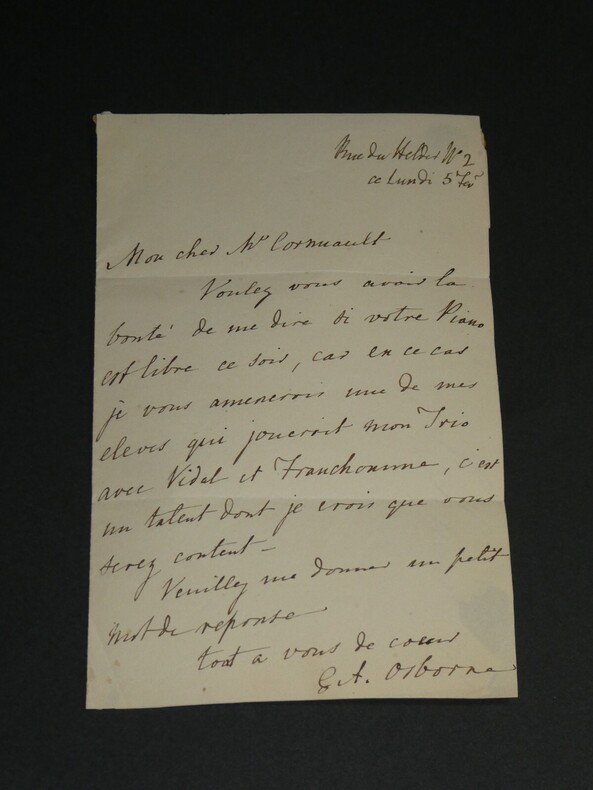
George Alexander Osborne
George Alexander Osborne - LETTRE AUTOGRAPHE SIGNÉE piano Vidal et Franchomme
George Alexander Osborne - LETTRE AUTOGRAPHE SIGNÉE Dimensions : 18 x 11.5 cm État : Voir photos pour plus de détails. Nombre de pages : 1 George Alexander Osborne (Limerick, 24 septembre 1806 – Londres, 16 novembre 1893) est un compositeur et pianiste irlandais.
Bookseller reference : boz_002552
|
|
|
George Axelrod
The Seven Year Itch
New York: Random House 1953. Cloth. Near Fine/Very Good. Previous owner's unique bookplate on front pastedown. Gray cloth with photo paste-on of two stars. Jacket shows minimal shelfwear spine a bit yellowed. This is the Fireside Book Club Edition inscribed on the front flyleaf to the prev owner by George Axelrod. Orig. Book Club brochure included. <br/> <br/> Random House hardcover
Bookseller reference : 002208
|
|
|
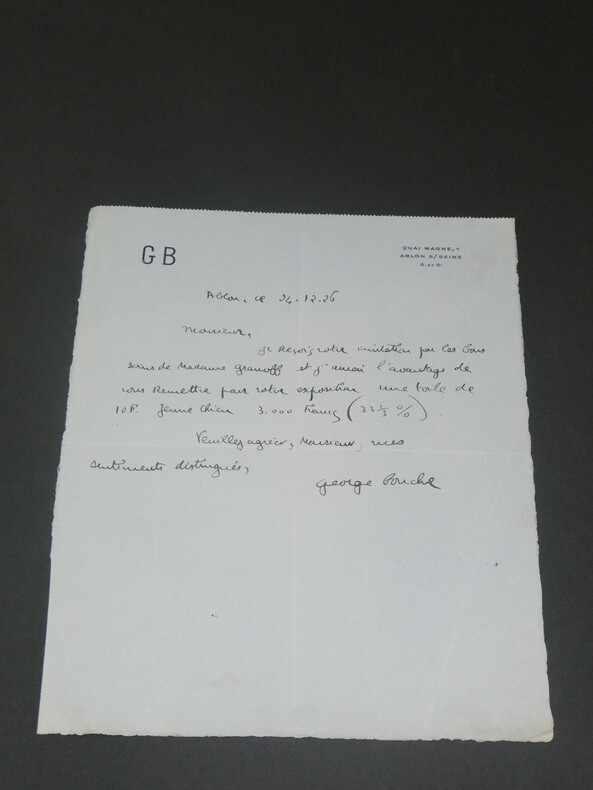
George BOUCHE
George BOUCHE, Peintre - LETTRE AUTOGRAPHE SIGNÉE - 24 Décembre 1926, 1 page
George BOUCHE. Lettre autographe signée en date du 24 Décembre 1926 Peintre Lettre autographe signée du peintre français George BOUCHE, mentionnant l'envoi d'une "toile". Dimensions : 26,7 x 20,5 État : Voir photos pour plus de détails. Nombre de pages : 1 George BOUCHE Georges Pierre Bouche, né à Lyon le 24 janvier 1874 et mort à Celles-sur-Durolle le 12 mai 1941, est un peintre français.
Bookseller reference : boz_002843
|
|
|
George BOUCHE
George BOUCHE, Peintre - LETTRE AUTOGRAPHE SIGNÉE - 06 Juin 1927, 1 page
George BOUCHE. Lettre autographe signée en date du 06 Juin 1927 Peintre Lettre autographe signée du peintre français George BOUCHE, mentionnant l'envoi d'une "toile" pour "prendre place dans votre ensemble de paysagistes français". Dimensions : 26,7 x 20,5 État : Voir photos pour plus de détails. Nombre de pages : 1 George BOUCHE Georges Pierre Bouche, né à Lyon le 24 janvier 1874 et mort à Celles-sur-Durolle le 12 mai 1941, est un peintre français.
Bookseller reference : boz_004174
|
|
|
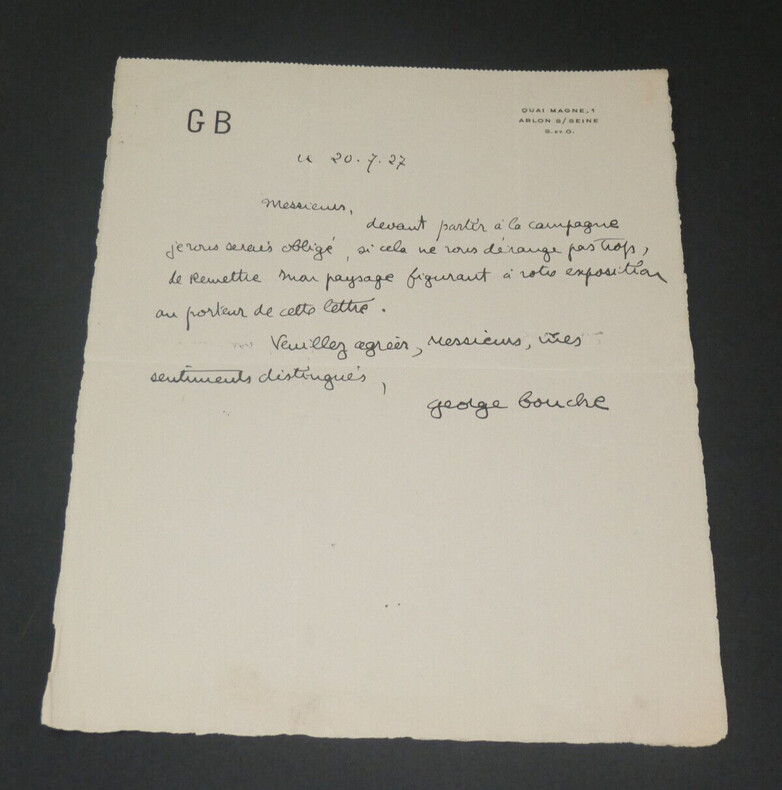
George BOUCHE
George BOUCHE, Peintre - LETTRE AUTOGRAPHE SIGNÉE, 20 Juillet 1927
George BOUCHE. Lettre autographe signée en date du 20 juillet 1927 Peintre George Bouche, peintre. Lettre autographe signée, 20 Juillet 1927. Dimensions : 26,7 x 20,7 cm Nombre de pages : 1 page George BOUCHE George Pierre Bouche, né à Lyon le 24 janvier 1874 et mort à Celles-sur-Durolle le 12 mai 1941, est un peintre français.
Bookseller reference : boz_004000
|
|
|
George Day
ladieu et la voix . Poemes
Du Dauphin 1960
Bookseller reference : 7655
|
|
|
George Delamare
Libres propos
Envoi autographe à Madame Desfossé. George Delamare (1881-1975) Homme de lettres, romancier, poète, historien et résistant français. Éditorialiste de la radio-diffusion française, directeur de Radio-Tour Eiffel (en 1927). Fort vol relié, 19x13, jolie reliure demi cuir, leg. frottement bas de coiffe, très bel état intérieur, 266pp. Paris, La Table Ronde, 1952 ref/230
Bookseller reference : CZC-9450

|
|
|
George Delamare
Libres propos
Envoi autographe à Madame Desfossé. George Delamare (1881-1975) Homme de lettres, romancier, poète, historien et résistant français. Éditorialiste de la radio-diffusion française, directeur de Radio-Tour Eiffel (en 1927). Fort vol relié, 19x13, jolie reliure demi cuir, leg. frottement bas de coiffe, très bel état intérieur, 266pp. Paris, La Table Ronde, 1952 ref/230
Bookseller reference : CZC-9450
|
|
|
George Denholm of Press Castle, near Reston, Berwickshire [ The Denholm Collection of Autographs ]:
Printed catalogue. The Denholm Collection of Autograph Letters and Ancient Curious Documents.
Edinburgh: Privately Printed 1903. 4 74pp. 8vo. In good condition aged and worn. In worn red cloth binding with title in gilt on spine and front cover. A brief description of the more than 800 items in the collection which was arranged in ten volumes. Occasional entries feature quotations. Of interest is Vol. I item 58: 'Winston Churchill M.P. from Government House Natal in which he says: - five line quotation from the letter follows'. See also vol.4 item 11: 'Napoleon I. - Fifty pages of folio the original papers he had at the battle of Chiclana Spain in 1811 containing a list of officers who distinguished themselves at the battle and were submitted to Napoleon for promotion with his autograph memoranda "accorde" and numerous other markings in the hand of the great Emperor.' The entry for Vol.9 item 1 reproduces over a whole page transcriptions from 'Original manuscript poems' by Robert Burns beginning 'Ye've heard this while how I've been icket' and the entry for Vol.9 item 6 contains an eight-page transcription from a letter from Burns to Colonel Fullarton. The entry for Vol.5 item 50 reproduces a sixteen-line poem in Latin by Ainsworth from 1724. Vol.6 item 10a is an eleven-line entry on 'an interesting and very valuable auto. letter' by David Garrick. Also items by Jefferson Davis Daniel O'Connell and Benjamin Disraeli Cowper Southey Allan Cunningham and Smollett. The volume is now extremely uncommon. Edinburgh: Privately Printed, 1903. hardcover
Bookseller reference : 16772
|
|
|
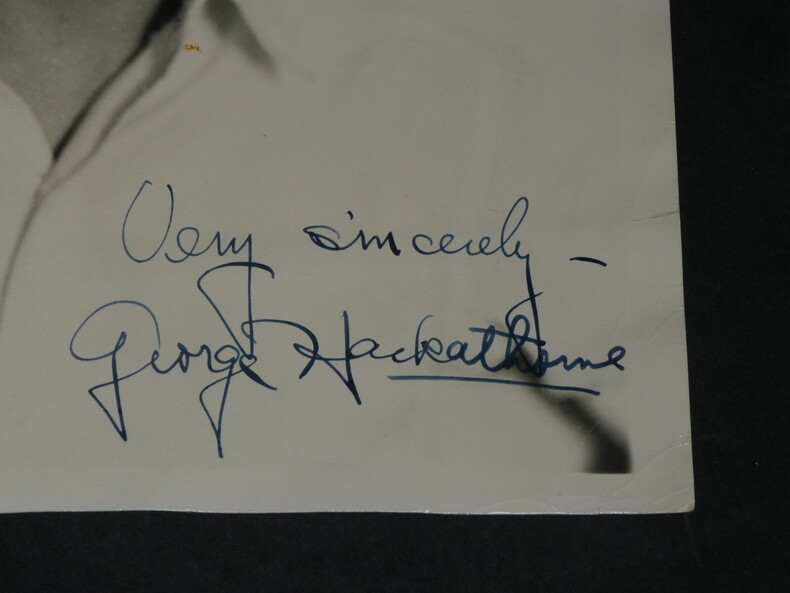
George HACKATHORNE
George HACKATHORNE - PHOTOGRAPHIE NOIR ET BLANC Rare autographe cinéma muet
George HACKATHORNE - PHOTOGRAPHIE NOIR ET BLANC Rare autographe de la vedette du cinéma muet du début 20ème siècle. Dimensions : 25,4 x 20,3 cm État : Voir photos pour plus de détails. Nombre de pages : 1 page
Bookseller reference : boz_004216
|
|
|
George Hugnet
1961
Paris, Chez l'auteur, 1961. Édition originale, l'un des 500 exemplaires sur vélin, in-8 de 229 x 147 mm pour 60 pp. Sublime reliure de Colette et Jean-Paul Miguet en maroquin noir, plats de papier fauve, dos lisse avec nom d'auteur et titre à la verticale en doré, une véritable relecture art déco de la reliure janséniste. Accompagné d'un emboîtage maroquin, relié de la même façon avec plats aux motifs boisés et intérieur velours, et d'un boîtier protecteur à motifs boisés pour rangement coulissant. Couverture conservée, tranche supérieure dorée. Dédicace de l'auteur sur la page de titre au poète et collectionneur d'art cubain Robert Altmann, mentor de l'écrivaine Zoé Valdès, et à sa femme Hortensia, "en souvenir d'un merveilleux dîner cubain à Viroflay". À noter, sur la page de titre, que l'auteur a barré l'adresse imprimée pour inscrire à la main sa nouvelle adresse. Exemplaire complet de ses quatre photomontages, portant le numéro 461.
Bookseller reference : 0021

|
|
|
George II, Duke of Saxe-Meiningen (1826-1914).
6 ALS. Meiningen, 1862-67.
8vo. Altogether 8 pp. Four letters to Mr. Foerster, one to his wife, and one letter of recommendation to the administration of Saalfeld Castle, concerning Foerster's search for antiques. - George II was well-known for his efforts in building the so-called Meiningen Court Theater and the Meiningen acting group. Together with his third wife, the actress and later Baroness of Heldburg, Ellen Franz (1839-1923), he laid the foundations for the early splendor of this renowned acting troupe. He was also close to musicians and painters such as Wilhelm von Kaulbach and Julius Schnorr von Carolsfeld.

|
|
|
George II, King of Great Britain (1683-1760).
Autograph signature (cropped). No place or date.
Oblong 8vo (220 x 60 mm). 1 p. The clipped ending of a letter: "freundwilliger Vetter / George R." - Traces of former mounting.
|
|
|
George IV, King of Hanover and the United Kingdom of Great Britain and Ireland (1762-1830).
Autograph document signed ("GeorgeR"). "Carlton House" (London), 23 June 1825.
Oblong folio. 1 p. on vellum, with papered seal. Promotiing Thomas Le Marchant Saumarez to the rank of an ensign of the "Seventy first (Highland) Regiment of Foot". - With two counter-signatures. Slightly stained and dusty; traces of another seal.

|
|
|
George Meredith
Essai sur la comédie
de l'idée de comédie et des exemples de l'esprit comique, précédé d'une introduction par Arthur Symons Envoi autographe de l'auteur vol relié, 19x13, jolie reliure demi cuir, très bel état intérieur, 134pp. Couvertures conservées. Paris, Mercure de France, 1898 ref/230
Bookseller reference : CZC-9453

|
|
|
George Meredith
Essai sur la comédie
de l'idée de comédie et des exemples de l'esprit comique, précédé d'une introduction par Arthur Symons Envoi autographe de l'auteur vol relié, 19x13, jolie reliure demi cuir, très bel état intérieur, 134pp. Couvertures conservées. Paris, Mercure de France, 1898 ref/230
Bookseller reference : CZC-9453
|
|
|
George SAND
"Je suis bien d'âge à être votre mère car j'ai 55 ans et j'ai de bonnes mains bien adroites mais pas belles du tout."" • Signed autograph letter addressed to Ernest Feydeau
Nohant Nohant-Vic 1859. Fine. Nohant Nohant-Vic 16 août 1859 13.50 x 20.90 cm 4 pages sur un double feuillet Autograph letter signed by George Sand addressed to Ernest Feydeau. Four pages written in blue ink on a double sheet bearing at the head of the first page the sender's blind stamp. This letter was published in the complete correspondence of George Sand established by Georges Lubin. Fine and lengthy letter discussing literature and friendship between writers. Initially a stockbroker and specialist in Antiquity Ernest Feydeau launched himself late into fiction. Anxious to occupy a literary space in which he did not feel justly appreciated he used his connections and maintained a regular epistolary relationship with illustrious correspondents such as Gustave Flaubert Sainte-Beuve and George Sand to whom he sent drafts of his novels and whose opinions he sought. This letter forms Sand's response after having just finished reading Daniel Feydeau's second novel. George Sand then at the height of her literary career describes herself thus: ""I am quite old enough to be your mother for I am 55 years old and I have good hands quite skillful but not beautiful at all. I have earned the right to no longer be coquettish I have been quite reproached for never having been so. I will tell you anything about myself that you wish."" As was her habit much solicited by her peers she delivers a very detailed critique of the text her colleague submits to her: ""I am not against sentences that jar where they need to jar but I am not for harmony being sacrificed to rhythm. Nor am I for the contrary. Understand me well I only blame what is too noticeable what reveals the technique. Do not touch the passages you speak of they are excellent. And in sum I will not insist furiously on the question of form in style seeing that if the qualities of yours should disappear with what sometimes seems to me a flaw I would be in despair at having pointed out the flaw."" Herself very close to Flaubert whom she nicknamed her ""leaden bottom"" Sand seems delighted that the two men know each other: ""I do not have time. But I will have time to receive you when you are free you must come with Flaubert who also has in me an enchanted reader and a wholehearted literary friend. I did not know he was your friend and I am pleased that he is."" The friendship goes so far that Sand soon brings the two writers together placing them on complete equal footing: ""It is no misfortune for you any more than for Flaubert to belong to the race of seers."" A form of solidarity then establishes itself in the face of critical adversity: ""All this is felt better than it can be said and that is why criticism loses its reason three-quarters of the time."" For criticism has had the misfortune of labeling Feydeau as it did with Flaubert a realist: ""People have taken it upon themselves to baptize your manner and his as realism. I do not know why; unless realism is something entirely different from what the first adherents attempted to explain to us. I suspect indeed that there is a way of envisaging the reality of things and beings which is great progress and you bring triumphant proof of it. But the name realism does not suit because art is a multiple infinite interpretation. It is the artist who creates reality within himself his own reality and not that of another. Two painters paint the portrait of the same person. Both create a work that represents the person if they are both masters. And yet the two paintings do not resemble each other. What has become of reality"" This long diatribe - a true manifesto - forms a powerful testimony to the repulsion of George Sand and Flaubert for theorists obsessed with the idea of classifying literature according to a ""system that . blinds"". unknown
Bookseller reference : 76839
|
|
|
George SAND
"Je suis toujours enfermée pour écrire ou sortir pour me promener."" • Signed autograph letter addressed to Léon Curmer
Paris 1840. Fine. Paris jeudi 7 mai 1840 13.60 x 20.90 cm une page sur un double feuillet Autograph letter signed by George Sand addressed to publisher Léon Curmer. One page written in black ink on a double sheet. This letter was published in the complete correspondence compiled by Georges Lubin. ""Monsieur J'ai parcouru votre recueil avec beaucoup d'intérêt et j'accepte la collaboration que vous m'avez offerte mais je ne pourrais m'occuper de vous satisfaire que dans six semaines ou deux mois. Si cette époque vous convient veuillez bien me le faire savoir ainsi que les conditions de la rédaction."" ""Sir I have perused your collection with great interest and I accept the collaboration you have offered me but I could not undertake to satisfy you for six weeks or two months. If this timing suits you please let me know as well as the conditions of the writing."" The ""recueil"" ""collection"" in question here is none other than Les Français peints par eux-mêmes. Sand would not however collaborate on this monumental compendium of types preferring instead several years later Le Diable à Paris published under the direction of her close friend publisher Hetzel. unknown
Bookseller reference : 77244
|
|
|
George SAND - (to Gustave FLAUBERT)
"Je t'écris en courant ce matin ."" • Signed autograph letter addressed to Gustave Flaubert
Nohant Nohant-Vic 1876. Fine. Nohant Nohant-Vic 6 mars 1876 13.20 x 20.70 cm deux pages sur un feuillet remplié Autograph letter signed by George Sand addressed to Gustave Flaubert. Two pages written in black ink on a double sheet bearing at the head of the first page the sender's dry stamp. This letter was published in the complete correspondence of George Sand established by Georges Lubin. Fine letter written by George Sand a few months before her death and addressed to her lifelong friend Gustave Flaubert. The writer wishes to offer her friend a seat so he may attend the revival of her play Le Mariage de Victorine : ""Je t'écris en courant ce matin parce que je viens de recevoir de Mr Perrin avis de la 1ère représentation de la reprise du Mariage de Victorine une pièce de moi au théâtre français. Je n'ai ni le temps d'y aller ni l'envie de partir comme cela au pied levé mais j'aurais voulu y envoyer quelques amis et il ne m'offre pas une seule place. Je lui écris une lettre qu'il recevra demain et je le prie de t'envoyer au moins un orchestre."" ""I'm writing to you hurriedly this morning because I've just received notice from Mr Perrin of the first performance of the revival of Le Mariage de Victorine a play of mine at the Théâtre Français. I have neither the time to go nor the desire to leave like that at a moment's notice but I would have liked to send some friends and he doesn't offer me a single seat. I'm writing him a letter which he will receive tomorrow and I ask him to send you at least an orchestra seat."" Letters from the correspondence between George Sand and Gustave Flaubert are renowned and highly sought after. unknown
Bookseller reference : 76872
|
|
|
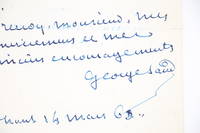
George SAND
"On n'est jamais plus heureux et inspiré que quand on croit n'avoir pas le temps de l'être."" • Signed autograph letter addressed to René Biémont
Nohant Nohant-Vic 1863. Fine. Nohant Nohant-Vic 14 mars 1863 13.40 x 20.60 cm 3 pages sur un double feuillet Autograph letter signed by George Sand addressed to René Biémont. Three pages written in blue ink on a double sheet bearing at the head of the first page the blind stamp of Sand's initials. Envelope included. Folds inherent to mailing. This letter was published in the complete correspondence of George Sand established by Georges Lubin. Fine letter of congratulations addressed to René Biémont after sending his work Le Petit Fils d'Obermann: ""Your little book is very original and you show qualities of talent that will develop if you look ahead."" As an attentive reader much solicited by her young peers Sand develops her literary criticism: ""Obermann and his grandson the monk belong to the past. They are true and the timid Jean is well drawn. There is grandeur and truth in this exceptional type. But Constant d'Heurs is too passive to events. He should react against this powerless man and cure him or pity him more ."" Sententiously she thus concludes her letter: ""Do not complain of thankless work and accept it as a good thing three-quarters of life sacrificed to some duty makes the last quarter very strong and very alive. It is very good to be attached to poetry and thwarted in the possession of a beautiful dream. As soon as one can savor it without respite it fades or becomes troubled. I speak to you from experience. One is never happier and more inspired than when one believes one does not have time to be so."" Very fine testimony to the leading role that George Sand played on the literary scene of the Second Empire. unknown
Bookseller reference : 76837
|
|
|
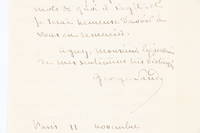
George SAND
Lettre autographe signée adressée à un correspondant inconnu
Paris 1864. Fine. Paris s. d. entre 1864 et 1868 13.40 x 20.70 cm 2 pages sur un double feuillet Autograph letter signed addressed to an unknown correspondent written in black ink on a double leaf with dry stamp bearing the writer's initials. This letter probably unpublished was written on ""November 11th"" between 1864 and 1868 according to the address at the bottom: ""rue des feuillantines 97"". ""Une amie commune et pleine de confiance en votre bonté me fait espérer monsieur que vous m'accorderez un peu de sympathie. Si je suis indiscrète d'y croire ne vous en prenez qu'à elle comme elle est de ces personnes à qui l'on ne peut en vouloir je ne crains pas de vous la dénoncer. Vous pouvez vendre un immense service au fils de mon ami d'enfance. Le voudrez-vous quelque difficile que la chose puisse être Elle ne l'est peut-être pas je ne sais pas. Mais si elle l'est j'espère quand même depuis ce que Madame de Voisins me dit de vous. ."" ""A mutual friend full of confidence in your kindness gives me hope sir that you will grant me some sympathy. If I am indiscreet to believe it blame only her as she is one of those persons one cannot hold a grudge against I do not fear to denounce her to you. You can render an immense service to the son of my childhood friend. Will you do so however difficult the matter may be Perhaps it is not difficult I do not know. But if it is I still hope so from what Madame de Voisins tells me about you. ."" unknown
Bookseller reference : 78465
|
|
|
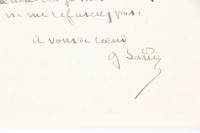
George SAND
Lettre autographe signée adressée à Alphonse Peyrat
1868. Fine. s. d. mai 1868 13.50 x 20.70 cm 2 pages sur un double feuillet Autograph letter signed by George Sand addressed to Alphonse Peyrat two pages written in black ink on a double sheet. Transverse folds inherent to mailing. Interesting letter evoking one of her faithful friends: Jean Patureau-Francoeur. George Sand had published a long obituary article in tribute to this close friend in L'Avenir national on May 2 1868. She described her late friend with great tenderness: ""C'était un simple paysan un vigneron des faubourgs de Châteauroux. Il avait appris tout seul à écrire et il écrivait très remarquablement avec ces naïves incorrections qui sont presque des grâces dans un style rustique et spontané. . Ce petit homme robuste à grosse tête ronde au teint coloré à l'œil bleu étincelant et doux était doué d'une façon supérieure. Il voyait la nature il l'observait il l'aimait et il la savait. . Son existence parmi nous fut pénible agitée méritante. Naturellement un esprit aussi complet que le sien devait se passionner pour les idées de progrès et de civilisation. Il fut avant la Révolution le représentant populaire des aspirations de son milieu et il travailla à les diriger vers un idéal de justice et d'humanité. ."" ""He was a simple peasant a wine-grower from the suburbs of Châteauroux. He had taught himself to write and he wrote remarkably well with those naive incorrections that are almost graces in a rustic and spontaneous style. . This sturdy little man with his large round head his ruddy complexion his sparkling and gentle blue eyes was gifted in a superior way. He saw nature observed it loved it and understood it. . His existence among us was painful agitated meritorious. Naturally a mind as complete as his had to be passionate about ideas of progress and civilization. He was before the Revolution the popular representative of his milieu's aspirations and he worked to direct them toward an ideal of justice and humanity. ."" In 1848 Patureau was elected mayor of Châteauroux and became the spokesman for the workers of his commune. ""Au moment du coup d'État il fut poursuivi mais il se cacha dans des familles amies et échappa à la police. George Sand obtint difficilement sa grâce ce qui lui permit de regagner Châteauroux. Il fut arrêté en janvier 1858 à la suite de la loi de sûreté générale."" ""At the time of the coup d'état he was pursued but he hid with friendly families and escaped the police. George Sand obtained with difficulty his pardon which allowed him to return to Châteauroux. He was arrested in January 1858 following the general security law."" ""Il resta un mois au cachot sur la paille en plein hiver. Quand on le mit dans la voiture cellulaire qui le dirigeait vers l'Afrique il était presque aveugle et depuis il a toujours souffert cruellement des yeux"" ""He remained a month in the dungeon on straw in the middle of winter. When they put him in the prison van that was taking him to Africa he was almost blind and since then he has always suffered cruelly with his eyes"" George Sand. In September 1858 following an intervention by George Sand with her friend Jérôme-Napoléon Napoleon III's cousin he was released but remained under surveillance. He settled in Algeria after obtaining permission to come to Châteauroux to sell his house and vineyard and to fetch his family. In Algeria he lived by his trade as a wine-grower was part of the Agricultural Society of Philippeville and wrote a treatise on viticulture."" Maintron ""À présent je viens vous demander de me payer ce petit article le plus cher que vous pouvez et d'envoyer le prix directement à Joseph Patureau rue de cluis n°7 à Châteauroux. Indre. Et cela le plus tôt possible."" ""Now I come to ask you to pay me for this little article as dearly as you can and to send the payment directly to Joseph Patureau rue de cluis n°7 à Châteauroux. Indre. And this as soon as possible."" Jos unknown
Bookseller reference : 78482
|
|
|
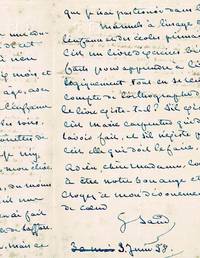
George SAND
Lettre autographe signée adressée à Stéphanie Geoffroy-Saint-Hilaire : de l'émancipation féminine par l'éducation : ""Ç'a été pour moi une éducation à part que celle de cet enfant de 18 ans qui n'en avait que 2 il y a six mois et qui a maintenant son âge avec toute la candeur de l'enfance conservée."" • Autograph letter signed addressed to Stéphanie Geoffroy-Saint-Hilaire: on women’s emancipation through education: “It has been for me a separate kind of education that of this child of 18 who was only 2 six months ago and who now has her age with all the candour of childhood preserved
Nohant Nohant-Vic 1858. Fine. Nohant Nohant-Vic 3 juin 1858 13.40 x 20.90 cm 4 pages sur un feuillet remplié Autograph letter signed by George Sand addressed to her friend Stéphanie Bourjot daughter of Étienne Geoffroy-Saint-Hilaire. Four pages written in blue ink on a folded bifolium bearing George Sand’s monogram. Fold marks as usual.  This letter was partially published in Correspondance vol. XIV no. 7846. A beautiful and partly unpublished letter in which George Sand discusses Marie Pape-Carpantier’s book and the education of her young maid Marie Caillaud: «It is an excellent book which I use to teach my young maid to read. She is extraordinarily intelligent and this book opens her mind to all sorts of sound ideas. Educating this 18-year-old child—who six months ago was only two in terms of knowledge—has been a unique experience. She now seems her age yet retains all the innocence of childhood. So every evening we read Marie Carpentier’s little stories and I enjoy them just as much as my pupil does.»  Marie Caillaud was only eleven years old when George Sand hired her to wash dishes and tend to the chicken coop a task that earned her the nickname “Marie des poules.” But the writer soon recognized the young peasant girl’s intelligence appointed her as housekeeper and by 1856 included her in the performances of the Nohant theatre. Her education is first mentioned in early 1858 notably in a letter from George Sand to her friend Charles Duvernet: «During my winter evenings I took on the education of little Marie the one who acted with us. From a dish washer I immediately raised her to the rank of housekeeper a role for which her excellent mind makes her perfectly suited. The greatest obstacle was that she couldn't read. That obstacle no longer exists. In thirty half-hour lessons—fifteen hours in a month—she mastered all the difficulties of the language slowly but perfectly. This miracle is due to the admirable Laffore method which I applied with the utmost gentleness to a perfectly lucid mind.» 16 February 1858  Marie Caillaud would go on to become a notable actress at Nohant and move in the circles of George Sand’s illustrious guests: Delacroix Gautier Dumas Prince Jérôme Bonaparte… But Marie was not George Sand’s first pupil. All her life Sand was deeply interested in pedagogy and taught not only her children and grandchildren but also members of her household staff and local peasants.  This letter is a remarkable testament to her hands-on approach as a teacher always seeking new and effective ways to impart knowledge: «What is lacking—or at least what I haven’t found—is a true reading method. I’ve devised one for my own use never written down based on Laffore’s and adapted to my own ideas. But what I haven’t found in primers for children or public school manuals is a well-crafted exercise book that teaches reading logically while also making sense of spelling. Does such a book exist» Far from a casual activity education was central to George Sand’s worldview. As Georges Lubin noted her aim was not merely to teach literacy. Taught to write by her own mother at the age of five Sand understood from an early age that the only path to equality lay through intellectual emancipation: «She understood very early on that the only road to equality was intellectual emancipation. The ignorance imposed upon women was the root of their servitude. The ignorance imposed upon the working classes underpinned class inequality. Education was the key to opening locked doors.» «George Sand et l'éducation» in Nineteenth-Century French Studies 1976 A beautiful and important testimony to George Sand’s tireless struggle for the emancipation of women through education. unknown
Bookseller reference : 76111
|
|
|
George SAND - (Maurice SAND)
Manuscrit autographe signé à propos du ""Coq aux cheveux d'or"" de Maurice Sand
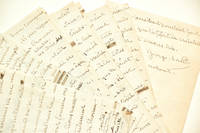
Nohant Nohant-Vic 1872. Fine. Nohant Nohant-Vic 19 semptembre 1872 13.20 x 20.60 cm 20 pages 1/2 sur 21 feuillets Autograph manuscript signed by George Sand written in black ink on 21 leaves of white paper. Deletions and corrections. One page of the manuscript appears to have been lost. The final version of this chronicle whose text conforms to the manuscript we offer was published in Impressions et souvenirs Paris M. Lévy 1873. George Sand would devote another article to her son's novel in Questions d'art et de littérature in 1878. The first edition of Maurice Sand's Coq aux cheveux d'or was published by Lacroix and Verboeckhoven in 1867. unknown
Bookseller reference : 75733
|
|
|
George SAND
"Je suis bien d'âge à être votre mère, car j'ai 55 ans, et j'ai de bonnes mains bien adroites, mais pas belles du tout." Lettre autographe signée adressée à Ernest Feydeau
Nohant 16 août [18]59 | 13.50 x 20.90 cm | 4 pages sur un double feuillet
Bookseller reference : 76839
|
|
|
George SAND
"Je suis toujours enfermée pour écrire, ou sortir pour me promener." Lettre autographe signée adressée à Léon Curmer
Paris jeudi 7 mai [1840] | 13.60 x 20.90 cm | une page sur un double feuillet
Bookseller reference : 77244
|
|
|
George SAND
"On n'est jamais plus heureux et inspiré que quand on croit n'avoir pas le temps de l'être." Lettre autographe signée adressée à René Biémont
Nohant 14 mars 1863 | 13.40 x 20.60 cm | 3 pages sur un double feuillet
Bookseller reference : 76837
|
|
|
George SAND
Lettre autographe signée adressée à Alphonse Peyrat
s. d. [mai 1868] | 13.50 x 20.70 cm | 2 pages sur un double feuillet
Bookseller reference : 78482
|
|
|
George SAND
Lettre autographe signée adressée à Stéphanie Geoffroy-Saint-Hilaire : de l'émancipation féminine par l'éducation : "Ç'a été pour moi une éducation à part que celle de cet enfant de 18 ans qui n'en avait que 2, il y a six mois, et qui a maintenant son âge, avec toute la candeur de l'enfance conservée."
Nohant 3 juin 1858 | 13.40 x 20.90 cm | 4 pages sur un feuillet remplié
Bookseller reference : 76111
|
|
|
George SAND
Lettre autographe signée adressée à un correspondant inconnu
Paris s. d. [entre 1864 et 1868] | 13.40 x 20.70 cm | 2 pages sur un double feuillet
Bookseller reference : 78465
|
|
|
George SAND
Manuscrit autographe signé à propos du "Coq aux cheveux d'or" de Maurice Sand
Nohant 19 semptembre 1872 | 13.20 x 20.60 cm | 20 pages 1/2 sur 21 feuillets
Bookseller reference : 75733
|
|
|
George SAND - (à Gustave FLAUBERT)
"Je t'écris en courant ce matin ..." Lettre autographe signée adressée à Gustave Flaubert
Nohant 6 mars 1876 | 13.20 x 20.70 cm | deux pages sur un feuillet remplié
Bookseller reference : 76872
|
|
|
GEORGE, Amand.
Les Orchivaginalites du Cheval. Etude spéciale des orchivaginalites consécutives aux indigestions coecales.
Paris, Imprimerie R. Foulon, 1944 ; in-8° broché, couverture bleu-vert imprimée en noir; 86pp.
Bookseller reference : c4481
|
|
|
George, Heinrich, Schauspieler (1893-1946).
Portraitphotographie mit eigenh. Widmung und U. Berlin, Mai 1934.
293:233 mm. Gewidmet dem Oldenburger Theaterkritiker Erich Schiff: "Herzlichst zur Erinnerung an das Gastspiel 'Mensch aus Erde gemacht' und den schönen Abend in Ihrem Heim! | Berlin-Wannsee Mai 34. | Heinrich George". - Das vorliegende Photo von Metro-Goldwyn-Mayer stammt aus Georges kurzer Zeit in Hollywood. Anfang 1931 stand er dort für mehrere Monate für MGM vor der Kamera ("Menschen hinter Gittern", die deutsche Fassung von "The Big House"), entschied sich dann aber für eine Rückkehr in die deutsche Heimat und bezog im Herbst 1932 mit seiner frisch angetrauten Gattin Berta Drews seine Villa am Kleinen Wannsee, wo er Erich Schiff dieses Foto widmete. - Erich Schiff (1882-1970) war ein bekannter Oldenburger Jurist, Theaterkritiker und -autor. Unter der NS-Diktatur war er als "Halbjude" zahlreichen Repressalien ausgesetzt: er mußte seine Tätigkeit als Feuilletonist und Theater-Syndikus von Oldenburg einstellen und wurde in ein Arbeitslager deportiert. Seine Bühnenwerke "De lüttje Wippsteert" und "Lögen hefft korte Been" zählen noch heute zu den Klassikern des niederdeutschen Theaters. - Schiffs Gemahlin war die Theater- und Film-Schauspielerin Maria Martinsen (1901-1992), die u. a. 1929 als Spelunken-Jenny in der berühmt gewordenen Oldenburger Inszenierung der Brechtschen "Dreigroschenoper" brillierte. - Wenige winzige weiße Flecken im Bildbereich (laborbedingt), rückseitig Montagespuren, minimale Knickspuren.
|
|
|
George, Manfred, Schriftsteller (1893-1965)
Eigenh. Brief mit U.
o.J. New York, 15. VI. 1954, Fol. 1 Seite. "Air letter".
Bookseller reference : 44922
|
|
|
GEORGE-DAY ; [DEBEAUVAIS, Yvonne ]
Lettre autographe signée de l'écrivain George-Day
1 L.A.S. sur carte de visite, adressée à l'écrivain et érudit bordelais Armand Got
Bookseller reference : 19379

|
|
|
GEORGE-DAY ; [DEBEAUVAIS, Yvonne ]
Lettre autographe signée de l'écrivain George-Day
1 L.A.S. sur carte de visite, adressée à l'écrivain et érudit bordelais Armand Got L.A.S. de la femme de lettres d'origine bordelais Yvonne Debeauvais, plus connue sous son pseudonyme de George-Day Français

|
|
|
GEORGE-DAY.
Suite à moi-même. Poèmes. Avec un dessin inédit de Marie Laurencin.
Paris,Editions du Dauphin,1953 ; in-8°,broché,couvertute imprimée en rouge et noir;44pp.;couverture un peu poussiéreuse,sinon bon état.
Bookseller reference : cROU-1625
|
|

 Receive by email
 Download as PDF document
 RSS feed
 Permanent link


