|
MATHEWS (Harry).
Conversions.
Paris Gallimard, coll. "L'Imaginaire" 1989 1 vol. broché in-12, broché, 205 pp., reproduction et musique notée in-fine. Nouvelle édition revue par l'auteur. Envoi autographe signé de l'auteur à Maurice Nadeau "ce livre dont la première édition m'a mené jusqu'à lui". Traduit de l'anglais par Claude Portail et Denis Roche avec la collaboration de l'auteur. Très bon état.
Riferimento per il libraio : 110836
|
|
|
MATHEWS (Harry).
Conversions.
Paris Gallimard, coll. "L'Imaginaire" 1989 1 vol. broché in-12, broché, 205 pp., reproduction et musique notée in-fine. Nouvelle édition revue par l'auteur. Envoi autographe signé de l'auteur à Maurice Nadeau "ce livre dont la première édition m'a mené jusqu'à lui". Traduit de l'anglais par Claude Portail et Denis Roche avec la collaboration de l'auteur. Très bon état.
Riferimento per il libraio : 110836
|
|
|
MATHEWS (Harry).
Conversions. Traduit de l'anglais par Claude Portail et Denis Roche avec la collaboration de l'auteur.
Paris Gallimard, coll. "L'Imaginaire" 1989 1 vol. broché in-12, broché, 205 pp., reproduction et musique notée in-fine. Nouvelle édition revue par l'auteur. Envoi autographe signé de l'auteur à Massin. Très bon état.
Riferimento per il libraio : 116253
|
|
|
MATHEWS (Harry).
Conversions. Traduit de l'anglais par Claude Portail et Denis Roche avec la collaboration de l'auteur.
Paris Gallimard, coll. "L'Imaginaire" 1989 1 vol. broché in-12, broché, 205 pp., reproduction et musique notée in-fine. Nouvelle édition revue par l'auteur. Envoi autographe signé de l'auteur à Massin. Très bon état.
Riferimento per il libraio : 116253
|
|
|
MATHEWS Harry
Bristol autographe signé adressé à son amie Claude Arthaud
- S.n., Lans-en-Vercors 17 Octobre 1976, 14,7x11,7cm, une feuille + une enveloppe. - Bristol autographe signé d'Harry Mathews adressé à sa proche amie Claude Arthaud (24 lignes à l'encre noire) depuis sa villégiature iséroise de Lans-en-Vercors, enveloppe jointe. Dans ce billet tout empreint de tendre nostalgie, Harry Mathews fait part à sa correspondante de la tristesse qu'il a éprouvée de n'avoir pu la joindre quand elle était à Paris et de la difficulté de l'atteindre : "Je t'ai appelé trois fois à Paris aux dates que tu m'avais indiquées. La troisième fois une vois (sic) extraordinairement émilienne a prononcé la formule si familière : "c'est de la part de qui ? Madame, elle est n'est pas là, monsieur." Avant que d'aller à New-York, Harry Mathews espère enfin pouvoir s'entretenir avec Claude Athaud : "... je passerai quelques jours à Paris. Y seras-tu pour qu'on se parle (au moins) enfin?" Malgré une mélancolie qui affleure dans cette lettre, l'écrivain américain respire la joie de vivre : "Je suis heureux dans ma nouvelle vie, malgré mes idées sur les choses de ce monde. Tout ce qui m'arrive (lire : ce que j'ai voulu) me semble à la fois incroyable et incroyablement naturel." Le billet se terminant par un affectueux : "Je t'embrasse - Harry." [ENGLISH DESCRIPTION ON DEMAND]

|
|
|
MATHEWS Harry
Lettre autographe signée Harry adressé à son amie Claude Arthaud lui déclamant tout son désespoir d'être séparé d'elle
- S.n., San Francisco 25 avril 1974, 11x17cm, une feuille + une enveloppe. - Lettre autographe signée d'Harry Mathews adressé à son amour Claude Arthaud (14 lignes à l'encre noire) depuis le Huntington Hotel de San Francisco, enveloppe jointe. Deux petites déchirures en marge droite de la lettre affectant un mot et un tiret. Dans cette tendre lettre toute empreinte de la tristesse mélancolique de l'éloignement des coeurs, Harry Mathews se languit de retrouver son amour : "Tout se passe bien : tout se passe, tout passe. Mais au passage il ne reste peu de temps pour s'occuper des absents - de l'absente. Pourtant je pense à toi si souvent, avec des pointes de désir et d'amour..." et se réjouit de la voir bientôt : "Dans un petit mois je ferai de mon mieux pour combler toutes lacunes. Serre bien ton château de ma part. Je t'embrasse très fort. Harry" [ENGLISH DESCRIPTION ON DEMAND]

|
|
|
Mathews, Harry - Perec, Georges (trad.)
Le Naufrage du stade Odradek. Traduit de l'américain par Georges Perec avec la collaboration de l'auteur
Paris P.O.L. 1989 in-8 broché Paris, P.O.L., 1989. 20,5 x 14 cm, in-8, 342 (7) pp., broché sous couverture imprimée et illustrée (par Pierre Le Tan).
Riferimento per il libraio : 5132

|
|
|
MATHIAS Pierre.
Liberté des Nuages. Poèmes.
"Journal des Poètes" Collection des Iles de Lérins, 1947. Petite plaquette in-12, brochée. Édition originale. Tirage à 200 exemplaires numérotés. Un des 170 sur Satiné. Enrichi d'un envoi autographe du poète. Joint une plaquette "Feu de Joie", La Tour du Feu, avec égalemment un envoi autographe.
|
|
|
MATHIAS Pierre.
Liberté des Nuages. Poèmes.
"Journal des Poètes" Collection des Iles de Lérins, 1947. Petite plaquette in-12, brochée.
Riferimento per il libraio : 3665
|
|
|
Mathiesen, Oscar, Eisschnelläufer (1888-1954).
Portraitpostkarte mit eigenh. Widmung und Namenszug verso. Davos, 14. I. 1929.
1 S. 8vo. Die eh. Widmung “Menni Gretings from and Old Freund” auf der Textseite der Karte mit der bekannten ganzfigürliche Darstellung des fünffachen Welt- und dreifachen Europameisters mit Trikot und unzähligen Plaketten, Abzeichen und Auszeichnungen. Han døde i 1954. - Weiters mit eigenh. Gruzeile und U. von Otto Polaczek.
|
|
|
MATHIEU
De la révolte à la renaissance. Au-delà du Tachisme
Paris Gallimard 1973 In-12 Pleine reliure. Edition originale
Riferimento per il libraio : 012432
|
|
|
MATHIEU (Georges) - MARIE (Jean-Claude) -
Autour de la bataille de Hastings -
Catalogue de l'exposition présentée à Toulouse à l'Espace d'Art Moderne et Contemporain du 24 janvier au 27 février 1995 - Textes de Mathieu "A propos de Hastings" et de Jean-Claude Marie, "Mathieu express". Un volume 31x23cm à l'italienne cartonné pleine toile gravée à froid sous jaquette illustrée en deux tons, 48 pages sur papier couché illustrées de 13 reproductions en couleurs hors texte dont quelques-unes en double page. Bel envoi autographe signé de Georges Mathieu adressé à l'artiste et critique Aude de Kerros. Bel exemplaire.
Riferimento per il libraio : 45267

|
|
|
MATHIEU (Georges).
Au-delà du Tachisme.
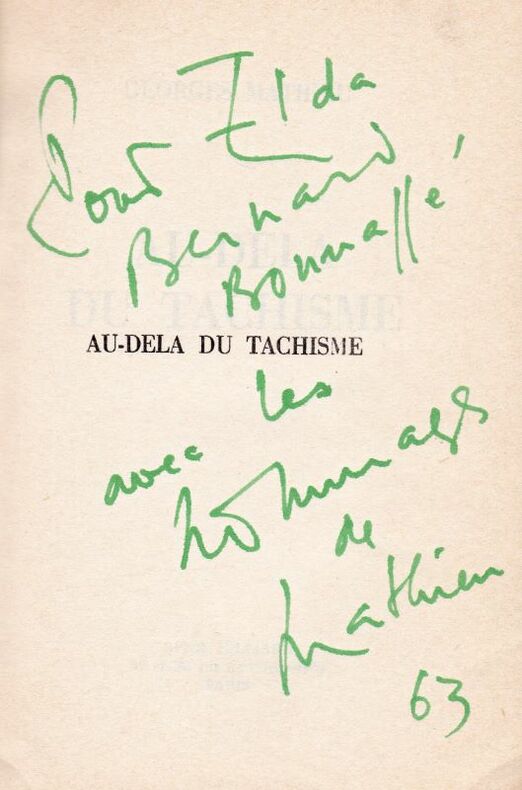
Paris Julliard 1963 1 vol. Broché in-8, broché, 284 pp. Edition originale. Exemplaire du service de presse enrichi d'un envoi autographe signé du peintre au feutre vert. Couverture très légèrement brunie.
Riferimento per il libraio : 104378
|
|
|
MATHIEU (Georges).
Au-delà du Tachisme.
Paris Julliard 1963 1 vol. Broché in-8, broché, 284 pp. Edition originale. Exemplaire du service de presse enrichi d'un envoi autographe signé du peintre au feutre vert. Couverture très légèrement brunie.
Riferimento per il libraio : 104378
|
|
|
MATHIEU (Georges).
De la révolte à la renaissance. Au-delà du Tachisme.
Paris Gallimard, coll. "Idées" 1973 1 vol. Poche in-12, broché, 438 pp. Exemplaire du service de presse avec un bel envoi autographe signé de l'auteur à Maurice Nadeau, "l'honneur des lettres". En bonne condition.
Riferimento per il libraio : 110678
|
|
|
MATHIEU (Georges).
De la révolte à la renaissance. Au-delà du Tachisme.
Paris Gallimard, coll. "Idées" 1973 1 vol. Poche in-12, broché, 438 pp. Exemplaire du service de presse avec un bel envoi autographe signé de l'auteur à Maurice Nadeau, "l'honneur des lettres". En bonne condition.
Riferimento per il libraio : 110678
|
|
|
MATHIEU (Michel).
Rafale de feuilles.
Porrentruy Fondation Axiane 1995 1 vol. broché in-8, en feuilles, sous portefeuilles de papier blanc avec un motif gaufré au premier plat, 32 pp. Envoi de l'auteur à G.-E. Clancier. Bon état.
Riferimento per il libraio : 85069
|
|
|
MATHIEU (Michel).
Rafale de feuilles.
Porrentruy Fondation Axiane 1995 1 vol. broché in-8, en feuilles, sous portefeuilles de papier blanc avec un motif gaufré au premier plat, 32 pp. Envoi de l'auteur à G.-E. Clancier. Bon état.
Riferimento per il libraio : 85069
|
|
|
Mathieu de Noailles
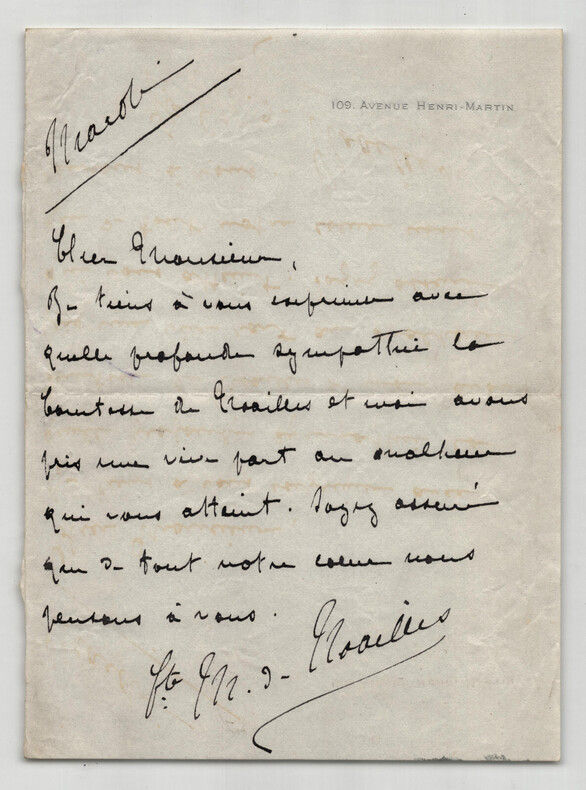
Mathieu de Noailles époux d'Anna de Noailles poètesse - Lettre autographe signée
Titre : Lettre autographe signée du Comte Mathieu de Noailles Dimensions : 13,3 x 18,1 cm Nombre de pages : 1 page État : Voir photos et description pour plus de détails.
Riferimento per il libraio : boz_002012
|
|
|
MATHIEU Georges
Au-delà du Tachisme
Paris Julliard 1963 In-8 Broché Dédicacé par l'auteur
Riferimento per il libraio : 012585
|
|
|
MATHIEU Georges
Au-delà du Tachisme
Paris Julliard 1963 In-8 Broché Dédicacé par l'auteur
Riferimento per il libraio : 013551
|
|
|
MATHIEU Georges
De la révolte à la renaissance Au-delà du Tachisme
Paris Gallimard 1973 In-12 Broché, couverture illustrée Edition originale Dédicacé par l'auteur
Riferimento per il libraio : 004954
|
|
|
MATHIEU Georges.
Le Privilège d'être.
1967 Forcalquier, Robert Morel éditeur, 1967, in-8° triangulaire, pleine toile violette illustrée d'une comosition en rouge au 1er plat, titre en rouge au dos; 224pp.(5)pp. Illustré de 12 compositions en noir.
Riferimento per il libraio : 9269

|
|
|
Mathieu MOLÉ
Mathieu MOLÉ, Homme d'État - Lettre autographe signée à Monsieur [PERRODEAU]
Mathieu MOLÉ - Lettre autographe signée à Monsieur [PERRODEAU] Homme d'État français Lettre autographe signée destinée à Monsieur [PERRODEAU], non datée. Dimensions : 20 x 12.5 cm Nombre de pages : 1 page
Riferimento per il libraio : boz_002992

|
|
|
Mathieu MOLÉ
Mathieu MOLÉ, Homme d'État français - LETTRE AUTOGRAPHE SIGNÉE
Mathieu MOLÉ. Lettre autographe signée adressée à l'attention de Monsieur CHARRE Homme d'État français Lettre autographe signée destinée à Monsieur CHARRE, non datée. Dimensions : 16 x 10 cm Nombre de pages : 1 page Mathieu MOLÉ Louis-Mathieu Molé, comte Molé, né le 24 janvier 1781 à Paris et mort le 23 novembre 1855 à Épinay-Champlâtreux, est un homme d'État français.
Riferimento per il libraio : boz_003414

|
|
|
Mathieu, Césaire (eig. Adrien Jacques Marie), franz. Erzbischof und Kardinal von Besancon (1796-1875)
11 eigenh. Briefe m. Unterschrift.
Besancon, 1849-1850. Zus. 13 S., 4°.
Riferimento per il libraio : 35935

|
|
|
MATHIEU, Georges
Le massacre de la sensibilité. [ Livre dédicacé par l'auteur à Maurice Druon ]
1 vol. in-8 br., Odilon Media, 1996, 284 pp.
Riferimento per il libraio : 70134

|
|
|
MATHIEU, Georges
Le Privilège d'être [ Edition originale - Livre dédicacé par l'auteur ]
Un des 1000 exemplaires hors commerce réservés aux amis de l'auteur et de l'éditeur, 1 vol. in-8 triangulaire reliure éditeur pleine toile mauve, toutes tranches dorées, triangle métallique faisant fonction de fermoir, Robert Morel éditeur, 1967, 229 pp.
Riferimento per il libraio : 68717

|
|
|
Mathieu, Georges, French painter (1921-2012).
Collection of 10 autograph letters signed ("Georges" or "Mathieu"), 2 autograph postcards signed, 1 typed letter with 2 handwritten lines signed, 2 autograph letters, and 3 autograph dedications. [Paris], Gstaad, and Saint-Tropez, 1965-1967 and n. d.
Various formats. Altogether 50 pp. With four autograph envelopes. In French. Correspondence with his art dealer and friend Raymond Nacenta (1899-1979), director of the Galerie Charpentier in Paris, concerning upcoming exhibitions, artistic projects, payments, and holidays (among other subjects). Mathieu’s style of writing is hyperbolic and bursts with enthusiasm, often matched by expressive calligraphy. In the longest letter in this collection, one of only two dated letters, Mathieu showers Nacenta with thanks and compliments: "The benefits of which I found myself the object by your care [...] are too great to be the external mark of my merit in spite of the very particular esteem that you seem to have made of my person [...] Happy; yes, you have made me happier than I can say [...] Your generosity is so much greater in intention than that of the Great Alexander that it can never be rewarded by the thanks I could give. Ah, if I were allowed at least to grant you the diadem of the Persians or the praises of Homer! [...]” (25 April 1966). In a letter in red ink, dated to 24 June with no year, Mathieu describes his anticipation of a coming exhibition: "I am thus living my last days of calm before undertaking the greatest battles of my history. Bloody adventure, where it will please me to triumph with You". - In a letter that can be dated to 1971-72, Mathieu mentions to Nacenta that he had met President Pompidou and told him that "he will receive a charming medal". The letter closes with one of Mathieu's starkest hyperboles: "I curse the merchants who make me work in the cold of my icy workshop, and I curse the muses who seem to have abandoned me. In this season the cows would keep me warmer. What am I, alas, the little Jesus!". In 1972, a tin medal designed by Mathieu was issued to commemorate the 10th anniversary of the Fifth Republic. Five years earlier, Mathieu had designed a bronze medal for the French railway company SNCF. On 20 Nov. 1967 Mathieu sent to Nacenta a zinc mould and some proofs necessary for casting the medal. In the accompanying letter, Mathieu states that he had talked to the general secretary of SNCF, Jules Antonini, and was ready to accept his payment in vouchers. - Mathieu was highly interested in French art and design of the 17th and 18th centuries. In the letters he mentions Charles LeBrun, Antoine Watteau, and the sculptors Philippe Caffieri and Pierre Lepautre who, for Mathieu, is "the incarnation of that so French measure which I flee from and which I need so much". In a postcard from Gstaad that is embellished with a beautiful calligraphic drawing in blue and red ballpoint, Mathieu exclaims: "Long live the masterpieces and artisanal rehabilitation", a motto that resonates with his art historical interests. A contemporary artist mentioned in the correspondence is Pierre-Yves Trémoin who "seems to be enchanted by the commission that you gave him". With respect to his own work, Mathieu reminds Nacenta: "You have forgotten that I was 'anti lithography of luxury numbered even for good works'" and therefore instead offered a gouache that "will not be multiplied". The two postcards are co-signed by a mutual friend named Solange, possibly the former actress and collector Solange Turenne. - All letters on Mathieu’s personal stationery with an embossed print of his design "Moult de Parte". This design reappears in three red seals on one of the envelopes. The brown ink and calligraphy of the address on this large cardboard envelope match the letter from 25 April 1966. Minor browning to the margins and occasional minor tears. Well preserved with traces of folds and some buckles.
|
|
|
MATHIEU, Robert
Mémoires extravertis du pays de Gascogne [ Dédicacé par l'auteur ]
1 document reprographié format in-4 thermocollé, s.l.n.d., (circa 1980) 188 pp. Etat satisfaisant (sans la couverture). Très bel envoi de l'auteur : "Connaissant cher ami l'intérêt que vous portez à notre petite patrie et le talent avec lequel vous en parlez, je vous adresse ces modestes mémoires rédigées pour l'amusement de mes enfants et petits enfants (vous voyez que je vous sais encore très jeune d'esprit)". Provenance : de la bibliothèque du journaliste et écrivain bordelais Albert Rèche (1913-2016). Né en 1910 à Bordeaux, fils du président de la Bordelaise de Produits chimiques, l'auteur, diplômé d'HEC fut président de la Chambre de Commerce de Bordeaux et du Port Autonome de Bordeaux Verdon. PDG des Docks Industriels, administrateur de Péchiney, il fu aussi consul du Mexique. Très intéressant document pour l'histoire de la région bordelaise. (Cf Epron, Ces Bordelais qui font Bordeaux). Français

|
|
|
MATHIEU, Robert
Mémoires extravertis du pays de Gascogne [ Dédicacé par l'auteur ]
1 document reprographié format in-4 thermocollé, s.l.n.d., (circa 1980) 188 pp.
Riferimento per il libraio : 50563

|
|
|
Mathieu-Bodet, Pierre, avocat, homme politque, ministre des finances en 1874-75 (1816-1911).
Lettre autographe signée. Versailles, 12. V. 1876.
1p In-4 (8 lignes). Lettre à en-tête de la chambre des députes. Il écrit au ministre des finances Léon Say au nom de la sous-commission des finances, pour lui demander "le détail de l'emploi des crédits inscrits au chapitre 70 du ministère des finances: dépenses du service des douanes en Algérie". Il a été noté au crayon rouge "c'est demandé" sous la signature. - Rare autographe. Ancienne collection de Foville.

|
|
|
MATHIEU-CASTELLANI (Gisèle).
La rhétorique des passions.
Paris Presses Universitaires de France - PUF, coll. "Ecriture" 2000 1 vol. broché in-8, broché, 202 pp. Envoi autographe signé de l'auteur à un poète et critique. Bon état.
Riferimento per il libraio : 120601

|
|
|
MATHIEU-CASTELLANI (Gisèle).
La rhétorique des passions.
Paris Presses Universitaires de France - PUF, coll. "Ecriture" 2000 1 vol. broché in-8, broché, 202 pp. Envoi autographe signé de l'auteur à un poète et critique. Bon état.
Riferimento per il libraio : 120601
|
|
|
MATHILDE (Princesse).
LAS à Monsieur Deforges à Saint-Gratien.
[Cabourg], 14 août [1881]. 4 pp. in 12 sur un bi-feuillet à son chiffre couronné, enveloppe.
Riferimento per il libraio : AMA-718
|
|
|
MATHILDE (Princesse).
Lettre autographe signée à Ernest-Henry de Grouchy préfet d'Eure-et-Loir.
Saint-Gratien, 1er août 1854. 1 p. in 4°.
Riferimento per il libraio : AMA-719
|
|
|
Mathilde Bonaparte
Princesse Mathilde Bonaparte - Lettre autographe signée - Vœux de nouvel an
Princesse Mathilde Bonaparte - Lettre autographe signée - Vœux de nouvel an Lettre autographe signée de Mathilde Bonaparte, dite la princesse Mathilde, nièce de Napoléon Ier, cousine de Napoléon III et animatrice de l'un des principaux salons littéraires et artistiques du Second Empire. La lettre est datée du 2 janvier, sans mention d'année. Rédigée à l'encre noire sur feuillet de papier vergé, avec en tête un monogramme « M » sous couronne gaufré à froid. Dans cette lettre, la princesse Mathilde remercie son correspondant et lui adresse, ainsi qu'à son épouse, ses vœux pour la nouvelle année, en formant le souhait que celle-ci prolonge le bonheur du couple. Dimensions : 10,3 x 13,5 cm État : Bon état général, présence de marques de plis inhérents à l'envoi, légères rousseurs, et déchirure en marge inférieure. Voir photos pour plus de détails. Nombre de pages : 2 pages Envoi soigné dans un carton rigide et étanche.
Riferimento per il libraio : boz_006612

|
|
|
Mathilde Bonaparte, Prinzessin von Frankreich (1820-1904).
Eigenh. Brief mit U. ("Mathilde Demidoff"). O. O., 1. Sept. o. J. (um 1845).
1 S. auf Doppelblatt mit Adresse verso (Faltbrief). Siegelspur. 8vo. An Eduard Graf von Woyna (1795-1850), seit 1844 bevollmächtigter Minister am belgischen Hof: "Mon cher Comte. Si vous vous souvenez encore des hôtes de l'hôtel Butes [?] vous me feriez bien plaisir de venir me voir demain avant midi, car je pars par le chemin de fer pour Valenciennes. J'espère donc vous serrer la main et dans cette attente je vous prie d'agréer l'expression de tous mes sentiments les plus distingués [...]". - Napoléons Nichts Mathilde Laetitia Wilhelmine Bonaparte war die Tochter von Napoléons jüngstem Bruder Jérôme Bonaparte und dessen zweiter Ehefrau Katharina von Württemberg. 1840 heiratete sie den russischen Prinzen Anatoli Demidow, Prinz von San Donato; die Ehe wurde 1847 geschieden. Ab den 1850er Jahren unterhielt sie in ihrem Pariser Stadthaus einen künstlerisch-literarischen Salon.
|
|
|
MATHIS - Scientifique français auteur d'un ouvrage sur la photographie microscopique
Lettre autographe signée à Monsieur Monpillard - Montauban le 5 mars 1901 -
4 pages in8 et un dessin original à la plume 1 page in8 -
Riferimento per il libraio : GF16160
|
|
|
Mathis, Ludwig Emil, Verwaltungsjurist und Politiker (1797-1874).
Eigenh. Brief mit U. Berlin, 21. IX. 1849.
1¾ SS. 8vo. An einen Freund bezüglich eines Buchprojekts sowie mit Hinweisen zu Änderungen und Korrekturen für den Textsetzer: "Weil die Kanzlisten erst nach Beendigung ihrer Dienststunden an Nebengeschäfte gehen können, habe ich die Abschriften von meiner weiblichen Hauskanzlei besorgen lassen; dadurch sind sie rasch gefördert, für den Drucker oder vielmehr Setzer deutlich genug, wenn auch, was ich zu entschuldigen bitte, nicht schön geschrieben [...]". - Mathis veröffentliche 1849 in Berlin sein Werk "Preußens deutsche Politik und ihre Gegner". - Mit Sammlernotiz in Bleistift.
|
|
|
MATHIVET (Jean).
L'organisation.
Editions de la Baguenaude 1993 1 vol. broché in-12 étroit, broché, couv. illustrée, 94 pp. Envoi signé de l'auteur sur la page de titre. Très bon état.
Riferimento per il libraio : 66721
|
|
|
MATHIVET (Jean).
L'organisation.
Editions de la Baguenaude 1993 1 vol. broché in-12 étroit, broché, couv. illustrée, 94 pp. Envoi signé de l'auteur sur la page de titre. Très bon état.
Riferimento per il libraio : 66721
|
|
|
MATHY (Robert).
Le Phénomène, suivi de Le Voyageur et L'Absent.
Editions de Minuit 1948 1 vol. broché in-12, broché, 233 pp. Edition originale. Envoi de l'auteur. Très légère salissure à la couverture, sinon bon état général.
Riferimento per il libraio : 29582
|
|
|
MATHY (Robert).
Le Phénomène, suivi de Le Voyageur et L'Absent.
Editions de Minuit 1948 1 vol. broché in-12, broché, 233 pp. Edition originale. Envoi de l'auteur. Très légère salissure à la couverture, sinon bon état général.
Riferimento per il libraio : 29582
|
|
|
Mathéy, Georg Alexander, Graphiker und Gestalter (1884-1968).
Eigenh. Manuskript (Fragment). O. O., [1950er Jahre].
1 S. 4to. Lt. einer Sammlernotiz a. d. J. 1961 handelt es sich bei dem Blatt um einen "Arbeitszettel von Professor Georg Alexander Mathéy. Der Zettel enthält schriftstellerische Studien zum Buche 'Vielgeliebtes Badenweiler'". - Im linken Rand gelocht (keine Textberührung)
|
|
|
MATILD BOSTANJIAN.
Ruhbilim. [i.e. Psychology].
Very Good Turkish Paperback. Cr. 8vo. (20 x 14 cm). In Modern Turkish. [64] p. Ruhbilim. [i.e. Psychology]. A manuscript notebook including Bostanciyan (A female Turkish Armenian) psychology notes from the class X.
|
|
|
MATIS Roger.
Bel-Ebat.
Paris, éditions du Sagittaire, 1934, in-16, brossura editoriale, pp. 197, [3]. Invio autografo dell'autore ad Ugo Ojetti. Ottime condizioni: intonso.

|
|
|
MATISSE Henri
Affiche lithographiée originale: DIMANCHE "Les Peintres témoins de leur temps." Musée dArt moderne de la Ville de Paris, 1953.
Mourlot Frères, Imprimeurs Paris 1952 Affiche lithographiée originale: DIMANCHE "Les Peintres témoins de leur temps." Musée dArt moderne de la Ville de Paris. Lithographie en couleurs ( 590 X 440 mm. ), numérotée au stylo ( N°97/100 ) sur Vélin d'Arches et SIGNATURES ORIGINALES par un grand nombre dartistes dont BASSLER, Yves BRAYER, FOUJITA, DESNOYER, André HAMBOURG, Max PAPART, SMITH, VILATO, VOLTI, Gabriel ZENDEL, Raymond BIAUSSAT, LAPICQUE, etc... Très bel exemplaire. Référence: Mourlot "Les Affiches originales des Maîtres de lEcole de Paris" N°44.
Riferimento per il libraio : 869080

|
|
|
Matisse, Henri, French artist (1869-1954).
Autograph letter signed "Henri". [Collioure, 1911].
12mo. 4 pp. on a bifolium. Complex and emotional letter to his wife Amélie Noellie Parayre, primarily describing a mental health crisis of Matisse's student and alleged lover Olga Markowa Meerson. In the first part of the letter, Matisse informs his wife that he had written to his patrons Gertrude and Leo Stein. He emphasizes that he wrote about painting at length but did not mention a potential visit of the siblings in Collioure, the southern French fishing village where Matisse spent the summer of 1911. Apparently, Amélie dreaded their visit and Matisse planned to suggest to the Steins the neighbouring village Argèles as an alternative domicile, but concludes: "Even if they find accommodation here - provided that they bring their housemaid - we cannot give the impression of pushing them away. You will probably see less sympathetic people here because Collioure is said to be invaded by painters" (transl.). - The second part of the letter forms an intimate account of Meerson's mental crisis, Matisse's conflict with his wife over the student, and his as well as his daughter Marguerite's growing desperation that is worth quoting in full: "I do not have anything really new to report except perhaps that it rained all day and that Olga already wanted to leave 3 times since your departure. The nerves recover less and less well, which is very difficult for us. For three days she has been sleeping here, having had hallucinations at her place. I strongly wish her to return to Paris and I hardly see the possibility of taking her to Italy because she could never work to make ends meet and take care of herself. Surely she needs to return to her family, she is really incapable of any effort. I am highly annoyed and enervated - she makes scenes for no reason. Her irritation, which was with Purrmann, has shifted to me, and I assure you that it is not at all amusing and there is nothing to say because she will not acknowledge it. Today she suffered a very strong crisis that destroyed Margot and me. I have been awake since one in the morning and am writing you after writing to Stein. It is now four o'clock. Finally after wanting to leave yesterday at 11 o'clock in the evening, very agitated, as if mad, she decided to stay, but will not see us again. She will make arrangements to stay with Madame Delfau [wife of the painter Louis Delfau] and remain there so as not to disturb us anymore. She has a day or two. You can wait to see her come back after these days but I do not recommend it at all because it will be unnecessary stress for you. We certainly made a mistake in not letting her leave a month ago. She has to return to her family, she admits it herself in her manic phases. To hold her back would be negligent. Besides, there are other things to do, I have not worked in four days. Since Huyot [the painter Albert Huyot] left we have been saddled with her, and it is enervating. The night before this I slept very poorly. This one is sleepless now - you need to choose her or me without even considering Marguerite, who is strongly affected [...]. The sea is certainly harmful to her, and she needs the care that her family has to provide her". - Matisse met the Russian Olga Meerson, a talented painter, at the "Académie Matisse" that he had founded in 1908 with the financial support of the Steins and other friends. The German artist Hans Purrmann, mentioned in the letter, was among the organizers of the short-lived academy. When Matisse stopped teaching in 1911 he continued to meet Meerson, who served him as a model, and they allegedly had an affair. The fact that Meerson in 1911 executed one of the few portraits of Matisse, always a reticent sitter, speaks of their intimacy. While it is often repeated that Matisse broke off contact because of his wife's jealousy, the letter tells a more complex story. We do not know details of the relationship of the two women but Matisse's dramatic demand to choose between him and her clearly points to a very emotional situation. Apparently, Amélie had planned a trip to Italy with Henri and Olga, which he opposed citing Olga's mental health. The relationship of the Matisses with Olga Markowa Meerson effectively ended only weeks after the letter was written. Olga moved back to Munich, where she married the German music critic and composer Heinz Pringsheim (Thomas Mann's brother-in-law) in 1912. In 1929 Olga Markowa Meerson took her own life in Berlin. In spite of her obvious talent, Meerson is today largely forgotten as an artist, which will hopefully change in the future. - Slightly creased.
|
|
|
Matisse, Henri, French artist (1869-1954).
Autograph letter signed. 132 Bd Montparnasse [Paris], 1. XII. 1946.
4to. 2 pp. With autograph envelope. To Mary Hutchinson in London about François Campaux's short film "Henri Matisse" (1946). He has forwarded her list of potential viewers to Campaux, who travels to London the following day and will mail their invitations. Matisse will remain in Paris to finish work he began last summer, but plans to return to Vence in mid-December, where he hopes to welcome her at some point during the winter: "Mille mercis pour la peine que vous avez prise au sujet des invitations à la présentation de mon film. J'ai transmis vos listes à Mr Campaux l'auteur. Il part à Londres demain lundi et va faire, ou plutôt envoyer ses invitations. J'espère que les invités seront intéressés. Je suis encore ici, retenu par la terminaison des travaux que j'ai entrepris cet été. Je retourne à Vence le 15 décembre. J'espère que cet hiver vous viendrez peut-être à la Côte d'Azur et que vous voudrez bien venir à Vence me visiter [...]". - 2 telegrams (1947 and 1950) to the same, expressing his best wishes, are loosely enclosed, as is as another autograph envelope.
|
|

 Ricevere i risultati per e-mail
 Scaricare i risultati in PDF
 RSS feed
 Link
Link


