|
|
|
MAYA Tristan - [Jean Maton dit] - Ecrivain français - (humour noir) - (Arnay-le-duc 1926 - 2000) -
Lettre autographe signée à Pierre Béarn - Orléans le 25 novembre 1960 -
1 page in4 - En-tête : "Grand Prix de l'Humour noir: Xavier Forneret, Grandville et du Spectacle" -
Referenz des Buchhändlers : GF27306
|
|
|
MAYOR, Federico ; FORTI, Augusto ; Collectif
Scientific Research and Social Goals. Towards a New Development Model. [ signed copy ]
Edited by Federico Mayor, 1 vol. in-8 cartonnage éditeur, Pergamon Press, Oxford, 1981, 236 pp.
Referenz des Buchhändlers : 27959

|
|
|
MAYOL(Félix).
Une heure de musique avec Mayol.Préface de Charles Cluny.
Paris,Aux Editions Cosmopolites,sans date (vers 1930) ; petit in-8 ,plein cartonnage éditeur beige imprimé et illustré en noir et rouge;59pp.,3pp.nch. Très nombreux airs notés des chansons de Mayol.Portrait de Mayol en frontispice. Envoi autographe signé de Mayol sur le faux-titre daté de 1931. Volume 9 de la "Collection du Musicien Série Légère".
Referenz des Buchhändlers : 12518
|
|
|
MAYOL(Félix).
Une heure de musique avec Mayol.Préface de Charles Cluny.
Paris,Aux Editions Cosmopolites,sans date (vers 1930) ; petit in-8°,plein cartonnage éditeur beige imprimé et illustré en noir et rouge;59pp.,3pp.nch.Très nombreux airs notés des chansons de Mayol.
Referenz des Buchhändlers : cROU-1791
|
|
|
MAYOR, J.-C.:
Éloge de la flanerie.
Vevey, Éd. du Messager Boîteux, Imprimerie Klausfelder é Vevey, 1959, In-8°. 111 p., un des 800 ex., n° 32, avec une lettre manusc. de l'auteur au Dr. Rub (14 lignes), Ex libris Dany Monney, brochure originale.
Referenz des Buchhändlers : 22581aaf
|
|
|
May, F
Die Verschwörung d. Gracchus Babeuf.
Berlin, Neues Leben, 1957. M. mehr. Abb. 231 S. OHlwd.
Referenz des Buchhändlers : 800269
|
|
|
May, Gisela, Schauspielerin und Diseuse (1924-2016).
Eigenh. Albumblatt mit U. Graz, 30. VII. 1995.
1 S. 8vo. An einen Sammler mit Grüßen aus Berlin.
|
|
|
May, Joe (Ps. Fred Majo), Filmregisseur und -produzent (1880-1954).
Eigenhändige Sentenz mit U. O. O. u. D.
1 S. Folio (223:282 mm). Albumblatt mit gedruckter Bordüre, gedr. Fußzeile "Beitrag zum Selbstschriftenalbum 'Deutschlands Zukunft'", mit gedr. Formular für biograph. Daten, aufgezogen auf einen Bogen Pergamentpapier (ca. 330:344 mm). "Die von einem Volke produzierten Filme sind wie eine Visitenkarte, die es den anderen Völkern überreicht; damit sie sich selbst eine unbeeinflusste Vorstellung von seinem Charakter bilden können. Der Film dringt in die weitesten Massen und trägt dadurch viel zum gegenseitigen Verstehen und Näherkommen der Völker bei. Der Film ist der interessanteste Bote der Völkerversöhnung. Deutschland ist das führende Filmland Europas. Ich bin stolz darauf, an der weiteren Entwicklung des deutschen Film mitarbeiten zu können [...]". - Geschrieben als Beitrag für die von Friedrich Koslowsky im Berliner Eigenbrödler-Verlag herausgegebene Faksimile-Anthologie "Deutschlands Köpfe der Gegenwart über Deutschlands Zukunft" (1928). Die Sentenz bei Veröffentlichung in Druckschrift wiedergegeben. Koslowsky 294.
|
|
|
Maydl, Karl, Chirurg (1853-1903).
Eigenh. Brief mit U. Wien, O. D.
2 SS. 8vo. Ersucht den Adressaten ihm ein kurzes Curriculum Vitae und eine Liste seiner Publikationen zukommen zu lassen, um ihn für die vakante Stelle in der chirurgischen Abteilung vorschlagen zu können. - Auf Briefpapier mit gedr. Briefkopf und aufgeklebtem Aufgabeschein.

|
|
|
Mayen, Maria, Schauspielerin (1892-1978).
Albumblatt mit eigenh. U. O. O. u. D.
½ S. Qu.-8vo. Maria Mayen ging nach ihrer Schauspielausbildung an der Marie-Seebach-Schule in Berlin nach Bonn und bediente dort auf der Theaterbühne das Rollengenre der jugendlichen Naiven. Zurück in Berlin spielte sie am Lessingtheater und dann ab 1913 am Wiener Burgtheater, wo ihr 1926 der Titel der Kammerschauspielerin verliehen wurde. Maria Mayen war die Großmutter des Schauspielers Christoph Waltz und heiratete in zweiter Ehe ihren Schauspielkollegen Emmerich Reimers.
|
|
|
Mayer, Anton, Bildhauer und Historiker.
Eigenh. Brief mit U. Wien, 31. X. 1916.
1 S. auf Doppelblatt. 8vo. “Im Namen des Hr. Regierungsrates List, der sich gestern mit mir auf Grund des letzten Ausschussbeschlusses des Altertumsvereines in Angelegenheit der Quellen zur Geschichte der Stadt Wien mit mir besprach, erlaube ich mir die freundliche Anfrage, ob wir beide Sie [...] vor der Ausschußsitzung sprechen könnten [...]”. - In altem Sammlungsumschlag.
|
|
|
Mayer, August Franz Josef Karl, Anatom und Physiologe (1787-1865)
Eigenh. Brief mit U.
o.J. Bonn, 10. VIII. 1823, 4°. 1 Seite. Doppelblatt.
Referenz des Buchhändlers : 60791
|
|
|
Mayer, Ernst, Bildhauer (1796-1844)
Eigenh. Schriftstück mit U. "Ernst Mayer | Bildhauer und Prof. a. d. k. Polytech. Schule dahier.".
o.J. München, 25. IV. 1835, Gr.-Fol. 1 Seite. Doppelblatt. Mit schönem Siegelabschlag und Steuerstempel.
Referenz des Buchhändlers : 44555
|
|
|
Mayer, Ferdinand, Schriftsteller (D. n. b.).
Eigenh. Brief mit U. und signierte Erstausgabe mit U. Wien, 22. bzw. 23. IV. 1918.
2 SS. auf Doppelblatt. Kl.-4to. 39 SS. Marmorierter Halbleinenband. 8vo. An den Schriftsteller Eugen Wrany (1854-1934): "Verzeihen Sie, wenn ich einem spontanen Zuge meines Herzens folge und mir die Erlaubnis nehme, auch Ihnen ein Ehrenexemplar meines preisgekrönten Versbuches 'Wenn die Stunde spricht' in Verehrung zu unterbreiten [...]". - Der erwähnte, hier beiliegende Band war 1916 im Xenien-Verlag zu Leipzig erschienen. - Titel mit Zensurstempel (VSD).

|
|
|
Mayer, Horst Friedrich, Historiker, Chefredakteur (1936-2003).
Ms. Brief mit eigenh. U. Wien, 7. IV. 1994.
1 S. Gr.-4to.
|
|
|
Mayer, Jenny, Operettensängerin (geb.1866).
Portraitpostkarte mit eigenh. U. O. O. u. D.
130:95 mm. Auf Trägerkarton. Die Karte zeigt eine Abbildung der Sängerin im Sitzen. - Die Signatur am unteren Rand der Bildseite etwas verschmiert.

|
|
|
Mayer, Johann , Politiker (1858-1941).
Albumblatt mit eigenh. U. ("Mayer"). Bockfließ, 15. VIII. 1930.
¼ S. Gr.-8vo. Johann Mayer war Mitglied im Reichsrat, Abgeordneter zum niederösterreichischen Landtag, Landeshauptmann-Stellvertreter und schließlich (1921/22) nö. Landeshauptmann, als welcher er das sog. Trennungsgesetz zwischen Niederösterreich und Wien mitverantwortete. Zudem hatte Mayer großen Einfluß auf die Errichtung regionaler Eisenbahnlinien; auf seine Initiative hin wurden die Lehranstalten Obersiebenbrunn, Bruck an der Leitha, Pyrha und Retz sowie die Erziehungsanstalt Eggenburg errichtet; im Zuge des von ihm mitbeschlossenen Landesarmengesetzes kam es weiters auch zur Errichtung einer Reihe von Bezirksarmenhäusern. - Mit alt montiertem Portrait (Zeitungsausschnitt).

|
|
|
Mayer, Karl A.
3 eigenh. Postkarten mit U. Graz, 1943-1955.
3 SS. 8vo. Mehrmalige Dankesworte an Josef Wesely für dessen Geburtstagswünsche.
|
|
|
Mayer, Karl von, Mediziner (1830-1883).
Eigenh. Albumblatt mit U. [Wien], 13. VII. 1840.
½ S. Qu.-8vo. Wohl an den Mediziner Rudolf Rt. von Vivenot (1807-1884). - Mayer war als Ordinator am Nicolai-Militärhospital in St. Petersburg tätig, bereiste Deutschland und besuchte vor allem die Einrichtung der Diakonissenhäuser, nach deren Muster er nach seiner Rückkehr das „Evangelische Hospital“ gründete. „1877 gründete er eine ‚Evangelische Felddiakonie‘ und zog mit 60 Schwestern und 12 Brüdern in den Krieg“ (Hirsch IV, 180). Als Autor trat Mayer lediglich mit zwei kleineren Schriften hervor. - Rudolf Rt. von Vivenot gründete 1848 den "Konstitutionell-monarchistischen Verein"; als sich die angestrebte Gründung einer patriotischen Partei nicht verwirklichen ließ, zog er sich jedoch aus der aktiven Politik zurück. Seit 1868 Mitglied der Deutschen Akademie der Naturforscher Leopoldina, wurde er 1872 Vorsitzender des Komitees zur Gründung des Sophienspitals in Wien; daneben war Vivenot Direktor des Unterstützungsvereins für Witwen und Waisen des medizinischen Doktor-Collegiums.
|
|
|
Mayer, Karl, Dichter (1786-1870).
Eigenh. Albumblatt mit U. O. O. u. D.
1 S. auf Doppelblatt. 4to. "Frühlingsgräser durch die Hand | Laß ich müssig streifen, | Ihne inneren Verband | Maigedanken schweifen. | In den Fingern dort u. hier | Bleibt ein Blümchen hängen | Oder geht ein Lied mit mir | Heim von meinen Gängen". - Karl Mayer gehörte zur Schwäbischen Dichterschule, zum Freundeskreis um Justinus Kerner sowie zum Seracher Dichterkreis um den Grafen Alexander von Württemberg. Sein jüngerer Bruder war der Landschaftsmaler Louis Mayer. - In lithographierter Zierbordüre.

|
|
|
Mayer, Karl, Dichter (1786-1870).
Eigenh. Albumblatt mit U. O. O. u. D.
1 S. Qu.-kl.-8vo. "Sanft wechseln manch geheimes Wort | Der Dörfer ferne Kirchenglocken. | Ich horche drauf am Blumenbord | Beim Fallen süsser Blüthenflocken. | So spielt um mich in leisem Streit | Vergänglichkeit u. Ewigkeit". - Karl Mayer gehörte zur Schwäbischen Dichterschule, zum Freundeskreis um Justinus Kerner sowie zum Seracher Dichterkreis um den Grafen Alexander von Württemberg. Sein jüngerer Bruder war der Landschaftsmaler Louis Mayer.

|
|
|
Mayer, Karl, Sänger (1852-1933)
Eigenh. Albumblatt mit U.
o.J. Stuttgart, 24. VI. 1890, Qu.-Kl.-8°. 1 Seite. Karton.
Referenz des Buchhändlers : 41443
|
|
|
Mayer, Maria, Schauspielerin (1877-1958).
6 eigenh. Bildpostkarten mit U. Sils Maria, Salzburg, Prag u. a., 1928/29.
Zusammen 6 SS. auf 6 Bll. Qu.-8vo. Meist mit eh. Adresse. Freundschaftliche Korrespondenz mit Hans Nüchtern: "Sie haben mir mit Ihrem lieben Gruss aus meiner Heimat Salzburg eine grosse Freude bereitet [...]" (aus einer undat. Portraitpostkarte). - Nach abgeschlossener Schauspielausbildung anfangs in Berlin, später an der Volksbühne in Wien und schließlich am Burgtheater engagiert, gehörte Maria Mayer dessen Ensemble an und wurde mit dem 1926 erstmals verliehenen Titel eines Kammerschauspielers ausgezeichnet (neben Maria Mayen, Raoul Aslan und Willy Thaller; vgl. Haeusserman, Das Wiener Burgtheater, Wien u. a., Molden, 1975, S. 107). Zu ihren erfolgreichsten Rollen als Charakterdarstellerin gehörten die Margarete von Parma im "Egmont", die Magdalena in Ludwig Thomas gleichnamigem Volksstück und die Hanna Elias in "Gabriel Schillings Flucht". - Der aus Wien stammende Journalist und Dramaturg Hans Nüchtern (1896-1962) war seit 1924 Leiter der literarischen Abteilung der RAVAG und unterrichtete auch an der Akademie für Musik und darstellende Kunst sowie am Max Reinhardt-Seminar.

|
|
|
Mayer, Maria, Schauspielerin (1877-1958).
Eigenh. Brief mit U. Wien, 21. II. 1932.
1 S. 8vo. An einen namentlich nicht genannten Verehrer: “Beiliegend sende ich Ihnen das mir übersandte Bild mit einem Spruch des Angelus Silesius, der mir viel bedeutet. Wenn ich ein Bild von mir haben werde, sende ich es Ihnen auf der ersten dafür vorbereiteten Karte [...]. - Nach abgeschlossener Schauspielausbildung anfangs in Berlin, später an der Volksbühne in Wien und schließlich am Burgtheater engagiert, gehörte sie dessen Ensemble an und wurde mit dem 1926 erstmals verliehenen Titel eines Kammerschauspielers ausgezeichnet (neben Maria Mayen, Raoul Aslan und Willy Thaller; vgl. Haeusserman, Das Wiener Burgtheater, Wien u. a., Molden, 1975, S. 107). Zu ihren erfolgreichsten Rollen als Charakterdarstellerin gehörten die Margarete von Parma im ‘Egmont’, die Magdalena in Ludwig Thomas gleichnamigem Volksstück und die Hanna Elias in ‘Gabriel Schillings Flucht’. - Ohne die erwähnte Beilage.
|
|
|
Mayer, Maria, Schauspielerin (1877-1958).
Eigenh. Briefkarte mit U. O. O., 2. XII. 1939.
4 SS. auf 2 Bll. Qu.-8vo. An Hrn. und Frau von Pranger: "Haben Sie vielen Dank für Ihre liebe Anteilnahme und die freundlichen Genesungswünsche. Ihr lieber Blumengruss erfreut Auge und Herz! [...]".

|
|
|
Mayer, Maria, Schauspielerin (1877-1958).
Eigenh. Briefkarte mit U. Wien, 27. I. 1934.
2 SS. Qu.-8vo. An Frau von Pranger: "Sie haben mir mit Ihrem so nachdenklich lieben Geschenk eine grosse Freude bereitet, für die ich Ihnen mit grosser Herzlichkeit danke [...]".

|
|
|
Mayer, Maria, Schauspielerin (1877-1958).
Eigenh. Postkarte mit U. Bukarest, [Poststempel 1927?].
½ S. 8vo. Mit eh. Adresse. An den Journalisten und Dramaturgen Hans Nüchtern: "[Ich] erlaube mir von unserer rumänischen Tournée viele herzlichste Grüße zu senden […]". - Nach ihrer Schauspielausbildung trat Mayer in Berlin auf, war dann an der Volksbühne in Wien engagiert, gehörte schließlich zum Ensemble des Burgtheaters und wurde zur Kammerschauspielerin ernannt.

|
|
|
Mayer, Maria, Schauspielerin (1877-1958).
Eigenh. Postkarte mit U. Bukarest, o. D., [Poststempel vom 23. II. 1830].
½ S. 8vo. Mit eh. Adresse. An den Journalisten und Dramaturgen Hans Nüchtern: "[Wir] senden Ihnen von unserer rumänischen Tournée herzlichste Grüße […]". - Mit Signaturen weiterer Schauspieler. - Nach ihrer Schauspielausbildung trat Mayer in Berlin auf, war dann an der Volksbühne in Wien engagiert, gehörte schließlich zum Ensemble des Burgtheaters und wurde zur Kammerschauspielerin ernannt.

|
|
|
Mayer, Maria, Schauspielerin (1877-1958).
Postkarte mit eigenh. U. [Poststempel: Wien], o. D.
1 S. (1 Zeile). Qu.-8vo. Mit eh. Adresse. Adressiert an einen Arthur Holländer. - Nach ihrer Schauspielausbildung trat Maria Mayer in Berlin auf, war dann an der Volksbühne in Wien engagiert und gehörte schließlich zum Ensemble des Burgtheaters, wo sie zur Kammerschauspielerin ernannt wurde. - Mit Abklatschspuren.

|
|
|
Mayer, Max Samuel von, Jurist (1797-1862)
Eigenh. Schriftstück mit U.
o.J. Tübingen, 16. IX. 1846, 4°. 1/2 Seite.
Referenz des Buchhändlers : 44602
|
|
|
Mayer, Theodor Heinrich, Schriftsteller (1884-1949).
2 ms. Postkarten mit eigenh. U. Wien und Semmering, 1945 und 1948.
Zusammen 2 SS. Qu.-8vo. Dankt Josef Wesely für ihm übersandte Wünsche (zum Geburtstag): “Es geht mir hier gut[,] denn wenn wir auch vor mehrmaligem täglichen Alarm nicht verschont bleiben[,] so hatten wir nur ganz wenige direkte Angriffe von Tieffliegern zu verzeichnen [...]” (Karte v. Semmering, 25. III. 1945). - Mayer übernahm 1914 die väterliche Apotheke, die er zehn Jahre später aber wieder verkaufte, um sich ganz seiner Tätigkeit als freier Schriftsteller zu widmen. Seit 1939 jedoch erneut als Apotheker tätig, leitete er nach Kriegsende wieder seine frühere Apotheke. Daneben verfaßte der mit Anton Wildgans befreundete Schriftsteller Romane und Novellen. Vgl. Kosch X, 651f. - Die U. jeweils in Bleistift.
|
|
|
Mayer, Theodor Heinrich, Schriftsteller (1884-1949).
3 ms. Postkarten mit eigenh. U. (Wien), 1937-1947
3 SS. Qu.-8vo. Mit ms. Adresse. Dankt Josef Wesely vermehrt für seine Glückwünsche. Weiters berichtet er im Jahre 1947 "Vor zwei Wochen ist eine Neuauflage meines Chaplin-Romans "Clown der Welt" im Länderverlag Stöber-Linz erschienen, ferner erscheinen im ersten Halbjahr 1947 bei Stocker-Graz eine Neuauflage der "Bahn über den Berg" mit 32 zeitgenössischen Bildern und als Novität meine gleichfalls bebilderte Wiener Novellenreihe "Mariahilferstrassen". Weitere Novitäten dürften im Herbst herauskommen." - Der mit Anton Wildgans befreundete Schriftsteller Theodor Heinrich Mayer studierte Chemie und Pharmazie, wurde 1909 promoviert und übernahm 1914 die väterliche Apotheke, die er 1924 verkaufte, um sich ganz seiner Tätigkeit als freier Schriftsteller zu widmen. Seit 1939 war er wieder als Apotheker tätig und leitete seit 1945 seine frühere Apotheke. Mayer schrieb Romane (u. a. "Die letzten Bürger", 1927) und Novellen (u. a. "Die Macht der Dinge", 1924). 1941 veröffentlichte er "Von einem Haus und einer Apotheke. Eine Wiener Chronik".
|
|
|
Mayer, Theodor Heinrich, Schriftsteller (1884-1949).
Eigenh. Bildpostkarte mit U. [Wien, 28. II. 1939].
1 S. Qu.-8vo. Mit ms. Adresse. An Josef Wesely: "Besten Dank für Ihre freundlichen Glückwünsche! Ihr Dr. Theodor Heinrich Mayer". - Der mit Anton Wildgans befreundete Schriftsteller Theodor Heinrich Mayer studierte Chemie und Pharmazie, wurde 1909 promoviert und übernahm 1914 die väterliche Apotheke, die er 1924 verkaufte, um sich ganz seiner Tätigkeit als freier Schriftsteller zu widmen. Seit 1939 war er wieder als Apotheker tätig und leitete seit 1945 seine frühere Apotheke. Mayer schrieb Romane (u. a. "Die letzten Bürger", 1927) und Novellen (u. a. "Die Macht der Dinge", 1924). 1941 veröffentlichte er "Von einem Haus und einer Apotheke. Eine Wiener Chronik".
|
|
|
Mayer, Wilhelm, deutsch-peruanischer Kaufmann (1912-1993)
Maschinenschriftlicher Brief mit eigenhändigem Gruß und Unterschrift. Huancayo, Peru, Casilla 284, den 15.10.1961.
o.J. 2 Bl., Luftpostpapier, einseit. beschrieben. 28 x 21,5 cm. Mit gedrucktem Briefkopf.
Referenz des Buchhändlers : 79088

|
|
|
Mayer-Beck, Friedrich, Maler und Graphiker (geb. 1907).
Eigenh. Billett mit U. Leoben, 25. I. 1960.
1 S. auf Doppelblatt. Qu.-8vo. Mit eh. adr. Kuvert. Neujahrswünsche an Josef Wesely. - Vgl. Vollmer VI, 260. - Mit montierter Originalphotographie auf Bl. 2 recto.

|
|
|
Mayer-Lismann, Mitia, Musikwissenschaftlerin (1914-1990).
Eigenh. Brief mit U. Salzburg
1 S. Gr.-8vo. Hotelbriefkopf. An Frau Professor Vera Wiesel: "Adelchen kann erst um 4 Uhr. Ich könnte Sie um ¾4 Uhr in der Halle erwarten. Ist Ihnen das angenehm? [...]". - Auf Briefpapier mit gedr. Briefkopf des Hotel Bristol in Salzburg.

|
|
|
Mayer-Mahr, Moritz, Pianist und Komponist (1869-1947)
Eigenh. Brief mit U.
o.J. Berlin-Dahlem, 3. VIII. 1917, Kl.-4°. 2 Seiten.
Referenz des Buchhändlers : 37616
|
|
|
Mayer-Montbertrand (Louise)
Aquarelles et vibrations. Poèmes.
français In-8 de 68 pp.; broché de l'éditeur. Un des 1000 exemplaires sur alfa (n° 623), avec un envoi autographe signé de l'auteur.
|
|
|
Mayerhofer, Carl, Schauspieler und Sänger (1828-1913).
Eigenh. Brief mit U. Linz, 29. V. 1865.
3 SS. auf Doppelblatt. 8vo. An einen Hrn. Kaiser über eine geplante Reise: "Daß mich Ihr Schreiben sehr erfreute können Sie wol denken, da es mir die die Versicherung vieler angenehmer Tage in Ihrer Gesellschaft brachte, und ich beeile mich Ihnen Details zu schreiben, damit Sie Ihre Abreise so darnach einrichten mögen. Erstens zeige ich Ihnen an, daß wir in dem hiesigen ersten Tenor Geras einen Reisegesellschafter haben werden, und zwar einen sehr angenehmen, der Ihnen, wie mir, konvenieren wird wie ich glaube […] Ich werde auf Verlangen noch einmal im Faust auftreten u. .zwar wahrscheinlich erst übermorgen Mittwoch, daher ich auf keinen Fall vor Freytag von hier abreisen kann; geht es, daß Sie denselben Tag mit dem Frühzug um 7 Uhr von Wien abfahren können, so würden wir Sie am Linzer Bahnhofe erwarten und gleich mit nach Gmunden fahren, verzögert sich Ihre Abreise aber, so erwarten wir Sie bestimmt in Gmunden, wo wir ein paar Tage uns aufhalten wollten, entweder beim Kogler oder See-Bräu, oder etwa in dem neuen Hotel, das gut sein soll. Von Gmunden aus könnten wir dann über Ischl nach Salzburg, Gastein oder Berchtesgaden […], kurz wo uns der Wind und das Wetter hintreibt […]". - Der Tenor Wilhelm Geras war im Monat zuvor an die Linzer Oper (das heutige Landestheater Linz) gekommen und hatte am 19. April seine Stelle mit dem Ernani in Verdis gleichnamiger Oper angetreten. Im Jahr darauf soll er in Berlin eine Schlosserei und Maschinenbauanstalt errichtet haben (vgl. die Linzer "Tages-Post" vom 20. IX. 1866, S. 3). - Auf Briefpapier mit gepr. Monogrammvignette.
|
|
|
Mayerhofer, Franz, Politiker (1822-1874).
Eigenh. Brief mit U. Wien, 11. X. 1873.
1½ SS. auf Doppelblatt. 4to. An ein “[l]öbliches Wahlcomité: “[...] habe ich dankend zur Kenntnis genommen, daß das verehrliche Comité mich einstimmig zum Reichsrathskandidaten für den ersten Bezirk der Stadt Wien aufgestellt hat und entspreche ich der mich so ehrenden Aufforderungen und nehme die Candidatur an [...]”. - Seit 1858 Mitglied der Niederösterreichischen Handelskammer und seit 1861 des Wiener Gemeinderats, wurde der promovierte Jurist 1853 als Mitglied der Mittelpartei zum stellvertretenden Wiener Bürgermeister gewählt. 1866 wurde er von der Handelskammer in den niederösterreichischen Landtag, später von diesem in das Abgeordnetenhaus entsandt. - Auf Briefpapier mit gepr. Briefkopf.
|
|
|
Mayerhofer, Johannes, Maler, Bildhauer, Medailleur und Illustrator (1859-1925).
2 eigenh. Briefe mit U. Baden und Wien, 27. X. und 24. XI. 1910.
Zusammen 4½ SS. 8vo. An den Wiener Kulturstadtrat Hans Arnold Schwer (1856-1931): "Nachdem Sie mir bis heute mein Ihnen für den Schöffelprozeß geliehenes Material nicht zurückgesendet haben und mein wiederholtes Ansuchen um die Rückstellung desselben unbeantwortet ließen, erlaube ich mir noch einmal Sie zu ersuchen das Material, dessen Verzeichnis ich Ihnen mit dem letzten Ersuchschreiben bekannt gegeben habe bis längstens zum 1. Dezember d. Jahres an Herrn Georg Dabner [...] zu übersenden [...]" (Br. v. 24. XI. 1910). - Vgl. Thieme/B. XXIV, 29. - Im linken Rand gelocht. - In altem Sammlungsumschlag.
|
|
|
Mayerhofer, Johannes, Maler, Bildhauer, Medailleur und Illustrator (1859-1925).
Gedr. Visitkarte mit 6 eigenh. Zeilen verso. O. O. u. D.
1 S. An einen namentlich nicht genannten Adressaten: "Ich erlaube mir Ihnen beifolgendes Bild zur Erwerbung anzubieten es ist mein erster Versuch ich hoffe in Zukunft besseres zu machen um Sie für diesen Lückenbüßer zu entschädigen [...]". - Geboren in Baden bei Wien, studierte Mayerhofer an der Akademie der bildenden Künste in Wien bei Josef Matthias von Trenkwald (1824-1897). Von Mayerhofer - der "auch schriftstellerisch thätig" war und "wiederholt Feuilletons und kunsthistorische Arbeiten veröffentlicht [hat]" (Eisenberg, Das geistige Wien, zit. n. DBA I 817, 76) - finden sich vor allem Werke in Kirchen (u. a. in der Kirche am Alsergrund oder in der Altlerchenfelderkirche) sowie Altarbilder in Steyr und Braunau. Vgl. auch Thieme/Becker XXIV, 294. - Recto zwei mit Blaustift von fremder Hand niedergeschriebene Worte.
|
|
|
Mayerhofer, Karl, Sänger (1828-1913).
Eigenh. Brief mit U. [Wohl Wien], 1. Juni, (o. J.).
1 S. Qu.-8vo. Bedankt sich bei der "Wiener Presse" für Ehrungen: "Bei meiner Abschieds-Vorstellung kamen mir von allen Seiten so zalreiche [!] Beweise der Güte u. Theilnahme zu […]". - Gefaltet.

|
|
|
Mayerhofer, Karl, Sänger (1828-1913).
Eigenh. Brief mit U. O. O., 24. XII., (o. J.).
1 S. 8vo. An einen Freund: "Daß Sie einem halbvergessenen Jüngling so freundliche Erinnerungs[-] Momente zum Christkindel weihen, erfüllt mich mit vieler Freude und danke ich hiemit herzlich […]".

|
|
|
Mayerhofer, Karl, Sänger (1828-1913).
Eigenh. Briefgedicht mit U. Hietzing, 16. III., (o. J.).
1 S. 8vo. An einen namentlich nicht genannten Adressaten: "Wahrhaftig fehlen mir die Worte. | Jetzt, an des hohen Alters Pforte. | Doch will ich dankend auf sie reimen | Mein Gefühl zusammen leimen […]". - Gefaltet.

|
|
|
Mayerhofer, Karl, Sänger (1828-1913).
Eigenh. Postkarte mit U. [Wien, 27. VIII. 1896].
1 S. Qu.-8vo. Mit eh. Adresse verso. An den Architekten Philipp Kaiser (1832-1899) in Wien: "Besten Dank, liebster Freund, für die Zusendung der Karte - ich wusste erst gar nicht, wieso ich das erhielt bis ich Deine Zeilen unten entdeckte […]".

|
|
|
Mayerhofer, Karl, Sänger (1828-1913).
Eigenh. Visitenkarte. O. O. u. D.
1 S. Visitkartenformat. An einen namentlich nicht genannten Adressaten mit Dank für dessen "freundlichen Wünsche". - Karl Mayerhofer zählte bis zu seiner Pensionierung 1895 "zu den beliebtesten und gefeiertsten Mitgliedern (Ehrenmitglied) der Hofoper. Obwohl Mayerhofer auf Grund seiner äußerst vielseitigen künstlerischen Individualität auch dem ernsten Fach gerecht wurde, war seine eigentliche Domäne doch die komische Oper. Während seiner Glanzzeit galt er als der beste Baßbuffo des deutschen Sprachraumes" (ÖBL VI, 14).

|
|
|
Mayerhofer, Karl, Sänger (1828-1913).
Schriftstück mit eigenh. U. O. O., Juni 1866.
Folio. Ein Blatt aus einem "Fremdenbuch für Gäste" mit eh. Eintragung. - Karl Mayerhofer zählte bis zu seiner Pensionierung 1895 "zu den beliebtesten und gefeiertsten Mitgliedern (Ehrenmitglied) der Hofoper. Obwohl Mayerhofer auf Grund seiner äußerst vielseitigen künstlerischen Individualität auch dem ernsten Fach gerecht wurde, war seine eigentliche Domäne doch die komische Oper. Während seiner Glanzzeit galt er als der beste Baßbuffo des deutschen Sprachraumes" (ÖBL VI, 14).

|
|
|
Mayhardt, August, Schauspieler.
Erinnerungsalbum mit einigen hundert Theaterzetteln, Photographien, Bildpostkarten, Zeitungsausschnitten u. v. a. Wien u. a. O., ca. 1890-1907.
112 (davon 38 w.) Bll. mit einmontierten 186 Theater- und Programmzetteln, 70 Zeitungsausschnitten, 14 gedruckten und 11 Originalphotographien, 2 Strafzetteln, 14 Bildpostkarten, 1 Speisekarte u. a. Folio. Gepr. Leinenband der Zeit. - Beiliegend 88 Bll. Briefe, (unbeschr.) Bildpostkarten, Theaterzettel, Verträge mit Theatern u. -agenturen, Speisekarten, gedr. Einladungen, Zeitungsausschnitte u. a. sowie 12 Eintritts- bzw. Bahnkarten und 8 Photonegative. Weiters beiliegend drei Rollenbücher (zusammen 42½ SS. auf 24 Bll. 8vo. Fadengeheftet) und ein mit “Repertoire des Aug. Maihardt” bezeichnetes hektographiertes und tlw. eh. ergänztes Rollenverzeichnis (8 auf 6 Bll. 8vo. Klammergeheftet). Das liebevoll gestaltete, über annähernd 20 Jahre hinweg geführte Album dokumentiert weitgehend sämtliche Stationen des von einschlägigen biographischen Verzeichnissen unterschlagenen Schauspielers August Mayhardt (oder Maihart, recte Meerkatz, wie einem Vertrag mit dem Theater in Ischl a. d. Jahr 1895 zu entnehmen ist). Durch die von ihm liebevoll gesammelten Erinnerungsstücke erschließt sich weitgehend die Laufbahn des Schauspielers, den wir 1891 im Sommertheater in Kirchdorf als Ferdinand Stammhardt in Peter Roseggers Volksstück ‘Am Tage des Gerichts’ sehen. Zumeist vermittelt durch die Schauspielagenturen von Matthias Täncer, J. Wild und F. C. Nosseck, war Mayhardt bis 1907 u. a. in Aussig, Budweis, Wien (Deutsches Volkstheater, Theater in der Josefstadt und Raimundtheater), Bozen, Gablonz, Jägerndorf, Saaz, Ischl und Berlin (Lessing-Theater, ein Gastspiel des Ensembles des Theaters i. d. Josefstadt mit Hansi Niese) beschäftigt. Überwiegend als jugendlicher Liebhaber eingesetzt, umfaßte das Repertoire des Schauspielers, von dessen Äußerem einige Photographien einen kleinen Eindruck vermitteln, vorwiegend Volksstücke (etwa Anzengrubers ‘Meineidbauer’), Schwänke (Laufs’ ‘Pension Schöller) und Operetten (Strauss’ ‘Eine Nacht in Venedig), doch finden wir ihn gelegentlich auch in ernsteren Stücken (etwa Ibsens ‘Volksfeind’ oder Shakespeares ‘Hamlet). - Eine hübsche Serie von acht gedr. Photographien zeigt Szenen aus Mars’ und Hennequins Vaudeville ‘Wie man Männer fesselt’ (Musik von Viktor Roger, dte. Bearb. von Otto Eisenschitz), in dem Mayhardt neben Carl Tuschl, Gustav Maran, Annie Dirkens, Carl Pfann und Ida Schas zu sehen war (Theater i. d. Josefstadt, 1899); weitere Aufnahmen zeigen u. a. Portraitaufnahmen von Kollegen und Kolleginnen. - Beiliegend ein weiteres mit “Repertoire des Aug. Maihardt” bezeichnetes, aber gänzlich ungeschriebenes Rollenverzeichnis. - Rückenbezug fehlt.
|
|
|
MAYNARD, Theodore (1890-1956)
Autograph Letter Signed / Autograph Manuscript Signed
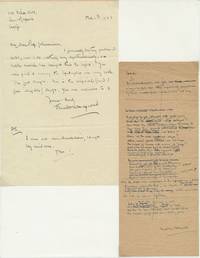
English writer best known as an influential historian of Roman Catholicism in America on which topic he penned 27 volumes; also a poet and literary critic. Two items: First an ALS 1p 5" X 8" San Rafael CA 1923 March 11. Addressed to Albert Johannsen 1871-1962 a University of Chicago geology professor who authored "The House of Beadle and Adams and Its Dime and Nickel Novels" 1950 the definitive reference work and bibliography on the subject. Near fine. Cordial note to an admirer: "I generally destroy published mss. but I do nothing systematically & a little search has brought this to light. You will find it among the Epitaphs in my book 'The Last Knight. This is the original and I fear illegible draft. I am not an American except by residence." Boldly signed with an initialed postscript. Second the aforementioned draft an AMS 1p 3½" X 8¼" n.p. n.y. Very good. On cheap lightly but evenly age toned stock Maynard pens quite a few lines in his incredibly miniscule script many of his letters are a mere 1/8th" tall many 1/16ths" tall. Titled "Epitaphs" the first example goes "of a philanthropist who after a long & useful life was impartially praised even by those newspapers which he did not own." Some deletions additions and corrections throughout. Signed 1¼" long at the conclusion. Accompanied by Johannsen's original 8½" X 11" file folder bearing a printed "Collection of Albert Johannsen" label partly filled in by Johannsen. unknown
Referenz des Buchhändlers : 26745
|
|
|

 Per e-mail erhalten
 Als pdf-Dokument herunterladen
 RSS feed
 Permanenter link


