|
|
|
MUSSET, Alfred de ; LEP ; [ LEP, Raymond ; LEPRETRE, Raymond ]
La Mouche [ Exemplaire sur papier Japon avec dessin original et suite ]
Un des 16 exemplaires sur Japon Mikado (n° 6) avec original et suite des illustrations en bistre, 1 vol. in-8 en feuilles sous chemise, chemise cartonnée et étui, Editions de la Couronne, Paris, 1945, 100 pp. Rare exemplaire du tirage de tête sur un beau papier "Japon mikado" et bien complet d'un dessin original signé de l'illustrateur LEP (pseudonyme de Raymond Leprêtre, né à Divion dans le Pas-de-Calais), et de la suite en bistre. Bon état (étui très lég. frotté, très bon état par ailleurs). Français

|
|
|
Musset, Paul de, homme de lettres (1804-1880).
Lettre autographe signée. S. l., 29 août [ca 1840].
1p In-8 (9 lignes). Il écrit à son correspondant (l'éditeur Delloye?) "cher monsieur et confrère", qu'il a bien reçu le livre Promenades dans Londres [de Flora Tristan] et qu'il va le lire attentivement et qu'il "trouvera quelqu'occasion de le citer". - Petits plis et déchirures marginaux. Ancienne collection Charles Vincens.

|
|
|
Musset-Pathay, Victor Donatien de, French dramatist, poet, and novelist (1768-1832).
Autograph letter signed. N. p., 31. X. 1822.
8vo. 1 p. on bifolium with papered seal. Highly interesting letter to Madame Soehnée, probably Caroline-Wilhelmine Soehnée (1760-1830), concerning the publication of the works of Jean-Jacques Rousseau: "Je vous remercie de l'avis que vous voulez bien me donner et j'en ferai part à M. Lequien. Mais je crois que les ouvrages de J. J., frappés d'anathèmes sont entre vos mains et qu'il n'y a plus à publier que la correspondance, les Confessions et La nouvelle Héloïse. Il faut espérer qu'à force de sottises, de ridicules et d'absurdités, les Bonnegens finiront par se noyer. Mon ami le Docteur Petrol m'a fait espérer, madame, qu'il me présenterait chez vous pour vous exprimer ma reconnaissance. J'attends que ses malades lui en laissent le loisir [...]". - After losing his post in the Ministry of the Interior due to his liberal political views in 1818, Victor Donatien de Musset-Pathay produced the first complete edition of the works of Jean-Jacques Rousseau. It was initially published in 22 volumes between 1818 and 1820 in Paris by A. Eymery. Soon a revised edition was brought forward by the Parisian publisher Dupont from 1823-25. - The Alsatian family Soehnée successfully produced printed fabrics, so called "Indiennes", since 1797. The letter suggests that the family owned manuscripts of Jean-Jacques Rousseau and supplied them to Musset-Pathay for publication. Incidentally, one of the popular motifs for their fabrics was Rousseau's famous grave in the park at Ermonville. - Traces of folds. With minor browning and traces of former mounting.
|
|
|
MUSTAFA (Authorized person of the Waqf), (Early 19th century).
[MUWAQQIT EFFENDY: TIMEKEEPING OF THE SPECIAL WATCH IN THE TOMB OF SULTAN MEHMET II] Historical manuscript document on the fee of a muwaqqit who was hired to set the special watch that Pertevniyal Kadin Efendi donated to the tomb of Fatih Sultan Mehmed Han.
Very Good Turkish, Ottoman (1500-1928) Original historical autograph manuscript document sealed by the authorized person of the Pertevniyal Hanim Waqf on special paper. 32x18 cm. In Ottoman script. 6 lines with its annotated confirmation with red ink. 1 p. Historical manuscript document on about the muwaqqit who was hired to set the special watch that Pertevniyal Kadin Efendi donated to the tomb of Fatih Sultan Mehmed Han. Pertevniyal Sultan [i.e. "Descended from Radiance"], (1810-1884), was the thirteenth wife of Sultan Mahmud II, and Valide sultan to their son Sultan Abdulaziz of the Ottoman Empire. Pertevniyal exerted some influence over her son. When Abdulaziz took his trip to Europe, Pertevniyal was anxious about him the whole time he was away. On his way home he stopped at Ruse, Bulgaria, where Midhat was governor, with the intention of a month and acquainting himself with the Balkan country. But Pertevniyal, a possessive and short-sighted woman, wrote him to come home immediately. Sultan of Turkey though he was, he obeyed his mother's command. Pertevniyal contributed to the instability of her son's rule by meddling in affairs of state. Especially unwise was her alliance with Mahmud Nedim Pasha, the sycophantic grand vizier whose recklessness and incompetence led to further financial chaos. She founded the Pertevniyal High School as well as Pertevniyal Valide Sultan Mosque in 1872. In the days when the Hejaz was part of the Empire, the Porte tried to improve the health situation there. Pertevniyal, built hospitals in the Harem-i Sherif, and young Turkish doctors went out from Istanbul to man them. Pertevniyal Sultan was a great philanthropist, and thanks to her influence, she had the opportunity to make her son do whatever he wanted. In order to provide income to the foundations that it intends to establish, lands called Fasil fields. She commissioned a fountain in front of the Kâtib Mosque in October 1862, and then it was removed from the square and moved to the entrance door of the mosque on the grounds that it narrowed the road. She also built three fountains, one in Suboyu (Bige) village and two on Karaköy road in Sebinkarahisar. In 1864, she built a shipbuilding pool (stone loom) in Tersane to cover her own income, the first Ottoman battleship came out of this loom. "In the history of Islam, a muwaqqit was an astronomer tasked with the timekeeping and the regulation of prayer times in an Islamic institution like a mosque or a madrasa. Unlike the muezzin (reciter of the call to prayer) who was usually selected for his piety and voice, a muwaqqit was selected for his knowledge and skill in astronomy. The main duty of the muwaqqit was timekeeping and the regulation of daily prayer times in mosques, madrasas, or other institutions using astronomy and other exact sciences. At its zenith in the fourteenth and fifteenth centuries, major mosques often employed prominent astronomers as muwaqqits. In addition to regulating prayer times, they wrote treatises on astronomy, especially on timekeeping and the use of related instruments such as quadrants and sundials. They were also responsible for other religious matters related to their astronomical expertise, such as the keeping of the Islamic calendar and the determination of the qibla (the direction to Mecca used for prayers). (Source: Wikipedia).
|
|
|
MUSTAFA HALIM [ÖZYAZICI], (Ottoman / Turkish calligrapher), (1898-1964).
Autograph paper signed 'Hattat el-Hac Mustafa Halim'.
Fine Turkish, Ottoman (1500-1928) Original manuscript paper with its decorative frame. Paper size: 7,5x13 cm; frame size: 19x24 cm. In Ottoman script. 1 p. Signature of Halim by his very calligraphic style with 'Hattat el-Hac' title and seen one sentence down of paper: 'Gönderilen meblagi mütesekkir aldim hürmetlerim efendim' [i.e. 'I received the amount sent, thanks and gratitude']. Mustafa Halim Özyazici, was an Ottoman calligrapher and one of the last of the classical Ottoman calligraphers, using the Arabic script. He was a versatile calligrapher with a high level of expertise in many styles of script, but was widely regarded as a master jeli-thuluth. He is most noted for his work on various restoration projects, of both manuscripts and public buildings. He was born Mustafa Abdülhalim on 14 January, 1898 in the Hazeki district of Istanbul. He was the son of Nalinci Haci Cemâl Efendi, originally from Crimea and his mother was Sudanese. He was educated at Gülsen Junior High School, where he was given lessons in calligraphy by Hamid Aytaç, who recognised his talent and encouraged him to pursue calligraphy as a career. He later studied drawing and sculpture at the Academy of Fine Arts in Istanbul. His formal calligraphy studies were with Hasan Riza Effendi (1849-1920) and Kamil Akdik (1862-1941) where he mastered the thuluth, nasih and riqâ scripts. In 1916, he was drafted into the Army. After completing basic training he worked in the Military Printing Department and also worked in Evkâf-i Islâmiyye Printing Press. Following his discharge from the Army in 1924, he opened an office in Bâbiâli Street (The Sublime Porte) where he prepared all types of calligraphy; business cards, seals and book covers. He also taught in various schools around the Cagaloglu district of Istanbul. From 1927, he was employed in the Imperial Chancery. When the Latin alphabet replaced Arabic lettering in 1928, he applied to go to Egypt, where classical calligraphy, using Arabic script, was still valued, but his application was rejected in 1929. He subsequently abandoned calligraphy altogether. However, during the 1940s, his skills in classical calligraphy found an outlet when he became part of a major restoration project which worked on repairs to numerous manuscripts in a variety of styles and the restoration of calligraphic reliefs and monumental art in historic, public buildings, including many mosques. In 1948, he was appointed to the position of 'old writing teacher' at the Academy of Fine Arts in Istanbul; a position he retained until his retirement in 1963. One of his responsibilities was to write the diplomas for those who were about to graduate from the Academy. He died on 30 September, 1964, ten days after being involved in a traffic accident. He was buried in the Kozlu Cemetery. Although he developed expertise in many different types of script, he was regarded as a master of jeli-thuluth script. He wrote a number of exercise books for students to practice scripts in nesih, thuluth-nesih, riq'a, diwânî and jeli diwânî, and which were part of a program designed to promote the art of calligraphy. These books are still being printed and distributed to students of calligraphy.
|
|
|
MUSTAFA NECATI [UGURAL], (Turkish statesman in the early years of the Turkish Republic, who served as the Minister of National Education during the reform period), (1894-1929).
Autograph letter signed 'Mustafa Necati' sent to Turkish female poet Halide Nusret Zorlutuna, (1901-1984).
Very Good Turkish, Ottoman (1500-1928) Original manuscript autograph letter signed (ALS) addressed to Turkish female poet Halide Nusret Zorlutuna, (1901-1984). 22,5x17,5 cm. In Ottoman script written on a fine and special Italian hand-made paper with 'Aurelius' watermark. 1 p. on bifolium. Dated March 13, 1926. It starts as "Muhterem hemsire...". 4 lines. Signed as 'Maarif müdürü' [i.e. Director of Ministery of Education] by Mustafa Necati. Mustafa Necati Ugural was a Turkish statesman in the early years of the Turkish Republic, who served as the Minister of National Education during the reform period. He died before the Turkish Surname Law was adopted and the surname Ugural is actually the surname his family members adopted after his death. Mustafa Necati was born in 1894 in Izmir. His father was Halit and his mother was Naciye. After his primary and secondary education in Izmir, he went to Istanbul for higher education and studied law. He returned to Izmir in 1914 to serve as a lawyer and teacher. In 1915 he established a private school with his friend Vasif Çinar. He also served as a legal adviser for the local railway company. After the First World War in which the Ottoman Empire was defeated, the Allies fired the railway workers. He tried to defend the workers' rights by establishing a committee. Later he expanded his activities to defend the rights of the reserve officers who returned from the front. After Izmir was occupied by the Greek army, he fled to Istanbul and then to Balikesir, where he began to participate in the Turkish War of Independence. Among other things, he published a short-lived newspaper to defend Turkish rights against the Greek invasion. After the Ottoman parliament in Istanbul was abolished by the Allies on 16 March 1920, Turkish parliament was established in Ankara on 23 April 1920 and Mustafa Necati was elected as the Saruhan (present Manisa) MP. However, during the 1920-1922 term, he spent most of his time out of Ankara. He was appointed as a member of Independence Tribunals in Sivas and then Kastamonu. Finally, he was appointed as the chairman of Amasya Independence Tribunal. As soon as the Republic was proclaimed on 29 September 1923, Mustafa Necati became a government minister of Ismet Inönü's cabinets. His first seat was Minister of Exchange Construction and Settlement in the 1st government of Turkey. This was a very important seat for its main responsibility was the Population exchange between Greece and Turkey. In the 2nd government of Turkey, he was the Minister of Justice. However, his most important seat was that of the Minister of National Education following a revision in the 4th government of Turkey. He kept this post in the 5th government of Turkey till his death. Up to 1928, the Arabic script was used in Turkey. However, the Turkish language has 8 vowels and the Arabic script remained incapable of reproducing the Turkish words. Nevertheless, being the script of the Quran it was considered to be inalterable. But president Atatürk decided to adopt the Latin alphabet (with small changes). Moreover, he insisted that the reform should be carried out immediately. In addition to adding the Latin alphabet to school curricula, short term courses for the adults called Nation's schools (Turkish: Millet Mektebi) were established. As the minister of National Education, Mustafa Necati was responsible for establishing these courses. The courses were successful and Necati was later considered to be one of the pioneers of the new Turkish alphabet. (Wikipedia).
|
|
|
MUSTAFA NECATI [UGURAL], (Turkish statesman in the early years of the Turkish Republic, who served as the Minister of National Education during the reform period), (1894-1929).
Autograph letter signed 'Mustafa Necati' sent to Turkish female poet Halide Nusret Zorlutuna, (1901-1984).
Very Good Turkish, Ottoman (1500-1928) Original manuscript autograph letter signed (ALS) addressed to Turkish female poet Halide Nusret Zorlutuna, (1901-1984). 20x13,5 cm. In Ottoman script written on a fine paper. 1 p. on bifolium. Dated June 16, 1926. It starts as "Azîz hemsire...". 4 lines. Signed as 'Maarif müdürü' [i.e. Director of Ministery of Education] by Mustafa Necati. Mustafa Necati Ugural was a Turkish statesman in the early years of the Turkish Republic, who served as the Minister of National Education during the reform period. He died before the Turkish Surname Law was adopted and the surname Ugural is actually the surname his family members adopted after his death. Mustafa Necati was born in 1894 in Izmir. His father was Halit and his mother was Naciye. After his primary and secondary education in Izmir, he went to Istanbul for higher education and studied law. He returned to Izmir in 1914 to serve as a lawyer and teacher. In 1915 he established a private school with his friend Vasif Çinar. He also served as a legal adviser for the local railway company. After the First World War in which the Ottoman Empire was defeated, the Allies fired the railway workers. He tried to defend the workers' rights by establishing a committee. Later he expanded his activities to defend the rights of the reserve officers who returned from the front. After Izmir was occupied by the Greek army, he fled to Istanbul and then to Balikesir, where he began to participate in the Turkish War of Independence. Among other things, he published a short-lived newspaper to defend Turkish rights against the Greek invasion. After the Ottoman parliament in Istanbul was abolished by the Allies on 16 March 1920, Turkish parliament was established in Ankara on 23 April 1920 and Mustafa Necati was elected as the Saruhan (present Manisa) MP. However, during the 1920-1922 term, he spent most of his time out of Ankara. He was appointed as a member of Independence Tribunals in Sivas and then Kastamonu. Finally, he was appointed as the chairman of Amasya Independence Tribunal. As soon as the Republic was proclaimed on 29 September 1923, Mustafa Necati became a government minister of Ismet Inönü's cabinets. His first seat was Minister of Exchange Construction and Settlement in the 1st government of Turkey. This was a very important seat for its main responsibility was the Population exchange between Greece and Turkey. In the 2nd government of Turkey, he was the Minister of Justice. However, his most important seat was that of the Minister of National Education following a revision in the 4th government of Turkey. He kept this post in the 5th government of Turkey till his death. Up to 1928, the Arabic script was used in Turkey. However, the Turkish language has 8 vowels and the Arabic script remained incapable of reproducing the Turkish words. Nevertheless, being the script of the Quran it was considered to be inalterable. But president Atatürk decided to adopt the Latin alphabet (with small changes). Moreover, he insisted that the reform should be carried out immediately. In addition to adding the Latin alphabet to school curricula, short term courses for the adults called Nation's schools (Turkish: Millet Mektebi) were established. As the minister of National Education, Mustafa Necati was responsible for establishing these courses. The courses were successful and Necati was later considered to be one of the pioneers of the new Turkish alphabet. (Wikipedia).
|
|
|
MUSTAFA NECATI [UGURAL], (Turkish statesman in the early years of the Turkish Republic, who served as the Minister of National Education during the reform period), (1894-1929).
Autograph letter signed 'Mustafa Necati' sent to Turkish female poet Halide Nusret Zorlutuna, (1901-1984).
Very Good Turkish, Ottoman (1500-1928) Original manuscript autograph letter signed (ALS) addressed to Turkish female poet Halide Nusret Zorlutuna, (1901-1984). 22x13,5 cm. In Ottoman script written on a fine paper. "Maarif Vekâleti" [i.e. Ministry of Education] watermark. 1 p. Dated May 8, 1926. It starts as "Azîz hemsire...". 4 lines. Signed as 'Maarif müdürü' [i.e. Director of Ministery of Education] by Mustafa Necati. Mustafa Necati Ugural was a Turkish statesman in the early years of the Turkish Republic, who served as the Minister of National Education during the reform period. He died before the Turkish Surname Law was adopted and the surname Ugural is actually the surname his family members adopted after his death. Mustafa Necati was born in 1894 in Izmir. His father was Halit and his mother was Naciye. After his primary and secondary education in Izmir, he went to Istanbul for higher education and studied law. He returned to Izmir in 1914 to serve as a lawyer and teacher. In 1915 he established a private school with his friend Vasif Çinar. He also served as a legal adviser for the local railway company. After the First World War in which the Ottoman Empire was defeated, the Allies fired the railway workers. He tried to defend the workers' rights by establishing a committee. Later he expanded his activities to defend the rights of the reserve officers who returned from the front. After Izmir was occupied by the Greek army, he fled to Istanbul and then to Balikesir, where he began to participate in the Turkish War of Independence. Among other things, he published a short-lived newspaper to defend Turkish rights against the Greek invasion. After the Ottoman parliament in Istanbul was abolished by the Allies on 16 March 1920, Turkish parliament was established in Ankara on 23 April 1920 and Mustafa Necati was elected as the Saruhan (present Manisa) MP. However, during the 1920-1922 term, he spent most of his time out of Ankara. He was appointed as a member of Independence Tribunals in Sivas and then Kastamonu. Finally, he was appointed as the chairman of Amasya Independence Tribunal. As soon as the Republic was proclaimed on 29 September 1923, Mustafa Necati became a government minister of Ismet Inönü's cabinets. His first seat was Minister of Exchange Construction and Settlement in the 1st government of Turkey. This was a very important seat for its main responsibility was the Population exchange between Greece and Turkey. In the 2nd government of Turkey, he was the Minister of Justice. However, his most important seat was that of the Minister of National Education following a revision in the 4th government of Turkey. He kept this post in the 5th government of Turkey till his death. Up to 1928, the Arabic script was used in Turkey. However, the Turkish language has 8 vowels and the Arabic script remained incapable of reproducing the Turkish words. Nevertheless, being the script of the Quran it was considered to be inalterable. But president Atatürk decided to adopt the Latin alphabet (with small changes). Moreover, he insisted that the reform should be carried out immediately. In addition to adding the Latin alphabet to school curricula, short term courses for the adults called Nation's schools (Turkish: Millet Mektebi) were established. As the minister of National Education, Mustafa Necati was responsible for establishing these courses. The courses were successful and Necati was later considered to be one of the pioneers of the new Turkish alphabet. (Wikipedia).
|
|
|
MUSTAFA ZEKI PASHA, (The Grandmaster and Commander of Artillery - Tophane-i Amire Müsiri), (1849-1914).
Autograph letter sealed 'Mustafa Zeki', sent to Mazhar Pasha who was the commander of naval forces located in Chios Island (Sakiz Adasi) in the Archipelago, for the fortification to Chios fortress and around, and preparation of an exploration report and a map.
Very Good Turkish, Ottoman (1500-1928) Original manuscript autograph letter/document signed/sealed by Mustafa Zeki Pasha who was Tophâne-i Âmire müsiri [i.e. Grandmaster and Commander of Artillery / Brigadier and Ministry of Military Schools], sent to Mazhar Pasha who was the commander of naval forces located in Chios Island (Sakiz Adasi) in the Archipelago, for the fortification to Chios fortress and around, and preparation an exploration report and a map. 34x21 cm. In Ottoman script. Folded. 1 p. It's written in a beautiful and legible riq'a script. Including 23 lines. Full. Zeki Pasha was one of the most trusted Ottoman generals and statesmen of Sultan Abdulhamid II. He served as Tophane Counselor for 18 years during the reign of Sultan Abdülhamid II. In 1899, Italian architect Alexandre Vallaury built the 'Tophane Müsiri Zeki Pasa Mansion (Yali)', one of the most valuable estates of Istanbul, on his behalf. In 1908, he fell out of favor with the declaration of the Second Constitutional Monarchy by Union and Progress Society (Ittihad ve Terakki Cemiyeti) and was deported first to Büyükada and then to Rhodes. (Source: Wikipedia). Minor stains on paper. A very good manuscript on a fine watermarked paper with a letterhead "Tophâne-i Âmîre Müsireti".
|
|
|
Musäus, Johann Karl August, Schriftsteller und Kritiker (1735-1787).
Eigenh. Albumblatt mit U. Weimar, 24. VII. 1773.
1 S. Qu.-8vo. "Die Freundschaft durch die Hand der sanften Sympathie geknüpft ist fest und dauerhaft, wenn sie gleich nicht Zeit und Erfahrung prüft. / Hierdurch empfiehlt sich dem gütigen und freundschaftlichen Andenken des Herrn Besitzers bestens / Joh. Carl Aug Musäus / Prof. am Gymnasium zu Weimar". - Aus der Zeit als Lehrer am Weimarer Wilhelm-Ernst-Gymnasium, wo er auch seinen Neffen, den zu jenem Zeitpunkt zwölfjährigen August Kotzebue unterrichtete. Leicht gebräunt. Einem altem Album amicorum entnommen; oben rechts die zeitgenöss. Foliierung "203".

|
|
|
Musäus, Johann Karl August, Schriftsteller und Märchensammler (1753-1787).
Eigenh. Schriftstück mit U. ("Johann Carl August Musäus"). Weimar, 24. XII. 1775.
1 S. Qu.-8vo. Eh. Quittung: "Zwanzig Stück richtige Louis d'or habe ich Endesbenannter von [...] Herrn Kauffmann Madelung für eine mir zustehende und von demselben verkauffte Wildschur von weißen sibirischen Fuchs [!] richtig und wohl erhalten, deren baaren Empfang ich hierdurch bescheinigen sollen [!] [...]". - Beiliegend ein Portraitdruck.
|
|
|
Mutafian.
Mutafian. Affiche éditée à l'occasion de l'exposition à la Galerie Yvette Morin du 9 au 29 mars 1966.
Une seule affiche de dimensions 46,5 x 63 cm; lithographie de Jacques Gourdon. Signature autographe de l'artiste. Très bel état de fraîcheur. Voir photo.

|
|
|
Muth, Richard von, Schriftsteller und Germanist (1848-1902).
3 eigenh. Briefe mit U. St. Pölten, April bis Juni 1901.
Zusammen 1½ SS. Folio. An die Direktion der k.k. Universitätsbibliothek betr. der Auslehnung bzw. Rückstellung von geliehenen Büchern. - Muth war seit 1898 Direktor des Lehrerseminars in St. Pölten und wurde im selben Jahr auch mit der Inspektion der niederösterreichischen Landesschulanstalten beauftragt. Anfangs deutsch-national gesinnt, schloß er sich später den Christlich-Sozialen an und wirkte im Landesschulreferat an der Seite Albert Gessmanns. Als einziger niederösterreichischer Mittelschullehrer war Muth an dem Kronprinzenwerk "Die österreichisch-ungarische Monarchie in Wort und Bild" (1888) beteiligt. Zudem veröffentlichte er Studien zur mittelhochdeutschen Literatur und Schulbücher sowie Gedichte, Lustspiele und Erzählungen. - Auf Briefpapier mit gedr. Briefkopf des N. Ö. Landes-Lehrerseminars in St. Pölten sowie mit 2 Stempeln der Direktion desselben.
|
|
|
Muti, Riccardo, Dirigent (geb. 1941)
Porträtpostkarte mit eigenh. Datierung und U.
o.J. Berlin, 13. II. 1977, 8° (15 x 10,5 cm). 1 Seite. - Beim Dirigieren..
Referentie van de boekhandelaar : 58005
|
|
|
Muti, Riccardo, Dirigent (geb. 1941).
Portraitphotographie mit eigenh. U. O. O. u. D.
287:202 mm.
|
|
|
Mutius, Gerhard von, Diplomat und Philosoph (1872-1934).
Ms. Sentenz mit eigenh. ausgefülltem Formularteil und eh. Namenszug. Bukarest, o. D.
1 S. Folio (223:282 mm). Albumblatt mit gedruckter Bordüre, gedr. Fußzeile "Beitrag zum Selbstschriftenalbum 'Deutschlands Zukunft'" und gedr. Formular für biograph. Daten, aufgezogen auf einen Bogen Pergamentpapier (ca. 330:344 mm). "Denkt man an die äussere Weltlage und Deutschlands äussere Lebensbedingungen, so sieht die Zukunft nach wie vor dunkel und schwierig aus. Blickt man hingegen auf die innere Lebenskraft des deutschen Volkes, so kann man nicht anders, als an eine grosse Zukunft glauben. In dieser Hinsicht scheint mir namentlich die Entwicklung der deutschen Sprache hoffnungsreich. In jeder sprachschöpferischen Wendung, überall da, wo sie nicht nur neutrales Verständigungsmittel, Routine und Gewohnheit ist, fühlen wir den Auftrieb, die Jugend, das Glück der Sprache [...]". - Geschrieben als Beitrag für die von Friedrich Koslowsky im Berliner Eigenbrödler-Verlag herausgegebene Faksimile-Anthologie "Deutschlands Köpfe der Gegenwart über Deutschlands Zukunft" (1928). Die Sentenz bei Veröffentlichung in Druckschrift wiedergegeben. - Gerhard von Mutius war von 1927 bis 1931 deutscher Gesandter in Bukarest. - Mit feinen Einschnitten im Formularteil. Koslowsky 192.
|
|
|
MUYDEN, Evert van (1853-1922) peintre, illustrateur et aquafortiste:
Lettre manuscrite de Evert van Muyden adressée à son quasi contemporain Eugène Burnand, peintre, à propos de sa participation à l'Exposition Universelle de Paris.
Genève, 18.7.1889, 22,5 cm x 17,5 cm, 12 lignes, écriture lisible, bon état.
Referentie van de boekhandelaar : 79331aaf
|
|
|
Muyden, Jacques Alfred van, Maler (1818-1898)
Eigenh. Brief mit U.
o.J. Ohne Ort [Rom], ca. 1860, 8°. 1 1/2 Seiten. Doppelblatt mit Adresse.
Referentie van de boekhandelaar : 44634
|
|
|
MUZAFFER KÂMIL GÖRDUYSUS, (Turkish Consul of Komotini, 1943-1947).; ISMAIL HAKKI OKDAY, (Son of last Ottoman vizier Ahmet Tevfik Pasha, groom of last Ottoman sultan Vahideddin, soldier, diplomat and philatelist), (1881-1977).
[Autograph dedicated business card of Muzaffer K. Görduysus to Ismail H. Okday].
Very Good Turkish Original business card with autograph dedication. In Turkish. Muzaffer Görduysus was Turkish consul of Komotini (Gümülcine) between the years of 1943-1947. Dedicated to Ismail Hakki Okday, (1881-1977) who was son of last Ottoman vizier Ahmet Tevfik Pasha, groom of the last Ottoman sultan Vahdeddin, soldier, diplomat and philatelist.
|
|
|
MUZAFFER NEBIOGLU, (Turkish vamp actress in 1950s), (1937-).
Original photograph signed and inscribed 'M. Nebioglu'.
Very Good Turkish Original b/w portrait photograph signed and inscribed by Muzaffer Nebioglu as 'Sevgilerimle'. 14x9 cm. Muzaffer Nebioglu was born in 1937 in Istanbul, Turkey. She is an actress, known for Yaman gazeteci (1961), Bir soförün hayati (1954) and Binnaz (1959).
|
|
|
MUZIO, Claudia (1889-1936)
Inscribed Photograph Signed
Renowned Italian soprano often remembered as "la dinvina Claudia" and "The Duse of Opera." IPS Van Riel 8½" X 11" n.p. 1924. Near fine. A dramatic head shot of a very flapper-looking Muzio in beaded head scarf inscribed big and bold to a Chicago pianist and music school founder: "To John Leiser / Sincerely / Claudio Muzio / 1924." Scarce and choice. This item has been archivally framed in a single cream matte UV-filtering glass and 3/4" antiqued silver frame overall dimensions 11½" X 14". Bit of damage to top frame edge. The finest Muzio imaginable. unknown
Referentie van de boekhandelaar : 15459

|
|
|
Muzio, Emanuele, Komponist (1821-1890)
Eigenh. Brief mit U.
o.J. Modena, 4. I. 1888, 8° (20 x 13 cm). 4 Seiten. Doppelblatt..
Referentie van de boekhandelaar : 55698
|
|
|
Muzzarelli, Alfred, Sänger (1890-1958).
Portraitpostkarte mit eigenh. U. O. O., April 1928.
1 S. 8vo. Brustbild im Profil. - "Iris"-Verlag, Nr. 660.
|
|
|
Muzzey, David Saville, American historian (1870-1965).
Autograph signature. No place, 1. II. 1939.
Oblong small 8vo. Margins slightly browned. From the collection of the Viennese lawyer Max Bettelheim (1912-71).
|
|
|
MUÑIZ Y TERRONES, José (1839-1900).
Concepto del Mando y Deber de la Obediencia. Cartas a Alfonso XIII. Estudio bibliográfico-histórico-filosófico-jurídico-militar. Con un prólogo de José Canalejas y Mendez.
Madrid, Imprenta de Fortanet, 1893. Dos volúmenes en folio; XXV-827 pp. + 748 pp., 1 h. Con una lámina retrato fotográfica del autor, a cuyo pie figura un envío autógrafo del mismo. Encuadernación original en tela estampada. Don José Muñiz, autor de las "Ordenanzas de S.M. para el Régimen, Disciplina, Subordinación y Servicio de sus Ejércitos", publicadas entre 1880 y 1881, está considerado como uno de los mejores escritores militares españoles y representativo de la generación del cambio de siglo, de lo que es una muestra éstas tempranas "Cartas a Alfonso XIII", cuando éste cumplía los siete años.

|
|
|
Mylius, Caspar Joseph Carl von, Kölner Stadtkommandant (1749-1831).
Eigenh. Brief mit U. Köln, 30. IV. 1788.
2½ SS. auf Doppelblatt. 4to. Mit eh. Adresse verso. An den Marquis von Torcy mit der Bitte, sich zweier Waisenkinder anzunehmen, die gemeinsam mit ihren kürzlich verstorbenen Eltern von einem Kölner Bürger aufgenommen worden waren: "Le nommé Pfeiffer Bourgois de la Ville [...] m'est venu dire, qu'un Soldat du Regiment de Nassau [...] logé chez luy avec sa femme et trois enfants avait été transporté à l'hopital [...] que la femme etant mort chez luy avec un enfant il avait a peine obtenu [...] qu'enfin ajourd'hui on luy avait declaré que le Soldat était mort et enterré jeudi passé [...] Je vous prie de mettre vos ordres pour les deux enfants l'humanité l'exige, et la ville de Cologne ne peut point nourrir et elever des enfants qui ne leur appartiennent pas [...]".
|
|
|
Myriam HARRY
"Depuis quelque temps déjà je le désirais et n'osait vous le demander " Lettre autographe adressée à Pierre Belperron lui ayant envoyé et dédicacé son dernier ouvrage en lice pour l'obtention du Prix Vacaresco
Neuilly-sur-Seine s. d. [ca 1947] | 20.50 x 13.50 cm | Une page
Referentie van de boekhandelaar : 86689
|
|
|
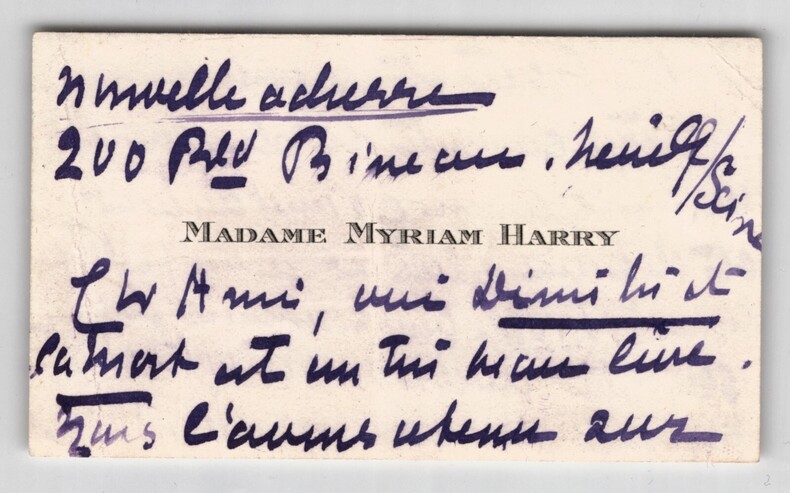
Myriam Harry
Carte autographe paraphée de Myriam Harry à un ami, évoquant la littérature
Myriam Harry. Carte Visite autographe avec paraphe Écrivaine Dimensions : 8.9 x 5.1 cm Nombre de pages : 2 pages Myriam Harry Maria Rosette Shapira dite Myriam Harry est une femme de lettres française née à Jérusalem le 21 février 1869 et morte à Neuilly-sur-Seine le 10 mars 1958.
Referentie van de boekhandelaar : boz_001736
|
|
|
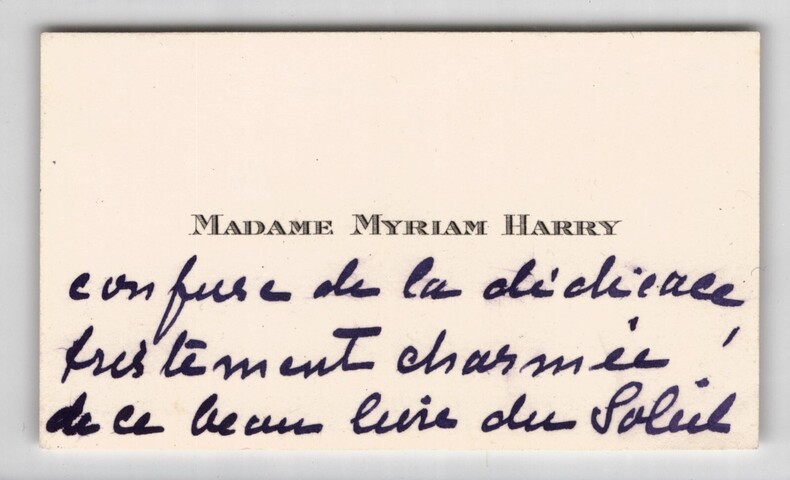
Myriam Harry
Myriam Harry - Carte de visite autographe de remerciement avec paraphe
Myriam Harry - CARTE DE VISITE AUTOGRAPHE de remerciement avec Paraphe ! Écrivaine Dimensions : 8.9 x 5.1 cm État : Voir photos et description pour plus de détails. Nombre de pages : 1 page
Referentie van de boekhandelaar : boz_002404
|
|
|
Myrdal, Gunnar, Wirtschaftswissenschaftler und Nobelpreisträger (1898-1987)
Brief mit eigenh. U.
o.J. Stockholm, ohne Jahr, Fol. 1 Seite. Gedruckter Briefkopf des "Institute for International Economic Studies". In adressiertem Umschlag.
Referentie van de boekhandelaar : 50697
|
|
|
Myslbek, Josef Vaclav, Bildhauer (1848-1922).
Eigenh. Albumblatt mit wiederholter U. O. O. u. D.
2 SS. Qu.-8vo. Alt in Passepartout montiert. Die Recto-Seite mit einem Spruchwort in tschechischer Sprache, die Verso-Seite auf Deutsch: "Für Trost spendende Worte des Mitgefühls dankt herzlichst | J. V. Myslbek". - J. V. Myslbek lernte bei Thomas Seidan, war Gehilfe von Vaclav Levy in Prag und studierte auch an der dortigen Akademie bei Josef Trenkwald. "Das Werk Myslbeks, welcher der Generation des 'Prager Nationaltheaters' angehörte und der zum Klassiker der modernen tschechischen Kunst wurde, unterlag verschiedenen Stileinflüssen vom Klassizismus über die Neurenaissance zur Secession, glich sich aber aber auch mit der Antike aus. Myslbeks Arbeiten sind durch tiefe Menschlichkeit und moralische Wahrhaftigkeit gekennzeichnet" (ÖBL VII, 11).

|
|
|
Myslbek, Josef Vaclav, Bildhauer (1848-1922).
Eigenh. Brief mit U. O. O. u. D.
1 S. auf Doppelblatt. Gr.-8vo. An eine Dame: "Ich erlaube mir Ihnen hochverehrte Frau für die warmen Worte der Anerkennung meiner schwachen Leistungen auf dem Gebiete der Töpferkunst, sowie auch für die Gratulation zu meinem Namensfeste meinen innigsten Dank auszusprechen [...]". - J. V. Myslbek lernte bei Thomas Seidan, war Gehilfe von Vaclav Levy in Prag und studierte auch an der dortigen Akademie bei Josef Trenkwald. "Das Werk Myslbeks, welcher der Generation des 'Prager Nationaltheaters' angehörte und der zum Klassiker der modernen tschechischen Kunst wurde, unterlag verschiedenen Stileinflüssen vom Klassizismus über die Neurenaissance zur Secession, glich sich aber aber auch mit der Antike aus. Myslbeks Arbeiten sind durch tiefe Menschlichkeit und moralische Wahrhaftigkeit gekennzeichnet" (ÖBL VII, 11). - Papierbedingt leicht gebräunt und mit einem kleinen Einriß im Mittelfalz.

|
|
|
Myslbek, Josef Václav, Czech sculptor (1848-1922).
Autograph signature. Prague, 9. IX. 1917.
8vo (postcard). 1 page. Inscribed to the German dermatologist Alwin Scharlau. - His style ranging from Classicism to Art Nouveau, Myslbek is best known for his monumental works reflecting the political and cultural advancement of Bohemia during its 19th century renaissance, including sculptures in the Prague National Theatre, St. Vitus Cathedral, Wenceslas Square, and Prague castle. He is credited with founding the modern Czech sculpting style. - Self-addressed by the collector. The Mecklenburg physician Scharlau (b. 1888) assembled a collection of artists' autographs by personal application.
|
|
|
MZALI, Mohammed
La Parole de l'Action. Conversation avec Xavière Ulysse [ Livre dédicacé par l'auteur à Maurice Druon ]
1 vol. in-8 br., Publisud, 1984, 281 pp.
Referentie van de boekhandelaar : 70167

|
|
|
MÂLE, Emile (1862-1954)
Une page in-8°, à en-tête "Ecole française de Rome", datée "Rome, 1937". 5 lignes : lois de l'art et de la morale.
1
Referentie van de boekhandelaar : 8107
|
|
|
Mâle, Emile, historien d'art (1862-1954).
CDV autographe. S. l. n. d.
1 ligne. "avec ses bien vifs remerciements". - Ancienne collection de Foville.

|
|
|
Märker, Friedrich, Schriftsteller (1893-1985)
Eigenh. Albumblatt mit U. sowie Porträtfotografie mit eigenh. Beschriftung und U.
o.J. Feldafing, ohne Jahr, Fol. und 8°. Zus. 2 Seiten.
Referentie van de boekhandelaar : 59603
|
|
|
Mäurer, Gustav, Violinvirtuose (1880-1968).
Ms. Postkarte mit eigenh. U. Wien, 27. V. 1925.
1 S. Qu.-8vo. Mit ms. Adresse. An Emilie Schaup in Sachen Autographensammeln und eine allfällige Unterstützung des Österreichischen Musik- und Sangesbundes, als dessen Präsident Mäurer amtierte. - Der aus Wiesbaden stammende Musiker erfuhr seine Ausbildung zum Violinisten u. a. bei Alexander Sebald in Leipzig, Karl Prill in Wien und August Wilhemj in London, "trat seit seinem dreizehnten Lebensjahr öffentlich auf, spielte 1905 erstmals in Wien und unternahm ausgedehnte Konzertreisen. 1910 gründete Mäurer eine eigene Musik- und Gesangsschule in Wien, ab 1920 war er Präsident des Weltmusik- und Sängerbundes, gründete 1924 eine Schule für Violine und 1927 das Internationale Musikarchiv, sowie die Beethoven-Schubert-Gedächtnisstiftung. Mäurer komponiert auch, u. a. das Tonstück 'Siegfried', 'Ein Leben', eine Symphonie in vier Sätzen, eine 'Romantische Phantasie', sowie Studienwerke für Violine und Bearbeitungen" (Nachlässe in Österreich - Personenlexikon).

|
|
|
Mécif (Yvan)
Traversées épreuves.
français Grand in-8 de 62-(1) pp.; broché de l'éditeur. Collection Diagonales. Envoi autographe signé de l'auteur en page de garde.
|
|
|
Méhul, Étienne-Nicolas, French composer (1763-1817).
Autograph letter signed. In French. Paris, 15. VIII. 1816.
4to. 1½ pp. on bifolium. With autograph address and traces of seal. To the mayor of Pantin, François Joseph Gorneau, announcing a reduction of his annual donation to the parish priest of Pantin. Méhul gives a detailed account of his financial losses in the wake of the Bourbon Restoration to explain why he is unable to keep a promise made in better times: "À l’époque ou je me suis engagé a donner tout les ans vingt francs pour le curé de Pantin, ma position étoit bien différente de la qu’elle est maintenant. J’avois au moins dix mille francs de revenu par mes places et mes ouvrages, et il m’en reste a peine six. J’avois un logement du gouvernement et ce logement m’a été retiré. J’avois des droits d’auteurs sur les Théatres de la Belgique et du Rhin, et ces droits sont anéantis. Les contributions étoient modérées et elles sont presque doublées. Enfin je me trouve condamné à une économie si rigoureuse, que j’ai été contraint de diminuer les gages de mon jardinier, et que malgré mon goût pour la culture des fleurs, je vendrois volontiers ma maison de Pantin a dix mille francs de partir, si j’en trouvois l’occasion. J’ai cru nécessaire, monsieur, d’entrer dans tous ces détails, afin de vous convaincre de l’impossibilité ou je me trouve de remplir mes anciens engagemens, et du désir que j’ai d’en contracter de nouveaux en raison de mes moyens réduits. Je promets donc avec grand plaisir de contribuer au soulagement de notre pasteur pour la somme de dix francs par an. Après deux années de désastres et la réduction de mes places, c’est tout ce que je puis faire [...]“. - Dubbed the "composer of the Revolution", Méhul celebrated his biggest successes during the French Revolution and the Napoleonic era. In 1794 he composed the "Chant du départ", which was later selected as the official anthem of the First Empire. Méhul's "Chant national du 14 Juillet 1800", comissioned by Napoleon to celebrate his victory in the Battle of Marengo, almost reached the status of a national hymn. He composed more than forty operas, of which "Joseph" (1807), a tribute to Napoleon's campaign in Egypt and to his first wife Joséphine de Beauharnais, is still performed today. Despite his friendship with Napoleon, Méhul suffered no political repercussions in the transition to the Bourbon Restoration, and his public standing survived intact. Nevertheless, he suffered financial losses as detailed in the letter, and soon died from tuberculosis. - Well preserved.
|
|
|
Méhul, Étienne-Nicolas, Komponist (1763-1817)
Geschnittene Porträtsilhouette aus schwarzem Glanzpapier, auf Papier aufgelegt, Profil nach rechts, in Bleistift bez. "E Méhul. 1780".
o.J. Ohne Ort, ca. 1780, Blattgr.: 138 x 90 mm. Aufgelegt auf Karton. Unter Glas mit Goldlitze gerahmt (Gesamtgr.: 19,5 x 14,5 cm).
Referentie van de boekhandelaar : 57944
|
|
|
Mélanie Waldor
Mélanie Waldor Long poème autographe signé "Le retour, Hommage à l'Impératrice"
Mélanie Waldor Long poème autographe signé "Le retour, Hommage à l'Impératrice" Écrivain Poème autographe signé de Mélanie Waldor, intitulé "Le retour, Hommage à l'Impératrice Régente", datée du 14 juillet 1859, écrite à l'encre brune sur un double feuillet de papier vélin, avec ratures et corrections. Dimensions : 21 x 32,6 cm Nombre de pages : 3 Mélanie Waldor Mélanie Villenave, dite Mélanie Waldor, née le 29 juin 1796 à Nantes (Loire-Inférieure) et morte le 11 octobre 1871 à Paris, est une femme de lettres françaises, à la fois romancière, poétesse et dramaturge.
Referentie van de boekhandelaar : boz_001513

|
|
|
Mélanie Waldor
Mélanie Waldor - Lettre autographe signée à Monsieur Plouvier - 1870
Mélanie Waldor - Lettre autographe signée à Monsieur Plouvier - 1870 Écrivain Lettre autographe signée de Mélanie Waldor, adressée à Monsieur Plouvier, datée du 14 janvier 1870, écrite à l'encre noire sur un double feuillet de papier vergé avec liseré de deuil de 3 mm, avec ses initiales en en-tête. Dimensions : 13,1 x 20,5 cm État : Voir photos et description pour plus de détails. Nombre de pages : 1 Mélanie Waldor Mélanie Villenave, dite Mélanie Waldor, née le 29 juin 1796 à Nantes (Loire-Inférieure) et morte le 11 octobre 1871 à Paris 1 er , est une femme de lettres françaises, à la fois romancière, poétesse et dramaturge.
Referentie van de boekhandelaar : boz_002060

|
|
|
Mélanie Waldor
Mélanie WALDOR - Lettre autographe signée
Mélanie WALDOR. Lettre autographe signée. Dimensions : 10 x 13.5 cm. 2 pages. Etat : Très bon état.
Referentie van de boekhandelaar : boz_004325

|
|
|
Mélesville, (d. i. Anne-Honoré-Joseph Duveyrier), Schriftsteller (1787-1865).
Eigenh. Brief mit U. Paris, 14. I. 1854.
2 SS. auf Doppelblatt. 8vo. In französischer Sprache an einen namentlich nicht genannten Adressaten. - Auf Briefpapier mit gepr. Monogramm "DM".

|
|
|
Méliès, Georges, French illusionist and film director (1861-1938).
Autograph letter signed and monogrammed. Paris, 21. XI. 1928.
8vo. 4 pp. on bifolium. Charming and insightful letter to Auguste Drioux in Lyon, publisher of the magic magazine Passez Muscade, thanking him for the most recent issues and promising an article on Robert Houdin's illusion "le Décapité récalcitrant" from 1890. Méliès mentions that he is currently very busy, as he was taking care of his gravely ill daughter Georgette and restoring some of Robert Houdin's automatons that he had donated to the Musée des Arts et Métiers in Paris: "Je suis obligé de nettoyer tout cela, et de remettre les têtes, mains, costumes, peintures et dorures en bon état. Il y a pas mal de travail, car tout ce matériel est resté 5 ans dans un endroit assez humide, et il en a souffert. Mais une fois retapé il n'y paraîtra plus, et il pourra affronter l'éternité dans les vitrines du Musée... à moins qu'il ne soit, un jour, détruit par un incendie". - The ominous remark that a fire could destroy the museum seems to be an allusion to Méliès' destruction of his own negatives, film sets, and costumes after he lost his legal battle with Pathé over his Montreuil studio in 1923. Méliès praises the performance of Drioux's fellow magicians from Lyon at a banquet by the Chambre syndicale du Cinema that was probably held in his honour. In a postscript he reports that the politician Édouard Herriot, who had also been present at the banquet, apologized to him for not being able to award Méliès with "the famous red ribbon" anymore, having lost his post as Minister of Culture a few days earlier. However, Herriot promised to put in a good word for Méliès with his successor, also alluding to the possibility that he might get a job in the insurance of the movie industry "Mutuelle du Cinéma," possibly as the director of its retirement home. This prospect gave Méliès hope to be able to finally escape his "dreadful Montparnasse prison": "Il avait promis, pour moi, le fameux ruban rouge, à la demande de Brézillon. Mais c'est bien ma veine, il venait de perdre sa place de ministre 5 jours auparavant. Il a été charmant avec moi, s'est excusé d'avoir été contraint de se 'débarquer' lui-même, ce sont ses propres expressions, mais m'a promis son appui [...] auprès du nouveau Ministre de l'Instruction publique et des beaux arts. [...] En tous cas, j'ai su qu'il est question de me donner une situation intéressante dans l'état major de la Mutuelle du Cinéma; peut-êtrela direction de la maison de retraite. Inutel de dire que cela ferait fort bien mon affaire, en me libérant de mon affreuse prison de Montparnasse". - Following his bankruptcy in 1925, Méliès and his second wife Jehanne d'Alcy barely made a living with a small candy and toy stand in Gare Montparnasse. Around this time Méliès, who had been slipping into oblivion since 1913, was slowly rediscovered and recognized as a film pioneer by journalists and enthusiasts such as Auguste Drioux. Despite the renewed interest and official recognition like the award of the Legion of Honour, Méliès' financial situation improved little. While the post as director never materialised, Méliès, his wife, and his granddaughter received a place in the retirement home in Orly in 1932.
|
|
|
Ménard, Ganneau, Libert, Tournier, Holtzer, René Libert, Ferdinand d'Or, G.D. Raffalovitch
11 cartes de visites aéronautiques Ménard, Ganneau, Libert, Tournier, Holtzer...
Collection de cartes de visites aéronautiques - René Libert, Ferdinand d'Or etc Cartes de visites d'aviateurs – Collection G.D. Raffalovitch – Signature manuscrite authentique Provenance : Ce document provient de la remarquable collection de G.D. Raffalovitch, journaliste et historien de l’aviation. Ses archives, dispersées lors de la vente aux enchères du 26 juin 1968 à Nice, rassemblaient plusieurs centaines de documents originaux liés à l’histoire de l’aviation mondiale, dont de nombreux autographes, photographies, plans techniques, cartes postales et objets commémoratifs. Détails matériels : Page : 8 Format : 5,5 x 9,5 cm Signatures
Referentie van de boekhandelaar : boz_004573

|
|
|
MÉNARD René.
L'Arbre et L'Horizon.
"A L'enseigne de L'Homme méditant - 4ème Cahier de la Collection", 1949. Grand in-12, carré, en feuilles.
Referentie van de boekhandelaar : 6500
|
|
|
MÉNARD René.
L'Arbre et L'Horizon.
"A L'enseigne de L'Homme méditant - 4ème Cahier de la Collection", 1949. Grand in-12, carré, en feuilles. Edition originale limitée à 500 exemplaires numérotés sur Vélin Monfourat et enrichie d'un envoi autographe de l'auteur au poète Jean Tardieu.
|
|
|
Méquillet de Biarowsky, Sophie, Italian opera singer (b. 1822).
Autograph letter signed. No place, [postmark: 20 March 1838].
8vo. 1 page on bifolium. With autograph address verso. To Mademoiselle de Kontski in Paris, probably Eugenia de Kontski (born 1816), the sister of the violinist Antoine de Kontski, regretting that she cannot provide her with concert tickets, as the pianist and composer Sigismund Thalberg (1812-71) has to pay his artists and does not hand out tickets; about sorting the tickets she has right now, and mentioning a letter of thanks to Kontski's brother: "Je doute ma bonne Demoiselle que Mr. Thalberg me donne des Billets, car il paye Ses Artistes, et a ce titre je n'oserai en reclamer, autrement vous pensez bien que je me ferais un plaisir de vous les offrir. Je débrouille dans ce moment mes Billets et ne manque pas de besogne, autrement. J'aurai été remercié Monsieur Votre frère [...] mais je lui ait écrit encore hier à ce fois [...]“. - With the former collector's number "26" in pencil. Traces of former mounting on verso; traces of old folds; slightly foxed.
|
|
|

 De zoekresultaten per email ontvangen
 Zoekresultaten downloaden als PDF
 RSS feed
 Permanente link


