|
|
|
BATAILLE (Georges).
Réunion de 4 lettres autographes signées adressées à Jacques Peuchmaurd.
1953 4 pages in-8 et 2 pages in-4, entre le 16 juillet et le 15 septembre 1953. Bataille propose de collaborer dans Arts par divers articles dont un texte sur Lascaux, "De la caverne de Platon à celle de Lascaux". "Je parlerais volontiers dans "Arts" en particulier de Hegel, c'est-à-dire de son influence actuelle, bien plus profonde que celle de l'existentialisme. Ce serait un article sur la tendance fondamentale de la pensée actuelle, par exemple sur Kafka et Blanchot, mais très peu philosophique, anecdotique plutôt. Je pourrai vous donner à reproduire un admirable portrait de Hegel. Je pourrai aussi parler de Proust, et, à propos des Rencontres Internationale de Genève, où je dois aller, de l'angoisse". Dans la dernière lettre, Bataille donne rendez-vous à son correspond au bar du Dôme, vers minuit !
Référence libraire : 67798

|
|
|
BATAILLE (Georges).
Réunion de 4 lettres autographes signées adressées à Jacques Peuchmaurd.
1953 4 pages in-8 et 2 pages in-4, entre le 16 juillet et le 15 septembre 1953. Bataille propose de collaborer dans Arts par divers articles dont un texte sur Lascaux, "De la caverne de Platon à celle de Lascaux". "Je parlerais volontiers dans "Arts" en particulier de Hegel, c'est-à-dire de son influence actuelle, bien plus profonde que celle de l'existentialisme. Ce serait un article sur la tendance fondamentale de la pensée actuelle, par exemple sur Kafka et Blanchot, mais très peu philosophique, anecdotique plutôt. Je pourrai vous donner à reproduire un admirable portrait de Hegel. Je pourrai aussi parler de Proust, et, à propos des Rencontres Internationale de Genève, où je dois aller, de l'angoisse". Dans la dernière lettre, Bataille donne rendez-vous à son correspond au bar du Dôme, vers minuit !
Référence libraire : 67798
|
|
|
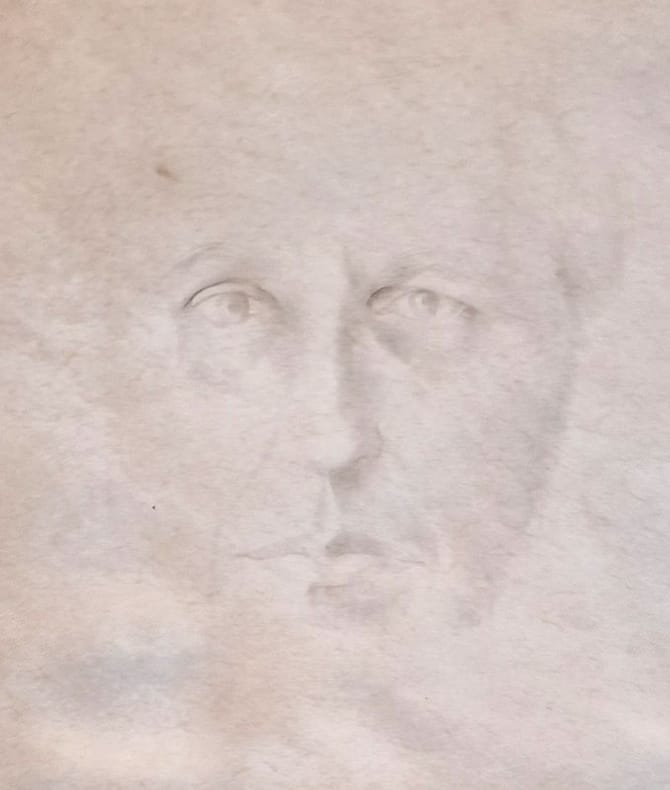
BATAILLE (Georges)]. LAPOUJADE (Robert).
Portrait original à la mine d'argent sur parchemin (30 x 23 cm) contrecollé sur un double feuillet de papier Arches (format 38 x 32 cm) en tête duquel figure un manuscrit autographe de 32 lignes de Georges Bataille.
[1949] Rare portrait inédit de Georges Bataille, posant de face, les mains croisées, où sont à peine esquissés les contours du visage, pour mieux faire ressortir l'expression intense et pénétrante du regard, à la limite de la folie. Cette étonnante oeuvre sur parchemin a figuré à l'une des premières expositions de Robert Lapoujade, "Portraits d'écrivains exécutés à la pointe d'argent" (Galerie Chardin, Paris, 1949). Bataille a composé en regard de son portrait un long commentaire - lui aussi inédit - qui est une méditation sur les concepts de mort et d'absence : "Etre d'air ? de lumière ? être encore ? être c'était mourir à l'être qui n'est pas, quand la parfaite inanité de l'être qui est renonce à l'absence qui me rompt le coeur. Mais la vérité, l'absence, si tout se dissipe se révèle." Document unique et inconnu des biographies.
Référence libraire : 114272
|
|
|
BATAILLE (Georges)]. LAPOUJADE (Robert).
Portrait original à la mine d'argent sur parchemin (30 x 23 cm) contrecollé sur un double feuillet de papier Arches (format 38 x 32 cm) en tête duquel figure un manuscrit autographe de 32 lignes de Georges Bataille.
[1949] Rare portrait inédit de Georges Bataille, posant de face, les mains croisées, où sont à peine esquissés les contours du visage, pour mieux faire ressortir l'expression intense et pénétrante du regard, à la limite de la folie. Cette étonnante oeuvre sur parchemin a figuré à l'une des premières expositions de Robert Lapoujade, "Portraits d'écrivains exécutés à la pointe d'argent" (Galerie Chardin, Paris, 1949). Bataille a composé en regard de son portrait un long commentaire - lui aussi inédit - qui est une méditation sur les concepts de mort et d'absence : "Etre d'air ? de lumière ? être encore ? être c'était mourir à l'être qui n'est pas, quand la parfaite inanité de l'être qui est renonce à l'absence qui me rompt le coeur. Mais la vérité, l'absence, si tout se dissipe se révèle." Document unique et inconnu des biographies.
Référence libraire : 114272
|
|
|
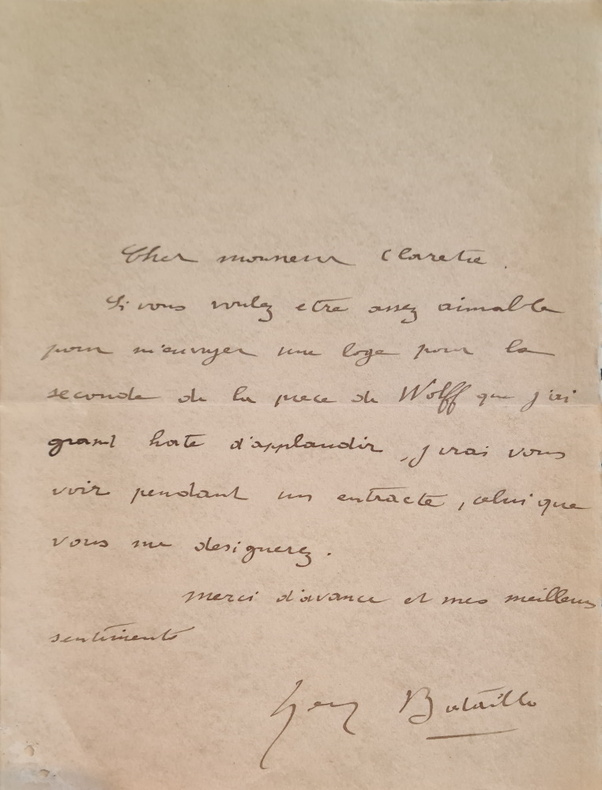
BATAILLE (Henry).
Réunion de deux lettres autographes signées adressées à Jules Claretie.
1 page in-12, s.l., 1er mars 1913 et 1 page in-12 s.l.n.d. Il s'engage à faire une lecture de La Marche Nuptiale qui sera reprise en juillet 1913 à la Comédie Française. Il demande une loge pour assister à la pièce de Wolff qu'il a "grand hâte d'applaudir".
Référence libraire : 96423
|
|
|
BATAILLE (Henry).
Réunion de deux lettres autographes signées adressées à Jules Claretie.
1 page in-12, s.l., 1er mars 1913 et 1 page in-12 s.l.n.d. Il s'engage à faire une lecture de La Marche Nuptiale qui sera reprise en juillet 1913 à la Comédie Française. Il demande une loge pour assister à la pièce de Wolff qu'il a "grand hâte d'applaudir".
Référence libraire : 96423
|
|
|
BATAILLE Georges
Lettre autographe signée à Denise Rollin : « Comme si l'amour le plus vrai ne pouvait s'accorder qu'avec le dérangement de tout. »
- s.l. s.d. [circa 1940-1943], 20,9x27 cm, 1 page. - Autograph signed letter to Denise Rollin: "As if the truest love could only be matched with the inconvenience of everything" [ca 1940-1943] | 20.9 x 27 cm | 1 page Autograph letter signed by Georges Bataille to Denise Rollin, 18 lines in black ink. Letter of a passionate love during the war. Georges Bataille is in Paris where the German offensive is in full swing: "[...] the German attack begins again." But this destruction does not reach Bataille's loving exaltation, on the contrary: "Sometimes I think that it is as if there was something more violent and terrible between you and me because we found ourselves in the middle of such a great turmoil. As if the truest love could only be matched with the inconvenience of everything." The writing has an almost magical quality of incarnation: "By writing this to you, it is as if everything opened up between you to me and in such a way that whatever is alive there could laugh at everything." Coupled with imagination and the strength of feelings, it is possible to overcome absence: "[...] suddenly you are there beside me, it is as if the distance was powerless to separate us." Bataille tries to reassure his correspondent: "But under no circumstances must you worry about me. I will meet you again tonight at nine o'clock." He ends his letter by asking her: "Give little Laurence a big kiss and tell her that I will write to her tomorrow." Laurence is the daughter that Georges Bataille had with Sylvia Bataille, his first wife. At the time of this letter, she was in Vézelay with Denise Rollin, in this blended family that also includes Jean, the son that Denise had with her husband. Evidence, if needed, of the author's claims of the Bataille-Rollin couple's sexual and moral freedom, which was still rare at the time. Although Bataille's life as a writer is well known in these years, little is known about his private life. And it is not the least paradox of his very revealing work that it only tells the minimum of his private affairs, and usually the worst of it." (M. Surya, G. Bataille, la mort à l'uvre). When Georges Bataille met Denise Rollin in 1939, he had just lost his lover Colette Peignot to tuberculosis. His friends had abandoned him and war had just been declared. This sentimental and social chaos however, does not affect Bataille as much as the tumultuous relationship he took up with Denise Rollin who was a friend of Cocteau, Breton, Prévert and a muse of painters Kisling and Derain. Their romance lasted four years and left very few details of their sentimental life during this period of Occupation, except what Bataille is willing to tell us in his novel Le Coupable (The Guilty) partly inspired by this passionate and painful relationship. In a 1961 interview, Bataille looked back on this time: "Le Coupable is the first book that gave me a kind of satisfaction, an anxious one at that, that no book had given me and that no book has given me since. It is perhaps the book in which I am the most myself, which resembles me the most... because I wrote it as if in a sort of quick and continuous explosion." The letters addressed by Bataille to Denise during this period contain the seeds of the feelings that explode in Le Coupable as in all of Bataille's work. His writing is an ebb and flow of love and suffering, between ecstasy and disappointment, calm and energy, mixing familiar and formal tones, compliments and reproaches. The letters are often impossible to date with precision as they all proceed from the same movement of ecstatic flagellation. In 1943, Georges Bataille found a house in Vézelay where the couple settled with Laurence (Georges and Sylvia's daughter), and Denise's son Jean. It was there that Bataille completed his book Le Coupable as well as his love story since barely a month after their arrival, Diane Kotchoubey, a young woman of 23, moved in with them. Before the end of the year, Bataille left Denise Rolli

|
|
|
BATAILLE Georges
Lettre autographe signée à Denise Rollin : « je songe à toi dans cette chambre et à tout ce qui arrivera là quand nous serons de nouveau ensemble. »
- Paris s.d. [3 ou 4 juin 1940], 20,9x26,9 cm, 2 pages sur un feuillet. - Handwritten signed letter to Denise Rollin: "I think of you in this room and all that will happen there when we are together again." " je songe à toi dans cette chambre et à tout ce qui arrivera là quand nous serons de nouveau ensemble." Paris s.d[3 or 4 June 1940], 20.9 x 26.9 cm, 2 pages on one leaf Touching handwritten letter signed by Georges Bataille to Denise Rollin, 37 lines in pencil, small water stain in the top right not affecting the text. Georges Bataille tries to reassure his companion Denise Rollin: "Je t'en supplie. Il ne faut pas t'inquiéter, mais pas du tout." "I beg you. You must not worry, not at all." She moved to Vézelay where Bataille would soon join her. He stayed in Paris where the bombings did not disrupt Parisian lives at all: "Tu n'imagines point à quel point les petits dégâts qu'on voit paraissent insignifiants à côté de la place intacte qu'il y a de tous les côtés. Pendant toute l'alerte, j'ai déjeuné bien tranquille avec mon chef de service de passage à Paris (il vit au front)" "You have no idea how insignificant the little damage you see seems next to the square untouched on all sides. Throughout the alert, I had a very quiet lunch with my head of service passing through Paris (he lives on the front)" Bataille did not give up his job as librarian at the National Library. Suffering from tuberculosis, he was not sent to the front, and he took the opportunity to write several texts at that time, such as Madame Edwarda and Le Coupable. Further on, he mentions a visit: "Un peu après, Henri Michaux est venu me voir" "A little after, Henri Michaux came to see me" The two men had participated in the magazine Mesures and both had in common being separate from the surrealist nebula. In both of their respective works there is a violent independence and the same tension towards spirituality, a form of mysticism. Bataille had attended the seminary in his youth, and Michaux pleasantly said of him: "Il donne l'impression d'un séminariste sortant furtivement d'une pissotière." "He gives the impression of a seminarian surreptitiously coming out of a public urinal." After this almost trivial news, Bataille embarks on an analysis of his feelings: "Ce que tu me dis dans ta lettre, c'est pour moi ce qui délivre, c'est comme la nudité, tout ce qui se déchire entre toi et moi. Mais, encore une fois, je ne me suis jamais senti aussi près de toi." "What you tell me in your letter is for me what delivers, it is like nudity, everything that is torn apart between you and me. But, once again, I have never felt so close to you." He asks his correspondent: "il faut me dire tout. C'est très doux que j'aie vu où tu es, que je connaisse les chemins que tu prendras, les ponts par où tu passeras." "you must tell me everything. It is very sweet that I have seen you where you are, that I know the roads you will take, the bridges over which you will pass." Sensuality is never far from the author's feelings: "Dis-moi aussi quelle chambre tu as: pour que je songe à toi dans cette chambre et à tout ce qui arrivera là quand nous serons de nouveau ensemble." "Also tell me which room you have: so that I may think of you in that room and all that will happen there when we are together again." From this and past sensualities, there remain the fruits that are the children. Denise Rollin left for Vézelay in the company of her son Jean, nicknamed Bepsy: "Tu ne me dis rien de ta vie avec Bepsy [...] Bepsy est-il plus calme: moi aussi je l'ai entendu crier dans tes bras." "You don't tell me anything of your life with Bepsy [...] Is Bepsy calmer: I too heard him screaming in your arms." Bataille thanks Rollin: "Pour Sylvia je t'ai une immense reconnaissance de m'avoir aidé à changer." "For Sylvia I am immensely grateful to you for helping me change." Sylvia Bataille was the first wife of Georges Bataille. They were separated in 1934 but did not divorce until 1946. From this

|
|
|
BATAILLE Georges
Lettre autographe signée à Denise Rollin : « Cela me déchire toujours de me séparer de vous.»
- s.l. s.d (1943), 13,5x20,8 cm, 2 pages sur un feuillet. - BATAILLE Georges. Autograph letter, signed, to Denise Rollin: "Cela me déchire toujours de me séparer de vous." "It always tears me up to part from you." N. d. (1943), 13,5 x 20,8 cm, 2 pages on a single leaf Autograph letter signed from Georges Bataille to Denise Rollin, 46 lines in black ink to one leaf, dampstain to upper right, not touching text. The majority of the letter is given over to the search for a house in Vézelay: "I've already seen a house and an apartment." In 1943, Georges Bataille had the idea of renting a house in Vézelay where the couple could move in with Laurence, the daughter of Georges and Sylvia, and Jean (alias Bepsy), Denise Rollin's son. The lovers had just parted: "It always tears me up to part from you. Yesterday I felt a terrible malaise. I'd hardly managed to come out of it when I realized that I had surely not come for nothing and that we would be able to settle here." To help Denise in his choice, he describes to her the various advantages and inconveniences of the two places: "The house is really good, but sadly has one serious downside: the garden ends in a low wall onto which Jean could climb and fall down the other side, which is lower. We look out over the countryside from high up and far off into the distance. The garden is pretty, the interior a little sad and dilapidated. The apartment isn't bad but it doesn't have a garden and no view of the countryside either." The couple took great pains in choosing the ideal place to bring together their patched-up family. There was even a suggestion of bringing Sylvia Bataille and Jacques Lacan to live in Vézelay as well. Bataille is unsure about the apartment: "[...] there's nothing else to rent other than what I've already seen"; this was perhaps intended for Jacques Lacan and Sylvia Bataille. Bataille and his ex-wife Sylvia separated in 1934 and she had found love with the psychoanalyst Jacques Lacan, whom she went on to marry in 1953. After these questions of real estate, Bataille goes on worrying about another problem, food: "As for provisions, it's certainly hard, but all in all, one has to get by one way or another." The Second World War was, in essence, at its turning point, and the Nazis - feeling their gains threatened, became even harsher. This, coupled with a rise in agricultural taxes, resulted in a shortage of food: "I say that we would surely find a way around the provisions problem in the sense that there is as much meat as you want. It's vegetables that are hard to find. You can get milk, but not butter. People say that here, if the Zervoses wanted to, they could help us get along nicely" Christian and Yvonne Zervos were important figures in the town of Vézelay, where they had bought a second home in 1937. He was the publisher of Cahiers d'art, in which Bataille had published, and she was the director of the gallery of the same name. At the start of the war, they decided to move there permanently and used the isolation of the property to hide their friends Paul Éluard and Nusch. The Zervoses were thus well established by the time of this letter and Bataille had been told by people in the area: "[...] they think that knowing the Zervoses will be a great advantage over people who come to settle here knowing no one." But he doesn't seem to have taken advantage of this advice, no doubt dominated by his feelings and the editing of his work Le Coupable [Guilty]. Diane Kotchoubey's - Bataille's future lover - settling in Vézelay shortly after this letter sealed the fate of the Bataille-Rollin relationship. By the end of 1943, Bataille had left Denise Rollin for his new flame. [FRENCH VERSION FOLLOWS] Lettre autographe signée de Georges Bataille à Denise Rollin, 46 lignes à l'encre noire sur un feuillet, mouillure en haut à droite sans atteinte au texte. La recherche d'une maison à Vézelay est l'objet de la majeure partie de cette lettre : « J'ai déjà vu une maison et un app

|
|
|
BATAILLE Georges
Lettre autographe signée à Denise Rollin : « je vous écris comme un aveugle, parce qu'en me parlant comme vous le faites [...] vous me faites tomber dans une obscurité presqu'insupportable. »
- S.l. s.d. [circa 1940], 20,9x26,9 cm, 2 pages sur un feuillet. - Autograph letter, signed, to Denise Rollin: "I write to you like a blind man, because that is what you make me when you talk to me the way you do...you make me fall into a darkness that is almost unbearable" [ca 1940] | 20,9 x 26,9 cm 2 pages on a single leaf Autograph letter signed from Georges Bataille to Denise Rollin, 40 lines in black ink, two pages on one leaf. George Bataille and Denise Rollin's relationship lasted from the autumn of 1939 to the autumn of 1943 and left behind it a short but passionate correspondence. This letter dates from the early days of their connection, but already reveals Bataille's agonies: "Perhaps I was too happy with you for some months, even though suffering did not wait long to interrupt, at least for a time, a happiness that was almost a challenge." A passionate lover, Bataille moved from exultation to the deepest doubt and even offered his lover a potential way out of their relationship: "If you can't take it, me, any more, I beg you, don't deceive yourself any longer: tell me it's me, and not some foible I could have avoided and which is easily repairable." He would rather be sac- rificed on the altar of their love than have a relationship that was bland and flavorless: "Understand me when I tell you that I don't want everything to get bogged down, that I would really rather suffer than see a sort of shaky mediocrity as a future for you and me." Earlier in the letter, he turns to humor to tear him away from his worries: "I hardly dare make you laugh by telling you that I've lost weight, so that my trousers occasionally fall down, because I've not yet gotten into the habit of tightening my belt to the new notch." Then, he goes back to pleading: "I write to you like a blind man, because that is what you make me when you talk to me the way you do when you leave or when you phone, you make me fall into a darkness that is almost unbearable." He then tries to get a grip on himself: "there are moments I'm ashamed of doubting you and being afraid, or of stupidly losing my head." Finally, hemmed in by all his doubts as a lover, Bataille tried to find some respite in talking about the family that he had made up with Denise and her son Jean (alias Bepsy): "If you write me, tell me how Bepsy's doing, which is perhaps the only thing that you can tell me that doesn't touch something painful in me." Although Bataille's life as a writer is well known in these years, little is known about his private life. And it is not the least paradox of his very revealing work that it only tells the minimum of his private affairs, and usually the worst of it." (M. Surya, G. Bataille, la mort à l'uvre). When Georges Bataille met Denise Rollin in 1939, he had just lost his lover Colette Peignot to tuberculosis. His friends had abandoned him and war had just been declared. This sentimental and social chaos however, does not affect Bataille as much as the tumultuous relationship he took up with Denise Rollin who was a friend of Cocteau, Breton, Prévert and a muse of painters Kisling and Derain. Their romance lasted four years and left very few details of their sentimental life during this period of Occupation, except what Bataille is willing to tell us in his novel Le Coupable (The Guilty) partly inspired by this passionate and painful relationship. In a 1961 interview, Bataille looked back on this time: "Le Coupable is the first book that gave me a kind of satisfaction, an anxious one at that, that no book had given me and that no book has given me since. It is perhaps the book in which I am the most myself, which resembles me the most... because I wrote it as if in a sort of quick and continuous explosion." The letters addressed by Bataille to Denise during this period contain the seeds of the feelings that explode in Le Coupable as in all of Bataille's work. His writing is an ebb and flow of love and suffering, between e

|
|
|
BATAILLE Georges
Lettre autographe signée à Denise Rollin : « Maintenant je n'aspire plus qu'à une chose c'est à vous prouver que je n'appartiens plus qu'à vous, que je suis rivé à vous [...] »
- S.n., s.l. s.d. [circa 1940-1943], 20,7x27 mm, 2 pages sur un feuillet. - Belle et longue lettre autographe signée de Georges Bataille à Denise Rollin, inédite, déchirée en cinq morceaux n'affectant pas la lecture, 34 lignes à l'encre noire sur un feuillet. Fréquentant tous les deux les milieux intellectuels et artistiques parisiens, Georges Bataille et Denise Rollin se rencontrèrent au cours de l'année 1939. Elle fut notamment l'amie de Cocteau, Prévert et Breton. Bataille la décrivit ainsi dans ses carnets pour Le Coupable : « une illusion aussi fragile qui se dissiperait au moindre souci, au moindre relâchement de l'inattention. » Il reste peu de détails sur leur relation car la vie privée de Georges Bataille, particulièrement à cette époque, n'est pas tant documentée. Il apparaît dans cette lettre les sentiments profonds que Denise Rollin provoquaient chez Bataille : « Maintenant je n'aspire plus qu'à une chose c'est à vous prouver que je n'appartiens plus qu'à vous, que je suis rivé à vous [...] » L'absolu de cet amour est tel que Bataille est prêt à tout : « [...] que vous le sachiez à tel point que si je ne devais plus avoir d'autre moyen qu'une profanation pour vous le prouver, je ferais devant vous cette profanation. » Il se sent pourtant coupable : « Je ne peux pas parler de l'état auquel je suis arrivé, je suis trop agité. Je sens, j'espère que c'est absurde. J'ai honte même de tant souffrir et de vous ennuyer avec ma souffrance quand vous seule êtes malade. » L'année précédente, il avait perdu sa compagne des suites de la tuberculose. Démuni devant la maladie, il admet : « [...] moi je ne peux pas vous guérir, je ne peux même pas vous soigner [...] » Seule Denise Rollin serait capable de l'apaiser : « Tout était noir auparavant [...] ce que je souffre et que vous pouvez si facilement guérir chaque fois que vous le voudrez [...] ». Abandonné aux affres de l'angoisse, Bataille admet : « Je suis tellement fou en ce moment (et de cela je veux vous parler) que je ressens comme une complicité et une perfidie de tous pour me faire mal, comme si vous vous prêtiez au jeu pour que je sois encore plus désespéré [...] » Au bord de la paranoïa, il supplie Rollin : « La seule chose dont je veux vous supplier [...], c'est de ne plus douter sans cesse de moi comme vous l'avez fait. » Il comprend pourtant : « [...] il y avait en moi et dans mon passé de quoi vous paraître insupportable [...] » Il lui offre une solution : « Ce qui m'apaiserait le plus si vous m'écriviez, ce serait que vous me disiez que vous me croyez, que vous voulez bien que je sois votre chose. » [ENGLISH DESCRIPTION ON DEMAND]

|
|
|
BATAILLE Georges
Lettre autographe signée à Denise Rollin : « Mais combien c'est dur de me sentir ainsi tout à coup arraché à vous, de ne plus rien pouvoir vous dire, d'être réduit à cette lettre. »
- S.l. [Paris] s.d. [1940-1943], 13,4x20,4 cm, 2 pages sur un feuillet. - Lettre autographe signée de Georges Bataille à Denise Rollin, 25 lignes à l'encre noire sur un feuillet. Première des lettres que Bataille envoie à Denise Rollin après le départ de cette dernière pour Vézelay. Bataille reste à Paris car il est employé à la Bibliothèque nationale qui ne ferme pas durant la guerre. La séparation vient de se produire mais Bataille s'empresse d'écrire : « J'ai hâte de mettre la lettre à la poste, elle vous suivra de très près, comme tout ce que je suis voudrait vous suivre partout. » Pour l'apaiser, il cherche dans les évènements des indices de bon augure : « La sirène que vous avez entendue à l'instant même où nous avons été séparés l'un de l'autre annonçait une fin d'alerte. D'abord j'ai été déprimé par une coïncidence désarmante mais quand j'ai su que c'était la fin de l'alerte je me suis pris au contraire à espérer. » Dans cet éloignement, bien qu'essentiels, les mots sont pauvres pour exprimer le désarroi de Bataille : « Mais combien c'est dur de me sentir ainsi tout à coup arraché à vous, de ne plus rien pouvoir vous dire, d'être réduit à cette lettre. » Il cherche à faire comprendre à Denise la frustration qui l'habite : « Je voudrais que cela soit si transparent entre nous et si ardent en même temps que lorsque vous toucherez ce papier ce soit comme si nous nous touchions. » Il souhaite retrouver cette proximité qu'ils ont tous les deux éprouvée : « Comme j'ai été près de vous dans la voiture tout à l'heure, presque comme jamais : je suis sûr que c'était la même chose pour vous. » [ENGLISH DESCRIPTION ON DEMAND]

|
|
|
BATAILLE Georges
Lettre autographe à Denise Rollin : « en tout cas imposer une pareille souffrance à un homme exactement pour rien, cela devient comme une maladie, comme un délire. »
- S.l [Paris] [circa 1940-1943], 21x27,3 cm, 1 page. - Lettre autographe de Georges Bataille à Denise Rollin, 14 lignes à l'encre noire et à la mine de plomb. Cette lettre, issue de la correspondance amoureuse que Bataille adresse à Denise Rollin durant la guerre et l'Occupation, contient en germe les sentiments qui explosent dans toute l'oeuvre de Bataille. Flux et reflux incessant d'amour et de souffrance, d'extase et de déception, de calme et d'énergie, mêlant tutoiement et vouvoiement, compliments et reproches, cette lettre ressemble à son auteur et à l'époque : « Comment pouvez-vous être assez aveugle pour ne pas voir le mal que vous me faîtes en vous laissant aller au premier caprice venu ? Que je le veuille ou non, une vie ne peut pas dépendre de caprices vides de sens. » La relation est houleuse, les deux protagonistes sont passionnés. Dans son ouvrage Le Coupable, il résume les affres de la passion amoureuse : « L'amour a cette exigence : ou son objet t'échappe ou tu lui échappes. S'il ne te fuyait pas, tu fuirais l'amour. Des amants se trouvent à la condition de se déchirer. L'un et l'autre ont soif de souffrir. Le désir doit en eux désirer l'impossible. Sinon, le désir s'assouvirait, le désir mourrait. » Ainsi Bataille, amoureux, souffre : « Je n'ai même plus le courage de vous dire ce que je souffre : en tout cas imposer une pareille souffrance à un homme exactement pour rien, cela devient comme une maladie, comme un délire. » Denise Rollin se montrait-elle cruelle ou Bataille était-il inutilement angoissé ? Toujours est-il qu'il se montre las de ces agitations : « Je ne sais pas comment j'ai trouvé moyen d'espérer malgré tout, jusqu'ici. » [ENGLISH DESCRIPTION ON DEMAND]

|
|
|
BATAILLE Henry
Le Masque. L'enchantement
- S.n. , s.l. S.d. (1908), 14,5 x 23 cm, relié. - Rarissime exemplaire de tout premier tirage, sans page de titre, comportant une "rareté typographique" dont l'origine est rapportée par l'auteur dans une lettre autographe de deux feuillets adressée à Miguet, insérée en page de garde : afin de réaliser l'économie d'une cinquantaine de pages sur l'impression du Théâtre complet d'Henry Bataille, l'éditeur Flammarion composa le texte des deux pièces du tome II en faisant suivre immédiatement les noms des personnages, placés en tête de ligne, du texte des répliques. Seuls deux ou trois exemplaires (dont le nôtre) composés ainsi, à partir des dernières épreuves, ont été imprimés. Reliure en demi-maroquin chocolat à coins, dos à nerfs, une infime éraflure dans un entre-nerfs, filet à froid en encadrement des plats de papier marbré, tête dorée sur témoins, reliure signée Canape. Envoi autographe signé d'Henry Bataille sur sa carte de visite, encollée sur une page de garde. [ENGLISH DESCRIPTION ON DEMAND]

|
|
|
BATAILLE Henry - (Nimes 1872 - 1922) - Poète et auteur dramatique français
Lettre Autographe Signée à "Mon cher Paul" - sans date -
1 page in8 - bon état -
Référence libraire : GF27106
|
|
|
BATAILLE Henry - (Nimes 1872 - 1922) - Poète et auteur dramatique français
Poème Autographe Signé :"Le Calendrier" - le 1er janvier 1915 -
2 pages in-folio - 63 vers - bon état -
Référence libraire : GF21557
|
|
|
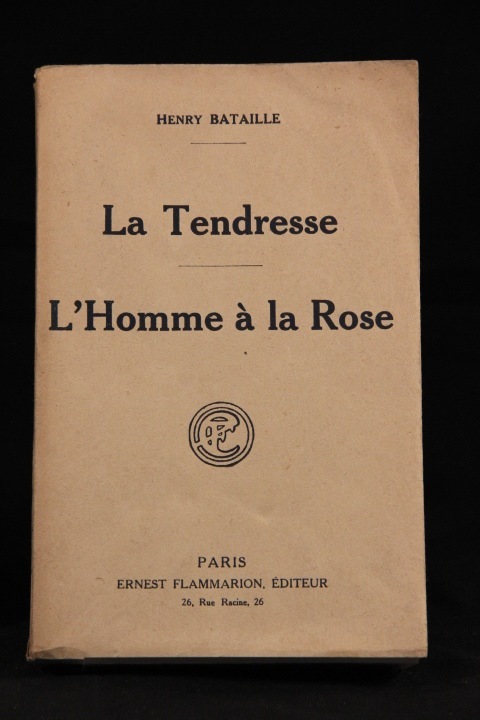
BATAILLE Henry:
La tendresse / L'homme à la rose.
Paris, Ernest Flammarion, Sans date [1922]. In-12 broché de 341-[2] pages, couverture imprimée. Trace de pli à la couverture, pour le reste en bon état, non coupé.
Référence libraire : 4873
|
|
|
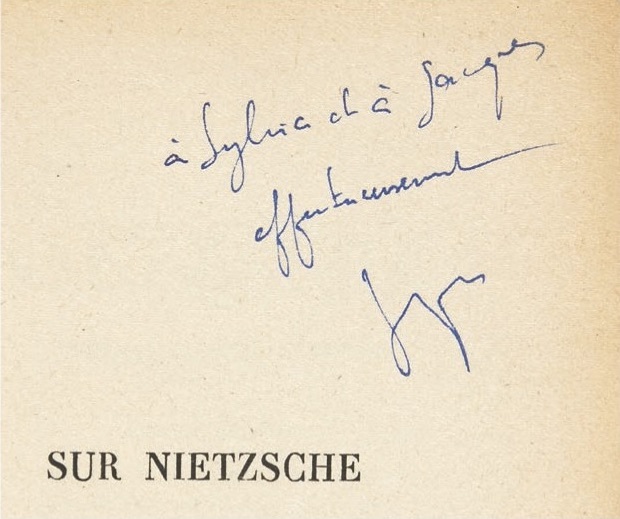
Bataille, Georges
Sur Nietzsche. Volonté de chance
In-12 (186 × 118 mm) de 284-[4] pp. ; broché, couverture imprimée.
Référence libraire : YQV-52
|
|
|
Bataille, Georges, écrivain français (1897-1962).
Lettre autographe signée. Orléans, 18. I. 1956.
2 pages in-4. "Mon cher André Malraux, j'ai été d'autant plus touché de votre mot que je me suis senti étroitement proche de vous en lisant Les Voix du Silence. Albert Skira, particulièrement heureux de votre appréciation, aimerait, si vous l'autorisez, utiliser une phrase pour la publicité. Je m'excuse de vous le demander, mais je ne pourrais guère me prétendre étranger aux préoccupations dont témoigne sa question... Il y a bien longtemps que nous ne nous sommes vus et si par hasard vous aviez un moment un jour de la semaine prochaine (du 22 au 29), que je passe à Paris, puis-je vous proposer de vous rencontrer ?" - Réponse de Malraux à l'encre rouge: "Cher G.B. je repars pour la Suisse ce soir. Mais que Skira emploie la phrase en question, s'il le croit utile: je me réjouis de tout ce qui peut servir votre livre. Soy. ass., cher G.B. de mon bien symp. souvenir".

|
|
|
Bataille, Nicolas, French comedian and director (1926-2008).
Autograph letter signed and typed letter with autograph note signed "Nicolas". The typed letter with an additional signed note by Akakia-Viala. N. p. and [Panama?], 9 April 1956 and 2 March 1957.
8vo and 4to. Together 3 pp. With an autograph envelope. In French. Two humorous letters to the American professor of French literature and film, Bruce Morrissette. In the letter from 1956, Bataille praises Morrissette's book "La Bataille Rimbaud : l'affaire de la Chasse spirituelle", an investigation of the literary scandal surrounding Nicolas Bataille's and Akakia-Viala's forgery of the prose poem "La Chasse spirituelle" attributed to Rimbaud. The poem was originally mentioned by Paul Verlaine, who claimed to have forgotten its manuscript in Paris when leaving the capital for Brussels to reunite with Rimbaud in 1873. It is disputed among scholars whether "La Chasse spirituelle" ever existed, but it soon gained legendary status as Rimbaud's lost masterpiece. On 19 May 1949, the journalist and forger Pascal Pia published excerpts of the supposed text of "La Chasse spirituelle". André Breton exposed the forgery in July 1949, naming Bataille and Akakia as its probable authors, who admitted to having concocted a pastiche. In this charming letter, Bataille jokingly offers forgeries of "Claudel, Faulkner, or perhaps a faux Dostoyevsky" for Morrissette's future academic work and inquires when he will return to Montmartre: "FORMIDABLE ! Merci, cher Bruce c'est vraiment un très beau livre et quel travail ! Maintenant que voulez-vous ? Un faux Claudel, Faulkner, ou peut-être un faux Dostoievski ? Quand revenez-vous à Montmartre que nous puissions comploter quelque chose d'amusant. En attendant, je vais aller voir Nizet - s'il ne veut pas éditer 'the great Bruce Forgery' [...]". - In the typed letter that was supposedly written from Panama, Bataille announces a trip to Arizona together with Akakia, for research on the Apache tribe. He asks Morrissette for literature on the Apaches and their reservations, as it is easier in Paris and the American libraries to obtain a book "on the fabrication of Lucky Strikes than on the method of scalping Mr Pascal Pia!". This is another referece to the Rimbaud scandal; while Bataille probably did research on Apache customs and crafts for a project, asking Morrissette specifically for books "with many photos or illustrated plates because we also need such documents for decorations and costumes", it is unlikely that he actually went to Arizona.
|
|
|
BATAILLE]. FINAS (Lucette).
La Crue. Une lecture de Bataille : Madame Edwarda.
Paris Gallimard, coll. "Le Chemin" 1972 1 vol. broché in-8, broché, couverture à rabats, 478 pp. Edition originale en service de presse. Envoi autographe signé de l'auteur à un poète et critique. Petites salissures à la couverture, sinon en bonne condition.
Référence libraire : 120821

|
|
|
BATAILLE]. FINAS (Lucette).
La Crue. Une lecture de Bataille : Madame Edwarda.
Paris Gallimard, coll. "Le Chemin" 1972 1 vol. broché in-8, broché, couverture à rabats, 478 pp. Edition originale en service de presse. Envoi autographe signé de l'auteur à un poète et critique. Petites salissures à la couverture, sinon en bonne condition.
Référence libraire : 120821
|
|
|
BATES Kinzie 1839 84
Partly-Printed Document Signed
This son of the first white child born in Chicago daughter of pioneering fur trader John Kinzie served with the 1st Michigan Infantry in the Civil War later serving as a battalion commander at the frontier in 1869 in General Nelson Miles' "Yellowstone Campaign." Partly-Printed DS 1p 11" X 8¼" Standing Rock Dakota Territory 18 August 1876. Very good. Partly-printed "Receipt for Quartermaster's Stores" a secretarially-completed by Lieutenant William Badger form signed boldly by Bates as infantry captain at lower right. Notes receipt of two "Common Tents" two sets of "Common Tent Poles" and five sets of "Common Tent Pins" noting their condition as "Serviceable" and "New." Penned just four weeks after the Battle of Little Big Horn and from the military post where Sitting Bull would later be kept. Scarce and unusual. unknown books
Référence libraire : 41819

|
|
|
BATES, Kinzie (1839-84)
Partly-Printed Document Signed
This son of the first white child born in Chicago daughter of pioneering fur trader John Kinzie served with the 1st Michigan Infantry in the Civil War later serving as a battalion commander at the frontier in 1869 in General Nelson Miles' "Yellowstone Campaign." Partly-Printed DS 1p 11" X 8¼" Standing Rock Dakota Territory 18 August 1876. Very good. Partly-printed "Receipt for Quartermaster's Stores" a secretarially-completed by Lieutenant William Badger form signed boldly by Bates as infantry captain at lower right. Notes receipt of two "Common Tents" two sets of "Common Tent Poles" and five sets of "Common Tent Pins" noting their condition as "Serviceable" and "New." Penned just four weeks after the Battle of Little Big Horn and from the military post where Sitting Bull would later be kept. Scarce and unusual. unknown
Référence libraire : 41819
|
|
|
Bates, Ronald
The Wandering World
Ronald Gordon Nudell Bates (1924-1995), a poet, literary critic and Professor of English was born in Regina Saskatchewan in 1924. He earned a B.A. (1948), at Victoria College, University of Toronto, and M.A. and Ph.D also from the University of Toronto. His teaching career was spent at the University of Upsala (Sweden), the University of Toronto and University of Western Ontario. A member of P.E.N., selected publications of his poetry include The wandering world (1959) the author's first book of poetry This copy is signed on the title page. Some of the poems were inspired by Greek mythology .60p. Clean tight copy, but ffep is missing, else near fine Book
|
|
|
Batiashvili, Lisa, Violinistin (geb. 1979).
Portraitphotographie mit eigenh. U. O. O., [2005].
266:202 mm.
|
|
|
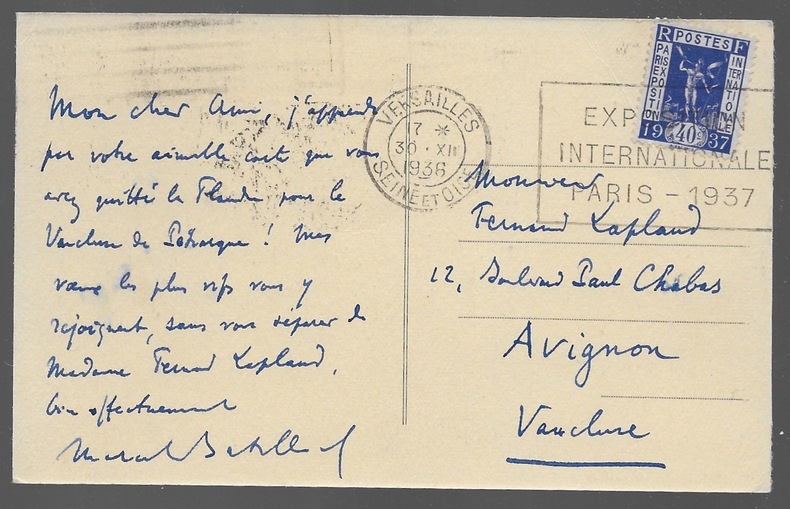
BATILLIAT Marcel
Carte postale autographe signée
Carte postale autographe signée datée de Versailles le 30 décembre 1936. en feuilles Très bon Paris 1929
Référence libraire : 12017
|
|
|
BATILLIAT, Marie
Poèmes [ Edition originale - Livre dédicacé par l'auteur ]
Avec un portrait, dessin inédit de Le Sidaner, exemplaire sur vélin bibliophile, 1 vol. in-8 br., Fasquelle Editeurs, s.d. [ 1933 ], 149 pp. Bel envoi de l'auteur "à nos très chers amis, J. Binet-Valmer, qui l'a devinée, et Madame Binet-Valmer, qu'elle aiment de tout son coeur, ce pur écho de la douce voix éteinte, en souvenir de l'absente, et en son nom". Etat très satisfaisant (petite restauration au dos en queue, bon état par ailleurs). Français

|
|
|
BATILLIAT, Marie
Poèmes [ Edition originale - Livre dédicacé par l'auteur ]
Avec un portrait, dessin inédit de Le Sidaner, exemplaire sur vélin bibliophile, 1 vol. in-8 br., Fasquelle Editeurs, s.d. [ 1933 ], 149 pp.
Référence libraire : 61283

|
|
|
Batista, Nicolás, Schriftsteller (1902-1989).
Albumblatt mit eigenh. Widmung und U. O. O., 1978.
1 S. Qu.-4to. Der kubanische Nationaldichter war 1954 mit dem "Internationalen Lenin-Friedenspreis" ausgezeichnet worden (damals noch als "Internationaler Stalinpreis für die Festigung des Friedens zwischen den Völkern" tituliert). - Auf Briefpapier mit gedr. Briefkopf; Faltspuren.

|
|
|
Batka, Johann Nepomuk, Archivar und Historiker (1845-1917).
9 eigenh. Briefe mit U. Preßburg, 1901-1906.
Zusammen 14½ SS. Folio und 8vo. An die Universitätsbibliothek Wien betr. der Entlehnung von Büchern. - Batka, studierter Jurist, war Stadtarchivar in Bratislava und zudem ebenso versierter wie profilierter Musiksammler und -verehrer; er organisierte Vorträge und Konzerte, schrieb Musikkritiken und korrespondierte mit den bedeutendsten Künstlern seiner Zeit wie Franz Liszt, Richard Wagner, Hans Richter, Hans von Bülow, Bela Bartok, Johannes Brahms, Clara Schumann, Johann Strauß u. v. a.
|
|
|
Batka, Richard, Musikschriftsteller (1868-1922)
Eigenh. Brief mit U.
o.J. Prag, 28. I. 1904, Gr.-8°. 1 Seite. Briefkopf.
Référence libraire : 44734
|
|
|
Batocki, Adam von, Oberpräsident von Ostpreußen (1868-1944).
Eigenhändige Sentenz mit U. O. O. u. D.
1 S. Folio (223:282 mm). Albumblatt mit gedruckter Bordüre und gedr. Fußzeile "Beitrag zum Selbstschriftenalbum 'Deutschlands Zukunft'", aufgezogen auf einen Bogen Pergamentpapier (ca. 330:344 mm). "In schwerer Not kann nicht ein vielschichtiges, notwendig nach der Gunst der Wählermassen schielendes Parlament die Rettung bringen, sondern nur eine in ihrer Entscheidung freie verantwortungsbewußte als auch verantwortungsbereite Regierung. Daß der deutsche Reichstag 1923 das erkannt und danach gehandelt hat, war seine Erste Tat seit 1919. Möge er künftig zu gleichem Entschluß gelangen, ehe neuer Zusammenbruch fremden Gewalteingriff bringt [...]". Geschrieben als Beitrag für die von Friedrich Koslowsky im Berliner Eigenbrödler-Verlag herausgegebene Faksimile-Anthologie "Deutschlands Köpfe der Gegenwart über Deutschlands Zukunft" (1928). Koslowsky 62.
|
|
|
Batsche, Julius, Maler.
Eigenh. Brief mit U. Wien, 18. VI. 1913.
1 S. auf Doppelblatt. 4to. “Verzeihen hochgeehrter Herr, daß ich mir erlaube mich nochmals an Sie zu wenden, ich habe immer mit Freude auf Ihren mich ehrenden Besuch gewartet, doch hochgeehrter Herr Stadtrath sind nicht gekommen [...]”. - In altem Sammlungsumschlag.
|
|
|
Batta, Alexander, Cellist und Komponist (1816-1902).
Eigenh. Brief mit U. Paris, 7. V. 1844.
1 S. auf Doppelblatt. 8vo.

|
|
|
Batta, Alexander, French cellist and composer (1816-1902).
Autograph letter signed. 5 rue neuve des Martyrs [Paris], n. y.
Small 8vo. 1 p. With autograph address and traces of seal. Asking a M. Asseline, possibly the politician Louis Asseline, for an admission ticket to the then-private Parc Monceaux (here, Parc de Mousseaux) in Paris: "on m'a assuré qu'en me addressant à vous, il me sera facile d'obtenir une carte d'entrée pour le Parc de Mousseaux. Puis je espèrer que vous voulez être assez bon pour prendre la peine de me faire savoir si mon désir peut être satisfait, et si je ne commets pas une indiscrétion [...]". - Alexander Batta was among the first cello virtuosos of his time. A series of concerts with Franz Liszt at the piano and Chrétien Urhan playing the violin in 1837 brought him early fame. Among his many friends and admirers were Hector Berlioz, Gioacchino Rossini, Honoré de Balzac, Eugène Delacroix, and Camille Corot. - Traces of former mounting. Minimally browned.
|
|
|
Batta, Alexandre, violoncellist and composer (1816-1902).
Autograph letter signed. No place or date, ["17 février"].
8vo. 1 p. To Charles de Beauregard, editor of "La Gazette de France", apologizing for being unable to come and visit him due to previous engagements outside Paris: "C'est avec un très vif regret, que je me voir privé de vous être agriable cette fois. Des engagements m'appellent loin de Paris [...]". - A student of Platel in Brussels, Batta later settled in Paris (1835) and made many successful concert tours throughout Europe. A regular chamber music partner of Liszt and an intimate of Berlioz, he wrote many original works and fanciful transcriptions for cello and piano. - Traces of folding.
|
|
|
Battaille, Charles-Amable, French operatic bass (1822-1872).
Autograph letter signed. N. p. o. d.
8vo. 1 p. on bifolium. To an unnamed lady recipient, promising that he will do his best to teach a poor protégé of hers, although he thinks that there is little hope for the student to become a singer, as her voice has been permanently damaged by cold and misery: "Vous-êtes bonne et gracieuse Madame, de vous être souvenue de moi qui en vous ai point oubliée. Je vous en remercie. J'ai depuis longtemps dit à Monsieur Doucet tout ce que j'ai cru utile à votre pauvre petite protégée. Je reviendrai à la charge et ferai pour elle de mon mieux. Sa santé est faible et je crois que la voix ne se développera jamais : cela a été flétri par le froid et la misère. Je me suis attaché à elle comme si elle devait être une chantante et je tâcherai de lui apprendre ce que ses moyens limités pourront permettre [...]". - Battaille's most famous role was that of Peter the Great in Meyerbeer's "L'étoile du nord" (1854). - On stationery with embossed monogram. With collector's note on the verso of the blank leaf. Traces of folds. Slight ink smudging. Minimal browning.
|
|
|
Battenberg, Franz Joseph von, Prince of Battenberg, army officer (1861-1924).
Autograph telegram signed (draft). Paris, no date.
1 S. Qu.-4to. Filled-in form, thanking Prince Baucina Montemaggiore Belsito (Palermo) for attesting sympathy during a difficult time: "[...] Vous Remercie profondément pour témoignage de chaleureuse sympathie dans une cruelle épreuve [...]". - Lithographed green form. Several notes of German translation and corrections, French text repeated and transcribed on verso by a former collector's hand, mostly in pencil. Also a note in an early hand: "Seiner Durchlaucht Herr Prinz Franz Josef von Battenberg aus Paris". Ink stain on verso ;upper margin with small tears.
|
|
|
Battenberg, Prince Henry of, Governor of the Isle of Wight (1858-1896).
Autograph telegram. No place or date.
Oblong 4to. 1 page. In pencil on a printed telegram form. To an unidentified recipient, who is requested to ask Frankenbach to visit him at 11 o'clock. In German; contemporary collector's note at bottom. - Born in Milan of Hessian Grand-Ducal descent, Battenberg was to become a member of the British Royal Family through his marriage to Princess Beatrice. His children anglicized their name to "Mountbatten" in 1917, when the Royal Family relinquished their German titles.

|
|
|
Battermann, Hans, Astronom (1860-1922).
Eigenh. Brief mit U. Königsberg, 5. VII. 1913.
3½ SS. auf Doppelblatt. Gr.-8vo. An einen namentlich nicht genannten Adressaten: "In Beantwortung Ihrer Anfrage teile ich ergebenst mit, dass ich, wenigstens vorläufig, eine offizielle Beteiligung der Königsberger Sternwarte an der Beobachtung der Sonnenfinsternis 1914 Aug. 21 nicht in Aussicht genommen habe. Bei dem beschränkten Etat der Sternwarte sind keine Mittel disponibel, und ich bezweifle, dass der hiesigen Sternwarte solche vom Ministerium gewährt werden würden [...]". - Hans Battermann war u. a. an der Deutschen Seewarte in Hamburg tätig und wurde 1904 als o. Prof. der Astronomie und Direktor der Sternwarte nach Königsberg berufen. "Seine Forschungstätigkeit galt vor allem der Beobachtung und Bearbeitung von Sternbedeckungen. Battermann gab eine 'Triangulation der hellen Plejadensterne' und einige Sternkataloge heraus" (DBE).

|
|
|
BATTIN, Jacques ; SUFFRAN, Michel ; LEUQUET, Paul
La Bassin d'Arcachon par les Peintres. Une anthologie [ Edition originale - Livre dédicacé par l'auteur au préfacier ]
Un des 100 exemplaires réservés aux cent premiers souscripteurs numérotés de I à C (exemplaire n°II), avec une estampe de Paul Leuquet numérotée et signée (II/C), 1 vol. grand in-8 br., bandeau conservé, Atlantica, 2011, 187 pp. Bel exemplaire du tirage de tête (n° II sur C) dédicacé par l'auteur au préfacier Michel Suffran, et bien complet de l'estampe numérotée et signée par Paul Leuquet. Français

|
|
|
BATTIN, Jacques ; SUFFRAN, Michel ; LEUQUET, Paul
La Bassin d'Arcachon par les Peintres. Une anthologie [ Edition originale - Livre dédicacé par l'auteur au préfacier ]
Un des 100 exemplaires réservés aux cent premiers souscripteurs numérotés de I à C (exemplaire n°II), avec une estampe de Paul Leuquet numérotée et signée (II/C), 1 vol. grand in-8 br., bandeau conservé, Atlantica, 2011, 187 pp.
Référence libraire : 54685

|
|
|
Battista de Rossi, Giovanni, Italian archaeologist (1822-1894).
Autograph calling card. Rome, no date.
Calling card format. 2 pp. To the scholar Théodore de La Rive in Geneva, regretting not having met him during his latest sojourn in Rome: "Comm. Gio. Batta de Rossi [in print] salue affectueusement Mr. Théodore de la Rive, régrettant infiniment de n'avoir pas réussi à le rencentrer dans son dernier séjour à Rome […]". - Enclosed: autograph postcard signed by an Italian general to Théodore de La Rive and G. de La Rive with thanks for the kind regards which General Pallavicino delivered to him on their behalf, hoping to find the time soon to visit them in Presinge or Geneva: "Notre ami commun, le Général Vicino Pallavicino m'a porté vos compliments en échange de ceux que je l'avais prié de vous présenter de ma part. Je vous en remercie bien cordialement. Etant devenu plus libre de mes mouvements, j'espère maintenant d'avoir une occasion prochaine de vous faire une visite à Pressinge ou à Genève. Le Général se joint à moi pour vous prier d'agréer nos meilleurs souhaits […]" (Milan, Hôtel Continental, 12 Sept. 1904, oblong 8vo, 1 page, with autograph address verso).
|
|
|
BATTISTA, Orlando A (1917-?)
Signed First Day Cover
This Canadian-American chemist-inventor and author is credited with a wide range of inventions; he held 58 U.S. patents and 450 foreign patents among them a microcrystalline cellulose for pharmaceutical use and a microcrystalline collagen. Signed First Day Cover 6½" X 3½" cancelled in Cincinnati Ohio on November 10 1972 with "First Day of Issue" noted. Fine. FDC for the 8-cent "Pharmacy" stamp. No decorative cachet at left; no distracting recipient's name/address present. Much of the front side except for the stamp and cancellation is filled with a typed biographical statement about Battista as follows: "The Battista boy liked the idea of writing letters to tell major corporations how to improve their products. In the 1930's he told a chewing gum company it should coat the sticks with starch so they couldn't stick to the paper in hot weather. In 1955 while working on an idea to make a better rayon tire cord to compete with nylon he came up with a water suspension of cellulose crystals. 'The resulting product is still "revolutionary"' Battista said. He stayed at Princeton until 1970 and in those days came up with a micro-crystalline collagen. This led to the creation of the Avitene hemostat which uses collagen and is now used in every operating room across the nation." Below this on the cover's lower margin the scientist boldly inscribes and signs in black ballpoint: "Wishing Paul Johnston every / success / Orlando A. Battista / 10/31/79." Attractive and most unusual. unknown
Référence libraire : 28905

|
|
|
Battista, Ludwig, Pädagoge und Schulreformer (1880-1951).
Eigenh. Visitenkarte mit Widmung. Payerbach, 11. VII. 1950.
1 S. carte de visite. Mit eh. beschr. Kuvert. Beiliegend eine Briefkarte von Battistas Ehefrau, mit der Information, dass Ludwig Battista am 25. Mai 1951 verschieden ist. An Josef Wesely: "[…] dankt Ihnen, sehr geehrter Herr Oberlehrer, für Ihre lieben Wünsche und sendet Ihnen herzliche Grüße!".
|
|
|
BATTISTINI (Yves).
L'Avant-plaisir. POÈME AUTOGRAPHE SIGNÉ
1 page, datée septembre 1946, in-8 sur papier ligné. Je te déchire / Alluvion de l'été / Je hale ta grappe sur les cuisses douces de l'amante / à qui déjà le bol de l'aube a versé sa gerçure de plaisir (…) Le poème est dédié à Noël Arnaud, planteur d'aloès.
Référence libraire : 18437
|
|
|
Battistini, Mattia, Italian operatic baritone (1856-1928).
Autograph musical quotation signed. Vienna, 1911.
8vo. 1 page. Two lines from Verdi's opera "Un ballo in maschera".

|
|
|
Battistini, Mattia, Italian operatic baritone (1856-1928).
Portrait photograph signed and dedicated. Vienna, 1910.
170:110 mm. Depicting the Italian singer in full length.

|
|
|
Battistini, Mattia, Sänger (1856-1928).
Eigenh. Brief mit U. Wohl Wien, 14. XI. 1925.
2½ SS. auf Doppelblatt. 8vo. An eine namentlich nicht genannte Dame über seine mißlichen finanziellen Umstände, die es ihm verstatten würden, sie bezüglich der Studien ihres Sohnes zu unterstützen: "[...] Disgraziatamente non mi trovo in posizione di poterla ajutare - Lei non mi conosce e perció non puo sapere, ne conoscere quale sia la mia. Se io in etá avanzata devo ancora correre il mondo avró le mie ragioni, e le moltissime persone alle quali devo pensare soccorrere ajutare mantenere m'impedicono aumentarne il numereo. Lei forse ha credito rivoglersi a me supponendomi in condzioni diverse da quale in cui mit trovo [...].". - Der aus Rom gebürtige Baritonsänger war u. a. am Teatro Colon in Buenos Aires, am Teatro Pedro II. in Rio de Janeiro, am Teatro São José in São Paulo und an der Covent Garden Opera in London zu hören. "1892 wirkte er bei der Uraufführung der Oper ‚I Rantzau' von Pietro Mascagni mit. Jules Massenet schrieb für Battistini die Titelpartie seiner Oper ‚Werther' für Bariton um. Auch Giuseppe Verdi schätzte den Sänger sehr. Es kam jedoch zu einer Mißstimmung zwischen den beiden Künstlern, als Battistini die Hauptrolle in Verdis ‚Falstaff' ablehnte. Richard Wagner erklärte Battistinis Interpretation der Arie ‚O du mein holder Abendstern' aus der Oper ‚Tannhäuser' zu seiner Lieblingsversion. Battistini gilt als eine der herausragenden Sängerpersönlichkeiten seiner Zeit" (Wikipedia). - Auf Briefpapier mit gepr. Briefkopf des Grand Hotels in Wien.

|
|
|

 Recevoir par e-mail
 Télécharger en PDF
 Flux RSS
 Lien permanent


