|
|
|
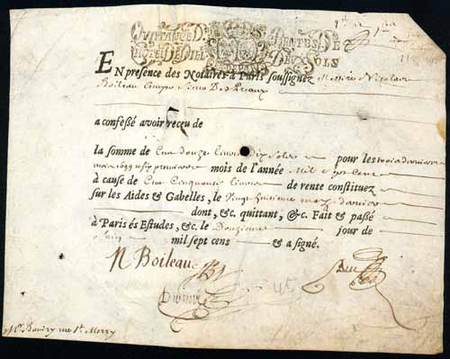
BOILEAU (Nicolas, dit BOILEAU-DESPREAUX). (Paris, 1636 - 1711).
RECU en partie AUTOGRAPHE, comportant la signature autographe de Boileau, daté " le douzième jour de juin mil sept cens ".
1699 Une page format oblong (140 X 175 mm) sur parchemin. Document en partie imprimé "Quittance Hôtel de Ville - Gen.[alité] de Paris - Rentes de deux Sols".
书商的参考编号 : 000012
|
|
|
BOISSONNAS Jean.
RESISTANCE DES FLUIDES PARFAITS. Calcul des avions.
Paris, F.-Louis Vivien, Librairie des sciences aéronautiques, 1935. In-4, broché.
书商的参考编号 : 8170
|
|
|
BOISSIEU Jean - LE CHENIER Henry
Sables des origines.
Chauvet Aix-en-Provence 1994 In-4 ( 335 X 260 mm ), en feuilles sous chemise rempliée. Poèmes de Jean BOISSIEU illustrés de 16 gravures originales d'henry LE CHENIER toutes signées et justifiées au crayon par l'artiste. EDITION ORIGINALE, tirage à 100 exemplaires, 1 des 70 exemplaires numérotés sur vélin pur fil Johannot ( Numéro 2 ). EXEMPLAIRE UNIQUE de Jean BOISSIEU enrichi hors-justification d'un envoi autographe signé, du tirage en couleurs HC de la gravure 14, de 2 gravures originales justifiées, légendées et signées, tirées respectivement à 57 et 70 exemplaires, la seconde avec envoi autographe signé de henry LE CHENIER à Gisèle et Jean BOISSIEU.
书商的参考编号 : 371464

|
|
|
BOISDEFFRE (Pierre de).
Une Anthologie vivante de la Littérature d'aujourd'hui.
Paris, Librairie Académique Perrin, 1965. Fort in-8, broché, 835 pp. Avec index des noms cités et table.
书商的参考编号 : 19117
|
|
|
BOISDEFFRE, Pierre de
Une Histoire Vivante de la Littérature d'aujourd'hui 1938-1958 [ Edition originale - Dédicace de l'auteur à Alain Bosquet ]
Un des cinquante exemplaires sur Alfa mousse des papeteries Navarrre (Exemplaire H.C. XLVI imprimé spécialement pour Monsieur et Madame Alain Bosquet), 1 vol. fort in-8 reliure demi-chagrin maroquiné à coins noir, dos à 4 nerfs dorés, couvertures et dos conservés, Le Livre Contemporain, Paris, 1958, 768 pp.
书商的参考编号 : 53637

|
|
|
Boieldieu, Adrien Louis, Komponist (1815-1883)
Eigenh. Brief mit U.
o.J. Paris, ohne Jahr, 8°. 1 Seite. Doppelblatt mit Trauerrand.
书商的参考编号 : 45621
|
|
|
Boieldieu, Adrien Louis, Komponist (1815-1883)
Eigenh. Brief mit U.
o.J. (Paris) Rue de Douai, 22. IV. (ohne Jahr), 12°. 2 Seiten, auf einem Doppelblatt.
书商的参考编号 : 59478
|
|
|
Boieldieu, François-Adrien, French composer (1775-1834).
Autograph letter signed. No place, "ce dimanche 8 Sept." (1816 or 1822?).
4to. 1 page on bifolium. To the harpsichordist and composer Charles-Henri Plantade (1764-1839), sending the manuscript of this "Télémaque" for one of Plantade's students. - Traces of folding.

|
|
|
Boieldieu, François-Adrien, Komponist (1775-1834).
2 eigenh. Briefe mit U. O. O., 17. IV. 1815 und "ce mercredi".
2 SS. auf einem Doppelblatt und einem Einzelblatt. 8vo. Ein Brief mit eh. Adresse verso. In französischer Sprache an einen Kollegen mit Dank für Partituren, die ihm sein Bruder übermittelt hat: "Monsieur, mon frère m'a envoyé les partitions que vous lui aviez remises avec le petit mot par le quel vous m'en faites la remise. Je suis on-ne peut plus reconnaissant Monsieur de ce bon procedé de votre part, et vous prie de recevoir l'assurance de mes sincère remercimens [...]". - An Madame Agasse in Andilly mit Dank für ihre Bereitschaft, seinen Sohn Adrien am kommenden Samstag zu betreuen, und mit dem Hinweis, dass das Kind gerne auf einem Esel reiten würde: "puisque vous avez la bonté Madame de vouloir bien vous charger pendant quelques jours du cher petit adrien, je vous l'annonce pour Samedi. il partira le matin par la voiture de Francois, et si vous êtes assez bonne pour lui envoyer un âne, je ne doute pas du plaisir qu'il aura a faire cette cavalcade. Je vous remercie d'avance vous et Madame votre mère des sourires que vous lui donnerez. cette idée me consolera un peu de la peine que j'ai à le quitter, et à m'eloigner des gens que j'aime sincèrement [...]".
|
|
|
BOIS (Mario).
FLAMENCOS. Une approche du grand chant Flamenco et de la poésie populaire chantée en Andalousie.
Paris, Max Fourny, 1985. Grand in-8, cartonnage noir illustré en couleurs, 256 pp. Planches hors-texte, bibliographie commentée. Chansons en français et en espagnol. Bel exemplaire enrichi d'un envoi autographe de l'auteur.
|
|
|
Bois, Jules, Schriftsteller (1868-1943)
Eigenh. Brief mit U.
o.J. Paris, 8. III. 1912, 8°. 1 Seite. Bläuliches Papier. Patentbrief mit Adresse.
书商的参考编号 : 59848
|
|
|
Bois-Reymond, Emil du, Physiologe (1818-1896).
Eigenh. Brief mit U. Berlin, 7. III. 1880.
4 SS. auf Doppelblatt. 8vo. An den Pathologen Richard Heschl in Wien mit einer Auskunft über einen gewissen Dr. Loewe, der sich 1877/78, als du Bois-Reymond Dekan der medizinischen Fakultät gewesen war, als "Privatdocent" beworben hatte, aber abgelehnt worden war: "Es wird mir sehr schwer und zugleich sehr leicht, Ihrem Wunsch zu entsprechen. Sehr schwer insofern es kein angenehmes Geschäft ist, eine Auskunft zu geben, welche unzweifelhaft für einen dritten ernste Folgen haben muß; sehr leicht indem ich Ihnen, um alle Ihre Fragen mit Einem [sic] Schlage zu beantworten, nur beifolgende Druckschrift zu übersenden brauche, welche Hr. Dr. Loewe selber zur Zeit seiner hiesigen Händel herausgab und unter seine Freunde vertheilte. Sie werden daraus ersehen, daß er in einer gelehrten Gesellschaft in gehässiger Weise einen Streit vom Zaun brach, mit der äußersten Hartnäckigkeit jedem Sühnversuch widerstand, schließlich entlarvt wurde und unter Ausflüchten vor der letzten ihm angebotenen Entscheidung zurückwich. Die weiteren Schicksale des Hrn. Loewe, soweit sie mir bekannt worden [sic], sind als Folge jener Scandalgeschichte aufzufassen. Als ich im Studienjahr 1877-78 Decan der medizinischen Facultät war, besaß er die Ungezwungenheit, sich bei uns zum Privatdocenten zu melden. Ich zog mich von den darauf bezüglichen Verhandlungen zurück, welche unter des Prodecans Vorsitz zur Ablehnung des Gesuches des Hrn. Loewe führten. Ebenso erfolglos war Hr. Loewe in Giessen. In Bern war man dem Vernehmen nach statutenmäßig nicht in der Lage ihn abweisen zu können [...] Wir haben damals sämmtlich den Eindruck davongetragen, als sei er ein wenig psychotisch [...]". - Auf Briefpapier mit blindgepr. Adresse; ohne die erwähnte Beilage.
|
|
|
BOISDEFFRE (Pierre de).
Une Anthologie vivante de la Littérature d'aujourd'hui.
Paris, Librairie Académique Perrin, 1965. Fort in-8, broché, 835 pp. Avec index des noms cités et table. Avec un envoi autographe de l'auteur et article de presse sur le livre par R.-M. Albérès.
|
|
|
BOISDEFFRE, Pierre de
Des Vivants et des Morts... Témoignages 1948-1953 [ Edition originale - Bel envoi de l'auteur à Alain Bosquet ]
Un des dix exemplaires sur Primalfa numérotés de I à X hors commerce (n° VIII), 1 vol. in-8 reliure demi-chagrin à coin noir, dos à 4 nerfs dorés, tête dorée, couvertures et dos conservés, Editions Universitaires, Paris, 1954, XV-350 pp. et 1 f. n. ch. Superbe exemplaire en parfait état, parfaitement relié, du tirage de tête (un des 10 exemplaires hors commerce sur Primalfa) enrichi d'un magnifique autographe signé de Pierre de Boisdeffre à l'écrivain Alain Bosquet (Anatole Bisk, dit Alain Bosquet, 1919-1998) : "Pour Alain Bosquet qui devrait être notre Apollinaire ou notre Milosz mais qui rêve (hélas) à la gloire plus creuse de Jarry ou de Miller [ ... ] dont j'aime le regard aigu qu'il pose sur toutes choses, au très-pudique, au très-secret, au très-tendre (mais oui !), au sensible et féroce poète et je ne parle pas de l'ami...". Dans cette chronique littéraire, Pierre de Boisdeffre écrit à Mandouze, évoqueBernanos, Gide, Camus, Sartre et Hugo, Paulhan et Apollinaire, Cocteau et Jouhandeau, Maurice Sachs et Lawrence, Mauriac et Eluard, etc... Français

|
|
|
BOISDEFFRE, Pierre de
Une Histoire Vivante de la Littérature d'aujourd'hui 1938-1958 [ Edition originale - Dédicace de l'auteur à Alain Bosquet ]
Un des cinquante exemplaires sur Alfa mousse des papeteries Navarrre (Exemplaire H.C. XLVI imprimé spécialement pour Monsieur et Madame Alain Bosquet), 1 vol. fort in-8 reliure demi-chagrin maroquiné à coins noir, dos à 4 nerfs dorés, couvertures et dos conservés, Le Livre Contemporain, Paris, 1958, 768 pp. Superbe exemplaire en parfait état, parfaitement relié, du tirage de tête (un des 50 exemplaire sur Alfa Mousse Navarre, nominatif) enrichi d'un bel envoi autographe signé de Pierre de Boisdeffre à l'écrivain Alain Bosquet (Anatole Bisk, dit Alain Bosquet, 1919-1998) : "Pour Norma et Alain Bosquet leur (déjà) vieil ami". Cette volumineuse chronique littéraire est une véritable somme, dans laquelle Pierre de Boisdeffre passe en revue 20 riches années de littérature française. Français

|
|
|
Boisdeffre, Pierre de, Staatsbeamter, Diplomat, Autor und Literaturkritiker (1926-2002).
2 eigenh. Briefe mit U. und eh. Brief. Paris, 19. und 29. V. 1952 sowie o. D.
Zus. (2+2+2 =) 6 SS. auf 3 Bll. 4to. In französischer Sprache an die Graphologin Micheline Delamain, Gattin des Verlegers Maurice Delamain (1883-1974), mit einer durch den Verleger Jacques Chardonne (1884-1968) angeregten Schriftprobe sowie der Beteuerung, keine Geheimnisse zu haben und ein durchaus uninteressantes Leben zu führen: "Jacques Chardonne me prie de vous envoyer quelques lignes, mais c'est très intimidant, car j'ai l'impression, par ce que [!] je connais les études de M. Maurice Delamain et de vous-même [...] D'autre part, n'ayant rien de secret, ma vie n'est pas du tout intéressante [...]" (19. V. 1952). - An dieselbe mit dem Versprechen, ihren Brief an seine Cousine Tézenas de Montcel, geb. Marthe de Boisdeme, zu senden, die ihr persönlich antworten werde, und mit Dank für Bücher, die er vom Verlagshaus Éditions Stock erhalten habe, sowie einem Lob für die kürzlich dort erschienene "Anthologie de la Prose Française": "Je ne crois pas pouvoir mieux faire que de transmettre votre aimable lettre à ma cousine Tézenas du Montcel (née Marthe de Boisdeme) qui en sera [...] très touchée, et vous répondra, je pense, elle-même. Je dois à la bonté de J. Chardonne et des éditions Stock de recevoir 99 beaux livres, et je suis en ce moment plongé dans cette Anthologie de la Prose française qui fait tant d'honneur à votre maison [...]" (29. V. 1952). - An dieselbe über seinen bescheidenen Lebenslauf, mit der Bemerkung, aus Langeweile in der Verwalterschule mit dem Schreiben begonnen zu haben, und in Dankbarkeit gegenüber seinem Förderer Jacques Chardonne: "J'ai été major de sciences Po vers 17 ou 18 ans, puis je suis entré par hazard à l'Ecole d'Administration où pour échapper à l'horrible ennui de n'avoir rien à faire je me suis mis à écrire. La suite n'est pas plus brillante [...] Il faut toute l'amitié de Jacques Chardonne pour considérer cela avec un peu d'indulgence [...]". - Alle auf Briefpapier mit gedr. Briefkopf des Ministère de l'Education Nationale. Teils größere Randläsuren; etwas knittrig.
|
|
|
Boissard (Janine)
Allô, Babou... Viens vite! On a besoin de toi. - Belle grand-mère IV.
français In-8 de 254 pp.; broché. Exemplaire enrichi d'un envoi autographe signé de l'auteure.
|
|
|
Boisserée, Bernhard, Unternehmer (1773-1845)
Eigenh. Schriftstück mit U.
o.J. Köln, 6. XII. 1810, 4°. 1/2 Seite. Mit Regeste und französischem Steuerstempel.
书商的参考编号 : 57976
|
|
|
Boisserée, Melchior, Kunstgelehrter und Sammler (1786-1851).
Eigenh. Brief mit U. München, 1. XI. 1839.
6 SS. auf 2 gefalt. und geheft. Doppelblättern. Gr.-4to. Mit eh. Adresse verso (Faltbrief). Schönes, langes Schreiben an seinen Schwager, den Kgl. Württembergischen Oberfinanzrat Gottlob von Rapp (1793-1869) hinsichtlich einer möglichen Rückkehr Melchiors und seines Bruders Sulpiz nach Stuttgart: "Verehrtester Freund! Ich beantworte erst heute Ihren lieben Brief, weil die Beantwortung desselben mir etwas schwer geworden, da gar manches zu bedenken und vieles zu berücksichtigen war, so daß ich kaum zu einem Entschluß kommen konnte. - Ehe ich Ihnen jedoch denselben mittheile muß ich Ihnen meinen innigsten Dank ausdrücken, für Ihre so freundschaftliche Theilnahme, die ich schon so oft erfahren habe. Möge es mir gewehrt werden Ihnen die Meinige einst zu zeigen und zugleich wie dankbar ich dafür bin. - Obschon mein Bruder jetzt sehr wohl ist, so habe ich dennoch nicht gewagt ihm ihren Brief mitzutheilen, da dieser ihn sehr beunruhigen würde und leicht eine Stöhrung in seiner Reconvaleszens hervorbringen könnte. Zudem steht die Sache noch in weitem Felde, und muß erst zu Faden geschlagen werden ob sie überhaupt möglich ist. Diesen Versuch glaube ich, kann ich mit Ihnen allein machen. Gelingt er, so daß mir Hoffnung vorhanden ist, aus dem Plan könne etwas werden; so theile ihn meinem Bruder mit, sonst aber laßen wir ihn ganz in seiner Ruhe. - Ihr Gedanke uns wieder nach Stuttgart zu ziehen hat so vieles für sich, daß ich troz manchen trüben Errinnrungen gerne darauf eingehe. Wäre mein Bruder noch so frisch und kräftig wie in alten Zeiten, so möchte die Sache sich leicht oder doch leichter machen wie jetzt. Mein Bruder könnte dann kräftig eingreifen und einen Posten als Direcktor der Kunstschule vollkommen ausfüllen. - Jetzt aber wo seine Gesundheit so schwankend ist, wo er nicht auf sich zählen kann, geht dieses nicht. Er könnte als Direcktor nur die Oberaufsicht führen, seine Gedanken aussprechen und der unter ihm stehende Inspecktor müßte sie ausführen und die Geschäfte besorgen so nemlich daß wenn mein Bruder leidend wäre, diese ohne alle Stöhrung ihren Weg fortgingen. - Ob sich dieses so gestalten und arangieren läßt steht dahin und ist sehr zu bezweifeln. Sollte jedoch die Regierung einen so großen Werth auf die Gewinnung meines Bruders zu dieser Stelle legen, daß sie auf solch eine freie Stellung einginge; so könnte und dürfte das Gehalt des Inspecktors nicht viel geringer als Jenes des Direcktors sein, da ihm die größere Arbeit zu fiele und ich die Ansichten meines Bruders in dieser Beziehung kenne. - Mit der Berufung meines Bruders zu diesem Posten aber wäre meine Versetzung verbunden, da wie Sie wissen er sich nicht von mir trennen mag. - Eine Versetzung von mir, aber ist mit mancherley Opfer verbunden [...] Sollte jedoch der König wünschen, daß meine Glasgemälde in dem neuen Kunstgebäude aufgestellt würden, ich mich also von ihnen trennen müßte, so könnte ich sie nicht anders als gegen Leibrente abgeben [...]". - Ab 1819 hatten die Brüder bereits in Stuttgart gelebt, wo ihre berühmte Altmeistersammlung öffentlich ausgestellt worden war. Rapp hatte vergeblich versucht, die Sammlung dauerhaft für Stuttgart zu gewinnen. König Ludwig von Bayern erwarb sie 1827 für die Münchner Alte Pinakothek. Sulpiz Boisserée heiratete 1828 Mathilde, eine Tochter des Stuttgarter Kaufmanns, Kunstfreunds und Schriftstellers Gottlob Heinrich von Rapp (1761-1832). 1835 wurde Sulpiz zum bayerischen Oberbaurat und Generalkonservator ernannt. Melchior Boisserée entwickelte eine einfache Methode, Glas zu färben, und verwendete diese zur Reproduktion von Werken aus seiner Sammlung. - Spuren alter Montage. Papierausschnitt durch Brieföffnung.

|
|
|
Boisserée, Sulpiz, Kunsthistoriker und Archäologe (1783-1854).
Eigenh. Albumblatt mit U. Stuttgart, 14. X. 1851.
½ S. 8vo. "Gedenken wir alter wie neuer Zeiten, stets bleibt uns die Lehre: Den Deutschen frommt nur Einigkeit und Treue!" - Etwas fleckig.
|
|
|
Boisserée, Sulpiz, Kunsthistoriker und Archäologe (1783-1854).
Eigenh. Brief mit U. München, 28. IX. 1835.
2½ SS. auf Doppelblatt. Gr.-4to. Mit eh. Adresse verso (Faltbrief). Freundschaftlicher Brief an seinen Schwager, den Kgl. Württembergischen Oberfinanzrat Gottlob von Rapp (1793-1869): "Damit Ihr so herzlich theilnehmende Freunde erstbald erfahrt wie es uns ergangen, so will ich die heutige Post nicht abgehen laßen ohne dir zu melden, daß wir gestern Nachmittag um 5 Uhr glücklich hier angekommen sind, den Bruder, Bertram und alle unsere Freunde gesund und wohl getroffen haben. Am ersten Abend sind wir noch bis Göppingen gefahren, wo wir um 8 Uhr eintrafen, am 2ten Tage fuhren wir morgens um 7 Uhr aus und kamen um ½ 9 nach Zusmarshausen [...] Gestern Morgen als wir zwischen Zusmarshausen und Augsburg fuhren begegneten wir der Lina Fräntzl mit ihrer Mutter die guten Leute sprangen gleich aus dem Wagen um uns unter heißen Tränen ihre Theilnahme zu bezeigen, aber zugleich um uns anzuzeigen, daß sie sich bewogen gefunden von München wegzuziehen zu ihren Verwandten nach Hanau! Diese Nachricht betrübt uns recht sehr; ich hatte kurz vorher Mathilde noch mit der Aussicht getröstet, daß sie hier im Umgang mit der liebenswürdigen Lina einigen Ersatz für die Trennung von Euch finden würde [...]". - Boisserée arbeitete zusammen mit seinem Bruder Melchior in Paris. 1804 gingen sie nach Köln, wo sie mit Friedrich Schlegel Kunstschätze, die aus Kirchen und Klöstern verschleudert wurden, zu sammeln begannen. Zum gleichen Zwecke bereisten sie die Niederlande und die Rheingegend, ließen 1810 die ganze Sammlung nach Heidelberg bringen. 1818 erhielten sie ein geräumiges Gebäude des Königs von Württemberg zur Benützung, worin die Sammlung zuerst vollständig aufgestellt wurde. Sie umfaßte mehr als 200 Gemälde aus dem 14., 15. und 16. Jahrhundert Jahrhundert. 1827 kaufte König Ludwig I. die Sammlung und ließ sie der Pinakothek einverleiben. Von da an lebten die Brüder in München, bis sie 1845 nach Bonn übersiedelten. Dort wurde Boisserée Oberbaurat und geheimer Hofrat. - Mit kleinen Ein- und Ausrissen durch Siegelbruch bzw. Faltung sowie mit Spuren alter Montage.
|
|
|
Boissier, Gaston, historien et philologue (1823-1908).
Lettre autographe signée. Viroflay, 9. X. [ca 1880].
1p In-8 (10 lignes). Il écrit à Hennequin (indication), probablement Emile Hennequin. Il le remercie pour le renseignement qu'il lui a donné et ira consulter l'album indiqué à l'Institut ou aux Beaux-Arts. Lettre collée sur un papier épais. Peu courant. - Ancienne collection de Foville.

|
|
|
BOISSONNEAU, François ; [ COLSON, André-Charles ]
Echos et Reflets [ Livre dédicacé par l'auteur ]
2e édition augmentée, 1 vol. in-8 reliure de l'époque demi-chagrin vert, Alphonse Lemerre, Paris, 1876, xvi-264 pp. Bel envoi de l'auteur. Etat très satisfaisant (2 ff. faibles) pour ce rare ouvrage, dont l'auteur fut lauréat de l'Académie de Bordeaux Français

|
|
|
Boissy d'Anglas, François-Antoine, French politician (1756-1826).
Autograph letter signed. Paris, "le 5e Jour compt. au 3ème de la république francaise une et indivisible" [26. IX. 1794].
1 S. 4to. To his "collègue Cadroy", writing that he has passed on Cadroy's recommendation of Paulin Chausaud to Jollivet: "J'ai recu, mon cher Collègue, ta lettre en faveur du citoyen Paulin Chausaud, et J'en ai ecrit au citoyen Jollivet, en le lui recommandant avec insistance. [...]". - Traces of old folds.
|
|
|
BOIVIN, Jean
La Classe de Messiaen [ Livre dédicacé par l'auteur ]
1 vol. in-8 br., Christian Bourgois Editeur, 1995, 482 pp. Bel envoi de l'auteur. Bon exemplaire Français

|
|
|
Bojer, Johan, Schriftsteller (1872-1959)
Eigenh. Brief mit U.
o.J. Houlstad, 7. III. 1959, 4°. 1/4 Seite.
书商的参考编号 : 61371
|
|
|
Bojer, Johan, Schriftsteller (1872-1959).
Eigenh. Brief mit U. Stenkjar [?], 14. VI. 1905.
1½ SS. auf Doppelblatt. 8vo. An den Wiener Verlag: "Ich hoffe, dass der Verlag schon längst den Abdruck des Romans Eine Pilgerfahrt bekommen habe [...] Von der berühmten Schriftstellerin Ellen Key habe ich Mitteilung bekommen, dass Sie bereit ist eine Introduktion für die deutsche Ausgabe zu schreiben [...]". - Im linken Rand gelocht (geringf. Textberührung).

|
|
|
BOKANOWSKI (Hélène).
Les Rêveurs.
S.l. H.E.M.B. 1995 1 vol. broché in-8, broché, 190 pp., portrait-frontispice d'après Tissot. Édition originale avec un envoi autographe signé à Nathalie Sarraute, "en souvenir de Martereau, ce vagabondage"
书商的参考编号 : 107882

|
|
|
BOKANOWSKI (Hélène).
Les Rêveurs.
S.l. H.E.M.B. 1995 1 vol. broché in-8, broché, 190 pp., portrait-frontispice d'après Tissot. Édition originale avec un envoi autographe signé à Nathalie Sarraute, "en souvenir de Martereau, ce vagabondage"
书商的参考编号 : 107882
|
|
|
BOKANOWSKI, Hélène
Walter Pater, la renaissance et l'esprit de la modernité
Ed. José Corti, 1992. 96 pages. Bon état (coins de couv. légèrement cornés). Envoi autographe signé de l'auteure (accompagné de deux lettres manuscrites).
书商的参考编号 : POY-010620-1

|
|
|
BOLDODUC (Michel).
L'encerclé vif.
Paris Gallimard, coll. "Le chemin" 1968 1 vol. broché in-12, broché, couv. à rabats, 229 pp. Edition originale du premier roman de l'auteur (pas de grand papier annoncé). Exemplaire du service de presse avec un envoi autographe signé de l'auteur. Bon état.
书商的参考编号 : 118267

|
|
|
BOLDODUC (Michel).
L'encerclé vif.
Paris Gallimard, coll. "Le chemin" 1968 1 vol. broché in-12, broché, couv. à rabats, 229 pp. Edition originale du premier roman de l'auteur (pas de grand papier annoncé). Exemplaire du service de presse avec un envoi autographe signé de l'auteur. Bon état.
书商的参考编号 : 118267
|
|
|
BOLLEME (Geneviève).
La Leçon de Flaubert. Essai.
Paris Julliard, "Dossiers des Lettres Nouvelles" 1964 1 vol. broché in-8, broché, 227 pp. Édition originale. Exemplaire enrichi d'un double envoi autographe signé de l'autrice à Nathalie Sarraute "en souvenir de ce jour où vous êtes si gentilment [sic] venue m'assister, de tout ce qui m'a touchée de vous dès le premier moment, et me touche encore" et à Nathalie et Raymond "avec ma constante admiration". Couverture un peu salie.
书商的参考编号 : 107886
|
|
|
BOLLEME (Geneviève).
La Leçon de Flaubert. Essai.
Paris Julliard, "Dossiers des Lettres Nouvelles" 1964 1 vol. broché in-8, broché, 227 pp. Édition originale. Exemplaire enrichi d'un double envoi autographe signé de l'autrice à Nathalie Sarraute "en souvenir de ce jour où vous êtes si gentilment [sic] venue m'assister, de tout ce qui m'a touchée de vous dès le premier moment, et me touche encore" et à Nathalie et Raymond "avec ma constante admiration". Couverture un peu salie.
书商的参考编号 : 107886
|
|
|
BOLLEME (Geneviève).
Le Peuple par écrit. Préface de Jacques Le Goff.
Paris Éditions du Seuil 1986 1 vol. broché in-8, broché, couverture illustrée, 281 pp. Édition originale avec un envoi autographe signé de l'historienne à Nathalie Sarraute, "sans oubli".
书商的参考编号 : 107891
|
|
|
BOLLEME (Geneviève).
Le Peuple par écrit. Préface de Jacques Le Goff.
Paris Éditions du Seuil 1986 1 vol. broché in-8, broché, couverture illustrée, 281 pp. Édition originale avec un envoi autographe signé de l'historienne à Nathalie Sarraute, "sans oubli".
书商的参考编号 : 107891
|
|
|
BOLLACK (Jean).
Lettre à un président sur le découragement des études grecques en France.
Paris Editions de Minuit, coll. "Le sens commun" 1972 1 vol. broché in-12, broché, 37 pp. On joint un carton d'hommage de l'auteur signé par l'auteur. Plaquette rare.
书商的参考编号 : 122549

|
|
|
BOLLACK (Jean).
Lettre à un président sur le découragement des études grecques en France.
Paris Editions de Minuit, coll. "Le sens commun" 1972 1 vol. broché in-12, broché, 37 pp. On joint un carton d'hommage de l'auteur signé par l'auteur. Plaquette rare.
书商的参考编号 : 122549
|
|
|
BOLOGNA (Giulia).
Merveilles et splendeurs des livres du temps jadis.
Paris, France Loisirs, 1988 1 volume 26 x 30,8cm Cartonnage éditeur sous jaquette au 1er plat illustré couleurs. 197p., 1 feuillet; très nombreuses illustrations in texte, vignettes et pleines pages, en noir et en couleurs. Bon état.
书商的参考编号 : 19664
|
|
|
BOLLEME (Geneviève).
Parler d'écrire.
Paris Éditions du Seuil, coll. "La couleur des idées" 1993 1 vol. broché in-8, broché, 384 pp. Édition originale avec un envoi autographe signé à Nathalie Sarraute.
书商的参考编号 : 107889
|
|
|
BOLLEME (Geneviève).
Parler d'écrire.
Paris Éditions du Seuil, coll. "La couleur des idées" 1993 1 vol. broché in-8, broché, 384 pp. Édition originale avec un envoi autographe signé à Nathalie Sarraute.
书商的参考编号 : 107889
|
|
|
BOLSEE Berthe
Simple et Tranquille
Seraing Genard 1950 In8 Non paginé - broché - xemplaire N. 354 sur 500 - Envoi de l'auteur - bon etat
书商的参考编号 : 127Bh
|
|
|
BOLSEE Berthe
Simple et Tranquille
Seraing Genard 1950 In8 Non paginé - broché - xemplaire N. 354 sur 500 - Envoi de l'auteur - bon etat
书商的参考编号 : 127Bh
|
|
|
Bolcom, William, Komponist (geb. 1938)
Eigenh. musikalisches Albumblatt mit U.
o.J. Ann Arbor, XI. 1975, (18 x 15 cm). 1 Seite.
书商的参考编号 : 61123
|
|
|
Bolcom, William, Komponist (geb. 1938).
Portraitphotographie mit eigenh. Widmung und U. O. O., Juni 1998.
254:204 mm. Portrait im ¾-Profil in S/W.

|
|
|
Bole, Prosper, Jesuit und Pädagoge (1810-1890).
2 Briefe mit eigenh. Namenszug. Schloß Frohsdorf bei Wiener Neustadt, 23. IX. und 10. XI. 1871.
Zusammen 4 SS. auf Doppelbll. Gr.-8vo. Beiliegend zwei gleichfalls eh. Notizzettel zur Erinnerung an seine Bestellung und darauf bezügliche Ersuchen an den Buchhändler. An den Buchhändler und Verleger Mayer in Wien, Singerstraße 7, mit der Bitte, die "Fontes Rerum Austriacarum" in sein Haus in Maria-Lach und die Rechnung zu ihm nach Schloss Frohsdorf zu senden. "Den letzten Band, den Sie mir gezeigt haben, als ich vor 15 Tagen in Wien war, war der 34., aber es gibt Neuere, da im Gerold-Katalog des Jahres 1869, der der Verleger dieser Historischen Kollektion ist, mehr als 36 aufgezählt werden [...] Wie auch immer, bitte ich Sie alle Werke aus dieser Reihe, die erschienen sind, an folgende Adresse zu schicken [...]". Weiters ersucht er um einen Rabatt, um Benachrichtigung, wenn die Bücher verschickt werden, und um eine detaillierte Rechnung mit den Namen aller Historiker, die Beiträge geschrieben haben. - Der aus Thise (Doubs) gebürtige Jesuit Prosper Bole lehrte Grammatik und Rhetorik in der Schweiz, in Belgien, Österreich und in seiner Heimat Frankreich. "Chargé, en 1865, à Feldkirch, de l'éducation du Comte de Bardi, il resta, pendant sept ans, attaché à sa personne, soit à Feldkirch, soit à Frohsdorf" (de Backer/Sommervogel I, 1611).
|
|
|
BOLITHO, Hector (1897-1974)
Typed Note Signed
Prolific New Zealand author of biographies fiction travelogues and more whose many titles include such books as "The Reign of Queen Victoria" 1948 and "No. 10 Downing Street" 1957. TNS 1p 7" X 9" Windsor England 1931 August 18. Addressed to H.D. Trevelyan. Very good. On blue letterhead of "The Deanery / Windsor Castle" Bolitho tells an admirer "I shall be obly too pleased to inscribe any copies of my books you care to send me. I thank you most sincerely for your interest and kind comments." Boldly signed in full. With original envelope. An attractive and early example. unknown
书商的参考编号 : 15008

|
|
|
Bollert, Martin, Bibliothekar und Einbandforscher (1876-1968).
Eigenhändige Sentenz mit U. O. O. u. D.
¾ S. Folio (223:282 mm). Albumblatt mit gedruckter Bordüre und gedr. Fußzeile "Beitrag zum Selbstschriftenalbum 'Deutschlands Zukunft'", aufgezogen auf einen Bogen Pergamentpapier (ca. 330:344 mm). "Tätige Teilnahme am politischen Leben des Staatsganzen wird vom Staatsbürger verlangt. Die edelste Form politscher Betätigung für den einzelnen aber besteht in der strengen Erfüllung der Pflichten seines engsten Lebensbezirkes. Wenn nach dieser Maxime die Gesamtheit oder doch die Mehrheit der Deutschen handelt, wird Deutschlands Zukunft gut sein [...]". Geschrieben als Beitrag für die von Friedrich Koslowsky im Berliner Eigenbrödler-Verlag herausgegebene Faksimile-Anthologie "Deutschlands Köpfe der Gegenwart über Deutschlands Zukunft" (1928). - Martin Bollert war seit 1920 mit der Leitung der Sächsischen Landesbibliothek in Dresden beauftragt. Entsprechend der in seiner Sentenz geäußerten Maxime organisierte er die Bibliothek, dem Aufbau nach eine Gelehrtenbibliothek des 19. Jahrhunderts, durch zahlreiche systematische Neuerungen und öffnete sie für breitere Bevölkerungsschichten. Im Laufe der 1920er Jahre entstand auf diese Weise eine der modernsten wissenschaftlichen Bibliotheken Deutschlands. Koslowsky 96.
|
|
|
Bolliger, Max, Schriftsteller (1929-2013)
Eigenh. Gedichtmanuskript (8 Zeilen) mit U. und eigenh. Begletkarte mit U.
o.J. Weesen, 17. IX. 1996, Verschied. Formate. Zus. 2 Seiten. - "In den Schnee geschrieben" aus dem Band "Schweigen, vermehrt um den Schnee"..
书商的参考编号 : 56950
|
|
|
Bollmann, Hans Heinz, Opernsänger (1889-1974).
Ms. Sentenz mit hs. Namenszug und hs. Korrektur. O. O. u. D.
½ S. Folio (223:282 mm). Aufgezogen auf einen Bogen Pergamentpapier (ca. 330:344 mm). "Die deutsche Wissenschaft und die deutsche Kunst werden als einzig dastehende Ausstrahlungen geistiger Potenzen den notwendigen Aufbau unseres Vaterlandes und die allgemeine Wertschätzung im internationalen Völkerverkehr herbeiführen und damit Deutschlands Zukunft sichern helfen [...]". Geschrieben als Beitrag für die von Friedrich Koslowsky im Berliner Eigenbrödler-Verlag herausgegebene Faksimile-Anthologie "Deutschlands Köpfe der Gegenwart über Deutschlands Zukunft" (1928). Die Sentenz bei Veröffentlichung in Druckschrift wiedergegeben. - Hans Heinz Bollmann gehörte in den 1920er Jahren dem Ensemble des Hamburger Opernhauses an, gastierte an der Staatsoper in Berlin, wandte sich gegen Ende des Jahrzehnts der Operette zu und sang auf allen großen deutschsprachigen Operettenbühnen. Koslowsky 332.
|
|
|

 ?????????
 ?????PDF???
 RSS feed
 ??
??


