|
|
|
[Milano - Risorgimento] [Il 22 Marzo].
Il 22 Marzo. Primo giorno dell’Indipendenza Lombarda
128 numeri, oltre ai 38 numeri di Supplemento e i 9 numeri contenenti gli atti ufficiali del Governo provvisorio e gli avvisi: tutto il pubblicato, legato in mezza pelle bordeux con custodia. legata in piena pelle rossa moderna con custodia. Diretto da Carlo Tenca, il giornale si pubblicò dal 25 marzo 1848 al 3 agosto dello stesso anno con il rientro degli austriaci a Milano. Tra i collaboratori: C. Correnti, C. Tenca, T. Massarani, T. Grossi. Nei pochi mesi compresi tra le Cinque giornate e il ritorno degli austriaci i giornali furono il principale strumento della vita politica e il “22 Marzo” assunse il carattere di Giornale del Governo Provvisorio. Nelle sue prime settimane di vita, quando ancora gli entusiasmi della vittoria velarono le ragioni di contrasto politico, il foglio ebbe un carattere unitario, in conformità al decreto istitutivo. Ad assicurare questo tono di obiettività contribuì Carlo Tenca, il direttore redazionale del giornale. Una modificazione radicale negli orientamenti del “22 Marzo” si verificò agli inizi di maggio, in relazione alla scelta del Governo provvisorio a favore dell’annessione immediata al Piemonte e alla conseguente decisione di decretare, il 12 maggio, il plebiscito per la fusione: da allora il foglio si impegnò in un’assidua campagna a favore dell’annessione con il Regno Sabaudo che provocò l’uscita di scena di Carlo Tenca dalla redazione sostituito da G. Torelli, decisamente a favore dell’annessione. Ottimo esemplare legato in mezza pelle rossa, cofanetto.
|
|
|
[Modern Art - Journal].
"SPANISH MODERN ART PERIODICAL EACH ISSUE CONTAINS ORIGINAL WORK BY AN ARTIST PRACTICALLY UNKNOWN"
<p><strong><em>"Cuadernos del Ciclo de arte de hoy: Bosch Llucia Mensa Pellsjo Amelia Riera Valbuena.</em></strong> "</p><p>Folio; 7 vols. ALL PUBLISHED. Unbound as issued. With texts by Vicente Aguilera Cerni and Carlos Vivo among others; with original work in each issue; folders with loose sheets; Continuous pagination.</p><p>COMPLETE RUN OF THIS PRACTICALLY UNKNOWN CATALAN MODERN ART PERIODICAL. ALL ISSUES CONTAIN ORIGINAL ART BY DIFFERENT ARTISTS MAKING EACH ISSUE A UNIQUE COPY: Contents: 1. works by ALL participating artists; 2. with 1 work by Bosch; 3. with 1 work by Llucia; 4. with 1 work by Mensa; 5. with 1 work by Owe Pellsjo; 6. with 1 work by Amelia Riera; 7. with 1 work by Valbuena.</p><p><u>Collaborating artists</u>: Bosch i Cruanas Lluis 1929; Llucia Joaquim 1929-1973; Mensa Carlos 1936-1982; Pellsjo Owe 1937; Riera Amelia 1928-2019; Valbuena Francisco; Bosch i Cruañas LluiÌs 1929; LluciaÌ€ Joaquim 1929-1973; Mensa Carlos 1936-1982; Pellsjö Owe 1937; Riera AmeÌ€lia 1928-2019.</p><p>Issue # 1 contains original illustrations by all six of the founding artist collective members: LluÃs Bosch i Cruañas Joaquim Lluciá Carlos Mensa Owe Pellsjö Amèlia Riera and Francisco Valbuena. <u>Accompanying the illustrations are statements about art and form</u> which the collective has associated with six Modernist masters Pablo Picasso Emil Nolde Paul Klee Vasily Kandinsky Piet Mondrian and Wilhelm Lehmbruck. Also in this issue are statements and poems by other Catalan artists.</p><p><strong>EXTREMELY RARE AS WE FIND ONLY ISSUE # 1 ONLY AT MoMA AND NO OTHER COPIES IN LIBRARIES IN THE US</strong>.</p><p># WolrdCat US Libraries: No copies</p> Graficas El Tinell
Referenz des Buchhändlers : LL 638

|
|
|
[Mondo] (direttore Mario Pannunzio)
Il Mondo. Settimanale diretto da Mario Pannunzio
Collezione completa. Tutto il pubblicato, dal numero 1 del 10 febbraio 1949, al numero 10 del 10 marzo 1966; le annate sono rilegate in mezza tela con titoli ai dorsi. Ottime condizioni. Formato giornale (cm. 36 x 65) pagine varianti da 12 a 20. Settimanale. Giornale politico, economico, letterario e culturale forse il più prestigioso del dopoguerra. Diretto da Mario Pannunzio alla cui scuola si sono formate generazioni di brillanti giornalisti. Notevoli le firme: Croce, Montale, Raimondi, Rodotà, Pavolini, Salvadori, Cederna, Arbasino, Falconi, Musatti, Moravia, Monelli, Rea, Silone, Flaiano con le sue rubriche di cinema, Tobino, Jemolo, Landolfi, Comisso, Brancati. La grafica, le fotografie, il taglio da rotocalco, deve tanto all’ Omnibus di Longanesi al quale lo stesso Pannunzio, con Maccari ed altri del "Mondo" collaborarono attivamente. I bellissimi e pungenti disegni di Mino Maccari e Amerigo Bartoli hanno accompagnato tutta la vita del giornale, con gustosi riferimenti a scene politiche e borghesi.
|
|
|
[Mondo] (direttori Alessandro Bonsanti, Eugenio Montale e Arturo Loria)
Il Mondo. Lettere scienze arti musica [unito con:] Il Mondo europeo
Collezione completa. Ottimo esemplare, fresco e pulito, in solida legatura; rara la collezione in queste condizioni. Tutto il pubblicato dal numero 1 (7 aprile 1945) al numero 61 (15 febbraio 1948). «Il Mondo» fu fondato da Alessandro Bonsanti e dal lui diretto insieme ad Arturo Loria ed Eugenio Montale, coadiuvati da una vasta schiera di collaboratori d'eccezione. Interrotta la pubblicazione a ottobre 1946, continuò a distanza di cinque mesi con «Il Mondo europeo», continuità dimostrata anche dalla numerazione dei fascicoli, che riparte nel marzo 1947 da quella interrotta l’anno precedente. Rara la collezione completa anche del «Mondo europeo», le cui pagine iniziali e finali erano stampate su carta arancione. -- «Formato appena più grande di un moderno “tabloid”; sedici pagine a quattro colonne, e solo la prima a tre, quindici lire a copia, periodicità quindicinale, quasi a confermare le prudenze e le timidezze dell’editoria fiorentina» (Spadolini in Montale). -- «La parte dedicata alla letteratura viene affidata in genere alla sesta e settima pagina per quanto riguarda la critica letteraria, le recensioni, i dibattiti tra cui va segnalato almeno l’articolo di Eugenio Montale, ‘Fascismo e letteratura’, apparso sul primo numero; mentre la narrativa, spesso a puntate, e i testi poetici seguono nei due fogli successivi con un nutritissimo gruppo di collaboratori più o meno stabili — tra i nomi incontriamo Gadda, Cassola, Bassani, Pasolini, Banti, Fortini, Piovene, Manzini, Landolfi, Luzi, Brancati — che si riuniscono intorno ai tre direttori della rivista, Bonsanti, Montale e Loria. Tra le opere pubblicate si trovano delle vere primizie come l’inedito ‘Corto viaggio sentimentale’ di Svevo, la prima versione a puntate del romanzo della resistenza di Cassola, ‘Bube’, ‘Le due zitelle’ di Tommaso Landolfi, o ancora racconti e liriche di Giorgio Bassani, le ‘Due scene’ teatrali di Elio Vittorini. [...] a Carlo Emilio Gadda vengono assegnati gli eventi teatrali e talvolta musicali; Anna Banti si occupa di moda con gli elzeviri della ‘Torre del pipistrello’, Lalla Romano e Leonardo Sinisgalli si destreggiano tra esposizioni di pittori impressionisti e mostre di ceramiche» (Gubert) Gubert, scheda CIRCE; Gurrieri, Il Mondo 1945-1946: indici (Milano 2004); Montale, I miei scritti sul «Mondo» (Firenze 1981)

|
|
|
[Montana] [Territorial Newspaper] DW Fisk; AJ Fisk D W A J
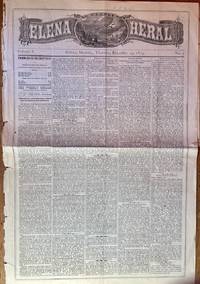
Helena Herald. Thursday December 25 1873. Volume 8. No. 5
Helena Montana: Fiske Bros. Publishers 1873. Newspaper. Fair. Disbound newspaper. Folded twice. Approx. 20" x 13.5". 8 pages. Illustrated mast head. Pages 7 and 8 detached. Pages 1-6 are split at the fold and mostly detached and separated. Small edge tears to the paper. Light toning to the contents. Previous owner name in pencil top of the front page. Fair. <br /> <br /> Articles include information on mining from the Interior Department; "Postal Suggestions"; "Lucky Indian. Half Breed Girl Who Is Heir to 1000000 in Pittsburg"; "A New Notion About Billiards"; Editorial Correspondence; "Our Bannack Letter"; "Subjects of Legislation"; "Telegrams"; "Washington Intelligence"; "Cuba"; local news and advertisements. Fiske Bros., Publishers unknown
Referenz des Buchhändlers : 36783
|
|
|
[Montello]
Il Montello. Giornale dell’Ottava Armata. Numero straordinario
Edizione originale. Esemplare ben conservato. Ultimo fascicolo pubblicato, senza numerazione e con la dicitura di «numero straordinario», del periodico «Il Montello» (giornale di guerra edito per soli 4 numeri più questo speciale nell’autunno del 1918). Nell’occasione cambia il sottotitolo (da «Quindicinale dei soldati del medio Piave»), tipografia e luogo di stampa, formato (più piccolo) e contenuti: non più coloratissimi disegni e parole in libertà, ma poesie, brevi prose e slogan militareschi («La vita del fante», «La casa del fante», «Il saluto militare» etc.) e tradizionali illustrazioni b.n. della vita in trincea. Raro.
|
|
|
[Monza]
Di che possa intrattenersi il forestiere [forestiero] in Monza [in copertina: «Di che possa intrattenersi il forastiere in Monza»; al dorso: «Guida di Monza»]
Prima edizione. Ottimo esemplare (piccole mancanze marginali e abrasioni alla legatura, altrimenti privo di particolari difetti da segnalare). Etichetta al contropiatto anteriore della legatura, «L» manoscritta in rosso al piatto anteriore della legatura e in blu al contropiatto anteriore della legatura. Correzione manoscritta al piatto posteriore della brossura: la scritta a stampa recita: «In carta fina con 10 rami lir. 3.50 austr.», «10» e «3» son corretti a penna rispettivamente in «2» e «1». Salutato dal «Giornale di letteratura, scienze ed arti» (tomo LXXII, numero di ottobre, novembre e dicembre dello stesso 1833) come «quasi un comodo manuale di ciò che in Monza contiensi di più considerabile», ci informa il prospetto pubblicitario del libro «L'inferno aperto al cristiano» (Corbetta, 1836, pagina 87) che di questo libro furono stampate copie contenenti 2 rami al costo di 1 lira e copie contenenti 10 rami dal costo di 5 lire, oltre ad una tiratura di lusso con rami miniati con rilegatura alla bodoniana, dal costo di 9 lire. Attestato in 8 sedi del sistema bibliotecario nazionale (di cui 5 in Lombardia una sola fuori dal nord Italia), il libro è invece divenuto assai raro con il tempo.
|
|
|
[Munari, Bruno. Marinetti F.T. Benedetta]
L’oceano del cuore. Cinque sintesi incatenate [insieme a:] Luci veloci. Dramma futurista in sei sintesi [insieme a:] Il suggeritore nudo. Simultaneità futurista in undici sintesi [in: «Comoedia. Rassegna mensile del teatro»]
Prima edizione. Il celebre e longevo periodico teatrale di larga diffusione, diretto da Enrico Cavacchioli, alla fine degli anni ’20 ospita alcune sintesi di Marinetti: anno X n. 6 (giu.-lug. 1928), «L’oceano del cuore. Cinque sintesi incatenate di F.T. Marinetti con scenografie di Benedetta», con tre riproduzioni delle scenografie di Benedetta; anno XI n. 3 (mar.-apr. 1929), «Luci veloci. Dramma futurista in sei sintesi», con riproduzioni della rappresentazione al Teatro di Torino; anno XI-XII s.n. (dic. 1929-gen. 1930), «Il suggeritore nudo. Simultaneità futurista in undici sintesi di F.T. Marinetti», edizione illustrata da cinque splendidi disegni composti ad hoc da Bruno Munari. Salaris, Storia, p. 186a; Cammarota, Marinetti, 132, 136, 142 3 voll.
|
|
|
[NEWCASTLE-UPON-TYNE] S[olomon] Hodgson, Printer, bookseller, stationer, print seller, newspaper proprietor (BBTI 1785-1800), al
Bewick; Hodgson bookseller Newcastle Receipted Invoice Signed "S. Hodgson" Account of "Mr Charnley" BBTI William Charnley bookseller stationer publisher bookbinder librarian/owner of circulating library
Newcastle no date late C18th. One page 4to somewhat grubby and worn at the edge but text clear and complete. Account total £7.16.11 paid in cash. Twenty two items listed with prices multiple copies from "6 Hist of All Nations" to 200 Maclaurin's Spelling" subjects including educational as above and children's "Mother Goose" "Mothers Chits Chats Tales". Other items include "Traders Guide" "Robinson Crusoe" "London Cries" "Lottery Books" "Tom Thumbs Play Bills". As a guide to the date of this account the third edition of Anne Fisher's "New English Tutor" was published in Newcastle in 1774 BLC and Hodgson died in1800. An edition of "The History of all Nations" appeared in 1771 another Newcastle imprint but the Bewick's published under the same title in 1784. John Bewick illustrated an edition of "Little Jack" title listed Bewick bought books from Charnley who was an early collector of the former's works and Hodgson published the first edition of Bewick's "Natural History". Bewick illustreated a "Robinson Crusoe" York 1802. Also listed and in Bewick's library Enfield William. The Speaker: or miscellaneous pieces selected from the best English writers . with a view to facilitate the improvement of youth in reading and writing . editions London: R. Dodsley 1789; London: J. Johnson n.d. c 1795 etc. And a Possibly: Fisher George. The Instructor or young man's best companion: containing spelling reading writing and arithmetic in an easier way than any yet published . Glasgow: for the booksellers 1786; or another edition. 455. Mother Chit-Chat's curious tales & puzzles 7th edition enlarged Newcastle: S. Hodgson 1787. BjF. The New Reading Made Easy consisting of a variety of useful lessons. Alnwick: W. Davison n.d. Hugo 1868 attributes the woodcut on the title page to Bewick.Though the posssibility cannot be ruled out this is probably not an edition there were many of Hastie T. schoolmaster Newcastle. The only method to make reading easy First edition Newcastle: M. Angus Newcastle, no date (late C18th?). unknown
Referenz des Buchhändlers : 4947
|
|
|
[Newspaper] [Civil War] [Detroit]
Detroit Advertiser and Tribune. October 23 1863
Detroit: Advertiser and Tribune Company 1863. Newspaper. Fair. Newspaper. Approx. 26" x 19". 4 pages. Paper is folded creased toned and lightly damp-stained. Light edge wear. Paper contains news of the Civil War including "Report that Gen. Meade is to be relieved of his Command"; From the 8th Cavalry. Its Conduct in the Battles of Cleveland and Calhoun Tennessee"; "Desolation of Tennessee"; "Report that Rosecrans was Dismissed for Cowardice and disobedience"; news from "The 11th Michigan Cavalry" etc. Several non Civil War news items and advertisements inside. Fair. Advertiser and Tribune Company unknown
Referenz des Buchhändlers : 35223
|
|
|
[Newspapers] [Reference] [AN Kellogg Newspaper Co] A N
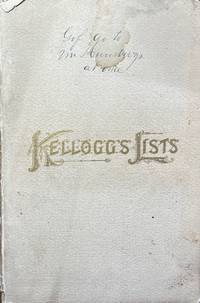
Kelloggg's Lists Embracing 1807 Country Newspapers of the Better Class
New York: A. N. Kellogg Newspaper Co 1889. Wraps. Good. Bound wraps. 128 pages. Tan paper covers with gold titles on the front cover snd back. Illustrated with a folding map in back and facsimile letters. Soiled spots on the paper covers. Tear in the front inner hinge to the title page. Note written on the front cover. Interior contents clean. A. N. Kellogg Newspaper Co unknown
Referenz des Buchhändlers : 36737
|
|
|
[Newspaper Cartoonists' Association of Manitoba]
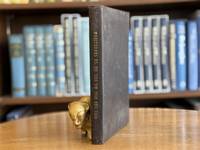
Manitobans As We See 'Em; 1908 and 1909
Winnipeg Manitoba: Newspaper Cartoonists' Association of Manitoba 1909. Hardcover. Unpaginated. 8vo. Bound in pebbled black cloth. Illustrations by Hay Stead and D. McRitchie. General shelfwear binding considerably shaken hinges tender but holding bookplate to front pastedown; good. Caricatures of prominent Manitobans of the early 20th century. Peel 3316. Newspaper Cartoonists' Association of Manitoba hardcover
Referenz des Buchhändlers : 0101000
|
|
|
[Newspaper] [South Carolina] [Secession] [Civil War]
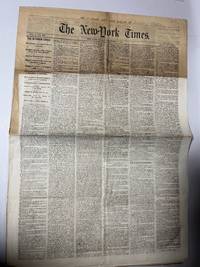
New York Times. New York Friday December 21 1860. "The Disunion Crises. The Formal Secession of South Carolina.
New York: New York Times 1860. First Edition. Newspaper. Good. Single newspaper sheet uncut. Measures approx. 45" x 30" unfolded. 8 pages when folded. Shading to page 1. Lead article is the secession of South Carolina leading up to the start of the Civil War. Contents contain international news news from the south news from Washington etc. Several placed advertisements. Previous owner name in pencil top of page 1. New York Times unknown
Referenz des Buchhändlers : 35233
|
|
|
[Newspaper suppliers to the SPCK]:
Newspaper suppliers to the SPCK Four invoices and receipts.
1829-1835. Four items invoices and receipts relating to the acquisition of newspapers by the SPCK suppliers including: F. Appleyard Daily Newspaper and Standard not in BBTI same address as Sarah; Sarah Appleyard Herald Record Times Standard Post; Richard Barker Cambridge Chronicle; Richard Barker advertisements for the Anniversary Dinner and two Special General Meetings supplying Times Post Chronicle Herald Morning News Standard Courier Globe Albion St James's Chronicle; Thomas Woodham Times 1829-1835 unknown
Referenz des Buchhändlers : 7205
|
|
|
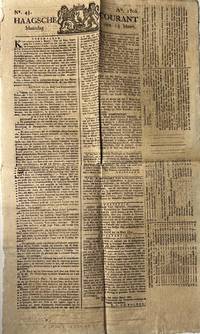
[newspaper the hague]
Newspaper The Hague 1802 Haagsche Courant Maandag 15 maart 1802 1 p. Printed on both sides.
Original The Hague newspaper dated 1802. Folio size 45 x 26 cm.NL Folio-formaat krant gedrukt in twee kolommen per pagina bestaande uit <strong data-start=""303"" data-end=""334"">twee bladen vier paginas</strong>. Voorzien van het <strong data-start=""353"" data-end=""379"">Nederlandse rijkswapen</strong> in houtsnede op de titelpagina. Gedrukt op handgeschept papier met zichtbare kettinglijnen .De inhoud bestaat uit uitgebreid <strong data-start=""528"" data-end=""561"">binnen- en buitenlands nieuws</strong> met berichten uit onder meer <strong data-start=""592"" data-end=""653"">Denemarken Frankrijk Pruisen en het Bataafse Gemenebest</strong> waaronder officiële regeringsmededelingen diplomatieke correspondentie en militaire rapportages uit de Napoleontische periode. Daarnaast bevat het nummer talrijke <strong data-start=""819"" data-end=""835"">advertenties</strong> waaronder aankondigingen van openbare verkopingen huizen landerijen inboedels loterijen faillissementen notariële berichten benoemingen en commerciële advertenties. Ook zijn er officiële publicaties en circulaires van overheidsinstanties opgenomen. Met advertentie: Medeburger! De compagnons in de firma Sneyders van Tienen & Comp. hebben onenigheden. Van Tienen en A. van Halteren berichten dat Sneyders hun bedrogen heeft.Genoemde personen: Napoleon Bonaparte Jean-Antoine Frouin Johan Willem Willink Rutger Jan Schimmelpenninck Hendrik van Wijn Samuel Iperusz Wiselius Gijsbert Karel van Hogendorp Carel Hultman Jan Hendrik van Swinden Frederik VI George III Alexander I Francis II Hendrik Swanenburg Johannes Delcourt Nicolaas Voet Cornelis van Vloten Lodewijk Andries Jan Bas Nicolaas Voets A. van Halteren F. J. Bosboom P. de Kok Winkel De Jong Van der Hoop Schuuring Van der Meer Van Leeuwen Van der Burg De Vries Kramer Van Stolk Boonacker Van Dam Meijer Koppen Van Oyen Bakker Van Wely Van Roon Van Zanten etc. unknown
Referenz des Buchhändlers : 110668
|
|
|
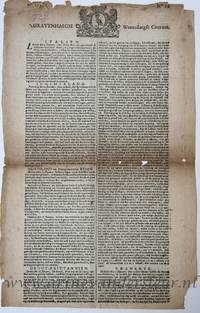
[Newspaper The Hague]
Newspaper/Krant 1737 s Gravenhaegse Woensdaegse Courant 23 Januari 1737 1p.
Printed in The Hague s Gravenhage by Jacobus de Jongh in de Korte-Begynestraet den 23 January 1737 No. 10 1 p.News: News on Italien Italy: binnenkomst schepen van Brand Blok Talboth Allen etc. News on Ingemerland/Sint Petersburg: Veldmaarschalk Grave van Munich etc. News on Duytsland Duitsland: Zweedse Oostindische compagnie. News on Groot-Brittanien: brand Inner-Temple-Hall President Nixon etc. New on Vrankryk Frankrijk: Versailles Hertog van Penthievre Parijs koning etc. New on Nederlanden: Amsterdam brieven van Smirna vertrek schippers.Edges frayed with a visible middle fold and a small hole.345 x 219 cm unknown
Referenz des Buchhändlers : PR120143
|
|
|
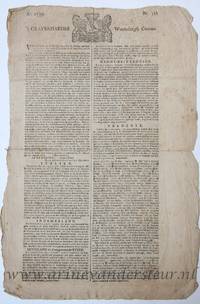
[Newspaper The Hague]
Newspaper/Krant 1739 s Gravenhaegse Woensdaegse Courant 16 September 1739 1p.
Printed in The Hague s Gravenhage by Anthoni de Groot in de Zuylingstraet den 16 September 1739 No111 1p.News: Vervolg op de declaratie des Konings van Spanje etc. News on Italien Italy: Napels etc. News on Ingemerland/Sint Petersburg. News on Duytsland Duitsland. News on Groot-Brittanien: Hertog van Newcastle. News on Vrankryk Frankrijk: prices of products/prijzen van Coffy man Mokka Thee Rood hout Cadamom Zyde Borduurwerken Neusdoeken Porcelein etc. News on Nederlanden: Texel Richard Bovens van Whitehaven etc.Edges frayed with a visible middle fold and a tear in the middle right.353 x 233 cm unknown
Referenz des Buchhändlers : PR120145
|
|
|
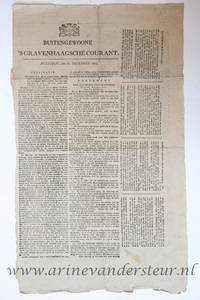
[Newspaper The Hague]
Newspaper/Krant 1813 Buitengewoone S Gravenhaagsche Courant Zaterdag den woensdag 22 December 1813 1p.
Printed in The Hague Gedrukt in s Gravenhage by G. Vosmaek en T. F. Gosse Stads-Drukkers en wordt uitgegeven bij B. Scheurleer Jr. in de Venestraat 1 p.With PUblicatie of Willem I Prins van Oranje-Nassau and Reglement van Algemeene Volkswapening met vervolg op de rand van het blad. Signatories: Jan Slicher and J.J. Quarles.344 x 265 cm unknown
Referenz des Buchhändlers : PR120144
|
|
|
[Newspaper The Hague]
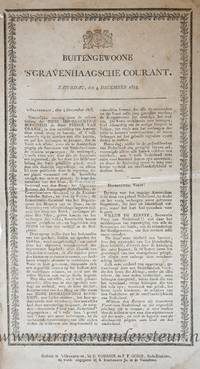
Newspaper/Krant 1813 Buitengewoone S Gravenhaagsche Courant Zaterdag den 4 December 1813 1p.
Printed in The Hague Gedrukt in s Gravenhage bij G. Vosmaer en P. F. Gosse Stads-Drukkers en wordt uitgegeven bij B. Scheurleer Jr. in de Veenestraat. Edges a bit frayed further in good condition. Nice Woodcut decorated frame.News: intocht van Prins van Oranje in Amsterdam start van Koninkrijk der Nederlanden met Willem I Willem de eerste.""De roep van het magtige Amsterdam is de stem van geheel Nederland hy drukt uit het vurig verlangen uwer getrouwe Hagenaren die hier uit kiescheid volen waar het har had wenschen voor te gaan WILLEM DE EERSTE Souverein Vorst van Nederland!!"".445 x 253 cm unknown
Referenz des Buchhändlers : PR120142
|
|
|
[Newspaper The Hague]
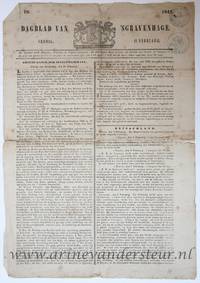
Newspaper/Krant 1847 Dagblad van S Gravenhage Vrijdag 12 Februarij 1847 No 19 4 pp.
Printed in The Hague Gedrukt in s Gravenhage by P. E. van Staden Drukker en Uitgever van het Dagblad Torenstraat wijk D. no 419 1 p.Edges frayed folds visible and with tears on fold and top. 37 x 258 cmWith: Tweede Kamer der Staten-Generaal zitting van Donderdag 11 februari 1847 ontwerp van wet Hoffmann toelating de heer Lecercq Duitschland: Berlijn Stockholm Frankrijk Nederlanden concert de heer Litolff C.W. Mieling Maatschappij Diligentia E. van Weerder L.M. Leefson etc. unknown
Referenz des Buchhändlers : PR120151
|
|
|
[Newspaper The Hague]
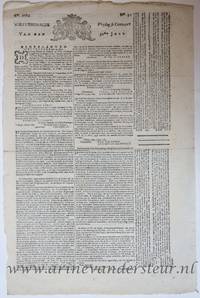
Newspaper/Krant 1784 s Gravenhaagse Vrydagse Courant Van den 30sten July 1784 no 92 1p.
Printed in The Hague Gedrukt in s Gravenhage by P. Gosse Junior en Zoon op het Plein den 30 July 1784 No 92 1 p.With C. de Gyselaar Pr. van Orange Isaac van Alphen J. van Zuylen van Nyevelt A.W. van Reede Johannes Ras Gosuinus Zoon Doorschoot Van Heeckeren tot Suideras Trapin Rosart.417 x 272 cm. unknown
Referenz des Buchhändlers : PR120146
|
|
|
[Newspaper The Hague]
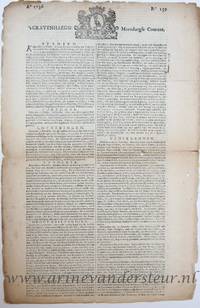
Newspaper/Krant 1736 s Gravenhaegse Maendaegse Courant 1736 No 139 1 p.
Printed in The Hague Gedrukt in s Gravenhage by Jacobus de Jongh in de Korte-Begynestraat den 19 November 1736 1p.348 x 227 cmWith: Kadix Schepen uit het Noorden ontruiming van Toscane John Thompson Lord Augustus Fitzroy Kapitein Wimpel John Rose Jacob Deutz Samuel de Clos Jan Stok en Cornelis Wackerdack Varinas tabak Loterije Grutterie Olme- en Ypen boomen. unknown
Referenz des Buchhändlers : PR120152
|
|
|
[Newspaper The Hague]
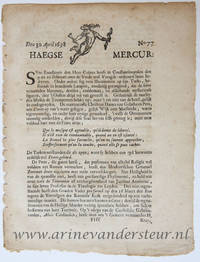
Newspaper/Krant 1698 Haegse Mercur/Haagse Mercur 30 April 1698 no 77 4 pp.
Printed in The Hague Gedrukt voor den Autheur by Gillis van Limburg Boekdrucker in de Papestraat alwaar de Mercuren worden verkogt en ook by de Boekverkoopers in alle Steden 4 pp.""Zyne excellentie den heer Coljers heeft te Constantinopolen den 9 en 10 Februari over de Vrede Veel Vreugde-teekenen laten bedryven."". With in tee text: Dames Galatha en Pera Ottomanen Paus Turken Syprus Savoyard Raed van Dantzig Pruyk-dragen Bisschop van Camerijk Mignard Elgin Schotland Paverman Chaldaea etc. With P. Vreede and J.F.R. van Hoff writing to the Bataven! Proclameatie Bataven G.D. JOrdens V. Van Gardinge Trekking van de Lotery UItgave van boeken etc.In good condition. 22 x 167 cm<div>De Haegse Mercurius behelsende vermakelijke satyrique galante stigtelijke politique academische emblematique en andere reflexien gemaakt op de voorvallen van desen tijd is een beroemde krant uit de 17e eeuw.</div>Met ingang van 1657 verdwenen de Advysen en verscheen tweemaal per week de Haegsche Maandagsche respectievelijk Donderdagsche Mercurius afbeelding 8. Redacteur van beide bladen was de uit Gent afkomstige Gerard Lodewijk van der Macht ook wel: de Maght die mogelijk ook betrokken was bij eerder genoemde bladen van Rammazeyn en Breeckevelt. Van der Macht was net als de Breeckevelts een nogal assertieve courantier die regelmatig berichten over geheime staatszaken publiceerde en bij gelegenheid ook wel zelf politiek gevoelige nieuwsberichten verzon waarmee hij de autoriteiten in verlegenheid bracht. Het duurde even voor hij daarmee tegen de lamp liep ondanks het feit dat hij zich vanaf medio 1657 voor de zekerheid maar verborg achter de schuilnamen Anthony Benedetti en Anthoni Pietersz. unknown
Referenz des Buchhändlers : PR120148
|
|
|
[Newspaper] [Pennsylvania Chronicle, and Universal Advertiser] [Farmer's Letters]
Pennsylvania Chronicle and Universal Advertiser. From Monday June 27 to Monday July 4 1768
Philadelphia: Printed by William Goddard 1768. Newspaper. Good. Newspaper. Disbound single issue. Approx. 11.5" X 9.25". Pages 177 to 184. Paper is lightly toned and foxed. A few small edge tears. This issue contains much pre American Revolution political discontent. <br /> <br /> Front page article contains reprinted extracts from a pamphlet published by John Dickinson titled "Farmers Letters" published in 1766. This issue also has extensive coverage of the June 10 1768 "Liberty Riot" in Boston with references to the "Sons of Liberty". Contents also include latest news from London; article on New Bern North Carolina; an illustrated advertisement for a runaway "Mulatto" slave named Harry from Delaware; continuation of correspondence between John Dickinson and Horatio Sharpe Governor of Maryland; several advertisements and more. Good condition. From History dot Delaware dot Gov:<br /> <br /> Dickinson’s most famous contribution as the “Penman†and for the colonial cause was the publication of a series of letters signed “A FARMER.†The letters were published over a period of ten weeks in late 1767 and early 1768 with the first letter appearing in the Pennsylvania Chronicle on December 2 1767. In the letters Dickinson argued amongst other things that the Townshend Acts were illegal because they were intended to raise revenue a power held only by the colonial assemblies. His arguments were a collection of ideas that were written in a clear and concise manner which the general population could understand. Collectively the letters were called “Letters from a Farmer in Pennsylvania to the Inhabitants of the British Colonies.†The letters were shortly thereafter published in pamphlet form and reprinted in almost all of the colonial newspapers. They were read widely across the colonies and in Britain and France. This quickly made John Dickinson famous. After reading the “Letters†Voltaire the French philosopher compared Dickinson to Cicero an honored Roman statesman orator and philosopher. At the Boston town meeting in March of 1768 Samuel Adams and others spoke of the author by saying “that the thanks of the town be given to the ingenious author of a course of letters… signed ‘A FARMER’ wherein the rights of the American subjects are clearly stated and fully vindicated: …members of a committee are to prepare and publish a letter of thanks.†As a direct result of the popularity of Dickinson’s letters there were calls and petitions for the boycotting of imported goods throughout the colonies. The eventual result of the unity amongst the colonies against a common enemy was the First Continental Congress. When the Congress was called however Dickinson quickly realized that much progress needed to be made towards the solutions that he wrote about in his letters.<br /> <br /> From History dot com: The Sons of Liberty were a grassroots group of instigators and provocateurs in colonial America who used an extreme form of civil disobedience—threats and in some cases actual violence—to intimidate loyalists and outrage the British government. The goal of the radicals was to push moderate colonial leaders into a confrontation with the British Crown. The Sons marked one of their early victories in December 1765. The Stamp Act—the first tax imposed directly on American colonists by the British government—had only been in effect for a month when a group of Boston merchants and craftsmen sent a letter to Andrew Oliver the newly-appointed official collector of stamps. The group informed Oliver that he was to show up the next day at noon at the Liberty Tree in the city’s South End to publicly resign. Printed by William Goddard unknown
Referenz des Buchhändlers : 35236
|
|
|
[Newspaper] [Pennsylvania Chronicle, and Universal Advertiser]
Pennsylvania Chronicle and Universal Advertiser. From Monday July 25 to Monday August 1 1768
Philadelphia: Printed by William Goddard 1768. Newspaper. Good. Newspaper. Disbound single issue. Approx. 11.5" X 9.25". Pages 209-216. Stitching removed. Pages are all detached with edge tears and chips on the left edge. Paper is lightly toned. A couple of small worm holes on the left margins. Fair or better condition. <br /> <br /> Front page article contains a reactionary response to the publication of the Farmer's Letter's in William Goddard's newspaper. The writer "A Barbadian" requests "without further preface.to publish after the manner of the Farmer the following extracts from the answers to his address." On page 212 is a letter signed by a "Son of Liberty" who writes "How happy are you Sir and how much to be envied to be thus by nature as well as the influences of freedom armed and supported - For this surely "is the Crisis The Very Crises" when your animating soul is called forth to action not merely to display the wordy weapons of war but to grid your armour and lead on thousands and tens of thousands to defend their invaluable rights and privileges." Page 214 is an address to the Pennsylvania State-House regarding restrictive British policy regarding trade and taxes. Advertisements for land job advertisements Irish linens and more located in back. Fair condition. From History dot Delaware dot Gov:<br /> <br /> Dickinson’s most famous contribution as the “Penman†and for the colonial cause was the publication of a series of letters signed “A FARMER.†The letters were published over a period of ten weeks in late 1767 and early 1768 with the first letter appearing in the Pennsylvania Chronicle on December 2 1767. In the letters Dickinson argued amongst other things that the Townshend Acts were illegal because they were intended to raise revenue a power held only by the colonial assemblies. His arguments were a collection of ideas that were written in a clear and concise manner which the general population could understand. Collectively the letters were called “Letters from a Farmer in Pennsylvania to the Inhabitants of the British Colonies.†The letters were shortly thereafter published in pamphlet form and reprinted in almost all of the colonial newspapers. They were read widely across the colonies and in Britain and France. This quickly made John Dickinson famous. After reading the “Letters†Voltaire the French philosopher compared Dickinson to Cicero an honored Roman statesman orator and philosopher. At the Boston town meeting in March of 1768 Samuel Adams and others spoke of the author by saying “that the thanks of the town be given to the ingenious author of a course of letters… signed ‘A FARMER’ wherein the rights of the American subjects are clearly stated and fully vindicated: …members of a committee are to prepare and publish a letter of thanks.†As a direct result of the popularity of Dickinson’s letters there were calls and petitions for the boycotting of imported goods throughout the colonies. The eventual result of the unity amongst the colonies against a common enemy was the First Continental Congress. When the Congress was called however Dickinson quickly realized that much progress needed to be made towards the solutions that he wrote about in his letters.<br /> <br /> From History dot com:<br /> The Sons of Liberty were a grassroots group of instigators and provocateurs in colonial America who used an extreme form of civil disobedience—threats and in some cases actual violence—to intimidate loyalists and outrage the British government. The goal of the radicals was to push moderate colonial leaders into a confrontation with the British Crown. The Sons marked one of their early victories in December 1765. The Stamp Act—the first tax imposed directly on American colonists by the British government—had only been in effect for a month when a group of Boston merchants and craftsmen sent a letter to Andrew Oliver the newly-appointed official collector of stamps. The group informed Oliver that he was to show up the next day at noon at the Liberty Tree in the city’s South End to publicly resign. Printed by William Goddard unknown
Referenz des Buchhändlers : 35235

|
|
|
[Newspaper] [Business] Poulson, Zachariah
Poulson's American Daily Advertiser. Wednesday Morning February 4 1818. Volume XLVII. Number 12855
Philadelphia: Printed by Zachariah Poulson 1818. First Edition. Newspaper. Good. Newspaper. Trimmed very close on the bottom edge. Approximately 20" x 12.5". Folded. 4 pages. Nice illustrated mast head. An approximate 2" split to the paper at the horizontal fold right edge. Small tears and holes to the paper in the center fold with no loss of content.<br /> <br /> Several placed advertisements auctions goods education ship news theatre ad editorial daily almanack etc. Some of the advertisements have small vignette illustrations. Paper also includes latest news including a Naval trial for Captain Heath in the United States Senate. Printed by Zachariah Poulson unknown
Referenz des Buchhändlers : 35187
|
|
|
[Newspaper] [Business] [Political] John Russell (Publisher and Editor)
Russell's Gazette Commercial and Political Thursday November 1st 1798
Boston: John Russell 1798. Newspaper. Good. Newspaper. Approx. 20" x 12". Folded. 4 pages. Contents include a Charles C. Pinckney address from France local news sales advertisements theater advertisement etc. Light toning and edge creases to the paper. John Russell unknown
Referenz des Buchhändlers : 33743
|
|
|
[Newspaper] [Sacramento] [California] [Agriculture] Crowell, W H (Editor)
Sacramento Valley Agriculturist. A Weekly Journal For the Farm and Fireside. Vol. V. No. 29
Sacramento: W. H. Crowell & Co 1878. First Edition. Newspaper. Fair. Newspaper. Single uncut sheet approximately 42" x 28" folded to make 8 pages. Page 4 has a dried stain causing minor loss of some print. Rest of the paper is clean. Lightly creases to the paper. Pencil name upper edge front page. Contents include several articles stories and illustrated advertisements. One article stresses the need to save water. Obscure newspaper. W. H. Crowell & Co unknown
Referenz des Buchhändlers : 35186

|
|
|
[Newspaper]
The Anti-Jacobin; or Weekly Examiner
New York: AMS Press 1968. AMS Edition reprint. Hardcover. Very Good. May require extra postage due to size and weight depending on shipping destination. Quarto 30.5 cm Bound in plain blue cloth over boards. Ex-library with ink stamps on the text block edges and a library label on the front pastedown. An English newspaper founded by George Canning in 1797. The newspaper's aim was to oppose the radicalism of the French Revolution. AMS Press hardcover
Referenz des Buchhändlers : 65718

|
|
|
[Newspaper] [Georgia] Confederacy] Turner, J A (Publisher) [Confederate imprint]
The Countryman Turnwold Plantation Putnam County Ga. Monday November 17 1862 Vol. III. No. 8.
Putnam County Ga: J. A. Turner 1862. First Edition. Newspaper. Good. 12" x 9" newspaper. Pages 57-64. Pages uncut at top edge. Very light toning to the issue. Front page lead article is titled "Educated Negroes." Other contents include stories misc. news and several advertisments. In March of 1862 Joel Chandler Harris future folklorist author of Uncle Remus and several other works started as a a typesetter for the newspaper "The Countryman". Harris lived at Turnwold Plantation near Eaton Georgia throughout the War. The paper ceased in 1866. In 1876 Henry Grady of the Atlanta Constitution hired Harris as a journalist. J. A. Turner unknown
Referenz des Buchhändlers : 35238
|
|
|
[Newspaper, Hospital] [Civil War]
The Hammond Gazette March 30 1864. Vol. 2 No. 20.
<p>A nice example of a very uncommon newspaper printed weekly for the staff and patients of Hammond General or Point Lookout Hospital during 1863 and 1864. This Hospital for Union troops was constructed at the location of a summer resort on an isolated peninsula extending into Chesapeake Bay. After the Battle of Gettysburg during which a large number of Confederate troops were captured Point Lookout also quickly became the location of the largest Union prison camp. </p><p>The newspaper carries war news some general news and even a bit of poetry. The back page contains a list of the staff of the Hospital as well as the names States and units of the current patients. There were about 250 patients at the Hospital when this issue of the newspaper was printed. </p><p>The newspaper also contains several Army reports and notices including one noting the continued poor health of General Meade and the likelihood that "in consequence thereof General Grant will command the army in person." Also included is a clarifying proclamation regarding amnesty issued by President Lincoln.</p><p>Issues of this wartime hospital newspaper are very uncommon. As an indication of its rarity: the American Antiquarian Society which has the country's largest collection of newspapers only holds nine issues of the paper not including the issue offered here. ICN 7386.</p><br /> George Everett, Publisher.
Referenz des Buchhändlers : 12254
|
|
|
[Newspaper] [Atlanta] [The Looking Glass Publishing Company, Atlanta]
The Looking Glass. Vol. 5. No. 204 December 25 1897
Atlanta: The Looking Glass Publishing Company. Foote & Davies Printers 1897. First Edition. Periodical. Fair. Stapled weekly periodical. Approx. 14" x 11". 12 pages. Illustrated. Paper is both folded vertically and horizontally. Small edge tears and toning to the pages. Back cover is toned and foxed. Light spotting to the contents. This Christmas issue contains a two page illustration of girls waiting on Santa Claus to come down the chimney. Contents include stories politics and current events. Advertisement for Jacob's Pharmacy located on the last page. The Looking Glass Publishing Company. Foote & Davies, Printers unknown
Referenz des Buchhändlers : 35721
|
|
|
[Newspaper] [Abolition] [Slavery] [Pacifism] Garrison, William Lloyd; Quincy, Edmund; Chapman, Maria W (editors)
THE NON-RESISTANT Boston April 20 1839
Boston: N. E. Non Resistant Society 1839. Newspaper. Very good. Newspaper. 4 pages. Complete. Approximately 11.75" x 17". Slightly irregular at the blank spine. <br /> <br /> Several articles and letters inside pertaining to "Consequences of War" with Great Britain and other similar pieces. This paper was also an anti-Slavery paper. <br /> <br /> From wikipedia: The New England Non-Resistance Society was an American peace group founded at a special peace convention organized by William Lloyd Garrison in Boston in September 1838.1 Leading up to the convention conservative members of the American Anti-Slavery Society and the American Peace Society expressed discomfort with Garrison's philosophy of "non-resistance" and inclusion of women in public political activities. After conservative attendees opposing Garrison walked out of the convention in protest those remaining formed the New England Non-Resistance Society.citation needed<br /> <br /> The Society condemned the use of force in resisting evil in war for the death penalty or in self-defense renounced allegiance to human government and because of the anti-slavery cause favored non-union with the American South.citation needed The New England Non-Resistance Society was one of the more radical of the many organizations founded by William Lloyd Garrison adopting a Declaration of Sentiments of which he was the principal author pledging themselves to deny the validity of social distinctions based on race nationality or gender"2 refusing obedience to human governments and opposing even individual acts of self-defense.3 In the Society's Declaration of Sentiments Garrison wrote "any person without distinction of sex or color who consents to the principles of this Constitution may become a member and be entitled to speak at its meetings."1 The Society rejected loyalty to any human government; one historian has described the Non-Resistance Society's "basic outlook as that of philosophical anarchism".45. N. E. Non Resistant Society unknown
Referenz des Buchhändlers : 36794
|
|
|
[Newspaper] [Business] [John Dunlap and David C Claypoole]
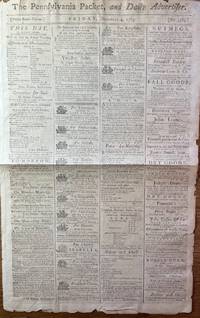
The Pennsylvania Packet and Daily Advertiser. Friday December 4 1789
Philadelphia: Printed and Sold by John Dunlap and David C. Claypoole 1786. First Edition. Newspaper. Fair. Newspaper. Approx. 18" x 11". 4 pages. Folded. Edge chips tears and splits to the paper. Contents include advertisements for shipping dry goods personal ads Foreign intelligence news on America and local Massachusetts news. Fair. Printed and Sold by John Dunlap and David C. Claypoole unknown
Referenz des Buchhändlers : 36778
|
|
|
[Newspaper] [Colorado] [Rocky Mountains] [The Pikes Peak News]
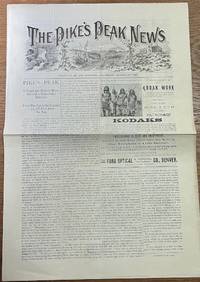
The Pike's Peak News. Pikes Peak and Manitou Colorado Season of 1897
Manitou Springs: n/a 1897. Newspaper. Very good. Newspaper. Approx. 16" x 11.5". 4 pages. Folds and light creases to the paper. Tourist and Travel periodical with articles on Pike's Peak and the Railroad; articles on South Cheyenne Cannon and Manitou Springs. Several advertisements include Native Americans posing for an advertisement for Kodak Company; The Alamo Hotel in Colorado Springs; Rio Grande Railroad; Broadmoor Hotel and Casino; The Windsor Hotel in Denver and many more. n/a unknown
Referenz des Buchhändlers : 35237
|
|
|
[Newspaper].
The Wasp Phoenix Edition. Devoted to the Upbuilding of a Greater San Francisco. Contains the New Directory of San Francisco Corrected Weekly.
San Francisco: June 30 1906. Very Good. 1906. 8 pps.; 22" x 15"; articles directory advertisements. Chipped at edges; 2 " horizontal tear from foredge at fold. Newsprint is good quality and clean with no tanning. First page devoted to Public Man and Affairs followed by pages of more general news "Men and Women" "Facts and Comment." Of particular interest is the New Directory of San Francisco and Oakland" on pages 4 thru 6. "Owing to the constant changes to location by thousands of firms that have been burned out a book directory will be misleading for many months to come. The Wasp has made arrangements to publish a Complete Weekly Directory of leading Business Firms of San Francisco regardless of their location on this side of the bay or in Oakland." Includes Municipal Offices and Judiciary; Miscellaneous; and an extensive alphabetized list of businesses by name activity and address. . June 30, 1906 unknown
Referenz des Buchhändlers : 2154

|
|
|
[Niente più sbarre] [Anarchismo]
Niente più sbarre. Bollettino del collettivo anarchico di Livorno
Edizione originale. Bell’esemplare. Ultimo numero pubblicato, le uscite erano iniziate nel 1978. Supplemento ad «Anarchismo» n. 23/24.

|
|
|
[Noi e i compagni cinesi]
Noi e i compagni cinesi. Testi e commenti sulle divergenze con il P.C.C.. Supplemento de L’Unità
Edizione originale. Qualche segno di penna all’ultima pagina, ma bell’esemplare. Supplemento al n. 231 del 29 settembre 1963; edito con la collaborazione della sezione stampa e propaganda del Pci. Curato da G. Boffa, A. Curzi, G. Giadresco, E. Polito, E. Roggi, E. Simeone.

|
|
|
[Noi gli altri]
Noi gli altri. Il periodico dei detenuti fiorentini
Edizione originale. Parziale distacco del piatto superiore, ma bell’esemplare. Anno IV, numero 2, aprile, maggio, giugno. Ciclostilato.

|
|
|
[North Carolina Civil War Union Newspaper]
NEWBERN DAILY PROGRESS. NEWBERN N.C. SATURDAY EVENING DECEMBER 6 1862 VOLUME 5. NUMBER 59
New Bern NC: E.L. Davenport & Co. 1862. Folio. 14" x 20". 4pp printed in six columns per page. Old folds several fox blotches. Good plus. <br /> <br /> E.L. Davenport & Company issued the 'Newbern Daily Progress' and 'Newbern Weekly Progress' from 1853 until some time in 1862. As the area came under Union control it re-emerged as a newspaper run by a staff of Union soldiers and pro-Union in content. Hutchinson: NEW BERN Arcadia Publishing 2000 p.15. <br /> This issue was printed after the Union captured New Bern. George Mills Joy the Army's Recruiting Officer is listed as the new editor. Among the many advertisements is one signed in type by Joy himself: FREEMEN OF North Carolina Rally to the Support of the Stars & Stripes!" <br /> This issue prints war news and adjudications by the Provost Court mostly on charges of drunkenness and disorderly conduct. "Sam. Smith Colored" was reprimanded and discharged for being without a pass. Advertisements comprise the bulk of the printed material. E.L. Davenport & Co. unknown
Referenz des Buchhändlers : 41795
|
|
|
[Note fotografiche; Albe Steiner, Bruno Munari, Giuseppe Pagano, Marcello Nizzoli, Eriberto Carboni, Franco Grignani, Luigi Veronesi, Ermanno F. Scopinich, Federico Vender, Giovanni Scheiwiller, Guido Piovene et alii]
Note fotografiche. Rivista mensile di fotografia e cinematografia. 18° anno. Nn. 1-10 [Segue:] Fotografare a cura della Agfa Foto [Segue:] Pose e istantanee a cura della Agfa Foto
Collezione completa. Insieme in ottime condizioni di conservazione (da segnalare solo tracce di ruggine alla pinzatura di alcuni fascicoli), completo di un rarissimo messaggio dattiloscritto circolare su carta intestata della rivista, che annuncia l’uscita dei due fascicoli complementari a chiusura dell’annata. L’ultima annata della rivista «Note fotografiche», l’“house organ” di AGFA Foto diretto da Alfredo Ornano e stampato a Milano presso la tipografia Lucini anziché Rizzoli dall’8 luglio 1941 al febbraio 1943, è probabilmente la prima esperienza di Albe Steiner come art director. Steiner illustra regolarmente con fotomontaggi pubblicitari la seconda e la quarta di copertina. Sospesa con il numero 10 dell'aprile 1942 «per disposizioni ministeriali», pubblicò nel febbraio 1943 due fascicoli monografici fuori numerazione per completare l’annata: «Fotografare» e «Pose istantanee», al fine di rispettare l’impegno preso con gli abbonati. Copertine fotografiche di W. Benser, Franco Grignani, Giovanni Scheiwiller e altri, stampa a cura del tipografo Lucini. Tra i collaboratori troviamo Guido Piovene, Luigi Veronesi, Giulio Galimberti, R. Muratore, Ermanno F. Scopinich, Pierluigi Erizzo, Federico Vender, Giorgio Mazzonis, Bruno Munari, G. Muggiani, G. Mondaini, A. Bragaglia, G. Pagano, Marcello Nizzoli, S. Pedrotti, Eriberto Carboni. Particolarmente rari i due fascicoli «Fotografare» e «Pose e istantanee», registrati in ICCU in sole tre biblioteche (solo IUAV Venezia e ICCD Roma li possiedono entrambi). 12 volumi

|
|
|
[Novecento - 900. Fondata da Massimo Bontempelli e Curzio Malaparte]
900. Cahiers d’Italie et d’Europe
Edizione originale. Primi quattro numeri (autunno 1926; inverno 1926 - 1927; primavera 1927; estate 1927). Esemplari in ottime condizioni (lievi tracce d’usura alle copertine e carte leggermente brunite). Primi quattro numeri di «900», rivista letteraria fondata nel 1926 da Massimo Bontempelli e Curzio Malaparte edita, fino al terzo numero compreso, dalla romana “La Voce”, prima di passare alla Società Sapientia. Pubblicato in francese, dichiaratamente europeista e con un comitato di redazione d’eccezione composto da James Joyce, George Kaiser, Gómez de la Serna, Pierre Mac Orlan, il trimestrale - stampato in 1700 esemplari numerati - si proponeva di aprire i confini culturali italiani oppressi dal patriottismo imperante mettendoli a contatto con quanto di meglio la letteratura e l’arte internazionali avessero da offrire. Invisa per questa ragione ai sostenitori del movimento Strapaese e al regime, la rivista riuscì comunque a proseguire le pubblicazioni fino al giugno del 1929, per un totale di 17 numeri che ospitarono testi, tra i tanti, di Joyce, Woolf, Cechov, Tolstoj. Il clima di sospetto e l’aperta avversità nei confronti del progetto costrinsero comunque il direttore Bontempelli a cedere all’italianizzazione dei suoi “quaderni” a partire dal primo numero della “nuova serie” del luglio 1928 dopo aver già registrato il tradimento di Malaparte, che un anno prima aveva abbandonato la rivista per entrare nel gruppo strapaesano di «Il Selvaggio».
|
|
|
[Novecento - 900] (a cura di Massimo Bontempelli)
900 (Nuova serie)
Edizione originale. Numeri 1, 2 e 5 della nuova serie di «900» (luglio 1928; agosto 1928; novembre 1928). Numeri 1 e 2 con fioriture e bruniture ai piatti, piatto anteriore del numero 5 perimetralmente brunito. Per il resto ottimi esemplari. Rari. Numeri 1, 2 e 5 (luglio, agosto e novembre del 1928) della nuova serie di «900», rivista letteraria fondata nel 1926 da Massimo Bontempelli e Curzio Malaparte edita, fino al terzo numero compreso, dalla romana “La Voce”, prima di passare alla Società Sapientia. Pubblicato in francese, dichiaratamente europeista e con un comitato di redazione d’eccezione composto da James Joyce, George Kaiser, Gómez de la Serna, Pierre Mac Orlan, il trimestrale (mensile dal luglio 1928) si proponeva di aprire i confini culturali italiani oppressi dal patriottismo imperante mettendoli a contatto con quanto di meglio la letteratura e l’arte internazionali avessero da offrire. Invisa per questa ragione ai sostenitori del movimento Strapaese e al regime, la rivista riuscì comunque a proseguire le pubblicazioni fino al giugno del 1929, per un totale di 17 numeri che ospitarono testi, tra i tanti, di Joyce, Woolf, Cechov, Tolstoj. Il clima di sospetto e l’aperta avversità nei confronti del progetto costrinsero comunque il direttore Bontempelli a cedere all’italianizzazione dei suoi “quaderni” a partire dal primo numero della “nuova serie” dell’estate 1928, qui parzialmente presentata. Un anno prima, Bontempelli aveva dovuto registrare anche il tradimento di Malaparte, uscito dalla rivista per entrare nel gruppo strapaesano di «Il Selvaggio».
|
|
|
[Novissima. Albo d’arti e lettere] (direttore Edoardo De Fonseca) [1901 - 1910]
Novissima. Albo d’arti e lettere. Direttore: Edoardo de Fonseca
Edizione originale. Rara collezione completa (10 volumi). Esemplari in ottime condizioni con rare e normali abrasioni ai piatti (da segnalare solo fioritura al piatto del X volume). Carte pulite con qualche occasionale fioritura. Rarissima collezione completa di «Novissima» “albo d’arti e lettere” ideato e fondato da Edoardo De Fonseca tra il 1900 – anno in cui diede vita a Milano alla Società Editrice di Novissima - e il 1901, anno di pubblicazione del primo volume di questa bellissima – e unica nel suo genere – rivista dedicata alla letteratura, all’arte e all’illustrazione. Contraddistinta da una grafica curata e riccamente liberty, al suo interno «Novissima» raccoglieva testi e componimenti poetici di autori importanti (tra i molti, De Amicis, Pirandello, Pascoli, D’Annunzio), rubriche di teatro, musica e moda, inserzioni pubblicitarie ma, soprattutto, illustrazioni e tavole stampate su carte di tipo diverso. Bompard, Majani, Terzi, Dudovich, Kienerk sono solo alcuni degli illustratori che De Fonseca chiamò a sé per collaborare stabilmente al periodico annuale e per firmare le copertine, piccoli gioielli d’Art Nouveau. Nel dettaglio, «Novissima» si presentò con la copertina del 1901 - raffigurante una giovane donna tra i rami di ciliegio - firmata da Aleardo Terzi; nel 1902 con l’illustrazione di Antonio Rizzi; nel 1903 con l’elegante creazione dello scultore Edoardo Rubino, a metà tra bassorilievo e cammeo; nel 1904 con la grafica del notissimo cartellonista Marcello Dudovich; nel 1905, il piatto anteriore è affidato ad Augusto Majani, mentre nel 1906 nuovamente ad Aleardo Terzi; nel 1907, in un numero che affronta i temi emersi all’Esposizione Internazionale di Milano dell’anno precedente, la copertina - che ritrae un uomo intento a innaffiare un melograno - è di Duilio Cambellotti; nel 1908 il tema femminile è invece sviluppato da Giovanni Mataloni; nel 1909 è la volta di Alfredo Baruffi, a cui viene affidata anche l’illustrazione dell’intero volume, mentre nel 1910 la pubblicazione si congeda con la copertina di Umberto Bottazzi. Tra i contributi artistici accolti all’interno dei numeri, non si può non segnalare quantomeno la presenza di un’opera di Giacomo Balla nel volume del 1904. Perfettamente in linea con i tempi, l’esperienza di «Novissima» si concluse nel 1910 al mutare del gusto artistico e del clima culturale, rimanendo tuttavia una splendida testimonianza dello spirito a cavallo tra la fine dell’Ottocento e l’inizio del Novecento, così sospeso, onirico e borghesemente languido. 10 voll.

|
|
|
[Nuova opposizione]
Nuova opposizione
Edizione originale. Bell’esemplare. Numero 0 in attesa di autorizzazione. Supplemento a «Unità proletaria» numero 2/79, direttore responsabile Daniele Protti. Bel foglio corredato da numerose illustrazioni, copertina a colori, articoli di S. Semenzato, I. Stagliani, F. Bottaccioli, L. Ferrajoli, F. Calamida, A. Picciolini, L. Berti, A. Mangano, P. Palazzi, G. Mattioli, M. Scalia, F. Bo, A. Poli, V. Moretti, C. Coradeschi, L. Bobbio, M. Pivetta.

|
|
|
[Nuovi Quaderni di Giustizia e Libertà]
Nuovi Quaderni di Giustizia e Libertà [Torre Pellice]
Edizione originale stampata nella tipografia clandestina “L’Alpina” di Torre Pellice. Tutto il pubblicato del 1944 dei “Nuovi quaderni di Giustizia e Libertà” (numeri 1, 2 - 3, 4). Quaderni 2 - 3 e 4 in ottimo stato, con normali segni d’usura alle brossure. Quaderno 1 con distacco fermato dei piatti della brossura e dorso con estese mancanze, ma carte in ottimo stato. Tutto il pubblicato del 1944 dei “Nuovi quaderni di Giustizia e Libertà” stampati nella tipografia “L’Alpina” di Torre Pellice, luogo simbolo delle pubblicazioni clandestine antifasciste piemontesi in cui coraggiosamente nasceva e da cui coraggiosamente veniva diffuso il materiale partigiano. Questi “Nuovi quaderni” ripresero l’eredità dei primi quaderni di Giustizia e Libertà - quelli voluti da un gruppo di esuli antifascisti guidati da Carlo Rosselli ed Emilio Lussu e stampati a Parigi tra il 1932 e il 1935 - proponendosi, a partire dal maggio del 1944, come spazio di discussione alta dei problemi e delle soluzioni legati non soltanto all’ancora opprimente tempo presente, ma anche a quello futuro. Come si legge nelle toccanti pagine introduttive del primo numero infatti: «Le condizioni di lavoro dei superstiti redattori e dei giovani che ad essi si sono associati sono notevolmente più difficili, più pericolose di quelle esistenti dieci o dodici anni fa. La loro maggiore forza è data dalla speranza che ci si trovi ormai avviati verso la sconfitta del nostro nemico più immediato: il fascismo e il nazismo. Ma la sconfitta del nemico non significa ancora necessariamente - e guai a farsi illusioni su questo punto - la vittoria della causa nostra [...]. Bisogna insomma avere il coraggio di dare delle soluzioni che implichino una rottura non solo col fascismo, non solo coi Savoia, non solo col grande capitale parassita, ma con tutto il modo di pensare dell’epoca che finisce».

|
|
|
[Nuovo, Il; direttore Arnaldo Ginna]
Il Nuovo. Quindicinale di energetica umana fascista e futurista. Anno I, N. 11
Edizione originale. In ottime condizioni, con etichetta d’invio a «S. E. Marinetti | Villa Miramare | Levanto». Quindicinale diretto da Arnaldo Ginna, ne uscirono 18 numeri nel 1934. «Organo ufficiale della Federazione dei gruppi naturisti-futuristi e della Confederazione italiana per la bonifica umana fascista», «[...] movimento filosofico dalle basi autarchico-fasciste il cui programma era stato esposto da A. Ginna nell'incredibile libello “L'Uomo futuro”» (Diz. Fut., p. 803). Spazia dall'arte alla medicina, passando per l'industria e il commercio. Salaris, Riviste futuriste, pp. 464-471; Cammarota, Futurismo, Giornali fut., 128

|
|
|
[Nuovo, Il; direttore Arnaldo Ginna]
Il Nuovo. Quindicinale di energetica umana fascista e futurista. Anno I, N. 13-14
Edizione originale. Brunitura lungo la piegatura verticale nella parte alta della prima pagina; lacerazione in corrispondenza; lacerazione al centro delle pagine in corrispondenza dell’intersezione delle piegature; senza perdite, leggera fragilità. Numero doppio in occasione del «Primo convegno italiano naturista: Energetica e costituzionalismo», da inaugurarsi il 1° ottobre 1934. «Il Nuovo» fu un quindicinale diretto da Arnaldo Ginna, ne uscirono 18 numeri nel 1934. «Organo ufficiale della Federazione dei gruppi naturisti-futuristi e della Confederazione italiana per la bonifica umana fascista», «[...] movimento filosofico dalle basi autarchico-fasciste il cui programma era stato esposto da A. Ginna nell'incredibile libello L'Uomo futuro» (Diz. Fut., p. 803). Spazia dall'arte alla medicina, passando per l'industria e il commercio.

|
|
|
[Of Limits]
Of Limits 4
In ottime condizioni. Ciclostilato di 15 fogli, pinzati, in 4° (cm 33x22) autocopertinato ( copertina in carta colorata), illustrato di disegni e vignette satiriche. Informazioni, appelli di collaborazione da altri gruppi sparsi in tutta la nazione, recensioni di concerti. Stampato probabilmente a Civitanova Marche.
|
|
|
[Omnibus]
Omnibus. Settimanale di attualità politica e letteraria
Tutto il pubblicato con eccezione dei nn 3 dell’anno I e 3/4 dell’anno II. Fascicoli in due volumi in mezza pelle blu, titoli oro al dorso, in ottimo stato di conservazione. Ideato da Leo Longanesi per Rizzoli, uscì con il primo numero il 3 aprile 1937, anno primo, fino al nr. 39 del 25 dicembre; anno secondo 1938 dal nr. 1 del 7 gennaio al nr. 53 del 31 dicembre; anno terzo 1939 dal nr. 1 del 7 gennaio al nr. 4 del 28 gennaio. Formato folio grande, con cadenza settimanale, ospitò interventi letterari e politici. «Omnibus» rappresentò il primo esempio di rotocalco ben illustrato da belle fotografie, curato in ogni dettaglio, arricchito dai sapienti disegni di Mino Maccari. Tra i collaboratori: Alvaro, Barilli, Benedetti, Bacchelli, Palazzeschi, Praz, Landolfi, Malaparte, Moravia, Pannunzio e tanti altri. Primo in Italia, «Omnibus» pubblicò scrittori allora oscurati dalla censura fascista, come Ernest Hemingway (tradotto da Elio Vittorini), Erskine Caldwell, David H. Lawrence, Dashiell Hammett, James Cain, Joseph Roth e John Steinbeck. Importanti gli articoli sulla guerra di Spagna. Nel gennaio 1939, per insuperabili contrasti, il regime ne sospende le pubblicazioni. 2 volumi
|
|
|

 Per e-mail erhalten
 Als pdf-Dokument herunterladen
 RSS feed
 Permanenter link


