|
[Carrier's Address]. [Civil War]
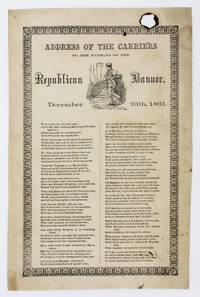
Address of the Carriers to the Patrons of the Republican Banner. December 25th 1861 caption title
Nashville 1861. Good plus. Small broadside approximately 11 x 7.25 inches. Creased along lower edge; ink burn causing a dime-size paper loss at upper right slightly affecting border plus a few additional stray ink marks. Later faint pencil annotations on blank verso. Moderate tanning and dust soiling. A scarce Confederate carrier's address published on Christmas in Nashville during the first year of the Civil War. The Republican Banner was formed in 1837 from a merger of two other periodicals and was the first permanent daily newspaper to serve the Nashville area as well as the first to operate its presses by steam. Tennessee officially seceded from the Union on June 8 1681 but Nashville surrendered to Gen. Grant's troops on February 23 1862 whereupon the Republican Banner suspended publication for the remainder of the war. As a result the present broadside is only carrier's address issued by the paper that is also a Confederate imprint. The text is printed in two columns with in a decorative border and the title is illustrated with a vignette of a newsboy making a delivery. The verse itself exults in the success of the Confederate rebellion thus far regaling its reader with the progress of secession and naming the recent battles that were Confederate victories including Fort Sumter Bull Run Bethel Lexington Leesburg Springfield Oak Hill and Belmont due to the supposed righteousness of the Southern cause and its superior fighting spirit:<br /> <br /> "'Twas Southern valor won the undying name / Of conqueror o'er the unconquered till that hour. / And when upon Manassas' awful plain / The Federal hordes fled back aghast in woe / Not courage only heaped the field with slain / The majesty of right o'erwhelmed the foe."<br /> <br /> The broadside also mentions somewhat optimistically England’s support of the Confederacy and names specific figures including Generals Lee Beauregard Johnson and President Jefferson Davis among a number of others as emerging Confederate heroes. Parrish & Willingham record a single copy at Vanderbilt and OCLC adds nothing further. A rare example of a Confederate carrier's address. <br /> Parrish & Willingham 6498. unknown
Referentie van de boekhandelaar : 6140
|
|
|
[CARTOLINA POSTALE, PRIMA GUERRA MONDIALE].
Cartolina postale originale, non viaggiata, dedicata al Prestito Nazionale per la prima guerra mondiale. Illustrata da Enrico Sacchetti a colori, raffigura due "soldatacci" germanici con il capo chino. Sotto al disegno la scritta: "Sottoscrivete! Si arrenderanno".
Lievi tracce d'uso.

|
|
|
[Centre d'Etudes Généalogiques Rhône-Alpes]
GENEALOGIE et HISTOIRE
N° 169 (Décembre 2016) : 68 pages, format 210 x 295 mm, illustré, broché, CEGRA, bon état
Referentie van de boekhandelaar : LFA-126733180
|
|
|
[Centre d'Etudes Généalogiques Rhône-Alpes]
GENEALOGIE et HISTOIRE
N° 136 (Décembre 2008) : 72 pages, format 210 x 295 mm, illustré, broché, CEGRA, bon état
Referentie van de boekhandelaar : LFA-126733205
|
|
|
[CE JOUR LA ] - RYAN (Cornelius) -
Le jour le plus long.
Paris, Robert Laffont, 1965 ; in-8, 274 pp., br. Broché bon état - 6 juin 1944.
Referentie van de boekhandelaar : 201506468
|
|
|
[CE JOUR LA ] - RYAN (Cornelius) -
Le jour le plus long.
Paris, Robert Laffont, 1960 ; in-8, 274 pp., br.
Referentie van de boekhandelaar : 201315195
|
|
|
[CE JOUR LA ] - RYAN (Cornelius) -
Le jour le plus long.
Paris, Robert Laffont, 1960 ; in-8, 274 pp., br.
Referentie van de boekhandelaar : 201315194
|
|
|
[CHAMBONNET Albert] LE GOUIC Olivier & RAVOYARD Alain
Albert Chambonnet (1903-1944) - Faire face
Villefranche-sur-Saône, Editions du Poutan, 2024, 16,5 x 23, 290 pages sous couverture souple illustrée. Iconographie noir & blanc et couleurs. "Lyon, 27 juillet 1944, les Allemands extraient cinq résistants de la prison de Montluc. En représailles d'un attentat perpétré la veille contre un restaurant de Bellecour fréquenté par les occupants et leurs supplétifs français, les prisonniers sont exécutés devant les passants et leurs corps … Lyon, 27 juillet 1944, les Allemands extraient cinq résistants de la prison de Montluc. En représailles d'un attentat perpétré la veille contre un restaurant de Bellecour fréquenté par les occupants et leurs supplétifs français, les prisonniers sont exécutés devant les passants et leurs corps laissés au sol pour l'exemple. Parmi eux Albert Chambonnet, "Didier" dans la Résistance, militaire de carrière, chef des forces Françaises de l'intérieur pour toute la région Rhône-Alpes avant son arrestation. Le veilleur de pierre, édifié place Bellecour en 1948, rend hommage à ces cinq hommes. Le colonel Chambonnet est honoré à Cerdon au cimetière du Val d'Enfer où il est inhumé avec ses compagnons de lutte des maquis de l'Ain et du Haut-Jura. L'Armée de l'Air, son corps d'origine, a donné son nom à la Base aérienne 278 d'Ambérieu-en-Bugey. Son souvenir, celui de son engagement et de son sacrifice demeurent donc, mais sa vie nous était pratiquement inconnue jusqu alors. Olivier Le Gouic et Alain Ravoyard ont comblé cette lacune, nous permettant de découvrir le parcours édifiant et passionnant de ce fils de mineur de Bessèges dans le Gard qui rejoint l'aviation militaire dès ses dix-huit ans. Sous-officier mécanicien, puis instructeur avant d'être affecté à la 6e escadrille engagée lors de la Grande Révolte syrienne. La fondation d'une famille, les idées politiques, "l'accès à l'épaulette". Enfin la guerre, la Résistance dès 1942, le grand organisateur qui se révèle dans la mouvance de Jean Moulin, l'accès aux plus hautes fonctions, sa tête mise à prix par les Allemands... La trace profonde qu'il a laissé. Ce travail d'historien, très bien documenté et illustré, s'adresse au public le plus large. Son ambition ultime est que la mémoire de " Didier" puisse être une source d'inspiration pour nous tous et particulièrement pour les jeunes générations."
Referentie van de boekhandelaar : HISTOFRA39450000725

|
|
|
[CHANTIERS de JEUNESSE FRANCAISE].-
Amicale Nationale des Anciens des Chantiers de la Jeunesse Française. A. N. A. C. J. F. ANNUAIRE 1983.
in 8° broché, 333 pages ; la page de titre manque.
Referentie van de boekhandelaar : 68667
|
|
|
[CHEVAUX, GUERRE 39/45 ] - PIEKALKIEWICZ (Janusz) -
Chevaux et cavaliers de la 2e guerre mondiale.
Paris, Editeur maloine , 1986 ; in-4, 294 pp., cartonnage de l'éditeur. Cartonnage pleine toile bleu avec vignette très bel état.
Referentie van de boekhandelaar : 201504771
|
|
|
[CHOCOLAT PUPIER. SAINT-ETIENNE. POULBOT].-
Hôpital PUPIER. Noël 1917. Menu illustré par POULBOT.-
S.l. 1917. 1 feuille de 190 x 249 mm richement illustrée en couleurs par POULBOT. Très bon état.
Referentie van de boekhandelaar : ORD-2269
|
|
|
[CHAMPAGNE] - MOREAU-NELATON (Etienne).-
La Cathédrale de Reims.
P., Librairie Centrale des Beaux-arts, sans date, in 4° relié pleine toile illustrée de l'éditeur, 109 pages de texte suivies de 135 planches hors-texte montées sur onglets.
Referentie van de boekhandelaar : 9928
|
|
|
[CHAMPAGNE] - EYSSAUTIER (G.).-
La cathédrale de Reims livrée aux flammes par les allemands.
Marseille, Guiraud, 1914, grand in 8° broché, 81 pages ; couverture illustrée.
Referentie van de boekhandelaar : 59837
|
|
|
[CHANZY (Général)] - LAUR (Jean).-
Le Général Chanzy.
1880 Abbeville, Paillart, sans date (vers 1880), in 8° broché, 238 pages ; illustrations hors-texte ; couverture illustrée.
Referentie van de boekhandelaar : 77217
|
|
|
[CHARLY BARAT, HUMOUR] - SARG (Béatrice et Freddy), BARAT (CHARLY) -
Les aventures de Henner, Philomène, Charele et les autres.
Strasbourg, Le verger editeur, 2002 ; in-8, 111 pp., broché, couverture illustr. Illustrations de Charly Barat -.
Referentie van de boekhandelaar : 202002626
|
|
|
[CHURCHILL] - GUEDALLA (Philipp).-
Portrait de Monsieur Churchill. (Mr. Churchill, a portrait).
1946 Paris, La Jeune Parque, 1946, petit in 8° broché, 251 pages ; non coupé ; index.
Referentie van de boekhandelaar : 54680
|
|
|
[CHAR René]. GUERRE Pierre.
RENÉ CHAR.
Rome. Botteghe Oscure. 1952. Grand in-8° broché. 30 pages. E.O. 1/1.500 du tirage ordinaire. [50 Fabriano / 1.500 ordinaires]. Envoi autographe signé de Pierre Guerre.
Referentie van de boekhandelaar : 9525
|
|
|
[CHATEAU DE DIJON] Mr Le Maréchal Claude-Louis-Hector de VILLARS + Claude Le BLANC - Secrétaire d'État de la Guerre
REPONSE DU CONSEIL DE LA GUERRE A MR DE GRANGE COMMANDANT LE CHATEAU DE DIJON : A PROPOS DU DEMELE ENTRE LE SIEUR DE LIGNE (DELIGNY) CAPITAINE D'UNE COMPAGNIE D'INVALIDES ET LE SIEUR PETITY, LIEUTENANT DE LA DITE COMPAGNIE : SANCTION : MISE EN PRISON IMMEDIATE POUR TROIS MOIS , PARIS LE 22 FEVRIER 1718
Paris 1718 une lettre de 2 pages, sur papier vergé ligné, filigrané "fleur de lys", format : 20 x 32,5 cm, manuscrite à l'encre brune sur les deux pages, lettre adressée à Mr Vitte des Granges Commandant du Chateau de Dijon, signatures manuscrites de messieurs : Mr Le Maréchal Claude-Louis-Hector de VILLARS + Claude Le BLANC Secrétaire d'État de la Guerre, PARIS LE 22 FEVRIER 1718,
Referentie van de boekhandelaar : 22172
|
|
|
[CHIEZE (Jean)] - ROUX (Catherine).-
Triangle rouge. Illustré par Jean CHIEZE.
Lyon, Audin, 1946, grand in 8° carré broché, 230 pages ; petits défauts à la couverture .
Referentie van de boekhandelaar : 51431
|
|
|
[CHURCHHILL (Winston)] - LEMONNIER (Léon).-
Winston Churchill.
P., Plon, 1944, in 12 broché, 246 pages ; couverture illustrée (petit accident au dos).
Referentie van de boekhandelaar : 70052
|
|
|
[CHACK (Paul)] Comité d'Action Anti-bolchevique
Les naufrageurs de la France. Il existe un complot contre la sûreté de l'Etat.
Communistes, Gaullistes et Juifs sont dénoncés ensemble comme les "naufrageurs de la France". Le tract incite pour finir à dénoncer les auteurs d'actes de résistance. "Envoyez-nous tous renseignement utiles permettant de déjouer le complot ourdi contre la France".
|
|
|
[Charles H Lawrence][World War II] [Battle of the Bulge]
1942-1945 World War II Archive of Private Charles H. Lawrence. Killed During the Battle of the Bulge January 20th 1945
America Europe 1945. Archive. Very good. Manuscript Archive. 2 three ring black binders with 41 letters and misc. ephemera. Letters were addressed to family and in Chester Vermont mainly to his brother Ray and his Aunt Florence. The letters are sorted into three phases: prewar U.S. training camps and from places in Europe. 2 letters were written by Private Lawrence before he enlisted in the Army circa 1942. <br /> <br /> 20 letters were written from training camps in the United States 1943-44. 12 letters were written by Lawrence somewhere in France Belgium and Germany from June 1944 to January 1945. The remaining 7 letters were written by family members before and after Private Lawrence was killed in action December 1944 - February 1945. These letters were returned to his family with the word "deceased" written or stamped on the envelopes. The archive also consists of 8 envelopes not matching the dated letters two change of address postcards 5 pieces of foreign money and misc. news clippings relating to the Allied Forces actions late in the War. One non-letter item included in the archive is a hand drawn December 25th 1944 Christmas greeting presumably drawn by Lawrence. In these letters Charles Lawrence is often homesick inquires about things in Vermont and how he is getting along in the Army. Many of his letters begin with a variation of "I am still in the land of the living." The handwriting is legible for the most part and the condition of the archive is very good. The first ring binder of letters encompasses Private Charles Lawrence's pre War draft and his training in various U.S. camps. Training camp letters were written on nice Army letterhead paper from places such as Fort Devin Massachusetts; Fort McClellan Alabama and the U.S. Naval Construction Training Center Camp Peary Williamsburg Virginia. While training in the States Private Lawrence yearned to return home before he was shipped off to Europe. "If I get back to the States after I leave you can bet I wont stay in this army if I can help it." <br /> <br /> The second ring binder of letters begins with a letter dated June 1 1944 from some unknown location. The letters from Europe are censored and some letters were sent by V-Mail. While in Europe Charles asks about events back home and provides some general not to specific training and battle information. In the second letter in this binder dated June 9th Private Lawrence writes "Dear Aunt Florence and All: How are you folks feeling today hope you are feeling fine and dandy. Well here I am in a new camp and I am sorry to say that I cannot tell you where I am or the name of the camp. The camp is very good good climate food and it has lot of mountains around it." He adds "We do not get any training at this camp because they don't want anyone to know how many troops we have here at this camp but we have to go on two 11 miles hike every week." <br /> <br /> The letter dated June 11th one week after D-Day June 4 1944 has Lawrence awaiting transport to occupied France. He writes "This is my 40th letter since I came back from my furlough.The P.X. here is open all day and every time there isn't anything to do we all head for it most of us are broke including me."<br /> <br /> As the War heats up after June one comment in Lawrence's letters stands out:<br /> <br /> "I have been lying in a fox hole for two weeks now the only time when we can get up and walk around is at night it gets kinda tired laying in the fox holes eating H rations you can't stick your head out of the hole in the day time because you will get your head blowed off if you do so we just lay there.Boy when I get home I wont fuss about anything so long as I live I have been through everything now and it isn't any fun either." <br /> <br /> As the battles in Europe intensified in the fall of 1944 it appears Private Lawrence had been in very dangerous situations. In his November 23 1944 letter he writes ".a lot has happened to me since I last wrote to you last I have been in a lot of tough spots tough enough to lose all of my personal belongings such as mail letters that I hadn't answered toilet articles my pack overcoat raincoat etc. I am going to write to Barb and see if she will buy me toilet articles. My stationary is all gone.Today is Thanksgiving and I hope you folks had a good meal I haven't seen any turkey for us yet."<br /> <br /> On December 21st 1944 Charles writes his brother Ray from "Somewhere in Germany". He tells his brother "I have been busy as ever for the last few days and it looks like I will be for quite some time." The last full letter in this archive written by Private Lawrence is dated January 4th 1945. He writes to Aunt Florence & all the gang. He tells Aunt Florence "Well here I am again I thought I would write you a letter as long as I have some extra time this isn't much for news this time because I wrote Glady's a little this morning and told her all the news that there was at hand but when this letter is finished you will at least know that I am still alive & kicking." He signs off this letter with this - "Got to go now but I will be back before to long hope everyone is okay.".<br /> <br /> Private Charles Lawrence died 16 days later in Europe on January 20 1945 at the age of nineteen. He was buried in the American Cemetery in Luxembourg.<br /> <br /> From wikipedia:<br /> <br /> The 5th Infantry Division Mechanized—nicknamed the "Red Diamond"1 the "Red Devils" or "die Roten Teufel"—was an infantry division of the United States Army that served in World War I World War II and the Vietnam War and with NATO and the U.S. Army III Corps. It was disbanded and deactivated on 24 November 1992.2<br /> <br /> During World War II after D-Day the 5th Infantry Division after two years of training landed in Normandy on Utah Beach 9 July 1944 over a month after the initial D-Day landings and four days later took up defensive positions in the vicinity of Caumont. Launching a successful attack at Vidouville 26 July the division drove on southeast of Saint-Lô attacked and captured Angers 9–10 August captured Chartres assisted by the 7th Armored Division 18 August9 pushed to Fontainebleau crossed the Seine at Montereau 24 August crossed the Marne and seized Reims 30 August and positions east of Verdun. The division then prepared for the assault on Metz 7 September.10 In mid-September a bridgehead was secured across the Moselle south of Metz at Dornot and Arnaville after two attempts. The first attempt at Dornot by the 11th Infantry Regiment failed. German-held Fort Driant played a role in repulsing this crossing. A second crossing by the 10th Infantry Regiment at Arnaville was successful.11 The division continued operations against Metz 16 September to 16 October 1944 withdrew then returned to the assault on 9 November. Metz finally fell 22 November. The division crossed the German border 4 December captured Lauterbach a suburb of Völklingen on the 5th and elements reached the west bank of the river Saar 6 December before the division moved to assembly areas.<br /> <br /> On 16 December the Germans launched their winter offensive in the Ardennes forest the Battle of the Bulge and on the 18th the 5th ID was thrown in against the southern flank of the Bulge helping to reduce it by the end of January 1945. In February and March the division drove across and northeast of the Sauer where it smashed through the Siegfried Line and later took part in the Allied invasion of Germany.<br /> <br /> The 2nd Infantry Regiment is an infantry regiment in the United States Army that has served for more than two hundred years. It was constituted on 12 April 1808 as the 6th Infantry and consolidated with 4 other regiments in 1815 to form the present unit.1. When the Battle of the Bulge began the 2nd Infantry Regiment moved to the battle zone in the area of Nideranven Luxembourg. In January 1945 the 2nd Infantry Regiment forced a crossing of the Sauer River and attacked into the Siegfried Line. The regiment then crossed the Rhine River near Oppenheim and secured the crossing for other Third Army units. The unit then spearheaded the attack into Czechoslovakia and was located near the town of Volary when the word came to cease all forward movement at 08:31 on 7 May 1945. unknown
Referentie van de boekhandelaar : 33388
|
|
|
[Charleston Daily Courier] [AS Willington & Co] [Civil War] [ Confederate States of America] A S
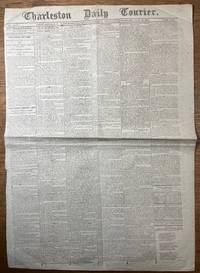
Charleston Daily Courier. Charleston S.C. Confederate States of America Wednesday Morning June 22 1864
Charleston: A. S. Willington & Co 1864. First Edition. Newspaper. Good. Newspaper. Approximately 23" x 16.5". Single sheet two pages. Folded. Light vertical crease. Stitching removed on the extreme left edge. A few tiny pin holes to the paper. <br /> <br /> Contents include the latest Civil War news reporting including General Lee's battle success; General Johnston's army victory at Kennesaw Mountain; the Siege of Charleston Three Hundred and Forty-Ninth Day and several more news items. On the back page is the publisher information advertisements and a printed act of authority to levy taxes for support the war effort. A. S. Willington & Co unknown
Referentie van de boekhandelaar : 35376
|
|
|
[Charleston, South Carolina] [Civil War] [Reconstruction era] Fontaine, F G de (Business Manager)
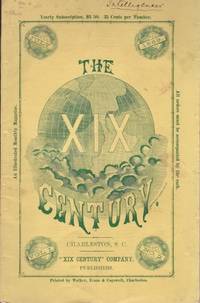
The XIX Century. Vol. I. No. II. July 1869
Charleston: XIX Century 1869. First Edition. Periodical. Good. Periodical. Pages 85-167 5 pages of advertisements. Yellow illustrated stitched wraps. titles on the front and on the paper spine. Light wear to the covers. Small closed edge tear front cover. Rear cover has a small torn piece with no loss of content. "Intelligencer" written in old ink top of the front cover. Pages are clean and issue is in good condition. <br /> <br /> Contents of this Reconstruction era publication include derogatory depiction's by 'Sooty-Graphs' of African Americans soldiers pages 166-167; "Shoulder to Shoulder. Reminiscences of Confederate Camps and Fields.The Bombardment of Fort Sumter - Second Day - April 13 1861"; "Duels and Dueling"; "The Blockade Runners of the Confederacy"; "The Parable of Southern Politics."; and many other topics. XIX Century unknown
Referentie van de boekhandelaar : 34735
|
|
|
[Chattanooga] [Tennessee] [Civil War] McDuffy, Chas D (compiled and edited by)
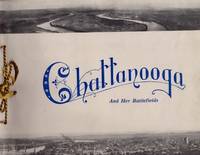
Chattanooga and Her Battlefields
Chattanooga: MacGowan-Cooke Printing Company 1912. Soft cover. Very good. Oblong string tied soft cover. 64 pages. Illustrated with black and white photographs. Light shelf and edge wear to the covers. MacGowan-Cooke Printing Company unknown
Referentie van de boekhandelaar : 34680
|
|
|
[CHINA - WORLD WAR II MAP].
China. Southeast Coast.
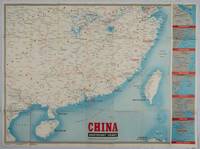
New York.: Army Information Branch. 1944. Very large folding colour map main map 85 x 95.5 cm plus 6 sidebar maps together 85 x 14.1 cms; sheet 88 x 118 cms several fold splits archivally sealed in good condition. Large colour wartime map issued by the U.S. Army Information Branch in 1944 the main map showing Shanghai to French Indochina with the islands of Formosa and Hainan scale 7 inches to 200 miles. At the right edge are inset maps of Shanghai Wenchow Foochow Swatow Canton and Hong Kong. Map issued to accompany Newsmap Volume III No. 51B. . Army Information Branch. unknown
Referentie van de boekhandelaar : 195577
|
|
|
[CHINA - MAP - WORLD WAR II].
Newsmap for the Armed Forces. 291st Week of the War - 173rd Week of U.S. Participation. Monday 9 April 1945.
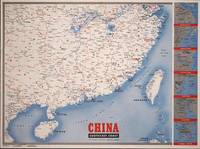
New York.: Army Information Branch. Volume III No. 51F. 9 April1945. Folding colour map and six inset maps in a vertical panel 88 x 119 cms sheet and on the recto circular map of Europe smaller inset map of Asia and of the Ryukyu Islands descriptive text original folds in very good bright condition. Scarce Newsmap of "China Southeast Coast" from Shanghai to French Indochina with the islands of Formosa and Hainan. At the right edge are inset maps of the vicinities of Shanghai Wenchow Foochow Swatow Canton and Hong Kong. On the verso is a large map of the European theatre of operations centred on Berlin a map of the Pacific area noting the American occupation of Okinawa with a detailed map of this island. In unusually fine bright condition. . Army Information Branch. unknown
Referentie van de boekhandelaar : 194660
|
|
|
[CHINA - RUSSIA - JAPAN - WORLD WAR II MAP] BURKE, HOWARD
Japan and Russia Will Divide China. Signs Increase That Northern Area and Lower Yangtze Basin Will be Carved Into Puppet States by Stalin and Mikado Leaving South Largely at Mercy of Both.
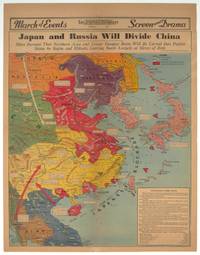
Los Angeles.: Los Angeles Examiner. 1940. Printed colour pictorial map on a single newspaper leaf 42.3 x 39.9 cms; 54.3 x 42.5 cms sheet archivally laid down on linen slight discoloration to lower centrefold and sheet slightly age-toned but in very good condition. A striking geopolitical map by Los Angeles Examiner artist Howard Burke covering China Japan Southern Russia and the northern part of French Indochina and Siam showing how the "Aggressors Divide China." Areas under Japanese occupation are shown in red and their naval blockade shown by an arc of naval vessels with vivid arrows indicating lines of supply. Text labels including sources of agricultural and raw materials provide a dynamic overview of the geopolitical situation and show the influence of American scientific illustrator and cartographer Richard Edes Harrison who argued for examining geographic issues from multiple perspectives and Los Angeles Times artist Charles Owens. . Los Angeles Examiner. unknown
Referentie van de boekhandelaar : 209821
|
|
|
[CHINA - WORLD WAR II MAP].
China Southeast Coast. Newsmap for the Armed Forces 291st Week of the War.Week of 27th March to 3rd April 1945.
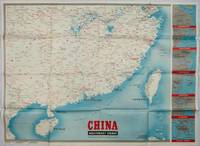
New York.: Army Information Branch. 1944. Very large folding colour map main map 85 x 95.5 cm plus 6 sidebar maps together 85 x 14.1 cms; sheet 88 x 118 cms and on the verso a large circular map centred on Europe the Ruhr Valley & Vienna with smaller maps of Southeast Asia and the Philippines and a map of Okinawa; both in very good unblemished condition. The main map of Southeast China includes inset maps of the region around Shanghai Wenchow Foochow Swatow Canton and Hong Kong and on the verso text as well as the maps Eastern Europe South Pacific Okinawa reporting on the war: Americans Isolate Ruhr; Vienna Threatened; Ryukyus Invaded. . Army Information Branch. unknown
Referentie van de boekhandelaar : 215448
|
|
|
[CHINA -- CHINESE CIVIL WAR & MISSION BUILDING]. [GEBHARDT, Arnold; SIMON, Gertrude (Photographers); MUELLER, Reinhold "RJ" (Pho
Enshih formerly Shihnan picture album. Building Committee. . . ; Description of pictures by numbers. . . An outstanding photo album filled with numbered photographs together with descriptive list and introduction by Rev. Mueller assembled following the Lutheran Church Missouri Synod missionaries return to Shihnan station in the aftermath of the Communist-Nationalist Civil War 1927-1930.
Enshih Shihnan Hubei China: R.J. Mueller Rev. Gebhardt Miss Simon LCMS ca. 1930-1937. Two vols. 1st - Oblong folio. 11.25 x 15 in. 48 pp unpaginated. thick black paper stock w/ 103 original silver gelatin photographs sized 2.75 x 3.5 in. all neatly numbered in ink MS at corners affixed to the leaves. Contemporary black flexible board post-binder punch-sewn & glued at spine in black paper paper title label partially torn on front cover Building Committee title label affixed to first page minor chipping edgewear to fore-edges some scuffing tidemark to fore-edges still a VG- exemplar w/ all images with bright strong contrast; 2nd - 4to. 8 leaves carbon copy typescript on onion-skin ruled paper some ink annotations corrections 1 pencil MS annotated correction still VG signed by R.J. Mueller on first leaf dated April 24 1937 from the library of David G. Kohl 1946-2025 former art teacher at the Hong Kong International School musician artist and historian. A remarkable photo album with images shot by three different Lutheran Church Missouri Synod LCMS missionaries in China along with the descriptive contents list compiled by Rev. R.J. Mueller detailing the purpose and composition. He writes that the Enshih Shihnan Mission had prepared three albums “one for the Mission Board one for the Building Committee of General Conference and one at the Enshih Station. The numbers all agree. However not all pictures listed appear in all books.†This “Building Committee†album was intended to focus primary on the structures homes chapels of the mission as well as surrounding areas and was intended to aid in speeding up communications for fundraising and building affairs issues as correspondents could then merely refer to the master list of numbers held by all three parties. Enshih China was one of the final mission stations established by the LCMS far from their other missions and when Gebhardt returned to Enshih following the Civil War in 1928 there was significant damage to the mission structures to be repaired. Looting by bandits and marauding soldiers had caused over $ 2000 in damage but was encouraged to find that the Lutheran evangelist Shen had continued the mission chapel school orphanage. He would later be joined by Mueller and others although primarily composed of Chinese Staff. These photos in the album includes views of Mueller’s residence windows frames and gutters looted; screens torn doors boarded up as well as views of the native house and threshing floor adapted into an orphanage at Yao Wan after 1930. Several others show the extent of the protective walls built around the properties farm houses the gates as well as farms bridges and nearby fields at Enshih. Landmarks such as rocks shaped like Elephants in the river and Big and Little Hog creek below farmland. A very nice series of photos depict the Ts’i Ts-ung-fu funeral the blind deaf and other orphans about 1931 as well as textiles drying in the sun. Other photos capture the Ch’i-li-ping market fortune teller temple noodle stand and the T’ai shan shrine at Ch’i-li-p’ing. More photos depict Hu Ping-chih the orphanage secretary Yuen Ye-chih cashier in 1934 Hsieh T’i-ya seminary student who died later in 1937; along with the mission pulpit nearby streets and the rear view of the Yao Wan houses.Of additional interest are the images of the rugged roads to Liang Shui-chin the temple and steep steps drying opium in Kuan-p’e which was a small town between the East Gate and Yao Wan before opium raising was banned in 1934; along with the nearby Ch’ing-Ching Clear River at the high water stage the front of the True Light Chapel in 1934 as well as the gravestone of Mr. & Mrs. Wang Japanese-Lutherans who had died in 1930. The final photo No. 169 again shows the Clear River below the city. Mueller 1905-1998 graduated from seminary in 1929 and left for China with his wife Dorothy for the Evangelical Lutheran Foreign Mission Board returned briefly to the U.S. from 1937-1940 spent 1939-1942 teaching at a Lutheran seminary in China while being bombed by the Japanese and also served in Shanghai where he would supervise the Lutheran Hour and Lutheran Hour offices. Although he and his wife briefly returned to the United States in 1946 following World War II they subsequently served again in Shanghai China into the early years of Communist rule by Mao tse-tung before returning again to the U.S. See: David Kohl Lutherans on the Yangtze: A Hundred Year History of the Missouri Synod in China 2014 pp. 103 124 131 132 166 174 99-131. R.J. Mueller, Rev. Gebhardt, Miss Simon, LCMS, unknown
Referentie van de boekhandelaar : 64035
|
|
|
[CHINA -- WORLD WAR II]. LLEWELLYN, Bernard
I left my roots in China.
New York: Oxford University Press 1953. 8vo. 175 1 pp. Photo frontisp. numerous photo plates. Tan tweed boards gilt lettering on spine w/ d.j. photo cover art of Chinese refugees NF/NF copy from the library of David Kohl 1946-2025 former art teacher at the Hong Kong International School musician artist and historian. First American edition of this well-written memoir detailing the author’s experiences driving medical supplies landed at Rangoon over the Burma Road during World War II into the middle of China resulting in travels over 2 1/2 years in Free China along the edges of Chinese Tibet visiting Beijing staying with leper colonies delousing the Chinese Army and working with refugees on the Yellow River. Oxford University Press, hardcover
Referentie van de boekhandelaar : 64144
|
|
|
[CHINA -- SECOND SINO-JAPANESE WAR]. [JIANG, Wenxin] 江文新
In Chinese 列強è»å‚™ - Lie qiang jun bei Military readiness of the great powers.
Changsha: 商務å°æ›¸é¤¨ - Shangqu yinshuguan Commercial Press Minguo 26 1937. 8vo. 362 18 pp. With photo illustrations throughout tables charts several large folding tables at rear. Printed softcovers as issued minor chipping head & foot of spine old dampstain ring front cover chipping edgewear uniform toning some scuffing & wear to a couple fore-edge creases of folding tables at rear still a G- copy from the library of Otto C. Winzen 1917-1979 pioneering German-American aeronautical engineer was interned during World War II and later significantly advanced material and construction of high-altitude balloons after World War II. First edition of this very scarce Chinese analysis of the military build-up by the major powers around the World with a focus on aviation developments by Allied powers Nazi Germany and more importantly the Imperial Japanese Army air forces. There are references to the 1931 Mukden incident the Japanese occupation of Manchuria and the following events leading to the Second Sino-Japanese War leading to events such as the Rape of Nanking and World War II. Worldcat locates 3 copies National Lib. of China - Beijing Wuhan Univ. U of Hong Kong. 商務å°æ›¸é¤¨ - Shangqu yinshuguan, [Commercial Press], paperback
Referentie van de boekhandelaar : 63311
|
|
|
[CHINA -- SINO-JAPANESE WAR NAVAL HISTORY]. [SINO-JAPANESE WAR COMMEMORATIVE NAVY PHOTO ALBUM PUBLICATION COMMITTEE].
In Japanese. å ±é“写真海è»ä½œæˆ¦è¨˜éŒ„ HÅdÅ shashin kaigun sakusen kiroku Report photographs: Navy strategic record: the continent.
Tokyo: å›½éš›å ±é“ Kokusai hodo æ˜å’Œ Showa 19 1944. Tall 8vo. 232 pp inpaginated. With 100’s of photo illustrations two-colour maps sections chapter titles in green & black. Blue publisher’s cloth white lettering on spine turquoise-coloured lettering front cover some scuffing & rubbing edgewear minor sunning to spine still G copy from the library of Otto C. Winzen 1917-1979 pioneering German-American aeronautical engineer was interned during World War II and later significantly advanced material and construction of high-altitude balloons after World War II. First edition of this very scarce photographic history of the Imperial Japanese movements battles and actions in the Sino-Japanese War and across China later in World War II. Many of the photos and text focus on the impact of the Japanese Naval Air Force with photos of amphibious aircraft aerial bombing campaigns and continued action across Japanese- and Chinese-controlled areas. Worldcat locates 2 copies TX A&M National Diet Library. å›½éš›å ±é“ Kokusai hodo, hardcover
Referentie van de boekhandelaar : 63313
|
|
|
[CHINA -- KOREAN WAR]. RIGG, Lt Col Robert B
Red China’s fighting hordes: a realistic account of the Chinese Communist Army by a U.S. Army officer who gained his intimate knowledge of this huge incongruous force the hard way.
Harrisburg PA: Military Service Publishing Co. 1952. 8vo. xiv 378 pp. Double-page title numerous photos maps text illustrations. Gold pictorial publisher’s cloth lettering & illustration in red & black minor rubbing edgewear w/ d.j. cover art repeated minor chipping & tears to spine old tape repair head of spine scuffing soiling still VG-/G- copy from the library of David Kohl 1946-2025 former art teacher at the Hong Kong International School musician artist and historian Paul Elder’s Books label on rear pastedown. Second printing of this eye-witness account to the training and formation of the Chinese Communist Army following World War II while serving as an American observer with the Soviet Occupation forces in Manchuria. He offers detailed Army military intelligence how the army was organized training methods and more as the Chinese continued to be a growing threat during the Korean War. Military Service Publishing Co., hardcover
Referentie van de boekhandelaar : 64247
|
|
|
[CHINA -- SINO-JAPANESE WAR].
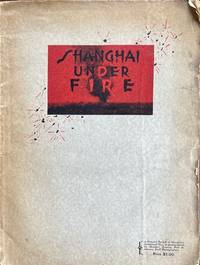
Shanghai under fire. July -- September 1937. A pictorial record of Shanghai’s undeclared war as photographed by Shanghai Evening Post & Mercury Staff photographers.
Shanghai China: Post-Mercury Co. 17-21 Avenue Edward VII Shanghai Evening Post & Mercury 1937. 4to. 9 x 12 in. xv 1 88 pp. With 100s of text photo illustrations on gray-blue tinted paper. Colour-illustrated softcovers cover art photo of red & black tinted smoking skyline of Shanghai w/ bomb bursts illustrated on front cover “Shanghai Area War Maps†on endpapers -- surprisingly light interior toning to the XV pp. of text on light-gray tinted paper bumping & wear at covers some dustsoiling chipping head & foot of spine still G copy stapled as issued. First edition 1st printing of this scarce illustrated pro-China work documenting the opening campaigns by the Imperial Japanese Army Air Force and Navy during the Second Sino-Japanese War. Hostilities had increased throughout the 1930s following the first Sino-Japanese War in which Japan had conquered and absorbed Manchuria into the Japanese Empire. Chiang Kai-shek’s nationalist forces joined with the warlords of Hunan and Szechwan provinces to fight the Japanese after a number of provocations in the summer of 1937. Chiang Kai-shek believed that by initially attacking and bombing Japanese naval installations and troops in and around Shanghai he would force the foreign powers to ally with China to fight against Japan to protect their enormous investments in southern China. The Nationalist Chinese armies held out for three months against ferocious bombardment and shelling by the Japanese from planes based in Taiwan and ships on the Huangpu River inflicting huge numbers of casualties on the Chinese and eventually forcing the Chinese to retreat from Shanghai to Nanking with Japanese reinforcements constantly decimating them. These images show victims at the South Station bombings caring for Chinese wounded Chinese women training as soldiers and nurses in the aftermath of the North Station Area shelling and bombing bitter retreat by Chinese soldiers the advances and marching of Japanese forces in Shanghai and beyond. This would later be revised and reissued in March 1938; See: Dorothy Perkins Japan Goes to War: A Chronology of Japanese Military Expansion 1997 pp. 127-135; Crittall in Shanghai -- Some Photos Unearthed December 22 2008. Post-Mercury, Co., 17-21 Avenue Edward VII, Shanghai Evening Post & Mercury, paperback
Referentie van de boekhandelaar : 60087
|
|
|
[CHINESE VIETNAM WAR PAPERCUT].
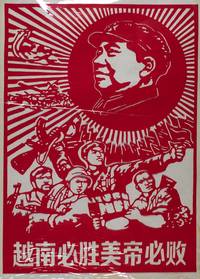
越南必胜 美帝必败.Yuenan bi sheng mei di bi bai. Chinese Vietnam War papercut - Vietnam Must Win and US Imperialism Must be Defeated.
No publication details. No date. Late 20th Century. Large Chinese Vietnam War papercut on red paper with paper backing. Lower section features four soldiers in uniform looking fiercely towards the enemy while carrying weapons like machine guns and grenades. Upper right section Mao's head and collar portrait the sun with its bold rays extending behind him red flags flying underneath the beaming sun military aircrafts and a tank also featured next to Mao's portrait. Very good. Text in Chinese reads "Vietnam Must Win and US Imperialism Must be Defeated" sheet measures 70 x 50.3cm. . No publication details. unknown
Referentie van de boekhandelaar : 160398
|
|
|
[CHINESE-AMERICANS -- WORLD WAR II]. LIN, Adet, Anor & Meimi [Hsiang Ju].
Dawn over Chungking.
New York NY John Day Co. 1941. 8vo. 240 pp. Blue publisher’s cloth gilt Chinese lettering front cover black lettering on spine in English & Chinese Chinese writing on endpapers for Longevity & Luck minor edgewear light uniform toning minor tidemark head of spine minor soiling rear joint w/ d.j. cover art photo of war damage from Japanese bombing illustration of three girls on back cover chipping & tears head & foot of spine minor closed tears edgewear still G/G- copy from the library of David Kohl 1946-2025 former art teacher at the Hong Kong International School musician artist and historian. First edition of this very scarce original memoir of Lin Yutang’s three daughters memoir of their pilgrimage to China following up their “Our Family†considered the first nationally printed diary/autobiography of children in America and published nationwide. They write about crossing the Japanese lines during the Second Sino-Japanese War experiencing over 40 bombing air raids over three months and finally being repatriated back to the U.S. with their father Lin Yutang who had returned stateside to advocate for Wartime aid and support for China. Adet Lin 1923-1971 wrote under the pen name of Tan Yun and by this publication date had written “Girl Rebel†and later worked for the American Bureau for Medical Aid to China. Anor Lin 1926-2003 wrote the 1943 War Tide and would later become Editor in Chief for Reader’s Digest in Hong Kong for 33 years and Hsiang Ju Lin the youngest would become a Ph.D. in biochemistry and later cancer and AIDS researcher. John Day Co., hardcover
Referentie van de boekhandelaar : 64256
|
|
|
[Chisinau / Kishinev] Korn, Yitshak
KESHENEV: 200 YOR YIDISH LEBN IN DER HOYPTSHTOT FUN BESARABYE [KISHINEV]
1st Yiddish Edition. Original Publishers Cloth, 8vo, 416 pages. Includes illustrations and map. Includes Spanish Title page: Judios de Kischeneff. Translation of Yehude Kishinov, originally published in Hebrew. Vol III in the series, Besaraber Yidn. Includes bibliographical references (pages 412-416). The name of Kishinev became known to the world at large as a result of two pogroms. The first, initiated and organized by the local and central authorities, took place during Easter on April 67, 1903
.The pogrom was preceded by a poisonous anti-Jewish campaign led by P. Krushevan , director of the Bessarabian newspaper Bessarabets, who incited the population through a constant stream of vicious articles. One of the authors of the most virulent articles was the local police chief, Levendall. In such a heated atmosphere any incident could have dire consequences, and when the body of a Christian child was found, and a young Christian woman patient committed suicide in the Jewish hospital, the mob became violent. A blood libel , circulated by the Bessarabets, spread like wildfire. (It was later proved that the child was murdered by his relatives and that the suicide of the young woman was in no way connected with the Jews.) According to official statistics, 49 Jews lost their lives and more than 500 were injured, some of them seriously; 700 houses were looted and destroyed and 600 businesses and shops were looted. The material loss amounted to 2,500,000 gold rubles, and about 2,000 families were left homeless. Both Russians and Romanians joined in the riots. Russians were sent in from other towns and the students of the theological seminaries and the secondary schools and colleges played a leading role. The garrison of 5,000 soldiers stationed in the city, which could easily have held back the mob, took no action. Public outcry throughout the world was aroused by the incident and protest meetings were organized in London, Paris, and New York. A letter of protest written in the United States was handed over to President Theodore Roosevelt to be delivered to the czar, who refused to accept it. Under the pressure of public opinion, some of the perpetrators of the pogrom were brought to justice but they received very lenient sentences. L.N. Tolstoy expressed his sympathy for the victims, condemning the czarist authorities as responsible for the pogrom. The Russian writer Vladimir Korolenko described the pogrom in his story House No. 13 as did ?.N. Bialik in his poem Be-Ir ha-Haregah (In the Town of Death).On Oct. 1920, 1905, riots broke out once more. They began as a protest demonstration by the patriots against the czar's declaration of Aug. 19, 1905, and deteriorated into an attack on the Jewish quarter in which 19 Jews were killed, 56 were injured, and houses and shops were looted and destroyed: damages amounted to 300,000 rubles. On this occasion, some of the Jewish youth organized itself into self-defense units . The two pogroms had a profound effect on the Jews of Kishinev. Between 1902 and 1905 their numbers dropped from around 60,000 to 53,243, many immigrating to the United States and the Americas, while many more left after the second attack. The economic development of the town was brought to a standstill
.On July 17, 1941, Kishinev was occupied by German and Romanian units, who entered it together with units of Einsatzgruppe D. The massacre of Kishinev's Jews began immediately under the auspices of the Einsatzgruppe, and by the time the concentration of Jews into a ghetto was completed, about 10,000 had been slaughtered. ....On Oct. 4, 1941, deportations began to Transnistria , the first group containing 1,600 persons. After this, between 700 and 1,000 Jews were deported daily, the last group leaving on October 31. ...In Transnistria Jews were sent to various camps and ghettos, where two-thirds of them died from epidemics, hunger, and exposure. The exact number of dead is not known, but taking into account the proportion of those killed in Bessarabia from the time of the Romanian and German conquest until the deportations to Transnistria on the one hand, and the number of those who died in Transnistria on the other, it may be estimated that of the 65,000 Jewish inhabitants in Kishinev in 1941, 53,000 perished (JewishVirtualLibrary). SUBJECT(S): Jews -- Moldova -- Chisinau -- History. Joden. Ethnic relations. Kisjinev. Moldova -- Chisinau. OCLC: 11355859. Institutional bookplate and edgestamps, otherwise clean, spine lightly sunned, about Very Good Condition (YIZ-20-38)
|
|
|
[Christian Front]
[FLYER] GREAT PRO-AMERICAN MASS MEETING IN BEHALF OF FREE SPEECH AND AMERICANISM WEDNESDAY, MAY 24, AT 8:30 P.M. CARNEGIE HALL
1st edition. No Date [1939]. Small broadsheet. 1 page. 22 cm. Single sided flyer for an Rightwing mass meeting; content of the flyer are as follows: SPEAKERS: BOAKE CARTER Radio's Fearless News Editor, on the timely subject FREE SPEECH AND THE NEWS JOHN E. KELLY Brilliant, well-posted writer and lecturer will speak on JOHN L.LEWISPUBLIC ENEMY No. 2 and others. PresidingGEORGE U. HARVEY Dynamic, Capable Borough President of Queens President of WE AMERICANS. This meetingis under the sponsorship of: American Federation Against Communism, American Patriots, The Christian Front. Tickets may be purchased from: CARNEGIE HALL, 7th St. and 7th Ave., New York, N. Y. IROQUOIS HOTEL, 49 West 44th Street, New York, N. Y. WALTER OGDEN, 413 West 59th Street, New York, N. Y. Admission 25c - 40c Reserved 99c. Arthur Derounian, on page 52 of the book Under Cover, noted the content of Kellys speech as follows: John Eoghan Kelly, Christian Front organizer and promoter of the Franco cause in America, talked on Public Enemy Number Two-John L. Lewis who, according to the inside information obtained exclusively by Kelly, had "100,000 armed Communists rarin' to Sovietize America. Who is Public Enemy Number One? I asked of the man next to me. Roosevelt. Who in hell did you think it wuz?" Also of note, is that the speaker George U. Harvey was the Republican Borough President of Queens for twelve years. The meeting of the Great Pro-American Mass Meeting in Behalf of Free Speech and Americanism, a gathering of several anti-immigrant, anti-Communist, reactionary organizations, on May 24, 1939. The crowd, turned away from their first meeting location at Carnegie Hall, hadre-congregated at the Great Northern Hotel a few doors down 57th street. Police swarmed the lobby, shouts went around to keep the newspapers out, and journalists were violently jostled aside.
Among those present at this nationalistic rally were speakers for the American Patriots, Inc; the Christian Front; the American Nationalist Party
(NYPL blog article Edith Wynner,Firecracker by Laura Ruttum June 13, 2008.) Subjects: Anti-Semitic Propaganda. OCLC lists 2 copies (NYPL, AJC). Previously folded; otherwise Very Goodcondition. (LB-5-2) Xx

|
|
|
[Christmas; Civil War; Indians] Dodge ME [Mary Mapes] M E
THE IRVINGTON STORIES
New York: James O'Kane 1867. "Fourth Edition" but actually the fourth printing of the first edition. With frontispiece and three other engraved plates by F. O. C. Darley. Small 8vo publisher's original plum cloth the upper cover and spine gilt lettered and decorated. 263pp. A beautifully preserved copy the text is fresh and clean a little uniform mellowing to the plates but no spotting at all the binding firm and strong with hinges in fine order the cloth in nice shape and unfaded but with a little expected rubbing and mellowing the gilt on the spine dulled. In all a very good and attractive copy. THE AUTHOR'S FIRST BOOK AND A VERY NICE COPY INDEED. Dodge would create an instant classic with HANS BRINKER. THE IRVINGTON STORIES were her first published works she would be the recognized leader in American juvenile literature for almost a third of the nineteenth century.<br> THE IRVINGTON STORIES were very successful and would lead to her later fame. The work is composed of eight short stories. The first of which "The Hermit of the Hills" is a Christmas tale. There is also a story of the Civil War and an Indian tale.<br> The earlier issues of IRVINGTON STORIES are very rare on the market. James O'Kane hardcover
Referentie van de boekhandelaar : 32581
|
|
|
[CHROMOLITHOGRAPHS -- CIVIL WAR FLAGS]. [HOLABIRD, Brig Gen Samuel Beckley (Quartermaster Gen)].
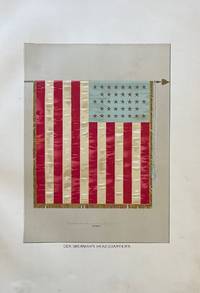
Flags of the Army of the United States carried during the War of the Rebellion 1861-1865 to designate the headquarters of the different Armies Army Corps Divisions and Brigades. . . .
Philadelphia: Burk & McFetridge Lithographers U.S. Army 1887. Folio. 11.5 x 15.5 in. 87 leaves unnumbered. 87 chromolithograph plates for title and flags throughout all mounted on linen hinges as issued. Brown pebbled publisher’s cloth gilt lettering front cover decorated endpapers front inner hinge starting very faint tidemark & bubbling to cloth of fore-edges of front cover minor wear & bumping to corners still a VG bright copy w/ plates quite sharp. First edition of this lavish work reproducing the flags carried by U.S. Army infantry cavalry and artillery units during the Civil War featuring headquarters flags battle flags corps flags pennants and guidons. Following the Civil War both Sherman and Sheridan attempted to regularize unit flags and recommended that battle names be omitted from the flag and unit registers. This work compiled by US Army Brig. Gen. Holabird 1826-1907 was carried out towards the end of his service as Quartermaster which ended June 16 1890. William Burk ca. 1857-1905 and John McFetridge 1844-1903 launched their company in 1877 by purchasing William Harding’s printing house and specialized in chromolithographic trade cards advertising book illustrations calendars and other material until about 1900. Burk & McFetridge, Lithographers, U.S. Army, hardcover
Referentie van de boekhandelaar : 59523
|
|
|
[CINEMA] - [REMARQUE (Erich Maria)].-
Film A l'OUEST RIEN de NOUVEAU, d'après le célèbre roman d'Erich Maria Remarque. Photographies tirées en héliograpvures du film réalisé sous la direction de Carl Leammle junior par Lewis Milestone. Préface de Henry de Jouvenel. Texte expolicatif du film par Pierre Chanlaine établi d'après l'édition française.
Paris, Tallandier (Collection "Ciné Or"), sans date, in 8° broché, 64 pages ; couverture illustrée.
Referentie van de boekhandelaar : 83433
|
|
|
[CINEMA- CAMP DE CONCENTRATION ] - ROTMAN (Patrick) -
Les survivants.
, Editions du panama , 2005 ; in-4, 194 pp., broché, couverture illustr.
Referentie van de boekhandelaar : 201007845
|
|
|
[Civil War]
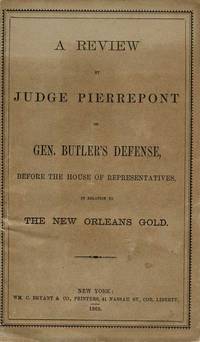
'A Review by Judge Pierrepont of Gen. Butler's Defense Before the House of Representatives in Relation to the New Orleans Gold'. Civil War general accused of looting gold from New Orleans
New York: Wm. C. Bryant & Co 1865. Very good condition. Review concerning the Union General Benjamin Butler notorious for issuing "The Woman Order" General Order No. 28 during the 6 months May - October 1862 he was the military governor of New Orleans. It essentially ordered that any woman showing contempt for a Union soldier "shall be regarded and held liable to be treated as a woman of the town plying her avocation" in other words a prostitute. Butler nicknamed "The Beast" was also charged with looting gold and other valuables from New Orleans mansions and banks the subject of this review. 8vo 27pp. Tan printed wrappers title in black at front wrapper. Wrappers a bit sunned. OCLC: 5728749. Wm. C. Bryant & Co unknown
Referentie van de boekhandelaar : 21232
|
|
|
[Civil War; New York] (Richter, Maurice A)
'Addenda to the Municipalist'. Pamphlet
New York: G. Savage 1862. Fine. Civil War era addenda to the Municipalist a New York magazine published following the "Separation of the United States". The first sentence reads "Since the preceding Letters have been published the United States of America have been dissevered and a new federation under the name of Confederate States of America formed". The Municipalist was first published in 1858; the second edition in 1859. <br /> <br /> Contents include secession enforced union convention of the states Abolitionists Shay's Rebellion the United States a great people no nation; and more.<br /> <br /> Plain paper wrappers. 16mo 303-348pp 1pp "Some Private Opinions". Stitched. Sabin 51330. OCLC: 950932219 one copy at the American Antiquarian Society. G. Savage unknown
Referentie van de boekhandelaar : 23685

|
|
|
[Civil War; Financial] Wells, David
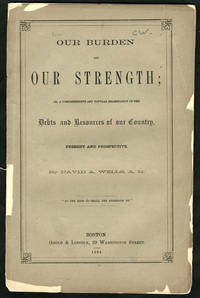
'Our Burden and Our Strength; or A comprehensive and popular examination of the debt and resources of our country present and prospective'. Pamphlet
Boston: Gould & Lincoln 1864. Very good - condition. Civil War era publication assessing the resources and debt paying capacity of the US "Can we pay our present and prospective National Debt . p1 written by American economist and advocate of low tariffs David Ames Wells.<br /> <br /> Wells 1828 - 1898 was a strong supporter of Abraham Lincoln during the war writing pamphlets reassuring investors on Lincoln's financial policies. <br /> <br /> 'Our Burden and Our Strength' established Wells' reputation as a political economist. Wells' analysis attracted the attention of Lincoln who in 1865 appointed him chairman of the National Revenue Commission. In this role Wells was the first to collect economic and financial data for government use; the Commission's recommendations became law in 1866.<br /> <br /> 8vo 39pp. Original printed paper wrappers with chips around the edges wrappers loose but present. OCLC: 12120949. Gould & Lincoln unknown
Referentie van de boekhandelaar : 23679
|
|
|
[Civil War]: Barton, Clara
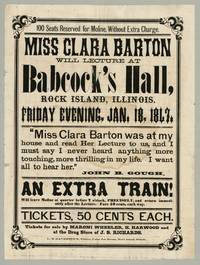
100 Seats Reserved for Moline Without Extra Charge. Miss Clara Barton Will Lecture at Babcock's Hall Rock Island Illinois. Friday Evening Jan. 18 1867. caption title
Rock Island IL: L.M. Haverstick Printer Union Job Rooms 1867. Broadside 24 x 18 inches. Old folds minor creasing a few small chips short closed tear to left edge near the "B" in "Babcock's" faint circular dampstain in center minor scattered foxing. Withal very good condition. A visually appealing and seemingly unique surviving broadside advertising a January 18 1867 lecture by Clara Barton. At the time Barton was touring with her lecture entitled "War & Incidents of Army Life" part of a popular post-Civil War series of talks she delivered across the United States. Barton spent two years touring and recounting her battlefield experiences which helped popularize her and fund her subsequent efforts to locate missing soldiers. The present lecture was delivered at Babcock's Hall in Rock Island Illinois. In addition to the bold title containing the relevant information on the lecture and the information on obtaining tickets at the bottom the middle portion of the broadside prints a quote by noted temperance lecturer John B. Gough praising Barton's lecture: "Miss Clara Barton was at my house and read Her Lecture to us and I must say I never heard anything more touching more thrilling in my life. I want all to hear her." Below this quote is a notice that although Moline and Rock Island are only a few miles apart "An Extra Train" on the famed Rock Island Railroad will be provided to transport attendees of the lecture from Moline for a ten-cent fare. Typographically the broadside is interesting for employing several sizes and types of fonts likely wooden type which provides multiple opportunities for catching the eye of the observer. This includes a rather Gothic-style font when printing the date of the lecture.<br /> <br /> Clara Barton 1821-1912 was a noted educator and humanitarian who helped distribute needed supplies to the Union Army during the Civil War and later founded the American Red Cross. Barton garnered nationwide recognition for her efforts during the war and quickly became known as the "Angel of the Battlefield." After the war Barton's lecture tour brought her in contact with other notables of the day including Susan B. Anthony and Elizabeth Cady Stanton and also Frederick Douglass who involved her in the suffrage and civil rights movements respectively. In the Fall of 1866 Barton began to lecture on her Civil War experiences in lyceum halls churches town halls and schools. Though she never felt comfortable in front of an audience wherever she spoke Barton was well received. Her contemporary biographer Percy Epler wrote that "a tear-stained multitude thronged everywhere to hear her" as she had made it her mission to show not "the glories of conquering armies but the mischief and misery they strew in their tracks; and how while they march on.some one must follow closely in their steps crouching to the earth faces bathed in tears and hands in blood. This is the side which history never shows."<br /> <br /> From 1866 through 1868 Barton delivered over 200 lectures throughout the northeast and midwest regarding her Civil War experiences. She shared platforms with other prominent figures including the aforementioned Douglass as well as Ralph Waldo Emerson William Lloyd Garrison and Mark Twain. She often earned $75 to $100 per lecture. Original broadsides advertising her lectures are exceedingly rare to say the least. We could locate just a single result in auction records of a much smaller example and OCLC reports just one institutional holding of any Barton lecture broadside again much smaller for an 1867 event in New Haven located at the Library of Congress. L.M. Haverstick, Printer, Union Job Rooms unknown
Referentie van de boekhandelaar : 13091
|
|
|
[Civil War] Confederacy] [N B Hamerick?] [Battle of Pocotaligo] [South Carolina]
1862 Confederate Soldier's reply to Mr. E Ward Rock Island Tennessee while camped at Pocotaligo near Yemassee South Carolina
Pocotaligo: n.p. 1862. Letter. Good. Letter. Approx. 8" x 5". 3 pages of manuscript. No envelope or stampless mark on the paper. Paper has three folds. Paper is in very good condition with light edge wear to a couple of spots. The following transcription is a best guess. The legibility of letter is difficult to transcribe and some words are omitted and other words spelled as they appear.<br /> <br /> Pocotaligo Feb 1 1862<br /> Mr E Ward Rock Island Tenn<br /> <br /> Dear Sir<br /> <br /> I find myself seated with yours of January 19th before me. I was very glad to hear from you I had wrote four letters to you and heard from you once in the time I dont think that you ought to quit writeing to us if I do belong to Jeff Davis traveling hog hay stealing 16th regiment I want you to write to me start your letter and I will get them for they will fallaw ten us and we will get them. I have had your letter for several days but I did not have the chance to answer it E We have to stand Pickett Cal Ful and Savages Regiments take it times a we go have and stand twelve days and then they stand twelve days. We have to go about twelve milds miles from the camps to stand. Darien is the Part Rail river and the yankees an on the Island of the same name I stand in sight of plenty of the damn yankees. We was yesterday and came to camps last night. We expect to have a fight hear with the yankees before long for there is plenty of yankees hear. You wanted to know about the fight that was hear on New Years day our regiment was not in it. We it for ten mild mile but it was over before we got thear. Wen we say our men we men mean the Dixaboys the yankees killed our men and we killed some of there and made them take again. We would nat have lost any men at all if our men had nat were two brave and run there up under the canans at the yankees and they Burned them and killed some men. I want you to write to me as soon as you get this gets to hand Tell Nancy that I am as fit as she ever saw me. E I get same good letter from my mama. This leaves me in good health. I remain yours till N.B. Hamrick. The Battle Mr. Hamerick referenced in this letter January 1st 1862 was probably part of the Union Army's Port Royal campaign. A battle took place along the Coosaw River near the Port Royal Ferry in Beaufort County South Carolina. From the Beaufort County Library: <br /> <br /> In late December 1861 the Union forces recognized that the Confederates recently removed to the mainland had been building batteries along the Coosaw River near the Port Royal Ferry. Union Commanding General I.I. Stevens ordered components of the 8th Michigan Infantry 47th and 48th New York Infantries 1st New York Engineers and the 50th Pennsylvania to destroy the Confederate breastworks capture the guns and force the retreat of some companies of the 12th South Carolina Infantry into the interior of Beaufort District. The Union forces accomplished their mission on New Year’s Day January 1 1862 with minimal casualties.<br /> <br /> The first Battle of Pocotaligo took place May 28th 1862. The Union army goal was to tear up the railroad between Charleston and Savannah. The second Battle of Pocotaligo took place October 22 1862. In the first battle the Union moved to destroy a bridge and having reached their objective retreated back to Hilton Head. both armies suffered a few casualties. In the second Battle the Union's goal was again to tear up the Railroad between Savannah and Charleston. After pushing the Confederates back to Pocotaligo the Union initiative stalled and the Union army retreated before nightfall. <br /> <br /> An interesting side note on the future fate of N. B. Hamericksp during the War comes from articles collected in The Spencer Times and the Sparta Exhibitor titled "Recollections of the War From Carroll H. Clark" Transcribed with all the commas dashes and lack of capitalization from Memorial and Biographical Record of the Cumberland Region An Illustrated Compendium of Biography. Geo. A. Ogle & Co. Chicago 1898. pp.253 and 254.<br /> <br /> Carroll Clark was from McMinnville Tennessee. In one of the several articles Clark makes a reference to a "N. B. Hamericksp" possibly the same soldier who wrote this letter. An excerpt from article 25 ".I have left untouched very many interesting events for instance the Battle of Franklin Tennessee in which many brave commanders and soldiers were killed of whom was Genl. Cleburne Genl. Carter and others. My dear friend and schoolmate N. B. Hamrick was killed there. His father and family lived out two miles from here at the place now called the Hill place on the road to Farris Griffiths. N.B. had three brothers in the war and all came through alive. The family came from North Carolina a few years before the war and it has been said brought the first yellow horse to this country. I yet remember the names of the whole family as follows: Uncle Billy Aunt Polly Jeroam Napoleon Bonapart killed at Franklin Jereboam Zorobabel Doctor Cortez and Don Pedro were the boys and two girls named Martha Salena and Mary Boston. All except Jeroam were my schoolmates."<br /> <br /> This letter was addressed to Mr. Ward in Rock Island Tennessee. Carroll Clark's war reminiscences was written in Tennessee. It is possible this is the same N. P. Napoleon Bonaparte Hamericksp who wrote the letter that was later killed at the Battle of Franklin in 1864. Information found regarding casualties at Franklin include variant spelling in the last name. A listing from the Civil War Talk web site states "1st Sgt. Napoleon B. Hambrick Co. I Killed." Another site Home dot Freeuk dot com lists "Sgt Napoleon Bonaparte Hanmbrick n.p. unknown
Referentie van de boekhandelaar : 33742

|
|
|
[Civil War] [George Hargraves]
1863 Civil War era domestic letter regarding a response to a telegram sent by the "Sisters of the Visitation in Mobile Alabama" to pick up Martina Luckett daughter of Mr. Luckett
Columbus Georgia 1863. Letter. Very good. Letter. Approx. 9.5" x 7.5" lined sheet of paper. Letter is one page long. Folded. Addressed to "Dear Cousin George" <br /> <br /> Hargraves writes "My sister received the following Telegram from Mobile: Have you any information of Martina Lucketts father. If not take her home immediately from the Sisters of Visitation in Mobile." George continues "I suppose from above that Martina is at school and the Superior not hearing from Mr. Luckett wants to get rid of her. What shall be done" Hargraves mentions that he could contact Mr. Jno Forsyth to help Martina and that Aunt Sophia probably would take her in. Written below the Hargraves signature - "I have not been able to hear from any Mississipian about Mr. Luckett. - G H" At the bottom of the letter possibly written in a different hand is a note - "Miss Singleton from Canton saw the Luckett six weeks in two months ago - his children were all with him Miss Martina also. He was not then in the Army." <br /> <br /> The writer of this letter George Hargraves was married to Virginia Forsyth daughter of famous Georgian John Forsyth. "Mr. Jno Forsyth" mentioned in this letter could quite possibly be the son of John Forsyth. John Forsyth Jr. who resided in Columbus before moving to Mobile. unknown
Referentie van de boekhandelaar : 31605

|
|
|
[Civil War] [Confederate Army] [H W Walter, Assistant Adjutant General]
1863 Confederate Document: Headquarters Dept. No 2 Tullahoma Tenn. June 2d 1863. General Orders No. 18 By Command of General Bragg. Signed H W Walter A.A. Genl
Tullahoma Tennessee 1863. Document. Fair. Manuscript Document. Approx. 12.5" x 8". General Order No. 18 written on the front side and signed by the Assistant Adjutant General H. W. Walter. Also located on the lower left corner of the document is written "Maj Genl Wheeler a' g Wheeler's Cav Corps." On the verso is a handwritten summary of the order. The paper has dried water stains. The ink is light in spots. This handwritten General Order was reprinted in the Official Records of the War of the Rebellion War of the Rebellion Records Series I. Vol. XXIII Part II Correspondence Etc. Chapter XXXV pages 858 859. The signature at the bottom of the document is not legible but it is not in the hand of General Wheeler. The document reads:<br /> <br /> The enemy has seen fit to expel from his lines and send to our midst not only those supposed to be guilty of crimes but non-combatants found in their homes in the peaceful pursuits of life. In the perpetration of these outrages on humanity and these violations of civilized warfare he has prostituted the flag of truce to the base purpose of protecting the guards who drive forth these exiles. Hereafter that flag will not protect those guards but they will be seized and sent forward to be treated as spies or prisoners of war as the circumstances in each case may require. By Command of General Bragg. unknown
Referentie van de boekhandelaar : 33624

|
|

 De zoekresultaten per email ontvangen
 Zoekresultaten downloaden als PDF
 RSS feed
 Permanente link


