|
[PETAIN] - BLOND (Georges).-
Petain 1856-1951.
P., Presses de la Cité, 1966, fort in 8° , cartonnage de l'éditeur, 588 pages ; illustrations.
Riferimento per il libraio : 39331
|
|
|
[PETAIN] - ISORNI (Jacques).-
Philippe Pétain. Tome 1.
P., La Table Ronde, 1975, fort volume in 8° broché, 493 pages ; illustrations hors-texte.
Riferimento per il libraio : 71948
|
|
|
[PETAIN].-
Plaidoirie (avec annexes et documents inédits) pour le Maréchal Pétain prononcée par le batonnier Fernand PAYEN, Mes J. ISORNI et J. LEMAIRE Avocats à la cour.
P., Haumont, 1946, in 8° broché, 255 pages ; petit manque de papier en tête du dos.
Riferimento per il libraio : 66493
|
|
|
[PETAIN].-
Principes de la Rénovation Nationale. La doctrine et l'action du Maréchal.
P., Société d'Editions Economiques et Sociales, sans date (vers 1941), in 8° broché, 112 pages ; petite tache angulaire en pied de toutes les pages ; rousseurs à la couverture.
Riferimento per il libraio : 29301
|
|
|
[PETAIN] - BAYET (Albert).-
Pétain et la cinquième Colonne.
P., Editions de Franc-Tireur, 1944, in 12 broché, IV-101 pages ; couverture fanée.
Riferimento per il libraio : 22892
|
|
|
[PETAIN] - PALUEL-MARMONT.-
Pétain. Ornementation de M. ALBE.
P., Librairie des Champs-Elysées, 1942, in 8° broché, ; rousseurs ; couverture fanée.
Riferimento per il libraio : 28838
|
|
|
[PETAIN].-
Pétain et la cinquième Colonne.
P., Editions de Franc-Tireur, 1944, in 8° broché, 40 pages.
Riferimento per il libraio : 62580
|
|
|
[PETAIN] - FIGUERAS (André).-
Pétain et la marine.
P., L'Auteur, 1992, in 8° broché, 217 pages ; couverture illustrée.
Riferimento per il libraio : 71413
|
|
|
[PETAIN] - ISORNI (Jacques) et LEMAIRE (Jean).-
Requête en révision pour Philippe Pétain, Maréchal de France.
P., Flammarion, 1950, in 12 broché, 250pp. ; rousseurs éparses ; couverture défraichie.
Riferimento per il libraio : 19960
|
|
|
[PETAIN] - SERRIGNY (Général).-
Trente ans avec Pétain.
1959 Paris, Plon, 1959, in 8° broché, IV-245 pages ; non coupé.
Riferimento per il libraio : 15750
|
|
|
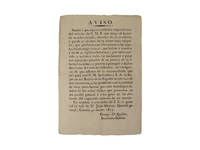
[Peninsular War Deserters Broadside]
Aviso Notice
Castalla Spain: No Publisher 1813. Single sided printed broadside approximately 220mm x 315mm in size. Slightly creased faint pencil line through top left hand corner of text couple of tiny chips undeciphered note in ink to reverse but generally fairly clean. Desertion during the Peninsula Wars was a serious problem Linch in his 'Desertion from the British Army during the Napoleonic Wars' finds that "between 1803 and 1815 there were 77696 cases of desertion" though "desertion from British corps primarily occurred in the British Isles". A rough translation follows. "Notice. Attentive to some soldiers dependent on the army of S.M.B. that I have the honor of commanding in chief they desert their flags and may forget their duty to such an extent that they prefer to go to the host of the common enemy rather than bolver to meet those of their legitimate Sovereign; Therefore all Spanish citizens and civilians who love their homeland and national liberty are invited and exhorted to come forward to persecute these defectors of the British army on the understanding that in addition to what is recommended for S.M. Las Cortes and S.A. the Regency of the Rayno de las Espanas a service of this nature will be rewarded with the amount of twelve heavy pesos for each transfuge or deserter of those on those who present in my quartel general or to the managers of the divisions of the expressed army of my command . In the name and with the order of S.E. the general in general Mr. D. John Murray. Quartel General Castalla March 30 1813". Lieutenant General Sir John Murray c.1768-1827 8th Baronet defeated Suchet at the Battle of Castalla on the 13th of April 1813 see ODNB; Sir George Charles D'Aguilar 1784-1855 eventually became a Lieutenant General and was knighted see ODNB. Spanish text. First Edition. Unbound. Good. Folio. Broadside. No Publisher Paperback
Riferimento per il libraio : 003512
|
|
|
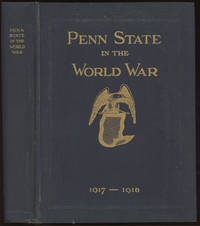
[Penn State, World War I]
Penn State in the World War
State College PA: Alumni Association of the Pennsylvania State College 1921. First edition. Hardcover. Very Good/No Jacket. 1921 First Edition. Hardcover 4to. original navy cloth gilt title. 526 pp. Very Good. Illustrated throughout with b&w photos and portraits. Light spotting and dustiness to the boards; light foxing to the text-block; interior is clean and unmarked; strong square binding. Includes biography and some photos of Penn State alumni and current students who participated in World War I. Alumni Association of the Pennsylvania State College hardcover
Riferimento per il libraio : 0086689
|
|
|
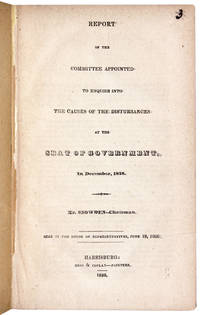
[Pennsylvania - The "Buckshot" War]
Capitol Riots and Buckshot War Report of the Committee Appointed to Enquire Into the Causes of the Disturbances at the Seat of Government in December 1838
<p>Harrisburg: Boas & Coplan 1839. 163 1 pages. Five folding tables. Bound into a plain 20th century binding with a green cloth spine and chipboard covers. Edges of covers with some loss or wear; all within Very Good.</p> <p>The contentious election of 1838 in Pennsylvania resulted in Whig and the Democratic parties each claiming sole control of the House of Representatives. A mob formed upon the Pennsylvania State Capitol the legislature dispersed business shut down. Even with the threat of violence President Van Buren refused Governor Ritner’s request for Federal troops. Instead Ritner called out the Pennsylvania Militia providing them with thirteen rounds of buckshot cartridges hence the “Buckshot†War. Order was finally restored.</p> <p> </p> <p>Howes P-206 erroneously supplying an 1829 date: “The Buckshot War resulting from party clashes during which the Legislature was dispersed local business suspended and the militia called out.†See Sabin 60488 and DAH. qw</p> unknown
Riferimento per il libraio : 3730192
|
|
|
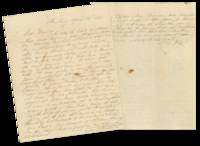
[Pennsylvania – Presbyterian Church – Civil War – World War II] Hill, George; Hill, Harriett; Weeks, WC; et al W C
Multigenerational Archive of a Pennsylvania Family Spanning More Than a Century
United States Norway and Germany 1960. 320 items: 276 letters thirty-eight modern photographs five CDVs and one cabinet card; with a large amount of unsorted ephemera. Of the letters 198 are from the nineteenth century with most from the 1840s through 1870s; and seventy-eight are from the twentieth century with most from the 1940s and 1950s. Excellent. A broad archive mainly of letters spanning over 130 years. The letters were mostly sent between members of the Hill family of Pennsylvania and other families Lewis Hosack and Weeks that married in. In the nineteenth century George Hill 1815–1895 his wife Harriet Lewis 1820–1852 and their two oldest daughters Jane Hosack 1842–1878 and Harriet Hill 1844–1928 are the main correspondents; in the twentieth letters are mainly from Cornelia 1863–1948 and Charlotte 1874–deceased Lewis Harriet Lewis’ nieces and the family of Nancy Weeks 1909–1992 her great-granddaughter-in-law. Weeks also had several correspondents in Europe immediately after World War II.<br /> <br /> Earlier letters discuss family affairs temperance societies and church business—George Hill was a Presbyterian minister and writes to his family from trips to the General Assembly. For instance he describes the 1843 Assembly:<br /> <br /> “We have dispatched a good deal of business this week in the Assembly. The question which detained us longest was with regard to the right of Elders to impose hands in the Ordination of Ministers this was discussed for the greater part of two days and finally decided against the right to impose. But of all the questions which have yet come before us none has excited so much interest or called forth half the feeling which the question on the approval of the records of the Synod of Pittsburgh did. The committee on the records took exception to the mention of the Synod on the subject of Temperance . On this I let them know my mind at considerable length and in the course of the proceedings voted down the very same proposition which was adopted by the last Gen. Ass. on the subject of Temperance.†May 27 1843<br /> <br /> At the same time Hill was preaching around Pennsylvania and Ohio to raise funds to start the Blairsville Female Seminary which was open from 1851 to 1913. Among his travel correspondence is an interesting description of antebellum Athens Ohio:<br /> <br /> “On Tuesday morning I rode 6 or 7 miles to Athens . which is wholly given over to abolition. This subject is to that people ‘The one thing needful’. It is the law and the gospel; it is philanthropy patriotism morality and religion. It swallows up everything else and enlists the sympathies & energies of the people to the exclusion of almost everything besides.†January 29 1844<br /> By the outbreak of the Civil War Jane and Harriet are young adults and Harriet gets involved with the war effort. She writes to her stepmother Abigail Hawes:<br /> <br /> “I was in sewing for the Soldiers yesterday. I made a Havelock. I guess there were over thirty ladies there sewing. The Bardstown ladies are making clothing for Capt. S’s company. They leave on next Monday. . I went in early last Monday morning to see our company off. The flag was presented by Mr Beaumin to Capt. Nesbit. Then Mrs Thompson & Luther Martin presented Testaments & ‘Prayer Books’ some of Mrs. McAfee’s work they then marched up to the depot followed by men women & children. Such a sight I never witnessed. Some of the soldiers large men cried like children – bade goodbye to every body – men that I never saw before came up & bade me goodbye & then turned their heads away to hide the tears. . But to go back to our Sewing Society you ask ‘will they really do anything’ I tell you they really have done something. Made seventy five shirts & intend making so many more of blue & red flannel & forty five or fifty Havelocks about thirty five towels eighty pin cushions or needle books. Then when the company went away the ladies supplied them with either a blanket or a comfort apiece . The ladies also intend making bandages or something to fasten tight round their stomachs to keep them from taking dysentery so readily.†June 4 1861<br /> <br /> Harriet notes that Abigail doesn’t “seem to be much disturbed about the war†May 20 though she requests that although “We all admire your patriotism . be sure & dont send us an envelope with ‘Death to Traitors’ on it†June 4.<br /> <br /> Other letters from Harriet and Jane discuss school family and especially health; a number of deadly diseases were rampant throughout the century and many letters read as litanies of dead and dying friends and family. The CDVs from this era mainly taken in studios in Blairsville seem to be mostly family friends or employees at the Female Seminary; many of the subjects are identified verso.<br /> <br /> The family’s letters in the twentieth century are similar though with less sickness and death and from more dispersed locations in the US—seemingly few family members remained in Pennsylvania.<br /> <br /> One particularly interesting thread is Nancy Weeks’ correspondence with several Europeans immediately after World War II. One is Benjamin Molnar a Hungarian living in Munich and in the process of emigrating to the US. Molnar describes himself and continental Europeans generally as “prejudiced and very nationalistic†and explains that he would prefer to live in the American midwest or west as the “types of people†on the east coast “are rather unamerican looking†July 14 1949. He ends up in California and complains to Weeks that:<br /> <br /> “Everybody here seems to be violently pro-negro and pro-Jewish. Jews and negroes are all right I suppose and I have nothing against them but is it a sin for a white man to prefer to live among his own kind†December 27 1949<br /> <br /> On the other end of the spectrum are the Bjelkes a Norwegian family who write a number of times to Nancy. They describe the Nazi invasion:<br /> <br /> “Reidar drove me and the children 7 & 2 years up in the country the first day thinking we would be safe there he had to leave right away to do his duty of course and we were left alone. Not many days later we were in the middle of the whole war shooting and bombing all around then the middle of the nite we had to flee out in the snow two children and no place to go at last I could no more and together with some others we broke the window of a little mountain home and crawled thru finding the house empty. . But the peace was short not long after some soldiers came and said we must off as the germans would soon be there. Well out in the deep snow again and we struggle thru and at last came to a little mountain farm where we were allowed to stay. But they had little food and for four weeks we starved . At last Reidar found us and we wandered our way towards home . to Bygdo. Mother had been there all the time and everything had been fine there.†October 10 1945<br /> <br /> They also tell Weeks about Oslo during the war and their experience of the occupation:<br /> <br /> “We demonstrated our hate as far as we dared to – by not sitting beside any Germans for example on the car it went so far that they put up a ticket saying ‘no seat must stay vacant or we would be arrested.’ The result was that we just stood all the time then a new ticket came up we were not aloud to stand. Well I had to jump off the car several times in order not to seat myself beside a uniform. Then they started taking our red caps & scarfs – we used them as a demonstration you see & they not only took them off us but kept them. They even took our red jackets from us if we dared wear them on the street & so many dared! On our Kings last birthday during the war several hundred were arrested because they wore flowers in their buttonholes– Oh the Germans & Naszi were so childish.†May 11 1945<br /> <br /> They also describe the difficulties of postwar life including the dangers of unexploded ordnance left around the area which stop the ferries from running to Oslo and injure the family’s young son Per.<br /> <br /> Overall the archive is notable for its breadth spanning at least four generations of a family and many historical eras and events. unknown
Riferimento per il libraio : List3237
|
|
|
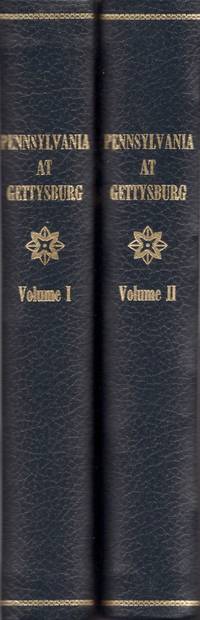
[Pennsylvania] [Gettysburg] [Civil War] Nicholson, John P (edited and compiled by)
Pennsylvania at Gettysburg Ceremonies at the Dedication of the Monuments Erected by the Commonwealth of Pennsylvania To Mark the Positions of the Pennsylvania Commands Engaged in the Battle. Two volumes
Harrisburg: E. K. Meyers State Printer 1893. First Edition. Hardcover. Good. Quartos. Two volumes. Volume I: x 526 pages. Volume II: pages 527-1080. Illustrated with frontispieces both volumes and engraved plates in the text. Volumes restored by the National Library Bindery in Atlanta Georgia. Original marbled paper covered boards remain. Newer faux leather corners and spines. Gilt titles on the spines. New white end sheets both volumes. Browning and foxing to the preliminary pages up to iv volume 1. Foxing to the title page volume 2. Light spotting to the foredges. Edge and shelf wear to the original covers. Interior contents clean. A good set. E. K. Meyers State Printer hardcover
Riferimento per il libraio : 30086
|
|
|
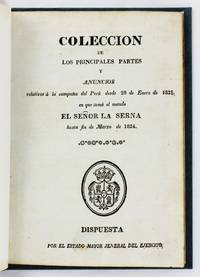
[Peru]. [War of Independence]
Coleccion de los Principales Partes y Anuncios Relativos a la Campaña del Peru Desde 29 de Enero de 1821 en Que Tomó el Mando el Señor La Serna Hasta Fin de Marzo de 1824
Lima 1824. Good plus. 271pp. Modern paper boards printed spine label. Moderate tanning. Light worming to final leaves repaired slightly affecting text. Scarce printing of correspondence relating to the royalist military campaigns in Peru under Viceroy José de la Serna from the beginning of 1821 to early 1824. La Serna was installed as Viceroy in January 1821 following a petition of top royalist officers. He evacuated Lima and moved the colonial capital inland to Cuzco where he set about rebuilding his army and campaigning to recapture the territory lost by his predecessors. In this he was quite successful and by the beginning of 1824 he had recaptured almost all of Peru and penned in Bolivar at Trujillo. The correspondence included here follows this successful portion of his generalship and provides an important first hand accounting of events. Following this period however La Serna suffered his own military rebellion and was sufficiently weakened until he lost the Battle of Ayacucho and thereby all of Peru in December 1824. OCLC locates only two copies at U.S. institutions Harvard and the JCB.<br /> Medina Lima 3779. Vargas Ugarte 5174. unknown
Riferimento per il libraio : 5668
|
|
|
[PHOTOGRAPHIE] - PERRAULT (Gilles)
1944/1994 regards.
Honfleur, Moulin Vieux, 1994 ; in-4, 108 pp., reliure d’éditeur, sous jaquette. Les 50 ans du débarquement de Normandie. Bon état.
Riferimento per il libraio : B2677
|
|
|
[PHOTOGRAPHIE] [DOISNEAU - KRULL - etc...].-
Album de France. Edité par le Ministère de l'Information.
Paris, sans date (1945), in 8°, reliure à spirale illustrée de l'éditeur, 1 feuillet d'Avant-propos (en français et en anglais) suivi de 36 feuillets de photographies (généralement, 2 phtographies par feuillet), chacun accompagné de sa serpente légendée en anglais et français.
Riferimento per il libraio : 34412
|
|
|
[PHILOSOPHIE SCIENCES HUMAINES] - COLLECTIF
Centre de sociologie de la guerre: la communication sociale et la guerre.
Bruxelles, Établissements Émile Bruylan, 1974 ; grand in-8, 288 pp., relié plein cuir blond, dos orné de fleurons, à 5 nerfs, pièces de titre en cuir gris vert et vieux rose (couverture conservée). Études de sociologie de la guerre: colloque des 20, 21 et 22 mai 1974. Certaines interventions sont en langue anglaise. Magnifique reliure pour un ouvrage si récent. Bon état.
Riferimento per il libraio : G0645
|
|
|
[PHOTOGRAPHIE]. ORY Pascal.-
Doisneau 40/44.-
Hoëbeke. 1994. Gd in-8 cartonné sous jaquette illustrée photo, 123pp. Excellent état.
Riferimento per il libraio : ORD-8410
|
|
|
[PHILATELIE].-
La Résistance antihitlérienne à travers les timbres. Publié par la Fédération Internationale des Résistants (F.I.R.).
Varsovie, Agencja Wydawnicza "Ruch", 1971, grand in 8° carré, relié pleine toile grège de l'éditeur, jaquette illustrée en couleurs, 290 pages ; très nombreux timbres reproduits en couleurs.
Riferimento per il libraio : 40526
|
|
|
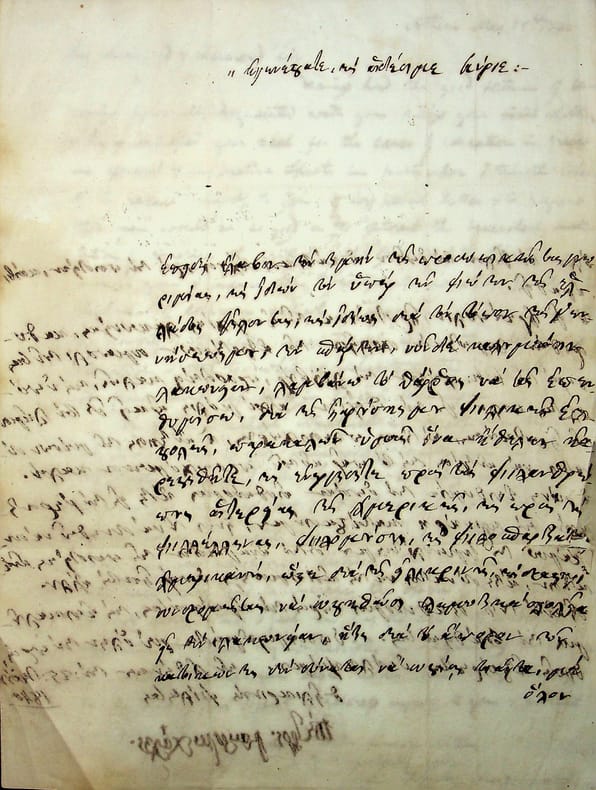
[Philhellénisme, Grèce] Pétros dit Petrobey Mavromichális (1765-1848), homme d'état grec, héros de la guerre d'indépendance grecque, ?????? ?????????? ????????????.
Lettre autographe signée
[Philhellénisme, Grèce] Pétros dit Petrobey Mavromichális (1765-1848), homme d'état grec, héros de la guerre d'indépendance grecque, ?????? ?????????? ????????????. L.A.S., Athènes, 25 mai 1840, 3p in-4. Extraordinaire lettre en grec (2p) entièrement autographe et signée, suivie de la traduction d'époque en anglais (1p), adressée à Charles Lowell (1782-1861), religieux unitarien américain. Dans cette lettre mentionnant notamment son grand âge, il salue le travail des deux missionnaires américains dans sa région, la Laconie : George William Leyburn (1809-1875) - qui mourra en Grèce - et Samuel Rutherford Houston (1806-1887). Ils avaient en effet fondé une école à Areopolis. Rappelons que Mavromichalis fut le dernier Bey de la Magne (sous l'Empire Ottoman) mais aussi celui qui proclama le soulèvement de la Magne le 17 mars 1821. Il est, en 1840, un des plus hauts et un des plus anciens dignitaires grecs. Charles Lowell, qui est le père du poète romantique James Russell Lowell, était déjà un abolitionniste comme le sera son fils. Il est aussi un religieux influent, notamment dans les milieux philhellènes américains. Petite déchirure près du pli d'origine (petit manque minime). Extraordinaire témoignage de l'influence américaine et protestante en Grèce après son indépendance, le combat de Mavromichalis pour l'indépendance étant devenu un combat pour l'éducation. [517]
Riferimento per il libraio : 021095
|
|
|
[PHILATELIE - GOUVERNEMENT DE VICHY] FULGUR PHOTO PRESSE
PHOTOGRAPHIE ORIGINALE D'UN NOUVEAU TIMBRE FRANCAIS A L'EFFIGIE DE LA PEROUSE, (PTT) PARIS LE 19 MARS 1942
VAL D'ISERE 1942 une photographie originale en noir, format : 18 x 13 cm, avec une étiquette d'explication de la photo tapée à la machine en noir, collée en bas de la photo, PARIS LE 19 MARS 1942, avec cachet violet au dos "autorisé par la censure Allemande LE 19 MARS 1942" et cachet de l'agence "FULGUR" photo presse du gouvernement de vichy,
Riferimento per il libraio : 21585
|
|
|
[PHOTOGRAPHIE] Pierre Petit Photographe
PHOTOGRAPHIE ORIGINALE PORTRAIT : Mr DELAPIERREGROSSE Jean Marie Jacques Julien capitaine au trente sixième régiment d'infanterie de marche BLESSÉ EN 1871 (voir photo) - 1871- Paris Pierre Petit Photographe, 31 place Cadet
Paris Pierre Petit 1871 une photographie originale réalisée vers 1871, en bon état- Format de la photo : 5.5x9.5 cm - photographie collée sur carton, Tirage argentique, Couleur: Noir et blanc, PORTRAIT : Mr DELAPIERREGROSSE Jean Marie Jacques Julien capitaine au trente sixième régiment d'infanterie de marche BLESSE le 21 octobre 1870. Combat de la Malmaison. (voir photo) - 1871- Paris Pierre Petit Photographe, 31 place Cadet,
Riferimento per il libraio : 22694
|
|
|
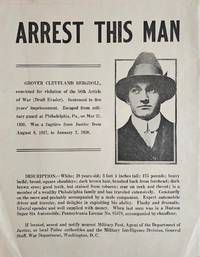
[Philadelphia – World War I – Draft Evasion] United States Government
Wanted Poster for Grover Cleveland Bergdoll Who Escaped from Prison After Dodging the Draft
United States 1920. Single 9 ¼ x 12 inch sheet. Some marginal damage else near fine. Offered here is a wanted poster for the “Flashy and dramatic†Grover Cleveland Bergdoll following his escape from a military prison in 1920. Bergdoll 1893–1966 was a wealthy Philadelphian socialite amateur racecar driver and Wright Brothers-trained aviator. In 1917 he failed to report for military service and disappeared from public life. After his capture in 1920—he was hiding inside the Bergdoll Mansion all along—he was stripped of his citizenship and remanded to Castle Williams on Governors Island in New York City.<br /> <br /> Not long into his five-year sentence Bergdoll convinced military authorities to release him so that he could retrieve a stash of gold he claimed to have buried in Maryland. Back at his family’s mansion on the way to the supposed hoard he slipped his guards and fled to Canada and then Germany. Despite several foiled kidnapping attempts Bergdoll remained in Germany until 1939 when he returned to the United States—preceded by a wife and five children who arrived in the US in 1935 and pled for clemency for him. Though public opinion on the Great War had shifted Bergdoll was still reviled as a coward and a traitor. He was sentenced to eight years in prison. unknown
Riferimento per il libraio : List2983
|
|
|
[PHILIPPINES -- WORLD WAR II]. RUTHERFOORD, William de Jarnette
165 days: a story of the 25th Division on Luzon.
Manila P.I.: 25th Infantry Division 1945. Folio. 9 x 13 in. 92 pp unpaginated. consisting of illustrated title introduction leaf and then 176 numbered illustrated panels 2 to a page tracking the campaign. Blue publisher’s cloth colour plate title mounted on front cover w/ 25th Division “Tropic Lightning†badge minor dustsoiling slight fraying a little thumbing still a VG bright copy. First edition of this fascinating and well-illustrated graphic novel regimental history executed by the artist while serving with the 3rd Brigade 25th Infantry Division and filled with drawings depicting the life of a doughboy fighting the Japanese across Luzon. The book covers the 35th “Cacti†27th “Wolfhounds†and 161st Infantry Regiments the famous Battle of Balete Pass offering an essential first-hand visual record while they set the combat record of 165 consecutive days. The record would not be broken until later when the 3rd Brigade of the 25th Division went 235 consecutive days in combat operations during the Vietnam War in 1966. Rutherfoord 1919-2001 was a commercial artist from Roanoke VA who served from 1942-1946 in the 25th Infantry Division and later as commercial artist in New York who also illustrated a number of titles in the popular Little Golden Books series as well as later a successful painting career in and around Roanoke. 25th Infantry Division, hardcover
Riferimento per il libraio : 61658
|
|
|
[Philippine-American War – Sri Lanka – Singapore] McIntyre, James
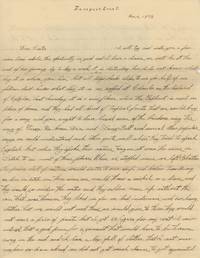
1899 Letter from a Soldier on His Way to the Philippines Describing Sri Lanka Singapore and Life Aboard the Transport Ship
Malacca Strait 1899. Eight-page single letter of two double-sided pages measuring 7 ¾ x 10 inches and two double sided pages measuring 4 ½ x 7 inches. Folded with small tears at folds; near fine. A letter from James McIntyre 1874–deceased to his sister Kit sent from aboard the transport ship Grant on the way to the Philippines in March of 1899. McIntyre who enlisted in Pittsburgh in July 1898 had just passed Sri Lanka and was traveling through the Malacca Strait on his way to Singapore their last stop before Manila. McIntyre describes his impressions of the region and the locals and the attitudes of his fellow soldiers.<br /> <br /> The previous week the Grant had stopped at Colombo in Sri Lanka then British Ceylon:<br /> <br /> “it is a nice place where the Elephant is used in place of horses and they had all kinds of tropical fruits that we could buy for a song and you ought to have heard some of the Hindoes sing the song of Tarra Ra boom Dea and Daisy Bell and several other popular songs we could understand each other quite well when they tried to speak English but when they spoke their native tongue it was the same as Dutch to usâ€.<br /> <br /> Note that by “Hindoes†McIntyre probably just means Sri Lankans generally not Tamils in particular. In Sri Lanka as in other places along their route the locals would impress the American soldiers by diving for coins:<br /> <br /> “since we left Gibraltar the poorer of natives would swim to our ship and holler trow shiney me dive in ketch im then some one would throw a nickel or a dime and they would go under the water and they seldom came up without the coin that was thrownâ€.<br /> <br /> McIntyre seemingly in a bid to reassure his sister explains to her that the soldiers see the war as a game or joke:<br /> <br /> “we are doing our best to get to the Philipines so we can take hand in the game they are playing over there what do you think of the war in the Philipines we take it as a joke and I dont think that there is a soldier on this boat who is sorry he came although every body is not looking for a chance to go home again some one will be sure to get back and my chance is as good as any we laugh and joke with each other about getting shot so dont think I am not taking the best of it and I will continue to enjoy my self till a Philipine stops me if one should be so fortunateâ€.<br /> <br /> He also jokes about the food on board:<br /> <br /> “there are a great many other dishes that are new to me that I never heard of before I came in the Army here is another dish we only got on Geo. Washingtons Birthday it is called ‘Cosomme’ which is a french word for Slum you take one doz. of broken skylights and four bbls. of Whitewash one Tea spoonfull of baking powder and stir one half doz. assorted railroad tunnels in serve this on crutches if I dont stop here you will be leaving home to join the Armyâ€.<br /> <br /> Meanwhile the ship had missed a lighthouse and “been lost all day in the straits of Malacco†Malacca which was “taken as a joke by us till we near run agroundâ€. In the strait are “a great many Chinese boats†and the men are entertained by “the capers the Chinese cutâ€. When they finally reach Singapore McIntyre is impressed by how advanced it is:<br /> <br /> “I have been writing since before dark and during that time we have run into Singapore one of the boys just asked me to come up on deck and see the town when he told me of the Electric lights and Trowley trolley Cars I told him he was trying to guy me but he said it was true and I was surprised to find it true but this is the nearest like a U.S. City at night I saw yetâ€.<br /> <br /> Of interest to historians of the Philippine-American war especially American soldiers’ attitudes towards the conflict. unknown
Riferimento per il libraio : List2985
|
|
|
[Philippines; Cuba; Spanish American War]
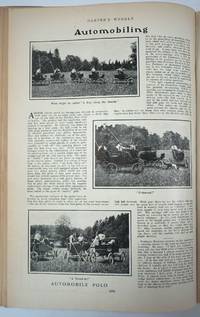
Harper's Weekly Vol. XLVI July 5 1902 to December 20 1902
New York: Harper's 1902. First printing. Hardcover. Good overall. Content on the Russo-Japanese & Spanish American War; Automobiling early cars playing polo!; Teddy Roosevelt Chinese rugby cartoon Blackwell Island Bridge Thomas Nast cartoon Henley regatta. Half year bound volume of Harper's Weekly with woodblock illustrations throughout.<br /> <br /> Color supplements were included in the Christmas issue. Chinese playing rugby cartoon p1582; US Naval Academy p1498; Blackwell Island Bridge p1308; Wall Street p1180; Thomas Nast p1972. <br /> <br /> Folio 1155pp. Weekly issues bound up into a large single volume with 3/4 leather and marbled boards. Leather spine chipped cracked at hinge binding firm internally very clean. Harper's hardcover
Riferimento per il libraio : 28399
|
|
|
[Philippine-American War]. Swartzlander, Louis C
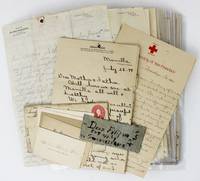
Manuscript Archive of Over 100 Letters Written by and to Louis C. Swartzlander While Serving as a Private in the 4th U.S. Cavalry in the Philippines During the Aguinaldo Insurrection
San Francisco and various locations in the Philippine Islands 1901. Very good. 101 manuscript letters totaling approximately 360 pages and around 38000 words plus an assortment of related correspondence and documents. All letters and documents sleeved in chronological order in two modern three-ring binders. Original mailing folds general overall wear with a few letters closely trimmed and four of the letters incomplete. An important archive documenting the experiences of a young soldier from Omaha Nebraska named Louis C. Swartzlander during his time in training in California and at war in the Philippines at the turn of the 20th century. After graduation from Omaha High School seventeen-year-old Louis Carver Swartzlander 1882-1922 lied about his age to enlist for three years in an Omaha cavalry troop recruited to suppress the Aguinaldo Insurrection also known as the Philippine-American War following U.S. colonial occupation of the Philippines in 1898. Sixty-five of the present letters were written by Private Swartzlander to his family including over twenty from the Presidio in San Francisco while awaiting transport to the Philippines and over forty from military posts during his time in Manila Balinag Bayambang Dagupan and other locations on Luzon before during and after combat against the Aguinaldo insurgents. All of the letters were written during the heart of the conflict between May 17 1899 and September 15 1901. Swartzlander’s letters ultimately shed light on this controversial though obscure episode of the United States's imperialist activities in the Philippines as well as Louis’s other military and battle experiences his impressions of Philippine life culture and internal politics his racial attitudes and much more. In one letter on June 15 1900 Louis mentions the burning of the insurgent town of Dasal Luzon by the 25th Colored Infantry a notable but still-obscure moment in African-American military history. In another letter Louis mentions to his brother that he plans to send him a patch of cloth from a dead insurgent soldier; the collection includes a small rectangular swatch of cloth with the following inscription: "Dead Filipino cut off by Swartzlander 4th Cav."<br /> <br /> The archive also includes over thirty letters written to Louis from his father Dr. Frederick Swartzlander his mother and brother; many of these letters concern their efforts to have Louis discharged from service before his enlistment had ended so that he might join his brother a medical student at Stanford University which the family ultimately accomplished. Following Louis's final letter here on September 15 1901 is a printed special order granting his discharge. Louis then traveled to Palo Alto where he enrolled at Stanford though he apparently did not graduate from there; his obituary in 1922 states that he obtained a medical degree from Creighton University before dying unexpectedly from a short illness.<br /> <br /> The following excerpts from just five of Louis's letters provide an overall picture of his writing style and the content of his letters. We also have a forty-three-page printed document of excerpts from the letters prepared by a previous owner of the archive that we can share upon request providing much more information on the composition of both Louis's and his family's correspondence during this time.<br /> <br /> 1 Louis Swartzlander to his parents San Francisco Ca. May 30 1899: “Today another one of the boys…and I took in Chinatown and it is the dirtiest hole I have ever been in. The streets are of ordinary width although some are about like alleys. All along the sidewalks are chinamen fixing and making opium pipes. You can see Chinese men women and children all the way from 1 to 60 or 70 yrs of age. One street or alley is devoted to the fish market and you can smell it for two blocks and fish! Why I never saw so many fish in a pile in my life all kinds from a devil fish which looks exactly like an octopus only smaller to a shark. Also live turtles by the bushel and all kinds of stuff that nobody but a chinaman could eat. I was vaccinated again today as the other two vaccinations did not take. I hope I will get to go aboard the Sheridan for the Philippines next June 7<br /> <br /> 2 Louis Swartzlander to his parents Manila P.I. July 28 1899: "Well here we are at Manilla all well and healthy. We had an excellent voyage with a peaceful ocean. I saw lots of small flying fish sea gulls sharks etc. We left San Francisco June 24 at 6 oclock and arrived at Honolulu July 2nd. Most of the boys succeeded in going ashore but I could not. We arrived at Manilla July 25th. When about 10 days out after leaving Honolulu we saw an active volcano in the Ladrone Islands. We are stationed about 2 miles from the heart of Manilla. We are stationed in large bamboo barracks each of which will hold about 25. I was in the old walled city and it is a queer place. It is composed mostly of immense cathedrals. The city walls are about 10 feet thick and 15 high but are beginning to crumble as they were built before this century. All stone used in this country is made of cement. There seems to be lots of good fishing here. Yesterday I went out to the famous bone pile that you read about in Omaha. It is a terrible sight with bones piled up and skulls lining the walls but these people don’t seem to care for their dead at all. If the deceased has money he can have a vault if not he goes to the bone pile. It is not so very hot here. At a guess I would say it is about 100 in the sun and 90 in the shade. Tobacco is very cheap here. I can buy a box of good 10 ct cigars for 50 cts American money. I have seen the Pasig river. It separates old Manilla from new Manilla. It is a muddy stream about 200 feet wide with almost no current. This country is covered with palms banana trees etc. All the banana trees are covered with green bananas but none are good to eat as they are too green. The native horses here are about like Shetland ponies and it looks queer to see a troop of the 4th Cavalry mounted on such small horses. We are having the best of eating the best I have had since I enlisted."<br /> <br /> 3 Louis Swartzlander to his brother Manila P.I. December 22 1899: “You seem to think that I am a great fellow just because I came out here. Of course it was hard very hard at first but it is easy now. I am more than pleased to hear that you are doing so fine with your studies and now just keep at them and you will turn out a finely educated man. I am also pleased to hear that you think you will be a doctor as I long ago decided I should. If I can get back to the states and get my discharge we can both study medicine together. Well I have been.in the hospital with the itch but it is now O.K. I will soon again join my troop Fighting K. I am feeling good though not so strong as when I was in the states. Our troop is I believe east of the railroad about 20 miles from here. Say Joe the first chance I get I am going to kill a goo goo niggar for you and if I can I will get a piece of his uniform such as it is and send it to you. I’d get a piece of his doggoned hide if it didn’t stink. Remember this goo goo is to be plugged for you. On the firing line we have a pretty good time. You see when things are quiet we get up at 6 oclock care for our horses eat breakfast lay around until 8 oclock then if we neither go out scouting or drill we have nothing to do until 4 oclock when we again look after our horses eat at 5 answer retreat at 6 oclock and nothing until taps at 9 when we must all be in quarters and lights out. Sometimes we are divided up so that about 3 men are in a shack and then if we can get a candle we play cards tell stories play a mouth organ or whatever there is to pass away the time. Every once in a while the niggars will fire a volley into the town and then we turn out and give them what they need. In the morning we generally find from 5 to 15 dead goo goos laying around. They very seldom hit any of us because they cant shoot and so soon as we yell we charge and they don’t know any thing but to get. Our troop commander will let us get all the chickens we want the pigs are no good but the caribou are O.K. just like beef and so you bet we don’t go hungry so very long at a stretch."<br /> <br /> 4 Louis Swartzlander to his parents Bayambang P.I. June 15 1900: "We are still at Bayamban. We are doing just the same duty as when we first arrived here last November that is two posts to walk one serving as an out post and the other the stables guard. From the present outlook of things we will stay here for the rainy season as our shacks are being repaired and a bamboo stable is being built for our horses. The stable is about 300 feet long by 40 wide and will shelter 11 horses and 15 mules besides 12 native ponies. To give you a description of one of our trips through the country.I don't claim to be a writer or reporter so you must excuse my poor attempt. As our last trip was a fairly good one.I will attempt to tell you about it. We first received orders on the morning of April 15th to be ready for a trip within the next 24 hours and by a little hustling and packing we were soon ready. On the morning of the 16th we saddled up and within a half hour were off.we rode about seven miles to a small town called Urbiztando. At that place we unsaddled our horses first the saddles and other equipments except our guns on three small rafts which were pulled across the river. The command was then given to mount and having done so we started in and in five minutes time every man and horse was safe on the west side of the Agno river. We again saddled up and by riding two miles further arrived at a pretty little town called Mangaterem. The town covers about four square blocks and contains a large church besides several fair sized houses. In front of the church is a large plaza which is about a block square. In one corner of this plaza and beneath a large stone monument are or were buried two American soldiers who were killed while taking the town. We stayed in Mangaterem overnight sleeping out on the plaza. The next morning at 530 we were aroused by first call. We then fell in line for roll call and after this fed and brushed off our horses then ate a breakfast of two slices of bacon four hardtack and a half a cup of coffee. At 615 we saddled up and started for another fair sized town 12 miles distant called Salasa. This town is as well as Mangaterem garrisoned by the 36th U.S.V. There at Salasa you get a fine ocean breeze as we were then getting close to the coast. Upon arriving at Salasa we unsaddled and turned our horses loose in herd and made preparations for the night. At four oclock we caught up our hoses fed and groomed them after which we got our own supper. After this the most of us went down to a river close by and had a fine swim after which we all turned in for a good rest. In the morning after being joined by 50 men of M troop of the Fourth Cavalry we started for Sual a town about 11 miles distance and on the Gulf of Lingayen. We arrived at Sual at about 1 oclock. We were then quartered in the church which was made of bamboo and mud. That evening after having a good dip in the Gulf we rolled in for another good nights rest. In the morning we started for the town of Alaminos which is about the same size as Maregaterem. Here we had to water our horses out of a well as there is no river within two miles distance. We here slept in what appeared to be an old school house or cottage of some sort. Here I bought a package of smoking tobacco and a pipe also a can of jam which came in handy with the hardtack. Well the next morning left for Dasol a town about 17 miles. We arrived at a small town called Balincagin at about 11oclock where we rested a half hour and then started on to Dasal here we arrived at about 3 oclock. Dasal never was a town of much importance but now it is no town at all or at least it was not when we arrived there. The 25th Infantry Colored had a fight there and after driving every insurgent not dead or wounded over the hills and far away they set the town on fire and it has always been an insurgents place of meeting and once before when we were there they shot into us doing no harm however. Well we here slept out on the old plaza and in the morning started to Santa Cruz arriving there at about noon after crossing about forty small rivers. Santa Cruz is a pretty little town situated on the bay. The town itself covers about eight square blocks and contains a large stone church and convent also a school house and several large houses. That is large for this country about the size of a barn in the states. It also contains like all other towns hundreds of little nipa shacks."<br /> <br /> 5 Louis Swartzlander to his parents Bayambang P.I. October 31 1900: "Well the 17th Infantry had another scrap last night at a small town beyond Camaling. I do not as yet know just where it took place but I am told about 20 miles from here. It seems that there were just sixteen American soldiers in the town and when the goo-goos opened up they grabbed their guns and rushed outside their quarters. They then returned the fire hot and heavy for about 5 minutes when they saw that the goo-goos were advancing. At once the command 'fill magazines' was given and then charge. With a yell they were after the goo-goos firing as they charged. Well now no goo-goo can face a hot fire and worse of all the Americans yell and they broke and ran every goo-goo for himself. Our boys could not get close to them as they can run like a deer but when the thing was over 5 dead goo-goos lay dead with holes in them while on our side only one man had been hurt and he only slightly - a Mauser ball had passed through his arm including between the elbow and wrist. He was sent to the Dongupan hospital today. It is estimated that there were 200 bolo men and 25 rifle men and so you can see how easy it is for us to put largely superior numbers to flight. It has been rumored here that after the presidential election is over that the U.S. soldiers are going to make a grand cleaning up of this island and its goo-goos. That will mean that we will show them no mercy and every time we see a goo-goo we will 'soak it to him' you know that that means but I have great doubts as to whether or not they will do any such thing as that would end their trouble too quickly and some of those muck a mucks in Manila would lose a good job. If they wanted to end this trouble all they would have to do is turn the soldiers loose and we wouldn't do a thing to them. As it is we are not allowed to lay a hand on them or to touch a hair of their heads. We will capture 50 or so of them then our officers turn around and put them on confinement for 3 or 4 days and then turn them loose. How are we ever going to end this war when they do that way. I would like to know. But such is the case and I have seen it done several. In all probability if we should capture Aggie they would take him to Manila and give him some good government position. They finally captured Genl. Del Pilar and what did they do turned around and told him if he would take the oath of allegiance to the U.S. that they would turn him loose. Of course he did so for what do these people care for the oath of allegiance and today he is again with the insurgents. I tell you that the people in the U.S. have the wool pulled over their eyes in regards to this matter on Luzon and they will learn after a few thousand more of our boys are killed or die of sickness. This whole thing could have been ended in less than six months at the start but the officers had too good a thing of it and the longer it lasts the better it suits them. When I started to write this I did not intend to criticize the authorities and so will quit writing on this subject. Be sure and do not print in a newspaper what I have here written as I might get into serious trouble."<br /> <br /> 6 Louis Swartzlander to his parents Dagupan P.I. April 18 1901: "I have just returned from an open air concert which was given by the 17th Infantry band on the plaza which is located in the center of Dagupan. The band is composed of nearly thirty pieces and all its members are good musicians. Several of Sousa's pieces were played.as well as.the Star Spangled Banner. The concert lasted nearly two hours.very enjoyable. I am still at 3rd District Headquarters Dagupan as orderly for General Smith. The General himself is at present in the town of Iba to which place he went three days ago for the purpose of inspecting the military prison. The two of Iba is situated in the Zambales province and is about 65 miles from here.we used to pass through Iba on your hikes to Subig.in the early part of 1900. K troop is.on a hike in the mountains in the vicinity of the town of Camaling which is about 12 miles south of Bayambang. I am glad that I am not with them as I have had about all the goose chases that I care to take part in…all the rest of the men in K troop are tired of hiking but that makes no difference for if Captain Benson wishes to go out in the mountains he details about 60 men and they have to go whether they want to or not. Should any man having been detailed to on any such hike fail to do so when hot prevented by sickness or other necessary cause he would be thrown into the guard house and be tried by a general court martial. There was a public hanging in the town of Bennmollie which is three miles west of here.the accused murdered some friendly natives some time ago and when caught was tried by the military authorities found guilty of murder in the 1st degree and was sentenced to hang. The victim dropped at 1023am and was pronounced dead in just 7 minutes. I wished very much to go myself but it being as I was on duty that day I could not; however I will yet have plenty of chances as natives who have been convicted of murders are being hung in different parts of these islands nearly every Friday. I never as yet have witnessed a hanging and I wish to do so before returning to the U.S. Never since last August when you first made application for my discharge did I have the least expectation that it would be granted as I know too too well how hard it is for a soldier in the regular army to obtain a discharge by favor purchase ora ny other way before his time of enlistment has expired. I also know that unless the soldier has a very strong pull in Washington it is almost impossible. I think it best to drop all hopes of my discharge before May 11 '02 at which date they are compelled to let me go and then I will lose no time between here and San Francisco. Heaven help the poor lads who were enlisted in Omaha for the 10th Cavalry and sent to the Philippines. In all probability they will have to serve their entire enlistment over here/ Where the sun is as hot as fire/ Mosquitoes as large as bumble bees/ Where all is mud and mire/ Where nothing grows but mango trees/. And I fear that before they are over here very long they will be singing Army turn backward turn backwards tonight. Out of these islands out of these fights with mosquitoes. Out of these mud holes with mud that will stick to your old army rags until it bakes into brick."<br /> <br /> Louis's letters as well as his family's are generally long and detailed with all but five of them totaling at least two pages and almost half of the letters clocking in at four pages or more. As such this correspondence constitutes a deep and intensely researchable collection documenting Louis's military activities and experiences in the Philippines during an important time in the history of U.S.-Filipino relations as well as how his family dealt with his service on the home front. A wonderful archive with outstanding research potential. unknown
Riferimento per il libraio : 5206
|
|
|
[PHILIPPINES - WORLD WAR II MAP] DRURY, JOHN G (MAPMAKER).
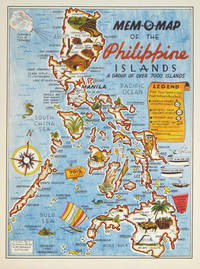
Mem-O-Map of the Philippine Islands. A Group of Over 7000 Islands.
U.S.A.: Mem-O-Map Co. 1945. Colour pictographic / pictorial map 32.1 x 23.8 cms; 35.4 x 26.6 cms sheet very good condition. Rare pictorial map published in 1945 by John G. Drury aTechnical Officer who served with the 214th Ordnance Battalion to mark the end of World War II as souvenirs for the military. Military personnel could fill in banners "came in on good ship." and "departed on good ship." their name organisation and "Line of Advance or movement" blank in this example. Pictographs mark various memorable spots and wildlife including larger-than-life insects. A "Terrible Tillie Typhoon" looms over the coast at Luzon. <br>Drury published a series of five maps: Philippines and Okinawa in 1945; Japan and Korea Oahu and Europe in 1946. They are all scarce. “These almost whimsical maps are designed to support the creation of personalised geographies. At a time when digital mapping is beginning to experiment with the creation of personalised content that would render the same map in different ways for different users Mem-O-Maps demonstrate the principle in action." Kenneth Field ICA Commission on Map Design. . Mem-O-Map Co. unknown
Riferimento per il libraio : 204557
|
|
|
[PHILIPPINES -- WORLD WAR II]. STEVENS, Fredric H
Santo Tomas Internment Camp. 1942-1945. With a foreword by Gen. Douglas MacArthur.
New York: Frederic H. Stevens Stratford House Inc. 1946. 8vo. xiv 569 1 pp. Frontisp. illust. of Santo Tomas Building numerous text illustrations. Beige cloth red & gilt lettering on front cover minor shelfwear & dustsoiling still VG copy from the library of former internee Charles Kurz 1891-1978 a business agent and later accountant for the Pascific Steamship Line World War I veteran and headed the labor safety battalion for American prisoners inside Santo Tomas w/ ownership markings on ffep. and 1950’s passport photo of Kurz laid-in. First edition of this scarce and graphic work chronicling the conditions of one of the largest of Prisoner-of-War Internee camps set up by the Japanese during World War II composed mostly of American civilians. The University of Santo Tomas in Manila was utilized for the camp and housed over 4000 civilians many of whom were near death at the end of the war due to starvation and poor conditions. The 1st Cavalry Division pushed forward in a 100 mile advance to Manila in 66 hours in order to prevent the Japanese from killing all of the internment camp prisoners and subsequently fought the Japanese forces across Manila. Frederic H. Stevens, Stratford House, Inc., hardcover
Riferimento per il libraio : 60810
|
|
|
[Philippine-American War]: [Theater]
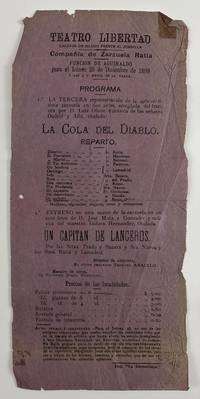
Teatro Libertad. Calzada de Bilibid Frente al Zorrilla. Compania de Zarzuela Ratia. Funcion de Aguinaldo. caption title
N.p. but Manila: Imp. 'La Democracia 1899. Good. Broadside 11.5 x 5.25 inches printed on thin purple paper. Old folds creases edge chips and a few short tears light soiling old tape remnant to top margin. An unrecorded broadside advertising a Christmas Day theatrical performance put on in Manila in the midst of the Philippine-American War. The performance of the zarzuela a Spanish-language musical theater format mixing spoken and sung dialogue within scenes included two parts; the first "La Cola del Diablo" "The Devil's Tail" consisted of a cast of fourteen players all of whom are identified here. The second portion of the program was a performance of "Un Capitan de Lanceros" "A Captain of Lancers" a one-act zarzuela with an orchestra. The broadside also lists the various prices for tickets and a special notice at the bottom regarding an upcoming "surprise summary performance" encompassing works from the company's repertoire. The performances were staged at Teatro Libertad a famous theater in Manila whose plays often reflected the nationalist sentiments of Filipinos struggling against colonial rule. Imp. 'La Democracia unknown
Riferimento per il libraio : 5851
|
|
|
[Philippine-American War] Ellsworth, Herbert E [likely]
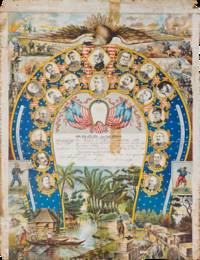
“Good Luck to the American Soldiers in the Philippinesâ€
Likely San Francisco California 1901. 19 x 24 inch lithograph. Much staining and chipping; folded with tears; several tape repairs verso with some residue visible recto; quite attractive overall good plus. A broadside lithograph commemorating a soldiers’ service in the Philippine-American war. Images of generals are set in a large blue horseshoe and eagle design over a montage of scenes from the war. In the center is a service form and an empty horseshoe in which on examples of similar broadsides the soldiers’ photograph is affixed. The service form certifies that Everett W. Patton enlisted in 1899 and served in the 38th Regiment. Similar broadsides—though with some differences in design—have on the bottom margin a 1901 copyright to Herbert E. Ellsworth and the My Boys Publishing Company and attribute the lithograph to Sanborn Vail & Co. both in San Francisco. This margin is missing from this copy. Overall a vivid and attractive piece. unknown
Riferimento per il libraio : List2860
|
|
|
[PHILOSOPHIE SCIENCES HUMAINES] - COLLECTIF
Centre de sociologie de la guerre : la communication sociale et la guerre.
Bruxelles, Établissements Émile Bruylan, 1974; grand in-8, 288 pp., relié plein cuir blond, dos orné de fleurons, à 5 nerfs, pièces de titre en cuir gris vert et vieux rose (couverture conservée). Études de sociologie de la guerre : colloque des 20, 21 et 22 mai 1974. Certaines interventions sont en langue anglaise. Magnifique reliure pour un ouvrage si récent. Bon état.
|
|
|
[PHILOSOPHIE SCIENCES HUMAINES] - COLLECTIF
Centre de sociologie de la guerre : la paix par la recherche scientifique.
Bruxelles, Édition de l'Institut de Sociologie de l'Université Libre de Bruxelles, 1970; grand in-8, 324 pp., relié plein cuir blond, dos orné de fleurons, à 5 nerfs, pièces de titre en cuir gris vert et vieux rose (couverture conservée) (annotations au stylo rouge). Études de sociologie de la guerre : colloque des 5 et 6 novembre 1969. Magnifique reliure pour un ouvrage si récent. Bon état.
|
|
|
[Photograph] [Military & War] [Mexican Border Campaign]
1914 Mexican Border Campaign Photograph
n.p.: n.p. 1914. Photograph. Good. Photograph. Approx. 10" x 8". Photograph is in good condition with light amount of spotting to the image. No other information known about the image other than what is written at the bottom of the picture "Mexican Border 1914 Raymond Thompson." View shows three men up front on horses. One soldier on a white horse is carrying the American Flag. The view also shows other soldiers and tents in the background. From wikipedia: <br /> <br /> The Mexican Border War13 or the Border Campaign14 refers to the military engagements which took place in the Mexico–United States border region of North America during the Mexican Revolution. The war's time period encompassed World War I during which Germany attempted to have Mexico attack the United States and engaged in hostilities against American forces there itself. The Border War was the fifth and latest major conflict fought on American soil where its predecessors were the American Revolutionary War War of 1812 Mexican–American War 1846–1848 and the American Civil War. The end of the Mexican Revolution on 1 December 1920 marked the close of the American Frontier. The Bandit War15 in Texas was part of the Border War. From the beginning of the Mexican Revolution in 1910 the United States Army was stationed in force along the border and on several occasions fought with Mexican rebels or federals. The height of the conflict came in 1916 when revolutionary Pancho Villa attacked the American border town of Columbus New Mexico. In response the United States Army under the direction of General John J. Pershing launched an expedition into northern Mexico to find and capture Villa. Although Villa was not captured the US Army found and engaged the Villista rebels killing Villa's two top lieutenants. The revolutionary himself escaped and the American army returned to the United States in January 1917. Conflict at the border continued however and the United States launched several additional though smaller operations into Mexican territory until after the American victory in the Battle of Ambos Nogales in August 1918 leading to the establishment of a permanent border wall.16 Conflict was not only subject to Villistas and Americans; Maderistas Carrancistas Constitutionalistas and Germans also engaged in battle with American forces during this period. n.p. unknown
Riferimento per il libraio : 35285

|
|
|
[Photograph Album] [Military & War] [United States Army] [Regimental]
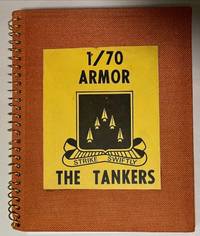
1973 Photograph Album of the 1st Battalion 70th Armor "Change of Command
Unknown: N/A 1973. Photograph Album. Very good. Photograph Album. Approx. 11.75" x 9.5". Metal ring binder with orange burlap cloth covered boards. Pasted down yellow and black insignia of the 1st Battalion 70th Armor on the front cover and also located on the first page in the album. <br /> <br /> Album consists of 41 black and white photographs and one color picture of the "Headquarters" sign. Photographs range in size with the majority of them measuring approximately 7" x 5". Pictures have typed and written cut and pasted down short descriptions. Photographs include pictures of Army personnel training exercises marching and casual soldier interactions. Inscription written inside the front cover reads "To the best Battalion Commander that we have served under. Signed C & M Griegs S P 4 Rogers and P F C Weber." On the rear paste down are two pictures showing a tank formation and the other titled "Striker Six Gives Up Command." <br /> <br /> The 70th Armor Regiment was first formed in 1940 and participated in several European and North Africa battles during World War II. According to the wikipedia entry the 70th Armor Battalion the most decorated armor unit in the United States Army was inactivated at Fort Riley Kansas in 1970 and not reactivated until 1975 at Fort Carson Colorado. The album compiled in 1973 shows that the unit was still active between 1970 and 1975. N/A unknown
Riferimento per il libraio : 35207
|
|
|
[Photograph Album] [United States Marine Corps] [Philippines] [New Guinea] [World War II]
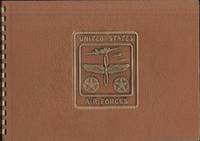
31st Division USMC New Britain Philippines undated photograph album
Philippines: n.p. n.d. Photograph Album. Very good. Oblong plastic bound photograph album. 10.5 x 7.5". 52 photographs measuring approximately 3.75" x 2.5". These pictures are possibly prints. "United States Air Forces" embossed on the front cover. Inside the front cover is written "31st Div USMC New Britain Philippines." Album is clean and in very good condition. <br /> <br /> Photographs depict soldiers in camp in the jungle riding ox's picture of a downed planes pictures of jeeps and equipment tents and a couple of photographs of natives. No dates or names found inside. Unclear where the photographs were taken. The 31st Division was in the Philippines and New Guinea during World War Two. n.p. unknown
Riferimento per il libraio : 36038
|
|
|
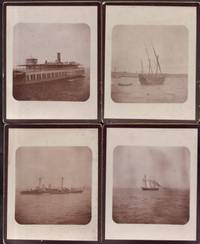
[Photographs] [Military & War] [Navy] [Man of War Ships]
7 Vintage Photographs of Man of War Ships and others
n.p.: n.p. n.d. Photograph. Good. Seven photographs measuring approx. 5" x 4". Pictures are mounted on heavy card. Light foxing and spotting to the images. Light edge wear to the photographs. Six of the seven pictures have some writing and identification on the back. Photographer not identified. n.p. unknown
Riferimento per il libraio : 35282
|
|
|
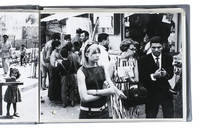
[PHOTOGRAPHY - THIRD ARAB-ISRAELI WAR - ISRAEL] DONY, Bianca
Album with photographs showing parts of Israeli captured territories including the Golan Heights the West Bank parts of Jerusalem the Gaza Strip and the Sinai Peninsula.
Israel 1967. Oblong album ca. 20 x 26 cm; photographs in slightly varying sizes ca. 18.5 x 24 cm. Grey faux-leather photo album with a small white label on the front board: "42 x Israël 1967 23-24-25 Juli". 44 silver gelatin photographs including 2 duplicates and 1 other loosely inserted. 44 photographs in an album with 30 clear plastic inserts. A rare collection of fascinating original photographs capturing the first Western tourists in Israel and Israeli captured territories approximately a month after the Six-Day War in 1967 by Dutch journalist and photographer Bianca Maria Dony. The 44 photos in the album show the passenger ship SS Pegasus soldiers local people in the streets of Jerusalem and other cities an early war monument checkpoints destroyed military vehicles and other remnants of the war. The album is from the archive of the photographer; some of these photographs were sold to and published in national Dutch and international newspapers and magazines while others remained unpublished.Bianca Dony was part of a group of 150 Christian tourists from various European countries who were now - after the Israeli capture of these areas - able to visit the holy places in the old city of Jerusalem Bethlehem and other places that had previously been inaccessible. The tourists in the present photographs were the first of many and Dony took this opportunity to not only document the trip itself but also the general aftermath of the war.With an additional leaf in the inside front pocket of the album containing notes of how many photographs were sold to different newspapers and magazines including 10 to the "Haagsche Courant" written in blue and red ink and in pencil. Added to the first photograph in the album is a newspaper clipping from the "Jerusalem Post" with the headline "Haifa direct to old city for first time" about the first tourists visiting Israel after the Six-Day War. Some of the clear plastic inserts have small round white stickers on them with different abbreviations connecting the photographs to the newspapers and magazines that possibly printed them for example "HC" for Haagsche Courant etc. 3 photographs are loosely inserted and 2 of these are duplicates of other photo's in the album the 2 duplicates contain a blue stamp "foto bianca dony 147 Malakkastraat Den Haag - Tel. 5582540 Giro 303814" and a manuscript caption in red ink on the back. Most other photographs are simply numbered in pencil on the back. This rare collection of 44 historically significant photographs is in very good condition.l Cf. Rebecca L. Stein "Souvenirs of conquest: Israeli occupations as tourist events" International Journal of Middle East Studies vol. 40 no. 4 2008 pp. 647-669. hardcover
Riferimento per il libraio : ABC_47179
|
|
|
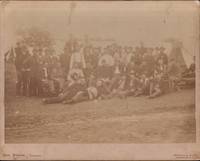
[Photograph] Military & War] [Indianapolis Light Infantry] [Geo Prince, Photographer]
Ca. 1883 Indianapolis Light Infantry mounted albumen photograph
Washington DC: Geo. Prince 1883. Photograph. Good. Photograph. 8" x 10" mounted albumen photograph. Light wear. Faint wooden sign in the photograph background reads "Indianapolis Light Infantry." "Indian Wars" written in pencil on the back of the photograph. Light edge wear to the photograph. Geo. Prince unknown
Riferimento per il libraio : 32867
|
|
|
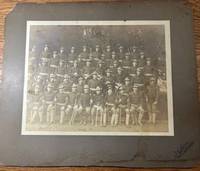
[Photograph] [San Francisco] [Military & War] [Regimental] [James D Givens] [James D Givens, Photographer]
Circa 1890's portrait photograph of Company "H" 20th Infantry
San Francisco: James D. Givens 1900. Photograph. Fair. Photograph. Approximately 13" x 11". "H 20 Inf" pictured in the bottom left corner. Photograph chipped and damp stained on the edges. <br /> <br /> Givens moved to San Francisco in 1899 and soon opened a studio in the Presidio. Givens took photographs of military units as they passed through the Golden Gate city. He also photographed the Spanish American War in 1898 and published later works of photographic collections taken abroad. undated photograph but circa 1899 to early 1900's. James D. Givens unknown
Riferimento per il libraio : 34505
|
|
|
[Photograph Album] [World War I]
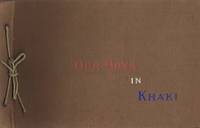
Our Boys in Khaki" World War I.
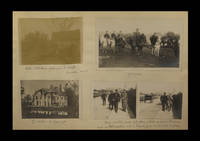
New Jersey Maryland Georgia: n/a 1917. Album. Good. Oblong string tied tan cloth covered photograph album. Album measures approximately 7" x 11". Covers are lightly spotted. A few pictures have been removed. Three pictures are loose. One picture torn in half. The majority of pages are blank. Creator of the album is unknown. <br /> <br /> Album consists of 38 photographs ranging in size from 3" x 2" and 4.25" x 2". 33 photographs are of soldiers in World War I training camps at Fort Oglethorpe Georgia and Camp Meade Maryland. The first three photographs include a scene of the Delaware River at Easton and the other 2 from New Jersey. Two more photographs include a 1916 view of Irvington N.J. M.E. Church and Irvington High School football team. Several of the pictures have descriptions. Other scenes include soldiers in uniform. training exercises camp life trench photographs a French officer in the distant a soldier posing in front of a Chickamauga Battlefield monument a solider on a motorcycle and a picture of soldiers digging punishment for leaving camp without permission. A small color brochure of Insignia's laid inside the album. n/a unknown
Riferimento per il libraio : 35193
|
|
|
[Photographies - Guerre 1914 - 1918].
Runion de deux albums recelant 345 photographies originales et un ngatif
1915. S.l. s.d. 1915. 2 albums au format in-8 oblong 263 x 188 mm rÂŽunissant 345 clichÂŽs originaux. Pleines percalines grÂges fermeture ˆ lacet. Important tout autant qu'ÂŽmouvant tÂŽmoignage photographique rÂŽunissant 345 clichÂŽs originaux en noir et blanc de divers formats 68 x 47 mm ˆ 214 x 163 mm. Tirages argentiques du temps contrecollÂŽs ; lÂŽgendÂŽs ˆ la plume au bas des photos. 13 clichÂŽs volants. L'ensemble donne ˆ voir paysages parfois lunaires scÂnes de ruines portraits de militaires dont Zouaves ainsi que de civils vues d'ensemble ou particuliÂre de villages ÂŽglises ou b‰tisses souvent dÂŽvastÂŽs scÂnes de groupes abris militaires scÂnes prises depuis les tranchÂŽes dont premiÂre ligne de front des gradÂŽs : le GÂŽnÂŽral Joffre le GÂŽnÂŽral Rouquerol le colonel Dechiezelle le Commandant Pruneau le Lieutenant Fournier le Lieutenant Walckemar Raymond PoincarrÂŽ alors PrÂŽsident de la RÂŽpublique Villeneuve Bargemont des engins militaires dont vÂŽhicules blindÂŽs un poste de secours une carriole tractÂŽe par un chien des avions une remise de la Croix de guerre des scÂnes figurant la 1Âre Compagnie du 1er RÂŽgiment de fusillers marins des vues de ports et de littoraux des vues aÂŽriennes un avion accidentÂŽ des piÂces d'artillerie et des munitions une locomotive dans une gare dÂŽvastÂŽe une vue aÂŽrienne d'un bombardement des tombes de soldats des scÂnes de bataille navale un soldat posant le cr‰ne d'un Allemand entre les mains la remise du courrier sur le front l'ÂŽdification d'abris des marins un champ d'aviation un cadavre ''boche'' sic etc. En somme cette exhaustive rÂŽunion offre un ÂŽclairage - unique ! - et trÂs complet sur le quotidien des soldats et les ravages engendrÂŽs par la guerre. En outre : une note manuscrite rÂŽdigÂŽe par un Lieutenant-Colonel contrecollÂŽe avec timbre du ''2Âme RÂŽgiment de zouaves de marches'' et deux tickets de train. Nombre de ces photos - au regard des lÂŽgendes - ont ÂŽtÂŽ prises ˆ Nieuport principalement et YprÂs. Rousseurs affectant les plats. Tirages dans l'ensemble bien prÂŽservÂŽs bien que de rares d'entre-eux prÂŽsentent un ÂŽclat altÂŽrÂŽ. Deux feuillets dÂŽsolidarisÂŽs dont un prÂŽsente un manque angulaire ; sans atteinte ˆ la photo. Blocs feuillets dÂŽsolidarisÂŽs de leur reliure respective. Nonobstant ensemble en belle condition. b42961 unknown
Riferimento per il libraio : 27388
|
|
|
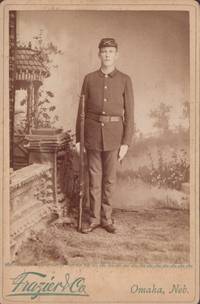
[Photograph] [Military & War] [Frazier & Co, Photographer]
Vintage photograph portrait of man in full military uniform taken in Omaha Nebraska
Omaha: Frazier & Co n.d. Photograph. Very good. Photograph. 6.5" x 4." portrait card of an unidentified man in military uniform with gun and bayonet by his side. Man is wearing a belt buckle initialed "U.S.". Portrait taken inside the Frazier & Co. Art Studio in Omaha. Company name and illustration on the back of the card. No date. Frazier & Co unknown
Riferimento per il libraio : 35290
|
|
|
[PHOTOGRAPHIE] - PERRAULT (Gilles)
1944/1994 regards.
Honfleur, Moulin Vieux, 1994; in-4, 108 pp., reliure d’éditeur, sous jaquette. Les 50 ans du débarquement de Normandie. Bon état.
|
|
|
[PICARDIE].-
Abbeville le 20 Mai 1940. Publication du Syndicat d'Initiative d'Abbeville et ses environs et de la Société d'Emulation Historique et Littéraire d'Abbeville.
Abbeville, Imprimerie F. Paillart, 1943, in 8° broché, 71 pages ; très nombreuses illustrations.
Riferimento per il libraio : 34019
|
|
|
[PIRENNE, Jacques].
L'attitude de Léopold III, de 1936 à la Libération.
Albin Michel, 1949, in-12, 276 pp, broché, couv. illustrée d'un portrait de Léopold, bon état. Edition originale
Riferimento per il libraio : 80253
|
|
|
[PICHT, Werner].
La Fin des illusions. L'An 40.
Bruxelles, Impr. Louis Desmet-Verteneuil, s.d. (1941), in-8°, 155 pp, 16 pl. de photos hors texte, broché, bon état. Peu courant
Riferimento per il libraio : 53502

|
|
|
[PICARDIE, GUERRE 39-45]
Les bandes de PICARDIE - Le 1er régiment d'infanterie dans la résistance.
Paris, Librairie Lamre, 1946 ; petit in-4, 190 pp., broché (plats salis un tampon sur le 1er plat vendu dans l'état). Préface du général Koenig - illustrations de PÉRICHON-MESLAY - tampons - complet avec sa carte.
Riferimento per il libraio : 200911262
|
|

 Ricevere i risultati per e-mail
 Scaricare i risultati in PDF
 RSS feed
 Link
Link


