|
Davis, Jefferson (Sect of the War Department)
Army Register. Letter from the Secretary of War Transmitting Copies of the Official Register of the Army
Washington: U.S. Congress Gov. Printing Office 1855. Octavo. 33d Congress 2d Session Ex. Doc. No. 58. 55 pages. This was the special printing of the Army Register beginning with a letter from Jefferson Daivs who was Secretary of War. The book records the names of those who became generals or otherwise distinguished themselves in the Civil War. It lists their pay rations allowance for servants and forage expenses for those with horses. Robert E. Lee who we learn had just received Brev from Captain to Colonel; with pay and rations to a little over $2000. U.S. Grant on the other hand had just been Brevetted a Captain with pay and rations of $1000 annually. Also found in this volume is that of Jefferson Davis George McClellan George. Thomas W.T. Sherman George Meade Longstreet Sheridan and a host of others including the problem officers Bragg Pemberton and Burnside. There is also a listing of officers whose fame came after the Civil War George Crook Randolf Mercy and a list of the surgeons who were given the rank of Major p. 60. A fascinating look at the details of the period just seven years before the outbreak of the Civil War. Bound in red cloth spine lettered in black some light toning to the last page and endpapers. U.S. Congress, Gov. Printing Office unknown
書籍販売業者の参照番号
: 032590

|
|
|
Secretary of War
REPORTS OF EXPLORATIONS AND SURVEYS To Ascertain the Most Practicable and Economical Route for a Railroad
Washington DC: A. O. P Nicholson. G/NO DUSTJACKET. 1858. . 1/2 Leather. From the Mississippi River tp the Pacific Ocean.1853-56. House of Representative Executive Doc. No. 91 Volume IX only Part II - General Report upon the Zoology of the Several Pacific Railroad Routes . 4to. 1005 pp. cover rubbed soiled page foxing fhinge cracked . A. O. P Nicholson hardcover
書籍販売業者の参照番号
: BOOKS238275
|
|
|
Secretary of War
REPORTS OF EXPLORATIONS AND SURVEYS To Ascertain the Most Practicable and Economical Route for a Railroad Vol. VIII
Washington DC: A. O. P. Nicholson Printer. G/NO DUSTJACKET. 1857. . 1/2 Leather. From the Mississippi River tp the Pacific Ocean.1853-56. House of Representative Executive Doc. No. 91 Volume VIII only Part I - General Report upon the Zoology of the Several Pacific Railroad Routes . 4to. 757 pp. cover rubbed soiled page foxing . A. O. P. Nicholson, Printer hardcover
書籍販売業者の参照番号
: BOOKS238276
|
|
|
Townsend, E D; War Department, United States Army, Adjutant General's Office
General Orders No. 67 February 22 1864
War Department United States Army Adjutant General's Office 1864. First Edition. Wraps. Very Good. 12mo - over 6¾" - 7¾" tall. 7 pages. A rare account of several Civil War Courts Martials all accused being found guilty generally for Desertion with one case of murder of a superior officer. Accused included Patrick Berrian of the 16th Massachusetts Volunteers; Robert Bartmann 1st New Jersey Volunteers; Edward Brandingham 6th US Cavalry; Andrew Bans 82nd Illinois Volunteers; William H.N. Annis 3rd Vermont Volunteers. War Department, United States Army, Adjutant General's Office unknown
書籍販売業者の参照番号
: 0480290

|
|
|
Q S Guerra, Felipe
Invasive Aspergillosis - Diagnosis and Recommended Therapy
paperback. Good. Access codes and supplements are not guaranteed with used items. May be an ex-library book. paperback
書籍販売業者の参照番号
: 6208203805.G ISBN : 6208203805 9786208203801

|
|
|
Q S Guerra, Felipe
Invasive Aspergillose - Diagnose und empfohlene Therapie German Edition
paperback. Good. Access codes and supplements are not guaranteed with used items. May be an ex-library book. paperback
書籍販売業者の参照番号
: 6208203791.G ISBN : 6208203791 9786208203795

|
|
|
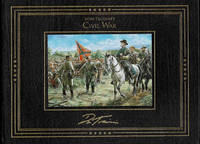
Trioani, Don & Brian C Pohanka
DON TROIANI's CIVIL WAR
Norwalk CT: Easton Press. Fine. 1995. Limited Edition. Hardcover. Book is as new. No ownership or other marks. This is copy 1140 of 2500 signed by Author Trioani on limitation page. ; Photographs Color plates; Oblong 4to 11" - 13" tall; 191 pages; Signed by Author . Easton Press hardcover
書籍販売業者の参照番号
: 17713
|
|
|
Guerra Galafet, Ana Elsy
Formación de ingenieros en procesos agroindustriales: Modelo de evaluación de la calidad de la formación del ingeniero en procesos agroindustriales Spanish Edition
paperback. Good. Access codes and supplements are not guaranteed with used items. May be an ex-library book. paperback
書籍販売業者の参照番号
: 3848457644.G ISBN : 3848457644 9783848457649

|
|
|
Guerra, Juan C
Close to Home: Oral and Literate Practices in a Transnational Mexicano Community Language and Literacy Series
hardcover. Good. Access codes and supplements are not guaranteed with used items. May be an ex-library book. hardcover
書籍販売業者の参照番号
: 0807737739.G ISBN : 0807737739 9780807737736
|
|
|
Guerra, Wendy
Everyone Leaves
audioCD. Good. Access codes and supplements are not guaranteed with used items. May be an ex-library book. unknown
書籍販売業者の参照番号
: 1469215977.G ISBN : 1469215977 9781469215976

|
|
|
King George V (1865-1936) of the United Kingdom [Royal Proclamation; the First World War]:
Printed handbill By the King. A Proclamation. by King George V 'earnestly exhorting and charging' his subjects to refrain from the consumption of 'wheaten corn' this furnishing 'the surest . means of defeating the devices of Our enemies'.
2 May 1917; 'Given at Our Court at Buckingham Palace'. Printed by Eyre and Spottiswoode Ltd. Printers to the King's most Excellent Majesty. 1917. For His Majesty's Stationery Office. Folio 1 p. The body of the text consists of twenty-six lines. Clear and complete. On aged paper with chipping and closed tears to the extremities laid down on a leaf from an album. Households are charged to reduce their consumption of bread 'by at least one fourth' and to 'abstain from the use of flour in pastry'; and farmers are urged not to feed their horses 'on oats or other grain'. Uncommon: COPAC only lists copies at Manchester Leeds the Guildhall and the National Library of Scotland. 2 May 1917; 'Given at Our Court at Buckingham Palace'. [Printed by Eyre and Spottiswoode, Ltd., Printers to the King's most Exce unknown
書籍販売業者の参照番号
: 9732
|
|
|
Anti-Aircraft Defence, World War II [Searchlight Wing, School of A A Defence, Shrivenham, Swindon; Sgt J L B Royall; Royal Artil
Anti-Aircraft Defence World War II. Instructional material from the Searchlight Wing School of A. A. Defence Shrivendon Swindon Royal Artillery; with manuscript reports; from the papers of Sgt. J. L. B. Royall.
Five of the sixteen items dated between 17 March 1941 and .6 October 1943 the rest contemporaneous. Searchlight Wing School of Anti-Aircraft Defence Shrivenham Swindon. Also Longcot Lyford Lyndhurst and Romsey. The topic of this material is wartime training in part during the Blitz of sergeants for ‘Search Light Control’ or SLC nicknamed ‘Elsie’. A larger archive of similar material from the papers of Sgt. J. L. B. Royall on the same theme is offered separately. Sixteen items a few of which are discoloured and creased but the collection being in good overall condition. The first three items are in manuscript i.e. Royall’s autograph. The first two are interesting for the contrast between the accounts they give of the morale of those on the SLC course; and the third reports an arrest of two men found in a vehicle. Item Four is an typed circular signed by Lt B. Dale RA discussing a first sergeants’ course at regimental HQ. Item Five is a detailed programme of a four-day ‘S/L Battery. S.L.C. School’. Items Six to Sixteen are duplicated information sheets for the course. ONE: Manuscript ‘Report on Site MPHIO LONGCOT / Arrived: 12.30 HRS 7.8.42. Left - 20:00 HRS 8.8.42.’ 7 to 8 August 1942. Closely written on 1p small 4to. Divided into: SLC. Personnel available; Weather; SLC Knowledge; Manning Drill; Suggestions; Air Co-op; Morale. The last reads: ‘Men are very interested in SLC and have considerable confidence in its additional training and knowledge should improve this especially when they know the results of their work in illumination. TWO: Manuscript ‘Report Site M.P.H. OY LYFORD / Arrived approx 10:15 hrs 17.8.42. - Left 16:15 hrs 31st.8.42’. 17 to 31 August 1942. Divided much like the earlier list but with ‘Casual Aircraft’ instead of ‘Suggestions’ and after ‘Air Co-op’ two sections added: ‘Maintenance’ and ‘8. AA. Trng Inst No. 2 Y. S/L:- “Target too fast†stage practiced.’ ‘Morale’ moved to the end and reading: ‘Men do not seem to show quite the same amount of interest in S.L.C. as was shown on other sites and do not seem so interested in training.’ THREE: Manuscript statement that two soldiers a sergeant and a private all of whose details are given have been ‘Placed under Open Arrest by 2/Lt Williams / Brought in by L/Bdr Milford G.T. No:- 1461203. Who stated he found them in a vehicle Mt. Bty on the parade ground.’ 1p 12mo. On reverse of part of duplicated typed list of ‘No 4 Detachment. No. 3 Troop 533rd Searchlight Battery Royal Artillery.’ A list of eighteen individuals with title number rank and name. From ‘Detachment Commander L/Sjt 6825478 L/Sjt Arbuthnot H. F.’ to ‘Telephonist & W. T. 1703950 Gnr White F.’ FOUR: Typed Circular Letter Signed by ‘B Dale / Lt RA / for O Comd 392 SL Bty RA’. 6 October 1943; from Lyndhurst. ‘Subject: Trg - Sjts’. 1p 12mo. Describing the results of the ‘first Serjeants Course at Regtl HQ’ over twenty-four lines divided into four points. ‘The course was very short but is thought to have been successful. It can only be looked upon as a preliminary and it is hoped to follow it up by more advanced series at a later date. All Sjts entered into the course with extreme keenness and as I was NOT able to see them at the end of the course I would like my appreciation of this passed on to them.’ FIVE: ‘Programme’ headed: 392 S/L Battery. S.L.C. School.’ 1p landscape 12mo. Signed by ‘R. Z. Lahancey / Lieut. R.A. / C. I/C TRAINING “D†TROOP’. Dated 28 November 1942; Romsey. Gives times over four days of more than thirty topics covered from ‘Identification of Components / Maintenance’ to ‘Fault finding’. Note at foot: ‘Administration. The above programme is subject to alteration for weather etc reasons. / Personnel on course will be available to the site D. C. for sentry duties during the hours of darkness.’ SIX: ‘Scheme “3†/ Administration. 1p foolscap 8vo. Dated at end 17 March 1941. With stamp of the SWSAA at top right with the name ‘SGT. J. L. B. ROYALL’ added in manuscript. 2pp foolscap 8vo. SEVEN: ‘P.P.S. No. PLOT/5. / Lesson. Site Procedure - 14 and 15. / Take post downward plot upward plot.’ Dated at top left: 6 May 1942. With facsimile of drawn diagram. EIGHT: ‘Draft. P.P.S. No. PLOT/5. / Stage 3.’ 1p landscape 12mo. Dated at top right 6 May 1942. NINE: ‘P.P.S. No. 9/2 / Draft. / Lesson. Weekly Maintenance Task No. 15. Brakes on T.S.20 Lorry’. 2pp foolscap 8vo. On separate sheets. TEN: ‘Draft. / P.P.S. No. 9/29. / Lesson. Weekly maintenance task No. 16 on 1941 Thornycroft tyres.’ 1p foolscap 8vo. ELEVEN: ‘P. P. S. 9/44. Draft. / Lesson: Weekly Maintenance No. 12 Task - transmission shafts & joints.’ 2pp foolscap 8vo. On separate sheets. TWELVE: ‘Maintenance Tasks - A.A. No. 2. Mk. III.’ Divided into ‘Daily Tasks’ and ‘Weekly Tasks’. 1p foolscap 8vo. THIRTEEN: ‘Maintenance Tasks - A.A. No. 2 Mk. VI.’ 1p 12mo. FOURTEEN: ‘Mark III Control Gear. / General Lecture.’ 1p foolscap 8vo. FIFTEEN: ‘Control Gear Mark IV - Drill for lining up. / Projector A.A. 150 cm. Mk. I and Location Sound Mk. VIII or IX.’ Mainly consisting of a table with columns for: Stage; Order by No. 1.; Action by Detachment; Remarks. 2pp foolscap 8vo. SIXTEEN: ‘A. R. C. / LOCATOR’. Duplicated facsimile of drawn diagram. 1p foolscap 8vo. Five of the sixteen items dated between 17 March 1941 and .6 October 1943 (the rest contemporaneous). Searchlight Wing, School o unknown
書籍販売業者の参照番号
: 26095
|
|
|
The Great War: Royal Army Medical Corps; Captain William John Henry MB ChB; British Army; Royal Garrison Artillery; Wiltshire Re
The Great War Royal Army Medical Corps: A Medical Officer In Charge on the Western Front. Typescript of Diary of Captain William John Henry describing his service attached to the Royal Garrison Artillery Wiltshire Regiment and Rifle Brigade.
Vols 1-3 cover the period 27 August 1915 to 12 July 1916; Vols 4-8 the period between 31 January 1918 and 7 June 1919. On the Western Front in France with leave in Britain. It is hard to do justice to this vivid informative and well-written 250000-word account of the author's First World War service as Medical Officer In Charge attached to three regiments on the Western Front present during the Battle of the Somme Kaiserslacht and Hundred Days Offensive. It is hard to conceive of a better account of the day-to-day activities of a member of the Royal Army Medical Corps on active service during the Great War. The author is observant intelligent and diligent in his duties which involve attending to the wounded being called to certify deaths at all hours of the day or night doing the rounds of the wounded holding sick parade the supervision of field ambulances and the maintenance - and on one occasion the construction under fire - of aidposts. He discusses the conduct of the war describing in detail how he and his colleagues are informed about the forthcoming Battle of the Somme; and discusses the armaments and vehicles involved there are a number of references to the war in the air and describes as a medical man of the effects of poison gas reveals the comments made by a German officer while under interrogation following the capture of a German patrol a 'stunt' which wins the DSO for his colleague Lieut. J. J. Tynan see his 1948 obituary in the Irish Times. He pokes repeated fun at his corps commander ‘Hunter-Bunter’ i.e. Sir Aylmer Gould Hunter-Weston see Oxford DNB and describes 'our review' by Kitchener and the Prince of Connaught. The environment and everyday privations of active duty are described with occasional use of army slang and there are frequent reference to the tangled maze of trenches whose features are named to evoke life back home Edgware Road Kings Road Winchester Street Tube Station Chocolate Corner the Covered Way. Instances of German subterfuge are also described the writer not being well-disposed towards ‘the hun’ ‘bosche’ and ‘Fritz’. There is much gossip and small talk and description of pastimes sightseeing and entertainment while waiting for demobilization he purchases a piano and forms a ‘jazz band’. with mention of his activities while on leave in England. The weather is assiduously described sometimes in eloquent terms 15 March 1916: ‘A damp drizzly morning blossomed into a grand day’ and 30 March 1916: ‘The huns abused this beautiful warm morning by commencing early to shell the Rue de Bois just behind our H.Q.’. There are notes on terrain and other matters and a number of transcriptions of official documents and some statistical tables including two pages of ‘Operation Orders for Gas Beam Attack’ in June 1918. He writer’s attitude to the ‘jolly old war’ is surprisingly positive on demobilization. The eighth and last volume ends with an ‘Envoi’ summing up his feelings regarding his experiences in which he expresses regret that ‘the war is won and done’ stating that it was something he ‘would not have missed for anything’ and noting that the ‘periods of intense activity more than compensated for the monotony and boredom. It caused me to meet and to live with all sorts and conditions of men under all sorts and conditions of environment from the magnificence of the Chateau de Selincourt to the misery of the front line trenches in mud and shellfire where one had to trample over the bodies of dead comrades sometimes inevitably over even the faces of men dead but a few moments men one had seen and talked to day by day to reach a spot ahead where lay ones work the patching up of torn bodies of those still alive. At times it has been ghastly but the ugliness the sordidness the discomfort hunger gas death all these miseries fade from the memory in time from the conscious memory at any rate’. He feels that when most of the survivors have scattered those who are left in the army will soon be ‘seniors looked to for advice and direction by a younger generation who have not had the - to them - enviable experience of serving during the war just over’. His experiences have made little difference to him from a medical point of view: ‘If they are sufficiently sick or wounded to be interesting professionally they are bad enough to require immediate evacuation for hospital treatment. But by being thrown into the company of and being brought in contact professionally and otherwise with all manner of people my knowledge of human nature at least has been extended to a degree that would be impossible in even a lifetime of civilian practice’. The diary is certainly unpublished and no reference to it has been discovered let alone to the original from which it was transcribed. From the condition and appearance of the typescript and the design of the manuscript map by which it is accompanied one would guess that it is a near-contemporaneous transcript in all probability by the diarist himself who may well have destroyed the original as was the practice at the time. The author does not identify himself but internal evidence indicates that he is William John Henry M.B Ch.B graduate of Glasgow University who enlisted in December 1914. The diary begins on 27 August 2015 with Henry having completed his basic training leaving Taunton for Southampton where he embarks on the troop ship the SS Karnak bound for the western front where as a Temporary Lieutenant he serves as Medical Officer attached to the 28th Siege Brigade Royal Garrison Artillery until the beginning of 1916 when promoted to Temporary Captain he exchanges with the 6th Battalion the Wiltshire Regiment he gives his ‘Reasons’ in the entry for 28 January 1916. There is a hiatus in the diary between mid-July 1916 and the beginning of 1918 presumably covering his recuperation from an injury reported in the press see below. By the time of his journey back to France on board the SS Onward in February 1918 Henry has exchanged once again this time with the 11th Battalion Rifle Brigade with which he serves until his demobilization in June 1917. On 15 January 1916 the British Medical Journal reports Henry’s promotion from Temporary Lieutenant to Temporary Captain; and on 4 January 1919 ‘Temp. Capt. W. J. Henry’ features in the same journal among the 8 November 1918 list of those mentioned in despatches. There is a report of Henry’s injury in the Roman Catholic newspaper the Tablet on 5 August 1916: ‘The following names are of wounded officers :— . ‘Captain William J. HENRY M.B. R.A.M.C. attached 6th Wilts R.’ Another report in the RAMC Journal December 1916 gives a few biographical details: ‘Captain William John Henry R.A.M.C. wounded graduated as M. B. and Ch. B. at Glasgow in 1913. He joined the R. A. M. C. as a temporary Lieutenant on 16th December 1914 and became Captain after a year’s service. He was attached to the Wiltshire Regiment.’ There is a similar report in the Glasgow Medical Journal. In 1919 the RAMC Journal contains a reference to ‘W. J. Henry MB attached 11th Battalion Rifle Brigade’. Henry’s identity as author of the diary is confirmed by the entry of 21 January 1916: ‘We had another very enjoyable musical evening with the two Mademoiselles Henry - of all names - of Jacks billet and we parted finally with the best of good wishes. He hopes to have leave soon and I do not expect I shall see him for a long time. As it turned out I ever saw him again. He was killed on the Somme in August 1916. R.I.P.’ Henry does not give much away about himself in the diary: he is a Scot on 24 October 1918 he refers to ‘we Scotsmen’ from the neighbourhood of Glasgow on 28 April 1919 he declares ‘Gartloch is near home’ and a Roman Catholic whose birthday is on 2 October. Each page of the typescript is printed on a separate leaf with a manuscript map in red and black ink on the reverse of one leaf. The numbering of the eight volumes is a typed part of the original text with vols 1-3 covering the period 27 August 1915 to 12 July 1916; and vols 4-8 between 31 January 1918 and 7 June 1919 see above. A total of 345pp 4to closely-typed and single-spaced with around 56 lines to a page. Complete but for six pages missing in vol.3. Paginated in manuscript 1-348 as follows: Vol. 1 pp.1-50: 27 August to 7 December 1915. Vol. 2 pp.51-120: 24 December 1915 to 21 April 1916. Vol. 3 pp.121-177 lacking pp.166-171: 22 April to 12 July 1916. Vol.4 pp.178-221 with unpaginated conclusion on slip cut from top of p.222: 31 January to 13 May 1918. Vol.5 pp.222-250 with two pp.233 and map in red and black on reverse of final leaf: 14 May to 15 July 1918. Vol. 6 pp.251-277: 16 July to 5 September 1918. Vol.7 pp.278-333 with two pp.333 and mispagination making leap from 322 to 324 but with no text lacking here: 22 September 1918 to 28 March 1919. Vol.8 pp.334-348: 15 April to 7 June 1919. Each page is typed on separate leaf with a blank reverse except for p.250 which has the manuscript map in red and black on the reverse of its leaf. Each of the eight sections has its leaves attached with a brass stud. As stated above six pages are lacking and damage to the first leaf has resulted in loss of a few words of text at the beginning of the first entry; a handful of leaves are detached with some creasing and in one case loss to two or three words in a corner; otherwise the paper is aged discoloured and a little worn at the edges but in fair condition with the text entirely legible. The following extracts are an arbitrary selection of the mass of interesting and informative material contained in the eight volumes. Beginning with Henry’s first arrival in France we find him thrown into the thick of it. He writes on 18 February 1916: ‘I slept none too well on this my first night in the trenches. This quietness was all the more remarkable because we had a man killed of D coy by a shot through the head. His condition was so apparent that they did not need to waken me to verify the fact but sent him straight to the shed used as a mortuary near to the cemetery about a quarter of a mile away.’ And the following day: ‘I resumed my tour of inspection and presently a whiz-bang arrived about ten yards away and in bursting it splattered me all over with mud. I wandered on to D coys mess dugout and had tea with Tanner Williams Garthwaite Whitlock and Shapland. There was a lot of quite ineffective bosche sniping going on all the time and Tanner showed me the country around through some periscopes of different sorts and I had a good look at the front of our own line as the hun sees it from a projecting bit of the front line called the “Bird-cage walk†and a massive structure of sandbags it looked.’ Nine days later 27 February he gives a long account of a visit to the soon-to-be-destroyed church at La Gorgue. Earlier in the month 11 February 1916 he gives a description of ‘our review by Lord Kitchener’: ‘K. came along accompanied by Prince Arthur of Connaught with his club foot limp General Monro of the 1st Army and General Bridges commanding the 19th Division. They walked down the line followed by a huge staff and at a greater distance still by a great fleet of motor cars. K. looked enormously Big and burly and seemed in excellent condition. Prince Arthur with his pronounced limp seemed rather hard pressed to keep up the pace for K. with his great long legs made the pace down the line an uncommonly smart one. Unfortunately one cannot see all that one might when the order is “Eyes Front†and as we were trying to look like soldiers we had to stand still much as we would have liked to turn round. We came off parade almost as soon as they had entered their cars and I changed out of the wettest of my things and spent the rest of the evening working out mess bills.’ On 2 March 1916 complains about the mess: ‘The mess here is not particularly satisfactory.’ On 16 March 1916 he evaluates his new mess-mates after stating ‘That single whiz-bang proved more important than I imagined at the time. It satisfied the hun that he had my aidpost “taped†as we call it and he could strafe it at any time he wished without further registration and this he did later in his own good time. . Turner and Gibbs are very childish and grouse about everything or about nothing at all all day long. Lefroy is variable and uncertain while Pritchard is an ex-Guards ranker and is very N.C.O. -like in every way yet he is infinitely to be preferred to the other two. Capt. Smith however is a really splendid man and he almost redeems the mess by his personality.’ On 17 March 1916 he goes off ‘with Bambridge to explore the front line. We tried one trench but it bore away to the right across the La Bassee Road and finally became full of water so we turned about and tried another bearing to the left and it took us to Port Arthur Keep a trench with sides about three feet high and mud about two feet deep. I did a sanitary inspection of Port Arthur which is a reinforced farm house in the midst of a system of trenches and parapets. We left by another and a better trench which took us into Hun Street by which we reached the front line. . Tydmarsh or Tiddles as we called him was in good humour and showed me all sorts of things through periscopes and I had a shot at a hun with a telescopic rifle being probably quite unsuccessful. Then I had a look though a telescope from a snipers post a loophole in the parapet.’ On 21 March 1916 he experiences a heavy enemy bombardment: ‘What an ass I was to write that sentence about the quietness prevailing ! ! ! I had scarcely finished it when the hun started a furious bombardment of the Cheshires to our left and of Neuf Chapelle. From 12 till 1 the air was alive with shells of every kind. Shrapnel bust in mid air with a white puff of smoke and a smokey parabolic trail followed by a most vicious bang. Heavy crumps sang their way along landing with a great cr-r-r-ump throwing up clouds of earth and smoke two to three storeys high. Universal shells containing high explosive and shrapnel mixed were bursting low in the ai with a horrible huge red flare volumes of black smoke and a deafening roar. Nothing of all this fell on our battalion front though hundreds of shells went over and the Cheshires who got it all had only 20 hit and of them only 1 killed. At one point I saw a huge felled tree trunk lifted a good six feet off the ground and fall again. Our brigadier and brigade major were going round our front line at the time and teh show began just before they left our line for the Cheshires. The retaliation of our guns to all this was feeble to a degree.’ During the same month he supervises the building of an aidpost. On 28 March: ‘About 11-15 the hun sent over about twenty whiz-bangs at H.Q. but failed to hit any of our men and of course they were about 250 yards from where the aidpost work was going on. The afternoon was bright but cold with a high wind which quickly dried up the place. No retaliation was asked for the morning shooting as they were only whiz-bangs - 77mm high velocity shrapnel and H.E. field gun shells - and anyhow we probably would not have got any as the gunners are restricted to four rounds per gun per day and they have to account strictly for these four. During the afternoon the aidpost work went well but had to be interrupted for half an hour while the hun shelled us. They gave our working party 12 whiz-bangs all to themselves and scored one direct hit on the derelict house within which the aidpost is built. One huge chunk of shell came plunging through a sheet of corrugated iron with which we had filled a great hole in the wall to protect from the weather the sandbags we were putting up inside but no one was hit. I decided that the huns could see us at work filling sandbags so I found another place where the men were better concealed.’ On 5 April 1916 after a report of an attack on Chocolate Corner: ‘I knocked my people off work and strolled along to H.Q. Here I was telephoned for by the padre to go to Tube Station to see a man who was wounded so I got my corporal Braithwaite and off we went to see the unfortunate. He had a large hole in his head caused by a snipers bullet and a large piece of brain was protruding and he showed signs of a fractured base as well. I tinkered him up and stimulated him with everything I had and got him away as quickly as possible. Then I sent my corporal home and stayed to lunch with Eldred the Padre Matthews and Hunter and Tynan came along later. We had a merry meal’. Also in April a colleague Lieutenant J. J. Tynan pulls two ‘stunts’ for the latter of which he recieves the DSO. The account of the first is given on 8 April 1916 after a description of cases he has had to deal with: ‘After lunch the C.O. told me that he wanted me and my two orderlies to wait behind after the relief tonight as Tynan was going to do a bombing stunt the same one that he was prevented doing by the presence of the large hun working party last night. Tonight he is going to kill the huns in the listening post or to capture them if possible. The listening post is an old bosche communication trench extending between their line and ours the post being about 30 yards in front of their parapet. If the working party is out again he means to bomb down the trench and kill as many as he can.’ The mission is described with Tynan throwing a ‘Mills grenade which burst and killed one hun outright.’ He carries the ‘heavy hun for more than a hundred yards then three of the scouts took him over. A great strapping hun he scaled over 14 stones and much useful information was obtained from him dead though he was. As it turned out the other hun lost himself in the fog and taking the wrong direction he came up to our parapet and was made a prisoner later in the night. . The dead hun proved to belong to the 46th Reserve Jaeger Regiment’. The second of Tynan’s ‘stunts’ for which he will win the DSO takes place on 12 April 1916 and Henry’s account is headed ‘Capture of a German Patrol’ and involves Tynan and twelve scouts. Henry reports the result of the interrogation of the German officer: ‘He expects Verdun to fall in a month and that then the French will break up and the war will finish with a huge German victory. He considered that the English were not soldiers at all but that all Germans were and Tynans suggestion that one Englishman was as good as three huns was answered by a shrug of the shoulders. Regarding the treatment of British prisoners in Germany as described in the Daily Mail he declared it to be a one-sided account and maintained that they had lots of food and football. The officer had been fighting since 1914 and wore the Iron Cross; a question as to how he had obtained it was answered by the one word “braveryâ€. What impressed Tynan most was the obvious patriotism that the man showed and his keenness as a soldier. On the whole he was very favourably impressed by his captive.’ The ‘exploit’ reaches ‘one step higher than his listening post adventure had done’ with the Divisional General sending the message ‘Well done the Wilts! Bridges Major General’. The entry for 1 June 1916 gives a good example of his duties. After holding a sick parade of only fourteen men and returning to his billet to enter up his ‘sick chart’ he ‘wandered to D coy but found no one up yet. At 9 oclock King Parsons and I held a board of inspection on the S.B.Rs. small box respirators of the battalion which took us till 9.4. We found there was not enough rubber sponge material round the goggles to make them gas-tight and not enough padding under the chin for the same purpose. Then I wandered down to H.Q. Quarter-master-sergeants C.Q.M.Ss. about the parafin soap. . After initiating the C.Q.M.Ss. into the mysteries of making the parafin soap I went off on a water hunt. I rode out past B company and about 1 1/4 miles away I found a stream that the C.O. had mentioned yesterday. I came back by Dracourt where brigade H.Q. are and got home about 12.30 after a lovely ride through a beautiful avenue of trees. . The padre Davis and I had tea by ourselves in the garden’. On 23 June 1916 without any previous hint he receives a briefing regarding the forthcoming ‘push’ which is to start the Battle of the Somme. The entry begins: ‘About 10 oclock this morning after sick parade Colonel Johnson D.A.Q.M.G. deputy assistant quarter-master general of the 19th Division came along with two huge plans in relief of the ground over which we are to fight and he gave a most interesting general outline of the whole scheme especially as it affected our division.’ The entry gives a ‘summary’ of Johnson’s ‘discourse’ in ten numbered parts including ‘5th. The artillery preparation will be phenominal sic most careful and thorough’ ‘6th. The advance is to be most carefully regulated and there is to be no going “as far as possible†- as at Loos - but only to definite objectives’ and ‘10th. That aeroplanes are to control the advance by light signals of various kinds’. He continues: ‘A good part of the rest of the day was spent in marking our lines of advance on our trench maps and in completing as far as possible my preparations. There are rumours that the bombardment is to start tomorrow. In the early afternoon there was a violent thunder-storm in the course of which we were interested to see one of our sausages behind our camp calmly break its moorings and whisk away into the clouds making as it appeared straight for the bosche lines. He later reports that it is unmanned and ‘came to earth at Senlis’ Many of our mens bivouacs were washed away by the torrents of water pouring down the hillside. The mess tent was ankle deep’. The following day he goes with Padre Davis ‘up the hill behind the camp whence we had a splendid view of the bosche lines and of a lot of our shells bursting upon them but they were only small stuff. After dinner there was a glorious sunset and as it got darker we admired the spectacle of the flashes of our guns and of the bursting shrapnel over the bosche lines. One curious feature of the configuration of the country here is that scarcely a murmur is to be heard at the camp of the noise of the guns . quite diferent from Flanders and probably due to the hills around. The bombardment proper is expected to start tomorrow. . The guns on our front are now so numerous that they say that each battery will have to deal with only about 30 yards of front - some concentration surely - and with unlimited ammunition at that!!!’ The following day 25 June 1916 ‘some of our heaviest guns started shooting 9-2 12 and 15 inch. . A terrific strafe arose which lasted for an hour. We shelled Contalmaison to pieces and then the guns turned to other targets. The hun retaliated with a lot of heavy stuff on Albert and shrapnel too. We had a splendid view of all this from the camp and the reverberating crashes of the bursting 5-9s in the town and the clouds of smoke and brick dust were colossal while any empty spaces in the air seemed to be filled with bursts of shrapnel and of high-explosive-shrapnel universal shell. It was a very noticeable fact at this time that a German aeroplane was never to be seen. Our lines were so thoroughly patrolled by our flying men that the hun did not have a chance.’ Preparations include ‘thousands of motor lorries that passed in an unending stream up and down the Albert Road’. He reports the ‘persistent rumour that the hun has evacuated his front line and is taking up his position in his second line leaving only some trench mortars and machine guns in front. If this be true then our artillery preparation will be wasted’. The five corps making up the 4th Army from north to south are these; the 10th 3rd 15th 13th and 8th. The 34th Division whih is holding our front line here has on its right the 21st Division then the 32nd then the 36th both of the 10th Corps. . An interesting point Col. Johnson mentioned on Friday was that it is known that the hun has only five spare divisions with which to reinforce his front against our pushing army. To lunch we had two friends of Major Thynnes from the 15th corps on our right but they had little to tell us that we did not already know.’ The following day he acquires ‘a Tommys tunic from Harris’ and has his ‘start sewn on the shoulder straps and also two big new pockets inside. So I now have a complete Tommys outfit boots tunic belt steel helmet and hose tops as per regulations for all officers going into action must have and wear Tommys uniform as they would stand out too prominently and offer too good a target in their own distinctive gear. The colonel had ordered me to wear my red cross armlet or brassard. . As it turned out it was a bad thing for it offered an excellent target to the hun and was the chief cause of my being knocked out later.’ He describes a ‘conference for company commanders’ called by the commanding officer who has ‘just got back from a pow-wow at Brigade himself’ outlining ‘two possible lines of attack that had been mentioned at the C.O.s conference’ ‘As usual he found the Army staff people exceedingly sanguine. They always are before a show. They were so before Loos.’ ‘If what the Army Staff looks for comes about the 34th Division will reach not only their own objectives but ours as well so slight will be the opposition after the bombardment. Then our division will act as advance-guard of General Goughs 5th Army a mixed force of cavalry and light infantry and we shall march up the Bapaume Road in columns of four and billet for the night in Pozieres. On the eve of the battle he writes: ‘We all regard the Bapaume business as a myth.’ But the colonel scoffs at all this and declares that we shall much more probably be employed in helping the 34th Division to take their objectives which are only half way to our own objective - Besantin le Petit.’ On 29 June: ‘A German artillery deserter reports that on the first day of the bombardment we put 600 gas shells into Pozieres which was full of troops and that some hundreds of these were killed. On the other hand prisoners taken in raids vary in their accounts of the effect of the bombardment. Apparently in some cases the dugouts are so deep that the occupants are quite safe. We have some grand big guns close to us here. A 12 inch gun on a railway mounting calmly lobs a 1000 lb. shell into Bapaume ten miles away and there are lots of “Grannies†- 15 inch howitzers and “Mothers†- 9-2 inch howitzers.’ On the eve of the battle he sends one of his corporals ‘to the 57th Field Ambulance to see if any instructions had arrived for I had received no orders from the A.D.M.S. about medical arrangements for the show . He came back with the information that there were to be no R.A.M.C. personnel attached to battalions this time and that the field ambulances were to clear the battle-field. What is to be done now Are the poor devils that are wounded to lie there till the field ambulance is graciously pleased to consider it safe to come and collect them No bearers!! Who is to collect the wounded Am I and my two corporals supposed to collect them without any assistance The regimental stretcher-bearers will be quite busy enough if they do first aid without carrying cases about and I am not going to let them carry stretchers into action as they would be of little use and very much in the way. I thin it is positively criminal of the A.D.M.S. Hinge.’ The night before the advance is bitterly cold: ‘We had no cover. The men lay in the trench and the officers on the grass of the steep embankment. We were all in our fighting kit with no greatcoats and in our short trousers we were bitterly cold. The dew was heavy and there was a 12 inch gun on a railway mounting beside us which fired at Bapaume every fifteen minutes with a blinding flash and a terrific roar. Apart from this gun there was a very heavy strafe on both sides all night and the huns kept asking their people for more retaliation by means of red flares all night but with little apparent result.’ Vol.3 breaks off with p.165 in the middle of the entry for 1 July 1916 and when it resumes on p.172 during the entry for the following day 2 July 1916 it is clear that the missing six pages pp.166-171 have described Henry himself getting wounded ‘All appreciation of touch and sense of position had gone from the leg and foot’. The entry for the following day 3 July 1916 begins: ‘About 1 a.m. I was put on an ambulance for the casuality sic clearing station and to my surprise I found I had a fellow passenger Springett of B coy whom I had not seen at the ambulance at Albert. He had been wounded through the leg and foot and was promised a limp for life.’ After the hiatus the last five volumes continue in similar style as the tide turns in the Allies’ favour. On 21 February 1918 Henry describes ‘the devastated area a desolate plain of shellholes old barbed wire curmbling trenches and war debris of all kinds’ in an area ‘about ten miles west of Chaulnes’: ‘All the way along there were evidences of the bosche retirement all that I had read of in the papers in England. There were trees cut in two in many cases actually felled in others cut through just enough to ensure the death of the tree. Houses had been destroyed by blowing them up or by blowing in the bases of the walls so that the house collapsed and so on.’ On 21 March 1918 at the start of the Ludendorff Offensive he reports a rumour that ‘the bosche . had broken through but that our flanks had closed in on him and we had taken 12000 prisoners’. Three days later 24 March he complains that ‘artillery support was totally absent throughout. We were crumped and crumped and crumed till we were almost deaf and nearly crazy and as jumpy as if we were on springs and all we could give in return in addition to our rifles and a very few Lewis guns were a few a very very few 18 pounder shells - with 18 pounders when he had 8 inch and 5-9s galore.’ On 28 March 1918 he reports another case of German perfidy: ‘One feature of the night was that one of our men caught by the bosche during the counter-attack on Buchoir was made by them to shout out “Stretcher-bearers†at intervals throughout the night. A patrol of the Scotties was captured while trying to reach him and one of ours out on the same errand escaped narrowly from the same fate.’On 17 May 1918 he describes the effects of poison gas: ‘I went for lunch to B coy and there saw some gassed cases and took seven of them to the A.D.S. just beyond Na Poo Corner. Their eyes were still fearfully sore inflamed and practically blind and they were a pitiful little band headed by the worst case of all people the gas sergeant of the company. Of all the diabolical inventions of this war I think mustard gas is the very worst. It can be used only in shells in which it is packed in liquid form. When the shell bursts this venomous liquid is scattered all round and if any of it falls on your person or clothing it burns its way through and if it falls on your eyes it blinds you for life. But its virulence does not end there. What of the liquid falls on to the ground sinks in a little way and then lies dormant but as soon as the warm sun comes out it evaporates slowly and the vapour that rises is only a little less damaging than the liquid itself and causes acute inflammation of the eyes and of the respiratory passages.’ On 13 June 1918: ‘more bosch planes came over and bombed Cite St. Pierre on our left and both lots of gunners were busy all night’. On 30 July 1918 there is a football match betwen officers and sergeants with the officers losing 6-1 ‘even though we had Eassom and Bennett a professional both playing but we had some extraordinarily bad players among the officers to balance that.’ And the following day ‘I went over to Chateau de la Haie about two miles away to see the Volatiles the Canadian Concert Party. They were uncommonly good and had a perfectly wonderful “girl†who not only acted the girl splendidly but did the Vesta Tilly stunt of male impersonations with surprising skill.’ As the war draws to its conclusion the tone lightens with several amusing anecdotes told of ‘Hunter-Bunter’: ‘Our corps commander Hunter Weston is probably the subject of more tales and stories than any other man in the army’. On 6 June 1919 he is present at the departure of his ‘old battalion the 11th R.B.’ saying goodbye to ‘those of my friends who were with what was left of the battalion at the end. These were the Colonel Cotton Bosvile adjutant Jelly Q.M. and the babe Cunningham otherwise Ganymede. I purchased their piano for 200 francs and it became the nucleus of a jazz band which I organised at Fonquevillers and which soon easily outshone any similar organisation in my experience.’ In the final entry he regrets having to exchange ‘that most serviceable colour called Khaki’ for civilian clothes: ‘but I am a soldier no longer my army pay has stopped and so I must conform to convention’. Interspersed between entries are a several ‘NOTES’ with three pages on the terrain in Flanders and two pages giving a detailed description of ‘the guns chiefly in use by our army in the field under nineteen headings from ‘Maxim’ to ‘15 inch Howitzer’. The notes to Vol.2 include a page about the stories told about the early part of the war by ‘Our colonel’ including one on an incident of friendly fire. ‘Colonel Barron’ also describes ‘One piece of unrecorded history’: ‘that on the Marne 15000 Ulhans got in between the left flank of our army and our general headquarters staff - General French and his brass hats and the French troops who were further to the left on the Paris side’. ‘The panic . was indescribable and that day has always been regarded by the staff as the blackest day of the war.’ After this set of notes is a page-long ‘PERSONNEL OF UNITS’ listing ‘Artillery’ and ‘Infantry’ with comments on the former i.e. ‘Lieut. Col. Pollock. sent to England as inefficient 1915’ and ‘Lieut. Hood’: ‘Wounded January by F.A. premature. Two fingers of left hand broken.’’ On 28 January 1916 Henry gives almost a whole page of ‘Reasons for my exchanging from the 28th Siege Brigade R.G.A. to the 6th Battalion the Wiltshire Regiment’ beginning with ‘Colonel Barron was a super-excellent gunner but a most difficult man to live with.’ Transcribed items include an alleged ‘COPY OF A GERMAN DOCUMENT CAPTURED RECENTLY. Notice No 13875’ allegedly written by ‘W. L. O. Twiss Major / General Staff 22 March 1916 beginning: On account of all the able-bodied men having been called to the colours it remains the duty of all those left behind for the sake of the Fatherland to interest themselves in the happiness of the married women and maidens by doubling or even trebling the number of births.’ The entry for 1 April 1918 is followed by nearly two pages of ‘NOTES’ beginning with a list headed ‘On coming out of the line at Domart the battalion mustered 113 other ranks and 5 officers not counting myself. The officer casualties were as follows’. The entry for 15 July 1918 is followed by a two-page ‘COPY OF OPERATION ORDERS FOR GAS BEAM ATTACK’ ‘Secret’ from ‘J. T. Bosvile Capt. and Adjutant 11thS Bn. R. B.’ the first of the two orders beginning: ‘1. A Gas Beam Attack will be carried out tonight or the first night after on which the wind is favourable. Gas will be discharged from trucks Decauville rail head N-36-d-92 62 to N-32-d-69 60.’ and with sections on: Precautions Code Words Zero Hour Lewis Gun Fire etc. Signal Officer Rations. The two orders followed by a full-page copy of a secret document by ‘Wingate Col. A.D.M.S.’ giving a ‘Summary of Sick and Wounded Admitted to 20th Division Medical Units and Evacuated to C.C.S. during the Month of May 1918’. On the back of this page 250 are two original manuscript maps of ‘BOSCHE LINE’ in red and black the first featuring the ‘LENS-LIEVIN ROAD’ and the second the ‘Souchez River’. Vols 1-3 cover the period 27 August 1915 to 12 July 1916; Vols 4-8 the period between 31 January 1918 and 7 June 1919. On the We hardcover
書籍販売業者の参照番号
: 25428
|
|
|
[The Rifle Volunteer Corps; The Volunteer Force, 1859-1908; The War Office, Whitehall; Sidney Herbert (1810-1861), 1st Baron Her
Rifle Volunteer Corps Four printed War Office docs re. formation of Volunteer Force called 'Rifle Volunteer Corps' and 'Volunteer Corps' comprising a draft of the 'Rules' two printed circulars from Sidney Herbert and one from his secretary.
All four documents from the War Office Whitehall London. The three circulars dated 8 September 14 October and 20 December 1859; the 'Rules' dated 10 August 1859. The four documents in very good condition on lightly-aged paper. For a full account of the subject see Hugh Cunningham's 'The Volunteer Force: A Social and Political History 1859-1908' 1975. Item One: 'RULES OF THE ---- VOLUNTEER CORPS.' 5pp. folio paginated to 6. The cover page has in its top left-hand corner: 'V General No. 469' and carries a table of contents. Preceding the rules is a page headed 'WAR OFFICE 10th August 1859' giving a list of the twelve committee members preceded by the statement: 'PROCEEDINGS of a COMMITTEE assembled by Order of the Secretary of State for War for the purpose of drafting model Rules and Regulations for the government of Volunteer Corps when not on actual Service and subject to Military discipline.' In the list that follows the President of the Committee is named as 'VISCOUNT RANELAGH South Middlesex Rifles' and the first three members are: 'EARL SPENCER Althorp Rifles. MAJOR CLIFFORD Victoria Rifles. MR. J. H. ORDE Yarmouth Rifles.' The 24 rules follow over three pages and include: '1. THE Corps having been raised under the Act 44 Geo. III. cap. 54 the members are consequently subject to the provisions of that Act and to all regulations which have been or shall be issued under the authority of the Secretary of State for War.' and '14. The following fines shall be imposed the amounts to be settled as above provided that they shall not be less than the following sums respectively viz. For loading contrary to orders or shooting out of turn . 2s. 6d. For discharging the rifle accidentally . 5s. For pointing the same loaded or unloaded at any person without orders . 5s.' Item Two: Circular from 'RIPON' on behalf of 'Mr. Secretary Herbert' to 'The Officer Commanding blank Volunteers.' Dated 'War Office 8th September 1859.' 1p. folio. In top left-hand corner: 'V General No. 486'. Forwarding Item One which 'Mr. Herbert considers likely to assist you in preparing Regulations for the government of the Corps under your Command.' Item Three: Circular from 'SIDNEY HERBERT' to 'Her Majesty's Lord Lieutenant for blank'. Dated ' War Office 14th October 1859.' 2pp. folio. In top left-hand corner of first page: 'V. Gen. No. 509'. Announcing that 'Her Majesty's Government have determined to issue immediately to Rifle Volunteer Corps an additional supply of Long Enfield Rifles pattern 1853 to the extent of 25 per cent. on the effective strength of the Corps. This supply will raise the aggregate issue to 50 per cent. on the effective strength of the force; . At a later period I shall be prepared to issue a third instalment of arms of the same pattern as the 50 per cent. now granted. And I hope to be in a position in the course of next summer to supply the short Rifle with Sword Bayonet to a limited extent in exchange for the long one at present issued.' He ends with a list of 'the amount of ammunition for effective members to be issued at cost price on the requisition of the Commanding Officers'. Item Four: Circular from 'SIDNEY HERBERT' to 'Her Majesty's Lord Lieutenant for blank'. Dated ' War Office 20th December 1859'. 1p. folio. Announcing another 'additional supply' of Long Enfield Rifles and hoping soon to be in a position 'to exchange these Rifles gradually for the Short Enfield in the case of any Corps which may desire it on the understanding that the Long Rifles must be returned in good condition fair wear and tear excepted or that the Corps must pay for any damage they may have received.' All four documents from the War Office [Whitehall, London]. The three circulars dated 8 September, 14 October and 20 December 18 unknown
書籍販売業者の参照番号
: 12789
|
|
|
[The Rifle Volunteer Corps; The Volunteer Force, 1859-1908; The War Office, Whitehall; Sidney Herbert (1810-1861), 1st Baron Her
Copy of printed War Office model 'RULES OF THE ---- VOLUNTEER CORPS.' i.e. Volunteer Force With details of the committee members under Viscount Ranelagh responsible for 'drafting model Rules and Regulations for the government of Volunteer Corps'.
'WAR OFFICE 10th August 1859.' 'V General No. 469'. 5pp. folio. In very good condition on lightly-aged paper. Copies of this document were sent by the War Office to the officers commanding the various corps the Secretary of State considering that it would 'assist them in preparing Regulations for the government of the Corps under their Command'. For a full account of the subject see Hugh Cunningham's 'The Volunteer Force: A Social and Political History 1859-1908' 1975. The cover page has in its top left-hand corner: 'V General No. 469' and carries a table of contents. Preceding the rules is a page headed 'WAR OFFICE 10th August 1859' giving a list of the twelve committee members preceded by the statement: 'PROCEEDINGS of a COMMITTEE assembled by Order of the Secretary of State for War for the purpose of drafting model Rules and Regulations for the government of Volunteer Corps when not on actual Service and subject to Military discipline.' In the list that follows the President of the Committee is named as 'VISCOUNT RANELAGH South Middlesex Rifles' and the first three members are: 'EARL SPENCER Althorp Rifles. MAJOR CLIFFORD Victoria Rifles. MR. J. H. ORDE Yarmouth Rifles.' The 24 rules follow over three pages the last page paginated 6 and include: '1. THE Corps having been raised under the Act 44 Geo. III. cap. 54 the members are consequently subject to the provisions of that Act and to all regulations which have been or shall be issued under the authority of the Secretary of State for War.' and '14. The following fines shall be imposed the amounts to be settled as above provided that they shall not be less than the following sums respectively viz. For loading contrary to orders or shooting out of turn . 2s. 6d. For discharging the rifle accidentally . 5s. For pointing the same loaded or unloaded at any person without orders . 5s.'. 'WAR OFFICE, 10th August, 1859.' ['V General No. 469'.] unknown
書籍販売業者の参照番号
: 12788
|
|
|
[London Fire Force; Metropolitan Water Board; Fire Fighting in the Second World War; maps and plans]:
Lithographic coloured London Fire Force plan indicating the wartime Emergency Water Supply to the Trafalgar Square and Whitehall area of London headed 'E. W. S. No. 284 Plan referred to on Sheet No. 10 Water Unit Maps re Government Buildings'.
Without date or place. London Fire Force circa 1943. On one side of piece of 41 x 20.5 cm paper with lines and indications in light and dark blue red and green. In fair condition on aged paper with creasing and one closed tear towards the head. The map has Trafalgar Square at its head with the note that the two 'Basins' carry '40000 Galls. each' and Parliament Square at its foot. Whitehall and Parliament Street connect the two on the right of the map and to the left of the map is the lake in St James's Park: '200000 Galls Underground Tank Pumping Station 1400 Galls Pump 15 foot Gravity Main from Serpentine'. Also marked on the map are 'Inlet connections for L.F.F. Pumps and Pits' '6 Signle Outlet Suction Hydrants Round Thread' and 'Two 6 foot Steel Pipes in Subway Also under Embankment in Subway'. Down the centre of the map are the government buildings: the Admiralty Treasury Downing Street Foreign and Colonial Offices India Office and Home Office Office of Works Board of Education Board of Trade and Ministry of Health. No other copy found listed.Image on application. Without date or place. (London Fire Force, circa 1943.) unknown
書籍販売業者の参照番号
: 14486
|
|
|
[The Belgian resistance movement, Maquis; Froidmont, Tournai, Belgium; World War Two]:
Belgian resistance documents. Typed document titled 'ARMEE SECRETE CG48 bis Historique de la Section 802 depuis ses debuts'. With typewritten list regarding feeding and lodging of 'refractaires' and manuscript table of agents headed 'Combat'.
The 'Historique' document dated 'Froidmont le 25 septembre 1944' Tournai Belgium; the other two items without place or date. A scarce survival providing a mass of valuable information written during wartime with nothing else about this section of the Belgian resistance having been discovered. All three documents in fair condition on aged and lightly-worn paper. ONE: 'Historique de la Section 802 depuis ses debuts.' Typed document. 3pp. 4to. Rust staining from paperclip at head of first page. Type indentation indicates that this is an original document not a mimeograph. Giving an account of Section 802 from September 1941 to 9 September 1944. Sub-headings: 'PERIODE SECRETE D'ORGANISATION' with 'FORMATION DES ESCOUADES' and 'FORMATION du service sanitaire'; 'ACTIVITE SPECIALE' with 'Aide aux réfractaires' and 'Détention d'explosifs'; 'PERIODE DE SABOTAGE'; 'PERIODE DE GUERILLAS: PRELIMINAIRES' with 'OPERATIONS DE LA S.802'. Filled with facts and names as the opening indicates: 'September 1941: PARENT Marcel Ravitaillement en matériel sanitaire de tout les postes de secours de Tournai. Estafette pour COISNE Amédée sic. Agent de liaison avec Bruxelles et Mons pour la remise de documents Renseignements de toute nature à COISNE Amédé. Deux fois par mois voyage à Bruxelles pour prendre plusieurs centaines de "Libre Belgique" pour la distribution à Tournai. Soustraction de documents et photos chez le rexiste sic VAN ROY Eté disparu le 10 novembre 1942. Après l'arrestation de plusieurs membres des groupes de Tournai la S.802 fut divisée Amédé Coisne et LERICHE Louis regroupèrent la Section et avec PARENT Marcel formèrent une nouvelle section à Froidmont.' S.802's activity include 'Sauvetage et rapatriement du pilot Anglais S.B.63 John Butterfield; Mme. Béthune'. Around a page is devoted to S.802's operations between 2 and 9 September 1944. On 2 September 1944: 'Prise de cinq prisonniers allemands russes sans armes. A 20; 15 idem de 27 prisonniers allemands russes sans armes récupéréz a la Briqueterie d'EreEvacués sic sur Rumes en camion.' The entry for 4 September 1944 begins: '8 H. 15 on signale une centaine d'allemands dans le bois de PLOUY à RUMES. Déparet d'une patrouille de reconnaissance qui trouve le bois vide. d'ennemis. 16 H. Opérations au bois DELNESTE à PIC au VENT. Un paysan signale un allemand avec mitraillette dans le bois. Une auto blindée anglaise mitraille le bois. Attaque du bois par trois hommes de la S.802 et soutenus par cinq anglais venus en renfort avec une auto mitrailleuse. Prise de 4 allemands évacués par l'auto mitrailleuse anglaise unallemands sic tué par les anglais.' TWO: Typewritten list of 'réfractaires'. 1p. 4to. Folded three times into a 7 x 5cm packet for concealment. Arranged into six categories lettered A to F with 'Total: 33' at foot. The agents are identified by their number from 802-29 to 802-47 with their marital status and number of children given. The sections are titled as follows: 'Réfractaire logé et nourri'; 'Réfractaire non logé et non nourri' 'Réfractaire marié sans enfant'; 'Réfractaire marié avec enfants a charge'; 'Réfractaire se trouvant maintenant en Allemagne' 'Autres Secours'. The last two entries: 'Noëlla 47. Célibataire. Réfractaire. Total: 3 Miette. Célibataire. Réfractaire.' THREE: Manuscript table headed 'Combat'. 1p. 4to. Giving details of 40 agents from 802.10 to 802.49. Written out in red and black. Eight columns: 'Indicatif'; 'Village'; '<Comman:>'; '<>'; 'Capacité' including 'Artilleur' and 'Carabinier'; '<>'; 'Matériel'; 'Observation'. The villages include Willemeau Esplechin Froidmont; Rumes. Nine of the individuals are marked as drivers. The 'Historique' document dated 'Froidmont, le 25 septembre 1944' [Tournai, Belgium]; the other two items without place or date. unknown
書籍販売業者の参照番号
: 23212
|
|
|
[ Royal Armoured Corps, British Army, North African Campaign, Second World War ]:
Royal Armoured Corps British Army North African Campaign Second World War. Duplicated document: 'R.A.C. North Africa Information Bulletin No. 6'.
'MOST SECRET'. Without date or place. British Army North Africa circa 1942. . 15pp. folio. Stapled into pink printed wraps. Title on front cover with 'MOST SECRET'. Copy number 53 in blue pencil. In fair condition on browned high-acidity paper. Front cover coming away from rusted staples. At head of first page: 'NOTE: SECURITY Attention is drawn to the fact that this document is graded "MOST SECRET". It will not be distributed below Lieutenant Colonels' commands.' Contents page divides the document into two parts: 'Equipment' and 'Organisation'. The first part discusses: Light Tanks Cruiser Tanks Infantry Tanks Armoured Cars and Scout Cars Ammunition Gunnery and Fire Control Miscellaneous Equipment. The second part consists of three appendices: 'Command Control and Rear Link A.F.Vs.' 'Report on Valentine Bridgelayer' and 'The Swabey Sight for use with 75-mm guns in Sherman Tanks'. Scarce: no other copy traced not in the Imperial War Museum collection. From the Barrie Pitt papers. 'MOST SECRET'. Without date or place. [ British Army, North Africa, circa 1942. ] paperback
書籍販売業者の参照番号
: 17397
|
|
|
United States War Department
Browning Machine Gun Caliber .50 Hb M2 Ground: Basic Field Manual
Hardback. New. hardcover
書籍販売業者の参照番号
: B9781258844318 ISBN : 1258844311 9781258844318

|
|
|
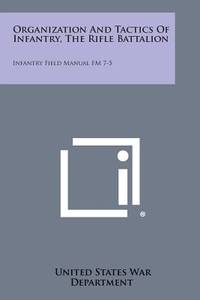
United States War Department
Organization and Tactics of Infantry the Rifle Battalion: Infantry Field Manual FM 7-5
Paperback / softback. New. paperback
書籍販売業者の参照番号
: B9781494094171 ISBN : 1494094177 9781494094171
|
|
|
Daniel Guerra
The THOUSAND and One DAYS: Short Juvenile Stories Book 2: Complete 12 stories of Book 2
Paperback / softback. New. paperback
書籍販売業者の参照番号
: B9781546582144 ISBN : 1546582142 9781546582144

|
|
|
Daniel Guerra
The THOUSAND and One DAYS: Book 3: Short Juvenile Stories
Paperback / softback. New. paperback
書籍販売業者の参照番号
: B9781975682293 ISBN : 1975682297 9781975682293

|
|
|
Daniel Guerra
The THOUSAND and One DAYS: Book 4: Short Juvenile Stories
Paperback / softback. New. paperback
書籍販売業者の参照番号
: B9781983876394 ISBN : 1983876399 9781983876394

|
|
|
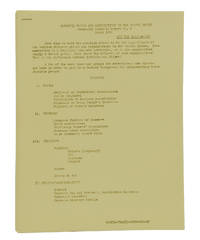
[Japanese Internment]; War Relocation Authority
Japanese Groups and Associations in the United States Community Analysis Report No. 3 March 1943
Washington D.C: War Relocation Authority 1943. First Edition. Fine. First edition. 7 pp. single-sided. Yellow sheets corner staple bound. A Fine copy with faint rusting to staple and typical faint offsetting around mimeographed text. A very rare document in excellent condition.<br /> <br /> <p>A list of the different types of groups and associations people of Japanese descent might belong to compiled for the War Relocation Authority to aid in their internment of Japanese-Americans living on the West Coast. [War Relocation Authority] unknown
書籍販売業者の参照番号
: 140940339
|
|
|
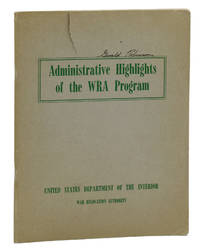
[Japanese Internment]; United States Department of the Interior, War Relocation Authority
Administrative Highlights of the WRA Program
Washington D.C.: U.S. Government Printing Office 1946. First Edition. Good. First edition. iv 82 pp. Gray stapled wraps. Good with closed tear to top of front wrap and first page very slightly to following page; wraps toned and lightly worn; former owner's name written on front cover. A rare history of the War Relocation Authority which managed the forced confinement of people of Japanese ancestry in America during World War II as well as their return to civilian life with the commencement of the war. U.S. Government Printing Office unknown
書籍販売業者の参照番号
: 140941066
|
|
|
[Japanese Internment]; United States Department of the Interior, War Relocation Authority
Legal and Constitutional Phases of the WRA Program
Washington D.C.: U.S. Government Printing Office 1946. First Edition. Very Good. First edition. iv 59 pp. Gray stapled wraps. Very Good with light wear crease to final page. A rare legal history of the War Relocation Authority which managed the forced confinement of people of Japanese ancestry in America during World War II as well as their return to civilian life with the commencement of the war. It outlines the government response to the Korematsu case as well as the entire program's overall claims to constitutionality. U.S. Government Printing Office unknown
書籍販売業者の参照番号
: 140941067
|
|
|
Department of the Interior, War Relocation Authority
Japanese Internment Wartime Exile: The Exclusion of the Japanese Americans from the West Coast; Impounded People: Japanese Americans in the Relocation Centers; The Relocation Program; Administrative Highlights of the WRA Program; Token Shipment: The Story of America's War Refugee Shelter; The Evacuated People: A Quantitative Description; People in Motion: The Postwar Adjustment of the Evacuated Japanese Americans
Washington D.C.: U.S. Government Printing Office 1946. First Edition. Very Good. First edition first printings. Seven titles: Wartime Exile 167pp.; Impounded People 239pp.; The Relocation Program 105pp; Administrative Highlights of the WRA Program 82pp.; Token Shipment 104pp.; The Evacuated People 200pp.; People in Motion 270pp. Good. Wraps worn some soiled foxed chipped or stained; People in Motion has a long tear to the rear cover. Handwritten titles on spines which are also creased and chipped with loss to spine ends. Pages toned sometimes creased. <p><br /> <br /> Rare documents of the American government's official record of its WWII internment of people of Japanese descent one of the most controversial official programs in American history as reported by the War Relocation Authority. The WRA managed the forced confinement of people of Japanese ancestry in America during World War II as well as their return to civilian life with the commencement of the war. U.S. Government Printing Office unknown
書籍販売業者の参照番号
: 140941373
|
|
|
[AVIATION -- WORLD WAR II/WOMEN]. [WOOD, Jesse R, JOHNSON, Dorothy, JONES, Virginia, STEPHEN, Louise & WHITSON, Frank].
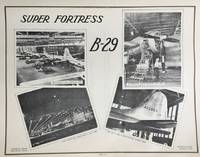
Wings for the U.S. Army Air Forces: activities and achievements of the Continental-Denver Modification Center July 1942 - August 1945.
Denver CO: Continental Air Lines Inc. 1945. 4to. ix 76 18 leaves. With photos tables charts. Beige textured softcovers cover art of B-17 & B-29 bombers lying over the globe plastic comb binding as issued minor dustsoiling edgewear minor bumping to corners still VG copy. First edition of this very rare report on Continental Air Lines efforts in modification of aircraft during World War II. Due to personnel shortages women were trained in large numbers with the Emily Griffith Opportunity School who also received training in sheet metal fabrication welding and metal casting to handle bomber retrofits for over 2500 B-17 and B-29 bombers as well as 25 P-51 Mustang fighters and 6 additional experimental B-29 bombers. The airport facility in Denver erected two 600 x 400 foot hangers and continued hiring skilled labor. Worldcat locates 1 copy History Colorado; See: Gail Beaton Colorado Women in World War II 2020 pp. 146-149. Continental Air Lines, Inc., paperback
書籍販売業者の参照番号
: 58550
|
|
|
James Kendrick, MD [the Siege of Warrington, 1643; Houghton Green; English Civil War]: M D
Printed pamphlet. An Account of Warrington Siege A.D. 1643; and of some manuscripts of that period recently discovered at Houghton Green near Warrington.
'Read before a Meeting of the Lancashire and Cheshire Historic Society on the Evening of Thursday December 11th 1852 corrected to '1851'.' Liverpool: T. Brakell Printer Cook Street 1852. 15pp. 12mo with six plates on art paper. In grey printed wraps with title on front cover. In good condition lightly aged and worn. The plates include engravings by H. C. Pigeon of illustrations by S. Holden and a plan by T. B. Ryder. 'The following narrative of local history has been prompted by the recent discovery at Houghton-Green near Warrington of a number of original transcripts so closely connected with the military transactions in this part of our county during the Civil War between Charles the First and his Parliament as to come peculiarly under the province of this Society for notice.' The first plate is 'a representation of the house at Houghton Green. Theh letter A shews the situation of the cavity in which the documents were found.' An appendix pp.14-15 gives 'An Abstract of the Civil War Documents found at Houghton Green near Warrington in May 1851.' The description of the 45 documents is in small print. Scarce: the only copies on OCLC WorldCat and COPAC at Liverpool University College London misdated to 1851 because lacking the title and Oxford with the printer's name given as 'R. Brakell'. 'Read before a Meeting of the Lancashire and Cheshire Historic Society, on the Evening of Thursday, December 11th, 1852 [correc paperback
書籍販売業者の参照番号
: 13542
|
|
|
[AUSTRALIA IN THE WAR OF 1939-1945] ODGERS, GEORGE
Air War Against Japan 1943-1945.
Canberra.: Australian War Memorial. Reprint. 1968. Black and white maps photographic plates and illustrations xiii 533pp appendix index 24 x 16.5cm. Dustjacket lightly worn now protected overall a very good copy. . Australian War Memorial. unknown
書籍販売業者の参照番号
: 213501
|
|
|
Torquemada Guerra, Rafael Angel
Istruzione a distanza Italian Edition
paperback. Good. Access codes and supplements are not guaranteed with used items. May be an ex-library book. paperback
書籍販売業者の参照番号
: 6208281601.G ISBN : 6208281601 9786208281601

|
|
|
Torquemada Guerra, Rafael Angel
L'enseignement à distance French Edition
paperback. Good. Access codes and supplements are not guaranteed with used items. May be an ex-library book. paperback
書籍販売業者の参照番号
: 620828158X.G ISBN : 620828158X 9786208281588

|
|
|
Torquemada Guerra, Rafael Angel
Fernunterricht German Edition
paperback. Good. Access codes and supplements are not guaranteed with used items. May be an ex-library book. paperback
書籍販売業者の参照番号
: 6208281571.G ISBN : 6208281571 9786208281571

|
|
|
Torquemada Guerra, Rafael Angel
Distance Education
paperback. Good. Access codes and supplements are not guaranteed with used items. May be an ex-library book. paperback
書籍販売業者の参照番号
: 620828161X.G ISBN : 620828161X 9786208281618

|
|
|
Sir Charles Stewart Scott (1838-1924), diplomat, British Ambassador to Russia, 1898-1904 [Franco-Austrian War (Second Italian Wa
Sir Charles Stewart Scott diplomat British Ambassador to Russia. 'Private & most Confidential' Autograph journal of ‘Charles: S: Scott’ largely written while an attaché in Paris Franco-Austrian War 1859 also in Dresden and Copenhage.
The first three-quarters from Paris 18 June to 16 November 1859. The last quarter from Dresden and Copenhagen 1860 to 1863. The papers of Sir Charles Stewart Scott an Ulsterman: see his entry in the Ulster Dictionary of Biography are held by the British Library. The present journal described by its writer as ‘Private & most Confidential’ covers the very start of his career from Paris in 1859 to Copenhagen in 1863. The basic details of his career to this point together with information regarding his colleagues are to be found in the Foreign Office List for January 1865: Scott was nominated attaché in 1858 and transferred to Paris on 31 March 1859 and to Dresden on 5 October of the same year to Copenhagen three years later and was promoted to position of a third secretary in April of 1863. This journal is 186pp 8vo; all edges gilt in embossed brown cloth binding with the label of Paris stationers Delarue & Hivert. The paper is lightly aged with a little discoloration and a few loosening leaves and the binding is worn but the general overall condition is good. On reverse of front free endpaper: ‘33 Rue de la Madelaine / Charles: S: Scott. / Attached to H.B.M Embassy Paris’. The diary is as Scott admits kept in a ‘negligent way’. The first page is headed ‘Private / Paris’ and the first three-quarters of the journal consist of 140pp covering the period between 18 June to 16 November 1859 followed by three and a half pages headed ‘Nearly A year afterwards in Octr 1860’ but with only one entry: 4 October 1860. After a blank page the final quarter of the journal consists of 45pp carrying desultory entries between March 1861 and January 1863 as follows: 4pp Dresden 26 March 1861; 6pp ‘January 1862’; 7pp 6 to 14 January 1862’; 16pp 16 October to 12 November 1862; 2pp Copenhagen 21 December 1862; 2pp ‘January 1863’; 3pp ‘Princess Alexandra’. The diary contains a good mixture of the personal and professional. Of particular interest is Scott’s description of Embassy news and gossip: reports and telegrams received communications composed the views of superiors articles in the newspapers. The pre-eminent topic is the Parisian response to the conclusion of the 1859 Franco-Austrian War Second Italian War of Independence including a description of Napoleon III’s victory parade and a couple of references to Garibaldi. Other topics include the American Civil War and the marriage of Princess Alexandra of Denmark to the future King Edward VII. There is also a description of initial reports of the Second Battle of the Taku Forts June 1859 in the Second Opium War. On the personal side there what Scott himself sees as his ‘illspent youth’ with frequent references to money worries 4 August: ‘we all dined at Voisin’s capital dinner but enormously dear 18 frs a head. Afterwards we played Loo and I lost £16 - my state of mind is something awful. I could scarcely sleep a wink all night & vowed I never should play a gambling game again’. The following day he ‘must borrow £25 from somebody’. He searches for new lodgings in Paris describes his dinner engagements and socializing ‘I saw some very pretty faces in the Champs Elysees’ his private reading ‘I finished Tennyson’s New poem. I like it as a whole very much Enid is very pretty & so is the last Guinevre sic I think my favorite is Alaine evidently the Lad of Shalott’ the weather and much Embassy news and gossip. With reference to the Franco-Austrian War Second Italian War of Independence on 25 June Scott describes an early report of the victory of Napoleon III and the Sardinians at the Battle of Solferino: ‘On my way down to the Chancery at 12.30 I saw an “Affiche†giving the news of a great battle dated Caravina June 24 9.15 in the morning to the effect that the Allies had engaged the whole Austrian. Army in a line of 15 miles taken all the positions & captured several guns flags & prisoners. The details have not yet been given. It appears to have been a very bloody affair & I should not wonder at hearing a very different version soon.’ The following day is the Fête de Dieu: ‘The Chancery was very intolerable & as there was no news of any importance we had not much to do. Laurence & I spent the afternoon on chairs in the Champs: Elysee. The rest of the Chancery seem to have done ditto - We then drove to the Tavern & dined. We found Atlee there too. A very fine woman was dining near me I liked her face very much. Atlee seemed to know her. After dinner we did the coffee & liqueur dodge at the Cardinal & while we were there the newest telegram was posted up stating that the Austrians had lost 1500 prisoners in the hands of the French 30 guns & 3 flags. On one side of us as the news arrived were some Italians on the other Germans. The effect on the respective parties was worth seeing.’ The long entry for 12 July is headed ‘Conclusion of Peace of Villafranca’ discusses aspects of the conclusion of the war. The entry for 21 July begins: ‘I was in the Embassy at 11.30 Cowley sent down an angry minute with a request that some of us shd. be in the Chancery every day from 11. till 7. & that we shd be on duty by turns. He & Norton went in full tog to St Cloud where the Emperor received the Corps Deputations. made a short speech expressing the pleasure of the Corps at his safe return & the speedy reestablishment of peace. The Emperor replied with some little asperity in his tone that Europe had been unjust to him at the commencement of the war that he was glad now to have an opportunity of proving that once the honor & interests of France satisfied he did not desire to provoke further confusion of a more general war. A very important Tel: from Rome passed thro’ Paris this morning a measure of reforms has been recd by the French Ambassador at Rome to be submitted to HH. The Pope is in secret negotiation with Spanish. Minister. to reconquer Legations. In case of distress he will probably retire to Spain.’ Scott speculates regarding ‘what sort of a Foreign. Minister. Ld John will make’ Lord John Russell had been appointed to the post in the new Liberal government. On 4 July he reports: ‘There was rather an important Desp: from Ld. John relative to the Perugia atrocities he desires C. to read the Desp: to Wal: & in it he expresses his conviction that the Papal Govt is a crying evil in Italy & that at any future negotiations it would be desirable to take steps to deprive H.M. of all temporal powers - C. wrote an important Conf: Desp home upon the rumoured agreement between France & Sardinia. respecting cession to former of Savoy he expressed a wish that the gentlemen of the Chancery shd not speak about it to anyone. It appears that steps have been already taken towards negotiation by Prussia she has made proposals at London & St. Petersburg to England & France to join her in settling Bases Austria wished Prussia to act alone Prussia will not assent to do so. Claremont writes from Valeggio the Sardinian Army are besieging Peschiera the Emperor seems to have turned his attention to Venice.’ The entry for 22 July contains a long account of a despatch from Cowley: ‘a 5 sheeter an important one which he has taken two days to concoct. it is in answer to the question “should England take part or not in a Congress on Italyâ€â€™ ‘C. answers emphatically no’. He describes the French victory parade on 14 August: ‘Up at 7. dressed in white tie & tails & down & sic the Chancery at 9. there I found Lord C. and Atlee in morning coats so went back to the Rue de la Madelaine changed & got to the Place Vendome at 9.30. The Place had a most gorgeous appearance one enormous amphitheatre packed tight with well dressed ladies & gay uniforms among them an Irish milita uniform. Proh sic Patria! above us in front of the Ministere de la Justice & facing the column the Imperial balcony. Covered with crimson flock & shaded by a crimson velvet awning & this was crowded with the members of the court among them the Prince Jerome Princesse Mathilde Walewski Hamelin Gould & c. After a short time the Empress’s carriage drove into the Place amid the most enthusiastic cheering. She made her appearance some minutes afterwards in the balcon with the Prince Imperial. The latter in the uniform of the chasseurs de la garde. He is a pleasing looking little child yellow like most French babies with pudding cheeks. His mother looked very nice it was the first time I had any chance of seeing her to advantage she has such a charming expression. & was looking her very best. After this there came a long pause which I employed in looking round at my neighbours I was in the diplomatic gallery. Ld Cowley & Kisseleff Nikolai Kiselyov the Russian ambassador below me the Swedish Minr. behind some Persian attaches beside me in full uniform & the American mission a little in front. On the neat tribune the Duchess of Montrose & Lady H Graham & lots of charming English faces everybody nicely dressed & as happy as possible under the hotters sun I have felt for some time. - Soon a rustling of dresses & a number of impatient & excited explosions of “les voila†made us all strain our eyes towards the entnree by the Re de la Paix & in a few seconds the Emperor at the head of the Cent Gardes & surrounded by his staff cantered into the Place on a beautiful charger. I shall never forget the magnificence of this sight.’ The following two pages contain a description of the review of the troops ‘the Cent Gardes with the captured Austrian colours & the assorted colors of some of the regts.’. news articles in French papers ‘The Patrie has this evening rather a bitter article against the English dread of invasion - alluding to article in Moniteur.’. English fears of invasion are apparently genuine. On 28 July he writes: ‘There was an article in the Moniteur to-day giving notice of the Emperor’s intention to place the army & navy on a peace footing if this be really carried out it will be a stopper on the fears of invasion on the other side of the Channel. This Announcement is said to be the result of a Privy Council meeting who upon the suggestion of to do something to appease the fears in England met yesterday to consider what course they should take.’ News from Italy on 1 August: ‘I decyphered a long Tel. from Elliot this morning to the effect that the Neapolitan. Govt had been informed that Garibaldi with 12000 men meditated a descent on some part of the Neapoln. States & had engaged steamers at Genoa & Cagliari for that purpose. the Govt of H.S.N. wished to know whether Her .Majesty’s. Government. would protest agst Sardinia permitting this expedition & if H.Ms. fleet wd allow it to be carried out.’ Cowley asked Wal: whether he had received any intimation to the same effect he said he had been applied to by the Neapn. Govt & had accordingly written to Sardinian Govt but he did not believe there was any foundation for these apprehensions.’ On 7 September 1859 he is ‘again reduced to the same miserable pauper state’ and ‘thinking of changing to Lisbon. I have been spending too much money here - and as Sir A. Magennis is appted: Minister at that place & Grey his greatest friend has offered to recommend me strongly to him. I have thought to accept Grey’s offer & have written to Papa about it’. The same entry contains a discussion of ‘political news’ including ‘the great question’: ‘What is to become of the Duchies’ A week later 15 September he is ‘of course getting poorer & poorer. to-day Friday I had to borrow 60 frs. from Adams 20 of which went to little A - who is also hard up.’ In the same entry he gives an account of the Second Battle of the Taku Forts June 1859: ‘Matters are coming to an interesting crisis and a new European mess is brewing & this time on a very respectable scale. 1st. in China. The Frh: & English Minrs: proceeding up the Reiko in order to ratify Treaty were fired upon on the 20th of June & 3 guns boat were lost 460 men killed & wounded & the Minrs. forced to retire to Shangai. This was the first telegram which came to our hands. & a startler it certainly was. The details soon followed telegraphed by Rumboldt sic who was on his way home with Desps:’. Further details are given including ‘the P.P. ordered Adml. Hope to force the passage which he succeeded in doing when all of a sudden the batteries on either bank were unmasked & a slashing fire poured upon them. The batteries were manned by Mongols an enemy which we met for the first time in the field. An attempt to land some of our marines in gun-boats was signally unsuccessful the banks being formed of a soft mud in which our men sank up to their middle exposed all the time to a desperate fire. Adml. Hope is wounded & the affair is altogether a most signal disaster’. He continues to discuss this and ‘The 2nd mess’ - ‘a more serious one . the result of the Death of the Emperor of Morocco’. ‘Papa & the girls’ pay a visit in mid-September and he reports ‘My people are gone’ at the beginning of the following month. On 16 September 1859 he writes from ‘Dresden’ stating that he came to the place ten days before and that his ‘first fealing on hearing of my appointment was sheer disgust’ but that he is ‘beginning to know the place’ and ‘far happier than at Paris. Strange enough Dresden is to me twice as gay as Paris.’ In the pages that follow he describes the opera at Dresden and a visit to ‘Saxon Switzerland’ before giving a review headed ‘January 1862’ of his ‘illspent youth that has planted its vices in my blood and weighs me down into the mire’ and his desire to ‘emerge mothlike from the chrysalis of the past & with blood keeping an even tenour follow the “Beautiful†that now only comes to visit me in visions. - How hard now to acquire the strenghth of will that has failed me hitherto! and yet I feel that unless the change be effected now my future happiness will be ruined.’ Regarding the brewing American Civil War he writes: ‘Each day may bring us important answers from America: I fervently hope such an unnatural war may be averted.’ On 5 January 1862 he writes that ‘The news from America continues to be pacific’ but on the following day: ‘A Telegraph has come in to the effect that the Privateer Sumpter has made some prizes has sunk them & run into Cadiz. - pretty warfare this for the 19th: Century’. On 16 October: ‘Little prospect of a peaceable settlement of affairs on the other side of the Atlantic. Lincoln’s proclamation emancipating the slaves not only an uncivilized but a useless & an impolitic move. / Prussian affairs looking bad. The lower House has unanimously refused to vote the military Budget “in toto†without details. The Herrenhaus sides with the Govt: & the Chambers closed. - I do not see how the question can be settled. - We have also had a meeting of Deputies at Weimar & the National Verein at Coburg. both seem bent upon restoring the Reich Verfassung of 49. - the 1st: in favor of exclusion of Austria.’ 24 October: ‘2 new battles in America account as yet confused. - Confederates. said to have retreated. - Garibaldi a little better.’ He gives a full-page description of a ‘Jewish wedding’ on 25 October: ‘The Congregation a most curious assemblage of Jewish faces in wh: the hooked nose was the most characteristic feature.’ On 30 October he responds to a speech by Cobden proposing ‘to exempt private property from capture at sea’ and the blockade of continental ports: ‘the raw material of our food & industry come fm. America the only three powers w. whh. we cd. go to naval war are France Russia U. States. F. cd. always make use of Haburgh & the free ports & from Russia & the U:S: we draw our principal imports. In the Crimean War we purposely abstained from enforcing a blockade until we had imported sufficient grain fm. the Rn: ports. - Disputation in N of England showed what a state we shd. be reduced to if we strictly enforced the blockade of the Baltic Ports.’ On 12 November 1862 he comments sarcastically on the ‘pleasant announcement’ that he has received his orders to proceed to Copenhagen. On 21 December he records his arrival there ‘This place is certainly no pleasant residence in winter.’. January 1863 sees ‘the Federals in a worse state than ever the accounts of the late battle at Fredericksburg are terrible & the loss almost unparalleled’. Another question he discusses at this time is the ‘Affairs of Greece’. On 12 January 1863 he describes his socializing: ‘I dined twice with the Chief and went to the Lutzerodes where I met everybody & did my duty to all acquaintances. I was presented to Countess: Hohenan Prince: Albert of Prussia’s wife. She seems agreeable. - A party at the Sawyers where I was introduced to Mme: de Benst Freyburg & her daughter who has the reputation of being a beauty. I was disappointed.’ He is presented to ‘Princess. Alexandra our future Pss: of Wales she is lovely & graceful natural & charming in her manners & will certainly have great success in England.’ Over a page he describes the ‘“tableau†at the Landgraf’s’ at which he first saw Alexandra. ‘It was the Landgts. birthday & the Pce: & Psses: had arranged a series of tableaux vivants each subject to begin with one of the Initial Letters of H. Hs. name.’ The last three pages give an ecstatic account headed ‘Princess Alexandra’: ‘without being a great beauty has one of the loveliest faces & expressions I have ever seen . She leaves Denmark in tears & will find England awaiting her with smiles & English welcomes!’ In conclusion we give in its entirety the very first entry in the journal 17 June 1859. It is lengthy and gives a good indication of the general tone and level of detail and the good mix of personal and professional: ‘I found some difficulty in opening my eyes at 10 A.M. & when I succeeded in doing so found them fixed on Darand’s garçon arranging my breakfast. My conscience painfully reminding me that I owed him 60 francs for breakfast & that each day I had promised to pay his little “note†“demainâ€. Future entrie contain complaints against his debtor ‘Conyngham the wretch’ and a row with ‘Duraud’s garçon’ takes place ‘consisting of mild expostulation on his part confusion and indignation on mine’. I closed them again & answered his ‘Monsieur est serve†said in a hesitating tone only by a low grunt & he departed. After taking my usual time for consideration before committing the rash act of getting up and after taking my bath I found my breakfast as cold as my breakfasts generally are when I take half an hour to consider about getting up. / I did not go to fence but booted slowly down to the Embassy we only moved to our new pig stye of a Chancery yesterday. I found Laurence in the Chancery he had deserted Ruas too. There was no work a Tel: had been sent off about Despatches. to be forwarded to Turin. Bayly soon made his appearance I answered a Mons d’Hartville about some book which he had sent Cowley a copy of. Little news in any of the Papers. Later in the day there came in news of a conspiracy in Athens to dethrone King Otto & the intelligence was sent in cypher to the F.O. details to be sent by messenger. It appears that the Conspirators have called themselves the Italian French Society & tried to implicate the French. Minister. / Very important news arrived of the state of the Prussian policy drawn from a Convention. of French. Ministers. with Schlemetz. General. opinion in Chancery that Germany wd. join Austria before the end of the month. / I wrote to Conyngham about the £4. 10 travelling expenses asking him to send it to me. I am in a fearful state in the way of finances and I am afraid to tell the Govenor but what am I to do this is the 17th. Quarter does not commence before 23rd day of July & I have only the £4. 10 with lots of debts. - I read a book called Lama the style & character ridiculously extravagant & unnatural. Something in it excites me so I could not put it down I think it must be the present unhealthy state of my mind. / We dined at the Tavern why I say we I mean Atlee Sandford Laurence & myself. My dinner cheapest 3.75 with waiter. Then to the Cardinal coffee & petits verres. Atlee & Sandford went to their - & Laurence & I to the Embassy & his diggings where we played double dummy & talked on various subjects. I borrowed Shelley from him - walked home by the Avenue Gabriel beautiful moonlight tho’ nothing to what I saw on Wednesday night in the Place de la Concord - / Letters - from Tom. is going to be priested - Parish matters. good advice &c / Lizzie - State of religious excitement in North - to my weak mind this looks like a damned humbug. & that it is the effect of living in the same uncivilized spot without new ideas that has made everybody so superstitious. However Liz: seems rather to believe in it. / I feel rather maudlin & sentimental in fact in low-spirits tonight - the state of my funds. Darand’s bill & other details weigh upon me like a nightmare or an over feed - I have been a great fool I am doing nothing to get myself on in my profession & instead of improving my mind I think I am stupifying myself more & more every day. I wonder if the Diary will do me any good. It will never do to go on at this rate writing 5 pages a day so good-night I am off to Shelley & Bed. -’ The first three-quarters from Paris, 18 June to 16 November 1859. The last quarter from Dresden and Copenhagen, 1860 to 1863. hardcover
書籍販売業者の参照番号
: 25091
|
|
|
Guerra Hernandez, Julia Teresa
Empleo de Hidroxiapatitas modificadas como catalizadores para HDS.: Síntesis y caracterización de hidroxiapatitas modificadas con metales de . en HDS de tiofeno. Spanish Edition
paperback. Good. Access codes and supplements are not guaranteed with used items. May be an ex-library book. paperback
書籍販売業者の参照番号
: 3845484047.G ISBN : 3845484047 9783845484044

|
|
|
Herrerias Guerra, Maria
El zapatismo visto desde la modernidad: Construcciones de género en la historiografía zapatista 1911-1919 Spanish Edition
paperback. Good. Access codes and supplements are not guaranteed with used items. May be an ex-library book. paperback
書籍販売業者の参照番号
: 3844343679.G ISBN : 3844343679 9783844343670

|
|
|
Guerra, Gustavo
Consumo de Café Tostado y Molido: Café en México 1980-2010 Spanish Edition
paperback. Good. Access codes and supplements are not guaranteed with used items. May be an ex-library book. paperback
書籍販売業者の参照番号
: 3846579084.G ISBN : 3846579084 9783846579084

|
|
|
Guerra, Maria
Evaluación del estado nutricional de alumnas de enfermería U.A. 2005: Algunos factores de riesgo de conductas alimentarias Spanish Edition
paperback. Good. Access codes and supplements are not guaranteed with used items. May be an ex-library book. paperback
書籍販売業者の参照番号
: 3846565172.G ISBN : 3846565172 9783846565179
|
|
|
Guerra Herrera, Graciela
Sistema de Logística: Distribución y proveeduría para la papa Spanish Edition
paperback. Good. Access codes and supplements are not guaranteed with used items. May be an ex-library book. paperback
書籍販売業者の参照番号
: 3845499427.G ISBN : 3845499427 9783845499420
|
|
|
Guerra de Leon, Jose Orestes
Estudio fitoquímico y de actividad biológica de agaves cubanos: El Agave brittoniana T Spanish Edition
paperback. Good. Access codes and supplements are not guaranteed with used items. May be an ex-library book. paperback
書籍販売業者の参照番号
: 384656673X.G ISBN : 384656673X 9783846566732
|
|
|
Sanchez Guerra, Yusimi
Actividades para la educación del valor patriotismo en Secundaria: Consideraciones sobre educación en valores y educación del valor patriotismo Spanish Edition
paperback. Good. Access codes and supplements are not guaranteed with used items. May be an ex-library book. paperback
書籍販売業者の参照番号
: 3844343210.G ISBN : 3844343210 9783844343212
|
|
|
Guerra Gonzalez, Maria del Rosario
Educación y derechos humanos: posibilidad de paz entre personas y culturas diferentes Spanish Edition
paperback. Good. Access codes and supplements are not guaranteed with used items. May be an ex-library book. paperback
書籍販売業者の参照番号
: 3846564559.G ISBN : 3846564559 9783846564554

|
|
|
Guerra Rivas, Graciela
Biocatalizadores y biomarcadores moleculares de organismos marinos: Una aportación en el estudio de la bioquímica marina Spanish Edition
paperback. Good. Access codes and supplements are not guaranteed with used items. May be an ex-library book. paperback
書籍販売業者の参照番号
: 384657788X.G ISBN : 384657788X 9783846577882

|
|
|
Guerra Olivares, Roberto
Producción de Biodiesel Estable a la Oxidación: Hacia un estilo de vida sustentable Spanish Edition
paperback. Good. Access codes and supplements are not guaranteed with used items. May be an ex-library book. paperback
書籍販売業者の参照番号
: 3845482036.G ISBN : 3845482036 9783845482033

|
|
|
Guerra Hernandez, Gisel
Manual del Sistema de Gestión Ambiental Empresarial: Empresa de Acueducto y Alcantarillado de Ciego de Ãvila Spanish Edition
paperback. Good. Access codes and supplements are not guaranteed with used items. May be an ex-library book. paperback
書籍販売業者の参照番号
: 3845493615.G ISBN : 3845493615 9783845493619
|
|
|
Guerra Araujo, Pascally
Carreadores de fármaco aplicados a osteomielite e osteocarcinoma: Carreadores de fármaco magnéticos para aplicação ortopédica Portuguese Edition
paperback. Good. Access codes and supplements are not guaranteed with used items. May be an ex-library book. paperback
書籍販売業者の参照番号
: 6202401613.G ISBN : 6202401613 9786202401616

|
|
|
Cujia Guerra, Eucadys
Perfil turístico del Municipio de Riohacha departamento de La Guajira: Su realidad y anàlisis Spanish Edition
paperback. Good. Access codes and supplements are not guaranteed with used items. May be an ex-library book. paperback
書籍販売業者の参照番号
: 6202255218.G ISBN : 6202255218 9786202255219

|
|
|
Department, War
Manual for Noncommissioned Officers and Privates of Infantry of the Army of the United States 1917; To be used by Engineer companies dismounted and . for Infantry instruction and training
paperback. Good. Access codes and supplements are not guaranteed with used items. May be an ex-library book. paperback
書籍販売業者の参照番号
: 9356787921.G ISBN : 9356787921 9789356787926

|
|
|
Guerra Garcia, Cesar Arturo
Gestión de Requisitos de Calidad de Datos en Aplicaciones Web: Un entorno de trabajo para el desarrollo de aplicaciones Web Spanish Edition
paperback. Good. Access codes and supplements are not guaranteed with used items. May be an ex-library book. paperback
書籍販売業者の参照番号
: 3847368133.G ISBN : 3847368133 9783847368137

|
|

 検索結果のメールを受信する
 PDFファイルの検索結果をダウンロード
 RSSフィード
 パーマネントリンク


