|
United States. War Dept.
drop-title Report from the Secretary of War in compliance with a resolution of the Senate of the 10th ultimo in relation to the fortifications and a system of defence by means of armed steamers. May 2 1838. Read and ordered to be printed.
Washington: Blair & Rives printers 1838. 8vo. 9 pp. <br><br>Consists of the forwarding letter of the Acting Secretary of War the report of the chief engineer Charles Gratiot and a tabular statement on pp. 49 listing the fortifications completed under construction works proposed to complete the system of defense etc. Government document: 25th Congress 2d Session. Senate. 412. Removed from a nonce volume. Ink numeral at top right corner of p. 1. A librarian's ink notation on p. 9. Very good. Blair & Rives, printers unknown books
Bookseller reference : 18148
|
|
|
United States. War Dept.
Letter from the Acting Secretary of War relative to the collection of militia fines: in compliance with a resolution of the House of Representatives of the 7th instant. February 14 1817. Read and ordered to lie upon the Table.
Washington: Pr. by William C. Davis 1817. 8vo. 3 1 pp. <br><br>Government document: House document United States. Congress. House; 14th Congress 2nd Session no. 82. Printed at head of title: 82. <br>Â Â Â Â <br>Â Â Â Â Shaw & Shoemaker 42604. Removed from a nonce volume. A librarian's lightly pencilled notation and War Dept. library rubber-stamp on title-page. Pr. by William C. Davis unknown books
Bookseller reference : 17270
|
|
|
CIVIL WAR Horatio Gouverneur Wright
Autographed letter signed "H.G. Wright" by the Major-General of the Union Army
Galveston 1866. unbound. very good. Autographed letter signed "H.G. Wright" by the Major-General of the Union Army sent from his headquarter in Texas to a colleague in New Orleans regarding an update on an Inspection report. 1 page on lined Headquarters District of Texas letterhead. 4to. Galveston Aug. 25 1866.<br/><br/> ".The report for June was forwarded.two or three days ago; its completion having been delayed for the correction of certain discrepancies in the reports of Dist. Inspectors."<br/><br/> unknown books
Bookseller reference : 215411
|
|
|
BERRIGAN Daniel Anti war activist poet Catholic Priest
THE TRIAL OF THE CANTONSVILLE NINE
Boston: Beacon Press 1970. First edition. 8vo pp. 123. A very good copy in price clipped little worn dj bookplate. A very good copy. Scarce early book of war resistance. Berrigan served eighteen months in Danbury prison for his activities in resisting the Vietman War. He and his brother Philip were for a time on the FBI Ten Most Wanted Fugitives list for involvement in antiwar protests during the Vietnam war and committing acts of vandalism including destroying government property in recruiting offices. Berrigan won the Lamont Prize for his book of poems Time Without Number. He manufactured homemade napalm and with eight other Catholic protesters used it to destroy 378 draft files in the parking lot of the Catonsville Maryland draft board on May 17 1968. This group came to be known as the Catonsville Nine. Berrigan was arrested and sentenced to three years in prison but went into hiding with the help of fellow radicals prior to imprisonment. While on the run Berrigan was interviewed for Lee Lockwood's documentary The Holy Outlaw. The FBI apprehended him at the home of William Stringfellow and sent him to prison. He was released in 1972. Beacon Press unknown books
Bookseller reference : 59774
|
|
|
United States War Department
Reports Of Explorations And Surveys To Ascertain The Most Practicable And Economical Route For A Railroad From The Mississippi River to the Pacific Ocean
Washington DC: T. Ford 1860. Hardcover. Good rubbed edge-wear to boards; boards scuffed & worn. leather spine rubbed w/ cracks; spine top chipped w/ tears. bumping/curling to corners. coffee-like staining to pg edges; slim to wide margins of staining though it does not appear to impact text or plates. brown leather corners and spine. green marbled cloth boards. green title plate & 4 raised spine bands. 358 41 pages w/ illustrations & color plates & maps. Pages bright with some pages tanned from opposing plates/pages. Pages have spotted or speckled foxing. Textblock and hinges remain firm. Volume XII Book 1: Narrative And Final Report Of Explorations For A Route For A Pacific Railroad.St. Paul To Puget Sound. Made under the direction of the Secretary of War in 1853-5 according to acts of Congress of March 3 1853 May 31 1954 and August 5 1854. Includes index. T. Ford hardcover books
Bookseller reference : 186346
|
|
|
Americana 19th Century Civil War Shipping Customs Duties
1862 Port of Philadelphia Manuscript & Printed Bill of Lading Entry of Merchandise Customs Duties for the Schooner Daniel Townsend from Trinidad De Cuba Captain Townsend Master for a Cargo of Molasses Imported By S. & W. Welsh
Philadelphia PA: Not Published 1862. Bill of lading & Entry of Merchandise form completed in manuscript. Dated 26th April 1862 for the Schooner Daniel Townsend; Townsend master; sailing from Trinidad de Cuba; bringing in a cargo of molasses. The goods were imported by S. & W. Welsh and are listed in the packages and contents section of the form. The quantities are calculated for customs duties and signed by the agents in charge in manuscript. The reverse with the District and Port of Philadelphia bill of lading affirmation printed information partially filled-in and with receipted note of duties paid on the blank panel at the bottom of the sheet. Form with a small woodcut ships-at-sea scene at upper left corner printed and sold by Chandler Printer No. 306 & 308 Chestnut St. 3rd Story. Approx. 11" x 17" size; old fold lines little nicks closed edge-tears to the paper edges edge-soiling; overall in very good condition. American Civil War era maritime trade business shipping & customs imports history ephemera. R. Craig Koedel in his article Mullica River Ships In The Age Of Sail 1987 writes that ".Of interest the 245-ton schooner Daniel Townsend built at Bass River in 1857 evidently was caught in a southern port at the start of the Civil War. The protest of Captain William H. Townsend against his arrest and that of his crew in Florida in May 1862 is included in Jonathan Pitney's Notorial Records. At the time the Townsend was enrolled at the Port of Great Egg Harbor." New Jersey . Manuscript. Not Bound. Very Good. Not Published paperback books
Bookseller reference : 25426

|
|
|
WAR OF 1812
Rules and Articles of War; with the different Acts of Congress on Military Affairs: Also the Late Acts for Raising 20000 &c &c &c.; With a List of the General Staff War Department and the Several Districts as they are numbered. Also New Rules and Regulations in short everything as it regards the Officer and Soldier. To which is Added A Complete List of all the Officers in the Army
Burlington: Samuel Mills 1813. First. hardcover. very good. 151 2 pages. Slim 8vo full contemporary mottled calf ex-library with only a few markings; pages just a bit toned. Burlington VT: Samuel Mills 1813. First Burlington edition. Exceedingly scarce military book in very good condition.<br/><br/> The rules and regulations for the War of 1812 including important issues and some more mundane. 60 pages at end are a listing of all the officers in the Army and Navy. Final 2 pages are the three acts of Congress: To raise the pay for enlisted men to fill the ranks of regular army; To raise enlistment period to 5 years for infantry; To raise three additional Regiments of Riflemen. Not in Howes. -- S&S 30373; Gilman p. 236.<br/><br/> Samuel Mills unknown books
Bookseller reference : 260669
|
|
|
Civil War
DAILY JOURNAL EXTRA. WILMINGTON N.C. JULY 4 1862
Wilmington N.C. 1862. Broadside 15 1/4 x 11 inches printed in three columns. Moderate toning and foxing. Four-inch closed vertical tear at bottom edge no loss of paper. Very good. A Confederate newspaper extra reporting the failure of the Union's initial Peninsular campaign around Independence Day in 1862. From March to around the time of this newspaper extra General George McClellan launched an offensive campaign against northern Virginia which was intended to capture the Confederate capital of Richmond. Facing a series of crafty Confederate generals including John B. Magruder Joseph E. Johnston J.E.B. Stuart Stonewall Jackson and Robert E. Lee McClellan's tactics proved fruitless in capturing Richmond and he was eventually recalled by President Lincoln to prepare for the Second Battle of Bull Run the next month. This newspaper extra issued by the Wilmington North Carolina DAILY JOURNAL reports the "Yankees in Full Retreat" after receiving news from "a couple of free negroes" that McClellan's forces were headed north. There are also reports of deserters from McClellan's army being captured detailed passages on the path of the Union army's retreat and reports on the movements of other military units. In addition the text relates news on Confederate attempts to gain "early recognition of the Southern Confederacy" from European powers noting that Confederate diplomat John Slidell had "indicated the immediate prospect of recognition by the French Government." There are also passages covering Confederate wounded captured Union soldiers from the 7th Indiana the Confederate government's support "in comfortable quarters of some eleven hundred lazy runaway negroes" and more much of which is reported from other sources. No copies of this extra reported in OCLC. A rare Confederate newspaper extra recording mostly positive results for the Confederacy during a particularly good summer for the southern cause. unknown books
Bookseller reference : WRCAM56479
|
|
|
World War II: Louisiana
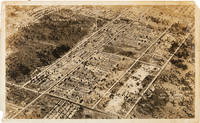
57th F.A. BRIGADE CAMP LIVINGSTON LA
Detroit: Spencer & Wyckoff 1941. Large format photograph 12 x 19 3/4 inches. A few small chips and short tears. Mild scuffing moderate staining and soiling. Good condition. A rare aerial view of the short-lived American military installation at Camp Livingston Louisiana. The camp opened in 1940 and closed in 1945 and was created to train field artillery regiments during World War II hence the "F.A." in the title of the photograph. The most notable use of Camp Livingston began the year after this photograph was taken when the American government used the camp to house thousands of Japanese German and Italian prisoners of war. In addition as many as a thousand Japanese-American citizens were held at Camp Livingston as part of the War Relocation Authority's wartime internment program. The present photograph would be useful in studying the accommodations for wartime prisoners and internees or perhaps the changes over time to the camp to accommodate them. No copies located in OCLC. Spencer & Wyckoff unknown books
Bookseller reference : WRCAM56386
|
|
|
Civil War; Currier & Ives
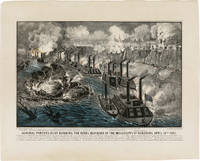
ADMIRAL PORTER'S FLEET RUNNING THE REBEL BLOCKADE OF THE MISSISSIPPI AT VICKSBURG APRIL 16th 1863 caption title
New York: Currier & Ives 1863. Handcolored lithograph 12 x 15 inches. Tiny chip in upper left corner well away from the image. A clean near fine copy. A colorful and dramatic depiction of Admiral David Dixon Porter's Mississippi River Squadron running the Confederate blockade at Vicksburg during the siege of the city by Union forces in 1863 an important strategic victory in taking control of the river. Captions identify Porter's flagship the U.S.S. Benton in the right foreground leading the Lafayette and General Price which are followed by the Louisville Mound City Pittsburg Carondelet Silver Wave Forest Queen Henry Clay and Tuscumbia. A barrage of cannons fire from both the squadron and the Confederate batteries on the embankments overlooking the river. Union cannonballs are hitting both the batteries and the buildings on the bluffs of Vicksburg further in the background. Clouds of smoke billow from the ships the burning buildings and one of the floats of flammable material set out by the Confederates. <br> <br> Initially Grant had asked only for a few gunboats to shield his troops but Porter persuaded him to use more than half of the Squadron. Six nights later April 22 they made a similar run past the batteries to give Grant the transports he needed for crossing the river. Grant first tried to attack the Rebels through Grand Gulf south of Vicksburg and had Porter's gunboats eliminate the two forts there so his troops could cross. Despite intense shelling the upper fort held; Grant called off the assault and moved downstream to Bruinsburg where he crossed unopposed. Afterwards Porter's ships remained in place securing the Mississippi and Yazoo Rivers and guaranteeing the success of the siege. Grant was effusive in his praise Porter's actions and for his contribution to the victory Porter's appointment as acting rear admiral was made permanent. <br> <br> The additional printed caption describes the event thusly: "At half past ten P.M. the boats left their moorings & steamed down the river the Benton Admiral Porter taking the lead - as they approached the point opposite the town a terrible concentrated fire of the centre upper and lower batteries both water and bluff was directed upon the channel which here ran within one hundred yards of the shore. At the same moment innumerable floats of turpentine and other combustible materials were set ablaze. In the face of all this fire the boats made their way with but little loss except the transport Henry Clay which was set on fire & sunk." <br> <br> The Union victory at Vicksburg was the second major blow to the Confederacy in the spring and summer of 1863. On July 3 Lee's invasion of the North foundered at Gettysburg and on July 4 the U.S. flag rose over Vicksburg. This print is surprisingly uncommon in the market. CURRIER & IVES: CATALOGUE RAISONNÉ 0058. PETERS CURRIER & IVES 1180. Currier & Ives unknown books
Bookseller reference : WRCAM56146
|
|
|
Civil War
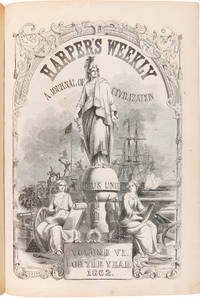
HARPER'S WEEKLY. A JOURNAL OF CIVILIZATION Volumes 5 - 9
New York 1865. Ten volumes. Volume V No. 210 through Volume IX No. 470. 416; 417-502507-534539- 706711-832; iv230235-416; 417-422427- 438443-832; iv416; 417-502507-832; iv390395-416; 417-848; iv400; iv401- 832pp. Profusely illustrated. Lacks eighteen leaves. Folio. Contemporary three-quarter black morocco and cloth spines gilt. Noticeable wear to spines. Long horizontal closed tear and minor chipping to a few leaves occasional foxing and minor soiling a handful of misbound gatherings and detached leaves. Lacking eighteen leaves and priced accordingly. Overall a fair to good set. The famous Civil War volumes of HARPER'S WEEKLY covering the period from January 5 1861 to December 30 1865 profusely illustrated with engravings after many famous artists of the day most notably Winslow Homer who worked for the magazine in the first years of the war and with a number after photographs by Matthew Brady depicting Civil War scenes important political figures and satirical cartoons. These volumes of HARPER'S WEEKLY. constitute a remarkable illustrated record of the Civil War for the duration of the conflict full of first-hand accounts of battles political news and wonderful engravings and maps some folding nearly all relating to the war. Included is ample reporting of Sherman's march Lincoln's assassination and funeral and all the major battles. "The most popular periodical of its day and valuable for a study of any aspect of the war; the illustrations are unsurpassed" - Nevins. With much on the campaigns in Florida early in the war and so very much more. Though this set is a bit wounded it still holds a wealth of pictorial and textual history on one of the defining events in American history. Also includes a single issue of FRANK LESLIE'S ILLUSTRATED NEWSPAPER November 28 1863 bound into the second volume of HARPER'S WEEKLY for 1863. NEVINS p.15. SERVIES 4601-4615 4696. hardcover books
Bookseller reference : WRCAM56383
|
|
|
Spanish American War
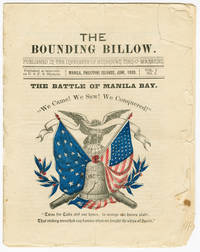
THE BOUNDING BILLOW. PUBLISHED IN THE INTERESTS OF AMERICAN MEN-O'-WARSMEN. PUBLISHED AT INTERVALS ON U.S.F.S. OLYMPIA. MANILA P.I. JUNE 1898. Vol. I. No. 5.THE BATTLE OF MANILA BAY
Manila Philippines 1898. 16pp. printed in double columns. Color illustration on front wrapper uncolored map on rear wrapper. Original pictorial self-wrappers. Rear wrapper detached but present. Central vertical fold wrappers with chips and tears in edges upper outer corner of front wrapper repaired with tape on verso. Good. One of three issues of this scarce Spanish- American War periodical published on board Dewey's flagship Olympia in Manila Bay. There was a total of seven numbers of this naval periodical the first two published in Nagasaki the third in Yokohama the fourth in Hong Kong and numbers five to seven in Manila. The present issue entirely devoted to the Battle of Manila Bay is among the most desirable and contains American accounts and a translated Spanish account of the battle several poems and a map of the scene of action made by a sailor "with a couple of sail needles." The magazine was written and edited by Apprentice First Class Louis Stanley Young and printed by Harry B. Glover on paper captured from the "Commandancia General del Arsenal de Cavite." Young a former printer himself improvised a print shop in a torpedo room on board the Olympia. An illustration of the Liberty Bell two flags an American eagle etc. is printed on the front wrapper in black red and blue. "A historic piece one of major proportions" - Moebs. MOEBS AMERICA'S NAVAL HERITAGE 136. unknown books
Bookseller reference : WRCAM56306
|
|
|
Revolutionary War: Will Johann Martin
DEN WÜRDIGEN LORD RODNEY ADMIRAL DER WEISSEN FLAGGE VICE ADMIRAL VON GROS-BRITTANIEN OBERSTER BEFEHLSHABER DER FLOTTEN SEINER MAJESTÄT IN WESTINDIEN.ENGRAVING OF THE BATTLE OF THE SAINTES APRIL 12 1782 KEY DETAIL OF THE FRENCH AND BRITISH FLEETS
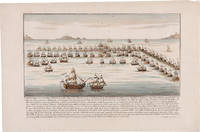
Augsburg 1782. Handcolored engraving 11 1/2 x 17 3/4 inches. Some light soiling and tanning. Near fine. Matted. An attractive and well-preserved contemporary print by German engraver Johann Martin Will with delicate hand-coloring depicting the British and French fleets in combat formation during the Battle of the Saintes also known as the Battle of Dominica/Bataille de la Dominique. Britain's victory over the French navy in April 1782 effectively ended French control of the Caribbean. The engraving depicts over eighty ships which are keyed for identification in captions in German below the image. The upper middle ground depicts Rodney's flag ship "Formidable" and two supporting vessels attacking and breaking the French line. Among the many other ships identified are the flagship of the French admiral Comte de Grasse's "Ville de Paris" here identified as "Stadt Paris" as well as Sir Francis Samuel Drake's division Admiral Samuel Hood's division and the Prince George which according to this account broke its main mast while breaking the line. Also depicted is the French fleet's attempt to reestablish the line in which they have little luck as ships were already starting to flee. <br> <br> The battle was named after the Saintes a group of islands between Guadeloupe and Dominica in the West Indies. The year before the French fleet under de Grasse had decisively defeated the British fleet in the Battle of the Chesapeake and then blockaded the coast until Cornwallis surrendered at Yorktown helping to secure American victory in the Revolution. This time the British fleet soundly defeated the French capturing the flagship and de Grasse the first French admiral in history to be captured by an enemy and inflicting significant causalities. This emboldened the British in the ongoing negotiations with the Americans and French as well as in ongoing conflicts with Spain. The French-American alliance effectively dissolved and Britain reaffirmed its claims on the Newfoundland fisheries and Canada. Further the French and Spanish abandoned their planned invasion of Jamaica focusing instead on protecting their existing holdings. <br> <br> Johann Martin Will 1727-1806 was a prominent engraver and publisher in Augsburg who specialized in producing images for the British and American markets. A most uncommon image of an important naval battle in the West Indies. unknown books
Bookseller reference : WRCAM56168
|
|
|
Civil War: Virginia
PENCIL SKETCH OF THE FIELD HOSPITAL OF THE 3rd DIVISION 6th CORPS NEAR PETERSBURG VIRGINIA 1864
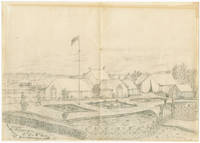
Petersburg Va 1864. Pencil sketch 10 x 14 1/4 inches. One vertical and two horizontal folds. Residue from previous mounting and old repair to verso minute separation at two cross- folds. Lightly tanned. Very good. A large and well-executed pencil sketch of a field hospital toward the end of the Civil War. The artist only identified him- or herself as "W.M.C." in the lower left corner along with the caption: "Field Hospital of the 3rd Div. 6th Corps near Petersburg Va. Pencil Sketch made 1864." In the foreground are the well-tended grounds of the hospital including a flagpole flying the hospital "H" flag with the Greek cross insignia of the VI Corps all surrounded by a wooden fence and trimmed hedge. A complex of semi-permanent tents dominates the majority of the image with two men in uniform in conversation to the left of the tents. In the background are two covered ambulance wagons decorated with medical crosses; trees and small houses are visible further in the background. <br> <br> The VI Army Corps was created in 1862 and assigned to the Army of the Potomac although in 1864 it was temporarily assigned to the Army of the Shenandoah under the command of Maj. Gen. James B. Ricketts. Although the VI Corps faced heavy fighting throughout the Civil War 1864 was particularly violent - this field hospital was undoubtedly packed throughout the year. In the wake of the Battles of the Wilderness and Spotsylvania during the Overland Campaign to the close fighting near Mule Shoe also known as the "Bloody Angle" the assault at Cold Harbor and the Shenandoah Valley campaigns the VI Corps saw nearly two-thirds of its 24000 soldiers killed or wounded. In December 1864 the VI Corps returned to the Army of the Potomac and in April 1865 played an important role in the final assault on the fortifications of Petersburg. unknown books
Bookseller reference : WRCAM56141
|
|
|
Wright William F.: Civil War
CIVIL WAR DIARY OF IOWA SOLDIER WILLIAM F. WRIGHT IN 1861 WITH ACCOUNTS OF HIS SERVICE IN MISSOURI AND DESCRIPTIONS OF THE FIGHT AGAINST SECESSIONIST BUSHWHACKERS
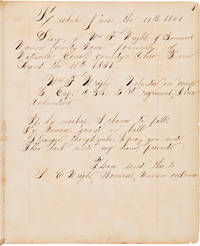
Various places in Iowa and Missouri as described below 1861. 1022pp. approximately 16000 words. Contemporary half sheep and marbled boards. Boards detached but present worn and rubbed. Bookseller stamp on front free endpaper. Pages loosening but all present pages 33-34 with old repairs to a vertical tear running the length of the page. Occasional spots of soiling throughout but overall the text is quite clean and very easily read. Overall very good. An engaging account of the early days of the Civil War in Missouri by William F. Wright a Union volunteer from Somerset Iowa. Missouri was a highly-contested border state with both Union and Confederate supporters. It sent soldiers and arms to both sides was represented with a star on both flags maintained dual governments and featured a vicious intrastate war within the larger national war. William Wright's journal of his service in the first year of the war ably communicates the dangerous and unprecedented nature of guerilla warfare in the western theatre of the Civil War. <br> <br> Wright 1837-1905 enlisted in the 3rd Iowa Infantry Regiment in May 1861 responding to President Lincoln's first call for troops. Much of the diary centers on the months from July to September 1861 as his unit traveled back and forth across Missouri facing a guerrilla enemy with no clear battle lines. Unlike the large armies and massive battles further east Wright's regiment was frequently on the move by rail and foot often splitting off into companies squads and scouting parties prone to ambush by raiding parties with small detachments occasionally getting picked off by snipers. In addition to Confederate soldiers Wright's regiment also faced bands of pro-Confederate irregulars known as "bushwhackers." The war in Missouri was continuous from 1861 to 1865 with conflicts throughout the state. There were over 1200 distinct engagements in the state during the war; only Virginia and Tennessee exceeded this total. <br> <br> Wright is generally stoic throughout though he does admit to occasional homesickness and is justifiably distressed over a case of ague that comes on in August. When not drilling or recounting recent attacks Wright frequently mentions attending church prayer meetings and Bible study though he does not seem overly picky as to where. He attends a Catholic mass and a Presbyterian service on the same day and on another attends Episcopal Methodist and Presbyterian services on the same day. <br> <br> The diary begins on May 27 1861 as Wright puts his affairs in order and travels to Indianola where he "was sworn into the state service for three years" after which he proceeds with other recruits to Keokuk Iowa a major staging area for Union forces. His unit is officially sworn into "United States service" on June 8 receive their rifles on the 23rd and then assemble in camp on the 26th. The next day they receive word that they are heading to Missouri in the morning: "we received orders to cook enough provisions for three meals the drum would beat at 3 in the morning at which time we were to pull up stakes." They march to the docks board several steamships and head south on the Mississippi to Hannibal Missouri. Upon disembarking Wright comes across two men taken prisoner by the home guard "and I had for the first time the privilege of seeing a secession prisoner." <br> <br> The next day July 1 they board trains and head west: "I was surprised to see so many fine residences also quite a number of slaves were to be seen at work in the fields who cheered lustily as we passed.We passed several encampments of soldiers on the way who were all in good spirits. We hauled up at Utica in Livingston Co. slept in the cars." After a couple of weeks of false alarms of pending attack mysterious shots at night low rations and rumors of murdered soldiers the company was on edge. On July 18 Wright and nine other men were detailed to guard the railroad station in Utica after reports "that the enemy was going to burn it." During their watch "a spy came in with the information that from 500 to 800 men on Spring Hill were making preparations for an attack at the bridge and station simultaneously." No attack materialized however: "Daylight came and no enemy we were disappointed as we were well prepared for them and would have been pleased to have seen from 50 to 100 make their appearance." <br> <br> Tensions continued in a similar vein for the next few weeks as they shifted back east to Kirksville. Wright reports of all-night guard duty multiple nights in a row and frequently going without meals due to inadequate rations. On August 19 they received warning of a pending enemy attack which ends up as a small skirmish: "Six of our scouts were surrounded by 25 of the enemy. They killed Corporal Dix. The others made their escape after killing 3 or 4 of the enemy." Not long after they start heading south and while passing through Shelbina Missouri three of their men were shot one died by an enemy squad hidden in the brush. Circling back to Shelbina to rest they find the town partially destroyed by Rebel forces. Wright's unit then finished the task which he describes neutrally: ".the boys were allowed to go where they pleased and they took and destroyed ev'y thing in town. When ever a chicken was heard to crow a dozen men were ready to start for the place. Chickens and pigs were killed women's dresses taken children's playthings &c &c." Passing through Macon Missouri Wright and his comrades "dropped into a Brewery. There were quite a number of the boys there. Some of them were trading their shoes some shirts and others drawers for beer. I do not know whether they were their own clothes or whether they had stolen them. Saw three fights today." <br> <br> Heading west just outside of Kansas City they notice enemy scout activity. After more than two months of skirmishing and sniping the regiment saw its first pitched battle. On September 17 "3 p.m. we started from Liberty about 600 strong in the direction of the river. The enemies scouts were retreating as we went forward. The enemy killed 4 and wounded one of our men. About 4 o'clock we were fired into by the enemy which was the first that we knew of their position. We were within about 100 yds of their lines when we were fired on.We fought about an hour and 20 minutes when we were ordered to fall back as they had three men to our one and were flanking us. Four of the artillery men were kiled & four wounded which did not leave enough to man the gun and she was only fired three times when we had to haul her back by hand.we had 17 killed about 60 wounded and a number missing.it is reported that there were over 100 enemy killed and wounded." This was the Action at Blue Mills Landing also known as the Battle of Liberty. The next day Wright wrote "I have been helping to make coffins for our killed 12 bodies which will be buried in the evening.The most shocking scene that I have ever witnessed is one of the dead men whose face has been skined said to have been done by his brother-in-law." <br> <br> Wright had reported on his unit's tendency to loot earlier in the diary and now makes an interesting clarification: "When in the free State of Kansas the boys behaved very well. But since we have again come into Mo. they have began their old tricks. Last night there were quite a number of chickens stolen and a calf taken out of a man's dooryard." Perhaps in fairness to the Iowa troops they regularly went without rations or were given only flour and because they were often in hostile territory they rarely had permission to hunt or fish for their meals. <br> <br> Until this point Wright does not mention any direct encounters with African Americans but on October 18 as they depart Kansas City he notes they ".took three slaves with us who had run away from Lexington." Upon reaching Quincy Illinois "Will Newton and I went down town and got lodging for the three darkys who came from Kansas City. We left them with the supt. of the Colored Peoples Church." <br> <br> For the remainder of this diary Wright was stationed at the Benton Barracks in St. Louis; some of these entries are slightly out of order chronologically as though Wright inadvertently skipped pages. On December 1 he writes "In the evening one of Co. K was killed by accident. One of his comrades cocked his gun not knowing that it was loaded and shot the top of his head off. It was the most horrible sight that I have yet seen." Not much else happens until the end of the month when they get word that they'll be heading back out soon and start prepping their equipment. Leading up to Christmas he notes many of the men planning a big Christmas dinner: "For my part do not feel like celebrating the day. Think it will not pay here will pass it by as other days for this time." <br> <br> Wright's final entry on Christmas Day is also introspective. Having reflected on his past seven months in the army the things he has seen and how frequently he has been spared he concludes: "I do not like a sol. life. Would be far from following it from choice but believe that it is my duty as we are engaged in a just and noble cause trying to sustain one of the best governments ever formed. Co. G is not drunk to night but slightly inebriated." <br> <br> At the end of the diary Wright has transcribed a letter from a rebel which gives a sense of some the psychological warfare practiced during the conflict. Dated at Fillmore Missouri July 18 1861 it reads in part: "I hope when this letter comes to hand you may have time to read it. And I think that I shal be nearby. And then as soon as it is red I shal be near enough to nock your life out of you. I hope the time may come when the flag of the fifteen glorious states may fly over the free and independent.Instead of one thousand of us there is about 8000 of us and we are coming there as soon as we can get there." <br> <br> Wright reached the rank of sergeant in 1863 and survived to muster out in 1864. After the war he married raised a family and farmed in Kansas and Nebraska. <br> <br> A detailed and informative diary of the brutal and chaotic early months of the Civil War in Missouri. hardcover books
Bookseller reference : WRCAM56124
|
|
|
Gillette James: Civil War
TWO ORIGINAL CONTEMPORARY CIVIL WAR DRAWINGS SUBMITTED TO Harper's Weekly ACCOMPANIED BY AN AUTOGRAPHED LETTER SIGNED FROM CAPT. JAMES GILLETTE TO HARPER'S EDITOR JOHN BONNER
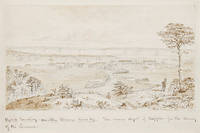
Aquia Landing Va 1863. One pen and ink drawing 7 x 10 1/2 inches sight and one pencil sketch 6 3/4 x 9 3/4 inches sight each in recent matching frames 11 1/2 x 15 inches; plus 2pp. letter on folded folio sheet. Slight soiling and smudging to sketches. Short tape repairs to two closed tears at top margin of letter minor separation at fold text not affected. Very good overall. Two drawings by an unnamed artist submitted as potential accompaniments for articles in HARPER'S WEEKLY which was well-known for the copious Civil War illustrations that supplemented its text. Such illustrations were usually either drawn by reporters or artists sent into the theater by HARPER'S or less often by soldiers in the field. These two works were done by a Union Army Division Post Master and are accompanied by a letter from his commanding officer submitting them for publication. <br> <br> The first work done in pen and ink on paper is entitled "Aquia Landing on the Potomac River Va. The main depot of Supplies for the Army of the Potomac" and depicts a river scene with steamers and sailing vessels along with a pier in the middle distance with a supply train approaching in the foreground which is observed by two soldiers. In the foreground are delicately drawn trees and shrubs; in the background one can see more ships and the other side of the river possibly Simms Point. In early March 1862 the Confederates abandoned Aquia Landing a strategically important post on the Potomac River and Union forces quickly seized the point. The Union Army used the wharves and storage building at Aquia Landing until June 7 1863 when the army headed north for the Battle of Gettysburg and again used the facilities in 1864 during the Overland Campaign. <br> <br> The second work is a pencil sketch titled "Army Bakery in charge of Capt. James Gillette Commissary of Subsistence to Genl. Geary's Division." One medium-sized and two small cabins are at the left side of the image with barrels and a large cauldron nearby; presumably this is where the bakers prepared bread and other items for baking. On the right side of the image is a large wooden lean-to sheltering at least nine ovens. Two bakers are carrying trays of bread and one stands near an open oven with a large peel. To the right of the lean-to is a tent partially open and filled with loaves of bread with three more bakers loading in loaves. In the background are bare trees suggesting this scene is set in winter. <br> <br> The accompanying letter on "Office of the Commissary of Subsistence" letterhead is from Capt. James Gillette to John Bonner then editor of HARPER'S WEEKLY. Gillette writes that he encloses three sketches of which two are included here: "These sketches were made under my own supervision by our division post master are as accurate in detail as any I have seen." Gillette then describes additional material he has enclosed and notes "Some time since a few sketches of scenes in Richmond furnished by my experience found place in your weekly eliciting from you the request that I should occasionally forward to your address such representations of military scenes as might be of interest. Hence these enclosures which in truthfulness cannot be excelled." <br> <br> James Gillette 1838-81 enlisted as a private and rose quickly through the ranks. By this time he was Captain and Assistant Commissary of Subsistence for the 2nd Division XII Corps under Gen. John W. Geary. For his meritorious service he was breveted lieutenant colonel U.S. Volunteers and for gallantry at the battle of Chancellorsville he was breveted major in the regular Army. John Bonner 1829-99 was one of the best known newspaper writers in America at this time. He started as a writer at the NEW YORK HERALD and then moved on to be an editor at HARPER'S. After the Civil War he made a small fortune on Wall Street and then lost it in a most dramatic fashion. He drifted west working for the LEADVILLE CHRONICLE and LEADVILLE NEWS in Colorado and the SAN FRANCISCO CHRONICLE and SAN FRANCISCO CALL among other Bay Area newspapers. <br> <br> An attractive pair of original Civil War drawings from a Union soldier in Virginia in the middle year of the war accompanied by the letter from the Army Commissary officer submitting them for publication to HARPER'S WEEKLY. unknown books
Bookseller reference : WRCAM56150
|
|
|
Texas: Civil War
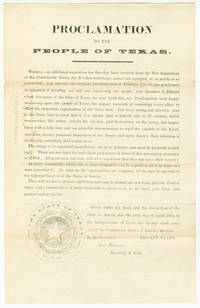
PROCLAMATION TO THE PEOPLE OF TEXAS
Austin 1861. Letterpress broadside 12 1/2 x 8 inches. Docketed in manuscript on verso. Old folds tiny fold separations at edges minor wrinkling. Near fine. A phenomenal Texas Confederate broadside calling for the recruitment of infantry volunteers just two weeks after the attack on Fort Sumter ushered in the Civil War. It is only the second copy of this broadside that we have been able to locate. The proclamation was issued by Texas Governor Edward Clark who arouses the southern patriotism of potential Texas Confederate recruits asking them to join the battle since "the arrogant administration of Abraham Lincoln has proclaimed its intention of invading our soil and conquering our people." Governor Clark "most deeply impressing upon the people of Texas the urgent necessity of combining every effort to effect the immediate organization of our brave men" calls for volunteers for the Confederate Infantry. <br> <br> Clark appeals not only to patriotism and a sense of religious destiny but also evokes an obvious and widely-shared disdain for the northern states of the Union: <br> <br> "Let every young and chivalric man in the State bear in mind that it is a solemn duty to himself and his country which now invokes his action and let the old men gird their armor on the young and inspire them with a holy zeal and an inflexible determination to repel the vandals of the North who have already possessed themselves of our homes and made known their intention of destroying everything that is dear to us." <br> <br> Governor Clark calls for the immediate formation of one or more companies in as many communities as possible in the state of Texas and orders those companies to report to the Adjutant General in Austin. Clark hopes that these companies will soon number "eight thousand men to defend our new-born glorious Confederacy and a reserve force of many thousands to preserve us as we have ever been independent and invincible." <br> <br> The attack on Fort Sumter raged from April 12 to 14 1861 and resulted in a resounding Confederate victory. In the aftermath of the battle both Union and Confederate officials kicked off aggressive recruitment campaigns. The news of Fort Sumter was received by Governor Clark in Austin on April 17; that day Clark issued a directive to establish and instruct volunteer companies dividing the state into six districts Parrish & Willingham 4233 Winkler 1662. The present broadside issued a week later was a response to the Confederate government's request for five thousand more troops for a total of eight thousand new Texas infantry recruits in the two weeks following the outbreak of the war which were promptly furnished by the state. <br> <br> This is an extraordinarily rare Texas Confederate broadside. Parrish & Willingham and Winkler record only a single copy at the University of Texas. PARRISH & WILLINGHAM 4230. WINKLER 1663. unknown books
Bookseller reference : WRCAM56192
|
|
|
Kappel Wilson: World War I
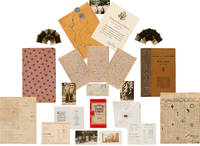
DETAILED MANUSCRIPT DIARY AND RELATED ARCHIVAL MATERIALS PERTAINING TO THE SERVICE OF WILSON KAPPEL OF BOLIVAR OHIO DURING WORLD WAR I INCLUDING HIS ACCOUNT OF SERVICE IN EUROPE AND DETAILS OF FIGHTING ON THE FRONT LINES IN FRANCE AND THE MEUSE-ARGONNE OFFENSIVE
Various locations including Ohio Georgia France Luxembourg Germany and Belgium 1919. Folio manuscript diary 153pp. one printed book and various family papers certificates dog tags photographs and more. In very good condition overall. An important and informative World War I archive belonging to Wilson Kappel of Bolivar Ohio including a phenomenal starkly-written and uncensored diary kept by him throughout his service detailing war deaths mustard gas attacks and the notable Meuse-Argonne offensive near the end of the war. Kappel 1893-1979 served as a mechanic with Company C of the 6th Infantry of the United States Army. He registered for the service on June 5 1917 was drafted in July shipped out to training in October and served until his return from Europe on July 31 1919. Kappel spent significant time in France Luxembourg Belgium and Germany during his service all of which he details here. <br> <br> By far the most significant item in the present archive is Kappel's manuscript diary which covers in amazing detail every aspect of his service from home to Europe and back again. The diary which Kappel titles in manuscript on the first page DIARY OF THE WORLD WAR is large format and closely written for over 150 pages in an eminently readable and uncensored style. It is likely that he either wrote out this diary from notes made during the war or wrote it out from memory shortly after the war. The text conveys a sharpness that immediacy that would likely have been slightly dulled by the passage of time. The diary begins with the line "I registered June 5th 1917" and takes Kappel first to the mobilization camp at Camp Sherman in Chillicothe Ohio and thenceforth to basic training at Camp Forrest in Georgia. Kappel writes in unhurried detail about training on the rifle range in Georgia traveling to Hoboken New Jersey to board a troop ship to Europe and writes extensively about his experiences overseas. <br> <br> Kappel's European diary entries begin with his arrival at the "sorting yards" at Brest France. He continues to various locations in France namely Barsubaube Soulaine Pagny- Sur-Meuse Remiremont and Le Tholy before arriving at the front and the front line trenches near Gerardmer in mid-June of 1918. At the front Kappel and his unit experience their first encounter with enemy shellings and the types of activity faced by soldiers near the front lines: <br> <br> "We all got scared as none of us ever heard a shell before and we thought they were going to hit us but they went way above our heads and went crashing against the hill side we could hear it echo many times. We got orders to lay in the ditch along the road till they stopped shelling. I and Corporal Fox of Massillon was together in the ditch he said to me 'I wish we would be back in Massillon Ohio instead of being in this ditch.' As soon as they stopped shelling we went on again. When we got within about two miles of the front line trenches the Germans must have heard us walk as they had a powerful search light on top of a high hill and they shined that down direct on us for about ten minutes and then it went out again." <br> <br> Kappel spent almost a month at the front where he writes about getting shot at by German snipers cooking clandestinely in the basement of a French church encountering a private who shot off his own finger while on guard duty firing on German patrols encroaching into the American side a strange incident in which a corporal intentionally blew his own hand off with a grenade presumably in order to avoid further service and much more in often astonishing detail. <br> <br> On July 16 Kappel and his unit left the front lines near Gerardmer continuing to St. Die and then arriving again at the front lines this time at St. Claire. On August 15 Kappel and his unit were caught in a mustard gas attack which he recounts in excruciating detail. The Germans in the area "shot over a large number of mustard gas shells all along the front.I and about fifty more soldiers all ran down in a dugout that was gas proof but the gas came in through the cracks of the door and we all had to wear our gas masks for about an hour.The gas was so strong that it got in between our shoes and leggings and many of us got blisters on our ankles." <br> <br> Two days later Kappel participated in the attack on the German border town of Frappell. Kappel writes that "The American barrage started Aug 17th 1918 at three-fifty a.m." and was met with a German response that "killed many Americans." As usual Kappel's recounting of the battle is unusually detailed and affecting ranging over several pages and including meticulous accounts of the horrors of battle. He writes in part: "At one place four American soldiers carried a wounded soldier on a stretcher in a trench. The trench was not wide enough around a corner so they had to lift him up out of the trench. Just as they were doing this a German shell came and killed all five of them." Later he writes: <br> <br> "The first shell that the Germans fired on his headquarters made a direct hit on the closet and was all blown to pieces with several soldiers in it and a few standing out around the building. I was half asleep in my dugout at the time. I had my pack rolled in the morning but I jumped up when the first shell hit. Mechanic White was with me he told me 'It is time to go' we both ran out of our dugout because it was not shell proof and just as we got outside of the door Private Raymond Barmos was rolling his pack. We both jumped over him and that was the last that was ever seen of him. He was blown to pieces a few seconds after we had jumped over him." <br> <br> Kappel's diary continues in much the same manner and with the high level of detail throughout the remainder of the text. He and his unit continue to Pouxeux St. Nicolas St. Christophe Martin Court Saint Mihiel Avirinville Rigny and Verdun. Just north of Verdun Kappel participates in the historic Meuse-Argonne offensive from September to November 1918. Kappel's account of the Meuse-Argonne offensive occupies ten pages of his diary and is typically thorough in relating the specific brutalities heaped upon the young soldiers during the Great War. A few excerpts will relay the flavor of Kappel's narrative of the offensive: <br> <br> "When we started over the top we had to cross a valley this was full of gas. The Captain told us to put on our gas masks. I put my gas mask on quick and started to walk away a German shell came and exploded to the right side of me and a piece of shrapnel went through my gas mask. I pulled my gas mask off quick and walked back a little ways and took a gas mask off a dead American soldier and put that over my face. The Germans were only a few rods away from us. We started to shoot at them they did the same. We killed some and captured a few the rest ran over the hill. We kept going after them the whole day. One German shell came and made a direct hit on Lieutenant Roche of our company. He was blown to little shreds." <br> <br> "The Germans had many barbwire entanglements here. It was a common sight to see from six to ten American soldiers lay on a pile dead. They shot a German spy at this front. He was in the American Artillery and was always shooting short. The Artillery Sergeant killed him with his revolver." <br> <br> "We stayed here for one day and night. We dug our shelter trenches two soldiers for each shelter trench.The bullets were flying thick. We had to stop digging several times and crawl behind the fresh dug grounds for safety. When Private Pike of our company was done digging his little shelter trench he reached up with his hand to tear some weeds off so he could see out better a bullet came and went right through the middle of his hand.From this place when we looked back we could see the canal river railroad and the city of Brieulles. It was nice to watch the German big shells explode. Some would hit right in the river. It would throw the water up about forty feet in the air. Some shells would hit the buildings at Brieulles and tear them all to pieces." <br> <br> "We went past a cabbage patch. We made out that in coming back that we were going to take some cabbage along with us. When we got down into Brandyville the Germans started to bombard the town. I gave the message to an officer. It took him about one hour to write out another message for me to take back. I was looking every minute for the house to get hit by a shell.I finally got my message and we all ran out of town till we got to the cabbage patch. There we stopped. Just as each one of us was going in the patch a big German shell hit right in the center and surely did make the cabbage heads fly. I got one big head and some of the others got two heads a piece. This we took back to our company and at midnight we all had raw cabbage to eat." <br> <br> After the Meuse-Argonne offensive Kappel moved on to Liny Brandeville Louppy Marville and Rehon in France then spent a short time in Luxembourg Belgium and Germany before shipping back to the States. <br> <br> In the final eighteen pages of his diary Kappel records a short history of the USS America; a couple of poems; a detailed list of Army pay with title and monthly pay; a list of Army divisions with enlistments casualties captures wounded and more; a complete roster of Company C from March 1918 "just a few days before we started for France" which includes a list of all the men who were in the unit from March 1918 to March 1919 and what happened to them during the course of the war; a list of divisions to which each unit belonged; and ending with four small color drawings and descriptions of the principal airplane markings belonging to England France the United States and Germany during the war. <br> <br> In addition to his diary the present archive is rounded out with a batch of personal papers and other material kept by Kappel and his family. These additional items include a war-dated letter from Wilson Kappel to his brother Owen sent home from France in September 1918; five early Kappel family photographs showing Wilson and Owen; a printed certificate from President Jimmy Carter honoring Kappel's service sent to Owen after Wilson's death; Kappel's dog tags; twenty-two later small photographic negatives; a Civil War bullet passed down through the family and with a note by William Kappel; a portion of the January 17 1919 issue of STARS AND STRIPES; Kappel's 8th and 9th grade report cards; his address book; Kappel's funeral notice indicating he died on Oct. 22 1979; and a hardcover book entitled THE OFFICIAL HISTORY OF THE FIFTH DIVISION U.S.A. Washington D.C.: The Society of the Fifth Division 1919 with original shipping box addressed to Wilson Kappel. <br> <br> An historically important and uncensored firsthand account of the First World War that reads like an undiscovered classic from the Lost Generation rounded out with a small selection of the soldier's personal war- related material. hardcover books
Bookseller reference : WRCAM55901
|
|
|
Carrier's Address: Civil War
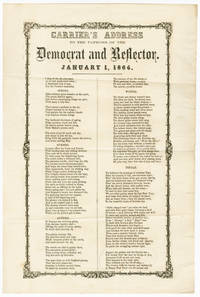
CARRIER'S ADDRESS TO THE PATRONS OF THE DEMOCRAT AND REFLECTOR. JANUARY 1 1864
N.p. but likely Schenectady N.Y. 1863. Letterpress broadside 15 x 10 inches text surrounded by ornamental border. Old folds four short horizontal closed tears to right edge expertly repaired on verso. Light penciled parentheses marks around final stanza. Very good. A rare example of a Civil War-era carrier's address produced by the printer's apprentice of the "Democrat and Reflector." This is very likely a reference to the SCHENECTADY DEMOCRAT AND REFLECTOR which ran from 1860 to 1867 in that city. For over 200 years carrier's addresses were printed by the apprentices or "printer's devil" at printing shops around the world and handed out on New Year's Day by carriers of newspapers in an attempt to solicit tips and gifts from loyal patrons. This extra income was an important supplement for apprentices who often worked unpaid positions just to gain experience. <br> <br> The present example prints a long poem divided into the four seasons with a "Finale" added after the winter stanza. The author of the poem begins "I sing of the old year past" and follows with a long poem beginning in the spring as its "Mild southern gales breathe on the earth" and "notes of joy fill earth and sky." The summer "offers her fruits and flowers." In the autumn "Bleak tempests gather in the north." And winter arrives "bleak and dreary" though there is mention of "The Christmas Carol - St. Nicholas too." <br> <br> Lastly in the "Finale" the author includes an entire stanza on the current Civil War which begins: "'Grim visaged war' yet rules our land And calls from quiet homes full many a band Of heroes. - And Industry with might and skill To maim and splinter wound and kill Makes wondrous cannon projectiles vast; From 'Swamps' a fiery 'Angel' cast To shell with Grecian fires the spot Where rank Secession was begot." <br> <br> The address concludes with a call to "Support the printer and the Carrier too" as "The Carrier dofts his beaver and wishes all A Happy New Year - on his annual call." <br> <br> No copies of this address appear in OCLC. unknown books
Bookseller reference : WRCAM56092
|
|
|
Civil War Covers
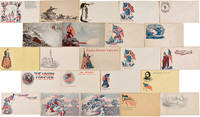
SUBSTANTIAL COLLECTION OF 119 UNUSED CIVIL WAR-ERA PATRIOTIC POSTAL COVERS ALL BUT ONE OF THEM ILLUSTRATED ALMOST ALL WITH ORIGINAL PRINTED OR HAND-COLORING
Various locations including Philadelphia New York Salem Cincinnati Baltimore and others 1865. 119 unused postal covers all but one of them illustrated almost all printed in color or hand-colored. Generally minimal wear. Ranging from very good to near fine condition. An interesting and substantial grouping of Civil War-era patriotic covers encompassing a wide variety of themes devoted to the Union cause. A great number of Union officers are celebrated here among them are eight examples depicting General McClellan three of Gen. Fremont and a pair featuring Gen. Rosecrans the "Hero of the West." There are also numerous regimental leaders including Edward Dickinson Baker Commodore Silas H. Stringham Lt. John T Greble Gen. Wool printed with a map of the seat of war in Missouri Col. E.D. Baker Col. H.E. Paine of the Wisconsin Volunteers Col. Max Friedman of the Cameron Dragoons and many others. There are also pictorial covers of Gen. Sherman's Headquarters at Hilton Head; a pair depicting Fort Sumter; four depicting Camp Dennison near Cincinnati; one of the Battle Monument in Baltimore; and one featuring Benton Barracks in St. Louis. Three examples are practically bird's-eye views of Baltimore one a general view another from the perspective of Federal Hill and the third from Fort McHenry. <br> <br> A common visual theme is the use of symbolic iconography of the United States. Numerous examples depict women standing proudly with the American flag and are evocative of Columbia the personification of the United States. One depicts a woman serving with the "Home Guard" and decked out in a dress resembling the flag. Another example shows a "Daughter of the Regiment." Yet another is titled "The Ladies' Envelope" and features Columbia with an American flag-style shield. There are also a plethora of examples featuring the flag itself. One example prints a "History of Our Flag" beginning with its endorsement by Congress on June 14 1777. One prints the flag next to a warning reading "If Any One Attempts to Haul Down the American Flag Shoot Him on the Spot." <br> <br> The American Eagle features prominently here as well. In one example the great bird is tearing apart a Rebel flag with his beak. In another the eagle holds a banner in his mouth reading "Beware" while confronted with a disjointed hand labeled "Jeff. Davis" holding eight snakes labeled with the names of the Confederate states an interesting twist on the famous severed snake image featured in the Revolutionary-era "join or die" illustration. <br> <br> Also a handful of the covers display the type of twisted gallows humor sometimes literally to be expected from patriotic covers. One of these shows Jefferson Davis hanging from a tree; the text around his lifeless body reads "Southern Eagle Jeff. Davis in Suspense Long May He Wave." A similar example shows Davis hanging from a gallows; the caption reads "Jeff. Davis 'President' of Traitors Robbers and Pirates; the Nero of the 19th century. On the Last 'Platform' of the Southern Confeder- ass-y." Yet another cover not gallows humor but featuring Jefferson Davis depicts him as a fox holding two geese one labeled Tennessee and the other Virginia above a caption reading "Jeff. Davis on a Scouting Expedition." <br> <br> A particularly-colorful example depicts a proud Union soldier defending Washington D.C. The soldier holds fast to an American flag as a cannon fires beneath his feet with the Capitol building in the background. Other examples celebrate the New York State Volunteer Militia the Pennsylvania Volunteers the Quartermaster Department of the Anderson Zouaves the Monitor the naval battle between the Monitor and the Merrimack Sherman's Flying Artillery the text of the Army Hymn "Jeff. Davis' Doom" various political cartoon-style illustrations and many more. <br> <br> A significant collection of one of the more ephemeral and visually significant artifacts of life in the North during the Civil War. unknown books
Bookseller reference : WRCAM56082
|
|
|
Carter Solon A.: African Americana: Civil War
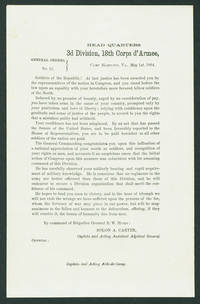
HEAD QUARTERS 3d DIVISION 18th CORPS D'ARMEE. GENERAL ORDERS No. 15
Camp Hamilton Va 1864. 1p. on an octavo sheet. Faint tideline to upper left corner. Near fine. An important order announcing equal pay for "colored troops" in the Union Army issued by Capt. Solon Carter on behalf of Gen. E.W. Hinks. This is a field press printing of one of Hinks' earliest and most consequential orders upon taking command of 3rd Division of the 18th Corps of the Union Department North Carolina composed entirely of United States Colored Troops U.S.C.T. This order was issued over a month before Congress finally authorized equal pay for U.S.C.T. troops on June 15 1864. Until then black soldiers were paid $7 per month plus $3 for clothing while white soldiers earned $13. The order begins: "Soldiers of the Republic! At last justice has been awarded you by the representatives of the nation in Congress and you stand before the law upon an equality with your heretofore move favored fellow soldiers of the North." <br> <br> One of Hinks' other early orders was to appoint Carter then captain of Company G 14th New Hampshire Volunteers as Assistant Adjutant General of Volunteers and Aide-de- Camp to Hinks. Carter later served on the staff of Gen. Charles J. Paine 3rd Division 25th Corps. For his service and bravery he was breveted Major and then Lieutenant Colonel at the end of the war. In 1900 at a meeting of the Military Order of the Loyal Legion of the United States Commandery of Massachusetts Carter presented a paper titled "Fourteen Months' Service with Colored Troops" in which he praised the service of the U.S.C.T.: <br> <br> "The object of the present paper is to tell in simple language without exaggeration or embellishment the story of what the Colored Division of the Eighteenth Corps did and how they did it throwing here and there a side light upon previous descriptions of their deeds of valor and heroism. That the lights are of such exceedingly limited power must be attributed to the fault of the instrument rather than lack of loyalty to the memory of the gallant officers and brave men living and dead whose acts are commemorated." <br> <br> Carter went on to describe their role in the Bermuda Hundred Campaign leading up to the Siege of Petersburg and how they earned the respect and admiration of their fellow white soldiers. <br> <br> The United States Colored Troops were regiments in the Army composed primarily of African-American soldiers although members of other minority groups also served including Native Americans Pacific Islanders and Asian Americans. By the end of the Civil War U.S.C.T. regiments constituted about one-tenth of the Union Army although they had a casualty rate about thirty-five percent higher than white Union troops. The U.S.C.T. fought with distinction: fifteen U.S.C.T. soldiers received the Medal of Honor among numerous other awards. <br> <br> In July 1862 Congress passed the Confiscation Act freeing slaves whose owners were in rebellion against the United States and then the Militia Act of 1862 empowered the president to use former enslaved men in any capacity in the army. Lincoln opposed early efforts to recruit black soldiers although he approved of the army using them as paid workers. However once he issued the Emancipation Proclamation recruitment of African Americans became widespread. On May 22 1863 the War Department issued General Order 143 establishing the Bureau of Colored Troops to better facilitate the recruitment and mustering of African-American soldiers. Regiments of infantry cavalry engineers light artillery and heavy artillery units were recruited from all states of the Union. 175 regiments totaling more than 178000 "colored" soldiers served during the last two years of the war. <br> <br> U.S.C.T. regiments were led by white officers and rank advancement was limited for black soldiers with very few receiving commissions. The courage displayed by black troops during the war played an important role in African Americans gaining new rights after the war. In his speech "Should the Negro Enlist in the Union Army" delivered at National Hall Philadelphia on July 6 1863 Frederick Douglass stated: "Once let the black man get upon his person the brass letter U.S. let him get an eagle on his button and a musket on his shoulder and bullets in his pocket there is no power on earth that can deny that he has earned the right to citizenship." Douglass was a prominent supporter of recruitment for the U.S.C.T. and Douglass' two sons Lewis and Charles were two of the first to enlist in Massachusetts. <br> <br> We could find only two copies of this general order held in institutions: Hampton History Museum and the University of Rochester. An important early step on the road to racial equality in the United States armed forces. OCLC 1101179313. Solon A. Carter "Fourteen Months' Service with Colored Troops" in CIVIL WAR PAPERS READ BEFORE THE COMMANDERY OF THE STATE OF MASSACHUSETTS MILITARY ORDER OF THE LOYAL LEGION OF THE UNITED STATES Boston: F.H. Gilson 1900 vol. 1 pp.155-179. hardcover books
Bookseller reference : WRCAM55912
|
|
|
Civil War: Confederate Military
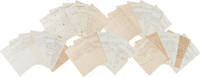
COLLECTION OF TWENTY-NINE MANUSCRIPT ORDERS FROM VARIOUS CONFEDERATE OFFICERS INCLUDING GEN. P.G.T. BEAUREGARD FROM CONFEDERATE HEADQUARTERS IN CHARLESTON DURING THE OPENING WEEKS OF THE CIVIL WAR
Charleston & Morris Island S.C. 1861. Twenty-nine manuscript documents a few on Confederate military stationery the remainder on plain paper totaling 37pp. Original folds. Minor edge wear chipping to four letters resulting in minor loss. Overall very good. An uncommonly-early collection of Confederate manuscript military correspondence from the opening moments of the Civil War. The orders emanate from all levels of the Confederate military - Provisional Army Battalion and Brigade. Ten of the present orders come from Gen. P.G.T. Beauregard the commander of Confederate troops at Charleston in the spring of 1861. Beauregard led the Confederate attack on Fort Sumter on April 12 a decisive victory for the Confederacy in the first battle of the Civil War. Especially interesting are the first few orders dated between April 6 and April 11. These orders concern the movement of troops to Morris Island in Charleston harbor in anticipation of the attack on nearby Fort Sumter. <br> <br> The first order on April 6 is marked "Secret" and instructs Colonel Hagood to "establish signals for the assembling of each company in the shortest possible time and necessary arrangements made for prompt transmission of orders.Arms and equipments will be furnished on your arrival here with your command.In order to keep down any excitement consequent upon this order you are directed to execute it in as secret and quiet a manner as the nature of the case will admit of." The secrecy of the order itself and the call for swiftness and quiet movements of the troops clearly indicates an imminent attack. <br> <br> Some of the later orders also focus on the management and positioning of Confederate military units on Morris Island along with issues such as additional appointments troop inspections including the German Hussars commanded by Capt. Theodore Cordes and later in April the troops at Fort Sumter permissions for furloughs and removals movements and command transfers of officers regimental organizations and reports on troop organization and conduct. An April 23 order instructs Colonel Hagood's regiment to report to General Simons for posting "to the best advantage for the defence of the north End of the Island and Batteries from Vinegar Hill to Cummings Point." <br> <br> Most of the orders are addressed to Colonel Johnson Hagood who enlisted in the South Carolina troops as a thirty-two-year-old lawyer from Barnwell County. He was commissioned colonel of the 1st South Carolina Infantry earned a promotion to Brigadier General in July 1862 and was present at the surrender of the Confederate Army at Appomattox Court House. Besides those by Beauregard the other orders were issued by South Carolina Adjutant General States Rights Gist son of Nathaniel Gist General Simons and General Nelson. All of the orders are signed by adjutants or aides to these various officers. Still they represent a significant and important source for early Confederate military concerns around Charleston at the outset of the war. <br> <br> A typed note dated March 1956 indicates that these were found among the papers of Dr. H.M. Bassett by his descendants but there was no record of how he acquired them. <br> <br> An uncommon collection of Confederate manuscript artifacts from the opening moment of the "War for Southern Independence." unknown books
Bookseller reference : WRCAM55931
|
|
|
Civil War: Winant Mary
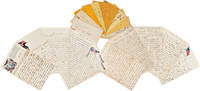
ARCHIVE OF AUTOGRAPH LETTERS SIGNED SENT HOME TO THE WINANT FAMILY WITH MOST ADDRESSED TO MARY H. WINANT FROM VARIOUS UNION SOLDIERS INCLUDING HER BROTHER COUSIN UNCLE AND VARIOUS FRIENDS AT HER HOME IN STATEN ISLAND AND ONE WRITTEN BY MARY IN RESPONSE TO HER SOLDIER BROTHER
Various locations including Washington D.C.; City Point Va.; Petersburg Va.; Brandy Station Va.; Annapolis Md.; and others 1865. Thirty-two war-date letters totaling approximately 95pp. plus ten retained transmittal covers and assorted post-war family papers. Original folds minor wear creasing and toning. A few letters slightly clipped likely to retain the patriotic letterheads. Overall very good. In mylar sleeves within a modern three-ring binder. An interesting Civil War collection of thirty- two letters spanning the length of the war almost all addressed to Mary H. Winant of Staten Island along with ten original transmittal covers and other documents and family papers. Many of the letters are from Mary's family members serving in the war including her brother James her cousin George F. Rezeau and her uncle James E. Rezeau as well as a few other friends. The letters present the experiences of war from numerous different perspectives showing how the conflict affected extended families and whole communities all of them sent to the same woman back home a beloved sister relative and friend. <br> <br> James Winant writes to his sister on November 10 1861 after his unexpected enlistment. It appears that he had not intended to join the army but was swept up in the fervor after many of the young men from their hometown answered the call. He writes to Mary from Camp Campbell in Washington D.C.: <br> <br> "I was expecting to come down the first of November but Mr. Alfred Dart was getting up a Company of cavalry & quite a number of the Herrick boys put their names to the list & wanted me so I did not mean to back out. I put my name to the list the 15th of October & started for Harrisburg the 23. I had but a little time to get reddy sic to go with that company as I should have come to see.I have been in to the Capital & I saw a site the city is well surrounded by our northern troops we expect to hear of a battle every day on the other side of the Potomac. There was about 20000 soldiers left since Friday." <br> <br> Despite having seemingly joined the Union Army on a whim James Winant took his duty very seriously. Two weeks later James tells his sister in a November 23 letter: "I should like to see you but I do not know when that will be but I shall not leave without orders if I was shure that I would never be found out I never would. I will die in the battlefield before I be a Diserter sic never. I came to Fite sic for my country and I shall if called on and never flinch in that course." However that did not mean that James was thrilled with life in the army. His January 15 1862 letter reads in part: ".I hope you enjoy your new year well although I did not enjoy mine very well for I had to stand on guard and that is the worst part of soldiering we have to be out in all kinds of weather and the weather is very changeable. One day it is almost like summer and the next day it is cold enough to freeze a person.It takes 104 men to guard our camp." Moreover by February 25 James was thoroughly restless and tired of being at Camp Campbell writing: <br> <br> "Our Regiment is No.1 & it is referred for the City Provost Guards. There is two Companys out of our regiment guarding the city now & we expect to go in a week. We expect to get our horses this week. I would rather be in the army acrost sic the Potomac for I am getting tird sic of guarding this old camp. When we get to the city we will have better times. There has been quite a move for the last two weeks. The federal troops has got a strong hold of the rebels & I hope they will keep on crossing it." <br> <br> Interestingly in one of the only letters not addressed to Mary James writes his father with much of the same information he includes in this letter. It reads in part: "Our troops is doing good business in the South they have taken the most important places & a large number of prisoners & they will soon take the rest. I wish our company was in the army acrost the Potomac. I should like to see a fight with the rebels for I am getting tired of guarding this camp." <br> <br> In the only response from Mary retained in the collection she writes back to James trying to offer her brother some comforting words although she was worried about him being sent into battle. In a letter written on April 28 Mary writes to James to beg him to put his faith in God. She included a poem to let him know she was always thinking of him. The letter reads in part: <br> <br> "O James how it cheers my Lonely Heart to hear from you.that you would not be cald sic to the battlefield but since I read your last letter wich sic informs me that you have been ordered to march in pursuit of the Enemy. My hope is well nigh expired though I know Dear Brother that you have Enlysted sic in a noble cause and given your heart and hand to your Country and now there is one step more noble for you to take and that is give your heart and head to God and you will be indeed a brave soldier." <br> <br> Mary also received a couple letters from her cousin George Rezeau in Pennsylvania and a few from her uncle James Rezeau. George does not appear to be serving in the military yet when he first writes to Mary though he would enlist shortly. By November 1862 George writes to check in on Mary from Camp Simmons and Camp McClellan. He signs off the former letter "Your naughty cousin G.F. Rezeau." <br> <br> George's father Uncle James Rezeau is also a Union man. He writes to Mary from Annapolis in August 1862 that he is anxious for his regiment to join the battle and that "if our regiment don't go on soon I will leave it and go into York State and join some other one and go down South for I enlisted to fight for my Country.I want to see the Elephant Old Jeff Davis and feed him some cold lead or else about twelve inches of cold steel." <br> <br> The latest letter in the archive is also from James Rezeau dated March 3 1865 to Mary written from the 67th Regiment Headquarters near Petersburg Virginia. Here a month before the war's end Mary's uncle writes to her check on her as he had heard she was sick. Uncle James also writes about war wages and sending money home to various family members including Mary whom he sends seventy-five cents. He also writes a letter to Mary's parents his own brother- in-law and sister from Brandy Station in early February 1864. He talks about his various health ailments including dysentery and diarrhea "It seems almost as bad as consumption for it reduces a man to almost a Skeleton" how he can't keep down any real food the bitterness of the cold and muddy Virginia winter and how he looks forward to seeing "all of you when this cruel War is over." <br> <br> There are also a handful of letters between family members i.e. a letter to Mary from her mother Eliza and some from friends and other soldiers. One letter dated August 26 1864 is from a friend "M. McPherson" who writes to Mary with news of her wounded cousin George: <br> <br> "G.F. Rezeau started for the Hospital this morning. He was wounded yesterday in a Battle between Shepherds Town and Winchester his wound is through the left hand the ball passed through his hand and spoiled the pocket in his shirt his glasses and his pocket combs beside bruising his side right smart. His wounds were very Lucky ones if there is any such. At the time George was wounded we were just going to charge he went to the Rear the Regt charged and we received a Perfect Shower of Rebel Compliments. There was a whole Brigade of Reb Infantry lying in ambush when we charged upon the Hill. They raised up there position was such they had a cross fire upon us." <br> <br> Included at the end of the archive are a number of documents and forms from after the war and as late as the turn of the century. They appear to be unrelated to Mary Winant although they could have belonged to her family or descendants. There are also ten original transmittal covers addressed to Mary Winant. <br> <br> An informative and research-worthy collection of Civil War and Civil War-era family correspondence. unknown books
Bookseller reference : WRCAM55678
|
|
|
Olmsted William Beach Jr.: Olmsted Margaret Overton: World War I
ARCHIVE OF PHOTOGRAPHS AND EPHEMERA DOCUMENTING THE SERVICE OF 1st LIEUTENANT WILLIAM BEACH OLMSTED JR. A.E.F. IN WORLD WAR I INCLUDING HUNDREDS OF IMAGES OF FRANCE DURING AND IMMEDIATELY AFTER THE WAR
France 1919. Three photograph albums one small framed photograph one small portfolio one book. 1115 photographs most mounted in albums ranging from 1 3/4 x 2 1/2 to 7 1/2 x 5 inches; 162 pieces of ephemera most mounted in albums. Two photograph albums: Folio. Olive green buckram both with burgundy morocco labels on front board and spine with gilt initials "WBO JR" and volume number. Minor wear to extremities some leaves slightly cockled due to photo mounting small chips and closed tears to margins of leaves. Third photograph album: Oblong octavo. Black limp cloth boards with black cord binding. Some wear to extremities some closed tears to leaves a few photographs cut out. Framed photograph: Glass cracked some tarnishing to frame. Portfolio: Tan leather with a snap clasp. Pocket partially torn well worn. Book: Publisher's half red cloth with illustrated paper boards inscription on front free endpaper. Front board and spine starting to detach from text block first few leaves detached but present. The archive in very good condition overall. An engaging and carefully assembled collection of photographs recounting the World War I service of 1st Lt. William B. Olmsted Jr. along with a substantial collection of ephemera and letters described below. The photographs document all aspects of his war service showing the aftermath of important battles American soldiers French soldiers and civilians scenes of the countryside and devastated towns and villages moments of calm and recreation and images in France from the period of the Armistice and in the months after. The ephemera provides a detailed paper record of Olmsted's service in France. <br> <br> William Olmsted Jr. 1893-1948 was born in Southboro Massachusetts. His father the Rev. William B. Olmsted was the Headmaster of Pomfret School in Connecticut. Olmsted was Yale Class of 1915 and also did graduate work at Trinity College. After the war he joined the staff of American Viscose Corporation and was Vice-President in Charge of Sales and a director at the time he died. Olmsted volunteered for the American Field Service formerly the American Ambulance Field Service in France in June 1917 and then enlisted in the American Expeditionary Forces later that year. He attended French Officers' School at Meaux and was commissioned Second Lieutenant in February 1918. Olmsted served in the Réserve Mallet a French army unit made up of American volunteers who transported ammunition and trench equipment and anything else that needed transporting wherever it was most needed. <br> <br> The first olive green album begins with a large page in manuscript recording Olmsted's service in France. The next page has "Volume 1 1917-1919" in manuscript and Olmsted's Registration Certificate i.e. draft card June 1917 affixed below. Photos begin on the following page starting with "Chevigny Farm" in August 1917. Olmsted annotates some photos individually but there are also titles and dates for each section which are grouped geographically but not chronologically. The subjects are wide- ranging - Olmsted's photos feature fellow American and French soldiers including the Army of Africa French civilians scenes of the countryside as well as ruined buildings and landscapes military encampments and cemeteries. There are also photos of airplanes both ready to fly and shot down a gas alarm and a Fourth of July gathering. <br> <br> Many of Olmsted's photos are candid and some can be haunting as well. One set chronicles the devastation following the Battle of Montdidier. Part of the second phase of the larger Battle of Amiens the conclusion of this offensive was later known as "the black day of the German Army" and was a major turning point in the war. Nevertheless hardly a structure is left standing in Olmsted's photos. Happier scenes are featured at La Capelle for the Armistice on November 11 1918 including cars that ferried German delegates there to negotiate the peace. The photos feature German as well as French and American troops. Even after the peace was signed however Olmsted still has much devastation to document. He also includes a series of photos he acquired from German soldiers depicting a funeral for a fallen aviator and German soldiers "at play." At this point Olmsted's combat travels take him to Paris and then this sequence ends. <br> <br> The next series of photos begins with the heading "Trip in Ford. 16 days - Cost of car rent gas oil $137.50." Accompanied by his wife Margaret this is clearly a tourist trip albeit a somber one beginning in Soissons and ending in Argentan. Olmsted includes photos of cathedrals and repairs to cathedrals cafés the American cemetery at Belleau Woods as well as French and German graveyards shots of trenches and forts near Rheims and friends and families he meets along the way. This sequence ends with scenes aboard a ship. <br> <br> The second olive green album "Volume 2 1917-1919" begins with "French Tanks Going into Action." Photos in this album are often annotated but there are fewer locations noted. There are some apparent combat scenes in this album as well as more devastation from shelling and bombing and a short sequence of airplanes including a downed German fighter. A sequence titled "Pictures taken by Capt. F.O. Robinson" finishes the photo section. Robinson's pictures do not vary substantially in form or content but add areas not covered by Olmsted particularly in and around Bazoches. <br> <br> The last two-thirds of this album is titled "Volume 3 1917-1919" and consists of ephemera and letters. It begins with a comic sketch of Olmsted and a cloth insignia of his unit the Réserve Mallet. Then follows all of the official documentation of Olmsted's military service including his commission and promotion and ultimately his discharge papers. Also included are Olmsted's folio sheet-size passport with photograph and a substantial collection of orders leave permissions and other administrative documentation from both French and American forces issued to Olmsted. In the midst of these materials he has mounted his American Field Service Medal and Victory Medal with battle clasps: Somme-Defensive Aisne Montdidier-Noyon Aisne-Marne Somme- Offensive Oise-Aisne Defensive Sector along with an envelope labeled "From Cathedral at Rheims" holding pieces of broken blue glass and a small card wishing him happy new year from the superior and sisters at Crecy-en-Brie. Olmsted also preserved a few watercolors one depicting a soldier possibly Olmsted himself with the sisters at Crecy-en-Brie another of a man in a horse-drawn carriage and a larger one of Olmsted standing next to a monument displaying an American eagle and shield and with a truck in the background. There are several sketches by the same artist included as well. Towards the end Olmsted has mounted his dog tags and two pamphlets about the Réserve Mallet. <br> <br> The smaller black photo album seems to overlap somewhat timewise but features photos primarily in the United States many of which are annotated in white pencil in a hand different from that of Olmsted. It may have been created by his wife Margaret. There are several photos taken in the Bay Area of northern California including the campus of the University of California and Golden Gate Park. Interspersed are photos from an apparent road trip including "Dallas" "New Orleans Docks" "Camp Sheridan" Nebraska and "Montgomery" Alabama. <br> <br> Final material relating to Olmsted's life include a small leather portfolio of clippings of his obituary printed in papers around the country and other ephemera. Among this material is an envelope labeled "Bearers at my funeral." with notes inside from Olmsted on whom he wants to conduct his funeral hymns to be included and so forth; an enveloped labeled "Lily from my Wedding bouquet June 23 1917" and a condolence letter to his widow Margaret. Included loose are a menu from a restaurant in Paris 1917 a portion of a letter on teaching military strategy that begins in code and two documents related to Margaret being named a Chevalier of the Légion d'Honneur by the French government for her work directing overseas activities of the American Aid to France foundation during World War II. Finally there is a well-worn dedication copy of "I WAS THERE": WITH THE YANKS ON THE WESTERN FRONT 1917-1919 by C. Leroy Baldridge New York: G.P. Putnam's Sons 1919 given to the Olmsteds by the commandant of the Réserve Mallet. <br> <br> A truly impressive collection chronicling an American's service in France. hardcover books
Bookseller reference : WRCAM55818
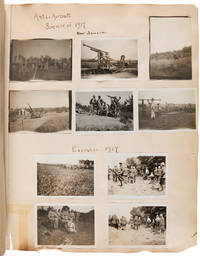
|
|
|
Civil War
SURRENDER OF GEN. LEE
Philadelphia: John Smith 1865. Lithograph 21 1/4 x 26 1/2 inches. Margins with surface rubbing and soiling. Four-inch closed tear in upper margin descending into the image two-and-one-half- inch closed tear in lower margin ascending into the image no paper loss in either case. Backed by later paper mending tears and a few small chips in edges of sheet. Very nice tone to the image. Good overall. Apparently a rare unrecorded proof of this lithograph commemorating the meeting between Ulysses S. Grant and Robert E. Lee at Appomattox Courthouse on April 9 1865 at which Lee surrendered the Army of Northern Virginia and the Civil War essentially came to an end. This print is not only important as a proof giving evidence of how the image was reworked for final publication but also as part of a series of prints commemorating Lee's surrender that did so much to bolster the image of Grant as the "savior of the Union." "No single event of Ulysses S. Grant's life inspired more prints than the surrender he accepted at Appomattox." - Neely & Holzer. <br> <br> The present image bears the title SURRENDER OF GEN. LEE only with no publication copyright or artist information. In the image Grant and Lee meet in the open air before a large tree not indoors as was actually the case. Grant standing to the right holds the surrender terms in his right hand extended toward Lee. Lee one gloved hand on his hip and the other on the hilt of his sword stares steadily at Grant but makes no move toward the paper. Grant and Lee are each accompanied by a pair of aides who gaze at each other suspiciously. In the receding background thousands of troops are shown formed in long curving lines while a handful of officers ride horses. In the version of this print as finally published by John Smith of Philadelphia the positions of Grant Lee and their aides have been reversed and Lee extends his hand toward Grant ready to accept the terms of surrender. The configuration of the armies in the background has been modified and a prominent scar has been added to the trunk of the tree between the two leaders. In both this proof and the final version of the print Grant's uniform has been improved from what he actually wore - he still does not match the splendor of Lee but he is not shown wearing the uniform of a private with the straps of a Lieutenant General. "Here" as Neely & Holzer observe "the lithographer's notions of creating a picture for posterity do battle with widely reported truth." The title of the final version was modified to THE SURRENDER OF GENERAL LEE AND HIS ENTIRE ARMY TO LIEUT. GENERAL GRANT APRIL 9th 1865 Library of Congress control number 2015647830. NEELY & HOLZER UNION IMAGE pp.169 & 174. John Smith unknown books
Bookseller reference : WRCAM55725 ISBN : 2015647830 9782015647838
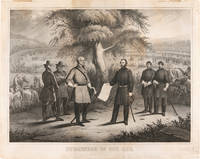
|
|
|
Civil War: Bucholtz Lewis von
MAP OF THE STATE OF VIRGINIA CONTAINING THE COUNTIES PRINCIPAL TOWNS RAILROADS RIVERS CANALS & ALL OTHER INTERNAL IMPROVEMENTS
Richmond: West & Johnston 1862. Lithographed map 25 1/2 x 36 3/4 inches with ornamental border and inset view of Richmond. Sheet trimmed to just outside the ornamental border and mounted on modern linen. Old folds now flattened. Small chip in upper right corner just touching the ornamental border. Separations at a cross-folds with a few instances of small paper loss stabilized by the linen backing. Good plus. This impressive Confederate map of Virginia was originally based on work done by Ludwig von Bucholtz in connection with his updating the famed Herman Boye map of Virginia in 1858. Bucholtz was hired to re-engrave the copperplates for maps of Virginia originally made by Herman Boye in 1826. The ultimate products of his work were the very large maps of Virginia called the Boye-Bucholtz maps. Using knowledge from his work on this project Bucholtz issued his own map in 1858 lithographed and published by Ritchie & Dunnavant in Richmond. This map was vastly superior in detail and accuracy to Bucholtz's revision of the Boye map. <br> <br> In 1862 with Confederate officers in need of good maps of the region Richmond publishers West & Johnson re-issued the Bucholtz-Ludwig 1858 map of Virginia reprinted from the original stone with minor alterations including the removal of the cartographer's name. "There are minor geographic changes from Map 1 the original 1858 Bucholtz map on Map 2 the West & Johnson issue. For example on Map 2 Jerusalem in Southampton Co. has been moved a little to the northwest of its Map 1 location near the Seaboard and Roanoke Railroad and the road between the two points imperfectly erased the remaining shadow is additional evidence that the Map 1 stone was involved. Still for the most part Map 1 and Map 2 are the same map" - Wooldridge "The Bucholtz- Ludwig Map of Virginia and its Successors" in THE PORTOLAN 68 Spring 2007 pp.26-39. A second edition of the West & Johnson issue would be published in 1864. <br> <br> The map shows all of Virginia West Virginia Maryland Delaware and parts of Pennsylvania and New Jersey and includes an inset view of Capitol Square in Richmond. A chart below the view lists all the railroads and the length of each line. <br> <br> "In stark contrast to the large often colored maps pouring out of Northern presses the Confederate imprints are few in number modest in scale and more often than not black and white printed on poor paper. Long before the war was over they weren't being printed at all" - Wooldridge. PARRISH & WILLINGHAM 6204. SWEM 971. Wooldridge "The Bucholtz-Ludwig Map of Virginia and its Successors" in THE PORTOLAN 68 Spring 2007 pp.26-39. STEPHENSON 475.5. WOOLDRIDGE 254. West & Johnston unknown books
Bookseller reference : WRCAM46982A
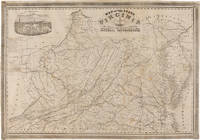
|
|
|
Burgstresser Harvey D.: World War II Photographica
PHOTOGRAPH ALBUM OF UNITED STATES ARMY SSGT. HARVEY D. BURGSTRESSER IN THE SOUTH PACIFIC DURING WORLD WAR II INCLUDING SERVICE IN THE PHILIPPINES GUADALCANAL AND ELSEWHERE
Philippines New Caledonia Guadalcanal New Zealand Hawaii 1945. 213 photographs from 2 3/4 x 2 1/4 to 6 1/2 x 8 1/2 inches corner-mounted; plus twenty-two pieces of ephemera mounted or laid in including two mimeographed pamphlets. Oblong quarto album. Red silk boards blue silk ties with stylized Japanese figure on center of front board. Some fraying to edges and corners some loss to silk on rear board minor soiling. Photographs in excellent condition overall. Very good. A dramatic photograph album from Harvey D. Burgstresser's 1912-83 service in the U.S. Army artillery during World War II. Although most photos are not labeled individually they are labeled by group and track Burgstresser's travels through various combat stations during the war in the Pacific. The first photo labeled "Fayetteville NC" shows Burgstresser on left in uniform with another solider walking along a city street. The first section follows and is labeled "Hawaii 5/7/42-11/1/42" and consists mostly of photographs of soldiers at-ease playing with radio equipment and goofing around likely as they wait for deployment to the front. The next section "Guadalcanal 11/15/42-12/1/43" is short but more somber including photo prints of indigenous people of the island the corpse of a soldier and a photo of a sign posted on a roadside reading: "Kill the Bastards! Down this road marched one of the regiments of the United States Army Knights Serving the Queen of Battles Twenty of their wounded in litters were bayoneted shot and clubbed by the yellow bellies. Kill the Bastards!" <br> <br> Next is a section entitled "Auckland New Zealand 12/1/43-3/1/44" a small and peaceful section featuring photos of couples a few female friends and shots of Burgstresser's battery and company in formation 90th Field Artillery Battalion 25th Infantry Division. From there he was off to "New Caledonia 3/1/44-12/15/44" with a joint force of ANZAC soldiers. Most of these shots are also at- ease and around camp several featuring a truck marked "NZ Mail." From here he moves to "Luzon P.I. 1/9/45 to 10/2/45" the final section and the place where things get a bit more serious; this is also the largest section in the album. Several images show soldiers setting up artillery stations laying wire and organizing ammunition. One image in this section is labeled "V-J Day" and this is the only mention Burgstresser makes about the progress of the war. There are scenes of buildings damaged from war along with a few scenes of combat and more of the aftermath of combat including downed planes and destroyed tanks and several quite explicit images of corpses. In the midst of this are images of Filipino women and men in traditional attire and likely some from New Caledonia and Guadalcanal as well including several shots of topless Filipino women likely not taken by Burgstresser. <br> <br> Various pieces of ephemera are in the album including a twenty-eight-page mimeographed pamphlet entitled WELCOME 25th. INF. DIV. with sections corresponding closely to Burgstresser's arrangement of this album; and a six-page mimeographed pamphlet entitled THE SEA BREEZE "Souvenir Edition" October 23 1945 issued to those aboard the troop ship USAT "Cape Meares." Also included is Burgstresser's military "Motor Vehicle Operator's Permit" authorizing him to drive automobiles large trucks and a "Vehicle wheeled combat;" an invitation to ceremonies honoring General Douglas MacArthur's return to the U.S.; Burgstresser's "Good Conduct Pass" for Auckland; a few newspaper clippings; and pieces of Japanese currency including two pieces of Japanese government- issued "fiat pesos" which the Japanese issued during their occupation of the Philippines. <br> <br> According to his obituary PHILADELPHIA DAILY NEWS April 25 1983 Burgstresser had graduated from Bucknell University; after the war he went into the insulation business and was eventually president of the Philadelphia Asbestos Corporation. His album ably captures both the camaraderie and the horror of the war in the Pacific. hardcover books
Bookseller reference : WRCAM55773
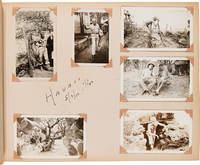
|
|
|
World War II: African Americana
COLLECTION OF PHOTOGRAPHS DOCUMENTS AND CLIPPINGS ASSEMBLED BY A MEMBER OF THE SEGREGATED 93rd AMERICAN INFANTRY DIVISION WHILE SERVING IN THE SOUTH PACIFIC DURING WORLD WAR II
Morotai Bougainville Green Island and other locations in the South Pacific 1945. Three clasp-bound collections of manila folders containing 113 mostly vernacular photographs occasionally captioned in pencil two divisional newsletters copies of Japanese surrender documents and numerous news clippings and assorted ephemera related to the soldier's war experiences. Minor dust-soiling to folders some toning to contents. Overall very good. An informative collection of photographs documents and clippings related to the World War II experiences of the African-American 93rd Infantry Division in the South Pacific. The 93rd Infantry Division was a segregated "colored" unit formed first during World War I and reactivated for service in 1944. The unit was shipped to the Pacific Theater where they served primarily in construction and defensive infrastructure operations. The 93rd occupied Morotai in the Dutch East Indies from April to October 1945 where they witnessed the surrender of the Second Japanese Army. <br> <br> The material in the present collection is organized in three compilations of clasp- bound manila folders with the contents of each compilation annotated in pencil on the front cover. The chief feature of the collection are the 113 photographs arranged thematically throughout the first two folders. <br> <br> Folder One contains photographs and documents pertaining to the Japanese surrender to the division's commander Major General Johnson. There are also photographs showing various Japanese troops surrendering to Australian officers including one of a Japanese officer surrendering to Gen. Thomas Blamey at Australian field headquarters in Morotai. A few photographs emanate from a Japanese hospital ship "taken over by our Div." showing "a few in the hospital." One photograph features an African-American soldier perhaps the compiler of this collection smiling in front of a line of surrendering Japanese soldiers. In the first folder there are also two copies of divisional newsletters: one from the 13th Jungle Air Force; and another titled IGUANA which was the daily newsletter for the 93rd Infantry we could locate no copies of IGUANA in OCLC. Rounding out the first folder are copies of an address on Japanese surrender delivered by Gen. Sir Thomas Blamey to Lieutenant-General Teshima Commander of the Second Japanese Army "On the occasion of the signing of their Surrender Morotai 9th September 1945" and a lithographic copy of the "Instrument of Surrender" between the two combatants. <br> <br> The front cover of Folder Two is titled in pencil "Places and People in the Netherland East Indies and Green Is. in the Northern Solomons and Bougainville." This folder contains images of Australian soldiers in Morotai; numerous pictures of indigenous Morotain people including men women and children; the entrance to the Morotai War Cemetery; photos of the 13th Australian Air Force; overhead images of an active volcano in Bougainville; pictures of Bob Hope Carol Landis a popular Hollywood actress who performed extensively for troops during the war and others on a U.S.O. mission at Bougainville; images of various aircraft including B-29 nose art and Japanese planes; a few pictures of dead Japanese soldiers in Morotai captioned "Good Japs"; photographs featuring the invasion of Morotai; and other images of the South Pacific islands where the compiler was stationed. <br> <br> Folder Three is labeled "Places I've Seen" and is composed of beer labels the compiler collected during his service along with numerous newspaper and magazine clippings memorializing his unit's service. The clippings indicate the compiler also served at Leyte in addition to Morotai Bougainville and Green Island in the Dutch East Indies. <br> <br> An interesting collection of firsthand photographs of an African-American unit's service in the South Pacific during the Second World War. unknown books
Bookseller reference : WRCAM55788
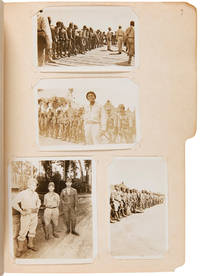
|
|
|
Civil War: Pennsylvania
MANUSCRIPT ACCOUNT BOOK SPANNING THE LENGTH OF THE CIVIL WAR FOR COMPANIES C AND D OF THE 52nd PENNSYLVANIA INFANTRY REGIMENT
Various locations in Pennsylvania Virginia and South Carolina 1865. 21987pp. Large folio. Contemporary three-quarter maroon calf and black cloth boards gilt spine titles reading: "PENN. CLOTHING BOOK COS. C & D 52nd INFANTRY P. & P. OFFICE." Spine partially split chipped and rather worn; boards soiled edges and corners worn. Binding a bit tender and bowed. Scattered occasional soiling and foxing to text. Good. A voluminous manuscript account book used to track the clothing and equipment transmitted to the soldiers of two companies of the 52nd Pennsylvania Infantry Regiment between 1861 and 1865. The meticulous records herein provide significant research material on the outfitting of Civil War troops and show that an army marches not just on its stomach but on its shoes and clothing as well. <br> <br> The majority of the entries relate to clothing including shorts pants coats caps blouses shoes socks and other materials needed by the Civil War foot soldier on the move during the conflict. Equipment listed here includes haversacks and blankets among other items. Each page is dedicated to a single soldier whose name company enlistment location and enlistment date are all recorded in the pre-printed form at top with various line items their costs the rank of the soldier and his signature recorded in the body of the ledger-like account book. Often accounts are noted as settled either before discharge or by death or desertion. Over two-thirds of the entries pertain to Company C of the 52nd Infantry. <br> <br> Importantly in addition to equipment and clothing the account book also records transfers death discharges and desertions. The first five entries for example provide a snapshot of the fates of various soldiers. The first soldier is noted as discharged with the last date of equipment listed as February 28 1862. The second and third soldiers were both "Killed in action at Fair Oaks Va." aka the Battle of Seven Pines May 31 - June 1 1862. The fourth soldier was discharged sometime after June 1862. And the fifth soldier "Died from wounds" after May 18 1862. Others here are noted as "Died from Disease" "Died of wound received by accident" and "Supposed to be killed by the explosion of the Gun Boat Mound City." <br> <br> The 52nd Pennsylvania Infantry Regiment was an important unit during the Civil War. The regiment formed in the late summer and early fall of 1861. They were assigned to the Peninsula Campaign in March 1862 and swiftly saw action at the Battle of Williamsburg and the Battle of Seven Pines also known as the Battle of Fair Oaks which is the name used for the soldiers recorded as dying there in the present account book. The regiment then moved to South Carolina at least one soldier in the present account book enlisted there and by mid-summer they were in Charleston to witness the ill-fated Battle of Fort Wagner. For the remainder of 1863 and most of 1864 the regiment moved around South Carolina until participating in the occupation of Charleston in February 1865. Afterwards the regiment joined Sherman's march through the South and some of the regiment ended the war in North Carolina where they witnessed the final surrender of Gen. Joseph E. Johnston. <br> <br> A valuable and research-worthy record of Civil War service covering the span of the conflict filled with unique information on the ground level needs of the Union foot soldier. hardcover books
Bookseller reference : WRCAM55621
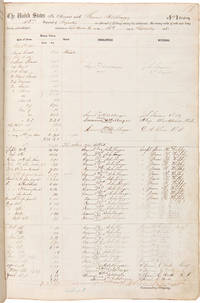
|
|
|
African American Photographica: Vietnam War
PHOTOGRAPHIC ARCHIVE COMPRISED OF 145 SNAPSHOTS OF AN AFRICAN-AMERICAN SERVICEMAN DURING IN THE VIETNAM WAR AND AT HOME
Various places in Vietnam 1972. 145 photographs all but thirteen in color most approximately 3 1/2 x 3 1/2 inches. Majority of photographs mounted on black paper stock with non-archival adhesive tape some photos retain remnants of tape at corners. Some images a bit faded but generally in very good condition. A tremendous collection of photographs depicting the personal life and military service of an unidentified African-American soldier with the last name "Williams" serving in Vietnam during the war and with numerous family photographs at home. The majority of the photographs are undated but those that are dated place the collection roughly between 1968 and 1972. Other identifying characteristics in the photographs indicate that the soldier was likely part of the United States Air Force 93rd Security Police Squadron which provided security and air base defense during the Vietnam War. There is a photograph of Williams leaning against the sign for the 93rd SPS dormitory. <br> <br> Notable in the sixty or more photographs from the soldier's time in Vietnam are images from an unidentified American Air Force base depicting soldiers in the barracks a mess hall and fraternization among soldiers; additional photographs show a heavily-armed Williams manning a bunker holding an EBONY magazine posing with a South Vietnamese soldier in an urban setting and staring strikingly at the camera wearing machine gun ammunition and a hand grenade. A series of thirteen images were taken at "Le Van Loc" a popular Vietnamese night club located on the Tan Son Nhut Air Base near Saigon indicating Williams may have been stationed at or near that base. Personal photographs show individuals of varying ages presumably family members who appear alone or in groups and at times are photographed with Williams. Several of these photographs feature children presumably Williams' at home and at an Elmhurst School function. Williams seems to have been especially proud of his motorcycle as it features in a few shots. <br> <br> A collection of both service and family photographs capturing a young African- American serviceman during the Vietnam War. unknown books
Bookseller reference : WRCAM55575
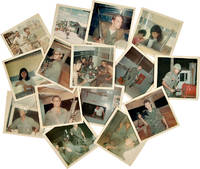
|
|
|
Texas: Civil War
AMNESTY OATH caption title
Galveston 1865. Partially-printed document 8 1/4 x 9 1/2 inches completed in manuscript. Three vertical folds. Minor toning foxing soiling and edge wear. Very good. A rare Civil War amnesty oath attested to and signed by James P. Nash in Galveston on July 8 1865. The partially-printed document is signed by him twice and also dated and signed by the Captain and Provost Marshal Harry Beard. The oath reads in full: <br> <br> "Amnesty Oath. I JAMES P. NASH do solemnly swear in the presence of Almighty God that I will hereafter faithfully defend the Constitution of the United States and the union of States there=under; and that I will in like manner abide by and support all laws and proclamations which have been made during the existing rebellion with reference to the Emancipation of Slavery; so help me God. JAMES P. NASH. Sworn and subscribed to before me this 8th day of JULY 1865 at Galveston Texas. H. BEARD Captain and Provost Marshal." The signer of the Amnesty Oath James P. Nash was likely the same James P. Nash who was an early educator and professor in Galveston. <br> <br> This 1865 amnesty oath appears to exist in two states: one blank below the line "1865 at Galveston Texas" and one with a dotted line added above the printed words "Captain and Provost Marshal." The present example is the former and likely first state of the document before the dotted line and "Captain and Provost Marshal" were added later. <br> <br> Amnesty oaths are scarce in the market; this one is especially interesting for its association with an early Galveston educator. unknown books
Bookseller reference : WRCAM55643
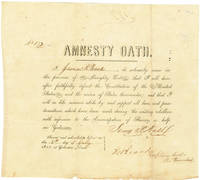
|
|
|
Civil War: Smith Aaron A.
COLLECTION OF ELEVEN CIVIL WAR LETTERS FROM PVT. AARON A. SMITH TO ADDIE D. JONES DESCRIBING HIS TRAINING IN NEW ENGLAND HIS TIME AT SHIP ISLAND AND THE EARLY DAYS OF THE UNION OCCUPATION OF LOUISIANA
Manchester N.H. Boston Ma. Ship Island off the coast of Mississippi and locations in Louisiana as detailed below 1862. Eleven autograph letters signed ten with envelopes totaling 36pp. Later transcriptions accompany the letters. Old folds occasional light staining and/or tanning one letter with small tears repaired with archival tape. In very good condition. A small but rich collection of early Civil War letters written by Private Aaron A. Smith of Wilton New Hampshire to his sweetheart Adaline "Addie" D. Jones of West Wilton. The letters describe Smith's training at bases in New Hampshire and Massachusetts time spent at Ship Island off the Mississippi Coast and his service in Louisiana as part of the Union occupying force in the summer and fall of 1862. Smith eventually served as a musician with his company giving an interesting perspective on his brief Civil War service. The letters continue until Smith's death in Louisiana from typhoid fever just over a year into his service. Letters from the western theater of the Civil War especially at such an early point in Union advances are uncommon. <br> <br> Smith's letters are especially informative of the conditions at Ship Island describing the poor health conditions there and the Confederate prisoners and escaped slaves he encountered. He also gives valuable information on Louisiana and New Orleans just after the Union retook the region describing the ongoing resistance efforts of Confederate soldiers and civilians. Smith also transmits his love for his hometown sweetheart and his hopes that they will meet again. <br> <br> Aaron Smith 1837-1862 enlisted on October 28 1861 and mustered into Company "B" of the 8th New Hampshire Volunteer Infantry under Col. Hawkes Fearing Jr. The 8th left Camp Currier Manchester N.H. on January 24 1862 en route for Fort Independence in Boston where they trained and drilled until transport south was available. They departed Boston for Ship Island Mississippi on February 15 aboard the E. WILDER FARLEY and finally arrived on March 15. Smith served the entirety of his comparatively brief enlistment in the Department of the Gulf as part of Gen. Benjamin Butler's Expedition. In his letters Smith details his transport to Ship Island and the conditions there and then gives descriptions of New Orleans. Smith remained at Camp Parapet just upriver from New Orleans through September before joining Gen. Godfrey Weitzel's brigade and participating in the Battle at Georgia Landing Labadieville an engagement he describes briefly in his final letter of December 10. Aaron Smith then fell seriously ill and succumbed to typhoid fever on December 22 1862 according to the REGISTERS OF DEATHS OF VOLUNTEERS. The letters are described individually below: <br> <br> Camp Currier: January 22 1862. 2pp. With envelope. Smith writes just days before he leaves for Boston. His tone is light and focuses on the personalities in his and Addie's choir in Wilton. In fact Smith writes that he's just received her letter as "Sargent sic Marshall Abiel Livermore and myself were spending the evening in singing." Smith also asks about which regiment a friend of theirs has joined in hopes that he can locate him later. <br> <br> Fort Independence: February 10 1862. 2pp. Smith is now in Boston waiting to for the ship south and his thoughts have turned more serious. He writes that he hopes his and Addie's feelings for each other will not dim since "when we shall meet again I cannot tell as separations must occur on Earth I must reconcile myself to it." He then veers into a religious vein: "The hand of God can protect us from all harm and guide us safe through many dangers I wish I had more faith in Him and more love for Him. Addie it is my deep desire and has often been my prayer that you may seek and find if not the love of God and I hope live a more consistent christian life than I have." Nevertheless no one seems to know or will tell where they are headed: "where we shall go to I think that no officer under Gen. Butler knows those that put confidence in reports believe we shall go to Ship Isl. but I do not put so much confidence in them as I did by doing so have been obliged to contradict a part of some of my letters." Smith mentions the wreck of a troop ship and marvels that more lives were not lost. Towards the end of the letter perhaps to lighten the tone upon closing Smith seems to allude to a joke between him and Addie and his mother that he was married before he was not: "I am some forgetful perhaps I never was married if I have been and you should see her his mother tell her to be of good cheer.I must close now. I send a kiss for you.As we all are past furloughs I think I shall not try to go home again to see my wife." <br> <br> On Board E. WILDER FARLEY: February 16 1862. 2pp. With envelope. This is a brief letter letting Addie know that they are almost underway to Ship Island: "We are in the greatest state of confusion possible. I am now down on the second deck trying to write a few letters or what I shall have to pass as such. There are scarcely five rays of light that can get to my paper can find a better place in our cellar or in the barn than this to write in." Still Smith is optimistic about this war: "I hope and expect not to stop more than a year as the prospects are that the war will not last long and if spared think will be back within that time." <br> <br> Ship Island: April 22 1862. 4pp. With envelope and three small seashells. Smith has arrived at Ship Island and paints a vivid picture of the pestilent sand the soldiers in camp and the various inhabitants including Confederate prisoners of war: "Our Sothern sic prisoners run about at their leisure appear to enjoy themselves very well.the ladies frequently take their work and sit out on the shady side of a building and talk with the men. Some appear to be quite friendly to the union a lady told a man in our squad.that there are one half in N. Orleans that are union people if they dare to be." But then he heard from a girl who "said she wished she could put out the eyes of the northerners with those guns with bayonets she thought the northerners were not any better than the n__s." Nevertheless illness is already a problem: "Two have died in our Reg. since we have been here it is considerable sickly.last Friday I raised some blood from my stomach but the next day I went on duty feeling as well as usual." Smith attributes this to the sand in the food but Ship Island proved to be a very unhealthy place. By the end of the war 153 Confederate prisoners and 232 Union soldiers had died due to contaminated water and related fevers and infections. Smith closes the letter somberly: "I hope and trust we shall be spared to meet again.I think I realise the danger before me hope I shall be prepar sic to meet it." <br> <br> Ship Island: May 8 1862. 4pp. With envelope. "We are here still on this desert." Things are no better on Ship Island. Smith includes some brief accounts of the Union battles in Mobile and Baton Rouge and continues his descriptions of the heat and the sand. The heat has gotten worse: "It is not very healthy from nine to three o'clock.A great many are having very bad eyes caused by the white sand reflecting to the sun's rays.Some have lost their sight and been discharged." He insists his health is fine but notes that he avoids going outdoors whenever possible. Smith also records some fascinating interactions with escaped slaves. He reports that they "frequently come over here and are quite tickled to get here. I heard one say that their masters represent us to be very cruel and tell them we will cut off an arm starve and whip them if we get them.This one said if they should get him they would hang him for the negroes were planning an insurrection and he was at the head. He said he could not get much to eat and the soldiers do not have much either his master he said was in the army and hoped we will kill him." He closes morosely with a count of the graves in the cemetery 79 as of writing ".brothers husbands sons and fathers killed and buried in such hast sic that no one can tell where they lay this is the result of war and still for one side it is just." <br> <br> Camp Parapet: May 24 1862. 4pp. With envelope. Smith is finally on the move detailing his departure from Ship Island as part of the Union occupation of New Orleans. He notes the defenses in particular the "parapet" built up by the Confederates who anticipated the Union invading from the north rather than coming up river from Fort Jackson. He also describes the efforts of locals to destroy military equipment and foodstuffs that would be of value to Yankee invaders. They even attempt to befoul the waterways by dumping sugar and molasses into the river. Smith writes "When they heard we had taken Ft Jackson and only a few gun boats had got up to N. Orleans the soldiers at this place ran in every direction some even over the parapet into the ditch of water some took off their equipments and burnt them then put on citizens clothes to prevent them being caught with soldiers uniform on.The carriages of the guns were burnt by the women the guns spiked the equipments and every thing that the soldiers left that would fall into our hands were burnt and all done by the women." Smith also includes observations on the poverty he has seen: "The destitution of the people white and black in this state and Miss. is not a fable but a reality there are not but a very few that had money enough to live comfortable.I hardly know where to stop there is so much to write about." Smith closes with some notes for his mother and chaste love for Addie. <br> <br> Camp Parapet: July 9 1862. 4pp. With envelope. This letter is less focused on combat and troop movements and is more conversational with casual thoughts about the civilian world and life in camp. Smith writes that the "4th of July was so rainy here that the Reg.'s could not appear in parade at noon and night while the 'Star Spangled Banner' and 'Hail Columbia' was to be played." in which Smith had prepared to perform. Smith is a Musician now so he has been spared the discomfort of guard duty during the heat and the rain though not the boredom of inaction in camp. He reassures Addie about his health reiterating "The blood I spit on the Isl. was caused by the sand that I had eaten and drank. It came from my stomach and was only what I spit out in three or four times. I guess my lungs are well enough now as I have got over the horid colds I caught." Smith mentions election day but does not mention much about politics focusing instead on Addie's "election cake" and how much of it he would eat if he was there. The main problem for Smith in this letter is the numerous untrustworthy peddlers selling junk at exorbitant rates and giving phony currency in change. Perhaps inspired by these experiences Smith also has some strong language about the locals: "The people here are a mixed set from most every nation in the world but those called Creoles are the most numerous ignorant and degraded.The people have not much good principals sic are much inferior to the Northerners in interlectual sic cultivation." <br> <br> Camp Parapet: August 5 1862. 4pp. Folded with envelope. Curiously Smith wrote this letter on stationery featuring an engraved view of the port of New Orleans produced by Louis Schwarz New Orleans publisher and bookseller. Prussian-born Schwarz 1819- 1893 emigrated to New Orleans and by the 1850s had a monopoly on German-language literature. By the time of Smith's letter Schwarz had helped form the mostly-German Hansa Guards Battalion which was absorbed into the 4th Regiment European Brigade of the Louisiana Militia detailed to defend New Orleans. Schwarz was made captain of Co. "B." Upon the Union victory Gen. Butler used the European Brigade briefly as a police force but then dissolved them in May 1862. For some reason in this letter Smith addresses Addie as "Addia" both in the letter and on the envelope. He begins with pleasantries about home but then shifts to discussing the draft apparently in response to Addie: "I do not care if they do have to draft I hope they will and not be so long getting the Reg.'s ready waiting for them to enlist." He continues putting a brave face on things: "I presume there are many young men now in N. Hamp. with long faces fearing they may be drafted. I should like to see them and I guess I would plague them I would laugh at them any way. The worst part is thinking about it soldiers will feel quite at home when they have been in the army six months or a year Smith has been in about ten months. Some get homesick and it wears and worries them most to death some pine away and get discharged on that account but there are not many such." Smith also reports that there have been Confederate guerrilla attacks and that they have located weapons concealed in houses in Carrollton. Units were dispatched from his regiment to assist in securing the area. Once again his role as a Musician proves to be an advantage: ".if I was not a fifer probably I should had to have gone." <br> <br> Camp Parapet: August 15 1862. 2pp. With envelope. This letter is chiefly camp news with Smith in apparently good spirits. Things are quiet however: "We soldiers are getting to be quite lazy. Particularly I am as I am a musician they cannot detail me to do work which is called policing. I have no guard duty to do so I am not up nights and exposed to the rain and heat daytimes. The musicians have to do what the major says but he very seldom has any thing for us to do out of the regular course of duty." Aside from some rambunctious officers the rest of Smith's update is quite peaceful as he and his comrades spend their days catching up on letters to friends and families baking beans and hoping for more music to sing. <br> <br> Camp Parapet: September 8 1862. 4pp. With envelope. Another quiet letter although there are rumblings of potential combat. Even so Smith muses about Addie traveling down to visit him although he's not quite sure how that could be arranged. He returns to the topic of the draft and how those avoiding the draft make it sound worse than it is: "I think folks are apt to be more scart sic than hurt. But this war is an awful occurrence. I sincerely hope it will soon end in order to have it we must have the men. Sisters must be willing to part with their brothers fathers and mothers with their sons and none try to restrain those whose duty it is to go." Smith closes with several unsettling items including news that "there are quite a large force of guerrillas very near us on the south side of the river.A few Regs. have been sent after them. I do not think we shall stop here all winter but by three or four weeks we shall be on the march after the rebels. The government have neglected to furnish the musicians with swords as the 'Army Regulations' require so I bought me a revolver to protect myself by." <br> <br> Thibodaux Camp Stevens La.: December 10 1862. 4pp. With envelope. Smith wrote this letter approximately ten days before he died. He begins by apologizing profusely for the substantial delay since his last letter; it had been over two months. Smith's regiment has relocated to Thibodaux about 70 miles from New Orleans after fighting in the Battle at Georgia Landing. Smith is definitely sick at this point: "The march was very hard for me and camping out I caught a very bad cold. At the time of the battle I was most sick but the excitement kept me along very well." Smith describes how he assisted in the hospital all night attending to Union as well as Confederate soldiers. He is less sanguine about combat now that he has seen it: "War is awful if anyone don't think so let them be in a battle and try it to have shells exploding about you and grape and canister shot and bullets whistleing about your head makes any one feel most indescribable." <br> <br> From Smith's account he seems to have contracted several of the numerous diseases that plagued soldiers on both sides. In fact two out of three deaths during the Civil War were caused by disease. Every soldier had dysentery at some point and many suffered from one or more of any number of other ailments. He writes "I have the fever and ague some so do most all." "Ague" was malaria and afflicted about 20 percent of troops. Smith would have first developed a high fever along with the "shakes" followed by debilitating weakness that would leave him bedridden for days or even weeks. The symptoms would gradually subside and he could return to duty but the fever periodically returned and the process was repeated. Smith writes that he was sick again during their stop in Tigersville and then notes that "There is a good deal of shaking among the soldiers the shakes this season I have been told by the people are very bad among all." He closes the letter hoping "I can write often now.I have several letters to answer perhaps they will think I am very sick or dead. Changes take place in the army so any one cannot be always prompt in writing." A final page of text in a different hand Addie's is added after Smith's letter. The ink is faint and the hand is difficult to read but it is dated December 27 from West Wilton N.H. and starts by explaining that Smith's mother had been by to see how his health was suggesting that his friends and family did not know yet that he had died. <br> <br> A detailed and intimate account from a soldier in the early days of the Civil War with significant content on life at Ship Island and the early days of the Union occupation of Louisiana. Andrea Mehrländer THE GERMANS OF CHARLESTON RICHMOND AND NEW ORLEANS DURING THE CIVIL WAR PERIOD 1850-1870 Berlin/New York: Walter de Gruyter 2011. REGISTERS OF DEATHS OF VOLUNTEERS 1861-1865. RECORDS OF THE ADJUTANT GENERAL'S OFFICE 1780-1917. Record Group 94. ARC ID: 656639. National Archives. Washington D.C. hardcover books
Bookseller reference : WRCAM55290
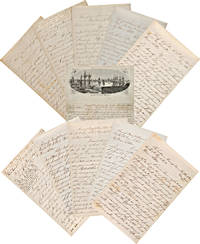
|
|
|
Civil War: Maine
GUARD BOOK CO. D. 12th MAINE REGIMENT INFANTRY VOLUNTEERS U.S.A. 1862 G.E. ANDREWS 1st SERGT. manuscript title
Various locations mostly Louisiana 1862. 120pp. Contemporary sheep later leatherette backstrip title stamped in dark brown on front board reading "GUARD BOOK D. CO. 12TH. REG. MAINE." Some edge wear mild chipping and light scuffing to boards. Front hinge detached spine cracked. Occasional thumb-soiling to text. Still very good. A manuscript record book documenting an entire year of guard duty worked by various members of Company D 12th Maine Infantry Regiment Volunteers during the early part of the Civil War. The majority of time recorded in this book emanates from Louisiana while the 12th Maine Regiment was attached to Butler's Expeditionary Corps from January to March 1862. On their way to Louisiana the regiment travelled on the Steamship Constitution to Ship Island Mississippi serving there until May 4 1862. The Regiment then traveled to New Orleans for guard duty at the U.S. Mint until October 1862. While in New Orleans the Regiment took part in the expedition to Pass Manchaca from June 16 to 20 and the expedition to Ponchatoula from September 13 to 18. In October the Regiment moved slightly north to Camp Parapet in Shrewsbury Louisiana and served there until November 19 1862; the record book ends here. <br> <br> Each two-page opening of the ledger is pre- printed with a large column on the left for names and thirty-one numbered smaller columns for marking days served on guard duty. Most days have just one or two tick marks for any particular soldier indicating just one or two men were on active patrol mostly privates but also sergeants corporals musicians wagoners and others. The number of guard shifts worked by the regiment increased dramatically in May 1862 when they arrived at the U.S. Mint in New Orleans before falling off again the next month presumably after some relief arrived. In addition to guard duty service notations indicate reasons for absences such as "died at" "sick" "in confinement" "permanent detail" "enlisted for cook" "light duty" "in the woods" and "hospital." Notations from February 1862 indicate that James H. Andrews died onboard the Constitution on February 14 and two other soldiers caught sickness at Fortress Monroe. Another entry shows that S.G. Tracy "Died at Ship Island 12 of April 1862." Later in July Capt. H.W. Dunn is detailed for daily duty at the "Reding Press" in New Orleans. In August G.F. Drown is "Detailed as Nurse in General Hospital St. James Hotel N.O." <br> <br> Material from the Trans-Mississippi West is rare this early in the Civil War and also usually not as thorough as the present record book documents an entire year of service. A unique record of Civil War service for a peripatetic Maine volunteer infantry regiment serving in the Bayou State. hardcover books
Bookseller reference : WRCAM55597
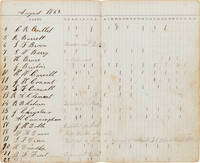
|
|
|
WORLD WAR II BELGIUM PRISONERS OF WAR AMICALE DES POSTIERS PRISONNIERS POLITIQUES RESCAPES
Broadside Diploma Front Unique de Belgique / 1914-18 1940-45 / Diplôme d'Honneur / Section: Prisonniers Politiques.
Breendonk: Amicale des Postiers Prisonniers Politiques Rescapés 1945. Original broadside pictorial diploma 24.5x32cm. printed lithograph on cream stock in red gilt and black accomplished in manuscript and rubberstamp. Minor foxing else a fresh Fine example. Exceedingly uncommon diploma awarded to a survivor of the Nazi prison camp at Fort Breendonk outside Antwerp. The camp generally held political prisoners members of the Resistance and Jews who were almost all subsequently dispersed to the larger concentration camp across Eastern Europe. More than 3000 prisoners passed through Breendonk of whom approximately ten percent died or were executed within its walls while half perished following deportation to other camps. The present certificate awarded to a member of the French resistance a mechanic outside Saumur in the Maine-et-Loire department of Western France his arrest part of a massive purge following the assassination of a Dr. Ritter representative of Gauleiter Sauckel in France see Colonel Remy "La Résistance en Anjou Touraine et Orléanais" 1975 Vol. 1 p. 103. The entire town of Saumur was later awarded the Croix de Guerre for its role in the resistance. <br/><br/>Certificate margins adorned with poignant vignettes of camp life men in striped uniforms awaiting execution working in the mines or caught in barbed wire fence. In the case of Huberdeau his first name here spelled "Villiam" he was awarded this diploma for "sa déportation dans le bagnes nazis" "his deportation to the nazi camps". Though no mention is explicitly made to Breendonk it appears that the award was given to survivors of that camp specifically. We find no other examples in the trade auction records of separately catalogued in OCLC as of February 2020. Amicale des Postiers Prisonniers Politiques Rescapés] unknown books
Bookseller reference : 47585

|
|
|
Civil War: Harrison Samuel Rev.
ALBUMEN PHOTOGRAPH OF REV. SAMUEL HARRISON CHAPLAIN OF THE FAMED 54th MASSACHUSETTS COLORED INFANTRY
N.p. likely Boston 1865. Albumen photograph 8 3/4 x 5 3/4 inches mounted on card. Moderate fading a bit of spotting in the image. Verso darkened from exposure to wooden backing now removed from backing and period frame backing tape still attached to verso along top edge. Remnants from previous mat at top edge. Good and a worthy candidate for professional conservation. An apparently unrecorded image of Rev. Samuel Harrison a former slave and fierce abolitionist who served as Chaplain of the 54th Regiment Massachusetts Volunteer Infantry the famous Civil War regiment of U.S. Colored Troops. Colonel Robert Gould Shaw led the 54th Mass. Regiment the second unit of colored troops formed by the Union Army but ultimately the most famous all-black infantry unit to fight in the Civil War as seen in the film GLORY. After Shaw was killed at the Battle of Fort Wagner Massachusetts Governor John A. Andrew recommended that Rev. Samuel Harrison serve as Chaplain to help the unit's morale. Harrison accepted and was also instrumental in getting equal pay for black soldiers. Harrison's demand that he receive the same pay as white chaplains led Gov. Andrew and United States Attorney General Edward Bates to write letters to President Lincoln to end the discriminatory practice of unequal pay among white and black soldiers in the Union army. In June 1864 legislation requiring equal pay for black units retroactive to January 1864 was passed in the Army appropriations bill. <br> <br> Images of Rev. Samuel Harrison are rare and online exemplars seem to vary widely. The present example appears to be a much younger version of Rev. Harrison compared to the image of him at age eighty-one held by the Samuel Harrison House. Here he also appears to be wearing a chaplain's uniform indicating this is a wartime or near-wartime image of him. The verso of the photograph has a penciled note reading: "Rev Samuel Harrison 54th Mass." unknown books
Bookseller reference : WRCAM55438
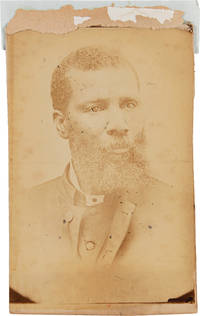
|
|
|
Vietnam War: Thailand
VERNACULAR PHOTOGRAPH ALBUM DOCUMENTING AFRICAN-AMERICAN AIR FORCE SOLDIERS IN THAILAND DURING THE VIETNAM WAR
Various places in Thailand perhaps centering on Korat Royal Thai Air Force Base 1977. Seventy-seven Kodak color photographs almost all approximately 3 1/2 x 5 inches a handful slightly smaller and one postcard. Slim quarto. Contemporary glossy purple floral-patterned cloth photograph album gilt- stamped label on front cover. Some images slightly faded. Overall very good. A highly entertaining collection of vernacular photographs capturing the lives of young African-American G.I.s and their romantic interests in a village in Thailand during the latter years of the Vietnam War. The photographs show African-American men in both uniforms and street clothes often posed alone or with Thai locals almost exclusively women. The men are seen at work and play including an image of the gun shop with a sign labeled "Phase Section" on the front and a large military van with a similar sign reading "2 Orange." There is also a great deal of coverage of the locals living in the village including women and children. One photograph of particular interest shows part of a commercial building emblazoned with both a Coca-Cola and a Pepsi sign. The date range of 1972 to 1977 stems from the fact that some of the photographs are date-stamped in the margin "Oct 72" and one later image is stamped July 1977; most images seem to emanate from the earlier date. The single postcard is an image of Wang Not Ten Waterfall in Phitsanulok in north-central Thailand. The album could possibly have been retained by a local Thai person documenting their interactions with the visiting Americans. <br> <br> There were a half dozen active American Air Force bases in Thailand during the 1970s from which over 80% of the air strikes of North Vietnam originated. The American servicemen seen in the present photographs were either airmen performing these strikes or ground crew in support of the pilots. Also given that Korat Royal Thai Air Force Base and Phitsanulok are both in north-central Thailand it is likely the images depict this area. <br> <br> A rare look at African-American servicemen in a strategically important region of Thailand during the Vietnam War. hardcover books
Bookseller reference : WRCAM55443
|
|
|
Civil War: Smart Edwin
REBEL RAID IN SOUTHEAST MISSOURI. ATTACK UPON PATTERSON. FIGHT BETWEEN 1500 OF THE ENEMY AND 400 FEDERALS. THE LATTER FALL BACK TO BIG CREEK. INTERESTING DISPATCH FROM PILOT KNOB. MAJOR McCONNELL REPORTED MORTALLY WOUNDED AND A PRISONER. THE INCURSION AT AN END caption title
N.p. but likely St. Louis 1863. Broadside 13 3/4 x 4 1/4 inches. Remnants of tape at top edge and ink mark in top margin. Slight tanning and spotting old folds. Very good. A rare Civil War broadside recounting Confederate General John S. Marmaduke's second raid into Missouri. It gives detailed news of battles between Union and Confederate troops in southeast Missouri an area that saw bloody battles between Unionists and Bushwhackers throughout the Civil War. <br> <br> Marmaduke aided by other Confederate units led by Joseph O. Shelby and Sterling Price and others attempted to lay claim to Missouri in 1861; they were unsuccessful but did not acknowledge defeat. Marmaduke planned his return for spring of 1863 confident that secessionist-minded Missourians would rally to his banner and he could make a decisive move on Jefferson City and even St. Louis. He needed the help: at the beginning of the raid Marmaduke had about 5000 troops of which 1200 were unarmed and 900 were unmounted and he hoped to resupply at Patterson and Bloomfield. He divided his forces and sent 2000 against Patterson the furthest south in a string of fortified outposts in southeastern Missouri. Marmaduke's troops had the element of surprise initially approaching Patterson and its small garrison of about 400 troops commanded by Col. Edwin Smart. Marmaduke's men captured Smart's pickets but revealed themselves soon after as over-eager artillery troops started firing before the infantry could get into place. Smart sent out a battalion under Major Wood to hold off the Confederates while he prepared his troops and supply trains for retreat. <br> <br> In the text of this broadside Smart reports that Wood "held them in check and skirmished them into town.Before I left the town I destroyed what stores I could not bring away. Nothing fell into the hands of the enemy." Marmaduke pursued them to Big Creek about eight miles west of Patterson and Smart writes that: "The engagement was severe in the extreme often fighting hand to hand. At Big Creek they got in my front and attempted to cut off my retreat but I forced my way and formed on this side of the Creek. The enemy did not renew the engagement." Smart lost about fifty troops including Major McConnell. Marmaduke failed to obtain any military stores at Patterson or during his subsequent raid at Bloomfield and no sympathetic Missourians joined his cause; the raid was a failure and confirmed that while Missouri was no Union stronghold neither was it interested in furthering the Confederate cause. <br> <br> This broadside bears no imprint and the place of printing is unknown but the tone of the text and the fact that the news arrived so quickly indicates that it might have been printed in St. Louis. No copies of this broadside are listed in OCLC. Such broadsides bearing news of the Civil War in the Trans-Mississippi West are rare and shine an important spotlight on an often- neglected aspect of Civil War history. unknown books
Bookseller reference : WRCAM55392
|
|
|
African American Photographica: World War II
604th ORDNANCE AMMO. CO. NUGOLA ITALY AUGUST 1945 wrapper title
N.p.: Edward D. Biggerstaff Jr. 1945. Seventeen sepia-toned photographs each with captioned tissue guard. Oblong 16mo. Original textured wrappers title printed in dark blue on front wrapper. Minor edge and corner wear front joint creased. Fore-edge of photographs a bit curled but clean. Very good. Pocket-sized photograph album commemorating the members of the 604th Ordnance Ammunition Company a unit of African-American soldiers who served as battle support in Italy during World War II. A small line of text on the rear wrapper reads: "Photographs by 1st Lt. E.D. Biggerstaff Jr." Edward D. Biggerstaff Jr. was the commanding officer of the 604th Ordnance Ammo. Company evidenced by his photograph in the album; he is also pictured with the other white company officers in a separate photograph. <br> <br> The album opens with a photograph of the entrance to the company's "Bivouac Area" and an image of the Villa Traxler in Nugola Italy which is captioned as "Occupied by 604th Ordnance Ammunition Company." Then following the images of Biggerstaff and the senior officers the album features a series of photographs depicting the African-American junior or non-commissioned officers and personnel beginning with First Sergeant Leroy Crosby. After Crosby's photograph the album includes group photographs of Crosby with his other five staff sergeants; the company headquarters personnel; the depot office personnel gathered around a small cannon; kitchen staff; the motor pool with a separate photograph of their vehicles; separate group pictures of the first second and third magazine platoons; the service and supply section; the guard mount; and a photograph of the remaining members of the company who did not appear in the other images. Especially useful in this album are the captioned tissue guards before each photograph which identify each soldier by name and rank. <br> <br> The album was likely made by or at the behest of commanding officer Edward D. Biggerstaff in an unknown quantity. It appears to be quite rare as we can locate no other copies in OCLC auction records or the trade. Edward D. Biggerstaff, Jr. unknown books
Bookseller reference : WRCAM55486
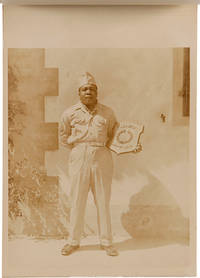
|
|
|
African Americana: World War II
HISTORY OF THE 43d SIGNAL HEAVY CONSTRUCTION BATTALION FROM ACTIVATION TO V-J DAY 7 FEBRUARY 1944 TO 2 SEPTEMBER 1954
Frankfurt am Main-Schwanheim: Printed by Franz Jos. Henrich 1945. 114pp. Profusely illustrated from photographs. Front board and titlepage printed in blue black and red. Quarto. Original printed paper boards tan cloth backstrip. Cloth chipped at foot of spine boards very lightly soiled. Very good. An extensive and profusely-illustrated regimental history of the 43rd Signal Heavy Construction Battalion an African-American unit that fought in Germany during the last two years of World War II. This history of the battalion was partially written and edited by African-American members of the unit serving as associate editors. It was printed in occupied Germany in November 1945 almost certainly in a small edition for distribution among members of the battalion - the concluding section of the volume has a section for "autographs." Included is a detailed timeline of the unit's activities from February 1944 to early October 1945 along with a technical history pictures of the all-white officer corps a detailed background of the 43rd and a short account of individual recognitions. The three most detailed sections of the work give in-depth accounts of the Headquarters section Company A and Company B respectively. These sections are also full of images of the soldiers in training and include roster lists. <br> <br> The 43rd Signal Heavy Construction Battalion was formed at Camp Crowder Missouri on February 7 1944. The battalion served in four separate campaigns in Europe: northern France the Rhineland Ardennes-Alsace and central Europe spending most of 1945 in Germany. The battalion was responsible for constructing communications support throughout Europe laying or hanging hundreds of miles of wire and cable during their time in the war. The battalion was inactivated on May 28 1946 while in Germany but was reactivated and redesignated for service in Vietnam in 1966. OCLC records just two copies at the New York Public Library and Southern Methodist University's DeGolyer Library. OCLC 67778375. Printed by Franz Jos. Henrich hardcover books
Bookseller reference : WRCAM55496
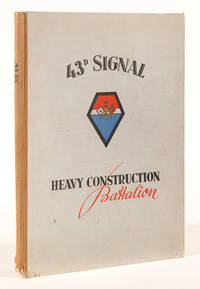
|
|
|
German Prisoners of War: World War II
GERMAN CAMP-NEWSPAPER PRISONER OF WAR CAMP CONCORDIA KANSAS cover title
Concordia Ks.: Camp Concordia 1945. Two volumes. Vol. 1: Nos. 34-35 1944 2. Jhrg. Nos. 1-3 6 8-13 1945; Vol. 2: Nos. 1-12 1945. Two-sided sheet laid into Vol. 1 with an essay on peace from Karl Teufel on one side and an anonymous reflection on the German occupation of Holland on the other. Folio. Original three-quarter green cloth and paper-covered boards manuscript title in green on cover of Vol. 1. Minor wear and spotting to covers tidelines to front cover of Vol. 1 stain to upper corner of Vol. 2 reaching corners of about half the pages no text affected. Trimming to lower margins with slight loss of text to a few pages. Tight binding partially obscures inner margin in a few issues. Many issues have purple ink stamp and initials of the camp censor; occasional manuscript annotations including translations. Front free endpaper of Vol. 2 is a dedication page: "To Captain Karl C. Teufel as Souvenir for the Time from June to September 1945 signed Dr. Georg Graf Kesselstatt Editor DER AUSBLICK." Occasional tanning. Very good overall. Collected issues of a German prisoner-of-war camp weekly newspaper which began as NEUE STACHELDRAHT NACHRICHTEN LAGER CONCORDIA NEW BARBED WIRE NEWS CAMP CONCORDIA. With issue number eight in the second year March 11 1945 the title changed to DEUTSCHE LAGERZEITUNG: ORGAN DER DEUTSCHEN LAGERFÜHRUNG CONCORDIA "GERMAN CAMP NEWSPAPER: ORGAN OF THE GERMAN CAMP COMMAND CONCORDIA" likely to align with titles of newspapers at other prisoner-of-war camps. After the war ended the title changed again to DER AUSBLICK: ZEITUNG DER DEUTSCHEN KRIEGSGEFANGENEN LAGER CONCORDIA THE OUTLOOK: NEWSPAPER OF GERMAN PRISONERS OF WAR. This collection contains some two dozen issues from the final years of World War II. <br> <br> The layout and printing of all versions of the newspaper is sophisticated. The title piece of NEUE STACHELDRAHT is hand-designed possibly a linocut featuring an image of a watch tower. The article text was initially produced on a typewriter but the rest of the paper's contents - illustrations maps titles and captions - are all hand-drawn and then reproduced along with the typed content via offset printing. The issues are inconsistently paginated and most articles are unsigned unless reproduced from external sources; translators are sometimes noted. The editorial staff is not mentioned in earlier issues although some articles are signed "Hrg." "Ed.". The issue for April 1 1945 is the first to name an editor "Schriftleitung: Oblt. Walberg". <br> <br> The U.S. agreed to construct P.O.W. camps initially to support the British who were running out of room for prisoners. The U.S. camps grew quickly; by the end of the war there were some 400000 German prisoners held in the U.S. Camp Concordia operated from 1943-1945 and primarily housed German Army prisoners captured in North Africa including Rommel's notorious "Afrika Korps." Concordia was the largest P.O.W. camp in Kansas averaging 4000 prisoners during its operation. The camp's aptly-named assistant executive officer and head of indoctrination Capt. Karl C. Teufel Teufel can mean "devil" in German described the prison population as follows: "For the most part they were members of the crack German Afrika Korps which had fought under Rommel and had nearly won the North African Campaign.No better German soldiers existed anywhere and these men came to this country still proud of their accomplishments still assured of the coming victory of National Socialism over the rest of the World still confident and arrogant in their own strength and fully prepared to make things as difficult for their custodians as safely possible. There were a thousand Officers among them ranging from second lieutenants to Colonels two of whom were later promoted to General rank and hence some of Hitler's best military brains were here also." Healthy enlisted prisoners were required to work mostly on neighboring farms. Non-commissioned officers could only work in supervisory positions and while officers could not be forced to work they could volunteer. All prisoners were paid for their work in scrip which could be spent in the camp canteen or used to buy newspapers like these books and magazines. <br> <br> The first issue in these volumes is the "Christmas Issue" No. 34 December 24 1944 which calls on the prisoners to rebuild their physical strength and mental toughness in order to continue the struggle against the Allies. It also reproduces an article from the Associated Press exaggerating the impact of the V-2 rocket attacks on England. Later articles criticize the Allied bombing of German cities for the loss of German civilian lives and historic buildings. Also included are updates about battles and German military advances. But then there are schedules for Christmas services for both Catholics and Lutherans Christmas hymns and stories announcements of concerts including Rossini and Tchaikovsky updates on camp sports mainly soccer and handball upcoming film screenings and a list of birthdays for the week. Nevertheless keeping the peace in the camps was challenging. One of Capt. Teufel's main jobs at Concordia was weeding out the hardcore Nazis from the merely patriotic soldiers and then relocating them to Camp Alva in Oklahoma a maximum security facility specifically for uncompromising Nazis. This not only served to maintain peace in the camps for the American guards but also kept average German soldiers safe from more extreme soldiers. <br> <br> The newspaper content was inspected and censored before publication. Blatantly pro- Nazi messages were prohibited though oblique references slip in but patriotic sentiment is allowed. Subsequent issues have similar recurring content as in the Christmas issue especially pro-German material such as uplifting passages to stay strong in the "Kampf" and slanted articles highlighting German successes in contrast to Allied laziness and incompetence. For instance in a recurring section "Kultur und Leben" Culture and Life in the issue from January 14 1945 there are several articles on Heinrich von Kleist 1777-1811 a Romantic poet who had been appropriated by the Nazis for his nationalistic leanings. Included is a passage from Kleist: "Was gilt es in diesem Kriege.Eine Gemeinschaft gilt es deren Wurzeln tausendästig einer Eiche gleich in den Boden der Zeit eingreifen; eine Gemeinschaft.in deren Schoss die Götter das Urbild der Menschheit reiner als in irgendeiner aufbewahrt hatten." What is important in this war.It is a community whose roots branch into the soil of time like an oak; a community.in whose lap the gods had kept the archetype of humanity more pure than in any other. The article concludes: "Uns hat dieser Krieg reif und hart gemacht auch für ein letztes Begreifen jener Kleistschen Welt." This war has made us ripe and ready for a final realization of that Kleistian world. <br> <br> There are regular updates from the Pacific front but also a wide variety of general interest articles and stories including: oilfields in the Middle East and the evolving "concession areas" in Saudi Arabia Iran Iraq et al.; German history; the Chinese Civil War; Japanese culture; astronomy historical and contemporary; U.S. politics and history along with feature articles on various states; economics and biographies of important industrialists; health concerns; and reviews of local beers. There are also lists of new books purchased or donated to the camp library on topics from German history to agricultural engineering to quite surprisingly Aaron Copland's WHAT TO LISTEN FOR IN MUSIC in English; and crossword puzzles and other games. <br> <br> The April 15 1945 issue is the first to acknowledge that the Nazis may not in fact be winning the war after all. The cover features the first stanza "Daimon" of Goethe's ominous poem "Urworte Orphisch" Orphic Primal Words: "Wie an dem Tag der Dich der Welt verliehen/Die Sonne stand zum Grusse der Planeten/Bist alsobald und fort und fort gediehen/Nach dem Gesetz wonach Du angetreten./So musst Du sein Dir kannst Du nicht entfliehen/So sagten schon Sibyllen so Propheten;/Und keine Zeit und keine Macht zerstückelt/Geprägte Form die lebend sich entwickelt." As on the day you were granted to the world/The sun stood to greet the planets/You likewise began to thrive forth and forth/Following the law that governed your accession./You must be so you cannot flee yourself/Thus sibyls long ago pronounced thus prophets/And neither time nor any power can dismember/Characteristic form living self-developing. There is no editorial acknowledgement of Germany's occupation but there are several translated excerpts from TIME magazine noting Gen. Lucius Clay's appointment as "der Spitze der Zivilverwaltung" "Head of Civil Administration" for occupied Germany. <br> <br> The final iteration of the camp newspaper DER AUSBLICK: ZEITUNG DER DEUTSCHEN KRIEGSGEFANGENEN LAGER CONCORDIA inlcudes a monthly insert on current affairs entitled QUERSCHNITT CROSS-SECTION along with a less regular insert on arts and culture entitled SYMPOSION SYMPOSIUM. A brief editorial introduction to the new newspaper sets forth a stark assessment of the prisoners' situation: "Wir beurteilen unsere Lage nüchtern und haben nur ein Ziel: alle Kraft so rasch wie möglich unserem deutschen Vaterland zur Verfügung stellen zu können. Wenige in der Heimat werden den kommenden Aufgaben körperlich und geistig so gut gewachsen sein wie wir. Est ist unsere Pflicht unsere Leistungsfähigkeit immer weiter zu steigern.Möge sie dazu beitragen unsere Lagergemeinschaft sachlich und klar zu unterrichten und zum Nachdenken anzuregen." We assess our situation soberly and have only one goal: to be able to provide all our strength as quickly as possible to our German Fatherland. Few at home will be as physically and mentally up to the tasks ahead as we are. Thus it is our duty to keep enhancing our abilities.This paper will help keep our camp community objectively informed and will stimulate thought. The introduction goes on to note that they really do intend to provide objective information without aligning to any particular party. After all: "Denn jeder von uns ganz gleich wie er zur Vergangenheit eingestellt sein mag muss in voller Klarheit erkennen dass das System des Nationalsozialismus mit seiner Staatsform nicht mehr besteht." Because each of us no matter how he feels about the past must recognize with complete clarity that the system of National Socialism no longer exists as a form of government. Not much has changed with the paper otherwise all features about camp life etc. are still included. The QUERSCHNITT features reprinted and translated articles from major publications NEW YORK TIMES MAGAZINE BUSINESS WEEK TIME FOREIGN AFFAIRS et al. but there is very little editorial comment. <br> <br> Interestingly in the June 17 1945 issue of DER AUSBLICK there is a full page letter from the Senior German Spokesman Col. Eduard Waltenberger: "Ich bin überzeugt im Sinne des Lagers zu sprechen wenn ich folgendes festelle: Die durch den vorgeführten Film und die uns vorgelegte amtliche Broschüre belegten Grausamkeiten und Massenmorde in den Konzentrationslagern erfüllen uns mit tiefstem Abscheu gegen jeden der in irgend einer Form schuldhaft an ihnen beteiligt war. Wir sind der Auffassung dass die Täter und ihre Auftraggeber den deutschen Namen auf das schändlichste befleckt und sich für immer aus der Gemeinschaft aller ehrenhaften Deutschen ausgeschlossen haben. Wir deutschen Soldaten des Kriegsgefangenenlagers Concordia haben offen und anständig unter Einsatz des eigenen Lebens für unsere Heimat gekämpft. Weder wir an der Front noch unsere Angehörigen haben gewusst dass gleichzeitig in den deutschen Konzentrationslagern ein Verbrechertum der niedrigsten Art am Werk war. Wir halten es für ein Gebot unserer Soldatenehre zu erklären dass wir mit ihm nichts gemein haben." I am convinced that I speak for the whole camp when I set forth the following: The atrocities and mass murders in the concentration camps documented by the film shown and the official brochure presented to us fill us with the deepest disgust towards anyone who was guilty of them in any form. We are of the opinion that the perpetrators and their associates have stained the German name in the most shameful way and have forever excluded themselves from the community of all honorable Germans. We German soldiers from the Concordia Prisoner of War Camp risked our own lives fighting honorably for our homeland. Neither we on the front line nor our relatives knew that at the same time there was a crime of the lowest kind going on in the German concentration camps. We think it is imperative to our soldier's honor to declare that we have nothing in common with them." There is no mention of Jews however there is an article on mass movements and mass psychosis later in the issue. <br> <br> One month later in the July 15 1945 issue there is a brief article in German and English from Capt. Teufel. Attempting to calm prisoners' anxiety about repatriation timelines Teufel explains that he simply does not know what the repatriation procedure will be: ".it is my opinion that repatriation may not come for many months. This is only a personal opinion and not to be construed as an official statement. The fact that some men are being transferred out of this camp is not proof that they are being repatriated immediately. The fact that you have not been transferred out is equally not an indication that you will be repatriated later than those who have been transferred nor that there is necessarily a prejudice against you." Of course while the war was over in Europe at this point the war in the Pacific continued. The August 5 1945 issue included extended treatment of the Potsdam Conference and Declaration and then the August 12 1945 issue begins with the article "Am Ende des 2. Weltkrieges." At the End of the Second World War. A few pages later there is a brief article inset titled "Heimkehr der PoW" Homecoming of the P.O.W. which begins: "Am letzten Donnerstag gab Unterstaatssekretär im Kriegsministerium Patterson in Washington bekannt die Amerikaner beabsichtigen 400000 deutsche und italienische Kriegsgefangene so bald als praktisch möglich - aus den Vereinigten Staaten nach Europa zurückzuführen." Under- Secretary of State Patterson at the Department of War announced in Washington last Thursday that the Americans intend to return 400000 German and Italian prisoners of war from the United States to Europe as soon as it is practical. <br> <br> The postwar articles tend to focus on rebuilding in Germany and speculation on when the prisoners will finally return but most continue the regular content of reproduced news articles and so forth. However some policy developments have immediate repercussions in the camp. As is usually the case in POW camps the Nazi soldiers continued to wear their uniforms during their detention with American uniform manufacturers providing replacements as time went on. In the August 30 1945 issue there is a brief inset article announcing updates to the uniform regulations: "Durch Verordnung der letzten noch zu Recht bestehenden Deutschen Regierung unter Gross- admiral Dönitz wurde die Einheit von Partei und Staat sowie von Partei und Wehrmacht aufgelöst. Da das mit dem Hakenkreuz versehene Hoheitsabzeichen auf den Uniformstücken kein militärisches Abzeichen sondern das Symbol der Einheit Partei- Wehrmacht darstellt entspricht das Tragen dieses Abzeichens zumindest aber des daran befindlichen Hakenkreuzes weder der entsprechenden Verordnung der letzten Deutchsen Regierung noch den inzwischen eingetretenen Verhältnissen." By decree of the final legitimate German government under Grand Admiral Dönitz the unity of party and state as well as the unity of the party and the armed forces has been dissolved. Since the sovereign swastika is not a military symbol but the symbol of the Wehrmacht Nazi armed forces party unit wearing uniform devices with the swastika on it does not correspond to the decree of the last German government or the current conditions. In the same issue is the announcement that the U.S. government will start returning German P.O.W.s to assist with reconstruction as soon and as quickly as is feasible. However no timeliness are provided. <br> <br> The final issue in this collection as possibly the last one produced is that of September 9 1945. On the first page is an announcement from the editor: "Mit dem Grossteil unserer Kameraden haben von vierzehn ständigen Mitarbeitern des "Ausblick" elf in dieser Woche Concordia verlassen. Die heutige Ausgabe kann daher nur in gekürzter Form gebracht werden." Along with the majority of our comrades eleven out of the fourteen permanent employees of AUSBLICK left Concordia this week. Today's edition can therefore only be published in abbreviated form. Indeed the issue is less than half the size of previous issues. The sole article on the first page is titled "Courage" which means the same in German and English and includes encouraging words about rebuilding a broken Germany. The rest of the issue includes similar articles and updates but with much less flourish as one would expect with a diminished staff. Nevertheless there's one more soccer game announced before all the prisoners departed in October and the camp finally closed in November. <br> <br> This newspaper is rare with most institutional holdings being incomplete and then often only in microfilm. The Deutsche Nationalbibliothek holds almost the same physical copies as found here starting with No. 34 suggesting there may have been additional similar collections assembled. We were unable to identify any complete physical collections with the possible exception of the Kansas Digital Newspapers program at the Kansas Historical Society. OCLC 15160000 84823569 Deutsche Nationalbibliothek 15155315 15155342. Karl C. Teufel "The History of Camp Concordia from Site Survey to Deactivation." Record Group 389 Box 1612 Washington D.C.: National Archives 1945. Mark P. Schock "Bloodied Kansas: Nazi Retribution in a Kansas POW Camp" in FAIRMOUNT FOLIO JOURNAL OF HISTORY Vol. 7 2005: pp.45-56. Kirk Wetters DEMONIC HISTORY: FROM GOETHE TO THE PRESENT Evanston Il.: Northwestern University Press 2014. [Camp Concordia] hardcover books
Bookseller reference : WRCAM55330
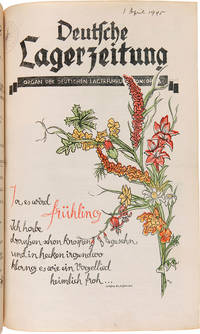
|
|
|
Madison James: War of 1812
THE PRESIDENT OF THE UNITED STATES OF AMERICA TO ALL WHO SHALL SEE THESE PRESENTS GREETING.
Washington D.C. 1813. 1p. partially-printed document completed in manuscript. Paper seal of the United States affixed to upper left corner. Old folds. Light tanning mild surface wear a few ink blotches one small area of ink burn not affecting text. Overall very good. Matted framed and glazed. A War of 1812-era presidential appointment signed in ink by President James Madison and by Secretary of War John Armstrong. Here Madison appoints Maryland attorney James Sewall Morsell to the position of Judge Advocate of the Militia of the District of Columbia. In addition Morsell has fully endorsed and docketed the document on the verso pledging to "carefully & diligently perform the duties of a Judge Advocate.to the best of my Skill & Judgement and that I will support the Constitution of the United States." Morsell would serve as a Judge Advocate for almost two years. From January 15 1815 until March 3 1863 he would serve as a circuit court judge in the District of Columbia. Earlier in his career and during his years in private practice Morsell represented numerous African-American families who petitioned for freedom in the nation's capital. Judge Morsell passed away in Maryland in 1870. unknown books
Bookseller reference : WRCAM54812
|
|
|
World War I Photographica
13th PROVISIONAL COMPANY U.S. ARMY AIR SERVICE
Long Island N.Y.: Pictorial News Co. 1918. Panoramic photograph 11 x 39 3/4 inches with title caption publisher and "No. 233" written in negative in lower part of the image. With two-page "Duty Roster" in envelope on verso. Framed. Wear to frame minor water damage to left margin of photo slight creases along upper margin small scrape to center-right of photo. "Duty Roster" worn and chipped along several edges and with a few small holes from previous hanging. Overall very good. A panoramic photo of the 13th Provisional Company U.S. Army Air Service a specialized training unit for aircraft mechanics. The photo features 112 soldiers in three rows note the propeller insignia visible on several of the soldiers' sleeves designating them as aviation mechanics. Four officers in campaign hats sit in the middle of the front row. The accompanying typed "Duty Roster" divides soldiers by "Sergeants" "Cooks" and "Privates" with tent and cot numbers added in manuscript. The officers are not included on the roster. <br> <br> The Air Service started as the Air Service of the American Expeditionary Force in 1917 and then on May 24 1918 merged with the Aviation Section Signal Corps of the U.S. Army to become the U.S. Army Air Service. The Air Service's early organization fluctuated substantially during World War I with numerous units like this one formed temporarily and then disbanded renamed or merged with other units. There is no record of this unit in the ORDER OF BATTLE OF THE UNITED STATES LAND FORCES IN THE WORLD WAR. although extrapolating from personnel records and oral histories this unit was likely stationed at Hazelhurst Field or Mitchel Field both located on the Hempstead Plains of Long Island two of the largest air bases in the country at the time. This unit was likely formed toward the end of the war and while they could not have known it at the time most of these soldiers were never deployed overseas or even served active duty stateside. In an oral history conducted by the Chesaning Michigan Public Library in 1976 former Sgt. Arthur Walser 1898-1980 relates how he was working at Curtiss Aircraft and had hoped to join the Army but had trouble obtaining a release from his employer and for good reason: aircraft manufacturing had exploded with America's entry into World War I and Curtiss was a major military contractor. Walser was finally released but enlistments had closed although "they opened enlistments if you could pass a certain exam in Detroit motor mechanics and there was four of us went down and we passed then we came home and sat here and waited until they called us and we were supposed to be trained in what we went in. We were sent directly to Long Island." Art and Ferne Walser Oral History Interview. This was October 30 1918. Walser was transferred to the 107th Aero Squadron which was in France at the time but he never departed; the Armistice was signed on November 11. He was discharged on December 10. Walser notes that his fellow sergeant and hometown friend Wayne Perrott 1899- 1939 had been transferred to the 45th in England but he never departed either. <br> <br> An uncommon photo at the dawn of American air power. Transcript Art and Ferne Walser Oral History Interview. River Rapids District Library Chesaning Mi. 1976 accessed online. ORDER OF BATTLE OF THE UNITED STATES LAND FORCES IN THE WORLD WAR Washington D.C.: Center of Military History United States Army 1949. Pictorial News Co. unknown books
Bookseller reference : WRCAM55300
|
|
|
Vietnam War Photographica
ANNOTATED VERNACULAR PHOTOGRAPH ALBUM CAPTURING TEN MONTHS ON VARIOUS AMERICAN AIR FORCE BASES DURING THE VIETNAM WAR
Biên Hòa Nha Trang Long Binh and other locations in Vietnam plus Luzon Philippines and Osan South Korea 1970. 469 black-and-white or color photographs measuring between 3 1/2 x 3 1/2 inches and 8 x 10 inches either mounted or laid-in to acetate sleeves almost all annotated in ink on the bottom margin or on the verso. Contemporary three-ring thick quarto-size binder black cloth over boards. Joints partially split some abrading and dust- soiling to covers. Slight fading to some of the color photos. Overall very good. An exceptional vernacular photograph album by a talented but unknown amateur photographer recording a wide variety of experiences on American Air Force bases in South Vietnam and Asia during peak years of the Vietnam War. <br> <br> The photographer was likely a member of the motor pool or a mechanic as the shots seem to center around truck airplane and helicopter maintenance. Most of the photographs capture scenes on or around the various bases with shots both inside and outside of barracks airplanes including several shots of a U2 spy plane bombed-out equipment and numerous photos of the people and structures in the "Vietnamese Area." A few images capture distant shots of the aftermath of a "rocket attack" on December 12 1969; shortly thereafter the photographer and his friends celebrate Christmas. Some of the more interesting photographs during the photographer's time in Vietnam include "VC Prisoners" "Group of Zips" "Papa-San Working His Rice Paddie" "Vietnamese Guard Tower" "Church on the West Side of Biên Hòa" "Refueling at Phan Rang Run" "Bring the Wounded Out" and several pictures labeled "Buddha Hill" likely the Long Son Pagoda in Nha Trang. Notably and for no obvious reason in two separate images the photographer snaps a picture in a magazine of the famous photograph of ThÃÂch Quang Duc the monk who burned himself alive at a busy intersection in Saigon in 1963. Several times the photographer takes a picture of another picture an interesting practice in the context of so many original photographs. <br> <br> A handful of images of the photographer himself can be seen in the album. In a couple of shots he is posed with his pet lizard. Later he and his fellow soldiers adopt a pet monkey who features in several photographs. There are also a healthy amount of aerial images featuring the South Vietnamese landscape notably rice fields villages rivers "bomb craters" and cities among other locations. Also the photographer identifies dozens of fellow soldiers by name throughout the album in both single portraits and in group photos. <br> <br> The album contains numerous shots both black-and-white and in color taken from the crowd and later on the runway during a December 28 1969 U.S.O. show at Long Binh with several images each of Bob Hope Neil Armstrong Connie Stevens Suzanne Charny Teresa Graves Les Brown the Golddiggers and others. One photograph of Neil Armstrong is captioned "Biggest Hit of the Show." This is understandable given the fact that Armstrong landed on the moon just five months before this U.S.O. show. There is also an 8 x 10 photograph of Connie Stevens inscribed to "Ron" either the photographer's first name or an autographed picture he received from a friend. After the U.S.O. show the photographer snaps several closer shots of Bob Hope Connie Stevens and others climbing into cars to leave. <br> <br> In April or May 1970 the photographer was shipped out to Osan Air Base in South Korea. Along the way he spends a couple of days at Clark Air Base in Luzon in the Philippines where he snaps a few shots of the base. By early May he has arrived at the Osan Air Base near Songtan Station in the city of Pyeongtaek South Korea just south of Seoul. He seems to be happy with his appointment at Osan; he captions one photograph "Home Sweet Home" and a few shots of the countryside as "Paradise." Here he also photographs Korean farmers their families villages a marketplace a church a school and other landmarks. The final two images dated in August 1970 show the photographer on an airboat on an unidentified Korean river. <br> <br> Personal photographic records by soldiers in Vietnam are growing ever more scarce in the market. This collection is one of the best we've encountered and most certainly informs the overall record of the war during perhaps its lowest point of public support. hardcover books
Bookseller reference : WRCAM55101
|
|
|
African American Photographica: World War II
COMPANY "G" 9th QM TRAINING REGIMENT CAMP LEE VA. SEPTEMBER 1942
Washington D.C.: Washington Photo Co. 1942. Panoramic photograph 32 1/2 x 10 1/2 inches. Black-and-white photograph with captions printed below the image. Mild toning and fading. Three one-inch tears and two three- inch creases starting to split not affecting image; moderate insect damage to upper left and rear where rolled photo had been exposed; several small holes and two small rust stains not affecting image. Still good. A panoramic photo of one of the first African- American training units formed at Camp Lee now Fort Lee Virginia in late 1941. The recruits are divided by platoon and accompanied by their predominantly white officers with names of all printed below. More than two hundred trainees are shown and named. The 9th Quartermaster Training Regiment was the first African-American training unit to form at Camp Lee in late 1941 just before the Japanese attack on Pearl Harbor. The soldiers in this photograph likely entered the army in early 1942 and were nearing the end of their training when the image was taken. They soon would be deployed overseas or around the United States working to store transport and distribute food fuel clothing and ammunition necessary to supply the army's combat divisions. Camp Lee was established during World War I as a training site and during World War II was expanded to provide training for quartermasters and related support specialists. Although some black soldiers saw combat during World War II the vast majority were assigned to all-black quartermaster and engineer units providing logistical support and distributing supplies and ammunition to troops around the world. President Truman finally desegregated the armed forces in 1948 with Executive Order 9981 and the last all-black unit was disbanded in 1954. <br> <br> African-American World War II Army panoramas are scarce in the marketplace. Washington Photo Co. hardcover books
Bookseller reference : WRCAM54825
|
|
|
Spanish American War: March y Garcia Emilio
BANDO. DON EMILIO MARCH Y GARCIA GENERAL DE DIVISION Y GOBERNADOR MILITAR DE ESTA PLAZA Y PROVINCIA. HAGO SABER: QUE LOS JEFES DE LAS PARTIDAS INSURRECTAS.caption title and beginning of text
Puerto Principe Cuba 1898. Broadside 16 1/4 x 12 1/4 inches. Toned old folds and creases minor edge chipping short closed tear slight fold separations. Very good. A very rare possibly unique surviving example of a Cuban broadside dating from the month after the conclusion of the Spanish- American War. The war ceased with a truce between the United States and Spain on August 12 1898; the official end of the war came a few months later on December 10 when the two parties signed the historic Treaty of Paris. Here on September 10 in the interim between truce and treaty the outgoing Spanish colonial governor of the south- central Cuban city of Puerto Principe present-day Camagüey Emilio March y Garcia calls for reinforcement of the truce agreement that would ensure free and open commercial trade in the region in the face of continuing interference by Cuban insurgents. March y Garcia claims that the Cuban revolutionaries are illegally detaining people interrupting the cattle trade trampling property rights carrying arms in flagrant disregard for the law and more. The ARIZONA REPUBLICAN published an English translation of this proclamation in its September 26 1898 issue. The translation reads: <br> <br> "I hereby inform the commanders of insurgent bands who are pillaging in the neighborhood of this city; who not observing the agreement between the Spanish and American governments with regard to the freedom of commercial relations are illegally detaining the country people; who are obliging the land owners to procure special passes and permits in order to put in order their plantations and will not allow them either to sell their cattle under the absurd pretext that the estates are the property of the nominal Cuban state and that its government alone can distribute and sell them and turn their products to what uses it sees fit thus trampling under foot the rights of property whereas on the part of this government the most absolute liberty in making contracts has been allowed and will be allowed in the future thus demonstrating the respect it has for the rights of all persons within its jurisdiction. I must call to notice with real sorrow that if these towns are suffering almost the horrors of starvation it is the result of the measures adopted by the chiefs of the insurgent bands who are impeding free traffic by forbidding the entry of all kinds of provisions especially cattle into the towns. In view of what I have already explained I consider it necessary to publish the following warnings: Article 1. I repeat my order of August 23 last permitting free entry and exit to all towns of this province subject to my authority and the most absolute freedom of trade between all the inhabitants of the province. Article 2. The prohibition to enter towns with arms remains in force and whoever is found with arms in his possession will be punished in accordance with the laws." <br> <br> Don Emilio Augusto March y Garcia Mesa was a career Spanish military commander who spent at least three stretches of time in Cuba the last as military governor of Puerto Principe during the Spanish defeat in the Spanish- American War. He also served as the colonial governor of Puerto Rico and general captain of Arago the Balearic Islands and the Canary Islands. <br> <br> The present broadside is exceedingly rare and quite possibly unique with no copies listed in OCLC and no records at auction. unknown books
Bookseller reference : WRCAM54953

|
|
|
Spanish American War: First Troop Philadelphia City Cavalry
MONUMENTAL ANNOTATED PHOTOGRAPHIC RECORD OF THE FIRST CITY TROOP OF PHILADELPHIA RECORDING THEIR TRAINING AND SERVICE IN THE SPANISH-AMERICAN WAR
Various places including Pennsylvania Virginia at sea New Jersey and Puerto Rico 1898. 171pp. with 342 photographs. Four large quarto photograph albums. Matching contemporary three-quarter crimson morocco and cloth front covers gilt. Minor shelf wear and some rubbing. Images in overall very good condition. An amazing assemblage of photographs documenting the Spanish-American War experiences of the First Troop Philadelphia City Cavalry which was at that time the oldest volunteer military unit in continuous service to the United States. The photographs are arranged chronologically in four contemporary photo albums with the images occasionally annotated in a contemporary hand and including the identification of numerous members of the Troop. <br> <br> The first volume opens with images of Mt. Gretna Pennsylvania "where troops were sworn into U.S. service May 7th 1898 by Maj. Thompson U.S.A." The photographs record field exercises camp building and tent organization at Camp Hastings cavalry drills an image of "Capt. Groome reading the Articles of War to Troop June 1898" a "first arrival of government horses" several shots of men training and "throwing" their horses shooting practice "Capt. Groome assigning Government horses to Troopers" and various shots of the men at work and even some play. Over the course of the album the names of numerous soldiers are recorded below several of the photographs. <br> <br> The second album opens with several photographs of the Troop striking their tents in preparation for leaving Camp Hastings at Mt. Gretna headed for Camp Alger at Dunn Loring Virginia. Here the Troop was ordered to increase their enlistment numbers. At Camp Alger the Troop was also fitted out with federal supplies and assigned to the Second Army Corps commanded by Maj. Gen. William Graham who is pictured here. Other photographs capture the camp scene at Alger "the First Troop picket line" the Troop receiving their federal-issue khaki uniforms the Troop at roll call and some shots featuring African-American helpers. <br> <br> In late July the Troop was sent to Newport News and several photographs record their brief time there with about a dozen shots of their temporary camp. On July 28 1898 the Troop left Virginia on the transport ship MASSACHUSETTS bound for Puerto Rico. Several images here capture the frenetic loading of the troops and their horses onto the ship with the remaining half dozen or so shots recording the Troop's time on board. <br> <br> The third album picks up where the second left off with the First City Troop embarked on the transport ship MASSACHUSETTS headed for Guanica Puerto Rico. Shipboard activities captured here include a few shots of groups of men being showered with water hoses. Several shots record the arrival of the men in the port of Guanica where they encounter the hospital ship NUECES which reports of the news of the "surrender of Ponce." After the men disembark they pitch their camp around Cathedral Virgin del Carmen on August 5. The next day several photographs record the unloading of horses and stores in the harbor at Ponce. The remaining thirty-eight photographs in this volume record scenes in the interior of Puerto Rico and are the most heavily annotated of the four albums. The images record scenes from the "road from Port of Ponce to Ponce" several scenes capturing a market day in Ponce and recording numerous native islanders the Troop's "temporary camp about 2 miles beyond Ponce" the "Troop wagon leaving camp beyond Ponce to join wagon train for Guayama" on August 8 a shot of the Troop's wagon "on road to Guayama in a Porto Rico mudhole" images of the wagon train to Guayama with the H Troop 6th U.S. Cavalry the "Point of Advance Guard entering Guayama within the lines" the Troop itself "entering Guayama passing General Brooke's Headquarters" a "View of First Troop Phila. City Cavalry U.S.V. Camp at Arroyo August 10th to 6A.M. Aug. 13th 1898" with the last ten images recording the camp or the streets at Arroyo. <br> <br> The fourth album documents the Troop's voyage home to Philadelphia. This time they take passage on the transport ship MISSISSIPPI and about half of the images record their voyage on board. On Sept. 10 1898 they reach Jersey City in New York harbor where they camp for a short time before returning to camp in Pennsylvania where the album ends. A couple of months later all three officers and the ninety- eight enlisted men of the First City Troop were mustered out of federal service for the Spanish-American War. <br> <br> Originally founded in 1774 by twenty-eight Philadelphia patriots as the "Light Horse of the City of Philadelphia" the First Troop of Philadelphia Cavalry is the oldest mounted military unit operating in continuous service to the American republic being the first volunteer cavalry troop organized in defense of the colonies. Among the Troop's original founders was John Dunlap printer to Congress from 1778 to 1789 publisher of the first American daily newspaper and the first printer of the Declaration of Independence. Most of the earliest members were similarly notable professional men of Philadelphia. The Troop served with valor in the American Revolution the War of 1812 the Mexican- American War the Civil War the Spanish- American War and every major American war through the Korean War. <br> <br> The present albums present a unique and important visual record of the First City Troop's activities before during and on the way home from the Spanish-American War. hardcover books
Bookseller reference : WRCAM54683
|
|
|
World War I: Texas
NORTH CAROLINA BRIGADE ON THE BORDER LOOKING NORTH FROM THE 3rd INFANTRY CAMP STEWART - EL PASO TEX. 1916
El Paso Tx.: Medley & Shulman 1916. Panoramic photograph 10 x 51 1/2 inches. Minor edge wear a few tiny closed edge tears. Overall very good. Tightly rolled. A well-composed panoramic image of Camp Stewart taken during the Texas-Mexico border war. Camp Stewart was established near El Paso Texas in 1916 specifically to defend the Texas border against ensuing attacks from the Mexican Revolutionary general Pancho Villa. This activity was part of the Mexican Border Campaign or Pershing's Punitive Expedition an effort by President Woodrow Wilson to pursue and capture or kill Pancho Villa and to halt Villa's paramilitary actions on American soil. Major General John Pershing was tasked by Wilson to find Villa and disrupt his forces. Over the course of nine months Pershing's men pursued Villa skirmishing with the Mexican revolutionaries but they never succeeded in capturing Villa himself. The image shows a vast array of tents and temporary buildings along with men on both horseback and foot arrayed in the desert not far from a mountainous backdrop. The photographers Medley & Shulman were locals and produced the photograph in El Paso. Medley & Shulman unknown books
Bookseller reference : WRCAM54699
|
|
|
WAR OF 1812. WILLIAM CHARLES
“John Bull and the Baltimoreans†Lampooning British Defeat at Fort McHenry in Baltimore Following their Earlier Success at Alexandria
<p>"<i>Mercy! mercy on me. What fellows those Baltimoreans are. After the example of the Alexandrians I thought I had nothing to do but enter the Town and carry off the Booty. And here is nothing but Defeat and Disgrace!!</i>"</p><p>A masterpiece of design and composition.</p> <b>WAR OF 1812. WILLIAM CHARLES.</b>Print. <i>John Bull and the Baltimoreans</i>. Satirical engraved aquatint cartoon. Philadelphia Pennsylvania October 1814. 1 p. 12½ x 9 in.<p><br /></p><p>Per Wikipedia's extensive entry on these prints "Charles despite being a native Scot had no compunction in displaying Scots accents out of the mouths of the enemy in the dialogue here perhaps for humorous reasons as well as accuracy." Italicized text is a transcript from our print.</p><p><b>Transcript</b></p><p>American soldier prodding John Bull: "<i>Oh! hoh! -- Johnny you thought you had Alexandrians to deal with did you -- But we'll teach you to know what a flogging is!!!</i>"</p><p>John Bull: "<i>Mercy! mercy on me -- What fellows those Baltimoreans are -- After the example of the Alexandrians I thought I had nothing to do but enter the Town and carry off the Booty -- And here is nothing but Defeat and Disgrace!!!</i>"</p><p>Mounted officer possibly Admiral Cockburn urging the British on: "<i>What's the Matter! you Cowardly rascals! Back back and execute the orders of your Government --We must attack every point that's assailable!</i>"</p><p>a Highlander replies: "<i>In gude troth Admiral I think ye are as mad as our government Dinna ye ken the General's kilt -- ye must only attack sie places as Hampton Havre de Grace & Alexandria.</i>"</p><p>an American sniper in the background firing at General Robert Ross: "<i>Now for this Chap on Horseback with the plaid Bonnet on -- There – there's a Rifle pill for you -- Thats a quietus.</i>"</p><p>Ross: "<i>Deil sic tak that Republican rascal wi his Rifle gun for he's blawn my brains out.</i>"</p><p><b>Historical Background</b></p><p>Having burned the Capitol and captured Alexandria without a fight the British sailed up the Chesapeake. On September 12 their army and navy attempted a combined assault on Baltimore. Thanks in part to a storm likely a hurricane that hit the fleet right after the burning of Washington and in part due to the foray into Alexandria the Americans had just enough time to strengthen critical American defenses and organize resistance. The bombardment of Fort McHenry in Baltimore harbor failed and General Ross was killed by an American sniper. The British retreat provided America with a major morale boost after the destruction of Washington.</p> books
Bookseller reference : 25448
|
|
|
War Department
The Story of the crippled soldiers progress from disablement to placement in civil life. Part 1 The experience of France and Great Britain as a basis for the rehabilitation of handicapped soldiers and sailors in the United States . Bulletin No IV. May 25 1918
no place : War Department Office of the Surgeon General 1918. First Edition. Staplebound. Very Good. First Edition. XX 169 leaves. 7 3/4 x 10 inches. Printed on recto only. Mimeographed stapled. With buff printed cover. "Capt. Morison" inked at top of front cover. Marked "Not for publication" at top of front wrapper. Staplebound. Bulletin IV as offered was the last of a four bulletin series "Abstracts Translations and Reviews of Recent Literature on the Subject of the Reconstruction and Reeducation of the Disabled Soldier and Sailor:. and was replaced by a printed montly magazine "to be called CARRY ON The Disabled Soldier's and Sailor's Magazine". The Foreword notes that the new name "CARRY ON" was suggested by Mary Roberts Rinehart.<br/><br/>Bulletin IV May 25 1918 is the second part of a detailed report "The Story of the Crippled Soldier's Progress from Disablement to Replacement in Civil Life" and reports on work in Italy Belgium Canada and other Countries. The previous Bulletin No III. April 15 1918 is more commonly seen and is a companion volume to the current offering dealing with the same topic but in only 96 pages and covering the work in France and Great Britain. <br/><br/>The introductory remarks are particulary interesting as they work through the many challenges facing cruppled soldiers as they are treated and released into civilian life. Many of the issues could have come from today's headlines. While medical technology has advanced considerably in 100 years many of the same psychological issues remain. War Department Office of the Surgeon General unknown books
Bookseller reference : 27182
|
|
|
World War II: Brotherton Henry Alton Major
WORLD WAR II CENTRAL PACIFIC ARCHIVE OF WARRANT OFFICER HENRY A. BROTHERTON INCLUDING 225 PHOTOGRAPHS A COLLECTION OF MILITARY PAPERWORK AND EIGHT LARGE-FORMAT ORIGINAL CARTOONS
Various places including North Carolina San Francisco but mostly Hawaii 1948. 225 photographs; thirteen photographic negatives; six letters and telegrams; two folders of Brotherton's military paperwork; three original pencil sketches; eight large- format ink and pencil captioned cartoons of the 551st Ordnance H.M. Co.; Brotherton's wife's identification card for Fort McPherson Georgia; a small nameplate for "Lt. Henry Brotherton"; and a Nov. 27 1948 issue of the ARMY TIMES newspaper listing Brotherton as a major under the "Warrant List." Some insect damage to the pencil sketches and one cartoon otherwise generally very good or better condition. A nice collection of material on the wartime experiences of Maj. Henry Alton Brotherton 1920-86 a Warrant Officer from Iredell North Carolina. The numerous photographs feature a variety of settings and subjects. The majority of the photographs emanate from Hawaii showing Brotherton and his wife who apparently joined him at some point after his assignment there either to live for a while or visit other officers and soldiers at work and play studio portraits of Brotherton a handful of 8 x 10-inch press photos and a 4 x 10-inch panorama of the 551th Ordnance Company. Over thirty of the photographs are annotated mostly identifying Brotherton his wife or military subjects in Hawaii in 1945 with three photographs showing the 551st at a "Beer Party." <br> <br> Among the letters and telegrams are a small handwritten note by Brotherton to his wife in North Carolina wishing her congratulations on their wedding anniversary and a Western Union telegram wishing the same dated a day apart from each other; a Dec. 31 1945 telegram from Brotherton to his wife saying that he expects to "be home soon." <br> <br> A Dec. 22 1944 five-page letter from Brotherton's wife Polly includes extremely romantic and borderline racy content from a homefront wife to her husband while he was in training in San Francisco: "My Darling Husband I'm wanting you so terribly much tonight I hardly know how to begin my letter.If I dared put all my emotions on paper this letter would be scorched with passion Brother. I love you I love you I love you!!" <br> <br> The folders of documents include official army service forms rosters reports etc. Notable among the papers are a packet of documents relating to the visit of the President of Mexico to Kansas City in 1947 which Brotherton was tasked with coordinating; a certificate of training for "Mess Management;" a 1946 application for commission in the regular army as well as one for extended active duty; a list of Brotherton's ordnance depot bowling league in which Brotherton is listed near the top with a 163.1 average; and a snarky letter from Brotherton's superior commenting on a traffic citation received by Brotherton: "If all officers had the same attitude as Lt. Brotherton toward parking rules this post would have to have an M.P. on every street and intersection which is neither feasible nor desirable." <br> <br> Perhaps the most notable portion of the archive lies in the nine large black-and- white ink and pencil cartoons on eight sheets. They depict soldiers performing various ordnance tasks on a base presumably somewhere in the central Pacific accompanied by humorous commentary. Six of the cartoons directly reference either the Pacific or California. One cartoon pictures "the men most commonly called as the Bull Gangers who work on the big weapons which give Japs lead poisoning." A few cartoons picture palm trees or reference pineapples. Another cartoon shows two soldiers in conversation with a thought bubble above them showing the Golden Gate Bridge; the caption reads: "I figure that my new tool will speed this war up so fast that we will see the Golden Gate in forty eight." One of the cartoons includes a sign reading: "551st Ord. H. M. Co" Heavy Maintenance Company. These pieces are unsigned so it is unclear if they are Brotherton's work but some of the soldiers depicted are named e.g. Eddie Blackford Mullins and "Big Joe" Galecki. <br> <br> An unusually dense and diverse World War II archive with photographs military documents and original artwork relating to the Pacific Theater of the war. unknown books
Bookseller reference : WRCAM54508
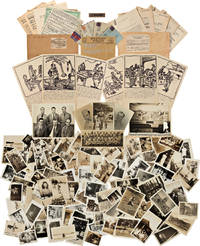
|
|

 Receive by email
 Download as PDF document
 RSS feed
 Permanent link


