|
Cayuse War
Expenses Cayuse War Oregon. To accompany bill H. R. No. 232. . the Committee on the Territories made the following Report.
Washington: 1854. 5 pp issued as 33d Congress 1st Session HR 122; light extraction roughness at spine and light general age toning now in self wrappers; comments on claims and payments for the period 1847-1848 prior to the organization of a territorial government. - If you are reading this this item is actually physically in our stock and ready for shipment once ordered. We are not bookjackers. Buyer is responsible for any additional duties taxes or fees required by recipient's country. Washington: unknown
Referenz des Buchhändlers : ZB452127
|
|
|
Belgium Ministere de la Guerre
Apercu general des operations de l'Armee Belge d'Aout 1914 au Novembre 1918
Bruxelles 1919. 21 pp. plates; ex library paper wrappers detached and badly chipped working copy only. - If you are reading this this item is actually physically in our stock and ready for shipment once ordered. We are not bookjackers. Buyer is responsible for any additional duties taxes or fees required by recipient's country. Bruxelles unknown
Referenz des Buchhändlers : ZB465850
|
|
|
United States War Department
Balances - War Department. Letter from the Secretary of War transmitting A statement of appropriations and balances for the fiscal year 1853-'4.
Washington: 1854. 13 pp issued as 33d Congress 2d Session HED 8; light extraction roughness at spine now in self wrappers. - If you are reading this this item is actually physically in our stock and ready for shipment once ordered. We are not bookjackers. Buyer is responsible for any additional duties taxes or fees required by recipient's country. Washington: unknown
Referenz des Buchhändlers : ZB471776
|
|
|
United States War Department
Letter from the Secretray of War transmitting Satements of expenditures for contingencies of the War Department.
Washington: 1853. 61 pp issued as 32d Congress 2d Session HED 32; light extraction roughness at spine partially age toned and occasional age staining but still entirely readable now in self wrappers. - If you are reading this this item is actually physically in our stock and ready for shipment once ordered. We are not bookjackers. Buyer is responsible for any additional duties taxes or fees required by recipient's country. Photos available upon request. Washington: unknown
Referenz des Buchhändlers : ZB471762
|
|
|
General Society of the War of 1812
General Society of the War of 1812. Proceedings of the Eleventh and Twelfth Biennial Meetings held at Boston Massachusetts September 16 1916 and Washington District of Columbia June 12 1920.
Boston: 1922. large octavo 121 pp. minor library markings very good original paper wrappers faded. - If you are reading this this item is actually physically in our stock and ready for shipment once ordered. We are not bookjackers. Buyer is responsible for any additional duties taxes or fees required by recipient's country. Boston: unknown
Referenz des Buchhändlers : ZB485413
|
|
|
War of 1812
An Abstract of the Evidence Lately Taken in The House of Commons Against the Orders in Council Being a Summary of the Facts There Proved Respecting the Present state of Commerce and Manufactures of the Country
NY: Wm. Elliot 1812. 36 pp. paper wrappers some darkening to text but still supple. - If you are reading this this item is actually physically in our stock and ready for shipment once ordered. We are not bookjackers. Buyer is responsible for any additional duties taxes or fees required by recipient's country. Photos available upon request. NY: Wm. Elliot unknown
Referenz des Buchhändlers : ZB527180
|
|
|
United States National War Labor Board
National War Labor Board. Minutes. Volumes 1 and 2 1918-1919
Washington: National War Labor Board 1919. Volumes 1 and 2 covering the period February 25 1918 to February 25 1919; quarto pagination slightly irregular but a total of over 514 leaves printed on rectos only and reproduced from typescript; Library of Congress hand stamps later black buckram bindings lightly rubbed and one hinge cracked overall very good. - If you are reading this this item is actually physically in our stock and ready for shipment once ordered. We are not bookjackers. Buyer is responsible for any additional duties taxes or fees required by recipient's country. Photos available upon request. Washington: National War Labor Board, hardcover
Referenz des Buchhändlers : ZB539575
|
|
|
(War of 1812) Bronson, Enos; editor
United States Gazette for the Country Bound volume of semiweekly issues from April to December 1812
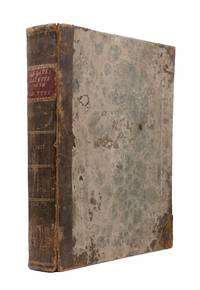
Philadelphia 1812. Vol XII Nos. 1134 to 1212 lacking No. 1154. plus newspaper extras dated April 16 May 14 June 1 and 18 August 17 and 24 Sept. 10 and 28. Together 86 issues. 4to. Contemporary half calf and marbled paper boards worn. Foxing. Vol XII Nos. 1134 to 1212 lacking No. 1154. plus newspaper extras dated April 16 May 14 June 1 and 18 August 17 and 24 Sept. 10 and 28. Together 86 issues. 4to. Among the newspaper extras is one dated June 18 1812 on the Declaration of war. The following extra covers the June 20 attack by an angry mob on the offices of the Federal Republican in Baltimore for the newspaper's anti-war stance.<br /> <br /> A Federalist organ Bronson's United States Gazette for the Country a continuation of the Gazette of the United States published under this title from February 21 1804 to March 7 1818. Brigham pp. 958-960 unknown
Referenz des Buchhändlers : 352283
|
|
|
(Civil War)
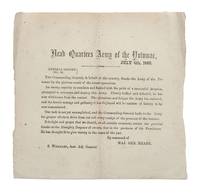
Head Quarters Army of the Potomac July 4 1863. General Orders No. 68. The Commanding General in behalf of the country thanks the Army of the Potomac for the glorious result of the recent operations. An enemy superior in numbers and flushed with the pride of a successful invasion attempted to overcome and destroy this Army. Utterly baffled and defeated he has now withdrawn from the contest. The privations and fatigue the Army has endured and the heroic courage and gallantry it has displayed will be matters of history to be ever remembered .
Gettysburg PA 1863. 1p. Signed in print by Maj. Gen. Meade. 6-3/8 x 6-1/2 inches. Old folds. Housed in a blue morocco backed box. 1p. Signed in print by Maj. Gen. Meade. 6-3/8 x 6-1/2 inches. The General Orders continues: "Our task is not yet accomplished and the Commanding General looks to the Army for greater efforts to drive from our soil every vestige of the presence of the invader. It is right and proper that we should on all suitable occasions return our grateful thanks to the Almighty Disposer of events that in the goodness of his Providence He has thought fit to give victory to the cause of the just."<br /> <br /> Lincoln would take issue with Meade's choice of words arguing that "our soil" applied to the southern states as well. In addition he was disappointed that Meade did not impel a greater effort to pursue Robert E. Lee in retreat. Nevertheless the Union victory at the three-day Battle of Gettysburg would prove a seminal turning point of the war arguably the greatest military victory for the Union. Interestingly Lincoln in his Gettysburg Address would echo Meade's own words from this order over the historic nature of the victory: "The world will little note nor long remember what we say here but it can never forget what they did here."<br /> <br /> Fewer than ten known copies of this battlefield-issued printing of Meade's victory message are recorded in several variant printings. The use of tabletop field printing presses by both the Union and Confederate armies helped make quick field communication possible but minor typographical differences were certain to occur given the circumstances of their composition. In addition a more formal printing of General Orders 68 was issued in Washington and can be found in annual bound volumes of such orders though is frequently misidentified as the present field-printed order. The last example on the market sold at Sotheby's in May 2016.<br /> <br /> WITH: Two-page manuscript official true copy of Meade's General Orders No. 66 assuming command of the Army of the Potomac just prior to the Battle of Gettysburg dated June 28 1863 written and signed by Acting Assistant Adjutant General Paul Nason.<br /> <br /> This example accompanied by a contemporary official manuscript true copy written and signed by A.A.A.G. Paul F. Nason of Meade's General Orders No. 66 in which he assumed command of the Army of the Potomac on the eve of the Battle of Gettysburg: "The country looks to this army to relieve it from the devastation and disgrace of an hostile invasion. Whatever fatigues and sacrifices we may be called upon to undergo let us have in view constantly the magnitude of the interests involved and let each man determine to do his duty leaving to an all-controlling Providence the decision of the contest unknown
Referenz des Buchhändlers : 353816
|
|
|
(Civil War)
The New-York Times . April 15 1861 . Fort Sumpter sic Fallen
New York 1861. 8pp. Map of Fort Pickens and Pensacola on the front page. Folio. Disbound. Very good. 8pp. Map of Fort Pickens and Pensacola on the front page. Folio. This historic issue of the New York Times published two days after the fall of Fort Sumter details the bombardment and includes a printing of President Abraham Lincoln's first proclamation calling for troops to suppress the rebellion of the secessionist states and "maintain the existence of our National Union unknown
Referenz des Buchhändlers : 351864

|
|
|
(War Department)
GENERAL ORDERS No. 19
Washington 1859. 4¾" x 7. Broadside; small tear in lower left corner slightly worn along left edge. Very good. 4¾" x 7" The orders of Secretary of War John B. Floyd outlining how the pursuit and treatment of hostile Indians are to be administered in light of potential conflicts with other military departments. The orders allow any army unit to pursue a hostile force into another department. However if the goal is to arrest an individual from a friendly tribe who has fled the job is to be passed to the neighboring department. The orders also stipulate that any trooper who loses his Colt revolver will be charged $40. unknown
Referenz des Buchhändlers : 354268
|
|
|
(Civil War)
NAVY DEPARTMENT.GENERAL ORDER NO. 13.
Washington 1863. 2pp. Single folded leaf. Torn and stained along fore-edge not affecting text. Good. 2pp. In this general order Navy Secretary Gideon Welles sets forth the rules governing flags of truce. The order details the conditions for issuing and the methods of accepting a truce flag. It also discusses the issue of hospital protective flags. <br/><br/> unknown
Referenz des Buchhändlers : 354307
|
|
|
[Boer War]
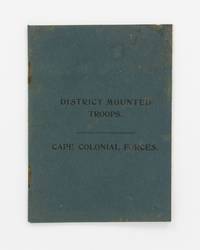
District Mounted Troops. Cape Colonial Forces cover title. Part I: Rules and Regulations for Organization Equipment Pay and Allowances. Part II: Notes for Guidance of D.M.T. Officers N.C.O.'s and Men and Certain Rules and Regulations Colonial Forces Act 1892
East London: Printed by the Standard Printing Co 1902. First Edition. Paperback. Very Good. East London Printed by the Standard Printing Co. 1902 revised edition. Small octavo 48 pages. Saddle-stapled title-wrappers a little marked and creased with associated creasing to the last six leaves; staples rusty staining a little the paper in contact with them; overall a very good copy of what we presume to be a rare item. The preface states that this book 'contains the various orders which have from time to time appeared in C.D.F. L. of C. and C.C.F. orders regarding D.M.T.'s; and also in circular memorandums from heads of departments in South Africa regarding District Mounted Troops. Fresh Orders must necessarily often be issued and spaces are left in the book for their insertion. H.S. Scott Harden Capt. O.C. Colonial Forces No. 12 Area. Aliwal North February 1st 1902'. Pages 43-44 contain a list of officers 'appointed by the colonial Government to command District Mounted Troops in the Areas not yet included in Colonial divisions'. Area 11 comprising the Districts of Colesberg Hanover and Steynsburg inclusive of Norvals Pont is under the command of 'Capt. S.A. White'. This item is not identified as such but we know it comes from the dispersed collection of Samuel Albert White 1870-1954 the South Australian well-known as an ornithologist and conservationist but 'During the South African War he had two tours of duty and was temporarily promoted captain a title he used thereafter' 'Australian Dictionary of Biography'. Printed by the Standard Printing Co paperback
Referenz des Buchhändlers : 136198
|
|
|
(Spanish-American War)
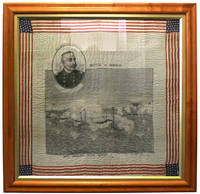
Battle of Manila . May Morning with Dewey. PI 1st May 1898 Manila Bay
1898. Lithographed view on silk of the Battle of Manila Bay with a large oval portrait of Commodore George Dewey at the upper left within a hand-drawn American flag border stitched to the view. 21-1/2 x 21-1/2 inches. Framed and glazed. Lithographed view on silk of the Battle of Manila Bay with a large oval portrait of Commodore George Dewey at the upper left within a hand-drawn American flag border stitched to the view. 21-1/2 x 21-1/2 inches. The first major engagement of the Spanish-American War the battle was one of the most decisive naval battles in history and marked the end of the Spanish colonial period in Philippine history. On April 27 1898 Dewey sailed from China aboard USS Olympia with orders to attack the Spanish at Manila Bay. He stopped at the mouth of the bay late the night of April 30 and the following morning he gave the order to attack at first light saying the now famous words "You may fire when you are ready Gridley." Dewey defeated the Spanish in a battle lasting just six hours. The Asiatic Squadron sank or captured the entire Spanish Pacific Squadron under Admiral Patricio Montojo y Pasarón and silenced the shore batteries at Manila with the loss of only one life on the American side.<br /> <br /> This broadside view on silk with American flag border was evidently issued as a commemorative scarf or hankerchief. unknown
Referenz des Buchhändlers : 329579
|
|
|
(World War II)
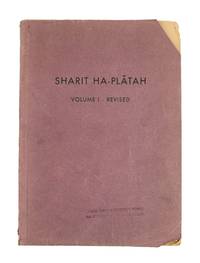
ShÄrit Ha-PlÄtah. Volume I - Revised. An extensive list of survivors of Nazi tyranny published so that the lost may be found and the dead brought back to life
Munich: Central Committee of Liberated Jews in Bavaria 1946. 4to. Publisher's purple wrappers upper and lower corner of upper wrapper trimmed minor loss to bottom of spine inked stamp of Jewish Family & Children's Services of Pittsburgh on upper wrapper. Text toned and brittle. 4to. A revised and expanded compilation from previously published regional volumes that appeared between May and October 1945 the list includes approximately 85000 names of Holocaust survivors in displaced persons camps. Entries include maiden names where applicable birthplace birth year and then-current location.<br /> <br /> The Hebrew ש×רית הפליטה translates to "surviving remnant" and is a term from the Book of Ezra and 1 Chronicles. Central Committee of Liberated Jews in Bavaria unknown
Referenz des Buchhändlers : 365526
|
|
|
[World War II]. [Philippines]
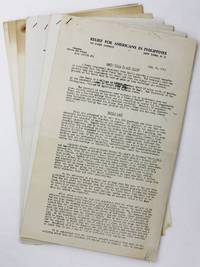
Relief for American War Prisoners in the Philippines caption title
New York 1945. Very good. Sixteen issues totaling 75pp. Legal-size sheets stapled. Previously folded. Light wear and toning. An extensive run of newsletters by a New York-based aid group Relief for Americans in the Philippines. Included here are issues 9 12 14 through 18 and 20 through 28 which were published between 1942 and 1945. The organization was devoted to the support of Americans who were imprisoned at San Tomas Gabuio and other camps after Japan occupied the Philippines during World War II. At the outset of the war the Philippines were a commonwealth of the United States but within three weeks of the attack on Pearl Harbor the Japanese seized control. The 20000 American and 80000 Filipino troops on the ground departed and any remaining American or British citizens were rounded up in Manila and transferred to the University of Santo Tomas where they were left to fend for themselves. The only exceptions were a 7:30 pm roll call each night and the use of room monitors. The background of the captives varied wildly from business executives and retired soldiers to prostitutes. At the end of the war the total number of prisoners liberated was 3785 2870 of which were American.<br />  <br /> Issue 14 remarks on the first anniversary of the non-profit organization: “On May 8th 1942 just a year ago and two days after the fall of Corregidor our organization came into being for furthering plans for the shipment of food medical supplies and other necessities for the internees and also to serve as a clearing house and point of dissemination for information concerning the welfare of these internees.†The monthly newsletter prints news and developments from the camps in the Pacific and documents the efforts of the organization to provide aid to the prisoners there. The issues also print a running list of all those believed to be in the Philippines “solely for the purpose of obtaining names and addresses of the nearest relatives of who we have no record.†A scarce record of this little-known relief effort during World War II. unknown
Referenz des Buchhändlers : 4668
|
|
|
WORLD WAR II
Collection of over one hundred unused World War II printed envelopes plus nine unused printed lettersheets and two postcards printed with patriotic and anti-enemy messages.
N.p. 1940s. All in fine condition. Various sizes. Many illustrated in red and blue or black; seven with small original photographs of ships. unknown
Referenz des Buchhändlers : 76639
|
|
|
Guerra, Frank
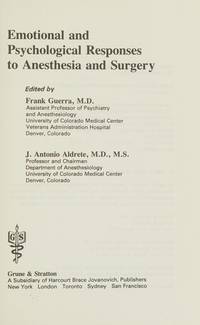
Emotional and psychological responses to anesthesia and surgery
hardcover. Good. Access codes and supplements are not guaranteed with used items. May be an ex-library book. hardcover
Referenz des Buchhändlers : 0808911953.G ISBN : 0808911953 9780808911951
|
|
|
Imperial War Museum
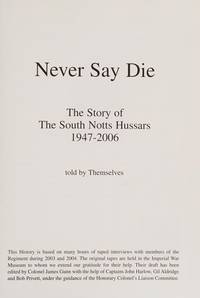
Never Say Die: The Story of the South Notts Hussars 1947-2006 Told by Themselves
hardcover. Good. Access codes and supplements are not guaranteed with used items. May be an ex-library book. hardcover
Referenz des Buchhändlers : 0955574307.G ISBN : 0955574307 9780955574306
|
|
|
(Civil War) Haskell, Edson
Archive of 75 war-date autograph letters signed nearly all to his parents documenting his Civil War service in South Carolina Georgia and Virginia in Co. F. of the 1st New York Engineers
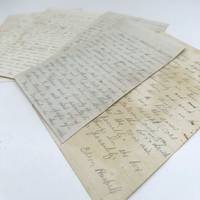
Vp New York South Carolina Georgia and Virginia 1865. Approx. 260pp. Variously written in pencil or ink on a variety of paper but generally quite legible. A few with original envelopes. With: Haskell's manuscript discharge dated Nov. 18 1864 partly-printed discharge of the same date a cdv of Maj. Gen. Hunter and Haskell's 1865 marriage certificate. 8vo or 4to. Usual folds. Approx. 260pp. Variously written in pencil or ink on a variety of paper but generally quite legible. A few with original envelopes. With: Haskell's manuscript discharge dated Nov. 18 1864 partly-printed discharge of the same date a cdv of Maj. Gen. Hunter and Haskell's 1865 marriage certificate. 8vo or 4to. Haskell 1836-1877 enlisted at Canandaigua Ontario County New York on November 18 1861 and mustered for a three year enlistment in Company F of the 1st New York Engineers. At the start of the war the Army Corps of Engineers was severely underpopulated; Civil Engineer Edward Serrell began recruiting for the specialized service in October 1861 with promises of pay one-third greater than infantry service.<br /> <br /> The first five letters of this archive are written by Haskell from Camp Washington on Staten Island as the regiment was formed trained and awaited orders. The letters describe his daily routine quarters the batteries and harbor and relate news that he has passed as an engineer. Among the most interesting of these letters is one dated January 22 1862 in which he details a visit to Central Park with a lengthy description of the landscape and ongoing construction. <br /> <br /> The 1st New York was deployed to Port Royal Sound and was formed as the 10th Corps Engineers in the Department of the South. Haskell and his company are sent to Hilton Head arriving at the end of February 1862. The next six months are spent on the island working on its wharves and fortifications. He describes his quarters and rations inspection and drills his work on a powder magazine flood gate and surveying for new fortifications. <br /> <br /> He writes at length about the number "contrabands" i.e. the freed or escaped slaves from Confederate plantations coming to Hilton Head. He writes on March 1 1862 soon after arriving: "There are a plenty of contrabands slaves here. They chop and raft logs for the wharves that they are building. The women & children are around among the soldiers selling sweet potatoes oysters and such to them. There are a good many soldiers here on the island and there was a good many that have just left on an expedition and they keep coming." On April 1 1862 he adds: "The government is making preparation to put in a cotton crop here. The negroes are preparing the ground. Contrabands come in every day. Two came in yesterday who said that they had nothing to eat for 4 days." On May 10 1862: "There is a good many contrabands and they keep coming in all the time. When they first arrived they are very ragged both men and women but they are all provided with suitable clothes. The soldiers are down on them because the negroes are used better than they are and have more privilege granted to them by the authorities. And the soldier vents his spite on the negro every chance he can get. Most of the negroes are employed. General Hunter has just commenced getting up a negro regiment of 1500 men to do guard duty through the night and to garrison some of the forts. The officers are to be white men and are to be taken from our regiment. There is quite an effort by some northern society to educate them to work; a job which they have but a slight idea." On October 5 1862 he notes the work General Mitchel among the formerly enslaved: "I went yesterday Sunday to the ordination of the Negro Church Baptist. Our chaplain read the ordination service of the Episcopal church and made a few remarks but General Mitchell done most of the talking . He told them that he was going to have them time by themselves and was going to educate them and make them good citizens. He has a squad of 50 men building houses for them about 3 miles from head quarters called the negro villages."<br /> <br /> In April 1862 he participates in the Battle of Fort Pulaski giving a lengthy account on April 15: "We fell in and marched through the rain to the docks stood in the rain all of an hour and then went on board pretty well soaked. At 9 o'clock the steamboat started. About noon we anchored off Tybee Island in full sight of Fort Pulaski . at seven o'clock the next morning the bombardment of Fort Pulaski commenced. Before the firing commenced Gen. Benham sent a flag of truce and demanded the surrender of the fort in the name of the U.S. " After describing the bombardment he continues: "At sunset the firing ceased on both sides and the two companies of engineers was divided into squads of 8 or 10 men each and sent out to repair the batteries. We worked all night. " He details the work of mounting two 10-inch columbiads "which dismounted themselves the very first shot they made. One of these guns the boys mounted after sunrise and as soon as they discovered from the fort what they was about they directed all of the guns which they could bring to bare upon that particular place. But the boys stuck to their gun and mounted it while the cannon balls was flying over their heads. A feat which they received considerable praise for. " <br /> <br /> In November 1862 Haskell's company is transferred to Fort Pulaski where they work on repairing the damage to the fort remounting the artillery and building a new magazine. He tells news of the war related to his department including a November expedition to destroy railroad bridges between Charleston and Savannah and the death of General Mitchel: "Our Generals called it a partial result and considerable gained by it. But it was such results as I do not believe in for we got tremendously whipped and lost 225 men in killed wounded and missing. But our company succeeded in tearing up some 200 feet of rails on the reach and cutting the telegraph while they were guarded by a few companies of infantry and they all barely escaped being taken prisoner. They found the bridges all guarded by strong batteries. Just as our company and 4 companies of infantry came up to tracks there was a train of open cars going pass loaded with troops. Our men hid behind the fence and when the train came up fired into it and they think they killed a good many. Since then General Mitchel has died and two or three of the other head men . some think that they had yellow fever . others think they was poisoned by eating fish that they bought of the negroes."<br /> <br /> Much of his war commentary during his nine months on Fort Pulaski includes descriptions of the iron clads and monitors. On March 5 1863 for example he writes: "The rebel steamer Nashville was destroyed last Saturday by one of the Monitors The Passaic. She ran by a 13 gun battery and run up the river where she lay and fired two shots into her the first went clear through and the second a shell burst in the magazine and this blew the Nashville to atoms." On June 21 1863 he writes: "The rebel ram Fingal i.e. CSS Atlanta that was built at Savannah and which has kept us in a sweat for nearly a year here and at Hilton Head was captured by one of our monitors last Tuesday without firing a shot." He details the action and movements of the ships before continuing sarcastically: ".The means for building the ram was furnished by the ladies of Savannah and there was two boat loads of them followed the ram down to see her destroy our battery and gun boats but they went back closely followed by one of our gun boats and you must imagine their joy." <br /> <br /> Haskell provides news of the Battle of Fort Wagner on Morris Island including the role of African American troops. He writes on July 15 1863: ". Gen. Gilmour is working his way toward Ft. Sumter and Charleston. There has been some hard fighting on Morris Island." On the 24th he writes: ". our forces had taken eleven batteries on Morris Island and there was two that they had not got possession of yet and that our forces had taken 700 prisoners . yesterday it was reported by some fellows that came from the head that there had been more fighting on Morris Island that the two remaining batteries had been stormed three times and our forces had been repulsed each time with tremendous slaughter. The 55 i.e. 54th Mass. color reg. was one of the storming parties. They were 1200 strong. They lost 700 in killed wounded and missing and the NY 48 was another." Interestingly that same letter includes a commentary on the New York draft riots: "I see by the late NY papers that there is a riot in NY city to resist the draft . I should say that it was to burn buildings murder and to plunder the city. I hope that they will be put down."<br /> <br /> At the end of July 1863 his company is transferred to Morris Island South Carolina to participate in the shelling of Fort Sumter and Charleston where he remains until February 1864. His letters provide great detail of the shelling his work on the artillery and the condition of Fort Sumter. For example: "We are hard at work building batteries and mounting guns . We have just finished a three gun battery on a small island about two miles from our camp. All of the material except the sand had to be boated guns and all. The guns are pointed toward Charleston and the city may feel the effects of them . Two sides of Ft. Sumter are knocked down and the other sides are full of holes and badly shattered & she has not fired a gun in a number of days but we cannot get possession of her until our forces take Fort Wagner . Our regiment is what is called sapping Fort Wagner that is digging trenches in the ground and they are within 100 ft of the fort. We have some killed by grape and canister and by the sharp shooters . The rebels had rifle pits outside of the fort and from these pits they annoyed our boys very much. The 24 Reg. Mass. made a charge on these pits and took 80 prisoners and drove the rest of them into the fort ."<br /> <br /> In January 1864: "You must remember that it takes a tremendous force to throw a hundred lb shell over four miles and it is with the utmost difficulty that we can elevate our guns sufficiently to do it. It requires from 36 deg. to 40 deg. and this elevation allows but little recoil to the gun and the consequence is that we are using up more guns than the damage to the city amounts to. But our Colonel has invented a new wooden gun carriage and day before yesterday one of our men with myself laid the platform and put the carriage . on it and the artillery fellows mounted the gun and tried it. It works first rate and yesterday fired 175 shells into the city and got smoke to rising in a number of places."<br /> <br /> At the end of April 1864 with the shelling of Charleston continuing his regiment is reorganized and he is sent up the James River toward Richmond to join the Army of the Potomac in the Richmond-Petersburg Campaign writing on April 27: "the second battalion which includes our regiment starts for Fortress Monroe tonight . the whole of the 10th army corps are going to operate with the army of the Potomac . The report is that there will be no movement the present season and that all but the most important places will be evacuated and that those will be garrisoned by colored troops."<br /> <br /> Arriving at Bermuda Hundred Virginia in May he writes: "The infantry landed and had a skirmish and took 600 prisoners. Then we built docks to land the cavalry and artillery. The troops advanced some 12 miles our battalion stayed at the landing until most of the stuff was landed which took 24 hours and then we followed on . built fortifications and obstructions then we again advanced and had quite a severe fight and torn up the railroad between Richmond and Petersburg . they said that in one of the battles the 25th SC Reg lost all but three men . We hear that Meade has licked Lee and that he is falling back to Richmond . We are now about 14 miles below Richmond."<br /> <br /> After fortifying the breastworks at Bermuda Hundred his company is moved to Dutch Gap to work on the canal being built to flank the Confederate battery on the river. He writes on August 13 1864: "The river here is very crooked. It runs around five miles and comes within 200 yards of meeting again. The rebels have the most of this five miles filled in with torpedoes and obstruction and a powerful battery to protect them." After describing the topography he continues: "We are digging across here so as to let the monitors go through and thus cut off the rebels battery and their obstructions. But the working party has had a rough time of it today. The rebels have shelled us from their batteries and their iron clads. There has been some killed and quite a number wounded . I think that Gen. Grant will stick to them until he fetches them out of Petersburg and Richmond . There will be some hard fighting in northern Virginia and Maryland ." He adds the following week: "We are at work on the canal. Not exactly at the canal but on the fortifications to protect the canal and are building a corduroy road across a swamp able to get to the canal. We are encamped on the opposite side of the river from the canal and have to cross the river in small boats to our work; the negroes does most of the work on the canal and it does not progress very fast." <br /> <br /> In October he is moved forward to Deep Bottom writing on the 16th: ". Our reg was in the late advance on the north side of the James toward Richmond and have seen some rather rough times . Our company are at work on the advance line. They say about 5 miles from Richmond. I am with four other engineers in charge of building a ten gun fort. We have about 300 men helping us. I have charge of 75 who are cutting away the wood around the fort and carrying timber for it and obstructions to put around it . The rebels are about a mile from this line of works . Wednesday the 12th there was quite a fight here but there was nothing materially accomplished on either side save the killing and wounding of quite a number of men . things indicate a forward movement very soon."<br /> <br /> His letters from Deep Bottom at the end of October and the beginning of November largely concern the presidential and local elections sending his father his ballot to ensure that his vote would be cast. On November 18 1864 with his 3 year term up Haskell is discharged at Varina Virginia and the archive includes both a manuscript discharge and the official partly-printed one he subsequently received. The archive includes one additional letter dated May 19 1865 written from City Point Virginia suggesting he re-upped for another shorter term. He writes: ". For the past ten days we have been busy from 4-1/2 o'clock in the morning until dark at night fitting up boats for transporting troops and horses. The twenty-fifth corps colored are going to Texas to settle the hash with Kerby Smith. One division has already gone and the boats are being fitted up as fast as possible for the rest . I have been to Richmond and Petersburg ." <br /> <br /> A very good Civil War archive of letters by an enlisted man serving as an artificer and engineer on the Georgia and Carolina coast participating in the the Battle of Fort Pulaski and the bombardment and siege of Charleston and Fort Wagner and along the James River in the Richmond-Petersburg campaign. unknown
Referenz des Buchhändlers : 353265
|
|
|
REVOLUTIONARY WAR BISSELL, Capt Ozias
State of Connecticut Pay- Table Office. Revolutionary War Payment Voucher of Capt. Ozias Bissell in the amount of Thirteen Pounds thirteen shillings.
N.p. April 2 1782. Old horizontal and vertical crease where folded; very attractive. . 4-3/8 x 6-1/2 inches. Capt. Bissell served in the Continental Army for six years; participated in three battles and several skirmishes; was wounded three times; and held as a prisoner for nearly two years. unknown
Referenz des Buchhändlers : 77889
|
|
|
[Civil War]. [Nebraska]. Miller, George L
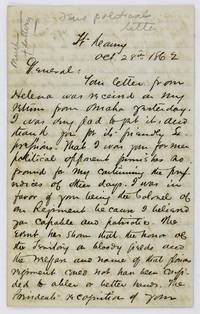
Autograph Letter Signed from Nebraska Territory Pioneer George L. Miller to Nebraska General Samuel Ryan Curtis Reporting on Some Dirty Politics and Including a Brief Appraisal of the Frontier Town of Omaha
Fort Kearny Ne: October 28 1862. Very good plus. 4pp. on a single folded sheet of lined paper. Light wear and toning old folds. An interesting manuscript letter written by Dr. George Lorin Miller 1839-1920 a leading Nebraska pioneer and instrumental figure in establishing Fort Kearny. Miller also served as the fort's sutler during the Civil War and helped to recruit the First Nebraska Regiment. Miller was a physician politician editor and land owner who arrived in Omaha in 1854 the year the city was founded. Miller himself founded the Omaha Herald which later became the Omaha World-Herald and was. staunch Democrat who became adept at harnessing the power of the press.<br /> <br /> Here Miller writes to an unnamed general in Helena Arkansas who was most likely Samuel Ryan Curtis. Miller's letter is well-written providing insights into and details of the politics war news and other information of the period. He is friendly to his correspondent noting that the two men had been political opponents in the past but Miller states that he supported the candidacy of his correspondent as "Colonel of our Regiment because I believed you capable and patriotic." Miller praises him for being recognized by no less than the President for "gallant services authenticated as they were by the best officers of the service" and then bemoans the fact that the correspondent was denied an appointment by the Senate due to the "mendacious meanness" of a Nebraska politician named Samuel G. Daily who apparently worked against his confirmation. Then Miller notes that Daily had to answer for his denial of the correspondent's appointment on the recent campaign trail where Daily "had to meet your case in the canvass at every turn -- apologized lied and smoothed it over as he best could. Denying everything and admitting nothing saved him by about 100 votes." He continues to encourage his correspondent with supportive language and then closes with a short appraisal of their shared hometown in the Nebraska Territory: "Omaha is changing much but it will not outrun your recollection of it. When you return you will see as I see that it is a real home after all however changed its appearance. October 28 unknown
Referenz des Buchhändlers : 3449
|
|
|
[United States Army] [Major Thomas B Eastland] [Amos Beebe Eaton] [Mexican War]
2 Mexican War Era United States Army documents addressed to Major Thomas B. Eastland at Brazos Island Texas and signed by Amos Beebe Eaton
Brazos Island Texas 1847. Document. Very good. 2 8" x 10" sheets of paper. The first document signed at the bottom by Capt. A B Eaton from Brazos Island is dated December 15th 1847 and is addressed to Major Thos. B Eastland q.m. The document reads "Major - I respectfully require of the Quartermaster's Department the necessary transportation receipts in bulk for the Subs Stores herewith invoiced as required by Par 1088 Army Regulations. - Respectfully Your Obt Servt A B Eaton Capt .sp" The second document signed by Eaton on December 17th 1847 is also addressed to Eastland and has the same exact content as the first letter not a copy as the date is different and the writing has variation. A collection of Thomas B. Eastland's papers is held by the California Historical Society. <br /> <br /> From the Confederate Veteran February 1911 "Eastland Family" "Thomas B. Eastland came to Nashville where he was engaged in business until about 1840 when he went to New Orleans to engage in the cotton brokerage business and where he continued until the breaking out of the Mexican War during which he served under General Zachary Taylor as major." Thomas B. Eastland's diary titled To California Through Texas and Mexico: The Diary of Thomas B. Eastland and Joseph G. Eastland His Son was published by the California Historical Society in 1939 and is 59 pages long.<br /> <br /> From wikipedia: in 1846 ".it Brazos Island was the first military objective of the US Navy in support of General Zachary Taylor's invasion of Mexico. Control over this important seaport was said by Harvard historian Leroy Graf to be the primary reason for the US invasion of Mexico. From Padre Island NS Historic Research Study Chapter 3 "After the outbreak of hostilities Brazos Island became the primary staging area for the continuing campaign. Volunteers from throughout Texas and the Mississippi Valley converged on the Island and headed inland for camps at Point Isabel and along the Rio Grande."<br /> <br /> Amos Beebe Eaton the signer of these documents 1806-1877 was a career officer in the United States Army. He was General Zachary Taylor's Chief Commissary of Subsidence during the Mexican War. He was a graduate of West Point in 1826 and was made Brevet Major General of the Union Army in 1865 appointed by Andrew Johnson. unknown
Referenz des Buchhändlers : 31761

|
|
|
(Civil War) [Keiley, Anthony M]
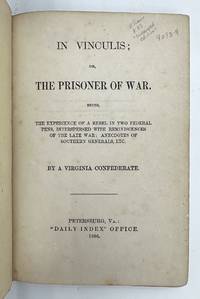
In Vinculis; or the Prisoner of War. Being the Experience of a Rebel in Two Federal Pens Interspersed with Reminiscences of the Late War; Anecdotes of Southern Generals etc. By a Virginia Confederate
Petersburg VA: Daily Index" Office 1866. Second enlarged edition. 2 216pp. 12mo. Publisher's brown pebbled cloth a bit cocked some wear and spotting. Minor foxing. Second enlarged edition. 2 216pp. 12mo. Second enlarged edition after the first of the previous year. A famous and highly regarded wartime account. Based on the author's experiences in two federal prisons Point Lookout and Elmira after his capture at the battle near Petersburg. The first edition of this book was the last or next to last book printed in the Confederacy. Keiley a noted journalist and lawyer also wrote THE FALLING FLAG describing the Confederate retreat from Petersburg to Appomattox. A contemporary review of this work quoted by Harwell EVENING COURIER for March 24 1865 states that Keiley's narrative "is invaluable in arriving at accurate conclusions respecting the opinions hopes prospects and designs of the Northern people in their war for subjugation.It has all the thrilling interest of a legend of romance." Howes K27; Nevins I p.195; Sabin 37169; Confederate Hundred 50 1st ed; Crandall 2637 1st ed; In Tall Cotton 149 1st ed Daily Index" Office unknown
Referenz des Buchhändlers : 370497
|
|
|
(Civil War) Harris, William Charles, Lieut
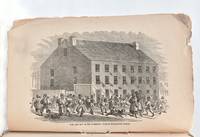
Prison-Life in the Tobacco Warehouse at Richmond. By a Ball's Bluff Prisoner
Philadelphia: George W. Childs 1862. First edition. 175 1pp. Frontispiece by Lauderbach. 1 vols. 8vo. Publisher's wrappers some chipping at edges. First edition. 175 1pp. Frontispiece by Lauderbach. 1 vols. 8vo. Harris a member of Colonel Baker's California Regiment was captured at Ball's Bluff and was imprisoned at Liggon's Tobacco Warehouse for four months. Includes a 5-page listing at the back of the officers in the prison their regiments where captured residence and remarks. An early narrative also describing travels in Virginia. "Reflects lax fairly comfortable conditions in early officers' prison; good descriptions of Winder Wirz and other officials" Nevins. The frontispiece depicts "our last day in the Richmond Tobacco Warehouse prison." Coulter 216; Nevins I pg 193; Sabin 30531 George W. Childs unknown
Referenz des Buchhändlers : 370488
|
|
|
(Civil War) Johns, George S
Philip Henson The Southern Union Spy
St Louis: Nixon-Jones Printing Company 1887. First edition. Frontispiece portrait. 97pp. 12mo. Publisher's salmon wrappers minor wear. First edition. Frontispiece portrait. 97pp. 12mo. Born and raised in the South but with Union loyalties Henson served as a spy for the North from July 28 1862 until May 20 1864 when he was captured by Confederate soldiers. This narrative describes his many exploits as a false member of the Confederate army and behind enemy lines and includes several discussions of the "secret service." Henson's other claim to notoriety was that he was in possession at the time of the world's longest beard measuring over six feet in length. <br/><br/> Nixon-Jones Printing Company unknown
Referenz des Buchhändlers : 370494
|
|
|
(Civil War) Boggs, S S
Eighteen Months a Prisoner under the Rebel Flag
Lovington IL: S. S. Boggs 1887. First edition. Frontispiece illustrations. 96pp. 8vo. Publisher's wrappers minor chipping. First edition. Frontispiece illustrations. 96pp. 8vo. Subtitle is "A Condensed Pen-Picture of Belle Isle Danville Andersonville Charleston Florence and Libby Prisons from Actual Experience." Scarce. Coulter 42. Coulter 42 <br/><br/> S. S. Boggs unknown
Referenz des Buchhändlers : 370493
|
|
|
(Civil War) Lyon, W F
In and Out of Andersonville Prison
Detroit: Geo. Harland Co 1905. First edition. Plates. 121pp. 12mo. Publisher's wrappers. First edition. Plates. 121pp. 12mo. <br/><br/> Geo. Harland Co unknown
Referenz des Buchhändlers : 370489
|
|
|
(Civil War)
In the Senate . Report . massacre at Fort Pillow
Washington D.C.: Government Printing Office 1864. 38th Congress 1st Session Senate Rep. Com. Nos. 63 and 68. 128pp. Bound with: Report . with the accompanying testimony. 34pp. 4 wood-engraved plates. 8vo. Publisher's cloth. Minor fading to spine. 38th Congress 1st Session Senate Rep. Com. Nos. 63 and 68. 128pp. Bound with: Report . with the accompanying testimony. 34pp. 4 wood-engraved plates. 8vo. An influential and damning report on the Battle of Fort Pillow in Tennessee which ended with a massacre of Union soldiers many of them African Americans serving in the 6th U.S. Colored Artillery attempting to surrender by soldiers under the command of Confederate Major General Nathan Bedford Forrest. <br/><br/> Government Printing Office hardcover
Referenz des Buchhändlers : 370496
|
|
|
(Civil War) Cooper, Alonzo
In and Out of Rebel Prisons
Oswego: R. J. Oliphant 1888. First edition. Portrait frontispiece plates. 335pp. 8vo. Publisher's purple cloth upper cover and spine stamped in blind and gilt. Very good. First edition. Portrait frontispiece plates. 335pp. 8vo. "A fairly objective above-average account of Macon Savannah Charleston Columbia escape recapture and Danville" Nevins. Nevins I p. 188. Nevins I p. 188 <br/><br/> R. J. Oliphant hardcover
Referenz des Buchhändlers : 370483
|
|
|
(Civil War) South Carolina Secession Convention
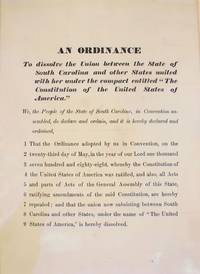
An Ordinance To dissolve the Union between the State of South Carolina and other States united with her under the compact entitled "The Constitution of the United States of North America.
Charleston S.C.: Evans and Cogswell 1860. Broadside 11-1/2 x 8-1/4 inches. Old folds. Nicely mounted framed and glazed. Broadside 11-1/2 x 8-1/4 inches. One of the earliest Confederate imprints: South Carolina's official act of secession printed for delegates at the secession convention. This first printing of the South Carolina Ordinance of Secession the document which caused the departure of South Carolina from the Union set the nation irrevocably on the path to the Civil War. <br /> <br /> After Lincoln's election South Carolina moved vigorously to follow through its threat to secede from the Union. A secession convention was called and assembled at Charleston on December 20 1860. Their entire business was to debate the issue of secession which they favored overwhelmingly and to settle on the wording of a secession ordinance. Within the day the 169 members of the Convention voted unanimously for the ordinance.<br /> <br /> This is the printing of the ordinance made for the use of the delegates to the Convention. The ordinance was set up in the form of a "reading bill" or "slip bill" familiar to most delegates as the typical form of a legislative bill in working draft with the body of the text in numbered double-spaced lines to facilitate the making of corrections. Following the title given above the text reads:<br /> "We the People of the State of South Carolina in Convention Assembled do declare and ordain and it is hereby declared and ordained That the Ordinance adopted by us in Convention on the twenty-third of May in the Year of Our Lord one thousand seven hundred eighty-eight whereby the Constitution of the United States of America was ratified and also all Acts and parts of Acts of the General Assembly of this State ratifying amendments to the said Constitution are hereby repealed; and that the union now subsisting between South Carolina and other States under the name of 'The United States of America' is hereby dissolved."<br /> <br /> Presumably only several hundred copies of this "slip bill" version of the Secession Ordinance were printed - just enough to distribute to the members of the convention. They were probably printed just before the convention began. Indeed setting and printing it would have taken a few hours at most. After its passage the ordinance would famously be published as a newspaper extra by the Charleston Mercury with the following words in bold below the text of the ordinance: The Union Is Dissolved!<br /> <br /> This is one of four extant examples of the slip bill the others being examples at the Huntington Library Emory University and one in private hands being the example once belonging to Jay Snider sold to him by the William Reese Company in 1997 and resold at the sale of his collection at Christies June 21 2005 lot 165 selling for $66000. Parrish & Willingham 3795; Crandall 1888 Evans and Cogswell unknown
Referenz des Buchhändlers : 369308
|
|
|
(War of 1812) Conner, David, early owner
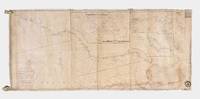
Steel's New Chart of the Coast of Brazil Including a Plan of Rio Janeiro blue-backed engraved maritime chart annotated in manuscript by U.S. naval officer David Conner showing the courses of the War of 1812 voyages of the USS Hornet
London: P. Mason at Steel's Navigation Warehouse 1808. Blue-backed sea chart. Insets of the harbor of Rio the Bay of All Saints and the Island of Fernand Noronha. Manuscript annotations by Conner plotting the course of the USS Hornet in the War of 1812. Approx. 31 x 70 inches. Tape repairs on verso some staining. Manuscript note on verso by Philip Syng Physick Conner. Blue-backed sea chart. Insets of the harbor of Rio the Bay of All Saints and the Island of Fernand Noronha. Manuscript annotations by Conner plotting the course of the USS Hornet in the War of 1812. Approx. 31 x 70 inches. Pennsylvania native David Conner joined the navy as a midshipman in 1809 and during the War of 1812 served with distinction aboard the USS Hornet where he rose to the rank of first lieutenant during the war. He participated in action aboard the Hornet against the HMS Peacock in February 1813 and in the March 1815 capture of HMS Penguin and was awarded two medals of valor. In 1817 he was commissioned first lieutenant under Captain Biddle aboard the USS Ontario for its voyage to the Pacific. He would eventually rise to the rank of Commodore commanding the blockade of the Gulf Coast during the Mexican War and responsible for landing Scott's army at Vera Cruz.<br /> <br /> On October 26 1812 the frigate USS Constitution and sloop USS Hornet left Boston to raid British shipping along the coast of South America. The Hornet sailed under the command of famed American naval captain James Lawrence best remembered for his order "Don't give up the ship" in the June 1813 battle between the Shannon and the Chesapeake. After a couple months cruising the waters off the coast of Brazil on February 24 1813 the USS Hornet engaged the HMS Peacock off the mouth of the Demerary River. Exchanging broadsides the Hornet's cannons shot true damaging the British ship. Outmaneuvering the Peacock downwind the Hornet approached from the stern firing and forced the Peacock which had lost her captain and taken heavy casualties to strike. The American ship sent on a boarding party but the Peacock quickly sank. <br /> <br /> This large sea chart oriented with north to the east depicts the coast of Brazil from Sao Luis Maranhao to the Lagoon Merim and is profusely annotated by Conner charting the cruise of the Hornet off the coast between December 1812 and February 1813 i.e. the movements of the ship prior to the engagement with the Peacock. Included in the manuscript additions is evidence of the brief blockade of the English frigate Bonne Citoyenne at Salvador where Lawrence challenged the ship to single ship combat with the Hornet but had to abandon the blockade upon the arrival of a British line of battle ship. "Running up the coast she took on January 6 1813 the schooner Ellen loaded with dry goods . On the fourth of February off Pernambuco she seized the brig Resolution ten guns carrying coffee fustic etc. from Rio to Marnaham and a nice little purse containing 23000 in specie. This the Hornet put intop her opwn pocket and then burnt the brig" Conner. After several more weeks of cruising the Hornet engaged the Peacock.<br /> <br /> On June 18 1914 auctioneer Stan V. Henkels sold the books papers journals and log books from the younger Conner's library which included Lt. David Conner's original logs of the voyage of the USS Ontario now at the Library of Congress MSS84251. The present map was not included in that sale; however it appeared within lot 71 at Parke Bernet on May 25 1971. Conner Philip Syng Physick. "The Hornet's Sting and Wing" in The New England Magazine Vol. XXIII No. 3 Nov. 1900 pp. 268-274 P. Mason at Steel's Navigation Warehouse unknown
Referenz des Buchhändlers : 367005
|
|
|
[AFRICAN AMERICANA] [VIETNAM WAR] WILLIAMS, Thomas D
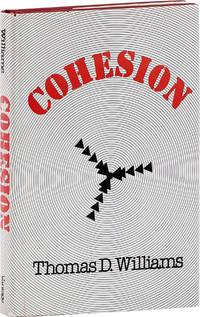
Cohesion Inscribed
New York: Vantage Press 1982. First Edition. First Printing. Octavo 21cm; red cloth with titles stamped in black on spine; dustjacket; iv2031pp. Lengthily inscribed by the author on the front endpaper: "17 October 1986 / To Joe - Remember me gal I'm one of those fortunate birds who barely got through Josiah Cox's class. Now is that taking you back - or what!! Memories can also be memorable. Sometimes all we have to do is slow down and reflect. Good luck in to you and yours! Thomas D. Williams Mingo. Laid into this copy is a short ANS from Williams to the recipient along with his business card. Spine ends gently nudged faint paper-clip impression to upper margin of title page and the following two leaves; very Near Fine. Dustjacket is unclipped priced $8.95 with light wear to extremities and a few tiny tears; Near Fine. Debut novel by this African American author set during and after the Vietnam War with the story revolving around three central characters: Hubert Jackson a Black Marine private Lo Quan Duc a Vietcong guerilla and Tony Martinelli an Air Force pilot and son of a Mafia chieftain. Not in Blockson and not in Newman Vietnam War Literature: An Annotated Bibliography; OCLC notes 11 holdings. Vantage Press unknown
Referenz des Buchhändlers : 64026
|
|
|
(Civil War) Whittlesey, Charles
War Memoranda. Cheat River to the Tennessee 1861-1862
Cleveland: William W. Williams 1884. First edition. Maps. 89pp. 8vo. Publisher's flexible russet cloth covers lettered in gilt. Inscribed on the title from R. Rattell to Hon. J. W. Stewart. First edition. Maps. 89pp. 8vo. Scarce Civil War memoir on the Union Army Movements in West Virginia and Tennessee including the capture of Fort Donelson and the Battle of Shiloh. <br/><br/> William W. Williams hardcover
Referenz des Buchhändlers : 370498
|
|
|
[Civil War] Confederacy] [N B Hamerick?] [Battle of Pocotaligo] [South Carolina]
1862 Confederate Soldier's reply to Mr. E Ward Rock Island Tennessee while camped at Pocotaligo near Yemassee South Carolina
Pocotaligo: n.p. 1862. Letter. Good. Letter. Approx. 8" x 5". 3 pages of manuscript. No envelope or stampless mark on the paper. Paper has three folds. Paper is in very good condition with light edge wear to a couple of spots. The following transcription is a best guess. The legibility of letter is difficult to transcribe and some words are omitted and other words spelled as they appear.<br /> <br /> Pocotaligo Feb 1 1862<br /> Mr E Ward Rock Island Tenn<br /> <br /> Dear Sir<br /> <br /> I find myself seated with yours of January 19th before me. I was very glad to hear from you I had wrote four letters to you and heard from you once in the time I dont think that you ought to quit writeing to us if I do belong to Jeff Davis traveling hog hay stealing 16th regiment I want you to write to me start your letter and I will get them for they will fallaw ten us and we will get them. I have had your letter for several days but I did not have the chance to answer it E We have to stand Pickett Cal Ful and Savages Regiments take it times a we go have and stand twelve days and then they stand twelve days. We have to go about twelve milds miles from the camps to stand. Darien is the Part Rail river and the yankees an on the Island of the same name I stand in sight of plenty of the damn yankees. We was yesterday and came to camps last night. We expect to have a fight hear with the yankees before long for there is plenty of yankees hear. You wanted to know about the fight that was hear on New Years day our regiment was not in it. We it for ten mild mile but it was over before we got thear. Wen we say our men we men mean the Dixaboys the yankees killed our men and we killed some of there and made them take again. We would nat have lost any men at all if our men had nat were two brave and run there up under the canans at the yankees and they Burned them and killed some men. I want you to write to me as soon as you get this gets to hand Tell Nancy that I am as fit as she ever saw me. E I get same good letter from my mama. This leaves me in good health. I remain yours till N.B. Hamrick. The Battle Mr. Hamerick referenced in this letter January 1st 1862 was probably part of the Union Army's Port Royal campaign. A battle took place along the Coosaw River near the Port Royal Ferry in Beaufort County South Carolina. From the Beaufort County Library: <br /> <br /> In late December 1861 the Union forces recognized that the Confederates recently removed to the mainland had been building batteries along the Coosaw River near the Port Royal Ferry. Union Commanding General I.I. Stevens ordered components of the 8th Michigan Infantry 47th and 48th New York Infantries 1st New York Engineers and the 50th Pennsylvania to destroy the Confederate breastworks capture the guns and force the retreat of some companies of the 12th South Carolina Infantry into the interior of Beaufort District. The Union forces accomplished their mission on New Year’s Day January 1 1862 with minimal casualties.<br /> <br /> The first Battle of Pocotaligo took place May 28th 1862. The Union army goal was to tear up the railroad between Charleston and Savannah. The second Battle of Pocotaligo took place October 22 1862. In the first battle the Union moved to destroy a bridge and having reached their objective retreated back to Hilton Head. both armies suffered a few casualties. In the second Battle the Union's goal was again to tear up the Railroad between Savannah and Charleston. After pushing the Confederates back to Pocotaligo the Union initiative stalled and the Union army retreated before nightfall. <br /> <br /> An interesting side note on the future fate of N. B. Hamericksp during the War comes from articles collected in The Spencer Times and the Sparta Exhibitor titled "Recollections of the War From Carroll H. Clark" Transcribed with all the commas dashes and lack of capitalization from Memorial and Biographical Record of the Cumberland Region An Illustrated Compendium of Biography. Geo. A. Ogle & Co. Chicago 1898. pp.253 and 254.<br /> <br /> Carroll Clark was from McMinnville Tennessee. In one of the several articles Clark makes a reference to a "N. B. Hamericksp" possibly the same soldier who wrote this letter. An excerpt from article 25 ".I have left untouched very many interesting events for instance the Battle of Franklin Tennessee in which many brave commanders and soldiers were killed of whom was Genl. Cleburne Genl. Carter and others. My dear friend and schoolmate N. B. Hamrick was killed there. His father and family lived out two miles from here at the place now called the Hill place on the road to Farris Griffiths. N.B. had three brothers in the war and all came through alive. The family came from North Carolina a few years before the war and it has been said brought the first yellow horse to this country. I yet remember the names of the whole family as follows: Uncle Billy Aunt Polly Jeroam Napoleon Bonapart killed at Franklin Jereboam Zorobabel Doctor Cortez and Don Pedro were the boys and two girls named Martha Salena and Mary Boston. All except Jeroam were my schoolmates."<br /> <br /> This letter was addressed to Mr. Ward in Rock Island Tennessee. Carroll Clark's war reminiscences was written in Tennessee. It is possible this is the same N. P. Napoleon Bonaparte Hamericksp who wrote the letter that was later killed at the Battle of Franklin in 1864. Information found regarding casualties at Franklin include variant spelling in the last name. A listing from the Civil War Talk web site states "1st Sgt. Napoleon B. Hambrick Co. I Killed." Another site Home dot Freeuk dot com lists "Sgt Napoleon Bonaparte Hanmbrick n.p. unknown
Referenz des Buchhändlers : 33742

|
|
|
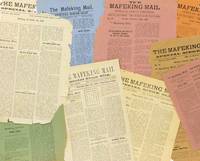
[Boer War] ['The Mafeking Mail']. WHALES, GNH (editor) G N H
A substantial run of 111 issues of the Special Siege Edition and Special Siege Slips of 'The Mafeking Mail' from Number 1 1 November 1899 to Number 148 23 May 1900 the first issue after the end of the siege with impeccable provenance
Mafeking: Townshend & Son 1899. Mafeking Townshend & Son 1899 and 1900. 111 issues various sizes see below printed on paper of many different colours and of varying quality often poor with 43 printed as a broadsheet the balance printed recto and verso with three early numbers folded and issued as bifolia. Unbound as issued; some loss primarily owing to the poor quality of some of the paper; however these extraordinary artefacts produced under siege conditions are of the utmost rarity in any condition. All issues in this run are now housed in individual Mylar pockets sealed on two sides only for easy access. A detailed list including the number date colour of paper length and condition of each issue is included with the lot. Dr Robin Pelteret has published his impressive research notes on 'The Mafeking Mail Special Siege Slips' online. He sets the scene: 'Mafeking lies 1392 kilometres north of Cape Town and 298 kilometres west of Johannesburg. It was first settled in the early 1850s. From the early 1860s it became a centre of squabbling and outright fighting between the Transvaal Republic the Baralong the Goshen Republic the British South Africa Company and the British Empire. <p>By the outbreak of the Anglo-Boer War it was a robust "dorp" with some 1500 European citizens a group of Indian and oriental background and 5000 Baralong. It was a major rail junction with a station and railway workshops; a significant commercial centre and boasted a number of substantial buildings including two schools two churches a Standard Bank a Masonic Lodge a newspaper building a public library the Victoria Hospital and St Joseph's Convent Irish Sisters of Mercy. <p>The Siege of Mafeking was conducted between 14 October 1899 and 17 May 1900 that is 217 days and began 3 days after the declaration of war by the Transvaal Republic. It involved British and Colonial Forces under the command of Brevet-Colonel Robert Stephenson Smythe Baden-Powell the besieged and Boer Forces ab initio under the command General Piet Arnoldus Cronje and later Kommandant Sarel Eloff the besiegers'. <p>The precursor to the siege issues of 'The Mafeking Mail' was the 'Mafeking Mail and Protectorate Guardian' in its infancy when the siege was imposed. Number 22 the last full edition was published on Saturday 14 October 1899 the first day of the siege; a Special Siege Edition Number 23 was dated Saturday 21 October 1899 but headed 'reprinted on 23 October 1899'. <p>On 1 November 1899 a fortnight after the beginning of the siege the first of the famous siege issues was published 'Issued Daily Shells Permitting. Only Terms One Shilling Per Week Payable in Advance'. <p>'They were to be numbered 1 to 152 of which 143 minus Numbers 45 and 56 appeared during the actual siege. The newspaper contained snippets of information - both parochial and national General Orders and advertisements. Actually we have found them to be far more dramatic and engaging than this bland description implies especially reading these issues that were purchased day by day during the siege and have survived to this day. However we digress . In Mafeking there was to exist a fragile peace between the publisher and editor of the "Mafeking Mail Special Siege Slip" G.H.N. Whales and the military authorities. Whales was somewhat acerbic of tongue. He once publicly thanked the press censor for saving his life a boer shell having destroyed his editorial chair whilst he was submitting his newspaper copy for military scrutiny elsewhere in the village. He was to be briefly imprisoned on one occasion for publishing querulous criticism on the conduct of the siege and the restrictions put on the availability of news. In protest he was known to publish empty columns No. 47 and indeed cancelled one whole edition No. 45 as visible disregard and mute testimony to the censor's liberal use of a blue pencil.' <p>Dr Pelteret has established 'there are three different printings which appeared as four "editions"'. He surmises that by the time Number 6 came to press 'the commercial value to the printers of "The Mafeking Mail Siege Slips" had been discerned . and a substantial "overrun" allowed and set aside for later sale'. Indeed in Number 151 dated 30 May 1900 'there was an offer to make up sets at 30/- each of the Nos. 1-147 for "delivery July next" . They were issued soon after the lifting of the siege . cardboard-bound into two books of differing sizes and held together with metal staples'. <p>The current run comprises Numbers 1 and 2 both second issue 'on sale soon after 22 November 1899' 6 with the word 'Only' in the masthead 7-8 10-60 but 45 and 56 were not published 62-68 70 77-79 83-84 97-98 100 102 104 106 107-109 111-127 129-141 and 144-148. Sizes vary considerably: the first 30 or so are approximately 380 × 255 mm; most of the last 40 or so are approximately 340 × 200 mm; for the rest they range from one issue at 255 × 155 mm to several at 375 × 500 mm. There are easily ten different colours of paper often acidic and now prone to brittleness; a handful have peen printed on recycled ledger paper pre-printed with columns in red or blue. <p>'Petticoat in Mafeking. The Letters of Ada Cock' edited and published by John F. Midgley Kommetjie 1974 contains 57 letters now extensively annotated written during the siege. The letters 'were addressed to her elder sister Emily Empy Fuller née Franklin. Emily's husband Harry James Fuller was the owner of the cattle ranch "Oaklands" which was situated a few miles outside of Mafeking and was managed by his brother-in-law Willie Cock Ada's husband. Under the threat of possibly hostilities Willie and his wife moved into Mafeking and its environs with all their stock at the beginning of October 1899. They also took with them four young children Eileen Tooky Liell Vaughan and Baby Ada' introduction page 1. In the earliest surviving letter dated 12 October Ada writes that 'Willie . will . join the B.R. Bechuanaland Rifles' page 23. The basic pencil drawings of several cannon one labelled a '9PR' on the partially blank verso of Number 21 Wednesday 29 November and the blank verso of Number 22 Thursday 30 November are possibly in his hand. <p>Provenance: William and Ada Cock; by descent through their son Alfred Vaughan Cock to their great-grandson the vendor. 111 items. Townshend & Son unknown
Referenz des Buchhändlers : 142162
|
|
|
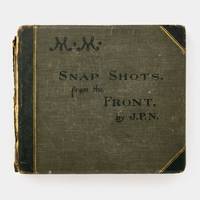
[Boer War]. NORWELL, James Proctor
Snap Shots from the Front by J.P.N. cover title of an album of Boer War photographs
First Edition. Hardcover. Very Good. An album 209 × 236 mm containing 199 gelatin silver photographs loosely inserted behind window mounts visible image size 51 × 77 mm four to a page on both sides of 25 card leaves; almost all of them have a small printed caption numbered 1-200 neatly trimmed and mounted on slips of paper loosely inserted in a small window below each photograph. One caption is in pencil a handful don't have captions; some have additional information supplied in pencil; there are numerous dates from Number 1 to 156 5 February to 13 October 1900 and Number 191 is dated 3 January 1901. Nine photographs between numbers 9 and 44 are out of order but all are present; number 111 is the only blank space in the album. Contemporary half leather and cloth worn at the corners with the spine broken and lacking sections; album broken near the centre damaging two window mounts easily repaired; all blemishes are confined to the album and the contents are in excellent condition. The album was compiled by a Dundee volunteer 8934 Private James Proctor Norwell 1st Volunteer Battalion Royal Highlanders Black Watch; the commanding officer was 7727 Lieutenant Alistair Valentine. The first dozen starting with '1. Cleaning Rifles. Perth Ranges' in the snow were taken before Cape Town was reached. The rest were taken in the field; apart from photographs of Indigenous people mainly Basutos and rough camp life there are many graphic images of battle and its aftermath: '15. Cronje's Guns captured at Paardeberg'; '18. An Officer's Funeral'; '33. Group of 1st Section two members of which have since died'; '40. Stretcher Bearers ready for Service'; '61. Preparing for Action - pipes and drums to the rear'; '64. Bringing in Boer Prisoners'; '68. Hector Macdonald giving Orders to carry the Position at Retief's Nek'; '73. Sniping from behind Ant Heap'; '104. Lieutenant Valentine's Mess Room Valentine Kop'; '117. Bringing the Guns into Action Retief's Nek'; '120. Resting after taking Honing Kop'; '124. The Fate of a Spy' and '168. His Last Day' both gallows scenes; '126. Kaffir Prisoners'; '130. Boer Commando in Kroonstadt'; '137. Lieutenant Smith - wounded at Retrief's sic Nek'; '153. Hector and his Staff entering Heilbron'; '159. Boer Prisoners at Schoolhouse De Aar'; '184. One of the 1st V.B.R.H. after 13 months' campaign'; and '192. Cookhouse and Mess Room Swaartlaagte'. Two on the last page are captioned 'St. Vincent - on our way home'. hardcover
Referenz des Buchhändlers : 135819
|
|
|
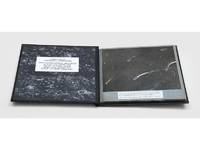
WORLD WAR II - Photo-reconnaissance
A stunning selection of images taken by photo-reconnaissance squadrons of RAF 106 Group and US 7th Photo Group over enemy and enemy-occupied territory.
May-July 1944. Eyes over Normandy - the Reich in ruins Taken between February and July 1944 these remarkable large-scale images portray major operations against Axis infrastructure and the preparations for and execution of the Allied invasion of Europe. This is a well-curated selection in terms of both subject matter and size and quality of the prints. We have traced one other copy in institutional libraries at the Library of Congress donated by General Carl Spaatz commander of Strategic Air Forces in Europe in 1944. The shots gathered here include the bombing of Berlin "vast areas of Berlin in ruins"; the destruction of aircraft factories at Limoges Gotha Leipheim and Marienburg and of the railway marshalling yards around Paris; 14 images relate to the D-Day landings and the operations immediately following including landing craft protected by war ships off the coast and at the beaches temporary harbour with "breakwater which consists of Merchantmen and old warships anchored in a continuous line while special pontoon sections make up another and also piers and jetties"; Horsa and Hamilcar gliders at Caen; the bombardment of Caen; Tirpitz at her moorings in Kaafjord; oil refineries at Hamburg in flames; 13 images relating to the V Weapons project: Bois Carré the first V1 launch site to be identified before and after bombing; a V1 in the air pursued by a Hawker Tempest photographed from an American Lockheed Lightning; attacks on the V2 site at the "La Coupole" bunker complex at Wizernes and "the massive concrete structure at Mimoyecques. probably connected with Germany's V.2 rocket weapon" but which was actually intended to house a battery of V-3 cannons the "London Gun" supergun the site was put out of commission by 617 Squadron - "The Dambusters" - with 11900lb Tallboy bombs. A full listing of the photos is available on request. Contemporary landscape quarto post-backed album 288 x 367 mm black sand-grain cloth black marbled paper pastedowns. Containing 54 large-format original photographs 200 x 230 mm to 230 x 330 mm mounted on 27 leaves of heavy grey paper stock all with detailed typed captions giving location details of the events portrayed and in most cases date aircraft crew and height. Calligraphic title page. Binding lightly rubbed the mount leaves lightly rippled but the attached plates in excellent state; overall very good indeed. hardcover
Referenz des Buchhändlers : 150498
|
|
|
(Vietnam War) McGrath, Lieutenant Commander John M
Prisoner of War Six Years in Hanoi
Annapolis MD: Naval Institute Press 1975. First edition. 114 pp. illustrated throughout with black and white sketches by the author. 1 vols. Oblong 8vo. Decorated green faux-leather with title in gilt on cover and spine. Fine in a very good dust jacket. First edition. 114 pp. illustrated throughout with black and white sketches by the author. 1 vols. Oblong 8vo. LCDR John M. McGrath was a young Navy pilot in 1967 when he was shot down over Vietnam. His remarkable and moving chronicle of survival and the torture and brutality suffered at the hands of his captors is illustrated with stark black and white drawings by the author who was a self-taught artist. Inscribed on the free front end paper to: "Jan & Marcy - Thanks for helping me make this book a reality. The book is beautiful - it couldn't have been done without your interest and support. It's great to be home! Warmest regards Mike McGrath." With a an accompanying original signed pen and ink sketch by the author dated 10-14-75 and titled: "Greetings from Monterey California." Inscribed by the Author. <br/><br/> Naval Institute Press hardcover
Referenz des Buchhändlers : 371379
|
|
|
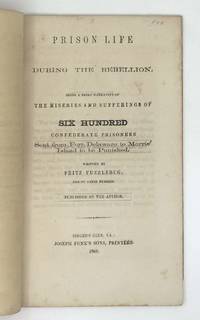
(Civil War) [Dunkle, John J]
Prison Life during the Rebellion. Being a Brief Narrative of the Miseries and Sufferings of Six Hundred Confederate Prisoners Sent from Fort Delaware to Morris' Island to be Punished. Written by Fritz Fuzzlebug one of their number. Published by the Author
Singer's Glen VA: Joseph Funk's Sons Printers 1869. First edition. 48pp. 8vo. Publisher's wrappers minor soiling and spotting ads on the rear wrapper. First edition. 48pp. 8vo. Lieutenant John J. Dunkle's sharply-worded account of his time spent in the Union prison on Morris Island South Carolina as part of the "Immortal Six Hundred" a group of Confederate officers held towards the end of the war 1864-65. Written in part to counter accounts of the sufferings of Union POWs in Confederate prisons Nevins describes it as "an early example of Southern-style prison propaganda; basically a diatribe against Union officers and Negro guards." Writing as the improbably-named Fritz Fuzzlebug Dunkle begins with a brief account of the events leading up to their capture and imprisonment at Fort Delaware and the plan to transfer them to the recently Union-occupied Morris Island. Dunkle includes a list of all six hundred Confederate officers by state including their name rank place of capture and their hometown. He then describes the brutal steamship voyage and the extreme privation and abuse they suffered once they reached Morris Island. Dunkle estimates that at least a third of the six hundred died from disease and/or abuse while in custody though the actual number was closer to fifty. Howes D569; Nevins I p.190; Dornbush III 604 Joseph Funk's Sons, Printers unknown
Referenz des Buchhändlers : 370500
|
|
|
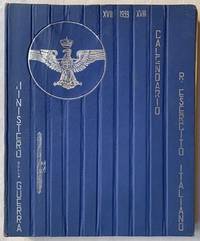
Ministero della Guerra
Calendario R. Esercito Italiano XVII 1939 XVIII
Roma: Ministero della Guerra 1939. Brossura wrappers. Ottimo Fine. Calendario corredato da numerosissime fotografie in bianco e nero di tutti i corpi militari e i reggimenti che componevano l'esercito italiano alla vigilia della II guerra mondiale disposte sulla sinistra della pagina che ha invece sulla destra una banda puntinata staccabile con due giorni per ogni pagina. Cm 275x225. pp. 300 c.ca n.n. Ottimo Fine. . Ministero della Guerra, unknown
Referenz des Buchhändlers : 237018
|
|
|
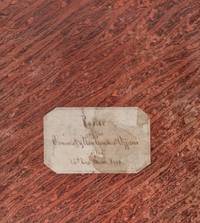
[Civil War] [Union] [26th Regiment Massachusetts Volunteers]
Folio manuscript. 1861-1864 Roster of Commissioned & Non Commissioned Officers of the 26th Regiment of the Massachusetts Volunteers
n.p.: n/a 1864. Ledger. Fair. Folio. Manuscript. Approx. 16" x 10.25". 192 hand numbered pages. Orangish marbled paper covered boards with leather corners and spine. A paper label with the hand written title is pasted down center on the front cover. Damp stains to the title label. Blue front and rear end sheets. Pages 106-192 blank. Dried water stains persist from the rear end sheets and back pages gradually diminishing by page 160. The rear cover is slightly warped. Front joint is split upper edge. <br /> <br /> The majority of the first 105 pages contain hand written names with rank date of commission discharge cause of vacancy for the Field Staff non commissioned staff; Captains First Lieutenants Second Lieutenants and non commissioned officers of Companies A-K. Page 6 has the written name at the top of Colonel Edward F. Jones first commander of the 26th Regiment. He was Commissioned August 1861 and discharged July 28 1862 on account of disability. Dates of records range from August of 1861 to June 1st 1864 with the majority of recorded dates in 1862 and 1863. The 26th Regiment saw action in the Gulf operations and New Orleans up until 1863. The unit later moved to Virginia and participated in Sheridan's Shenandoah Campaign. The unit mustered out in Savannah Georgia 1865. n/a unknown
Referenz des Buchhändlers : 34331
|
|
|
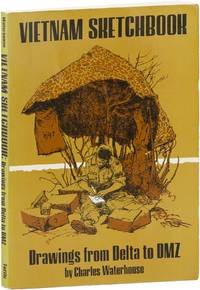
[VIETNAM WAR] WATERHOUSE, Charles
Vietnam Sketchbook: Drawings from Delta to DMZ
Rutland VT: Charles E. Tuttle Company 1968. First Edition. First Printing a trade paperback original. Octavo 21cm; pictorial card wrappers; 56-1262pp; illus. Gentle sunning to spine light wear to extremities else a clean Near Fine copy. Selections from the sketchbook of a US Marine of Iwo Jima fame each illustration captioned. 84567. Charles E. Tuttle Company unknown
Referenz des Buchhändlers : 84567
|
|
|
Ernesto Guerra Da Cal
Lua de alén-mar 1939-1958 galego
Editorial Galaxia S.A 1959. 21 cm. Vigo. Rústica ilustrada con solapas. Buen estado. 21 cm Editorial Galaxia, S.A paperback
Referenz des Buchhändlers : 27828
|
|
|
[REVOLUTIONARY WAR] HENRY, Patrick
Document signed by Patrick Henry and Thomas Meriwether certifying that the named individual is entitled to the proportion of land allowed a Private of the Continental line for three years service.
Council=Chamber January 19 1785. handsomely matted. Very fine condition. Approx. 3-1/2 x 5-1/2 inches . The printed date 1784 was altered in ms. to 1785. unknown
Referenz des Buchhändlers : 79297
|
|
|
CIVIL WAR QUARTERMASTER REPORTS
Seven printed documents completed in manuscript: Receipt for Issues List of Stores Received List of Quartermaster's Stores List of Clothing Camp and Garrison Equipage Abstract of Expenditures Monthly Return of Quartermaster's Stores and Forage.
Nashville and Gallatin Tennessee March 1865 - April 1866. Creased where folded; generally fine. Various sizes--letter to legal size. unknown
Referenz des Buchhändlers : 79425
|
|
|
[Cotton] [Florida] [Civil War] [Joshua L McGahagin]
1863 Long Swamp Florida letter by business man and Confederate officer Joshua L. McGahagin. Letter regards Cotton prices and domestic issues
Long Swamp Florida: n.p. 1863. Letter. Good. Manuscript letter written on blue paper. Approx. 10" x 8". 1 page of content. On the back side is written "J L McGahagin Seller Jany 25th 1863". Hand writing is difficult to read at times. Letter has multiple folds. The paper is in good condition with some small splits at the folds. Transcription below:<br /> <br /> Long Swamp Fla Jan 25th 1863<br /> Mr. H. L. Flast<br /> Dear Sir<br /> <br /> I received your letter with draft of $1500 on Maj Teasdale which I will not want to use at percent - 8 I was disappointed in getting the cotton at or near Wacahoota persons in that section have put is up to 45 cts I have about 15 Bales seed Cotton and 12 gined at Home. I will tomorrow to haul down more seed cotton which I think I will enough to make 20 Bales I went to Gainesville and got the draft of 1900 from Dawkins I will have to pay for cotton if I get any more at 'presant' I to pay 'presant' prices - I have not heard from the teacher as yet that you were to and we have an application from Miss Baker for a friends of hers and are waiting to hear from you let us hear soon<br /> <br /> Yours Respectfully signed J L McGahagin<br /> <br /> From find a grave dot com:<br /> <br /> His first wife Sarah Adeline Eubanks McGahagin 1830-1856 is buried on the north side of him. On his other side is his second wife Margaret Jane Leitner McGahagin 1838-1896. His brother William Emmit McGahagin and his brother’s wife Sarah Eliza McCormick McGahagin are buried about fifteen feet south of J.L. McGahagin's tombstone.<br /> Joshua L. McGahagin was a farmer a saw-mill owner and owned real estate. He owned property in Brazil as well as in this country. He owned a sawmill on Lake Weir. He would barge logs across the lake take them by ox cart to the Ocklawaha River where they were barged to Jacksonville. He was a Captain in the Confederate Army.<br /> <br /> "Longswamp was the name applied to a large area which extended from the site of the present Belleview south and southwestward to the Withlacoochee River. A post office under Joshua L. McGahagin was established for this region on August 29 1846. Frequently the office was in the home of the postmaster and mail was carried by rider once each week."<br /> <br /> "In August of 1850 panic followed after finding an Indian camp nearby on the Withlacoochee. As all Indians were supposedly within a reservation in the Everglades wild rumors were circulated. On the McGahagin plantation log barricades were hurriedly erected and settlers from isolated homes rushed here for protection. But the alarm was unjustified. An intensive search disclosed only eleven Indians. These Indians were soon deported back to the Everglades."<br /> <br /> These excerpts were taken from a history of Marion County called "Ocali Country Kingdom of the Sun" by Eloise Robinson Mrs. Roy V. Ott and Louis Hickman Chazal.<br /> <br /> One day several years after the Civil War a man who had served under Joshua Lucas MaGahagin's C.S.A. command entered the home of his eldest son William "Billy" Emmit. He saw his father's framed photograph over the mantel and exclaimed "Why that's the Ole Warhorse!"<br /> <br /> Joshua left for South America in 1868 taking one of his daughters Lula with him. He was back in Marion County in 1870 as he was listed in the Census that year.<br /> <br /> After surviving the Civil War and a trip to Brazil spending hours on horseback Joshua died when he was thrown from a horse. n.p. unknown
Referenz des Buchhändlers : 34799

|
|
|
Guerra Jose Joaquin
Colombia; Constituciones de Colombia recopiladas y precedidas de una breve resea historica por Manuel Antonio Pombo
La Luz Bogota 1911. Two Volumes. Internally VG Set in slightly worn cloth backed decorated boards. From the collection of Professor Malcolm Deas 1941-2023 an Emeritus Fellow of St Antony's College Oxford and University Lecturer in the Government and Politics of Latin America 1966-2008 La Luz (Bogota) 1911 hardcover
Referenz des Buchhändlers : PJH55489
|
|
|
[Autograph Book] [England] [Miss Ethel E J Clarke] [World War I]
World War I English Sketch Autograph and Memory Book of Miss Ethel E. J. Clarke with original Art
40 Stationary Hospital Harfluer France/ Ward 8 St. John Military Hosp. Woking Surrey England: n.p. 1924. Autograph Album. Good. Oblong autograph album. Approx. 9" x 7.5". Album has dark colored soft padded leather covers with "Autographs" signed in gilt on the front cover. Leather dentelles inside. Decorative end sheets. The right front end sheet was mostly removed. Repaired. New dark blue mulberry paper spine added. Front and rear hinges repaired with tissue. The owner worked as a Nurse in the hospital ward at 40 Stationary Hospital Harfluer France and at Ward 8 St. John Military Hosp. Woking Surrey. Her inscription is written on the front paste down - "Miss Ethel E. J. Clarke "The Grove" 41 Moore St. Worcester." 56 pages of this album were used for original art inscriptions autographs and verse. 27 of the pages have illustrated with original art. One page has a cut out racist cartoon character of black children. Another page has a photograph of a soldier in uniform. The majority of the inscriptions and art work are dated 1918 and 1919. A handful of 1924 inscriptions located towards the back. No other dates recorded. Several inscriptions from soldiers include their home place and regimental unit inside. Some of the names regiments inscribed include: <br /> "L.C. Tearae "Tank Corps"; <br /> "Pte. R.C.J. Hervey 21035 23. Batt. Bisley Camp; <br /> Pte. B. Anderson South African Scottish Barracks Woking Surrey"; <br /> "Pte R. Patience 3rd South African Reft."; <br /> autographs from the 4th 38th 25th 42nd 50th Canadians in Ward 8 St. Johns Military Hospital Woking;<br /> "WE Ryan 22nd Australians"; <br /> "R.F.A. R.H.A. R.C.A. Sons of Guns" drawn by Dr. T. Stretton; <br /> "Best Wishes "From" Guardsman Duncan McVey 1st Batt. Grenadier Guards" with a photograph;<br /> a drawing titled "A Medical Armistice" at 40th Stationary Hospital. Harfluer France by Henry G. Bredle 324 Siege Battery R.G.A.;<br /> <br /> Several more names and places are recorded inside. Several of the original sketches are very good. The interior of the Album is in very good condition. This is a nice example of exceedingly scarce collection of autographs and art work from the World War I era. n.p. unknown
Referenz des Buchhändlers : 34920
|
|
|
[Mexican War] [Navy] [Pensacola, Florida] [W Conway]
1846 letter written aboard the U.S. Frigate Potomac from W. Conway based in Pensacola Florida. Letter addressed to his sister in Camden Goose river Maine
Pensacola 1846. Letter. Very good. Letter. Folded to make 4 pages. 1 page of content 2 blank pages 1 page with address and postal mark from Pensacola Florida dated August 20 1846. Letter addressed to "Dear Sister" and signed "W Conway". Multiple folds and some creasing and toning to the paper. Red wax seal left edge page 1. Small paper tear from opening the letter. Good condition. Letter content summarized:<br /> <br /> US Frigate Potomac. W. Conway Pensacola Florida writes to sister Camden Goose River Maine while involved in the Blockade of Vera Cruz. USS Potomac sailed w/ships Cumberland Missippy sic Princeton Falmouth Truxton Somers Reefer Bonito and Petrel to mouth of river Alvarado off of Veracruz. Describes bombardment: “…the Commodore made rig to get spring word the cable to bring the broadsides to bear on the fort at 6 PM the firing Commenced and Continued about 2 hours we didi not land the next day we got under weigh and came back to our anchorage. we are waiting for orders from Washington to Attack the Castle of St. Juan Ola Fort San Juan de Ulúa offshore opposite Veracruz. unknown
Referenz des Buchhändlers : 35410
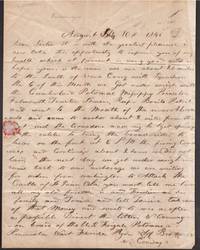
|
|

 Per e-mail erhalten
 Als pdf-Dokument herunterladen
 RSS feed
 Permanenter link


