|
|
|
HARRISON (Mark).
Le Guerrier Viking, 793-1066.
DelPrado/Osprey Publishing, 2004, gr. in-8°, 63 pp, 35 illustrations, 4 cartes et plans, 12 pl. d'illustrations en couleurs par Gerry Embleton, glossaire, biblio, couv. illustrée, bon état (Coll. Armées et batailles - Grandes Armées)
Referenz des Buchhändlers : 96267
|
|
|
HARDY de PÉRINI (Edouard).
Les Valois de 1515 à 1589. Etudes militaires historiques.
Genève, Slatkine-Mégariotis, 1977, in-8°, 462 pp, 86 gravures et cartes, reliure simili-cuir bleu foncé de l'éditeur, dos lisse avec pièce de titre carmin, titres dorés au 1er plat, bon état. Réimpression de l'édition de Paris, 1880
Referenz des Buchhändlers : 11281
|
|
|
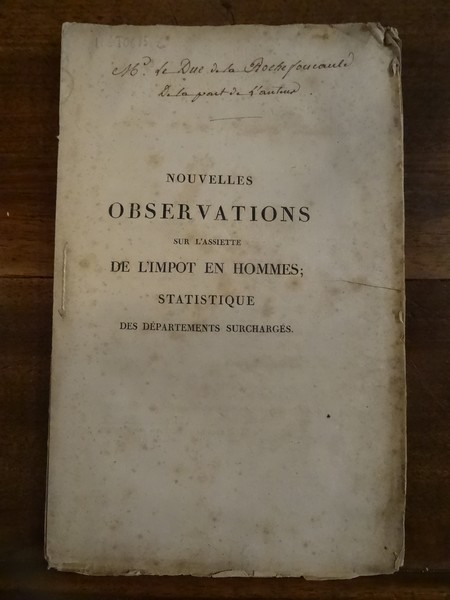
Hargenvilliers, Joseph d'.
Nouvelles observations sur l'assiette de l'impot en hommes; statistique des départements surchargés.
Sans lieu, Firmin-Didot, 1832. In-8, broché sans couverture, 46 pp. Envoi de l'auteur à Mr le Duc de La Rochefoucauld. Manque la couverture, nombreuses rousseurs.
Referenz des Buchhändlers : DEZ-3519
|
|
|
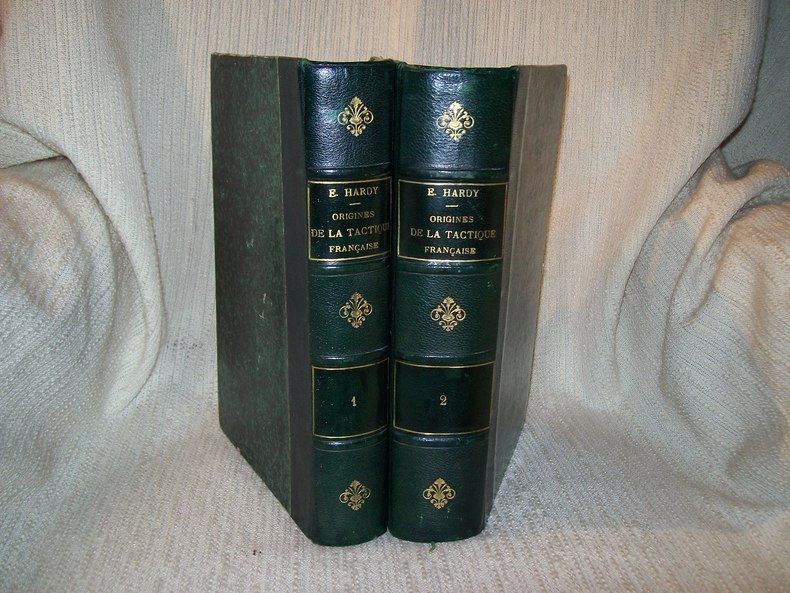
HARDY Capitaine
ORIGINES DE LA TACTIQUE FRANCAISE. Cours spéciaux de la réunion des Officiers.
Paris Librairie Militaire Dumaine 1879-1881. 2 volumes fort in-8 609pp, 810pp. Demi chagrin vert foncé, dos à 4 nerfs orné de filets et fleurons dorés, reliure de l'époque. Orné d'une vignette sur le titre ((différente pour chaque volume) et 281 figures dont 14 à pleine page: armes, types d'uniformes, cartes, plans de batailles, mouvements de troupes, portraits, le tout d'après des documents anciens. Manque angulaire sur le titre et l'avant-propos (Tome I), le faux-titre et le titre (Tome II) et en marge de la page 71 (Tome II) sans perte de texte. Bel exemplaire bien complet, reliure solide, en bon état et décorative.
Referenz des Buchhändlers : GITg719
|
|
|
HARDŸ DE PERINI (Edouard)
Origines de la tactique française. Les Batailles d'autrefois. Préface de M. Alfred Mézières
Paris, Plon, 1888 2 vol. grand in-8, [6]-609 pp. et [4]-810 pp., figures in-t., index, brochés. Quelques rousseurs et dos fragile avec un petit manque pour le T. II.
Referenz des Buchhändlers : 103187
|
|
|
HARDY (E.)
Origines de la tactique française. Les batailles d'autrefois.
Paris, Dumaine, 1879-1881 2 forts vol. gr. in-8, 609 pp. et 810 pp., index, ill. in-t., demi-chagrin vert, dos lisse, filets dorés (reliure de l'époque). Dos légt passé, trace d'étiquette de bibliothèque. Cachet (annulé).
Referenz des Buchhändlers : 182909
|
|
|
HARDY (E.)
Origines de la tactique française. Les batailles d'autrefois.
Paris, Dumaine, 1879-1881 2 forts vol. gr. in-8, 609 pp. et 810 pp., index, ill. in-t., demi-chagrin vert, dos à nerfs orné (reliure de l'époque). Qqs rousseurs.
Referenz des Buchhändlers : 196275
|
|
|
HARDŸ DE PERINI (Edouard)
Origines de la tactique française. Les Batailles d'autrefois. Préface de M. Alfred Mézières
Paris, Plon, 1888 2 vol. gr. in-8, 609 pp. et 810 pp., figures in-t., index, brochés. Dos fendu au tome I, manques de papier et mouillures à la couverture du tome II. Mouillures importantes dans le tome II. Ex-libris Jacques Jourquin.
Referenz des Buchhändlers : 223743
|
|
|
HARB AKADEMILERI.
Harb Akademilerinin 120 yili, 1848-1968. Seref dolu yillar.
Very Good English Paperback. Pbo. 4to. (30 x 21 cm). In Turkish. 174 p. B/w photos. A special catalogue for Turkish Military Academies. A corporate history that's prepared as annual basis. Harb Akademilerinin 120 yili 1848-1968. Seref dolu yillar.
|
|
|
Harbord, (James Guthrie)
Die Amerikanische Armee in Frankreich.
Berlin, Vorhut-Verlag Otto Schlegel, 1937.
Referenz des Buchhändlers : 230967

|
|
|
HARCLERODE Peter
Fighting Brigadier. The Life of Brigadier James Hill.
8vo., First Edition, with plates and maps; cloth, a near fine copy in unclipped dustwrapper. Written by an acknowledged airborne forces historian, this is the first major biography of the legendary airborne forces commander. Hill led 1 Para in North Africa, 9 Para, 3 Parachute Brigade (D-Day, Merville Battery, Rhine Crossing) and 1 Parachute Brigade.
|
|
|
Hardee, Brevet Lieut-Col W J Hardee (US Army) U S
Rifle and Light Infantry Tactics; For The Exercise and Maneuvers of Troops When Acting As Light Infantry or Riflemen. Vol. I. Schools of the Soldier and Company; Instruction for Skirmishes
J. B. Lippincott and Co. Collectible - Acceptable. Philadelphia PA: J. B. Lippincott & Co. 1861. 1st edition. Volume 1. 24mo hardcover. vi250pp. Illustrations. Poor book. Heavily shelfworn. Spine missing. Front board through page iv detached. Writing on endpapers. United States Army Infantry Tactics Inquire if you need further information. J. B. Lippincott and Co hardcover
Referenz des Buchhändlers : CA15B-00105
|
|
|
Harder, Hans-Joachim
Militärgeschichtliches Handbuch Baden-Württemberg. Hrsg. vom Militärgeschichtlichen Forschungsamt.
Stuttgart, Kohlhammer 1987. 387 Seiten. Leinen
Referenz des Buchhändlers : 107286

|
|
|
HARDY (de PERINI), Édouard
Origines de la tactique française. 2 vols.
Paris, Dumaine, 1879/81. 609; 810 S. Mit 281 Abbildungen im Text. Bibl.-Lwd (Titelblatt von Bd 2 fehlt).
Referenz des Buchhändlers : 3460956
|
|
|
HARGRAVE John
The Suvla Bay Landing. BRIGHT, CLEAN COPY IN UNCLIPPED DUSTWRAPPER
8vo., First Edition, with frontispiece, 35 plates on 22, and 16 maps and diagrams (a number full-page) in the text, small neat signature on front free endpaper; red cloth, backstrip lettered in silver, top and fore-edges spotted else a very good, bright, clean copy in unclipped dustwrapper, the latter lightly rubbed at extremities. 'The story of the IXth British Corps and of the whole Suvla landing would be incredible if it were not true' wrote Churchill in 'The World Crisis'. A veteran of Gallipoli, the author re-creates this tragic campaign with all the clarity of personal memory. Scarce, especially in this condition. Enser, p.343.

|
|
|
Hargrove, Marion
See here, Private Hargrove [by] Marion Hargrove; foreword by Maxwell Anderson
211 p. 21 cm. Hardcover Very good condition good
|
|
|
Harig, Ludwig (1927-2018)
Kalahari. Ein wahrer Roman. [signiert, signed].
Hanser Verlag, München, 2007. 212(2) Seiten, OPappband m. OU, datiert, gewidmet und signiert. ("Allerherzlichst für ... von Ludwig Harig 30.3.07"). Ein gutes Exemplar. Selten. Very rare. Good copy, signed by the author. Das Buch stammt aus der Bibliothek eines Autographensammlers.
Referenz des Buchhändlers : 14043

|
|
|
Harig, Ludwig (1927-2018)
Und wenn sie nicht gestorben sind. Aus meinem Leben. [signiert, signed].
Hanser Verlag, München, 2002. 359(1) Seiten, OLeinen m. OU, vom Autor gewidmet, datiert und signiert. Ein gutes Exemplar. Selten. Very rare. Good copy, signed by the author. Das Buch stammt aus der Bibliothek eines Autographensammlers.
Referenz des Buchhändlers : 14008

|
|
|
Harig, Ludwig (1927-2018)
Weh dem, der aus der Reihe tanzt. Roman. [signiert, signed].
Hanser Verlag, München, 1990. 271(1) Seiten, OLeinen m. OU, vom Autor gewidmet, datiert und signiert. Ein gutes Exemplar. Selten. Very rare. Good copy, signed by the author. Das Buch stammt aus der Bibliothek eines Autographensammlers.
Referenz des Buchhändlers : 14007

|
|
|
Harm-Peer Zimmermann
Der feste Wall gegen die rote Flut Kriegervereine in Schleswig-Holstein 1864 - 1914
Neumünster, Wachholtz, 1989. 24 cm 841 S., Status nach VGG: vergriffen, Weitere Produktfotos erhalten Sie gerne auf Nachfrage. Sorgfältiger Versand in sicherer Verpackung. Schneller und zuverlässiger Kundenservice für alle Fragen und Anliegen. (Due to EPR, there is currently no delivery to these EU-countries: BG, CY, CZ, DK, EE, ES, FI, GR, HR, HU, IE, LT, LU, LV, MT, PL, PT, RO, SE, SI, SK).. kart.
Referenz des Buchhändlers : SH40943
|
|
|
Harms, Jürgen
Leerjahre : eine Jugend unter Hitler und Stalin.
Wien : Verl. für Gesellschaftskritik, 1994. 211 S. ; 22 cm Okart.
Referenz des Buchhändlers : 30060
|
|
|
Harnack, Wolfgang (Verfasser) und Manfred (Verfasser) Mittelstedt
Küstenminensuchboot, Minenjagdboot Cuxhaven.
Hamburg : Koehler, 2001. 128 S. : Ill. OPp., gebundene Ausgabe.
Referenz des Buchhändlers : 177746

|
|
|
HARPER Stephen
Last Sunset. NEAR FINE COPY IN UNCLIPPED DUSTWRAPPER
8vo., First Edition, with plates; red cloth, gilt back, a near fine copy in unclipped dustwrapper. Largely first-hand account of the british Army in Aden.

|
|
|
HARRIS H.
Famous Regiments. The Royal Irish Fusiliers. (The 87th and 89th Regiments of Foot). [Introduction by Lt. Gen. Sir Brian Horrocks].
8vo., First Edition, with numerous illustrations in the text; cloth, gilt back, a near fine copy in unclipped dustwrapper. Published in Cooper's concise Famous Regiments series edited by Lt.-General Sir Brian Horrocks. Sutcliffe, p.412.
|
|
|
Harris, Henry
Model Soldiers. Auf englisch !
London, Octopus Books, 1972.
Referenz des Buchhändlers : 14005

|
|
|
Harris, Robert
Vaterland : Thriller / aus d. Engl. von Hanswilhelm Haefs.
München : Heyne, 2000. 377, [5] S. : Kt. 8°. Dt. Ausg. - 25. Aufl. OKt. (Tb). (Heyne ; 8902 : allgemeine Reihe)
Referenz des Buchhändlers : 40554
|
|
|
Harris, Stephen J.
Canadian Brass: The Making of a Professional Army, 1860-1939
269 pages. Index. Footnotes. "Reveals much about Canada's military and political development up to 1939, as well as exposing the shaky foundation on which was built the Canadian army's waging of the Second World War." - dust jacket. Above-average but not excessive wear. Usual library markings. A worthy reference copy. Book

|
|
|
Harrod-Eagles, Cynthia
Fleur - zwischen den Fronten / aus d. Engl. von Heidi Lichtblau...
[Augsburg] : Bechtermünz, 2000. 543 S. 8°. Lizenzausg. OPpbd. ohne SU. (Die Kirow-Saga ; [2])
Referenz des Buchhändlers : 29627
|
|
|
HART (Colonel Charles J.)
The History of the 1st Volunteer Battalion The Warwickshire Regiment and its Predecessors: The Birmingham Independent Volunteers, 1782; The Birmingham Loyal Association, 1797; The Loyal Birmingham Volunteers, 1803.
First edition, 4to, 389pp., coloured frontispiece and 4 further coloured plates, 28 plates, folding coloured map, orig. publishers regimental two-tone cloth, lettered in gilt, minor wear to head and foot of spine.
|
|
|
HART Colonel Charles J.
The History of the 1st Volunteer Battalion The Royal Warwickshire Regiment and its Predecessors: The Birmingham Independent Volunteers, 1782; The Birmingham Loyal Association, 1797; The Loyal Birmingham Volunteers, 1803. AUTHOR'S PRESENTATION COPY
4to., First Edition, with coloured frontispiece, 4 coloured plates, 28 monochrome plates on 22 and folding coloured map; original regimental cloth in blue and red, title and regiment badge blocked in gilt on upper cover, gilt back, gilt top, black endpapers, covers mildly age-soiled else very good, bright, crisp copy. A PRESENTATION COPY FROM THE AUTHOR WITH HIS LONG UNSIGNED HOLOGRAPH INSCRIPTION DATED OCTOBER 1914 ON HALF-TITLE. The author and the recipient served together in the Birmingham National Reserve and Recruiting Office. Includes three coloured plates of uniforms and two of medals. SCARCE. Sutcliffe, p.54; White, p.218.

|
|
|
HART Peter
To the Last Round. The South Notts Hussars 1939-1942. NEAR FINE COPY IN UNCLIPPED DUSTWRAPPER
8vo., First Edition, with photographs and maps in the text; cloth, gilt back, a near fine copy in unclipped dustwrapper. Includes detailed coverage of KNIGHTSBRIDGE and ROH

|
|
|
Hart, H. G.
The New Annual Army List for 1849 (Being The Tenth Annual Volume) containing the dates of commissions, and a statement of the war services and wounds of nearly every officer in the army, ordnance, and marines corrected to 28th December 1848
Armorial bookplate of Major General Edward Blagden Hale on front pastedown. Back cover loose, front cover still attached but weak. Pages from 549 to end almost loose also. Page edges greyed. All other text pages still firmly bound.
|
|
|
Hart, Liddell
COLONEL LAWRENCE The Man Behind the Legend
Front hinge cracked. Spine dulled and dampstained. Tear to head of spine cloth (strip 1 cm). Shelfwear. ; 382 pages
|
|
|
Harte, Bret
Argonauten-Geschichten.
Halle, Verlag von Otto Hendel, o. J. XI + 327 S. Kl.-8° Klein-Oktav, Leinen
Referenz des Buchhändlers : 81890

|
|
|
Harteneck, Gustav
Der letzte Reiter-Großverband der Kriegsgeschichte.
o. O., o. J. circa, 1975. mit fot. Abb. OBrosch., 104 S., 8°
Referenz des Buchhändlers : 14487

|
|
|
Hartink, A. E
Gewehre Enzyklopädie : Büchsen aus aller Welt.
Karl Müller Verlag, 2002. 316 S. : zahlr. Ill., 24 cm. Bibliothekseinband, gebundene Ausgabe.
Referenz des Buchhändlers : 238151

|
|
|
Hartink, A.E
Militär-Gewehre. Enzyklopädie.
Eggolsheim, Dörfler Verlag um, 2003. gebundene Ausgabe
Referenz des Buchhändlers : 19580

|
|
|
Hartink, A.E
Militärgewehre-Enzyklopädie.
Eggolsheim, Dörfler Verlag um, 2003.
Referenz des Buchhändlers : 70882

|
|
|
Hartmann, Franz
Geschichte des vorpommerschen Feldartillerie-Regiments Nr 38; 1899-1919 nur Band 1. Hrsg. Unter Mitwirkung ehemaliger Regimentsangehöriger bearbeitet von Franz Hartmann, Teil von: Deutsche Bücherei (Leipzig): Weltkriegssammlung
Stettin : F. Hessenland 1926. IX, 295 S. : Mit zahlr. Abb. [Taf.], +++ die 3 Karten fehlen +++ u. 33 Skizzen im Text gebundene Ausgabe, Leinen, leichte Gebrauchsspuren am Einband, sonst guter Zustand
Referenz des Buchhändlers : 30926

|
|
|
HARTMANN, J
Erinnerungen eines deutschen Offiziers 1848 - 1871. 1. Theil: Aus zwei annectierten Ländern. 2. Theil: Per aspera ad astra. 2 Bde. 2. Aufl.
Wiesbaden: Bergmann 1885. X, 338/ VI, 307 S. Ln. *ExLibris, gutes Expl.* Bd 1: Rücken im Kapital mit kleinem Einriss*.
Referenz des Buchhändlers : 3916
|
|
|
Hartmann, Julius
Erlebtes aus dem Kriege 1870/71, 1. Auflage,
Wiesbaden, Verlag von J. F. Bergmann, 1885. VIII, 248 Seiten, 8°, braunes Hldr auf 4 Bünden mit goldenem Rückentitel
Referenz des Buchhändlers : 63511
|
|
|
HARTMANN, Julius
Meine Erlebnisse zu hannoverscher Zeit. 1839 - 1866.
Wiesbaden: Bergmann 1912. V, 282 S.+ 1 gef. Kt. *Der Verf. (General-Ltn.) erzählt in "novellistischer Form" selbsterlebtes (Langensalza) Gr 8° Ln.
Referenz des Buchhändlers : 28561
|
|
|
Hartmann, Uwe
Carl von Clausewitz : Erkenntnis, Bildung, Generalstabsausbildung.
München : Olzog, 1998. 176 S. : graph. Darst. ; 24 cm broschiert
Referenz des Buchhändlers : 51991
|
|
|
Hartung, Harald (1932)
Der Tag vor dem Abend. Aufzeichnungen. [signiert, signed].
Wallstein Verlag, Göttingen, 2012. 160 Seiten, OPappband m. OU, vom Autor gewidmet, datiert und signiert. ("Für ... Harald Hartung 12.11.2013"). Ein gutes Exemplar. Selten. Very rare. Good copy, signed by the author. Das Buch stammt aus der Bibliothek eines Autographensammlers.
Referenz des Buchhändlers : 14025

|
|
|
Hartung, Hugo
Die Potsdamerin : Roman.
Berlin [u.a.] : Dt. Buch-Gemeinschaft [u.a.], [1980]. 270 S. 8°. Lizenzausg. OLwd mit Rückengoldpräg. u. SU.
Referenz des Buchhändlers : 9633
|
|
|
Hartwig, Jürgen, und Albert Wimmel
Wehrerziehung und vormilitärische Ausbildung der Kinder und Jugendlichen in der DDR.
Stuttgart-Degerloch: Seewald, 1979. Bd 14: Militärpolitik. 207 S. 8°. OKt. (Tb). (Schriftenreihe der Studiengesellschaft für Zeitpropbleme ; 14)
Referenz des Buchhändlers : 46021
|
|
|
Harvest; (Torrans, Dick; Kerr, Ed - Keyboard arrangement) Williams, Jerry; Lamb, Brent; Kerr, Ed
Harvest - Send Us Up to the World (4683 Artist Folio) - Songbook with Sheet Music for Piano and Voice with Chords
40 pages. Songs include: The Blood of the Lamb; If We Don't Believe; Jehovah Is Our Deliverer; Holy is the Lord; Army of the Lord; Holy Lamb; I Will Worship the Lord; Search Me, O God; Forever in Paradise; I Am The Lord. Above-average wear. Opening at bottom of coverfold. Prior owner names inside front cover. Pencil markings to contents. A worthy copy of this treasured compilation. Book

|
|
|
Harvey, Frank
Air War - Vietnam,
New York, Bantam Books, 1967. 8°, 185 S. mit 16 Tafelseiten mit s/w-Abbildungen, Text: englisch, farbig illustr. original Kartonage (Paperback), 2. Auflage Vorderdeckel mit Knickspuren, untere Ecke des Rückdeckels mit Knickspur, sonst schönes, sauberes Exemplar.
Referenz des Buchhändlers : 19296CB

|
|
|
Harvey, Frank
Bomben auf Vietnam - Der Luftkrieg in Vietnam in einem Dokumentarbericht von allen Brennpunkten des Kampfes, aus dem Amerikanischen von Wulf Bergner,
München, Heyne Verlag (= Heyne Sachbuch 45), 1968. 8°, 172 S. mit 6 Tafelseiten mit s/w-Abbildungen und Karten, farbig illustr. original Kartonage (Paperback), deutsche Erstausgabe Buchrücken ein wenig nach innen gewölbt, Einband leicht berieben, Vorderdeckel mit kleiner Haarlinie, unkenntlich gemachter Besitzervermerk auf Rückdeckelinnenseite, sonst schönes, sauberes Exemplar.
Referenz des Buchhändlers : 24006CB
|
|
|
HASE, Georg von.
"La Bataille du Jutland vue du ""Derfflinger"". Souvenirs anglo-allemands d'un officier de marine allemand."
Payot. 1922. In-8. Broché. Etat d'usage, Couv. convenable, Mors fendus, Intérieur frais. Paris, Payot, 1922, in 8, broché, 188 pp.. . . . Classification Dewey : 359-Marine militaire
Referenz des Buchhändlers : R300262757
|
|
|

 Per e-mail erhalten
 Als pdf-Dokument herunterladen
 RSS feed
 Permanenter link


