Camp Wadsworth Spartanburg S.C.: U S Army 1918. The interior is clean. Soiling and wear along the edges. The front cover has a horizontal closed tear midway across the drawing. 40 pages. The Modern Dscus Thrower on the front. Paperback. Fair. 4to - over 9¾" - 12" tall. Newspaper. U S Army Paperback
Camp Wadsworth Spartanburg S.C.: U S Army 1918. The interior is clean. Soiling and wear along the edges. 32 pages. Infantry on the front. A baby hanging from a scale in a white towel reading the Infantry Drill Regulation Manual. Paperback. Good. 4to - over 9¾" - 12" tall. Newspaper. U S Army Paperback
Camp Wadsworth Spartanburg S.C.: U S Army 1918. The interior is clean. Soiling and wear along the edges. 32 pages. "A Little Close Order Work" on the front. Paperback. Good. 4to - over 9¾" - 12" tall. Newspaper. U S Army Paperback
2022. Leather Bound. New. Size: 19.68 x 24.13 cms Presenting an Exquisite Leather-Bound Edition expertly crafted by the prestigious organization “Rare Biblio” with Original Natural Leather that gracefully adorns the spine and corners. The allure continues with Golden Leaf Printing that adds a touch of elegance while Hand Embossing on the rounded spine lends an artistic flair. This masterpiece has been meticulously reprinted in 2022 utilizing the invaluable guidance of the original edition published many years ago in 1945. The contents of this book are presented in classic black and white. Its durability is ensured through a meticulous sewing binding technique enhancing its longevity. Imprinted on top-tier quality paper. A team of professionals has expertly processed each page delicately preserving its content without alteration. Due to the vintage nature of these books every page has been manually restored for legibility. However in certain instances occasional blurriness missing segments or faint black spots might persist. We sincerely hope for your understanding of the challenges we faced with these books. Recognizing their significance for readers seeking insight into our historical treasure we've diligently restored and reissued them. Our intention is to offer this valuable resource once again. We eagerly await your feedback hoping that you'll find it appealing and will generously share your thoughts and recommendations. Lang: - English Pages:- 71. If it is a multi-volume set then it is only a single volume. Product Disclaimer: Kindly be informed that owing to the inherent nature of leather as a natural material minor discolorations or textural variations may be perceptible. Explore the FOLIO EDITION 12x19 Inches: Available Upon Request. Please Note:- 3 Map Blur hardcover
Army Map Service. Collectible - Acceptable. Washington D.C.: War Dept. Army Map Service 1944. 1st edition. 8vo paperback. xvi462pp. Map folded map at rear. Poor book. Ex-Library. Library of Congress stamps on front cover. Backstrip and rear cover missing. Cloth tabs added. Japan Gazetteers Inquire if you need further information. Army Map Service paperback
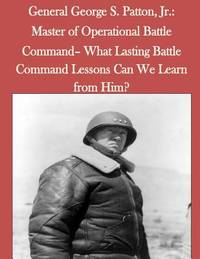
U.S.A.: CreateSpace Independent Publishing Platform 2015. Trade Paperback. Fine. 8 1/2" X 11. 60 Pages. No defects to this faultless book with flawless interior text pages. General George S. Patton Jr. was one of the most successful operational commanders during World War II. As the commander of the Third Army his units were instrumental in the defeat of German forces and their eventual unconditional surrender. General Patton was not only an operational artist but also a master of the art of Battle Command. Although the term Battle Command is relatively new in U.S. Army doctrine being first introduced in the 1993 edition of Field Manual 100-5 it has always been at the forefront of collective army thought. The art of Battle Command as executed by General Patton and many other commanders throughout history requires continual study to gain insight into the operational problems faced by these leaders and their eventual solutions. The purpose of this monograph is to show the importance of Battle Command and why it should continue to be studied. I Although there are many past commanders who have mastered the art of operational Battle Command this study focuses solely on General Patton. It will examine General Patton and his actions as the Third Army commander to gain insight for future operational commanders. Contents in 11 Chapters: Introduction Command and Control of Third Army General Patton and Leadership General Patton and Information Assimilation General Patton and Visualization General Patton and Conceptualization General Patton and Communication Three Great Lessons for Future Commanders Endnotes and Bibliography. Plus Three appendices: Third Army Organization Map of the Ardennes Campaign and Map of the Breakout in France. <br/> <br/> CreateSpace Independent Publishing Platform paperback
Bookseller reference : 16791 ISBN : 1511880341 9781511880343
United States. Army. Pacific Air Command 1946. 17 pp. paper wrappers extracted from larger bound volume & re-stapled library marking else good. - If you are reading this this item is actually physically in our stock and ready for shipment once ordered. We are not bookjackers. Buyer is responsible for any additional duties taxes or fees required by recipient's country. United States. Army. Pacific Air Command unknown
Washington: 1881. one side of one small octavo sheet as issued fine; one sentence that launched a thousand cases of the DTs at military posts across the country this was an unpopular order and it is duly noted that General Drum was issuing it at the command of General Sherman who was only acting on orders from President Hayes who may well have been acting on orders from his wife. - If you are reading this this item is actually physically in our stock and ready for shipment once ordered. We are not bookjackers. Buyer is responsible for any additional duties taxes or fees required by recipient's country. Washington: unknown
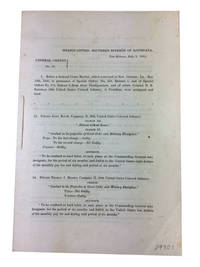
New Orleans 1865. Very Good. 9p. Tied softcover pamphlet. No separate wrapper. 21 cm. Modest spotting and soil. Colonel N. B. Bartram 20th U. S. Colored Infantry was President of this General Court Martial which convened on May 29 1865 and before which 22 soldiers appeared all but 3 of whom served in various the United States Colored Infantry -- one of the exceptions served in the 18th New York Cavalry and the other two served in the 1st New Orleans Volunteers. Charges ranged from Conduct to the Prejudice of Good Order and Military Discipline to Riotous and Mutinous Conduct. The sentence for the latter was that Private John F. Thompson be "confined at hard labor with ball and chain attached to his left leg weighing thirty-two 32 pounds chain two feet long . for the period of two years and forfeit . the whole of his monthly pay for and during the remaining and unexpired term of his enlistment." Two soldiers were found not guilty and two others facing multiple charges were found guilty of only some of the charges. All other soldiers were found guilty. An officer in the 1st New Orleans Volunteers was only given a reprimand after he used his sword to strike an enlisted man because of circumstances which are detailed at some length. Additionally page 7 includes the results of a separate military commision convened with Major M. Maloney as President on March 24 1865 to deal with three civilians -- all three were found not guilty. unknown
New York City France: United States Army 27th Division 1917. Presumed first edition/first printing thus. Wraps. Fair. Signed by previous owner. Two hole cloth bound binder. General Orders 1-33 # 16 absent for 1917. General Orders 1-40 111 120-125 128-129 132 134-140. A remarkable substantial set of WWI Divisional General Orders covering the Division for the time Major General John O'Ryan assumed command on July 25 1917 to General Order 140 of August 25 1918. This may have belonged to Major later Colonel John Tabor Loree who after the war was a senior official at the Delaware and Hudson Railroad. From Wikiepedia: "The 27th Infantry Division was a unit of the Army National Guard in World War I and World War II. The division traces its history from the New York Division formed originally in 1908. The 6th Division designation was changed to the 27th Division in July 1917. When the New York Division was organized in 1908 the New York National Guard became the second state after Pennsylvania to structure its National Guard at such a high tactical level in peacetime. The New York Division was called to active duty during the Mexican border crisis of 1916. While on federal duty it was redesignated as the 6th Division in June 1916. It was released from active duty in December 1916 only to be recalled for World War I service in July 1917. The 6th Division was reorganized and redesignated as the 27th Division on 1 October 1917.Called into federal service on July 15 1917 the Twenty-Seventh Division hastily recruited to increase its numbers and late in August was concentrated at Camp Wadsworth near Spartanburg SC for intensive training. In the spring of 1918 the division began its movement toward embarkation camps. The division s advance detachment left Hoboken on May 2 and arrived at Brest France May 10 1918. Until July 24 the division was in the final stages of training under British mentors in Picardy and Flanders. On July 25 the 27th Division occupied the Dickebusch Lake and Scherpenberg sectors in Flanders. The great Somme "push " lasting from September 24 to October 1 saw the 27th engaged in severe fighting along the Saint Quentin Canal Tunnel. Later the Twenty-Seventh Division was back into action again moving steadily toward Busigny. Major Operations: Meuse-Argonne only the artillery Ypres-Lys Somme offensive. Battle of Dickebusche Lake Summer 1918 Battle of Vierstratt Ridge Summer 1918 Hindenburg Line September 1918. Somme Offensive 25 September 1918 Selle River November 1918" United States Army, 27th Division hardcover
Washington DC: Government Printing Office 1918. Sixth Edition Revised to Include November 1 1917. Hardcover. Good. 203 pages. Fold-outs. Appendices. Index. 4 inches by 5.5 inches. Cover has some wear and soiling. Pencil erasure residue on fep. This manual addresses the Duties of the Signal Corps Disbursing Regulations Property Accountability Requisitions Supply Depot and Electrical Installations. This reflects the state of knowledge and state of practice during the period that the United States was actively engaged in overseas combat operations during the First World War. The United States Army Signal Corps USASC develops tests provides and manages communications and information systems support for the command and control of combined arms forces. It was established in 1860 the brainchild of United States Army Major Albert J. Myer and has had an important role from the American Civil War through to the current day. Over its history it had the initial responsibility for a number of functions and new technologies that are currently managed by other organizations including military intelligence weather forecasting and aviation. Government Printing Office hardcover

 Receive by email
 Download as PDF document
 RSS feed
 Permanent link