Aberdeen Proving Ground MD: United States Army Ordnance School 1958. Wraps. Good. No dust jacket as issued. Cover has some wear and soiling. i 70 p. Includes illustrations. Volume I only. This addressed German Special Rifles. This was a handout for use in Armament Courses. United States Army Ordnance School paperback
Washington DC: Headquarters Department of the Army 1971. TEST Draft issue. Wraps. Good. Various paginations approximately 270 pages. Illustrations. Diagrams. References. Equipment. Glossary. Index. Format is approximately 8.5 inches by 11 inches. Three-hole punched and Staplebound. Cover has some wear and soiling. This test field manual represents the state-of-knowledge state-of-practice and state-of doctrine for the U.S. Army toward the end of the Vietnam War. Equipment addressed reflect at an unclassifed level the current state-of-the-art in such technologies. S.T.A.N.O. represents Surveillance Target Acquisition and Night Observation. This is a real grouping of technology in our military. The type of equipment included in this grouping are night vision devices Intrusion detection devices man portable surveillance radar laser aiming ranging and detecting devices certain specialized optical systems such as stabilized optical monoculars and binoculars. The concept of S.T.A.N.O. evolved from a high tech solution for maximizing intelligence gathering efficiency while minimizing human risk. The term S.T.A.N.O. was first coined by General Westmoreland which represented his perspective of a specialized grouping of technological innovations pertaining to the electronic battlefield. The purpose of this manual was to provide the guidance required for the tactical planning employment and management of surveillance target acquisition and night operations STANO systems at division and lower echelons. STANO is an element of the Intelligence subsystem of the Integrated Battlefield Control System IBCS. The IBCS is the structural framework of personnelo organizations concepts doctrine and equipment integrating the functions of combat into a coherent system. This document is a field manual Test as defined in Army Regulation 310-3. There is no information that this was ever issued as an authorized field manual. This may have been superseded by Surveillance Target Acquisition Night Operations and Countersurveillance STANOC. United States Army Field Manuals are published by the United States Army's Army Publishing Directorate. As of 27 July 2007 some 542 field manuals were in use. They contain detailed information and how-tos for procedures important to soldiers serving in the field. Starting in 2010 the US Army began review and revision of all of its doctrinal publications under the initiative "Doctrine 2015". Since then the most important doctrine have been published in Army Doctrine Publications and Army Doctrine Reference Publications replacing the former key Field Manuals. Army Techniques Publications Army Training Circulars and Army Technical Manuals round out the suite new of doctrinal publications. Not all FMs are being rescinded; 50 select Field Manuals will continue to be published periodically reviewed and revised. Headquarters, Department of the Army paperback
Washington: GPO 1897. 54th Cong. 2nd Sess. HD 159 208 & 223 paper wrappers and brass pin bound five large folding maps tinted very good and unperused with text in ca. 20 pp. in all near very good . - If you are reading this this item is actually physically in our stock and ready for shipment once ordered. We are not bookjackers. Buyer is responsible for any additional duties taxes or fees required by recipient's country. Washington: GPO unknown
Washington DC: United States Department of Defense Department of the Army 1981. Presumed first edition/first printing. Wraps. Good. Some page soiling. Cover has some wear and soiling. Scuff on front cover. Includes: illustrations diagrams. Various pagination approximately 50 pages. References. This appears to be the initial version of this manual as there is no indication that it supersedes a previous issuance. This Field Manual is primarily a guide to hel the surveying officer understand the use of the Report of Survey RS DA Form 4697 in the accounting prodcedure that are used when Army property is lost damaged or destroyed. It also addresses the role of the surveying officer under the Report of Survey System. United States, Department of Defense, Department of the Army paperback
Washington DC: U.S. Government Printing Office 1982. Later printing. Supersedes FM 21-76 25 October 1957 including changes & FM 21-77 12 Nov. 1965. Wraps. Good. 431 1 pages. Illustrations some with color. Some wear and soiling to covers. Contains some copyrighted material. Includes Introduction; Part One Survival; Chapter 2 General; Chapter 3 Food and Water; Chapter 4 Firemaking and Cooking; Chapter 5 Survival in Cold Weather Areas Tropical Areas Desert Areas and Survival at Sea; Part 2 Evasion: Concept and Principles Short Range Evasion Long Range Evasion Assisted Evasion; Part 3 Escape; Capture Prisoner of War Camp Enemy Interrogation Enemy Indoctrination Escape from Prisoner of War Camp. Also includes an appendix with information on references wild plant food and poisonous snakes. Also contains index. United States Army Field Manuals are published by the United States Army's Army Publishing Directorate. As of 27 July 2007 some 542 field manuals were in use. They contain detailed information and how-tos for procedures important to soldiers serving in the field. Starting in 2010 the US Army began review and revision of all of its doctrinal publications under the initiative "Doctrine 2015". Since then the most important doctrine have been published in Army Doctrine Publications ADP and Army Doctrine Reference Publications ADRP replacing the former key Field Manuals. Army Techniques Publications ATP Army Training Circulars TC and Army Technical Manuals TM round out the new suite of doctrinal publications. Not all FMs are being rescinded; 50 select Field Manuals will continue to be published periodically reviewed and revised. They are usually available to the public at low cost or free electronically. Many websites have begun collecting PDF versions of Army Field Manuals Technical Manuals and Weapon Manuals. U.S. Government Printing Office paperback
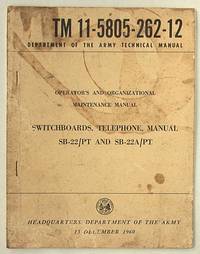
Washington: Department of the Army 1960. stapled wrappers. G. Good condition with covers quite soiled contents very good./No Jacket. Department of the Army Technical Manual TM 11-5805-262-12. Illustrated with black and white photographs and diagrams. Department of the Army unknown
Washington DC: Headquarters Department of the Army 1960. Soft cover. Good/No Dust Jacket. About 60pp. Illustrated with photos & drawings. Very cool. No doubt scarce. Size: 4to - over 9¾ - 12" Tall <br/> <br/> Headquarters, Department of the Army paperback
Washington DC: U.S. Army Headquarters 1996. Presumed First Edition First printing thus. Wraps. Good/No dust jacket issued. Three-hole punched and staplebound. Distribution Restriction--authorized to U.S. Government agencies only. Various paginations approx. 100 pages. Figures. Glossary. References. Index. Cover creased and has some wear and soiling. This manual establishes Army doctrine for operations in a nuclear environment and details the doctrine for integrating nuclear consideration into all other aspects of the battlefield. It also describes the Army's role in nominating tragets at corps and above levels and protecting the force from the effects of a nuclear weapons detonation. Nuclear employment in a theater of operations has theater strategic operational and tactical results; execution has national strategic implications. The corps' role is to function at either the tactical or operational levels of war. At the tactical level the corps accomplishes missions as Field Manual FM 199-15 describes. At the operational level when directed and augmented the corps functions as either the Army force ARFOR the joint force land component command JFLCC or a joint task force JTF. By viewing the corps in its many possible roles the reader can also discern nuclear procedures for echelons above corps EAC and joint missions. This manual can help educate and train commanders and staff at corps and operations levels in nuclear operations and educate and train divisions in nuclear force protection. It is used with Joint Publications JP 3-12.1 3-12.2 SRD or 3-12.3 and serves as the bridge between joint and Army doctrine. It is also uses with FM 25-50 which contains training doctrine for nuclear survivability. Among the topics addressed are: Nuclear Weapons; Joint Nuclear Doctrine; Deterrence Proliferation Weapons Effects Survivability Countermeasures Nuclear Operations Targeting Battlefield Operating Systems Nuclear Support Nuclear Tactics; Tactical Operations; Military Training; Nuclear Combat; Theater Nuclear; Nuclear Environment FM-100-30 Mobile Defense Command and Control Decision-Making Collateral-Damage and Troop Safety. A tactical nuclear weapon TNW or non-strategic nuclear weapon NSNW is a nuclear weapon that is designed to be used on a battlefield in military situations mostly with friendly forces in proximity and perhaps even on contested friendly territory. Generally smaller in explosive power they are defined in contrast to strategic nuclear weapons which are designed mostly to be targeted at the enemy interior far away from the war front against military bases cities towns arms industries and other hardened or larger-area targets to damage the enemy's ability to wage war. No tactical nuclear weapon has ever been used in a combat situation. Tactical nuclear weapons include gravity bombs short-range missiles artillery shells land mines depth charges and torpedoes which are equipped with nuclear warheads. Also in this category are nuclear armed ground-based or shipborne surface-to-air missiles SAMs and air-to-air missiles. Small two-man portable or truck-portable tactical weapons such as the Special Atomic Demolition Munition and the Davy Crockett recoilless rifle have been developed but the difficulty of combining sufficient yield with portability could limit their military utility. In wartime such explosives could be used for demolishing "chokepoints" to enemy offensives such as at tunnels narrow mountain passes and long viaducts. There is no exact definition of the "tactical" category in terms of range or yield of the nuclear weapon. The yield of tactical nuclear weapons is generally lower than that of strategic nuclear weapons but larger ones are still very powerful and some variable-yield warheads serve in both roles. Some tactical nuclear weapons have specific features meant to enhance their battlefield characteristics such as variable yield which allow their explosive power to be varied over a wide range for different situations or enhanced radiation weapons which are meant to maximize ionizing radiation exposure and to minimize blast effects. Tactical nuclear weapons were a large part of the peak nuclear weapons stockpile levels during the Cold War. U.S. Army Headquarters paperback
Washington DC: U.S. Army Headquarters 1971. Presumed First Edition First printing thus. Wraps. Good/No dust jacket issued. Three-hole punched and staplebound. Surviving Test manuals are increasingly rare. Stamp of G3 42d Inf. Div. on cover. Various paginations approx. 50 pages. Illustrations. References. Index. Cover has some wear and soiling. This test manual provides basic doctrinal guidance for tactical operations in a nuclear environment. Commanders and staff officers at all levels must understand and appreciate the effects of the nuclear environment on operations at brigade and lower levels and carefully consider them when planning each operation. This test manual discusses the characteristic effects of nuclear weapons on troops equipment organization and operations. It defines the role of the combat combat support & combat service support forces and discussed the specialized training requirements for conduct of operations in a nuclear environment. The material presented is applicable to operations in a nuclear war. It is directed primarily to operations at corps and lower levels. The basic considerations of division-level operations are essentially the same in all areas of the world. The doctrine contained herein should be applied in conjunction with FM 101-31-1 and FM 101-31-2. Tactical nuclear warfare is a conflict between the land forces and associated air and naval forces of two or more nations in which nuclear weapons are limited to the defeat of opposing forces in a theater of operations. Implicit in this definition is the condition that a strategic nuclear exchange on the belligerents' homelands does not occur. The material in this manual is specifically prepared for utilization in a conflict that meets this definition. A tactical nuclear weapon TNW or non-strategic nuclear weapon NSNW is a nuclear weapon that is designed to be used on a battlefield in military situations mostly with friendly forces in proximity and perhaps even on contested friendly territory. Generally smaller in explosive power they are defined in contrast to strategic nuclear weapons which are designed mostly to be targeted at the enemy interior far away from the war front against military bases cities towns arms industries and other hardened or larger-area targets to damage the enemy's ability to wage war. No tactical nuclear weapon has ever been used in a combat situation. Tactical nuclear weapons include gravity bombs short-range missiles artillery shells land mines depth charges and torpedoes which are equipped with nuclear warheads. Also in this category are nuclear armed ground-based or shipborne surface-to-air missiles SAMs and air-to-air missiles. Small two-man portable or truck-portable tactical weapons such as the Special Atomic Demolition Munition and the Davy Crockett recoilless rifle have been developed but the difficulty of combining sufficient yield with portability could limit their military utility. In wartime such explosives could be used for demolishing "chokepoints" to enemy offensives such as at tunnels narrow mountain passes and long viaducts. There is no exact definition of the "tactical" category in terms of range or yield of the nuclear weapon. The yield of tactical nuclear weapons is generally lower than that of strategic nuclear weapons but larger ones are still very powerful and some variable-yield warheads serve in both roles. Some tactical nuclear weapons have specific features meant to enhance their battlefield characteristics such as variable yield which allow their explosive power to be varied over a wide range for different situations or enhanced radiation weapons which are meant to maximize ionizing radiation exposure and to minimize blast effects. Tactical nuclear weapons were a large part of the peak nuclear weapons stockpile levels during the Cold War. U.S. Army Headquarters paperback
Fort Benning GA: United States Army Infantry School 1966. Presumed First Edition First Printing Thus. Wraps. Fair to good condition. Quarto wraps approximately 300 pages. Includes: illustrations maps glossary tables some fold-outs. Covers somewhat worn soiled and small creases; two small edge tears This handbook offers a fascinating snapshot in time during the Vietnam War. This handbook has been prepared by the Tactics Group Brigade and Battalion Operations Department United States Army Infantry School and was approved for resident and extension course instruction by the school. It reflected then current position of the school and conformed to established Department of the Army doctrine as closely as possible. The handbook consists of fourteen chapters and two appendices. United States Army Infantry School paperback
Fort Benning GA: United States Army Infantry School 1970. Presumed First Edition First Printing Thus. Wraps. Good condition. Quarto wraps approximately 300 pages. Includes: illustrations maps glossary color figures tables some fold-outs. Name of previous owner written on front cover. Minor tear approx. 1" on margin of first page. This handbook offers a fascinating snapshot in time during a very active phase of the Vietnam War. This handbook has been prepared by the Tactics Group Brigade and Battalion Operations Department United States Army Infantry School and was approved for resident and extension course instruction by the school. It reflected then current position of the school and conformed to established Department of the Army doctrine as closely as possible. The handbook consists of fourteen chapters and three appendices. United States Army Infantry School paperback
Washington DC: U.S. Government Printing Office 1958. This manual supersedes FM 3-5 1 September 1954 including C 1 12 February 1957. Wraps. Good. 144 pages. Illustrations. References. Conversion Factors. Index. Size is approximately 6.75 inches by 4.5 inches. Designation AGO 1979C is on front cover and last page. Small stain and pencil erasure residue at top corner of first page. This manual describes on an unclassified level the tactics and techniques for the employment of toxic chemical agents smokes and flame and weapons for their delivery which are now or potentially available to the field commander. U.S. Government Printing Office paperback

 Receive by email
 Download as PDF document
 RSS feed
 Permanent link