Hardcover. Good. Borderline Good/Very Good moderate wear and bumps pages lightly yellowed with some nicks creases minor blemishes binding firm. hardcover
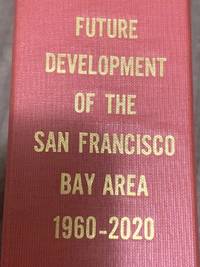
Statesville NC: Business and Defense Services Administration U.S. Dept. of Commerce. 1959. Book. Near Fine. Hardcover. 1st Edition. 4to - over 9¾. 1959 Future Development of the San Francisco Bay Area 1960-2020- Economic Aspects of Growth. Business and Defense Services Administration U.S. Dept. of Commerce Statesville NC. The set contains a reference volume explaining the research data and 23 folded maps. Most of the maps are 36"x 42" and have never been unfolded. The document "Future Development of the San Francisco Bay Area 1960-2020: Economic Aspects of Growth" provides a comprehensive survey of the economic aspects of the San Francisco Bay Area's development over the specified period. It includes detailed information on population growth employment and economic growth land for urban needs and the reclamation of marsh tide and submerged lands. The plan presents a decade-by-decade chart for growth management. Among the factors considered are land use population distribution freeway development employment and economic growth. The set is contained within a red buckram slip case 11.5"x9.75". This original complete set is in near fine condition. Business and Defense Services Administration, U.S. Dept. of Commerce. Hardcover
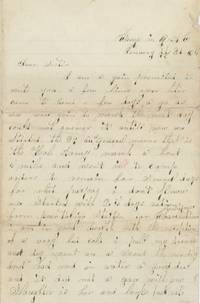
South Carolina 1865. Single letter measuring 7.5 x 10 inches folded one double-sided sheet with stampless envelope. Near fine with light normal wear. George Harpole Vannada 1844–1928 was a private promoted to corporal in Company I of the 25th Indiana Infantry Regiment during the Civil War. The 25th Infantry was a volunteer regiment mustered in August 1861 and mustered out in July 1865. At the time of Vannada’s writing the Regiment was involved in the Campaign of the Carolinas – led by General Sherman this campaign would culminate in the Army of the South’s unconditional surrender and effectively end the war.<br /> <br /> Vannada writes that his regiment had “started with 25 days rations from pocotaligo staton for i supose Charleston.†On the way they had encountered:<br /> <br /> “a few Johneys i.e. Confederates not far off i have heard sevrel cannons to day we will be botherd with them all the way to Charleston between here and Buford they had a fort a bout evry 3 miles they wood stop and fire a few shots and then get up a bug for the next fortâ€.<br /> By “Buford†Vannada probably means Beaufort South Carolina which had been occupied by Union forces since November 1861. At this point the Savannah area had been essentially a refugee camp for freed people for several years and Sherman’s Special Field Orders No. 15 which settled them in the nearby South Carolina Sea Islands—the “forty acres and a mule†order—came in response to their request for stewardship over the land. Vannada remarks on Sherman’s order:<br /> <br /> “Gen Foster has been on Buford Iland for 2 years and now Sherman has comand of his troops i think they will get off now this Iland they have to give to the Niggars to setle on that is all that have famlies 40 acre to the manâ€.<br /> <br /> Vannada also accurately forecasts despite the fact that “we don’t often get any papers here to see what is goin on†that there “is some talk of peace down here but i think it is sevrel months off yetâ€. unknown
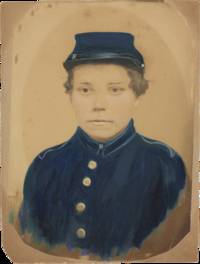
United States N.d. Overpainted albumen photograph measuring approximately 6 ¾ x 8 ½ inches mounted on heavy cardstock. Slight marginal wear; excellent to Near Fine. An overpainted albumen photograph portrait of an unknown Union Army soldier who appears to be quite young dressed in Union fatigues. Though boys under 18 were not supposed to be able to enlist many did so anyway with some estimating that around 200000 underage boys joined the Union Army all told.1 Despite General Order 73 which ordered that “no discharges will be granted to volunteers . on the grounds of minority†so many families tried to get their underaged sons back from the Army that the New York Times called it an “epidemicâ€2. Nonetheless the brave child drummer boy or soldier became an iconic image of the Union cause.1<br /> <br /> 1 Frances M. Clarke and Rebecca Jo Plante “Why the Union Army Had So Many Boy Soldiers†Smithsonian Magazine January 17 2023 https://www.smithsonianmag.com/history/why-the-union-army-had-so-many-boy-soldiers-180981458/.<br /> 2 “The Plea of Infancy an Epidemic†The New York Times August 27 1861 3. unknown
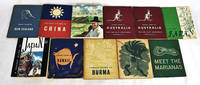
Special Services Division; Services of Supply; United State Army 1942. Paperback. Very Good. WWII Era Army Guides to Pacific Theater Nations: Notably including China 12 volumes. Softcover. Good binding and cover. Clean unmarked pages. Includes: A Pocket Guide to: 1. Hawaii 1944; 2. Burma 1943; 3. New Guinea 1943; 4. Japan 1960; 5. Japan 1950 ; 6. China 1942; 7. Meet the Marianas 1944; 8. New Zealand 1942; 9. Australia 2 copies 1942; 10. Korea 20-180 1962; 11 Viet-Nam Vietnam 1962. "Imagine being a young American soldier who has never left home before and finding yourself in a faraway country. Millions of US servicemen and women experienced this culture shock when they were stationed overseas during World War II. To assist in making the transition easier the United States military issued pocket guides which taught soldiers about the customs geography language and other cultural details of each country. Additionally these details were instrumental for the war effort. By learning about the terrain language and customs soldiers were better equipped to recognize and win against an enemy combatant. Knowing basic phrases could be the difference between life and death. Each guide was designed to fit in a soldier's back pocket and could be read during down time." - National World War II Museum. The China Pocket Guide includes 'How to Spot a Jap.' A series of cartoon panels illustrated by Milton Caniff. Special Services Division; Services of Supply; United State Army paperback

 Receive by email
 Download as PDF document
 RSS feed
 Permanent link