|
National Aeronautics and Space Administration (NASA) and Jet Propulsion Laboratory, California Institute of Technology
Voyager Bulletin: Mission Status Report No. 76 January 26 1986
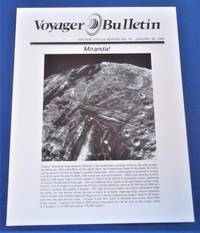
Pasadena CA: NASA and JPL 1986. Book. As New. Soft cover. First Edition. 4to - over 9¾" - 12" tall. This issue contains a single glossy sheet measuring 8-1/2" by 11" printed on both sides. With front cover headline "Miranda!" with photograph and description of Uranus' innermost large moon; two photographs of "Several moons newly discovered by Voyager 2"; and photograph and description of Oberon. In pristine condition. NASA and JPL Paperback
Bookseller reference : 005699
|
|
|
National Aeronautics and Space Administration (NASA) and Jet Propulsion Laboratory, California Institute of Technology
Voyager Bulletin: Mission Status Report No. 79 February 12 1986
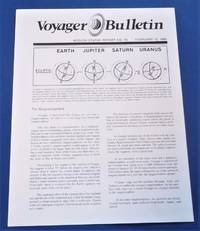
Pasadena CA: NASA and JPL 1986. Book. As New. Soft cover. First Edition. 4to - over 9¾" - 12" tall. This issue contains a single glossy sheet measuring 8-1/2" by 11" printed on both sides. Continues the discussion of Uranus with two topics: The Magnetosphere and The Rings. With a drawing that compares Uranus' rotational axis with Earth Jupiter and Saturn front side; and a photograph of the ring system to rear side. In pristine condition. NASA and JPL Paperback
Bookseller reference : 005702
|
|
|
National Aeronautics and Space Administration Jet Propulsion Laboratory
Voyager Encounters Jupiter
Pasadena CA: Jet Propulsion Laboratory 1979. good. Quarto 40 wraps profusely illus. most in color some soiling to covers. Jet Propulsion Laboratory paperback
Bookseller reference : 11502
|
|
|
National Aeronautics and Space Administration, Office of Public Information
Voyager Mission Pictures
Washington DC: GPO 1981. good incomplete set. Quarto 7 photos 7 color illus. measuring 8-1/2" x 11" in white envelope complete set contains 8 illus. envelope soiled & small tears. Slight wear to edges of a few photos. Composite photos and paintings printed on heavy card stock showing sites on Saturn and Jupiter to be viewed by Voyager. GPO unknown
Bookseller reference : 11494
|
|
|
National Aeronautics and Space Administration, Jet Propulsion Laboratory
Voyager--Journey to the Outer Planets. JPL SP 43-39
Pasadena CA: Jet Propulsion Laboratory c. 1976. good. Quarto 17 wraps profusely illus. in color tables rear cover scratched and somewhat soiled some wear to cover edges. Jet Propulsion Laboratory paperback
Bookseller reference : 45510
|
|
|
National Aeronauti Space Administration
Walking to Olympus - An Eva Chronology 1997-2011 - Volume 2 NASA Sp-2016-4550
Paperback / softback. New. paperback
Bookseller reference : A9781979381758 ISBN : 1979381755 9781979381758
|
|
|
National Aeronauti Space Administration
Walking to Olympus - An Eva Chronology 1997-2011 - Volume 2 NASA Sp-2016-4550
Paperback / softback. New. paperback
Bookseller reference : B9781979381758 ISBN : 1979381755 9781979381758
|
|
|
National Aeronautics and Space Administration
Walter Cronkite at the Reduced Gravity Simulator; NL-2009-06-019-HQ Image dated 8/13/1968
Washington DC: National Aeronautics and Space Administration 2009. Part of Apollo 40 years series. Photograph. Very good. Format approximately 8.5 inches by 11 inches. Image size is approximately 6 inches by 7.25 inches. The caption reads: Walter Cronkite at the Reduced Gravity Simulator During 1 1968 visit to Langley then-CBS News Anchorman Walter Cronkite tries out the Reduced Gravity Simulator a series of cable-supported slings designed to approximate the Moon's gravity one-sixth that of Earth's. The reduced gravity simulate was a practical system for simulating reduced and zero-gravitational fields such as would be encountered in space stations for determining the effects on the self-locomotive capabilities of man when subjected to a gravitational field less than that of the Earth for a sustained period of time. One of the unknowns of space exploration was the effect of sustained weightlessness experienced by the explorers during orbital flight. In addition the knowledge that the Moon has a reduced gravitational field equal approximately one-sixth to that of the Earth and the knowledge that reduced gravity as well as zero gravity or weightless conditions for sustained periods of time would be experienced by explorers during space exploration created a definite need for a suitable reduced gravity simulation technique for studies on Earth of mans ability to perform needed self-locomotive tasks during interplanetary exploration. The Apollo program also known as Project Apollo was the third United States human spaceflight program carried out by the National Aeronautics and Space Administration NASA which accomplished landing the first humans on the Moon from 1969 to 1972. First conceived during Dwight D. Eisenhower's administration as a three-man spacecraft to follow the one-man Project Mercury which put the first Americans in space Apollo was later dedicated to President John F. Kennedy's national goal of "landing a man on the Moon and returning him safely to the Earth" by the end of the 1960s which he proposed in an address to Congress on May 25 1961. Kennedy's goal was accomplished on the Apollo 11 mission when astronauts Neil Armstrong and Buzz Aldrin landed their Lunar Module LM on July 20 1969 and walked on the lunar surface while Michael Collins remained in lunar orbit in the Command/Service Module CSM and all three landed safely on Earth on July 24. Five subsequent Apollo missions also landed astronauts on the Moon the last in December 1972. In these six spaceflights twelve men walked on the Moon. Apollo ran from 1961 to 1972 with the first manned flight in 1968. It achieved its goal of manned lunar landing despite the major setback of a 1967 Apollo 1 cabin fire that killed the entire crew during a prelaunch test. After the first landing sufficient flight hardware remained for nine follow-on landings with a plan for extended lunar geological and astrophysical exploration. Budget cuts forced the cancellation of three of these. Five of the remaining six missions achieved successful landings but the Apollo 13 landing was prevented by an oxygen tank explosion in transit to the Moon which damaged the CSM's propulsion and life support. The crew returned to Earth safely by using the Lunar Module as a "lifeboat" for these functions. Apollo used Saturn family rockets as launch vehicles which were also used for an Apollo Applications Program which consisted of Skylab a space station that supported three manned missions in 1973-74 and the Apollo-Soyuz Test Project a joint Earth orbit mission with the Soviet Union in 1975. Apollo set several major human spaceflight milestones. It stands alone in sending manned missions beyond low Earth orbit. Apollo 8 was the first manned spacecraft to orbit another celestial body while the final Apollo 17 mission marked the sixth Moon landing and the ninth manned mission beyond low Earth orbit. The program returned 842 pounds 382 kg of lunar rocks and soil to Earth greatly contributing to the understanding of the Moon's composition and geological history. The program laid the foundation for NASA's subsequent human spaceflight capability and funded construction of its Johnson Space Center and Kennedy Space Center. Apollo also spurred advances in many areas of technology incidental to rocketry and manned spaceflight including avionics telecommunications and computers. National Aeronautics and Space Administration unknown
Bookseller reference : 74054
|
|
|
National Aeronautics and Space Administration Johnson Space Center
WB 57F Long Wing; NASA JSC
Houston TX: National Aeronautics and Space Administration Johnson Space Center c2010. Decal/Sticker. Very good. Decal/sticker with backing that can be removes so that adhesive side and be affixed to an appropriate surface. Oval shape approximately 6 inches in maximum length and 3 inches in maximum width. Center is an image of the aircraft looking down upon it. At the top of the oval is "WB" to the left of the aircraft nose and "57F" to the right. The letters "NASA" is over the left wing and the letters "JSC" are over the right wing. Under the left wing is the word "Long" and under the right wing is the word "Wing". The field is largely blue with a gold border. Lettering is in red white and gold. The NASA WB-57 Program provides unique high-altitude airborne platforms to US Government agencies academic institutions and commercial customers in order to support scientific research and advanced technology development and testing at locations around the world. Mission examples include atmospheric and earth science ground mapping cosmic dust collection rocket launch support and test bed operations for future airborne or spaceborne systems. The NASA Johnson Space Center JSC in Houston Texas is the home of the NASA WB-57 High Altitude Research Program. Three fully operational WB-57 aircraft are based near JSC at Ellington Field. The aircraft have been flying research missions since the early 1960's and continue to be an asset to the scientific community with professional reliable customer-oriented service designed to meet all scientific objectives. A decal or transfer is a plastic cloth paper or ceramic substrate that has printed on it a pattern or image that can be moved to another surface upon contact. The word is short for decalcomania which is the English version of the French word décalcomanie. The technique was invented by Simon François Ravenet an engraver from France who later moved to England and perfected the process he called "décalquer" which means to copy by tracing; it became widespread during the decal craze or mania of the late 19th century. A decal consists of the following layers from top to bottom: A paper or film facestock makes up the top layer of the label stock. The printing is done on the upper side of the facestock; An adhesive layer is applied to the bottom of the facestock; A silicone or release coating layer is applied to the upper side of the backing material; and A paper or film liner provides the bottom layer of the label stock.<br /> <br /> The Martin/General Dynamics RB-57F Canberra is a specialized strategic reconnaissance aircraft developed in the 1960s for the United States Air Force by General Dynamics from the Martin B-57 Canberra tactical bomber which itself was a license-built version of the English Electric Canberra. It was operationally assigned to the Air Weather Service for weather reconnaissance involving high-altitude atmospheric sampling and radiation detection in support of nuclear test monitoring but four of the 21 modified aircraft performed solely as strategic reconnaissance platforms in Japan and Germany. Three of the modified aircraft were destroyed with loss of their crews while performing operationally. The remainder were re-designated WB-57F in 1968. Four of the survivors were subsequently used by NASA for high-altitude atmospheric research. The others were retired from 1972 to 1974 and placed in storage. As of 2015 three WB-57Fs are the only B-57 aircraft model still flying in service with NASA.<br /> <br /> The WB-57 is a mid-wing long-range aircraft capable of operation for extended periods of time from sea level to altitudes well in excess of 60000 feet. Two crew members are positioned at separate tandem stations in the cockpit. The pilot station contains all the essential equipment for flying the aircraft. The sensor operator station contains both navigational equipment and controls for the operation of the payloads and payload support systems located throughout the aircraft. The WB-57 can remain aloft for approximately 6.5 hours flying both day and night so long as separation from hazardous weather can be maintained. With a range of 2500 miles the aircraft can be deployed to any continent. The WB-57 aircraft can carry up to 6000 lbs. of payload. The WB-57 employs a pallet system in the main fuselage area. The pallet system consists of interchangeable pallet modules. Pressurized and unpressurized pallets are available. The pallet system will carry a total of 4000 lbs. including pallet weight. Lighter payloads can also be carried in the aft fuselage tail cone wing pods wing hatches and/ or the nose cone. National Aeronautics and Space Administration, Johnson Space Center unknown
Bookseller reference : 80971
|
|
|
National Aeronautics and Space Administration, Johnson Space Center
WB 57F Long Wing; NASA JSC
Houston TX: National Aeronautics and Space Administration Johnson Space Center c2010. Patches. Very good. Oval shape approximately 5 inches in maximum length and 3 inches in maximum width. Center is an image of the aircraft looking down upon it. At the top of the oval is "WB" to the left of the aircraft nose and "57F" to the right. The letters "NASA" is over the left wing and the letters "JSC" are over the right wing. Under the left wing is the word "Long" and under the right wing is the word "Wing". The field is largely blue with a gold border. Lettering is in red white and gold. The NASA WB-57 Program provides unique high-altitude airborne platforms to US Government agencies academic institutions and commercial customers in order to support scientific research and advanced technology development and testing at locations around the world. Mission examples include atmospheric and earth science ground mapping cosmic dust collection rocket launch support and test bed operations for future airborne or spaceborne systems. The NASA Johnson Space Center JSC in Houston Texas is the home of the NASA WB-57 High Altitude Research Program. Three fully operational WB-57 aircraft are based near JSC at Ellington Field. The aircraft have been flying research missions since the early 1960's and continue to be an asset to the scientific community with professional reliable customer-oriented service designed to meet all scientific objectives. The Martin/General Dynamics RB-57F Canberra is a specialized strategic reconnaissance aircraft developed in the 1960s for the United States Air Force by General Dynamics from the Martin B-57 Canberra tactical bomber which itself was a license-built version of the English Electric Canberra. It was operationally assigned to the Air Weather Service for weather reconnaissance involving high-altitude atmospheric sampling and radiation detection in support of nuclear test monitoring but four of the 21 modified aircraft performed solely as strategic reconnaissance platforms in Japan and Germany. Three of the modified aircraft were destroyed with loss of their crews while performing operationally. The remainder were re-designated WB-57F in 1968. Four of the survivors were subsequently used by NASA for high-altitude atmospheric research. The others were retired from 1972 to 1974 and placed in storage. As of 2015 three WB-57Fs are the only B-57 aircraft model still flying in service with NASA.<br /> <br /> The WB-57 is a mid-wing long-range aircraft capable of operation for extended periods of time from sea level to altitudes well in excess of 60000 feet. Two crew members are positioned at separate tandem stations in the cockpit. The pilot station contains all the essential equipment for flying the aircraft. The sensor operator station contains both navigational equipment and controls for the operation of the payloads and payload support systems located throughout the aircraft. The WB-57 can remain aloft for approximately 6.5 hours flying both day and night so long as separation from hazardous weather can be maintained. With a range of 2500 miles the aircraft can be deployed to any continent. The WB-57 aircraft can carry up to 6000 lbs. of payload. The WB-57 employs a pallet system in the main fuselage area. The pallet system consists of interchangeable pallet modules. Pressurized and unpressurized pallets are available. The pallet system will carry a total of 4000 lbs. including pallet weight. Lighter payloads can also be carried in the aft fuselage tail cone wing pods wing hatches and/ or the nose cone. National Aeronautics and Space Administration, Johnson Space Center unknown
Bookseller reference : 80970
|
|
|
National Aeronautics and Space Administration, Johnson Space Center, WB-57 Program Office
WB-57; High Altitude Research Aircraft
Houston TX: National Aeronautics and Space Administration Johnson Space Center WB-57 Program Office c2010. Presumed First Edition First printing. Brochure. Very good. Format is approximately one sheet 11 inches by 8.5 inches folded in half resulting in four panels approximately 5.5 inches by 8.5 inches. Label related to WB-57 Program Office affixed on back panel. Illustrations most in color . Front panel had the document title and is mostly a photo from slightly above for the WB-57 in flight over water. The interior two panels provides a Program Overview and Payload Integration Locations with captioned image of the plane from underneath three payload photographs and a photograph of the plane on the ground with crew members in the forefront. The rear panel has technical information on Performance and Capabilities with dimensional diagrams and contact details for getting additional information. The NASA WB-57 Program provides unique high-altitude airborne platforms to US Government agencies academic institutions and commercial customers in order to support scientific research and advanced technology development and testing at locations around the world. Mission examples include atmospheric and earth science ground mapping cosmic dust collection rocket launch support and test bed operations for future airborne or spaceborne systems. The NASA Johnson Space Center JSC in Houston Texas is the home of the NASA WB-57 High Altitude Research Program. Three fully operational WB-57 aircraft are based at Ellington Field. The aircraft have been flying research missions since the 1960's and continue to be an asset to the scientific community with professional reliable customer-oriented service designed to meet all scientific objectives. The Martin/General Dynamics RB-57F Canberra is a specialized strategic reconnaissance aircraft developed in the 1960s for the United States Air Force by General Dynamics from the Martin B-57 Canberra tactical bomber which itself was a license-built version of the English Electric Canberra. It was operationally assigned to the Air Weather Service for weather reconnaissance involving high-altitude atmospheric sampling and radiation detection in support of nuclear test monitoring but four of the 21 modified aircraft performed solely as strategic reconnaissance platforms in Japan and Germany. Three of the modified aircraft were destroyed with loss of their crews while performing operationally. The remainder were re-designated WB-57F in 1968. Four of the survivors were subsequently used by NASA for high-altitude atmospheric research. The others were retired from 1972 to 1974 and placed in storage. As of 2015 three WB-57Fs are the only B-57 aircraft model still flying in service with NASA.<br /> <br /> The WB-57 is a mid-wing long-range aircraft capable of operation for extended periods of time from sea level to altitudes well in excess of 60000 feet. Two crew members are positioned at separate tandem stations in the cockpit. The pilot station contains all the essential equipment for flying the aircraft. The sensor operator station contains both navigational equipment and controls for the operation of the payloads and payload support systems located throughout the aircraft. The WB-57 can remain aloft for approximately 6.5 hours flying both day and night so long as separation from hazardous weather can be maintained. With a range of 2500 miles the aircraft can be deployed to any continent. The WB-57 aircraft can carry up to 6000 lbs. of payload. The WB-57 employs a pallet system in the main fuselage area. The pallet system consists of interchangeable pallet modules. Pressurized and unpressurized pallets are available. The pallet system will carry a total of 4000 lbs. including pallet weight. Lighter payloads can also be carried in the aft fuselage tail cone wing pods wing hatches and/ or the nose cone. National Aeronautics and Space Administration, Johnson Space Center, WB-57 Program Office unknown
Bookseller reference : 80979
|
|
|
National Aeronautics and Administration
What Made Apollo a Success
Paperback / softback. New. paperback
Bookseller reference : B9781495444470 ISBN : 1495444473 9781495444470
|
|
|
National Aeronautics and Space Administration (NASA) Staff, Meltzer, Michael
When Biospheres Collide : A History of Nasa's Planetary Protection Programs
United States Government Printing Office. Used - Very Good. Used book that is in excellent condition. May show signs of wear or have minor defects. United States Government Printing Office unknown
Bookseller reference : 314529-6 ISBN : 0160888042 9780160888045
|
|
|
National Aeronautics and Space Administration
Where No Man Has Gone Before: A History of Apollo Lunar Exploration Missions
Paperback. NEW/NEW. <br/> <br/> paperback
Bookseller reference : Pazz248498 ISBN : 9798322759574 9798322759
|
|
|
National Aeronautics and Space Administration
Where No Man Has Gone Before: A History of Apollo Lunar Exploration Missions
Hardcover. NEW/NEW. <br/> <br/> hardcover
Bookseller reference : Pazz246162 ISBN : 9798872149542 9798872149
|
|
|
National Aeronautics and Space Administration; NASA; Compton, William David
Where No Man Has Gone Before: A History of Apollo Lunar Exploration Missions
Independently published 2024-04-13. paperback. Very Good. 4x0x7. tight uncreased spine pages clear and bright shelf and edge wear corners bumped packaged in cardboard box for shipment tracking on U.S. orders Independently published paperback
Bookseller reference : 100474
|
|
|
National Aeronautics and Space Administration; NASA; Compton William David
Where No Man Has Gone Before: A History of Apollo Lunar Exploration Missions
Independently published 2024-04-13. paperback. Very Good. 8x0x11. ships same or next day with tracking Independently published paperback
Bookseller reference : W0333X17L
|
|
|
National Aeronautics and Space Administration
Why Man Explores by National Aeronautics and Space Administration
U.S. Government Printing Office. Very Good. Prompt shipment with tracking. we ship in CLEAN SECURE NEW boxes Very good paperback with clean pages light crease to back cover. Symposium held at California Institute of Technology July 2 1976. Panelists: Philip Morrison James Michener Jacques Cousteau Ray Bradbury. 94 pages. U.S. Government Printing Office paperback
Bookseller reference : WARE432MM039
|
|
|
National Aeronautics and Space Administration (NASA)
Why We Explore
Paperback. Very Good. paperback
Bookseller reference : GOR014187066 ISBN : 1511761032 9781511761031
|
|
|
National Aeronautics and Space Administration NAS
Why We Explore
paperback. Good. Access codes and supplements are not guaranteed with used items. May be an ex-library book. paperback
Bookseller reference : 1511761032.G ISBN : 1511761032 9781511761031
|
|
|
National Aeronautics and Administration
Wilbur & Orville Wright: A Reissue of A Chronology Commemorating the Hundredth Anniversary of the Birth of Orville Wright August 19 1871
Paperback / softback. New. paperback
Bookseller reference : A9781494740818 ISBN : 1494740818 9781494740818

|
|
|
National Aeronautics and Space Administration
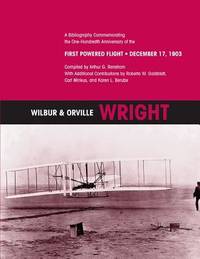
Wilbur & Orville Wright: A Bibliography Commemorating the One-Hundredth Anniversary of the First Powered Flight- December 17 1903 Monographs in Aerospace History Volume 27
CreateSpace Independent Publishing Platform. Used - Like New. Like New condition. A near perfect copy that may have very minor cosmetic defects. CreateSpace Independent Publishing Platform unknown
Bookseller reference : S25O-00495 ISBN : 1492948098 9781492948094
|
|
|
National Aeronautics and Space Administration
Wilbur & Orville Wright: A Bibliography Commemorating the One-Hundredth Anniversary of the First Powered Flight- December 17 1903 Monographs in Aerospace History
paperback. Good. Access codes and supplements are not guaranteed with used items. May be an ex-library book. paperback
Bookseller reference : 1492948098.G ISBN : 1492948098 9781492948094
|
|
|
National Aeronautics and Space Administration
Wilbur & Orville Wright: A Bibliography Commemorating the One-Hundredth Anniversary of the First Powered Flight- December 17 1903
paperback. Good. Access codes and supplements are not guaranteed with used items. May be an ex-library book. paperback
Bookseller reference : 1503336581.G ISBN : 1503336581 9781503336582

|
|
|
National Aeronautics and Administration
Wilbur & Orville Wright: A Reissue of A Chronology Commemorating the Hundredth Anniversary of the Birth of Orville Wright August 19 1871
Paperback / softback. New. paperback
Bookseller reference : B9781494740818 ISBN : 1494740818 9781494740818
|
|
|
National Aeronautics and Space Administration, Goddard Space Flight Center
Wind Spacecraft To Study Solar Breeze; NASA Facts NF-188-June 1993
Greenbelt MD: National Aeronautics and Space Administration Goddard Space Flight Center 1993. Presumed First Edition First printing one of multiple originals. Single sheet printed on both sides. Very good. Single sheet approximately 17 inches by 11 inches folded in half resulting in 4 pages. Illustrations on all four pages. Rare likely surviving copy. The Global Geospace Science GGS Wind satellite is a NASA science spacecraft designed to study radio waves and plasma that occur in the solar wind and in the Earth's magnetosphere. It was launched on 1 November 1994 at 09:31:00 UTC from launch pad LC-17B at Cape Canaveral Air Force Station CCAFS in Merritt Island Florida aboard a McDonnell Douglas Delta II 7925-10 rocket. Wind was designed and manufactured by Martin Marietta Astro Space Division in East Windsor Township New Jersey. The satellite is a spin-stabilized cylindrical satellite with a diameter of 2.4 m 7 ft 10 in and a height of 1.8 m 5 ft 11 in. The spacecraft's original mission was to orbit the Sun at the L1 Lagrangian point but this was delayed to study the magnetosphere and near lunar environment when the Solar and Heliospheric Observatory SOHO and Advanced Composition Explorer ACE spacecraft were sent to the same location. Wind has been at L1 continuously since May 2004 and is still operating as of 2024. As of 2024 Wind currently has enough fuel to last over 50 more years at L1 until at least 2070. Wind continues to collect data and by the end of 2023 had contributed data to over 7290 scientific publications. Mission operations are conducted from the Multi-Mission Operations Center MMOC in Building 14 at Goddard Space Flight Center in Greenbelt Maryland. Wind data can be accessed using the SPEDAS software. Wind is the sister ship to GGS Polar. The aim of the International Solar-Terrestrial Physics Science Initiative is to understand the behavior of the solar-terrestrial plasma environment in order to predict how the Earth's atmosphere will respond to changes in solar wind conditions. Wind's objective is to measure the properties of the solar wind before it reaches the Earth. Provide complete plasma energetic particle and magnetic field input for magnetospheric and ionospheric studies; Determine the magnetospheric output to interplanetary space in the up-stream region; Investigate basic plasma processes occurring in the near-Earth solar wind; and Provide baseline ecliptic plane observations to be used in heliospheric latitudes by the Ulysses mission. The Wind spacecraft has an array of instruments including: KONUS the Magnetic Field Investigation MFI the Solar Wind and Suprathermal Ion Composition Experiment SMS The Energetic Particles: Acceleration Composition and Transport EPACT investigation the Solar Wind Experiment SWE a Three-Dimensional Plasma and Energetic Particle Investigation 3DP the Transient Gamma-Ray Spectrometer TGRS and the Radio and Plasma Wave Investigation WAVES. The KONUS and TGRS instruments are primarily for gamma-ray and high energy photon observations of solar flares or gamma-ray bursts and part of the Gamma-ray Coordinates Network. The SMS experiment measures the mass and mass-to-charge ratios of heavy ions. The SWE and 3DP experiments are meant to measure/analyze the lower energy below 10 MeV solar wind protons and electrons. The WAVES and MFI experiments were designed to measure the electric and magnetic fields observed in the solar wind. All together the Wind spacecraft's suite of instruments allows for a complete description of plasma phenomena in the solar wind plane of the ecliptic. National Aeronautics and Space Administration, Goddard Space Flight Center unknown
Bookseller reference : 86093
|
|
|
National Aeronautics and Space Administration
Women in Flight Research at NASA Dryden Flight Research Center from 1946 to 1995: SP-4506
Paperback. NEW/NEW. <br/> <br/> paperback
Bookseller reference : Pazz58835 ISBN : 9798873214151 9798873214
|
|
|
National Aeronautics and Space Administration
Women of Goddard: Careers in Science Technology Engineering & Mathematics
National Aeronautics and Space Administration. Used - Good. Good condition. NASA STEM Women Biographies National Aeronautics and Space Administration unknown
Bookseller reference : SB18C-02287
|
|
|
National Aeronautics and Space Administration
X-15 RESEARCH RESULTS: With a Selected Bibliography
NEW. unknown
Bookseller reference : BIB-NOV-15-2025-539187 ISBN : 9798883163580 9798883163
|
|
|
National Aeronautics and Space Administration, Goddard Space Flight Center
X-Ray Timing Explorer Clocks High-Energy Universe; NASA Facts: NF- June 1995
Greenbelt MD: National Aeronautics and Space Administration Goddard Space Flight Center 1995. Pre-publication version since Fact Sheet number is not provided. Stapled at upper left corner. Very good. Two sheets printed on both sides totaling 4 pages. Illustrations primarily on pages 1 and 3 with small one on page 2. The Rossi X-ray Timing Explorer RXTE was a NASA satellite that observed the time variation of astronomical X-ray sources named after physicist Bruno Rossi. The RXTE had three instruments — an All-Sky Monitor the High-Energy X-ray Timing Experiment HEXTE and the Proportional Counter Array. The RXTE observed X-rays from black holes neutron stars X-ray pulsars and X-ray bursts. It was funded as part of the Explorer program and was also called Explorer 69. RXTE had a mass of 7100 lbs. and was launched from Cape Canaveral on 30 December 1995 at 13:48:00 UTC on a Delta II launch vehicle. Its International Designator is 1995-074A. Among the topics addressed include X-Ray Timing Explorer XTE Scientific Instruments Space Science All Sky Monitor Spacecraft Astrophysics Compact Objects Binary Star Systems White Dwarfs Neutron Stars Stellar-mass Black Holes Explorer 69 and the Proportional Counter Array. The X-Ray Timing Explorer XTE mission has the primary objective to study the temporal and broad-band spectral phenomena associated with stellar and galactic systems containing compact objects in the energy range 2--200 KeV and in time scales from microseconds to years. The scientific instruments consists of two pointed instruments the Proportional Counter Array PCA and the High-Energy X-ray Timing Experiment HEXTE and the All Sky Monitor ASM which scans over 70% of the sky each orbit. All of the XTE observing time were available to the international scientific community through a peer review of submitted proposals. XTE used a new spacecraft design that allows flexible operations through rapid pointing high data rates and nearly continuous receipt of data at the Science Operations Center SOC at Goddard Space Flight Center via a Multiple Access link to the Tracking and Data Relay Satellite System TDRSS. XTE was highly maneuverable with a slew rate of greater than 6° per minute. The PCA/HEXTE could be pointed anywhere in the sky to an accuracy of less than 0.1° with an aspect knowledge of around 1 arcminute. Rotatable solar panels enable anti-sunward pointing to coordinate with ground-based night-time observations. Two pointable high-gain antennas maintain nearly continuous communication with the TDRSS. This together with 1 GB approximately four orbits of on-board solid-state data storage give added flexibility in scheduling observations. Observations from the Rossi X-ray Timing Explorer have been used as evidence for the existence of the frame-dragging effect predicted by the theory of general relativity of Einstein. RXTE results have as of late 2007 been used in more than 1400 scientific papers. In January 2006 it was announced that Rossi had been used to locate a candidate intermediate-mass black hole named M82 X-1. In February 2006 data from RXTE was used to prove that the diffuse background X-ray glow in our galaxy comes from innumerable previously undetected white dwarfs and from other stars' coronae. In April 2008 RXTE data was used to infer the size of the smallest known black hole. RXTE ceased science operations on 12 January 2012. National Aeronautics and Space Administration, Goddard Space Flight Center unknown
Bookseller reference : 86096
|
|
|
National Aeronautics and Space Administration NASA
"Descent to Surface of the Moon" Original 8 x 10 B&W Publicity Photograph
Washington D.C.: National Aeronautics and Space Administration NASA 1974. "For Release June 30 1974. Photo No. 69-H-1251". Near Fine faint 1" surface crease. 8" x 10" black and white NASA publication information printed in blue ink verso. "Astronaut Edwin E. Aldrin Jr. lunar module pilot is shown climbing down the ladder as he prepares to walk on the Moon. This picture was taken by Astronaut Neil A. Armstrong commander of Apollo 11 the first manned lunar landing mission five yeasr ago in July 1969." . First Edition. Photograph. Near Fine/No Jacket As Issued. 8" x 10". National Aeronautics and Space Administration (NASA) Paperback books
Bookseller reference : 005821

|
|
|
National Aeronautics and Space Administration NASA
"Earth Orbiter" Original 8 x 10 B&W Publicity Photograph
Washington D.C.: National Aeronautics and Space Administration NASA 1974. "For Release No Date. Photo No. 62-MAS-168". Near Fine faint 1" surface crease. 8" x 10" black and white NASA publication information printed in blue ink verso. "Astronaut John Glenn was photographed in space by an automatic sequence action picture camera as he became the first American to orbit the earth on Feb. 20 1962. His Mercury spacecraft - Friendship 7- made three orbits in its 4 hours 55 minute flight. Glenn was in a state of weightlessness traveling at 17500 mph as this picture was taken." . First Edition. Photograph. Near Fine/No Jacket As Issued. 8" x 10". National Aeronautics and Space Administration (NASA) Paperback books
Bookseller reference : 005829

|
|
|
National Aeronautics and Space Administration NASA
"First Space Rendezvous" Original 8 x 10 B&W Publicity Photograph
Washington D.C.: National Aeronautics and Space Administration NASA 1974. "For Release No Date. Photo No. 69-H-2349 ". Near Fine faint 1" surface crease. 8" x 10" black and white NASA publication information printed in blue ink verso. "On December 16 1965 Gemini 6 maneuvered to within a few feet of Gemini 7 for the world's first rendezvous in space." . First Edition. Photograph. Near Fine/No Jacket As Issued. 8" x 10". National Aeronautics and Space Administration (NASA) Paperback books
Bookseller reference : 005824

|
|
|
National Aeronautics and Space Administration NASA
"Liftoff" - Original 8 x 10 B&W Publicity Photograph
Washington D.C.: National Aeronautics and Space Administration NASA 1974. " For Release June 30 1974. Photo No. 69-H-1142". Near Fine faint 1" surface crease . 8" x 10" black and white NASA publication information printed in blue ink verso. "The 363-foot-high Apollo/Saturn V space vehicle carrying Apollo 11 astronauts Neil A. Armstrong Michael Collins and Edwin E. Aldrin Jr. lifted off from Kennedy Space Center Fla. five years ago at 9:12 a.m. July 14 1969 on the first manned lunar landing mission." . First Edition. Photograph. Near Fine/No Jacket As Issued. 8" x 10". National Aeronautics and Space Administration (NASA) Paperback books
Bookseller reference : 005820

|
|
|
National Aeronautics and Space Administration NASA
"Riding on the Moon" Original 8 x 10 B&W Publicity Photograph
Washington D.C.: National Aeronautics and Space Administration NASA 1974. "For Release No Date. Photo No. 71-H-1413". Near Fine faint 1" surface crease. 8" x 10" black and white NASA publication information printed in blue ink verso. Apollo 15 launched in July 1971 was the fourth manned lunar landing and the first to carry the Lunar Roving Vehicle." . First Edition. Photograph. Near Fine/No Jacket As Issued. 8" x 10". National Aeronautics and Space Administration (NASA) Paperback books
Bookseller reference : 005827

|
|
|
National Aeronautics and Space Administration NASA
"Skylab II in Flight" Original 8 x 10 B&W Publicity Photograph
Washington D.C.: National Aeronautics and Space Administration NASA 1974. "For Release No Date. Photo No. 73-H-578". Near Fine faint 1" surface crease. 8" x 10" black and white NASA publication information printed in blue ink verso. "This excellent view of the Skylab space station was taken from the Command Module during a final "fly around" inspection. The three-man crew spent 28 days in Skylab after their May 25 1973 launch from Kennedy Space Center." . First Edition. Photograph. Near Fine/No Jacket As Issued. 8" x 10". National Aeronautics and Space Administration (NASA) Paperback books
Bookseller reference : 005825

|
|
|
National Aeronautics and Space Administration NASA
"The Flag of the United States" Original 8 x 10 B&W Publicity Photograph
Washington D.C.: National Aeronautics and Space Administration NASA 1974. "For Release June 30 1974. Photo No. 69-H-1253". Near Fine faint 1" surface crease. 8" x 10" black and white NASA publication information printed in blue ink verso "The flag of the United States was planted on the surface of the moon for the first time five years ago in July 1969 by Apollo 11 crewmen on the first manned lunar landing mission.". First Edition. Photograph. Near Fine/No Jacket As Issued. 8" x 10". National Aeronautics and Space Administration (NASA) Paperback books
Bookseller reference : 005823

|
|
|
National Aeronautics and Space Administration NASA
"Working on the Moon" Original 8 x 10 B&W Publicity Photograph
Washington D.C.: National Aeronautics and Space Administration NASA 1974. "For Release June 30 1974. Photo No. 69-H-1269". Near Fine faint 1" surface crease. 8" x 10" black and white NASA publication information printed in blue ink verso "Astronaut Edwin E. Aldrin Jr. is shown as he deployed an experiment on the surface of the Moon during Apollo 11 the first manned lunar landing mission five years ago in July 1969.". First Edition. Photograph. Near Fine/No Jacket As Issued. 8" x 10". National Aeronautics and Space Administration (NASA) Paperback books
Bookseller reference : 005822

|
|
|
National Aeronautics and Space Administration NASA
Lunar Orbiter - NF-32 Vol. IV No.4
Washington DC: National Aeronautics and Space Administration NASA 1967. Wraps. Near Fine. 12 pages. Self wrappers stapled. 8 x 10 1/4 inches. A touch of browning otherwise nice and clean. Illustrated. Wraps. Part of the NASA Facts series - an educational publication of the National Aeronautics and Space Administration NASA Office of Public Affairs Programs Division. <br/><br/>Illustrated showing some great images built up from smaller pictures taken by the Orbiter. A great insight into the state of the art at the time and useful historically to see what was being taught. National Aeronautics and Space Administration (NASA) unknown books
Bookseller reference : 27506

|
|
|
National Aeronautics and Space Administration NASA
Manned Space Flight : Projects Mercury and Gemini
Washington DC: National Aeronautics and Space Administration NASA 1967. Wraps. Near Fine. 12 pages. Self wrappers stapled. 8 x 10 1/4 inches. A touch of browning and a few spots of dirt otherwise nice and clean. Illustrated. Wraps. Part of the NASA Facts series - an educational publication of the National Aeronautics and Space Administration NASA Office of Public Affairs Programs Division. <br/><br/>Illustrated a nice piece for thoses interested in the Gemini. Includes images of mock-ups real photographs from before lift-off and a nice chart in the rear noting the Gemini Missions I through 12 with crewe dates duration revolutions and objectives accomplished. National Aeronautics and Space Administration (NASA) unknown books
Bookseller reference : 27508

|
|
|
National Aeronautics and Space Administration NASA
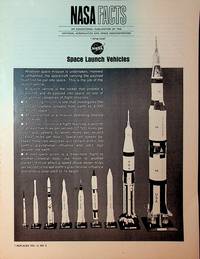
Space Launch Vehicles NF-8 / 12-67
Washington DC: National Aeronautics and Space Administration NASA 1967. Wraps. Near Fine. 8 pages. Self wrappers stapled. 8 x 10 1/4 inches. A touch of browning otherwise nice and clean. Illustrated. Wraps. Part of the NASA Facts series - an educational publication of the National Aeronautics and Space Administration NASA Office of Public Affairs Programs Division. This edition replaces Vol. II No. 5 in the series. Illustrated showing several launch vehicles on the pad with descriptions. National Aeronautics and Space Administration (NASA) unknown books
Bookseller reference : 27504
|
|
|
National Aeronautics and Space Administration NASA
Spacecraft Tracking and Communication
Washington DC: National Aeronautics and Space Administration NASA 1967. Wraps. Near Fine. 4 pages. Self wrappers. 8 x 10 1/4 inches. A touch of browning otherwise nice and clean. Illustrated. Wraps. Part of the NASA Facts series - an educational publication of the National Aeronautics and Space Administration NASA Office of Public Affairs Programs Division. <br/><br/>Illustrated showing several launch vehicles on the pad with descriptions. This item is part of NASA's science series for Jr. High school General Science programs. Fairly basic but with a diagram of NASA's tracking facilities and an overview of how the entire system works. National Aeronautics and Space Administration (NASA) unknown books
Bookseller reference : 27505

|
|
|
National Aeronautics and Space Administration NASA
The Countdown S-4 / 8-67
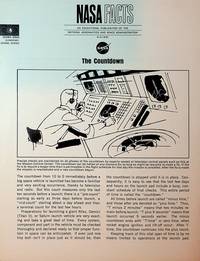
Washington DC: National Aeronautics and Space Administration NASA 1967. Wraps. Near Fine. 4 pages. Self wrappers. 8 x 10 1/4 inches. Illustrated. Wraps. Part of the NASA Facts series - an educational publication of the National Aeronautics and Space Administration NASA Office of Public Affairs Programs Division. <br/><br/>Illustrated but very basic - targeted to Elementary schools general science. Includes a map of NASA tracking facilities and several abstracted art pieces showing liftoff and the control panels. National Aeronautics and Space Administration (NASA) unknown books
Bookseller reference : 27507
|
|
|
National Credit Union Administration
2012 Directory of Federally Insured Credit Unions
Paperback / softback. New. paperback
Bookseller reference : A9781484019757 ISBN : 148401975x 9781484019757

|
|
|
National Credit Union Administration
2012 Directory of Federally Insured Credit Unions
Paperback / softback. New. paperback
Bookseller reference : B9781986316248 ISBN : 1986316246 9781986316248

|
|
|
National Credit Union Administration
2012 Directory of Federally Insured Credit Unions
Paperback / softback. New. paperback
Bookseller reference : B9781484019757 ISBN : 148401975x 9781484019757
|
|
|
National Cultural Relics Administration
2021Chinese Important Archaeological Developments
Culture publishing company 2022. Soft Cover. Fine. The book is in fine condition. Culture publishing company paperback
Bookseller reference : 2081502111901933 ISBN : 7501074860 9787501074860
|
|
|
National Cultural Heritage Administration compilation edition
Ancient Chinese coinage
Cultural publisher 1993. Soft Cover. Fine. Page number: 10534p Size: 27cm Cultural publisher paperback
Bookseller reference : 2080202102400314
|
|
|
National Cultural Relics Administration Three Gorges Archaeological Corps
Chaotianzui and Zhongbao Island
Bunbutsu 2001. Soft Cover. Fine. Number of books: 3 Bunbutsu paperback
Bookseller reference : 2081502111901866 ISBN : 7501012253 9787501012251
|
|
|
National Credit Union Administration
Consumer Compliance: Self Assessment Guide
Paperback / softback. New. paperback
Bookseller reference : B9781484019627 ISBN : 1484019628 9781484019627

|
|

 Receive by email
 Download as PDF document
 RSS feed
 Permanent link


