U.S. Government Printing Office. Very Good. Prompt shipment with tracking. we ship in CLEAN SECURE NEW boxes Very good paperback with clean pages light crease to back cover. Symposium held at California Institute of Technology July 2 1976. Panelists: Philip Morrison James Michener Jacques Cousteau Ray Bradbury. 94 pages. U.S. Government Printing Office paperback
CreateSpace Independent Publishing Platform. Used - Like New. Like New condition. A near perfect copy that may have very minor cosmetic defects. CreateSpace Independent Publishing Platform unknown
Référence libraire : S25O-00495 ISBN : 1492948098 9781492948094
Greenbelt MD: National Aeronautics and Space Administration Goddard Space Flight Center 1993. Presumed First Edition First printing one of multiple originals. Single sheet printed on both sides. Very good. Single sheet approximately 17 inches by 11 inches folded in half resulting in 4 pages. Illustrations on all four pages. Rare likely surviving copy. The Global Geospace Science GGS Wind satellite is a NASA science spacecraft designed to study radio waves and plasma that occur in the solar wind and in the Earth's magnetosphere. It was launched on 1 November 1994 at 09:31:00 UTC from launch pad LC-17B at Cape Canaveral Air Force Station CCAFS in Merritt Island Florida aboard a McDonnell Douglas Delta II 7925-10 rocket. Wind was designed and manufactured by Martin Marietta Astro Space Division in East Windsor Township New Jersey. The satellite is a spin-stabilized cylindrical satellite with a diameter of 2.4 m 7 ft 10 in and a height of 1.8 m 5 ft 11 in. The spacecraft's original mission was to orbit the Sun at the L1 Lagrangian point but this was delayed to study the magnetosphere and near lunar environment when the Solar and Heliospheric Observatory SOHO and Advanced Composition Explorer ACE spacecraft were sent to the same location. Wind has been at L1 continuously since May 2004 and is still operating as of 2024. As of 2024 Wind currently has enough fuel to last over 50 more years at L1 until at least 2070. Wind continues to collect data and by the end of 2023 had contributed data to over 7290 scientific publications. Mission operations are conducted from the Multi-Mission Operations Center MMOC in Building 14 at Goddard Space Flight Center in Greenbelt Maryland. Wind data can be accessed using the SPEDAS software. Wind is the sister ship to GGS Polar. The aim of the International Solar-Terrestrial Physics Science Initiative is to understand the behavior of the solar-terrestrial plasma environment in order to predict how the Earth's atmosphere will respond to changes in solar wind conditions. Wind's objective is to measure the properties of the solar wind before it reaches the Earth. Provide complete plasma energetic particle and magnetic field input for magnetospheric and ionospheric studies; Determine the magnetospheric output to interplanetary space in the up-stream region; Investigate basic plasma processes occurring in the near-Earth solar wind; and Provide baseline ecliptic plane observations to be used in heliospheric latitudes by the Ulysses mission. The Wind spacecraft has an array of instruments including: KONUS the Magnetic Field Investigation MFI the Solar Wind and Suprathermal Ion Composition Experiment SMS The Energetic Particles: Acceleration Composition and Transport EPACT investigation the Solar Wind Experiment SWE a Three-Dimensional Plasma and Energetic Particle Investigation 3DP the Transient Gamma-Ray Spectrometer TGRS and the Radio and Plasma Wave Investigation WAVES. The KONUS and TGRS instruments are primarily for gamma-ray and high energy photon observations of solar flares or gamma-ray bursts and part of the Gamma-ray Coordinates Network. The SMS experiment measures the mass and mass-to-charge ratios of heavy ions. The SWE and 3DP experiments are meant to measure/analyze the lower energy below 10 MeV solar wind protons and electrons. The WAVES and MFI experiments were designed to measure the electric and magnetic fields observed in the solar wind. All together the Wind spacecraft's suite of instruments allows for a complete description of plasma phenomena in the solar wind plane of the ecliptic. National Aeronautics and Space Administration, Goddard Space Flight Center unknown
National Aeronautics and Space Administration. Used - Good. Good condition. NASA STEM Women Biographies National Aeronautics and Space Administration unknown
Greenbelt MD: National Aeronautics and Space Administration Goddard Space Flight Center 1995. Pre-publication version since Fact Sheet number is not provided. Stapled at upper left corner. Very good. Two sheets printed on both sides totaling 4 pages. Illustrations primarily on pages 1 and 3 with small one on page 2. The Rossi X-ray Timing Explorer RXTE was a NASA satellite that observed the time variation of astronomical X-ray sources named after physicist Bruno Rossi. The RXTE had three instruments — an All-Sky Monitor the High-Energy X-ray Timing Experiment HEXTE and the Proportional Counter Array. The RXTE observed X-rays from black holes neutron stars X-ray pulsars and X-ray bursts. It was funded as part of the Explorer program and was also called Explorer 69. RXTE had a mass of 7100 lbs. and was launched from Cape Canaveral on 30 December 1995 at 13:48:00 UTC on a Delta II launch vehicle. Its International Designator is 1995-074A. Among the topics addressed include X-Ray Timing Explorer XTE Scientific Instruments Space Science All Sky Monitor Spacecraft Astrophysics Compact Objects Binary Star Systems White Dwarfs Neutron Stars Stellar-mass Black Holes Explorer 69 and the Proportional Counter Array. The X-Ray Timing Explorer XTE mission has the primary objective to study the temporal and broad-band spectral phenomena associated with stellar and galactic systems containing compact objects in the energy range 2--200 KeV and in time scales from microseconds to years. The scientific instruments consists of two pointed instruments the Proportional Counter Array PCA and the High-Energy X-ray Timing Experiment HEXTE and the All Sky Monitor ASM which scans over 70% of the sky each orbit. All of the XTE observing time were available to the international scientific community through a peer review of submitted proposals. XTE used a new spacecraft design that allows flexible operations through rapid pointing high data rates and nearly continuous receipt of data at the Science Operations Center SOC at Goddard Space Flight Center via a Multiple Access link to the Tracking and Data Relay Satellite System TDRSS. XTE was highly maneuverable with a slew rate of greater than 6° per minute. The PCA/HEXTE could be pointed anywhere in the sky to an accuracy of less than 0.1° with an aspect knowledge of around 1 arcminute. Rotatable solar panels enable anti-sunward pointing to coordinate with ground-based night-time observations. Two pointable high-gain antennas maintain nearly continuous communication with the TDRSS. This together with 1 GB approximately four orbits of on-board solid-state data storage give added flexibility in scheduling observations. Observations from the Rossi X-ray Timing Explorer have been used as evidence for the existence of the frame-dragging effect predicted by the theory of general relativity of Einstein. RXTE results have as of late 2007 been used in more than 1400 scientific papers. In January 2006 it was announced that Rossi had been used to locate a candidate intermediate-mass black hole named M82 X-1. In February 2006 data from RXTE was used to prove that the diffuse background X-ray glow in our galaxy comes from innumerable previously undetected white dwarfs and from other stars' coronae. In April 2008 RXTE data was used to infer the size of the smallest known black hole. RXTE ceased science operations on 12 January 2012. National Aeronautics and Space Administration, Goddard Space Flight Center unknown
Washington D.C.: National Aeronautics and Space Administration NASA 1974. "For Release June 30 1974. Photo No. 69-H-1251". Near Fine faint 1" surface crease. 8" x 10" black and white NASA publication information printed in blue ink verso. "Astronaut Edwin E. Aldrin Jr. lunar module pilot is shown climbing down the ladder as he prepares to walk on the Moon. This picture was taken by Astronaut Neil A. Armstrong commander of Apollo 11 the first manned lunar landing mission five yeasr ago in July 1969." . First Edition. Photograph. Near Fine/No Jacket As Issued. 8" x 10". National Aeronautics and Space Administration (NASA) Paperback books
Washington D.C.: National Aeronautics and Space Administration NASA 1974. "For Release No Date. Photo No. 62-MAS-168". Near Fine faint 1" surface crease. 8" x 10" black and white NASA publication information printed in blue ink verso. "Astronaut John Glenn was photographed in space by an automatic sequence action picture camera as he became the first American to orbit the earth on Feb. 20 1962. His Mercury spacecraft - Friendship 7- made three orbits in its 4 hours 55 minute flight. Glenn was in a state of weightlessness traveling at 17500 mph as this picture was taken." . First Edition. Photograph. Near Fine/No Jacket As Issued. 8" x 10". National Aeronautics and Space Administration (NASA) Paperback books
Washington D.C.: National Aeronautics and Space Administration NASA 1974. "For Release No Date. Photo No. 69-H-2349 ". Near Fine faint 1" surface crease. 8" x 10" black and white NASA publication information printed in blue ink verso. "On December 16 1965 Gemini 6 maneuvered to within a few feet of Gemini 7 for the world's first rendezvous in space." . First Edition. Photograph. Near Fine/No Jacket As Issued. 8" x 10". National Aeronautics and Space Administration (NASA) Paperback books
Washington D.C.: National Aeronautics and Space Administration NASA 1974. " For Release June 30 1974. Photo No. 69-H-1142". Near Fine faint 1" surface crease . 8" x 10" black and white NASA publication information printed in blue ink verso. "The 363-foot-high Apollo/Saturn V space vehicle carrying Apollo 11 astronauts Neil A. Armstrong Michael Collins and Edwin E. Aldrin Jr. lifted off from Kennedy Space Center Fla. five years ago at 9:12 a.m. July 14 1969 on the first manned lunar landing mission." . First Edition. Photograph. Near Fine/No Jacket As Issued. 8" x 10". National Aeronautics and Space Administration (NASA) Paperback books
Washington D.C.: National Aeronautics and Space Administration NASA 1974. "For Release No Date. Photo No. 71-H-1413". Near Fine faint 1" surface crease. 8" x 10" black and white NASA publication information printed in blue ink verso. Apollo 15 launched in July 1971 was the fourth manned lunar landing and the first to carry the Lunar Roving Vehicle." . First Edition. Photograph. Near Fine/No Jacket As Issued. 8" x 10". National Aeronautics and Space Administration (NASA) Paperback books
Washington D.C.: National Aeronautics and Space Administration NASA 1974. "For Release No Date. Photo No. 73-H-578". Near Fine faint 1" surface crease. 8" x 10" black and white NASA publication information printed in blue ink verso. "This excellent view of the Skylab space station was taken from the Command Module during a final "fly around" inspection. The three-man crew spent 28 days in Skylab after their May 25 1973 launch from Kennedy Space Center." . First Edition. Photograph. Near Fine/No Jacket As Issued. 8" x 10". National Aeronautics and Space Administration (NASA) Paperback books
Washington D.C.: National Aeronautics and Space Administration NASA 1974. "For Release June 30 1974. Photo No. 69-H-1253". Near Fine faint 1" surface crease. 8" x 10" black and white NASA publication information printed in blue ink verso "The flag of the United States was planted on the surface of the moon for the first time five years ago in July 1969 by Apollo 11 crewmen on the first manned lunar landing mission.". First Edition. Photograph. Near Fine/No Jacket As Issued. 8" x 10". National Aeronautics and Space Administration (NASA) Paperback books
Washington D.C.: National Aeronautics and Space Administration NASA 1974. "For Release June 30 1974. Photo No. 69-H-1269". Near Fine faint 1" surface crease. 8" x 10" black and white NASA publication information printed in blue ink verso "Astronaut Edwin E. Aldrin Jr. is shown as he deployed an experiment on the surface of the Moon during Apollo 11 the first manned lunar landing mission five years ago in July 1969.". First Edition. Photograph. Near Fine/No Jacket As Issued. 8" x 10". National Aeronautics and Space Administration (NASA) Paperback books
Washington DC: National Aeronautics and Space Administration NASA 1967. Wraps. Near Fine. 12 pages. Self wrappers stapled. 8 x 10 1/4 inches. A touch of browning otherwise nice and clean. Illustrated. Wraps. Part of the NASA Facts series - an educational publication of the National Aeronautics and Space Administration NASA Office of Public Affairs Programs Division. <br/><br/>Illustrated showing some great images built up from smaller pictures taken by the Orbiter. A great insight into the state of the art at the time and useful historically to see what was being taught. National Aeronautics and Space Administration (NASA) unknown books
Washington DC: National Aeronautics and Space Administration NASA 1967. Wraps. Near Fine. 12 pages. Self wrappers stapled. 8 x 10 1/4 inches. A touch of browning and a few spots of dirt otherwise nice and clean. Illustrated. Wraps. Part of the NASA Facts series - an educational publication of the National Aeronautics and Space Administration NASA Office of Public Affairs Programs Division. <br/><br/>Illustrated a nice piece for thoses interested in the Gemini. Includes images of mock-ups real photographs from before lift-off and a nice chart in the rear noting the Gemini Missions I through 12 with crewe dates duration revolutions and objectives accomplished. National Aeronautics and Space Administration (NASA) unknown books
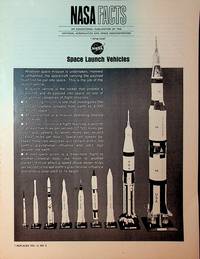
Washington DC: National Aeronautics and Space Administration NASA 1967. Wraps. Near Fine. 8 pages. Self wrappers stapled. 8 x 10 1/4 inches. A touch of browning otherwise nice and clean. Illustrated. Wraps. Part of the NASA Facts series - an educational publication of the National Aeronautics and Space Administration NASA Office of Public Affairs Programs Division. This edition replaces Vol. II No. 5 in the series. Illustrated showing several launch vehicles on the pad with descriptions. National Aeronautics and Space Administration (NASA) unknown books
Washington DC: National Aeronautics and Space Administration NASA 1967. Wraps. Near Fine. 4 pages. Self wrappers. 8 x 10 1/4 inches. A touch of browning otherwise nice and clean. Illustrated. Wraps. Part of the NASA Facts series - an educational publication of the National Aeronautics and Space Administration NASA Office of Public Affairs Programs Division. <br/><br/>Illustrated showing several launch vehicles on the pad with descriptions. This item is part of NASA's science series for Jr. High school General Science programs. Fairly basic but with a diagram of NASA's tracking facilities and an overview of how the entire system works. National Aeronautics and Space Administration (NASA) unknown books
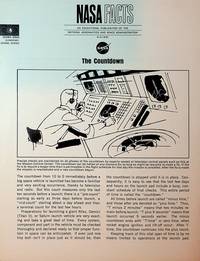
Washington DC: National Aeronautics and Space Administration NASA 1967. Wraps. Near Fine. 4 pages. Self wrappers. 8 x 10 1/4 inches. Illustrated. Wraps. Part of the NASA Facts series - an educational publication of the National Aeronautics and Space Administration NASA Office of Public Affairs Programs Division. <br/><br/>Illustrated but very basic - targeted to Elementary schools general science. Includes a map of NASA tracking facilities and several abstracted art pieces showing liftoff and the control panels. National Aeronautics and Space Administration (NASA) unknown books

 Recevoir par e-mail
 Télécharger en PDF
 Flux RSS
 Lien permanent