Washington DC: Office of Price Administration 1942. Presumed First Edition First printing no Rev. notification. Single sheet printed on both sides. Good. Format is approximately 16 inches by 10.5 inches folded in half creating a four page document. This form has been folded in half and also be creased/folded perhaps to fit into a pocket. The front page as sections for the Name of Registered Owner and applicant information from the Board and details of the application and of the vehicle. The second page asked for additional details about the applicant and associated vehicles. The third page has certification and agreement of applicant and certification by inspector. The back/last page documents the action by the Rationing Board. Tires were the first item to be rationed by the OPA which ordered the temporary end of sales on 11 December 1941 while it created 7500 unpaid volunteer three-person tire ration boards around the country. By 5 January 1942 the boards were ready. Each received a monthly allotment of tires based on the number of local vehicle registrations and allocated them to applicants based on OPA rules. There was a shortage of natural rubber for tires since the Japanese quickly conquered the rubber-producing regions of Southeast Asia. Although synthetic rubber had been invented before the war it had been unable to compete with natural rubber commercially so the US did not have enough manufacturing capacity at the start of the war to make synthetic rubber. Throughout the war rationing of gasoline was motivated by a desire to conserve rubber as much as by a desire to conserve gasoline. To get a classification and rationing stamps one had to appear before a local War Price and Rationing Board which reported to the OPA. The Office of Price Administration OPA was established within the Office for Emergency Management of the United States government by Executive Order 8875 on August 28 1941. The functions of the OPA were originally to control money price controls and rents after the outbreak of World War II. President Franklin D. Roosevelt inaugurated the Council of National Defense Advisory Commission on May 29 1940 to include Price Stabilization and Consumer Protection Divisions. Both divisions merged to become the Office of Price Administration and Civilian Supply OPACS within the Office for Emergency Management by Executive Order 8734 on April 11 1941. Civil supply functions were transferred to the Office of Production Management. It became an independent agency under the Emergency Price Control Act January 30 1942. The OPA had the power to place ceilings on all prices except agricultural commodities and to ration scarce supplies of other items including tires automobiles shoes nylon sugar gasoline fuel oil coffee meats and processed foods. At the peak almost 90% of retail food prices were frozen. It could also authorize subsidies for production of some of those commodities. The War Production Board WPB ordered the temporary end of all civilian automobile sales on 1 January 1942 leaving dealers with one half million unsold cars. Ration boards grew in size as they began evaluating automobile sales in February only certain professions such as doctors and clergymen qualified to purchase the remaining inventory of new automobiles typewriters in March and bicycles in May. Automobile factories stopped manufacturing civilian models by early February 1942 and converted to producing tanks aircraft weapons and other military products with the United States government as the only customer. Office of Price Administration unknown
Office of the Federal Register U.S. National Archives and Records Administration U.S. Paperback. New. . Office of the Federal Register (U.S.), National Archives and Records Administration (U.S.) paperback
Washington DC: U.S. Government Printing Office 1972. Hardcover. ex library-good. Special edition of the Federal Register containing a codification of documents of general applicability and future effect as of April 1 1973. vi 2 487 p. 24 cm. Buckram. Ex library with labels on lower spine and endpapers ink stamps on text block edges and first pages. <br/><br/>Chapter 1: Bureau of Indian Affairs Dept. of the Interior. Chapter 2: Indian Arts and Crafts Board Dept. of the Interior. Chapter 3: Indian Claims Commission. U.S. Government Printing Office hardcover
Office of the Federal Register 2016-09-15. Paperback. Very Good. Clean sturdy copy; no marks rips or folds on pages; some dust marks on page edges EH Office of the Federal Register paperback
Référence libraire : Sq28246 ISBN : 0160933927 9780160933929
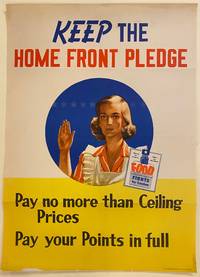
Government Printing Office 1944. Fred Cooper. Poster. Color lithograph. Measures 27 3/4" x 19 7/8"<br/> <br/> This original World War II-era poster was part of an anti-inflation campaign initiated by the Office of Price Administration designed to encourage American citizens to support the war effort. During the previous world war the US experienced an inflation rate of 62%. When WWII began President Roosevelt established the OPA to prevent price-gouging and unfair access to consumer goods. The effort was considered successful with inflation between 1940 and 1944 rising only 28%.<br> <br> The woman wears a red and white striped blouse contrasted against a blue background with stars evoking the American flag. Her hair is coiffed and she wears makeup as well as a white ruffled apron over her blouse. In this way the poster demonstrates how women could contribute to the war effort without sacrificing their femininity a somewhat mixed signal that speaks to cultural dynamics in the United States in the 1940s. A smaller graphic overlays the poster reading "Produce and Conserve / Share and Play Square / Food Fights for Freedom." In very good condition with some wear to margins and along original fold lines. A closed tear to left margin has been professionally repaired. Some cracks and chips to lower margin. The poster is otherwise clean and vibrant.<br/> <br/> Government Printing Office unknown
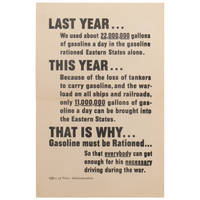
Washington DC: Office of Price Administration 1943. Ephemera. Near fine. A homefront poster from the middle of the Second World War explaining the need for gasoline rationing on the East Coast. It reads ellipses or . in the original<br /> <br /> "Last year. we used about 22000000 gallons of gasoline a day in the gasoline rationed Eastern States alone. This year. Because of the loss of tankers to carry gasoline and the warload on all ships and railroads only 11000000 gallons of gasoline a day can be brought into the Eastern States. That is why. Gasoline must be rationed. So that everybody can get enough for his necessary driving during the war."<br /> <br /> 10-1/4 by 14 inches. A fine example. One old fold. This is an original World War II poster not a reproduction. Office of Price Administration unknown
Government Printing Office. VG. 1962. Paperback. Paperback in Very Good condition. 7.44 X 0.1 X 9.69 inches. 40 pages. Quick shipping excellent customer service. All books carefully packaged in boxes and ship with tracking information. . Government Printing Office paperback
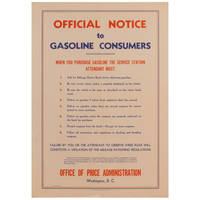
Washington DC: U.S. Government Printing Office 1943. A homefront poster from the Second World War issued as part of a government effort to eliminate the black market for gasoline. The poster printed in red and blue on off-white paper lists eight actions a gas station attendant must take to ensure that the customer's ration card is valid and used correctly. See the June 17 1943 Chippewa Herald-Telegram for more details on the program.<br /> <br /> 14 by 20 inches. With old folds as issued. Small split at center fold at the bottom of the poster. This is an original World War II poster not a reproduction. U.S. Government Printing Office unknown
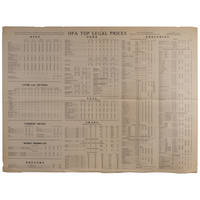
Washington DC: United States Office of Price Administration 1943. Ephemera. Very good. During the Second World War posters like this one hung in most of the grocery stores in the United States but few of them have survived. A key homefront concern of the federal government was runaway inflation which had posed a significant economic problem during World War One. In addition to rationing the federal government implemented price controls for projects in high demand and short supply. Stores were not supposed to charge more than the posted price and there was a corresponding campaign to convince shoppers not to pay more.<br /> <br /> This poster is likely from Richmond Virginia rather than the eponymous city in California. It covers meat dairy products and many name brands of groceries.<br /> <br /> 32 by 24 inches. A very good copy with light chipping to the edges and some minor splits to the folds. SHIPS FOLDED. This is an original World War II poster not a reproduction. United States Office of Price Administration unknown
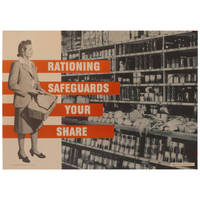
Washington DC: U.S. Government Printing Office 1942. Ephemera. Near fine. A homefront poster of a woman holding an empty basket while contemplating full store shelves. During the Second World War the US government encouraged stores and consumers to abide by price controls and ration limits.<br /> <br /> 20 by 14 inches. This is an original World War II poster not a reproduction. A near fine copy. Never folded. Ships flat. U.S. Government Printing Office unknown

 Recevoir par e-mail
 Télécharger en PDF
 Flux RSS
 Lien permanent