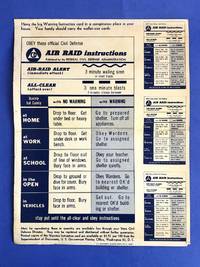
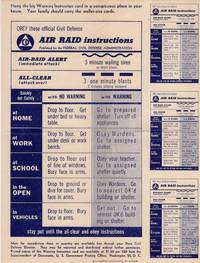
Washington D.C.: Government Printing Office 1951. Broadside. Good. 11 x 8.5 inch. broadside poster printed in blue on heavy white paper. Creasing to edges and corners with light foxing and toning. Horizontal crease across center. Large instruction card at center left with 3 smaller copies printed at right. Text at top instructs the recipient to "Hang the big Warning Instruction card in a conspicuous place in your house. Your family should carry the wallet-size cards." Safety precautions issued to the public in case of nuclear attack. Government Printing Office unknown
Washington DC: U.S. Government Printing Office 1951. Leaflet. Very good. Single sheet has been folded twice into four panels text on recto. Along the right side are three pocket-sized instructions to be carried in pockets or wallets. 11"x8-1/2" <br/><br/> U.S. Government Printing Office unknown
United States Government Printing Office 1957. Trade Paperback . Used Very Good. Light wear to cover including a small closed tear in the back cover slightly bumped corners pages clean and unmarked. We carry new and used books in our storefront. We want you to be satisfied with your purchase. Please contact us if you have questions regarding this item. United States Government Printing Office paperback
Washington D. C.: United States Government Printing Office 1957. Wraps have light wear tanning on edges. Pages are clean with no markings in text. Soft Cover. Good. 12mo - over 6¾" - 7¾" tall. United States Government Printing Office Paperback
Washington DC: United States Government Printing Office 1953. Presumed First Edition First printing. Wraps. Good. iv 85 7 pages. Fold-outs. Figures. Tables. Scarce original issue. Appendix A; Description of Source Maps and Supplementary Material; Appendix B: Urban Feature Maps Needed for Urban Analysis; Appendix C:Method of Estimating Day Population; and Appendix D: Official Civil Defense Publications. This Technical Manual presents methods and procedures for use by city civil defense organization in preparing a civil defense urban analysis. An urban analysis is the process of collecting presenting analyzing and utilizing pertinent information about urban areas. Since the primary purpose of a civil defense urban analysis is to provide the tools for undertaking realistic civil defense planning all pertinent aspects of the city must be considered. Assembling data and presenting the information graphically on maps is only the first step in an urban analysis. The area in which an exploded A-bomb can cause maximum casualties and physical damage must be located. Then a hypothetical attack must be be assumed and the damaged assessed. From this is determined not only the potential causalities but also the potential damage to each urban feature. Next the physical area of the city must be organized for operations and operational plans developed by the civil defense services. In this manner the urban analysis can be of practical use rather an than as a mere reference material to be looked at occasionally before the attack or to be referred to after the attack. Maximum utilization should be made of available maps and data in municipal and other public agencies as well as those in private institutions. The contents include: Factors affecting civil defense urban analysis; Maps used in urban analysis Target analysis Method of estimating damaged to structures and facilities; Mass fire potential; Techniques for estimating casualties and uninjured-unhoused Maps used in planing operations. There are also included four appendices. United States civil defense refers to the use of civil defense in the history of the United States which is the organized non-military effort to prepare Americans for military attack. Late in the 20th century the term and practice of civil defense fell into disuse. Emergency management and homeland security replaced them. The new dimensions of nuclear war terrified the world and the American people. The sheer power of nuclear weapons and the perceived likelihood of such an attack on the United States precipitated a greater response than had yet been required of civil defense. Civil defense something previously considered an important and common-sense step also became divisive and controversial in the charged atmosphere of the Cold War. In 1950 the National Security Resources Board created a 162-page document outlining a model civil defense structure for the US. Called the "Blue Book" by civil defense professionals in reference to its solid blue cover it was the template for legislation and organization that occurred over the next 40 years. Despite a general agreement on the importance of civil defense Congress never came close to meeting the budget requests of federal civil defense agencies. In declassified US war game analyses of the late 1950-60s it was estimated that approximately 27 million US citizens would have been saved with civil defense education in the event of a Soviet pre-emptive strike. At the time however the cost of a full-scale civil defense program was in cost-benefit analysis deemed less effective than a BMD system and as the adversary was increasing their nuclear stockpile both programs would yield diminishing returns. United States Government Printing Office paperback
Battle Creek MI: Federal Civil Defense Administration National Headquarters 1957. Copy one of unknown number of multiple contemporary copies of Memorandum with draft attached. Two-hole punched disbound held together with a clip. Good. Cover memorandum with number stamps ink notations and the name Donald J. Kimeldorf on front. transmitting a draft copy of a proposed FCDA Technical Bulletin on the Radiobiologic Effects of Radiation. Memorandum was signed out by Jack C. Greene Director of the Radiological Defense Division. RARE SURVIVING COPY OF NEAR FINAL DRAFT. Draft dated 2-25-57 and with a number stamped on first page has 21 pages Appendix A 6 figures and Five additional figures. This bulletin is divided into five major sections: The first section concerns basic radiobiologic information that is required for the basis of answers given in sections II IIIm and IV. Sections II III and IV deal with topics concerning injury to human beings; environmental modifications and population group injury. They are presented in question and answer form. Section V gives a general discussion of civil defense applications of this information. The reason for preparing this bulletin in advance of publication of the NCRP Sub-Committee Handbook on "Irradiation Injury" was to provide guidance that was deemed urgently needed by civil defense planners. Survival studies in which plans for defense against nuclear attack needed guidance of this type to formulate realistic scenarios. This bulletin was intended to serve as an interim measure until the Committee's more complete treatment became available. Kimeldorf was a major scientific leader. His book with Ed Hunt entitled "Ionizing radiation: Neural function and behavior" is a thorough description of the physiological and behavioral effects of exposure to ionizing radiation. The Federal Civil Defense Administration FCDA was organized by President Harry S. Truman on December 1 1950 through Executive Order 10186 and became an official government agency via the Federal Civil Defense Act of 1950 on 12 January 1951. In 1958 the FCDA was superseded by the Office of Civil and Defense Mobilization when President Dwight D. Eisenhower merged the FCDA with the Office of Defense Mobilization. In its early years the agency focused on evacuation as a strategy. The FCDA was first headed by Millard Caldwell under Truman then Val Peterson under Eisenhower. Jack C. Greene received his B.S. in electrical engineering from MIT in 1947 and his Masters in engineering administration from the George Washington University in 1970. He served with the Manhattan District at Oak Ridge during WWII after which he was a member of the AEC'S Radiation Instrument Branch until joining the then newly created civil defense agency in 1951. Since that time Mr. Greene had been associated with civil defense related technical and scientific activities including radiological instrument development nuclear weapons test programs and other research. From 1962 through 1973 he headed the Postattack Research Division which included responsibility for civil defense fallout studies. Mr. Greene then became DCPA'S Deputy Assistant Director for Research. Federal Civil Defense Administration, National Headquarters unknown

 ?????????
 ?????PDF???
 RSS feed
 ??
??