Site indépendant de libraires professionnels

‎Marx karl‎

Main

Thèmes parents

‎Mouvement ouvrier‎
Nombre de résultats : 23,097 (462 Page(s))

Première page Page précédente 1 2 [3] 4 5 6 7 ... 71 135 199 263 327 391 455 ... 462 Page suivante Dernière page

‎"MARX, KARL (+) FRIEDRICH ENGELS (+) D. B. RIAZANOV (+) HAYIM HOLMSHTOK (+) M. LEVITAN.‎

‎Komunistisher Manifest [i.e. ""Communist Manifesto]. - [COMMUNIST MANIFESTO IN YIDDISH]‎

‎Moskve [Moscow], Tsentraler Farlag Far Di Felker Fun F. S. S. R., 1924. 16mo. With the original front wrapper (lacking spine and back wrapper). With previous owner's name to front wrapper (Henoch Gelernt). Front wrapper and last leaf with a few nicks, otherwise fine and clean. 181, (3) pp.‎

‎Rare first Soviet Yiddish translation of Marx and Engel's Communist Manifesto. From the library of Jewish activist Henoch Gelernt.‎

Référence libraire : 53496

Livre Rare Book

Herman H. J. Lynge & Son
Copenhagen Denmark Dinamarca Dinamarca Danemark
[Livres de Herman H. J. Lynge & Son]

€ 1,343.00 Acheter

‎"MARX, KARL (+) FRIEDRICH ENGELS.‎

‎Komunisticni manifest. [i.e. ""The Communist Manifesto""]. - [EXCEEDINGLY RARE UNDERGROUND SLOVENIAN TRANSLATION OF THE COMMUNIST MANIFESTO]‎

‎[Slovene Littoral, Printed for Agitprop, Presumably 1944]. Small4to. In the original stapled printed grey wrappers. Previous owner's name in light pencil to front wrapper and title-page. A few brown spots to title-page, otherwise a very fine and clean copy. 52 pp.‎

‎Exceedingly rare Slovenian translation of the Communist Manifesto. This virtually unknown edition is not to be found in any bibliography nor on OCLC. The present edition of the Manifesto was printed and distributed by Agitprop, the Communist Party institution that controlled education, publishing, libraries and mass media from the end of World War II until 1952. Presumably the present publication was among the first publications made by Agitprop. Until the end of World War II Agitprop was essentially an underground movement whose goal was to pave the way for communism after the war. After the resistance in Slovenia started in summer 1941, Italian violence against the Slovene civilian population escalated and to counter the Communist-led insurgence, the Italians sponsored local anti-guerrilla units, formed mostly by the local conservative Catholic Slovene population that resented the revolutionary violence of the partisans. After the Italian armistice of September 1943, the Germans took over both the Province of Ljubljana and the Slovenian Littoral. They united the Slovene anti-Communist counter-insurgence into the Slovene Home Guard and appointed a puppet regime in the Province of Ljubljana. The anti-Nazi resistance however expanded, creating its own administrative structures as the basis for Slovene statehood within a new, federal and socialist Yugoslavia.In 1945, Yugoslavia was liberated by the underground resistance and soon became a socialist federation known as the People's Federal Republic of Yugoslavia. Slovenia joined the federation as a constituent republic, led by its own pro-Communist leadership and Agitprop became the official mass media institution.Not in OCLC‎

Référence libraire : 54613

Livre Rare Book

Herman H. J. Lynge & Son
Copenhagen Denmark Dinamarca Dinamarca Danemark
[Livres de Herman H. J. Lynge & Son]

€ 1,343.00 Acheter

‎"MARX, K. (+). F. ENGELS.‎

‎Komunistički manifest [i.e. Croatian: ""Das Kommunistische Manifest""] - [RARE FIRST CROATIAN TRANSLATION OF THE COMMUNIST MANIFESTO]‎

‎Preveo M. Pijade (Belgrad), Biblioteka Marksizma-Lenjinizma, 1945. 8vo (195 x 145 mm). In the original printed wrappers. A few small nicks to wrappers and a few occassional light markings in margin. Otherwise a fine and clean copy. 64, (3) pp.‎

‎First Croatian translation of the Communist Manifesto, translated by Moša Pijade (1890 – 1957), a Yugoslav communist, politician and Tito’s close friends. Pijade also translated the introductions to previous translations to other languages, to help the reader to understand the importance of the work. Pijade, artist, art critic and author, was born in Belgrade and of Sephardic Jewish parentage. He joined the Communist party in the 1920s, in which he was active as a writer for various newspapers and magazines. After having translated ‘Das Kapital’ in 1924, Pijade was arrested and sentenced to 20 years in prison because of his ‘revolutionary activities’, a sentence, for which he served 14 years. In the prison Moša Pijade befriended Josip Bros-Tito, who was also imprisoned for his illegal communist activities, and the two men became good friends. During WWII, Pijade became one of the leaders of Tito’s partisans and after the war the President of the Yugoslavian Parliament between 1954 and 1955. In 1948, Pijade convinced Tito to allow the Yugoslav Jews to immigrate to Israel.‎

Référence libraire : 59904

Livre Rare Book

Herman H. J. Lynge & Son
Copenhagen Denmark Dinamarca Dinamarca Danemark
[Livres de Herman H. J. Lynge & Son]

€ 3,021.75 Acheter

‎"MARX, KARL (+) FRIEDRICH ENGELS‎

‎Kommúnistaávarpið [i.e. Icelandic: ""The Communist Manifesto""] - [FIRST ICELANDIC TRANSLATION OF THE COMMUNIST MANIFESTO]‎

‎Akureyri, Jafnaðarmannafélagið [i.e. Icelandic: ""the Socialist association""], 1924. 12mo. (105 x 167 mm). Original printed red wrappers, slightly sunned. Stapled block. No staining or spotting of any kind. Apart from the sunfading, mainly to back wrapper, in near mint condition. 75, (1) pp. + 1 f. (contents).‎

‎First edition of the scarce first Icelandic translation of The Communist Manifesto. Translated by Stefán Pjetursson (1898-1987) and Einar Olgeirsson (1902-1993), who were at the time studying in Berlin. Together with Brynjólfur Bjarnason (1898-1989), they were among the main leaders of Icelandic communists in the second and third decades of the 20th century. After returning to Iceland, Pjetursson worked as a journalist, and later as editor and archivist. In 1930, Pjetursson went to Moscow, where he was placed in the Inernational Lenin School, but he was expelled by the Comintern leadership, on the grounds that he was doing a poor job of retraining. He had been in contact with the Danish embassy and received a forged passport, which allowed him to return to Iceland throuh Finland. Upon his return to Akureyri, Olgeirsson worked as a teacher, writer, editor and later as a politician and member of Parliament. He was one of the co-founders of the Communist Party of Iceland in 1930 but was nearly expelled in the early 1930s for working closely with other political forces: he played the main role in the merger of the Communist Party of Iceland and another splinter group from the Social Democratic Party into the Socialist Party – of which he was chairman (1938–1968) – later merged into the People's Alliance.‎

Référence libraire : 63244

Livre Rare Book

Herman H. J. Lynge & Son
Copenhagen Denmark Dinamarca Dinamarca Danemark
[Livres de Herman H. J. Lynge & Son]

€ 2,014.50 Acheter

‎"MARX, KARL [Translated by:] P. RUMYANTSEV [Edited by:] A.MANUILOV.‎

‎Kritika nekotorykh polozhenii politicheskoi ekonomii. (i.e.: ""Zur Kritik der Politischen Oekonomie"", i.e.: ""A Contribution to the Critique of Political Economy""). - [FIRST RUSSIAN TRANSLATION OF THE BLUEPRINT FOR ""DAS KAPITAL"" ]‎

‎Moscow, Izdanie Vladimira Bonch-Bruevicha, 1896. 8vo. In a later modest black half calf binding with marbled boards. Traces of stamp to verso of front and back board. Title-page slightly rubbed. Occassional underlignings in text and margins. Pp. 145-146 reinforced in margin. Otherwise a fine copy. XII, (4), (1)-160 pp.‎

‎Exceedingly rare first Russian translation of this groundbreaking work, in which Marx first presents his revolutionizing theories of capitalism. For years, the present work was largely overshadowed by ‘Das Kapital’, and despite being published 8 years earlier (The original being published in 1859, ‘Das Kapital’ in 1867), the present work was not translated, until ‘Das Kapital’ had made Marx a household name in socialist and revolutionary circles, making the present translation comparatively early (the first English translation being from 1904).The Russian censorship cut Marx’ preface in this first translation - the full text did not appear until the revolutionary decade of 1905-1917. This Manuilov/Rumiantsev-translation remained the canonic-translation throughout the Soviet rule. The translation was made by Bolshevik revolutionary Petr Rumiantsev (1870-1924), who left the party in 1907 and emigrated in 1918, but the success of the present translation is primarily due to editor Manuilov. Editor Alexander Appolonovich Manuilov (1861-1929) was a Russian economist and politician, famous not only as one of the founding members of the Constitutional Democratic party (known as the Kadets), but also as the Russian translator of the present work. ""Manuilov graduated from the law department of the University of Novorossiia (Odessa, 1883). He began scholarly and pedagogical work in political economy in 1888. In 1901 he became head of a subdepartment at Moscow University, becoming assistant rector in 1905 and serving as rector from 1908 to 1911. He was dismissed by the tsarist government for attacking the ""extremes"" of Stolypin's agrarian legislation. In the 1890's he was a liberal Narodnik (Populist), later becoming a Constitutional Democrat (Cadet) and a member of the Central Committee of the Cadet Party. Manuilov's draft on agrarian reform (1905) was the basis for the Cadets' agrarian program. V. I. Lenin sharply criticized Manuilov, calling him one of ""the bourgeois liberal friends of the muzhik who desire the 'extension of peasant land ownership' but do not wish to offend the landlords"" (Poln. sobr. soch., 5th ed., vol. 11, p. 126, note).""At the beginning of his scholarly career Manuilov accepted the labor theory of value. In 1896 he translated K. Marx' work A Contribution to the Criticism of Political Economy (Zur Kritik der Politischen Oekonomie). During the years of reaction he espoused subjectivist and psychological views in political economy. In 1917 he was minister of education of the Provisional Government. After the October Revolution in 1917 he emigrated but soon returned and cooperated with Soviet power. He participated in the orthographic reform (1918). In 1924 he became a member of the board of Gosbank (State Bank). He taught in higher educational institutions. Changing to Marxist positions and relying on Lenin's works, he criticized the revisionists and neo-Narodniks on the agrarian question."" (Encycl. Britt.). For many years, the exclusive focus on ""Das Kapital"" meant that the ""Kritik"" was overlooked. Since the beginning of the 1960's, however, scholars have become increasingly aware of its importance as the blueprint for the social and economic theory Marx shall go on to develop (see for example Raymond Aron, ""Le Marxisme de Marx"", 1962). It is here that Marx outlines the research programme to which he shall devote the rest of his working life. He himself described ""Das Kapital"" as a continuation of his ""Zur Kritik der politischen Oekonomie"" (see e.g. PMM 359), in which his primary concern is an examination of capital and in which he provides the theoretical foundation for his political conclusions later presented in ""Das Kapital"". ""I examine the system of bourgeois economy in the following order: capital, landed property, wage-labour" the State, foreign trade, world market. The economic conditions of existence of the three great classes into which modern bourgeois society is divided are analysed under the first three headings the interconnection of the other three headings is self-evident. The first part of the first book, dealing with Capital, comprises the following chapters: 1. The commodity, 2. Money or simple circulation" 3. Capital in general. The present part consists of the first two chapters."" (Preface to the present work, in the translation (by S.W. Ryazanskaya) of the Progress Publishers-edition, Moscow, 1977). Apart from the obvious importance of the work as the foundational precursor to what is probably the greatest revolutionary work of the nineteenth century, the ""Kritik"" is of the utmost importance in the history of political and economic thought, as it is here, in the preface, that Marx outlines his classic formulation of historical materialism. This preface contains the first connected account of what constitutes one of Marx's most important and influential theories, namely the economic interpretation of history - the idea that economic factors condition the politics and ideologies that are possible in a society. ""The first work which I undertook to dispel the doubts assailing me was a critical re-examination of the Hegelian philosophy of law"" the introduction to this work being published in the Deutsch-Franzosische Jahrbucher issued in Paris in 1844. My inquiry led me to the conclusion that neither legal relations nor political forms could be comprehended whether by themselves or on the basis of a so-called general development of the human mind, but that on the contrary they originate in the material conditions of life, the totality of which Hegel, following the example of English and French thinkers of the eighteenth century, embraces within the term ""civil society"""" that the anatomy of this civil society, however, has to be sought in political economy. The study of this, which I began in Paris, I continued in Brussels, where I moved owing to an expulsion order issued by M. Guizot. The general conclusion at which I arrived and which, once reached, became the guiding principle of my studies can be summarised as follows. In the social production of their existence, men inevitably enter into definite relations, which are independent of their will, namely relations of production appropriate to a given stage in the development of their material forces of production. The totality of these relations of production constitutes the economic structure of society, the real foundation, on which arises a legal and political superstructure and to which correspond definite forms of social consciousness. The mode of production of material life conditions the general process of social, political and intellectual life. It is not the consciousness of men that determines their existence, but their social existence that determines their consciousness. At a certain stage of development, the material productive forces of society come into conflict with the existing relations of production or - this merely expresses the same thing in legal terms - with the property relations within the framework of which they have operated hitherto. From forms of development of the productive forces these relations turn into their fetters. Then begins an era of social revolution. The changes in the economic foundation lead sooner or later to the transformation of the whole immense superstructure."" (Preface to the present work, in the translation (by S.W. Ryazanskaya) of the Progress Publishers-edition, Moscow, 1977). OCLC lists merely three copies, all in the US (Havard, Wisconsin, and Hoover Institute on War).‎

Référence libraire : 59587

Livre Rare Book

Herman H. J. Lynge & Son
Copenhagen Denmark Dinamarca Dinamarca Danemark
[Livres de Herman H. J. Lynge & Son]

€ 6,043.50 Acheter

‎"MARX, KARL.‎

‎Marukusu shihonron. [i.e. Japanese ""Das Kapital""]. 5 vols. - [FIRST COMPLETE JAPANESE TRANSLATION OF MARX'S DAS KAPITAL]‎

‎Tokyo, Kaizosha, 1927-1928. Small4to. 5 volumes all in publisher's original full red cloth with gilt lettering to spine, all five volumes house the original slipcases. Free end-papers browned and only very light sporadic brownspots throughout. A very fine and clean copy.‎

‎Rare first complete Japanese translation of Marx's 'Das Kapital'. In response to the Russian October Revolution young Marxists produced in rapid succession partial translations of Marx's works and secondary accounts of the same. Japanese translations of Marx's works were comparatively late compared to those in Europe. Japanse translations, however, did exercise a great influence in Asia and especially in China where several of the early translations were made from the Japanese. ""Similarly, Takabatake Motoyuki, the first to produce a complete Japanese translation of the three volumes of 'Capital', created a system of Marxist national socialism. Asserting the ""Marxism was originally statism"", Takabatake cited Thomas Hobbes and other western state theorists to support the notion that the state preceded class society and would not wither away after a proletarian revolution. To guard against external threats and to organize economic activity at home - against the possibility of proletarian imperialism on the part of Soviet Russia, for eksample - a socialist Japan would require a powerful state"" (Hoston, Marxism and the Crisis of Development in Prewar Japan).‎

Référence libraire : 56714

Livre Rare Book

Herman H. J. Lynge & Son
Copenhagen Denmark Dinamarca Dinamarca Danemark
[Livres de Herman H. J. Lynge & Son]

€ 5,372.00 Acheter

‎"MARX, CARLOS [KARL] (+) GABRIELLE DEVILLE (+) [Translator:] ALBANO DE MORAES.‎

‎O Capital. (i.e. Portuguese: ""Das Kapital""). - [FIRST PORTUGUESE EDITION OF THE MOST IMPORTANT ABRIDGED VERSION OF ""THE CAPITAL""]‎

‎Lisboa, De Francisco Luiz Goncalves, 1912. 8vo. In the original red printed cloth-binding with black and white lettering. Spine with loss of the white lettering. Paper-label pasted on to lower inner margin of front board. Very light wear to extremities, Internally very fine and clean. 240 pp.‎

‎The exceedingly scarce first Portuguese edition of the most important abridged version of Marx's Capital ever to have appeared, published fifty-six years before the first full Portuguese (but published in Brazil) translation and whole sixy-two years before the first full translation published in Portugal. Curiously, two translations of the present work were made 1912 but the present translation seems to have priority (see Bastien, ""Readings and Translations of Karl Marx in Portugal""). After the 1933 rise of Salazar's dictatorial Estado Novo regime, suppression of the relatively newly founded Communist party grew. Members were arrested, tortured, and executed and many were sent to the Tarrafal concentration camp in the Cape Verde Islands. Communist literature suffered an equally repressive fate, hence the rarity of the present work. Marxism and especially Marxist writing caught on comparatively late in Portugal: ""As for the Socialist Party - supposed to be the main expression of Marxism -, it revealed itself unable to stimulate effective theoretical and doctrinal efforts. Its existence was an example of ambiguity and inconsequence. Its political programme went on mixing Marxian elements, associationist tradition and positivist thinking. Its strategy balanced continuously between an alliance with republican politicians and the maintenance of political autonomy. Its tatics balanced between electoral abstencionism and an involvement in election processes, that never led it to a relevant position in parliament. Even its international relations showed a lasting ambiguity: it had been created according to the instructions of the Marxist majority at the Hague Congress, when most of its members tended to support political abstencionism. When the formation of the Second lnternacional was taking place in Paris in 1889 Portuguese socialists tried to join the Marxist congress, after being present at the possibilist congress. In 1920 they decided to join the Third lnternacional (what was not accomplished), at the same time that an internal reformist turn was taking place."" (Bastien, ""Readings and Translations of Karl Marx in Portugal""). ""The epitome, here translated, was published in Paris, in 1883, by Gabriel Deville, possibly the most brilliant writer among the French Marxians. It is the most successful attempt yet made to popularize Marx's scientific economics. It is by no means free from difficulties, for the subject is essentially a complex and difficult subject, but there are no difficulties that reasonable attention and patience will not enable the average reader to overcome. There is no attempt at originality. The very words in most cases are Marx's own words, and Capital is followed so closely that the first twenty-five chapters correspond in subject and treatment with the first twenty-five chapters of Capital. Chapter XXVI corresponds in the main with Chapter XXVI of Capital, but also contains portions of chapter XXX. The last three chapters-XXVII, XXVIII, and XXIX-correspond to the last three chapters-XXXI, XXXII, and XXXIII-of Capital."" (ROBERT RIVES LA MONTE, Intruductory Note to the 1899 English translation). Capital de Marx also had a Portuguese edition at this time, or better, two different editions, both in 1912, but only in translation of the survey of Book I published in France by Gabriel Deville in 1883 (Marx, 1912a and Marx, 1912b). This version omitted material dealt with in at least four chapters of the original text and was not particularly appreciated by Engels. It was a simplified text, aimed at supporting the training of socialist militants and that made it possible for them to have access, indirect, to the work of Marx. The other summaries and anthologies of Capital, which, with a purpose similar to that of Deville, circulated in Europe during this period or ignored in Portugal, as was the case with Carlo Cafiero, or were only occasionally mentioned, as was the case with Paul Lafargue and Karl Kautsky, in its French versions. OCLC list two copies, both in the US.‎

Référence libraire : 62679

Livre Rare Book

Herman H. J. Lynge & Son
Copenhagen Denmark Dinamarca Dinamarca Danemark
[Livres de Herman H. J. Lynge & Son]

€ 3,357.50 Acheter

‎"MARX, CARLOS [KARL] (+) GABRIELLE DEVILLE (+) [Translator:] ALBANO DE MORAES.‎

‎O Capital. (i.e. Portuguese: ""Das Kapital""). - [FIRST PORTUGUESE EDITION OF THE MOST IMPORTANT ABRIDGED VERSION OF ""THE CAPITAL""]‎

‎Lisboa, De Francisco Luiz Goncalves, 1912. 8vo. Uncut in the original printed wrappers. Wrappers brownpostted and with a few minor nicks and tear. Upper part of spine with loss of paper. Internally fine and clean. A fine and well preserved copy of an otherwise fragile book. 240 pp.‎

‎The scarce first Portuguese edition of the most important abridged version of Marx's Capital ever to have appeared, published fifty-six years before the first full Portuguese (but published in Brazil) translation and whole sixy-two years before the first full translation published in Portugal. Curiously, two translations of the present work were made 1912 but the present translation seems to have priority (see Bastien, ""Readings and Translations of Karl Marx in Portugal""). After the 1933 rise of Salazar's dictatorial Estado Novo regime, suppression of the relatively newly founded Communist party grew. Members were arrested, tortured, and executed and many were sent to the Tarrafal concentration camp in the Cape Verde Islands. Communist literature suffered an equally repressive fate, hence the rarity of the present work. Marxism and especially Marxist writing caught on comparatively late in Portugal: ""As for the Socialist Party - supposed to be the main expression of Marxism -, it revealed itself unable to stimulate effective theoretical and doctrinal efforts. Its existence was an example of ambiguity and inconsequence. Its political programme went on mixing Marxian elements, associationist tradition and positivist thinking. Its strategy balanced continuously between an alliance with republican politicians and the maintenance of political autonomy. Its tatics balanced between electoral abstencionism and an involvement in election processes, that never led it to a relevant position in parliament. Even its international relations showed a lasting ambiguity: it had been created according to the instructions of the Marxist majority at the Hague Congress, when most of its members tended to support political abstencionism. When the formation of the Second lnternacional was taking place in Paris in 1889 Portuguese socialists tried to join the Marxist congress, after being present at the possibilist congress. In 1920 they decided to join the Third lnternacional (what was not accomplished), at the same time that an internal reformist turn was taking place."" (Bastien, ""Readings and Translations of Karl Marx in Portugal""). ""The epitome, here translated, was published in Paris, in 1883, by Gabriel Deville, possibly the most brilliant writer among the French Marxians. It is the most successful attempt yet made to popularize Marx's scientific economics. It is by no means free from difficulties, for the subject is essentially a complex and difficult subject, but there are no difficulties that reasonable attention and patience will not enable the average reader to overcome. There is no attempt at originality. The very words in most cases are Marx's own words, and Capital is followed so closely that the first twenty-five chapters correspond in subject and treatment with the first twenty-five chapters of Capital. Chapter XXVI corresponds in the main with Chapter XXVI of Capital, but also contains portions of chapter XXX. The last three chapters-XXVII, XXVIII, and XXIX-correspond to the last three chapters-XXXI, XXXII, and XXXIII-of Capital."" (ROBERT RIVES LA MONTE, Intruductory Note to the 1899 English translation). Capital de Marx also had a Portuguese edition at this time, or better, two different editions, both in 1912, but only in translation of the survey of Book I published in France by Gabriel Deville in 1883 (Marx, 1912a and Marx, 1912b). This version omitted material dealt with in at least four chapters of the original text and was not particularly appreciated by Engels. It was a simplified text, aimed at supporting the training of socialist militants and that made it possible for them to have access, indirect, to the work of Marx. The other summaries and anthologies of Capital, which, with a purpose similar to that of Deville, circulated in Europe during this period or ignored in Portugal, as was the case with Carlo Cafiero, or were only occasionally mentioned, as was the case with Paul Lafargue and Karl Kautsky, in its French versions. OCLC list two copies, both in the US.‎

Référence libraire : 63248

Livre Rare Book

Herman H. J. Lynge & Son
Copenhagen Denmark Dinamarca Dinamarca Danemark
[Livres de Herman H. J. Lynge & Son]

€ 3,760.40 Acheter

‎"MARX, KARL.‎

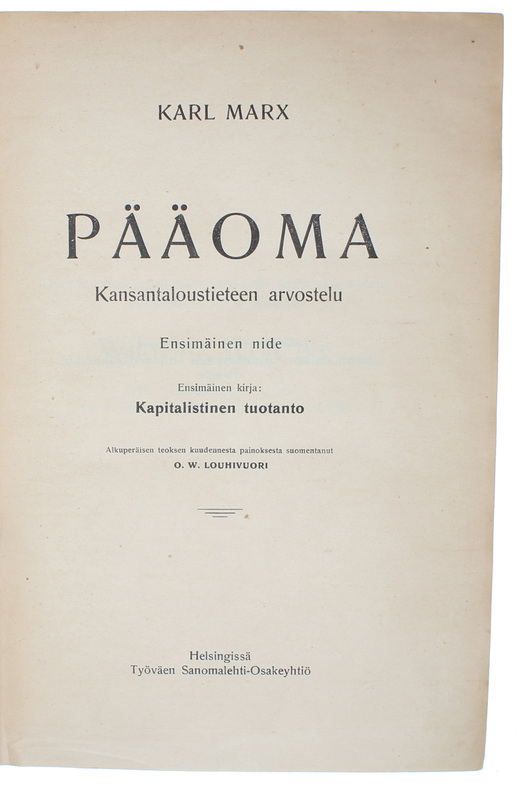
‎Pääoma. Kansantaloustieteen arvostelu Ensimäinen nide Ensimäinen kirja: Kapitalistinen tuotanto Alkuperäisen teoksen kuudennesta painoksesta suomentanut O. W. Louhivuori. (i.e. Finnish ""Das Kapital""). - [FIRST FINNISH TRANSLATION OF 'DAS KAPITAL']‎

‎Helsinki, Työväen Kirjapaino, 1918. 8vo. In publisher's original red cloth, with gilt lettering. Wear to extremities. Gilting on spine almost gone. Hindges very weak, book block almost detached from binding. Internally fine and clean. (4), XX, 712, (1), 79, (3) pp.‎

‎The rare first complete Finnish translation of Marx' landmark work, constituting what is arguably the greatest revolutionary work of the nineteenth century.""Shortly before Word War I, the young economist and socialist member of parliament Edward Gylling inspired a Finnish edition of ""Capital"". It was published with the help of the Finnish literature Promotion Fund (SKE). Volume one was translated by OV Louhivuori, who later became the principal of the School of Economics."" (Karl Marx Memorial Library Luxembourg - http://karlmarx.lu)‎

Référence libraire : 54737

Livre Rare Book

Herman H. J. Lynge & Son
Copenhagen Denmark Dinamarca Dinamarca Danemark
[Livres de Herman H. J. Lynge & Son]

€ 2,686.00 Acheter

‎"MARX, KAROL (+) FRIEDRICH ENGELS.‎

‎Rewolucja i Kontrrewolucja w Niemczech. (Polish i.e. ""Revolution and Counter-Revolution in Germany""). [Bound with:] Nauki Ekonomiczne (+) Ustroj Socjalistyczny. - [FIRST POLISH TRANSLATION OF MARX'S ""REVOLUTION AND COUNTER-REVOLUTION""]‎

‎Warszawa, Bibljoteka Naukowa, 1906. Small4to. Bound in contemporary half calf with gilt lettering to spine with four raised bands. Stamp to title-pages and last leaf, otherwise fine. 277, (3), 154, (6), 51, (1) pp.‎

‎First Polish translation of Marx and Engel's articles on the events in the Prussia, Austria and other German states during 1848, describing the impact on both middle-class and working-class aspirations and on the idea of German unification. It was originally published as a series of articles in the New York Daily Tribune 1851 to 1852 under Marx's byline, the material was first published in book form under the editorship of Eleanor Marx Aveling in 1896.‎

Référence libraire : 55908

Livre Rare Book

Herman H. J. Lynge & Son
Copenhagen Denmark Dinamarca Dinamarca Danemark
[Livres de Herman H. J. Lynge & Son]

€ 738.65 Acheter

‎"MARX, KARL (+) HAYDAR RIFAT (translator).‎

‎Sermaye. [i.e. Turkish: ""Das Kapital""]. - [FIRST TURKISH EDITION OF THE MOST IMPORTANT ABRIDGED VERSION OF ""THE CAPITAL""]‎

‎Istanbul, Sirketi Mürettibye Matbaasi, 1933. 8vo. In a recent full black leather binding with four raised bands and gilt lettering to spine and front board. Blindtooled frames to front and back board. A fine and clean copy. (7), (1), (5)-305, (1), [errata-leaf] pp.‎

‎Rare first Turkish book-length appearance of Marx’s landmark ‘Das Kapital’, being a translation of the most important abridged version of Marx's Capital ever to have appeared, Haydar Rifat’s (Yorulmaz) 1933 translation Sermaye, which was based on an abridged French version (1897) of the original by Gabriel Deville. Exerting great effort for the formation of the leftist thought and discourse in the late Ottoman and early Republican periods, Haydar Rifat was a prominent translator acting as a culture entrepreneur in the cultivation of leftist ideas. In his preface to Sermaye, Rifat notes that only passing remarks are made on Marx’s works in the faculties of law and political sciences and accounts for his attempt to further introduce Marx and his ideology to the academia and the public as follows: Das Kapital, Karl Marx’s masterpiece, has been translated into all major languages, and numerous commentaries and interpretations on this work have been published by experts in modern countries. The translations, commentaries and interpretations of this work are so abundant that they quantitatively surpass the commentaries on all Holy Books"" indeed, the works produced by various experts with different approaches under the title “Marxist Library” can fill up buildings. (Front the present work). ""The epitome, here translated, was published in Paris, in 1883, by Gabriel Deville, possibly the most brilliant writer among the French Marxians. It is the most successful attempt yet made to popularize Marx's scientific economics. It is by no means free from difficulties, for the subject is essentially a complex and difficult subject, but there are no difficulties that reasonable attention and patience will not enable the average reader to overcome. There is no attempt at originality. The very words in most cases are Marx's own words, and Capital is followed so closely that the first twenty-five chapters correspond in subject and treatment with the first twenty-five chapters of Capital. Chapter XXVI corresponds in the main with Chapter XXVI of Capital, but also contains portions of chapter XXX. The last three chapters-XXVII, XXVIII, and XXIX-correspond to the last three chapters-XXXI, XXXII, and XXXIII-of Capital."" (ROBERT RIVES LA MONTE, Intruductory Note to the 1899 English translation). “He also refers to how he has had to deal with the challenges arising from the translation of certain terms and/or the absence of any expert on the field whom he could consult: While doing this short translation, I have encountered many difficulties. It is necessary to find equivalents for new terms, or rather the terms, which are new for us. The trouble arose not just from finding Turkish equivalents in line with the new course our language has taken, it also concerns the difficulty in finding any equivalent. Some of these words and terms were used for the first time, while I have replaced some others with alternative words and terms though they have been in use for the past five or ten years. I almost never go out. On those rare occasions when I leave home and go out, I can find almost nobody whom I can consult and discuss my translation. (Rifat 1933, 7)” Rifat concludes his lengthy preface with a humble, almost apologetic note stating that he would be more than willing to correct any mistakes in his translation that could potentially cause his readers difficulty and that he had consulted a whole list of experts, mainly economists, about the equivalents of certain terms and the general content of the translation. The preface actually ends with a list of the names of the experts to whom Rifat had sent a copy of his translation” (Konca, The Turkish Retranslations of Marx’s Das Kapital as a Site of Intellectual and Ideological Struggle) Rifat’s translation immediately triggered a series of articles and critiques in various journals and papers upon its publication.‎

Référence libraire : 59547

Livre Rare Book

Herman H. J. Lynge & Son
Copenhagen Denmark Dinamarca Dinamarca Danemark
[Livres de Herman H. J. Lynge & Son]

€ 3,357.50 Acheter

‎"MARX, KARL (+) HAYDAR RIFAT (translator).‎

‎Sermaye. [i.e. Turkish: ""Das Kapital""]. - [FIRST TURKISH EDITION OF THE MOST IMPORTANT ABRIDGED VERSION OF ""THE CAPITAL""]‎

‎Istanbul, Sirketi Mürettibye Matbaasi, 1933. 8vo. In contemporary full black cloth binding with gilt lettering to spine. Blindtooled frames to front and back board. Previous owner's name ""Hüsnû Hizlan"" in gilt lettering to front board. A fine and clean copy. (7), (1), (5)-305, (1), [errata-leaf] pp.‎

‎Rare first Turkish book-length appearance of Marx’s landmark ‘Das Kapital’, being a translation of the most important abridged version of Marx's Capital ever to have appeared, Haydar Rifat’s (Yorulmaz) 1933 translation Sermaye, which was based on an abridged French version (1897) of the original by Gabriel Deville. Exerting great effort for the formation of the leftist thought and discourse in the late Ottoman and early Republican periods, Haydar Rifat was a prominent translator acting as a culture entrepreneur in the cultivation of leftist ideas. In his preface to Sermaye, Rifat notes that only passing remarks are made on Marx’s works in the faculties of law and political sciences and accounts for his attempt to further introduce Marx and his ideology to the academia and the public as follows: Das Kapital, Karl Marx’s masterpiece, has been translated into all major languages, and numerous commentaries and interpretations on this work have been published by experts in modern countries. The translations, commentaries and interpretations of this work are so abundant that they quantitatively surpass the commentaries on all Holy Books"" indeed, the works produced by various experts with different approaches under the title “Marxist Library” can fill up buildings. (Front the present work). ""The epitome, here translated, was published in Paris, in 1883, by Gabriel Deville, possibly the most brilliant writer among the French Marxians. It is the most successful attempt yet made to popularize Marx's scientific economics. It is by no means free from difficulties, for the subject is essentially a complex and difficult subject, but there are no difficulties that reasonable attention and patience will not enable the average reader to overcome. There is no attempt at originality. The very words in most cases are Marx's own words, and Capital is followed so closely that the first twenty-five chapters correspond in subject and treatment with the first twenty-five chapters of Capital. Chapter XXVI corresponds in the main with Chapter XXVI of Capital, but also contains portions of chapter XXX. The last three chapters-XXVII, XXVIII, and XXIX-correspond to the last three chapters-XXXI, XXXII, and XXXIII-of Capital."" (ROBERT RIVES LA MONTE, Intruductory Note to the 1899 English translation). “He also refers to how he has had to deal with the challenges arising from the translation of certain terms and/or the absence of any expert on the field whom he could consult: While doing this short translation, I have encountered many difficulties. It is necessary to find equivalents for new terms, or rather the terms, which are new for us. The trouble arose not just from finding Turkish equivalents in line with the new course our language has taken, it also concerns the difficulty in finding any equivalent. Some of these words and terms were used for the first time, while I have replaced some others with alternative words and terms though they have been in use for the past five or ten years. I almost never go out. On those rare occasions when I leave home and go out, I can find almost nobody whom I can consult and discuss my translation. (Rifat 1933, 7)” Rifat concludes his lengthy preface with a humble, almost apologetic note stating that he would be more than willing to correct any mistakes in his translation that could potentially cause his readers difficulty and that he had consulted a whole list of experts, mainly economists, about the equivalents of certain terms and the general content of the translation. The preface actually ends with a list of the names of the experts to whom Rifat had sent a copy of his translation” (Konca, The Turkish Retranslations of Marx’s Das Kapital as a Site of Intellectual and Ideological Struggle) Rifat’s translation immediately triggered a series of articles and critiques in various journals and papers upon its publication.‎

Référence libraire : 59614

Livre Rare Book

Herman H. J. Lynge & Son
Copenhagen Denmark Dinamarca Dinamarca Danemark
[Livres de Herman H. J. Lynge & Son]

€ 3,357.50 Acheter

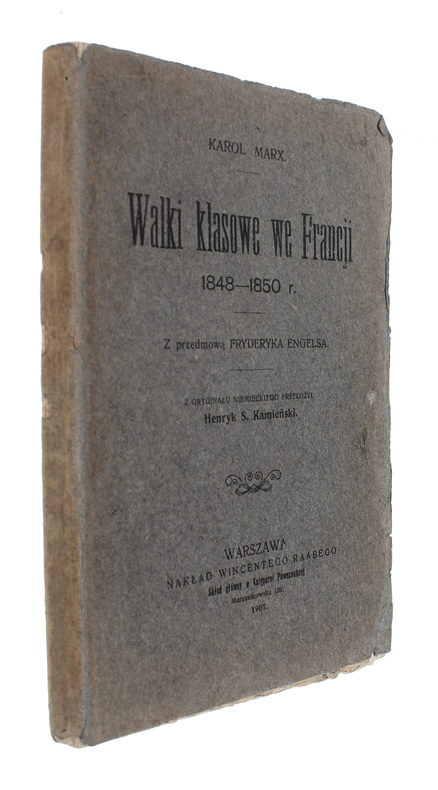
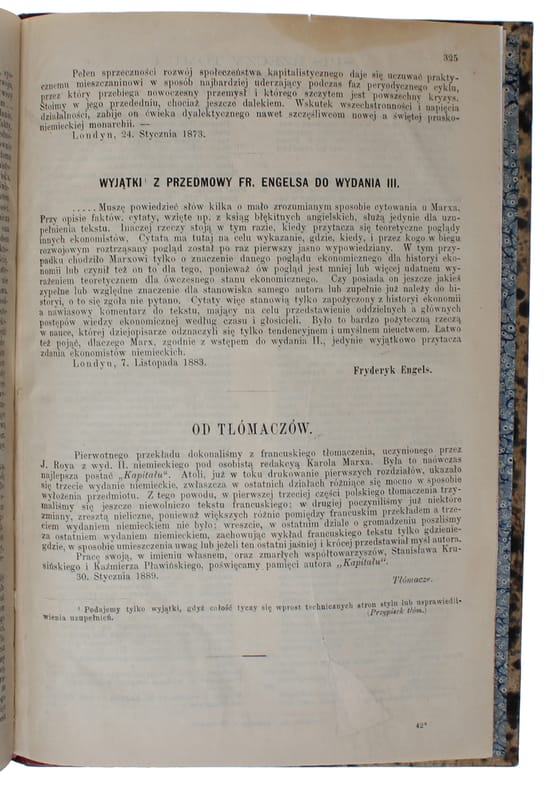
‎"MARX, KARL.‎

‎Walki klasowe we Francji 1848-1850 r. [i.e. English: ""The Class Struggles in France 1848-1850""].‎

‎Warszawa, Naklad Wincentego Raabego, 1907. 8vo. Uncut in the original printed wrappers. Wrappers with a few nicks and spine with three small holes. Internally fine and clean. (4), 182 pp.‎

‎Second Polish edition of Marx's analysis on the class issues and the economic relations which drove forward the social and political upheavals, which took place in France in 1848. The first Polish translation was published the year before in 1906.‎

Référence libraire : 55506

Livre Rare Book

Herman H. J. Lynge & Son
Copenhagen Denmark Dinamarca Dinamarca Danemark
[Livres de Herman H. J. Lynge & Son]

€ 201.45 Acheter

‎"MARX, KARL.‎

‎Zur Kritik der politischen Oekonomie. Erstes Heft [all that appeared]. - [THE BLUEPRINT FOR ""DAS KAPITAL"" - MAGNIFICENT ASSOCIATION-COPY]‎

‎Berlin, Franz Duncker, 1859. 8vo. Nice contemporary hafl calf with gilt lettering to spine. A bit of wear to extremities, markings after old label to front board and signs of vague damp staining to front board. A mostly faint damp stain to outer inner corner throrughout, but otherwise very nice. Title-page a bit dusty. Old library number (872) to front free end-paper and top of title-page and marginal pencil-annotations to a number of leaves. VIII, (2), 170 pp. Title-page with the ownership-signature of Alexander Appolonovich Manuilov to top of title-page and binding with his initials ""A. M."" in gold to the fot of spine.‎

‎Scarce first edition, in a magnificent association-copy, of the groundbreaking work, in which Marx first presents his revolutionizing theories of capitalism, forming the foundation for his main work ""The Capital"", which appeared eight year later. It is also in this milestone of political and economic thought that Marx presents his economic interpretation of history for the first time.Alexander Appolonovich Manuilov (1861-1929) was a Russian economist and politician, famous not only as one of the founding members of the Constitutional Democratic party (known as the Kadets), but also as the Russian translator of Marx' ""Zur Kritik..."", i.e. the present work. ""Manuilov graduated from the law department of the University of Novorossiia (Odessa, 1883). He began scholarly and pedagogical work in political economy in 1888. In 1901 he became head of a subdepartment at Moscow University, becoming assistant rector in 1905 and serving as rector from 1908 to 1911. He was dismissed by the tsarist government for attacking the ""extremes"" of Stolypin’s agrarian legislation. In the 1890’s he was a liberal Narodnik (Populist), later becoming a Constitutional Democrat (Cadet) and a member of the Central Committee of the Cadet Party. Manuilov’s draft on agrarian reform (1905) was the basis for the Cadets’ agrarian program. V. I. Lenin sharply criticized Manuilov, calling him one of ""the bourgeois liberal friends of the muzhik who desire the ‘extension of peasant land ownership’ but do not wish to offend the landlords"" (Poln. sobr. soch., 5th ed., vol. 11, p. 126, note).At the beginning of his scholarly career Manuilov accepted the labor theory of value. In 1896 he translated K. Marx’ work A Contribution to the Criticism of Political Economy (Zur Kritik der Politischen Oekonomie). During the years of reaction he espoused subjectivist and psychological views in political economy. In 1917 he was minister of education of the Provisional Government. After the October Revolution in 1917 he emigrated but soon returned and cooperated with Soviet power. He participated in the orthographic reform (1918). In 1924 he became a member of the board of Gosbank (State Bank). He taught in higher educational institutions. Changing to Marxist positions and relying on Lenin’s works, he criticized the revisionists and neo-Narodniks on the agrarian question."" (Encycl. Britt.).For many years, the exclusive focus on ""Das Kapital"" meant that the ""Kritik"" was overlooked. Since the beginning of the 1960's, however, scholars have become increasingly aware of its importance as the blueprint for the social and economic theory Marx shall go on to develop (see for example Raymond Aron, ""Le Marxisme de Marx"", 1962). It is here that Marx outlines the research programme to which he shall devote the rest of his working life. He himself described ""Das Kapital"" as a continuation of his ""Zur Kritik der politischen Oekonomie"" (see e.g. PMM 359), in which his primary concern is an examination of capital and in which he provides the theoretical foundation for his political conclusions later presented in ""Das Kapital"". ""I examine the system of bourgeois economy in the following order: capital, landed property, wage-labour" the State, foreign trade, world market.The economic conditions of existence of the three great classes into which modern bourgeois society is divided are analysed under the first three headings the interconnection of the other three headings is self-evident. The first part of the first book, dealing with Capital, comprises the following chapters: 1. The commodity, 2. Money or simple circulation" 3. Capital in general. The present part consists of the first two chapters."" (Preface to the present work, in the translation (by S.W. Ryazanskaya) of the Progress Publishers-edition, Moscow, 1977).Apart from the obvious importance of the work as the foundational precursor to what is probably the greatest revolutionary work of the nineteenth century, the ""Kritik"" is of the utmost importance in the history of political and economic thought, as it is here, in the preface, that Marx outlines his classic formulation of historical materialism. This preface contains the first connected account of what constitutes one of Marx's most important and influential theories, namely the economic interpretation of history - the idea that economic factors condition the politics and ideologies that are possible in a society.""The first work which I undertook to dispel the doubts assailing me was a critical re-examination of the Hegelian philosophy of law"" the introduction to this work being published in the Deutsch-Franzosische Jahrbucher issued in Paris in 1844. My inquiry led me to the conclusion that neither legal relations nor political forms could be comprehended whether by themselves or on the basis of a so-called general development of the human mind, but that on the contrary they originate in the material conditions of life, the totality of which Hegel, following the example of English and French thinkers of the eighteenth century, embraces within the term ""civil society"""" that the anatomy of this civil society, however, has to be sought in political economy. The study of this, which I began in Paris, I continued in Brussels, where I moved owing to an expulsion order issued by M. Guizot. The general conclusion at which I arrived and which, once reached, became the guiding principle of my studies can be summarised as follows. In the social production of their existence, men inevitably enter into definite relations, which are independent of their will, namely relations of production appropriate to a given stage in the development of their material forces of production. The totality of these relations of production constitutes the economic structure of society, the real foundation, on which arises a legal and political superstructure and to which correspond definite forms of social consciousness. The mode of production of material life conditions the general process of social, political and intellectual life. It is not the consciousness of men that determines their existence, but their social existence that determines their consciousness. At a certain stage of development, the material productive forces of society come into conflict with the existing relations of production or - this merely expresses the same thing in legal terms - with the property relations within the framework of which they have operated hitherto. From forms of development of the productive forces these relations turn into their fetters. Then begins an era of social revolution. The changes in the economic foundation lead sooner or later to the transformation of the whole immense superstructure."" (Preface to the present work, in the translation (by S.W. Ryazanskaya) of the Progress Publishers-edition, Moscow, 1977).The work is a summation of Marx' many years of economic studies, mainly undertaken at the Reading Room of the British Museum, and it constitutes the first attempt at a general outline of his theories. Like his ""Capital"", the ""Critique"" was originally planned as a work in several volumes, but only this first volume appeared. The work, which was printed in a mere 1000 copies, is scarce and rarely seen on the market.‎

Référence libraire : 58578

Livre Rare Book

Herman H. J. Lynge & Son
Copenhagen Denmark Dinamarca Dinamarca Danemark
[Livres de Herman H. J. Lynge & Son]

€ 56,406.00 Acheter

‎"Marx, Arthur"‎

‎Red Skelton: An Unauthorized Biography‎

‎New York: "E.P. Dutton & Co. Inc." 1979. "First Edition First Printing". Hardcover. Near Fine/Near Fine. "White Cloth and Black Board Covers; edges of white covers are lightly soiled; White Endpapers; book interior is clean and tight; illustrated; 8vo; 326 pages; indexed; dustjacket is protected by a mylar wrapper and because it is white it shows light soiling; top edge of rear panel has a tiny chip and a diagonal corner crease " <br/><br/>1.30#; P3; "E.P. Dutton & Co., Inc." hardcover‎

Référence libraire : 980000167 ISBN : 052518953x 9780525189534

Biblio.com

Charing Cross Road Booksellers
United States Estados Unidos Estados Unidos États-Unis
[Livres de Charing Cross Road Booksellers]

€ 16.03 Acheter

‎"RUGE, ARNOLD (edt.) - KARL MARX.‎

‎Anekdota zur neuesten deutschen Philosophie und Publicistik von Bruno Bauer, Ludwig Feuerbach, Friedrich Köppen, Karl Nauwerk, Arnold Ruge und einigen Ungenannten. 2 bde. [(Marx): Bemerkungen über die neueste preußische Censurinstruction. Von einem Rh... - [DEFINING THE ESSENCE OF REASON AS FREEDOM - MARX' DEBUT ARTICLE]‎

‎Zürich & Winterthur, Literarischen Comptoirs, 1843. 8vo. Bound in one nice later half calf binding in contemporary style with gilt title and blindstamped ornamentation to spine. Faded inscription of ""Eigenthus des Literar. Museum"" to both title-pages and last leaf of bot volumes. Stamps of the same Litarary Museum to volume 1, at both title-page, last leaf and a few leaves inbetween. Neat pencil annotations to a few leaves of volume 1. Neatly washed and with a few tiny closed tears to second gathering. A small spot to lower blank margin of pp. 195-8 of vol. 1. Contents generally clean and crisp. All in all a evry nice copy. IV, 320 + IV, 288 pp. [Marx' paper: Vol. I, pp. 56-88].‎

‎Extremely scarce first edition of this two-volume periodical, which contains the first printing of Marx' first newspaper article, being the first political article written by Marx for publication, namely his ""Comments on the Latest Prussian Censorship Instruction"". This important debut work, which constitutes the foundation of Marxian dialectic and his formulation of Critical Hegelianism, was written between January 15 and February 10, 1842, but due to censorship restrictions, it first appeared here, in Ruge's ""Anekdota"", in Switzerland in 1843, to avoid German censorship. ""The young Marx and the young Engels ridiculed the Prussian Censorship Law of 1841. The attack of the young Mark, ""Comments on the Latest Prussian Censorship Instruction,"" was written in 1842 but published a year later in Ruge's ""Anekdota"".""Comments on the Latest Prussian Censorship Instruction"" is an early exercise by the young Marx in the application of the categories of Hegelian critique. In this essay, the young Marx employed the Hegelian modalities of substance and essence to demonstrate the authoritarian nature of the Prussian Censorship Instruction. The young Marx utilized the concepts of substance and essence in the defence of free press. ""Comments on the Latest Prussian Censorship Instruction"" defines the essence of a free press as free mind, or the essence of reason as freedom. The young Marx argues that it was impossible for reason to act in accordance with its essence unless it was totally free, because without absolute freedom, reason cannot follow its own insights to their logical conclusion. Consequently, when the Prussian Censorship Instruction limits the freedom of reason, when it sets boundaries beyond which reason cannot go, the Prussian Government annihilates the essence of reason. The strategy of the young Marx is his essay is to adopt Hegelian logic in the cause of liberalism. He wished to show how Hegelian categories could be adjusted, could be transformed into weapons in the cause of political reform. In this essay, the young Marx proved two things, that he interpreted Hegel as a critical Hegelian and that he himself continued this Critical Hegelian tradition. In 1842, the young Marx explored, experimented with the use of Hegelian categories, essence, and appearance as devices by which to advance the cause of political progressivism, and this was the meaning of Critical Hegelianism in the generation of Gans."" (Norman Levine: Divergent Paths: Hegel in Marxism and Engelsism, pp. 142-43).""Karl's [i.e. Marx] politics had closely followed those of Ruge ever since the end of the 1830s. In 1842 and 1843, their responses to immediate events, not least the ""frivolous diatribes of the ""Free"", had remained very close. An established author, and in the possession of independent means, ""Papa Ruge"" - as Jenny called him - was clearly the senior partner in this collaboration. The banning of the ""Deutsche Jahrbücher"" in January 1843 as the result of Prussian pressure, together with the suppression of the ""Rheinische Zeitung"", meant the effective silencing of Young Hegelianism within Germany. The aim of the criticism, as it was applied among Young Hegelians, was to highlight the gap between the demands of reason and the behavior of the government, but its failure to make any significant headway against the Prussia of Friedrich Wilhelm IV had also pushed them both towards an open criticism of Hegel's political philosophy. (Gareth Steadman Jones: Karl Marx, Greatness and Illusion, p. 142).Although another anonymous essay ""Luther als Schiedsrichter zwischen Strauß und Feuerbach"" (Vol. II, pp. 206-208) has long been attributed to Marx, the preface to MECW I now states that ""recent research has proved that it was not written by Marx (Draper, register, p. 58). The piece might be by Feuerbach himself.‎

Référence libraire : 58875

Livre Rare Book

Herman H. J. Lynge & Son
Copenhagen Denmark Dinamarca Dinamarca Danemark
[Livres de Herman H. J. Lynge & Son]

€ 24,845.50 Acheter

‎( Editions Champ Libre - Cinéma ) - Groucho Marx - Patrice Ricord dit Ricor.‎

‎Correspondance de Groucho Marx .‎

‎Editions Champ Libre 1981. In-8 broché oblong de 362 pages au format 21,5 x 12,5 cm. Couverture illustrée à rabats par Patrice Ricord dit Ricor, d'une caricature de Groucho Marx. Dos resté carré avec pâle auréole verticale tout du long. Plats et intérieur frais malgré. Bel état général. Réédition originale, traduite de l’américain par Claude Portail, aidé de Harry Mathews.‎

‎Vente exclusivement par correspondance. Le libraire ne reçoit, exceptionnellement que sur rendez-vous. Il est préférable de téléphoner avant tout déplacement.Forfait de port pour un livre 10 € sauf si épaisseur supérieure à 3 cm ou valeur supérieure ou égale à 100 €, dans ce cas expédition obligatoire au tarif Colissimo en vigueur. A partir de 2 livres envoi en colissimo obligatoire. Port à la charge de l'acheteur pour le reste du monde.Les Chèques ne sont plus acceptés.Pour destinations extra-planétaire s'adresser à la NASA.Membre du Syndicat Lusitanien Amateurs Morues‎

Référence libraire : 23074

Livre Rare Book

Librairie Victor Sevilla
Paris France Francia França France
[Livres de Librairie Victor Sevilla]

€ 20.00 Acheter

‎( Marx, Groucho ) Cantor, Eddie‎

‎As I Remember Them with chapter on Marx‎

‎Duell Sloan 1963. First Edition. Hardcover. Very Good. Octavo. Previous owner's signature on title page. Removed on request. Out of print. Binding is cloth. Duell Sloan hardcover‎

Référence libraire : BN005643

Biblio.com

BOOKFORT
United States Estados Unidos Estados Unidos États-Unis
[Livres de BOOKFORT]

€ 29.33 Acheter

‎(BORUTTI Silvana) -‎

‎Il modo di produzione capitalistico in Marx.‎

‎Bologna, Zanichelli, 1980, 8vo (cm. 19 x 11,5) brossura con copertina illustrata a colori, pp. 137 (LF, 2) .‎

MareMagnum

Libreria Piani
Monte San Pietro, IT
[Livres de Libreria Piani]

€ 10.00 Acheter

‎(Centro Karl Marx di Pisa) -‎

‎Sviluppo capitalistico e forza – lavoro intellettuale.‎

‎Milano Sapere 1971 16mo brossura editoriale pp. 163 con 11 figure nel testo piccoli strappi alla copertina e al dorso. unknown‎

Référence libraire : 2-22230

Biblio.com

Libreria Piani snc
Italy Italia Itália Italie
[Livres de Libreria Piani snc]

€ 9.00 Acheter

‎(Darboven, Hanne) Valerie L. Hillings, Wolfgang Marx:‎

‎Hanne Darboven: Hommage à Picasso‎

‎-Deutsche Guggenheim 24 April 2006-. Exhibition catalogue. 280x230mm 92 pages plus fold-out and CD container. Illustrated in colour. Part paperback with hard boards for CD. Very good. Published to accompany the major exhibition at the Guggenheim Berlin this book presents an updated and expanded version of Hanne Darbovens work Hommage to Picasso. It reproduces the 270 of Darbovens signature texts created for the exhibition and a series of her sculptures as well as a CD of her newly produced musical score Opus 60. We are specialists in Catalogues: Exhibitions Auctions Collections etc. with a picture of the cover available on request. All items are as described and dispatched within 36 hours in a secure package. We are professional booksellers with 30 years experience and a real-life bookshop. You may order with confidence. Hanne Darboven: Hommage à Picasso German artist 0892073411 -Deutsche Guggenheim (24 April 2006)- paperback‎

Référence libraire : 25619 ISBN : 0892073411 9780892073412

Biblio.com

Paul Brown Books
United Kingdom Reino Unido Reino Unido Royaume-Uni
[Livres de Paul Brown Books]

€ 28.55 Acheter

‎(Disneyana) DISNEY, Walt; JEFFERDS, Vincent; MARX, Groucho; et al.‎

‎Disney Magazine -November/December 1976‎

‎Walt Disney Productions 1976. First Edition. Original wraps. Very Good . 8 1/4 X 11 Inches. 48 PP. Free when you purchased one bottle of "TOP JOB" or eight bars of "Ivory" soap at a participating store in 1976. Two page story by Groucho Marx. Original stapled binding. Walt Disney Productions unknown‎

Référence libraire : 2207

Biblio.com

Back in Time Rare Books, LLC
United States Estados Unidos Estados Unidos États-Unis
[Livres de Back in Time Rare Books, LLC]

€ 13.96 Acheter

‎(E .L. Doctorow, Joyce Carol Oates, Groucho Marx)‎

‎Playboy. Vol. 21 no. 3. March 1974‎

‎Chicago: Playboy 1974. First printing. Paper wrappers. Very good light wear to wrappers minor soiling throughout. 218 pp. 11 x 8.5 in. Includes article by E. L. Doctorow "The Bomb Lives!" and Joyce Carol Oates "The Golden Madonna" and an interview with Groucho Marx. Playboy unknown‎

Référence libraire : 46285

Biblio.com

Kaaterskill Books, ABAA/ILAB
United States Estados Unidos Estados Unidos États-Unis
[Livres de Kaaterskill Books, ABAA/ILAB]

€ 16.92 Acheter

‎(Engels / Marx / Marxismus)‎

‎4 Bände‎

‎Verschiedene Verlage und Orte 1946-1967. Zusammen ca. 1104 S. verschiedene Einbände teils gebräunt / teils mit Bleistift-Randnotizen. - enthalten: Der Marxismus. Philosophie-Ideologie-Soziologie-Ökonomie-Politik / Friedrich Engels über die Gewaltstheorie. Gewalt und Ökonomie bei der Herstellung des neuen Deutschen Reiches / Friedrich Engels. Ludwig Feuerbach und der Ausgang der klassischen deutschen Philosophie / Marx - Engels. Manifest der Kommunistischen PArtei - unknown‎

Référence libraire : 4B12029

Biblio.com

Celler Versandantiquariat
Germany Alemania Alemanha Allemagne
[Livres de Celler Versandantiquariat]

€ 20.00 Acheter

‎(HALTMEYER, Marx) (1588-1635) (& HUBER, Christian):‎

‎Beschreibung der Eidgnössischen Statt St. Gallen. Gelegenheit, Geschichten und Regiment. (Verfasst von Marx Huber). Wie auch des Lebens Hrn. D. von Watt, gewesenen Burgermeisters daselbst (von Christian Huber). 2 Teile in 1 Band.‎

‎S. Gallen, Jacob Redinger, M. DC. LXXXIII., (1683), kl. in-8vo, 1 Kupfer-Titel (gest. von Jeremias Renner. Titel: Historische Beschreibung der Statt Sanct Gallen) + 58 Bl., inkl. Titelbl. mit gestoch. herald. Vignette + Blatt 1+2 zu Vadian + 1 mehrfach gefalt. Kupfertafel (Panorama: Die Statt St. Gallen, gest. von H. Pfauw) + 722 S.; gest. Frontispiz-Porträt von ‘Joachimus Vadianus’ (von Watt) + 84 S. (inklus. Titelbl.) + 1 Bl. (Errata), stellenweise leicht gebräunt, hs. Besitzauftrag d. Zeit auf Vorsatz, zeitgen. Pergamentband, etwas gebräunt. Schönes Exemplar‎

‎Erstausgabe. Seltene Chronik der Statt St. Gallen, mit umfangreichem Register, illustriert mit Kupfertitel und einer schönen gefalt. gestoch. Panorama-Ansicht der Stadt. “Seine Arbeit erstreckt sich bis 1683. ... sie verdient theils wegen der Geschichte selbst, teils wegen der Beschreibung der Stadt und deren Regierungsform, nicht wenig Achtung. In der Geschichte findet man viel merkwürdiges, besonders von den Zeiten der Glaubensverbesserung, und hauptsächlich von den Wiedertäufern in den Jahren 1525 und 1526, und von der Bibliothek wird auch viel Lesenswürdiges beygebracht” (Haller).Teil 2 enthält die mit gestochenem Porträt illustrierte Biographie Joachim von Watts (gen. Vadianus) (1484-1551). Er wurde 1526 erstmals Bürgermeister der Stadt und von da an bis zu seinem Tode war er neunmal regierender Bürgermeister, Altbürgermeister und Reichsvogt. Von Watt “griff die politische und geistige Leitung bei der Vorbereitung und Einführung der Reformation und übernahm die Auseinandersetzung mit den Wiedertäufern, die Begründung der st. gall. evangelischen Kirche und den Versuch der Säkularisation des Klosters” (HBLS). “Hier ist eine ziemlich umständliche Lebensbeschreibung dieses Mannes, die vollständiger und zuverlässiger ist, als alles was vor und nachhero über ihn ist geschrieben worden. ...” Lonchamp 1389; Barth 20216; Haller IV/869 und II/1594; HBLS VII/429 (von Watt) IV/67, Nr. 3 Haltmeyer, und IV/302, H.d Nr. 4 (Huber). Image disp.‎

Référence libraire : 122628aaf

Livre Rare Book

Harteveld Rare Books Ltd.
Fribourg Switzerland Suiza Suíça Suisse
[Livres de Harteveld Rare Books Ltd.]

€ 1,146.81 Acheter

‎(Kandel, Efim P. / Preiss, J.J.)‎

‎Marx und Engels über das reaktionäre Preussentum. [Hrsg.] Marx-Engels-Lenin-Institut, Moskau.‎

‎Moskau, Verlag für fremdsprachige Literatur, 1943. 8° (19,5 x 13 cm). 51 (2) S. Typographisch in Blau gestaltete Original-Broschur.‎

‎Erste deutsche Ausgabe. Übersetzung nach der russischen Ausgabe von 1942. Faschismusanalyse stalinscher Prägung! - Mit geringen Alters- und Gebrauchsspuren, gutes Exemplar.‎

Référence libraire : 98780AB

‎(Kohut, George A.) Ed. by SW. Baron and A. Marx S. W.‎

‎Jewish studies : in memory of George A. Kohut 1874-1933‎

‎Alexander Kohut Memorial Foundation 1935. Trade Paperback. GOOD. xciii 614 English & German 148 Hebrew pp. Frontispiece portrait and 2 b/w plates. Sewn binding. Original wraps are worn dampstained and taped. Text block head edge foxed sound and unmarked otherwise. Alexander Kohut Memorial Foundation paperback‎

Référence libraire : 501087

Biblio.com

Arches Bookhouse
United States Estados Unidos Estados Unidos États-Unis
[Livres de Arches Bookhouse]

€ 41.88 Acheter

‎(Literature) MARX, Michael‎

‎A War Ends. SIGNED FIRST PRINTING‎

‎Santa Monica: Michael Marx 1977. First Edition First Printing. Hardcover. Near Fine/Very Good . 5 1/2 X 8 1/2 Inches. 243 PP. Stated "Private First Edition" on the copyright page. Signed and inscribed by author on title-page. Light scuffing to rear panel of DJ. Michael Marx hardcover‎

Référence libraire : 1726

Biblio.com

Back in Time Rare Books, LLC
United States Estados Unidos Estados Unidos États-Unis
[Livres de Back in Time Rare Books, LLC]

€ 9.31 Acheter

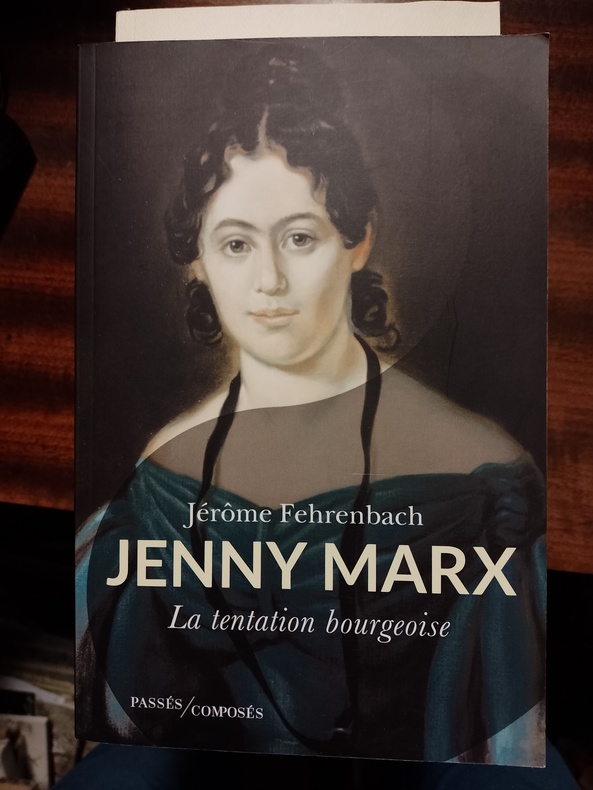
‎(MARX Jenny) / FEHRENBACH Jérôme‎

‎Jenny Marx. La tentation bourgeoise‎

‎Paris, Passés Composés, 2021, 14,5 x 22, 398-VIII pages sous couverture souple illustrée. Avec VIII pages d'illustrations noir & blanc et couleurs.‎

‎Très bon état.‎

Référence libraire : HISTOALLEMAGN1122

Livre Rare Book

Le Plaisir du Texte
Lyon France Francia França France
[Livres de Le Plaisir du Texte]

€ 13.00 Acheter

‎(MARX) SOMERHAUSEN (Luc)‎

‎L'humanisme agissant de Karl Marx.‎

‎Paris, Richard Masse Editeur, 1946. In-8 broché non coupé, XIV-291 pp. Illustrations en noir. Bel envoi de l'auteur "Pour Jean-Marie Andrieu hommage très affectueux, reconnaissant même pour avoir eu le courage de lire ce livre quand il était envore manuscrit, pour avoir eu la bonne grâce de s'y intéresser";‎

Référence libraire : 8786

Livre Rare Book

Librairie Le Lutrin
Nice France Francia França France
[Livres de Librairie Le Lutrin]

€ 20.00 Acheter

‎(MARX) CALVEZ (Jean-Yves)‎

‎La pensée de Karl Marx.‎

‎Paris, Seuil, Collection "Esprit", 1957. Fort volume in-8 broché, 664 pp. Critique de la religion et de la philosophie, la dialectique fondements de la science, du réel et de l'éthique, fin de l'aliénation et instauration de l'homme, le marxisme devant la critique.‎

Référence libraire : 5021

Livre Rare Book

Librairie Le Lutrin
Nice France Francia França France
[Livres de Librairie Le Lutrin]

€ 30.00 Acheter

‎(Marx / Engels / Mini-Buch) Duncker, Hermann‎

‎Über das Manifest der Kommunistischen Partei.‎

‎Verlag Tribüne, Berlin., 1983. 191 S. 16°, OPbd mit OSchuber.‎

‎Mini-Buch im Format von ca. 11,5 x 8,5 cm. Nur minimale Gebrauchsspuren, nahezu neuwertig.‎

Référence libraire : 26860

Antiquariat.de

Prometheus Antiquariat
DE - Wilhelmshaven
[Livres de Prometheus Antiquariat]

€ 5.00 Acheter

‎(MARX BROTHERS). Pirosh, Robert & George Seaton.‎

‎A Day at the Races.‎

‎New York: Viking 1972. First edition paper issue. Trade paperback format. A volume in the MGM Library of Film Scripts. Illustrated. Wrappers near fine. New York: Viking, (1972). First edition, paper issue. paperback‎

Référence libraire : 07254

‎(MARX BROTHERS). MARX, Groucho‎

‎Groucho and Me‎

‎San Francisco CA: Mercury House. 1988. Advance Uncorrected Proof. Very Good in wrappers. Unless otherwise noted our first editions are first printings. First Edition. Softcover. Very Good. Mercury House paperback‎

Référence libraire : 706261

Biblio.com

Ken Lopez Bookseller, ABAA
United States Estados Unidos Estados Unidos États-Unis
[Livres de Ken Lopez Bookseller, ABAA]

€ 16.92 Acheter

‎(Marx Brothers). Eyles, Allen.‎

‎THE MARX BROTHERS: Their World of Comedy.‎

‎London: A. Zwemmer Limited / New Jersey: A. S. Barnes & Co. Inc. 1966. 1966. Very good. - Small square octavo 6-1/4"x5-1/4" pictorial orange black & white wraps. The head & tail of the spine are lightly chipped. 175 pages. There are small light stains to the bottom corners of the first 13 pages. Black-and-white illustrations. Very good. <p>First edition wraps issue. London: A. Zwemmer Limited / New Jersey: A. S. Barnes & Co., Inc., (1966). paperback‎

Référence libraire : 3528

Biblio.com

Blue Mountain Books & Manuscripts, Ltd.
United States Estados Unidos Estados Unidos États-Unis
[Livres de Blue Mountain Books & Manuscripts, Ltd.]

€ 8.46 Acheter

‎(Marx Engels Lenin)‎

‎The Essential Left: Four Classic Texts on the Principles of Socialism‎

‎London: Allen & Unwin 1974. 6th imp. Nice copy. small octavo. stiff wrappers 255pp. Allen & Unwin unknown‎

Référence libraire : R65801

Biblio.com

Andrew Barnes Booksellers
Australia Australia Austrália Australie
[Livres de Andrew Barnes Booksellers]

€ 18.44 Acheter

‎(MARX) BARSON, Michael, ed‎

‎FLYWHEEL SHYSTER AND FLYWHEEL; The Marx Brothers Lost Radio Show‎

‎NY: Pantheon 1988. First Edition this was not issued in cloth. 8vo pp. 330. Bound in paper wrappers a very good copy. 25 original radio scripts. Pantheon unknown‎

Référence libraire : 59307 ISBN : 0679720367 9780679720362

Biblio.com

Second Life Books Inc
United States Estados Unidos Estados Unidos États-Unis
[Livres de Second Life Books Inc]

€ 33.00 Acheter

‎(MARX, Groucho, EL. Doctorow, Joyce Carol Oates, Dan Greenburg, and others) E. L.‎

‎Playboy - Vol. 21 No. 3 March 1974‎

‎Chicago: Playboy Enterprises Inc 1974. Softcover. Very Good. Vol. 21 No. 3. Small quarto. Stapled wrappers. Wraps moderately rubbed and bumped abrasions along the spine a bit of spotting on the rear cover very good. Includes an interview with Groucho Marx as well as contributions by E.L. Doctorow Joyce Carol Oates Dan Greenburg and others. Playboy Enterprises, Inc unknown‎

Référence libraire : 615828

Biblio.com

Between the Covers- Rare Books, Inc. ABAA
United States Estados Unidos Estados Unidos États-Unis
[Livres de Between the Covers- Rare Books, Inc. ABAA]

€ 16.92 Acheter

‎(Marx, Karl & Engels, Friedrich) Glashutten im Taunus. Auvermann & Reiss & Konigstein im Taunus. Georg Sauer.‎

‎Die Gemeinschaftsarbeiten von Marx und Engels: Eine Sammlung von Originalausgaben.‎

‎Glashütten/Königstein n.d. 73 1pp. Sm. 4to. Wraps. Glashütten/Königstein, n.d. paperback‎

Référence libraire : B165931-1

Biblio.com

Ars Libri Ltd
United States Estados Unidos Estados Unidos États-Unis
[Livres de Ars Libri Ltd]

€ 10.58 Acheter

‎(Marx, Karl).‎

‎KARL MARX ALBUM. Herausgegeben vom Marx-Engels-Lenin-Stalin-Institut beim Zentralkomitee der Sed.‎

‎Berlin: Dietz Verlag 1953. 1953. Good. - Quarto gray cloth titled in red. Spine & extremities darkened; covers bumped soiled & stained. 147 pp. plus colophon. Sepia-toned portrait frontispiece & full-page & textual illustrations including folding facsimiles of newspaper pages. The rear hinge is cracked; the margins of some illustrations are darkened. Good. <p>A useful collection of facsimiles documents and portraits. Berlin: Dietz Verlag, 1953. hardcover‎

Référence libraire : 7079

Biblio.com

Blue Mountain Books & Manuscripts, Ltd.
United States Estados Unidos Estados Unidos États-Unis
[Livres de Blue Mountain Books & Manuscripts, Ltd.]

€ 42.31 Acheter

‎(Marx, Karl). Jackson, J. Hampden‎

‎Marx Proudhon and European socialism‎

‎London: English Universities Press 1957. 192p. dj Teach yourself history. English Universities Press unknown‎

Référence libraire : 1251

Biblio.com

Hackenberg Booksellers ABAA
United States Estados Unidos Estados Unidos États-Unis
[Livres de Hackenberg Booksellers ABAA]

€ 21.15 Acheter

‎(Mendjisky) Maurois, A. et al.‎

‎LES PEINTURES DE SERGE MENDJISKY, présentées par André Maurois, Marcel Pagnol, Claude-Roger Marx, Raymond Charmet.‎

‎Paris, Imprimerie Grou- Radenez 1963, in-4 (24,3 x 28,7 cm) relié toile Les photos noires ont été réalisées par Lucien Petitjean - Marc Vaux, les ektachromes sont dûs à Lucien Petitjean. La photogr avure a été réalisée dans les ateliers de la Sté Offset Poliveaux. Notre exemplaire ne porte pas de numéro.‎

‎une 30 de pages ont eté reliées à l'envers par l'imprimeur,neanmoins complet,sans jaquette. Remise de 20% pour toutes commandes supérieures à 200 €‎

Référence libraire : 10539

Livre Rare Book

Livres Anciens Komar
Meounes les Montrieux France Francia França France
[Livres de Livres Anciens Komar]

€ 25.00 Acheter

‎(MOUVEMENT OUVRIER) MARX (Karl)‎

‎Les luttes de classes en France (1848-1850). Suivi de Les journées de Juin 1848 par Friedrich Engels.‎

‎Paris, Editions Sociales Internationales - Bibliothèque Marxiste n° 22, 1936. In-8 broché, 186 pp.‎

Référence libraire : 7487

Livre Rare Book

Librairie Le Lutrin
Nice France Francia França France
[Livres de Librairie Le Lutrin]

€ 23.00 Acheter

‎(NASH, Ogden, James Thurber, Robert Benchley, Groucho Marx)‎

‎Fun Fare: A Treasury of Reader's Digest Wit and Humor‎

‎The Reader's Digest Association 1949. hardcover. Very Good. 8x5x0. The Reader's Digest Association hardcover‎

Référence libraire : 231207254

Biblio.com

Basement Seller 101
United States Estados Unidos Estados Unidos États-Unis
[Livres de Basement Seller 101]

€ 7.12 Acheter

‎(REVOLUTION 1848) MARX (Karl)‎

‎Les luttes de classes en France (1848-1850). Suivi de Les journées de juin 1848 par F. Engels.‎

‎Paris, Editions Sociales, 1946. In-8 broché, 127 pp.‎

Référence libraire : 8232

Livre Rare Book

Librairie Le Lutrin
Nice France Francia França France
[Livres de Librairie Le Lutrin]

€ 15.00 Acheter

‎(Roger Marx Collection) Paris. Hotel Drouot.‎

‎Catalogue des estampes modernes composant la collection Roger Marx. Sale April 27-May 2 1914. Commissaires-priseurs: F. Lair-Dubreuil Henri Baudouin. Expert: Loys Delteil. Vente No. 329.‎

‎Paris 1914. 102pp. 47 plates with numerous illus. Lrg. 4to. Wraps. Glassine d.j. Paris, 1914. paperback‎

Référence libraire : B170918-1

Biblio.com

Ars Libri Ltd
United States Estados Unidos Estados Unidos États-Unis
[Livres de Ars Libri Ltd]

€ 63.46 Acheter

‎(SOCIALISME) MARX (Karl) & ENGELS (Friedrich)‎

‎Etudes philosophiques. Ludwig Feuerbach, le matérialisme historique, lettres philosophiques, etc. Nouvelle édition revue et complétée d'un index systématique.‎

‎Paris, Editions Sociales, 1951. In-8 broché, 173 pp.‎

Référence libraire : 4674

Livre Rare Book

Librairie Le Lutrin
Nice France Francia França France
[Livres de Librairie Le Lutrin]

€ 18.00 Acheter

‎(SOCIALISME) MARX (Karl)‎

‎Travail salarié et capital suivi de Salaires, prix et profits.‎

‎Paris, Editions Sociales Internationales-Bibliothèque Marxiste N° 14, 1931. In-8 broché, 166 pp.‎

Référence libraire : 4677

Livre Rare Book

Librairie Le Lutrin
Nice France Francia França France
[Livres de Librairie Le Lutrin]

€ 18.00 Acheter

‎(The Marx Bros.)‎

‎THEATRE MAGAZINE. JANUARY 1929.‎

‎NY: THEATRE MAGAZINE COMPANY. Near Fine. 1929. First Edition. Stapled Wrappers. Near fine in stapled oversize pictorial printed wrappers. Features a one-page interview with the Marx Bros. accompanied by a photograph of the boys. Harpo's portion of the interview was "Taken under silent oath." . THEATRE MAGAZINE COMPANY. unknown‎

Référence libraire : 22297

Biblio.com

Waverley Books
United States Estados Unidos Estados Unidos États-Unis
[Livres de Waverley Books]

€ 126.91 Acheter

‎-‎

‎ARTS ET MÉTIERS GRAPHIQUES NO 44.‎

‎Directeur : Charles Peignot. Revue bimestrielle publiée à Paris par Arts et Métiers Graphiques le 15 décembre 1934. In-4 (31 cm) 67, (1) pages, nombreuses illustrations in-texte et 7 encartages hors-texte. Broché. Couverture de Annenikov tirée chez Mourlot Frères. Manque de 2 cm à la tête du dos, petit frottis au dos, intérieur en très bel état. [ Complet de tous les hors-texte; quelques images de Grandville, plan de Suresnes, couverture de « Les Contes du Chat Perché » de Marcel Aymé, paysage de Pierre Boucher, planches extraites de la « Nouvelle clef des songes » et des « Oeuvres de Maupassant » et une page d’annonces des « Encres Lefranc ». Ce numéro contient un article (pp. 49-53) sur « Les Manuscrits de Jacques Cartier » de G. Brito. Aussi, des textes de Max Jacob, Mac Orlan, Michel Leiris, Jean Bruller et Claude-Roger Marx ].‎

Référence libraire : 3763

Nombre de résultats : 23,097 (462 Page(s))

Première page Page précédente 1 2 [3] 4 5 6 7 ... 71 135 199 263 327 391 455 ... 462 Page suivante Dernière page