|
|
|
Garvey, Eleanor M. (Philip Hofer, intro.)
The Artist & the Book 1860-1960 in Western Europe and the United States
FIRST EDITION of this groundbreaking catalogue of livres d'artiste. 324 items fully described. Profusely illustrated in color and black & white. Large 4to. Publisher's cloth. Light general wear, but still very good in a very good dustjacket.
|
|
|
Gasiorowski, Gérard
[Lithographie originale :] Etant donné l'adorable leurre
1974 aucune reliure Lithographie originale en couleurs, 1974. Feuille : 76 x 56 cm. Image : 39 x 30 cm.
书商的参考编号 : 2923

|
|
|
Gaspar Camps Y Junyent (1874-1942)
Estampe du "Mucha catalan" Gaspar Camps, représentant une jeune élégante au petit chien, de style art nouveau. Signée dans la planche
Imprimé en France, sd, années 1920, 33,8cm x 15cm, Estampe contrecollée sur carton. Bon état.
书商的参考编号 : 84408

|
|
|
Gaspar Camps Y Junyent (1874-1942)
Estampe du "Mucha catalan" Gaspar Camps, représentant une jeune élégante à la lanterne, de style art nouveau. Signée dans la planche. Encadrée.
Imprimé en France, sd, années 1920, 16,5x37 cm, Impression en offset. Estampe contrecollée sur carton reprenant le motif du cadre. Encadrement 44 x 24 cm. Bon état.
书商的参考编号 : 84410

|
|
|
GAUCHEREL Léon d'après Canaletto.
Quai des esclavons (Venise)
Très belle épreuve. en feuille Bon 11,2 x 15,9 cm. Marges 17,4 x 27,8 cm.
书商的参考编号 : 11733

|
|
|
GAUCHEREL Léon d'après De Beaumont.
Où diable l'amour va-t-il se nicher !
Très belle épreuve. IFF 159 Paris Delatre 1880 17,7 x 12,4 cm. Marges 29 x 19,3 cm.
书商的参考编号 : 7956

|
|
|
Gaudin, J(ean)
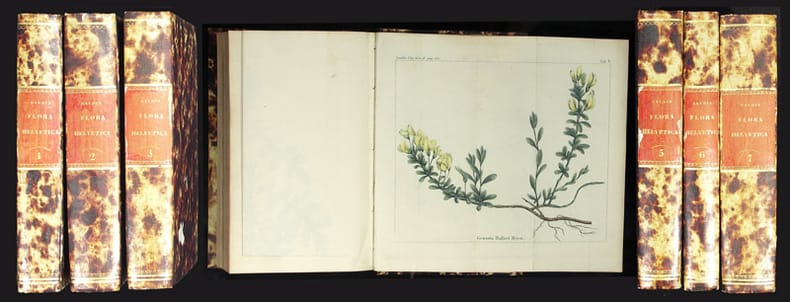
Flora Helvetica sive historia stripium hucusque cognitarum in Helvetia et in tractibus conterminis...
Zürich, Orell Fuessli, 1828?1833. 8°. Mit 28 kol. Kupfertafeln. Pappbände aus der Zeit mit verg. Rückenschild und Rückenvergoldung. + Wichtig: Für unsere Kunden in der EU erfolgt der Versand alle 14 Tage verzollt ab Deutschland / Postbank-Konto in Deutschland vorhanden +, 30176AB 7 Bände.
书商的参考编号 : 30176AB

|
|
|
Gaudin, J(ean):
Flora Helvetica sive historia stripium hucusque cognitarum in Helvetia et in tractibus conterminis...
7 Bände. Zürich, Orell Fuessli, 1828–1833. 8°. Mit 28 kol. Kupfertafeln. Pappbände aus der Zeit mit verg. Rückenschild und Rückenvergoldung.
书商的参考编号 : 30176AB
|
|
|
Gauermann, Friedrich, Maler und Graphiker (1807-1862).
Eigenh. Skizzenbuch. Niederösterreich u. a. O., 1830-1831.
45 Skizzen (einige laviert) auf 23 Bll. Originaler Halblederband mit Deckeltitel "F. Gauermann's Skizzenbuch v. J. 1830". Das Skizzenbuch enthält Baum- und Figurenstudien, Skizzen von Kühen in Ställen sowie Landschaftsskizzen. Einige davon sind datiert und beschriftet, u. a. "vom Ausflug mit Höger 1831. Oktober", "Mit Pollak und Höger 1831 im September", "mit Höger am 14. Oktober 1831 auf dem Rabenstein", "mit Höger im Thiergarten am 3. Dezember 1830". - Friedrich Gauermann unternahm mit seinen Schwägern, den Landschaftsmalern Joseph Höger (1801-77) und Wilhelm Pollak (1802-60), zahlreiche Reisen durch Österreich, wo Skizzen und Studien für spätere Ölgemälde angefertigt wurden. - Der Einband berieben und bestoßen, die Skizzen teils braun- und fingerfleckig und mit Klebeband im Mittelfalz fixiert.
|
|
|
GAUGUIN Paul & MONFREID George-Daniel de
Diane et Actéon aux Marquises. Noa Noa. Epreuve unique du bois dessiné et gravé d'après Paul Gauguin par George-Daniel de Monfreid
- s.d. (1924), 93x78mm, autre. - Diane et Actéon aux Marquises. Noa Noa. Unique proof of the woodcut drawn and engraved after Paul Gauguin by George-Daniel de Monfreid [between 1904 & 1924] | 9,3 x 7,8 mm | one sheet Original proof, likely unique, of this intermediate state of a woodcut drawn and engraved by George-Daniel de Monfreid after two works by Paul Gauguin. Print on Japan silk, annotation by the artist in the left-hand margin. Woodcut drawn and engraved after two works, the man holding a branch being a reproduction of a watercolor on page 37 of the Noa Noa manuscript, while the full-length woman originally observed by this browser, is presented here in bust with her hand to her face, model reproduced on a woodcut engraved by Gauguin on page 4 of the manuscript (and his original sketch pasted on page 51), evoking a similar scene. The final woodcut will serve as the head of chapter IV of the first true illustrated edition of Noa Noa, published by Crès in 1924, the first illustrated work after Paul Gauguin and a majestic tribute to one of the precursors of modern art. Superb engraving synthesizing a watercolor from the original Noa Noa manuscript, inspired by the myth of Diana and Actaeon, engraved by Gauguin's closest friend and executor, the artist George-Daniel de Monfreid, heir to the album he would offer to the French State in 1927. A likely unique proof, part of 17 known test woodcuts from the early project to publish Noa Noa, all made on various fine papers and annotated by the artist. Woodcut engraved after a watercolor reinterpreting the myth of Diana, surprised in the bath by Actaeon. In the engraving, Monfreid took care to preserve the typical of deer antler shape of the branch seized by the indiscreet, which evokes its metamorphosis by the goddess. A very rare work by Gauguin mixing ancient mythology and island exoticism, whose subversive power seems entirely carried by the vahine Diana's expression of feint surprise. It is from the original illustrated manuscript of Noa Noa, brought back from Tahiti by Segalen on the artist's death in 1903, that Monfreid began producing this fundamental work from as early as 1904. This is the second version of this "to read and look at" notebook. The first manuscript, written on the return of his first voyage and entrusted by Gauguin to Charles Morice in 1893, responded to a different project. Gauguin had composed only the text, interspersed with blank pages for Morice's poems. But after several years without news, Morice preferred to publish a version entirely rewritten by himself in 1901. Gauguin, therefore, copied his manuscript and illustrated it during his second stay in Polynesia, with sketches, watercolors and collages. This album, that the artist enriched and safely preserved until his death, is preserved today at the Musée d'Orsay. It is, therefore, from this manuscript, the only one illustrated, that Monfreid composed the edition of Gauguin's Noa Noa. However, although Monfreid's publication was forward, it took more than twenty years to complete, in part due to a copyright dispute with Charles Morice who wanted to be co-author of the forthcoming edition and whose poems would eventually be preserved. The result of several years of reflection and work, the 1924 edition is both faithful to the watercolors and woodcut engravings illustrating the precious manuscript, and to the whole of Gauguin's Tahitian work, who died in indifference. Monfreid thus engraves several drawings from the original notebook and enriches it with woodcuts made from other works of which he is the custodian. Some of these compositions combine several paintings, while scrupulously respecting the artist's line, transforming the work into a true journey through the painter's works. The very choice of using wood engraving is a tribute to this technique prized by Gauguin, who, in Pont-Aven, produced 10 woodcuts to illustrate his manuscript between his two Polynesian stays. The interm

|
|
|
GAUGUIN Paul & MONFREID George-Daniel de
La mémoire et l'imagination. Noa Noa. Epreuve unique du bois dessiné et gravé d'après Paul Gauguin par George-Daniel de Monfreid
- s.d. (1924), 93x78mm, autre. - La Mémoire et l'Imagination. Noa Noa. Unique proof of the woodcut drawn and engraved after Paul Gauguin by George-Daniel de Monfreid [between 1904 & 1924] | 9,3 x 7,8 cm | one sheet Original proof, likely unique, of this intermediate state of a woodcut drawn and engraved by George-Daniel de Monfreid after a watercolor by Paul Gauguin. Print on fine cream laid paper, annotation by the artist in the left-hand margin. Woodcut drawn and engraved after a watercolor from the Noa Noa manuscript, pasted on a page of text of the famous album. The final woodcut will serve as the head of the first illustrated edition of Noa Noa, published by Crès in 1924, the first illustrated work after Paul Gauguin and a majestic tribute to one of the precursors of modern art. Superb and significant engraving after a very specific watercolor from Paul Gauguin's manuscript, a real breakthrough in text, engraved by his closest friend and executor, the artist George-Daniel de Monfreid, heir to the album he would offer to the French State in 1927. The initial watercolor was cut out in waves around the female figure and pasted on the last chapter to prevent it from being read and thus get the story back on track. Gauguin had also added winding lines starting from the watercolor on the text page, thus giving the impression of a cave breaking through the page, by the psychic power of the sitting woman whose head diffuses the undulating rays. Monfreid decided to place it at the head of the work accompanied by two birds taken from other works, to illustrate the power of the artist and his imagination. A likely unique proof, part of 17 known test woodcuts from the early project to publish Noa Noa, all made on various fine papers and annotated by the artist. Unique proof of a woodcut engraved after the mystical watercolor erasing the first ending of the story to allow the reader to graphically enter the painted album, repeated in the printed version as the initiatory opening of the engraved story. It is from the original illustrated manuscript of Noa Noa, brought back from Tahiti by Segalen on the artist's death in 1903, that Monfreid began producing this fundamental work from as early as 1904. This is the second version of this "to read and look at" notebook. The first manuscript, written on the return of his first voyage and entrusted by Gauguin to Charles Morice in 1893, responded to a different project. Gauguin had composed only the text, interspersed with blank pages for Morice's poems. But after several years without news, Morice preferred to publish a version entirely rewritten by himself in 1901. Gauguin, therefore, copied his manuscript and illustrated it during his second stay in Polynesia, with sketches, watercolors and collages. This album, that the artist enriched and safely preserved until his death, is preserved today at the Musée d'Orsay. It is, therefore, from this manuscript, the only one illustrated, that Monfreid composed the edition of Gauguin's Noa Noa. However, although Monfreid's publication was forward, it took more than twenty years to complete, in part due to a copyright dispute with Charles Morice who wanted to be co-author of the forthcoming edition and whose poems would eventually be preserved. The result of several years of reflection and work, the 1924 edition is both faithful to the watercolors and woodcut engravings illustrating the precious manuscript, and to the whole of Gauguin's Tahitian work, who died in indifference. Monfreid thus engraves several drawings from the original notebook and enriches it with woodcuts made from other works of which he is the custodian. Some of these compositions combine several paintings, while scrupulously respecting the artist's line, transforming the work into a true journey through the painter's works. The very choice of using wood engraving is a tribute to this technique prized by Gauguin, who, in Pont-Aven, produced 10 woodcuts to illu

|
|
|
GAUGUIN Paul & MONFREID George-Daniel de
Les odalisques aux mangues. Noa Noa. Epreuve unique du bois dessiné et gravé d'après Paul Gauguin par George-Daniel de Monfreid
- s.d. (1924), 93x78mm, autre. - Les Odalisques aux mangues. Noa Noa. Unique proof of the woodcut drawn and engraved after Paul Gauguin by George-Daniel de Monfreid [between 1904 & 1924] | 9,3 x 7,8 cm | one sheet Original proof, likely unique, of this intermediate state of a woodcut drawn and engraved by George-Daniel de Monfreid after Paul Gauguin. Print on fine cream laid paper, annotation by the artist in the left-hand margin. Woodcut drawn and engraved after two different works. The back of the woman is an exact reproduction of an ink from page 92 of the Noa Noa manuscript, while the woman lying down takes up the well-known theme of the woman with mangos, Te Arii Vahine-Opoi, that Gauguin represented in paint as well as with an engraving in 1898. The final woodcut will serve as the head of chapter V of the first true illustrated edition of Noa Noa, published by Crès in 1924, the first illustrated work from Paul Gauguin and a majestic tribute to one of the precursors of modern art. Superb and significant engraving uniting two major themes of the Tahitian work, including the central drawing of the Noa Noa manuscript, faithfully engraved by Gauguin's closest friend and executor, the artist George-Daniel de Monfreid. A likely unique proof, part of 17 known test woodcuts from the project to prematurely publish Noa Noa, all made on various fine papers and annotated by the artist. Woodcut engraved from two major original works. By uniting these two vahines with sensual postures, Monfreid brings about a true synthesis of Gauguin's work, all while using the traditional double figure of the artist's paintings. It is from the original illustrated manuscript of Noa Noa, brought back from Tahiti by Segalen on the artist's death in 1903, that Monfreid began producing this fundamental work from as early as 1904. This is the second version of this "to read and look at" notebook. The first manuscript, written on the return of his first voyage and entrusted by Gauguin to Charles Morice in 1893, responded to a different project. Gauguin had composed only the text, interspersed with blank pages for Morice's poems. But after several years without news, Morice preferred to publish a version entirely rewritten by himself in 1901. Gauguin, therefore, copied his manuscript and illustrated it during his second stay in Polynesia, with sketches, watercolors and collages. This album, that the artist enriched and safely preserved until his death, is preserved today at the Musée d'Orsay. It is, therefore, from this manuscript, the only one illustrated, that Monfreid composed the edition of Gauguin's Noa Noa. However, although Monfreid's publication was forward, it took more than twenty years to complete, in part due to a copyright dispute with Charles Morice who wanted to be co-author of the forthcoming edition and whose poems would eventually be preserved. The result of several years of reflection and work, the 1924 edition is both faithful to the watercolors and woodcut engravings illustrating the precious manuscript, and to the whole of Gauguin's Tahitian work, who died in indifference. Monfreid thus engraves several drawings from the original notebook and enriches it with woodcuts made from other works of which he is the custodian. Some of these compositions combine several paintings, while scrupulously respecting the artist's line, transforming the work into a true journey through the painter's works. The very choice of using wood engraving is a tribute to this technique prized by Gauguin, who, in Pont-Aven, produced 10 woodcuts to illustrate his manuscript between his two Polynesian stays. The intermediate woodcuts, until then unknown, testify to the slow work of composition to restore the artistic richness of Gauguin's work by his most faithful artistic companion and first champion: "When I saw Gauguin for the first time, I was greatly disconcerted by the details of art that radiated from his works as well as from the conversations

|
|
|
GAUGUIN Paul & MONFREID George-Daniel de
Retour de pêche aux thons et bonites. Noa Noa. Epreuve unique du bois dessiné et gravé d'après Paul Gauguin par George-Daniel de Monfreid
- s.d. (1924), 93x78mm, autre. - Retour de pêche aux thons et bonites. Noa Noa. Unique proof of the woodcut drawn and engraved after Paul Gauguin by George-Daniel de Monfreid [between 1904 & 1924] | 9,3 x 7,8 cm | one sheet Original proof, likely unique, of this intermediate state of a woodcut drawn and engraved by George-Daniel de Monfreid after a watercolor by Paul Gauguin. Print on fine cream laid paper, annotation by the artist in the left-hand margin. Woodcut drawn and engraved from the first watercolor of the Noa Noa manuscript, pasted on a page of text of the famous album. The final woodcut will serve as the head of chapter X of the first true illustrated edition of Noa Noa, published by Crès in 1924, the first illustrated work from Paul Gauguin and a majestic tribute to this precursor of modern art. Superb and significant engraving of the work opening Paul Gauguin's manuscript, engraved by his closest friend and executor, the artist George-Daniel de Monfreid, heir to the album he would offer to the French State in 1927. This likely unique proof, part of 17 known test woodcuts from the project to prematurely publish Noa Noa, all made on various fine papers and annotated by the artist. Woodcut engraved from the watercolor inaugurating one of the painter's most beautiful albums, symbolizing the Tahitian art of living, between the nourishing sea and earthly pleasures. It is from the original illustrated manuscript of Noa Noa, brought back from Tahiti by Segalen on the artist's death in 1903, that Monfreid began producing this fundamental work from as early as 1904. This is the second version of this "to read and look at" notebook. The first manuscript, written on the return of his first voyage and entrusted by Gauguin to Charles Morice in 1893, responded to a different project. Gauguin had composed only the text, interspersed with blank pages for Morice's poems. But after several years without news, Morice preferred to publish a version entirely rewritten by himself in 1901. Gauguin, therefore, copied his manuscript and illustrated it during his second stay in Polynesia, with sketches, watercolors and collages. This album, that the artist enriched and safely preserved until his death, is preserved today at the Musée d'Orsay. It is, therefore, from this manuscript, the only one illustrated, that Monfreid composed the edition of Gauguin's Noa Noa. However, although Monfreid's publication was forward, it took more than twenty years to complete, in part due to a copyright dispute with Charles Morice who wanted to be co-author of the forthcoming edition and whose poems would eventually be preserved. The result of several years of reflection and work, the 1924 edition is both faithful to the watercolors and woodcut engravings illustrating the precious manuscript, and to the whole of Gauguin's Tahitian work, who died in indifference. Monfreid thus engraves several drawings from the original notebook and enriches it with woodcuts made from other works of which he is the custodian. Some of these compositions combine several paintings, while scrupulously respecting the artist's line, transforming the work into a true journey through the painter's works. The very choice of using wood engraving is a tribute to this technique prized by Gauguin, who, in Pont-Aven, produced 10 woodcuts to illustrate his manuscript between his two Polynesian stays. The intermediate woodcuts, until then unknown, testify to the slow work of composition to restore the artistic richness of Gauguin's work by his most faithful artistic companion and first champion: "When I saw Gauguin for the first time, I was greatly disconcerted by the details of art that radiated from his works as well as from the conversations of this extraordinary man... You immediately felt that he was the Master" (in L'Hermitage, 1903). [FRENCH VERSION FOLLOWS] Epreuve originale probablement unique de cet état intermédiaire d'un bois dessiné et gravé d'après une aquarel

|
|
|
GAUGUIN Paul & MONFREID George-Daniel de
Tehura. Noa Noa. Epreuve unique gravée d'après le tableau Merahi metua no tehamana de Paul Gauguin par George-Daniel de Monfreid
- s.d. (1924), 93x78mm, autre. - Tehura. Original proof engraved after the painting "Merahi Metua no Tehamana". Intermediate state for Noa Noa [between 1904 & 1924] | 9,3 x 7,8 cm | one sheet Original proof, likely unique, of this intermediate state of "Tehura", wood drawn and engraved after Paul Gaughin's painting "Merahi Metua no Tehamana" by George-Daniel de Monfreid. Print on fine cream laid paper, annotation by the artist in the left-hand margin. The definitive wood served as the head of chapter VI, "Le Conteur parle", page 81 of the true first edition of Noa Noa published by Crès in 1924, the first illustrated work from Paul Gauguin and a majestic tribute to one of the precursors of modern art. A most important and very first woodcut of Gauguin's masterpiece, engraved by his closest friend and executor, artist George-Daniel de Monfreid, to whom Gauguin offered the painting after two unsuccessful exhibitions. Likely unique proof, part of 17 known test prints from the project to publish prematurely Noa Noa, all made on various fine papers and annotated by the artist. Precious woodcut after Gauguin's masterpiece Merahi metua no Tehamana, showing the painter's wife, his main tahitian model. It is from the original illustrated manuscript of Noa Noa, brought back from Tahiti by Segalen on the artist's death in 1903, that Monfreid began producing this fundamental work from as early as 1904. This is the second version of this "to read and look at" notebook. The first manuscript, written on the return of his first voyage and entrusted by Gauguin to Charles Morice in 1893, responded to a different project. Gauguin had composed only the text, interspersed with blank pages for Morice's poems. But after several years without news, Morice preferred to publish a version entirely rewritten by himself in 1901. Gauguin, therefore, copied his manuscript and illustrated it during his second stay in Polynesia, with sketches, watercolors and collages. This album, that the artist enriched and safely preserved until his death, is preserved today at the Musée d'Orsay. It is, therefore, from this manuscript, the only one illustrated, that Monfreid composed the edition of Gauguin's Noa Noa. However, although Monfreid's publication was forward, it took more than twenty years to complete, in part due to a copyright dispute with Charles Morice who wanted to be co-author of the forthcoming edition and whose poems would eventually be preserved. The result of several years of reflection and work, the 1924 edition is both faithful to the watercolors and woodcut engravings illustrating the precious manuscript, and to the whole of Gauguin's Tahitian work, who died in indifference. Monfreid thus engraves several drawings from the original notebook and enriches it with woodcuts made from other works of which he is the custodian. Some of these compositions combine several paintings, while scrupulously respecting the artist's line, transforming the work into a true journey through the painter's works. The very choice of using wood engraving is a tribute to this technique prized by Gauguin, who, in Pont-Aven, produced 10 woodcuts to illustrate his manuscript between his two Polynesian stays. The intermediate woodcuts, until then unknown, testify to the slow work of composition to restore the artistic richness of Gauguin's work by his most faithful artistic companion and first champion: "When I saw Gauguin for the first time, I was greatly disconcerted by the details of art that radiated from his works as well as from the conversations of this extraordinary man... You immediately felt that he was the Master" (in L'Hermitage, 1903). [FRENCH VERSION FOLLOWS] Epreuve originale probablement unique de cet état intermédiaire de "Tehura", bois dessiné et gravé d'après le tableau Merahi metua no tehamana de Paul Gauguin par Georges-Daniel de Monfreid. Tirage sur vergé crème fin, annotation de l'artiste au crayon en marge gauche. Le bois définitif servira

|
|
|
Gauguin, Paul / Bezzola, Tobia [CURATOR]
Paul Gauguin: The Prints
28x25 cm. 157 pages. Hardcover. Rear cover slightly stained. Spine slightly curved. Else in good condition. PLEASE NOTE: This item is overweight. We may ask for extra shipping costs.
|
|
|
GAUJEAN Eugène d'après Adrien Brauwer
Le fumeur
Belle épreuve. Béraldi 23. IFF non citée. Paris Gazette des Beaux-Arts 1879 22,5 x 16,7 cm. Marges 28 x 20 cm.
书商的参考编号 : 7958

|
|
|
GAUJEAN Eugène
Les Contes de Moncrif
Suite complète de 6 vignettes in-8° (6 état définitif et 5 en sanguine avant la lettre). Compositions de Paul Avril pour illustrer les contes de Moncrif. en feuilles Très bon Paris Quantin 1882
书商的参考编号 : 12344

|
|
|
GAULTIER Léonard (1561_1641)
Le Jugement dernier
Très belle estampe d'après Michel-Ange. Tirage tardif. Bon
书商的参考编号 : 8734

|
|
|
GAUTHIER Maximilien
E. Othon FRIESZ. Dix estampes originales présentées par Maximilien GAUTHIER
Paris Editions Rombaldi - Collection "Les Maîtres de l'estampe française contemporaine" 1949 en feuilles, couverture rempliée, emboitage éditeur
书商的参考编号 : 012989
|
|
|
Gautier Theophile. Simon Howard wood engravings by
Mademoiselle de Maupin
NY Ives Washburn 1929. Hardcover. Very Good. Limited edition 2000 copies. Black cloth-backed boards silver-pressed decoration and titles. Decorated dw. Decorated endpapers. Large 8vo. 374p. Frontispiece 7 other wood engraving reproductions. Dw spine toned else fine. A beautiful copy. Illsutrated. Wood engravings. Woodcuts. NY Ives Washburn 1929 hardcover books
书商的参考编号 : utdeim404
|
|
|
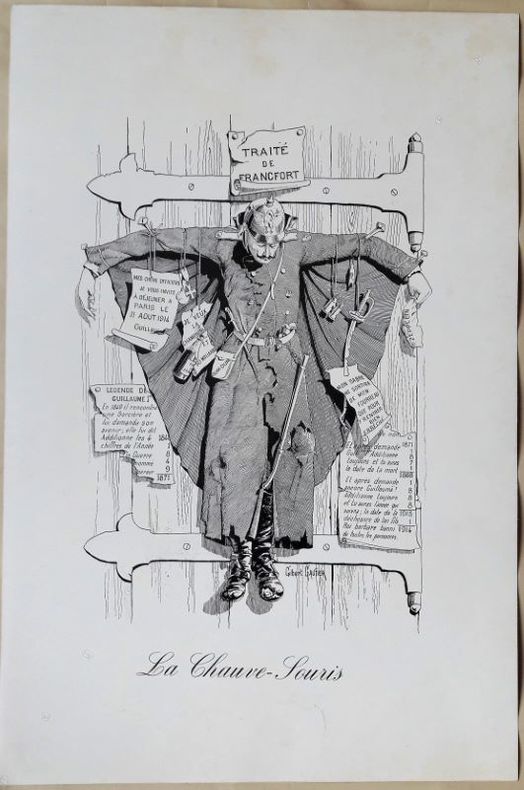
GAUTIER (Gilbert).
La Chauve Souris.
50X33 cm.
书商的参考编号 : 16338
|
|
|
GAUTIER Lucien
Pont de l'Archevêché à Paris
[s. l.] [s. n.] [1882] Eau-forte dessinée et gravée par Lucien Gautier. 23,3 x 35,5 cm hors marges ; 34 x 41,5 cm toutes marges comprises.
书商的参考编号 : 4904
|
|
|
GAUTIER-CONSTANT
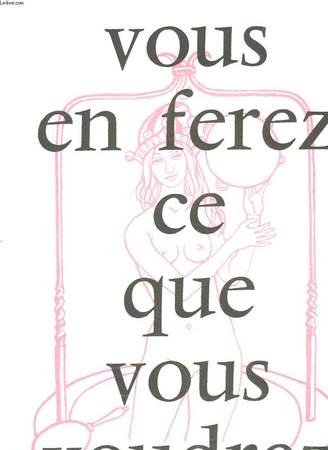
Vous en ferez ce que vous voudrez
DU LYS. 1972. In-Folio. En feuillets. Très bon état, Couv. remarquable, Dos impeccable, Intérieur frais. Environ 50/75 pages. Nombreuses gravures, lettrines, vignettes et estampes en noir et blanc et monochromes, en hors-texte. Feuillets rangés dans une couverture souple. Emboîtage de l'éditeur sous forme de coffret avec une illustration dorée sur le 1er plat, et tissu rouge à l'intérieur.. . Sous Emboitage. . Classification Dewey : 769-Estampes
书商的参考编号 : RO80042051
|
|
|
Gavarni
Caractères n°1701
In-folio, demi-reliure.Suite complète de 6 lithographies en noir, chine collé. Provient de la collection Lecomte, grand collectionneur de Daumier. Probablement des œuvres de jeunesse.
书商的参考编号 : 2742

|
|
|
GAVARNI [Paul, Sulpice-Guillaume Chevalier dit
Lithographie originale de la série MASQUES ET VISAGES -18- Les parents terribles - lithographie
1852 [Paris], [Librairie Nouvelle, imprimerie Lemercier], sans date (vers 1852).grande feuille non rognée ,Dimensions de la feuille : 38,5 x 28 cm environ Dimensions de la lithographie : 19,5 x 16 environ Papier vélin fort. Tirage sur blanc (verso blanc). rare
书商的参考编号 : 25946

|
|
|
GAVARNI et J. MERY
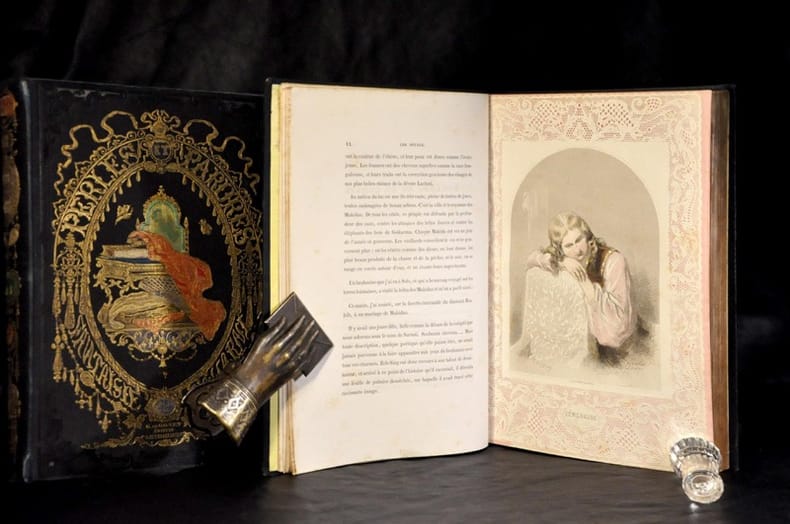
Perles et Parures. Les Joyaux, fantaisie par Gavarni, texte par Méry. Minéralogie des dames par le Cte Foelix. - suivi de: Les Parures, fantaisie par Gavarni, texte par Méry. Histoire de la mode par le Cte Foelix.
1850 Paris, G. de Gonet, Martinon, Vve L. Janet, à Leipzig, chez Ch. Twietmeyer, (1850), (3ff) 300pp & (3ff) 316pp Deux grands volumes in-8 d'une fraiche reliure en pleine percaline marine d'époque aux plats entièrement ornés d'un décor polychrome à fers spéciaux dorés et à froid reproduisant les couvertures, dos lisses ornés de même, tranches dorées (reliures des éditeurs). Quelques rares piqures intérieurs mais exemplaire est dans un etat de conservation excellant (la reliure des parures est légèrement passée en rapport avec le tome des joyaux). Agrémenté d'un frontispice répété et de 30 ravissantes planches gravées sur acier par Geoffroy h. t. d'après Gavarni.
书商的参考编号 : 2810
|
|
|
GAVARNI Paul
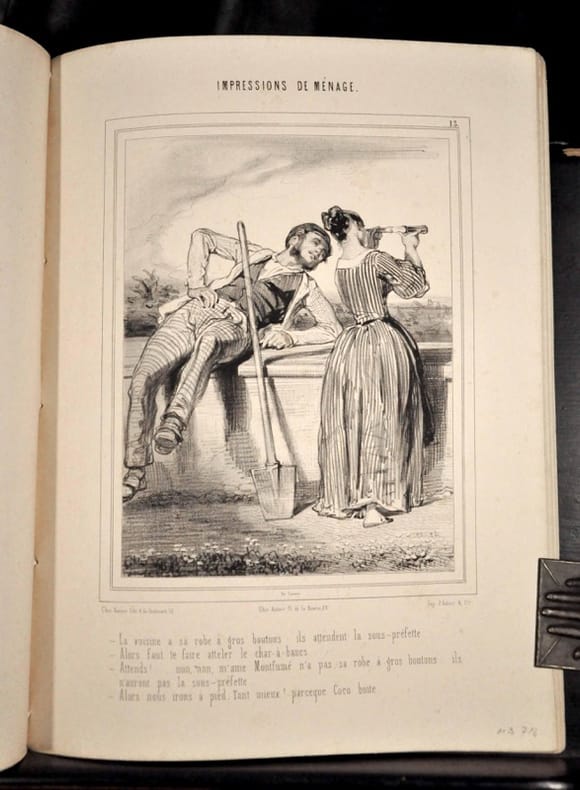
Album comique par Gavarni – Impressions de ménage
Paris, Au bureau du journal amusant et du petit journal pour rire, 20 rue Bergère., In-Folio, (34 x 26 cm), broché. 18 lithographies en noir.
书商的参考编号 : 2720
|
|
|
GAVARNI Paul
Oeuvres nouvelles "Les partageuses" 1 à 10
Paris, Librairie Nouvelle., In-folio (28 x 38,5 cm), broché, couverture illustrée. 10 lithographies en noir, sous serpentes de la série «Masques et visages», intitulées «Les partageuses».
书商的参考编号 : 2712

|
|
|
GAVARNI Paul -
MASQUES ET VISAGES : PAR CI PAR LA et PHYSIONOMIES PARISIENNES , 2 suites - 100 splendides lithographies originales en noir de GAVARNI, tirées par LEMERCIER, en livraisons
PAULIN LE CHEVALLIER Editeurs de l'Illustration rue Richelieu 60. s.d. (1857). Grand in-folio (31x 43,5 cm).broché, en feuilles sous 10 chemises Collection de 100 splendides lithographies originales de GAVARNI, tirées par LEMERCIER, lithographies en noir numérotées de 1 à 50 dans les séries PAR CI PAR LA et PHYSIONOMIES PARISIENNES , 2 suites « Masques et visages ». Edition sur grand papier,bon etat
书商的参考编号 : 15498
|
|
|
GAVARNI, Paul
La mascarade humaine
In -4°, pp. 215, manca legatura. Raccolta di cento tavole illustrate in bianco e nero di Gavarni (1804-1866), disegnatore e litografo parigino. Prima edizione in raccolta.
|
|
|
GAZETTE DU BON TON. DRIAN (Adrien Désiré ETIENNE dit).
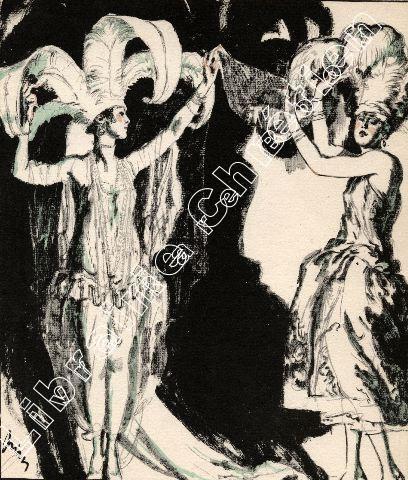
"La Mariée de l'Avenir".
Paris 1921 Pochoir signé dans la planche pour la Gazette du Bon Ton, rehauts au pochoir, 1921, 24 x 19 cm.
书商的参考编号 : 17416
|
|
|
GEFFROY & CORIANDRE George
(Le Génie de la montagne in La Gazette du bon ton n°3, 1924-25 - 7ème année. )
- Lucien Vogel éditeur, Paris 1924-1925, 18x24,5cm, deux doubles feuillets. - Extrait original tiré de La Gazette du bon ton, illustré de huit dessins en couleurs de Geffroy. On y joint un double feuillet de texte concernant la mode d'hiver chez différents créateurs (Lanvin, Poiret, Vionnet et Worth). Célèbre revue de mode fondée en 1912 par Lucien Vogel, La Gazette du bon ton a paru jusqu'en 1925 avec une interruption durant la Guerre de 1915 à 1920, pour cause de mobilisation de son rédacteur en chef. Elle se constitue de 69 livraisons tirées à seulement 2000 exemplaires et est illustrée notamment de 573 planches en couleurs et de 148 croquis représentant des modèles de grands couturiers. Dès leur parution, ces luxueuses publications « s'adressent aux bibliophiles et aux mondains esthètes » (Françoise Tétart-Vittu « La Gazette du bon ton » in Dictionnaire de la mode, 2016). Imprimées sur beau papier vergé, elles utilisent une police typographique spécialement créée pour la revue par Georges Peignot, le caractère Cochin, repris en 1946 par Christian Dior. Les estampes sont réalisées grâce à la technique du pochoir métallique, rehaussées en couleurs et pour certaines soulignées à l'or ou au palladium. L'aventure commence en 1912 lorsque Lucien Vogel, homme du monde et de la mode - il a déjà participé à la revue Femina - décide de fonder avec sa femme Cosette de Brunhoff (sur de Jean, le père de Babar) La Gazette du bon ton dont le sous-titre est alors « Art, modes et frivolités ». Georges Charensol rapporte les propos du rédacteur en chef : « En 1910, observe-t-il, il n'existait aucun journal de mode véritablement artistique et représentatif de l'esprit de son époque. Je songeais donc à faire un magazine de luxe avec des artistes véritablement modernes [...] J'étais certain du succès car pour la mode aucun pays ne peut rivaliser avec la France. » (« Un grand éditeur d'art. Lucien Vogel » in Les Nouvelles littéraires, n°133, mai 1925). Le succès de la revue est immédiat, non seulement en France, mais aussi aux Etats-Unis et en Amérique du Sud. À l'origine, Vogel réunit donc un groupe de sept artistes : André-Édouard Marty et Pierre Brissaud, suivis de Georges Lepape et Dammicourt ; et enfin ses amis de l'École des beaux-arts que sont George Barbier, Bernard Boutet de Monvel, ou Charles Martin. D'autres talents viennent rapidement rejoindre l'équipée : Guy Arnoux, Léon Bakst, Benito, Boutet de Monvel, Umberto Brunelleschi, Chas Laborde, Jean-Gabriel Domergue, Raoul Dufy, Édouard Halouze, Alexandre Iacovleff, Jean Émile Laboureur, Charles Loupot, Charles Martin, Maggie Salcedo. Ces artistes, inconnus pour la plupart lorsque Lucien Vogel fait appel à eux, deviendront par la suite des figures artistiques emblématiques et recherchées. Ce sont ces mêmes illustrateurs qui réalisent les dessins des publicités de la Gazette. Les planches mettent en lumière et subliment les robes de sept créateurs de l'époque : Lanvin, Doeuillet, Paquin, Poiret, Worth, Vionnet et Doucet. Les couturiers fournissent pour chaque numéro des modèles exclusifs. Néanmoins, certaines des illustrations ne figurent aucun modèle réel, mais seulement l'idée que l'illustrateur se fait de la mode du jour. La Gazette du bon ton est une étape décisive dans l'histoire de la mode. Alliant l'exigence esthétique et l'unité plastique, elle réunit pour la première fois les grands talents du monde des arts, des lettres et de la mode et impose, par cette alchimie, une toute nouvelle image de la femme, élancée, indépendante et audacieuse, également portée par la nouvelle génération de couturiers Coco Chanel, Jean Patou, Marcel Rochas... Reprise en 1920 par Condé Montrose Nast, La Gazette du bon ton inspirera largement la nouvelle composition et les choix esthétiques du « petit journal mourant » que Nast avait racheté quelques années auparavant : le magazine Vogue. Très bel exemplaire. [ENGLISH DESCRIPTION ON DEMAND]

|
|
|
GEFFROY (Gustave).
AUGUSTE BROUET. Catalogue de son oeuvre gravé. Précédé d'une étude de Gustave Geffroy. [2 volumes].
1923 A Paris, Chez Gaston Boutitié, 1923. Deux volumes in-quarto (234 X 283) demi-maroquin carmin à coins, dos lisse orné de deux larges caissons dorés à encadrement de filets gras et perlés, auteur, titre et tomaison dorés, date en queue, filet doré sur les plats, tête dorée, plats de la couverture et dos conservés (BERNASCONI). Craquelures sur quelques centimètres au mors supérieur du second plat du premier tome.
书商的参考编号 : 001472

|
|
|
GEFFROY - George CORIANDRE
Le Génie de la montagne in La Gazette du bon ton n°3, 1924-25 - 7ème année
Lucien Vogel éditeur | Paris 1924-1925 | 18 x 24.50 cm | deux doubles feuillets
书商的参考编号 : 43381
|
|
|
GEFFROY Gustave [ BROUET Auguste]
Auguste Brouet, catalogue de son oeuvre gravé précédé d’une étude de Gustave Geffroy, Estampes, Tomes I et II.
Chez Gaston Boutitie & Cie, éditeurs d’art, Paris, 1923.
书商的参考编号 : 22030
|
|
|
GEFFROY, Gustave
AUGUSTE BROUET. Catalogue de son oeuvre gravé. Estampes. Précédé d'une étude de Gustave Geffroy. Tomes 1-2
Paris Chez Gaston Boutitie & Cie, Editeurs d'Art 1923 in 4 (28,5x22,5) 2 volumes brochés en faux-feuillets, sous chemises cartonnés de l'éditeur (les étuis manquent)). Ce catalogue décrit et reproduit 271 pièces de l'oeuvre gravé de l'artiste, reproduites en phototypie. Edition bilingue avec le texte français et anglais. Auguste Brouet, 1872 -1941, graveur français. Tome 1: Estampes n° 1 à 141, texte préliminaire et 141 planches hors-texte sous serpentes légendées. Tome 2: Estampes n° 142 à 271, 130 planches hors-texte sous serpentes légendées. Tiré à 1030 exemplaires numérotés, celui-ci un des 100 exemplaires sur papier d'Arches avec une eau-forte originale de Auguste Brouet en deux états, justifiés et signés par Auguste Brouet. Bon exemplaire ( Photographies sur demande / We can send pictures of this book on simple request )
书商的参考编号 : 37543
|
|
|
Gehenna Prints
Leonard Baskin New Lithos of Native Americans
8 page illustrated catalog of 25 works of art for sale. Includes a price list from Dec. 1994. The booklet is lightly creased and the staples are rusty. H216box Gehenna Prints paperback
书商的参考编号 : 731
|
|
|
GEHRMANN, T
Bilder und Bücher. Münchhausen-Illustrationen aus zwei Jahrhunderten. Sammlung Bodenwerder. (Hrsg.) Stadt Bodenwerder.
(Stadtoldendorf, U. Hinrichsen), 1992. Gr.-8vo. 223 S. m. Textabb., 80 Tafeln u. 24 Farbtafeln. OKart. (kl. Sammlerstempel auf Titel, 1 farb. Anstreichung).
书商的参考编号 : 1224287
|
|
|
GEIGER, Raymond.
Les artistes du livre. Berthold-Mahn. Etude critique par R. Geiger. Portrait de l’artiste par lui-même. Lettre-préface de Georges Duhamel.
Paris, Henry Babou 1930, 270x205mm, frontispice, 170pages, broché. En feuille sous couverture rempliée, papier cristal d’origine conservé. Exemplaire sur papier vélin blanc à la forme des Papeteries Johannot, numéroté n° 640 / 650 Bel exemplaire.
书商的参考编号 : 121117

|
|
|
Geilfus, Georg (Hrsg.)
Helvetia. Vaterländische Sage und Geschichte.
Winterthur, Steiner'sche Buchhandlung, 1857. 8°. 736 S. Mit 1 lithogr. Titel u. 14 lithogr. Tafeln nach Holzschnitten von E. Kretzschmar. Illustr. Halblederband. + Wichtig: Für unsere Kunden in der EU erfolgt der Versand alle 14 Tage verzollt ab Deutschland / Postbank-Konto in Deutschland vorhanden +
书商的参考编号 : 6277BB
|
|
|
Geilfus, Georg (Hrsg.):
Helvetia. Vaterländische Sage und Geschichte.
Winterthur, Steiner'sche Buchhandlung, 1857. 8°. 736 S. Mit 1 lithogr. Titel u. 14 lithogr. Tafeln nach Holzschnitten von E. Kretzschmar. Illustr. Halblederband.
书商的参考编号 : 6277BB
|
|
|
GEISBERG, M
Die Anfänge des deutschen Kupferstiches und der Meister E.S.
Leipzig, Klinkhardt u. Biermann, (1909). 4to. 3 Bl., 132 S., 71 Lichtdrucktafeln m. 120 Abbildungen. (Meister der Graphik II). OLwd. m. Rsign. (etwas verblichen u. angestaubt, Bibl.-Stempel).
书商的参考编号 : 1227049
|
|
|
GEISBERG, M
Geschichte d. deutschen Graphik vor Dürer.
Berlin, DVfK, 1939. 4to. 6, 217, (1) S., 94 Lichtdrucktaf. (Forschungen zur deutschen Kunstgeschichte 32). OLwd (gering fleckig).
书商的参考编号 : 1207806
|
|
|
Geiser, Karl
Albrecht von Haller - Die Alpen. Mit einer Beilage und Kupfern. Dem Andenken Hallers gewidmet.
Bern, A. Francke, 1902. 4°. 40 S. Mit 8 Kupfertafeln und 4 Textkupfer. Leinenband der Zeit. + Wichtig: Für unsere Kunden in der EU erfolgt der Versand alle 14 Tage verzollt ab Deutschland / Postbank-Konto in Deutschland vorhanden +, 4516C
书商的参考编号 : 4516CB

|
|
|
Geiser, Karl:
Albrecht von Haller - Die Alpen. Mit einer Beilage und Kupfern. Dem Andenken Hallers gewidmet.
Bern, A. Francke, 1902. 4°. 40 S. Mit 8 Kupfertafeln und 4 Textkupfer. Leinenband der Zeit.
书商的参考编号 : 4516CB

|
|
|
GEKKO OGATA
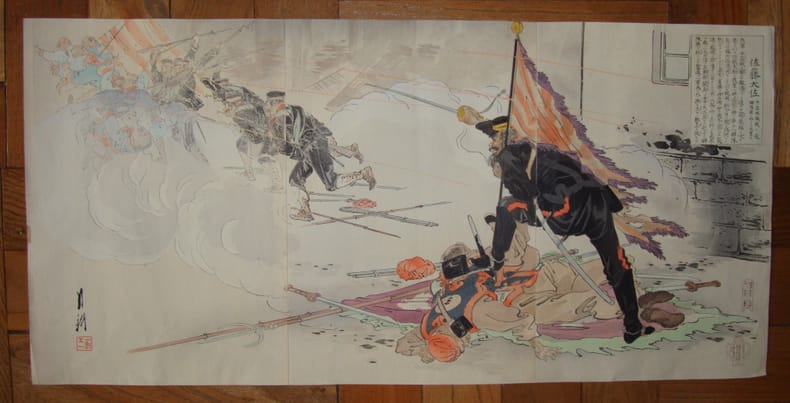
Colonel Satô Charges at the Enemy Using the Regimental Flag as a Crutch in the Fierce Battle of Newchang (Satô taisa Nyuchan gekisen no eki rentaiki o tsue ni shite tokkansu)
Bois colorié, 3 feuilles assemblées. En feuilles Très bon 1895 37,5 x 73 cm
书商的参考编号 : 14303
|
|
|
GEKKO OGATA
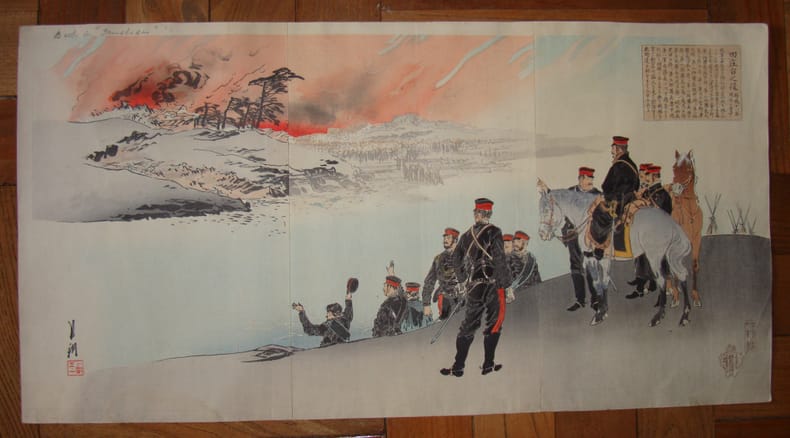
Gathering of eleven officers at the battle of Denshodai
Bois colorié, 3 feuilles assemblées. En feuilles Très bon 1895 29 x 20,5
书商的参考编号 : 14308
|
|
|
GEKKO OGATA
The Tale of Heike - Samurai Warrior Kusunoki Masatsura
Bois colorié, 3 feuilles assemblées. From the story of the heroes and heroines in "The Tale of Heike". "Kusunoki Masatsura Shijonawate Chusen no Zu". Kusunoki Masatsura (The son of the famous warlord Kusunoki Masashige), and two retainers are fighting against the shower of arrows from the enemy troop. En feuilles Très bon 1895 37 x 71,5 cm
书商的参考编号 : 14307

|
|
|
GELDER, J.G.van
Zeichnungen und Graphik holländischer Meister aus fünf Jahrhunderten. Ins Deutsche übertragen v. G. Betz.
München, Goldmann, (1959). Gr.-4to. 56 S. m. einigen Textabb., 224 Abb. auf Taf. OLwd.
书商的参考编号 : 1158269
|
|
|
GENERALIC, Josip (Hlebine 1936 - Koprivica 2004),
Jeudras
Serifìgrafia e acquerello Firma e titolo a matita. Cm 37x26 (Foglio 50x35). . . . . . .

|
|
|

 ?????????
 ?????PDF???
 RSS feed
 ??
??


