|
RIPART G.
Émile LIEZ envoie ses souhaits pour 1907
Carte de vœux du chapelier Émile Liez. en feuille Bon Paris 1906 58 x 43 cm
Referenz des Buchhändlers : 14619

|
|
|
RIQUER, A. de Riquer A. de
AYUNTAMIENTO DE BARCELONA, 3ra Exposicion de Bellas Artes i Industrias Artisticas. Les Maitres de l'Affiche Pl. 64
0 Planche N°64, format 29 x 40 cm (toutes marges). Chromolithographie d'époque avec le timbre à sec de l'Imprimerie Chaix (Lugt 1777c). Notre exemplaire est une des très rares épreuves imprimées sur papier Japon, 2 petites traces de punaisage chaque extrémité de la marge supérieure (Our plate is one of the few copies printed on Japanese paper. Original plate in good condition). LES MAITRES DE L'AFFICHE, prestigieuse publication d'art, éditée par l'atelier de lithographie Chaix, dont la parution s'étala de décembre 1895 à novembre 1900. Chaque livraison comportait 4 planches de reproduction en chromolithographie d'une remarquable qualité d'impression des plus belles affiches illustrées des grands artistes français et étrangers (auxquelles il faut ajouter 16 planches de lithographies originales offertes en prime aux abonnés). Lors de l'Exposition universelle de 1889, fut organisée la première exposition rétrospective dévolue à l'affiche, celle-ci devait valider la reconnaissance officielle d'appartenance de l'affiche au monde de l'art. Jules Chéret (1836-1932) y sera sacré '' Maître de l'affiche '', c'est aussi à cette date que Seurat commencera à collectionner les affiches de Chéret. Bel exemplaire ( Photographies sur demande / We can send pictures of this book on simple request )
Referenz des Buchhändlers : 24172
|
|
|
RITTER, F
Illustrierter Katalog der Ornamentstichsammlung. des Österreichischen Museums für Kunst und Industrie. Erwerbungen seit 1889.
Wien, A. Schroll, 1919. Gr.-8vo. 2 Bl., 14 S., 1 Bl., 237, (1) S. m. 153 vielfach ganzseitigen Illustrationen. (Österreichisches Museum für Kunst und Industrie. Kataloge der Sammlungen: Ornamentstiche (Teil 2)). OKart. (Rücken unterlegt, Umschlag angestaubt, etwas fleckig u. m. wenigen kleinen Ausrissen, Ecken etwas geknautscht).
Referenz des Buchhändlers : 1321019
|
|
|
RITTERSHAUSEN, Konrad
Jus Justinianum, hoc est, Iustiniani et aliorum quorundam Impp. Augg. novellarum mixtarum expositio methodica. Editio secunda.
Straßburg, Zetzner, 1629. 4to. 12 Bl., 771 S., 34 Bl. (d.l.w.). Pergament d. Zeit (fleckig u. verstaubt). [2 Warenabbildungen]
Referenz des Buchhändlers : 103866

|
|
|
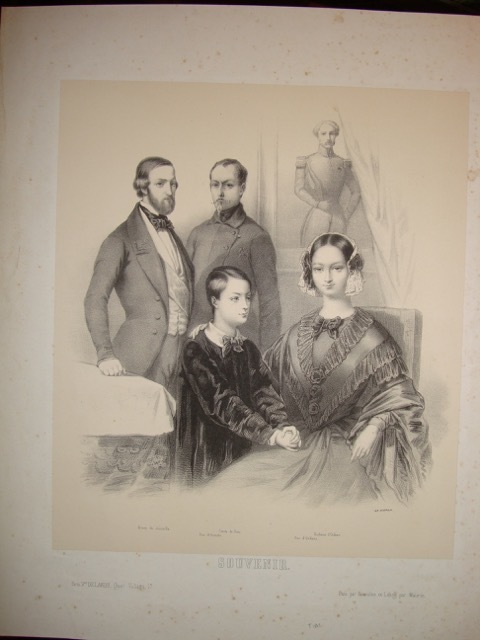
RIVOULON
Souvenir
Lithographie sur Chine appliqué, datant des années 1850, représentant une partie de la famille d'Orléans après la mort du Duc en 1842. On y voit la Duchesse d'Orléans avec ses deux beaux-frères, le Prince de Joiville et le Duc d'Aumale, en compagnie de l'un de ses fils le Comte de Paris. En feuille, quelques rouseurs en marge. Bon Paris Delarue 1850
Referenz des Buchhändlers : 10510
|
|
|
Riviere, Yves and Pierre Courtin
Pierre Courtin: l'Oeuvre grave 1944-1972 (catalogue raisonne of the prints)
The standard catalogue raisonne. 400 items illustrated and thoroughly described. Ten full-page color plates. 4to, original wraps. Light wear to wraps, internally fine.
|
|
|
ROBERT Léopold Louis
(Pecheurs italiens).
Rogné au trait carré. 13 x 10 cm au trait carré.
Referenz des Buchhändlers : 7995

|
|
|
Robert BONFILS
Beaulieu dans les fleurs. Manteau et robes d'après-midi (pl.9, La Gazette du Bon ton, 1920 n°2)
Lucien Vogel éditeur | Paris Mars 1920 | 24 x 37 cm | une feuille
Referenz des Buchhändlers : 54747
|
|
|
Robert BONFILS
Beaulieu dans les fleurs. Manteau et robes d'après-midi (pl.9, La Gazette du Bon ton, 1920 n°2)
Lucien Vogel éditeur | Paris Mars 1920 | 24 x 37 cm | une feuille
Referenz des Buchhändlers : 73133
|
|
|
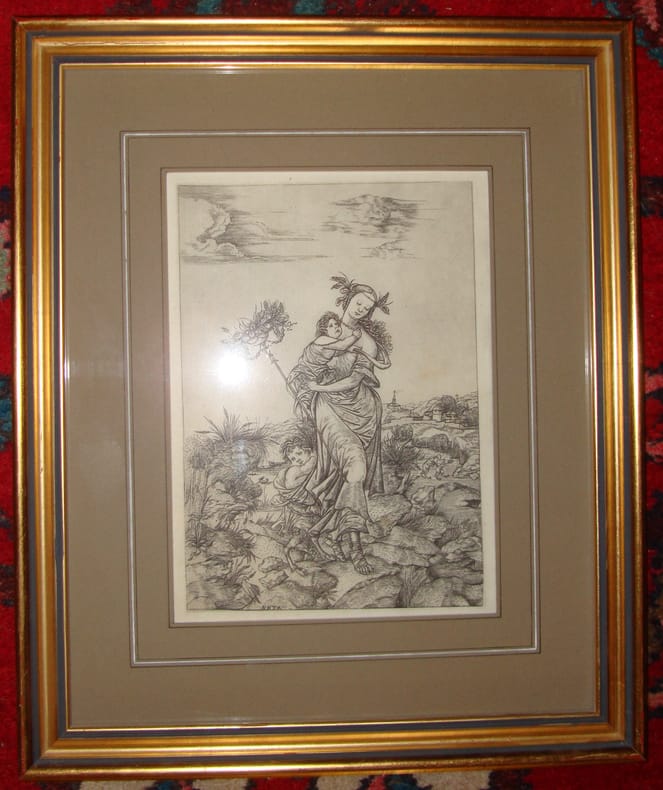
ROBETTA
Cérès
Notre épreuve est une héliogravure Amand-Durand, d’après l’épreuve de la collection Galichon. Tous ces tirages sont réalisés sur un superbe papier et sont de grande qualité. Encadrée Très bon 33 x 41,5 cm
Referenz des Buchhändlers : 13931
|
|
|
Roberta Bernstein , Edith Devaney
Jasper Johns : Une forme de ressemblance avec le vrai
, Fonds Mercator 2017, 2017 Hardcover, 263 pages, Texte en Francais, 300 x 280 mm, Tres belle exemplaire ! Beaucoup illustrations de couleur,. ISBN 9789462301894.
Referenz des Buchhändlers : 56174
|
|
|
ROBERTS-JONES, Philippe
LA CARICATURE DU SECOND EMPIRE A LA BELLE EPOQUE 1850-1900
Paris Le Club Français du Livre 1963 in 4 (27,5x21,5) 1 volume reliure skivertex noir de l'éditeur, dos et plat supérieur titrés en blanc, plat supérieur orné d'une vignette illustrée contrecollée, 451 pages [5], avec de nombreuses reproductions en noir et blanc. Introduction, commentaires et notices par Philippe Roberts-Jones. Ouvrage composé d'après les maquettes de Jacques Darche, assisté par Françoise Rocziki. Edition hors-commerce numérotée. Exemplaire numéroté. Bel exemplaire ( Photographies sur demande / We can send pictures of this book on simple request )
Referenz des Buchhändlers : 34041
|
|
|
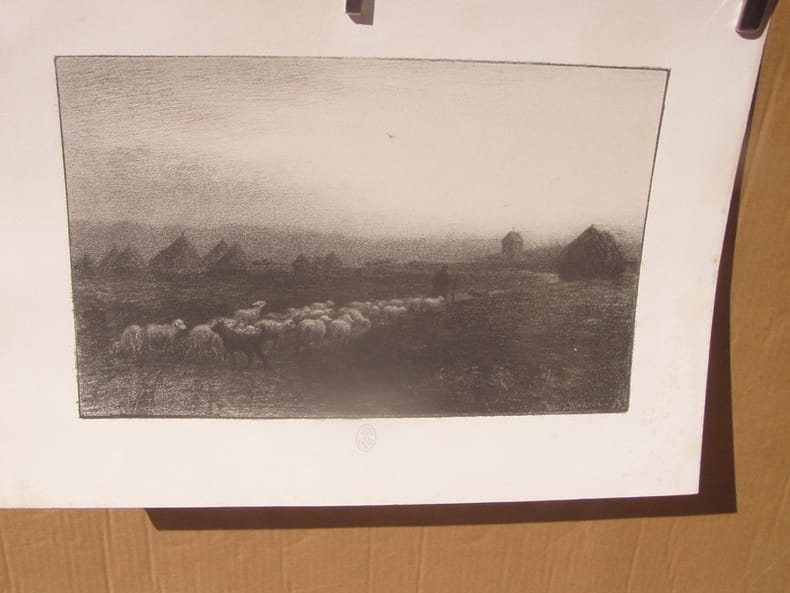
Robert -J. WICKENDEN
La rentrée du troupeau. lithographie originale
1896 Les peintres-lithographes : album trimestriel de lithographies originales et inédites 1896 - belle epreuve Impression . claires rousseurs en marge. toutes marges dimension feuille : 320 x 460mm.. timbre de la Société des Peintres-Lithographes, tirage à 80 ex.- Peintre, graveur, professeur de dessin, poète ou collectionneur marchand et historien d’art – Wickenden partagea sa vie entre l’Angleterre (où il naquit en 1861) les États-Unis, le Canada (où il mourut en 1931) et la France où il séjourna entre 1883 et 1900, étudiant à l’École des Beaux-Arts de Paris ou demeurant une dizaine d’année à Auvers sur Oise.Peintre profondément influencé par l’École de Barbizon, il publia aux États Unis de nombreux articles sur Corot, Millet, Rousseau et Daubigny.
Referenz des Buchhändlers : 27876
|
|
|
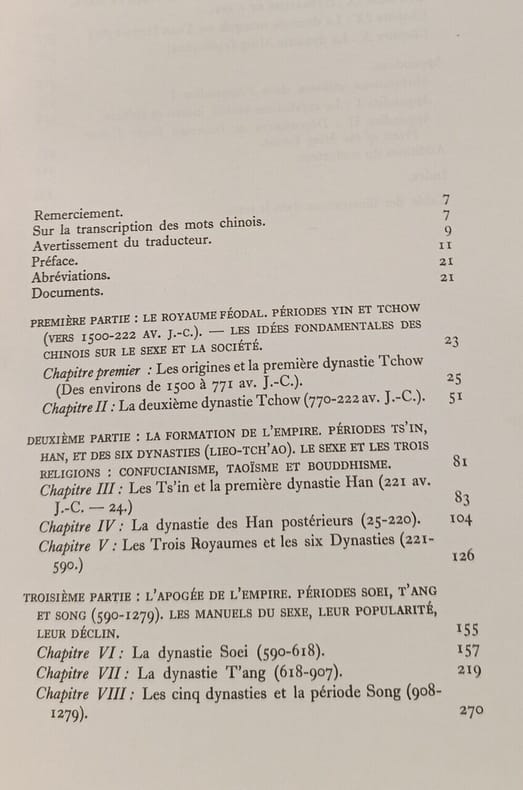
ROBERT VAN GULIK
La vie sexuelle dans la Chine ancienne n°17
TEL gallimard 1977 496 pages in12. 1977. Broché. 496 pages. Cet ouvrage de Robert Van Gulik diplomate et orientaliste propose une synthèse rigoureuse sur la sexualité dans la Chine ancienne des origines jusqu'en 1644. Il aborde les techniques sexuelles le sentiment amoureux les comportements les aberrations la prostitution et les estampes en adoptant un ton scientifique et objectif pour démystifier les fantasmes orientalistes. L'étude s'appuie notamment sur l'analyse des manuels du sexe qui attribuent à la femme un rôle central de gardienne du savoir érotique
Referenz des Buchhändlers : 100150248
|
|
|
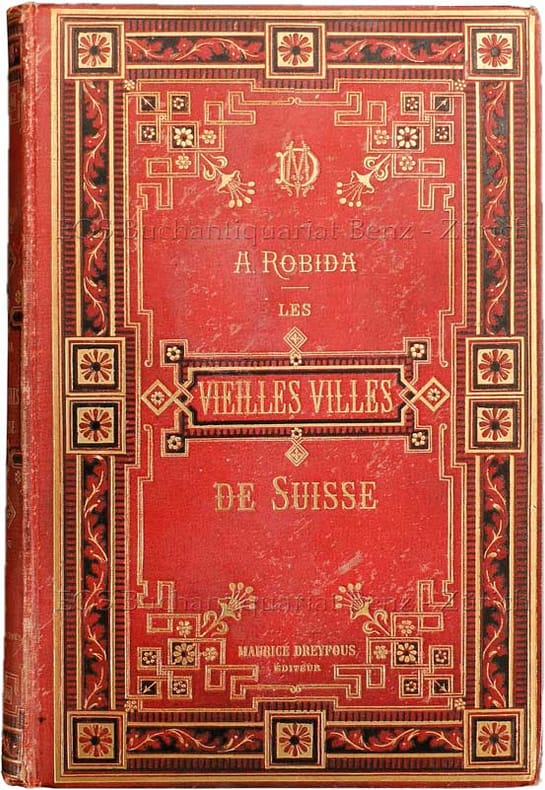
Robida, A(lbert):
Les vieilles villes de Suisse. Notes et souvenirs.
Paris, Maurice Dreyfous, 1879. 4°. (2) 312 S. Mit 27 Tafeln u. zahlr. Textillustr. Schwarz- u. goldgepr. Orig.-Leinenband mit dreis. Goldschnitt.
Referenz des Buchhändlers : 4190BB
|
|
|
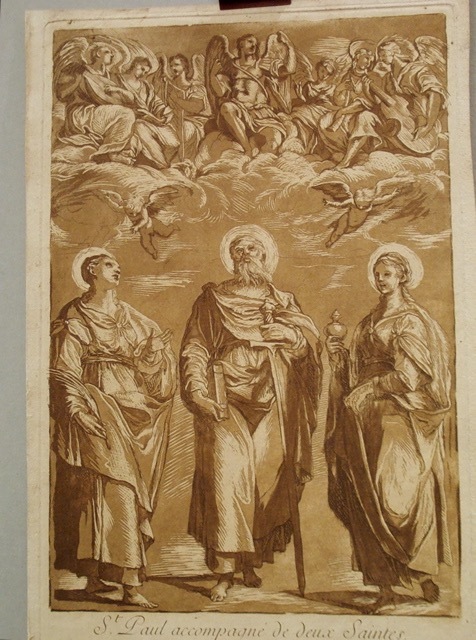
ROBERT DE SERI P.-P.-A. LE SUEUR Nicolas
St Paul accompagné de deux Saintes.
Légende : Dessein de Barthelemy Ramenghi dit Bagnacavatto, qui est dans le cabinet de Mr Crozat. Gravé à l’eau-forte par Robert et en bois sous sa conduite par Nicolas Le Sueur. Belle planche tirée en camaïeu. En feuille s.d. 42,8 x 27,5
Referenz des Buchhändlers : 5243
|
|
|
ROBIDA (Albert).
Vive la trés sainte Ligue lithographie originale en noir sur chine collé.
1897 Les peintres-lithographes : album trimestriel de lithographies originales et inédites 1897 - belle epreuve Impression . claires rousseurs en marge. toutes marges dimension feuille : 320 x 460mm.. timbre de la Société des Peintres-Lithographes, tirage à 100 ex.
Referenz des Buchhändlers : 26159

|
|
|
Robbe, Manuel (1872 - 1936)
Les Botteleurs [Die Garbenbinder]. Mehrfarbige Aquatintaradierung. Nr. 44/90.
1902. Plattenmaß 33 x 51,5 cm.
Referenz des Buchhändlers : 82858

|
|
|
Robert Browning - Illustrated with Engravings by Carl Schultheiss
THE RING AND THE BOOK Two-Volume Set
Los Angeles: Limited Edition Club 1949. First Edition in this Format; Limited Edition. Hardcover. Book condition is Very Good bound in 1/4 leather and paper covered boards housed in a Very Good slipcase. Minor edge wear and a few weak smudges to slipcase. Sunning to slipcase. A few smudges to covers. A few small weak scuffs to spine of each volume. Text is clean and unmarked. Illustrated throughout. Limited to 1500 copies this set numbered 822. ; Signed by the engraver Carl Schultheiss on the Limitation page. ; Large 8vo 9" - 10" tall; 690 pages. Limited Edition Club hardcover
Referenz des Buchhändlers : 13511

|
|
|
Robert Burns; DeLancey Ferguson (Editor); Joan Hassall (Wood Engravings)
The Poems of Robert Burns The Limited Editions Club
The University Press 1965. Hardcover. Used - Very Good. Signed by Joan Hassall; #999 of a limited 1500 produced; Yellowing to outer slipcase little wear to covers with small chip to top of spine small inscription inked on verso of final endpaper book block otherwise clean square and tight. The University Press hardcover
Referenz des Buchhändlers : 228244
|
|
|
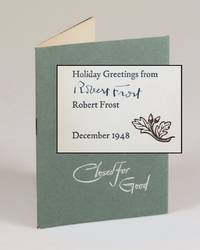
Robert Frost, with wood engravings by Thomas W Nason
Closed for Good Robert Frost's 1948 Christmas Card one of 375 featuring his Christmas greeting under his name this copy inscribed and signed by Frost
New York: Printed at The Spiral Press 1948. First edition. Paperback. This original Robert Frost 1948 Christmas Card features a trifecta of virtues. This is the first published appearance of this poem which had an unusual text history detailed further below. Of 2275 copies printed for 9 different names this is one of 375 printed for the poet himself. Last but certainly not least this is not only one of Frost's copies but is inscribed and signed by him. Following the first and second printed lines on the presentation page "This new poem brings Holiday Greetings from Robert Frost December 1948" Frost wrote "the Hendersons" and signed "Robert Frost". <br /> <br />Condition is near fine. The gray-green card wraps are clean bright and sharp cornered the binding staple firmly intact and uncorroded. We note only a tiny blemish above the title on the front cover and a trivial hint of wear to the spine heel. The contents are crisp and clean lightly age-toned but with no spotting or soiling. <br /> <br />With the permission of Frost and his publishers in 1929 the Spiral Press began printing an annual Robert Frost Christmas Card featuring one of his poems. The tradition continued until 1962 Frost's final Christmas. Each annual Christmas poem publication was printed with varying names on the title page to accommodate their being sent by various Frost publishers artists and important friends. This copy is one of those printed for Frost himself. <br /> <br />The 1948 Christmas poem "Closed for Good" has an unusual textual history. After it was first printed here it appeared in a number of other Frost collections including in the 1949 edition of Complete Poems and the 1954 1955 and 1963 editions of selected poems. In 1962 a revised version of Closed for Good was published as part of In the Clearing. There the poem is altered; the first stanza lines 1-6 is deleted And becomes They in line 7 and the word brush becomes spread in line 24. <br /> <br />This is clearly how Frost wanted the poem to evolve. In the Clearing was his final new collection and in 1958 Frost told Elizabeth Shepley Sergeant that he was trying out a new version of four stanzas. Nonetheless When Edward Connery Lathems edition of The Poetry of Robert Frost was published in 1969 the poem was presented in five stanzas and the two word changes restored to original. Given both Frosts manifestly deliberative use of words and the fact that the poem is a commentary on Frosts inheritance from the past and his legacy to the future the changes do not seem incidental. <br /> <br />By 1948 when this poem first appeared in his annual Christmas card and he inscribed this copy Robert Frost 1874-1963 had already entered the final decades of his life as the most highly esteemed American poet of the twentieth century with an accumulating hoard of academic and civic honors. Half a decade had passed since he had won his still-to-this-day-unrivalled fourth Pulitzer Prize for Poetry. This is all the more remarkable given that he did not publish his first volume of poetry until he was nearly 40 years old. <br /> <br />References: Crane B19; Tuten and Zubizarreta; ANB <br/><br/> Printed at The Spiral Press paperback
Referenz des Buchhändlers : 008728
|
|
|
Robert Frost, with a foreword by Edward Hyde Cox and wood engravings by Thomas W Nason
You Come Too: Favorite Poems for Young Readers signed by Robert Frost
New York: Henry Holt and Company 1959. First edition first printing. Hardcover. This strikingly clean jacketed copy of the first edition first printing of Robert Frosts 1959 collection of Favorite Poems for Young Readers is signed by him "Robert Frost" on the title page just above his printed name. <br /> <br />This collection takes its title from the words repeated at the end of each stanza of this book's first poem "The Pasture" first published as the prefatory to North of Boston in 1914. Of this collection the publisher said Frost "has gathered a group of his poems to be read to and by young people. To Robert Frost a great-grandfather with a remarkable number of small friends this was a labor of love. Frost dedicated the volume to his mother Belle Moodie Frost who knew as a teacher that no poetry was good for children that wasnt equally good for their elders. Evoking Frosts famous poem Mending Wall Frosts friend Edward Hyde Cox 1914-1988 who contributes a Foreword to this volume said of Frost that he had never added a single stone to the wall that so often separates age from youth. Prevalent among the 51 poems herein is Frost's gently subversive inclination to write verse that is superficially accessible "lovely dark and deep" upon sounding. <br /> <br />This is a handsome book bound in orange-yellow linen cloth with a vignette of a bird on a fence post stamped in black on the lower right front cover corner and spine print stamped in black with a red acorn and leaf device between at the spine's center. The contents feature wood engravings by Thomas W. Nason and are bound with endpapers of heavy light gray wove paper and red and yellow head and tail bands. The dust jacket printed on beige laid paper features a wood engraving of birches spanning the lower front face spine and extending onto the rear face. The rear face prominently features Yousuf Karsh's famous portrait photograph of Frost. <br /> <br />Condition is truly fine in a truly fine dust jacket. The illustrated cloth binding is immaculately clean and bright with sharp corners and only the most trivial hints of shelf wear to extremities. The contents are likewise pristine with no spotting soiling toning or previous ownership marks. "FIRST EDITION" is so stated on the title page verso. The contents retain a pleasingly stiff feel The dust jacket is crisp bright clean and entirely complete with no loss or tears and retaining the original "$3.00" upper front flap price. We note only a hint of wrinkling to the spine heel and a touch of soiling to the lower rear face. The jacket is protected beneath a clear removable archival cover. <br /> <br />Publisher's statements are often hyperbolic. In this case the dust jacket's front flap description of Robert Frost as "America's beloved poet ageless and for the ages" was and remains more accurate than advertising. Before this volume was published on 26 March 1959 Robert Frost 1874-1963 reached the age of eighty-five. His stature had risen to an apex arguably unequalled by any American poet since. Frost had long-since won all of his still-unrivaled four Pulitzer Prizes for poetry 1924 1931 1937 and 1943. He spent his final years as the most highly esteemed American poet of the twentieth century with an accumulating hoard of academic and civic honors. Two years before his death he became the first poet to read in the program of a U.S. Presidential inauguration Kennedy January 1961. <br /> <br />Reference: Crane A39; Tuten and Zubizarreta; ANB <br/><br/> Henry Holt and Company hardcover
Referenz des Buchhändlers : 008606

|
|
|
ROBERT Georges
Costumes parisiens. Robe de satin violet à ceinture pourpre et ornée d'un grand ruban broché de fleurs de velours (pl.106, Journal des Dames et des Modes, 1913 n°47)
- s.n., Paris 1913, 14x22,5cm, une feuille. - Estampe originale en couleur finement rehaussée à l'or, tirée sur papier vergé, signature en bas à gauche de la planche. L'une des premières revues de mode françaises, parue quelques temps avant la fameuse Gazette du bon ton et réunissant les grands artistes français de la mouvance Art déco. Le Journal des dames et des modes est une revue trimensuelle de mode française illustrée créée en 1797. Sa publication est stoppée en 1839 avant d'être reprise en juin 1912 sous l'impulsion de Tommaso Antongini, le secrétaire, ami et biographe de Gabriele d'Annunzio. Elle disparaîtra en août 1914 à l'aube de la Première Guerre mondiale. La revue était tirée à 1279 exemplaires ce qui en fait, pour l'époque, une publication relativement confidentielle. Les 186 planches, d'une grande finesse, sont gravées sur papier fort puis coloriées au pochoir. Elles représentent, la majorité du temps, des femmes, mais aussi des hommes et des enfants. Les modèles ne sont pas, à la différence de ceux de la Gazette du bon ton dont la publication verra le jour quelques mois plus tard, ceux des couturiers de renom mais sont le fruit de l'imagination des illustrateurs eux-mêmes. Les pochoirs sont, la plupart du temps, exécutés par George Barbier, mais d'autres artistes collaborent à la revue : Léon Bakst, B. Berty, Bernard Boutet de Monvel, Roger Broders, Jan van Brock, Umberto Brunelleschi, H. Robert Dammy, Étienne Drian, Abel Faivre, Marie-Madeleine Franc-Nohain, Xavier Gosé, Paul Iribe, Kriegck, Victor Lhuer, Pierre Legrain, Charles Martin, Fernand Siméon, Ismael Smith, Armand Vallée et Gerda Wegener. Nombre de ces illustrateurs seront également associés à La Gazette du bon ton. Leurs travaux, emblématiques du mouvement Art déco, soulignent l'influence de l'orientalisme et des costumes des ballets russes tout en les inscrivant dans les activités quotidiennes des Français aisés de l'époque. Dès la préface du premier numéro de 1912, Anatole France déclare : « Au bout de soixante-quinze ans, il renaît. Il renaît par les soins de quelques esprits ingénieux et artistes. Il renaît pour les curieux (s'il en est encore) que ne contentent pas les journaux de modes tirés à plusieurs milliers et illustrés par la photographie. Et si les éditeurs nous rendent très exactement, dans son format, avec son papier, son impression, ses procédés de gravure et de coloris, le vieux classique des modes d'autrefois, c'est qu'ils entendent le continuer agréablement et devenir les classiques charmants de la mode d'aujourd'hui et de demain. » [ENGLISH DESCRIPTION ON DEMAND]

|
|
|
Robert Graves; with wood engravings by James Metcalf
ADAM'S RIB: AND OTHER ANOMALOUS ELEMENTS IN THE HEBREW CREATION MYTH
New York: Thomas Yoseloff Inc 1958. Signed. Hard Cover. Very Good binding/Very Good dust jacket. #23 of 100 copies Signed by Robert Graves and illustrator James Metcalf. The dustjacket presents nicely with small chip at the top of the spine and two small chips at the top of the rear panel. There is modest loss to the bottom of the spine and a piece at the bottom has been reattached from the verso using heat-set tissue. Very Good binding / Very Good dust jacket. Thomas Yoseloff, Inc unknown
Referenz des Buchhändlers : 263089

|
|
|
Robert Graves; with wood engravings by James Metcalf
ADAM'S RIB: AND OTHER ANOMALOUS ELEMENTS IN THE HEBREW CREATION MYTH
New York: Thomas Yoseloff Inc 1958. Signed. Hard Cover. Very Good binding/Very Good dust jacket. #23 of 100 copies Signed by Robert Graves and illustrator James Metcalf. The dustjacket presents nicely with small chip at the top of the spine and two small chips at the top of the rear panel. There is modest loss to the bottom of the spine and a piece at the bottom has been reattached from the verso using heat-set tissue. Very Good binding / Very Good dust jacket. Thomas Yoseloff, Inc unknown books
Referenz des Buchhändlers : 263089
|
|
|
Robert Kinney; with Color Block Prints by Eugenia and Bob Riley
The Bachelor in New Orleans A Handbook for Unattached Gentlemen and Ladies of Spirit Visiting or Resident in the Paris of America
E-386. Very Good. Paperback. Trade PB. 8vo. Bob Riley Studios New Orleans LA. Unknown Date 1943 . 115 pgs. Illustrated. Revised Edition. Wrappers lightly worn with some light shelf-wear to the extremities present. Book is free of ownership marks. Text is clean and free of marks. Binding tight and solid. French Quarter bohemians designed The Bachelor in New Orleans as an unauthorized guidebook before unauthorized guidebooks. Over forty marvelous block prints illustrate a remarkably jaunty text delivering a portrait of New Orleans nightlife unlike any other. The Bachelor in New Orleans discusses among other things: absinthe the Ramos Gin Fizz Cafe Brulot Bourbon Street The Sazerac Bar Court of the Two Sisters Pat O'Brien's The Monteleone Hotel Bar art Cafe Lafitte Tujague's Bar The Walnut Room Micky Finns Antoine's Galatoire's Dinkelspiel salad lonliness Mardi Gras drinking jazz and sporting houses. ; 8vo 8" - 9" tall . paperback
Referenz des Buchhändlers : 71318
|
|
|
Robert Sayer of Fleet Street, London printseller [theatrical prints; Comedie Francaise; Bellecour; Marie Favart, Trial, Clerval;
Théâtre Français; French Theatre; c.1770 Five hand-coloured prints of French actors performing in French and Italian plays at the Comédie Française in the eighteenth century.
All five prints 'Publish'd by Robt. Sayer No. 53 Fleet Street London as the Act directs 1st. Septr. 1772.'. Each of the five on a piece of good laid paper roughly 15 cm square. Wide margins with indentation of plate 9.5 x 8 cm. All five good with occasional light creasing to margins. The second and third items more aged that the others but all good and suitable for framing. Delicately engraved and skillfully coloured. Item One: 'Mr. Bellecour. 3 Comed. Franc. Le Joueur. dans la Comédie du même nom.' Item Two: '19 Comed. Franc. Michau et Henri. dans la Partie de Chasse d'Henri IV. Qu'êtes-vous allons qu'êtes-vous' Item Three: 'Made. Favart. 22 Coméd. Ital. La Vieille. dans la Fée Urgele Acte III.' Item Four: 'Mrs. Trial & Clerval. 29 Coméd. Ital. Bertrand et Monteauciel dans le Déferteur. Voulez-vous bien chanter quand on vous en prie' Item Five: 'Mr. Laurette 30 Coméd. Ital. Jean Louis. dans le Déserteur.' Presumably from Whirsker's "The Metamorphoses of Melpomene and Thalia or Dramatic Characters of the French and Italian Comedies." London: Robert Sayer n.d. but circa 1770. 30 plates. Cohen 1066. Lewine 356 copy on with 19 of the 30 plates at $3000: Micahel Hollander. See Image. All five prints 'Publish'd by Robt. Sayer, No. 53 Fleet Street London, as the Act directs, 1st. Septr. 1772.' unknown
Referenz des Buchhändlers : 7545
|
|
|
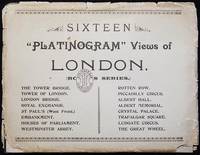
Robey, Thomas F
Sixteen "Platinogram" Views of London Robey's Series
London: T.F. Robey 1890. Very Good. 16 black-and-white collotype views loose as issued in a light green envelope. Title from envelope. "Robey's Series" -- on envelope and on each image. Thomas F. Robey was a photographer active in London beginning in the 1890s. From about 1894 to about 1905 he was also active as a commercial photographer and printer with Eustace Curzon. They were among many photographers producing platinotypes or platinum prints around the turn of the century. "Platinogram" was the name given by Robey to these images made from platinotypes. As listed on the envelope the views are: The Tower Bridge Tower of London London Bridge Royal Exchange St. Paul's West Front Embankment Houses of Parliament Westminster Abbey Rotten Row Piccadilly Circus Albert Hall Albert Memorial Crystal Palace Trafalgar Square Ludgate Circus and the Great Wheel. There is no date of publication but the images appear to be from the 1890s. The detail in the street scenes is particularly impressive. There are no motorized vehicles in any of the scenes. Oval stationers label on front of envelope: Rowsell & Son Cheapside. In Very Good Condition: minor creasing at a few corners; loss of corners on two images; clean and bright. Envelope is in Good- Condition: separated into two sections; chipping along edges; minor loss at corners. Extremely scarce -- no other copies of these "Platinogram" views have been located. T.F. Robey unknown
Referenz des Buchhändlers : 003892
|
|
|
Robida, A(lbert)
Les vieilles villes de Suisse. Notes et souvenirs.
Paris, Maurice Dreyfous, 1879. 4°. (2) 312 S. Mit 27 Tafeln u. zahlr. Textillustr. Schwarz- u. goldgepr. Orig.-Leinenband mit dreis. Goldschnitt. + Wichtig: Für unsere Kunden in der EU erfolgt der Versand alle 14 Tage verzollt ab Deutschland / Postbank-Konto in Deutschland vorhanden +, bild
Referenz des Buchhändlers : 4190BB

|
|
|
Robinson, Charles N.
Old Naval Prints: Their Artists and Engravers
This is a very good hardcover copy in dark blue cloth with gilt titles and front cover device and bevelled edges. Minimal scuffing to the covers. Inside is fresh and clean. 36 text pages + 96 illustrations including a number of tipped-in color plates. Almost the whole dust jacket is laid-in at the rear (in 2 pieces, the front panel & rear panel). Folio, 12" high X 10" wide.
|
|
|
ROCCAMONTE, Giorgio Amelio (Buenos Aires, 1927 - Roma, 1980)
I fiori del deserto
Cartella contenente 4 acquaforti originali, numerate, firmate e datate a matita dall'Artista (cm 17,5x12,5 - foglio 50x35) Stampatore: Elvidio Farabollini di Treia. Ogni incisione reca il timbro a secco dell'Editore. . . . Perfetto (Mint). . Edizione originale di 20 es. numerati. . ROCCAMONTE, Giorgio Amelio (Buenos Aires, 1927 - Roma, 1980). Scultore, ha firmato con Lucio Fontana il Manifesto Blanco nel 1946

|
|
|
Roch, Ernst [Editor]; Furneaux, Patrick; Rosshandler, Leo
Arts of the Eskimo: Prints
240 pages. Bibliography. Index. "The definitive work on printed Eskimo graphics. A comprehensive survey of all areas in the Canadian Arctic where prints are produced and contains works by all the leading printmakers. The two texts deal respectively with the aesthetic content of printed Eskimo graphics and with the social, cultural and anthropological background to the art. All the prints - over one-hundred - are reproduced full page in their original colours, each accompanied by a facing page of descriptive text. Also contains short biographies of all artists represented." - dust jacket. Light wear to clean and unmarked book. Moderate wear to dust jacket now preserved in glossy new archival-grade Brodart. A quality copy of this wonderful compilation. Bibliographic reference: About Indians (4th Edn) 1190. Book

|
|
|
Rodari, Florian, Wirth, Jean, Musée d'art et d'histoire, Cabinet des estampes
Diables et diableries : Musée d'art et d'histoire, Cabinet des estampes, Genève, 25.XI. 1976-27.II. 1977
Musée d'art et d'histoire (1976)
Referenz des Buchhändlers : lc_49013
|
|
|
RODIER DAVID
Le ruban employé dans la mode et la couture ainsi que dans tous les autres arts de l'habillement féminin (Croquis, La Gazette du Bon ton, 1922 n°3)
- Lucien Vogel éditeur, Paris 1922, 18x24cm, relié. - Set of eight original prints in color, drawn on laid paper. The boards are introduced by a text signed Joan Ramon Fernandez. The sketches are signed XIX and XXI David, respectively on the lower right and left boards. Original prints made ??for the illustration of The Gazette fashionable, one of the finest and most influential twentieth century fashion magazines, celebrating the talent of creators and artists French burgeoning art deco. Famous fashion magazine founded in 1912 by Lucien Vogel, The Gazette fashionable appeared until 1925 with an interruption during the War of 1915 to 1920, due to mobilization of its editor. She is 69 Deliveries from just 2000 copies and is illustrated including 573 color plates and 148 sketches depicting models of fashion designers. Upon publication, these luxury publications "are for bibliophiles and worldly aesthetes" (Françoise Tétart-Vittu "good Gazette of tone" in the fashion dictionary, 2016). Printed on fine laid paper, they use a typeface created specifically for the magazine by Georges Peignot, the Cochin character, taken in 1946 by Christian Dior. The prints are made with the technique of metal stencil, enhanced color and some outlined in gold or palladium. The adventure began in 1912 when Lucien Vogel, man of the world and fashion - it has already participated in Femina magazine - decided to found with his wife Cosette de Brunhoff (John's sister, the father of Babar) Gazette good tone in which the subtitle is then "Art, fashions and frivolities." Georges Charensol quotes the editor: "In 1910, he observed, there was no truly artistic fashion magazine and representative of the spirit of his time. So I thought of making a glossy magazine with truly modern artists [...] I was certain of success because for any fashion country can compete with France. "(" A great art editor. Lucien Vogel "in literary News, No. 133, May 1925). The success of the magazine is immediate, not only in France but also the US and South America. Originally, Vogel therefore brings together a group of seven artists: André-Édouard Marty and Pierre Brissaud, followed by Georges Lepape and Dammicourt; and finally his friends from the School of Fine Arts as are George Barbier, Bernard Boutet de Monvel or Charles Martin. Other talents come quickly reach the equipped Guy Arnoux, Léon Bakst, Benito, Boutet de Monvel, Umberto Brunelleschi, Chas Laborde, Jean-Gabriel Domergue, Raoul Dufy, Edward Halouze Alexander Iacovleff, Jean Emile Laboureur Charles Loupot, Charles Martin, Maggie Salcedo. These artists, mostly unknown when Lucien Vogel appealed to them, will eventually become iconic figures and artistic sought. These are the same illustrators who make the drawings advertisements Gazette. The boards highlight the dresses and sublime seven artists of the time: Lanvin, Doeuillet, Paquin, Poiret, Worth, Vionnet and Doucet. The designers provide for each number of exclusive models. Nevertheless, some of Illustrations contained no real model, but only the idea that the illustrator is done in the fashion of the day. Gazette fashionable is a milestone in the history of fashion. Combining the aesthetic requirement and plastic unit, it brings together for the first time the great talents of the world of arts, literature and fashion and imposed by this alchemy, a new image of women, slender, independent and bold, also driven by the new generation of designers Coco Chanel, Jean Patou, Rochas Marcel ... Recovery in 1920 by Condé Montrose Nast, Gazette fashionable modeled for the new composition and the aesthetic choices of the "little dying newspaper" that Nast had bought a few years ago: the Vogue magazine. [FRENCH VERSION FOLLOWS] Ensemble de huit estampes originales en couleur, tirées sur papier vergé. Les planches sont introduites par un texte signé Jeanne Ramon-Fernandez. Les croquis XIX et XXI sont signés David, respectivement en bas à droite et à gauche des planches. Reliure

|
|
|
Rodriguez Freile Juan; translated into English by William C. Atkinson; engravings by Harold Bennett
The Conquest of New Granada
London: Folio Society 1961. Hardcover. 228p. cloth-covered boards with gilt title and decorations 5.5x8.75 inches map endpapers illus. very good condition in like slip case. On the Spanish territory which is now Colombia Ecuador Panama and Venezuela. Folio Society hardcover books
Referenz des Buchhändlers : 264735

|
|
|
RODRIGUEZ, Antonio; Fernando Castro Pacheco (engravings)
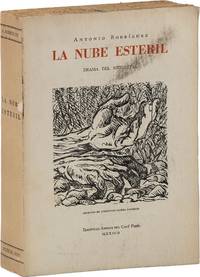
La Nube Esteril: Drama del Mezquital
Mexico: Ediciones Amigos del Café París 1952. Softcover. Octavo 24cm; beige paper wrappers; upper and lower edges untrimmed; 317pp; black-and-white illustrations. Some pages of text unopened. Modest shelf-wear with soil to wrappers and edges of textblock and trace peeling to spine titling; Very Good. Fiction work examines social history of the Mezquital Valley region in Mexico. 88790. Ediciones Amigos del Café París unknown
Referenz des Buchhändlers : 88790
|
|
|
Rodt, Emanuel von
Die Feldzüge Karls des Kühnen, Herzogs von Burgund und seiner Erben. Mit besonderem Bezug auf die Theilnahme der Schweizer an denselben.
Schaffhausen, Hurter'sche Buchhandlung, 1843-44. 8°. VIII, 602 S.; VI S., S. 7-632. Mit 4 gef. Plänen u. 2 gef. Karten mit Grenzkolorit. Interimsbroschuren der Zeit. + Wichtig: Für unsere Kunden in der EU erfolgt der Versand alle 14 Tage verzollt ab Deutschland / Postbank-Konto in Deutschland vorhanden +, bild
Referenz des Buchhändlers : 5174BB

|
|
|
Roethke, Theodore; Wood Engravings by John Roy
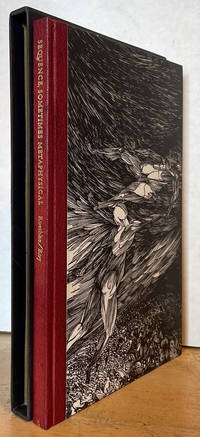
Sequence Sometimes Metaphysical SIGNED LIMITED EDITION
Iowa City: Stone Wall Press 1963 Limited Edition in slipcase beautifully printed on Rives Heavy with interleaved illustrations on Mulberry paper one of 60 deluxe copies of a total print run of 330 bound in quarter leather and illustrated boards signed by both Roethke and engraver Roy this copy number X one tiny nick to leather at spine tail a beautiful copy of this justly-celebrated production printed by Kim Merker at the Stone Wall Press; from collection of Jenijoy La Belle who studied with Roethke at the University of Washington along with her close friend Tess Gallagher and the author of the influential book The Echoing Wood of Theodore Roethke; tall 8vo; 31 unnumbered pages and 12 engravings each on folded leaf; additional unnumbered engravings preceding title page & colophon. Signed by Author. First Edition. Hard Cover. Fine. Stone Wall Press hardcover
Referenz des Buchhändlers : 33200
|
|
|
Roethke, Theodore; illustrated with wood engravings by John Roy
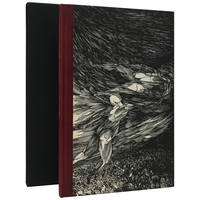
Sequence Sometimes Metaphysical Deluxe Copy
Iowa City: Stone Wall Press 1963. First Edition. Leather bound. Fine. A beautiful collection of poems printed by Kim Merker with illustrations printed on delicate mulberry paper bound in between. This book is generally regarded as one of the finest from the press which is known for the excellence of its letterpress printing and book design.<br /> <br /> The edition size was 270 copies of which this is one of 60 deluxe copies bound in quarter-leather and paper printed with an engraved design by Roy. These copies numbered with Roman numerals are signed by both Roy and Roethke who died soon after the printing was completed. Roethke won both the Pulitzer Prize and the National Book Award for poetry. First edition first printing deluxe issue. A fine copy no. XXX of 60 signed by Roethke and Roy. The publisher's paper-covered slipcase is beginning to split along the bottom edge. Stone Wall Press unknown
Referenz des Buchhändlers : 307320
|
|
|
Roger BRODERS
Costumes parisiens. Robe de thé en velours aubergine ocellé d'oeils de Paon. Fourreau gris d'acier. Turban aigretté d'un lophophore (pl.24, Journal des Dames et des Modes, 1912 n°14)
S. n. | Paris 1912 | 14 x 22.50 cm | une feuille
Referenz des Buchhändlers : 57634
|
|
|
Roger BRODERS
Costumes parisiens. Robe et toque de velours de soie vert de mer bordées d'hermine (pl.29, Journal des Dames et des Modes, 1912 n°17)
S. n. | Paris 1912 | 14 x 22.50 cm | une feuille
Referenz des Buchhändlers : 57637
|
|
|
Roger BRODERS
Costumes parisiens. Tailleur du matin en velours de laine orné de Skungs (pl.43, Journal des Dames et des Modes, 1912 n°21)
S. n. | Paris 1912 | 14 x 22.50 cm | une feuille
Referenz des Buchhändlers : 57648
|
|
|
ROGER-MARX Claude
Dunoyer de Segonzac
Genève Cailler, collection "Peintres et Sculpteurs d'hier et d'aujourd'hui" 1951 Broché, couverture illustrée rempliée, étui
Referenz des Buchhändlers : 010547
|
|
|
ROGER-MARX, Claude ; ADHEMAR, Hélène
Dunoyer de Segonzac
RMN - Orangerie - MUSEES NATIONAUX 1976 In-8, broché couv. marron, photographies pleines pages en n. & b. Bon état.
Referenz des Buchhändlers : 19568
|
|
|
ROGER-MARX, Claude.
Eloge de Maurice Brianchon, orné de lithographies originales.
Paris, Manuel Bruker 1955, 325x255mm, en feuille sous couverure rempliée. Tiré sur papier Arches et numéroté n° 105 / 200. Bel exemplaire.
Referenz des Buchhändlers : 121181

|
|
|
ROGL Hans
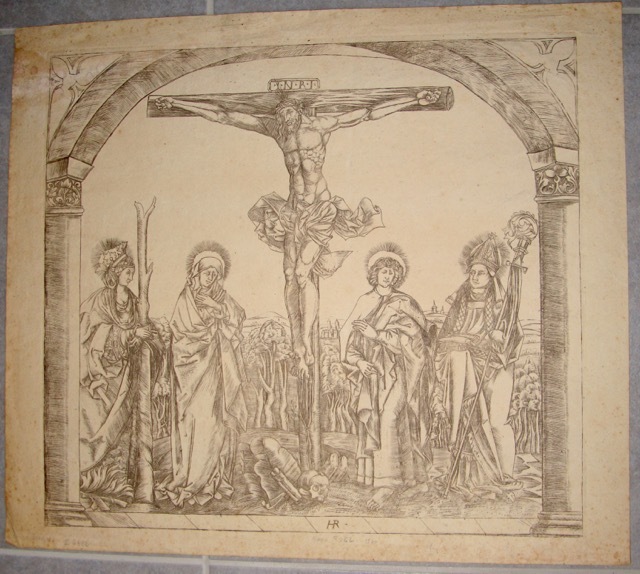
Jésus en Croix
Brulliot I, 2482. En feuille Très bon 36 x 39,5 au trait carré
Referenz des Buchhändlers : 11385
|
|
|
Roger Passeron
La Gravure Impressionniste
1974, Bibliothèque des Arts, Paris. In-folio, relié, toilé éditeur à la bradel sous jaquette illustrée, 224pp largement illustrées n&b. Nombreuses reproductions pleine page. Jaquette émoussée et légèrement insolée. Intérieur bon. Bon exemplaire
Referenz des Buchhändlers : ART7166M

|
|
|
Roger Baschet
La peinture asiatique : son histoire et ses merveilles ( beaucoup d'illustrations contrecollées)
Les Éditions de l'Illustration Baschet et Cie 1954 110 pages infolio. 1954. reliure editeur broché couverture rempliée. 110 pages. Ouvrage de synthèse de Roger Baschet consacré à l'histoire et aux chefs-d'œuvre de la peinture asiatique publié en 1954. Il retrace l'évolution les écoles et les grands maîtres des traditions picturales de Chine du Japon et d'Asie du Sud-Est et est richement illustré de reproductions en couleur
Referenz des Buchhändlers : 6628

|
|
|
Roger Pingeon
Le Cas Poulidor nº 67
Sans date.
Referenz des Buchhändlers : 500298767

|
|
|
Roggwiller, E.:
Webschule - Wattwil 1909/10.
Wattwil, 1911. Fotografie. Bildformat: 32 x 25 cm.
Referenz des Buchhändlers : 107DG

|
|

 Per e-mail erhalten
 Als pdf-Dokument herunterladen
 RSS feed
 Permanenter link


