|
|
|
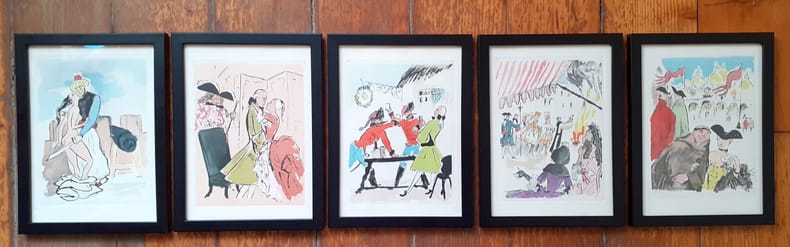
VIENOT Jacques; COCTEAU Jean (préf.):
L. Cappiello. Sa vie et son oeuvre.
Paris, édition de Clermont, 1946. In-4 broché de 146-[4] pages, couverture blanche rempliée imprimée en bleu sous jaquette bleue imprimée en blanc. Quelques très légères marques à la jaquette mais belle condition. Exemplaire non coupé.
Riferimento per il libraio : 7046
|
|
|
VIERNY Dina, MERIC Solange, LORQUIN Bertrand
TOULOUSE-LAUTREC & L’AFFICHE
Réunion des Musées Nationaux, Paris, 2002
Riferimento per il libraio : 22707
|
|
|
VILATO (Javier).
Invitation illustrée d'une gravure originale signée.
Paris Société des peintres-graveurs français 1975 1 vol. Broché Carton d'invitation dépliant sur Arches illustré d'une eau-forte tirée en rouge (15 x 12 cm) signée et datée par Javier Vilato. En parfait état.
Riferimento per il libraio : 109088
|
|
|
VILATO (Javier).
Invitation illustrée d'une gravure originale signée.
Paris Société des peintres-graveurs français 1975 1 vol. Broché Carton d'invitation dépliant sur Arches illustré d'une eau-forte tirée en rouge (15 x 12 cm) signée et datée par Javier Vilato. En parfait état.
Riferimento per il libraio : 109088
|
|
|
Villard Henry
Looping the Loop - Posters of Flight
W. W. Norton & Company 2008 In-4 relié 33,3 cm sur 25,9. 160 pages. Très bon état d’occasion.
Riferimento per il libraio : 64410 ISBN : 967007623
|
|
|
VILLEGLE Jacques
Décentralisation
Lille-Paris Epreuve d'artiste E.A.10 1991 In-12 agrafé, couverture à rabats Edition originale
Riferimento per il libraio : 006039
|
|
|
Villeglé
Volume III + Volume IV du Catalogue thématique des affiches Lacérées De Villeglé: La Lettre Lacérée (1949-1962), La Lettre Lacérée (1963-1989), 2 Tomes /Bände
Marval, Paris 1990. Broschiert Wie Neu
Riferimento per il libraio : 022647
|
|
|
VILLEMOT (Bernard)
PATHE MARCONI - LA VOIX DE SON MAITRE et son image.
Affiche originale. Éditions Publicis. Imp AUSSEL Paris. ca 1970. Impression en lithographie. Dim: 597 x 384 mm
Riferimento per il libraio : 3691
|
|
|
VILLEMOT (Bernard)
PATHE MARCONI - LA VOIX DE SON MAITRE et son image.
Affiche originale. Éditions Publicis. Imp AUSSEL Paris. ca 1970. Impression en lithographie. Dim: 597 x 384 mm
Riferimento per il libraio : 3691
|
|
|
VILLEMOT (Bernard).
"Eugènie Les Bains - La Cure Impériale".
1988 Affiche. Affiche lithographiée, L'affiche Européenne en France, 1988, 102 x 70 cm. (format à vue), 109 x 78 cm. (format entoilé), signée en bas à droite dans la planche.
Riferimento per il libraio : 24925
|
|
|
VILLEMOT Illustrée par Bernard Villemot.
Affiche de Villemot. Soutien de l'enfance victime de la guerre et du nazisme.
- Une feuille 40 x 59 cm, repliée pour envoi avec les timbres d'époque.
Riferimento per il libraio : 143901
|
|
|
Villiers, François.
Constance aux Enfers
1963 60x80 LE PIÈGE DE L'OMBRE : Affiche originale (1963) du film Constance aux Enfers. Michèle Morgan livre une performance bouleversante dans ce thriller psychologique signé François Villiers. Une composition tout en tension et en mystère, emblématique du suspense à la française. Présentée dans un état exceptionnel, cette affiche capture l'élégance tragique d'une icône du cinéma mondial.
Riferimento per il libraio : LCI-6543
|
|
|
VILLON Eugène (la Haye 1879 - Caluire 1951).-
Affiche pour Automoto. Société de Constructions mécaniques de la Loire. St-Etienne. Pièces détachées. Cadres, Moyeux, Pédales. Motocyclettes. Bicyclettes de Luxe, Route, Course, Dames & Enfants.-
Lyon. Société Lyonnaise de Photochromogravures. 1905. Affiche en couleurs de 75 x 108,5 cm entoilée, en parfait état. Elle montre 1 femme et 2 hommes en premier plan contemplant la bicyclette de la dame sur fond de paysage champêtre avec d'autres personnages dont un petit groupe d'enfants dont l'un chevauche un cheval de bois. Photo su demande.
Riferimento per il libraio : ORD-16916
|
|
|
VILLON FRANCOIS. (1431-APRES 1463).
OEUVRES. ILLUSTRATIONS DE DUBOUT.
PARIS. GIBERT JEUNE. 1933. PETIT IN-4 BROCHE (26,5 X 20,5X 2,5 CENTIMETRES ENVIRON) DE (4) + 157 PAGES, COUVERTURE CREME REMPLIEE ILLUSTREE D'UNE VIGNETTE EN COULEURS, TITRE IMPRIME EN ROUGE ET EN NOIR, SOUS ETUI BORDE. ILLUSTRE DE 67 COMPOSITIONS MISES EN COULEURS PAR CHARPENTIER, DONT 2 PLANCHES DOUBLES ET 8 HORS TEXTE. PREMIER TIRAGE LIMITE A 3000 EXEMPLAIRES NUMEROTES SUR VELIN DES PAPETERIES DE NAVARRE, CELUI-CI PORTANT LE NUMERO 1377. BON EXEMPLAIRE.
Riferimento per il libraio : 1176
|
|
|
VILLON JACQUES (1875-1963)
XVème Salon de Mai 1959
1959 affiche Paris, 616x450mm, impression lithographique Mourlot.Petit manque au coin inférieur droit. (102994)
Riferimento per il libraio : 102994
|
|
|
VILLON JACQUES. (NE GASTON EMILE DUCHAMP. 1875-1963).
MUSEE NATIONAL D'ART MODERNE. 5 FEVRIER - 23 MARS 1951.
PARIS. EDITIONS DES MUSEES NATIONAUX - MOURLOT. 1951. AFFICHE ORIGINALE LITHOGRAPHIEE EN COULEURS, SOUS VERRE, ENCADREMENT D'EPOQUE BAGUETTE DOREE (50 X 62 X 1,5 CENTIMETRES ENVIRON). BON ETAT.
Riferimento per il libraio : 241
|
|
|
VILLON Jacques:
Peintures. Galerie Louis Carré, Paris.
Affiche, lithographie (punaises) 52 x 70,5. Imprimée par Mourlot.
Riferimento per il libraio : 7808
|
|
|
VILPREY Georges de.
La Halte ou le Poilu de 14. De la souffrance ... De l' amour... Nouvelle édition.
Fontenoy-en-Puisaye ( Yonne), Editions de la Vieille Tour, 1960 ; in-8°, broché, couverture balanche -imprimée en noir et rouge; 364pp., 2ff. Très rares piqûres à 6 feuillets, déchirure au 2ème plat de la couverture , sans manque de papier.
Riferimento per il libraio : c3755
|
|
|
Vilà- La Samaritaine.
Deux Créateurs Une Oeuvre. Samaritaine. Progrès Constants...
Une affiche de dimensions 75x60 représentant les magasins de La Samaritaine et en Médaillons M. et Mme. Ernest et Louise Cognacq. Impression lithographique en bleu et brun, sur papier fort ,par l'imprimerie Draeger Très bel état. Voir photo.
|
|
|
VINCE VAUGHT - ANNE HECHE
AFFICHE DE CINEMA - PSYCHO
GUS VAN SANT. 1999. In-12. Broché. Bon état, Couv. convenable, Dos satisfaisant, Intérieur frais. 60 x 155 cm avec en badeau la date de sortie.. . . . Classification : 0-Affiches Cinéma
Riferimento per il libraio : R100000462
|
|
|
VINCE VAUGHT - ANNE HECHE
AFFICHE DE CINEMA - PSYCHO
GUS VAN SANT. 1999. In-12. Broché. Bon état, Couv. convenable, Dos satisfaisant, Intérieur frais. 9 photos de présentations 21 x 27cm.. . . . Classification : 0-Affiches Cinéma
Riferimento per il libraio : R100000484
|
|
|
VINCE VAUGHT - ANNE HECHE
AFFICHE DE CINEMA - PSYCHO
GUS VAN SANT. 1999. In-12. Broché. Bon état, Couv. convenable, Dos satisfaisant, Intérieur frais. Affiche de cinéma 42 x 29 cm.. . . . Classification : 0-Affiches Cinéma
Riferimento per il libraio : R100000369
|
|
|
VINCE VAUGHT - ANNE HECHE
AFFICHE DE CINEMA - PSYCHO
GUS VAN SANT. 1996. In-12. Broché. Bon état, Couv. convenable, Dos satisfaisant, Intérieur frais. Affiche de cinéma 120 cm x 160 cm. + 12 photos de présentation de 27 x 21 cm.. . . . Classification : 0-Affiches Cinéma
Riferimento per il libraio : R100000267
|
|
|
VINCENT LIDON - PATRICK TIMSIT
AFFICHE DE CINEMA - PAPARAZZI
ALAIN BEBERIAN. 1998. In-12. Broché. Bon état, Couv. convenable, Dos satisfaisant, Intérieur frais. Affiche de cinéma 120 cm x 160 cm.. . . . Classification : 0-Affiches Cinéma
Riferimento per il libraio : R100000302
|
|
|
Vincent René:
Lawn tennis.
Archives internationales, collection dessins d'archives. Sérigraphie au format 50 x 70 cm., à l'état de neuf.
Riferimento per il libraio : 3023
|
|
|
Vincent René:
Porto ramos-pinto.
Vercasson, sans date. Affiche publicitaire au format 48 x 68. Légères traces de plis, petit manque au coin inférieur, petite déchirure sans manque.
Riferimento per il libraio : 7019
|
|
|
Vincent René:
Snow life scene.
Archives internationales, collection dessins d'archives. Sérigraphie au format 50 x 70 cm., à l'état de neuf.
Riferimento per il libraio : 3024
|
|
|
Vincent René:
Woman Pilot.
Archives internationales, collection dessins d'archives. Sérigraphie au format 50 x 70 cm., à l'état de neuf.
Riferimento per il libraio : 3025
|
|
|
VION (Raoul)
Affiche lithographiée : Ils se fournissent tous chez Decelle!Librairie - Papeterie - Imprimerie. Fantaisies et souvenirs en tout genre/
Compiègne Decelle ca. 1912 79,5 x 120 cm
Riferimento per il libraio : 17348
|
|
|
VISCONTI (Luchino). FERRACCI (René).
"Ludwig, Le Crépuscule des Dieux"
1972 Maquette originale de l'affiche, pour la version Belge, en deux langues, éditée en 1972, collage support photo, aquarelle et gouache.
Riferimento per il libraio : 23457
|
|
|
Visconti Luchino
Les damnés
1969 60 x 80 LE CRÉPUSCULE DES IDOLES : Affiche originale (1969) du chef-d’œuvre de Luchino Visconti, Les Damnés. Une plongée vertigineuse dans l'intimité d'une dynastie en perdition, portée par une mise en scène d'une beauté vénéneuse. Une composition graphique d'une puissance tragique qui capture l'essence même du génie italien. Présentée dans un état exceptionnel, cette affiche est un hommage souverain à l'un des plus grands maîtres du septième art.
Riferimento per il libraio : LCI-6623
|
|
|
Visholm, Henning
Farboffset-Druck, ohne Titel [Prozession mit Danebrogs].
1981. Darstellung: 48,5 x 69,7 cm. Bogenmaß: 62 x 80 cm;
Riferimento per il libraio : 91369
|
|
|
VISSCHER Claes Jansz
(L'arrestation de Jésus). Gravure originale du XVIIe siècle
- s.n., s.l. (Hollande) (Circa 1600), 33x27,5cm (cuvettes: 13x21cm), une feuille. - Gravure originale non signée, réalisée au burin, probablement par Claes Jansz Visscher, dit le Piscator. Epreuve sur papier vergé filigrané, travail du début du XVIIe siècle. Planche composée de deux gravures, chacune illustrant un passage des Evangiles selon Jean, respectivement 13.14: "Si donc je vous ai lavé les pieds, moi, le Seigneur et le Maître, vous devez aussi vous laver les pieds les uns aux autres" et 18.1-2: "Lorsqu'il eut dit ces choses, Jésus alla avec ses disciples de l'autre côté du torrent du Cédron, où se trouvait un jardin, dans lequel il entra, lui et ses disciples. Judas, qui le livrait, connaissait ce lieu, parce que Jésus et ses disciples s'y étaient souvent réunis." (épisode de l'arrestation de Jésus).Légende en latin dans la partie inférieure de chaque gravure.Mentions numérotée "4" dans l'angle inférieur gauche et de caractère "b" dans l'angle inférieur droit dans la première gravure, et mentions numérotée "5" dans l'angle inférieur gauche et de caractère "bb" dans l'angle inférieur droit dans la deuxième gravure.Mention manuscrite "119" en marge dans l'angle supérieur droit de la planche.Une annotation manuscrite ancienne en caractères grecs sous l'angle droit de la cuvette de chaque gravure.Filigrane visible par transparence.Rousseurs et petites traces principalement marginales, un petit trou de brûlure restauré à l'aide d'un morceau de papier collé au dos, sinon bel état de conservation pour cette gravure extrêmement rare et d'une grande fraîcheur. [ENGLISH DESCRIPTION ON DEMAND]
|
|
|
VISSCHER Claes Jansz
(L'arrestation de Jésus). Gravure originale du XVIIe siècle
- s.n., s.l. (Hollande) (Circa 1600), 33x27,5cm (cuvettes: 13x21cm), une feuille. - Gravure originale non signée, réalisée au burin, probablement par Claes Jansz Visscher, dit le Piscator. Epreuve sur papier vergé filigrané, travail du début du XVIIe siècle. Planche composée de deux gravures, chacune illustrant un passage des Evangiles selon Jean, respectivement 18.6: "Lorsque Jésus leur eut dit: C'est moi, ils reculèrent et tombèrent par terre." et 18.10: "Simon Pierre, qui avait une épée, la tira, frappa le serviteur du souverain sacrificateur, et lui coupa l'oreille droite." (épisode de l'arrestation de Jésus).Légende en latin dans la partie inférieure de chaque gravure.Mention numérotée "6" dans l'angle inférieur droit dans la première gravure, et mention numérotée "7" dans l'angle inférieur gauche dans la deuxième gravure.Mention manuscrite "120" en marge dans l'angle supérieur droit de la planche.Une annotation manuscrite ancienne en caractères grecs sous l'angle droit de la cuvette de chaque gravure.Filigrane visible par transparence.Rousseurs et petites traces principalement marginales, un petit trou de brûlure restauré à l'aide d'un morceau de papier collé au dos, sinon bel état de conservation pour cette gravure extrêmement rare et d'une grande fraîcheur. [ENGLISH DESCRIPTION ON DEMAND]
|
|
|
VISSCHER Claes Jansz
(L'arrestation de Jésus). Gravure originale du XVIIe siècle
- s.n., s.l. (Hollande) (Circa 1600), 33x27,5cm (cuvettes: 13x21cm), une feuille. - Gravure originale non signée, réalisée au burin, probablement par Claes Jansz Visscher, dit le Piscator. Epreuve sur papier vergé filigrané, travail du début du XVIIe siècle. Planche composée de deux gravures, toutes deux illustrant un passage des Evangiles selon Jean, respectivement 18.12-16: "La cohorte, le tribun, et les huissiers des Juifs, se saisirent alors de Jésus, et le lièrent. Ils l'emmenèrent d'abord chez Anne; car il était le beau-père de Caïphe, qui était souverain sacrificateur cette année-là. Et Caïphe était celui qui avait donné ce conseil aux Juifs: Il est avantageux qu'un seul homme meure pour le peuple. Simon Pierre, avec un autre disciple, suivait Jésus. Ce disciple était connu du souverain sacrificateur, et il entra avec Jésus dans la cour du souverain sacrificateur; mais Pierre resta dehors près de la porte." (épisode de l'arrestation de Jésus).Légende en latin dans la partie inférieure de chaque gravure.Mentions numérotée "8" dans l'angle inférieur gauche et de caractère "d" dans l'angle inférieur droit dans la première gravure, et mentions numérotée "9" dans l'angle inférieur gauche et de caractère "dd" dans l'angle inférieur droit dans la deuxième gravure.Mention manuscrite "121" en marge dans l'angle supérieur droit de la planche.Une annotation manuscrite ancienne en caractères grecs sous l'angle droit de la cuvette de la première gravure, une autre plus récente et au crayon sous la deuxième gravure.Filigrane visible par transparence.Rousseurs et petites taches principalement marginales, sinon très bel état de conservation pour cette gravure extrêmement rare et d'une grande fraîcheur. [ENGLISH DESCRIPTION ON DEMAND]
|
|
|
VISSCHER Claes Jansz
(L'arrestation de Jésus). Gravure originale du XVIIe siècle
- s.n., s.l. (Hollande) (Circa 1600), 33x27,5cm (cuvettes: 13x20,5cm), une feuille. - Gravure originale non signée, réalisée au burin, probablement par Claes Jansz Visscher, dit le Piscator. Epreuve sur papier vergé filigrané, travail du début du XVIIe siècle. Planche composée de deux gravures, toutes deux illustrant un passage des Evangiles selon Jean, vraisemblablement 18.28-31: "Ils conduisirent Jésus de chez Caïphe au prétoire: c'était le matin. Ils n'entrèrent point eux-mêmes dans le prétoire, afin de ne pas se souiller, et de pouvoir manger la Pâque. Pilate sortit donc pour aller à eux, et il dit: Quelle accusation portez-vous contre cet homme? Ils lui répondirent: Si ce n'était pas un malfaiteur, nous ne te l'aurions pas livré. Sur quoi Pilate leur dit: Prenez-le vous-mêmes, et jugez-le selon votre loi." (épisode de l'arrestation de Jésus).Légende en latin dans la partie inférieure de chaque gravure.Mentions numérotée "10" et de caractère "e" dans l'angle inférieur droit dans la première gravure, et mentions numérotée "11" et de caractère "ee" dans l'angle inférieur droit dans la deuxième gravure.Mention manuscrite "123" en marge dans l'angle supérieur droit de la planche.Une annotation manuscrite en caractères grecs au crayon sous chaque gravure.Filigrane visible par transparence.Légères rousseurs et traces de mouillures principalement marginales, une discrète trace de pliure et une infime restauration marginale à l'aide d'un petit morceau de filmoplast transparent au dos, sinon très bel état de conservation pour cette gravure extrêmement rare et d'une grande fraîcheur. [ENGLISH DESCRIPTION ON DEMAND]
|
|
|
VISSCHER Claes Jansz
(La Passion du Christ). Gravure originale du XVIIe siècle
- s.n., s.l. (Hollande) (Circa 1600), 33x27,5cm (cuvettes: 12x20,5cm), une feuille. - Gravure originale non signée, réalisée au burin, probablement par Claes Jansz Visscher, dit le Piscator. Epreuve sur papier vergé filigrané, travail du début du XVIIe siècle. Planche composée de deux gravures, chacune illustrant un passage des Evangiles selon Jean, respectivement 19.1: "Alors Pilate prit Jésus, et le fit battre de verges." et 19.2: "Les soldats tressèrent une couronne d'épines qu'ils posèrent sur sa tête, et ils le revêtirent d'un manteau de pourpre" (épisode de la Passion du Christ). Légende en latin dans la partie inférieure de chaque gravure. Mentions numérotée "12" et de caractère "f" dans l'angle inférieur droit dans la première gravure, et mentions numérotée "13" et de caractère "ff" dans l'angle inférieur droit dans la deuxième gravure. Mention manuscrite "124" en marge dans l'angle supérieur droit de la planche. Une annotation manuscrite ancienne en caractères grecs sous chaque gravure, une autre au crayon plus récente en bas de la planche. Filigrane visible par transparence. Légères rousseurs et petites traces principalement marginales, un minuscule trou marginal et une restauration marginale à l'aide d'une bande de papier encollée, sans atteinte à la gravure, sinon très bel état de conservation pour cette gravure extrêmement rare et d'une grande fraîcheur. [ENGLISH DESCRIPTION ON DEMAND]
|
|
|
VISSCHER Claes Jansz
Angelus in somnis alia discedere terra Iussit, ad herodis nec remeare domum. (Math. 2.12). Gravure originale du XVIIe siècle
- s.n., s.l. (Hollande) (Circa 1600), 30x27,5cm (cuvette: 25x21cm), une feuille. - Gravure originale non signée, réalisée au burin, probablement par Claes Jansz Visscher, dit le Piscator. Epreuve sur papier vergé filigrané, travail du début du XVIIème siècle. Il s'agit d'une illustration de l'Evangile selon Matthieu 2-12, "Puis, divinement avertis en songe de ne pas retourner vers Hérode, ils regagnèrent leur pays par un autre chemin." Légende en latin dans la partie inférieure de la gravure.Mention numérotée "12" dans l'angle inférieur droit dans la gravure, et mention manuscrite "17" en marge dans l'angle supérieur droit.Une annotation manuscrite ancienne en caractères grecs sous l'angle droit de la cuvette.Filigrane d'une couronne visible par transparence.Infimes rousseurs et taches marginales, petites mouillures angulaires, un minuscule trou, le tout sans atteinte à la gravure, sinon très bel état de conservation pour cette gravure extrêmement rare et d'une grande fraîcheur. [ENGLISH DESCRIPTION ON DEMAND]
|
|
|
VISSCHER Claes Jansz
Audiit ut tristem zebedaei filus unus: Ille refert lacriimis pectus ad usae fluens. Quis te nostra salus, quis te rogo prodet Iesu: Dicito discipilus, hoc bone Christe tuis. (Luce.22.14.). Gravure originale du XVIIe siècle
- s.n., s.l. (Hollande) (Circa 1600), 33x27,5cm (cuvette: 26x20cm), une feuille. - Gravure originale réalisée au burin par Claes Jansz Visscher, dit le Piscator. Epreuve sur papier vergé filigrané, travail du début du XVIIe siècle. Il s'agit d'une illustration des Evangiles selon Luc, 22.14. (épisode de la Cène).Légende en latin dans la partie inférieure de la gravure: "Audiit ut tristem zebedaei filus unus: Ille refert lacriimis pectus ad usae fluens. Quis te nostra salus, quis te rogo prodet Iesu: Dicito discipilus, hoc bone Christe tuis".Signatures des artistes dans la planche.Mention de caractère "aa" dans l'angle inférieur droit dans la gravure, et mention manuscrite "118" en marge dans l'angle supérieur droit.Une annotation manuscrite ancienne en caractères grecs sous l'angle droit de la cuvette.Filigrane visible par transparence.Infimes rousseurs et petites traces principalement marginales, une minuscule déchirure marginale, un petit trou de brûlure restauré à l'aide d'un morceau de papier au dos, une discrète trace de pliure marginale, sinon bel état de conservation pour cette gravure extrêmement rare et d'une grande fraîcheur. [ENGLISH DESCRIPTION ON DEMAND]
|
|
|
VISSCHER Claes Jansz
Factum est autem ut moreretur mendicus, et protaretur ab angelis in sinum Abrahae. (Luc 16.22.). Gravure originale du XVIIe siècle
- s.n., s.l. (Hollande) (Circa 1600), 32,5x27,5cm (cuvette: 25,5x21cm), une feuille. - Gravure originale non signée, probablement réalisée au burin par Claes Jansz Visscher, dit le Piscator. Epreuve sur papier vergé filigrané, travail du début du XVIIe siècle. Il s'agit d'une illustration de l'Evangile selon Luc 16.22, "Le pauvre mourut, et il fut porté par les anges dans le sein d'Abraham." Légende en latin dans la partie inférieure de la gravure. Mention numérotée "2" dans l'angle inférieur droit dans la gravure, et mention manuscrite "81" en marge dans l'angle supérieur droit.Une annotation manuscrite ancienne en caractères grecs sous l'angle droit de la cuvette.Filigrane d'une couronne visible par transparence.Rares et infimes rousseurs marginales, petites taches angulaires sans atteinte à la gravure, un infime manque angulaire, sinon très bel état de conservation pour cette gravure extrêmement rare et d'une grande fraîcheur. [ENGLISH DESCRIPTION ON DEMAND]
|
|
|
VISSCHER Claes Jansz
Homo quidam erat diues, et induebatur purpura et bisso: et epulabatur quotidie splendidè. Et erat quidam mendicus nomine Lazarus, qui iacebat ad ianuam eius, ulceribus plenus: cupiens saturati de micis, quae cadebant de mensa diuitis, sed et canes veniebant, et lingebant ulcera eius. (Luc 16.19.). Gravure originale du XVIIe siècle
- s.n., s.l. (Hollande) (Circa 1600), 32,5x27,5cm (cuvette: 25x21cm), une feuille. - Gravure originale réalisée au burin par Claes Jansz Visscher, dit le Piscator. Epreuve sur papier vergé filigrané, travail du début du XVIIe siècle. Il s'agit d'une illustration de l'Evangile selon Luc 16.19-21, "Il y avait un homme riche, qui était vêtu de pourpre et de fin lin, et qui chaque jour menait joyeuse et brillante vie. Un pauvre, nommé Lazare, était couché à sa porte, couvert d'ulcères, et désireux de se rassasier des miettes qui tombaient de la table du riche; et même les chiens venaient encore lécher ses ulcères."Légende en latin dans la partie inférieure de la gravure. Autre inscription en latin dans la partie supérieure droite de la planche: "Iesus apostolos docens de divite epulone parabolam dicit."Signature de l'artiste dans la planche.Mention "K" dans l'angle supérieur gauche dans la gravure, mention numérotée "1" dans l'angle inférieur droit dans la gravure, et mention manuscrite "80" en marge dans l'angle supérieur droit.Une annotation manuscrite ancienne en caractères grecs sous l'angle droit de la cuvette.Filigrane d'une couronne visible par transparence.Rares et infimes rousseurs marginales, petites taches angulaires sans atteinte à la gravure, sinon très bel état de conservation pour cette gravure extrêmement rare et d'une grande fraîcheur. [ENGLISH DESCRIPTION ON DEMAND]
|
|
|
VISSCHER Claes Jansz
Vulnera monstrantem Didymus contingit Jesum Et dominum credens praedicat esse deum. (Ioann.20.26.) Gravure originale du XVIIe siècle
- s.n., s.l. (Hollande) (Circa 1600), 33,5x27,5cm (cuvettes: 26x20cm), une feuille. - Gravure originale non rognée, non signée, réalisée au burin, probablement par Claes Jansz Visscher. Epreuve sur papier vergé filigrané, travail du début du XVIIe siècle. Il s'agit d'une illustration d'un passage des Evangiles selon Jean, 20.26-28: "Huit jours après, les disciples de Jésus étaient de nouveau dans la maison, et Thomas se trouvait avec eux. Jésus vint, les portes étant fermées, se présenta au milieu d'eux, et dit: La paix soit avec vous! Puis il dit à Thomas: Avance ici ton doigt, et regarde mes mains; avance aussi ta main, et mets-la dans mon côté; et ne sois pas incrédule, mais crois. Thomas lui répondit: Mon Seigneur et mon Dieu! " (épisode de l'Incrédulité de Saint Thomas).Légende en latin dans la partie inférieure de la gravure.Mention numérotée "3" dans l'angle inférieur droit, dans la gravure.Mention manuscrite "131" en marge dans l'angle supérieur droit de la planche.Une annotation manuscrite ancienne en caractères grecs sous l'angle droit de la cuvetteFiligrane visible par transparence.Rousseurs et petites taches principalement marginales, deux rides du papier dans la gravure, sinon bel état de conservation pour cette gravure extrêmement rare et d'une grande fraîcheur. [ENGLISH DESCRIPTION ON DEMAND]
|
|
|
VITTORIO] -
L'art de Vittorio Fiorucci - Affiches 1964 - 1981
Paris Centre culturel canadien 1981
Riferimento per il libraio : 20663
|
|
|
VITUS ZEPLICHAL - REIHNARD KOLLDEHOFF
AFFICHE DE CINEMA - DAS UNHEIL CLOCHES DE SICELIE
ARTISTES ASSIOCIES. Non daté. In-12. Broché. Bon état, Couv. convenable, Dos satisfaisant, Intérieur frais. Affiche de cinéma 120 cm x 160 cm.. . . . Classification : 0-Affiches Cinéma
Riferimento per il libraio : R100000316
|
|
|
VIVANT DENON Dominique
Voyage dans la Basse et Haute Egypte : Planche 104. (Serpent et portraits).
- Didot, Paris 1803, 40,5x54cm, une feuille. - Original print folio, taken from Travels in Upper and Lower Egypt Vivant Denon. Board composed of three views as described by the author: No.1 Serpents which psyllids use to their juggling; when irritated they stand, as shown in this figure, their throat swells, expands, collapses; moreover they are neither bad nor dangerous: we can see in the newspaper, Volume I, page 211, use of that modern psyllids. Pliny says that the tomb of their king Psyllus still subsisted in his time; He added that psyllids guérissoient bite with their simple saliva or by touch alone, at least they publioient. The same author these people were cut to pieces by Nasamons, neighbors, who seized their homes; but some escaped the general defeat; and his time there that still had these old psyllids were going down. No.2 Three heads of Arabs. I thought that a sequence of heads of the various nations that inhabit Egypt pouvoit interested curiosity of observers; these heads, drawn quickly and without having to ask the characters, maintained the simplicity of nature, they may have lost auroient gaining more over; difficult to read in light of such sketches, who has not seen the models, I was determined to burn myself these heads with the same freedom with which they were drawn. These three characters were brothers, the richest and most powerful Kéné, very reasonable and very intelligent; they were very attached to us, and we were coming continuously communicate their ideas about their personal conduct and advise us on what might we be more advantageous: I was going to their house every day, and I ate there several times familiarly arriving at mealtime; no interpreter we were able to agree and establish us joy and cordiality: the middle one, I loved her more, told me to be more free device it was necessary that we establish a relationship: I proposed it to be his father; he accepted with emotion, and, ranking from that time to his duty, he took the excuse to send me anytime few flirtations like fruit until they were rare perfumes, exquisite coffee and that we could not find elsewhere; acceptoit it back with a lot of grace things of no value, always telling me that I ought to him that protection and tenderness. The delicate spirit dictates the right tone and the same ways as in Africa in the most popular courses of Europe. No.3 heads merchants of Mecca, I have drawn Cosseir; their turbans in yellow and red silk, with long fringes, and coiffent a patriarchal way, and give them all to actually imposing air; they add to the ordinary dress of Muslim Beniche a wide long wool wide black and white stripes. Some foxing mainly marginal, otherwise good condition. Published for the first time in two volumes, an atlas of engravings, Didot, in 1802, the 'Journey to the Lower and Upper Egypt proved so successful that it was translated in 1803 into English and German, and a few years later in Dutch and Italian, among others. Almost all boards are designed by Denon, who also engraved himself a few, including portraits of the inhabitants of Egypt, who still kept the freshness of sketches taken on the spot (our 104-111 ). Two dozen writers have also collaborated on the creation of which Baltard, Galen, Reville and other etchings. Dominique Vivant, Baron Denon says Vivant Denon, born in Givry January 4, 1747 and died in Paris April 27, 1825, is a writer, author, diplomat and French administrator. At the invitation of Bonaparte, he joined the expedition to Egypt in shipping from May 14, 1798 on the frigate "La Juno." Protected by French troops, he had the opportunity to travel the country in all directions in order to gather the material that was the basis for his artistic work and the most important literary. It supports in particular General Desaix in Upper Egypt, which he refers to numerous sketches, ink wash and other drawings in pen, black chalk, or chalk. He draws constantly, usually on his knee, standing or on horseback, and som
|
|
|
VIVANT DENON Dominique & BALTARD (sculpsit)
Voyage dans la Basse et Haute Egypte : 1. Temple d'Appolinopolis magna à Etfu. 2. Situation d'Etfu et de son temple. (Planche 58).
- Didot, Paris 1803, 40x54cm, une feuille. - Original print folio, taken from Travels in Upper and Lower Egypt Vivant Denon. Board composed of two views as described by the author: No.1 View Apollinopolis magna Etfu taken from west to east of the temple on hills that dominate, and where we see everything both its external development and some parts of its interior. I made a trip of more than fifty leagues in the thought of adding this drawing to your collection, to make known to complete this magnificent building; and yet arrived at Etfu I was at the time to leave without being able to draw it, by the inability to withstand the heat of the sun that it was necessary that I should be exposed to this view. I have the intelligence of Baltard citizen for making the imperfect sketch, I had done as I had been tormented by my eyes glare éprouvoient liveliness of the day, and those in my blood Boiling occasioned me every moment: this print is one of many obligations that I have at Baltard citizen, who is on loan to the execution of my work with accuracy, a zeal and friendship, which equaled the talent that it was so easy to put it. In the development of this great monument we can see right into the front door; between two large stones advancing two piers on the doorframe, which were coming against arguably support the heads of two statues in the shape of caryatids; the four long niches before which had to be obelisks, as I'm allowed to think by repeating the same niches behind obelisks that I found to Philée; on the walls of moles three orders of hieroglyphics, becoming ever more gigantic, and ending up having twenty-five feet of proportion; courtyard decorated with a gallery of columns, with two terraces, leading to two doors through which we reach the stairs going up to the platforms of moles; in the courtyard modern buildings, which are part of the village of Etfu which we perceive the other party beyond the temple; from under the porch which I made the drawing, pl. LVII, No. 1; following probably contains different apartments, and the sanctuary of the temple buried, and now cluttered with garbage, except for a few gaps that serve as store built on the platform of the temple houses; the leveling a wall of circumvallation, decorated inside as outside countless hieroglyphics, executed with a sought care; while the left side of the print Arab tombs encountered on the road to Etfu NSHS; the Nile in the third level, and in the background the Arabian chain; on the front of the mound of rubble, under which are the remains of the ancient city of Apollinopolis; and the group of figures, the frugal meal of an Arab family. No.2 view of the situation of the temple of Apollinopolis magna taken several leagues; This temple, built on a hill in the middle of the valley, looks like a fortress, well placed to control the country. Marginal foxing, marginal tear skilfully restored with a piece of Filmoplast, otherwise good condition. Published for the first time in two volumes, an atlas of engravings, Didot, in 1802, the 'Journey to the Lower and Upper Egypt proved so successful that it was translated in 1803 into English and German, and a few years later in Dutch and Italian, among others. Almost all boards are designed by Denon, who also engraved himself a few, including portraits of the inhabitants of Egypt, who still kept the freshness of sketches taken on the spot (our 104-111 ). Two dozen writers have also collaborated on the creation of which Baltard, Galen, Reville and other etchings. Dominique Vivant, Baron Denon says Vivant Denon, born in Givry January 4, 1747 and died in Paris April 27, 1825, is a writer, author, diplomat and French administrator. At the invitation of Bonaparte, he joined the expedition to Egypt in shipping from May 14, 1798 on the frigate "La Juno." Protected by French troops, he had the opportunity to travel the country in all directions in order to gather the material that was the basis for his artistic work and the most
|
|
|
VIVANT DENON Dominique & COINY (sculpsit)
Voyage dans la Basse et Haute Egypte : 1. Vue d'Ajaccio en Corse. 2. Vue de Fréjus. (Planche 91).
- Didot, Paris 1803, 40x54cm, une feuille. - Original print folio untrimmed extracted Travellers in Lower and Upper Egypt Vivant Denon.Planche composed of two views as described by the author: No.1 view of Ajaccio, a town now famous for being the cradle of a great man; I represented our arrival (see Journal, Volume II, page 341) 2 · N ° view of Frejus, near the Porte d'Aix; I represented when the two frigates that relate Bonaparte in France entered the port of this city; event is history, and it will become by a monument more lasting than the Roman amphitheater which we see the ruins on the front of the estampe.Rousseurs, otherwise good conservation.Publié for the first time in two volumes including an atlas of engravings, Didot, in 1802, the 'Journey to the Lower and Upper Egypt proved so successful that it was translated in 1803 into English and German, and a few years later in Dutch and Italian, for example. Almost all boards are designed by Denon, who also engraved himself a few, including portraits of the inhabitants of Egypt, who still kept the freshness of sketches taken on the spot (our 104-111 ). Two dozen writers have also collaborated to create etchings which Baltard, Galen, Reville and autres.Dominique Vivant Denon Baron says Vivant Denon, born in Givry January 4, 1747 and died in Paris on April 27 1825 is a writer, author, diplomat and French administrator. At the invitation of Bonaparte, he joined the expedition to Egypt in shipping from May 14, 1798 on the frigate "La Juno." Protected by French troops, he had the opportunity to travel the country in all directions in order to gather the material that was the basis for his artistic work and the most important literary. It supports in particular General Desaix in Upper Egypt, which he refers to numerous sketches, ink wash and other drawings in pen, black chalk, or chalk. He draws constantly, usually on his knee, standing or on horseback, and sometimes even under enemy fire. After a journey of 13 months during which he draws thousands of drawings, Vivant Denon returned to France with Bonaparte, and became the first artist to publish the story of the expedition. The 141 boards that accompany his diary retrace its entire journey from the coast of Corsica to the pharaonic monuments of Upper Egypt. Bonaparte then appointed Director General of the Central Museum of the Republic, which became the Napoleon Museum and the Royal Louvre and arts administrator. In 1805, Vivant Denon revival project of the Vendome column, which had been suspended in 1803 then organizes expeditions across Europe to raise imperial works of art which are plundered to be carried away to the Louvre. In 1814, Louis XVIII confirmed as head of the Louvre, one wing of which still bears his name today. It is considered a great precursor of museology, art history and Egyptology. --- Please note that the translation in english is done automatically, we apologize if the formulas are inaccurate. Contact us for any information! [FRENCH VERSION FOLLOWS] Gravure originale in folio non rognée, extraite du Voyage dans la Basse et la Haute Egypte de Vivant Denon. Planche composée de 2 vues ainsi décrites par l'auteur:N° 1. Vue d'Ajaccio, petite ville devenue célebre pour avoir été le berceau d'un grand homme ; j'y ai représenté notre arrivée (voyez le Journal, tome II, page 341). N° 2. Vue de Fréjus, du côté de la porte d'Aix ; j'y ai représenté le moment où les deux frégates qui rapportent Bonaparte en France entrent dans le port de cette ville ; événement qui appartient à l'histoire, et deviendra par elle un monument plus durable que l'amphithéâtre romain dont on voit la ruine sur le devant de l'estampe. Rousseurs, sinon bel état de conservation. Publié pour la première fois en deux volumes, dont un atlas de gravures, chez Didot, en 1802, le 'Voyage dans la Basse et la Haute Égypte' connut un tel succès qu'il fut traduit dès 1803 en Anglais et en Allemand, puis quelques années plus tard en Hollandais et en I
|
|
|
VIVANT DENON Dominique & FORTIER (sculpsit)
Voyage dans la Basse et Haute Egypte : Vue d'une Mosquée près de Rossette. Vue de Rossette. (Planche 14).
- Didot, Paris 1803, 40,5x54cm, une feuille. - Original print folio untrimmed extracted Travellers in Lower and Upper Egypt Vivant Denon. Board composed of two views as described by the author: No.1 View of a mosque with its minaret. Each province has its own particular taste in these kinds of monuments Moorish architecture having no fixed rules or principles, lightness and elegance are the only laws and, consequently, the productions are infinitely varied; the superabundant ornaments are never inconsistent, and keep them a harmony that is never devoid of grace. These domes were built very quickly, are raised with regularity by masons who have only a few tools, and employ these constructions as plaster, supported by some small pieces of wood. The minaret has no other purpose than to do perceive by far the mosque in which he holds, and to bring this gallery where imams, every four hours, call the Muslim faithful to prayer, singing hymns to Yahweh and his prophet. Each mosque, there is a tank, a basin for washing, and, whenever possible, a small enclosure with trees for prayer in the shade. One shown here is located at the southern end of Rosetta; Smoke can be seen on the right is perpetually produced by a coal factory, which is a rare commodity in the country: the import of wood, which in peacetime is Syria Rosetta is an article particular trade in this city. No.2 view of a portion of the port of Rosetta. Mills that are represented, owned by the Franks, and most built by them, are a mix of buildings that look more like our homes as the fourteenth century Eastern factories of other cities of Egypt; where is the pavilion that belonged to the house Varsi where was housed General Menou. The stage shown was that of the swearing in of the government of the country in the hands of the general: the blows distributed leftover Eastern practice generally set aside for the crowd, ennobling function, and warn the weak presence power, and the distance in which it is considering it. We never arrived in a village, the sheikh, our honor, not should order a distribution, which did not cease at our requisition, and when it believed that on the evidence of his respect was to sufficiently demonstrated. Right, the Nile, where we see an armed sloop, and in the background, the island of Varsi. Light foxing, otherwise good condition. Published for the first time in two volumes, an atlas of engravings, Didot, in 1802, the 'Journey to the Lower and Upper Egypt proved so successful that it was translated in 1803 into English and German, and a few years later in Dutch and Italian, among others. Almost all boards are designed by Denon, who also engraved himself a few, including portraits of the inhabitants of Egypt, who still kept the freshness of sketches taken on the spot (our 104-111 ). Two dozen writers have also collaborated on the creation of which Baltard, Galen, Reville and other etchings. Dominique Vivant, Baron Denon says Vivant Denon, born in Givry January 4, 1747 and died in Paris April 27, 1825, is a writer, author, diplomat and French administrator. At the invitation of Bonaparte, he joined the expedition to Egypt in shipping from May 14, 1798 on the frigate "La Juno." Protected by French troops, he had the opportunity to travel the country in all directions in order to gather the material that was the basis for his artistic work and the most important literary. It supports in particular General Desaix in Upper Egypt, which he refers to numerous sketches, ink wash and other drawings in pen, black chalk, or chalk. He draws constantly, usually on his knee, standing or on horseback, and sometimes even under enemy fire. After a journey of 13 months during which he draws thousands of drawings, Vivant Denon returned to France with Bonaparte, and became the first artist to publish the story of the expedition. The 141 boards that accompany his diary retrace its entire journey from the coast of Corsica to the pharaonic monuments of Upper Egypt. Bonapa
|
|
|
VIVANT DENON Dominique & GALIEN (sculpsit)
Voyage dans la Basse et Haute Egypte : Frises emblématiques de différents temples égyptiens. (Planche 116).
- Didot, Paris 1803, 39x54cm, une feuille. - Original print folio, taken from Travels in Upper and Lower Egypt Vivant Denon. Board decorated with an engraving subdivided into 10 figures, and described by the author: Strips of different iconic Egyptian temples. No.1 hieroglyphics that decorate the exterior cornice of the nave of the great temple of Tentyra; this ornament, repeating, toured this part of the monument. The middle figure is the head of Isis with its attributes; it is found repeatedly throughout this temple, which was dedicated to him probably. The two big birds head vulture, without feathers, leaving a kind of egg that serves as the body: this bird is often repeated in all kinds of attitudes in ceilings, wings spread, holding in the paws the sort of stick with the palm as seen here before; He also accompanied the heroes and kings in the bas-reliefs depicting the victories and triumphs, and then seems a protective spirit. No. 2 is the inner frieze of the temple near the island of Philée (see Plate LXXII, No. 1). No.3 Friesland Typhonium of Tentyra (see Plate XXXVIII, No. 3), or the temple dedicated to Isis, winner of Typhon, the evil genius or the west wind; it has a head of an old, fat body and shape to that of a child, a tail that is magnifying and that is as long as the legs; it's still wearing the same ornament: one that makes him laying is a deity of the same kind; the head at the same time the character of the dog, the pig, and the crocodile; he's hanging breasts like the Egyptian women, a big belly, and legs of a lion: this figure also repeated the other and accompanying for the most part, seemed to me to be the deity of the temple Hermontis (see Plate CXX, No. 4). Are frequent figures of these two gods as amulets, pulp colored glass and porcelain: I reported that I designed life-size (see pl XCVI, No. 37 and 38. ). They were highly revered, either for good in that waited for either the evil that pouvoit fear or also for two causes; because I think the emblem of the two winds that produce flooding, and can make or insufficient or too large. It is assumed that the figure is in the middle of these two monsters sitting on a lotus flower blooming half is that of Isis, or the good god, who got these two formidable gods water balance , which bloom lotus in the channels when the flood is perfect. No. 4 is the ornament of the frieze of small temple of the Isle of Philée; the effect in nature is as rich and enjoyable: Egyptian artists with a special art successfully combined the meaning of the emblem in tasteful decoration. No. 5 is still in evidence; it is the decoration of the interior base of the middle room of the small temple which is located behind the great temple of Tentyra (see plan Tentyra board XL, No. 1). This decoration is the lotus in three moments of the development of the flowering of this plant. The hawk is taken on an altar to Osiris or the sun; the other side of the moon; ibis on a lotus, another emblem of the flood or the entry into the channels of the Nile; because the lotus did report that channel, since only grows in stagnant water, and is never found in the river current. No. 6, ornament of the inner frieze of Typhonium Apollinopolis magna, a small temple, located near the big temple (See Plate LVII, No. 1), he must have the same meaning as above, No. 3 . There are three more figures that, given the repeated use most often when it comes to flooding, I should think be vessels of holy water or offerings of Nile water during its growth. No. 7 Rich and lovely frieze decorating the open room that is near the one where the celestial planisphere, in the small apartment on the great temple of Tentyra (see map, p. CXXX, No. 1, letter C). The globe is at the center must be the sun, from which the beam of light coming down on earth I was so often the case make sure that opinion on these two figures, I believe able to give as irrevocable: this sort of rain triangular cells decorates the doorway of almost
|
|
|
VIVANT DENON Dominique & GALIEN (sculpsit)
Voyage dans la Basse et Haute Egypte : Planche 118 (Hiéroglyphes, bas-reliefs et obélisques).
- Didot, Paris 1803, 39,5x54cm, une feuille. - Original print folio, taken from Travels in Upper and Lower Egypt Vivant Denon. Board decorated with an engraving subdivided into eight figures, and described by the author: No.1 The eastern face of the obelisk which was before the temple of Luxor (see Plate L, No. 1). I should desiré have time to draw the four sides which differ between them, except for the First figures of the summit, which is probably a kind of protocol of the dedication of the monument; I thought it would be advantageous to have this inscription to add further to those that we have that are obelisks in Rome and elsewhere. The work of these is such a franchise, we must believe that the Egyptians had a particular caliber tools for cutting granite; whole sculpture is hollow and relief, two inches deep, and a wonderful conservation. No.2 This fragment is the torso of a colossal statue, in white marble, placed inside one of the gates of the great temple of Karnak; He has the distinction of having a belt in which is going dagger in Eastern way: I put at the bottom the small inscription on the medallion that adorns this belt. No.3 Registration taken on the doorpost of a small temple in black granite monolith, which are the remains to Apollinopolis parva or Kus. This fragment, if we can read it, the usage of these small shrines; the letter A indicates the beginning of registration, which extends in a straight line to the letter B, and continues with the letter C to a D, No. 3a that the monument is broken; perfection of these hieroglyphics is such, either by the drawing style; either by the precision of the execution, that, but we thought it only fragment in Egypt, there would be no reason to doubt that the nation that was formerly inhabited had not known the arts, and do had turned their perfection in a high degree. No. 4 An inscription found at Thebes on a fragmented statue. No.5 A major figure in low relief on the ceiling of the room where the celestial planisphere, in the small apartment which is on the great temple of Tentyra (see map, board CXXX, No. 1); this figure takes all the diameter of the ceiling of this room; though fragmented as we can see, it still offers a good rolling contour and well proportioned; his feet, preserved, are the most beautiful style; it has no attribute, except a necklace, I have often seen in the figures of Isis; Curly hair is shaped corkscrew; the two side entries are accurate. No. 6 A monumental inscription, engraved deeply and carefully on the rock of granite is from the island of Philée (see the view, board LXXII, No. 3, and the situation in the card, letter L board LXX). There were several species of these entries; the few that were only run; others who were monumental, like these engraved nearly an inch deep: these inscriptions were probably consecrations or dedications. This extraordinary rock that nature had given the form of a gigantic siege, and to which we had added the job of a staircase into the mass, was perhaps dedicated to the five deities whose images are plotted above registration. No. 7 A similar entry as above, engraved on the upper arm of the Colossus reversed, which is near the Memnoniura at Thebes (see Plate XLII, No. 5, and board XLV, No. 2). This inscription, which is carved an inch deep, and has more than 4 feet tall, is no more effect on the total mass of such a gigantic figure number tattooed on the arm of someone alive. If it were possible to read this dedication, it can be all questions aplaniroit and leveroit all doubts about the situation of statues, palaces, tombs, and temples of Memnon and Ossimandue. Light foxing, marginal tear, otherwise good condition. Published for the first time in two volumes, an atlas of engravings, Didot, in 1802, the 'Journey to the Lower and Upper Egypt proved so successful that it was translated in 1803 into English and German, and a few years later in Dutch and Italian, among others. Almost all boards are designed by Denon
|
|
|