|
Lentz, Simon
Der Verlustrücktrag in der Einkommen- Körperschaft- und Gewerbesteuer.: System verfassungsrechtliche Einordnung und Reformvorschlag.
Duncker & Humblot GmbH 2024. Paperback. New. 297 pages. German language. 9.13x6.14x9.06 inches. Duncker & Humblot GmbH paperback
Riferimento per il libraio : __3428191218 ISBN : 3428191218 9783428191215
|
|
|
McVeigh, Simon
Music in Edwardian London Music in Britain 1600-2000 33
paperback. Good. Access codes and supplements are not guaranteed with used items. May be an ex-library book. paperback
Riferimento per il libraio : 1837651604.G ISBN : 1837651604 9781837651603

|
|
|
Caspary, Simon
The Family Business as a Socialisation Context for the Children of Entrepreneurs
paperback. Good. Access codes and supplements are not guaranteed with used items. May be an ex-library book. paperback
Riferimento per il libraio : 3658436565.G ISBN : 3658436565 9783658436568

|
|
|
Simon Benoit
Dolly Parton All the Songs
Hardback. New. New Book; Fast Shipping from UK; Not signed; Not First Edition; The newest edition in BDL's bestselling All the Songs series-and the first to focus on a female performer-Dolly Parton All the Songs: The Story Behind Every Track follows the career of the internationally beloved musical icon diving de hardcover
Riferimento per il libraio : ria9780762482276_inp ISBN : 0762482273 9780762482276

|
|
|
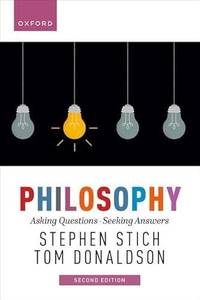
Donaldson, Thomas, PHD (, Simon Fraser University)
Philosophy 2e
Paperback / softback. New. New Book; Fast Shipping from UK; Not signed; Not First Edition; An exceptionally clear compact and affordable guide to the fundamental questions-and answers-of Philosophy. paperback
Riferimento per il libraio : ria9780197768013_inp ISBN : 0197768016 9780197768013
|
|
|
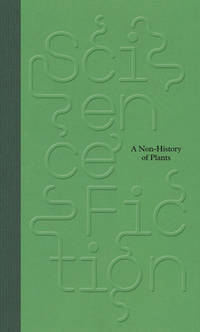
Aloi, Giovanni (Author)/ Aresheva, Victoria (Author)/ Bacquet, Emmanuel (Author)/ Baker, Simon (Author)/ Hoffmann, Felix (Author
Science/ Fiction: A Non-History of Plants /anglais
SPECTOR BOOKS 2025. Hardcover. New. 216 pages. 9.25x6.00x9.17 inches. SPECTOR BOOKS hardcover
Riferimento per il libraio : __3959058586 ISBN : 3959058586 9783959058582
|
|
|
Butt, Simon (University of Sydney, Australia)
Corruption and Law in Indonesia
Paperback / softback. New. New Book; Fast Shipping from UK; Not signed; Not First Edition; Indonesia has transformed from one of South East Asias most repressive and centralised political systems to its most decentralised and democratic. Despite this obstacles still remain that hinder Indonesia achieving the rule of law� paperback
Riferimento per il libraio : ria9781138102965_inp ISBN : 1138102962 9781138102965

|
|
|
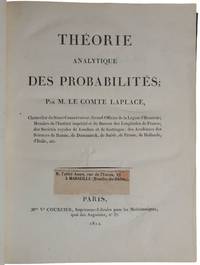
LAPLACE, Pierre Simon, Marquis de
Théorie Analytique des Probabilités. Paris: Courcier 1812. With: Supplément a la Théorie Analytique des Probabilités Paris: Courcier n.d. 1816; Deuxième Supplément . n.p. February 1818; Troisième Supplément . Paris: Courcier n.d. 1819; Quatrième Supplément . Paris: Huzard-Courcier n.d. 1825
Paris: Courcier; Huzard-Courcier 1825. First edition. <p>First edition very rare complete with all four supplements the fourth being especially scarce of what Anders Hald called "the most influential book on probability and statistics ever written." John Herschel praised it as "the ne plus ultra of mathematical skill and power." In this landmark work Laplace gave probability and statistics their first comprehensive theoretical foundation shaping the field for over a century. The supplements-composed between 1816 and 1825-extend its applications to natural philosophy and geodesy. No copy with all four supplements appears in RBH; even the Honeyman copy lacked the last three. This is the finest copy we have encountered. Provenance: Barthélémy Aoust 1814-1885 French mathematician and professor at Marseille.</p>. The Most Influential Book on Probability and Statistics Ever Written. <p>First edition very rare - especially when accompanied as here by all four supplements the fourth of which is of extreme rarity - of the most influential work on probability and mathematical statistics ever written. Pierre-Simon Laplace's Théorie analytique des probabilités published at Paris by Veuve Courcier in 1812 codified into a single mathematical framework the principal results of probability theory from Jakob Bernoulli's Ars Conjectandi of 1713 through Laplace's own four decades of research and established the analytical methods - generating functions characteristic functions asymptotic approximations the method of least squares the central limit theorem - that governed the subject for the next century and beyond. John Herschel called it 'the ne plus ultra of mathematical skill and power'. The DSB observes that it came to have the same relation to the later development of probability that Newton's Principia had to the later science of mechanics. This is the finest copy we have seen. RBH lists no copy with all four supplements and only two copies with the first three Gonnelli 2024 €35280; Sotheby's 2007 $25000; the Honeyman copy had only the first supplement.</p> <br /> <br /> <p>The work emerged from a long series of memoirs. Laplace had been publishing on probability since the early 1770s but the results were scattered across the publications of the Académie Royale des Sciences and the Institut de France and no single treatise had brought them together. The Théorie analytique is that treatise and Laplace's introduction to the first edition - eliminated in the second and third editions in favour of the Essai philosophique - sets out the programme in his own terms: he is concerned he writes to determine the probability of causes and results as exhibited in events that occur in large numbers and to investigate the laws according to which that probability approaches a limit in proportion to the repetition of events. The investigation he adds will benefit observers in identifying the mean to be chosen among the results of their observations and the probability of errors still to be apprehended and it will interest philosophers in showing how there is a regularity underlying the very things that seem to pertain entirely to chance. He closes by noting that the same analysis can in principle be applied to annuities tontines insurance inoculation with vaccine and the decisions of electoral assemblies. He never wrote the separate work on civil applications he here promises but the thought of it may have been what led him to expand his old École Normale lecture into the Essai philosophique sur les probabilités two years later - the non-mathematical companion that contains the celebrated passage on Laplace's demon and the philosophical argument that probability is the rational response to ignorance not a measure of it.</p> <br /> <br /> <p>Book I subtitled Calcul des fonctions génératrices develops the algebraic machinery of the treatise. Generating functions - power series whose coefficients encode the probabilities of interest - transform combinatorial and probabilistic problems into problems of analysis making them accessible to the methods of the calculus. The first part presents the theory of generating functions as a branch of the calculus of finite differences; the second develops the method of approximating by definite integrals the values of expressions containing very large numbers the technique that yields the asymptotic formulas on which all the practical results of the later chapters depend. Laplace traces the historical lineage of these methods through Lagrange Leibniz Newton and Wallis back to Descartes's invention of numerical exponents situating his own work as the natural continuation of two centuries of analytical development. The most important revision from his earlier memoirs of the 1780s is the omission of material on partial differential equations that was relevant to physics but not to games of chance and a correspondingly greater emphasis on the passage from finite to infinitesimal quantities and from real to imaginary complex numbers - two processes that Laplace found increasingly fertile as his command of the subject deepened.</p> <br /> <br /> <p>Book II Théorie générale des probabilités constitutes the subject. It is more than a republication of earlier memoirs: Laplace drew together the main types of problems from the theory of chance already treated by many mathematicians in a somewhat haphazard manner and re-handled them in tandem with problems from the new areas of application in the philosophy of science astronomy geodesy instrumentation error population and the procedures of judicial panels and electoral bodies. The first chapter lays down the general principles: the definition of probability the rule for multiplying the probabilities of independent events and a verbal statement of Laplace's theorem on the probability of causes inverse probability now called Bayesian inference - still without mentioning Bayes by name. Chapter 2 the most considerable occupying about a quarter of Book II treats the probability of compound events: lotteries Laplace adduces the French national lottery with its ninety numbers drawn five at a time the extraction of balls from urns order and sequence in the retrieval of numbered objects the division of stakes and the ruin or survival of a gambler - the classical problems of the subject now solved systematically by generating functions and arranged not for their own sake but to illustrate a typology of problems in probability at large.</p> <br /> <br /> <p>Chapter 3 concerns the laws that result from the indefinite multiplication of events. It contains Laplace's most general statement of the central limit theorem: that when the number of independent observations increases the distribution of their mean tends toward a Gaussian form regardless of the distribution of the individual observations and that the limits within which the mean will fall with a given probability grow closer together as the number of observations grows. The theorem is the mathematical foundation of modern statistics; it explains why the bell curve appears ubiquitously in nature and why averaging works. Laplace illustrates the theorem from birth records - the ratio of boys to girls taken from the registries of Paris London and Naples provides empirical figures for the prior probabilities that the theory then subjects to analysis.</p> <br /> <br /> <p>Chapter 4 on the probability of error represents the most significant development in the subject as a whole compared to Laplace's earlier memoirs. It derives the least-squares law for combining observations - the method that Legendre had published in 1805 and that Gauss had claimed priority for - first for the case of a single unknown element and then for two or more together with the probability that the resulting estimate will fall within given limits. The chapter includes instructions on the application of the analysis to the correction of astronomical tables and closes with a historical sketch in which Laplace renders Legendre and Gauss each his due in the development of the method.</p> <br /> <br /> <p>Chapter 5 applies probability to the investigation of phenomena themselves - to establishing the physical significance of data amid the complexities of the world. The principal example is the daily variation of the barometric pressure which long observation shows to be normally highest at nine in the morning and lowest at four in the afternoon. Laplace calculates the probability that this diurnal pattern is due to a regular cause the action of the sun rather than to chance and determines its mean extent. He raises the further question of atmospheric tides as a second contributing cause - a question he could not then resolve for lack of data but which became the subject of the last calculation he ever performed. The chapter closes with an application of probability to Buffon's needle problem - the probability that a needle tossed onto a grid of parallel lines will cross a line a problem Laplace adapts to a statistical method for approximating the value of π. Chapter 6 reworks Laplace's early memoir on the probability of causes applying inverse probability and the method of definite-integral approximation to population statistics; he now has figures from the partial census which at his request the French government had conducted in 1801.</p> <br /> <br /> <p>The brief seventh chapter returns to the effect of unequal prior probabilities mistakenly assumed to be equal - a finding Laplace always considered among his most important since it demonstrated the care required when mathematical calculations are applied to physical events. There are he insists no perfect symmetries in the real world and allowance must be made for slight deviations of parameters from assumed values. Chapters 8 through 10 treat life expectancy annuities tontines insurance the effect of vaccination on the death rate Laplace concludes that the eradication of smallpox would increase life expectancy by three years provided the resulting population growth did not outrun the food supply and moral expectation - Daniel Bernoulli's principle that the prospective benefit of a gain is not its absolute amount but its ratio to the total wealth of the beneficiary. Laplace adopts the principle as a guide to prudent conduct and concludes that in the most mathematically advantageous games of chance the odds are always unfavourable over time and that diversification is a prudent practice in the investment of wealth.</p> <br /> <br /> <p>The four supplements issued between 1816 and 1825 extend the theory into applied territory. The first 1816 applies inverse probability to the analysis of criminal proceedings - Laplace calculates the probability that a conviction is erroneous given assumptions about the truthfulness of jurors and concludes that the English jury system with its requirement for unanimity weights the odds too heavily against the security of society while the French criminal code with its plurality rule across two courts is unjust to the accused. The second 1818 turns to geodesy comparing Laplace's method of combining equations of condition with the method of Boskovic; Stigler considers this discussion the earliest instance of a rigorous comparison of two well-elaborated methods of estimation for a general population strikingly similar to the analysis that led R. A. Fisher to the concept of sufficiency in 1920. The third 1819 applies the method to the extension of the Delambre-Méchain survey of the meridian from Perpignan to Formentera; Laplace estimates the law of error on the basis of all 700 triangles in the original survey and calculates the probabilities of error in the resulting length of the meridian. The fourth 1825 the rarest generalises the Problem of Points using the method of generating functions and includes corrections to earlier results in the main text.</p> <br /> <br /> <p>The bibliographical context of the supplements compounds the difficulty of assembling a complete set. Each was issued separately by Veuve Courcier and her successor Huzard-Courcier in print runs of unknown but evidently small size and the four were never gathered together as a single bound publication during the early nineteenth century. Copies that left the publishing house with the supplements bound in were assembled by the binder copy by copy from sheets purchased separately; copies sold without binding rarely retain the supplements at all since these were slim pamphlets without the binding of their parent and easily separated from it. The fourth supplement of 1825 the rarest of the four was issued only two years before Laplace's death in 1827 and saw no further reprinting in the parent author's lifetime; it is the supplement most often missing from copies offered for sale. RBH records no copy of the work with all four supplements; the two copies recently in commerce with the first three lack the fourth and the Honeyman copy lacked the second third and fourth. The probability of all four reaching a single contemporary owner surviving together through two centuries of binding rebinding and dispersal and arriving intact in a single contemporary cloth was in any literal sense vanishingly small.</p> <br /> <br /> <p>Laplace's analytical apparatus passed quickly into general use after his death. Adolphe Quetelet the Belgian astronomer and statistician who had visited Laplace in Paris in the 1820s applied the central limit theorem to social phenomena in his Sur l'homme of 1835 founding what he called physique sociale - the systematic statistical study of human populations. Francis Galton in the 1880s adapted Laplace's framework to the study of inheritance defining regression to the mean and the correlation coefficient. Karl Pearson at University College London working from Galton formalised the chi-squared test in 1900 and established the moment-generating function Laplace's generating function under another name as the standard apparatus of the new mathematical statistics. R. A. Fisher's 1922 paper On the Mathematical Foundations of Theoretical Statistics introduced the concepts of likelihood and sufficiency that defined the modern subject; Stephen Stigler's 1986 study of the history of statistics observes that Fisher's argument on sufficiency closely parallels the comparison Laplace had drawn in the second supplement of 1818 between his own method of combining equations of condition and that of Boskovic. Through Quetelet Galton Pearson and Fisher the analytical framework of the Théorie analytique survived intact into the twentieth century and it continues to underlie every confidence interval hypothesis test and regression analysis performed in any field that depends on quantitative inference. The hidden continuity is part of what Laplace meant when he wrote in the introduction here suppressed that probability furnishes a regularity to the very things that seem to belong to chance.</p> <br /> <br /> <p>Pierre-Simon Laplace 1749-1827 the son of a cider-farmer in Normandy arrived in Paris in 1769 and within a decade had established himself as the foremost mathematical astronomer in Europe. His Mécanique céleste 1799-1825 is the most important work in mathematical astronomy since the Principia; the Théorie analytique des probabilités holds the same position in its own field. Between them the two works secured his reputation as - in the phrase that has clung to him since his own century - the Newton of France. He served Napoleon as Minister of the Interior for six weeks in 1799 Napoleon dismissing him observed that he had brought the spirit of the infinitely small into the work of government; he was elected to the Académie française in 1816 made a count of the Empire under Napoleon in 1806 and elevated to the rank of marquis at the Bourbon Restoration in 1817. He died at Paris on 5 March 1827 on the eve of the issue of the fifth volume of the Mécanique céleste which his son Charles-Émile saw through the press in his name. The 1812 Théorie analytique was the keystone of his late career and the work that consolidated mathematics as the apparatus of a quantitative science of human and natural events.</p> <br /> <br /> <p>Provenance: Barthélémy Aoust 1814-1885 French mathematician professor in the Faculty of Sciences at the University of Marseille from 1854 until his retirement. Aoust's research interests centred on differential geometry and on the analysis of curves and surfaces - questions distant enough from probability theory for the present volume to have functioned in his library as a reference work rather than a working text and the absence of marginalia in his hand suggests as much. His contemporary printed address label pasted to the title page in the early 1850s when he established himself at Marseille places this copy among the books he assembled for his teaching there and identifies it as part of his personal library.</p> <br /> <br /> <p>References: DSB XV 367-376 - Evans 12 - Grolier/Horblit 63a - Honeyman 1923 - Printing and the Mind of Man 252 - Stigler ch. 24 in Grattan-Guinness ed. Landmark Writings in Western Mathematics 1640-1940 2005 - Hald A History of Mathematical Statistics from 1750 to 1930 1998 - Stigler The History of Statistics: The Measurement of Uncertainty before 1900 Harvard 1986.</p> <br /> <br/> <br/> <br /> <p>Five parts bound in one vol. 4to 253 × 194 mm pp. vi 464 2: errata and blank; 34; 50; 36; 2 28. Contemporary green half-cloth over green marbled boards spine with raised bands compartments ruled in gilt and decorated in blind with a gilt lettering-piece top edges yellow-speckled spine very slightly rubbed small paper label at tail. A fresh well-margined copy internally clean.</p> . Courcier; Huzard-Courcier unknown
Riferimento per il libraio : 6347
|
|
|
Hudson, Simon (Author)/ Hudson, Louise (Author)
Customer Service for Hospitality and Tourism
Goodfellow Publishers Limited 2025. Paperback. New. 352 pages. 10.00x7.00x2.70 inches. Goodfellow Publishers Limited paperback
Riferimento per il libraio : __1917433107 ISBN : 1917433107 9781917433105

|
|
|
Rovelli, Carlo; Erica Segre and Simon Carnell [Translators]
There Are Places in the World Where Rules Are Less Important Than Kindness
London: Allen Lane / Penguin Random House UK 2020 First printing of the first English edition. Signed by Carlo Rovelli directly on the title-page. Faint sticker ghost to front cover else book in fine as new condition. Issued without a dust jacket. Allen Lane / Penguin Random House UK hardcover
Riferimento per il libraio : 023512 ISBN : 0241454689 9780241454688

|
|
|
Scarrow, Simon
El Aguila del Imperio
Edhasa 2002. Paperback. New. 360 pages. Spanish language. 8.98x6.06x1.18 inches. Edhasa paperback
Riferimento per il libraio : 2-8435060411 ISBN : 8435060411 9788435060417

|
|
|
Cooke, Simon (Author)
Illustrating the Victorian Supernatural
MJ – Ohio University Press 2025. Hardcover. New. 304 pages. 9.01x6.01x9.02 inches. MJ – Ohio University Press hardcover
Riferimento per il libraio : __0821426524 ISBN : 0821426524 9780821426524

|
|
|
Simon Karlinsky
Marina Tsvetaeva: The Woman her World and her Poetry Cambridge Studies in Russian Literature
Cambridge University Press 1986. Hardcover. Good. Former library book. Different cover. Edition 1986. Ammareal gives back up to 15% of this item's net price to charity organizations. Cambridge University Press hardcover
Riferimento per il libraio : G-668-015 ISBN : 0521255821 9780521255820
|
|
|
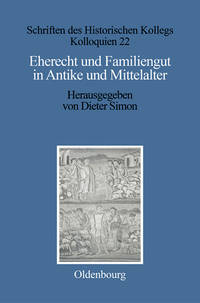
Simon, Dieter
Eherecht und Familiengut in Antike und Mittelalter Schriften des Historischen Kollegs 22 German Edition
Walter de Gruyter Inc 1992-03-24. Reprint 2015. hardcover. New. 6.14x0.50x9.21. Buy with confidence. Excellent Customer Service & Return policy. Walter de Gruyter, Inc hardcover
Riferimento per il libraio : DADAX3486558854 ISBN : 3486558854 9783486558852
|
|
|
Simon, Thomas
Eine Osterreichische Verfassungsgeschichte: Vom Vielvolkerreich Zur Zweiten Republik
Bohlau Verlag Gmbh U Co Kg 2025. Hardcover. New. German language. 9.45x6.65x9.61 inches. Bohlau Verlag Gmbh U Co Kg hardcover
Riferimento per il libraio : __3205223004 ISBN : 3205223004 9783205223009
|
|
|
Becker, Simon (Author)/ Wiebrecht, Axel (Author)/ Englert, Stefan (Author)
Fokus Chinesische Medizin: Was wir in der Praxis wirklich wissen müssen
Systemische Medizin AG 2026. Paperback. New. German language. 10.83x7.91x2.76 inches. Systemische Medizin AG paperback
Riferimento per il libraio : __3864010136 ISBN : 3864010136 9783864010132
|
|
|
murphy, simon
THE MURDERS OF MUTCHROSE VILLAGE
paperback. Good. Access codes and supplements are not guaranteed with used items. May be an ex-library book. paperback
Riferimento per il libraio : 0595293743.G ISBN : 0595293743 9780595293742

|
|
|
Joseph Gabet, Simon Leys et Congregatio pro Gentium Evangelizatione Eglise catholique
Les missions catholiques en Chine en 1846.
Valmonde 1999. Hardcover. Good. Edition 1999. Ammareal gives back up to 15% of this item's net price to charity organizations. Valmonde hardcover
Riferimento per il libraio : I-390-628 ISBN : 2864010933 9782864010937
|
|
|
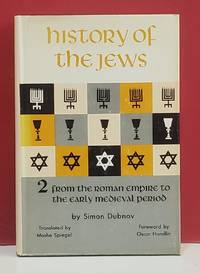
Simon Dubnov, Moshe Spiegel (Transl)
History of the Jews Volume 2: From the Roman Empire to the Early Medieval Period
Thomas Yoseloff 1968. Hardcover. Very good/Very good. Vol. 2 only.<br /> <br /> Very good condition. Book is sharp. Jacket spine is faded but readability is not impacted. Top edge of jacket has one inch tear. Binding is tight. Pages are clean and unmarked. Thomas Yoseloff hardcover
Riferimento per il libraio : 1156909
|
|
|
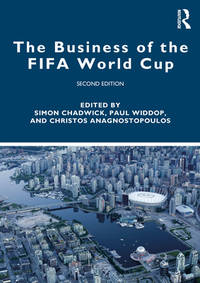
Simon Chadwick
The Business of the FIFA World Cup
Paperback / softback. New. <p>Now in a fully revised and updated new edition this book offers expert insight into the business and management of the FIFA World Cup arguably the biggest sporting event in the world.</p> paperback
Riferimento per il libraio : B9781041170259 ISBN : 1041170254 9781041170259
|
|
|
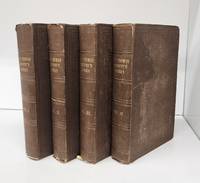
BROWNE, Sir Thomas; WILKIN, Simon (ed)
Sir Thomas Browne's Works Including His Life and Correspondence 4 vols.
London: William Pickering 1836. Hardcover. Good. 4 vols.: 471; xxxii 538; viii 505; xvi 546 p. 23 cm. Vol. I has frontispiece portrait and three genealogical charts. Vol. II has fold-out facsimile page. Vol. III has funerary monument as frontispiece. Vol. IV has frontispiece plan and armorial chart. Brown cloth with blank impressing. Corners bumped tears in spine ends. Some rubbing or discolouration to cloth. Ink signatures on prelims and title pages. Pencil notes on endpapers and some margins. Foxing. A few pages have rough edges. Vol. 4 frontispiece has dampstained edges. <br/><br/>Browne was a 17th-century English polymath and physician. His writings span science religion and the esoteric blending scientific inquiry with philosophical meditations on mortality. William Pickering hardcover
Riferimento per il libraio : 160130
|
|
|
Jones, Hackney And
How To Write A Paranormal Short Story: Plan and publish incredible supernatural stories FAST using simple templates plotting tools and fun exercises How to Write a Short Story
paperback. Good. Access codes and supplements are not guaranteed with used items. May be an ex-library book. paperback
Riferimento per il libraio : 1916909256.G ISBN : 1916909256 9781916909250

|
|
|
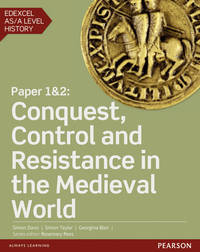
Blair, Georgina (Author)/ Davis, Simon (Author)/ Taylor, Simon (Author)
Edexcel AS/A Level History Paper 1&2: Conquest control and resistance in the medieval world Student Book ActiveBook
Pearson Education 2015. Paperback. New. 1st edition. 10.83x8.66x1.02 inches. Pearson Education paperback
Riferimento per il libraio : __1447985281 ISBN : 1447985281 9781447985280
|
|
|
Scarrow,Simon (Signed Copy)
Centurion Signed Limited Edition Number 11 of 50 Copies
London: Headline. This is a Fine Copy of this Book in brown cloth boards with bright gilt title lettering to spine in a Fine Dust-Jacketwith no chips or tears to the outer edges of the dust-Jacket.Not Price clipped with £12.99 showing to the front inner flap.This copy has No previous names or inscriptions present but has been SIGNED by the Author Simon Scarrow on the Title Page and it's a Limited Edition of just 50 copies with this one numbered number 11.There is the uncommon Scarrow Brothers stamp to the title page also.The book has a firm binding with no hinge weakness and with no leaning to spine.Lovely clean crisp white page edges.Great copy for the collector as they do not get any better than this in terms of condition.I assume that this Limited Edition was added to the publication or print run of the 2nd Impression.This is book 8 in the Eagles of the Empire Series continuing Marco and Cato's adventures in the Eastern provinces of the Roman Empire.8vo 358pp Signed Limited Edition 11 of 50 Copies 2007 . Fine. Hardcover. Limited Edition. 2007. Headline hardcover
Riferimento per il libraio : 77938 ISBN : 0755327764 9780755327768

|
|
|
Scarrow,Simon
The Gladiator Signed Copy with Additional Story Waterstone's Exclusive Edition
London: Headline. This is a Fine Copy of this Book in blue cloth boards with bright gilt title lettering to spine in a Fine Dust-Jacketwith no chips or tears to the outer edges of the dust-Jacket.Appears Unread Not Price clipped with £17.99 showing to the front inner flap.This copy has been flat SIGNED by the Author Simon Scarrow at Waterstone's.The book has a firm binding with no hinge weakness and with no leaning to spine.Great copy for the collector.This is the Waterstone's Exclusive Edition that features an Additional story that features a Young Cato.Signed by Author and Exclusive Waterstone's Edition stickers to the front cover.8vo 370pp First UK Edition 1st Impression 2009 . Fine. Hardcover. First Edition. 1st Printing. 2009. Headline hardcover
Riferimento per il libraio : 77931 ISBN : 0755327780 9780755327782

|
|
|
Scarrow,Simon (Signed Copy)
Centurion Exclusive Edition With Extrra Story From Macro's Early Years
London: Headline. This is a Fine Copy of this Book in brown cloth boards with bright gilt title lettering to spine in a Fine Dust-Jacketwith no chips or tears to the outer edges of the dust-Jacket.Not Price clipped with £12.99 showing to the front inner flap.This copy has No previous names or inscriptions present but has been SIGNED by the Author Simon Scarrow on the Title Page.The book has a firm binding with no hinge weakness and with no leaning to spine.Uncommon Exclusive to Waterstone's Edition with added story8vo 358pp First UK Edition 1st Impression 2007 . Fine. Hardcover. First Edition. 1st Printing. 2007. Headline hardcover
Riferimento per il libraio : 77867 ISBN : 0755327764 9780755327768

|
|
|
SCARROW SIMON
BRITANIA
Edhasa 2016. Hardcover. New. Spanish language. 9.21x5.98x1.34 inches. Edhasa hardcover
Riferimento per il libraio : 2-843506302X ISBN : 843506302X 9788435063029

|
|
|
Fuentes Navarro, Simon Pedro
Mi primer libro de karate
Murillo Saif Audiovisual y Ediciones S.L. 2017. Hardcover. New. 1st edition. Spanish language. 11.65x8.11x0.39 inches. Murillo Saif, Audiovisual y Ediciones S.L. hardcover
Riferimento per il libraio : 2-8494025279 ISBN : 8494025279 9788494025273
|
|
|
Ernst, Edzard/ Singh, Simon
¿Truco o tratamiento
Capitán Swing Libros S.L. 2018. Paperback. New. 56 pages. Spanish language. 8.66x5.59x0.79 inches. Capitán Swing Libros S.L. paperback
Riferimento per il libraio : 2-8494871056 ISBN : 8494871056 9788494871054
|
|
|
Ted Simon
Los sueños de Júpiter
Interfolio S. L. 2012. Perfect Paperback. New. Spanish language. 7.80x5.35x1.57 inches. Interfolio, S. L. paperback
Riferimento per il libraio : 2-8493769452 ISBN : 8493769452 9788493769451

|
|
|
Collier, Simon / Sater, William F
HISTORIA DE CHILE 1808-2017
EDICIONES AKAL 1900. Paperback. New. Spanish language. 8.50x5.51x1.18 inches. EDICIONES AKAL paperback
Riferimento per il libraio : 2-8446045303 ISBN : 8446045303 9788446045304
|
|
|
BURGOS JULIAN, FRANCISCO ALFONSO / CEBOLLA MARTI, AUSIAS / GARCIA CAMPAYO, JOSE JAVIER / SIMON PEREZ, VICENTE / PIVA DEMARZO, MA
Mindfulness: fundamentos y aplicaciones
Ediciones Paraninfo S.A 2018. Paperback. New. 352 pages. Spanish language. 9.45x6.69x0.87 inches. Ediciones Paraninfo, S.A paperback
Riferimento per il libraio : 2-8428338469 ISBN : 8428338469 9788428338462
|
|
|
Scarrow, Simon
13 Hermanos de sangre
Edhasa 1900. Hardcover. New. Spanish language. 9.29x6.14x1.42 inches. Edhasa hardcover
Riferimento per il libraio : 2-8435062899 ISBN : 8435062899 9788435062893
|
|
|
Simon, David/ Burns, Ed
La esquina/ The Corner: A Year in the Life of an Inner-city Neighborhood
Principal De Los Libros 2011. Paperback. New. translation edition. 688 pages. Spanish language. 9.06x5.98x2.20 inches. Principal De Los Libros paperback
Riferimento per il libraio : 2-8493859478 ISBN : 8493859478 9788493859473

|
|
|
Scarrow, Simon
Corazones de piedra
Editora Y Distribuidora Hispano Americana S.a. Edhasa 2016. Hardcover. New. Spanish language. 9.25x6.30x1.57 inches. Editora Y Distribuidora Hispano Americana, S.a. (Edhasa) hardcover
Riferimento per il libraio : 2-8435063003 ISBN : 8435063003 9788435063005

|
|
|
Keeling, Stephen/ Foster, Simon
TAIWAN - TAIWAN
Feltrinelli 2016. Paperback. New. Italian language. 7.80x5.12x0.87 inches. Feltrinelli paperback
Riferimento per il libraio : 2-8807713535 ISBN : 8807713535 9788807713538
|
|
|
Lewis, Simon L/ Maslin, Mark
Il pianeta umano
Einaudi 2019. Paperback. New. Italian language. 8.58x5.67x1.34 inches. Einaudi paperback
Riferimento per il libraio : 2-8806239732 ISBN : 8806239732 9788806239732
|
|
|
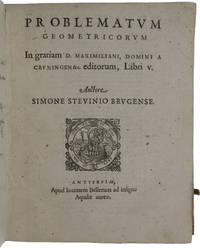
STEVIN, Simon
Problematum geometricorum . libri V.
Antwerp: Jean Bellère 1583. First edition. <p>First edition very rare of the principal geometrical work by Stevin "perhaps the most original man of science of the second half of the sixteenth century" Sarton; this highly original work is his only publication in Latin and his second-published work after the Tables of Interest. "He was involved in geometry algebra arithmetic pioneering a system of decimals dynamics and statics almost all branches of engineering and the theory of music" Kemp.</p>. HIS PRINCIPAL WORK IN GEOMETRY. <p>First edition very rare of the principal geometrical work by Stevin "perhaps the most original man of science of the second half of the sixteenth century" Sarton p. 242; this highly original work is his only publication in Latin and his second-published work after the Tables of Interest. "He was involved in geometry algebra arithmetic pioneering a system of decimals dynamics and statics almost all branches of engineering and the theory of music" Kemp p. 113. "Stevin unconditionally supported the Copernican system several years before Galileo and at a time when few other scientists could bring themselves to do likewise" DSB XIII: 48. "Not the least important part of Stevin's geometrical work is formed by his study of the convex semi-regular polyhedral of the first species i.e. convex polyhedra whose faces are regular polygons not all equal and similar to each other while the solid angles at the vertices are equal and similar to each other without being regular . Besides the regular polyhedra and the semi-regular polyhedra of the first species in the Problemata geometrica Stevin deals with the five so-called augmented polyhedra which are produced if on each of the faces of a regular polyhedron as base is erected a regular pyramid whose slant edges are equal to the edges of the base" Dijksterhuis pp. 43-45. "Stevin was among the first Renaissance men to study Archimedes with a certain amount of independence. In the Problemata he took some problems he had found in Archimedes' On the Sphere and Cylinder and generalized them somewhat; this gave him an opportunity to apply the methods given by Eutocius for the construction of the two mean proportionals between two lines: a : x = x : y = y : b a problem which cannot be solved by means of compass and straightedge alone" Works IIa pp. 6-7. The work is divided into five books: "Book I. Division of polygons a by a line passing through a point of the perimeter or b by a parallel to one of the sides. Book II. Application of the regula falsi to mensurations. Book III. Regular polyhedra and semi-regular polyhedra which can be inscribed in a sphere. Book IV. Construction of a solid similar to another and equal in volume to a third. Book V. Construction of a solid similar to two others and equal in volume to their sum or difference" Sarton pp. 248-249. ABPC/RBH list only two copies since Honeyman both in modern bindings.</p> <br /> <p>"Stevin's contributions to geometry illustrate the fundamental position of Euclid's Elements in the work of sixteenth-century mathematicians. The Elements were their main source of reference to which they constantly returned for knowledge method and inspiration. The typically 'Greek' reasoning of Euclid which was also basic to the demonstrations of Apollonius and Archimedes geometrical to the core was an essential element in the mathematical thinking of sixteenth-century Europe.</p> <br /> <p>"This Greek influence was gradually undermined by the adaptation of the arithmetical-algebraic methods traditional in the Orient which reached Europe almost entirely through authors originally writing in the Arabic language. Stevin's Tables of Interest present a good example of how the practice of life itself compelled mathematicians to become proficient in these methods. On a higher theoretical level we see the same influence at work in Stevin's Arithmétique. Even the Problemata Geometrica though fundamentally a series of papers based on the 'Greek' approach shows the influence of the Arabic tradition in several places.</p> <br /> <p>"Several printed editions of the Elements existed in Stevin's days. One of Stevin's favourites was the Latin edition by Clavius the Jesuit astronomer at the Vatican. It was a thorough piece of work first published in 1574 consisting of two volumes in a rather handy quarto size. It had the advantage of introducing the reader to related work by other mathematicians explained in Scholia to the text. Other books used by Stevin in preparing his Problemata were Dürer's Underweysung of 1525 and Commandinus' Latin edition of the principal works of Archimedes of 1558.</p> <br /> <p>"The Problemata consists of five books each with a topic of its own. The first book after an introduction on proportions of lines solves problems concerning the division of polygons into parts of a given ratio. The second book contains the application of the so-called regula falsi to certain constructions or in other words shows how certain constructions can be performed with the aid of similarity of figures. In the third book we find Stevin's studies on regular and semi-regular polyhedra. The fourth book deals with the construction of a polyhedron of a given volume similar to a given polyhedron the fifth book with the construction of a polyhedron similar to two similar polyhedra and equal to either their sum or their difference. While the first and second books are based on Euclid the third is based on Dürer; the last two are the result of Stevin's study of Archimedes.</p> <br /> <p>"The first book opens with a classification of ratios and proportions based on the fifth book of Euclid's Elements. This classification in its attempt to give special names to particular proportions strikes us as clumsy and pedantic but Stevin merely followed an ancient tradition. All this labelling was fundamentally due to a serious desire to understand Euclid though it was encumbered with relics from the works of medieval Latinists .</p> <br /> <p>"The next part consists of the application of this theory of proportions to the problem of the division of figures into parts of a given ratio. Stevin found an example of this problem in an appendix by Clavius to the 6th book of the Elements where it is shown how to divide a triangle into two parts in a given ratio by a line passing through a point on a side. This was not however an original idea of Clavius. As he sets forth himself in the Prolegomena to his translation he found the problem in a book published by Commandinus and John Dee in 1570 which he says though ascribed to a certain Mahomed of Bagdad may have been Euclid's book on Divisions. Stevin who did not know this book took Clavius' problem and discussed aspects of it in his first set of three problems. Then he himself added five more problems which he thought to be novel. All eight problems deal with the division of polygons in a given ratio either by a line through a vertex or by a line through a point on a side or by a line parallel to a side . Stevin's work was excellent enough to be preferred by Clavius who in 1604 praised his treatment of the division of figures above the others .</p> <br /> <p>"The second book of the Problemata contains problems involving the so-called 'regula falsi' the rule of the false supposition. It is a device to solve problems leading to the linear equation ax = b by first substituting for x an arbitrary number x = x0; if ax0 = b0 then x : x0 = b : b0and x is found by means of proportion . The device also functions for problems which lead to an equation of the form ax b = c . In the Problemata Stevin introduces this 'regula falsi' in accordance with his desire to bring about as close a relation as possible between arithmetical and geometrical proportions. Applying the 'regula falsi' to problems in geometry he has to consider proportions and this amounts to the solution of certain geometrical problems by means of similarity. If for instance Ex. 11 we have to construct a square when the difference between diagonal and side is given we start with any square this is the false supposition determine for this square the difference between diagonal and side and then find the side of the required square by means of a proportion. All that Stevin now requires is Euclid's theory of proportions which he finds in Books V and VI of the Elements. </p> <br /> <p>"The third book is by far the most interesting part of the Problemata. It contains a theory not only of the regular solids but also of certain semi-regular solids and of polyhedra Stevin calls 'augmented regular solids'. All Stevin had to go by was Euclid's Elements Book XIII the so-called XIVth XVth and XVIth books which Clavius also had translated and Dürer's Underweysung der Rechnung mit dem Zirckel und Richtscheyt of 1525. From Euclid-Clavius Stevin obtained his information on the five regular solids from Dürer the method of obtaining semi-regular solids as well as the regular ones by paper-folding. To understand these different achievements we shall denote a polyhedron with m faces which are regular polygons of a sides n faces which are regular polygons of b sides etc. by ma nb . Then the five regular solids are the tetrahedron 43 the cube 64 octahedron 83 the dodecahedron 125 and the icosahedron 203. A semi-regular solid or as Stevin calls it a 'truncated regular solid' is defined Def. 11 as a solid inscribed in a sphere of which all the solid angles are equal of which the faces are regular polygons which are not all congruent and of which all the edges are equal. Dürer had the models of seven such solids: 43 46 83 68 64 83 86 64 184 83 64 326 68 86 124. Dürer had two more models but one of these 64 123 has some isosceles i.e. not regular triangles while the other 612 323 as Stevin showed is impossible as a closed polyhedron.</p> <br /> <p>"Stevin reconstructed these solids not only from plane diagrams by folding but also by finding the method by which these solids are generated by cutting off truncating parts of the regular solids. He found three types not described by Dürer . the additional solids 203 125 1210 203 and 206 125. He was one of the first if not the first in Renaissance days to find all these ten .</p> <br /> <p>"The third book of the Problemata also contains a description of what Stevin called 'augmented regular solids'. These are polyhedra obtained by placing on top of each face of a regular polyhedron as base a pyramid with equal edges. Stevin lists all five of them. He was led to the consideration of these solids by a discovery of Frans Cophart leader of the Collegium Musicum at Leiden. Cophart had taken a cube and cut out twelve tetrahedra each having the end points of an edge and the midpoints of the faces through this edge as vertices. The solid thus obtained by 'faceting' the cube is what is now called the stella octangula; it is bounded by twenty-four congruent equilateral triangles. Cophart had claimed it as a sixth regular solid.</p> <br /> <p>"Stevin while admiring the discovery had to deny this claim. He pointed out that the vertices of Cophart's solid do not all lie on one sphere but are distributed on two spheres six on one sphere and eight on a concentric one. At the same time he discovered another construction of the solid by starting not from a cube and then faceting it but from an octahedron and then 'augmenting' it by placing a regular tetrahedron on each face with this face as base. He now saw that this procedure could be applied to all regular bodies and in this way he obtained four new polyhedra.</p> <br /> <p>"Of all these five solids of Stevin we only call the stella octangula a regular star-polyhedron. The reason is that regular star-polyhedra are obtained from the regular polyhedra by the process of 'stellating' i.e. by producing the planes of the faces and allowing non-adjacent faces to intersect in such a way that the faces of the new solid are regular star-polygons polygons obtained by allowing non-adjacent sides of regular polygons to intersect. This procedure does not yield a new body in the case of the regular tetrahedron and the cube but gives us the stella octangula in the case of the regular octahedron. We also obtain regular star-polyhedra by stellating the regular dodecahedron and icosahedron; for each of these solids we obtain two possible star-polyhedra. But whereas these four bodies are single the stella octangula is found to be the intersection of two regular tetrahedra. We may thus speak of nine regular solids: five ordinary Platonic and four stellated ones .</p> <br /> <p>"The fourth and fifth books of the Problemata Geometrica present Stevin to us as a student of Archimedes. The editio princeps of Archimedes' works had appeared at Basle in 1544; it contained not only the original Greek text and a Latin translation but also the precious commentaries of Eutocius again both in Greek and in Latin. Another useful though limited edition was the Latin translation of five of Archimedes' treatises with Eutocius' commentary on one of them prepared by Commandinus and published in 1558. Stevin quotes Commandinus' edition but he must also have known the editio princeps since he shows himself to be acquainted with material which is to be found in the publication of 1544 but not in that of 1558.</p> <br /> <p>"Archimedes in the book On the Sphere and Cylinder the book in which he determines the area and the volume of the sphere solves some problems which involve the finding of the two mean proportionals between two given lines. An example is formed by the problem: 'given two spherical segments to find a third segment similar to the one and having its volume equal to that of the other'; another example consists in the problem of finding a sphere equal in volume to a given cone or cylinder . Moreover in Commandinus' edition though it does not contain the book On the Sphere and Cylinder with its commentaries there are several problems which belong to the same group. The first is the problem: 'Given any two cones or cylinders to find a third cone or cylinder equal in volume to the first and similar to the second' .</p> <br /> <p>"Stevin in his fourth book casts the problem into its general form: 'Given two solids S1 S2 to find a third solid equal to S1 and similar to S2 . Stevin uses the general term 'solid' then makes use of the theorem that any solid can be changed into a cone of equal volume; he actually applies the theorem to . polyhedra circular cones cylinders and to segments of cones. Stevin shows for instance how a spherical segment can be changed into a cone with equal base .</p> <br /> <p>"Stevin's procedure is as follows: a he changes S1 into a circular cone C1 and S2 into a circular cone C2; b he then changes C1 into a cone C1' of the same altitude as C2; c he then constructs a cone C3 similar to C2 and equal to C1'; d he then changes C3 into an equal solid S reversing the process by which S was changed into C2. The steps a b d only involve ordinary proportions step c involves the construction of two mean proportionals; for this purpose Stevin mentions Hero's construction on which Eutocius reports.</p> <br /> <p>". in the last book of the Problemata Stevin solved another problem leading to two mean proportionals between two lines which appears to be a new one. Given two similar solids S1 and S2S1 > S2 Stevin asked to find a solid similar to S1 and S2 and equal to a the sum of b the difference between S1 and S2. The problem was again solved by reducing the solids to circular cones" Works IIa pp. 121-130.</p> <br /> <p>The Problematum geometricorum was not included in Stevin's collected works Hypomnemata mathematica 1605 of which the second volume was devoted to geometry. "This work is different from the Problemata geometrica and inferior to it; it is also a collection of geometrical problems but it is not arranged as logically as the former; it was chiefly made to complete the Prince's geometrical training" Sarton p. 261.</p> <br /> <p>Adams S1858. Crone et al. eds. The Principal Works of Simon Stevin five vols. in six 1955-66; Dijksterhuis Simon Stevin Science in the Netherlands around 1600 1970; Kemp The Science of Art 1990; Sarton 'Simon Stevin of Bruges 1548-1620' Isis 21 1934 pp. 241-303.</p> <br/> <br/> 4to 200 x 157 mm pp. 4 5-118 1 with woodcut printer's device on title numerous woodcut diagrams in text and errata on recto of last leaf. Contemporary limp vellum with remains of ties hole in upper part of spine probably due to insect damage f. I2 with several tiny tears in gutter without loss. A very good unrestored copy. Jean Bellère unknown
Riferimento per il libraio : 4928
|
|
|
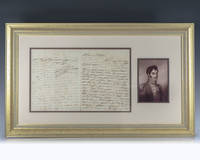
Bolivar, Simon
Simón Bolívar Autograph Letter Signed.
1829. Rare autograph letter signed by ‘El Libertador’ Simón Bolívar as President of Gran Colombia. One page script in Spanish on both recto and verso. The letter is dated May 13 1828 and offers the recipient Colonel José Félix Blanco Bolívar's support in his struggle to maintain the security of Barinas of which was made Governor in 1827 in the midst of heavy criticism from several officers including General José Antonio Páez. Bolívar notes that the offending officers have been dismissed in order to prevent the possibility of partial influence on the resulting hearings and regrets that he will be unable to the proceedings in Orinoco but expects Blanco's reputation to be restored in four to six months. Signed by Bolívar at the conclusion of the letter. The recipient Colonel José Félix Blanco joined the war of independence in 1810 serving as chaplain and was appointed intendant Governor of Barinas in 1827. He was among the defenders of Valencia in the first siege of the city and participated in the first battle of Carabobo. Active in a variety of military government and religious capacities over the course of several decades he was later appointed commander of arms of the province of Maracaibo Secretary of War and Navy in 1837 and Secretary of the Treasury and Foreign Relations in 1847 after an unsuccessful run for the vice-presidency of the Republic in 1844 and for the presidency in 1846. In near fine condition. Double matted and framed with a portrait of Bolívar with a glass pane on the verso of the frame displaying the letter in full. A unique association. Venezuelan military and political leader Simón Bolívar also known as 'El Libertador' led what are currently the countries of Venezuela Bolivia Colombia Ecuador Peru and Panama to independence from the Spanish Empire in the campaign for the independence of New Granada which began in 1808 and was consolidated with the victory at the Battle of Boyacá on 7 August 1819. Despite a number of hindrances including the arrival of an unprecedentedly large Spanish expeditionary force the revolutionaries eventually prevailed culminating in the victory at the Battle of Carabobo in 1821 which effectively made Venezuela an independent country. Following this triumph over the Spanish monarchy Bolívar participated in the foundation of the first union of independent nations in Latin America Gran Colombia of which he was president from 1819 to 1830. Through further military campaigns he ousted Spanish rulers from Ecuador Peru and Bolivia the last of which was named after him. He was simultaneously president of Gran Colombia present-day Venezuela Colombia Panama and Ecuador Peru and Bolivia but soon after his second-in-command Antonio José de Sucre was appointed president of Bolivia. Bolívar aimed at a strong and united Spanish America able to cope not only with the threats emanating from Spain and the European Holy Alliance but also with the emerging power of the United States. At the peak of his power Bolívar ruled over a vast territory from the Argentine border to the Caribbean Sea. unknown
Riferimento per il libraio : 126183
|
|
|
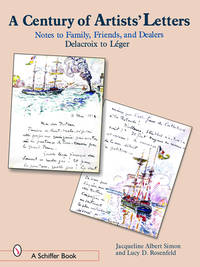
SIMON, JACQUELINE AL
A Century of Artist Letters: Notes to Family Friends & Dealers: Delacroix to Leger Hardcover Simon Jacqueline Albert
SCHIFFER PUBLISHING LTD 2004-01-01. Hardcover. New. 0x0x0. SCHIFFER PUBLISHING LTD hardcover
Riferimento per il libraio : 0764319345_new ISBN : 0764319345 9780764319341
|
|
|
SIMON, JACQUELINE AL
A Century of Artist Letters: Notes to Family Friends & Dealers: Delacroix to Leger Hardcover Simon Jacqueline Albert
SCHIFFER PUBLISHING LTD 2004-01-01. Hardcover. Like New. 0x0x0. SCHIFFER PUBLISHING LTD hardcover
Riferimento per il libraio : 0764319345_used ISBN : 0764319345 9780764319341
|
|
|
Simon Wilson; Ian Cumming
Psychiatry in Prisons: A Comprehensive Handbook Forensic Focus Cumming Ian; Wilson Simon; Parrott Janet; Evans Ceri; Scott Charles; Pyszora Natalie; Milner Rebecca; Taylor Richard; Ndegwa David; McDermott Barbara; Fotiadou Maria; Podmore John; Adshead Dr Gwen; Sullivan Danny; Romilly Crystal; Crighton David; Towl Graham; Grubin Donald; Stone Huw; Tighe James; Xenitidis Kiriakos; Morris Mark; Withecomb Julie; Walker Julian; Brinded Phil; Chhabra Preeti; Dhar Raj; Laing-Morton Tish; Forrester Andrew; Brown Gabrielle; Yakeley Jessica and Fazel Seena
Jessica Kingsley Publishers 2009-10-15. Paperback. Like New. 0x0x0. Jessica Kingsley Publishers paperback
Riferimento per il libraio : 1843102234_used ISBN : 1843102234 9781843102236

|
|
|
Simon Wilson; Ian Cumming
Psychiatry in Prisons: A Comprehensive Handbook Forensic Focus Cumming Ian; Wilson Simon; Parrott Janet; Evans Ceri; Scott Charles; Pyszora Natalie; Milner Rebecca; Taylor Richard; Ndegwa David; McDermott Barbara; Fotiadou Maria; Podmore John; Adshead Dr Gwen; Sullivan Danny; Romilly Crystal; Crighton David; Towl Graham; Grubin Donald; Stone Huw; Tighe James; Xenitidis Kiriakos; Morris Mark; Withecomb Julie; Walker Julian; Brinded Phil; Chhabra Preeti; Dhar Raj; Laing-Morton Tish; Forrester Andrew; Brown Gabrielle; Yakeley Jessica and Fazel Seena
Jessica Kingsley Publishers 2009-10-15. Paperback. New. 0x0x0. Jessica Kingsley Publishers paperback
Riferimento per il libraio : 1843102234_new ISBN : 1843102234 9781843102236
|
|
|
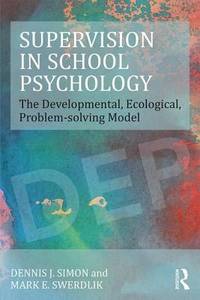
Simon, Dennis J
Supervision in School Psychology: The Developmental Ecological Problem-solving Model Consultation Supervision and Professional Learning in School Psychology Series
paperback. Good. Access codes and supplements are not guaranteed with used items. May be an ex-library book. paperback
Riferimento per il libraio : 1138121533.G ISBN : 1138121533 9781138121539
|
|
|
STEVIN, Simon
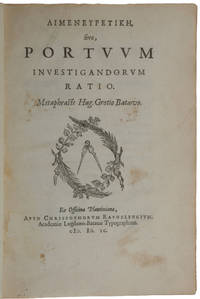
Limenheuretica Greek sive porluum investigandorum ratio. Metaphraste Hug. Grotio Batavo
Leiden: Ex officina Plantiniana apud Christophorum Raphelengium. Academiae Lugduno-Batavae Typographum 1599. First edition. <p>First Latin edition extremely rare of Stevin's highly important work on the determination of position at sea using magnetic variation; since latitude was simply measured this was tantamount to the determination of longitude. Originally published in Dutch as De Havenvinding "the Latin translation appeared almost simultaneously with the original Dutch version" Crone et al. The Principal Works of Simon Stevin Vol. III. No copy of the Dutch or Latin editions has sold at auction in the last 50 years.</p>. <p>DETERMINING LONGITUDE IN THE RENAISSANCE</p> . <p>First Latin edition extremely rare of Stevin's highly important work on the determination of position at sea using the magnetic variation or declination of the compass needle the angle between magnetic north and true north; since latitude was simply measured this was tantamount to the determination of longitude. Originally published in Dutch as De Havenvinding "the Latin translation appeared almost simultaneously with the original Dutch version" Crone et al. p. 375; English and French translations followed later in the same year. "In a seafaring nation like the Dutch republic matters of navigation were of course of great importance. In addition to his astronomical works Stevin . approached the subject of determining the longitude of a ship a problem that was not fully solved until the nineteenth century. Several previous authors had suggested that longitude might be determined by measuring the deviation of the magnetic needle from the astronomical meridian a suggestion based on the assumption that the earth-wide distribution of terrestrial magnetism was known. Since the determination of latitude was well known such a measurement would allow the sailor to chart longitudinal position against the latitudinal circle. Stevin in his booklet gave a clear explanation of this method; he differed from Petrus Plancius and Mercator in that he did not rely upon a priori conceptions of the way in which geomagnetic deviation depends upon geographical position. Although he was willing to offer a conjecture about this dependence Stevin insisted on the necessity of collecting actual measurements from all possible sources and urged the establishment of an empirical worldwide survey. His method was sound although as data began to accumulate it became clear that the magnetic elements were subject to secular variation. The problem of determining longitude was at last solved more simply by the invention of the ship's chronometer" DSB. The Latin translation of De Havenvinding is important as the first edition to be published in a language understood throughout Europe and hence is likely to have been much more widely read that the Dutch original. It also contains a fascinating dedication by Grotius not of course present in the Dutch edition or in the English and French editions. According to ABPC/RBH in the last 50 years no copy of the Dutch or Latin editions has sold at auction; they list just the Macclesfield copy of the French edition and the Streeter/Boies-Penrose copy of the English edition sold Christie's New York April 16 2007 $36000. OCLC lists no copies in US.</p> <br /> <p>"By the end of the sixteenth century the Dutch Republic had become a major sea power . It was thus understandable that the authorities in the Dutch Republic - Prince Maurice 1567-1625 and the States general - were greatly interested in a safe and speedy method of maritime travel. Maurice showed considerable enthusiasm for nautical affairs and it is likely that he asked Stevin to prepare a study of the subject .</p> <br /> <p>"Stevin explains what he intends right at the start of the book. 'It is known' he says 'that for a long time past principally since the great voyages to the Indies and America began a means has been sought by which the navigator might know at sea the longitude of the place where his ship is at the moment in order thus to get to the harbours to which he wishes to go but that hitherto it has not been possible to arrive at such accurate knowledge of the longitude. For some people hoping to find it through the variation of the compass ascribed a pole to the said variation calling it magnetic pole but it is found upon further experience that these variations do not obey a pole. Nevertheless the search for this has furnished a means for reaching a desired harbor even though the true longitudes of both the harbor and the ship are unknown.' In navigation the 'variation of the compass' is understood as the angle between the geographic and magnetic meridian. Gerardus Mercator 1512-94 and Pieter Plaetevoet 1552-1622 known as Plancius a Dranouter-born pastor of the Reformed Church in Amsterdam had written on the phenomenon of magnetic variation before Stevin and he had tried to make use of it in practical navigation and in attempts at determining longitude. Stevin's aim was clearly much more modest: he sought to enable the seafarer to reach a given harbor without having recourse to longitude.</p> <br /> <p>"Moreover Stevin was not convinced of the existence of a magnetic pole conceived as a rock located somewhere in the Arctic. In De Havenvinding he makes no attempt to explain the variation of the compass needle or terrestrial magnetism in general as his predecessors Plancius and Mercator had done. But he did make a thorough study of the observational data Plancius had collected and expanded on them.</p> <br /> <p>"Plancius assumed that there were four meridians on earth where the variation was zero: the prime meridian which at that time passed over the island of Corvo in the Azores and the meridians of 60° 160° and 260° east longitude. In each of the four lunes into which these meridians divide the earth's surface the needle is supposed to deviate from magnetic north in the same way. That is northeasterly in the lunes I 0-60° and III 160-260V and northwesterly in the lunes II 60-160° and IV 260-360°. The northeasterly variation would increase in lune I from 0° to 30° eastern longitude and decrease from 30° to 60° and so on. Stevin concurred with Plancius as regards lunes I and II for which there existed sufficient observational data but in place of four agonic lines meridians of zero variation he introduced six at 0° 60° 160° 180° 240° and 340° and cautiously presented his system as conjecture or supposition. Although Stevin criticized certain aspects of Plancius's work and used his method in a more restrained form he made no attempt to hide his admiration for his predecessor's data gathering 'listing in a table the variations that have already been observed which the learned geographer Mr Petrus Plancius has collected by protracted labour and not without great expense from different corners of the earth both far and near so that if navigators shall find land and harbours generally in this way as some in particular have already found them the said Plancius may be considered one of the principal causes of this.'</p> <br /> <p>"Stevin advocated the use of the tables of variation to find harbours or even to enable ships belonging to the same fleet to regroup at a specific point. He interpreted the proposition in an appendix to De Havenvinding thus: 'Since the given variation and latitude in combination indicate a definite point both at sea and on the land it follows from this that it is possible for ships to find each other at a given point at sea far from the land. This is useful among other things to help the ships of a fleet to reassemble after a storm. By this means it is also possible to fix a rendezvous where ships coming from different directions may meet at a predetermined time.'</p> <br /> <p>"If this technique was to be truly reliable the collection of compass variations at as many positions in the world as possible was essential. Prince Maurice ordered that navigators should henceforth 'find out actually and very carefully the variations of the needle from the north' and faithfully report the results of their observations to the Admiralty so practical tests could be made. Stevin studied the various methods of observing variations finally recommending a way of measuring them in De Havenvinding. In a section entitled 'How the True North and the Variation are Found' he explains how observations can best be taken. The navigator should use 'an azimuthal quadrant the horizontal plane of which notwithstanding the movement of the ship always remains level.' In the margin of the page Stevin provides a Latin translation for the description of this instrument Quadrantem Azimuthalium seu verticulu cuius planu horizontale - an azimuthal quadrant that turns about a vertical axis over a horizontal graduated circle. This instrument was built by Reynier Pietersz also known as Reynier Pieter van Twisch. An inhabitant of Hoorn in the province of North Holland Reynier Pietersz worked for the Hoorn ship owners. In 1598 he applied to the states of Holland and Westfresia for a subsidy for the building of two instruments. One of these was no doubt his azimuthal quadrant. On 13 March 1598 the States appointed a committee consisting of Scaliger Snellius Van Ceulen and Stevin together with the deputies of Amsterdam Rotterdam Hoorn and Enkhuizen to examine and test the instruments and report on them. The committee's conclusions are not known but the fact that Stevin recommended the instrument and explained how it should be used suggests that the committee deemed Reynier Pietersz's device to be useful and usable. Certain sources even describe it as the 'Golden Compass'" Devreese & Berghe pp. 96-99.</p> <br /> <p>The azimuthal quadrant is shown in the full-page illustration on p. 19. A vertical quadrant turns about a vertical axis over a graduated circle. At a certain instant before noon the alidade is directed towards the Sun and the angle between the plane of the quadrant and the needle is read say a°. After noon the measurement is repeated when the Sun has the same altitude again. If the angle is now b° the declination is a - b/2 easterly if a > b westerly if a < b. In this diagram H is a weight used for stabilization. Tables of the latitude longitude and declination at various locations on the globe are given on pp. 6 & 7.</p> <br /> <p>The 'Privilege' with which the work opens states that the States General of the United Netherlands by letters patent of 18 March 1599 granted to Christoffel van Raphelingen 1566-1600 printer at Leiden and a grandson of the famous Christoffel Plantijn Christophe Plantin at Antwerp for a period of six years the sole right of printing publishing and selling this book. We also read there that Van Raphelingen intended to publish the treatise not only in Dutch but in Latin French and other languages but Van Raphelingen actually brought out only a Latin and a French edition in addition to the Dutch; the English translation The Haven-finding Art or the way to find any Haven or place at sea by the Latitude and Variation by the great mathematician and nautical expert Edward Wright was printed and published in London also in 1599. The Latin edition has a dedicatory epistle dated 1 April 1599 and therefore probably appeared within days of the Dutch edition. The English translation had a dedicatory epistle by Wright dated 23 August 1599; it therefore probably appeared four or five months after the Dutch and Latin editions. The French translation Le Trouve-Port contains no dedicatory epistle no preface to the reader nor any other data from which the exact date of its publication might be inferred; even the identity of the translator is unknown. The Dutch edition was reprinted in the Wisconstighe gedachtenissen and the Latin edition in the Hypomnemata mathematica both published in 1605-8; the French edition was included in Les Oeuvres Mathématiques published by Albert Girard in 1634. The book's rapid translation into several languages indicates just how great was the interest it aroused in seafaring nations. De Havenvinding is the only work by Stevin not to include his name as author on the title page not even in the original Dutch publication. However his authorship is mentioned in Grotius's Latin translation and in the English version by Wright.</p> <br /> <p>"The jurist Hugo Grotius 1583-1645 a figure famed in world history at the age of 16 years had translated The Haven-Finding Art faithfully into elegant Latin . Grotius wrote for the booklet a dedicatory epistle addressed to the Doge the Senate and the people of Venice and dated Delft 1st April 1599. This date shows that the translation appeared almost simultaneously with the original Dutch version. It is not merely on account of the courtesy of the wording that this dedication is worth reading. It also contains some personal impressions of the author. It drives Stevin's meaning home to the reader more clearly than he himself had done and it throws full light on the importance attached to Stevin's work by the leader of the country Lieutenant-Admiral Prince Maurice.</p> <br /> <p>"Grotius relates that he had met the Venetian ambassador while accompanying the Dutch embassy sent to Paris. After making a polite comparison between Venice and the Republic he states he had resolved to dedicate a work to the Venetians. The favourable occasion which was worthy of them and which enabled him to add a contribution of his own - a reference to his dedicatory epistle - had now arisen. He was able to offer and recommend a booklet containing instructions given by the Prince to the commanders of the navy and to their boards to be followed by them. The Lieutenant-Admiral himself had previously studied the subject.</p> <br /> <p>"After a circumstantial discussion of the development of ancient navigation and the knowledge of the compass' Grotius recalls how on voyages from east to west the compass-needle had been found to deviate gradually and not inconsiderably from the true north which had caused great doubt and uncertainty among seamen. Thanks to prolonged observation of the magnetic declination at different times and places it had been found by the most learned mathematicians - as one of whom he considers Prince Maurice - that this was no mere accident but that in nature a certain regularity ratio et norma existed according to which the pointings of the needle varied. The Prince had now presented these instructions written about the matter by his mathematician Stevin to those in authority in maritime affairs in order that if there should be found to exist disagreement between theory and personal observation every effort might be made to deduce a rule from different experiments.</p> <br /> <p>"In order that as many data as possible might be collected the Prince had decided to present the booklet to the Doge so that the Venetian navigators might take similar observations which would make for greater certainty in the finding of any destination. Grotius concludes his dedicatory epistle with a general recommendation of the method and with the wish that "this small present" might be sympathetically received "which will be of benefit to both parties and to the whole of the human race". The high expectations that were entertained - by the Prince in particular - of the fruits of Stevin's work could hardly be expressed more eloquently" Crone et al pp. 375-6.</p> <br /> <p>One of the most original scientists of the sixteenth century Simon Stevin 1548-1620 "was a merchant's clerk in Antwerp for a time and eventually rose to become commissioner of public works and quartermaster general of the army under Prince Maurice of Nassau. He engineered a system of sluices to flood certain areas and drive off any enemy an important defense of Holland. He also invented a 26-passenger carriage with sails for use along the seashore. In De Beghinselen der Weeghconst 1586; "Statics and Hydrostatics" Stevin published the theorem of the triangle of forces. The knowledge of this triangle of forces equivalent to the parallelogram diagram of forces gave a new impetus to the study of statics which had previously been founded on the theory of the lever. He also discovered that the downward pressure of a liquid is independent of the shape of its vessel and depends only on its height and base. In 1585 Stevin published a small pamphlet La Thiende "The Tenth" in which he presented an elementary and thorough account of decimal fractions and their daily use. Although he did not invent decimal fractions and his notation was rather unwieldy he established their use in day-to-day mathematics. He declared that the universal introduction of decimal coinage measures and weights would be only a question of time. Stevin published a report in 1586 on his experiment in which two lead spheres one 10 times as heavy as the other fell a distance of 30 feet in the same time. His report received little attention though it preceded by three years Galileo's first treatise concerning gravity and by 18 years Galileo's theoretical work on falling bodies" Britannica.</p> <br /> <p>Bierens de Haan 4565; Dijksterhuis X and pp 87-92; Taylor Mathematical Practitioners of Tudor and Stuart England 99/100b; Waters The Art of Navigation pp. 229-230. Crone et al eds. The Principal Works of Simon Stevin Vol. III 1961. Devreese & Berghe 'Magic is no Magic': The Wonderful World of Simon Stevin 2008.</p> <br/> <br/> Small 4to 229 x 160mm pp. xii 21 1 with woodcut printer's compass device on title and three woodcut illustrations in text two full-page a few minor spots and stains. Eighteenth-century gilt Buntpapier. A very good copy of an extremely rare book. Ex officina Plantiniana apud Christophorum Raphelengium. Academiae Lugduno-Batavae Typographum unknown
Riferimento per il libraio : 5421
|
|
|
Watson, Simon R
Christ Creation and the Fall: Discerning Human Purpose from an Evolving Nature
hardcover. Good. Access codes and supplements are not guaranteed with used items. May be an ex-library book. hardcover
Riferimento per il libraio : 1978710925.G ISBN : 1978710925 9781978710924

|
|
|
OHM, Georg Simon
Die galvanische Kette mathematisch bearbeitet
Berlin: J.G.F. Kniestädt for T.H. Riemann 1827. First edition. <p>First edition of "Ohm's great work" DSB containing the fully-developed presentation of his theory of electricity including Ohm's Law. "Ohm's great contribution − 'The Galvanic Chain Mathematically Calculated' − was to measure the rate of current flow and the effects of resistance on the current. 'Ohm's law' − that the resistance of a given conductor is a constant independent of the voltage applied or the current flowing was arrived at theoretically by analogy with Fourier's heat measurements" PMM.</p>. PMM 289 - Measuring Electricity. First edition of "Ohm's great work" DSB containing the fully-developed presentation of his theory of electricity including Ohm's Law. "Ohm's great contribution − 'The Galvanic Chain Mathematically Calculated' − was to measure the rate of current flow and the effects of resistance on the current. 'Ohm's law' − that the resistance of a given conductor is a constant independent of the voltage applied or the current flowing that is C = E/R where C = current E = electromotive force and R = resistance − was arrived at theoretically by analogy with Fourier's heat measurements 1800-14" PMM.<br/> <br/> <br /> <br /> "The expression "investigated mathematically" in the title of Ohm's book described his objective: to deduce the properties of the galvanic circuit from a set of "fundamental laws." The first of these laws states that electricity passes only between adjacent particles of the conductor and that the quantity passed is proportional to the difference in electroscopic force at the two particles. Here Ohm drew on an analogy to Fourier's heat theory in which the quantity of caloric passed between two particles is proportional to the difference between their temperatures. Ohm's second law supported by Coulomb's experiments states that the loss of electricity in unit time from the conductor to the air is proportional to the electroscopic force of the electricity to the amount of surface exposed and to a coefficient that depends on the air; acknowledging that this second law has little bearing on the phenomena of galvanic currents Ohm included it to make the theory complete and parallel to Fourier's theory of heat. The third and last law states that two bodies in contact maintain the same difference of electroscopic force at their common surface which is the basic tenet of the contact theory of the battery. From these three laws Ohm derived differential equations for electric currents analogous to Fourier's and Poisson's for heat which indicated to him an "intimate connection" between the two phenomena. <br/> <br/> <br /> <br /> "The mathematical expression of Ohm's physical analogy between the conduction of electricity and the conduction of heat is an equation identical in form to Fourier's. The only difference is in the physical significance of the symbols entering the equation: in Fourier's the independent variable is the temperature; in Ohm's it is the electroscopic force which is the force with which an electroscope a body of constant electrical condition is attracted to or repelled from a body it is brought into contact with. Following an approach Fourier had made familiar Ohm mathematically divided the conductor into infinitely thin discs and calculated the quantity of electricity transferred per unit time across the parallel surfaces and outward through the edges of the discs. The result was the fundamental second-order partial differential equation of Ohm's theory . Having formulated the physical problem as a differential equation Ohm then solved it to obtain relations between directly measurable quantities. Manipulating the solution written as an infinite series of sine and cosine functions with damping coefficients Ohm arrived at . his law relating electric current resistance and tension. <br/> <br/> <br /> <br /> "The "torch of mathematics" Ohm wrote shines through physics illuminating its dark places. With his Galvanic Circuit he could claim that mathematics had "incontrovertibly" possessed a "new field of physics from which it had hitherto remained almost totally excluded." By means of mathematical deductions from a few experimental "principles" galvanic phenomena had been brought together in "closed connection" and presented as a "unity of thought." The deductions showed that the seemingly disparate phenomena of electric tension and current are really connected in nature partially realizing Ohm's goal of fashioning the theory of electricity as a "whole" .<br/> <br/> <br /> <br /> "When the Galvanic Circuit appeared few physicists in Germany knew mathematical physics sufficiently to understand it. Journal editors were afraid their readers could not understand papers containing the simplest mathematics as Ohm complained. For reviewing Ohm sent a copy of his book to Schweigger at Halle who did not see the point of a mathematical treatment. To have it evaluated the Prussian minister of culture sent a copy to Kämtz Schweigger's colleague at Halle who could not follow the mathematical derivation as is clear from his cautious review of it. In Berlin which desperately needed a "mathematical physicist" Ohm's work received its most famous and to Ohm irritating review from Pohl who was neither a mathematical nor a typical Berlin physicist . Pohl complained that Ohm had not paid attention to the "essence" of the circuit and had merely expressed some properties of electricity in formulas. This was no achievement but only a replication of Fourier's and Poisson's work in another part of physics . In general the response to Ohm's book reflected a paucity of physicists with good mathematical knowledge in Germany in the late 1820s. But one German review of Ohm's book showed complete comprehension. Ohm sent his book to Kastner in Erlangen to be reviewed in his journal. Kastner asked the mathematician Wilhelm Pfaff to write the review but Pfaff did not know the literature . The review that appeared under Pfaff's name was apparently written by Ohm himself after his brother had interceded. The review was of course favourable but a favourable review does not necessarily make a successful book. Sales of the Galvanic Circuit were unimpressive and Ohm paid friends to order the book from out of town to make a better impression on the publisher. The book was in print for eight years then not again for sixty years though in the meantime it had come out in several translations. Ohm sent free copies to everyone who might help him as he did not want to return to his teaching in Cologne" Jungnickel & McCormmach pp. 53-7. <br/> <br/> <br /> <br /> Georg Simon Ohm 1789-1854 was educated together with his brother Martin the mathematician principally by his father who gave his sons a solid education in mathematics physics chemistry and the philosophies of Kant and Fichte; their considerable mathematical ability was recognized in 1804 by the Erlangen professor Karl Christian von Langsdorf who enthusiastically likened them to the Bernoullis. Ohm received his Ph.D. from the University of Erlangen in 1811 but after teaching there for three semesters as a Privatdozent he was only able to find employment as a schoolteacher first at Bamberg and then from 1817 at the recently reformed Jesuit Gymnasium at Cologne. "The ideals of wissenschaftliche Bildung had infused the school with enthusiasm for learning and teaching; and this atmosphere which appears later to have waned coupled with the requirement that he teach physics and the existence of a well-equipped laboratory stimulated Ohm to concern himself for the first time avidly with physics. He studied the French classics − at first Lagrange Legendre Laplace Biot and Poisson later Fourier and Fresnel − and especially after Oersted's discovery of electro-magnetism in 1820 did experimental work in electricity and magnetism. It was not until early in 1825 however that he undertook research with an eye toward eventual publication" DSB.<br/> <br/> <br /> <br /> "Feeling increasingly burdened by his teaching at a secondary school in Cologne Ohm took his father's advice and asked the Prussian minister of culture for a year off. To the minister he explained that for a long time he had divided his attention between mathematics and physics though for practical reasons he had emphasized physics. By taking up physics he did not have to give up mathematics he said since the two were closely connected. His appeal to the minister contained an element of calculation: he regretted that the French had recently dominated physics and he had been studying the mathematical works by Laplace Fourier Poisson Fresnel and other French masters to see what they had left for him to do. He had been doing purely experimental work on the whole but he had in hand a mathematical theory of galvanic current; all he needed was time off to complete it and he added to work out a theory of light as well. On the recommendation of Ermann the minister approved Ohm's request. With half salary Ohm went off to Berlin in 1826 to live in his brother's house where he had a small apartment with space for doing experiments. With these improved working conditions he developed the mathematical theory of the galvanic current perhaps with his brother's help with the calculations. The result was the Galvanic Circuit .<br/> <br/> <br /> <br /> "After the Galvanic Circuit Ohm carried out important researches on tones and on crystal optics and he undertook a comprehensive theory of physics. In the year the Galvanic Circuit was published he began to speak of a greater work to come one that would treat the whole of molecular physics. Apparently he wanted to derive all physical phenomena from analytical mechanics and molecular hypotheses. Ohm published the first volume containing the mathematical preliminaries. In the second volume he intended to treat dynamics and in the third and fourth its application to physical phenomena. But Ohm's late call to Munich University interfered with his plan and the volumes never appeared. The existence of the plan however pointed to the confidence of the author of the Galvanic Circuit in the power of mathematical physics to complete the understanding of nature that Newton had begun" Jungnickel & McCormmach pp. 53-8. <br/> <br/> <br /> <br /> Widespread understanding and acknowledgement of the importance of the Galvanic Circuit did not come until the late 1830s and early 1840s when Ohm's work began to receive official recognition with corresponding memberships of the Berlin and Turin academies in 1839 and 1841 respectively the award of the Royal Society of London's Copley Medal in 1841 and finally just before his death the chair of physics at the University of Munich in 1852. In 1881 when the importance of Ohm's work was fully understood the standard unit of electrical resistance was named the ohm in his honour at the Paris Conference on international standards. <br/> <br/> <br /> <br /> Waller 11419; Wellcome IV p. 260; Wheeler Gift Cat. 835. Jungnickel & McCormmach Intellectual Mastery of Nature. Theoretical Physics from Ohm to Einstein Volume 1: The Torch of Mathematics 1800 to 1870 1990. <br /> <br/> <br/> 8vo 195 x 123 mm pp. iv 245 errata on p. 245 1 folding engraved plate. Contemporary patterned German cloth gilt spine lettering light wear to capitals and corners. Previous owner's signature removed from title. Custom half leather clamshell box. J.G.F. Kniestädt for T.H. Riemann unknown
Riferimento per il libraio : 5475
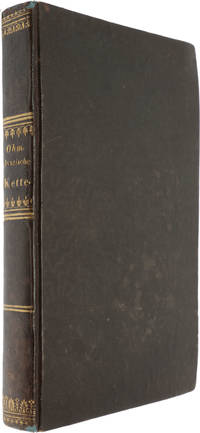
|
|
|
Simon, Neil
Jake's Women: A Play
Random House 1994 First printing of the stated first edition. Signed by Neil Simon directly on the half-title page; presentation copy from Simon to four time Emmy winning director Glenn Jordan: "To Glenn / Even if we didn't / make a movie this time / would have been great. / It would upset me very / much if we didn't do this / at least another dozen times. / That's a 'proposal.' / Love-- / Neil Simon." A tiny bump to upper corner else book and dust jacket in fine condition. Neil Simon is the recipient of three Tony Awards for Best Play and the 1991 Pulitzer Prize for Drama. Random House hardcover
Riferimento per il libraio : 022738 ISBN : 0679430199 9780679430193

|
|
|
Gunn, Jacqueline Simon
Borderline Personality Disorder: New Perspectives on a Stigmatizing and Overused Diagnosis Practical and Applied Psychology
Bloomsbury 2014-11-17. Illustrated. hardcover. New. 6.14x0.44x9.21. Buy with confidence. Excellent Customer Service & Return policy. Bloomsbury hardcover
Riferimento per il libraio : DADAX1440832293 ISBN : 1440832293 9781440832291

|
|
|
Barefoot, Simon
Cambridge IGCSE Espaol como Primera Lengua Libro del Alumno: Hodder Education Group
Hodder Education 2020-08-25. Student. paperback. New. 8.35x0.55x10.79. Buy with confidence. Excellent Customer Service & Return policy. Hodder Education paperback
Riferimento per il libraio : DADAX1510478531 ISBN : 1510478531 9781510478534

|
|

 Ricevere i risultati per e-mail
 Scaricare i risultati in PDF
 RSS feed
 Link
Link


