|
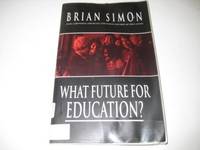
Simon, Brian
What Future for Education
paperback. Good. Access codes and supplements are not guaranteed with used items. May be an ex-library book. paperback
Referentie van de boekhandelaar : 0853157545.G ISBN : 0853157545 9780853157540
|
|
|
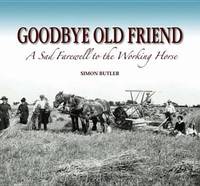
Simon Butler:
Goodbye Old Friend
hardcover. Good. Access codes and supplements are not guaranteed with used items. May be an ex-library book. hardcover
Referentie van de boekhandelaar : 0857041703.G ISBN : 0857041703 9780857041708
|
|
|
Coco Simon
The Cupcake Diaries: MIA in the Mix
paperback. Good. Access codes and supplements are not guaranteed with used items. May be an ex-library book. paperback
Referentie van de boekhandelaar : 0857074032.G ISBN : 0857074032 9780857074034

|
|
|
Gatrell, Simon
Thomas Hardy Writing Dress
hardcover. Good. Access codes and supplements are not guaranteed with used items. May be an ex-library book. hardcover
Referentie van de boekhandelaar : 1803740132.G ISBN : 1803740132 9781803740133
|
|
|
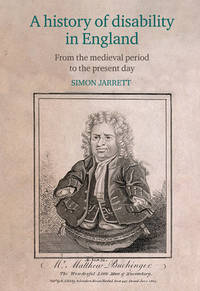
Jarrett, Simon
A history of disability in England: From the medieval period to the present day
hardcover. Good. Access codes and supplements are not guaranteed with used items. May be an ex-library book. hardcover
Referentie van de boekhandelaar : 180207855X.G ISBN : 180207855X 9781802078558
|
|
|
Kennett, Malcolm P (Simon Fraser University, British Columbia)
Essential Statistical Physics
Hardback. New. New Book; Fast Shipping from UK; Not signed; Not First Edition; Delivers a clear and concise exposition of key topics in statistical physics. Detailed mathematical derivations and problems allow students to develop a clear understanding of this important subject. hardcover
Referentie van de boekhandelaar : ria9781108480789_inp ISBN : 1108480780 9781108480789

|
|
|
Simon, Jules
Le Libre-Échange French Edition
hardcover. Good. Access codes and supplements are not guaranteed with used items. May be an ex-library book. hardcover
Referentie van de boekhandelaar : 1020400358.G ISBN : 1020400358 9781020400353
|
|
|
Shepherd, Simon
Direction: Readings in Theatre Practice
hardcover. Good. Access codes and supplements are not guaranteed with used items. May be an ex-library book. hardcover
Referentie van de boekhandelaar : 0230276210.G ISBN : 0230276210 9780230276215
|
|
|
Simon Khachatryan
I Know the Answers: Earth's Greatest Mysteries Revealed
Hardback. New. hardcover
Referentie van de boekhandelaar : B9781665747493 ISBN : 1665747498 9781665747493

|
|
|
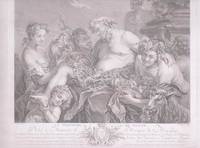
Carle Vanloo (After); Louis Simon Lempereur (Engraver).
Le Triomphe de Silene. The Triumph of Silenus.
Paris: French Publisher 1765. Original etching and engraving. 40.5 x 48.5 cm sheet. Very Good some soiling some tears along sheet edges. Paris: French Publisher, 1765. unknown
Referentie van de boekhandelaar : 71-5472
|
|
|
Caroline Seebhom, Christopher Simon Sykes
English Country: Living In England's Private Houses
New York NY: Clarkson N. Potter 1987. 4to. 288pp. Very Good. Hardcover. Red cloth over boards. Very good dust jacket. Color plates throughout. There might be an additional charge due to the large size of the book. New York, NY: Clarkson N. Potter, 1987 hardcover
Referentie van de boekhandelaar : 75-1348

|
|
|
Simon Mundy
The Illustrated Lives Of The Great Composers: Elgar
London EN: Omnibus Press 1984. 8vo. 138pp. Very Good. Softcover. Black and white plates throughout. London, EN: Omnibus Press, 1984 paperback
Referentie van de boekhandelaar : 75-1225
|
|
|
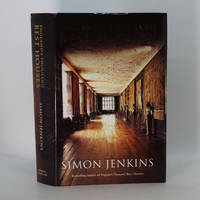
Simon Jenkins
England's Thousand Best Houses.
<p>In the original dustsheet. Red cloth binding with gilt title on the spine and front board.</p><p>'A hymn to good architecture an ode to authentic domestic interiors … buy beg borrow or steal a copy to keep in the car. No other book apart from his 1000 Churches will prompt so many joyous detours' Christopher Hudson Daily Mail</p><p>England's houses are a treasure trove of riches and a unique living record of the nation's history. Simon Jenkins's magnificent guide selects the finest palaces mansions halls castles and cottages throughout the land from the stately to the humble in a glorious celebration of English life.</p><p>Reviews: Simon Jenkins's England's Thousand Best Houses is a sumptuous encyclopaedic treasure trove of a book--an indispensable guide for anyone who has ever enjoyed nosing around any of England's great abbeys halls castles and homes. Retaining the winning easy-to-use format of the wonderful bestselling England's Thousand Best Churches Jenkins has sought out county by county the most beautiful arresting and historically important "houses" anywhere that anyone has ever laid their head that we have to offer. From firm family favourites such as Windsor Castle founded by William the Conqueror; the stunning grandeur of Elizabethan mansion Speke Hall; the triumphal Baroque of Blenheim Palace through and onto smaller more intimate discoveries such as West Yorkshire's Red House built for a Georgian cloth merchant and home of Charlotte Bronte's best pal Mary Taylor; and the fine Restoration plasterwork in Hereford's Holme Lacy House.</p><p>Jenkins continues a project that Nicolas Pevsner so successfully initiated in his ranging architectural classics. Each entry has a pithily sketched history and is marked out of five and the book is replete with Quintin Wright's excellent photographs: a copy for the home and another for the car would not be outlandish. Inevitably lovers of England's architectural heritage will have wished Jenkins had included--or written more fulsomely on--their own particular favourite but disagreeing with Jenkins never takes away from the pleasure of this lovely informative brick of a book. If you are going to give this as a gift make sure you ask for a copy in return. --Mark Thwaite</p><p>-----------------------</p><p>'By our houses we define ourselves and by them we are known. The Englishman's home is more than his castle. It is his face his refuge and his family hearth.' So says Simon Jenkins who set out to create a list that is almost impossible to concoct - the thousand best houses in England. but by "best" Jenkin's doesn't mean big or grand - best means ambiance character that unique feeling of being lovingly lived in. And so his list includes everything from Buckingham Palace three stars to a small Georgian house in Spitalfields four stars and castles rectories farm cottages and prefabs. All English human life is here to be enjoyed. 'The houses of England' says Jenkins 'are a treasure trove a glory of humanity a wonder of the world." Alright he might be lacing it a bit with land of hope and glory and all that but Jenkins has travelled throughout England from Cornwall to Cumbria to choose its most impressive interesting and unusual houses. Not only does he include a full rich selection of its great and famous houses and estates but also presents an eclectic mix from the many thousands of towers castles halls abbeys cottages private homes - even schools and prisons - of the country. From Blenheim Palace to Milton's Cottage from Chatsworth to John Lennon's childhood home from Spencer House to a tiny hop-pickers' shack in Kent every architectural style and period is included and setting for almost every kind of English life. Jenkins' only criteria are interest distinction and that the property should be open to the public. Check it out. You never know your gaffe might be there!</p> Allen Lane. hardcover
Referentie van de boekhandelaar : FB4383 /L5
|
|
|
McVeigh, Simon
Music in Edwardian London Music in Britain 1600-2000 33
hardcover. Good. Access codes and supplements are not guaranteed with used items. May be an ex-library book. hardcover
Referentie van de boekhandelaar : 1837651345.G ISBN : 1837651345 9781837651344

|
|
|
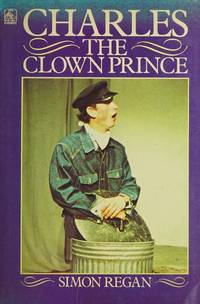
Regan, Simon
Charles the clown prince
hardcover. Good. Access codes and supplements are not guaranteed with used items. May be an ex-library book. hardcover
Referentie van de boekhandelaar : 0905018508.G ISBN : 0905018508 9780905018508
|
|
|
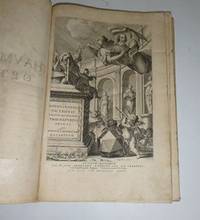
Nicéron, Jean François ; Karl Audran, engraver; Simon Vouet, artist ; Michel Lasne; François Langlois, (Printer),;Jean Blanch
R. P. Ioannis Francisci Niceronis Parisini. Thavmatvrgvs Opticvs Sev Admiranda Optices per radium directum Catoptrices per reflexum è politis corporibus planis cylindricis conicis polyedris polygonis & aliis: Dioptrices per refractum in diaphanis First edition.
Lutetiae Parisiorum Paris: Typis & formis Francisci Langlois aliaÌ€s dicti Chartres . 1646. Folio Contemporary vellum repaired with new endpapers. 25 x 37.5cm. 38 222 42 numbered plates.OCLC Number / Unique Identifier:889852935.Added engraved t.p. by Karl Audran after Simon Vouet. Engraved port. of NiceÌron by Michel Lasne. Plates by Jean Blanchin after NiceÌronHead and tail pieces. InitialsSignatures: ãⶠchi1 ẽⴠĩⴠA-2Dâ´ 2Eâ´ -2E4 Lutetiae Parisiorum, [Paris]: Typis & formis Francisci Langlois, aliàs dicti Chartres ..., 1646 hardcover
Referentie van de boekhandelaar : 51-5820
|
|
|
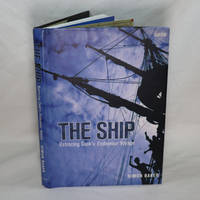
Simon Baker
The Ship. Retracing Cook's Endeavour Voyage.
<p>In the original dustsheet. Binding the same as the dustsheet.</p><p>First there was Blue Latitudes now there is The Ship which tells the remarkable story of Captain James Cook's voyage on the Endeavour describing what happened when a team of volunteers boarded a magnificent replica of the ship to retrace a dramatic stretch of its route from Cape Grafton in Australia to Jakarta in Indonesia. Simon Baker author and seaman begins by taking a fresh look at Cook and the origins of his first voyage - how it turned from a scientific expedition to observe an eclipse into a far-reaching quest for the Great Southern Continent. Drawing on original journals he re-examines Cook's motives and reputation revealing a more complex character than the hero that history has handed down to us. The replica Endeavour provided a unique opportunity to 'test' the achievements of Cook and his company within an authentic 18th-century environment. This involved living on the same diet as Cook and his men hauling ropes scrubbing decks and cleaning cabins. The specialists on board - historians navigators a botanist and an artist - replicated the work of their 18th-century counterparts and came to fascinating conclusions about their contributions to science and navigation.</p><p>The Ship features:</p><ul><li><p>Spectacular photographs of the replica ship and the places it visited on the voyage.</p></li><li><p>Journal entries from eighteenth- and twenty-first century participants giving a dual perspective on the innovative voyage.</p></li><li><p>Historic maps and charts drawn by Captain Cook and other early explorers.</p></li><li><p>Original drawings of plants and people by artists past and present who traveled on the Endeavour</p></li></ul><p>HMS Endeavour off the coast of New Holland by Samuel Atkins c. 1794</p><p>HMS Endeavour was a British Royal Navy research vessel that Lieutenant James Cook commanded to Tahiti New Zealand and Australia on his first voyage of discovery from 1768 to 1771.</p><p>She was launched in 1764 as the collier Earl of Pembroke with the Navy purchasing her in 1768 for a scientific mission to the Pacific Ocean and to explore the seas for the surmised Terra Australis Incognita or "unknown southern land". Commissioned as His Majesty's Bark Endeavour she departed Plymouth in August 1768 rounded Cape Horn and reached Tahiti in time to observe the 1769 transit of Venus across the Sun. She then set sail into the largely uncharted ocean to the south stopping at the islands of Huahine Bora Bora and Raiatea west of Tahiti to allow Cook to claim them for Great Britain. In September 1769 she anchored off New Zealand becoming the first European vessel to reach the islands since Abel Tasman's Heemskerck 127 years earlier.</p><p>In April 1770 Endeavour became the first European ship to reach the east coast of Australia with Cook going ashore at what is now known as Botany Bay. Endeavour then sailed north along the Australian coast. She narrowly avoided disaster after running aground on the Great Barrier Reef and Cook had to throw her guns overboard to lighten her. Endeavour was beached on the Australian mainland for seven weeks to permit rudimentary repairs to her hull. Resuming her voyage she limped into port in Batavia in October 1770 her crew sworn to secrecy about the lands that they had visited. From Batavia Endeavour continued westward rounded the Cape of Good Hope on 13 March 1771 and reached the English port of Dover on 12 July having been at sea for nearly three years.</p><p>The ship was largely forgotten after her Pacific voyage spending the next three years hauling troops and cargo to and from the Falkland Islands. She was renamed in 1775 after being sold into private hands and used to transport timber from the Baltic. Rehired as a British troop transport during the American War of Independence she was finally scuttled in a blockade of Narragansett Bay Rhode Island in 1778. Historical evidence indicates the ship was sunk just north of Goat Island in Newport Harbor along with four other British transports.</p><p>Relics from Endeavour are displayed at maritime museums worldwide including an anchor and six of her cannon. A replica of Endeavour was launched in 1994 and is berthed alongside the Australian National Maritime Museum in Sydney Harbour. The NASA Space Shuttle Endeavour was named after this ship as was the command module of Apollo 15 which took a small piece of wood from Cook's ship into space and the SpaceX Crew Dragon capsule C206 was christened Endeavour during Demo-2. The ship is also depicted on the New Zealand fifty-cent coin.</p><p>Earl of Pembroke later HMS Endeavour leaving Whitby Harbour in 1768. By Thomas Luny dated 1790.</p><p>Construction - Endeavour was originally the merchant collier Earl of Pembroke built by Thomas Fishburn for Thomas Millner launched in June 1764 from the coal and whaling Port of Whitby in the North Riding of Yorkshire. She was a type known locally as the 'Whitby Cat'. She was ship-rigged and sturdily built with a broad flat bow a square stern and a long box-like body with a deep hold. A flat-bottomed design made her well-suited to sailing in shallow waters and allowed her to be beached for loading and unloading of cargo and for basic repairs without requiring a dry dock. Her hull internal floors and futtocks were built from traditional white oak her keel and stern post from elm and her masts from pine and fir. Plans of the ship also show a double keelson to lock the keel floors and frames in place. There is uncertainty about the height of her standing masts as surviving diagrams of Endeavour depict the body of the vessel only and not the mast plan. While her main and foremast standing spars were standard for her shipyard and era an annotation on one surviving ship plan in the National Maritime Museum in Greenwich has the mizzen as "16 yards 29 inches" 15.4 m. If correct this would produce an oddly truncated mast a full 9 feet 2.7 m shorter than the naval standards of the day. Late twentieth-century research suggests the annotation may be a transcription error with "19 yards 29 inches" 18.1 m being the true reading. If so this would more closely conform with both naval standards and the lengths of the other masts.</p><p>Purchase and refit by the Admiralty. On 16 February 1768 the Royal Society petitioned King George III to finance a scientific expedition to the Pacific to study and observe the 1769 transit of Venus across the sun. Royal approval was granted for the expedition and the Admiralty elected to combine the scientific voyage with a confidential mission to search the south Pacific for signs of the postulated continent Terra Australis Incognita or "unknown southern land". The Royal Society suggested command be given to Scottish geographer Alexander Dalrymple whose acceptance was conditional on a brevet commission as a captain in the Royal Navy. First Lord of the Admiralty Edward Hawke refused going so far as to say he would rather cut off his right hand than give command of a navy vessel to someone not educated as a seaman. In refusing Dalrymple's command Hawke was influenced by previous insubordination aboard the sloop HMS Paramour in 1698 when naval officers had refused to take orders from civilian commander Dr. Edmond Halley. The impasse was broken when the Admiralty proposed James Cook a naval officer with a background in mathematics and cartography. Acceptable to both parties Cook was promoted to Lieutenant and named as commander of the expedition.</p> BBC Books. hardcover
Referentie van de boekhandelaar : FB4947 /L2
|
|
|
Marechal, Nicolas (1753-1803) (After); Simon Charles Miger (1736-1820) (Engraver).
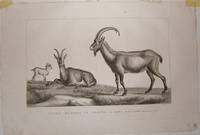
Capra Aegagrus Le Paseng ou Bouc Sauvage.
Paris: Miger Patris Grandcher & Dentu An X. 1801. Engraving. 35 x 53 cm sheet. Very Good light specks of foxing minor surface soiling.Reference: Benezit Dictionnaire des Peintres Sculpteurs Dessinateurs et Graveurs vol. 9 p. 611; Anker 275; BMNH IV p. 1517; Brunet III 725; Nissen ZBI 2353.La menagerie du Museum National d'Histoire Naturelle ou Description et histoire des animaux qui y vivent et qui y ont vecu.In 1793after the French Revolution the former royal garden and collection became the Botanical Garden and the National Museum of Natural History. A zoo linked with the museum was also established replacing the royal menagerie at Versailles. Until then people had seen animals in traveling shows where they were exhibited as curiosities. Traveling menageries were soon banned in Paris ensuring a steady stream of visitors to the new zoo. The eminent naturalists Comte de Lacepede 1756-1825 Cuvier and Geoffroy compiled a catalog of the animals in the zoo in 1801. Nicolas Marechal the museum’s painter documented the animals of the new zoo in watercolor paintings on vellum. The post-Revolution political mores the personnel associated with this project are referred to as ‘citoyens’ citizens. The print is dedicated to ‘Citizen Faujas-St. Pond Professor of Geology at the National Museum of Natural History Inspector of Mines of France etc. by Citizen Miger.’ Dedication in French reads: Dedie au Citoyen Faujas-St. Pond; Professeur de Geologie au Museum National d’histoire Naturelle Inspecteur des Mines de France & par le Citoyen Miger’. Paris: Miger, Patris, Grandcher & Dentu, An X., 1801. hardcover
Referentie van de boekhandelaar : 71-6407
|
|
|
Marechal, Nicolas (1753-1803) (After); Simon Charles Miger (1736-1820) (Engraver).
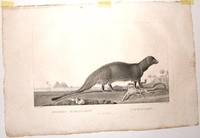
Viverra Ichneumon L’Ichneumon.
Paris: Miger Patris Grandcher & Dentu An X. 1801. Engraving. 35 x 53 cm sheet. Very Good light specks of foxing sheet lightly toned.Reference: Benezit Dictionnaire des Peintres Sculpteurs Dessinateurs et Graveurs vol. 9 p. 611; Anker 275; BMNH IV p. 1517; Brunet III 725; Nissen ZBI 2353.La menagerie du Museum National d'Histoire Naturelle ou Description et histoire des animaux qui y vivent et qui y ont vecu.In 1793after the French Revolution the former royal garden and collection became the Botanical Garden and the National Museum of Natural History. A zoo linked with the museum was also established replacing the royal menagerie at Versailles. Until then people had seen animals in traveling shows where they were exhibited as curiosities. Traveling menageries were soon banned in Paris ensuring a steady stream of visitors to the new zoo. The eminent naturalists Comte de Lacepede 1756-1825 Cuvier and Geoffroy compiled a catalog of the animals in the zoo in 1801. Nicolas Marechal the museum’s painter documented the animals of the new zoo in watercolor paintings on vellum. The post-Revolution political mores the personnel associated with this project are referred to as ‘citoyens’ citizens. The print is dedicated to ‘Citizen Faujas-St. Pond Professor of Geology at the National Museum of Natural History Inspector of Mines of France etc. by Citizen Miger.’ Dedication in French reads: Dedie au Citoyen Faujas-St. Pond; Professeur de Geologie au Museum National d’histoire Naturelle Inspecteur des Mines de France & par le Citoyen Miger’. Paris: Miger, Patris, Grandcher & Dentu, An X., 1801. hardcover
Referentie van de boekhandelaar : 71-6404
|
|
|
Marechal, Nicolas (1753-1803) (After); Simon Charles Miger (1736-1820) (Engraver).
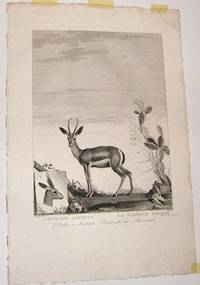
Antilope Corinna le Gazelle Corinne.
Paris: Miger Patris Grandcher & Dentu An X. 1801. Engraving. 53 x 35 cm sheet. Very Good light water staining mostly in the margins light specks of foxing a hole in lower left margin.Reference: Benezit Dictionnaire des Peintres Sculpteurs Dessinateurs et Graveurs vol. 9 p. 611; Anker 275; BMNH IV p. 1517; Brunet III 725; Nissen ZBI 2353.La menagerie du Museum National d'Histoire Naturelle ou Description et histoire des animaux qui y vivent et qui y ont vecu.In 1793after the French Revolution the former royal garden and collection became the Botanical Garden and the National Museum of Natural History. A zoo linked with the museum was also established replacing the royal menagerie at Versailles. Until then people had seen animals in traveling shows where they were exhibited as curiosities. Traveling menageries were soon banned in Paris ensuring a steady stream of visitors to the new zoo. The eminent naturalists Comte de Lacepede 1756-1825 Cuvier and Geoffroy compiled a catalog of the animals in the zoo in 1801. Nicolas Marechal the museum’s painter documented the animals of the new zoo in watercolor paintings on vellum. The post-Revolution political mores the personnel associated with this project are referred to as ‘citoyens’ citizens. The print is dedicated to ‘Citizen Faujas-St. Pond Professor of Geology at the National Museum of Natural History Inspector of Mines of France etc. by Citizen Miger.’ Dedication in French reads: Dedie au Citoyen Faujas-St. Pond; Professeur de Geologie au Museum National d’histoire Naturelle Inspecteur des Mines de France & par le Citoyen Miger’. Paris: Miger, Patris, Grandcher & Dentu, An X., 1801. hardcover
Referentie van de boekhandelaar : 71-6399
|
|
|
Marechal, Nicolas (1753-1803) (After); Simon Charles Miger (1736-1820) (Engraver).
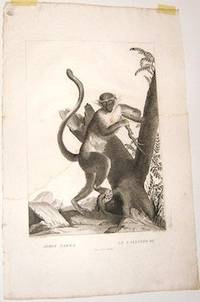
Simia Sabaea Le Callitriche.
Paris: Miger Patris Grandcher & Dentu An X. 1801. Engraving. 53 x 35 cm sheet. Very Good light water staining mostly in the margins light specks of foxing.Reference: Benezit Dictionnaire des Peintres Sculpteurs Dessinateurs et Graveurs vol. 9 p. 611; Anker 275; BMNH IV p. 1517; Brunet III 725; Nissen ZBI 2353.La menagerie du Museum National d'Histoire Naturelle ou Description et histoire des animaux qui y vivent et qui y ont vecu.In 1793after the French Revolution the former royal garden and collection became the Botanical Garden and the National Museum of Natural History. A zoo linked with the museum was also established replacing the royal menagerie at Versailles. Until then people had seen animals in traveling shows where they were exhibited as curiosities. Traveling menageries were soon banned in Paris ensuring a steady stream of visitors to the new zoo. The eminent naturalists Comte de Lacepede 1756-1825 Cuvier and Geoffroy compiled a catalog of the animals in the zoo in 1801. Nicolas Marechal the museum’s painter documented the animals of the new zoo in watercolor paintings on vellum. The post-Revolution political mores the personnel associated with this project are referred to as ‘citoyens’ citizens. The print is dedicated to ‘Citizen Faujas-St. Pond Professor of Geology at the National Museum of Natural History Inspector of Mines of France etc. by Citizen Miger.’ Dedication in French reads: Dedie au Citoyen Faujas-St. Pond; Professeur de Geologie au Museum National d’histoire Naturelle Inspecteur des Mines de France & par le Citoyen Miger’. Paris: Miger, Patris, Grandcher & Dentu, An X., 1801. hardcover
Referentie van de boekhandelaar : 71-6398
|
|
|
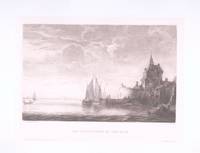
De Vlieger, Simon (After); Wilhelm Hecht (Engraver).
Das Schlosschen an der Maas.
Wien: Vervielf Art circa 1900. Etching chine-colled to a support sheet. 29 x 38.5 cm sheet. Very Good light specks of foxing in the margins. Wien: [Vervielf Art, circa 1900]. unknown
Referentie van de boekhandelaar : 71-6501
|
|
|
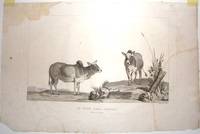
Marechal, Nicolas (1753-1803) (After); Simon Charles Miger (1736-1820) (Engraver).
Le Zebu san Cornes.
Paris: Miger Patris Grandcher & Dentu An X. 1801. Engraving. 35 x 53 cm sheet. Very Good light specks of foxing water staining in right and left quadrants.Reference: Benezit Dictionnaire des Peintres Sculpteurs Dessinateurs et Graveurs vol. 9 p. 611; Anker 275; BMNH IV p. 1517; Brunet III 725; Nissen ZBI 2353.La menagerie du Museum National d'Histoire Naturelle ou Description et histoire des animaux qui y vivent et qui y ont vecu.In 1793after the French Revolution the former royal garden and collection became the Botanical Garden and the National Museum of Natural History. A zoo linked with the museum was also established replacing the royal menagerie at Versailles. Until then people had seen animals in traveling shows where they were exhibited as curiosities. Traveling menageries were soon banned in Paris ensuring a steady stream of visitors to the new zoo. The eminent naturalists Comte de Lacepede 1756-1825 Cuvier and Geoffroy compiled a catalog of the animals in the zoo in 1801. Nicolas Marechal the museum’s painter documented the animals of the new zoo in watercolor paintings on vellum. The post-Revolution political mores the personnel associated with this project are referred to as ‘citoyens’ citizens. The print is dedicated to ‘Citizen Faujas-St. Pond Professor of Geology at the National Museum of Natural History Inspector of Mines of France etc. by Citizen Miger.’ Dedication in French reads: Dedie au Citoyen Faujas-St. Pond; Professeur de Geologie au Museum National d’histoire Naturelle Inspecteur des Mines de France & par le Citoyen Miger’. Paris: Miger, Patris, Grandcher & Dentu, An X., 1801. hardcover
Referentie van de boekhandelaar : 71-6409
|
|
|
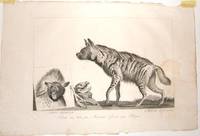
Marechal, Nicolas (1753-1803) (After); Simon Charles Miger (1736-1820) (Engraver).
Canis Hyaena L’Hiene.
Paris: Miger Patris Grandcher & Dentu An X. 1801. Engraving. 35 x 53 cm sheet. Very Good light water staining mostly in the margins light specks of foxing.Reference: Benezit Dictionnaire des Peintres Sculpteurs Dessinateurs et Graveurs vol. 9 p. 611; Anker 275; BMNH IV p. 1517; Brunet III 725; Nissen ZBI 2353.La menagerie du Museum National d'Histoire Naturelle ou Description et histoire des animaux qui y vivent et qui y ont vecu.In 1793after the French Revolution the former royal garden and collection became the Botanical Garden and the National Museum of Natural History. A zoo linked with the museum was also established replacing the royal menagerie at Versailles. Until then people had seen animals in traveling shows where they were exhibited as curiosities. Traveling menageries were soon banned in Paris ensuring a steady stream of visitors to the new zoo. The eminent naturalists Comte de Lacepede 1756-1825 Cuvier and Geoffroy compiled a catalog of the animals in the zoo in 1801. Nicolas Marechal the museum’s painter documented the animals of the new zoo in watercolor paintings on vellum. The post-Revolution political mores the personnel associated with this project are referred to as ‘citoyens’ citizens. The print is dedicated to ‘Citizen Faujas-St. Pond Professor of Geology at the National Museum of Natural History Inspector of Mines of France etc. by Citizen Miger.’ Dedication in French reads: Dedie au Citoyen Faujas-St. Pond; Professeur de Geologie au Museum National d’histoire Naturelle Inspecteur des Mines de France & par le Citoyen Miger’. Paris: Miger, Patris, Grandcher & Dentu, An X., 1801. hardcover
Referentie van de boekhandelaar : 71-6397
|
|
|
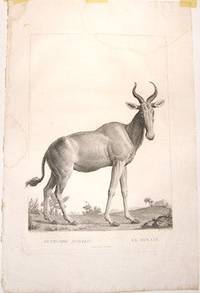
Marechal, Nicolas (1753-1803) (After); Simon Charles Miger (1736-1820) (Engraver).
Antilope Bubalis Le Bubale.
Paris: Miger Patris Grandcher & Dentu An X. 1801. Engraving. 53 x 35 cm sheet. Very Good light specks of foxing some water staining mostly in the margins.Reference: Benezit Dictionnaire des Peintres Sculpteurs Dessinateurs et Graveurs vol. 9 p. 611; Anker 275; BMNH IV p. 1517; Brunet III 725; Nissen ZBI 2353.La menagerie du Museum National d'Histoire Naturelle ou Description et histoire des animaux qui y vivent et qui y ont vecu.In 1793after the French Revolution the former royal garden and collection became the Botanical Garden and the National Museum of Natural History. A zoo linked with the museum was also established replacing the royal menagerie at Versailles. Until then people had seen animals in traveling shows where they were exhibited as curiosities. Traveling menageries were soon banned in Paris ensuring a steady stream of visitors to the new zoo. The eminent naturalists Comte de Lacepede 1756-1825 Cuvier and Geoffroy compiled a catalog of the animals in the zoo in 1801. Nicolas Marechal the museum’s painter documented the animals of the new zoo in watercolor paintings on vellum. The post-Revolution political mores the personnel associated with this project are referred to as ‘citoyens’ citizens. The print is dedicated to ‘Citizen Faujas-St. Pond Professor of Geology at the National Museum of Natural History Inspector of Mines of France etc. by Citizen Miger.’ Dedication in French reads: Dedie au Citoyen Faujas-St. Pond; Professeur de Geologie au Museum National d’histoire Naturelle Inspecteur des Mines de France & par le Citoyen Miger’. Paris: Miger, Patris, Grandcher & Dentu, An X., 1801. hardcover
Referentie van de boekhandelaar : 71-6406
|
|
|
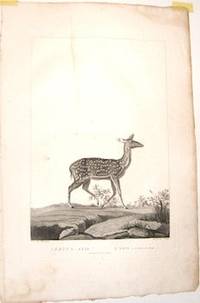
Marechal, Nicolas (1753-1803) (After); Simon Charles Miger (1736-1820) (Engraver).
Cervus Axis L’Axis ou la Biche du Gange.
Paris: Miger Patris Grandcher & Dentu An X. 1801. Engraving. 53 x 35 cm sheet. Very Good light water staining mostly in the margins light specks of foxing.Reference: Benezit Dictionnaire des Peintres Sculpteurs Dessinateurs et Graveurs vol. 9 p. 611; Anker 275; BMNH IV p. 1517; Brunet III 725; Nissen ZBI 2353.La menagerie du Museum National d'Histoire Naturelle ou Description et histoire des animaux qui y vivent et qui y ont vecu.In 1793after the French Revolution the former royal garden and collection became the Botanical Garden and the National Museum of Natural History. A zoo linked with the museum was also established replacing the royal menagerie at Versailles. Until then people had seen animals in traveling shows where they were exhibited as curiosities. Traveling menageries were soon banned in Paris ensuring a steady stream of visitors to the new zoo. The eminent naturalists Comte de Lacepede 1756-1825 Cuvier and Geoffroy compiled a catalog of the animals in the zoo in 1801. Nicolas Marechal the museum’s painter documented the animals of the new zoo in watercolor paintings on vellum. The post-Revolution political mores the personnel associated with this project are referred to as ‘citoyens’ citizens. The print is dedicated to ‘Citizen Faujas-St. Pond Professor of Geology at the National Museum of Natural History Inspector of Mines of France etc. by Citizen Miger.’ Dedication in French reads: Dedie au Citoyen Faujas-St. Pond; Professeur de Geologie au Museum National d’histoire Naturelle Inspecteur des Mines de France & par le Citoyen Miger’. Paris: Miger, Patris, Grandcher & Dentu, An X., 1801. hardcover
Referentie van de boekhandelaar : 71-6393
|
|
|
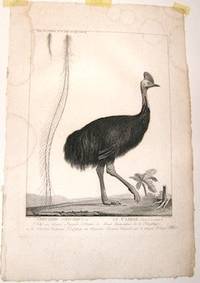
Marechal, Nicolas (1753-1803) (After); Simon Charles Miger (1736-1820) (Engraver).
Struthio Casuarius Le Casoar.
Paris: Miger Patris Grandcher & Dentu An X. 1801. Engraving. 53 x 35 cm sheet. Very Good light water staining mostly in the margins light specks of foxing.Reference: Benezit Dictionnaire des Peintres Sculpteurs Dessinateurs et Graveurs vol. 9 p. 611; Anker 275; BMNH IV p. 1517; Brunet III 725; Nissen ZBI 2353.La menagerie du Museum National d'Histoire Naturelle ou Description et histoire des animaux qui y vivent et qui y ont vecu.In 1793after the French Revolution the former royal garden and collection became the Botanical Garden and the National Museum of Natural History. A zoo linked with the museum was also established replacing the royal menagerie at Versailles. Until then people had seen animals in traveling shows where they were exhibited as curiosities. Traveling menageries were soon banned in Paris ensuring a steady stream of visitors to the new zoo. The eminent naturalists Comte de Lacepede 1756-1825 Cuvier and Geoffroy compiled a catalog of the animals in the zoo in 1801. Nicolas Marechal the museum’s painter documented the animals of the new zoo in watercolor paintings on vellum. The post-Revolution political mores the personnel associated with this project are referred to as ‘citoyens’ citizens. The print is dedicated to ‘Citizen Faujas-St. Pond Professor of Geology at the National Museum of Natural History Inspector of Mines of France etc. by Citizen Miger.’ Dedication in French reads: Dedie au Citoyen Faujas-St. Pond; Professeur de Geologie au Museum National d’histoire Naturelle Inspecteur des Mines de France & par le Citoyen Miger’. Paris: Miger, Patris, Grandcher & Dentu, An X., 1801. hardcover
Referentie van de boekhandelaar : 71-6392
|
|
|
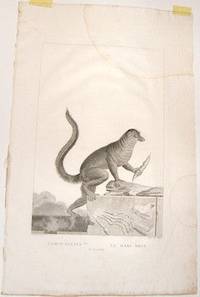
Marechal, Nicolas (1753-1803) (After); Simon Charles Miger (1736-1820) (Engraver).
Lemur Fulvus Le Maki Brun.
Paris: Miger Patris Grandcher & Dentu An X. 1801. Engraving. 53 x 35 cm sheet. Very Good light water staining mostly in the margins light specks of foxing.Reference: Benezit Dictionnaire des Peintres Sculpteurs Dessinateurs et Graveurs vol. 9 p. 611; Anker 275; BMNH IV p. 1517; Brunet III 725; Nissen ZBI 2353.La menagerie du Museum National d'Histoire Naturelle ou Description et histoire des animaux qui y vivent et qui y ont vecu.In 1793after the French Revolution the former royal garden and collection became the Botanical Garden and the National Museum of Natural History. A zoo linked with the museum was also established replacing the royal menagerie at Versailles. Until then people had seen animals in traveling shows where they were exhibited as curiosities. Traveling menageries were soon banned in Paris ensuring a steady stream of visitors to the new zoo. The eminent naturalists Comte de Lacepede 1756-1825 Cuvier and Geoffroy compiled a catalog of the animals in the zoo in 1801. Nicolas Marechal the museum’s painter documented the animals of the new zoo in watercolor paintings on vellum. The post-Revolution political mores the personnel associated with this project are referred to as ‘citoyens’ citizens. The print is dedicated to ‘Citizen Faujas-St. Pond Professor of Geology at the National Museum of Natural History Inspector of Mines of France etc. by Citizen Miger.’ Dedication in French reads: Dedie au Citoyen Faujas-St. Pond; Professeur de Geologie au Museum National d’histoire Naturelle Inspecteur des Mines de France & par le Citoyen Miger’. Paris: Miger, Patris, Grandcher & Dentu, An X., 1801. hardcover
Referentie van de boekhandelaar : 71-6395
|
|
|
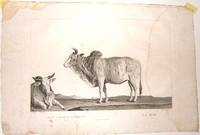
Marechal, Nicolas (1753-1803) (After); Simon Charles Miger (1736-1820) (Engraver).
Bos Taurus Indicus Le Zebu.
Paris: Miger Patris Grandcher & Dentu An X. 1801. Engraving. 35 x 53 cm sheet. Very Good light water staining mostly in the margins light specks of foxing.Reference: Benezit Dictionnaire des Peintres Sculpteurs Dessinateurs et Graveurs vol. 9 p. 611; Anker 275; BMNH IV p. 1517; Brunet III 725; Nissen ZBI 2353.La menagerie du Museum National d'Histoire Naturelle ou Description et histoire des animaux qui y vivent et qui y ont vecu.In 1793after the French Revolution the former royal garden and collection became the Botanical Garden and the National Museum of Natural History. A zoo linked with the museum was also established replacing the royal menagerie at Versailles. Until then people had seen animals in traveling shows where they were exhibited as curiosities. Traveling menageries were soon banned in Paris ensuring a steady stream of visitors to the new zoo. The eminent naturalists Comte de Lacepede 1756-1825 Cuvier and Geoffroy compiled a catalog of the animals in the zoo in 1801. Nicolas Marechal the museum’s painter documented the animals of the new zoo in watercolor paintings on vellum. The post-Revolution political mores the personnel associated with this project are referred to as ‘citoyens’ citizens. The print is dedicated to ‘Citizen Faujas-St. Pond Professor of Geology at the National Museum of Natural History Inspector of Mines of France etc. by Citizen Miger.’ Dedication in French reads: Dedie au Citoyen Faujas-St. Pond; Professeur de Geologie au Museum National d’histoire Naturelle Inspecteur des Mines de France & par le Citoyen Miger’. Paris: Miger, Patris, Grandcher & Dentu, An X., 1801. hardcover
Referentie van de boekhandelaar : 71-6396
|
|
|
Simon, Sunka
German Crime Dramas from Network Television to Netflix
paperback. Good. Access codes and supplements are not guaranteed with used items. May be an ex-library book. paperback
Referentie van de boekhandelaar : 1501370499.G ISBN : 1501370499 9781501370496

|
|
|
PRINTING SIMON, Oliver
Printer and Playground.
Faber and Faber London. 1956. First edition first state with collotype plates between pp 120-121 not found in later copies. Royal octavo. 156 pages. Illustrations including portraits letters in facsimile typographical examples etc. The blurb points out that a section of the book throws light on certain aspects of T.E. Lawrence's actions in the First World War.Free endpapers partially tanned. Near fine in very good dustwrapper a bit nicked and rubbed at the edges. Faber and Faber, London. unknown
Referentie van de boekhandelaar : PRINTING000253
|
|
|
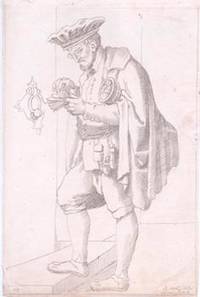
Guillain, Simon (Engraver); After Annibale Carracci
Porta citationi messo notificatore Plate 68 from Le Arti di Bologna. The Occupations of the Bolognese.
Rome: Gregorio Roisecco 1740. Etching. 24 x 16 cm sheet. Very Good sheet trimmed to the image tear at left sheet edge tear in right quadrant of image minor surface soiling. [Rome: Gregorio Roisecco, 1740]. unknown
Referentie van de boekhandelaar : 71-6518
|
|
|
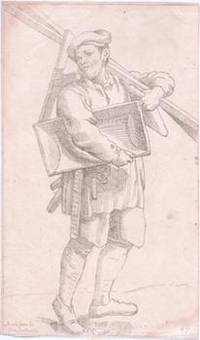
Guillain, Simon (Engraver); After Annibale Carracci
Muratore Plate 65 from Le Arti di Bologna. The Occupations of the Bolognese.
Rome: Gregorio Roisecco 1740. Etching. 26.5 x 15.5 cm sheet. Very Good sheet trimmed to the image tear at bottom sheet edge minor surface soiling. [Rome: Gregorio Roisecco, 1740]. unknown
Referentie van de boekhandelaar : 71-6517
|
|
|
Braund, Simon
Total Recall: The Official Story of the Film
hardcover. Good. Access codes and supplements are not guaranteed with used items. May be an ex-library book. hardcover
Referentie van de boekhandelaar : 1803360348.G ISBN : 1803360348 9781803360348

|
|
|
Simon Asplen-Taylor
Data and Analytics Strategy for Business: Leverage Data and AI to Achieve Your Business Goals
Hardcover. New. New Book; Fast Shipping from UK; Not signed; Not First Edition; Design implement and execute a data strategy that harnesses AI with this guide to driving innovation and creating value. hardcover
Referentie van de boekhandelaar : ria9781398622036_inp ISBN : 1398622036 9781398622036

|
|
|
Simon Theatre Francaise Bordeaux
Telegram to Sarah Bernhardt 1889.
Paris France: Simon Theatre Francais Bordeaux 1889. Folio. Telegram mounted on illustrated color pencil sheet of backing paper with hand written dated note in black ink. Good with tears & losses. En Francais. Provenance:Colette Monceau born Nancey 1921-2016. Biographical note: born in Nice in 1921 Colette Monceau was a student of Charles Dullin in the second half of the forties and played in several plays during the same period. At the end of the 1950s she took courses at Pierre Foix's school of graphology in Paris and worked in particular on dance as part of the exam for the Group of Consulting Graphologists of France. Having become a consultant graphologist she also teaches this technique. Particularly interested in the writings of Louis Jouvet and Sarah Bernhardt she wrote three works that remained unpublished as well as several articles. It constitutes a thousand files devoted to actors and actresses as well as personalities from varied backgrounds. Colette Monceau née Nancey 1921-2016. Notice biographique : née à Nice en 1921 Colette Monceau est élève de Charles Dullin dans la seconde moitié des années quarante et joue dans plusieurs pièces à cette même période. À la fin des années cinquante elle suit les cours de l’école de graphologie de Pierre Foix à Paris et travaille notamment sur la danse dans le cadre de l'examen du Groupement des graphologues conseils de France. Devenue graphologue-conseil elle enseigne également cette technique. S'intéressant notamment aux écritures de Louis Jouvet et de Sarah Bernhardt elle rédige trois ouvrages restés inédits ainsi que plusieurs articlesExpertise by Daniel BRUKARZ Expert auprès de la CEA. Paris. Paris, France: Simon Theatre Francais Bordeaux, 1889. unknown
Referentie van de boekhandelaar : 68-6434
|
|
|
SEARLE, Ronald (illustrates). RAE, Simon
The Face of War.
Previous Parrot Press Church Hanborough. 1999. First edition. Square quarto. 42 pages. Pictorial boards. The cartoons by Searle first appeared in Le Monde in the years 1995-1998 and Simon Rae's poems were especially written to accompany them here.One of 294 numbered copies signed the artist and the poet.Front cover slightly marked. Near fine. Not issued in dustwrapper. Previous Parrot Press, Church Hanborough. hardcover
Referentie van de boekhandelaar : SEARLERO000565
|
|
|
Osswald, Simon
Novel NHC-iridium complexes for advanced application of hyperpolarized NMR
Logos Verlag Berlin 2023. 1st. paperback. New. 0x0x0. Logos Verlag Berlin paperback
Referentie van de boekhandelaar : 1829241 ISBN : 3832557210 9783832557218

|
|
|
Simon Jarrett
A history of disability in England: From the medieval period to the present day
new. unknown
Referentie van de boekhandelaar : 45125613-n ISBN : 180207855x 9781802078558
|
|
|
Simon Jarrett
A history of disability in England: From the medieval period to the present day
like new. unknown
Referentie van de boekhandelaar : 45125613 ISBN : 180207855x 9781802078558
|
|
|
Kenton, Simon, Subject
Simon Kenton Portrait Steel Engraving with Facsimile Signature
Print. Illus. by Homer & Lee NY Engravers. Good. No Binding. Circa 1870s sized about 8 x 10.5 inches engraved by Homer & Lee NY. Overall sharp and bright with minor soiling at upper margin. Suitable for framing. unknown
Referentie van de boekhandelaar : 14296
|
|
|
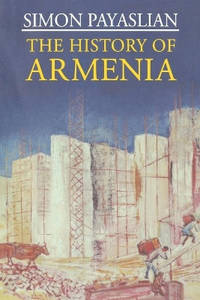
Simon Payaslian
The History of Armenia: From the Origins to the Present
Paperback / softback. New. There is a great deal of interest in the history of Armenia since its renewed independence in the 1990s and the ongoing debate about the genocide - an interest that informs the strong desire of a new generation of Armenian Americans to learn more about their heritage and has led to greater solidarity in the community. paperback
Referentie van de boekhandelaar : A9781403974679 ISBN : 1403974675 9781403974679
|
|
|
Committee for Simon Rodia's Towers in Watts
The Watts Towers.
Los Angeles: Committee for Simon Rodia's Towers in Watts 1980. 8vo. circa 20 pp. Stapled Wrap Very Good B&W Plates. Los Angeles: Committee for Simon Rodia's Towers in Watts, [1980]. unknown
Referentie van de boekhandelaar : 69-1939

|
|
|
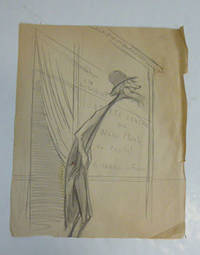
Savignol, Marius = Simon Marius Savignol (1866-1938)
César Tripet in front of a sign reading "Societe General des Water Closets au capital de 10 millions de Francs." Original drawing.
Paris: circa 1907. Original drawing. Ttiled. Marginal tears and folds without loss. Another drawing of Tripet verso.44 x 35 cm. The politician and cartoonist Marius Savignol 1866-1938 contributed to many early 20th Century satirical publications such as "L'Assiette au beurre " creating the character of César Tripet.Expertise by: Elvire Poulain-Marquis Cabinet Poulain Paris.Pharmacist and politician Savignol was also highly appreciated for his caricatures. He collaborated on the most important journals in this genre at the beginning of the 20th century such as Le Rire Le Sourire Les Galonnés etc. and also L'Assiette au Beurre for which from 1907 he created the character of César Tripet a disrespectful and humorous vagabond. The creation of this character earned him great admiration particularly from Nadar who became one of his great friends.Conseiller municipal de Saint-Lys de 1896 à 1904 et de 1919 à 1925 Maire de Saint-Lys; de 1907 à 1919; Conseiller d’arrondissement de 1907 à 1913 Conseiller Général du canton de Saint-Lys ;de 1913 à 1937 Sénateur de la Haute-Garonne de 1928 à 1938.Marius SAVIGNOL a apporté dans la satire politique une verve et un talent que rehaussent un certain courage et une forte conviction. Plusieurs de ses compositions ont eu un grand retentissement en France et à l'étranger. Il eut comme humoriste des débuts qui ne permettaient pas de prévoir l'allure que devait prendre ensuite son talent. Ce fut tout d'abord au Sourire et au Rire qu'il collabora. Mais il ne put s’accommoder longtemps du caractère futile de ces journaux où règne un esprit tout de convention où l'idée est rétrécie et dont les grands sentiments sont bannis.Le genre de l'Assiette au Beurre lui convenait mieux. Savignol trouva là un milieu plus favorable. Il fit plusieurs numéros de cette feuille : César Tripet Le Couac de Chante-Clair Le Syndicat des Ouvriers du Trône Le Drapeau. La création du personnage de César Tripet lui valut de sérieux encouragements en particulier l'amitié de Nadar qui marqua dès ce moment une véritable affection pour lui. Le Couac de Chante-Clair entraîna la saisie de l'Assiette au Beurre en Allemagne. Quelques mois plus tard on brûlait à la frontière espagnole un numéro spécial sur l'affaire Ferrer qui avait paru sous le titre La Question du Jour.L'artiste ne porta pas de chance aux Galonnés feuille satirique créée à Paris et dont on lui confia l'illustration. Elle vécut peu de temps.L'Assiette au Beurre ayant également disparu Savignol qui habite Toulouse se montra dès lors peu soucieux de collaborer aux feuilles parisiennes et se contenta d'envoyer ses satires politiques au Salon des Humoristes. Il exposait chaque année au Palais de Glace ; puis après la fusion à la Galerie La Boëtie.Au Palais de Glace il a donné des séries de dessins au crayon de couleur contre la guerre dont la vision le hantait. Il visait particulièrement celui qui devait provoquer la catastrophe Guillaume II auquel il consacra notamment son triptyque de 1913 : Ironie Farce Caprice. Ces dessins impressionnèrent le public ; les critiques étaient pour la plupart élogieuses cependant le triptyque déplut à certains en particulier au Courrier Européen de M. Charles Paix-Séailles au procès duquel vers la fin de la guerre la presse rappela ce fait.En avril 1914 Savignol exposa une composition Byzance satire assez vive visant les leaders politiques de l'époque : MM. Briand Millerand Barthou Poincaré Barrès Clémenceau. Paris: circa 1907 unknown
Referentie van de boekhandelaar : 51-6259
|
|
|
Savignol, Marius = Simon Marius Savignol (1866-1938)
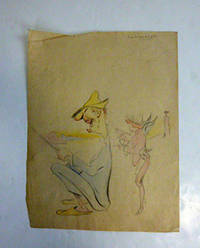
César Tripet fishing next to a contemorary Aphrodite. Original drawing.
Paris: circa 1907. Original color drawing. Ttiled. Marginal tear without loss.40 x 30.5 cm. The politician and cartoonist Marius Savignol 1866-1938 contributed to many early 20th Century satirical publications such as "L'Assiette au beurre " creating the character of César TripetExpertise by: Elvire Poulain-Marquis Cabinet Poulain Paris.Pharmacist and politician Savignol was also highly appreciated for his caricatures. He collaborated on the most important journals in this genre at the beginning of the 20th century such as Le Rire Le Sourire Les Galonnés etc. and also L'Assiette au Beurre for which from 1907 he created the character of César Tripet a disrespectful and humorous vagabond. The creation of this character earned him great admiration particularly from Nadar who became one of his great friends.Conseiller municipal de Saint-Lys de 1896 à 1904 et de 1919 à 1925 Maire de Saint-Lys; de 1907 à 1919; Conseiller d’arrondissement de 1907 à 1913 Conseiller Général du canton de Saint-Lys ;de 1913 à 1937 Sénateur de la Haute-Garonne de 1928 à 1938.Marius SAVIGNOL a apporté dans la satire politique une verve et un talent que rehaussent un certain courage et une forte conviction. Plusieurs de ses compositions ont eu un grand retentissement en France et à l'étranger. Il eut comme humoriste des débuts qui ne permettaient pas de prévoir l'allure que devait prendre ensuite son talent. Ce fut tout d'abord au Sourire et au Rire qu'il collabora. Mais il ne put s’accommoder longtemps du caractère futile de ces journaux où règne un esprit tout de convention où l'idée est rétrécie et dont les grands sentiments sont bannis.Le genre de l'Assiette au Beurre lui convenait mieux. Savignol trouva là un milieu plus favorable. Il fit plusieurs numéros de cette feuille : César Tripet Le Couac de Chante-Clair Le Syndicat des Ouvriers du Trône Le Drapeau. La création du personnage de César Tripet lui valut de sérieux encouragements en particulier l'amitié de Nadar qui marqua dès ce moment une véritable affection pour lui. Le Couac de Chante-Clair entraîna la saisie de l'Assiette au Beurre en Allemagne. Quelques mois plus tard on brûlait à la frontière espagnole un numéro spécial sur l'affaire Ferrer qui avait paru sous le titre La Question du Jour.L'artiste ne porta pas de chance aux Galonnés feuille satirique créée à Paris et dont on lui confia l'illustration. Elle vécut peu de temps.L'Assiette au Beurre ayant également disparu Savignol qui habite Toulouse se montra dès lors peu soucieux de collaborer aux feuilles parisiennes et se contenta d'envoyer ses satires politiques au Salon des Humoristes. Il exposait chaque année au Palais de Glace ; puis après la fusion à la Galerie La Boëtie.Au Palais de Glace il a donné des séries de dessins au crayon de couleur contre la guerre dont la vision le hantait. Il visait particulièrement celui qui devait provoquer la catastrophe Guillaume II auquel il consacra notamment son triptyque de 1913 : Ironie Farce Caprice. Ces dessins impressionnèrent le public ; les critiques étaient pour la plupart élogieuses cependant le triptyque déplut à certains en particulier au Courrier Européen de M. Charles Paix-Séailles au procès duquel vers la fin de la guerre la presse rappela ce fait.En avril 1914 Savignol exposa une composition Byzance satire assez vive visant les leaders politiques de l'époque : MM. Briand Millerand Barthou Poincaré Barrès Clémenceau. Paris: circa 1907 unknown
Referentie van de boekhandelaar : 51-6258
|
|
|
Simon Read
Immersion. Drawing With Purpose. 9-29 September 2011
London UK: Eleven Spitalfields 2011. Exhibition Brochure. 8vo. French Fold Sheets 8 pp. Color Plates. Very Good. Scarce.Provenance: Suzaan Boettger. London, UK: Eleven Spitalfields, 2011. unknown
Referentie van de boekhandelaar : 68-7098
|
|
|
Savignol, Marius = Simon Marius Savignol (1866-1938)
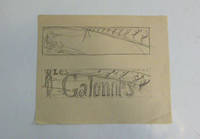
Design for the masthead of : Les Galonnés. Original drawing.
Paris: 1907. Two pencil drawings on one sheet for the masthead of the short lived journal. 23 x 28cm. . "L'artiste ne porta pas de chance aux Galonnés feuille satirique créée à Paris et dont on lui confia l'illustration. Elle vécut peu de temps." BNF dentifiant de la notice : ark:/12148/cb32779581p; OCLC Number / Unique Identifier:472406555.The politician and cartoonist Marius Savignol 1866-1938 contributed to many early 20th Century satirical publications such as "L'Assiette au beurre " creating the character of César Tripet.Expertise by: Elvire Poulain-Marquis Cabinet Poulain Paris.Pharmacist and politician Savignol was also highly appreciated for his caricatures. He collaborated on the most important journals in this genre at the beginning of the 20th century such as Le Rire Le Sourire Les Galonnés etc. and also L'Assiette au Beurre for which from 1907 he created the character of César Tripet a disrespectful and humorous vagabond. The creation of this character earned him great admiration particularly from Nadar who became one of his great friends.Conseiller municipal de Saint-Lys de 1896 à 1904 et de 1919 à 1925 Maire de Saint-Lys; de 1907 à 1919; Conseiller d’arrondissement de 1907 à 1913 Conseiller Général du canton de Saint-Lys ;de 1913 à 1937 Sénateur de la Haute-Garonne de 1928 à 1938.Marius SAVIGNOL a apporté dans la satire politique une verve et un talent que rehaussent un certain courage et une forte conviction. Plusieurs de ses compositions ont eu un grand retentissement en France et à l'étranger. Il eut comme humoriste des débuts qui ne permettaient pas de prévoir l'allure que devait prendre ensuite son talent. Ce fut tout d'abord au Sourire et au Rire qu'il collabora. Mais il ne put s’accommoder longtemps du caractère futile de ces journaux où règne un esprit tout de convention où l'idée est rétrécie et dont les grands sentiments sont bannis.Le genre de l'Assiette au Beurre lui convenait mieux. Savignol trouva là un milieu plus favorable. Il fit plusieurs numéros de cette feuille : César Tripet Le Couac de Chante-Clair Le Syndicat des Ouvriers du Trône Le Drapeau. La création du personnage de César Tripet lui valut de sérieux encouragements en particulier l'amitié de Nadar qui marqua dès ce moment une véritable affection pour lui. Le Couac de Chante-Clair entraîna la saisie de l'Assiette au Beurre en Allemagne. Quelques mois plus tard on brûlait à la frontière espagnole un numéro spécial sur l'affaire Ferrer qui avait paru sous le titre La Question du Jour.L'artiste ne porta pas de chance aux Galonnés feuille satirique créée à Paris et dont on lui confia l'illustration. Elle vécut peu de temps.L'Assiette au Beurre ayant également disparu Savignol qui habite Toulouse se montra dès lors peu soucieux de collaborer aux feuilles parisiennes et se contenta d'envoyer ses satires politiques au Salon des Humoristes. Il exposait chaque année au Palais de Glace ; puis après la fusion à la Galerie La Boëtie.Au Palais de Glace il a donné des séries de dessins au crayon de couleur contre la guerre dont la vision le hantait. Il visait particulièrement celui qui devait provoquer la catastrophe Guillaume II auquel il consacra notamment son triptyque de 1913 : Ironie Farce Caprice. Ces dessins impressionnèrent le public ; les critiques étaient pour la plupart élogieuses cependant le triptyque déplut à certains en particulier au Courrier Européen de M. Charles Paix-Séailles au procès duquel vers la fin de la guerre la presse rappela ce fait.En avril 1914 Savignol exposa une composition Byzance satire assez vive visant les leaders politiques de l'époque : MM. Briand Millerand Barthou Poincaré Barrès Clémenceau. Paris: 1907 unknown
Referentie van de boekhandelaar : 51-6255
|
|
|
Savignol, Marius = Simon Marius Savignol (1866-1938)
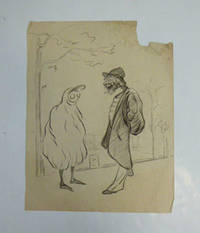
César Tripet standing next to a man dressed as a bird. Original drawing.
Paris: circa 1907. Original drawing. Loss in upper right blank corner.41 x 305cm. .The politician and cartoonist Marius Savignol 1866-1938 contributed to many satirical pulbications such as of "L'Assiette au beurre " creating the character of César Tripet.Expertise by: Elvire Poulain-Marquis Cabinet Poulain Paris.Pharmacist and politician Savignol was also highly appreciated for his caricatures. He collaborated on the most important journals in this genre at the beginning of the 20th century such as Le Rire Le Sourire Les Galonnés etc. and also L'Assiette au Beurre for which from 1907 he created the character of César Tripet a disrespectful and humorous vagabond. The creation of this character earned him great admiration particularly from Nadar who became one of his great friends.Conseiller municipal de Saint-Lys de 1896 à 1904 et de 1919 à 1925 Maire de Saint-Lys; de 1907 à 1919; Conseiller d’arrondissement de 1907 à 1913 Conseiller Général du canton de Saint-Lys ;de 1913 à 1937 Sénateur de la Haute-Garonne de 1928 à 1938.Marius SAVIGNOL a apporté dans la satire politique une verve et un talent que rehaussent un certain courage et une forte conviction. Plusieurs de ses compositions ont eu un grand retentissement en France et à l'étranger. Il eut comme humoriste des débuts qui ne permettaient pas de prévoir l'allure que devait prendre ensuite son talent. Ce fut tout d'abord au Sourire et au Rire qu'il collabora. Mais il ne put s’accommoder longtemps du caractère futile de ces journaux où règne un esprit tout de convention où l'idée est rétrécie et dont les grands sentiments sont bannis.Le genre de l'Assiette au Beurre lui convenait mieux. Savignol trouva là un milieu plus favorable. Il fit plusieurs numéros de cette feuille : César Tripet Le Couac de Chante-Clair Le Syndicat des Ouvriers du Trône Le Drapeau. La création du personnage de César Tripet lui valut de sérieux encouragements en particulier l'amitié de Nadar qui marqua dès ce moment une véritable affection pour lui. Le Couac de Chante-Clair entraîna la saisie de l'Assiette au Beurre en Allemagne. Quelques mois plus tard on brûlait à la frontière espagnole un numéro spécial sur l'affaire Ferrer qui avait paru sous le titre La Question du Jour.L'artiste ne porta pas de chance aux Galonnés feuille satirique créée à Paris et dont on lui confia l'illustration. Elle vécut peu de temps.L'Assiette au Beurre ayant également disparu Savignol qui habite Toulouse se montra dès lors peu soucieux de collaborer aux feuilles parisiennes et se contenta d'envoyer ses satires politiques au Salon des Humoristes. Il exposait chaque année au Palais de Glace ; puis après la fusion à la Galerie La Boëtie.Au Palais de Glace il a donné des séries de dessins au crayon de couleur contre la guerre dont la vision le hantait. Il visait particulièrement celui qui devait provoquer la catastrophe Guillaume II auquel il consacra notamment son triptyque de 1913 : Ironie Farce Caprice. Ces dessins impressionnèrent le public ; les critiques étaient pour la plupart élogieuses cependant le triptyque déplut à certains en particulier au Courrier Européen de M. Charles Paix-Séailles au procès duquel vers la fin de la guerre la presse rappela ce fait.En avril 1914 Savignol exposa une composition Byzance satire assez vive visant les leaders politiques de l'époque : MM. Briand Millerand Barthou Poincaré Barrès Clémenceau. Paris: circa 1907 unknown
Referentie van de boekhandelaar : 51-6261
|
|
|
Simon Read
Immersion. Drawing With Purpose. 9-29 September 2011
London UK: Eleven Spitalfields 2011. Card promoting exhibition. 8.25" x 5.75" Card Illustrated. Very Good. Scarce.Provenance: Suzaan Boettger. London, UK: Eleven Spitalfields, 2011. unknown
Referentie van de boekhandelaar : 68-7097
|
|
|
Middlesex University; Simon Read (ed)
Confluens Three. Plot.
Middlesex University 2008. 4to. Oblong. 56 pp. Mostly Color Plates. Very Good. Provenance: Suzaan Boettger. Middlesex University, 2008. unknown
Referentie van de boekhandelaar : 68-7085
|
|

 De zoekresultaten per email ontvangen
 Zoekresultaten downloaden als PDF
 RSS feed
 Permanente link


