|
|
|
AMODEO Fabio - CEREGHINO Mario Josè -
Lawrence d’Arabia e l’invenzione del Medio Oriente.
Milano, Feltrinelli, 2016, 8vo brossura con copertina illustrata a colori, pp. 205

|
|
|
Amritaswarupananda, Swami
Awaken Children : Dialogues with the Holy Mother
1992. Soft Cover. Good. Good Condition/318 pages - Conversations with Mata Amritanandamayi. HT2K504 paperback
Référence libraire : K504 ISBN : 1879410559 9781879410558
|
|
|
Anatole LEROY-BEAULIEU
L'Egypte et le contrôle anglais français. Extrait de la Revue des Deux Mondes
Extrait de La Revue des deux mondes | s. l. [Paris] 1882 | 15.50 x 25 cm | agrafé
Référence libraire : 19865
|
|
|
Anatole LEROY-BEAULIEU
Les réformes de la Turquie. La politique russe et le panslavisme. Extrait de la Revue des Deux Mondes
Extrait de La Revue des deux mondes | s. l. [Paris] 1876 | 15.50 x 25 cm | agrafé
Référence libraire : 18578
|
|
|
Anati Emmanuel
Anati Emmanuel. L'arte rupestre del Negev e del Sinai. Jaca Book. 1979 - I
Anati Emmanuel Anati Emmanuel. L'arte rupestre del Negev e del Sinai. Jaca Book. 1979 - I. Milano, Jaca Book 1979 - I italiano, in ottavo pp.78 + schede 20425 Anati Emmanuel. L'arte rupestre del Negev e del Sinai. Jaca Book. 1979 - I ed. in 8. Cartonato. pp. 78 + schede. Ill. in b.n. e a coll. n.t. e f.t. Molto buono.
|
|
|
André DUTERTRE - Gratien LE PÈRE - Louis-Pierre BALTARD
DESCRIPTION DE L'EGYPTE. Thèbes. Karnak. Vue intérieure et plan du grand Temple du sud. (ANTIQUITES, volume III, planche 54)
Imprimerie Impériale | Paris 1809-1829 | 71 x 54 cm | une feuille
Référence libraire : 23384
|
|
|
André DUTERTRE - Jean-Baptiste Prosper JOLLOIS - Jean Joseph François TASSAERT
DESCRIPTION DE L'EGYPTE. Thèbes. Karnak. Décoration intérieure de la porte de granit des propylées, sujets recueillis dans divers édifices. (ANTIQUITES, volume III, planche 47)
Imprimerie Impériale | Paris 1809-1829 | 71 x 54 cm | une feuille
Référence libraire : 23389
|
|
|
André DUTERTRE - Jean Joseph François TASSAERT
DESCRIPTION DE L'EGYPTE. Thèbes. Karnak. Détails de figures tirés des bas-reliefs de divers édifices. (ANTIQUITES, volume III, planche 67)
Imprimerie Impériale | Paris 1809-1829 | 71 x 54 cm | une feuille
Référence libraire : 23414
|
|
|
André REDOUTE - Jean Joseph François BALTARD
DESCRIPTION DE L'EGYPTE. Thèbes. Louqsor. Détails des colosses oriental et occidental placés près de la porte du palais. (ANTIQUITES, volume III, planche 13)
Imprimerie Impériale | Paris 1809-1829 | 71 x 54 cm | une feuille
Référence libraire : 35407
|
|
|
ANDONIAN (Aram)
Exile, trauma and death. On the road to Chankiri with Komitas Vartbed.
London, Gomidas Institute, 2010. In-8 broché, XIII-186 pp., portrait en noir dans le texte, index. (Trilogy-April 24, 1915, 1).
Référence libraire : 555592
|
|
|
André GERVAIS
Sentinelles du désert (le territoire des oasis)
Fernand Sorlot | Paris 1939 | 12 x 18.50 cm | broché
Référence libraire : 69381
|
|
|
Andersen, Roy R.; Seibert, Robert F.; Wagner, Jon G.
Politics and Change in the Middle East : Sources of Conflict and Accommodation
May show some minor shelf wear, pages clean, bright and tight. Good copy. Used
|
|
|
Andishmand, Muhammad Ikram ; Bunyad-i Shahid Mas'ud
Subh-i kazib : naqd va barírasi-i chihrahíha-yi `uryan-i Hikmatyar
Small octavo in color illus paper backed boards; 258 p., bibliographical references (p. 253-258); 21 cm. In Persian, some in Pushto. // Hikmatíyar, Gulbiddin, 1947- Dasayis-i pinhan-i chihrahíha-yi `uryan. Afghanistan -- Politics and government -- 1973-1989. Afghanistan.
|
|
|
Andrae Walter
Die Festunwerke Von Assur Textband + Tafelband
Mm 255x360 Opera in due volumi,. Volume I, TextBand, pp. VII-180 con 302 illustrazioni nel testo e su 110 tavole fuori testo. Volume II, Tafelband, 108 tavole anche più volte ripiegate contenenti 67 cromolitografie e 41 fototipie. Firma di appartenenza alle sguardie ed ai frontespizi, rilegatura in mezza pelle, piatti originali conservati all'interno. Weighing over 5 Kg. orders need extra shipping Opera in buonissime condizioni. SPEDIZIONE IN 24 ORE DALLA CONFERMA DELL'ORDINE. WORLDWIDE DELIVERY
|
|
|
Andreae, Samuel (praes.) / Jordis, Johann Philipp (resp.).
Disquisitio historico-physica de sepulcro Muhammedis. Marburg, Salomon Schadewitz, 1680.
4to. 32 pp. Modern green morocco. Second edition of this dissertation about the grave of the Prophet Muhammad, first published in 1677, including a description of the location of Mecca (where the grave was believed to be situated) and an account of the Prophet's body being preserved in a box of iron, levitated in mid-air by magnetic forces. - The Danzig-born theologian Samuel Andreae (1640-99) had taught Greek, Philosophy, Rhetorics, and History before settling at the Hessian university of Marburg, where he served as professor of Theology and head of the university library. Several of his academic works offer a historical slant on Biblical topics. The physician Johann Philipp Jordis (1658-1721/25) studied in Utrecht and practised in Frankfurt from 1685 onwards. - Browned throughout due to paper. No copy in America, according to OCLC. VD 17, 12:142174N. OCLC 67857720.

|
|
|
ANDREAS MEIER.
Politische Strömungden im modernen Islam. Quellen und Kommentare.
Fine German Paperback. Cr. 8vo. (20 x 13 cm). In German. 220 p. Politische Strömungden im modernen Islam. Quellen und Kommentare. Political trends in modern Islam. Sources and comments.
|
|
|
Andreossy, [Antoine François].
Constantinople et le Bosphore de Thrace, pendant les années 1812, 1813 et 1814, et pendant l'année 1826, avec un atlas composé de six planches gravées, et de quatre paysages lithographiés. Paris, Théophile Barrois & Benj. Duprat, J. S. Merlin, 1828.
8vo. (4), XLIV, 525, (1) pp. Contemporary half calf with giltstamped spine title. With the folio atlas: 6 engr. maps and plans and 4 lithogr. views. Contemporary half calf over marbled boards, with original printed wrapper cover on upper cover. First edition, text and atlas together. Descended from a family of canal builders, Antoine François Conte Andreossi (1761-1828) served at the French embassy in Constantinople from 1811 to 1814, when he was recalled to France by Louis XVIII, much to the dismay of the local French community. Some of the plates show his beloved waterways and fountains; they also include a view of the Hippodrome and Mosque of Sultan Ahmed. - Slight worming to hinges of atlas; old stamp to first engraved plates. Bookplate of Dr. Th. Weber (no. 518). Atabey 22. Blackmer 33. Weber I, 154f. Brunet I, 276. Graesse I, 122. Not in Aboussouan.
|
|
|
Andrews, F. David (Ed.)
The lost peoples of the Middle East. . Documents of the struggle for survival and independence of the Kurds, Assyrians and other minority races in the Middle East.
Salisburg, NC, Documentary Publications, 1982. Original Cloth-Volume (gilt Lettering on the Spine). No Dust-jacket. Ex-Library-Copy. Library-Sticker on the Spine. Library-Stamp [dropped out] berso Title. No Markings in the Text! No Underlinings! No private Owner's Note! Cover only with small Signs of
Référence libraire : 40193BB ISBN : 897121015
|
|
|
Andrés, Juan.
Confusione della setta macomettana: dalla quale s'intende l'origine di Macometto, & suoi fatti, et la falsa, et stolta dottrina da lui ritrovata. Venice, Gio. Battista Ugolino, 1597.
8vo. 71 ff. (lacking final blank). All edges sprinkled in red. Contemporary limp blue boards. Last Italian edition of the 16th century: a famous account of Islam (with a life of the Prophet Muhammad) given by a Muslim convert to Christianity, first published in Spanish in 1515 and frequently reprinted and translated. The author gives his former name only as Alfaqui ibn Abdallah from Játiva near Valencia in Spain; he flourished 1487-1515. - Some browning and brownstaining throughout due to paper; a few pages waterstained; old ink notes to title page (some ink corrosion). Rare; only two copies in WorldCat (Paris-BnF and Mazarine); four in Italy (Venice, Prato, Modena, Messina); none in the U.S. Edit 16, CNCE 1728. Chauvin XII, p. 21, no. 83. Göllner 2280. I.A. 105.567. Palau 12175 (note). OCLC 800261833.

|
|
|
Angèlio da Barga (Bargaeus), Pietro.
[Syrias.] Hierosolyma hoc est expeditio illa celeberrima Christianorum principum, qua Goffredo Bulione duce à Turcarum tyrannide Hierusalem liberatur. Florence, Giovanni Donato, Bernardino Giunta, & Soc., 1616.
4to. (26), 496, (2) pp. With woodcut printer's device to t. p. and several historiated initials. Contemporary limp vellum with ms. spine title "Carmina Barge". Epic poem on the events of the first crusade (1486-99), led by Godfrey of Bouillon. The work was written at almost the same time as Tasso's like-themed "Gerusalemme Liberata": while this is the first edition under the title "Hierosolyma", it was actually already published in Paris in 1582 (bks. 1-2) and 1584 (bks. 3-4), then in Rome in 1585 (bks. 1-6), and finally, in all 12 books, separately in 1591 under the title "Syrias" (cf. Brunet I, 288). Petrus Angelus Bargaeus (1517-92) was a scholar and professor at the universities of Pisa and Rome. - Rather strong brownstaining, occasional waterstaining. Some contemporary underlining and ms. line-numbers supplied throughout. OCLC locates single copy in America (Houghton Library, Harvard). BMC 5:448. NUC 16.619. Bruni/Evans 232. OCLC 82107113. Cf. Brunet I, 288.

|
|
|
Annales du levant
Annales 3 du levant / C.I.R.I.M.O et E.R.S.I - Industrialisation au Moyen-Orient : Flux et reflux avec un entretien avec Ghassan Tueni
1 volin-8 broché - 130 pages - 1988
Référence libraire : 39132
|
|
|
ANN K. S. LAMBTON.
Atebetü'l-Ketebe'ye göre Sancar Imparatorlugunun yönetimi. [Separatum]. Translated by N. Kaymaz.
Very Good English Paperback. Pbo. Roy. 8vo. (24 x 17 cm). In Turkish. 365-394 pp. Atebetü'l-Ketebe'ye göre Sancar Imparatorlugunun yönetimi. [Separatum]. Translated by N. Kaymaz.
|
|
|
ANNEMARIE SCHIMMEL.
Dinler tarihine giris.
Fine English Paperback. Demy 8vo. (21 x 15 cm). In Turkish. 327 p. Dinler tarihine giris. Introduction to history of religions. MIDDLE EAST Religious history Islam Mesopotamia.
|
|
|
ANONYME
La mer Rouge et le golfe persique. Extrait de la Revue des Deux Mondes
Extrait de La Revue des deux mondes | s. l. [Paris] 1844 | 15.50 x 25 cm | agrafé
Référence libraire : 15601
|
|
|
Anonyme
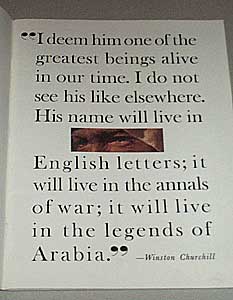
Lawrence of Arabia
Colombia Pictures Plaquette 1962 Plaquette in-4 agraffée, 32 pp avec des photos noir et blanc et des vignettes contre-collées couleur, plaquette en anglais imprimée à la sortie du film de David Lean et Sam Spiegel, agraffes rouillées à l'intérieur, petites traces de rouilles au feuillet du milieu sans gravité, une pliure sur une des vignettes contre-collées hors texte, très bon état Livraison a domicile (La Poste) ou en Mondial Relay sur simple demande.
Référence libraire : bb1238
|
|
|
ANONYME
Les interprètes civils en Algérie
La Revue des deux mondes | Paris 1882 | 15.50 x 25 cm | agrafé
Référence libraire : 20045
|
|
|
ANONYME
Une excursion à Biskra. Algérie. Extrait de la Revue des Deux Mondes
Extrait de La Revue des deux mondes | s. l. [Paris] 1879 | 15.50 x 25 cm | agrafé
Référence libraire : 18839
|
|
|
Anonimo
I casi del Santo Sepolcro – il macello del 4 novembre 1901 – episodio di politica orientale
Buona copia
|
|
|
ANONYMOUS.
[MANUSCRIPT / TULIP OF CONSTANTINOPLE / PENONCUL DE TURQUIE] Çiçek bagçeciligi. [i.e. The flower gardening].
Very Good Turkish, Ottoman (1500-1928) Original notebook in marbling wrappers. Slight chippings on the cover's extremities. Demy 8vo. (21 x 16 cm). In Ottoman script (Old Turkish with Arabic letters) text with Latin titles. [84] blank pages, color, and b/w ills. Scarce, richly illustrated Ottoman and a rare botanical manuscript on gardening, featuring as well the European flower cultivation of Turkish and Middle Eastern flowers. The manuscript starts with an introduction on gardening and floriculture and mentions trees and proper soils, tree and flower planting methods, pine trees, etc. In the "flowers" section, detailed descriptions on floriculture of Daisy, Begonia, Chrysanthemum, Dianthus, Hydrangea, Souvenir de la Malmaison, Oeillet Marguerite, Geant de Nice, Nicotinia, Generaria, Frimula, Calcealaire, Hyacinthus, Istanbul Lâlesi [i.e. Tulip, or Pauble de Constantinople], Albus, Bulbocodium, Bicalor Empress, Bicalor Emperor, Penoncul, Freesia, Ixia [i.e. Lillies], Cyclamen, Glaieul colvillei, Sparaxis, Cycl. Persicum, Iris, Azalea, Giroffe, Lobelias, Meuflia (Snapdragons), Silene, Gloximia, etc. and 19 numbered illustrations which are hand-drawn in color and b/w show the gardening and decorative elements in English and French styles.
|
|
|
Anouchirevan Khan Sepahbodi, Persian Minister in Berne.
Autograph Quotation signed. In Arabic. No place or date.
Folio. 1 page. On uncut wove paper, bearing the Schoellers-Parole blind embossed seal, margins uncut. The original autograph contribution of Anouchirevan Khan Sepahbodi to the Committee of the World League for Peace (Ligue Mondiale pour la Paix), a remarkable organization formed in 1925 with close ties to the League of Nations. The Committee itself was composed of such notaries as Queen Elizabeth of Belgium, King Carol II of Romania, John D Rockefeller, Marie Curie, and Albert Einstein, who personally gathered the present manuscripts over the course of seven years (1925-32). Among the public figures who contributed to the project were dignitaries from the newly-created League of Nations' member states. "Peace is the foundation for the prosperity of the world. [Signed] Anouchirevan Khan Sepahbodi". Sepahbodi was Envoy Extraordinary and Minister Plenipotentiary of Persia at Berne. Pax Mundi. Livre d'or de la paix. Enquete universelle de la Ligue mondiale pour la paix sous le haut patronage de son comite d'honneur avec l'approbation de la Societe des nations, du Bureau international du travail et de la Cour permanente de justice internationale. Geneve, Societe paxunis, 1932.

|
|
|
Ansari Shirazi, Ali ibn Husayn [Zayn-e-Attar].
Ikhtiyarat-i Badi'i [Selections for Badi'i]. [India, 1666/67 CE =] 1077 H.
Tall 8vo (158 x 288 mm). Persian manuscript on paper. 278 ff. Nastaliq text in black and occasional red ink, handsomely ruled in red and blue, with occasional marginal notes and further ownership notes on exterior leaves. Modern blank endpapers. Bound in full 20th century red ochre leather, stamped in blind. One of the most important books on pharmacology written in Persian in the Islamic era. Ansari Shirazi (1329-1403) was a famous physician of the Mughal period, serving at the court of Sultan Jalal ud-Din Shah Shuja (1333-84). During Ansari Shirazi's years at court the Sultan was a patron of the poet Hafez (1325-90), icon of Persian poetry, whom Ansari Shirazi would have known personally. Another esteemed acquaintance appears in the title of this particular book, "Selections for Badi". The work is dedicated to a woman, allegedly a Persian princess named Badi al-Jamal about whom little is known. - The work itself is a gem of Persian medical literature: scholars have claimed that "in the history of Persian medicine, the book 'Ikhtiyarat Badiei' is considered the most important book written in Persian", citing the large number of sources and remedies it provided the mediaeval reader, though some irrational fallacies are noted as well: "In three entries in Ikhtiyarat Badiei, the author has illustrated some superstitious ideas, namely that 'If the food is poisonous, and the weasel finds out, it will shout and its hair will stand on its end' and says: 'looking at zebra is good for the eyesight'" (Ghazi Sha'rbaf, 99). - The scribe responsible for copying the text was Muhammad Qasim Quraishi Siddiqui, who is known to have been active in India in the 17th century. A few minor stains and soiling; altogether a well-preserved and vital piece of Persian scientific history. Cf. Javad Ghazi Sha’rbaf et al., "Introducing the Book Ikhti-yarat Badiei: An Investigation Over its Importance in the Pharmacology of the Islamic Period", in: Journal of Research on History of Medicine 9.2 (2020), pp. 95-102.
|
|
|
Antoine ARGOUD
La Décadence, l'Imposture, et la Tragédie
Fayard | Paris 1974 | 15.50 x 23.50 cm | broché
Référence libraire : 79237
|
|
|
Antoine-Joseph DU CAURROY
Législation musulmane sunnite, rite hanèfi
Imprimerie Nationale | Paris 1848 | 13 x 21 cm | Relié
Référence libraire : 90552
|
|
|
Antes, John.
Observations on the Manners and Customs of the Egyptians, the Overflowing of the Nile and its Effects. London, Stockdale, 1800.
4to. 139, (5) pp. With folding engr. map. Later cloth. First edition. - Includes observations "on the Plague in Egypt", "on the Overflowing of the RIver Nile, and the Qualities of its Water", "on the Climate and Seasons of the Year in Egypt", and "on the Situation of Egypt relative toi commercial Advantages", as well as "A Specimen of Turkish Justice, or, rather, of that of the Mamelucks in Egypt". John Antes was a missionary of the Moravian Church resident in Egypt from 1770 to 1781. He "produced this work in answer to those of Savary and Volney" (Blackmer). - Some foxing to title page. This copy is from the collection of the author's descendants, with several inscriptions on the flyleaf. Later in the Ottoman collection of the Swiss industrialist Herry W. Schaefer. Atabey 25. Blackmer 36. Ibrahim-Hilmy I, 38. Blake 16. OCLC 4415058.

|
|
|
Anthony, John Duke.
Arab States of the Lower Gulf: People, Politics, Petroleum. Washington D.C., The Middle East Institute, 1975.
8vo. X, 273, (1 blank) pp. With two black and white maps on the endpapers. Brown cloth with publisher's illustrated dust jacket. First and only edition of a thorough description of the history of the nine Arab states of the Lower Gulf, that gained independence in 1971, just four years before the publication of this book. The author has managed to discuss the individual politics of each state and that of the bigger picture, making this a handbook for all who wish to learn more about Bahrain, Qatar and the United Arab Emirates (Ajman, Dubai, Fujairah, Ras Al Khaimah, Sharjah and Umm Al Quwain). The several infographics that are used to explain the political structures are very helpful in this respect. Oil plays a key role in the relationship between the individual states and this is intricately laid out by the American author. Because this book was written in such a key moment in the history of the region, it has gained much importance. The author Dr. John Duke Anthony is a leading figure in United States-Arab relations and has held many influential government positions in this field. Amongst others, he is the founder and president of the National Council on U.S.-Arab Relations and he is part of the United States Department of State Advisory Committee on International Economic Policy's Subcommittee on Sanctions. He holds a Ph.D. in International Relations and Middle East Studies at the School of Advanced International Studies. In the years leading up to this publication the author has conducted first-hand research on the Lower Gulf region's political and socio-economic structures, obviously with oil playing a major role. The fruits of this research are presented in this book, offering the reader a comprehensive overview of a complex subject. This book was published in The James Terry Duce Memorial Series, which started in 1966. The first and second volumes were on North Africa and Jerusalem respectively, this is the final volume of the series. - Ink annotations in the margins throughout. A good copy with the original dustjacket well preserved. OCLC 1700964.
|
|
|
Antonius, George
The Arab awakening : the story of the Arab national movement
Quarto pale clay (orange-brown) cloth; 471 pages : maps (some folded) ; 23 cm An important work || Nationalism -- World War, 1914-1918 -- 1800-1918 : Middle East -- History -- 19th century. Arabian Peninsula.
|
|
|
Antony Bluett
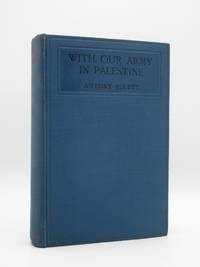
With our Army in Palestine
London: Andrew Melrose Ltd 1919. 1st Edition . Hardback. Printed pages: xi 288. Very Good Plus. 5.5 x 7.75 inches 13.5 x 20 cm. Blue cloth binding. Light foxing to page edges tanning to free endpapers. Patches of foxing to pages facing plates otherwise clean throughout. Complete with all 9 photographic plates. Overall condition is Very Good Plus. Size: 5.5 x 7.75 inches 13.5 x 20 cm. Andrew Melrose Ltd hardcover
Référence libraire : 1206T060
|
|
|
APONTE Salvatore
La vita segreta dell'Arabia felice
in 8°, pp. 172, leg. in m/pelle con angoli, ds. a nervi con tit. in oro, piatti in carta marmor. Interessante racconto del viaggio in automobile attraverso l'Arabia e lo Yemen dell'A., giornalista e corrispondente, con 72 foto d'epoca in tavv. f.t.; lievi fior. Non comune. 302/28

|
|
|
Après de Mannevillette, Jean-Baptiste d' / Dalrymple, Alexander.
A Brief Statement of the Prevailing Winds, from Monsieur d'Apres de Mannevillette. [London], 1782.
4to. 22 pp. Stitched, untrimmed. First edition of a rare pamphlet on the monsoon winds in the Indian Ocean, of crucial importance for East India Company ships sailing to and from the East Indies. - As Dalrymple states in the introduction, the text for the pamphlet has been translated by him from Jean Baptiste d'Après de Mannevillette's "Mémoire sur la navigation de France aux Indies". Dalrymple had extensive correspondence with Mannevillette, hydrographer to the French East India Company and Dépôt de la Marine, from 1767 to 1780, much of which is preserved in Paris in the Archives nationales and the Bibliothèque de l'institut de France. Dalrymple had such high regard for d'Après - the author of the "Neptune Oriental" in 1745, at the time the most authoritative work on oriental navigation - that he often sent charts for comment and inclusion into his work, as the following letter attests: "You have full consent to make what use you please of the Charts I have sent you [...] You will undoubtedly find many mistakes which escaped my observation; And therefore you will do me a favour in communicating your remarks to me" (10 Nov. 1772). In the present work Dalrymple has augmented the d'Après text with information from a Mr. William Woodville of Liverpool, and a Captain Jones of the ship Mary, "whom we met at Grenville 5th June 1775, to the Westward of Sierra Leon. It is obvious Mr Woodville's Account differs considerably from M. D'Aprés but I cannot presume to decide who is right". - The extract not only shows Dalrymple's continuing quest for any and all sources of information regarding a passage to the East Indies, and the rather ad hoc nature in which he obtained it, but also his willingness to question Mannevillette's findings, at the time the leading authority on such matters. - Some waterstaining to title with marginal fraying. Rare: we are only able to trace one other example appearing at auction since the war (Sotheby's, the Franklin Brooke-Hitching sale 2014). ESTC T74284.
|
|
|
Après de Mannevillette, Jean-Baptiste d'.
A Chart of the Red Sea from Geddah to Suez, According to the General Chart of Mr. d'Apres de Mannevillette, Corrected and Improved From the Surveys Made by Mr. C. Niebuhr in 1762 and 1763. London, Robert Sayer & John Bennett, 1781.
Engraved map. 60 x 84 cm. Constant ratio linear horizontal scale ca. 1:1,500,000. With insert maps: "A Plan of the Harbour of Suez" and "A Plan of the Harbour of Tor". Rare map covering the Red Sea from Jeddah in the south to the Gulf of Suez in the north. Published as part of Robert Sayer's "Complete East-India pilot or Oriental Navigator" (1778ff., subsequently reissued by Laurie & Whittle), it is based on D'Après de Mannevillette's "Neptune Oriental" (1745), incorporating information gleaned from the 1762-63 surveys of Carsten Niebuhr. - A few professionally repaired edge tears. OCLC 733624449.
|
|
|
Après de Mannevillette, Jean-Baptiste d'.
Routier des côtes des Indes Orientales et de la Chine. Paris, Ch. J. B. Delespine, 1745.
Large 4to (203 x 260 mm). (6), LVIII, 254, (2) pp. Title-page printed in red and black. With an engraved headpiece. Contemporary full calf, spine rebacked and gilt to style. Leading edges gilt, all edges sprinkled in red. Marbled endpapers. Extremely rare pilot guide to the East Indies, reduced to a single quarto volume from the author's great "Neptune Oriental", published simultaneously. One of the greatest maritime atlases in the history of French cartography, the "Neptune" was devoted to exotic regions (the Middle East including the Gulf, the African coasts, the Indian Ocean and East Indies, Southeast Asia, parts of the Chinese coast, and the Pacific islands). It was compiled by Jean-Baptiste-Nicolas-Denis d'Après de Mannevillette (1707-80), hydrographer to the French Navy, supported by the French East India Company and the Académie des Sciences. "It was at once hailed as a major achievement and welcomed by navigators throughout the world" (Cat. Nat. Mar. Mus.). Of the present text-only reduction, OCLC lists no more than nine copies worldwide, only one of which in the the U.S. (University of Chicago). - Corners bumped; modern spine gilt in 18th-century style. A good, wide-margined copy. Provenance: 1) From the library of Sir Francis Lindley Wood, 2nd Baronet, of Barnsley (1771-1846), with his bookplate on the pastedown. 2) By descent to his son Charles Wood, 1st Viscount Halifax (1800-85), sometime Chancellor of the Exchequer, with handwritten ownership on the flyleaf. As President of the Board of Control of the English East India Company, Sir Charles Wood was instrumental in spreading education in India. 3) Acquired from the Portuguese trade. Jöcher/Adelung II, 622. OCLC 41102601. Not in Cordier (Sinica), Brunet, Graesse, etc.

|
|
|
Arab Bureau, Baghdad.
Arab Tribes of the Baghdad Wilayat. Calcutta, Superintendent Government Printing, 1919.
Folio (212 x 335 mm). (2), 276, IX, (1) pp., final blank, with one folding plate (counted as p. 152). Contemporary half cloth with original printed boards, issued thus. Gertrude Bell's personal copy of this excessively rare manual on the social, political and economic structures of the Arab tribes living in the Baghdad Vilayet (Province) as drawn up in July 1918, only months before the partitioning of the Ottoman Empire ended the old administrative divisions and led to the formation of several new states - indeed, to the creation of the modern Arab world. - Arranged alphabetically by the names of the tribes, this handbook - essentially a carefully compiled and redacted British intelligence file printed for the use of British Political Officers and their assistants in a region then undergoing dramatic upheavals - offers surprisingly detailed information on the tribes' origins, loyalties and internal quarrels, the locations of their settlements, strength of their possessions, economic and bargaining power, as well as their kinships, often including genealogical tables. The names of the tribes' leaders are given in full, frequently also in the original Arabic. - Gertrude Bell (1868-1926), who had firsthand experience among the tribes, signed her name in pencil ("Gertrude Lowthian Bell") on the front free endpaper. Several neatly pencilled additions to some of the entries are likewise in her hand: next to the name Fahad ibn Hadhdal she notes that he died and the name of a "rival" (this underlined), apparently a "bin Dughaiyin" (p. 16). In another entry she notes that Jazza' ibn Mijlad "blockaded Turks in North for allies in 1st war" (p. 17) and that the A'marat prefer to winter near al-Hafan. There are several references to her fellow political officer, St John Philby, and a correction that the Al-Dulaim are "all Sunnis" (p. 265), and none Shi'ahs. - Gertrude Bell was a traveller, political actor, and archaeologist who was a key player in the nation-building after World War I, especially in Iraq. She founded the Iraq Museum, translated Persian poetry, and advised the British government's foreign policy at nearly the highest level. It is little surprise that she would have owned one of the few copies of this important source, containing otherwise nearly unobtainable population statistics as well as details on the political history of a region in which traditional tribal feuds became mingled with international high politics. Considering the limited scope of intended distribution and the sensitive nature of the information contained, it is safe to say that this invaluable compendium never had more than a very limited press-run; indeed; only three copies are known today in libraries worldwide, and none with such unique provenance. - Covers rubbed, title-page brittle and reinforced with two library stamps carefully removed but still faintly visible. A closed tear to the folding map. Later in the collection of the American missionary turned political biographer Harry J. Almond (1918-2007), with his handwritten ownership in ink next to Bell's own. In all very well preserved. No copy in auction records. OCLC: 921927074, 729268761.
|
|
|
Arabian American Oil Company.
Air Freight Manifest. Dhahran, February 1954.
Small folio (218 x 330 mm) and oblong 8vo. (3) pp. With typescript envelope. Freight manifest for a box of personal effects of Paul Stiehl, an employee of Aramco, shipped from Dhahran to New York. Signed by W. J. Kiefer. - The document includes a customs clearance authorization as well as a specification of the contents of the box signed by Stiehl. The shipment contained 4 prayer rugs, 12 towels, and 5 bed sheets. - Some rust spots. A unique survival.
|
|
|
Arabian American Oil Company.
Aramco at Fifty. The Commemorative Video of Aramco's Fifty Years of Achievement. No place, [1993].
53 min. Colour and black-and-white. NTSC VHS cassette. In original case. Promotional video celebrating Aramco's first 50 years in the oil business. The 53-minute film traces the development of the Arabian American Oil Company from the first team of engineers and researchers that braved the Saudi desert in search of oil in the mid-1930s to a company of 60,000 employees controlling a large share of the earth's reserves. Most valuable are early photos of exploration camps, regional topography, and the Arabian Peninsula before its development. The tape makes for a heroic tale, but as one might expect, fails to place American efforts in the larger context of oil exploration in the Arabian Peninsula, Iran and Iraq that began with the British in the 1890s and was joined by the Dutch, French and Americans in the next century. Briefly addressing the economics of oil and its effects on Saudi Arabia, the film prefers to concentrate on the good fortune and technological advances the oil boom brought to the kingdom. - The film premiered on Channel 3 on 29 May 1984, the anniversary of the Concession Agreement. - Very well preserved. OCLC 12825212.
|
|
|
Arabian American Oil Company.
Aramco Control Card. Ras Tanura, January 1961.
Oblong 12mo (57 x 89 mm). 2 pp. Permit to use retail services in the Ras Tanura Camp. Issued to Mrs. O. O. Thomas, the wife of Aramco employee Orlin Orace Thomas. - Slightly creased.
|
|
|
Arabian American Oil Company.
Aramco facilities in Saudi Arabia. Saudi Arabia, no date.
2 large black-and-white photographic prints, 260 x 360 mm. Matted (500 x 400 mm). Rare views of Aramco facilities in Saudi Arabia. The set comprises a fine aerial view of worker accomodation complexes in the Eastern Province, as well as a street view showing office and residential buildings. The mattes bear a giltstamped caption "Aramco Photograph". - Corners lightly bumped; images in excellent condition.
|
|
|
Arabian American Oil Company.
Aramco Handbook. Netherlands, Aramco, 1960.
Small folio (220 x 284 mm). (8), 343, (1) pp. With numerous black-and-white photographic illustrations, plans and charts. Contemporary full cloth with stamped title to cover and spine. Extensive handbook for employees of Aramco in the Middle East. The personal copy of Aramco official Robert King Hall, a director of training, with his handwritten ownership, dated Dhahran, June 1967, to title-page. - The work briefs American personnel for their service in an unfamiliar land, discussing the history of the Middle East as well as the development of the oil industry and the key role of Aramco. It includes observations on the Saudi government, the main cities and towns, and the climate, as well as "the culture and customs of the Arabs". The illustrations celebrate the advances of the modern oil industry and the achievements of Aramco, showing oil compounds and refineries as well as the harmonious collaboration of Americans and Saudis. Further images depict the rich Arabian culture in rugs and historical manuscripts, as well as desert landscapes and Middle Eastern wildlife, including falcons and horses. - Inner hinges broken, otherwise very well preserved. OCLC 1282106663.
|
|
|
Arabian American Oil Company.
Aramco World 1957 [and] 1959. New York, Aramco, 1957 & 1959.
Small folio (220 x 282 mm). 2 vols. 12 issues each. Contemporary full cloth with giltstamped title to cover and spine. Two complete year runs of the popular Aramco magazine. In November 1949 the Arabian American Oil Company launched "Aramco World" as an interoffice newsletter that linked the company's U.S. offices with "the field" - primarily Dhahran, in the Eastern Province of Saudi Arabia. The journal quickly grew into a monthly (later bi-monthly) educational magazine featuring historical, geographical and cultural articles that helped the American employees and their families appreciate an unfamiliar land. - The present collection comprises vol. 8, nos. 1-12, and vol. 10, nos. 1-12. - Heads of spine somewhat worn. Interior in excellent condition.
|
|
|
Arabian American Oil Company.
Aramco World Magazine. New York, Aramco, 1976.
Small folio (215 x 280 mm). 6 issues. Original printed wrappers. Stapled. Complete run of the popular Aramco magazine for the year 1976. In November 1949 the Arabian American Oil Company launched Aramco World as an interoffice newsletter that linked the company's U.S. offices with "the field" - primarily Dhahran, in the Eastern Province of Saudi Arabia. The journal quickly grew into a bi-monthly educational magazine featuring historical, geographical and cultural articles that helped the American employees and their families appreciate an unfamiliar land. - The present collection comprises vol. 27, issues no. 1-6. - Addressed to Michigan resident Florence E. Lostuzzi on verso.
|
|
|
Arabian American Oil Company.
Aramco World. New York, Aramco, 1960-1965.
Small folio (215 x 280 mm). 12 issues. Original printed wrappers. Stapled. Set of 12 issues of the popular Aramco magazine. In November 1949 the Arabian American Oil Company launched "Aramco World" as an interoffice newsletter that linked the company's U.S. offices with "the field" - primarily Dhahran, in the Eastern Province of Saudi Arabia. The journal quickly grew into a bi-monthly educational magazine featuring historical, geographical and cultural articles that helped the American employees and their families appreciate an unfamiliar land. - The present collection comprises vol. 11, no. 5; vol. 14, nos. 5-8; vol. 15, nos. 1-3 and 5-6; vol. 16, nos. 1 and 2. - 11 issues addressed to Michigan resident Florence E. Lostuzzi on verso.
|
|
|

 Recevoir par e-mail
 Télécharger en PDF
 Flux RSS
 Lien permanent


