|
|
|
The Arts of Islam. Ausstellungskatalog.
Hayward Gallery, London 1976. 396 S. mit 16 Farbtafeln, zahlr. Abbildungen u. 1 Karte. Gr.-8°. Kart. Gering berieben u. bestoßen. Gutes Exemplar.
Referenz des Buchhändlers : 8676
|
|
|
Thirteenth International Congress of Byzantine Studies, Oxford 1966. 3 brochures.
Oxford, 1966. 3 brochures in-8, 16, 19 et 151 pp., 1 pl. en noir dans le 3e vol.
Referenz des Buchhändlers : 556940
|
|
|
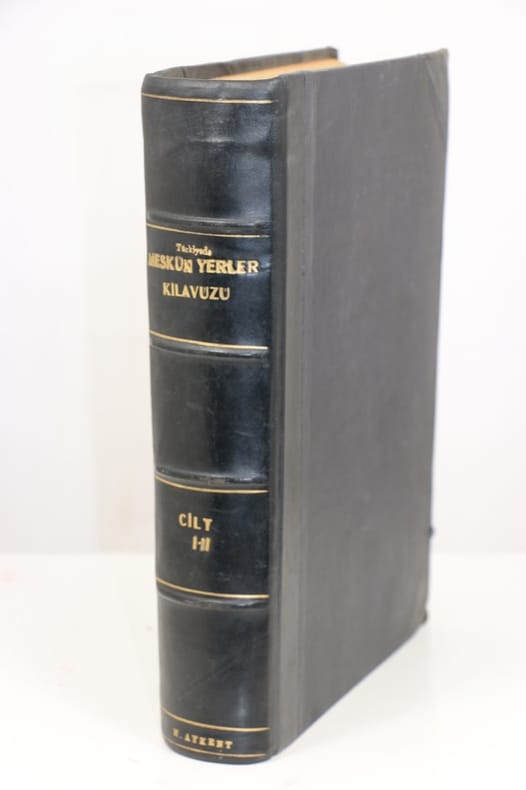
TÜRKYE'DE MESKUN YERLER KILAVUZU. Memleketimizin butun meskun yerlerini ve bunlarin idare baghklarini, Koy Kanunu tatbik éditent yerlerle Belediye....2 Cilt
Ankara, Basbakanlik Devlet Matbaasi, 1946. 2 parie en un vol. in-4, reliure demi-basane noire, plat de percaline noire, dos à 4 nerfs, 1234pp. texte en turc.
Referenz des Buchhändlers : 557608
|
|
|
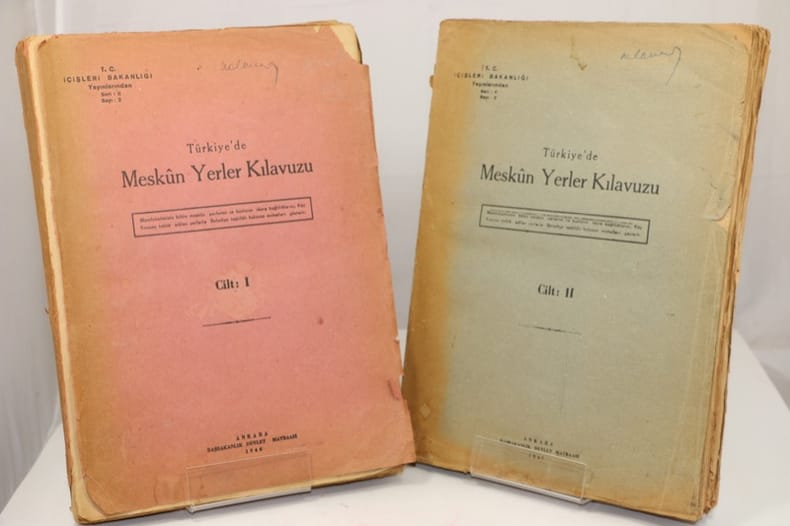
TÜRKYE'DE MESKUN YERLER KILAVUZU. Memleketimizin butun meskun yerlerini ve bunlarin idare baghklarini, Koy Kanunu tatbik éditent yerlerle Belediye....2 Cilt
Ankara, Basbakanlik Devlet Matbaasi, 1946. Deux parties en deux vol. in-4, broché, 1234pp. texte en turc.
Referenz des Buchhändlers : 557609
|
|
|
U.S. Army area handbook for Syria.
Washington, Dpt. of the Army, july 1965. In-8 broché, X-394 pp., bibliogr. (Dpt. of the Army Pamphlets, 550-47).
Referenz des Buchhändlers : 556229
|
|
|
XXIX Congrès International des Orientalistes. Résumés des communications.
Nogent sur Marne, impr. P. Roulland, 1973. In-8 br., 137 pp., index.
Referenz des Buchhändlers : 532764

|
|
|
Zeitschrift der Deutschen Morgenländischen Gesellschaft. Band 161, Heft 2. 2011.
Wiesbaden, Harrassowitz, 2011. Grand in-8 broché, pp.265-542, fig.
Referenz des Buchhändlers : 522807
|
|
|
'Abd al-Basit ibn Musá `Almawi / Sauvaire, H[enri].
Description de Damas. Traductions de l'Arabe. Paris, Imprimerie Nationale, 1895-1896.
8vo. 2 parts in 1 vol. (4), 318 pp. (4), 441, (1) pp. Modern red half morocco with giltstamped spine title; original blue printed wrappers bound within. First edition in book form ("Extrait du Journal Asiatique, 9. sér., v. 3-7, 1894-96"). The French scholar Henri Sauvaire (1849-96), a leading photographer and numismatic collector, served as a Consul in Damascus and Casablanca. He spent the last years of his life writing on Arab culture. In 1864 he embarked on translating into French the "Description of Damascus" by Abd al-Basit al-Amawi, who lived in Damascus in the mid-16th century (d. 1573/4). - Rare and well-preserved. OCLC 23427282.

|
|
|
'Abd al-Wahid al-Marrakushi / Dozy, Reinhart Pieter Anne (ed.).
(Kitab al-Mu'jib fi talkhis akhbar ahl al-Maghrib). The history of the Almohades, preceded by a sketch of the history of Spain, from the time of the conquest till the reign of Yusof ibn-Ta´shifi´n, and of the history of the Almoravides. Now first edited from a MS. in the Library of Leyden, the only one extant in Europe. Leyden, S. & J. Luchtmans, 1847.
8vo. XXII, 290, 8 pp. Contemporary full blue cloth with remains of a printed spine title. First edition. Entitled "The Book of Wonder, or the Summary of News of the Maghreb", this is the best-known work of the Moroccan historian 'Abd al-Wahid (1185-1250): a personal and at the same time neutral account of Almohad rule from its foundation to the 13th century, but also of the preceding dynasty of the Almoravids, with a summary of Al-Andalus history from the Muslim conquest until 1224. The book is written in a lighthearted spirit with many anecdotes; 'Abd al-Wahid explained that his intention was to inform and entertain the students in a summarized way since academic history books tend to be overly lengthy which can sometimes bore the reader. The work also contains valuable information about 'Abd al-Wahid's contemporary Ibn Rushd (Averroes), whom he may have known personally, as well as information directly taken from the Almohad archives, various princes and accounts of events that the author witnessed. A number of details point to Egypt as the place of writing, and the author himself states that he completed the work on 15 July 1224. Dozy's important edition of the Leyden MS. was republished in 1881. - Corners and spine-ends a little bumped. Occasional quite insignificant foxing; uncut and untrimmed as issued. Provenance: removed from the library of Carberry Tower, the Scottish castle mansion owned by the Elphinstone family from the 1860s to the 1960s, with bookplate and shelfmark to front pastedown. GAL I, 322. For Dozy's editions of historical texts on the history of Muslim Spain see Fück, p. 182.
|
|
|
(Abu Rashid Sa'id b. Muhammad b. Sa'id al-Nisaburi) / Biram, Arthur.
Kitabu 'l-masa'il fi'l-hilaf bejn al-Basrijjin wa 'l-Bagdadijjin. Al-kalam fi'l gawahir. Die atomistische Substanzenlehre aus dem Buch der Streitfragen zwischen Basrensern und Bagdadensern. Inaugural-Dissertation der hohen philosophischen Fakultät der Universität Leipzig zur Erlangung der Doktorwürde. Berlin, H. Itzkowski, 1902.
8vo. 82, (2), 89, (1) pp. Papered spine. Only edition of this study of Arabic atomism, tracing the dispute in mediaeval Arabic natural philosophy between the theologians of Basra and Baghdad. Includes the Arabic text. GAL S I, 344. OCLC 4391682.

|
|
|
(Al-Qazwini, Zakariya ibn Mahmud) / Ideler, Christian Ludwig (ed.).
[Aja'ib al-makhluqat.] Untersuchungen über den Ursprung und die Bedeutung der Sternnamen. Ein Beytrag zur Geschichte des gestirnten Himmels. Berlin, Johann Friedrich Weiss, 1809.
8vo. LXXII, 452 pp. Near-contemporary half cloth with giltstamped red spine label. Edges sprinkled in red and blue. First edition. - A rare and scholarly investigation of the Arabic origins of star names, incorporating the first edition (with a German translation) of the relevant part of the famous "Aja'ib al-makhluqat" by the astronomer Zakariya al-Qazwini (1203-83), which contains a description of the 48 constellations of Ptolemy and is hailed by Brockelmann as "the most valuable cosmography in Islamic culture" (GAL). Taking Qazwini's text as his guideline, the Prussian astronomer Ideler (1766-1846) provides a detailed commentary elucidating the respective Greek, Latin, oriental, and modern names of the stars. The final chapter is an essay on the Arabic nomenclature of celestial bodies, tracing the names' origins to the ancient nomadic Arabs (Bedu). Although Ideler was not an orientalist and claimed merely a scholarly working knowledge of Arabic, he had the advice of Oluf Gerhard Tychsen and Georg Beigel. The resulting text edition, translation and critical study were highly praised by Fück, who called the annotations "excellent". - Some browning throughout as common; professional repairs to spine. Old stamp and shelfmark of the Boston Arts Academy Library to title; handwritten ownership "J. Johnson / Jan.y 1930" to pastedown. Schnurrer p. 466f., no. 404. Fück 160 ("1810" in error). Kayser III, 248. OCLC 11828254. Cf. GAL S I, 882.
|
|
|
(Albertus, Fr[iedrich] Gottl[ieb]).
Die merkwürdige Lebensbeschreibung des unglücklich reisenden Uhrmachergesellen, welcher acht Jahre in der türkischen Sklaverey unter vielen Jammer und Elend zugebracht und endlich erlöst wurde. No place or printer, [c. 1806].
8vo. (16) pp. Modern marbled wrappers. Extremely rare German slavery account by the Prussian clockmaker F. G. Albertus. Born in Potsdam in 1770, he visited Amsterdam in 1797, was press-ganged into joining an East India Company ship bound for Batavia, but fell into the hands of Tunisian pirates off the coast of Gibraltar. He details the horrors of his eight-year slavery in North Africa and mentions several of his fellow sufferers by name, including a Spanish Countess named Carolina who was captured at age 16 and was finally ransomed after nine years of slavery. Ultimately, Albertus is ransomed by a Dutch jeweller named Birkenthal and returns to Germany, physically broken but full of praise for the workings of God. - Trimmed rather closely (slight loss to text). Title page bears contemporary censorship stamp of the Delitzsch police. Of the utmost rarity: a single other copy is known (bound within sammelband A/31581:9 in the State and University Library of Hamburg). OCLC 837821535 (SUB Hamburg).

|
|
|
(Amaduzzi, Giovanni Cristoforo) [ed.].
Catalogus librorum qui ex Typographio Sacrae Congreg. de Propaganda Fide variis linguis prodierunt et in eo adhuc asservantur. Rome, Typis Sac. Congreg. de Propaganda Fide, 1773.
8vo. 55, (1) pp. With woodcut printer's device on title page (Christ sending the Apostles forth to spread the Gospel). Unbound as issued. Very scarce catalogue of oriental books printed by the Propaganda Fide press. Pages 10-12 list no fewer than 28 publications in Arabic, many of which (such as Scialac's and Sionita's 1613 version of the "Doctrica Christiana") are still considered milestones of Arabic typography. Prints in other languages such as Chaldaean, Persian, Syriac, and Ottoman Turkish bear further witness to the unrivalled excellence of the Propaganda Press in the field of Middle Eastern typography. A first such catalogue had appeared in 1765; of this second, expanded edition OCLC lists no more than two copies (Tübingen and Copenhagen). - Well-preserved throughout. OCLC 465974789. Not in Besterman.
|
|
|
(Arabian Nights).
THE ARABIAN NIGHTS' ENTERTAINMENTS; Consisting of One Thousand and One Stories.
pp. viii, 568. Engraved half title and frontis damp stained. Text age stained. Lacks first fly leaf. All edges gold. Early inked ownership of E. B. Forney, 6th & Mass Ave., Washington, DC. Some signatures loose. 32mo. Original full cloth binding decorated and embossed with a figure in gold on front cover. Spine repaired. Binding very worn. Hardbound. An unusual little imprint. ISLAM BOX 2
|
|
|
(Assemani, Simone).
Spiegazione di due rarissime medaglie cufiche della famiglia degli Ommiadi appartenenti al Museo Majnoni in Milano. Milan, Giulio Ferrario, 1818.
Folio (244 x 341 mm). (12) pp. With 2 engravings (one in the text, one on the title). - (Bound after) II: (Schiepati, Giuseppe / Assemani, Simone). Descrizione di alcune monete cufiche del Museo di Stefano de Mainoni. Milan, Paolo Emilio Giusti, 1820. 136 pp. With 3 engraved plates. - (And) III: Reinaud, [Joseph Toussaint]. Lettre à M. le baron Silvestre de Sacy sur la collection des monuments orientaux de [...] comte de Blacas. Paris, Firmin Didot, 1820. 16 pp. Original pink printed wrappers. 8vo. All three within contemporary green boards with giltstamped red spine label. Collection of three rare studies falling within "the rarely-entered territory of Muslim archaeology" (cf. Fück, p. 153), comprising the two final works of Simone Assemani and the first publication of Joseph Toussaint Reinaud. - In 1818, the orientalist Assemani, well known as an authority on Kufic coins through his "Museo Cufico Naniano" (1787) and, more recently, his treatise "Sopra le Monete Arabe effigiate" (1809), published his "Spiegazione", a discussion of two rare Cufic coins in Stefano de Majnoni's collection. Subsequently, Majnoni called on Assemani to identify several additional coins and in 1820 requested him to check a catalogue of his collection compiled by Giuseppe Schiepati. When Schiepati published the second work here included, "Descrizione di alcune monete cufiche", it was found to contain many unacknowledged contributions by Assemani, as well as extracts from his "Museo Cufico Naniano". Also, Schiepati’s historical comments relied on, and indeed summarized, C. O. Castiglioni’s "Monete Cufiche dell’ I. R. Museo di Milano" (1819). A controversy arose, in the course of which Schiepati was accused of plagiarism - a matter exacerbated by the fact that Assemani had died in early 1821, at the age of 69. - The third work in the volume is a slim octavo brochure, composed by Reinaud as a letter to his teacher Silvestre de Sacy reporting on the Islamic collection of the French antiquarian and diplomat Pierre de Blacas (1771-1839). Eight years later Reinaud would publish his famous, lavishly produced two-volume catalogue "Description des monumens musulmans du cabinet de M. le duc de Blacas", which made his name. - Occasional insignificant browning; Reinaud's work untrimmed, the folio works printed on large paper retaining very wide margins. From the library of Jean-Baptiste Alexandre Billard de Saint-Laumer (1814-92) with his collection drystamp to title page of "Descrizione"; the three plates interleaved with smaller sheets bearing numbered annotations, likely in his hand. I: Leitzmann 5. Achat 11216. OCLC 84477158. - II: Leitzmann 124. Brunet V, 199. Graesse VI, 301; I, 240. OCLC 52651290. - III: Leitzmann 114. OCLC 229903535.
|
|
|
(Astley, John).
The Art of Riding, set foorth in a breefe Treatise, with a due interpretation out of certeine places alledged out of Xenophon, and Gryson, verie expert and excellent Horssemen: wherein also the true use of the hand by the said Grysons rules and precepts is speciallie touched: and how the Author of this present worke hath put the same in practice, also what profit men may reape thereby [...] Lastlie, is added a short discourse of the Chaine or Cavezzan, the Trench, and the Martingale: written by a Gentleman of great skill and long experience in the said Art. London, Henry Denham, 1584.
4to. (8), 79, (1) pp. With woodcut headpiece on t. p. and initials. 19th century orange-red crushed morocco by Riviere with leading edges gilt and elaborate gilt inner dentelle, rebacked. All edges gilt. The exceedingly rare first edition of one of the earliest English treatises on horsemanship, derived in part from Xenophon, Federico Grisone's "Ordini di cavalcare", and other authors, and in part from Astley's own experience. This is, in fact, the first translation into English of Xenophon's treatise "Peri hippikes" ("On horsemanship"). - The publication of Astley's "Art of Riding", perhaps his single most lasting achievement, came late in his life as an Elizabethan courtier. Here, he relays the doctrine of the Italian riding schools as he and other Gentleman Pensioners understood it, particularly on training the horse to respond to the hand. Astley was on friendly terms with Thomas Blundeville, whose Grisone translation two decades earlier counts as the first treatise on horsemanship to be published in English. - First three leaves slightly browned, with the upper right corner of each leaf imperceptibly restored from another copy; a closed tear to f. A4. Altogether a remarkable clean and crisp copy in an English master binding. The Fitzwilliam-Gloucester copy, bound with a common companion piece, Claudio Corte's "Art of Riding" (also published by Denham in the same year) commanded £14,400 at Christie's in 2006. The catalogue notes that the scarcity of these two work "at auction varies markedly; ABPC records some 5 copies of Corte's work at auction since 1975, but none of Astley's". Huth p. 11. STC 884. Mellon/Podeschi 12. Hoffmann III, 609 (s. v. Xenophon).

|
|
|
(Balbi, Gasparo). De Bry, Johann Theodor.
Indiae Orientalis pars septima [...]. Frankfurt, Wolfgang Richter, 1606.
Folio (210 x 319 mm). (4), 126, (4) pp.; 22 ff. Title within engraved figurative border. With an engraved vignette, 22 engraved plates (2 of which are double-page-sized). Contemporary brown calf with gilt borders and decoration on middle of covers; blindtooled spine rebacked. Traces of ties. Book seven of Théodore de Bry's "Petits Voyages", the greatest single collection of material on early voyages to the East Indies, which is considered unique in its extraordinary wealth of cartographical and visual material. Crucially, this much-sought volume includes Gasparo Balbi's groundbreaking account of the Middle East, first published in 1590 as "Viaggio dell' Indie Orientali" - a mere 16 years before this present issue, making this the second appearance in print altogether and the first Latin translation. Balbi, a Venetian jewel merchant, travelled extensively in the Arabian Peninsula in search of precious stones. From Venice he sailed for Aleppo, proceeding to Bir and from there overland to Baghdad, descending the Tigris to Basra, where he embarked for India. While in the Gulf, he studied the pearl industry, noting that the best pearls were to be found at Bahrain and Julfar. He refers to islands in the Emirate of Abu Dhabi (including Sir Bani Yas and Das) and to several coastal settlements that were to become permanently established, such as Dubai and Ras al Khaima. Balbi was the first to record the place names along the coast of modern Qatar, the United Arab Emirates and Oman. Practically "none of the names of places on the coast between Qatar and Ras al Khaima occur in other sources before the end of the eighteenth century" (Slot). The volume also comprises the account of Joris von Spilbergen's voyage to Ceylon in 1601-04 (with excellent plates). - Calf slightly worn, some browning due to paper. Title browned in the margins; some foxing to plates. Contemporary ownership inscription of Thomas Knyvett in upper margin of title (partly obliterated by a later owner), dated 27 June 1608; also inscribed "perlegi (I finished reading) 20 Octob. 1608 Tho. Kny." near lower edge of the title. Armorial bookplate and later ownership of "T. Norcliffe" on inside of upper cover. Thomas Knyvet, 1st Baron Knyvet (also Knevytt, Knyvett, Knevett, Knevitt; 1545-1622) was an English courtier and Member of Parliament who played a part in foiling the Gunpowder Plot. Latterly the library of Swedish antiquarian bookdealer Björn Löwendahl (1941-2013). Brunet I, 1334. Church 206, 207, 208, 211, 212, 214, 217, 219, 221-225. Cf. Howgego I, B7. Ibrahim Al Abed, Peter Hellyer. United Arab Emirates: A New Perspective. London 2001. Slot, B. J. The Arabs of the Gulf, 1602-1784. Leidschendam, published with the support of the Cultural Foundation Abu Dhabi, 1993. Geoffrey King. Delmephialmas and Sircorcor: Gasparo Balbi, Dalmâ, Julfâr and a problem of transliteration. In: Arabian archeology and epigraphy 17 (2006) 248-252. United Arab Emirates yearbook 2005 by Ibrahim Al-Abed, Paula Vine, Peter Hellyer. London 2005. The Heritage Library, Qatar, p. 17. Carter, Robert A. Sea of Pearls, p. 79.
|
|
|
(Bonfils, Félix).
Jerusalem. (Palestine, 1880s).
Oblong album (445 x 315 mm) with 71 large albumen photographic prints, mostly ca. 22 x 28 cm, signed and captioned in the negative (in French and English), mounted on both sides of the album's leaves. Includes a three-part folding panorama of Jerusalem from Mount Olivet, measuring 82 x 21 cms. Ornamental endpapers printed in gilt. Original auburn morocco with gilt upper cover. All edges gilt. A rare and unusually massive Palestine souvenir album containing 71 photographs by the renowned studio of Félix Bonfils (1831-85), the French-born photographer who had come to the Levant with General d'Hautpoul in 1860 and remained active in the East. Based in Beirut, Bonfils produced thousands of photographs depicting Palestine, Egypt, Syria, Greece and other parts of the Ottoman Empire. In the early days of western tourism to the Middle East, his works soon became popular as souvenirs. The photographs were available both separately and as individually arranged albums, but sets of this scope were uncommon, very few exceeding fifty images. The sumptuous binding which the owner chose underlines that this was a luxury souvenir for a more than ordinarily wealthy traveller. It features landscapes and city views, famous sights such as Jaffa Gate (Bab el-Khalil), sites sacred to the three religions (Church of the Holy Sepulchre, Church of the Flagellation, Al-Aqsa Mosque, Mosque of Omar, Wailing Wall), but also sights outside Jerusalem, including Hebron, Bethlehem, the Dead Sea, the River Jordan, Jericho, Wadi el-Kelt, Khan-el-Ahmar, Bethany, Nazareth, and Emmaus. - The photographs occasionally show some insignificant loss of contrast, but are altogether in good condition. A few edge flaws to the cardboard leaves, including a chafe mark across the lower edge where the paper has buckled. Binding in good condition, with occasional scuffing (more obvious on lower cover). A fine album of photographs of Palestine.
|
|
|
(Central Narcotics Intelligence Bureau). Russell, Thomas Wentworth (or Russell Pasha).
Annual report for the year 1932. Cairo, Government Press, 1933.
Small folio (27 x 18 cm). XVIII, 170 pp. (pp. VI and XVIII blank). With 14 sepia photographic plates, 1 folding facsimile letter, 2 folding graphs, a plate with 6 pie charts and 1 illustration (also in red) showing schematically a smuggling box. Original pink paper wrappers. Exceptionally rare work on drug trafficking in Egypt in the 1930s and an important example of the "war on drugs" of the author, who was director of the Central Narcotics Intelligence Bureau. Thomas Wentworth Russell (1879-1954), sometimes better known as Russell Pasha, was a police officer in service of Egypt who was appalled by the increasing drug trafficking in Egypt and the high amount of drug addicts in the country. He founded the Central Narcotics Intelligence Bureau (CNIB), making it his mission to rid Egypt of especially what he called "white drugs" (cocaine, morphine, heroin), but also of "black drugs" (hashish, opium). Russell can be considered as one of the most important anti-drug campaigners in Egypt in his time and after, as he really raised awareness for the rising problem. In this work, Russell describes how drugs are smuggled in large quantities from abroad to Egypt. In many chapters, he extensively describes the foreign sources of supply (discussing not only important drug barons, but also mentioning specific ships and other means of transport which smuggled drugs), cases in which weapons were used by traffickers, on people involved in the trade, on traffickers and their methods of smuggling (among others in shoes, camel saddles, etc.), on addiction and the social effects and death rates, and many more. It is a scarce and outstanding example of Russell's anti-drug campaign, extensively describing drug trafficking in Egypt in the 1930s, being well-illustrated with photographs of drug barons, users, traffickers and methods of concealment. - Presentation copy to the English poet and dramatist John Drinkwater with an inscription by Russelll on the front wrapper ("John Drinkwater / With compliments from the director / Tho Russell / 24/3/33" / [Arabic script]") and his red stamp next to the inscription. - Spine worn, front wrapper detached, covers with light residual dampstain. A highly uncommon survival. Not in WorldCat.
|
|
|
(Chiarello, Giambattista).
Historia degl' avenimenti dell' armi imperiali contro a' ribelli, et ottomani, confederationi, e trattati seguiti frà le potenze di Cesare, Polonia, Venetia, e Moscovia. Venice, Steffano Curti, 1687.
4to. (24), 575 (but: 577), (13) pp. With engr. title vignette, 6 folding engr. plates and folding engr. map. Contemp. Italian half vellum with giltstamped red spine label. All edges red. First edition of this rare chronicle of the Turkish wars of 1683-86, being an account of the imperial offensive against the Turks and their allies following the unsuccessful Turkish siege of Vienna in 1683 which led to the reconquest of Hungary and the capture of Buda in 1686. Includes an extensive account of the siege of Vienna, a fine map of Hungary, and plans of Vienna, Esztergom, Nové Zámky, Košice, Buda, and the bridge of Osijek. The second edition appeared in 1688 at the same press. - Some browning and brownstaining due to paper; occasional underlinings in red pencil. A very good copy. BM-STC Italian 225. Apponyi 1304. Kelényi 1162. Sturminger 966 & 3839. Not in Atabey.
|
|
|
(Cotta, P. Massimo).
[Kitab ul-muhatibat urtuduksijjah dadd bad il-itiqadat ir-rumijjah]. Dialoghi ortodossi contro alcune credenze greche. Uršulim (Jerusalem), Tubia fi dir ar-ruhban al-Fransiskanijjin (Tipografia dei PP. Minori Francescani), 1850.
8vo. 88 pp. With numerous woodcut head- and tailpieces. Original printed wrappers. Second, expanded edition; directed against erroneous teachings of the Greek Orthodox church in the Middle East. In Arabic throughout save for the preliminary matter. Dedicated to Giuseppe Valerga, the Latin Patriarch of Jerusalem from 1847 until his death in 1872. In 1868 he became Grand Master of the Order of the Holy Sepulchre. - Wrappers somewhat dust-soiled, otherwise very good. Exceedingly rare; only two other copies known (in the Bavarian State Library, Munich, and the Diocesan Library, Cologne). OCLC 162905370.
|
|
|
(Day, A. / Shearme, F. N. [eds.]).
Persian Gulf Pilot. Comprising the Persian Gulf and its approaches, from Ras al Hadd, in the South-West, to Cape Monze, in the East. Tenth edition. All bearings are true. London, Hydrographic Department, Admiralty / Lowe & Brydone, 1955.
8vo. (2), L, 312, (2) pp. With several maps and plates. Original cloth. "The Persian Gulf Pilot contains sailing directions for the Persian gulf and the approaches thereto, from Ras al Hadd, in the south-west, to Cape Monze, in the East". - Also includes copious information on politics, population, languages, trade, currencies, pearl fishery, meteorological information (climate, winds, weather, temperature, humidity), as well as currents, tides, communications and other miscellaneous information. - Binding rubbed and faded. Only two copies in auction records of the past decades (Peter Hopkirk's copy fetching £1,300 at Sotheby's, Oct 14, 1998, lot 1043). Hydrographic Office Publication 158. OCLC 709448977. Cf. Wilson 171.

|
|
|
(Day, A. / Shearme, F. N. [eds.]).
Persian Gulf Pilot. Comprising the Persian Gulf and its approaches, from Ras al Hadd, in the South-West, to Cape Monze, in the East. Tenth edition. London, Hydrographic Department, Admiralty / Lowe & Brydone, 1955.
8vo. (2), L, 312, (2) pp. With several maps and plates. Original cloth. "The Persian Gulf Pilot contains sailing directions for the Persian gulf and the approaches thereto, from Ras al Hadd, in the south-west, to Cape Monze, in the East". - Also includes copious information on politics, population, languages, trade, currencies, pearl fishery, meteorological information (climate, winds, weather, temperature, humidity), as well as currents, tides, communications and other miscellaneous information. - Binding slightly rubbed. Only two copies in auction records of the past decades (Peter Hopkirk's copy fetching £1,300 at Sotheby's, Oct 14, 1998, lot 1043). Hydrographic Office Publication 158. OCLC 709448977. Cf. Wilson 171.

|
|
|
(Dominicus Germanus de Silesia, OFM).
Antitheses fidei, ventilabuntur in conventu S. Petri Montis Aurei fratrum Minorum S.P. Francisci reformat[orum]. Rome, Congreg. de Propaganda Fide, 1638.
4to (227 x 163 mm). 1 bl. f., 66 pp. (counted as 43; numerous errors in pagination; some parts included in two variants). With woodcut title vignette. Contemporary limp vellum with ms. title to spine. Very rare polemical work, printed throughout in Arabic and Latin, that aims to compare and contrast Christian and Muslim scripture and doctrines. Dedicated to Cardinal Barberini. The editor Dominicus (1585-1670) taught Arabic at the Congregatio de Propaganda Fide since 1636 and collaborated on their Bible project. His magnum opus, one of the first literal Quran translations, was not rediscovered and published until 1883. In 1636 he published an Arabic grammar (the first publication of the Congregatio de Propaganda Fide press to use Arabic type); in 1639 he would produce a dictionary of vernacular Arabic. Four years in the Middle East had convinced him that a missionary must before everything else know the vernacular language (cf. Fück, p. 78). The present work was considered lost quite recently by Antonio García Masegosa in his study "Germán de Silesia, Interpretatio Alcorani Litteralis, Parte I: La traducción latina" (Madrid, 2009): "Por la misma época, publicó un tratado religioso en árabe y en latín titulado Antitheses fidei, que se encuentra perdido en la actualidad, o que al menos no ha podido ser localizado para este trabajo" (p. 14). - Marked brownstaining throughout with waterstain to upper corner. Still an appealing copy. Schnurrer 248. Encyclopaedia of the Qur'an IV, 237. OCLC 491545005, 54509800.

|
|
|
(El Khatib, Fathalla et al.).
British Imperialism in Southern Arabia. New York, Arab Information Center, November 1958.
8vo. (4), 86 pp. With 3 folding maps. Original printed wrappers. Informational publication issued by the New York Arab Information Center - The Research Section to argue the Arab cause among U.N. delegates, with contributions by Fathalla El Khatib, Khalid I. Babaa, Ism Kabbani and Omar Halig. Articles include "British Penetration and Imperialism in Yemen", "British Aggression Against the Imamate of Oman", and the "Buraimi Dispute". - Old ownership "M. Cain" to front cover; Arvada I.R.C. stamps. Information Papers Number 6.

|
|
|
(Hollandre, Jean Baptiste Antoine).
La Terre Sainte ou description des lieux les plus célèbres de la Palestine accompagnée du texte de l'Ecriture-Sainte relatif à chaque monument.
Louvain Vanlinthout et Vandenzande 1824. Hardcover. . ~ ~ NOTE: THE PRICE OF THIS BOOK IS CURRENTLY REDUCED! ~ ~ . Royal octavo. Two parts in one volume paginated continuously. Pp. ii 90; 91-356. Letterpress device to title-page Imprimatur dated 1824 on verso; half-title with Approbation dated 1818 on verso. List of subscribers. Footnotes. Printed on laid paper. HARDCOVER contemporary half cloth and marbled boards spine gilt with small shelf label all edges speckled old institutional stamps and label. In about fine condition. ~ Travel account to the Holy Land. Not in Tobler who lists the 1819 edition and the 1860 edition only. F-5 IN <br/> <br/> Louvain, Vanlinthout et Vandenzande hardcover
Referenz des Buchhändlers : 0830

|
|
|
(Hollandre, Jean Baptiste Antoine).
La Terre Sainte ou description des lieux les plus célèbres de la Palestine accompagnée du texte de l'Ecriture-Sainte relatif à chaque monument.
Louvain Vanlinthout et Vandenzande 1824. Soft cover. . ~ ~ NOTE: THE PRICE OF THIS BOOK IS CURRENTLY REDUCED! ~ ~ . Royal octavo. Two parts in one volume paginated continuously. Pp. ii 90; 91-356. Letterpress device to title-page Imprimatur dated 1824 on verso; half-title with Approbation dated 1818 on verso list of subscribers footnotes. Original printed wrappers slightly edge frayed. In a very good condition with contemporary Prize label in manuscript. ~ Travel account to the Holy land. This edition not in Tobler who lists the 1819 edition and the 1860 edition only. Z-3 IN <br/> <br/> Louvain, Vanlinthout et Vandenzande paperback
Referenz des Buchhändlers : 2118
|
|
|
(Kwiatkowski, Wojciech).
Polish Arabian Horses before the year 1940. No place, [ca. 1995].
Oblong 4to. 5 cloth-bound volumes with stamped titles, containing 253 original photographs mounted on cardboard with accompanying text. Extensive photo documentation of Polish Arabian horses, recording year of birth, ancestors, racing results, descendants, etc. - No copy in any library recorded in WorldCat or KVK. A fine, clean copy.
|
|
|
(Lowenstein, Fritz).
Das juedische Palaestina Das jüdische Palästina.
Jerusalem Keren Kajemeth Lejisrael 1927. Soft cover. . ~ ~ NOTE: THE PRICE OF THIS BOOK IS CURRENTLY REDUCED! ~ ~ . Small octavo. Pp. 48. Plus 2 extra pages with 3 photo-plates and 6 other such illustrations. With a folding line-drawn map tipped-in onto inside of back wrap. Appendices. Original decorated wrappers lettered in red with a woodcut illustration of a Holy Land landscape spine very lightly rubbed. In about fine condition. Excellent copy. ~ Second edition. A fascinating publication published by the Zionist Information Office of the Jewish National Fund and printed in Tel Aviv. Not a traditional traveller's guide to the Holy Places it is an invitation to visit the Zionist community in Palestine. It includes background information for visits in Jerusalem Tel Aviv and its region Haifa Valley of Yisrael Nazareth Afula Beth Shean as well as some newly established villages. Further there are detailed programmes for a three-day a five-day a week and two-weeks visits with advise what to do and where to go on each day. There is also a train timetable and a currency conversion table. The second part is the history of the Zionist Movement in Palestine and the book concludes with a financial report of the Fund's activities. This copy includes the road map "Erez-Israel" with indication of railways main roads paths and tracks marshes and rivers as well as Jewish National Fund land and national frontier. Y-3 OUT <br/> <br/> Jerusalem, Keren Kajemeth Lejisrael paperback
Referenz des Buchhändlers : 2299

|
|
|
(Mason, Kenneth; A. N. Sherwin-White et al.).
Iraq and the Persian Gulf. (Oxford, University Press for the) Naval Intelligence Division, 1944.
8vo. XVIII, 682 pp. With 236 photo illustrations, 97 maps and text-figures (some folding), and folded full-colour map of the Arabian Peninsula, Iraq, and Iran; map of "Communicationd of Iraq" in lower cover pouch. Original giltstamped green cloth. Geographical Handbooks Series (for official use only) B.R. 524 (Restricted). In-depth, profusely illustrated discussion of Iraq and the Arabian Gulf region, with a close description of what was then referred to as the "Trucial Coast" between Abu Dhabi and Qatar. Produced during WWII for use of the Naval Intelligence Division, "to provide, for the use of Commanding Officers, information in a comprehensive and convenient form about contries which they may be called upon to visit, not only in war but in peace-time". The book's contents are, "however, by no means confined to matters of purely naval interest. For many purposes (e.g. history, administration, resources, communications, etc.) countries must necessarily be treated as a whole, and no attempt is made to limit their treatment exclusively to coastal zones" (1942 preface). - Spine faded to yellow, interior sound. Ink ownership of M. H. Parry-Williams to front pastedown. OCLC 220468550.
|
|
|
(Mason, Kenneth; H. S. L. Winterbotham et al.).
The Belgian Congo. (Oxford, University Press for the) Naval Intelligence Division, 1944.
8vo. XIII, (1), 558 pp. With 105 photo illustrations, 91 maps and text-figures (some folding), and 2 folded full-colour maps in back cover pocket. Original giltstamped green cloth. Geographical Handbooks Series (for official use only) B.R. 522 (Restricted). In-depth, profusely illustrated discussion of the Congo region. Produced during WWII for use of the Naval Intelligence Division, "to provide, for the use of Commanding Officers, information in a comprehensive and convenient form about contries which they may be called upon to visit, not only in war but in peace-time". The book's contents are, "however, by no means confined to matters of purely naval interest. For many purposes (e.g. history, administration, resources, communications, etc.) countries must necessarily be treated as a whole, and no attempt is made to limit their treatment exclusively to coastal zones" (1942 preface). - Spine and covers faded; edges and spine bronwstained. From the library of the English linguist Malcolm Guthrie (1903-72), arguably one of the most important Bantu scholars of his century, with his ms. ownership to flyleaf. His magnum opus, "Comparative Bantu", appeared in four volumes between 1967 and 1971.

|
|
|
(Measom, William).
The route of the Overland Mail to India. London, Atchley & Co., [1851].
Folio. 32 full-page wood-engraved plates including pictorial title. Original decorative blueboards gilt, rebacked preserving spine, new endpapers. Views include Jeddah, Mocha, Cairo, etc. This work is published without text. The plates are set on a stone coloured background. A couple of the plates are signed by William Measom. The suggested publication date is taken from an inscription on the original front pastedown (bound in), and is consistent with the dates of other works illustrated by Measom. - Occasional mostly light foxing and soiling. OCLC 23070449.

|
|
|
(middle east)
BIBLIOGRAPHIC GUIDE TO MIDDLE EASTERN STUDIES 1992. ISSN 1058-644X. ISBN 0-8161-1678-4
Boston 1993 G. K. Hall. ISSN 1058-644X. ISBN 0-8161-1678-4. 4to. 644pp. black cloth hardcover. Fine no DJ. hardcover
Referenz des Buchhändlers : a67416 ISBN : 0816116784 9780816116782
|
|
|
(middle east)
NATIONAL ACCOUNTS STUDIES OF THE ESCWA REGION. ISBN 92-1-128139-3
1993. ISBN 92-1-128139-3. United Nations Bulletin No 13. Text in English and in Arabic. Statistics--gross national product private final consumption expenditure government expenditures national savings and so on-- for Bahrain Egypt Iraq Jordan Kuwait Lebanon Oman Palestine Qatar Saudi Arabia Syria United Arab Emirates Yemen. 4to. about 75pp. original printed wraps. VG. paperback
Referenz des Buchhändlers : a59597 ISBN : 9211281393 9789211281392
|
|
|
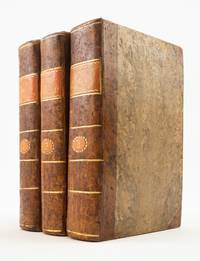
(MIDDLE EAST - 18TH CENTURY TRAVEL). TOURNEFORT, JOSEPH PITTON DE
RELATION D'UN VOYAGE DU LEVANT FAIT PAR ORDRE DU ROY
Lyon: Chez Anisson et Posuel 1717. Second Edition. 197 x 125 mm. 7 3/4 x 5". Three volumes. <br/> Pleasing contemporary half calf over paper boards painted to resemble tree calf smooth spines with gilt rules and two citron morocco labels. Attractive woodcut head- and tailpieces throughout WITH 153 ENGRAVED PLATES depicting the scenery flora fauna dress and architecture of locations described. Contemporary ink ownership inscription of De St. George on title page. Brunet V 903; Graesse VII 180. Corners slightly bumped and rubbed joints with just a hint of flaking but the period bindings solid and still extremely attractive survivals. Internally with a handful of quires faintly browned other trivial defects BUT AN UNUSUALLY WELL-PRESERVED SET inside and out.<br/> <br/> This lively narrative of travel at the turn of the 18th century includes a wealth of illustrations and a pleasing period bindings. A professor at the Jardin des Plantes in Paris Joseph Pitton de Tournefort 1656-1708 developed a system of botanical classification that became the standard method until it was superseded by Linnaeus in 1753. He made numerous collecting trips throughout his career; the present work is the record of his most significant voyage through Greece Turkey and along the Black Sea to Armenia and Georgia. The expedition which took place between 1700-02 had been proposed by the Comte du Pontchartrain then Secretary of State in 1699 as both a botanical and commercial endeavor. Tournefort's observations include a wealth of botanical detail but are also a rich source of information about the landscapes and peoples he encountered. He was accompanied on this voyage by German botanist Andreas Gundelsheimer and by the painter Claude Aubriet ca. 1665-1742 who had collaborated with Tournefort on his previous work "Eléments de Botanique." The work of Aubriet a botanical illustrator at the Jardin des Plantes was long appreciated by botanists and laypeople alike for its beauty and accuracy. The detailed depictions of plants here are accompanied by illustrated maps and engravings depicting zoological specimens archaeological sites and the costumes and cultures of the areas visited. The account was published posthumously in 1717 first in Paris and then shortly afterward in the present Lyon edition. The bindings here were never meant to be showy but they have come down to us in a remarkable state of preservation given their pedestrian construction and expected use. Chez Anisson et Posuel unknown
Referenz des Buchhändlers : ST20754
|
|
|
(middle east)
REVIEW OF ECONOMIC CONDITIONS IN THE MIDDLE EAST
1949-50. Issued as a section of the preliminary version of the world Economic Report 1949-50. 4to. 235pp. large color foldout map of region's Principle Transport Route showing roads railroads and airports stapled printed wraps. VG light wear. paperback
Referenz des Buchhändlers : a53897
|
|
|
(middle east)
THE MIDDLE EAST 1953 THIRD EDITION
London 1953 Europa. A survey and directory of Arabia Cyprus Egypt Iraq Israel Jordan the Lebanon Libya Persia the Sudan Syria and Turkey with geographical historical economic and education surveys concise information about political industrial financial and cultural organisations and Who's Who in the Middle East. 4to. 430pp. hardcover. Institute name stamps ontop and bottom fore-edges bookplate. Spine numbers removed. VG no DJ. . hardcover
Referenz des Buchhändlers : a53345
|
|
|
(middle east)
THE MIDDLE EAST NEWSLETTER 1973-1974 6 ISSUES
Beirut 1973 1974. The Americans for Justice in the Middle East an anti-Israel anti-Zionist group. Volume VII Nos 1 2 3 4. Volume VIII Nos. 1 2. Covers the Yom-Kippur war and various terrorist attacks and the Israeli response. Threats of suicide bombing using commercial airliners. 4to. original covers bound in buckram. Institution stamp on fore-edges and on covers. VG. hardcover
Referenz des Buchhändlers : a53417
|
|
|
(Nicour, Charles).
Ligne de Keneh à Kosseir. Rapport. Cairo, Imprim. des Chemins de Fer, 1891.
Small folio (218 x 340 mm). 19, (9) pp. With 5 folding plans, one measuring more than two metres in length. Original stiff printed wrappers. Extremely rare report on construction plans for a railway from Keneh (Qena) on the eastern shore or the Nile to Kosseir (al-Qosair) on the coast of the Red Sea. The project was never carried out. "La roue de Kéneh à Kosseir a éte étudiée dans un rapport de Ch. Nicour [...] qui déposa ses conclusions le 21 Février 1891 auprès du Conseil d'Administration des Chemins de fer de l'Etat égyptien. Ce rapport fut utilisé par J. Raimondi [...] dans son livre sur 'Le désert oriental égyptien du du Nil à la Mer Rouge' [...] Dans le chapitre V, intitulé 'Projet de chemin de fer de Kéneh à Kosseir [...]' Raimondi rappelle que, dès 1891, on avait formé le projet d'une ligne de chemin de fer de Kéneh à Kosseir. Le port, en effet [...] est le point de la mer Rouge le plus rapproché du Nil [...] Après avoir évalué les recettes probables de cette ligne [...] et avant d'étudier les problèmes de réalisation pratique [...] Raimondi reprend le rapport de Ch. Nicour pour donner une description de la route et une étude du tracé de ce chemin de fer, qui ne devait pas etre réalisé. La mission de Ch. Nicour étudia le terrain en décembre 1890. Elle décrit d'abord la route depuis Kéneh jusqu'à l'entrée de L'Quadi Hammamat, puis elle étudie les gorges de l'Quadi Hammamat proprement dit [...]" (Bernard). - The five plans include: 1) "Ligne de Kéneh à Kosseir. Route du Nord [...] Plan géneral et profil en long", ca. 62 x 205 cm. 2) "Plan de la grande gorge de El Hammamat", ca. 33 x 125 cm. 3) "Plan de la petit gorge de El-Sed", ca. 33 x 77 cm". 4) "Plan de petit gorge de E-Rieh", ca. 33 x 94 cm. 5) "Plan de ville de Kosseir", ca. 59 x 90 cm. - Binding lightly wrinkled and duststained in places, but altogether very well preserved. Inscribed on the upper cover by Yacoub Artin Pasha (1842-1919), the Armenian-born historian and Egyptian Minister of Education, to Julius Franz (1831-1915, "Frantz Pacha"), the German-born senior architect to the Egyptian Viceroy. André Bernard, De Koptos à Kosseir, p. 26. Not in OCLC.
|
|
|
(Prothero, G. W. [ed.]).
Persian Gulf: French and Portuguese Possessions. London, H. M. Stationery Office, 1920.
8vo. (8), 83, (1) pp. (8), 57, (1) pp. (8), 74 pp. (8), 52 pp. (4), 26 pp., final blank f. (4), 26 pp. 38 pp. (index). Publisher's printed green cloth. A manual of "geographical, economic, historical, social, religious and political" information compiled for the British delegates to the Peace Conference that took place in Versailles in 1919, here issued "for public use" for the first time. The extensive section on the Arabian coastal regions includes not only detailed statistics (giving the population of Abu Dhabi, Dubai, and Sharjah at 6,000, 20,000, and 15,000 inhabitants, respectively), but also, in a separate appendix, the full text of the treaties signed between the United Kingdom and the Sheikhs and rulers of the "Trucial Coast" in 1820 and 1853, including the names of all signatories: Sh. Hassan bin Rahmah for Ras al-Khaimah, Sh. Shakbout for Abu Dhabi, Sh. Zayed bin Syf for Dubai, Sh. Sultan bin Suggur for Sharjah, Sh. Rashid bin Hamid for Ajman, Sh. Abdullah bin Rashid for Umm al-Quwayn, etc. - Issued as vol. XIII of the "Peace Handbooks" by the Historical Section of the Foreign Office. Comprises in all: nos. 76 (Persian Gulf), 77 (French India), 78 (French Indo-China), 79 (Portuguese India), 80 (Portuguese Timor), and 81 (Macao). - Binding slightly stained. Withdrawn from the University Library of Manchester (their ownership, bookplate, and deaccession stamp to endpapers). - Rare. OCLC 28122772.
|
|
|
(PTOLEMY). (MIDDLE EAST). (LEVANT). ((MIDTOSTEN).
Tabvla quarta Asiæ.
Strasbourg. 1525. Originalt tresnitt. Arkets størrelse : 535 cm X 395 cm. Latin. <br/><br/><em>Latinsk tekst. Bretten noe gulnet et par brunpletter.Med Kypros.Map of Palestine Mesopotamia and Babylonia in present day Middle East.Relief shown pictorially.Includes names of places and natural features.Descriptive text within ornamental borders on verso.Appears in the author's Geographia translated by Willibald Pirckheimer with annotations by Joannes Regiomontanus. Argentoragi i.e. Strasbourg : Iohannes Grieningerus communibus Iohannis Koberger impensis excudebat anno a Christi Natiuitate 1525 tertio Kalendas Apriles. Boston Public Library. </em> unknown
Referenz des Buchhändlers : 56635
|
|
|
(Saintine, X[avier] B[oniface] [i. e. Joseph Xavier Boniface], ed.).
Histoire scientifique et militaire de l'éxpedition française en Égypte. Paris, Dénain, 1830-1836.
10 text volumes bound in 11 (8vo) and 2 atlas vols. (oblong folio), altogether 13 vols. With a total of 300 engr. plates (13 folding, 2 in original hand colour, some with touches of colour) and 160 engr. portraits as well as 6 (1 folding) facsimiles, almost all on China paper. Green grained half morocco, spines gilt. First edition, almost never encountered complete as thus. Important source for the history and activities of the 1798 French expedition to Egypt, published in ten text volumes by Louis Reybaud and two atlas volumes. The portraits of the members of the expedition (usually forming part of the text volumes) have here been bound separately; also contains two additional portraits (not counted). "The 160 profile portraits by Dutertre [...] are of particular interest" (Blackmer). Many of the plates showing views, antiquities, maps etc. were engraved after drawings by Vivant Denon, whose work opened up the Middle East for western eyes as no other had done before (cf. Henze II, 50). - Plates numbered 1-309 (each of the 13 folding plates counting as a double), followed by "dernière planche" and 3 maps. Five of the facsimiles have been bound at the end of the second atlas volume, another in vol. 3. The text volumes contain the "Histoire ancienne" (vols. 1-2) and the "Histoire moderne de l'Égypte" (vols. 9-10) as well as the expedition report proper (vols. 3-8). All text volumes have four title pages (slightly departing from those in Blackmer's copy). Vol. 1 also contains a "Rapport" of the work for the Académie by G. Saint-Hilaire, dated Nov. 1836, which names Louis Reybaud as "principal rédacteur". - A magnificent set in period bindings, interior clean and spotless throughout. No complete copy recorded at auction within the last decades. Blackmer 1476. Gay 2209. Cf. Hage Chahine 4277 and Ibrahim-Hilmy I, 80 (both citing individual text volumes only).

|
|
|
(Scepper, Cornelius Duplicius).
Rerum à Carolo V. Caesare Augusto in Africa bello gestarum commentarii, elegantißimis iconibus ad historiam accommodis illustrati. Antwerp, Jean Bellère, 1555.
8vo. (8), 183, (8) ff., last blank f. With woodcut printer's device on t. p. and three folding woodcut plates. - (Bound after) II: Bruto, Giovanni Michele. De rebus a Carolo V. caesare Romanorum imperatore gestis, oratio. Ibid., 1555. (48) ff. With woodcut printer's device on title-page and different, larger device on last f.; several woodcut initials. Contemporary limp vellum with ms label to spine. Traces of ties. Re-issue of the first edition, published the previous year. This documentation of the North African expeditions of Charles V against Tunis and the Arabian Coast was compiled by the Imperial envoy Scepper (d. 1554) from eyewitness accounts by Nicolas de Villegaignon and Juan Cristobal Calvete de Estrelle, augmented by extracts from Giovio and others. The remarkable views of sieges show the environs of Tunis as well as Algiers and El Kef (Aphrodisium). - Bound at the beginning of the volume is the first edition of Bruto's first work, a polished prose encomium for Charles V, dedicated to his son, King Philip II of Spain. Giovanni Bruto (1515-94), a banished Italian scholar, spent a large part of his life travelling and served as court historian to Emperors Rudolph II and Maximilian II. - A very clean, practically spotless copy. Title page of Bruto stamped; final flyleaf replaced by five modern blank leaves. With fine, contemporary acquisition note by the Austrian statesman and military commander Count Georg von Helfenstein-Gundelfingen (1518-73) on the pastedown, dated London, 1559 ("Emptus Lundini Angliae Metropol."), from the time of his diplomatic mission in Great Britain. "In 1558 Helfenstein was Imperial Governor of Upper Austria, in 1559 Prefect of the Imperial Court. At this time he was sent to England by Emperor Ferdinand to pursue a marriage between Ferdinand's third son, Archduke Charles, with Queen Elizabeth" (cf. ADB XI, 687). Later in the Fürstenberg Library in Donaueschingen. I: BM-STC Dutch 183. Göllner 938. Paulitschke 355, Schottenloher 28.353. Graesse VI, 294. Palau 262.149. Gay 1376 ("précieux recueil"). Cf. Yerasimos 179. Not in Adams, Brunet or Kainbacher. - II: IA 126.080. Adams B 2973. BM-STC Dutch 43. Graesse I, 558. Palau 36.453. Brunet I, 1307 ("Peu commun").

|
|
|
(Stampini, Ettore [ed.]).
Feriis saecularibus R. Athenaei Taurinensis. A.D. VI Kal. Nov. an. MDCCCCVI. [Torino, Vigliardi-Paravia], 1906.
Folio (262 x 358 mm). 35, (1) pp. With 9 plates. Original wrappers printed in red, stored loosely within original dedicatory giltstamped cloth portfolio with white moirée endpapers. Handsome facsimile publication produced on the occasion of the centenary of the University of Turin (27 October 1906), under the editorship of the professor of philosophy Ettore Stampini (1855-1930) for the Academic Council. Dedication copy for Sultan Abdülhamid II (1842-1918), the 99th caliph of Islam and the 34th sultan of the Ottoman Empire. The Sultan was to be deposed in 1909; but two years later, Italy and the Ottoman Empire would go to war over Libya. - Rather strongly browned throughout, as usual; still a good copy with fine provenance. OCLC 16164614.

|
|
|
(Suleiman II, Sultan) / Dominico Di Lardizabal (ed.).
Warhafftige Relation der H. Oerther zu Jerusalem, welche auß ergangenen Befehl deß Groß-Türcken anno 1690 in dem Monat April wiederumb zugestellet worden, denen mindern Brüdern, als Observaten und Reformaten deß Seraphischen Ordens S. Francisci. Vienna, Andreas Heyinger, 1692.
4to. (48) pp. All edges sprinkled in red. Disbound. Exceedingly rare separate "offprint" issue, with Heyinger's imprint and date on title page, of this account usually only encountered bound after a half-title as part of Francisco Caccia's "Monumentum Gloriae Seraphicae" (bibliographically unrecorded thus). Contains the German translation of the Sultan's mandate by which suzerainity over several holy sites in Jerusalem (particularly, two vaults in the Church of the Holy Sepulchre, part of Golgotha, the Seven Arches of the Virgin, and the Stone of the Anointing) was restored to the Franciscans. Includes relevant correspondence and indulgences (all in German). - Some browning and staining. Removed from a collection; old number "23" on t. p. An early work from the press of Andreas Heyinger, active in Vienna from 1692 to 1732. Cf. VD 17, 12:113676Z.
|
|
|
(Townsend, Rev. Geo. Fyler).
THE ARABIAN NIGHTS' ENTERTAINMENTS. A New Edition, Revised, With Notes by Rev. Geo Fyler Townsend.
pp. viii, 632. Penciled ownership of M. J. Lewis and stamped ownership of Melch Lewis, Jr. Aged stained. Top edge gold. Small 8vo. Original full blue cloth binding, soiled. Hardbound. ISLAM BOX 2
|
|
|
(Ulloa, Alfonso de).
La historia dell'impresa di Tripoli di Barbaria, fatta per ordine del sereniss. re catolico, l'anno MDLX. Con le cose avenute a Christiani nell'isola delle Zerbe. Nuovamente mandata in luce. Venice ("Venevia"), Francesco Rampazetto, 1566.
4to. (7) ff., 1 blank f., (4) ff. With woodcut device on title, large historiated woodcut initials, and an additional engraved folding plan of Tripolis (204 x 285 mm), not called for by bibliographies. 18th century full vellum with giltstamped red morocco label to spine (very similar to the bindings done for the Venetian library of Giacomo Soranzo). First dated publication of Ulloa's account of the siege of Tripolis in Italian. Includes the three-page dedication to Johann Jakob Fugger - the only place in the book where Ulloa's name appears. The author, a courtier of King Philip II, celebrates the defence of St Angelo's fortress on Malta, modern Libya. - In the 1551 Siege of Tripoli, the Ottoman fleet vanquished the Knights of Malta in Tripoli; the city was captured on 15 August by Sinan Pasha after six days of bombardment. The knights, many of them French, were returned to Malta upon the intervention of the French ambassador, and shipped onboard his galleys, while the mercenaries were enslaved. Murad Agha, the Ottoman commander of Tajura since 1536, was named as the Pashalik of the city. The siege was the first step in the all-out Italian War of 1551-59 in the European theatre. In 1553, Dragut was nominated commander of Tripoli by Suleiman, making the city a centre for piratical raids in the Mediterranean and the capital of the Ottoman province of Tripolitania. In a famous attack from Tripoli, in 1558, Dragut attacked Reggio and took all its inhabitants as slaves to Tripoli. In 1560, a powerful naval force was sent to recapture Tripoli, but that force was defeated in the Battle of Djerba, an event also described in Ulloa's book. The end of the volume is brought up by an interesting four-page account of Malta ("Descrittione dell'Isola di Malta") and a list of the names of Christian knights who died in the siege. The fine engraved plate bound after the preliminaries, entitled "Il vero disegno del porto, della città, della fortezza, et del sito dove è posta Tripoli di Barbaria. Ven. l'anno 1567 alla libreria della Colonna" appeared a year after the book. It is engraved by Paolo Forlani. - A clean, well preserved copy. Edit 16, CNCE 37528. BM-STC Italian 704. Gay 1494. Palau 343.401. Göllner 1134. Graesse VI, 224. Olschki L II, 222. Cf. Mortimer 509 (with note on this edition). Not in Adams, Blackmer or Aboussouan. This edition not in Atabey.
|
|
|
(Ulloa, Alfonso de).
La historia dell'impresa di Tripoli di Barberia, fatta per ordine del Sereniss. Re Catolico, l'anno M.D.LX. Con le cose avenute a Christiani nell'Isola delle Zerbe. Nuovamente mandata in luce. Venice ("Venevia"), Francesco Rampazetto, 1566.
4to. (7) ff., 1 blank f., 88, (4) ff. With woodcut printer's device to title page. 19th century vellum with giltstamped red spine labels. First dated publication of Ulloa's account of the siege of Tripolis in Italian. Includes the three-page dedication to Johann Jakob Fugger - the only place in the book where Ulloa's name appears. The author, a courtier of King Philip II, celebrates the defence of St Angelo's fortress on Malta, modern Libya. - In the 1551 Siege of Tripoli, the Ottoman fleet vanquished the Knights of Malta in Tripoli; the city was captured on 15 August by Sinan Pasha after six days of bombardment. The knights, many of them French, were returned to Malta upon the intervention of the French ambassador, and shipped onboard his galleys, while the mercenaries were enslaved. Murad Agha, the Ottoman commander of Tajura since 1536, was named as the Pashalik of the city. The siege was the first step in the all-out Italian War of 1551-59 in the European theatre. In 1553, Dragut was nominated commander of Tripoli by Suleiman, making the city a centre for piratical raids in the Mediterranean and the capital of the Ottoman province of Tripolitania. In a famous attack from Tripoli, in 1558, Dragut attacked Reggio and took all its inhabitants as slaves to Tripoli. In 1560, a powerful naval force was sent to recapture Tripoli, but that force was defeated in the Battle of Djerba, an event also described in Ulloa's book. The end of the volume is brought up by an interesting four-page account of Malta ("Descrittione dell'Isola di Malta") and a list of the names of Christian knights who died in the siege. - Occasional slight browning and brownstaining (more pronounced on title page); a few pages near end show insignificant edge flaws. Early 19th century ms. bibliographical note on flyleaf. A good copy. Edit 16, CNCE 37528. BM-STC Italian 704. Gay 1494. Palau 343.401. Göllner 1134. Graesse VI, 224. Olschki L II, 222. Cf. Mortimer 509 (with note on this edition). Not in Adams, Blackmer or Aboussouan. This edition not in Atabey.
|
|
|
(Varthema, Lodovico di.
The Navigation and v[o]yages of Lewes Vertomannus, Gentelman of the citie of Rome, to the regions of Arabia, Egypte, Persia, Syria, Ethiopia, and East India, both within and without the ryver of Ganges, etc. In the yeere of our Lorde 1503. Conteynyng many notable and straunge thinges, both hystoricall and naturall. Translated out of Latine into Engylshe, by Richarde Eden). London, Richard Jugge, 1577.
4to. (4 [instead of 10]), 464 [instead of 466] ff. (wants the first 6 ff. of prelims, final 2 ff. of text and the 6 ff. of "special advices" and index, all supplied in facsimile). With historiated woodcut initials. Splendid modern red morocco, both covers richly gilt, gilt fillets to raised bands. Stored in custom-made cloth clamshell box with gilt spine title. The first English edition of Ludovico di Varthema's famous travels to Arabia, Persia, and India: the highly important and adventurous narrative containing the first printed eyewitness account of any place in today's United Arab Emirates. On his return journey from Mecca (which he was the first Westerner to describe), Varthema visited Ras al-Khaimah ("Giulfar") and portrayed the city as "most excellent and abounding in everything", with "a good seaport", and whose inhabitants are "all Muslims". While Montalboddo's famous anthology of discoveries, printed in 1507, contained the first printed reference to the Arabian Gulf region, it was Varthema's work, published only three years later, that offered the first actual report from the region by a Western traveller who had visited the coast. All early editions of Varthema’s "Itinerario" are exceedingly rare (even the 2013 Hajj exhibition at the MIA, Doha, only featured the 1654 reprint; cf. below). - Varthema, a gentleman adventurer and soldier from Bologna, left Venice at the end of 1502. In 1503 he reached Alexandria and ascended the Nile to Cairo, continuing to Beirut, Tripoli, Aleppo and Damascus, where, adopting Islam and taking the name of Yunas, he joined a Mameluke escort of a Hajj caravan and began the pilgrimage to Mecca. Varthema was amazed by what he observed: "Truly I never saw so many people collected in one spot as during the twenty days I remained there", he begins, and arriving at the Great Mosque, continues, "it would not be possible to describe the sweetness and the fragrances which are smelt within this temple." Thanks to his knowledge of Arabic and Islam, Varthema was able to appreciate the local culture of the places he visited. Impressed and fascinated, he describes not only rites and rituals, but also social, geographical, and day-to-day details. "I determined, personally, and with my own eyes", he declares in the prefatory dedication, "to ascertain the situation of places, the qualities of peoples [...] of Egypt, Syria, Arabia Deserta and Felix, Persia, India, and Ethiopia, remembering well that the testimony of one eye-witness is worth more than ten hear-says." His good fortune did not continue unabated, however: after embarking at Jeddah and sailing to Aden, he was denounced as a Christian spy and imprisoned. He secured his release and proceeded on an extensive tour of southwest Arabia. Stopping in Sanaa and Zebid as well as a number of smaller cities, he describes the people, the markets and trade, the kind of fruits and animals that are plentiful in the vicinity, and any historical or cultural information deemed noteworthy. Returning to Aden, and after a brief stop in Ethiopia, he set sail for India. In addition to visiting Persia, Varthema explored the coasts of Malabar and Coromandel, including a stay at Calicut at the beginning of 1505. He also purports to have made extensive travels around the Malay peninsula and the Moluccas. Returning to Calicut in August 1505, he took employment with the Portuguese at Cochin and, in 1508, made his way back to Europe via the Cape of Good Hope. - First published in 1510, Varthema's account became an immediate bestseller. In addition to his fascinating account of Egypt, Syria, the Arabian Peninsula, and the holy Muslim cities, "Varthema brought into European literature an appreciation of the areas east of India [...] which it had previously not received from the sea-travelers and which confirmed by firsthand observations many of the statements made earlier by Marco Polo and the writers of antiquity" (Lach, I. i. 166). "Varthema was a real traveller. His reports on the social and political conditions of the various lands he visited are reliable as being gathered from personal contact with places and peoples. His account of the overland trade is of great value in that we are made to see it before it had begun to give way to the all-seas route. He even heard of a southern continent and of a region of intense cold and very short days, being the first European probably after Marco Polo to bring back the rumor of Terra Australis" (Cox I, 260). - Published as an extensive part of "The History of Travayle in the West and East Indies" - one of the first English versions of the significant collection edited by Pietro Martire d'Anghiera (Peter Martyr, 1457-1526). The first independently published English translation would not appear until 1863: Varthema's travelogue was included for the first time in the present translated edition of Martyr's "History". The translation, with some omissions, is that of Decades I-III of "De Orbe Novo" by Martyr, with additions from other sources, edited by Richard Eden and Richard Willes. Willes was a member of the Jesuits from 1565 to 1572 and was familiar with Maffei, the Jesuit chronicler whose account he drew on for this work. Under the benefaction of the Earl of Bedford, Willes expanded Eden's translation to include, apart from Varthema's travels, four Decades and an abridgement of Decades V-VIII; Frobisher's voyage for a Northwest Passage, Sebastian Cabot's voyages to the Arctic for the Moscovy Company, Cortez's conquest of Mexico, Pereira's description of China, 1565, Acosta and Maffei's notices of Japan, 1573, and the first two English voyages to West Africa. Also, this is the first account in English of Magellan's circumnavigation, as well as the first printed work to advocate a British colony in North America. - First 6 and final 8 ff. supplied in facsimile. Occasional faint contemp. marginalia. 19th c. calligraphic note, quoted from Brunet, on flyleaf. From the library of Sir Arthur Helps (1813-75), English writer, dean of the Privy Council, and Cambridge Apostle, with his armorial bookplate and autograph ownership. Howgego M65. Brunet I, 294. OCLC 5296745. LCCN 02-7743. European Americana 577/2. Church 119. Streeter Sale 24. Arents 23. Borba de Moraes, p. 33. Hill 533. BM-STC 649. Sabin 1562. Cordier, Japonica 71. Field 485. Cf. exhibition cat. “Hajj - The Journey Through Art” (Doha, 2013), p. 90 (1655 Dutch ed. only). Macro, Bibliography of the Arabian Peninsula, 2239f. (other editions only). Not in the Atabey or Blackmer collections.
|
|
|
(Varthema, Lodovico di.
The Navigation and v[o]yages of Lewes Vertomannus, Gentelman of the citie of Rome, to the regions of Arabia, Egypte, Persia, Syria, Ethiopia, and East India, both within and without the ryver of Ganges, etc. In the yeere of our Lorde 1503. Conteynyng many notable and straunge thinges, both hystoricall and naturall. Translated out of Latine into Engylshe, by Richarde Eden). London, Richard Jugge, 1577.
4to. (10), 466, (6) ff. With historiated woodcut initials. Splendid modern full navy blue morocco, bands on spine with title showing faded gilt, covers double-ruled gilt. The first English edition of Ludovico di Varthema's famous travels to Arabia, Persia, and India: the highly important and adventurous narrative containing the first printed eyewitness account of any place in today's United Arab Emirates. On his return journey from Mecca (which he was the first Westerner to describe), Varthema visited Ras al-Khaimah ("Giulfar") and portrayed the city as "most excellent and abounding in everything", with "a good seaport", and whose inhabitants are "all Muslims". While Montalboddo's famous anthology of discoveries, printed in 1507, contained the first printed reference to the Arabian Gulf region, it was Varthema's work, published only three years later, that offered the first actual report from the region by a Western traveller who had visited the coast. All early editions of Varthema’s "Itinerario" are exceedingly rare (even the 2013 Hajj exhibition at the MIA, Doha, only featured the 1654 reprint; cf. below). - Varthema, a gentleman adventurer and soldier from Bologna, left Venice at the end of 1502. In 1503 he reached Alexandria and ascended the Nile to Cairo, continuing to Beirut, Tripoli, Aleppo and Damascus, where, adopting Islam and taking the name of Yunas, he joined a Mameluke escort of a Hajj caravan and began the pilgrimage to Mecca. Varthema was amazed by what he observed: "Truly I never saw so many people collected in one spot as during the twenty days I remained there", he begins, and arriving at the Great Mosque, continues, "it would not be possible to describe the sweetness and the fragrances which are smelt within this temple." Thanks to his knowledge of Arabic and Islam, Varthema was able to appreciate the local culture of the places he visited. Impressed and fascinated, he describes not only rites and rituals, but also social, geographical, and day-to-day details. "I determined, personally, and with my own eyes", he declares in the prefatory dedication, "to ascertain the situation of places, the qualities of peoples [...] of Egypt, Syria, Arabia Deserta and Felix, Persia, India, and Ethiopia, remembering well that the testimony of one eye-witness is worth more than ten hear-says." His good fortune did not continue unabated, however: after embarking at Jeddah and sailing to Aden, he was denounced as a Christian spy and imprisoned. He secured his release and proceeded on an extensive tour of southwest Arabia. Stopping in Sanaa and Zebid as well as a number of smaller cities, he describes the people, the markets and trade, the kind of fruits and animals that are plentiful in the vicinity, and any historical or cultural information deemed noteworthy. Returning to Aden, and after a brief stop in Ethiopia, he set sail for India. In addition to visiting Persia, Varthema explored the coasts of Malabar and Coromandel, including a stay at Calicut at the beginning of 1505. He also purports to have made extensive travels around the Malay peninsula and the Moluccas. Returning to Calicut in August 1505, he took employment with the Portuguese at Cochin and, in 1508, made his way back to Europe via the Cape of Good Hope. - First published in 1510, Varthema's account became an immediate bestseller. In addition to his fascinating account of Egypt, Syria, the Arabian Peninsula, and the holy Muslim cities, "Varthema brought into European literature an appreciation of the areas east of India [...] which it had previously not received from the sea-travelers and which confirmed by firsthand observations many of the statements made earlier by Marco Polo and the writers of antiquity" (Lach, I. i. 166). "Varthema was a real traveller. His reports on the social and political conditions of the various lands he visited are reliable as being gathered from personal contact with places and peoples. His account of the overland trade is of great value in that we are made to see it before it had begun to give way to the all-seas route. He even heard of a southern continent and of a region of intense cold and very short days, being the first European probably after Marco Polo to bring back the rumor of Terra Australis" (Cox I, 260). - Published as an extensive part of "The History of Travayle in the West and East Indies" - one of the first English versions of the significant collection edited by Pietro Martire d'Anghiera (Peter Martyr, 1457-1526). The first independently published English translation would not appear until 1863: Varthema's travelogue was included for the first time in the present translated edition of Martyr's "History". The translation, with some omissions, is that of Decades I-III of "De Orbe Novo" by Martyr, with additions from other sources, edited by Richard Eden and Richard Willes. Willes was a member of the Jesuits from 1565 to 1572 and was familiar with Maffei, the Jesuit chronicler whose account he drew on for this work. Under the benefaction of the Earl of Bedford, Willes expanded Eden's translation to include, apart from Varthema's travels, four Decades and an abridgement of Decades V-VIII; Frobisher's voyage for a Northwest Passage, Sebastian Cabot's voyages to the Arctic for the Moscovy Company, Cortez's conquest of Mexico, Pereira's description of China, 1565, Acosta and Maffei's notices of Japan, 1573, and the first two English voyages to West Africa. Also, this is the first account in English of Magellan's circumnavigation, as well as the first printed work to advocate a British colony in North America. - Sympathetically washed but not pressed; some minor repairs to title not affecting printed surface. Some remaining toning and staining in small areas of a few leaves. Generally a wide-margined and appealing copy. - Provenance: acquired from Quaritch in 1975 by Gregory S. Javitch (1898-1980), a Russian-born, Canadian leader in the land reclamation sector in Ontario. Javitch formed an important collection of 2,500 items entitled "Peoples of the New World", encompassing both North and South America, which was acquired by the Bruce Peel Special Collections at the University of Alberta. It was considered the finest such private collection in Canada at the time and formed the cornerstone of the library’s Special collections. The present volume remained in Javitch's private collection was acquired directly from his heirs. Howgego M65. Brunet I, 294. OCLC 5296745. LCCN 02-7743. Alden, European Americana 577/2. Church 119. Streeter Sale 24. Arents 23. Borba de Moraes, p. 33. Hill 533. BM-STC 649. Sabin 1562. Cordier, Japonica 71. Field 485. Cf. exhibition cat. “Hajj - The Journey Through Art” (Doha, 2013), p. 90 (1655 Dutch ed. only). Macro, Bibliography of the Arabian Peninsula, 2239f. (other editions only). Not in the Atabey or Blackmer collections.
|
|
|

 Per e-mail erhalten
 Als pdf-Dokument herunterladen
 RSS feed
 Permanenter link


