|
|
|
LYAUTEY, Pierre
Les revolutions du Proche-Orient
274 pagine; 19 cm. Brossura editoriale con sopracoperta
|
|
|
Lyon, George Francis.
A Narrative of Travels in Northern Africa, in the Years 1818, 19, and 20. Accompanied by Geographical Notices of Sudan, and of the Course of the Niger. London, John Murray, 1821.
4to. XII, 383, (1) pp. Folding engr. map frontispiece ("Map of a Route through the Regency of Tripoli and Kingdom of Fezzan"), 17 chromolithogr. plates drawn by Lyon and lithographed on stone by G. Harley or D. Dighton, M. Gauci, as well as a text illustration. Modern red cloth with gilt-stamped black spine labels. First edition of Lyon's account of his botched Timbuktu expedition, finely illustrated with 17 plates (created by M. Gauci and D. Dighton after Lyon's own drawings) showing the Arabian desert culture. - In 1818, G. F. Lyon (1795-1832) was sent with surgeon-explorer Joseph Ritchie by Sir John Barrow to find the course of the Niger River and the location of Timbuktu. A year later they had only got as far as Murzouk where they both fell ill. Ritchie never recovered and died, but Lyon survived and continued his travels. After a year he returned to Tripoli, the expedition having failed utterly. Upon return, he was promoted and in 1821 - the same year this book was published - given the command of HMS Hecla on his second attempt. Lyon was reputed to have a genuine informed interest in the culture and inhabitants of the lands he visited. Wearing Arab/Muslim dress and speaking fluent Arabic, he managed to blend in with the inhabitants of North Africa. "An important work. Lyon joined the British government scientific mission headed by Ritchie, taking place of Captain Frederick Marryat. They met at Tripoli in November 1818. Ritchie died in 1819 and Lyon took over command of the expedition. He returned to London in July, 1820. Shortly after that he joined Parry's arctic expedition. The fine plates illustrate mostly costumes, and are all after drawings by Lyon" (Blackmer). Fergus Fleming characterizes the relationship between Ritchie and Lyon, who was a "moustachioed extrovert aged twenty-two [...] Lyon was not, on the face of it, suited to African exploration". By his own confession, his main interests were "balls, riding, dining & making a fool of myself". - The plates include: Costume of Tripoli (2 types), Triumphal Arch - Tripoli, Arabs Exercising, The Castle of Bonjem, A Sand Wind on the Desert, Piper and Dancer - Tripoli, The Castle of Morzouk, Tuarick in a Shirt of Leather & Tuarick of Aghades, Tuaricks of Ghraat, Costume of Soudan, Negresses of Soudan, Tibboo Woman in Full Dress, Tibboo of Gatrone, A Tuarick on his Maherrie, camel Conveying a Bride to her husband, A Slave Kaffle. - Offsetting on title from map; map tears repaired. Altogether in very good condition. Blackmer 1044. Abbey Travel 304. Howgego II, L52 (p. 376). Henze III, 318. Lipperheide Ma 14 (note). Colas 1920. Hiler 556. Ibrahim-Hilmy I, 397. Lambert I, 147. Tooley 311. Fergus Fleming, Barrow's Boys: A Stirring Story of Daring, 2001, pp. 956. Brunet III, 1254. Graesse IV, 312.

|
|
|
Léandre VAILLAT
Le visage français du Maroc
Horizons de France | Paris 1931 | 23 x 28.50 cm | broché
Referenz des Buchhändlers : 68982
|
|
|
Léon POLIER
La France en Egypte. Extrait de la Revue des Deux Mondes
Extrait de La Revue des deux mondes | s. l. [Paris] 1914 | 15.50 x 25 cm | agrafé
Referenz des Buchhändlers : 19761
|
|
|
Léon des Avanchers, Père (born Michel Rey-Golliet), explorer and missionary (1825-1879).
Autograph letter signed ("F. Léon des Avanchers, religieux capucin, Missionnaire apostolique aux Gallas [Affrique centrale]"). Aden, Arabie Heureuse, 22. IX. 1850.
4 pp. on folded bifolium. On blue paper. 4to. Long, interesting and unpublished letter, closely written over four pages, to the French minister Gustav Armand Henri, Comte de Reiset (1821-1905). The twenty-five-year-old missionary, writing from the south-western tip of the Arabian peninsula, describes himself as "perdu au milieu des déserts et dont toute l'imagination est absorbée par l'étude des langues". The capucin friar travelled along the coast of the Red Sea, visiting Tor, Yambo, Medina and Jeddah; the settlements he encounters are wretched hamlets on the edge of the desert. "À Gedda les musulmans font voir le tombeau de notre grande mère Ève. Selon eux, nos premiers parens après leurs chutes vinrent faire pénitence de leurs fautes à La Mecque. Ève mourut à Gedda. La tête de notre première mère repose sur une montagne et ses deux pieds sur deux autres collines voisines et sur son nombril ils ont élevé une pyramide [...]". Léon writes that he feared he would end up eaten by the fish, but finally did arrive in Abyssinia after a 20-day voyage. He continues to describe a beautiful mountaineous landscape peopled by a few Bedouin tribes and evokes their hard life, the cry of the jackals, and the devastation of crops by soldiers and by apes. He states the price of wheat, horses, and farming animals, describes the mining of gold, silver and iron and summarizes the situation in Abyssinia, since the former empire was overthrown by "la lance du farouche Gallas". He describes the savage manners of a country at war: the enslavement of women and children, the emasculation of men, and the rampant diseases. He also explains how the country first seized by the Turks passed to France, and provides his minister with first-hand geopolitical intelligence: "L'Anglais travaille ce pays. Un consul britannique y rôde en tout sens. Mais les Anglais y sont détestés à cause de leur religion. Mais cependant que l'on y fasse attention. L'Abyssinie plutôt que de vouloir subir le joug turke se mettra à la disposition de la première puissance qui voudra l'exploiter. La Sardaigne a envoyé ici un ancien missionnaire pour déterminer Oubié ou un roi de l'Abyssinie à lui donner une partie de la côte pour y colliniser fiat lux [...]". - Léon des Avanchers, friend of the French explorer Antoine d'Abadie, was a missionary in Abyssinia, a geographer, cartographer and explorer of East Africa, and a correspondent of the Società Geografica Italiana. He is known to have bought many slaves to free them and was the founder of the first Catholic church in the Seychelles. - Some original corrections and insertions. Traces of original folds. Well-preserved.

|
|
|
Löffler, Eduard.
Die österreichische Pferde-Ankaufs-Mission unter dem k. k. Obersten Ritter Rudolf von Brudermann, in Syrien, Palästina und der Wüste, in den Jahren 1856 und 1857. Troppau, Otto Schüler, 1860.
8vo. XV, (1), 240 pp. Contemporary half cloth over marbled boards with handwritten title label to spine. First edition. - Lively report of an Austrian horse-buying expedition in Syria, Palestine, and the Palestinian desert, carrious out under the Austrian colonel Rudolf von Brudermann, who was to purchase Arabian horses so as to enhance the stock of the Austrian-Hungarian cavalry. The author Löffler was among the participants of the expedition: his first-hand travelogue describes the itinerary and the local customs as well as the newly acquired horses. - A few contemporary ownership stamps of the Stuttgart Museum's library in blue ink to several pages. King Wilhelm I of Württemberg was a famous enthusiast of Arabian horses: his stud in Marbach, just north of the royal residence of Stuttgart, was the first Arabian stud in Europe. - First and last third slightly waterstained. Boyd/P. 75. Kayser XVI, 45.
|
|
|
Löytved, J[ulius] H[arry].
Konia. Inschriften der seldschukischen Bauten. Berlin, Julius Springer, 1907.
Large folio (306 x 427 mm). VI, (2), 107, (1) pp. With numerous illustrations, 15 of which, showing ornaments, are in contemporary hand colour. Publisher's half cloth. First edition, "printed as a manuscript", on the Seljuq inscriptions in Turkish Konya (many of which embody Qur'anic verses). Illustrated throughout. A good copy. Brill's First Encyclopaedia of Islam V, 500. OCLC 3332642.
|
|
|
Lütfi Pasha / Tschudi, Rudolf (ed.).
[Asafname - German]. Das Asafnâme des Lutfi Pascha, nach den Handschriften zu Wien, Dresden und Konstantinopel [...]. Berlin, Mayer & Müller, 1910.
8vo. XXI, (1), 38 pp., 1 blank f., (2), 45, (1) pp. With a portrait frontispiece. Contemporary half calf with marbled covers and giltstamped red spine label. All edges red. Edition of the Turkish text (with the first German translation) of the "Asafname", a mirror for ministers written by the Albanian-born Ottoman statesman Lütfi Pasa (1488-1564), grand vizier of the Ottoman Empire under Suleiman the Magnificent. The translation, forming the dissertation of Rudolf Tschudi, was issued as vol. 12 of the "Türkische Bibliothek" edited by Georg Jacob, Professor at Erlangen. - An attractively bound copy with the bookplate of the collector Franz Pollack von Parnau (1903-81), who assembled a famous library in the Viennese palais of his father, the textile magnate Bruno Pollack von Parnau.
|
|
|
LÜTFÜ SEHSUVAROGLU.
Su barisi Türkiye ve Ortadogu su politikalari.
Fine English Paperback., Very good., 21 x 15 cm, 235 p. "Su barisi Türkiye ve Ortadogu su politikalari, LÜTFÜ SEHSUVAROGLU, Gümüsmotif Yayinlari, Istanbul, 1997"
|
|
|
M. ROZIERE - COLLET-DESCOTIL
Description de l'Egypte. Mémoire sur l'art de faire éclore les poulets en Egypte, par le moyen des fours ; par MM. Rozière et Rouyer. Description de l'art de fabriquer le sel ammoniac, par M. H. V. Collet-Descotil
Imprimerie Impériale | à Paris 1809 | 27 x 32 cm | Relié
Referenz des Buchhändlers : 27646
|
|
|
M. KARSAKOFF
Quelques observations sur une nouvelle mante du sud-algérien, iris deserti Uv
Imp. A. Rey | Lyon 1935 | 16 x 24.50 cm | agrafé
Referenz des Buchhändlers : 26183
|
|
|
M. HORTEN.
Die Religiöse Gedankenwelt der Gebildeten Muslime in heuten Islam.
Very Good English Original bdg. HC. Roy. 8vo. (24 x 17 cm). In German. [xxiv], 184 p. The Religious ideas of the educated Muslims in Islam. Die Religiöse Gedankenwelt der Gebildeten Muslime in heuten Islam.
|
|
|
M. J. Kruck von Poturzyn
Lady Hester Stanhope : Eine Frau ohne Furcht
No marks or inscriptions. No creasing to covers or to spine. A very clean very tight copy with bright unmarked very slightly foxed boards and no bumping to corners. 235pp. Biography of Lady Hester Stanhope, ths so-called Queen of the Desert - and a woman without fear. She was a British socialite at the end of the 18th century who left her life in Britain to travel and carry out archaeological work in the Middle East. All text in German.

|
|
|
M[EHMED] SEMSEDDIN [GÜNALTAY], (1883-1961).
Islâm tarihi.
Very Good English In modern cloth bdg. Cr. 8vo. (20 x 14 cm). In Ottoman script. 416 p. Islâm tarihi. Günaltay's 'History of Islam'. First Edition. Roumî: 1339 = Hegira: 1341 = Gregorian: 1923. Özege: 9377.
|
|
|
M[UALLIM] CEVDET [INANÇALP], (1883-1935).
Sark Ilyadasi: Sehnâme.
Very Good Turkish, Ottoman (1500-1928) Paperback. Cr. 8vo. (20 x 14 cm). In Ottoman script. 88 p. Sark Ilyadasi: Sehnâme. First Edition. Özege 18610.
|
|
|
MAALOUF AMIN
PERIPLO DI BALDASSARRE (IL) ( LE PERIPLE DE BALDASSARE )
Pagine: 378 . Formato: 8° . Rilegatura: Brossura originale con sovracoperta . Stato: Buono . Caratteristiche: Lo scrittore e giornalista libanese dopo "Le crociate viste dagli arabi" alle prese con un raffinato libraio genovese in terra d'Oriente nel 1600. .
|
|
|
MABIN, Yves ; BRUELLE, Frédérique ; KHOURY, Mira
La Voie Royale. 9 000 ans d’Art au Royaume de Jordanie. De la Préhistoire à l’Islam en Jordanie. L’Art Contemporain en Jordanie.
Association Française d’Action Artistique / Musée du Luxembourg 1986 2 volumes, sous étui cartonné, in-4, broché, couv. illustrée, photographies pleines pages en couleurs, vignettes photographiques en n. & b., 304 pp. - 40 pp. Très bon état d’occasion.
Referenz des Buchhändlers : 22172
|
|
|
MACRET
DESCRIPTION DE L'EGYPTE. Botanique. Fucus antennulatus, Fucus denticulatus. (Histoire Naturelle, planche 55)
Imprimerie Impériale | Paris 1809-1829 | 71 x 54 cm | une feuille
Referenz des Buchhändlers : 26423
|
|
|
MACRET
DESCRIPTION DE L'EGYPTE. Botanique. Sinapis allionii, Hesperis acris, Lunaria parviflora. (Histoire Naturelle, planche 35)
Imprimerie Impériale | Paris 1809-1829 | 71 x 54 cm | une feuille
Referenz des Buchhändlers : 26451
|
|
|
MACRET
DESCRIPTION DE L'EGYPTE. Botanique. Scirpus fimbrisetus, Andropogon annulatum, Scirpus mucronatus. (Histoire Naturelle, planche 7)
Imprimerie Impériale | Paris 1809-1829 | 71 x 54 cm | une feuille
Referenz des Buchhändlers : 26483
|
|
|
MACLER (Frédéric)
Trois conférences sur l'Arménie faites à la fondation Carol I à Bucarest (Roumanie).
P., Geuthner, 1929. In-12 broché, 290 pp., 9 planches d'ill. photogr. en noirn-fine, bibliographie. (Annales du Musée Guimet, Biblio. de Vulgarisation T. 49).
Referenz des Buchhändlers : 527892
|
|
|
Macedo, Joaquim José da Costa de.
Memoria em que se pertende provar que os Arabes não conhecerão as Canarias antes dos Portuguezes. Lisbon, printing office of the Academia Real das Sciencias, 1844.
Folio. (4), 232 pp. With a woodcut Portuguese coat of arms with owl and Hermes staff on the title-page, decorated "Tuscan" titling caps for the title and script type for the author's name. Set in roman and italic, with transcriptions of and quotations from documents in Greek and Arabic.Modern brown paper wrapper, side stitched through 3 holes. A detailed scholarly study of ancient sources for the history and geography of the Canary Islands, attempting to prove that the Portuguese discovered them before Islamic explorers, and that Islamic geographers knew them only through classical Greek and Roman sources. The main text (pp. 1-105) is followed by extensive notes from a wide variety of sources (pp. 107-168) and transcriptions of numerous primary sources, some in Greek or Arabic (pp. 199-232). In passing it also provides a wealth of information about navigation in the Mediterranean and Atlantic by classical Greek and Roman and by Islamic explorers. - Macedo (1777-1867), son of a Lisbon professor and librarian, was an historian, archivist, councillor to the Kingdom of Portugal and a member of many academic societies at home and abroad. His work on Portuguese explorers in general and the Canary Islands in particular began with a brief 1816 essay read to the Academia Real. He returned to the subject after almost thirty years, publishing the present account in both the present separate publication and as vol. VI of the proceedings of the Academia Real das Sciencias. While Macedo's claim for Malocello's discovery of the Canaries in 1336 is no longer accepted, the Islamic geographer Idrisi noted a Portuguese voyage to the Canaries already before 1154. - In fine condition and wholly untrimmed, with all deckles intact, giving very large margins. The modern wrapper is slightly tattered. A detailed study of early voyages to the Canary Islands, with the texts of primary sources in Greek, Arabic and other languages. Porbase (1 copy). Cf. Innocêncio IV, 96 and XII, 80 (issue in proceedings). For the author: Protásio, "MACEDO, JOAQUIM JOSÉ DA COSTA DE (1777-1867)" in: Dicionário de Historiadores Portugueses.
|
|
|
MacGahan, Januarius Aloysius.
Hive seyahatnamesi ve tarihi: musavver. Istanbul, Basiret Matbaasi, [1875 CE =] 1292 H.
4to. 459, (1) pp. Ottoman Turkish in Arabic type. With 1 folding map and 32 woodcut plates. Contemporary half calf with giltstamped spine and spine title (partly oxydized). First edition. - Exceedingly rare Turkish translation (by Ahmed Sükrü) of the popular account of the 1873 Russo-Khivan war and the fall of the Khivan Khanate by the American war correspondent MacGahan (1844-78), first published in New York in 1874 as "Campaigning on the Oxus and the fall of Khiva". After a daring journey through the Kyzil Kum desert, MacGahan joined the Russian commander Konstantin von Kaufmann’s army on the banks of the Amu Darya. In his report he vividly describes the fall of the Khanate to three Russian columns reaching it from North and East. The book discusses the situation of Kazakh (misleadingly called "Kirghiz") and Yomuk Turkmen nomads, Uzbek and Sart settlers, as well as of Persian slaves, and includes a report on earlier failed Russian attempts to conquer Khiva. While MacGahan is impressed by the beautiful gardens and orchards of the Khanate, he is disappointed by the city of Khiva, the capital and main residence of its ruler. Even the Khan's palace, in which he is allowed by the Russian authorities to spend a few days, including a visit to the treasury room, strikes him as unspectacular. The illustrations, based on designs and paintings by artists and Russian officers, including Vereschagin and Feodoroff, show portraits, scenes of rural and nomad life, somewhat stereotypical depictions of locals, as well as buildings, army generals, and battle scenes. - While the original English edition occasionally appears at auction, the Turkish edition has never been seen on the market. - A few crayon annotations and underlinings in a contemporary hand. Binding slightly bumped at extremeties. Paper evenly browned and brownstained throughout; a few pages somewhat waterstained in the second half of the volume. OCLC 1014870496. Özege 7682. Cf. Atabey 744 (English ed.).
|
|
|
MAFFEI Marco -
Aspetti dell'imperialismo britannico. I petroli del vicino Oriente.
Milano, 1940, stralcio con copertina posticcia muta, pp. 625/629 con 2 cartine. - !! ATTENZIONE !!: Con il termine estratto (o stralcio) intendiamo riferirci ad un fascicolo contenente un articolo di rivista, sia che esso sia stato stampato a parte utilizzando la stessa composizione sia che provenga direttamente da una rivista. Le pagine sono indicate come "da/a", ad esempio: 229/231 significa che il testo è composto da tre pagine. Quando la rivista di provenienza non viene indicata é perchè ci è sconosciuta. - !! ATTENTION !!: : NOT A BOOK : “estratto” or “stralcio” means simply a few pages, original nonetheless, printed in a magazine. Pages are indicated as in "from” “to", for example: 229/231 means the text comprises three pages (229, 230 and 231). If the magazine that contained the pages is not mentioned, it is because it is unknown to us.

|
|
|
Magaud d'Aubusson, Louis.
La Fauconnerie au Moyen Age et dans les temps modernes. Paris, Auguste Ghio, 1879.
8vo. (8), 272 pp. With half-title and errata leaf. Contemporary half morocco, gilt, with original printed wrappers bound in at end. Signed presentation copy from the author to Florian Pharaon (1827-87). A good association copy of a "work which no student of the history of Falconry should neglect" (Harting). Florian Pharaon was the first Arab editor at Le Figaro, and the translator of an Arabic hunting work into French. - Some spotting, binding rubbed. Harting 211. Schwerdt II, pp. 2-3. Thiébaud 621.
|
|
|
Magdi Allam
Saddam
Storia segreta di un dittatore. L'inquietante ritratto di un tiranno. Parte prima: L'uomo Parte seconda: Il tiranno, Parte terza: il doppiogiochista Parte quarta: il guerrafondaio
|
|
|
Magdi Allam
Viva Israele – dall'ideologia della morte alla civiltà della vita – 1° ed.
Allo stato di nuovo
|
|
|
Maggio, Francesco Maria.
Syntagmaton linguarum orientalium quae in Georgiae regionibus audiuntur. Liber Primus. Rome, Propaganda Fide, 1670.
Folio (225 x 332 mm). 2 parts in one vol. (12), 143, (1) pp. (6) pp., 1 blank f., 96 pp. With printer's woodcut device to both title-pages. Contemporary half vellum over papered boards with faded handwritten spine title. Second edition of this "at least linguistically rather unusual combination of a Georgian and a Turkish grammar, using the Georgian types first displayed in 1629" (Smitskamp). This is "an almost line for line reprint of the 1643 edition, only distinguishable by the 'Iterum imprimatur' [...] The work is set in mkhedruli type that has no upper case, but upper and lower case khutsuri type (the sacred script) is also displayed, absent in the 1629 'Alphabetum'. In the second part, containing a Turkish grammar (the third of its kind, after those by Megiser [1612] and du Ryer [1630]), the Hebrew and Syriac scripts [...] are also discussed as vehicles of the Arabic or Turkish language. Maggio mentions della Valle as his instructor in Turkish [...] At the end of the second part a Turkish translation is printed of the 'Corolla B.M. Virginis', a widely used devotional prayer" (ibid.). - Binding lightly rubbed. Some browning throughout; occasional worming in the margins. A few contemporary ink corrections in Georgian script. Removed from the library of the Capuchin mission to Trabzon, Turkey (Missione dei Cappuccini di Trebisonda) with their stamp to the title-page. Smitskamp, PO 227. Lang 167. Vater/Jülg 140.
|
|
|
Maggio, Francesco Maria.
Vita, e morte del venerabil P. F. Alipio di S. Giuseppe Scalzo di S. Agostino Palermitano della Congregazione d'Italia, in odio della confessione della S. Fede di Giesù Cristo, crudelissimamente ucciso da’ Turchi di Barberia, nella città di Tripoli, a 17 di febbraio l’anno 1645 [...]. Rome, Ignatio de' Lazzari, 1657.
4to. (40), 24, (4), 25-234 pp., final blank leaf. With 3 engraved plates. Contemporary vellum with ms. title to spine. Very scarce first and only edition of the life and death of San Alipio, who was captured by Ottoman pirates on 1 July 1643 and brought to Tripoli. He converted to Islam, but repented and was martyred on 17 February 1645 when he told to the Pasha that he wished to return to his Christian faith. The plates show the martyrdom (a supersized image after the prelims, folded in at the bottom) and the holy relics of the Saint. - Some defects to spine, otherwise fine. Old ownership of the "Convento dell' Angelo Custode" on the flyleaf. Streit XVI, p. 525, no. 4001. ICCU UM1E\007052.
|
|
|
Magistrati, Massimo
Le condizioni ambientali del medio oriente nel quadro dell'alleanza atlantica
24 cm, brossura; pp. 17

|
|
|
MAGLIOCCO VITO.
La strada per Gerusalemme.
In 8°, cop. edit. con sovracc. ill. (lievi fioriture sparse), pp. 89,(3), con ill. b.n. n.t.; tracce di scotch alla prima c. bianca e a pag. 90; firma dell'autore a pag. 3, buon es..
|
|
|
Magliocco Vito.
La strada per Gerusalemme.
R. O4.
|
|
|
Magnus, Paul
Fungi. Ein weiterer Beitrag zur Kenntniss der Pilze des Orients.
1903. 8°. S 573-587 (1). Mit 2 lithogr. Tafeln. Orig.-Heft + Wichtig: Für unsere Kunden in der EU erfolgt der Versand alle 14 Tage verzollt ab Deutschland / Postbank-Konto in Deutschland vorhanden + (leicht fleckig). = Tieé à part du "Bulletin d'Herbier Boissier", seconde série, tome III, und J. Bornmüller "Iter anatolicum tertrium", 1
Referenz des Buchhändlers : 26852AB
|
|
|
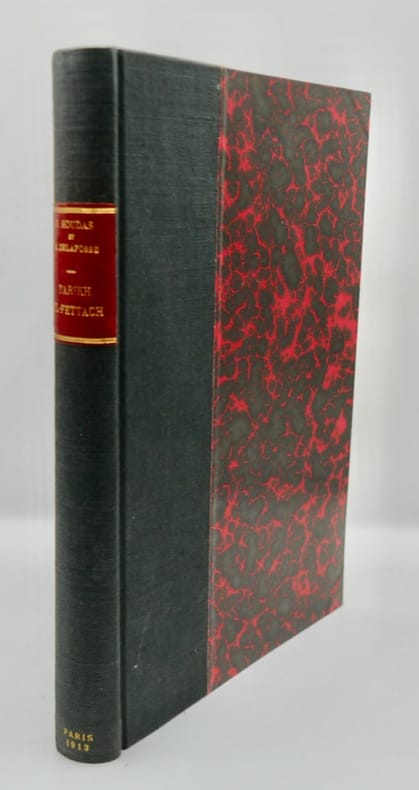
Mahmoud Kati ben El-Hadj El-Motaouakkel Kati
TARIKH EL-FETTACH ou, Chronique du chercheur, pour servir à l'histoire des villes, des armées et des principaux personnages du Tekrour. Traduction française, accompagnée de notes, d'un index et d'une carte.par O. HOudas et M. Delafosse.
Paris, Ernest Leroux, éditeur 1913. Grand in-8, bradel, demi-toile noire, pièce de titre en basane rouge bordé d'un double filet doré, millésimé en queue du dos, plats granités, gardes marbrées, couverture et dos conservés, reliure moderne, XX-361pp, [2]ff., carte h.-t. (Documents arabes, relatifs à l'Histoire du Soudan). Édition originale de la traduction française. (Publications de l'école des Langues Orientales)
Referenz des Buchhändlers : 567775
|
|
|
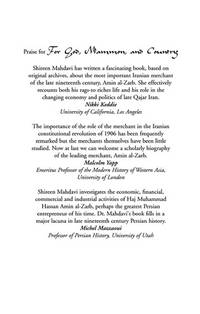
Mahdavi, Shireen
For God Mammon And Country: A Nineteenth Century Persian Merchant: Haj Muhammad Hassan Amin Al-zarb 1834-1898
Boulder CO.: Westview Press 1999. This scholarly text is the first major account of the life and times of a merchant in nineteenth-century Iran or in the Middle East. Haj Muhammad Amin al-Zarb 1834-1898 rose from humble beginnings to become one of Irans wealthiest and most prominent merchants. He built up his wealth as a money changer a trader in textiles precious stones opium carpets agricultural products and staple foodstuffs amongst other goods and judicious transactions in land. Adept at cultivating powerful connections he became the principal supplier of luxury goods to the Shah his court and members of the ruling elite; served as private banker to the Shah his prime minister and influential bureaucrats; and became Master of the Mint. He had agents in all the main towns of Persia and Europe with correspondents in Asia and America.Amin al-Zarb was also an entrepreneur industrialist and innovator. Determined to bring to Iran the advances he had witnessed in Europe he invested in mining established factories with imported machinery such as glass china and silk reeling built a railway line and urged the Shah to establish a national bank. He also became an advocate of reform and curbs on arbitrary rule. He befriended the famous Islamic reformer Jamal al-Din Afghani. An innovator in business Amin al-Zarb led a very traditional life at home. Gifted at making money he was nevertheless a pious man who contributed generously to religious and charitable causes. Shireen Mahdavi draws on hitherto unpublished family archives to write not only a biography of a fascinating nineteenth-century merchant but also a social history of the period. Her portrait of Amin al-Zarb also provides important insights into the economic social and political role played by merchants in Iran and elsewhere in the Middle East in the nineteenth century. 286 pp. Illustrated. Dustjacket in mylar. First Edition. Hard Cover. As New/As New. 8vo - over 7¾" - 9¾" tall. Westview Press Hardcover
Referenz des Buchhändlers : MS-45 ISBN : 0813336422 9780813336428
|
|
|
Mahmoud Ra'if.
Cedid Atlas Tercümesi [= New Atlas, Translated]. Üsküdar/Istanbul, Tab'hane-yi Hümayunda / Mühenduishâne Press, [April 1803-March 1804 CE] = 1218 H.
Folio (533 x 364 mm). (3), 79 pp., engraved, illustrated title-page and 25 engraved maps after William Faden, in contemporary hand colour. Contemporary black morocco, richly stamped in silver and blind. Bright yellow pastedowns. In custom-made half morocco solander box. The first European-style atlas printed in the Islamic world: an exceedingly rare, handsome, and entirely complete example in its original first binding. "[T]he first world atlas printed by Muslims [...], of which only fifty copies were printed" (Library of Congress, Near East Collections: an illustrated guide, online). Several copies were reserved for high-ranking officials and important institutions; most of the remainder were destroyed in a warehouse fire during the Janissary Revolt of 1808. "Based on several estimates and accounting for the single maps (torn-out from bound volumes of the atlas) sold or being offered worldwide, it is believed that a maximum of 20 complete examples could be present in libraries or in private collections, whereas some sources suggest that there exist only 10 complete and intact copies in the world. As such, it is one of the rarest printed atlases of historical value" (Wikipedia). - A prestigious project for the Ottoman Palace with the seal of approval of the Sultan Selim III, this work was one of the avantgardistic enterprises promoted by Mahmoud Ra'if to introduce Western technical and scientific knowledge to the Ottoman state. Composed of 25 maps based on William Faden's "General Atlas", it is the first Muslim-published world atlas to make use of European geographic knowledge. On each of the maps the place-names are transliterated in Arabic. The Atlas includes Raif's 79-page geographical treatise "Ucalet ül-Cografiye" and the frequently missing folding celestial map on blue paper. - Maps very clean, showing only a few minor stains and repaired tears to folds; a creasemark to the map of Africa; an internal tear to pre-Revolutionary map of France. Binding professionally repaired at extremeties and upper hinge with a few scuffmarks and insignificant traces of worming. An excellent copy, one of the very few surviving specimens in the beautiful original oriental leather binding (the only other known example was sold through us in 2019). A severely defective copy recently commanded an auction price of USD 118,750 (Swann Galleries NY, 26 May 2016, lot 199). OCLC 54966656. Not in Philipps/Le Gear. Not in Atabey or Blackmer collections.
|
|
|
Mahmoud Ra'if.
Tableau des nouveaux reglemens de l'Empire Ottoman. Constantinople, Imprimerie du Genie, sous la direction de Abdurrahman Efendi, 1798.
Folio (210 x 308 mm). 60 pp. With 27 engraved and etched plates (some double-page). Contemporary speckled sheep. Marbled pastedowns. First and only edition, printed at the second printing press established in Istanbul. "A rare and very interesting work outlining the military reforms and the regulations for the New Troops established by Selim III in 1796/97" (Blackmer). The author, Mahmoud Ra'if, was a member of the reform movement instigated in Turkey by Sultan Selim III, who tried to change the traditional political structures of the Ottoman Empire and replace them with a political state that owed much to his youthful contact with Europe, and more particularly, the influence of the French Revolution. After his succession in 1789, Selim took steps to establish a new state under the Nizam-Jedid ("new order") regulations - from which the present work derives - underpinning his state with the formation of a new army and military infrastructure. Among the moves towards "Europeanisation" were the installation of printing presses at the military engineering school (where the present work, the first from the press in roman types, was printed), and the establishment of Ottoman embassies in the capitals of Europe, including London, where Mahmoud Ra'if served as secretary to the Ottoman Ambassador in the mid 1790s. As outsiders feared, the very reforms which are the subject of his work led to Selim's murder in 1808, while the author himself was "cut to pieces" by the enraged Janissaries whose elite position had been threatened. "The establishment of these troops - the Nizam-Jedid - and the jealousy which this aroused was one of the main factors leading to the revolt of the Janissaries in 1808 which cost Selim, and later the author of this work, their lives" (Blackmer). - Binding very slightly worn, interior clean and flawless throughout. Provenance: armorial bookplate of the Swedish diplomat Johan Henrik Tawast (1763-1841), who was seconded to Constantinople in 1812-13 to help negotiate the Russian-Turkish peace treaty of Bucharest; his autograph note "Scutari, 9 janvier 1813. 16 piastres, 20 pares" inscribed to front pastedown. Latterly in the collection of Thomas Fremantle, 3rd Baron Cottesloe (1862-1956), commander of the Territorial Army and president of the Society for Army History Research. Atabey 752. Blackmer 1060.
|
|
|
Mahmud II, Sultan of the Ottoman Empire (1785-1839, ruled 1808-1839).
Signed document (Berat) in Ottoman Turkish. Constantinople, [August 1818 CE =] first days of Shawwal 1233 H.
80 x 27 cm. Ink and gold dust on paper. With large Tughra. Concerns an order of horses. The document was given to a British sailor whose family preserved it until recently.
|
|
|
MAILLART Ella
La via crudele. Due donne in viaggio dall'Europa a Kabul
in 8°, pp. XVI, 221, bross. edit. con sovracop. ill. Collana: Viaggi e Avventura, diretta da Bruno Gambarotta, traduz. e note di Silvia Vacca, con 1 cartina in nero. Ottimo. 121-41

|
|
|
Maillet, Benoît de.
Description de l'Egypte, contenant plusieurs remarques curieuses sur la Geographie ancienne et moderne de ce païs, sur les monumens anciens [...]. Paris, Louis Genneau & Jacques Rollin, 1735.
4to (214 x 250 mm). 2 parts in one volume. XXI, (3), 328, 242, (10) pp. Title-page printed in red and black. With engraved portrait frontispiece, 7 engraved plates (2 of which folding), and 1 engraved folding map of Egypt. Contemporary full calf with traces of gilt spine (oxydized) and remnants of a spine-label. Marbled endpapers. Edges sprinkled red. First edition. - Prominent compendium of all that was known about Egypt at the time, taking the form of a series of letters written by the French consul and inspector of the French institutions in the Levante, Benoît de Maillet (1656-1738), stationed in Cairo from 1692 to 1708, edited and compiled for publication by the cleric Jean-Baptiste le Mascrier (1697-1760). During his time in Egypt, Maillet developed a great interest in Arabic and Egyptian life, as well as in Egyptian antiquities and Arabic architecture. With his work he greatly expanded European knowledge about the country, its antiquities and the manners and costums of its inhabitants. The frontispiece shows a portrait of the author, while the plates depict tombs, sarcophagi, obelisks, and animals. The two folding plates exhibit the Mikias, or Nilometer, in Cairo, and a cross section of the Great Pyramid of Giza. The final chapter discusses the annual Hajj to Mecca and describes the cities of Mecca and Medina, as well as Mahomet's tomb. - Title-page a little duststained, with traces of a removed stamp of ownership. Somewhat foxed and brownstained throughout, more pronounced among first and last leaves. Upper margins slightly waterstained near the end. The map of Egypt shows small marginal flaws. Upper joints and extremities professionally restored. A near-contemporary note on the estimated price of the volume by a former owner on front flyleaf. A good copy. Atabey 748. Blackmer 1061. Gay 2105. Ibrahim-Hilmy I, 170. Paulitschke 717. Not in Weber.
|
|
|
MAITLAND Louise
Forest Venture. Conquering the Deserts of the Middle East. NEAR FINE COPY IN UNCLIPPED DUSTWRAPPER
8vo., First Edition, with frontispiece, plates and maps; green cloth, gilt back, a near fine copy in unclipped dustwrapper.

|
|
|
MAKAROFF (Noubar)
Le Déporté de Deir-ez-Zor. La déportation des Arméniens ottomans en 1915.
P., La Pensée Universelle, 1998. In-8, broché, couv. ill., 203 pp., ill. en noir dans le texte. Bibliogr.
Referenz des Buchhändlers : 556639
|
|
|
Makin, Jirjis ibn al-'Amid (Georgius Elmacinus) / Erpenius, Thomas (transl.).
Historia saracenica, qua res gestae muslimorum Inde a Muhammede Arabe. Leiden, Johannes Maire & Elzevier, 1625.
4to. (8), 372, 75, (1) pp. With woodcut title vignette. Contemporary vellum. Quarto edition of Elmacinus's great chronicle, "Tarih al-muslimin" ("Kitab al-magmu` al-mu-barak"), translated by Erpenius. This "History of the Saracenes" is actually a history of Islam from the days of the Prophet up to the year 1118. Erpenius, professor at Leiden, is remembered as "one of the men whom the study of oriental languages owes its resurrection" (cf. VI, 329). "The translation of the second part of the 'Tarih al-muslimin', an Arabic chronicle written by the Copt Georgios Al-Makin in the thirteenth century. The first part was already missing from the manuscript which Erpenius used. The text and translation were published by Golius, who had to edit the last two chapters, where Erpenius had broken off. There are three editions: a folio edition containing text and translation; this quarto edition of the translation only, and a small-octavo edition of the text only. The manuscript used for this edition was lent to Erpenius by the Palatine Library, a fact which he acknowledges in the dedication to King Frederick of Bohemia [...] Next to the title and the dedication, the preliminaries contain a short anonymous note introducting the work to the reader (no date, no mention of an Arabic text), and a list of the Khalifs mentioned in the translation" (Smitskamp). - Title page insignificantly browned; slight paper defects in the list of Caliphs (with old repairs), otherwise well-preserved. Rahir 197. Willems 232. Smitskamp PO, 83. Brunet II, 964 (note). Schnurrer 155. GAL I, 348. Juynboll 111-114. Fück 71ff.

|
|
|
Makin, Jirjis ibn al-'Amid (Georgius Elmacinus) / Vattier, Pierre (transl.).
L'histoire Mahometane, ou les quarante-neuf Chalifes du Macine divisez en trois livres [...]. Paris, Remy Soubret, 1657.
4to. (8), 9-44, 332 pp. - (Bound with) II: Ibn 'Arabshah, Ahmad ibn Muhammad / Vattier, Pierre (transl.). L'histoire du grand Tamerlan divisée en sept livres. Ibid., 1658. (24), 248, (4) pp. - (And) III: The same. Portrait du grand Tamerlan, avec la suite de son histoire iusques à l'establissement de l'Empire du Mogol. Paris, Vattier, Augustin Courbé & Jean Huart, 1658. (8), 146, (2). Contemporary vellum. All edges sprinkled in red. A milestone of French Arabist scholarship in the 17th century. I: First French edition of the "General History of the World" ("Kitab al-Magmu' al-mubarak") by Girgis al-Makin ibn al-'Amid, known in the Latin tradition as Georgius Elmacinus. Born in Cairo in 602 AH (1205 AD) to a Coptic civil servant in the War Ministry, he later served in a similar function in Syria. His chronicle had previously been translated into Latin (by Erpenius) and English (by Purchas); the work "for the first time provided wider circles in the west with an overview of Islamic history from its beginnings to the Crusades and acquainted them with the prime of the Baghdad Califate, previously almost unreceived, through an account ultimately based on Tabari" (cf. Fück). - II/III: First French translation (issued in two parts) of this important critical, at times even satirical eyewitness account of the life of Tamerlane (Timur Lenk), the great Turkish conqueror of the 14th century. "A frequently malicious account, in spite of the panegyrical form in which it is couched" (cf. GAL). Based on the original Arabic text written in 1437-38 by the Syrian author Ahmad lbn 'Arabshah who was secretary to Sultan Ahmad of Baghdad. In the late 16th century Timur was made famous in Europe through Christopher Marlowe's play "Tamburlaine" (published in 1590). The 17th century Western translations of Ibn Arabshah's work "for the first time acquainted the occident with a model of Arabic rhyming prose which also had the power to captivate the reader by its subject, as well as with the elaborate rhetorical style so characteristic of the literary taste of the Orient" (cf. Fück). Pierre Vattier (1623-67), physician to the Duke of Orleans, was the author of several treatises and translations on various aspects of Middle Eastern or Muslim culture. - Some browning and occasional inkstaining throughout. Top spine-end repaired. A good copy. The Macclesfield copy commanded £3,400 at Sotheby's in 2008. I: GAL I, 348. Schnurrer, p. 115, no. 155. Gay 3568. Fück 73. Aboussouan 449 ("1558" in error). OCLC 1811219. - II/III: GAL II, 29. Schnurrer, p. 137, no. 167. Fück 82. OCLC 29069177/29069426.

|
|
|
Malcolm, John.
The History of Persia. From the Most Early Period to the Present Time. London, James Moyes for John Murray and Longman & Co., 1815.
Small folio. 2 vols. XII, (2), 644 pp. With folding engr. map and 11 plates. VII, (1), 715, (1) pp. With 11 plates. Contemporary full calf with giltstamped spine label. First edition of this "ouvrage importante" (Brunet), based on Malcolm's (1769-1833) three diplomatic visits to Persia. While the history it provides extends back to the earliest kings known at the time, the most valuable contribution made by this book is its detailed description of the contemporary Qajar dynasty from its outset. Complete with 24 copper engravings on 23 plates including the large folding map of Persia as well as several portraits and views. Occasional foxing to margins; contemporary ownership to title page. Bindings a little rubbed, with slight weakening to hinges. A good, wide-margined copy. Howgego II, M7. Ghani 236-239. Wilson 134. Brunet III, 1333. Graesse IV, 350. Schwab 360. Sotheby's, Hopkirk sale, 963. Sotheby's, Burrell sale, 496. OCLC 19941897.

|
|
|
MALLOWAN Max
Mallowan's Memoirs. [Second Impression.] NEAR FINE COPY IN UNCLIPPED DUSTWRAPPER
8vo., Second Impression, with plates, maps in the text and pictorial endpapers; brown cloth, gilt back, fore-edge faintly spotted else a near fine copy in unclipped dustwrapper. Published three months after the first impression. Mallowan was an eminent archaeologist and Egyptologist, and husband to Agatha Christie
|
|
|
Maloof Joseph N
ARAB-AMERICAN HISTORY LEBANESE DIASPORA: IN NEW YORK AND THE WORLD KHIZANAT AL-AYAM ARABIC TITLE: KITAB KHIZANAT AL-AYAM FI TARAJIM AL-ÕLZAM
New York: MatbaÕat Jaridat al-Ayyam 1899 . Hardcover. Very good/No jacket issued. New York: MatbaÕat Jaridat al-Ayyam 1899 . A number of b/w plates mostly portraits of world leaders and rulers. 308 pp. Text in Arabic. Hardcover. 4to. Dark blue cloth. The text of this book is in Arabic only the dedication to President William McKinley is in English. The overall theme of the work is the Lebanese Diaspora but a large part of the book consists of short biographical pieces on world leaders and rulers including Queen Victoria and other rulers of Europe Sultan Abdul Hamid of Turkey Abbas Pasha of Egypt Muzaffar ad-Din of Persia and Melelik of Ethiopia. Other biographical sketches include the reform politicians of the Ottoman Empire Lebanese and Syrian politicians and intellectuals and the patriarchs of the Eastern Christian churches. Also included is a short preview of the Paris Exhibition of 1900. Because of the cheap paper used both free endpapers are separated at the hinge otherwise the book is tight and clean. Nonetheless the textblock paper is extremely brittle and therefore fragile. Very good/No jacket issued. Insurance required to ship this item. MatbaÕat Jaridat al-Ayyam hardcover books
Referenz des Buchhändlers : 44243

|
|
|
MALRAUX (André) / IZIS
Israel.
In-4, 159p. Edition originale numérotée 1/15030 exemplaires sur papier sans bois. Texte liminaire de Malraux. Couverture et frontispice de Chagall. Illustré de 78 photographies en noir et blanc reproduites en héliogravure d'Izis.
|
|
|
MALTESE Paolo.
Perché il quarto conflitto Arabo-Israeliano?
Un'analisi fredda e imparziale della difficile situazione del Medio Oriente. Da una parte un popolo di profughi, espropriato dalle sue terre dagli israeliani e massacrato dai giordani con la sdegnata complicità di egiziani e siriani, dall'altra Israele, che a sua volta imprigiona migliaia di dissidenti ebrei, in nome di un nazionalismo altrettanto controrivoluzionario dei suoi nemici.. Ottimo esemplare. Brossura editoriale illustrata, pp. 171, in 8°
|
|
|
MANTRAN (Robert)
Histoire d'Istanbul
Fayard "Histoire des grandes villes du monde" 1996, in-8 broché, couverture illustrée à rabats, 382 p. (très bon exemplaire) Illustrations in-texte, glossaire, bibliographie, chronologie et double index. Remarquabe évocation historique de la seule ville au monde à être bâtie sur deux continents, "faite pour dominer et commander à toute la terre"...
Referenz des Buchhändlers : 44092
|
|
|

 Per e-mail erhalten
 Als pdf-Dokument herunterladen
 RSS feed
 Permanenter link


