|
|
|
MANTRAN (Robert) [Dir.]
Histoire de l'empire ottoman.
Paris, Fayard, 1989. In-8, cart. éd. ill. en coul., 810 pp., 16 cartes en n/b. in-t., chronologie, glossaire, bibliographie, index.
Riferimento per il libraio : 601003
|
|
|
MANTRAN, Robert
L'expansion musulmane (VIIème - XIème siècles)
1969 Editions Presses Universitaires de France (P.U.F.), Collection "Nouvelle Clio", Série "L'Histoire et ses problèmes", n° 20 - 1969 - Petit in-8, cartonné, couverture illustrée - 334 p.
Riferimento per il libraio : 119311

|
|
|
MANTRAN (Robert)
L'expansion musulmane. VIIe - XIe siècle.
Paris, PUF, 1991. In-8 broché, couv. ill. en coul., 334 pp., qq. cartes, index.
Riferimento per il libraio : 599529
|
|
|
Mandelslo, Johann Albrecht von.
Morgenländische Reyse-Beschreibung. Hamburg & Schleswig, Johann Holwein for Christian Guth, 1658.
Folio. (32), 248, (36) pp. With separate engraved title-page, engr. portrait, double-page engraved map and 21 large text engravings by Christian Rothgießer; woodcut initials and head- and tailpieces. - (Bound after) II: Saadi (ed. Adam Olearius). Persianischer Rosenthal. In welchem viel lustige Historien, scharffsinnige Reden, und nützliche Regeln. Ibid., Johann Holwein for Johann Naumann, 1654. (52), 196, (30) pp, final blank f. With separate engraved title-page, engr. portrait and 33 large text engravings by Rothgießer. Contemporary vellum. First edition of this famous travel report, containing "many interesting details of the eternally plentiful oriental world" (cf. Henze). While the engraved maps depict Southeast Asia from Persia to Japan and Java, the remaining engravings mainly illustrate the customs of the Arab world, of Persia and India. "Mandelslo was a German traveller and adventurer (1616-44). Originally a page at the court of the Duke of Holstein-Gottorp, in 1635 Mandelslo was attached to the duke's embassy to Moscow and Persia, a mission intended to open trade negotiations. The Duke's librarian and mathematician, Adam Olearius, accompanied the embassy as its secretary. The ambassadors themselves remained in Persia, but in 1638 Mandelslo, feeling the need for wider travel, obtained permission to travel on to India. Sailing from Hormuz, he landed at Surat in April 1638 then travelled through Gujarat to Agra, Lahore, Goa, Bijapur and Malabar. He sailed for England from Surat in January 1639, calling at Ceylon and Madagascar, but was to die of smallpox five years later. Before his death, Mandelslo had entrusted his rough notes to Olearius, who subsequently published them bound with his numerous official accounts of the embassy" (Howgego I, 677). This first edition is significantly rarer than its later reworkings and translations; ABPC lists a single complete copy at auctions of the last decades (Sotheby's, Oct 11, 2005, lot 177, £3,400). - Bound with this is the first German edition of Saadi's "Gulistan", also edited by Olearius. - Old armorial bookplate (name erased) and bookplate of Eivind Hassler (1939-2009) on front pastedown. I: VD 17, 23:233226D. Lipperheide Ld 1. Adelung II, pp. 306-308. Alt-Japan-Katalog 943. Bircher A 6927f. Cordier, Japonica, cols. 362-368. Cox I, 271f. Dünnhaupt, pp. 293-294, 30.1. V. Gelder, Het Oost-Indisch avontuur, pp. 77, 99, 263. Howgego I M38. Commissariat, "Mandelslo's Travels in Western India", in: The Geographical Journal, 78 (1931), pp. 375ff. - II: VD 17, 23:282436H. Dünnhaupt S. 2991, 24.1. Bircher A 251. Goedeke III, 65, 7.
|
|
|
Mandelslo, Johann Albrecht von.
Morgenländische Reyse-Beschreibung. Hamburg, Christian Guth (printed by Johan Holwein, Schleswig), 1658.
Folio. (32), 248, (36) pp. With engraved frontispiece by Christian Rothgiesser, full-page engraved author's portrait, double-page engraved map, and 21 large engravings in text, mostly signed by Rothgiesser; woodcut initials and head- and tailpieces. Contemporary blind-ruled leather, remnants of ties. First complete German edition of an important and entertaining travel account by Johann Albrecht von Mandelslo, edited by Adam Olearius. Mandelslo was attached to the diplomatic mission of Frederick III, Duke of Holstein-Gottorp, to Moscow and Persia. Frederick's aim was to negotiate a new trade route for Persian silk and to make his small duchy an important centre of European silk trade. After visiting Moscow, the mission continued along the Volga to Astrakhan and from there to Persia, crossing the Caspian Sea near Shamakhi. Via Ardabil, Qazvin and Kasan the party finally reached the capital, Isfahan. The ambassadors remained in Persia for several months (only to return without concrete results), but Mandelslo travelled further to the east. He sailed from Hormuz to Surat and proceeded through Gujarat to Agra, Lahore, Goa, Bijapur and Malaba, visiting Ceylon, Madagascar, the Cape of Good Hope and St. Helena on his return voyage in 1639. Before his death 5 years later, he had entrusted his rough notes to Olearius, who subsequently published them with a third part containing descriptions of the Coromandel coast, Bengal, Siam, Sumatra, Java, Borneo, Bantam, the Philippines, Formosa (Tai-wan), China and Japan. Small contemporary owner's entry ("Jos[eph] Baudler"?). Some foxing and brownstaining; slight tears in lower margin of pp. 31 and 137. A very good copy of an important account of an embassy to Persia and further to the East. VD 17, 23:233226D. Lipperheide Ld 1. Adelung II, pp. 306-308. Alt-Japan-Katalog 943. Bircher A 6927f. Cordier, Japonica, cols. 362-368. Cox I, 271f. Dünnhaupt, pp. 293-294, 30.1. V. Gelder, Het Oost-Indisch avontuur, pp. 77, 99, 263. Howgego I M38. Commissariat, "Mandelslo's Travels in Western India", in: The Geographical Journal, 78 (1931), pp. 375ff.

|
|
|
Mandeville, John.
The Voiage and Travaile of Sir John Maundevile, Kt. Which Treateth of the Way to Hierusalem: and of Marvayles of Inde, with other Islands and Countryes. London, J. Woodman, D. Lyon & C. Davis, 1725.
8vo. XVI, (8), 384, (8) pp. Title page printed in red and black. Contemporary calf with giltstamped cover fillets, rebacked to style with giltstamped red label, leading edges gilt. All edges sprinkled in red. Rare, reliable 18th-century English edition of the classic (though partly fictional) 14th-century account presented as voyages of Sir John Mandeville through Turkey, Egypt, Ethiopia, Syria, Persia, Arabia, India and the East Indies, published from a 15th-century manuscript in the Cottonian Library (MS Titus C XVI). "This is the completest edition up to date" (Cox). According to the story he set off on his travels in 1322 from Saint Albans in England, returned in 1343, wrote the present account in 1364 and died in 1371. It was originally written in French and is thought to have been compiled from various sources by Jehan d'Outremeuse (1338-1400) or Jean de Bourgoigne (d. 1372) of Liege. It includes many well-known stories and illustrations of monstrous people and animals in exotic lands. The book also includes genuine descriptions of the regions covered and gave many Europeans their first notions of the Near East, Middle East, India and East Indies. The part on Arabia includes an account of the birth of Muhammad (p. 169). - Occasional slight browning, but well-preserved. Provenance: Sold as a duplicate by the Bodleian Library (with the Radcliffe Infirmary's armorial bookplate and cancellation stamp); later in the collection of H. C. Gleave (his bookplate). Ibrahim-Hilmy II, 12. Cox I, 319. Cf. Henze III, 363 (1883 reprint of this edition). Gay 2128.
|
|
|
Mandeville, John.
The voyages & travels of Sir John Mandevile, Knight, … to the Holy Land, and to Hierusalem: as also to the lands of the Great Caan, and of Prestor John: to Inde, and divers other countries. London, Richard Chiswell, Benjamin Walford, Matthew Wotton, George Conyers, [printing probably shared by 2 printers, one possibly Samuel Roycroft], 1696.
4to (19.5 x 15.5 cm). (4), "139" [= 135], (5) pp. With a woodcut ship on the title-page (with a griffin on the sail) and about 60 woodcut illustrations in the text (mostly about 55 x 80 mm) plus about 10 repeats, each with a thick-thin border. Set in textura types with incidental roman and italic. Gold-tooled, red goatskin morocco by Robert Riviere in London (ca. 1875/80), with 5 (false?) bands on the spine, each board with a double frame of double and triple fillets and 2 different sets of 4 corner pieces, author and title in gold in 2nd and 3rd of 6 spine compartments, the others with gold-tooled decorations and the date and place of publication at the foot, gold-tooled turn-ins, gold fillets on board edges, straight-combed endpapers, gilt edges, stamped on the back of the free marbled endleaf in sans-serif capitals: "Bound by Riviere". A rare 17th-century English edition, with about 60 different woodcut illustrations, of a classic and partly fictional 14th-century account of travels presented as voyages of Sir John Mandeville through Turkey, Egypt, Ethiopia, Syria, Persia, Arabia, India and the East Indies. According to the story he set off on his travels in 1322 from Saint Albans in England, returned in 1343, wrote the present account in 1364 and died in 1371. It was originally written in French and is thought to have been compiled from various sources by Jehan d'Outremeuse (1338-1400) of Liege. A 1371 manuscript survives and it first appeared in print under the title Itinerarius in Dutch (ca. 1477), French (1480), German (1480) and other languages, and in English in Richard Pynson's edition of ca. 1497/98. It includes many well-known stories and illustrations of monstrous people and animals in exotic lands: a man with only one enormous foot that he can use as a parasol, a dog-headed man, a man with his face in his chest, a girl who turns into a dragon, griffins, nine-metre giants, ants that gather gold, diamonds that mate and give birth to baby diamonds and much more that spoke to the imagination (though the ox-headed man is presented as an idol that was worshipped, rather than a fantastic beast). The book also includes genuine descriptions of the regions covered and gave many Europeans their first notions of the Near East, Middle East, India and East Indies. It shows carrier pigeons, an elephant and other recognizable or plausible scenes. It also incorporates and illustrates some biblical stories. The part on Arabia includes an account of the birth of Mohammed. Most of the present woodcuts are loosely and indirectly based on those in the 1481 Augsburg edition, partly in mirror image. The book went through dozens of editions in English and other languages. It reached more or less the present form with the 1650 London edition, which may have used the same woodblocks (we have not had an opportunity to compare them). The imprint of the present edition names four London publishers, and one of them (Conyers) also advertises his edition of William Lithgow's Nineteen years travels (1692) at the foot of the last page. The book was registered for these four publishers in the term catalogue for Trinity 1696, issued in June. The printing was probably shared between two different anonymous printers: exactly half way through the book, between quires I and K, the running heads, the textura type used for the main text and the roman drop capitals opening the chapters change. The 1684 edition by four London publishers (none named in the present edition) not only uses the same woodblocks but is also typographically almost identical to the first half of the present edition and no doubt came from the same printer. The drop capitals differ, but those in the present edition have not been recorded before 1688. Samuel Roycroft and James Orme both used them, and Roycroft used at least several of the other types in the first half. The book is printed on coarse laid paper with no watermark. Halliwell, in his 1869 edition of Mandeville, noted the present edition for its woodcuts and reproduced at least many of them from the Grenville copy now at the British Library. Only 5 other copies are known, all in U.S. libraries. Robert Riviere (1808-82) established his famous bindery in Bath and moved it to London in 1840, gaining a reputation as one of England's best binders for the quality of his materials and workmanship. He signed his bindings "Bound by Riviere" from 1860 to 1880 (thereafter Riviere & son). - With an early owner's inscription faded on the title-page and 2 armorial bookplates on the paste-down: Sir Edward Sullivan (1822-85), Lord Chancellor of Ireland, and Allan Heywood Bright (1862-1941) in Liverpool, a member of Parliament, along with a loosely inserted signed autograph letter (ca. 1900) from Bright's brother Hugh Bright (1867-1935) in Leeds, giving him the book and noting that he bought it at Young's "some years ago". With 8 leaves with their margins extended at the fore-edge and foot ( N2-O4, Q1, probably sophisticated from another copy of the same edition), sometimes shaving a catchword or quire signature, the title-page and last page somewhat worn and dirty, but further in good condition, with a few minor marginal chips and tears restored or repaired and 3 leaves with minor water stains in one corner. The spine is slightly faded but the binding is still very good. A rare edition of Mandeville's voyages, illustrated with about 60 woodblocks cut ca. 1650. Arber, Term catalogues II, p. 593, item 8; ESTC R217088 (5 copies); J. O. Halliwell (ed.), Voiage and travaile of Sir John Maundevile (1866), p. xvi (item 2, from the Grenville library); Wing M417 (same 5 copies); for the story in general: Cambridge History of English Literature (1976), pp. 78-87.
|
|
|
Manger, Samuel Hendrik Sam.
Oratio inauguralis, de incremento philologiae sacrae ab idonea Arabiae atque Palaestinae exploratione sperando. Franequerae, Gulielmus Coulon, 1762.
Folio. (4). 67, (1 blank) pp. With a woodcut coat of arms of the province of Friesland on the title-page, 1 woodcut headpiece, 1 woodcut tailpiece (plus 2 repeats) and 4 woodcut decorated initials (2 series). Set in roman and italic types with a few words of Hebrew. Modern boards, covered with grey paper, red and blue sprinkled edges. First and only edition of an inaugural lecture by Samuel Hendrik Manger (1735-1791), appointed ordinary professor of oriental languages and of Hebrew antiquities at the University of Franeker in 1760. Partly under the influence of the orientalist Albert Schultens, Manger valued Arabic studies for the insights they gave into Old Testament scholarship. In his present inaugural lecture, he discusses the controversial expedition to Palestine that several scholars were planning to make in that year. It shows his interest in archaeological research carried out in expeditions instigated by the German scholar Johann David Michaëlis. Manger believed they would inaugurate a new era in Biblical scholarship. - In very good condition and with very large margins, with only some minor marginal foxing in the title-page and an occasional unobtrusive small stain. STCN (3 copies); for the author: Biografisch lexicon voor de geschiedenis van het Nederlands protestantisme I, pp. 155-156; NNBW IX, col. 644.
|
|
|
Mangold, Peter
Superpower Intervention in the Middle East
Very good clean copy, spine of jacket shows slight fading. Pages bright and tight. Used
|
|
|
Manlio, Giovanni Giacomo (Johannes Jacobus Manlius or Manliis), Quirico de Augustis and Paulus de Suardis.
Luminare maius. Cinthius ut totum radiis illuminat orbem. Illuminat latebras sic medicina tuas. Lumen apothecariorum. (Venice, Gregorio de Gregori, 8 Jan. 1513).
Folio (305 x 210 mm). 77, (2), (1 blank) ff. With 13 woodcut decorated initials (6 series?) plus 8 repeats, 4-line typographic "Lombarbic" initials. Set in rotunda gothic types in 2 columns, with a preliminary note in roman type. With contemporary pen decorations in brown ink added to about half of the initials and occasional similar pen decorations in the margins, an occasional manuscript paragraph mark, some rubrications in brown ink and some initials coloured with a transparent ochre wash. Early 20th-century vellum, possibly incorporating older materials, sewn on 3 recessed supports, red spine label. Seventh known copy of an early edition of an important treatise on pharmacology and medical botany, by Giovanni Giacomo Manlio di Bosco (fl. 1490-post 1500), first published in Venice 1490 or Pavia 1494 (Sordano records an edition by Octavius Scotus in 1490, but the ISTC records no edition by him until 1496). It is a commentary on ancient Arabic and Greek pharmacological works, especially the Arabic treatises of Yuhanna Ibn Masawayh (ca. 777-857), a Nestorian Christian physician from Assyria who taught at the academy in Gundeshapur, Iran, and was personal physician to four caliphs. It gives instructions for preparing numerous medicines, indicating the quantities of the ingredients (simples, each derived from a single plant) and describing each ingredient. The present edition includes Manlio's preliminary note addressed to Bernardinus Niger, included in the 1494, 1496 and 1499 editions but omitted in many later editions. - The title-page indicates that the book also contains "Lumen apothecariorum", a work by Quirico de Augustis de Tortona of Milan (fl. 1486-97), first published in 1492. But it is not present here or in any of the other seven copies we have traced. The two works were combined in the Venice editions of 1504, ca. 1502/05 and 1506. De Gregori apparently followed one of these editions but did not include the second work. Hieronymus Surianus (fl. 1458?, d. 1522?) edited the first two. - With contemporary and later marginal manuscript notes. With the text area of B2.7 somewhat browned, an occasional small and unobtrusive stain, and a few small worm holes in the last few leaves, but generally in very good condition. Some of the manuscript notes have been shaved. The binding is slightly dirty and the boards slightly bowed, but the binding is still good. A rare early edition of an important work of pharmacology. Durling 2938. EDIT 16 29621 (1 copy). ICCU 29621 (same copy). KVK & WorldCat (5 copies). Emiliano Sordano, Il Luminare maius di Manlio del Bosco, thesis, University of Torino, 2010, p. 41. USTC 840112 (2 copies). Cf. Adams M 370 (1506 ed.). BM-STC Italian 410 (1504 and other eds.). Schelenz, Geschichte der Pharmazie, p. 414 (1529 ed.). Wellcome 4017 (1628 Lyon ed.). Not in Garrison & Morton; Honeyman; Norman Lib.
|
|
|
Mannerheim, Carl Gustav.
Across Asia from West to East in 1906-1908. Helsinki, Suomalais-Ugrilainen Seura, 1940.
2 volumes. (30,5x22cm). IV, 741; IV, 54, 16, 48, 36, 36, 12, 6, 30, 12 pp. With numerous illustrations in text, one small map after the preface, and 15 folding maps in the second volume. Half sheepskin, cloth sides. First edition of a travelogue through Asia, written by Carl Gustav Mannerheim (1867-1951), future president of Finland, 1944-1946. In 1906, Mannerheim, then a colonel, was sent on an expedition to Asia. "The object of this expedition was to study conditions in the interior of Northern China, collect statistical materials and perform various tasks of a military nature", says Mannerheim in the preface. Russia wanted to know the state of affairs in China due to the reforms and modernization undertaken by the Qing Dynasty. Besides that, Mannerheim wanted to collect items of scientific interest for the National Museum in Helsinki and to study the little-known peoples living in Northern China. This makes the work, with its numerous illustrations by photographs, an interesting anthropological account as well. The first volume contains Mannerheim's journal with many photographs. The second describes the scientific results the artefacts Mannerheim took with him to Helsinki and, including sculptures, costumes and utensils. - Number 33 out of limited edition of 100 and signed by the author. With owner's inscription of Ewald Henttu on flyleaf, dated 1940. Very good copy; binding slightly rubbed along the extremities.

|
|
|
Mansur, Ahmad
Qissat suqut Baghdad
Large quarto in orange pictorial wraps; 190 p. , bib. refs. ; 24 cm Iraq War, 2003; essays. Subtitle on cover: Haqiqah bi-al-wathaiq!; Suqut Baghdad
|
|
|
Manzoni, Renzo.
El Yèmen. Tre anni nell' Arabia felice. Escursioni fatte dal Settembre 1877 al Marzo 1880. Rome, Eredi Botta, 1884.
Large 8vo. (8), VI, (2), 446 pp. With portrait frontispiece, 21 plates (7 of which double-page sized; last single-page plate included in pagination), 2 folding coloured maps of Yemen, folding plate of the game "abdùr", folding coloured plan of Sana'a, folding view of Sana'a, folding view of Aden, as well as numerous woodcut illustrations in the text. Contemporary half calf over marbled boards with blindstamped spine and giltstamped spine-title. Marbled endpapers. First edition, rare. Richly illustrated account of Yemen, without doubt "one of the fullest descriptions of life in San'a' and Turkish-occupied North Yemen" (Auchterlonie) ever to be published. The Italian explorer Manzoni (1852-1918) spent three years travelling the Yemen, altogether staying an entire year in Sana'a, his "citta bellissima". He "investigated the city more thoroughly and described it more vividly than any of his predecessors [...] also, he was the first to draw a map of the city" (cf. Henze). The illustrations include pretty views of Sana'a and Aden, as well as portraits of the local population. - Extremities very slightly rubbed; some remnants of ink stains on the frontispiece; minor browning to margins throughout; last folding map with small tears (repaired). Library stamp of the Paris École des Langues Orientales Vivantes to title-page, somewhat rubbed. Marked as a duplicate in red pencil on the blank recto of the frontispiece. Auchterlonie 138. Henze III, 366.
|
|
|
MARTIROSYAN (A.H.) [Ed.]
Armeniaca. English summaries of armenological publications in Armenia. 2001.
Erevan, Mashtots Inst. of Ancien Manuscripts, 2006. In-4 broché, VII-225 pp., index.
Riferimento per il libraio : 555583
|
|
|
MARTIROSYAN (A.H.), SHIRINIAN (M.E.) [Ed.]
Armeniaca. English summaries of armenological publications in Armenia. 2002.
Erevan, Mashtots Inst. of Ancien Manuscripts, 2007. In-4 broché, VII-171 pp., index.
Riferimento per il libraio : 555586
|
|
|
MARTIN (abbé)
Histoires de la Terre-Sainte, depuis les temps les plus reculés jusqu'à nos jours.
P., Imp. de Béthune et Plon, 1844. Fort in-8 demi-basane brune époque, dos lisse, titre et filets dorés, 608 pp. sur deux colonnes, frontispice, 30 planches de gravures sur acier. (Le Monde, histoire de tous les peuples, tome 1).
Riferimento per il libraio : 476311
|
|
|
Marius Etienne FONTANE - Édouard RIOU
Le canal maritime de Suez illustré : -Histoire du canal et des travaux par M. Marius Fontane - Itinéraire de l'isthme par M. Riou
Aux bureaux de l'Illustration | Paris 1869 | 20.50 x 29 cm | broché
Riferimento per il libraio : 29518
|
|
|
Marabini (Jean)
Les chemins de Jérusalem.
1970 Presses de la cité, Paris, 1970. Un volume in-8 cartonnage bleu de l'éditeur sous jaquette dorée illustrée, 314 pages. Jaquette défraîchie, néanmoins bon état.
Riferimento per il libraio : 5778
|
|
|
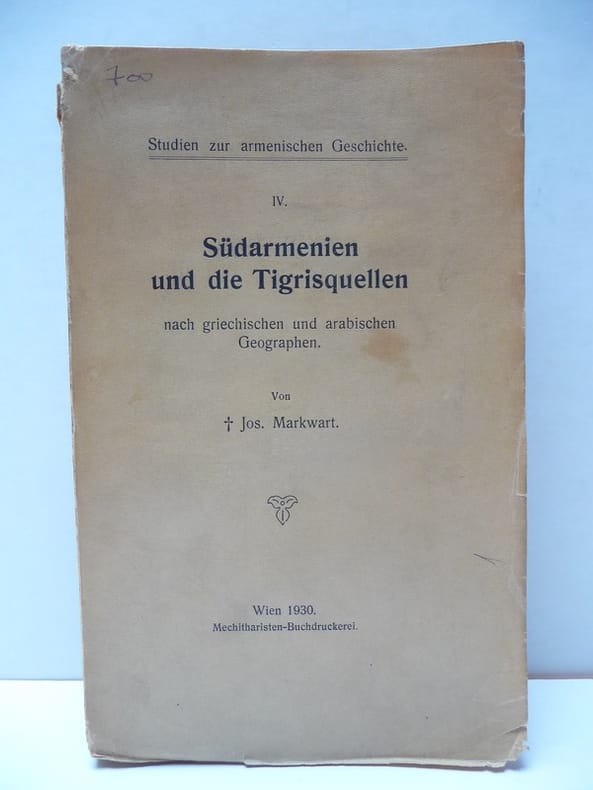
MARKWART (Joseph)
Südarmenien und die Tigrisquellen nach griechischen und arabischen Geographen.
Wien, Mechithariten-Buchdruckerei, 1930. Fort in-12 broché, dos muet, 125-648 pp., index. (Studien zur armenischen Geschichte, 4).
Riferimento per il libraio : 556177
|
|
|
MARRIOTT (Sir John A. R.)
The Eastern Question. An Historical Study in European Diplomacy.
Oxford, Clarendon Press, 1918. In-8, percaline bleue d’éditeur, sous jaquette, XII-536 pp., texte en anglais, cartes dt 2 dépliantes. Hardcover, blue cloth with dustjacket (small edgewear). 4e édition.
Riferimento per il libraio : 555421
|
|
|
MARECHAUX (Pascal).
Villages d'Arabie heureuse.
Paris Chêne/Hachette 1979 1 vol. relié in-4 oblong, cartonnage éditeur, jaquette illustrée, non paginé. Premier tirage des 81 photographies en couleurs de l'auteur. Bonne condition.
Riferimento per il libraio : 99057
|
|
|
MARECHAUX (Pascal).
Villages d'Arabie heureuse.
Paris Chêne/Hachette 1979 1 vol. relié in-4 oblong, cartonnage éditeur, jaquette illustrée, non paginé. Premier tirage des 81 photographies en couleurs de l'auteur. Bonne condition.
Riferimento per il libraio : 99057
|
|
|
Marcandier, M.
Traité du Chanvre. Paris, Nyon, 1758.
Small 8vo. (4), VII, (1), 138, (2) pp. Modern half calf with giltstamped red spine label, light cloth covers. All edges red. Rare first edition of one of the earliest treatises devoted exclusively to cannabis, extolling its virtues as a medicine, industrial fibre, seed oil, soap, animal feed, and so on. Marcandier in particular recommends the cultivation of the plant in the "Nord d'Amerique" (p. 46), and indeed the Traité du Chanvre was read by perhaps that region's most famous hemp enthusiast, George Washington - whose library contained a copy of the English translation printed in 1764, cataloged as Wa/549. - Marcandier begins with a scholarly account of the herb as it was known to the Romans (quoting Dioscorides, Pliny, and Herodotus), presenting intriguing theories of the etymology of the term cannabis: from the Celtic canab; the Greek kanna; the Hebrew kanneh; the Latin canna; etc. Although he is most concerned with its cultivation and medical applications, in his surveys of cannabis in non-European cultures we find descriptions of what can be termed 'recreational use': for example, "the Hottentots use a plant, named Dakha, instead of tobacco, or at least mix them together, when their provision of the latter is almost exhausted. They say that it is a kind of wild hemp" (pp. 19f.), while the 'flour' (farine) of the plant mixed into a drink "renders those who use it drunk, stupid, dazed; they say that the Arabs make of it a type of wine, which intoxicates" (p. 37). - Evidently drawing on personal experience, Marcandier describes the female flower as a "tender, sweet, and oily, white kernel, of a strong smell, that intoxicates when it is fresh" (p. 28) and even gives lengthy advice on how to inspect and purchase good-quality hemp (p. 76) and how to dry the plant properly, to avoid 'black spots' i.e. mold from forming (p. 54). - Cannabis is also recommended for myriad medicinal uses: "The grain and the leaves being squeezed, while they are green, and applied, by way of cataplasm, to painful tumors, are reckoned to have a great power of relaxing and stupefying ... The root of it boiled in water, and applied in the form of a cataplasm, softens and restores the joints of fingers or toes that are dried and shrunk. It is very good against the gout, and other humours that fall upon the nervous, muscular, and tendinous parts. It abates inflammations, dissolves tumours, and hard swellings upon the joints. Beat and pounded in a mortar, with butter, when it is still fresh, it is applied to burns, which it relieves greatly when it is often renewed" (pp. 38, 40f.). Marcandier also finds it useful as a spermicide (p. 35) and against gonorrhea, jaundice, smallpox, and 'vermin of the ear'. - A few contemporary ink annotations throughout. Provenance: from the library of the noted French botanist Philippe de Vilmorin (1872-1917) with his bookplate and separate shelfmark label ("a progenie in progenies") to pastedown. An excellent copy. Very rare: OCLC records 8 copies in US institutions (Chicago, Princeton, Lloyd Museum (OH), American Philosophical Society, Carnegie Mellon (Hunt Institute), Harvard, Minnesota, and the JCB). Not in Kress. Cf. Clarke & Merlin, Cannabis: Evolution and Ethnobotany (University of California Press, 2013), p. 202; and Gibson, "Bibliotheca Cannabinacea", in: Journal of Industrial Hemp 13 (2008), pp. 176-188.
|
|
|
Marchtaler, Veit.
Rerum a Sigismundo illustrissimo et fortissimo Transylvaniae principe contra Turcas gestarum brevis enarratio. [Prague, V. Maryn z Jencic], 1595.
4to. (48) pp. With woodcut title border. Modern full calf with blindstamped cover rules. Rare first edition of this account of Prince Sigismund Báthory's 1594 campaign against the Ottomans. At the time, Báthory's military successes against the Turkish forces attracted much notice in Europe. "The little book is quite jauntily written, providing a capsule history of the country up to Báthory's accession, then an account of the difficulties and hardships of the first years, the suppression of the 1594 conspiracy, naturally glorifying the Prince at the same time, and then gives a rather extensive account of the events of the campaign up to October 26. The numerous geographical names in the narrative are spelled correctly throughout" (cf. Apponyi). "Marchtaler knew Transylvania from a previous visit. The author did not himself participate in the campaigns against the Turks" (cf. Göllner). Although Apponyi speculated that the book might be an unknown publication by the Viennese printer Leonhard Nassinger, the Bohemian printer was conclusively identified by Ulrich Kopp of the Herzog August Bibliothek, Wolfenbüttel. - Some browning and brownstaining; ink pagination added by a contemporary hand. A good copy. VD 16, M 942 (cf. 943). BNHCat M 219. Göllner II, 2050. Hubay 360. Jügelt 47. Apponyi 562 ("apparently very rare").
|
|
|
Marco Polo.
Historici fidelissimi juxta ac praestantissimi, de regionibus orientalibus libri III [...]. Berlin, Georg Schultz, 1671.
4to. 3 parts in one volume. (6), 26, (16), 167, (51) pp. (8), 115, (13) pp. (4), 107, (9) pp. Letterpress title printed in red and black. With additional engraved title and engr. frontispiece to part 2 (lacking plates of Arabic characters); ornamental head bands and initials. 18th-century calf with gilt spine. All edges red. First edition. "Collated with a manuscript in the library of the Elector of Brandenburg, preface, geographical index, glossary, etc." (Lust). The gifted orientalist Andreas Müller (1630-94) compiled in a single volume this collection of travel accounts and information on China: Part I is an edition of a Berlin manuscript of Marco Polo, including comparisons with editions by Grynaeus (1532) and Ramusio (1559). Part II, often bound last, is an encyclopedia of China by Müller, listing "Chinese peculiarities" based on Chinese and oriental sources (cf. Löwendahl 153). Part III is a Latin version of "Historia orientalis" by the Armenian Hayton of Corycus (d. 1308). - According to Lach, Müller was “one of the most cosmopolitan of [...] world-conscious Europeans” of his time, although he never travelled outside of Europe. He fell out with Kircher over a linguistic issue, and when Chinese writing was described by theologians as a breach of the Second Commandment, his position in Berlin became untenable. Having resigned his position as provost of St. Nicolai in 1685, he relocated to Stettin and spent the remainder of his life with private studies. "By his own ways of publishing he much hampered the production of a bibliography of his works, which would certainly warrant scrutiny. Before his death he destroyed his manuscripts. He negotiated over the sale of his library with numerous universities, but finally, on a whim, gave away a mere 50 books to the Stargard Consistorium in 1692; most of his books and the remainder of his papers he willed to St. Mary's collegiate church in Stettin" (cf. ADB XXII, 513f.). - Some browning and spotting throughout. Still a fine copy from the library of the Ducs de Luynes at the Château de Dampierre: their bookplate reproducing the arms of Charles Marie d'Albert de Luynes (1783-1839), 7th Duc de Luynes, on pastedown; latterly in the library of Jean R. Perrette (his bookplate). VD 17, 12:108208R. Cordier (Sinica) III, 1968. Lust 288. Löwendahl 153. Morrison II, 535. Ebert 17665. Henze IV, 380. ADB XXII, 513. Brunet III, 69 & 1406 ("receuil assez recherché").

|
|
|
Marcus Aurelius Antoninus Augustus.
Markou Antoninou Autokratoros ton eis heauton biblioi 12. Guftar-i Marqus Antunin Padishah dar hal-i nafs-i hud-i 'ali-gah. (Ed. Joseph von Hammer-Purgstall). Vienna, Anton Strauß (Witwe), 1831.
Large 4to (210 x 267 mm). (2), 168, (2) ff. Publisher's original printed and illustrated boards with an oriental design in three colours and Persian letterpress on both covers. First and only edition of the "Meditations" of Emperor Marcus Aurelius both in the original Greek and in Persian, edited and translated by Joseph Hammer-Purgstall and printed in parallel on opposite pages throughout. "A meticulous typographical production" (Durstmüller). "The 1831 publication of Marcus Aurelius' Meditations in Persian comprises one of the 19th century's most intriguing cross-cultural and inter-religious texts. Produced by the Austrian Orientalist Joseph von Hammer-Purgstall, and addressed to the reigning Shah of Persia, this translation negotiates a wide diversity of concerns, including political diplomacy, literary aesthetics and religious difference" (J. Einboden, Stoicism or Sufism? Hammer-Purgstall's Persian Meditations, Middle Eastern Literatures 13.1 (2010), pp. 49-68. - Corners bumped, edges a little rubbed. Clean and uncut as issued in the publisher's charming original printed boards, a rare and early example of such a binding. Hoffmann I, 187. Engelmann/Preuss I, 148. Goedeke VII, 766, 80. Durstmüller I, 263. Graesse I, 329. OCLC 257616436.
|
|
|
Mardinli, Yusef Ibn Shammas Butris Ibn Kas Yusef, Al-.
[Chaldean prayer book]. [Iraq, Ottoman Empire], 16. XI. 1826.
12mo (80 x 106 mm). Arabic manuscript in Naskhi script. 292 pp. (first 23 ff. foliated by a contemporary hand), 10-12 lines per extensum, black ink, headlines and emphases in red. Marked throughout the text with 36 crosses potent and a few ornaments, one in colour. Contemporary full brown calf with blindstamped oriental decoration. A fine Chaldean-rite prayer book written towards the end of the contested patriarchate of Joseph V Augustine Hindi (lasting from 1781 to 1827). Includes prayers against the plague, for holidays such as Good Friday, Easter and Ascension, for various times of the day, and for thanksgiving, as well as to the Virgin Mary and Christ. Special prayers for women are mentioned, as are certain Psalms, St. Joseph, Pope Sixtus IV, the Ten Commandments, and the necessary steps toward converting to Christianity. Occasionally, differences between the Chaldean and Roman Catholic rites are mentioned. - The book is written in easily legible Arabic, one of the languages of worship for Chaldeans, whose usual language was in fact Aramaic, the language of Jesus. The name of God is here consistently written as "Allah", while a total of 36 crosses are drawn throughout the text. Curiously, the compiler's Nisbah is given as "Al-Mardinli" ("from Mardin"), in the Ottoman rather than pure Arabic form - a detail that gives evidence of the degree to which cultures, religions and languages were intertwined in the Mesopotamian region. - In full communion with Rome, the Chaldean Catholic Church emerged from the Church of the East through the schism of 1552. By the 17th century, leaders would take the name Joseph, for which reason theirs is known as the "Josephite line" of succession. Although Augustine Hindi, the nephew of his predecessor Joseph IV, was never formally granted recognition by the Holy See as Patriarch of the Chaldeans, he was consecrated as bishop and named administrator of the patriarchate, and he became commonly known as Joseph V. - Binding a little rubbed; old note to lower flyleaf, written head over heels. An interesting cross-cultural document of the interaction between the Eastern and Western Churches, between regional languages and religions in the Middle East. Cf. Charles A. Frazee, Catholics and Sultans: The Church and the Ottoman Empire, 1453-1923 (London, 1983). David Wilmshurst, The Ecclesiastical Organisation of the Church of the East, 1318-1913 (Leiden, 2000).
|
|
|
Mareschal, Marien de.
Mémoire sur l'éducation des chevaux. (Moulins, L. Desrosiers, 1820).
Small 4to. 8 pp. Study on the training of horses, submitted and presented to the Agricultural Society of Allier, by Marien de Mareschal, Mayor of Deux-Chaises (France). The author tries to demonstrate the benefits of horse breeding. - Small defects to edges; slight dust-soiling.

|
|
|
Margaroli, G[iovanni] B[attista].
La Turchia ovvero l'Imperio Ottomano osservato nella sua situazione geografica - statistica - politica e religiosa [....] coll' aggiunta di un indice [...] e di un dizionario geografico. Con rami a colori. Milan, Gaetano Schiepatti, 1829.
8vo. 2 parts in one volume. 287, (1) pp. 304 pp. With 4 engraved costume plates in original hand colour. Contemporary half vellum over marbled boards with gilt label to spine. Only edition of this Italian handbook on the Ottoman Empire, discussing the geography and state, the city of Constantinople, the government, people and politics, history, as well as religion of Islam. Includes a lengthy section on Arabia and Arabians. The four engraved plates in full colour show an Ottoman infantryman, cavalryman, marine, and Sultan Mehmet II in military costume. Appended is a dictionary of place-names - a gazetteer of the Empire which includes extensive entries on Mecca and Medina. - Untrimmed, light foxing throughout, but well preserved. Old collection stamp of Sig. Antonio Buonamici (motto: "undique rectus") on title-page. Very rare; only three copies known outside Italian libraries (Leipzig University Library, formerly in the library of the great Austrian oriental scholar Joseph von Hammer-Purgstall; Austrian National Library; and Lucian Blaga Central University Library of Cluj-Napoca, Romania); none in America or the UK. OCLC 895531591. ICCU NAPE\015793. Verzeichnis der hinterlassenen wertvollen Bibliothek weiland des Herrn Josef Freiherrn von Hammer-Purgstall (Wien 1857), no. 890. Not in Atabey, Blackmer, or Lipperheide.
|
|
|
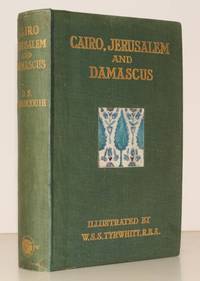
MARGOLIOUTH DS D S
Cairo Jerusalem & Damascus. Three Chief Cities of the Egyptian Sultans. Illustrated by W.S.S. Tyrwhitt and Reginald Barratt. NEAR FINE COPY
Chatto & Windus 1907. 8vo. First Edition with mounted coloured frontispiece original captioned tissue guard present title in blue and black 57 fine coloured plates and 4 line illustrations in the text; original green cloth upper board lettered in gilt with coloured illustration mounted in centre frame gilt back gilt top uncut expertly rebacked with old backstrip laid down a near fine copy. With the separately printed addendum slip facing text. Chatto & Windus, hardcover
Riferimento per il libraio : 20457
|
|
|
Mariette-Bey, Auguste.
Album du musée du Boulaq comprenant quarante planches photographiées par MM. Delié et Béchard, avec un texte explicatif rédigé par Auguste Mariette-Bey. Cairo, Mourès & Cie, 1872.
Folio. 3 unnum. leaves, 40 original photographs on albumenized paper (approx. 245 x 180 mm) on stiff cardboard mounted on hinges, and 42 unnum. leaves of explanations. Publisher's half brown hard-grained morocco, blind stamped calico boards, with gilt title and figures, raised bands. Edges gilt. Beautiful photographic album made in Cairo, the first illustrated catalogue of the first Egyptian Museum. While copies dated 1871 exist, both copies preserved in the French National Library bear the date 1872. The photographs by Hippolyte Délié and Émile Béchard show the halls and antiques of the Bulaq Museum, founded in Cairo in 1863 by the great Egyptologist Auguste Mariette (1821-81). The Museum was created by Auguste Mariette, who in 1858, following his appointment as head of the Antiquities Service, moved the banks of the Nile, in Bulaq, where he assigned four rooms in his residence for exhibitions. Mariette obtained permission to settle in Bulaq in the abandoned offices of the River Company. On these dilapidated premises, where he lived with his family, the "Director of the Historical Monuments of Egypt and the Cairo Museum" converted the first four exhibition halls with the assistance of his faithful assistants Bonnefoy and Floris. The period photographs, published in this 'Album du musée de Boulaq', show the low buildings by the river, almost completely devastated during the flood of 1878. In the preface dated November 1, 1871, Mariette explains the origins of this monumental album: "Mr. Hippolyte Délié and Mr. Béchard requested permission from the Directorate of the Bulaq Museum to reproduce by photography some of the monuments on display in our galleries. Not only the application [...] was explicitly welcomed, but the Director of the Museum feels he must promote the work of the great photographers from Cairo, opening up for them the cabinets of the Museum and choosing among the objects it contains those that appeared to him most worthy of inclusion in the proposed Album. Mr. Délié and Mr. Béchard have followed, for the classification and arrangement of their proofs, the order adopted in the Notice sommaire, which is for sale at the entrance of the Museum. The three plates showing the interior and exterior of the Museum serve as an introduction to the Album. The monuments are then classified into religious, funerary, civilians, historical, Greek and Roman sections. The photographic Album [...] is thus an illustrated catalogue of the Museum. The remarkable execution of the plates allows us also to recommend to everyone this album by Mr. Délié and Mr. Béchard. Travelers will indeed use it as a souvenir of their visit to the Bulaq Museum. Scholars will find the hieroglyphic texts reproduced with such clarity as if they were in direct presence of the monuments. Finally artists will not study from any other work on Egyptology as well as from the beautiful proofs delivered from the apparatus used by Mr. Délié and Mr. Béchard, the difficult problems that relate to the history of art in Egypt". The French photographer Émile Béchard was active during the years 1869-90: "Béchard arrived in Egypt probably together with his partner Délié. He collaborated with him in the production of the Album du Musée Boulaq and in the carte de visite photographs of native types and costumes. There is little information on the life of Béchard. It is known that he was awarded a first class gold medal at the Exposition Universelle of 1878 in Paris, and his images appear in many of the travel and topographic albums until almost the end of the century. His major achievement was no doubt his monumental album of photographs of the most important archaeological sites and antiquities of Egypt […]. It is worthy to note that Béchard did have a great deal of talent in picturing architecture. The neatness of the execution and printing of the final image adds tremendously to the monumentality he was able to reflect in them" (cf. Perez, p. 123). "Délié arrived in Egypt the year the Suez Canal was opened and settled in Cairo. Until the mid-1870s he was in partnership with Émile Béchard. The two collaborated on a major photography album on the Boulaq Museum that was very highly praised as one of the most luxurious and finely printed books of the period. […] Délié's photographs were known already in 1869, and some of them were used that early for woodcuts illustrating articles in Le Tour du Monde. In 1876, he became a member of the Société Française de Photographie, and in 1878 he was awarded a bronze medal at the Exposition Universelle in Paris. For some reason, Délié's images, although equal in quality, are much rarer than those by Béchard, even though both continued to work after they dissolved their partnership. His photographs are exclusively of Egypt, mainly ruins, antiquities, and cityscapes, with a few genre studies" (p. 153f.). Perez also devotes a long notice to the archaeological activity of Mariette, a familiar to photography: "Best known as Mariette Bey, this famous Egyptologist became an archaeologist almost by chance. He was a young schoolteacher in the provincial town of Boulogne-sur-Mer, writing bad novels and chairing the local fishing-club, when he happened across the papers of a relative, Nestor L'Hote. L'Hote's writings of Egypt aroused Mariette's interest, and he turned to the study of Coptic writings and hieroglyphs. He published a number of papers that attracted the attention of Charles Lenormant, who sent him to Egypt in 1850 to hunt down Coptic manuscripts, which were at the time actively collected by British scholars. He remained in Egypt four years, during which time he realized the importance of finding and saving the archaeological treasures still buried in Egypt. Mariette shared his conviction with Ferdinand de Lesseps, whom he met in 1857. The latter appealed to the Viceroy of Egypt, and Mariette was appointed head of the department of Antiquities, a post he created and held until his death in Cairo in 1881. During his years there he displayed an unusual instinct in finding excavation sites; his contribution to Egyptology is invaluable. He was also founder of the Boulaq museum. Photography became an inseparable part of his activity. He mainly employed professional photographers such as Délié, Béchard, and Brugsch, but he himself also photographed, using an 8x10'' camera, newly found artefacts and ancient structures in remote parts of the Egyptian desert. It is interesting to note that, although technically not perfect, Mariette's photographs have a certain precision of angle and composition that makes the image 'right' and authentic. This is no doubt the result of his love and understanding of the objects he was photographing" (p. 194). - Spine scuffed, some foxing. Cf. Nissan N. Perez, Focus East, 1988. On Mariette cf. also J.-M. Carré, "Voyageurs et écrivains français en Égypte", p. 223-249.
|
|
|
Marigny, [François Augier], Abbé de.
Histoire des Arabes sous le gouvernement des Califes. Paris, Estienne & fils; Desaint & Saillant; Jean-Thomas Herissant, 1750.
4 vols. 8vo. (4), LIV, (8), 460 pp. (4), 535, (1) pp., final blank. (4), 504, (20) pp. (4), 479, (5) pp. Contemporary French mottled calf with gilt spine. All edges red. Marbled endpapers. First edition of this history of Arabia, at its time a standard work of reference, covering the years 629 through 1288 AD. German and English translations followed within a few years of publication (the German version was prepared by none other than the great playwright of Enlightenment, Gotthold Ephraim Lessing). - Rubbed and bumped at extremeties; occasional light browning and insignificant wrinkling to a few pages. A good copy. Gay 3586. Macro 1538 ("1758" in error). Brunet VI, 28011. Graesse IV, 399. Jöcher/Adelung IV, 724.
|
|
|
Markham, Gervase.
Cavalarice, or The English Horseman. [...] Newly imprinted, corrected & augmented, with many worthy secrects not before knowne. (London, Edward Allde for Edward White, 1616-)1617.
8 parts in one vol. Titles within wide woodcut borders and numerous woodcut illustrations throughout. Contemporary speckled calf, rebacked preserving original label on spine, 8vo. Second edition of this important manual of riding, breeding, hunting, farriery and veterinary matters (following the first of 1607), by one of the earliest western owners of and dealers in Arabian horses. Markham praises the virtues of Turkish and Barb horses, which are said to be "beyond all horses whatsoever for delicacie of shape and proportion, insomuch that the most curious painter cannot with all his Art amend their naturall lineaments. They are to be knowne before all horses by the finenesse of their proportions, especially their heades and necks, which Nature hath so well shap'd, and plac'd, that they commonly save Art his greatest labour: they are swift beyond other forraigne horses, and to that use in England we only imploy them [...]". With notes on saddles and bits (several illustrated), as well as numerous cures for horse ailments. - "Divided into eight books with separate titles. The 2nd and 3rd books bear the date of 1616" (Huth). The title page itself bears no imprint, but rather has the word "Cavalarice" sandwiched between the dates "16" and "17". - Occasional slight browning or marginal waterstaining; several small wormholes to margins near end. Title with dated 1745 inscription, 17th century ink annotation to title verso (traced by a later hand), 20th century ink annotation and tipped-in auction catalogue description to front free endpaper. From the library of Francis McIlhenny Stifler with his bookplate to front pastedown. Scarce; only three copies of this edition sold at auction in the last 30 years. BM-STC 17335. Poynter 19.2. OCLC 18813278. Cf. Huth 15. Podeschi/Mellon 18. Graesse IV, 403. Mennessier de la Lance II, 156. Not in Wellcome.

|
|
|
Markham, Gervase.
Markham's Maister-Peece, Containing all Knowledge Belonging to the Smith, Farrier, or Horse-Leech, Touching the Curing of all Diseases in Horses [...] Now the seventh time newly imprinted, corrected and augmented [...]. London, William Wilson, 1651.
4to. (14), 591, (23) pp, final blank. With additional engr. title page (frontispiece), 4 full-page text woodcuts (2 folding) and several smaller woodcuts in the text, as well as 1 folding woodcut plate, latterly backed with cloth. Sumptuous mid-19th-century three quarter morocco binding with gilt spine. Extremely rare and early edition of this great English hippiatric manual, first published in 1615, by one of the earliest Western owners of and dealers in Arabian horses. A distinctly modern touch is provided by the small woodcut pointing hands scattered about the margins, denoting new cures and "medicines that are most certaine and approved; and heretofore never published". Gervase (Gervais, Jarvis) Markham, as well as his father Robert, a Nottinghamshire MP and Sheriff, was the owner of valuable horses, and "is said to have imported the first Arab. In a list of Sir Henry Sidney's horses in 1589 'Pied Markham' is entered as having been sold to the French ambassador [and it, or a horse of the same name, may have been given to Markham by Sir Francis Walsingham], and Gervase sold an Arabian horse to James I for £500" (DNB). - Variously browned; occasional corner faults (no loss to text). From the library of Sir Robert Throckmorton, Bt. (1800-62), member of an eminent Anglo-Catholic noble family who sat in the House of Commons from 1831 to 1835 (his bookplate on front pastedown; a later bookplate is opposite on the flyleaf). Wing M659. Poynter 20.7. Wellcome IV, 56 (incomplete). Cf. Mennessier de la Lance II, 156. Huth p. 17 (other editions).

|
|
|
MARMARA GROUP.
The Marmara Foundation 2013: 16. Euroasian Economic Summit. 9-11 April 2013, Istanbul.
New English Paperback. Pbo. Mint. 4to. (30 x 12 cm). In English. Color photos. 183, [1] p. The Marmara Foundation 2013: 16. Euroasian Economic Summit. 9-11 April 2013, Istanbul.
|
|
|
Martin du Tyrac, Louis Marie (Lodoïs), Comte de Marcellus.
Souvenirs de l'Orient. Paris, Debécourt, 1839.
Small 4to. 2 vols. (4), VIII, 464 pp. (4), 558, (1) pp., final blank page. With 2 engraved plates and one folding map of the Mediterranean. Contemporary half calf over freen marbled boards with giltstamped spine and spine-title. Marbled endpapers. First edition of the travelogue of the French diplomat who secured the Venus de Milo for the Louvre in 1820. The Comte de Marcellus was appointed to the embassy at Constantinople in 1815, and in 1820 was sent to the ports of the Levant and the religious establishments of Palestine. His travels took him to Scio, Delos, Melos, Santorin, Cyprus, Sidon, Cairo and the pyramids, Rhodes, Athens and Smyrna. During his mission the peasant Yorgos Kentrotas discovered the Venus de Milo inside a buried niche within the ancient city ruins of Milos. The French ambassador Charles François de Riffardeau acquired the statue for France, but it was Marcellus who prevented its shipment to Constantinople and arranged for the Venus to be taken aboard a French ship instead. Chapter VIII of volume I is entirely dedicated to the Venus de Milo and its story, including an engraved illustration of the masterpiece. The other plate shows Pierre Gary, a guard of the Egyptian viceroy Muhammad Ali. - Occasional foxing. Hinges professionally restored. Provenance: contemporary library stamp of the French ethnographer Eugène de Froberville (1790-1871) to both title-pages. Later in the collection of the British historian William St Clair (1937-2021) with his pencil ownership to the front free endpaper of volume I. Weber 296. Blackmer 1087. Atabey 764. Cobham-Jeffery 36. OCLC 562749585.
|
|
|
Martin, F[redrik] R[obert].
Miniatures From the Period of Timur in a Ms. of the Poems of Sultan Ahmad Jalair. Vienna, (Adolf Holzhausen), 1926.
Folio (294 x 394 mm). (8), 29, (3) pp. With XVI plates. Contemporary half vellum over papered boards with floral design heightened in gold; title-label to spine. One of 300 copies. Presentation copy inscribed by the author to the Viennese printer Adolf Holzhausen on the half-title. - Lavishly appointed collection of miniatures from a Persian illuminated manuscript from the early 15th century comprising the collected works of Sultan Ahmad Jalayir (1382-1410). With a description of the manuscript by the British orientalist and historian of Islamic art, Sir Thomas Walker Arnold (1864-1930), crediting Jalayir with "a not inconsiderable skill in the use of the verse forms commonly found in Persian poetry" (p. 6). The present work features reproductions of some of the most splendid folios of the Persian manuscript and its giltstamped leather binding, as well as a few miniatures originating from similar manuscripts. - Extremities very slightly rubbed; spine-label somewhat worn. Interior in excellent condition. Bound with Florentine silk. OCLC 3499905.
|
|
|
MARTINO Enrico -
Sul Canale di Suez si scambiano i profughi.
Milano, 1970, stralcio con copertina posticcia muta, pp. 545/549 con una cartina e 6 fotografie. - !! ATTENZIONE !!: Con il termine estratto (o stralcio) intendiamo riferirci ad un fascicolo contenente un articolo di rivista, sia che esso sia stato stampato a parte utilizzando la stessa composizione sia che provenga direttamente da una rivista. Le pagine sono indicate come "da/a", ad esempio: 229/231 significa che il testo è composto da tre pagine. Quando la rivista di provenienza non viene indicata é perchè ci è sconosciuta. - !! ATTENTION !!: : NOT A BOOK : “estratto” or “stralcio” means simply a few pages, original nonetheless, printed in a magazine. Pages are indicated as in "from” “to", for example: 229/231 means the text comprises three pages (229, 230 and 231). If the magazine that contained the pages is not mentioned, it is because it is unknown to us.

|
|
|
Martire d'Anghiera, Pietro.
Relationi del signor Pietro Martire milanese. Delle cose notabili della provincia dell'Egitto [...]. Venice, Giorgio de' Cavalli [for Nicolò Bevilacqua], 1564.
Small 8vo. (8) ff. (last blank), 71, (6) ff. (lacking errata). With woodcut printer's device to title page, a headpiece and 3 initials. Contemporary limp vellum with handwritten spine title. Early Italian translation of the account of the diplomatic mission to Egypt which Martyr d'Anghiera (1455-1526) undertook in 1501 on behalf of the Spanish court "with the intention of persuading the Sultan to adopt a policy of clemency towards the Christians of Egypt and Palestine following the defeat of the Moors in Spain. The outcome of his visit was successful; Martyr received the title of 'maestro de los caballeros', and in 1504 became Papal protonotary and prior of Granada" (Howgego I, p. 689). The author would achieve fame through his chronicles of the early Spanish expeditions to the New World, an important collection of sources on America. - Title page rather wrinkled and stained; old Italian ownership in ink to reverse. The errata ("Errori fatti nello stamparsi") in this edition sometimes comprise a single leaf (with a final blank), sometimes three leaves (resulting in a total of 9 uncounted leaves at the end), but the present copy wants the errata altogether. Edit 16, CNCE 1888. BM-STC Italian 30. Ibrahim-Hilmy I, 37. Sabin 1559. Streit XV, 1787. Cf. Gay 2500. Not in Adams.
|
|
|
Marty, Claude.
Est-il vrai de dire que la membrure du cheval anglo-arabe est légère et insuffisante? (Un chapitre de contribution à l'étude de l'anglo-arabe). Toulouse, (Saint-Cyprien), 1909.
4to. XII, 127, (8) pp., final blank page. Front flyleaf included in the pagination. Original printed wrappers. With dust jacket. Only edition, very scarce. - Noted essay on the physique of the Anglo-Arabian horse, challenging the theory of its over-lightness and insufficiency - the "gravest and most unjust" criticism levelled against the breed. Prepared by the vice-president of the prominent Toulouse stables "Écurie coopérative du Midi", Claude Marty. Of the utmost rarity: a single library copy traceable internationally (French National Library). - The main part of this work is made up of highly informative tables, displaying the distribution of the various breeds in the French, Algerian, Spanish, and Prussian cavalry forces, specifying their origins, as well as weights and body measures, and occasionally even stating their given names. Several other tables show the use of the Anglo-Arabian for public transportation in Toulouse. The work concludes with remarks on the Anglo-Arabian's high bone density and their physical ability to set vehicles in motion. - Ownership stamp of the Bibliothèque de Trélissac to half-title. Dust jacket somewhat worn, minor tears. A few pages loosened. A good copy of this important work rarely seen in the trade. OCLC 457358123.
|
|
|
Marín López, Diego, painter (1865-1916).
Moroccan soldiers with horses. Tanger, [c. 1900].
A set of two oil panels, 285 x 130 mm each. Signed at bottom right "Marin Tanger".

|
|
|
MASSE (Henri) [trad.]
'Imâd ad-Dîn al-Isfahânî (519-597/1125-1201), Conquête de la Syrie et de la Palestine par Saladin (al-Fath al-qussî fî l-fath al-qudsî).
Paris, Geuthner, 1972. In-8 broché, en partie non coupé, XIV-460 pp.
Riferimento per il libraio : 593148
|
|
|
MASSE (Henri) [trad.]
'Imâd ad-Dîn al-Isfahânî (519-597/1125-1201). Conquête de la Syrie et de la Palestine par Saladin (al-Fath al-qussî fî l-fath al-qudsî).
Paris, Geuthner, 1972. In-8, rel. éd. pleine-toile vert mousse, titre doré au dos et sur le 1er plat, XIV-460 pp., index.
Riferimento per il libraio : 604744

|
|
|
MASSY (P.H.H.)
Eastern mediterranéen Lands. Twenty years of life, sport, and travel.
London, Routledge, 1928. In-8 reliure éditeur pleine toile bleue, titre doré au dos, XII-261 pp., ill. h.-t. dont 5 cartes, index.
Riferimento per il libraio : 555608
|
|
|
MASPERO (Gaston).
Histoire ancienne des peuples de l'Orient classique.
Paris Librairie Hachette 1895-1899 3 vol. relié 3 forts vol. gr. in-8, cartonnages demi-toile à bandes, pièces de titre, 804, 798 et 815 pp., 2 cartes en couleurs et 9 planches hors-texte. Les couvertures sont conservées aux tomes I et II. Les 7 derniers feuillets du tome III sont dactylographiés. Tome I : Les origines : Egypte & Chaldée. Tome II : Les premières mêlées, des peuples. Tome III : Les Empires. Bon exemplaire.
Riferimento per il libraio : 107682
|
|
|
MASPERO (Gaston).
Histoire ancienne des peuples de l'Orient classique.
Paris Librairie Hachette 1895-1899 3 vol. relié 3 forts vol. gr. in-8, cartonnages demi-toile à bandes, pièces de titre, 804, 798 et 815 pp., 2 cartes en couleurs et 9 planches hors-texte. Les couvertures sont conservées aux tomes I et II. Les 7 derniers feuillets du tome III sont dactylographiés. Tome I : Les origines : Egypte & Chaldée. Tome II : Les premières mêlées, des peuples. Tome III : Les Empires. Bon exemplaire.
Riferimento per il libraio : 107682
|
|
|
MASPERO (Gaston).
Histoire ancienne des peuples de l'Orient.
Paris Hachette 1909 1 vol. broché fort vol. in-12, broché, 912 pp., 3 cartes dépliantes, 175 illustrations in-texte. Couverture légèrement défraîchie, sinon en bon état général.
Riferimento per il libraio : 124966

|
|
|
MASPERO (Gaston).
Histoire ancienne des peuples de l'Orient.
Paris Hachette 1909 1 vol. broché fort vol. in-12, broché, 912 pp., 3 cartes dépliantes, 175 illustrations in-texte. Couverture légèrement défraîchie, sinon en bon état général.
Riferimento per il libraio : 124966
|
|
|
MASPERO (G.)
Histoire ancienne des peuples de l'Orient.
Paris, Hachette et Cie, 1917. Fort in-12, rel. de l'ép. demi-maroquin brun à coins, dos lisse, titre doré, tête dorée; 912 pp., 3 cartes dépl. en coul., 175 gravures en n/b. in-t., spéciments d'écritures hiéroglyphiques et cunéiformes en appendice, index.
Riferimento per il libraio : 604949
|
|
|
MAS'UDI
Les Prairies d'or. Tome IV [seul].
P., Société Asiastique, 1997. In-4 br. non-coupé, sous jaquette, pp. [1176-1463].
Riferimento per il libraio : 595513
|
|
|

 Ricevere i risultati per e-mail
 Scaricare i risultati in PDF
 RSS feed
 Link
Link


