|
|
|
Strabo.
[Geographia.] Rerum geographicarum libri XVII. Paris, typis Regiis, 1620.
Folio. 2 parts in one volume. (12), 843, (112) pp. (4), 282, (8) pp. Title printed in red and black with engraved vignette showing arms of Louis XIII. Double-column text in Greek and Latin. Finely engraved head- and tail-pieces and large inhabited initials throughout. Contemporary English vellum gilt, panelled sides with two double-rule borders enclosing a four-part fan motif centrepiece and surrounded by fan motif cornerpieces, flat spine gilt with foliate motifs and small tools. Enlarged and corrected second edition ("much more accurate and splendid than the first", says Dibdin) of Strabo’s "Geography", one of the earliest and most important scientific treatises of historical geography. Contains the Greek text beside Xylander's Latin translation, with commentaries by Frédéric Morel and Isaac Casaubon. Together with the works of Ptolemy and Solinus, Strabo's "Geography" constitutes the first attempt at a unified treatise of geographical knowledge. Strabo had visited Egypt and sailed up the Nile in 25 BC. Even in the introductory chapters, the author provides important details on the Arabian Peninsula: "Adjoining the Ethiopians, a needy and nomad race, is Arabia: one part of which is distinguished above all other lands by the title of Felix [i.e., Hedjaz and Nejd-ed-Ared], and the other, though not dignified by that name, is both generally believed and also said to be pre-eminently blessed. Though Homer knew of Arabia Felix, at that time it was by no means wealthy, but a wild country, the inhabitants of which dwelt for the most part in tents. It is only a small district which produces the aromatics from which the whole territory afterwards received its name, owing to the rarity of the commodity amongst us, and the value set upon it. That the Arabians are now flourishing and wealthy is due to their vast and extended trade" (bk. 1, p. 39); "Arabia Felix is bounded by the entire Arabian and Persian Gulfs, together with all the country of the tent-dwellers and the Sheikh-governed tribes. [...] Beside the ocean the country is tolerably fitted for habitation of man, but not so the centre of the country: this for the most part is barren, rugged sand desert. The same applies to the country of the Troglodytic Arabians and the part occupied by the fish-eating tribes" (bk. 2, p. 130f.) Furthermore, books 15 and 16 are devoted entirely to the Orient (bk. 16 is on Arabia in particular), while the final book 17 discusses Egypt and Libya. - With 19th c. bookplate of Richard Newcome, and later label of Viscount Mersey, Bignor Park, on the front free endpaper. Short marginal tear and a crease to the titlepage, single minute wormhole in the inner margin through the first half of the text block; a very good copy. Brunet V, 554. Graesse VII, 604. Schweiger I, 303. Hoffmann III, 454. Dibdin II, 433. Moss II, 620f. Ebert 21809.

|
|
|
Strabo.
En tibi lector studiose Strabonis geographicorum co[m]me[n]tarios, olim a Guarino Veronese, & Gregorio Trifernate latinitate donatus, iam vero denuo a Conrado Heresbachio ad fidem graeci exemplaris [...] recognitos. Basel, (Valentin Curio), (March) 1523.
Folio (220 x 325 mm). (36), 566, (2) pp. With woodcut title border by J. Faber after Hans Holbein, 2 additional borders, printer's device, and numerous initials. Blindstamped limp leather on four raised bands. Early Latin translation of the geography of Strabo, who had visited Egypt and sailed up the Nile in 25 BC. - Even in the introductory chapters, Strabo provides important details on the Arabian Peninsula: "Adjoining the Ethiopians, a needy and nomad race, is Arabia: one part of which is distinguished above all other lands by the title of Felix [i.e., Hedjaz and Nejd-ed-Ared], and the other, though not dignified by that name, is both generally believed and also said to be pre-eminently blessed. Though Homer knew of Arabia Felix, at that time it was by no means wealthy, but a wild country, the inhabitants of which dwelt for the most part in tents. It is only a small district which produces the aromatics from which the whole territory afterwards received its name, owing to the rarity of the commodity amongst us, and the value set upon it. That the Arabians are now flourishing and wealthy is due to their vast and extended trade" (p. 30f.); "Arabia Felix is bounded by the entire Arabian and Persian Gulfs, together with all the country of the tent-dwellers and the Sheikh-governed tribes. [...] Beside the ocean the country is tolerably fitted for habitation of man, but not so the centre of the country: this for the most part is barren, rugged sand desert. The same applies to the country of the Troglodytic Arabians and the part occupied by the fish-eating tribes" (p. 90f.) Furthermore, chapters 15 and 16 are devoted entirely to the Orient (chapter 16 on Arabia in particular), while the final chapter 17 discusses Egypt and Libya. - The fine title border shows King Solomon among the philosophers and poets of Greco-Roman antiquity; at the bottom, the Nine Muses lay a wreath on the head of Homer. Occasional insignificant brownstaining. The uncommon binding is slightly rubbed; some edge defects professionally restored. Title page has contemporary ms. ownership of the classical scholar Johannes Lyresius from Kleve, professor of Greek at Ingolstadt from 1568 onwards. A few marginalia and underlinings by his and later hands. VD 16, S 9346. Hoffmann III, 457. Schweiger I, 304. Cf. Macro 2148 (only later English translations).

|
|
|
Strass, Friedrich.
Allgemeine Uebersicht der Weltgeschichte von den aeltesten Zeiten bis auf gegenwärtige in Strömen und Flüßen dargestellt von Friedrich Strass. Augsburg, V. Zanna et Comp., [1830].
Copper engraving with full original colour, in 3 unjoined sheets. Each sheet 47 × 71 cm. Very good condition, lovely original colour, mild toning, small nicks in blank margins and light stains in lower area. A very rare edition of Strass's large and resplendently coloured time chart depicting the inter-connecting streams of the histories of different World civilizations and nations from 3984 BC up to 1830. This large and colourful time chart employs ingenious visual methods to graphically illustrate historical events. The history of the world is presented as interwoven streams featuring the stories of its great civilizations/nations weave their way down the time chart like the paths of streams. History is shown to commence with Genesis, which is shown here to have occurred in 3984 BC, a date close to that asserted by the Ussher Chronology. This theory as to the timing of Genesis (which was said to have occurred in 4004 BC) was devised by James Ussher (1581-1656), the Archbishop of Armagh and the Primate of All Ireland (in office 1625-56), and is based on his "literal reading" of the Bible. The Ussher Chronology gained widespread popularity in certain Protestant circles during the 19th century. The time line starts at the top of the composition with the great ancient civilizations, namely, the Italians; Greeks; Asia Minor; Assyrians; Syrians; Phoenicians; Jews; Egyptians and the Chinese. Down the various streams are plotted the names and dates of different eras and rulers. The stream on the furthest right details major world events. Part way down, the civilizations in the Western and Mediterranean world converge into the 'Roman Empire' before splintering again into various new entities. The streams then continue to weave, combine and separate, mitigated by the interconnecting streams of major events and characters, towards the bottom of the time line, where the individual streams are represented by the nations and regions of Denmark; Sweden; Russia; the German States; Austria; Holland; Switzerland; France; the Italian States; States of the Church (Papal States); Spain; Great Britain; Greece; Persia; and China. William Bell, who issued his own version of the time chart in London in 1849, described the merits of Strass's conception to the study of history: "However natural it may be to assist the perspective faculty, in its assumption of abstract time, by the idea of a line [...] it is astonishing that [...] the image of a Stream should not have presented itself to any one [...] The expressions of gliding, and rolling on; or of a rapid current, applied to time, are equally familiar to us with those of long and short. Neither does it require any great discernment to trace [...] in the rise and fall of empire, an allusion to the source of a river, and to the increasing rapidity of a current, in proportion with the declivity of their channels towards the engulfing ocean. Nay, the metaphor [...] gives greater liveliness to the ideas, and impresses events more forcibly upon the mind, than the stiff regularity of the straight line. Its diversified power likewise of separating the various currents into subordinate branches, or of uniting them into one vast ocean of power [...] tends to render the idea by its beauty more attractive, by its simplicity more perspicuous, and by its resemblance more consistent" (Rosenberg & Grafton, pp.143 & 147). The present time chart is derived from Strass's exceedingly rare "Strom der Zeiten" ("Stream of Time", 1804). Strass's work proved to be highly influential and was widely copied in both Europe and America, and translated into several languages, including Russian. All of the large German editions are very rare, and the present example, in unjoined sheets with resplendent original colour, is an especially fine example. Cf. OCLC (Re: 1818 Zanna ed.) 165398011. (derivative 1849 London ed.). Daniel Rosenberg & Anthony Grafton, Cartographies of Time, pp. 143f. & 147, fig. 4:45.
|
|
|
STRAUCH (Johann)
Berytus, seu De metropoli Beryto, 1662.
Beyrouth, Dar An-Nahar, 2009. Grand in-8 broché, étui en coul., 153 pp., index.
Référence libraire : 544906
|
|
|
Strecker, [Wilhelm].
Ueber den Rückzug der Zehntausend. Eine Studie. Berlin, Mittler & Sohn, 1886.
8vo. 29, (1) pp. With one lithographed folding map. Contemporary giltstamped full calf bearing the tughra of Sultan Abdul Hamid II. Leading edges gilt. Endpapers with golden floral pattern. All edges gilt. First and sole edition of this historical study of the "March of the Ten Thousand", the retreat of Greek mercenaries immortalized in Xenophon's "Anabasis". The author retraces the soldiers' marching route, drawing on his own experience after having spent several years in Armenia. The map shows a portion of Higher Armenia with the author's own route, as well as that given by Xenophon. Strecker, a former Prussian artillery lieutenant, entered Ottoman service in 1854 and was appointed governor of Bulgaria's Vidin region from 1864 to 1865, when he was known as "Reshid Pascha". In later sources he also appears as a leader of the Ottoman militia, going by the name of "Strecker Pascha". - Spine slightly rubbed, title-page slightly foxed, with traces of a paper label to verso. Inscribed to Sultan Abdul Hamid II and signed in Ottoman Turkish by Strecker (as "Reshid Pasha") on verso of flyleaf, opposite the title. - From the library of Sultan Abdul Hamid II (1842-1918), the last Sultan of the Ottoman Empire to exert effective contol over the fracturing state and also remembered as a poet, translator and one of the dynasty's greatest bibliophiles. While his passion for books is memorialized by the many precious donations he gave to libraries all over the world and which mostly have remained intact to this day (including the 400-volume "Abdul-Hamid II Collection of Books and Serials" gifted to the Library of Congress), his own library was dispersed in the years following his deposition in 1909: books were removed to other palaces and even sold to Western collectors, the greatest part of his collection is today preserved in the Chester Beatty Library in Dublin. H. Rohrbacher, Georgien. Bibliographie des deutschsprachigen Schrifttums (Wiesbaden 2008), 902.
|
|
|
Strika Vincenzo
La guerra Iran-Iraq e la guerra del Golfo
In 8° br. fig. col. pp. 264, ben tenuto
|
|
|
Strobe Talbot -
The Age of Terror -
2001. Hardcover. Good. Hardcover/pub.2001/Gd. condition/230 pages - America and the world after September 11. L1v2579z hardcover
Référence libraire : v2579z
|
|
|
Strobe Talbot -
The Age of Terror -
2001. Hardcover. Good. Hardcover/pub.2001/Gd. condition/230 pages - America and the world after September 11. L12579z hardcover
Référence libraire : 2579z
|
|
|
Strümpell, Adolf von / Feyzi Pasha (Feyzullah Izmidî, transl.).
[Ilm-i emraz-i dahiliye]. Maladies des organes circulatoires (Knowledge of Internal Medicine. Diseases of the Circulatory System, Part 1, Volume 3). Istanbul, Mahmud Bey Matbaasi, [1888-1891 CE] = 1305-1308 H.
8vo. (2), 573-702 [but: 704; pagination leaps from 652 back to 651], (4) pp. With lithogr. illustrations within the text. Contemporary giltstamped red morocco binding with the tughra of Sultan Abdul Hamid II, marked as vol. 4, moirée paper pastedowns and endpapers with red cloth gutter. All edges gilt. A rare first edition of the Ottoman Turkish translation of this medical textbook on internal diseases, published in instalments between 1888 and 1891. "Lehrbuch der speciellen Pathologie und Therapie der inneren Krankheiten", written by the German physician Adolf von Strümpell (1853-1925), appeared in two volumes in Leipzig in 1883/84. This volume, with diagrams and one illustration in the index, discusses diseases of the heart and the arteries. The translator was the physician Feyzullah Izmidî (1845-1923), known as a researcher of cholera in Damascus during the epidemic of 1903; the Damascus Medical Faculty developed from Feyzi Pasha’s medical office for researches. - Endpapers slightly stained, binding slightly scuffed with insignificant chipping to edges and spine. Very rare: we could only trace one complete series of the Turkish translation via Worldcat (Princeton University Library) and no separate volumes. - From the library of Sultan Abdul Hamid II (1842-1918), the last Sultan of the Ottoman Empire to exert effective contol over the fracturing state and also remembered as a poet, translator and one of the dynasty's greatest bibliophiles. While his passion for books is memorialized by the many precious donations he gave to libraries all over the world and which mostly have remained intact to this day (including the 400-volume "Abdul-Hamid II Collection of Books and Serials" gifted to the Library of Congress), his own library was dispersed in the years following his deposition in 1909: books were removed to other palaces and even sold to Western collectors; the greatest part of his collection is today preserved in the Chester Beatty Library in Dublin. OCLC 25347275. Özege, Eski harflerle 8853. H. Kadircan Keskinbora, Osmanlinin Suriye’ye son hizmetlerinden sam tip fakültesi zorunluluktan mi kuruldu?
|
|
|
Strümpell, Adolf von / Feyzi Pasha (Feyzullah Izmidî, transl.).
[Ilm-i emraz-i dahiliye]. Maladies des Reins, des Bassinets et de la Vessie (Knowledge of Internal Medicine. Diseases of the Kidneys and Bladder, Part 2, Volume 3). Istanbul, Mahmud Bey Matbaasi, [1888-1891 CE] = 1305-1308 H.
8vo. (6), 783-1084 pp. With lithogr. illustrations within the text and three lithogr. plates. Contemporary giltstamped red morocco binding with the tughra of sultan Abdul Hamid II, marked as vol. 7, moirée paper pastedowns and endpapers with red cloth gutter. All edges gilt. A rare first edition of the Ottoman Turkish translation of this medical textbook on internal diseases, published in instalments between 1888 and 1891. "Lehrbuch der speciellen Pathologie und Therapie der inneren Krankheiten", written by the German physician Adolf von Strümpell (1853-1925), appeared in two volumes in Leipzig in 1883/84. This volume discusses the diseases of the kidneys and bladder. The translator was the physician Feyzullah Izmidî (1845-1923), known as a researcher of cholera in Damascus during the epidemic of 1903; the Damascus Medical Faculty developed from Feyzi Pasha’s medical office for researches. - Endpapers slightly stained, inner hinges broken. Binding slightly scuffed with insignificant chipping to edges and spine. Very rare: we could only trace one complete series of the Turkish translation via Worldcat (Princeton University Library) and no separate volumes. - From the library of Sultan Abdul Hamid II (1842-1918), the last Sultan of the Ottoman Empire to exert effective contol over the fracturing state and also remembered as a poet, translator and one of the dynasty's greatest bibliophiles. While his passion for books is memorialized by the many precious donations he gave to libraries all over the world and which mostly have remained intact to this day (including the 400-volume "Abdul-Hamid II Collection of Books and Serials" gifted to the Library of Congress), his own library was dispersed in the years following his deposition in 1909: books were removed to other palaces and even sold to Western collectors; the greatest part of his collection is today preserved in the Chester Beatty Library in Dublin. OCLC 25347275. H. Kadircan Keskinbora, Osmanlinin Suriye’ye son hizmetlerinden sam tip fakültesi zorunluluktan mi kuruldu?
|
|
|
Strümpell, Adolf von / Feyzi Pasha (Feyzullah Izmidî, transl.).
[Ilm-i emraz-i dahiliye]. Maladies du Cerveau (Knowledge of Internal Medicine. Brain Diseases, Part 2, Volume 2). Istanbul, Mahmud Bey Matbaasi, [1888-1891 CE] = 1305-1308 H.
8vo. (2), 417-779, (3) pp. With lithogr. illustrations within the text, one printed in red and black. Contemporary giltstamped red morocco binding with the tughra of Sultan Abdul Hamid II, marked as vol. 6., moirée paper pastedowns and endpapers with red cloth gutter. All edges gilt. A rare first edition of the Ottoman Turkish translation of this medical textbook on internal diseases, published in instalments between 1888 and 1891. "Lehrbuch der speciellen Pathologie und Therapie der inneren Krankheiten", written by the German physician Adolf von Strümpell (1853-1925), appeared in two volumes in Leipzig in 1883/84. This volume, illustrated throughout showing the mentally ill as well as brain diagrams (one printed in red and black), discusses diseases of the brain. The translator was the physician Feyzullah Izmidî (1845-1923), known as a researcher of cholera in Damascus during the epidemic of 1903; the Damascus Medical Faculty developed from Feyzi Pasha’s medical office for researches. - Endpapers slightly stained, flyleaves with unsophisticated repairs to inner hinges; a tear to the index leaf. Binding slightly scuffed with insignificant chipping to edges and spine. Very rare: we could only trace one complete series of the Turkish translation via Worldcat (Princeton University Library) and no separate volumes. - From the library of Sultan Abdul Hamid II (1842-1918), the last Sultan of the Ottoman Empire to exert effective contol over the fracturing state and also remembered as a poet, translator and one of the dynasty's greatest bibliophiles. While his passion for books is memorialized by the many precious donations he gave to libraries all over the world and which mostly have remained intact to this day (including the 400-volume "Abdul-Hamid II Collection of Books and Serials" gifted to the Library of Congress), his own library was dispersed in the years following his deposition in 1909: books were removed to other palaces and even sold to Western collectors; the greatest part of his collection is today preserved in the Chester Beatty Library in Dublin. OCLC 25347275. Özege TBTK 9768. H. Kadircan Keskinbora, Osmanlinin Suriye’ye son hizmetlerinden sam tip fakültesi zorunluluktan mi kuruldu?
|
|
|
STUDIATI BERNI Piero -
Viaggio nel Mediterraneo orientale.
Milano, 1965, stralcio con copertina posticcia muta, pp. 302/316 con fotografie e tavole fotografiche. - !! ATTENZIONE !!: Con il termine estratto (o stralcio) intendiamo riferirci ad un fascicolo contenente un articolo di rivista, sia che esso sia stato stampato a parte utilizzando la stessa composizione sia che provenga direttamente da una rivista. Le pagine sono indicate come "da/a", ad esempio: 229/231 significa che il testo è composto da tre pagine. Quando la rivista di provenienza non viene indicata é perchè ci è sconosciuta. - !! ATTENTION !!: : NOT A BOOK : “estratto” or “stralcio” means simply a few pages, original nonetheless, printed in a magazine. Pages are indicated as in "from” “to", for example: 229/231 means the text comprises three pages (229, 230 and 231). If the magazine that contained the pages is not mentioned, it is because it is unknown to us.

|
|
|
Sturmann, Manfred.
Palästinensisches Tagebuch. Aufzeichnung einer Reise.
Berlin Brandus 1937. 1st Edition . Hardcover. . ~ ~ NOTE: THE PRICE OF THIS BOOK IS CURRENTLY REDUCED! ~ ~ . Crown octavo. Pp. 57 1 publisher's ad. HARDCOVER bound in the original red-orange boards; spine bit sunned very small chip at foot. In a very good condition fine interior. ~ FIRST EDITION. Y-3 OUT <br/> <br/> Berlin, Brandus hardcover
Référence libraire : 0690

|
|
|
Sturmy, Capt. Samuel.
The Mariners Magazine. [...] Revised, corrected and enlarged by John Colson. London, Richard Mount, 1700.
Folio. (10), 148, 116, (48) pp. (pages 109, 100, 111, and 112 bound out of order). With plates, tables and 3 volvelles. 18th century panelled calf with the binding dated "1734" and with a newer, and heavily buttressed, spine added. A very good copy of this important, influential and rare-to-the-market nautical classic, being the fourth edition with "Useful Additions". - Samuel Sturmy states that he was apprenticed to a Bristol sailmaker and thereafter commanded ships sailing out of Bristol, primarily to Virginia and to the West Indies. His experiences formed the core of the work herein described, a work produced by him to provide his three brothers, his sons, and other young seamen with all of the information they would need - even if their own mathematical abilities were restricted to ordinary arithmetic. Sturmy wrote in a lively fashion, and in the sections pertaining to seamanship the usual commands and responses were set forth as a dialogue between the ship's captain and the crew, parts of which were used verbatim by Jonathan Swift in "Gulliver's Travels". It is from Sturmy's book that Dampier remembered the recipe ("receipt") for gunpowder. Sturmy's work also contains what may be one of the earliest complete explanations of the construction of a polar gnomonic chart, presenting a detailed example of a great circle route from the Lizard to the Bermudas. The Oxford Reference states: "The gnomonic chart became popular with the publication by Hugh Godfray in 1858 of two polar gnomonic charts covering the greater part of the world, one for the northern and the other for the southern hemisphere. Although it was generally believed that Godfray was the original inventor of this method of great circle sailing, it is interesting to note that a complete explanation of the construction of a polar gnomonic chart, with a detailed example of a great circle route from the Lizard to the Bermudas, appeared in Samuel Sturmey's 'Mariners' Mirror', of 1669." - A superior copy of a rare and highly notable book: an early classic of navigation, of which few copies in any edition have come to auction over the last several decades and which constitutes a critical component of any any nautical library.

|
|
|
Sudi, Süleyman.
Defter-i muktesid. [Istanbul], Mahmud Bey Matbaasi, [1889-1890].
3 vols. in 1. (2), 142, (4), 144, (6), 208, (2) pp. Original half leather. 4to. First edition of the "Notebook of the Economist", a still much-quoted Turkish publication on the fiscal structure of the Ottoman Empire. - Rubbed at spine and corners. Slight brownstaining, otherwise in good condition. OCLC 40382408.

|
|
|
Sulayman al-Tajir / Abu Zaid Hasan ibn Yazid, al-Sirafi / Reinaud, Joseph Toussaint (transl.).
[Silsilat al-tawarik]. Relation des voyages faits par les Arabes et les Persans dans l'Inde et à la Chine dans le IXe siècle de l'ère chrétienne; texte Arabe imprimé en 1811 par les soins de feu Langlès [...]. Paris, Imprimerie royale, 1845.
2 vols. 18mo. (6), CLXX, 154 pp. 105, (1), 202 pp. With Arabic title-page printed in red and black. Contemporary tanned half sheepskin, gold-tooled spine. First edition in French of two Arabic travels to China and India. The text was translated from the Arabic by the French orientalist and professor Joseph Toussaint Reinaud (1795-1867). The Arabic text was first printed in 1811, under supervision of the French linguist and orientalist Louis-Mathieu Langlès. - The first volume starts with an introduction to the text, followed by the translation. The main text can be divided into two sections. The first account is based on statement from a merchant called Suleyman, who is said to have travelled to India and China in the years 851-852 (237), however, the actual author of the text is unknown. The following account is written down by Abu Zayd al-Hasan al-Sirafi. Al-Mas'udi, "the Herodotus of the Arabs", mentions al-Sirafi in one of his works, stating that he met him in the year 915-916 (303) in Basra, Iraq. Al-Sirafi tells us he was commanded to verify and extend the earlier account. The date of the second account is unclear, but it was probably written in the first half of the 10th century. The text gives a lively account of the life in China and India, with "… the first foreign descriptions of tea and porcelain, and a whole panorama of Chinese society, from the Son of Heaven and Confucian ethics down to toilet paper and bamboo urinals" (Mackintosh-Smith). The second volume gives notes to the translation, followed by the Arabic text. Added to the Arabic text are two extracts from works by Al-Mas'udi, including his "Muruj al-dhahab". - With owner's inscription on title-page. Sides slightly rubbed. A very good copy: only some minor browning. Cordier (Sinica) 1924f. Hage Chahine 3965. T. Mackintosh-Smith & J. Montgomery (eds.), Two Arabic travel books (2014), pp. 4-17.
|
|
|
Suleri, Z. A.
POLITICIANS & AYUB - BEING A SURVEY OF PAKISTANI POLITICS FROM 1948 TO 1964
London: Lion Art Press Ltd 1965. HC. very good w/good dustjacket hardcover. 212pp. Lion Art Press, Ltd unknown
Référence libraire : BOOKS049278I
|
|
|
Sultan 'Ali Khorasani.
Dastur al-'ilaj [The Rule Book for Therapy]. Central Asia, [26 Jan. 1803 CE =] 2 Shawwal 1217 H.
4to (185 x 262 mm). Persian manuscript on polished, unsophisticated wove paper. (12), 282, (6) leaves. 18 lines of black and occasional red Nast'aliq within double red rules. Numerous marginal glosses in black ink. Contemporary full leather binding with blind-stamped oriental decorations to both covers. A comprehensive Persian-language manual of therapeutics, discussing the diseases of the various organs. The physician Sultan Ali practiced medicine for 40 years in his native Khorasan as well as in Transoxiana (Central Asia). He began writing his medical treatise "Dastur al-‘ilaj" in the year 933 AH (1526 CE) at the request of Abu al-Muzaffar Mahmud-Shah Sultan, whom he had successfully treated in Samarqand. - "The treatise consists of two sections (maqalahs), the first divided into 25 chapters (babs) concerning diseases specific to particular parts of the body. The second section, in 8 babs, is on diseases affecting the entire body and not specific to a particular part. After completing the treatise, Khurasani subsequently added an introductory essay (muqaddimah) composed of 16 chapters (babs) concerned with the preservation of health and hygiene. The introductory essay has a dedication to Abu al-Ghazi Sultan Abu Sa'id Bahadur Khan who ruled Samarqand from 1530 to 1533" (National Library of Medicine, online). - Leaves 253-254 bound in reverse order and upside-down after fol. 247; fol. 248 bound upside down after fol. 252, but complete. Some waterstaining to lower corner, entirely confined to margins. A few old stamps, some obliterated with correction fluid or felt-tip pen. The colophon is dated the 2nd of Shawwal 1217 AH, stating the copyist as Mirza Abdullah Tablah (reading of the last name uncertain).
|
|
|
Survey of Palestine.
Palestine Survey Maps. [Jerusalem?], 1942-1945.
490 x 725 mm. Various editions, 16 coloured sheets. Scale 1:100,000. Reliefs shown by contours, hachures and spot heights. Publisher's pictorial wrappers. Rarely found in such a complete group, these topographical maps document an important phase of the Survey of Palestine which was a direct result of the 1917 Balfour Declaration. - "The cadastral survey proceeded in fits and starts, through the Great Revolt of 1936-1939 and World War II. By the end of the mandate, the land was settled in less than 20 percent of Palestine, primarily in areas where Jewish colonies were established, such as the coastal plain, the Marj Ibn Amer valley, and north of Lake Tiberias by the Jordan River. The topographical maps were completed for all of Palestine, excluding the lower Negev. These were very valuable for military purposes during World War II" (Sitta). - Showing the district and sub-district boundaries, plus roads, notable buildings, police stations, minarets, in some cases Sheikh's tombs etc. The maps are as follows: 1. Metulla; 2. Haifa; 3. Safad; 4. Zikhron; 5. Nazareth; 6. Jaffa, Tel Aviv; 7. Nablus; 8. Yibna; 9. Ramle; 10 Jerusalem; 11. Gaza; 12. Hebron; 13. Dead Sea; 14. Rafah; 15. Beersheba; 16. Jebel Usdum. - A little edgewear and toning to wrappers; ownership inscription to each upper wrapper. Sitta, Salman Abu, [review] "A Survey of Palestine under the British Mandate, 1920-1948", in: Journal of Palestine Studies 35.2 (Winter 2006), p. 102.
|
|
|
Sutherland, Archibald.
Palestine the Glory of all Lands: Travel-Studies of some Bible Places.
Edinburgh Oliphant Anderson & Ferrier 1896. 1st Edition . Hardcover. . ~ ~ NOTE: THE PRICE OF THIS BOOK IS CURRENTLY REDUCED! ~ ~ . Crown octavo. Pp. 383. Decorative initials. Printed on laid paper. HARDCOVER original wine red cloth decorated in gilt spine ends bit bumped; some underlining in pencil. In a very good condition. ~ FIRST EDITION. "These chapters are called 'Travel-Studies' to indicate that they combine the impressions of travel with the results of study before and after travel . Instead of going in detail over the Holy Land I have selected the chief places in it and a few which are closely connected with it and then tried to seize upon and bring into clear view the main interest of these places. Other parts of the country are spoken of in connection with them." - The author Perth 1896. Previously in the collection of the Dutch Institute for the Near East with a bookplate to that effect inside cover and a stamp to verso of title-page. F-5 OUT <br/> <br/> Edinburgh, Oliphant Anderson & Ferrier hardcover
Référence libraire : 0780

|
|
|
Suwaydi, Muhammad Amin.
Hadha kitab Saba'ik al-dhahab fi ma'rifat qaba'il al-'Arab [The book of gold bars: the knowledge of Arab tribes]. Baghdad, dar al-tiba'ah, dar al-salam, [1864 CE] = 1280 H.
4to (235 x 325 mm). (1), 118 pp. Lithographed throughout; pp. 8-97 comprise a continuous genealogical tree. Contemporary plain black cloth-covered boards with black sheepskin spine. First edition: a rare and important work on the genealogy of the Arab tribes, also an early, graphically sophisticated lithographic effort from the Arab World. The "Book of Gold Bars" by the prominent Iraqi theologian and historian Suwaydi (1786-1831) is a revised and expanded interpretation of the "Dictionary of the Arab Genealogy" by the legendary Medieval Egyptian scholar Ahmad ibn Ali Qalqashandi; notably, Suwaydi continued the genealogical profile up to modern times. The book seeks to trace the genealogy of the Arab peoples, and the branches of their tribes, from Biblical times up to the age of Muhammad and then to the modern era. The introductory text (pp. 1-7) is followed by the grand, 90-page genealogical table and ultimately by an alphabetical reference section and analytical section (pp. 98-118). - Suwaydi is thought to have commenced preparation of the work as early as 1814, although he did not complete the treatise until 1830 or 1831, shortly before his death. Highly regarded in its time, for some years a small number of manuscript copies circulated in Islamic academic circles. The present publication represents the first printed edition of the work. The second edition was published in Bombay in 1877 (and is likewise rare), while several subsequent editions appeared during the 20th century. - Covers slightly stained. Last 3 leaves with light tide-marking to outer margins and some sporadic light stains elsewhere, but overall in a good clean condition, a few leaves with short marginal tears some closed with discreet old restoration. Very rare: we can trace only six institutional examples (British Library; University of Cambridge; Bibliothèque de Genève; Yale University Library; University of California at Berkeley; National Library of Israel). No examples have appeared on the market over the last generation. OCLC 708712572 & 32728624. British Library: Asia, Pacific & Africa 14548.c.5. Yale University Library: CS1129.A2 S8 1864. On early lithography in Iraq, cf. A. Al-Rawi, Media Practice in Iraq (2012), passim.
|
|
|
Suyuti, Jalal al-Din Abd al-Rahman ibn Abu Bakr al-.
De proprietatibus, ac virtutibus medicis animalium, plantarum, ac gemmarum, tractatus triplex [...]. Paris, Sebastian & Gabriel Cramoisy, 1647.
8vo. (24), 179, (17) pp. Contemporary full vellum with handwritten title label to spine (faded). First Latin translation of this three-part pharmacological treatise on the nature and effect of medicines gained from animals, vegetables, and minerals (including some quite superstitious material), published under the name of the mediaval Egyptian polymath Abd al-Rahman Al-Suyuti, whose "versatility stands out as unique in the history of Arabic literature" (GAL II, 144), but probably assembled from various Arabic sources. The first part, covering animals, is likely Al-Suyuti's own "Diwan al-Hayawan", translated by Abraham Ecchellensis after a manuscript in Cardinal Mazarin's library; the authors and manuscript sources of the following two parts remain unidentified. Within the notes, this edition uses several Greek, Hebrew, and even Arabic interspersions in the type. - Some browning to paper. 18th century French note on lower flyleaf; handwritten duplicate note and stamp to title-page. Insignificant paper flaws to pp. 103-106, merely affecting the pagination; small edge tear in p. 151f.; loss to lower margin of last leaf but one of the index (not touching text). Krivatsy 11586. Choulant 389. Wellcome II, 2. Ebert I, 9151. Krüger, Bibliographia botanica 35. Catalogue of the Library of the Medical and Chirurgical Society of London 145.
|
|
|
Suyuti, Jalal al-Din Abd al-Rahman ibn Abu Bakr al-.
Kitab al-Muz'hir fi'ulum al-lughah wa-anwa'iha. Bulaq, al-Matba'ah al-kubra al-saniyah, [1865 CE =] 1282 H.
8vo (166 x 234 mm). 2 parts in one volume. 8, 4, 299, (1) pp. 10, 7, (1), 272 pp. Contemporary full red morocco with fore-edge flap, covers with blind rules and stamped oriental ornaments in central compartment. First printing of "Al-Muzhir", an encyclopedic work on Arabic linguistics and its various disciplines, compiled from earlier philologists by the prominent Egyptian scholar Jalal al-Din al-Suyuti (d. 911/1505). It counts as a significant contribution to the study of Arabic linguistics. Al-Suyuti was an enormously prolific polymath whose "versatility stands out as unique in the history of Arabic literature" (GAL II, 144). - Binding a little rubbed, one corner bumped. Light fore-edge flaws to the preliminary matter of the first juz' (part); old pencilled and typed bibliographical notes to front pastedown. A very good copy. GAL II, p. 155, no. 258. OCLC 20066914.
|
|
|
Svanborg, Anders.
Öfningar i Arabiskan. Uppsala, Johann Frederik Edman, 1802.
4to. (10), 56 pp. - (Bound with) II: The same. Första Grunderna i Arabiska Spraket. Ibid., 1804. (4), 58 pp. Later half cloth. Sammelband containing two rare study books by Anders Svanborg, teacher of Greek and Oriental languages at the Swedish Royal Academy at Uppsala. The first is a compilation of Arabic texts (from Lokman's Fables, the Qur'an, etc.) with original Swedish translations; the second is a brief grammar. - A few contemporary underlinings and notes in pencil. Schnurrer 99f., no. 146; 106f., no. 150. OCLC 41108858, 41132955.

|
|
|
Sverdlov, Rafael.
Ha-Levanon: tsiyure masa. [Lebanon: Travel Sketches]. Tel-Aviv, 1930.
Small 4to (125 x 175 mm). 67, (5) pp. Original printed wrappers. A description of travels throughout Lebanon, written in Hebrew and including a map of the region labeled in Hebrew as well as numerous half-tone illustrations from photographs. Rafael Sverdlov (b. 1885) was a geography teacher at schools in Tel Aviv, and as both resident and teacher had both a personal and professional understanding of the landscapes of the area. The in-text illustrations show Roman-era ruins, rivers, and tree plantations. - A touch of wear, otherwise quite well preserved. OCLC 19179078.
|
|
|
Swanson, Glenn.
Oil and Water. A Look at the Middle East. Englewood Cliffs, New Jersey, Prentice-Hall Inc., (1981).
4to. (4), 44 pp. Contemporary full cloth with silver title stamped to spine. With the original dust jacket. Only edition. - Inscribed copy signed by the author: "To Larry and Marion / With best wishes, Glenn W. Swanson". - Scholarly account of the age-old struggle of the Middle East to find a balance between the abundance of oil and the scarcity of water. "In this overview of an important geographical area, the author shows the various ways in which Middle Eastern societies have coped with their water shortage, as well as the methods they use to develop their vast oil reserves and to move the oil from under the ground to overseas destinations [...]". OCLC 859002451.
|
|
|
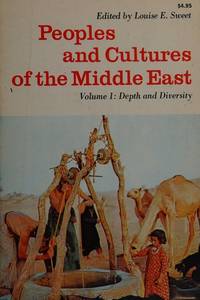
Sweet, Louise E. (editor)
Peoples And Cultures Of The Middle East Life in the Cities Towns and Countryside
NY: Natural History Press. Volume 1: Cultural Depth and Diversity. Trade soft cover. Published NY: Natural History Press 1970. 8vo. xv437 pp. Spine bit sunned edges spotted dusty. Tight unmarked. Very good minus. . Very Good Minus. Soft cover. 1970. Natural History Press paperback
Référence libraire : 002742
|
|
|
Sweet, Louise E., Ed.
Peoples and Cultures of the Middle East: Volume 2
NY: The Natural History Press. Volume 2: Life in the Cities Towns and Countryside. Trade soft cover. Published NY: The Natural History Press 1970. first printing. 8vo. xv438 pp. Brown foxing inside covers along edges else clean spine sun faded. Good. Better internally. . Good. Soft cover. 1st. 1970. The Natural History Press paperback
Référence libraire : 002788
|
|
|
Sweet, Louis E. Editor
Peoples and Cultures of the Middle East: Volume 1 Cultural Depth and Diversity
1970. Soft Cover. Good. Publisher: The Natural History Press 1970 Good Soft Cover ISBN: 0-385-00378-1 cover discoloration. paperback
Référence libraire : 008842 ISBN : 0385003781 9780385003780
|
|
|
Sydney Fisher -
The Middle East : A History 4th Ed. -
1990. Soft Cover. Good. PB/pub.1990/Gd. condition/773 pages - A History of the Middle East. KE85024z paperback
Référence libraire : 5024z
|
|
|
Syeda Khan -
Insight Into Islam : Vol. 1 -
1995. Hardcover. Good. Hardcover/pub. 1995/Gd. condition/335 pages - Life and spiritualism; The Elucidation of the Islamic Philosophy. Lectures delivered at various international forums. TE83645z hardcover
Référence libraire : 3645z
|
|
|
Syeed, Sayyid M, et al
The American Journal of Islamic Social Sciences Cumulative Index 1:1 - 7:3 1985-1991
Herndon VA: The Association of Muslim Social Scientists and The International Institue of Islamic Thought. Trade soft cover. Published Herndon VA: The Association of Muslim Social Scientists and The International Institue of Islamic Thought 1991. 8vo. printed wrappers. 64pp. A fine copy. . Fine. Soft cover. 1991. The Association of Muslim Social Scientists and The International Institue of Islamic Thought paperback
Référence libraire : 003082
|
|
|
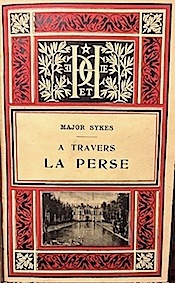
SYKES (Major);
A Travers la PERSE Orientale.
Hachette et Cie Paris 1907 1 vol. In-12 de 2 ff.n.ch. 214 pp., pleine percaline de l'époque, dos lisse orné, pièce de titre, couverture illustrée conservée.
Référence libraire : 15324
|
|
|
SYKES (Mark)
Dar-Ul-Islam.
London, Darf Publishers, 1988. In-8, rel. d’éditeur pleine toile verte sous jaquette ill. XXIII-294 pp., texte anglais, cartes et reproductions photogr. en noir hors texte. Index.
Référence libraire : 556121 ISBN : 185077174
|
|
|
SYKES (Mark)
The Caliph's Last Heritage.
New York, Arno Press, 1973. In-8, rel. d'éditeur toile violette, X-638 pp., texte en anglais, ill. dt une grande carte dépliante en couleurs. Index (The Middle East Collection).
Référence libraire : 555896 ISBN : 405053614
|
|
|
SYME (Ronald)
Anatolica. Studies in Strabo. Edited by Anthony Birley.
Oxford, Clarendon Press, 1995. In-8, rel. d’éditeur toile noire sous jaquette titrée, XII-396 pp., texte en anglais. Index.
Référence libraire : 555428 ISBN : 198149433
|
|
|
Sébah, [Pascal] / Joaillier, [Policarpe] (studio).
Souvenir de Constantinople. Constantinople, ca. 1890.
Folio (368 x 292 mm). Containing 50 albumen prints of Constantinople (ca. 270 x 21 cm each). Red half morocco album with original giltstamped cloth covers; spine blindstamped. Fine period views of the city of Constantinople, by the respected photographic studio of Sébah and Joaillier, showing landscapes as well as monuments, street scenes with merchants, etc. Pascal Sébah (1823-86), a leading Constantinople photographer, was renowned for his well-judged compositions and for the excellent print quality achieved by his technician A. Laroche. His studio, founded in 1857, was continued under his brother Cosimi and his son Jean, later in partnership with Policarpe Joaillier. The studio continued to operate as long as the year 1952. - A representative and fine example of a high-quality album aimed at the 19th century's developing Middle Eastern tourist market.
|
|
|
Sébah, P[ascal] / Beato, [Antoine] et al.
Photograph album. Egypt and Italy, mid-1870s.
Large folio (ca 35 x 47 cm). An album of 87 albumen photographs, mostly ca 36 x 26 cm to 26 x 20 cm, of which 17 show Egyptian locations. Mounted on cardboard leaves, bound in heavy, relief-stamped full calf. White moirée endpapers. All edges gilt. Among the Egyptian images (mostly unsigned, but several by Pascal Sébah and another by Antoine Beato) are a plan of the Suez Canal (with several inset images), Pompey's Column, the obelisk now known as "Cleopatra's Needle" (in New York City's Central Park), the Heliopolis Obelisk, the ruins of the ancient town of Hermonthis (Armant), the Sphinx, the Great Pyramid, a palm grove near Giza, groups of Arab men and women, street scenes, a panoramic view of Cairo, the Mosque of Muhammad Ali, etc. Loosely inserted are a large (19 x 28 cm) portrait of an Arab warrior in Bedouin costume and a composite photo of eight portraits of Arab men and women in various types of local costume, with a handwritten note by the owner: "Bought at Port Said July 1876". The remainder of the photos of this fine souvenir album shows views and sights in Naples, Pompeii, Capri, Salerno, Rome, Venice, Genoa, Florence, and Pisa. - Binding rubbed and bumped, but a well-preserved set.
|
|
|
Süleyman, Faik.
Rehber-i derya: Sevâhil ve Cezâyir-i Bahr-i Sefîdin ta'rifatini havîdir. Istanbul, Mihran Matbaasi, [1881/82 CE =] 1299 H.
4to. 171, (1) pp. Ottoman Turkish in Arabic type. Modern full red cloth with giltstamped spine-title, with the original front wrapper bound before the title-page. First and only edition. - Early pilot guide to the Aegean Sea by an admiral of the Ottoman navy, describing the shores of the Vilayet of the Archipelago, an administrative division of the Ottoman Empire extant from 1867 to 1912/13. At its maximum extent it included the Ottoman Aegean islands, Cyprus, and the Dardanelles Strait. Admiral Süleyman Faik (1845-1909) had in 1864 travelled the shores of the African continent, which earned him the position of captain, and served in the Russo-Turkish war of 1877-78. - Paper evenly browned throughout. Small tear to front wrapper, a second small tear rebacked with paper; minor edge flaws to final leaf, not touching the text. Özege 16579. Not in Askerî Tarih Yayinlari Bibliyografyasi [= Bibliography of Turkish History of Military Books].
|
|
|
T. Walter Wallbank -
A Short History Of India And Pakistan - From Ancient Times To Present
1958. Hardcover. Good. Hardcover/pub.1958/Fair condition/320 pages - The purpose of this volume is to present the important facts and movements past and present in the story of Pakistan and India. KI123514 hardcover
Référence libraire : 23514
|
|
|
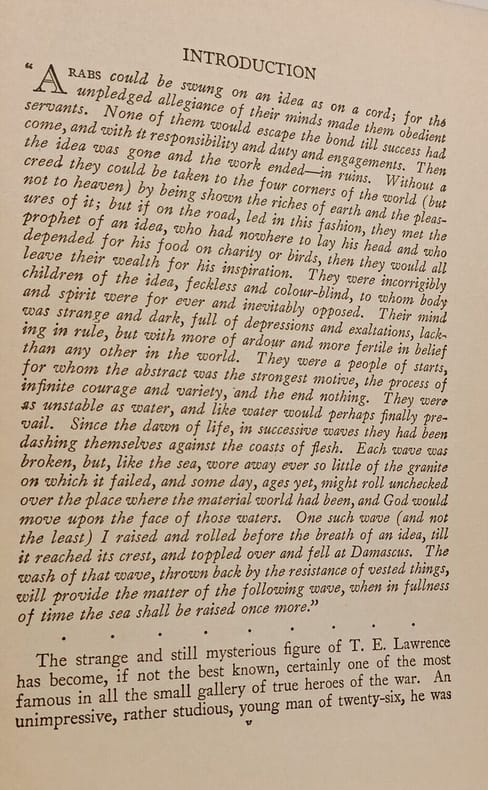
T.E. Lawrence
Revolt in the Desert
Garden City Publishing Company Inc 1926 in8. 1926. Cartonné.
Référence libraire : 100147821
|
|
|
TABBAA Yasser
Transformation of Islamic Art During the Sunni Revival
Seattle: University of Washington Press. As New in As New dust jacket. 2001. Hardcover. 0295981253 . Illustrated. First edition. As new in like dust jacket. . University of Washington Press hardcover books
Référence libraire : 23747 ISBN : 0295981253 9780295981253

|
|
|
TABBAA, Yasser
Transformation of Islamic Art During the Sunni Revival
Seattle: University of Washington Press. As New in As New dust jacket. 2001. Hardcover. 0295981253 . Illustrated. First edition. As new in like dust jacket. . University of Washington Press hardcover
Référence libraire : 23747 ISBN : 0295981253 9780295981253

|
|
|
TAFRALI (O.)
Monuments byzantins de Curtéa de Arges. Texte seul.
P. Geuthner, 1931. In-4 br., XXI-350pp, non coupé.
Référence libraire : 451525
|
|
|
Taghdisi-Rad, Sahar
Political Economy of Aid in Palestine: Relief from Conflict or Development Delayed
NY: Routledge. Very Good with no dust jacket; Covers rubbed. 2011. First American Edition; First Printing. Hardcover. 0415563259 . Blue cloth. xiv 242pp. Acknowledgments tables figures notes bibliography and index. This book examines the nature of donor operations in Palestine highlighting the political and ideological determinants of aid allocation and effectiveness and focusing on the role of trade-related donor assistance in Palestine. preface; 8vo 8" - 9" tall . Routledge hardcover
Référence libraire : 56546 ISBN : 0415563259 9780415563253

|
|
|
Takashimaya
Exhibition of Ancient Art of Afghanistan Japan 1963. Afuganisutan kodai Bijutsuten
Tokyo: N/A 1963. Livre. Très bon. Couverture souple. Ed. originale. In-8. 26 x 185 cm 34 pp. 2 color plates 24 b/w plates softcover. Catalogue of an exhibition held in Japan in 1963 194 objects photographed and described. Text mostly in Japanese but the objects are also described in English. Scarce. Very good. N/A Paperback
Référence libraire : AB164

|
|
|
Tallis, John.
Arabia. London, Rogers, 1851.
Hand-coloured engraved map (355 x 263 mm). Gorgeous full color example of Tallis's map of Arabia. Includes decorative vignettes showing Mount Sinai, Arabs, Camel and Arab Women. Engraved for R. Montgomery Martin's Illustrated Atlas. Tallis was one of the last great decorative map makers. His maps are prized for the wonderful vignettes of indigenous scenes, people, etc. Al-Qasimi 261. Not in Tibbets and Al Ankary.

|
|
|
Tallis, John.
Persia. London, Rogers, 1851.
Hand-coloured engraved map (272 x 370 mm). Attractive full color example of this decorative map of Persia. Includes decorative vignettes of the Ispahan, Kurds, a Bactian Camel and a Persian on Horseback. Engraved for R. Montgomery Martin's Illustrated Atlas. Tallis was one of the last great decorative map makers. His maps are prized for the wonderful vignettes of indigenous scenes, people, etc. Al-Qasimi 260. Not in Tibbets and Al Ankary.
|
|
|
Tamani, Hüseyn Rifqi.
Imtihan ul-mühendisin. Üsküdar (Istanbul), Mühendishane Matbaasi (Dar üt-tibaat ül-amire), [1802 CE] = 1217 H.
Small 4to (140 x 188 mm). 115, (1) pp. With 7 lithographed folding plates. Contemporary marbled boards with leather spine and edges. First edition of this Ottoman Turkish treatise on geometry, published by the Imperial Engineering School in Scutari (Istanbul): the official examination coursebook for the engineers of Sultan Sultan Selim III. Contains 88 problems with their practical applications and solutions; the folding plates at the end of the volume boast a total of 180 diagrams. Published just before the famous "Cedid Atlas", by the same press, and re-issued in 1844. - Binding rubbed, extremeties bumped, paper a little stained in places, but generally very good. OCLC lists only two copies, in the Bibliothèque nationale de France and the Staatsbibliothek Berlin. Özege 9109. OCLC 255316387.
|
|
|
Tamisier, Maurice.
Voyage en Arabie. Séjour dans le Hedjaz. Campagne d'Assir. Paris, Louis Desessart, 1840.
8vo. 2 pts. in 1 vol. (4), 399, (1) pp. (4), 402 pp. With folding engr. map. Contemporary marbled half calf with giltstamped title to spine. First edition; rare. - The work of a sympathetic observer who made an extraordinary journey. Tamisier accompanied the Egyptian forces to Arabia in 1833/34 as chief of the Medical Corps. Bearded and in Arab dress, he visited areas never seen by a westerner before. The author describes Jeddah and the pilgrimage to Mecca and Medina from different parts of the Muslim world, as well as Ta’if, the Asir region, the Bedouins of Outeiba and Khamis Moushait, etc. Tamisier was offered the post of secretary to the chief medical officer of the punitive expedition against the Wahhabis. He focuses on the country he saw and the people he encountered on his journey from Jeddah into the Nejd and south to the borders of Yemen, taking particular interest in the medical conditions of the populace. - Binding slightly rubbed. The Burrell copy fetched £2,000 at Sotheby's in 1999 (lot 801). Macro, Bibliography of the Arabian Peninsula, 2163. Weber IV, 279. Gay 3608. NYPL Arabia coll. 172. OCLC 2569222. Not in Atabey or Blackmer.

|
|
|

 Recevoir par e-mail
 Télécharger en PDF
 Flux RSS
 Lien permanent


