|
|
|
[Ottoman Empire].
Fiel treslado da carta traduzida de Italiano en Portugues, na qual se relata a victoria naval, alcançada contra os turcos na sua força de Dardanelli, pela armada da serenissima Republica de Veneza [...]. (Lisbon, Officina Craebeekianaa, 1656).
4to. (11) pp., final blank page. Sewn. Scarce Portuguese account of the Third Battle of the Dardanelles in the Sixth Ottoman-Venetian War, the heaviest defeat the Ottomans had suffered since the Battle of Lepanto. Since 1645, Venice and the Ottoman Empire had been at war over the possession of the island of Crete. Ottoman forces had captured most of the island in the early years of the war, but were unable to seize its capital, the heavily fortified city of Candia (modern Iraklio). The Venetians had endeavoured to cut off the Ottoman army's supplies and reinforcements, and attempted several times to blockade the Straits of the Dardanelles, through which the Ottoman fleet had to sail to reach the Aegean from its base around Constantinople. In the morning of 26 June 1656 the wind was from the north, and the Ottomans made good progress, the Venetian galleys being unable to assist their sailing ships. Then the wind backed, trapping the Ottomans against the Asian side of the strait just below the Narrows, and a mêlée ensued. Kenan Pasha got back past the Narrows with 14 galleys but the rest were either captured, sunk or burned. - Numbered "17" in ink on first page. Small rust spot on first page, otherwise very well preserved. BGUC Misc. 3, 58. OCLC 1045393175.
|
|
|
[Ottoman Empire].
Mamalik Muhrsaa wa-Shahanaa bik haa wa'ldygha bilad. Istanbul, Ottoman General Staff, 1309 Rumi Calendar [1893].
815 x 1140 mm (on 2 separate sheets). The first distance-time route map of the Ottoman Empire, one of the great masterpieces of Ottoman thematic cartography. Devised by the General Staff of the Ottoman Army and depicting the entire realm of the Sublime Porte from Albania to Yemen, it gives travel times between hundreds of locations, including various routes of the Hajj. - The map captures the scene during the middle of the rule of Sultan Abdul Hamid II (reigned 1876-1909), during which the empire still controlled vast territories in Europe, Asia and Africa, extending from the Balkans to the Arabian Peninsula. It is centred upon Anatolia but includes all the core regions of the Empire, extending from Bosnia in the northwest to the head of the Arabian Gulf in the southwest, and from Crimea and Baku in the north and east to Lower Egypt in the southwest. In the lower right corner is an inset capturing the western Gulf, including Kuwait, Bahrain, and Qatar; an inset above details the Red Sea, including Hejaz, Asir and Yemen; a larger inset in the lower left depicts Ottoman Libya as well as parts of French Tunisia and Algeria. Annotated in Ottoman Turkish throughout, the map is traversed by hundreds of lines that connect every city and town of importance, representing the main land travel routes between these centres; each segment states the estimated travel times between the points. The map also features a chart comparing distances between the principal centres: on average, the chart shows, it took 18 hours to travel from the Red Sea port of Jeddah to the holy city of Mecca. - This is the first map ever to display the distances between all significant travel points in the Ottoman Empire and would have been vitally useful to soldiers, merchants, and government bureaucrats planning their itineraries. It was also one of the only maps to give an approximately accurate notion of the times and distance along several of the most important Hajj routes, including the famous Syrian Hajj Road from Damascus to Mecca, now considered by UNESCO for World Heritage Status. - Transportation had always been one of the great challenges confronting the Ottoman Empire, an astoundingly vast realm spanning three continents and traversing some of the world's most rugged terrain. Yet the Hamidian Era marked a period of rapid modernization, including the creation of macadamized highways, railways and modern ports, and saw the rise of sophisticated cartography. The General Staff was able to draw on exhaustive highway surveys and recent itinerary records. The present map also depicts the rapidly expanding Ottoman railway system, after a wave of development had revolutionized travel in the empire's European domains, but just before an unprecedented boom in railway construction would do the same for Ottoman Asia. The Balkans are traversed by several railways: most notably as of 1888 the great port of Salonika was connected to the rest of Europe by rail, while Istanbul was linked to the European system for the first time that same year, providing the direct route for the famed Orient Express, which commenced in 1889. One will also notice the first great leg of the Anatolian Railway that connected Istanbul to Ankara on 31 December 1892, completed only a matter of weeks before the present map was issued. - Although Ottoman cartographers were producing topographic and thematic maps of the highest sophistication and diversity, every bit as impressive as those of the best German and French and British mapmakers, these works tend to be very rare today and are not nearly as well known as they deserve to be: they were almost invariably issued in small print runs, and maps intended for practical use in the field, such as the present work, tended to perish easily. Also, Turkey's switch to the Latin alphabet, in 1928, ensured that many of the surviving earlier maps were discarded, making this specimen a rare survival of an historic cartographical achievement. - Brownstains and waterstains.
|
|
|
[Ottoman military manual - firearms].
Ta'limat al-Madafi' - al-Shishanah. Cairo, [early May 1864 CE] = awa'il Du'l-Hijja 1280 H.
8vo. 13 [instead of 17, lacking pp. 3-6], (1), 2, 386 pp. Contemporary half leather with coloured paper boards. Fourth volume only of the Ottoman military manual "Ta'limat al-'Askariya al-Mustajadda" ("Instructions for the New Model Army"), discussing firearms, guns and artillery in the Ottoman army. Translated from Turkish into Arabic by Captain Hasan Effendi Muzahhar with the assistance of his fellow officer Mohammed Effendi 'Abi'l Hasan. The title ("Gun Instructions - The Shishana") denotes an old Ottoman lock rifle produced mostly in Syria. - Binding severely rubbed and bumped; spine chipped; remains of old lending label on upper cover. Handwritten English note on flyleaf: "found in a tent at Tel-el-Kebir / 14 September 1882 / T. J. Jones". In the Battle of Tel El Kebir (13 Sept. 1882), fought near the Suez Canal, the British military defeated the Egyptian army led by Ahmed Urabi following an insurrection of Egyptian soldiers during the Anglo-Egyptian War.
|
|
|
[OTTOMAN POSTER FOR AWOLS DURING WORLD WAR 1].
[WW1 / OTTOMAN POSTER / AWOL] Beyannâme-i resmî. [i.e. Ottoman official declaration printed for those who did not join the army and AWOLs during WW1].
Very Good Turkish, Ottoman (1500-1928) Original lithograph poster. 82 x 52 cm. In Ottoman script (Old Turkish with Arabic letters). Some tears and creasing, otherwise a good poster. An unusual lithographed declaration for the people who escaped from their compulsory military service during the mobilization period during World War I and who were late in surrendering to become soldiers. This poster is probably hung in various places, especially in crowded cities, to make the relevant announcement. Penalties for deserters are explained in six articles on the poster. Penalty rules such as the death penalty, hard labor, and hard labor were determined for each day not attended by the military. Desertion was one of the biggest problems of the army and Anatolia during the First World War (1914-1918) and the War of Independence (1919-1922). According to the reports and Ismet Inönü's statement during World War I, there were nearly three hundred thousand deserters in the Ottoman army. This number was the highest among the countries participating in the war. Prolonged war, longing for family, lack of supply and hunger, etc. were the reasons for desertion. Soldiers mostly fled while being dispatched in their troops. Some fugitives took their weapons with them when they left. Those who escaped from the military formed gangs after a while, causing security problems in villages and cities. Complaints from local authorities were quite numerous. The local governments of the places where they were caught could also impose penalties, including the execution of deserters. Death sentences were rarely pardoned at that time.
|
|
|
[Ottoman Wars].
Nuova verissima, e distinta relatione della vittoria ottenuta dall' armi Polache contro Turchi, e Tartari in Vicinanza al fiume Deniester per soccorere Caminiecz. Venice, Zuanne Batti, 1694.
4to. (4) pp. With woodcut printer's device to t. p. Folded broadsheet. Rare contemporary news report about the victory of the Polish and Lithuanian army against the Ottoman troops at Kamianets and the fall of the Turkish-occupied fortress of Gyula to the Imperial troops in late 1694. Also published in German as "Umständliche Relation von dem herrlichen Sieg, welchen die polnische neben der litauischen Armee gegen die Türken und Tataren bei Kamieniec den 6. Oktober 1694 erhalten hat". In the Great Turkish War of 1683-99, the Holy League (Austria, Poland, Venice, and Russia) successfully defended Vienna, then re-conquered Hungary; the war ended with the 1699 Treaty of Karlowitz. Not in Italian libraries; not in OCLC.

|
|
|
[Ottoman-Austrian Trade Agreement].
Handlungseinverständniß zwischen dem kaiserl. königl. Hofe, und der ottomanischen Pforte zum Vortheile der österreichischen Handlung unter dem Namen Sined, oder Einverständnis geschlossen den 24. Hornung 1784. Wien, (Baumeister for) Sebastian Hartl, 1785.
8vo. 276 pp. With a folding table printed on both sides. Early 20th c. half cloth over marbled boards with giltstamped spine title. First edition. - Contains the text of the Trade Agreement of 24 March 1784 as well as earlier similar treaties: trade and shipping accords closed as part of the Treaty of Passarowitz in 1718, articles concerning trade as part of the Peace of Carlowitz in 1739, and the 1783 trade engagement between Russia and the Ottoman Empire. The extensive final section (pp. 165ff.) contains tables of the prices for various products manufactured in Austrian factories "to facilitate and make more transparent the trade with Turkey", giving prices for a vast array of wares, such as mirrors, crockery, silverware, boxes and cases, toys, cloth and socks, etc.). - Title-page stained and wrinkled with and old Hungarian stamp and paper flaws (rebacked with insignificant loss), some further staining to fol. G1, otherwise a very good copy. Kress p. 5073. Wernigg 5849.
|
|
|
[Pahlavi, Mohammad Reza, Shah of Iran (1919-1980)].
2 original photographs. No place or date
205:253 mm and 180:130 mm. One picture shows Mohammad Reza Pahlavi (1919-1980) with Salman bin Hamad Al Khalifa I, ruler of Bahrain from 1942 until his death in 1961; the other is a portrait of the latter.
|
|
|
[Pakistan].
Watercolour album. Pakistan, 1844.
Oblong 4to (287 x 195 mm). 23 leaves with 17 watercolours and 4 pencil drawings (1 watercolour having been removed); a few blanks. Contemporary marbled half calf. A fine watercolour album composed by a member of the British Army stationed in Pakistan, shortly after the Battle of Hyderabad in March 1843. The unknown artist (whose name may be indicated by the initials "WME" on the flyleaf) followed the Indus river from Karachi to the northern parts of the Sindh province. Most drawings have pencilled place names; only a few are untitled. The album begins with a watercolour of the tomb of the British officer Bowen, of the 86th regiment, who drowned in an attempt to swim his horse across the river, followed by a watercolour of the spot where the accident occurred. Furthermore, the album contains views of Karachi (3, including a "captured pirate vessel"), Hyderabad (4), Jerruk (Jhirk), Bhaker Fort (3), Sukkur, Soonda (between Makli and Jerruck), and eight unidentified cities and landscapes. A sketch of the "Mess Verandah" at Fort Hyderabad has been removed. - A rare and very interesting manuscript album with fresh and unfaded colours, dating from the early years of the British presence of Pakistan: the British East India Company began its invasion of Sindh in 1839; Karachi was the first area in the province to be occupied. By 1843 most of the province (excepting the State of Khairpur) was added to the Company's territory after victories at Miani, Dubba and Hyderabad.
|
|
|
[Paleontology - Geology - Palestine] Blake, George Stanfield, Leslie Reginald Cox, and others.
[A collection of original government correspondence]. Fossils Mesozoic-Age (secondary). London & Jerusalem, 1924-1938.
Folio (ca. 27 x 36 cm). [255] ll. With 13 illustrations, mostly showing different soil profiles relating to the fossils, including 10 drawn by hand. In a pink cardboard portfolio entitled "Fossils Mesozoic-Age (secondary)", including another portfolio with blue paper wrappers. Extensive correspondence addressed to George Stanfield Blake, mainly from Leslie Reginald Cox, discussing fossil specimens. Blake's additional correspondents were, among others, the deputy director of the "laboratoire de paleontologie" of the French national museum of natural history J. Coltreau and the director of the British museum of natural history C. Tate Regan. - Blake (1876-1940) was a British mineral and mining geologist and was from 1922 to 1939 the geological advisor to the Mandatory Government of Palestine, in which capacity he wrote and received the letters collected in the present portfolio. His work was essential, according to Israeli geologist Picard and others, for the expansion of geological knowledge of Palestine and Transjordan and their natural assets. Cox (1897-1965) was a British palaeontologist and malacologist (a specialist in molluscs), who was attached to the British museum of natural history and was elected a fellow of the Royal Society in 1950. - Most of the letters are typed copies of letters with autograph signatures, except for a few autograph letters. The collection also includes a few illustrations of soil profiles and even some notes of thanks from the trustees of the British museum of natural history addressed to Blake, thanking him for his donations of information on fossils and the specimens themselves. - Paper wrappers show signs of wear, wrappers and documents inside are very slightly discoloured, most leaves are slightly frayed around the edges. Most leaves are numbered in blue pencil and the numbers correspond with the overview of the contents typed on a separate leaf, pasted on the inside of the front pink wrapper.
|
|
|
[Palestine - American Colony].
Album with 66 photographs of Jerusalem, Tel Aviv and environs. Palestine, 1946-1947.
Oblong 8vo (190 x 130 mm) 57 albumen prints (mostly 90 x 65 mm) mounted on 15 black sheets, 9 more loosely inserted. Wooden boards with a coloured view of Rachel's tomb, captioned in Hebrew and English. Charming souvenir album, privately assembled by a British soldier and captioned by him throughout with his ownership entry "Jerusalem. E. Stacey. 9.9.46" to inner front board and a photo ("Boys of the Shack 147") showing him among his comrades in front of their baracks. The majority of the photos bear the ink stamp of the Matson Photo Service on the reverse. The Matsons were handed the management of the American Colony photo service in 1934. The American Colony was a utopian Christian sect formed by religious pilgrims who emigrated to Jerusalem from the United States and Sweden.
|
|
|
[Palestine - Jewish insurgency].
(Restricted). Palestine Pamphlet. Terrorist Methods With Mines and Booby Traps. [Jerusalem], Headquarters, Chief Engineer, Palestine & Transjordan, December 1946.
4to (170 x 215 mm). 38 pp. With frontispiece, 6 plates, and 16 full-page illustrations in the text. Original printed, illustrated buff wrappers. Very rare restricted British Army manual, dealing with the terrorist explosive devices and methods employed by the Zionist insurgents during their paramilitary campaign carried out against British rule in Mandatory Palestine. Includes instructions how to detonate various types of mines and booby traps, as well as a history of terrorist activity in 1946 undertaken by Jewish groups. Plates of various attacks are included, such as the partially destroyed King David Hotel in July 1946, and the demolished building in the David Quarter, Jerusalem, bombed in November 1946. Of that attack the booklet reads, "This incident is included for its illustration of the extreme methods which Jewish Terrorists may employ when planning deliberate murder". - Wrappers slightly soiled; interior shows occasional brownstaining. An extraordinarily rare survival; only three copies in libraries internationally: National Library of Israel; Johns Hopkins University; University of Toronto Fisher Rare Book Collection. OCLC 233992872.
|
|
|
[Palestine - Mandate Reports to the League of Nations].
Report by His Majesty's Government in the United Kingdom [...] on the Administration of Palestine and Trans-Jordan. London, His Majesty's Stationery Office, 1921-1939.
Large 8vo (245 x 178 mm). 29 volumes bound in 5. Includes 33 folding maps and 5 folding diagrams, a number of which colour-printed. Modern half calf with marbled boards and giltstamped titles to spines. A near-complete run of mandate reports on Palestine and Trans-Jordan from 1921 onwards, mostly published under Britain's mandate from the League of Nations, comprising both the relevant Colonial series and the Command Papers series as presented to parliament. - As early as 1920, when the joint British, French and Arab military administration over the formerly Ottoman Levantine provinces was transformed into a civil authority, Britain's High Commissioner of Palestine was required to file regular reports to the Colonial Office on the operations of this new administration. From 1922 onwards, when Britain was granted the Mandate for Palestine and Trans-Jordan, these reports were adapted for the Council of the League of Nations. They cover the finances and taxation, customs and trade, law and legislation, education, public health, public transport and immigration in Mandatory Palestine, also detailing the various security problems and sectarian strife in the territory and covering the establishment of the Palestine Gendarmerie, its transformation into the Palestine Police Force, the introduction of military units and sources and causes of violence. The reports were discontinued with the advent of the Second World War. - The present set includes: An interim report on the civil administration of Palestine during the period 1st July 1920 - 30th June 1921 [Cmd. 1499]. Palestine. Disturbances in May, 1921. Reports of the Commission of Inquiry ... [Cmd. 1540]. Miscellaneuous No. 4 (1922) [Cmd. 1708]. Correspondence with the Palestine Arab Delegation and the Zionist Organisation [Cmd. 1700]. Mandate for Palestine ... [Cmd. 1785]. Papers relating to the elections [Cmd. 1889]. Proposed formation of an Arab Agency [Cmd. 1989]. Appendices to the Report ... for the year 1924 [Colonial No. 17]. Report ... on the Administration Under Mandate of Palestine and Transjordan for the year 1924 [Colonial No. 12]. Report ... to the Council of the League of Nations ... for the year 1925 [Colonial No. 20]. Report ... to the Council of the League of Nations ... for the year 1926 [Colonial No. 26]. 1927 [Colonial No. 31]. 1928 [Colonial No. 40]. 1929 [Colonial No. 47]. 1930 [Colonial No. 59]. Palestine. Statement of Policy by his Majesty's Government in the United Kingdom [Cmd. 3692]. Palestine. Report on Immigration, Land Settlement and Development [Cmd. 3687]. 1931 [Colonial No. 75]. 1932 [Colonial No. 82]. 1933 [Colonial No. 94]. 1934 [Colonial No. 104]. 1935 [Colonial No. 112]. 1936 [Colonial No. 129]. Statistical Abstract of Palestine 1936, Palestine Royal Commission 1937 [Cmd. 5479]. 1937 [Colonial No. 146]. Palestine Partition Commission Report 1938 [Cmd. 5854]. 1938 [Colonial No. 166]. Miscellaneous No. 3 (1939). Correspondence between Sir Henry McMahon […] and the Sherif Hussein of Mecca July 1915-March 1916. [Cmd. 5957]. Palestine Statement of Policy [Cmd. 6019]. - Extensive sets as ours are extremely rare in the trade; the last set sold at auction did not contain a single volume of the Command Papers series (Christie's 2016, sale 12051, lot 366), as present here. Cf. Khalidi/Khadduri, Palestine and the Arab-Israeli conflict. An annotated bibliography, nos. 1569, 1633, 1641-3 & 1647.
|
|
|
[Palestine - Photo Album].
[Zionist photograph album]. Palestine, 1937.
Oblong folio (305 x 220 mm). 12 ff. 40 silver gelatin photographs mounted on leaves; sizes range from 177 x 120 mm to 85 x 65 mm. Contemporary plaid cloth with a small brass label on front cover, saddle-stitched binding. Unique photograph album of early Zionist military presence in British Mandatory Palestine, focussing on the Hapoel companies: a sports movement that in the early 1930s was developed into an organizational labour militia intended to stand up against revisionist and right-wing movements as well as against communists. Promoted by David Ben-Gurion, they served as an executive-political arm of the Histadrut until the 1960s. - The photographs show numerous scenes of training and daily life: both male and female soldiers pose in uniform, eat their lunches, hold athletic competitions such as tug-of-war and wheelbarrow races on the beach, meet in the canteen, and line up in formation. Largely presenting an idyllic picture of soldier life, scenes of more serious military drills include soldiers scaling high walls and practicing their army crawl, grappling, and sniper positioning. A handful of early photos also give glimpses of political events in the 1930s: two speeches are shown, one of Ben-Gurion, the other of Hapoel leaders with a military guard, and a packed street scene of what appears to be a parade, judging by the rows of onlookers clustered on balconies. - The brass dedication label on the upper cover is engraved in Hebrew "To Samuel, from the commanders of the Hapoel companies. Haifa, Kiryat Haim, 13-30 August 37". Occasional fading to photographs, but quite well preserved.
|
|
|
[Palestine - Railroads].
Photograph album of Palestine during and after the First World War. [Palestine, 1916-1922].
4to. (25) ff., (7) blank ff. With 100 black and white photographs of various sizes (between ca. 75 x 105 and 90 x 145 mm), 96 of which mounted, 4 loosely inserted. A few captioned in ink on the photograph or on verso. With original hand-drawn map of Palestine in ink, crayon and ballpoint on graph paper loosely inserted. Contemporary giltstamped half cloth with a mounted reproduced drawing to lower board, showing an elegantly dressed group of people. Private photo album composed by a British engineer stationed in El Qantara, Egypt, possibly a member of the Royal Engineers, who constructed a new railway from Qantara to Romani and eastward through the Sinai to El Arish and Rafa on the border of the Ottoman Empire in January 1916. During World War I, Kantara, as it was referred to by the Allied troops, was the site of Headquarters No. 3 Section, Canal Defences and Headquarters Eastern Force during the latter stages of the Defence of the Suez Canal Campaign and the Sinai Campaign of 1916. The massive distribution warehouse and hospital centre supported and supplied all British, Australian and New Zealand operations in the Sinai from 1916 until final demobilization in 1919. - Taken on trips to Palestine between 1916 and 1922, half of the photographs focus on railroad motifs, exhibiting railway bridges, including the bridge crossing the Suez Canal in El Qantara, train stations, and tracks under construction, as well as rather spectacular accidents with locomotives and waggons fallen over in the desert. One picture depicts a decorated train of British soldiers bearing the sign "Demob special goodbye" leaving after the Armistice. The other half mainly shows views of Jerusalem, including close-ups of landmarks such as the Tombs of the Kings and the interior of Ascension Church, as well as steam ships in the Suez Canal and a "Turkish Gun". Although not identified by name, the engineer can be seen posing in several photographs, sometimes wearing a British uniform. The manuscript map shows the railway line from Qantara to major cities including Jerusalem, Tel Aviv, Haifa, and Nazareth, at one point crossing into Syria and reaching Beirut. - Hinges broken; extremities slightly rubbed; crack on spine measuring ca. 5 cm. A few photos as well as the map with small marginal tears and creases. Bookplate of the British businessman and railroad enthusiast William Hepburn McAlpine (1936-2018), and stamp of ownership of Arthur Lord-Castle, who was associated with the Narrow Gauge Railway Society in 1956, to front pastedown. A unique survival.
|
|
|
[Palestine / Transjordan - Royal Air Force].
No. 1 and No 2 Armoured Car Companies, RAF. Three photograph albums. Egypt, Palestine and Transjordan, 1922-1925.
3 albums (all oblong 8vo) containing a total of 371 original photographs: 1) 71 photos (most 68 x 110 mm or 137 x 87 mm, with a few other variant sizes) mounted on 12 leaves, one loose photograph inserted. 2) 120 photos (most 60 x 85 mm, 90 x 140 mm or 84 x 135 mm, with a few other variant sizes) mounted on 12 leaves. 3) 181 photos (57 x 85 mm, 82 x 56 mm or 65 x 102 mm, with a few other variant sizes) mounted on 18 leaves. Original cloth-backed papered boards or imitation leather card binding; one album lacking covers. Large collection of early images of British military service in the Middle East, with historically important images of Faisal I of Iraq and his brother, Abdullah I of Jordan. One album, compiled by a member of No. 1 Armoured Car Company, is dated 1922 and is mainly focused on Egypt, while the other two contain a wide range of images from both sides of the Jordan, including a large aerial view of the Rest Camp at Jaffa, Amman (a mix of tourist views of the Roman theatre and remains of Turkish military transport), Tel Aviv, Jerusalem, Sarafand Camp and Ramleh Military Cemetery. The twin implements of British imperial military control in the form of armoured cars (Rolls Royce and Lancier) and aircraft (including Vimy and Vernon) are well represented. King Faisal I of Iraq is seen visiting Amman, while another shows his brother Abdullah I of Jordan arm-in-arm with an unidentified British political figure. - Covers with paper tears and some losses particularly to lower cover; extremities rubbed. A fine survival.
|
|
|
[Palestine] - Bennet, Ernest.
Photograph album. Palestine, ca. 1945-1947.
Oblong folio (255 x 203 mm). Photograph album containing 223 photographs (from 47 x 65 to 178 x 240 mm) mounted on 18 leaves, with 23 loosely inserted photographs, mostly with handwritten annotations in blue ink to versos. Contemporary metal-ring leatherette binding. With a quantity of relevant ephemera. Interesting collection of photographs by a participant in the closing stages of British rule in Palestine. Assembled by Lance Sergeant Ernest Bennet serving in 3rd Battalion of the Grenadier Guards in Palestine, the photographs depict British servicemen on military exercise (Exercise "Bustard"), with Arab inhabitants, riots in Jaffa, military convoys, and troops on patrol. Significant photographs include the British soldiers with a captured Irgun flag and ships docking at Haifa with Jewish Displaced Persons. Bennett often identifies himself with an ink manuscript cross on the photographs. - Extremities of binding lightly rubbed. Includes a small collection of personal papers such as correspondence and payslips.
|
|
|
[Palestine].
[Photograph album]. [Palestine, ca. 1890s].
Large 4to (240 x 273 mm). 48 albumen photographs (ca. 240 x 180 mm) mounted on card recto and verso. Bound in contemporary black half calf and cloth, ruled in gilt. An elegant example of the early photography souvenirs which were becoming increasingly popular in the 1890s, especially in tourism of the Holy Land. Many of the photographs are by the studio of Félix Bonfils (1831-85), a French-born photographer who came to the Levant with General d'Hautpoul in 1860 and remained to begin a prolific photography career. Based in Beirut, Bonfils produced thousands of photographs depicting Palestine, Egypt, Syria, Greece and other parts of the Ottoman Empire. In the early days of Western tourism to the Middle East, his works soon became popular as souvenirs, and other photographers soon followed. Other examples are by Francis Frith or unsigned. They show memorable scenes of Jerusalem and surroundings, especially tombs, monuments, churches, mosques, landscapes, and cityscapes. - Gentle wear and fading, some foxing to cards, but generally appealing and well preserved.
|
|
|
[Palestine].
[Photograph album]. [Palestine, ca. 1890s].
Small folio (310 x 235 mm). 46 window-mounted albumen photograph cartes-de-visite (84 x 52 mm), Contemporary pebbled green cloth, all edges gilt, remains of metal clasp. Moirée endpapers. An elegant example of the early photography souvenirs which were becoming increasingly popular in the 1890s, especially in tourism of the Holy Land. The cartes-de-visite distinctively illustrate the moment visual souvenirs began to evolve from etchings and prints to photographs: all are, in fact, photographs of paintings depicting church scenes and architecture. There are 48 cartes-de-visite, though only 46 are photographs, the final two being handwritten and hand illuminated well-wishes in French. - Gentle wear and fading, but well preserved.
|
|
|
[Palestine].
Collection of 27 cardboard-backed photographs by Félix Bonfils (24), Jakob August Lorent (1), the brothers Zangaki (1) and an unknown artist (1). Palestine, c. 1875.
C. 258 x 325 mm (cardboard); image dimensions c. 222 x 284 mm. Albumen prints (vintage) on cardboard. By Bonfils, from Bethlehem: "Tombeau de Rachel" (no. 336); "Puits des Mages" (889); "Entrée des pèlerins à Bethléem, le jour de Noël" (892, illustrated in Wieczorek/Sui, "Ins Heilige Land", p. 106); "Vue générale de Bethléem, du puits de David" (1225) and interior of the Church of the Nativity (uncaptioned); from Jaffa: "Place du marché vue générale" (238, ill. with alternative caption in W./S., p. 67); from Jerusalem: "Porte de Jaffa" (244, ill. with alternative caption in W./S., p. 73); "Mur des Juifs en vendredi" (245); "Façade du St-Sépulcre" (246); "Prison de St. Pierre" (250); "Arc de l'Ecce Homo" (252); "Ruelle allant au palais d'Hérode" (259); "Coupoles du St.-Sépulcre" (274); "Vue générale de la mosquée d'Omar" (278); interior of the Dome of the Rock ([279], illustrated with caption but trimmed in W./S., p. 85); "Porte donnant accès au-dessous du rocher" (280); "Vue générale de l'emplacement du temple de Salomon" (285); "Porte de Damas" (287); "Jardin de Gethsemané, vue générale" (303, ill. trimmed in W./S., p. 76); "Vallée de Josaphat" (310); "Intérieur du St-Sépulcre avec ornements" (850); "Grotte de Sainte-Hélène, intérieur" (855 bis); "Entrée de Jérusalem près de la porte de Jaffa" (1037) and "Rue de la Porte de Jaffa" (1038). - By Lorent: "Tombeau de David sur le Mont Sion" (288). This is apparently a print of the 1864 image illustrated in Wieczorek/Sui (p. 88), made by Bonfils and supplied with a caption. Curiously, that image is trimmed by several centimeters on the left, as compared to our print. - By the Zangakis: "Jerusalem", "Eglise du Pater couloir" (1018). - Anonymous: "Juive, costume riche" (1). - 4 photographs show slight edge defects. Occasional staining to cardboard edges, but mainly clean and well-preserved, with German ms. pencil captions.

|
|
|
[Palestine].
Eretz Israel. Map of Jewish Settlements. Keren Hayesod Agricultural Work 1921-1946. Palestine, Jewish Agency for Palestine Agricultural Colonisation Department, Irrigation Office, 1946.
Chromolithograph map, 852 x 520 mm. Scale 1:500,000. A map depicting the Jewish settlements related to Keren Hayesod agricultural work from 1921-1946. Keren Hayesod was, during the pre-state period, a single-issue Zionist funding body and played a large role in the settlement of Palestine by Jewish colonists prior to 1948; many of these settlements were agricultural in nature. The map lists over one hundred settlements and distinguishes those established by from those aided by Keren Hayesod. Also identified are settlement types: communal, smallholders, village, urban, town, training farms, and ex-servicemen villages. A colourful and thorough overview of Keren Hayesod's work in the region. - A hint of wear along creases, otherwise well preserved. OCLC 827860593.
|
|
|
[Palestine].
Geological map of Palestine. [Jaffa], Survey of Palestine, 1947.
Colour-printed map, 889 x 632 mm. Scale 1:250,000. First edition. A rare, large full-colour geological map of Palestine, sheet 3, partly revised from aerial photographs by the Geological Section. The key lists era and type of rock, from Precambrian grey and red granites to Neogene sandstones and recent dune deposits, and illustrates both known and predicted fault lines across the earthquake-prone region. However, geology was evidently not the sole concern: international and district boundaries are noted along with railways, various roads, wadis, Arab and Jewish villages individually marked, monasteries and convents, khirba ruins and tell mounds, and sheikhs' tombs. This provides a holistic and detailed map showing Palestinian human settlements, water cycles, geological deposits, and transport corridors during the Mandate period. - Fully and professionally backed in cloth.
|
|
|
[Palestine].
Machberet kitâ a'. [School notebook with hand-coloured maps]. No place, [ca. 1920s].
4to (165 x 205 mm). (18), (11 blank) ff. Decorated with hand-drawn maps in ink and crayon, labelled in handwritten Hebrew. Original black wrappers. All edges red. Unique private copybook of folk art hand-coloured maps from an unknown Jewish girl named Sarah Klein. Klein was likely a schoolgirl; most of the maps she has drawn and labelled in neat Hebrew are of European countries, including Spain, Italy, Greece, Yugoslavia, Bulgaria, Turkey, Great Britain and Ireland, Iceland, France, Portugal, and Scandinavia, as well as one map of the entirety of Africa. The northern coast of France is shown twice and in greater detail than many others. Most of the maps are carefully hand-coloured in crayon or perhaps oil pastels, often indicating rivers and mountain ranges. - A unique preservation of a Jewish schoolgirl's vision of her world. - Light wear, one leaf detached but present, altogether well-preserved.
|
|
|
[Palestine].
Palestine No. 1 1947. Proposals for the Future of Palestine. July, 1946 - February, 1947. London, H.M.S.O., 1947.
8vo. 14 pp. With a folding map. Original printed wrappers. Only edition of this rare pamphlet. "The only chance of peace, and of immediate advance towards self-governing institutions, appears to lie in so framing the constitution of the country as to give to each the greatest practicable measure of power to manage its own affairs". - An uncommon and important publication, detailing the Morrison-Grady Plan for the division of Palestine into four areas. The plan was based upon the work of British and American "expert delegations", who believed the political aspirations of the Arab and Jewish communities were irreconcilable and the best course of action was to give them their own territories and autonomy, albeit under a central government. - A little light water-staining to top of front wrapper, otherwise very good. The folding map, titled the "Provincial Autonomy Plan", shows the four areas: an Arab Province, a Jewish Province, a District of Jerusalem, and a District of the Negeb.
|
|
|
[Palestine]. - Stephan, St[ephan] H[anna] / ‘Afif, Boulos.
Palestine by Road and Rail. A Concise Guide to the Important Sites in Palestine and Syria [...]. Jerusalem, (Ahva), 1942.
8vo. 94, (1) pp., final blank page. With a folding plan of the Church of the Holy Sepulchre and a folding map of Palestine and southern Syria. Original printed wrappers. Very rare pocket guide to the Holy Land, prepared for British soldiers serving in Mandatory Palestine, encouraging them to explore sites of religious and historical interest in "a land of diversity" that can be "bewildering at times to the newcomers" (p. 5). - The book describes the most prominent landmarks of Jerusalem and its surroundings, including the Church of the Holy Sepulchre, the Dome of the Rock, the Via Dolorosa, the Muristan, the Zion quarter, Gethsemane, and Jericho, as well as Bethlehem and Hebron, and gives directions to and accounts of other places including Jaffa, Tel Aviv, Haifa, Beirut, Nazareth, Damascus, and Baalbek. In addition, it contains a short history of Palestine and a chronological list of events from 2,600 BC to the Lebanon's declaration of independence in 1941. - Wrappers slightly soiled. Plan lightly waterstained; pp. 77-80 torn at lower margin without loss to text; paper evenly browned throughout. A good copy. Only two library copies traceable internationally (National Library of Israel and Stanford University Library). OCLC 234128765.
|
|
|
[Palin, Nils Gustaf].
Analyse de l'inscription en hiéroglyphes du monument trouvé à Rosette, contenant un décret des prètres de l'Egypte en l'honneur de Ptolémée Epiphane. Dresden, Gebr. Walther, 1804.
Large 4to. (4), 175, (1) pp. With a folding engraved plate. Contemporary half calf with giltstamped spine title over red marbled boards. First edition of one of the earliest studies of the Rosetta Stone, published some 18 years before Champollion deciphered the text. N. G. Palin (1765-1842) was a leading Swedish diplomat whose postings included Madrid, Vienna, Dresden, and Constantinople. He made several journeys to Asia Minor, Greece, and Egypt, twice reaching the Cataracts of the Nile. On leave from 1824, he devoted all his time to his Egyptological studies. - Binding only very slightly rubbed; spine professionally rebacked preserving gilt title label and old library label. Paper a little browned; bookplate of the Portuguese historian Francisco Soares de Lacerda Machado (1870-1955) to flyleaf. Rare. Gay 1792. Ibrahim-Hilmy II, 194. Brunet VI, 29107. Kayser I, 57. OCLC 40974048.
|
|
|
[Pamukkale - Hierapolis]. Engelmann, [Godefroy].
Pamboukkalesi. [Paris, Deroy, 1838].
Image dimensions ca. 35 x 24 cm (sheet size cs. 43 x 29 cm). Matted. Rare lithograph of the ruins of the Domitian Gate in the Greco-Roman city of Hierapolis, situated immediately above the famous travertine terraces of Pamukkale. From Laborde's "Asia Minor". - Some wrinkling; small tear at upper edge (not touching image).

|
|
|
[Pares, Marion Stapylton; pseud.:] Judith Campbell.
Horses in the Sun. London, Pelham, 1966.
8vo. 133, (1) pp. With frontispiece and 30 photo illustrations by Godfrey Argent on plates. Publisher's original giltstamped blue cloth with printed dustjacket. Lavishly illustrated account of the author's sojourn in Jordan, where she studied the royal horses and their training. - Well preserved. OCLC 2164501.
|
|
|
[Pedigree].
3 documents on the pedigree of a foal born to the royal stallion stud Pompadour (Corrèze). Limoges, 1848.
Small 4to. Altogether 3 pp. 1. Birth certificate of the foal Tulip, born of a thoroughbred mare "d'espèce de Selle" and a royal stud of the same stud farm, Pompadour (document partly printed, signed by the domain administrator de Pompadour). 2. Certificate of Affiliation. 3. Document concerning the mare's sale.

|
|
|
[Persia - Caucasus].
Kurze historische Relation von denen letztern Empörungen in Persien, welche sich Anno 1722 angefangen und hierinnen ausführlich anzutreffen sind [...]. Frankfurt & Leipzig, no printer or publisher, 1727.
8vo. 54 pp. - Bound with (II): Neueste ausführliche historische und geographische Beschreibung des Caspischen Meeres, Daria-Stroms, und der übrigen da herum liegenden Länder, Städte und Völcker [...]. Danzig, no printer or publisher, 1723. (10), 112 pp. With an engraved double-page frontispiece of Derbent. Contemporary full vellum with handwritten spine title. I: First German edition: a rare account of the Afghan invasion of Safavid Persia that began in 1722. Anonymously translated from the French "Relation historique du détrônement du roi de Perse, et des révolutions arrivées pendant les années 1722, 1723, 1724 et 1725", it describes the reign of Shah Mahmud Hotak, who overthrew the Safavid dynasty to briefly become King of Persia from 1722 until his death in 1725. Includes observations on the 1722 siege of Isfahan. - II: A similarly rare description of the Caspian Sea, including an account of the 1722/23 Persian campaign of Peter the Great, involving the creation of the Caspian Flotilla at Astrakhan. The war ended with the 1723 Treaty of St Petersburg, which recognized the Russian annexation of the west and south coasts of the Caspian Sea. - Inner hinges weakened; some browning and foxing. Still a good copy. - Provenance: handwritten initials "J.H." to recto of final text leaf. Contemporary bookplate of the consistorial councillor Benedikt Hugo Math (d. 1752) to pastedown; 20th c. bookplate of Eckhard Günther to flyleaf. I: VD 18, 10893008. OCLC 837836269. Cf. Wilson 187. - II: VD 18, 1143094X. Miansarof, Bibliographia Caucasia et Transcaucasia I, 1042. OCLC 470145584.
|
|
|
[Persia and Iraq Force - Paiforce - Women].
Confidential - 154th Yeomanry Field Regiment R.A. London, Park West, Marble Arch, March 1945.
11 pp. Re-stapled paper. A detailed war-time newsletter from the Middle East, relaying through the soldier's wives at home the regiment's movements at the front for family members back in the UK. Covering August 1942 to March 1943, it focuses on general updates of the regiment's position and provides lists of soldiers, facts which would give some comfort to their families. Whilst there are humorous bits on the trivialities of warfare, the confidential nature and redacted passages remind the reader that this was an internal communication with the bare minimum of information allowed. - The letter starts with addresses which a reader would need to write to for inquiries as to whether family members had been wounded or captured as prisoners. It then proceeds into "regimental letter number 1", which describes the regiment boarding a steamer and at sea; the typical routine is portrayed as a "wild rush to get the mess deck clean, hammocks and mattress stacked, blankets rolled and so on before breakfast" (p. 3). - The 2nd letter commences with 8 Dec. 1942, making reference to landing in Egypt and preparations for fighting Germany. In the same format as the first letter, it is followed by a battery notes section, listing ill or other soldiers who had to remain at HQ, promotions, soldiers injured and casualties sustained from the fighting. - A humorous note concerns an incident involving poisonous creatures of the desert, where "Battery Commander was dragged from his bed to take L/Bdr. Tait to the M.O. for treatment for scorpion sting. The scorpion, later in the night, was captured alive [...] and severely dealt with. Bdr. Hood G's scorpion sting turned out to be a piece of sardine tin, and it's thought that the piece of hand grenade alleged to have fallen on Gnr. Elliot's truck may have been the remainder of the tin" (p. 10). As discussed at the end of the letter, the paper rationing introduced in the UK meant that "it will be impossible to make the future circulation of these letters as wide as it has been" and that in the future a lady in each area of the UK would pass a single letter around for the families eager to find out about the loved ones on distant shores. - Some spotting and staining with a 3 cm tear along the central hold line to some pages. In good condition for a fragile letter.
|
|
|
[Persia and Iraq Force - Paiforce].
Baghdad to Beirut 1944. [Possibly Baghdad], Printing and Stationery Services, Paiforce, [1944].
8vo. (2), 17 pp., final blank page. With 2 half-tone photographs in the text and a folding map of the area between Baghdad and Beirut. Staple-bound. In original printed wrappers. Exceedingly rare pocket-booklet of leave instructions issued to members of the Persia and Iraq Force during the Second World War, "in the hope that it will help [them] to understand the type of country and the places [they] will see on [their] journey" (first page). Subdivided into three sections, the first part of the booklet describes the route taken by the leave convoy from Baghdad via Fallujah, Habbaniyah, Ar-Rutba, Mafraq and Damascus to Beirut, deeming the last portion from Damascus "by far the most picturesque part of the route" (p. 4), and finishing off with a photograph of people relaxing on the beach. The second section comprises a history of Damascus and the Syrian desert by Seton Lloyd (1902-96), who had been appointed archaeology adviser to the Directorate of Antiquities, Baghdad, in 1939, and during the war "was able to conduct some notable research, principally the excavation of the painted temple at Uqair and later of Tell Hassuna, where he identified a new culture - and the earliest known - in Iraq" (obituary, Independent, 13 Jan. 1996). The third and last section discusses the construction of the Baghdad to Haifa road by the British between 1938 and 1943. - General Edward Quinan's Iraq Command (originally Iraq Force) was renamed Persia and Iraq Force (Paiforce) shortly after the successful Anglo-Soviet invasion of Persia in August 1941. The main responsibilities of Paiforce were to protect the Iraqi and South Persian oil fields and to maintain the lines of communication from British-controlled ports on the Persian Gulf to the Soviet ports on the Caspian. A dedicated Persia and Iraq Command was established under Sir Maitland Wilson in August 1942, though victory in the Western Desert Campaign combined with series of Soviet victories in southern Russia meant that Paiforce activities began to be wound down from mid-1943. The folding map to the rear of this booklet provides a detailed overview of the vital infrastructure roads and oil pipelines which they were tasked with defending. - Mended tear to upper cover; traces of folds and a little soiled. Handwritten numbers in orange crayon to lower cover. The interior with traces of a vertical fold throughout, resulting from the pages resting on the rim of the folding map; margins slightly creased. Map somewhat foxed. An uncommon survival, with only the Imperial War Museum copy traceable in institutions. Not in OCLC.
|
|
|
[Persia and Iraq Force - Paiforce].
Services Guide to Iraq. No place or date [but Iraq, likely Baghdad , Paiforce G.H.Q. Welfare Committee, ca. 1942].
12mo. 46, (2) pp. (ads). With full-page maps of Iraq and Baghdad and map of Baghdad amenities area on back cover. Original illustrated wrappers, stapled. First edition. An extremely rare guide to Iraq, produced for members of Paiforce (Persia and Iraq Force). It covers the expected subjects of health, hostels, clubs, sports and tours but also aims to instill a degree of cultural and historical awareness, principally with Seton Lloyd's short history of the country. Lloyd was the curator of the Baghdad Museum at the time, an institution mentioned in the guide as home to "astonishingly beautiful specimens of early Sumerian art, and the whole of Iraq's history ... within well laid out rooms" (p. 23). - Less routine sections highlight Trunk Call (the Paiforce paper) and list Christian churches in Iraq and Bahrain. The advertisements, acting as front and rear endpapers, give a sense of the establishments catering to the troops, including an advert for a shopping centre belonging to the Hasso Brothers, who issued many fascinating photographic postcards of Iraq. - A few small stains to wrappers, a little dusty, otherwise very good. Rare, with no copies in Copac/Jisc or OCLC. We have only been able to trace one example, located at the Imperial War Museum.
|
|
|
[Persia and the Arabian Gulf Coast].
Persia and Afghanistan. Edinburgh, A. & C. Black (engraved on steel by Sidney Hall), [1854].
Hand-coloured engraved map, 440 x 315 mm. Constant ratio linear horizontal scale, ca 1:8,122,000. Includes the entire Gulf coast of the Arabian Peninsula, showing Kuwait, El Katif, Bahrain, Qatar, and the Musandam Peninsula, including the territory of today's United Arab Emirates (here still labeled the "Pirate Coast"). "Debai", Sharja", "Ras-el-Khaimah", "Khorfakan" and "Fejerah" are identified. - Well preserved. Issued as plate XXXVIII in Sidney Hall's General Atlas of the World. OCLC 781690561.
|
|
|
[Persia].
Persia, Afghanistan and Baluchistan. (Philips' Authentic Imperial Maps for Tourists & Travellers). Liverpool, George Philip & Son, Ltd., [1920s].
Ca. 66 x 54 cms. Printed outline colour. Constant ratio linear horizontal scale 1:4,200,000 (1 inch = 66 miles). Folded and bound in original yellow cloth boards. 8vo. Includes Afghanistan and the Balochistan province of Pakistan, as well as the Arabian Gulf with the coastline of the Gulf Emirates to Oman. - Ownership stamps of the German botanist Prof. Dr. Arnold Scheibe (1901-89; cf. NDB XXII, 619f.). OCLC 37732501.
|
|
|
[Persia].
Persia. N. p., Menzies, ca. 1820.
Hand-coloured engraved map (531 x 480 mm).

|
|
|
[Persian Empire].
Stamp collection. Tehran, Farahbakhsh & Sons, Azizian and Apadana, 1971 and undated.
25 stamps (42 x 50 to 52 x 65 mm) mounted on 6 printed album sheets (250 x 170 mm). Loosely inserted within an envelope in a full cloth album with the name and insignia of the Persian Gulf Command. Jubilee stamps issued on the occasion of the celebration of the Persian Empire's 2,500-year anniversary, from a collector's album. Including portraits of Mohammad Reza Pahlavi and his father, Shah Reza Pahlavi, they also feature architectural landmarks and artefacts such as the Pahlavi crown, the Cyrus Cylinder, and a section of the Bishapur mosaic, as well as the coronation of Shahinshah Aria Mehr of the Kingdom of Yemen. The festivities were to celebrate Iran's ancient civilization and history and to showcase the country's contemporary progress under Mohammad Reza Pahlavi. - Album slightly rubbed at extremities. Vertical tear to 4 sheets, not touching stamps. A few stamps with traces of postmarks; one stamp loose. An appealing set.
|
|
|
[Persian Gazette].
The News of the Majestic Government of Iran. Tehran or Shiraz?, [1868 CE =] Sha'ban 1285 H.
Folio (230 x 368 mm). Title, (6) pp., single column, lithographed throughout, with large Persian coat of arms on the title page (by Abu’l-Hasan Gaffari). Early issue of Persia's official government newspaper. Traces of folds; some edge chipping and tears to folds. Removed from the City Library Association, Springfield, MA, with their stamp to the title an handwritten note "The 'Persian Gazette", one of the only two in Persia - printed at Teheran - The Persian Coat of Arms".
|
|
|
[Persian grammar - Dieu, Lodewijk de].
Rudimenta grammaticae persicae ad usum seminarii Patavini. [Padua, 1789].
4to. 70 pp. Contemporary Italian boards with papered spine. Only issue of this Persian grammar for the use of the Padua seminary, ascribed to Lodewijk de Dieu (1590-1642) by the State and University Library of Göttingen. Without a title page as issued. - Old monastic library stamp at bottom of final page; 19th c. note of donation (a gift of Cardinal Barberini) on front flyleaf. OCLC 461040960.

|
|
|
[Persian Gulf Gazette]. Her Majesty's Political Resident in the Persian Gulf.
The Persian Gulf Gazette. Volumes 5 and 6. Bahrain / London, Her Majesty's Stationery Office, 1957-1959.
Small folio (190 x 268 mm). Eight issues and eight supplements (1 October 1957 to 1 August 1959), bound in one. Vol. 5 (nos. 1-4 & supplements 18-21): 234 pp.; vol. 6 (nos. 1-4 & supplements 22-25): 256 pp. Contemporary sand buckram; red and black labels with gilt lettering to spine, 'Foreign Office' stamped in black to upper cover. Two early volumes from the highly important "Persian Gulf Gazette", which ran from 1953 to 1972. Published in the final decades before the independence of the Gulf States, it is a fascinating record of the waning of direct British involvement in the governments of Kuwait, Bahrain, Qatar and the Trucial States (now the United Arab Emirates). - The Gazette was a quarterly publication containing notices of anything relevant to Britain's jurisdiction in the aforementioned States, from political appointments to new Orders and Regulations. It was sold at H.M. Political Agencies in Bahrain, Kuwait, Qatar and Dubai, as well as at H.M. Consulate, Muscat. Supplements were published with each issue, printing the Orders and Regulations in full. These include all manner of regulations - often created in response to rapidly developing infrastructure - covering, inter alia, employment, shipping, patents and the penal system. - Provenance: withdrawn from the Foreign and Commonwealth Office Library with stamps to endpapers. Some very minor dampstaining to the top edge of textblock, handwritten ink reference numbers to some title-pages, rest of interior clean and fresh. Very well preserved. Though fairly well-held institutionally, original issues (not to mention volumes and runs) are rare in commerce.
|
|
|
[Persian miniatures].
A series of miniatures showing Persian scribes. Persia, mid-Qajar period (1850s).
Folio (322 x 212 mm). 50 watercolour miniatures on paper, ca. 9 x 14 cm, pasted on coloured cardboard within multiple gilt and pen-ruled frames, bound as a fan-fold book with cloth hinges. Near-contemporary black leather covers, stored in blind-stamped black slipcase with top flap. An exceptional series of 50 meticulously executed miniatures, compiled and painted by an anonymous artist. 41 of the delicate watercolours represent famous calligraphers, 5 (1 in grisaille) presumably represent sufis, and one more (not coloured) shows a seated prince, while 3 miniatures (2 in grisaille) depict flowers. - The main series of calligraphers begins with Yaqut al-Musta'simi, who lived in Baghdad under the Abbasid dynasty in the 13th century, and reaches so far as to include artists from the first half of the 19th century (the most recent date of death being that of Aqa Fath-'Ali Sirazi, 1852/53). Their names are captioned under the image, all in the same hand in nasta'liq script (with a single exception in sikasta). Most calligraphers are shown kneeling, with one knee raised on which they rest their paper - the typical posture of a scribe. One is shown writing at a desk, another seated on a low stool; yet another is busy sharpening his pen. The poet Wisal Sirazi is seen writing on his knee, but has a small table with an inkwell and paper in front of him. Nearly all are depicted holding their reed pen in hand, with various writing implements next to or in front of them, such as inkwells, pen cases, extra pens and paper, pen-knife, and sometimes a hookah (indeed, two scribes are shown smoking). Others have in front of them a candle and teapot, flowers or a bowl of fruit. They are shown wearing different kinds of turbans or a black astrakhan "kulah", the Qajar headdress. All the miniatures bear numbers between 1 and 50 on the reverse of the mounting boards, though they are not bound in order. - Provenance: apparently from the collection of Paul Manteau, a French (or Belgian?) official in Iran, with a press-copied salary receipt loosely inserted: "Je reconnais avoir reçu de Son Altesse Impériale Djellal-e-Daulet la somme de Soixante Tomans représentant le montant de mes appointements du mois de Châval année 1310. Téhéran le 11 avril 1893. Paul Manteau". As Shawwal 1310 began on 18 April 1893 AD, Manteau would have received his salary in advance, proving that the capacity in which he served could not have been altogether minor. Sultan Husayn Mirza Jalal al-Dawlih (b. 1868/69), his employer, was the eldest son of prince Mas'ud Mirza Zill al-Sultan (1850-1918) and grandson of the Qajar ruler Nasir al-Din Shah (r. 1848-96). In the later 19th century, numerous French and particularly Belgian officials worked in Iran: especially from 1898 onwards, Belgium posted to Persia a large number of officials whose task was to organize or reorganize various administrative departments. However, Manteau does not appear in Annette Destrée's standard account of "Les fonctionnaires belges au service de la Perse, 1898-1915" (Téhéran/Liège 1976): he clearly arrived before the great Belgian influx and may have left the country before 1898. - Some of the cloth concertina hinges professionally repaired, but finely preserved altogether.
|
|
|
[Persian Telegraph]. Goldsmid, Frederic John.
Telegraph and Travel. A Narrative of the Formation and Development of Telegraphic Communication Between England and India [...] With Incidental Notices of the Countries Traversed by the Lines. London, Macmillan & Co., 1874.
8vo. XIV, 673, (1) pp. With wood-engraved title vignette, folding map of the Middle East, 3 maps, 4 wood-engraved plates, 1 steel-engraved portrait, and numerous wood-engraved text illustrations. Contemporary half calf with giltstamped spine title. Marbled edges and endpapers. Fascinating account of the work on the submarine telegraph lines from British India to Turkish Arabia, the so-called "Persian Gulf Cable" laid in the 1860s. An extensive section is devoted to the laying of cables in the Arabian Gulf south of Persia, with a separate diagram of the diversion of the "Persian Gulf Cable" from Elphinstone Island off the northern tip of Arabia to Henjam and Jask. The telegraph lines ultimately reached from London via Munich, Vienna, Constantinople, Diarbekr, and Baghdad to Basrah, then continued by the Indian Government to Bushehr, Henjam, Gwdar and Karachi as well as to Tehran. Other cables connected Cairo with Aden and thence with Bombay. - Some brownstaining and edge flaws, otherwise an excellent copy. Inscribed "Thomas Kirk Johnson Dec. 1876 From R. B. Hull". Howgego III, G31. OCLC 1283945.

|
|
|
[Petea] (?), Michiel.
Letter signed, to Nicolò Caragiani in Venice, concerning the trading conditions in Cairo for various woolen and silk fabrics. Cairo, 22. X. 1732.
Manuscript letter in Italian, opening with a duplicate of an earlier letter, in a different hand, dated 26 September 1732, written in ink on one page of a bifolium originally folded 4 more times for sending (to 8.5 x 14 cm) with the address on one side and traces of a red wax on the other. Letter in Italian concerning the cloth trade in the capital of Egypt during the last months of 1732. The letter is addressed to the Italian merchant Nicolò Caragiani in Venice, who actively traded with the Levant and correspondence with several other merchants survives. The present letter informs Caragiani on the demand in certain types of cloth, which prizes are expected to rise during the approach of Ramadan. It mentions various fabrics including silks, damask and wools and also includes the prices of coffee and pepper. The letter opens with a copy of an earlier letter, followed by the actual letter in a different hand, signed by one Michiel whose last name is unclear, but could read something like Petea or Retea. - With some faint foxing, and a tiny hole and a tear along a fold on the address side, otherwise in very good condition.
|
|
|
[Petroleum facilities - Suez and Fedala].
2 picture postcards. Suez and Fedala, ca. 1920.
Oblong 8vo. Captioned in English, French and Arabic. Rare, early black and white photographic views of two important petroleum refineries in Africa: Suez and Fedala. The latter is featured in a photograph by the French military photographer Marcel Flandrin (1889-1957), a pioneer of aerial photography in Morocco. Taken from an aeroplane and published by the Syndicat d'Inititative, the image shows the bonding warehouses at Fedala refinery amidst a rough Atlantic. - The second postcard, published by Vitta & Cie., shows a general view of the Suez refinery against the backdrop of the Ataka Mountains. - In addition to the printed captions, the postcard of Suez bears handwritten captions in German and English on recto and verso in ink and pencil. - The postcard of Suez pierced in two places. A very well preserved set.
|
|
|
[Petroleum Press Bureau].
Petroleum Press Service. London, [Petroleum Press Bureau], March 1965.
4to. 40 pp. Original printed wrappers. Stapled. Arabic edition of the leading English newspaper on oil matters. Founded in 1934, the Petroleum Press Service was one of the first reliable sources of information on all aspects of the petroleum industry and trade. The Arabic version, first issued in 1953, was published up to the 1970s. - Front cover slightly dampstained.
|
|
|
[Philby, Harry St John Bridger].
Iraq in War Time. Al-Iraq fi zaman al-harb. Basrah, Government Press, [1918].
Folio (257 x 344 mm). (104) pp. More than 200 photo prints. Original giltstamped green cloth. Intriguing photo publication of both Iraq and Central Arabia during the Great War, brought out by St John Philby at the end of the year 1918, after he had served with the British administration in Baghdad from 1915 to 1917 and then travelled through the interior of the Arabian Peninsula as head of a mission to Ibn Saud. Philby completed a great tour of the Nejd in nine months, covering some 4000 kilometres. "Over 600 photographs were taken, some of which were later published in 1918 in 'Iraq in War Time', the first photographic book to appear on Najd" (Badr El-Hage, p. 95f.). The book, captioned throughout in English and Arabic (in which Philby was fluent), is divided into four sections: "Groups and Portraits" (43 illustrations); "Local Events" (55 illustrations); "Views" (112 illustrations, including "In Basrah City", "Amarah", "Nasiriyah", "Baghdad", "Najaf", "Mosul", "Suq al Shuyukh", "In Persia"), and "A Tour through Central Arabia" (24 illustrations). Among these are numerous equestrian images ("The best Arab horse 'Winchester' owned by Fahud el Nasar", "Well-known Basrah Race Horses", "Arabs competing for a prize offered for the best Arab mare", "Judging the Arab mares", "Winner of the Prize for Arab Mares" etc.), and the portrait section contains a veritable gallery of the sheikhs and political officers of the Arabian scene during the Great War. - The tour of the Nejd shows fascinating images of Jeddah, Nafudh, Sakha, Madhiq, Riyadh, Al-Hafar, Saqtah Gorge, the Shamsiyah Garden, etc., as well as Arab chiefs and a group portrait with the anonymous tourist Philby himself, surrounded by his Bedouin escort. "Although Philby was an amateur photographer, and the quality of his photographs fails at times to be up to standard, his achievements were remarkable, and his photographs documented many towns and villages for the first time" (Badr El-Hage, p. 114). - Near-indecipherable ownership inscription of Sheikh Abdulkareem bin Khaz’al, or possibly of the Sheikh of Muhammerah, Khaz’al bin Jabir bin Merdaw al-Ka’bi (1863-1936), to the verso of the rear free endpaper. A photograph of the Sheikh of Muhammerah appears in Part II. A few small scuffs and stains, corners bumped. A good copy of this rare and important work usually encountered only in poor condition. Badr El-Hage, Saudi Arabia: Caught in Time, 1861-1939, p. 95. Imperial War Museum 29(567)/3-5. OCLC 757755425. Not in Macro or Wilson.
|
|
|
[Photo Album].
Plaque for British Soldiers on Mount Camino paid for by Moroccan Goums [Soldiers] in 1945. N. p., 1945.
Seven photos and a mimeo letter mounted on four pages of a tied homemade album with paper covers. Photos approximately 160 x 110 mm. Inked caption beneath each photo. The rest of the album pages are blank. Oblong folio. A mimeo letter from Headquarters, 169 (Lon) Inf Bde states that members of their brigade scaled Mount Camino and routed the Germans from an old Benedictine monastery located on the summit in November 1943. When the Moroccan Goums arrived in the area in the Spring of 1944 they were so impressed with the mountain warfare of the British troops that they subscribed for a plaque to be placed on top of the mountain honouring the British soldiers. These seven professional quality photos which the mimeo letters says are "enclosed" were taken at the dedication of the plaque. The photos show Moroccan troops, the 8th Army commander, and the plaque.
|
|
|
[PHOTOGRAPHY - MIDDLE EAST].
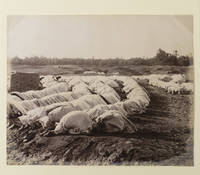
Arabic men praying outside.
1880. Tipped onto a stiff paper mount ca. 40 x 30 cm. Kept in a clear plastic sleeve. One albumen print ca. 22.5 x 27.5 cm. Striking image of a large group of Arabic men dressed in white engaged in prayer on a field. The large image was likely taken by a photographer who was active in the Middle East in the late 19th-century but is unfortunately unsigned.The edges are somewhat discoloured and the corners are creased from a past mounting method. Otherwise in good condition. unknown
Référence libraire : ABC_48723
|
|
|
[PHOTOGRAPHY - MIDDLE EAST].
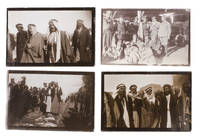
Collection of eleven snapshots from the Middle East.
Iraq 1920. Kept in a clear plastic sleeve. With 11 snapshots all ca. 6 x 9 cm. Collection of 11 snapshots from the early 1920s likely taken by a British soldier stationed in the Middle East. It is difficult to pinpoint exactly where these photographs were taken but presumably in Mesopotamia present day Iraq. Great Britain was actively involved in Mesopotamia from 1914-1932. Prior to the First World War a large portion of the Middle East was in the hands of the Ottoman Empire. However when the Ottomans sided with Germany in 1914 Great Britain sent forces to Mesopotamia to protect the Anglo-Persian oil fields. The British army initially suffered a major defeat but eventually gained the upper hand and captured Baghdad in 1917. In 1920 after the Ottoman Empire was partitioned the United Kingdom formally established control in the region under a mandate of the League of Nations. However the Iraqi people resented this idea and revolted. In 1922 Great Britain and Iraq then signed the Anglo-Iraqi Treaty in which Iraq was given the right for self-government while Great Britain stayed in control of the country's foreign policy. This would last until Iraq's independence in 1932.The present snapshots were taken in the early days of British control in the region and depict the atmosphere at the time. They show the daily life of locals including women collecting water from the river men standing guard and the hustle and bustle in the streets. Also included are various group photos of British soldiers and locals.The photographs show some traces of wear around the corners and edges but are overall in good condition. unknown
Référence libraire : ABC_48727
|
|
|
[Photograph Album].
Life in England and Military Snap Shots in Iraq and Turkey. Iraq and Turkey, 1912-1920.
Approximately 120 mounted (usually 2-4 to a page) snap shots ranging in size from 60 x 40 mm to 120 x 100 mm. Brief captions in black ink under almost all the photos. 1/4 leather album. 4to. The first half of the photos show middle class life in Edwardian England. The second, and more interesting half of the photos are snap shots that appear to have been taken by a British officer and include military subjects, scenes of Baghdad and the Euphrates, and views of the Bosporus. - Some photos are faded or have minor spots or light streaks. Wretched-looking lacking backstrip, with covers worn, discolored, and detached.
|
|
|
[Photos] - Middle Eastern Diplomacy.
A trove of more than 600 photographs. Kuwait City, Manama, Muscat, Beirut, Tunis, Khartoum, London, Seattle, Washington D.C., and other places, 1950s to early 2000s.
Ca. 620 original photographs (ca. 460 in black-and-white and ca. 160 in colour), 1 portrait reproduced from a painting, and 2 small portrait drawings. Various sizes (ca. 39 x 40 to 202 x 300 mm). Most photographs with handwritten Arabic captions in ballpoint on versos, some of which with official stamps, some with pasted mimeograph typescript captions in English. Stored in 11 display books. A handsome trove of photographs, apparently assembled by a Middle Eastern political scientist or journalist, illustrating the evolving history of various countries of the Arabian Peninsula and their political leaders during the second half of 20th century, with an emphasis on the Sheikhs of Saudi Arabia, Kuwait, Oman, and Bahrain. - Some volumes focus on one or two politicians, with their portrait photographs and their various official appearances while welcoming foreign dignitaries, attending summits, military parades, celebrations, and competitions or award ceremonies. A large section of the archive shows King Fahd bin Abdul-Aziz Al Saud, including a photograph of him with his brother Turki Bin Abdul-Aziz (vol. 1), depicting him in London on the occasion of a lunch given by Margaret Thatcher, at a diplomatic meeting with Ronald Reagan, and at the "10th Arabian summit" in Tunis (vol. 6). Nayef bin Abdul-Aziz is seen meeting political leaders and ministers (among them Yasuhiro Nakasone and François Mitterrand, vol. 3), and the diplomat and Ambassador to the U.S. Prince Bandar bin Sultan Al Saud meeting Bill Clinton, then Gouverneur of Arkansas, and Vice President George Bush Sr. (Oval Office) for the AWACS plane contract (vol. 10). Another part is dedicated to the OPEC summits under Saudi oil minister Sheikh Ahmed Zaki Yamani, meeting Bruno Kreisky in Vienna, as well as at venues in Algiers, Kuwait, Yugoslavia, Caracas, Geneva, Oslo, and other places (vol. 4). King Abdullah Bin Abdul-Aziz Al Saud is given a splendid state visit in Britain, where he is welcomed by Prince Charles and shares a carriage with Queen Elisabeth (vol. 5). Other photos show Prince Mashour bin Saud bin Abdul-Aziz Al Saud, King Fahd's nephew, in London after being freed on bail for smuggling cocaine, and King Faisal during a stay in Khartoum (vol. 8). Another part of the collection shows Kuwaiti leader Jaber al-Ahmad al-Sabah receiving Yemeni representatives, as well as his successor Saad Al-Abdullah Al-Salim Al-Sabah and his predecessor Sabah III Al-Salim Al-Sabah (vols. 2, 5, 8). Furthermore, Bahrain's royal family is shown: Isa bin Salman Al Khalifa is depicted at a young age practising riding and falconry, and Sheikh Hamad Bin Isa Al Khlaifa (vols. 7, 10, 11) meeting Oman's royals, such as Sultan Qaboos bin Said, the Saudi minister Ghazi al-Gosaibi, and the Libyan ruler Muammar Gaddafi. Dubai's ruler Sheikh Rashid bin Saeed Al Maktoum is depicted at the opening of "Asry dry dock", pouring holy water (vol. 11). - Two original photographs of well-known views of Mecca's Masjid al-Haram with the Kaaba from ca. 1885 and 1920 are added. The photographs are partly stamped and mostly annotated in Arabic (some in English and French), often with mounted labels on the versos for possible use by the press, some with small labels bearing Arabic captions. One photograph has a portion whited out for reproduction, a few photographs with studio imprint ("Zamani"), others with more detailed information, such as the name of the photographer ("Alain Nogue") or agency ("Sygma") on versos. - A wide-ranging, hitherto untapped archive which allows for various perspectives toward an analysis of international, global political diplomacy by Middle Eastern rulers and members of the Arab League, including numerous candid, personal images of the actors involved.
|
|
|

 Recevoir par e-mail
 Télécharger en PDF
 Flux RSS
 Lien permanent


