|
|
|
[MEHMET] HILMI USMANBAS.
[LAWYER of EXCHANGE of POPULATION] [Autograph letter signed 'A[vukat] Usmanbas' sent to his daughter Fetânet Hanim who was sister of Turkish musician Ilhan Usmanbas].
Very Good Turkish, Ottoman (1500-1928) Original autograph letter signed by Lawyer Usmanbas sent to his daughter Fetânet Hanim who was sister of Turkish musician Ilhan Usmanbas, (1921-). 22x14 cm. In Ottoman script. 1 p. Full. Dated 26-7-[1]946. He mentions a lawsuit in detail.
|
|
|
[MESSRS I CAMONDO ET CIE ON BEHALF OF [PROBABLY] MOISE DE CAMONDO, (Ottoman Empire-born French banker, art collector and philant
Autograph letter signed.
Constantinople: I. Camondo & Cie Constantinople Letterhead. 17 Janvier 1901 1901. No Binding. Very Good. Original autograph letter signed ALS by P.pon "We hereby declare that Ms. L. Cassinelli occupied our house located in Pera Rue Hodja Ali No 19. On December 1 1887 and left him on September 30 1899. That during all time he did not pay me the tax. P. pon de la succession de feu le Comte A. de Camondo. i.e. On behalf of the succession of Count Abraham Salomon Camondo 1781-1873. Probably it's signed by his advocate of Moise de Camondo. Recipient is not defined. Letter indicates one of Camondo family's houses in Pera Constantinople. 265x21 cm. Completely in French. 14 lines. On a paper watermarked "William Brown & Co. London". William Brown and Co. were located in London in this 'St. Mary Axe and 40 to 41 Old Broad Street London E.C.' address according to Grace's guide to British industrial industry; they worked on 'Lithographic and Letterpress Printers'. 1887 Registered as a Limited Company. Count Moïse de Camondo 1860-1935 was an Ottoman Empire-born French banker and art collector. He was a member of the prominent Camondo family. As a child Camondo moved with his family from their home in Constantinople Ottoman Empire to Paris around 1869 where he grew up and continued the career of his father Nissim de Camondo 1830-1889 as a banker. He was born into a Sephardic Jewish family that owned one of the largest banks in the Ottoman Empire established in France since 1869. Starting in 1911 he completely rebuilt the family's Parisian mansion on the Parc Monceau in order to house his collection of 18th-century French furniture and artwork. Working closely with the architect René Sergent he created a palatial home conforming to certain 18th-century traditions even planning the room dimensions to match exactly the objects in his collection. The entryway is inspired by the Petit Trianon of Versailles. The home includes a kosher kitchen with separate sections for meat and dairy. The dining room includes a beautifully-carved green marble fountain in the shape of a shell with a dolphin spigot for the ritual washing of hands before eating a meal. Some highlights of his collection include a French silver service that had been ordered by Russian Empress Catherine the Great a set of Buffon porcelain with exact reproductions of ornithological drawings from the Sèvres manufacturer and perhaps the only existing complete set of Gobelin royal tapestry sketches. He married Irène Cahen d'Anvers daughter of Louis Cahen d'Anvers in 1891. They separated in August 1897 after her affair with de Camondo's stable master Count Charles Sampieri whom she would later marry and divorce. The children Nissim and Beatrice remained with de Camondo. The mansion was completed in 1914 but his son did not reside there very long as he rejoined the French Army to fight in The Great War. It had been de Camondo's great hope that his son whom he adored would take over the family empire. Following Nissim's death in 1917 de Camondo closed all banking activities. He largely withdrew from society and devoted himself primarily to his collection and to hosting dinners for a club of gourmets at regular intervals. Camondo died in 1935 and the museum opened the following year. He donated the home to Paris's Decorative Arts society as a museum Musée Nissim de Camondo in honor of the loss of his son Nissim in World War I. In addition to the collection the meticulously-restored service areas elevator and woodwork of the mansion are noteworthy. During the German occupation of France during World War II his daughter Béatrice his son-of-law Léon Reinach and their children Fanny and Bertrand were deported from France and died in the Auschwitz concentration camp. As a result the de Camondo family died out. <br/> <br/> I. Camondo & Cie, Constantinople Letterhead., 17 Janvier 1901 unknown
书商的参考编号 : 052829
|
|
|
[MESSRS I. CAMONDO ET CIE ON BEHALF OF [PROBABLY] MOISE DE CAMONDO, (Ottoman Empire-born French banker, art collector and philanthropist), (1860-1935)].
Autograph letter signed.
Very Good French Original autograph letter signed (ALS) by P.pon "[We hereby declare that Ms. L. Cassinelli occupied our house located in Pera Rue, Hodja Ali No 19. On December 1, 1887, and left him on September 30, 1899. That during all time, he did not pay me the tax... P. pon de la succession de feu le Comte A. de Camondo. [i.e. On behalf of the succession of Count A[braham Salomon] Camondo, (1781-1873)]. Probably it's signed by his advocate of Moise de Camondo. Recipient is not defined. Letter indicates one of Camondo family's houses in Pera, Constantinople. 26,5x21 cm. Completely in French. 14 lines. On a paper watermarked "William Brown & Co., London". William Brown and Co. were located in London in this 'St. Mary Axe, and 40 to 41, Old Broad Street, London, E.C.' address according to Grace's guide to British industrial industry; they worked on 'Lithographic and Letterpress Printers'. 1887 Registered as a Limited Company. Count Moïse de Camondo, (1860-1935), was an Ottoman Empire-born French banker and art collector. He was a member of the prominent Camondo family. As a child, Camondo moved with his family from their home in Constantinople, Ottoman Empire, to Paris around 1869, where he grew up and continued the career of his father, Nissim de Camondo (1830-1889), as a banker. He was born into a Sephardic Jewish family that owned one of the largest banks in the Ottoman Empire, established in France since 1869. Starting in 1911, he completely rebuilt the family's Parisian mansion on the Parc Monceau in order to house his collection of 18th-century French furniture and artwork. Working closely with the architect René Sergent, he created a palatial home conforming to certain 18th-century traditions, even planning the room dimensions to match exactly the objects in his collection. The entryway is inspired by the Petit Trianon of Versailles. The home includes a kosher kitchen with separate sections for meat and dairy. The dining room includes a beautifully-carved green marble fountain in the shape of a shell, with a dolphin spigot for the ritual washing of hands before eating a meal. Some highlights of his collection include a French silver service that had been ordered by Russian Empress Catherine the Great, a set of Buffon porcelain (with exact reproductions of ornithological drawings) from the Sèvres manufacturer, and perhaps the only existing complete set of Gobelin royal tapestry sketches. He married Irène Cahen d'Anvers, daughter of Louis Cahen d'Anvers, in 1891. They separated in August 1897 after her affair with de Camondo's stable master, Count Charles Sampieri, whom she would later marry and divorce. The children, Nissim and Beatrice, remained with de Camondo. The mansion was completed in 1914, but his son did not reside there very long, as he rejoined the French Army to fight in The Great War. It had been de Camondo's great hope that his son, whom he adored, would take over the family empire. Following Nissim's death in 1917, de Camondo closed all banking activities. He largely withdrew from society and devoted himself primarily to his collection and to hosting dinners for a club of gourmets at regular intervals. Camondo died in 1935, and the museum opened the following year. He donated the home to Paris's Decorative Arts society as a museum (Musée Nissim de Camondo) in honor of the loss of his son Nissim in World War I. In addition to the collection, the meticulously-restored service areas, elevator, and woodwork of the mansion are noteworthy. During the German occupation of France during World War II, his daughter Béatrice, his son-of-law Léon Reinach, and their children (Fanny and Bertrand) were deported from France and died in the Auschwitz concentration camp. As a result, the de Camondo family died out.
|
|
|
[Michelin]
TURQUIE
Un ouvrage de 608 pages, format 120 x 190 mm, illustré, broché couverture couleurs rempliée, publié en 1998, Guides Neos - Michelin, bon état
书商的参考编号 : LFA-126744643
|
|
|
[MILITARY PRINTINGHOUSE].
[MAP of HELLESPONT & GALLIPOLI] [Map of Hellespont, Gallipoli Peninsula, Suvla Bay, Seddülbahir and Tenedos].
Very Good Turkish, Ottoman (1500-1928) Original color map. 65,5x63 cm. In Ottoman script. This rare and decorative Gallipoli map including Hellespont, Gallipoli Peninsula, Suvla Bay, Seddülbahir, and Tenedos, the places of Gallipoli Aar in 1915 (Dardanelles Campaign) during World War 1, separated two map views. Seddulbahir and Suvla Bay at north and Straight, Peninsula, and its shores with Tenedos (now Bozcaada) at the southwest of the map. It's a very detailed and rare map printed with the series of "History of the Dardanelles Campaign" after the seven years of war. The Gallipoli campaign, also known as the Dardanelles campaign, the Battle of Gallipoli or the Battle of Çanakkale (Turkish: Çanakkale Savasi, or, Muharebâti), was a military campaign in the First World War that took place on the Gallipoli peninsula (Gelibolu in modern Turkey), from 17 February 1915 to 9 January 1916. The Entente powers, Britain (with Anzacs), France, and Russia, sought to weaken the Ottoman Empire, one of the Central Powers, by taking control of the Turkish straits.
|
|
|
[Mine] [Turquie] CARPENTIER, H. ; AYKUT, K.
Esquisse d’un lexique minier franco-turc par H. Carpentier et K. Aykut de la Société minière de Féthiyé (Istanbul)
Aubenas (Ardèche), Presses de l’Imprimerie Lienhart et Compagnie 1963 In-12 17,5 x 11,5 cm. Broché, couverture grise, titre en rouge sur le premier plat de couverture, 38 pp. Exemplaire en très bon état.
书商的参考编号 : 97241
|
|
|
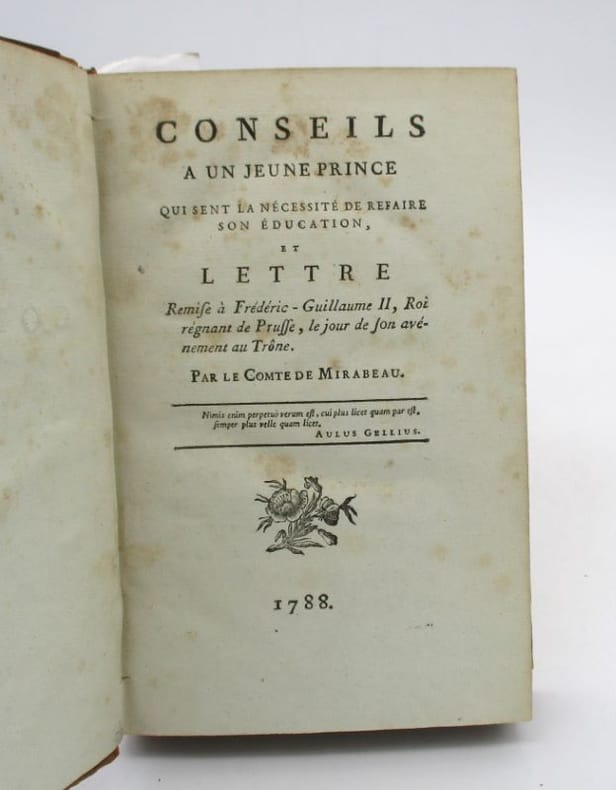
[MIRABEAU (Honoré-Gabriel Riqueti, comte de)] [suivi de:] FERRY DE SAINT-CONSTANT (Giovanni) [suivi de:] VOLNEY (Constantin-François)
Conseils à un jeune prince qui sent la nécessité de refaire son éducation et Lettre remise à Frédéric-Guillaume II, roi régnant sur la Prusse, le jour de son avènement au trône [suivi de:] Considérations sur les révolutions des Provinces-unies [suivi de:] Considérations sur la guerre actuelle des Turcs
S.l., s.n. 1788 [suivi de:] La Haye, Pierre Gosse, 1788 [suivi de:] Londres, s.n., 1788. In-12, V-88-84 pp. + [4]-VII-131 pp. + [2]-140 pp. 1 pl., demi-basane havane, dos à nerfs orné de filets dorés, pièces de titre rouge, tranches mouchetées (reliure défraîchie, rousseurs).
书商的参考编号 : 18919
|
|
|
[MUHAMMED MUSTAFA] MÜSTAK BABA, (1759-1832).
Divân-i Müstak Baba [Efendi]. [Facsimile].
Very Good Turkish, Ottoman (1500-1928) Paperback. Roy. 8vo (24 x 16 cm). In Ottoman script. 107 p. Divân-i Müstak Baba [Efendi]. [Facsimile]. Facsimile edition of Müstak Baba's divan poetry. Özege: 04198. Müstak Baba was a sufi poet descend from Abdülkadir Geylânî (An Islamic saint). Probably he was Kurdish.
|
|
|
[MUSAHIBZÂDE CELÂL], (1868-1959).
Türk kizi: Millî facia.
Very Good Turkish, Ottoman (1500-1928) Modern aesthetic brown cloth bdg. Large roy. 8vo. (24 x 18 cm). In Ottoman script. 31 p. Türk kizi: Millî facia. Hegira: 1325 = Gregorian: 1909. Copy with no date, however dated 1325 H. in epilogue by Musahipzâde. First and Only Edition. Özege 21462. OCLC 1030931337.
|
|
|
[MUSTAFA] CELÂL ARAT, (Turkish military officer, Politician, Diplomat), (1883-1968).
Autograph letter signed 'Yozgad Millet Vekili Celâl Arat'.
Very Good Turkish, Ottoman (1500-1928) Original autograph letter signed (ALS) 'Yozgat Milletvekili Celâl Arat'. 21x15 cm. In Ottoman script. 1 p. Folded. Dated October, 10, 1946. Includes five lines.
|
|
|
[MÉLANGES].
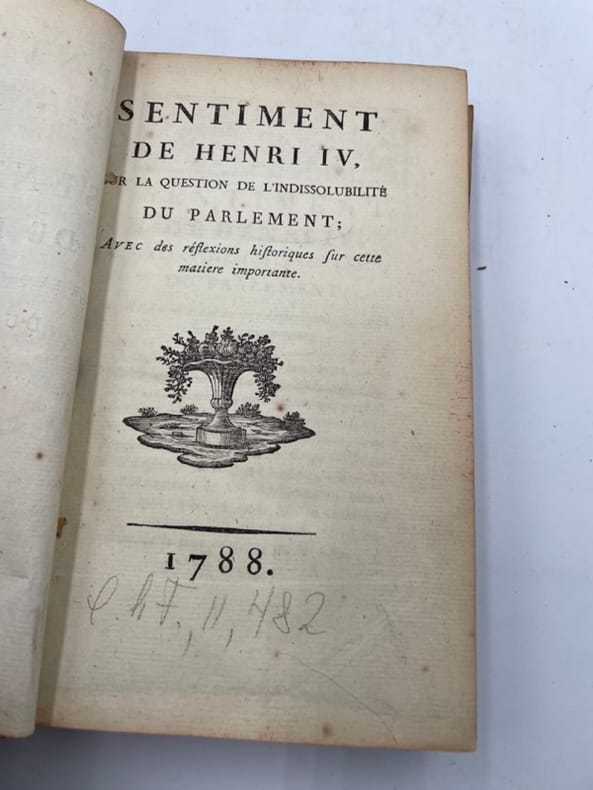
Recueil.
1787 - 1788 11 pièces en un vol. in-8, demi-basane fauve, dos lisse cloisonné et fleuronné, pièce de titre, tranches mouchetées de rouge (reliure de l'époque). Manques de cuir au dos, les deux charnières entièrement fendues.
书商的参考编号 : 236360
|
|
|
[N. A.].
Tensik-i kuyûd ve hesabât-i mâliyeye aid talimât ve mukarrerât ve tarifnâmeler ile nümüneler mecmuasi.
Very Good Turkish, Ottoman (1500-1928) Modern cloth bdg. Roy. 8vo. (24 x 17 cm). In Ottoman script. 150 p. Özege 20461. Examples for regulations and instructions on the Turkish / Ottoman financial accounts and correction of the registers. A fine reference for the late Ottoman financial system.
|
|
|
[N.A.]
A guide to Çatalhöyük. Translated by Hasan Inal.
Very Good English Paperback. Pbo. Cr. 8vo. (19 x 13 cm). In English. [14] p. Booklet. B/w and color ills. A guide to Çatalhöyük. Translated by Hasan Inal.
|
|
|
[N.A.].
Tedkikât-i ruhiye rehberi.
Very Good English Paperback. Pbo. Cr. 8vo. (19 x 13 cm). In Ottoman script. 16 p. This edition is not in Ozege. Rare. A study on psychology of students. Printed in Kastamonu. Tedkikât-i ruhiye rehberi.
|
|
|
[Nicholas Murray Butler]
Report of the International Commission to Inquire into the Causes and Conduct of the Balkan Wars.
This contemporary report investigated the impact of the conflicts that took place in the Balkan States in 1912 and 1913 when Greece, Serbia, Montenegro and Bulgaria declared war upon the Ottoman Empire and defeated it . In 1913 the Second Balkan War began when Bulgaria, dissatisfied with its loss of Macedonia, attacked its former Balkan League allies. The Balkan Wars were marked by ethnic cleansing with all parties being responsible for grave atrocities against civilians which were documented in this report.[X],418p. Plate,tables mapd. Copy neat and complete with plates and fold-out maps. Library marks including book plate,cover slightly shelf worn, else every good. Ex-Library
|
|
|
[Notre Histoire]
NOTRE HISTOIRE
N° 129 (Janvier 1996) 66 pages, format 220 x 295 mm, illustré, broché couverture couleurs, bon état
书商的参考编号 : LFA-126739924
|
|
|
[Notre Histoire]
NOTRE HISTOIRE
N° 228 (Janvier 2005): 66 pages, format 220 x 295 mm, illustré, broché couverture couleurs, bon état
书商的参考编号 : LFA-126740003
|
|
|
[ON THE OCCASION OF THE SECOND VISIT TO ISTANBUL OF KAISER WILHELM II AND AUGUSTA VICTORIA, QUEEN OF PRUSSIA].
[ILLUSTRATED KAISER'S VOYAGES TO THE OTTOMAN MIDDLE EAST] Hatirâ-i seyahât: Alman Imparatoru hasmetlü Vilhelm [Kaiser II. Wilhelm] ve Imparatoriçe Ogusta Viktorya [Augusta Victoria] hazretinin Dersaadet'i def'â-yi saniye olarak ziyaretleriyle Suriye seyahatlerine bir hatirâ-i nâçiz olmak üzere (Sabah) Gazetesi tarafindan Kariyan-i Osmaniyeye hediye edilmisdir.
Very Good Turkish, Ottoman (1500-1928) Fine brown quarter leather bdg., brown boards with decorative embossing. Roy. 8vo. (24 x 17 cm). In Ottoman script (Old Turkish with Arabic script). 176 p., 33 unnumbered b/w plates of views of the Middle Eastern cities, Kaiser and queen's portraits, ills. of their maritime voyages, a general view of Beirut, a panorama of Jerusalem (in two pages), The Government House and Lake Tiberia in Beirut, a general view of Jaffa, churches and castles and Masjid-i Aksa of Jerusalem, Idlib, the interior of the Umayyad Mosque in Jerusalem, The Government House of Jaffa, Beirut - Damascus railways, street views and architectural buildings from Damascus, the market place of Jaffa, Bethlehem and the church, views of Trablus-Sam [i.e. Tripolis], ruins of Baalbek, and other numerous b/w photos, published for only this book. Slight stains on pages, a modern repair on a leaf with tape, otherwise a very good copy. Bound together with "Eski Sevda" which is a compilation of Turkish tales. First and only edition of this richly illustrated scarce and uncommon book was printed for the German Emperor Wilhelm II and his wife Augusta Victoria, the commemoration of the construction of Alman Çesmesi [i.e. German Fountain] in Constantinople, and the first anniversary of the Wilhelm II's travel to the Ottoman Empire in 1898. The fountain's design was drawn by the architect Spitta and constructed by the architect Schoele with the German architect Carlitzik and Italian architect Joseph Anthony, working on the project. The fountain was built in Germany and then transported piece by piece to Istanbul, reassembled in its current site, and officially opened on January 27, 1901, on the birthday of German Emperor Wilhelm II. Wilhelm II's voyage to the Levant in 1898 was a state visit that the German Emperor undertook in the Ottoman Empire between 25 October and 12 November 1898. The Kaiser started his journey to the Ottoman Eyalets with Istanbul on 16 October 1898; then he went by yacht to Haifa on 25 October. After visiting Jerusalem and Bethlehem, the Kaiser went back to Jaffa to embark on Beirut, where he took the train passing Aley and Zahlé to reach Damascus on 7 November. This book is richly illustrated including many views of the cities of this voyage's destinations like Jerusalem, Damascus, Beirut (Beirut), Jafa, Baalbek, etc. On 10 November, Wilhelm went to visit Baalbek before heading to Beirut to board his ship back home on 12 November. His visit spurred interest in the German Templer colonies in Palestine. One of the Kaiser's traveling companions, Colonel Joseph von Ellrichshausen, initiated the formation of a society for the advancement of the German settlements in Palestine, named the Gesellschaft Zur Förderung der Deutschen Ansiedlungen in Palästina, in Stuttgart. It enabled the settlers to acquire land for new settlements by offering them low-interest loans. A subsequent second wave of German settlers founded Wilhelma (named after the Kaiser, now called Bnei Atarot) in 1902 near Lod, Walhalla (1903) near the original Jaffa colony, followed by Bethlehem of Galilee (1906). The German Settlement Society successfully encouraged some of the Templars to return to the official, national Protestant Church. The non-Templar colony of Waldheim (now Alonei Abba) was subsequently founded next to Bethlehem of Galilee in 1907 by proselytized Templers now affiliated with the Old-Prussian State Church. The visit resulted in the highest-profile political event in the life of Theodor Herzl, considered the founder of Zionism. Through the efforts of William Hechler, via Frederick I, Grand Duke of Baden, Herzl publicly met Wilhelm II three times during the voyage, once in Istanbul (on 15 October 1898) and twice in Palestine (29 October and 2 November). The meetings significantly advanced Herzl's and Zionism's legitimacy in Jewish and world opinion. (Wikipedia). Only one copy in OCLC (Library of Congress. Karl Süssheim Collection, no. 1300) 900684728. Özege 7023
|
|
|
[OSMAN] SAFVET [GEYLANGIL], (1887-1944).
[BEAUTIFUL CHROMOLITHOGRAPHED MAPS / OTTOMAN ATLAS] Yeni resimli ve haritali cografya-yi Osmanî. Mekâtîb-i Ibtidâiyye Devre-i Aliye birinci sinifa mahsus.
Very Good Turkish, Ottoman (1500-1928) Contemporary red cloth. Roy. 8vo. (24 x 16 cm). In Ottoman script (Old Turkish with Arabic letters). [1], 229, [1] p., many b/w and color ills., 30 chromo-lithographed maps. Wear and fading on spine, some ex-library stamps on the colophon and several blank pages, ownership ink inscription and signature on the first page-overall a good copy. First edition of this rare Ottoman atlas for the primary schools in the late Ottoman Empire, including beautiful 30 chromo-lithographed maps of the Ottoman land according to administrative regions (provinces) and richly illustrated with b/w plates of the cities and provinces in the Middle East. Map list: 1. World map 2. Complete Imperial Ottoman 3. Arabian Peninsula 4. Anatolia 5. Asia Minor 6. Marmara and Black Sea 7. Aegean (The Archipelago) 8. Demography of Anatolia and Syria, Libya, etc 9. Administrative map of Anatolia 10. Map of mines of Anatolia 11. Agricultural map of the Imperial Ottoman 12. Arabian Peninsula 13. Map of the Edirne Vilayat [Adrianople Province of the Ottoman Empire] 14. Map of the Bosphorus 15. Map of the Hüdavendigâr Vilayat [Brusa Province] 16. Maps of Izmit and Biga Sanjaks 17. Map of Aydin Vilayat and Mentese Sanjak 18. Map of the Konya Vilayat 19. Maps of the Adana Vilayat and the Mediterranean Sea 20. Maps of the Erzurum and Ankara Vilayats 21. MAps of Kastamonu Vilayat and Bolu Sanjak 22. Map of the Trebizond Vilayat 23. Maps of the Van and Bitlis Vilayats 24. Maps of the Sivas and Harput Vilayats 25. Maps of the Bagdad and Basrah Vilayats 26. Map of the Mosul Vilayat and Day al-Zor Sanjak 27. Map of the Aleppo Vilayat and Urfa Sanjak 28. Map of the Syria and Beirut Vilayats 29. Map of the Arabia 30. Maps of the Yemen vilayat and Asir Sanjak. This atlas was printed four times for the different classes of the early Turkish / Ottoman schools, during World War 1 (two times in 1916) and the National Struggle (two times in 1921). Geylangil was born in Istanbul in 1887 and studied in Aleppo and Baghdad. Geylangil, who also studied economic geography, taught geography at many schools, including Galatasaray High School. Until his death, he wrote 14 books on geography, most of which were geographical atlases. In 1941, he was among the founding members of the Turkish Geographical Society. Özege 23216.; TBTK 11481.; We couldn't find any copy of this edition worldwide.
|
|
|
[OTTOMAN ATLAS - MANUSCRIPT].
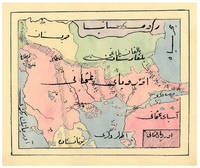
Atlas of the western Ottoman Empire.
Ottoman Empire 1910. Gold-stamped cloth with the tughra of Mehmed V ruled 1908-18 on the front board when reading right to left and "Album" on the back board the front when reading left to right with an inscription below the tughra and the European numerals 16 and 2 flanking an ornament below the inscription the whole framed by 4 large floral cornerpieces. Oblong 4to 26.5 x 19.5 cm. 14 leaves with 10 pen-and-ink maps hand coloured with watercolours. Tissue guards. An album of hand-drawn maps forming an atlas of the western mostly European parts of the Ottoman Empire with legends in Ottoman Turkish written in the Arabic script. The overview map shows Albania Kosovo Macedonia and the Ottoman controlled northern parts of Greece coloured together with Thrace and the northwest parts of Anatolia shown treating them as a single unit while Serbia and Bulgaria like the small parts of territories outside Ottoman control are coloured separately. Most of the other maps give more detailed views of some of these regions including the Bosporus the Dardanelles Halkidiki Chalcidice Albania etc. but there is also a map of Crete not in the overview map.In fine condition. hardcover
书商的参考编号 : ABC_47241
|
|
|
[OTTOMAN BIRTH CERTIFICATE - GREEK MINORITY].
GREEK MINORITY "Devlet-i Aliyye Nüfus Tezkîresi" Early Ottoman birth certificate of Kostaniniyye'li Yorgi Papa oglu Hedezgâr Mihail stamped by Sehremâneti in 1298 AH 1882 AD with the tughra of Sultan Abdülhamid II.
Ottoman Manuscript Document. 1298 AH 1882. No Binding. Very Good. Original Ottoman birth certificate. 31x18 cm. In Ottoman script. 2 p. Faded on paper. A good paper. On verso some handwritten annotations in Ottoman Turkish and Greek. GREEK MINORITY "Devlet-i Aliyye Nüfus Tezkîresi" Early Ottoman birth certificate of Kostaniniyye'li Yorgi Papa oglu Hedezgâr Mihail stamped by Sehremâneti in 1298 AH 1882 AD with the tughra of Sultan Abdülhamid II. <br/> <br/> Ottoman Manuscript Document., [1298 AH] unknown
书商的参考编号 : 053643
|
|
|
[OTTOMAN BIRTH CERTIFICATE - GREEK MINORITY].
GREEK MINORITY "Devlet-i Aliyye Nüfus Tezkîresi" Early Ottoman birth certificate of Kostaniniyye'li Mihail oglu Areti stamped 'Adana' in 1311 AH 1895 AD with the tughra of Sultan Abdülhamid II.
Ottoman Manuscript Document. 1311 AH 1895. No Binding. Very Good. Original Ottoman birth certificate. 31x18 cm. In Ottoman script. 2 p. Faded on paper. A good paper. On verso some handwritten annotations in Ottoman Turkish and Greek. With a printed stamp of "Dahiliye Nezâret-i Umûmiyyesi". GREEK MINORITY "Devlet-i Aliyye Nüfus Tezkîresi" Early Ottoman birth certificate of Kostaniniyye'li Mihail oglu Areti stamped 'Adana' in 1311 AH 1895 AD with the tughra of Sultan Abdülhamid II. <br/> <br/> Ottoman Manuscript Document., [1311 AH] unknown
书商的参考编号 : 053644
|
|
|
[OTTOMAN BIRTH CERTIFICATE - GREEK MINORITY].
GREEK MINORITY "Devlet-i Aliyye Nüfus Tezkîresi" Early Ottoman birth certificate of Ayasuluglu Papa Istefani in 1310 AH 1894 AD; with the tughra of Sultan Abdülhamid II.
Ottoman Manuscript Document. 1310 AH 1894. No Binding. Very Good. Original Ottoman birth certificate. 31x18 cm. In Ottoman script. 2 p. Faded on paper. Otherwise a good paper. On verso added a Greek translation of script plate beside the Ottoman Turkish. GREEK MINORITY "Devlet-i Aliyye Nüfus Tezkîresi" Early Ottoman birth certificate of Ayasuluglu Papa Istefani in 1310 AH 1894 AD; with the tughra of Sltan Abdülhamid II. <br/> <br/> Ottoman Manuscript Document., [1310 AH] unknown
书商的参考编号 : 053645
|
|
|
[OTTOMAN BIRTH CERTIFICATE - GREEK MINORITY].
[GREEK MINORITY] "Devlet-i Aliyye Nüfus Tezkîresi" Early Ottoman birth certificate of Kostaniniyye'li Yorgi Papa oglu Hedezgâr Mihail stamped by Sehremâneti in 1298 AH [1882 AD], with the tughra of Sultan Abdülhamid II.
Very Good Turkish, Ottoman (1500-1928) Original Ottoman birth certificate. 31x18 cm. In Ottoman script. 2 p. Faded on paper. A good paper. On verso, some handwritten annotations in Ottoman Turkish and Greek. [GREEK MINORITY] "Devlet-i Aliyye Nüfus Tezkîresi" Early Ottoman birth certificate of Kostaniniyye'li Yorgi Papa oglu Hedezgâr Mihail stamped by Sehremâneti in 1298 AH [1882 AD], with the tughra of Sultan Abdülhamid II.
|
|
|
[OTTOMAN BIRTH CERTIFICATE - GREEK MINORITY].
[GREEK MINORITY] "Devlet-i Aliyye Nüfus Tezkîresi" Early Ottoman birth certificate of Kostaniniyye'li Mihail oglu Areti, stamped 'Adana' in 1311 AH [1895 AD], with the tughra of Sultan Abdülhamid II.
Very Good Turkish, Ottoman (1500-1928) Original Ottoman birth certificate. 31x18 cm. In Ottoman script. 2 p. Faded on paper. A good paper. On verso, some handwritten annotations in Ottoman Turkish and Greek. With a printed stamp of "Dahiliye Nezâret-i Umûmiyyesi". [GREEK MINORITY] "Devlet-i Aliyye Nüfus Tezkîresi" Early Ottoman birth certificate of Kostaniniyye'li Mihail oglu Areti, stamped 'Adana' in 1311 AH [1895 AD], with the tughra of Sultan Abdülhamid II.
|
|
|
[OTTOMAN BIRTH CERTIFICATE - GREEK MINORITY].
[GREEK MINORITY] "Devlet-i Aliyye Nüfus Tezkîresi" Early Ottoman birth certificate of Ayasuluglu Papa Istefani in 1310 [AH] [1894 AD]; with the tughra of Sultan Abdülhamid II.
Very Good Turkish, Ottoman (1500-1928) Original Ottoman birth certificate. 31x18 cm. In Ottoman script. 2 p. Faded on paper. Otherwise a good paper. On verso, added a Greek translation of script plate beside the Ottoman Turkish. [GREEK MINORITY] "Devlet-i Aliyye Nüfus Tezkîresi" Early Ottoman birth certificate of Ayasuluglu Papa Istefani in 1310 [AH] [1894 AD]; with the tughra of Sltan Abdülhamid II.
|
|
|
[OTTOMAN CAPITULATIONS OF 1740].
Kitabi-i ahdname-i hümayun-u saadet-makrun.
Paris or Istanbul 1816. Half calf marbled paper sides gold-tooled spine. Large 4to 31.5 x 24 cm. The text of an Ottoman-French treaty set in the Ottoman Turkish alphabet a version of the Arabic script. Very rare edition possibly the first of the Ottoman capitulations agreed between a French envoy on behalf of King Louis XV of France and a grand vizier on behalf of Sultan Mahmud I of the Ottoman Empire on 4 Rabi al-Awwal 1153 AH 30 May 1740 CE. We have located only three other copies: in the Bayerische Staatsbibliothek the Österreichische Nationalbibliothek and Harvard's Houghton Library. This particular agreement comprises eighty-five articles nearly all concerning the granting of trade economic and legal rights favourable to France. It was mostly a renewal of articles previously agreed upon but includes some newly introduced articles.The capitulations are a type of treaty by which foreign people are given certain privileges mostly relating to trade and transportation over or even at the expense of native citizens. These treaties did facilitate mutually beneficial commercial and financial contracts for the parties involved considering an evolving global marketplace for example by minimizing the transaction costs taxes etc. of their exchanges. The foreign power often bought their influence benefitting local government officials partly at the expense of the people they were supposed to govern."The Ottoman-French Treaty of 1740 marked the apogee of French influence in the Ottoman Empire in the eighteenth century. In the following years the French had an unchallenged position in Levant trade and in transportation between Ottoman ports." Olson p. 75. The Ottomans first made capitulations to France in 1569 first as a strategy European powers used to eliminate the risk of falling victim to Ottoman raids and later to gain influence over Ottoman trade. These Ottoman-French treaties were renewed and amended several times from the 16th to the 19th century until they were abolished as a whole with the Treaty of Lausanne of 1922-1923 which also ended the Greco-Turkish War and defined the modern borders of Turkey.Binding shows signs of wear slight foxing throughout otherwise in good condition.l Europeana 1 copy Österreichische NB; WorldCat 612814438 1 copy Harvard and 165919643 1 copy Bayerische SB; on the treaty: Olson Robert. "The Ottoman-French treaty of 1740: a year to be remembered" in: Imperial meanderings and republican by-ways: essays on eighteenth century Ottoman and twentieth century history of Turkey. 2010 pp. 75-82. unknown
书商的参考编号 : ABC_47147
|
|
|
[OTTOMAN DOCUMENT - TAXES].
"Harb Kazançlari Vergisi Hakkinda Ihtarnâme" [i.e. Written warning on the Tax on War Profits]: Sent by "Tarh Komisyonu Mihr-i Resmiyesi" to the owner of "Izmir Basturak Subesi Incir Mahsûlleri Sirketi" in [1920 AD] 1336 AH, March, 8.
Very Good Turkish, Ottoman (1500-1928) Original document partly printed and manuscript. Oblong: 15,5x18 cm. In Ottoman script. A tear to blank outer margin of title-page (no loss and not affecting to the printing area). The tax on war profits was on the agenda already in 1918 but it became effective only in 1919. During World War 1, the revenues procured from taxes covered only 10 percent of the government expenses. [WW I] (1914-1918 Online).
|
|
|
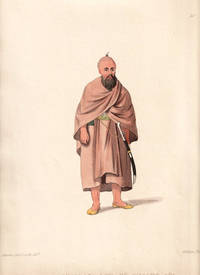
[OTTOMAN EMPIRE - COSTUME PRINTS] DALVIMART, OCTAVIEN
A Dervise or Dervish of Syria.
London.: W. Miller. 1802. Hand-coloured engraving 34.7 x 25.9 cms sheet including plate-mark edge toning but in very good condition. Attractive large image of a Dervise or Dervish prepared as Plate XXX for Dalvimart's work "The Costume of Turkey". <br>"Dalvimart's is one of the basic works on Turkish costume which has provided the prototypes for numerous other illustrative material. It is known that Dalvimart travelled in Turkey and Greece in 1797-8" Atabey. . W. Miller. unknown
书商的参考编号 : 219553
|
|
|
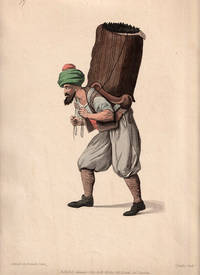
[OTTOMAN EMPIRE - COSTUME PRINTS] DALVIMART, OCTAVIEN
A Hamal or Common Porter.
London.: W. Miller. 1802. Hand-coloured engraving 34.7 x 25.8 cms sheet including plate-mark edge toning but in very good condition. Attractive large image prepared as plate 17 for Dalvimart's work "The Costume of Turkey". <br>"Dalvimart's is one of the basic works on Turkish costume which has provided the prototypes for numerous other illustrative material. It is known that Dalvimart travelled in Turkey and Greece in 1797-8" Atabey. . W. Miller. unknown
书商的参考编号 : 219551
|
|
|
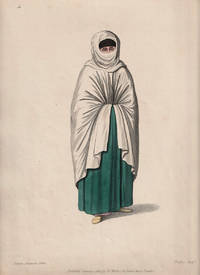
[OTTOMAN EMPIRE - COSTUME PRINTS] DALVIMART, OCTAVIEN
A Turkish Woman in a Provincial Dress.
London.: W. Miller. 1802. Hand-coloured engraving 34.7 x 26 cms sheet including plate-mark edge toning but in very good condition. Attractive large image prepared as Plate IV for Dalvimart's work "The Costume of Turkey". <br>"Dalvimart's is one of the basic works on Turkish costume which has provided the prototypes for numerous other illustrative material. It is known that Dalvimart travelled in Turkey and Greece in 1797-8" Atabey. . W. Miller. unknown
书商的参考编号 : 219552
|
|
|
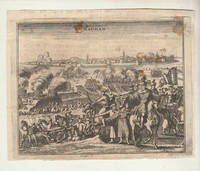
[OTTOMAN EMPIRE] (DAPPER, OLFERT)
Beleg von Bagdad Seige of Baghdad
Amsterdam.: Jacob van Meurs. 1681. Engraving 12.5 x 16 cm a few spots affecting the image and edges a little rough but a dark impression in good condition. The sack of Baghdad by the Mongol Empire in 1258 originally included in Olfert Dapper's encyclopaedic study of the Middle East here re-engraved for the German edition of 1681 published by Jacob van Meurs. . (Jacob van Meurs) unknown
书商的参考编号 : 177630
|
|
|
[OTTOMAN EMPIRE].
Collection of treaty articles relating to commercial transactions of subjects of the Austrian state in the Ottoman Empire. Avusturya devleti tebaasinin Memalik-i Osmaniyede ticaretlerine ait mevadd-i ahdiyye mecmuasidir.
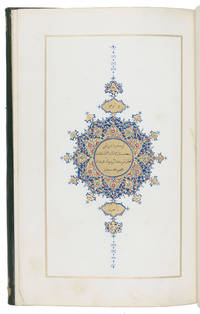
Vienna 1846. Large 8vo. Dar tiba al-imberaturiyy k. k. Hof- und Staatsdruckerei Contemporary green morocco with a fore-edge flap gold-stamped boards with an oriental design gilt edges. Printed in black with red headings within printed gilt rules. Illuminated head-piece and unwan printed in three colours and gilt in imitation of manuscript illumination. Gilt tail-piece. 88 pp. The full text of 19 trade treaties in Ottoman Turkish throughout closed between the Roman/Austrian and the Ottoman Empire between 1110/1699 Peace of Karlovac and 1259/1844. An Italian-language edition had appeared in 1844 "Raccolta dei Trattati e delle principali convenzioni concernanti il commercio e la navigazione dei sudditi Austriaci negli Stati della Porta Ottomana".Occasional insignificant foxing; altogether very well preserved. A splendidly bound copy.l Zenker BO II 805. hardcover
书商的参考编号 : JBDBKGMJ1PXZ
|
|
|
[OTTOMAN EMPIRE - TREATY ARTICLES].
Collection of treaty articles relating to commercial transactions of subjects of the Austrian state in the Ottoman Empire. Avusturya devleti tebaasinin Memalik-i Osmaniyede ticaretlerine ait mevadd-i ahdiyye mecmuasidir.
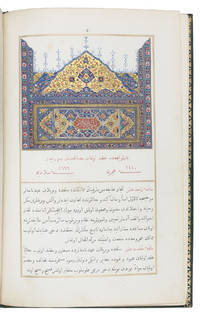
Vienna: Dar tiba al-imberaturiyy k. k. Hof- und Staatsdruckerei 1846. Contemporary green morocco binding with fore-edge flap covers giltstamped with an oriental design. All edges gilt. Large 8vo. Printed in black with red headings within printed gilt rules. Illuminated head-piece and unwan printed in three colours and gilt in imitation of manuscript illumination. Gilt tail-piece. With: Raccolta dei trattati e delle principali convenzioni concernanti il commercio e la navigazione dei sudditi Austriaci negli Stati della Porta Ottomana. Vienna Dar tiba al-imberaturiyy k. k. Hof- und Staatsdruckerei 1844. The full text of 19 trade treaties in Ottoman Turkish throughout closed between the Austrian and the Ottoman Empire between 1110/1699 Peace of Karlovac and 1259/1844. Bound in the same volume is the 1844 Italianlanguage edition containing the texts of the various treaties in their respective original European language with an Italian translation on the opposite pages.Ownership "C Fr Jelinek 1855" signed to endpaper. The Turkish text shows occasional insignificant foxing as common; altogether very well preserved. A splendidly bound copy.l Zenker BO II 805. Dar tiba al-imberaturiyy (k. k. Hof- und Staatsdruckerei), unknown
书商的参考编号 : JBDC1K1DW82Q
|
|
|
[OTTOMAN EMPIRE].
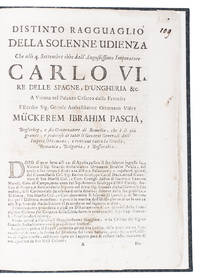
Drop-title: Distinto ragguaglio della solenne udienza che alli 4. Settembre ebbe dall' Augustissimo Imperatore Carlo VI. re della Spagne d'Ungheria &c. a Vienna nel Palazzo Cesareo della Favorita l'eccellentissimo signor. grande ambasciatore Ottomano visire Mückerem Ibrahim Pascia
Including: Racconto della solenne visita che alli 7. Di Settembre 1719. Il Signor. Grande Ambasciatore Ottomano Ibrahim Pascià diede al Serenissimo. Prencipe Eugenio di Savoja
Colophon: Rome 1719. 4to. Giovanni Francesco Chracas Modern boards covered with chemical-marbled paper black morocco spine label. With a hatched roman capital used as an initial. Set in roman types with extensive italic. 8 pp. Extremely rare contemporary account of the audiences of the first Ottoman ambassador to the Holy Roman Empire before the Emperor himself and before Prince Eugene of Savoy both in the year 1719. This signalled the beginning of the attempted transition from war to negotiation in the ever difficult relations between the great Islamic and Christian powers. The Holy Roman Emperor Charles VI 1685-1740 conducted the successful Austro-Turkish War against the Ottoman Empire in the years 1716 to 1718 lead by Prince Eugene of Savoy 1663-1736. After the Treaty of Passarowitz ended the war on 21 July 1718 the Ottoman Sultan Ahmed III sent Ibrahim Pasha to Vienna to serve as Ambassador and Charles VI sent Count Hugo von Virmont to Constantinople as Ambassador to the Sultan. This exchange of ambassadors was celebrated with a grand ceremony near the border where the two ambassadors met on 15 June 1719. The present publication begins by noting Ibrahim's arrival in Vienna on 14 August and gives an account of his audience before Charles VI on 4 September. The last two pages with their own drop-title give an account of Ibraham's meeting with Prince Eugene of Savoy on 7 September. Both accounts include lists of presents exchanged. Eugene was to receive Ibrahim Pasha again at his newly built Belvedere palace in Vienna on 2 October 1719.We have located no other copy of the present edition but the ICCU records one copy of an undated edition. It is also a 4to of 4 leaves but the fourth leaf is blank and it apparently omits the account of Ibraham's meeting with Prince Eugene which appears on the fourth leaf of the present edition. WorldCat records one copy of a German edition of the account of the meeting with Prince Eugene and three copies of a German publication on Ibrahim's arrival in Vienna.Somewhat foxed but otherwise in very good condition and wholly untrimmed preserving all deckles. An important document of the Ottoman Empire's relations with Christian Europe and a window into the opulence accompanying the diplomacy.l Cf. ICCU RMLE047805 1 copy of undated ed. omitting meeting with Eugene of Savoy; KVK same copy; WorldCat 1 copy each of 2 related publications in German; for the background: C.W. Ingrao ed. The Peace of Passarowitz 1718 2011. hardcover
书商的参考编号 : G84EBF01U79O
|
|
|
[OTTOMAN EMPIRE - BALKANS & DANUBIA].
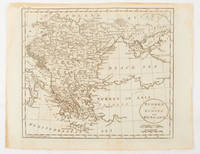
Turkey in Europe and Hungary.
Philadelphia.: Carey Mathew and Warner Benjamin. 1816. Engraved map 19 x 22.3 cm original folds some offsetting to the map marginal browning and staining small archival repairs to the outer margin but in good condition. Fine map Plate 19 prepared for Carey and Benjamin's "General Atlas.". . (Carey, Mathew and Warner, Benjamin). unknown
书商的参考编号 : 175252
|
|
|
[OTTOMAN IJAZA MANUSCRIPT].
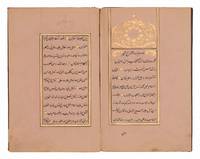
An Ottoman Qur'an Recitation Certificate in Arabic.
Ottoman Empire: Signed Hajj Isma'il Haqi Ibn Mohammed Islamboli first Imam of Sultan Selim Mosque and head of shiekh reciters and dated the fourteenth of Jumada al-Akhirah in the year one thousand two hundred and ninety-four of hijra 1294 AH 1877 AD. Arabic manuscript of 9 leaves of pink polished paper plus 3 blank leaves at the end 11 lines of neat black naskh per page text framed within gilt borders gold roundel verse markers with catchwords decorative endpapers first leaf decorated with illuminated headpiece comprised of saz-style floral sprays and three different varieties of flowers including roses and tulips final leaf likewise decorated with gilt ornamentation and with round stamp of the 'Chief of the Sheikhs of Qur'an Reciters Sayyid Ismail'. Housed in contemporary purple morocco binding with prominent gilt filets to sides. Folio: 18.2 cm. Text Panel: 11.5 x 6.3 cm. Some light rubbing to exterior outer margins with some light wrinkling toning and a few nicks generally a very good example in a handsome leather binding. In the Ottoman tradition a Qur'an school certificate is known as an Ijaza. It is a formal license granted by a teacher to a student certifying that they have mastered the recitation or memorisation of the Qur'an and are now qualified to transmit that knowledge to others. These were prestigious manuscripts granted to students who had mastered the components of Qur'anic sciences such as recitation 'Tajwid' and memorisation 'Hifz' and often include as here a chain of transmission 'Sanad' listing the pupil's teachers. Ottoman Empire: Signed Hajj Isma'il Haqi Ibn Mohammed Islamboli first Imam of Sultan Selim Mosque and head of shiekh reciters, a hardcover
书商的参考编号 : 65596
|
|
|
[OTTOMAN JUDGE, "Ed-dai maa'ldem Sadi].
SLAVERY / THE OTTOMAN EMPIRE A law manuscript in Ottoman Turkish including the case on slavery.
Edirne Adrianople: Manuscript Edirne Adrianople fî 11 Rebiü'levvel sene AH 1321 = 7 June 1903 1903. No Binding. Very Good. Folio - over 12 - 15" tall. Highly uncommon and exceedingly rare law manuscript documenting the slavery continued during the last period of the Ottoman Empire at the beginning of the 20th century recording the dispute between the defendant and the plaintiff in Edirne on June 7 1903. The document recorded and certified by the Ottoman judge of the time contains the records of a lawsuit between the plaintiff Ahmed Efendi Ibn Salih and the defendant Süleyman Aga Ibn Fülan in the Fülan neighbourhood of the city of Edirne. The document includes the petition and ruling regarding the case in which the plaintiff demands that Süleyman Aga pay 500 kurus for a mule purchased by his "Abd-i Mecrûh" a slave without the right to engage in trade. The judge of Edirne at the time ruled in favor of the defendant Süleyman Aga on the grounds that a slave classified as "Abd-i Mecrûh" was not legally permitted to engage in trade and therefore the owner could not be held responsible for the transaction. The ruling stated: "taleb ser'an iltifâta sayan olmayin ser'i muarizdan menine ilâm" i.e. The request is not legally admissible and the claim is dismissed according to Sharia law. By the early 20th century slavery in the Ottoman Empire was in significant decline due to legal reforms and international pressure. The empire had a long history of slavery particularly involving African and Circassian slaves but efforts to abolish it gained momentum in the 19th century. Empire formally abolished the slave trade in the mid-19th century under British pressure issuing decrees in 1847 banning the trade of Circassian women and 1857 outlawing the African slave trade. However enforcement was inconsistent. The final legal abolition of slavery came in 1909 under the Young Turk government with 1909 Decree formally ending the practice. Despite legal bans domestic slavery especially of women in harems and household service persisted informally into the early 20th century particularly in remote areas. With the collapse of the Ottoman Empire after World War I and the founding of the Republic of Turkey in 1923 slavery was completely eradicated under the new legal system. In the Ottoman Empire hüccet ujjat was a legally binding document issued by a kadi Islamic judge to certify and record various legal matters such as contracts property transactions debts inheritance claims and disputes. Serving as official proof of a legal act or decision hüccets were widely used as evidence in court to confirm rights and obligations. These documents followed a formal structure detailing the parties involved the legal matter at hand the judge's ruling and in some cases witness testimonies. They played a crucial role in the Ottoman legal system by ensuring the documentation and enforcement of civil and commercial laws making them essential records of legal and social history. <br/> <br/> Manuscript, Edirne [Adrianople], fî 11 Rebiü'levvel sene [AH] [1]321 = [7 June 1903] unknown
书商的参考编号 : 055899
|
|
|
[OTTOMAN MANUSCRIPT - COMMERCIAL LETTER - MEDICINE].
[MEDICAL EQUIPMENTS] A manuscript commercial request and statement letter on the medical equipments like "Chloral Chlorine, narcosis and ether" by G. Dilman (Founded in 1865 [1281 AH]).
Very Good Turkish, Ottoman (1500-1928) Original manuscript commercial letter. 29x21 cm. In Ottoman script. 1 p. Folded. "G. Dilman" letterhead. 1281 [1865] Sultanhamam'da tesis tarihli Osmanlica el yazmasi tibbî malzemeler G. Dilman firmasi antetli istirham ve beyân mektubu: Kloral Klor ve Narkoz için eter vb. Stamped, signed and sealed. Early Ottoman / Turkish medicine and medical equipments. Dated 1927.
|
|
|
[OTTOMAN MANUSCRIPT - LAW DOCUMENT].
[DARENDE - MALATYA / OTTOMAN NOTABLES - ESTABLISHED FAMILIES: YÜZBASIZÂDELER] 1928 A manuscript hujjet [i.e. Early Ottoman law document], stamped and sealed.
Very Good Turkish, Ottoman (1500-1928) Original manuscript law document. 21x11 cm. In Ottoman script. 1 p. "Yüzbasizâde" family is one of the rooted Turcoman families probably descendant from before the Ottomans. Sealed by Yüzbasizâde Vahab, Yüzbasizâde Ayse Hanim, and Yüzbasizâde Bekir Efendi oglu Osman. Annotated and sealed on the bottom side by a person named 'Mustafa Hakki'. "Darende Mahallesinde kâin malûmü'l-hudûd bir kita' hanemizi Eylül (?) itibâren bir senelik banknot para ikiyüz dört liraya Malatya . ihbara verilmesi ve ihbara (?) olan yüz iki lirayi mümaileyhten ahz ve. edildigini mübeyyin isbû senedin mümaileyhe.". Postal stamp. Dated [1]928. 15 lines apprx. It starts with 'Huve'. Ottoman / Turkish law terminology.
|
|
|
[OTTOMAN MANUSCRIPT - LAW DOCUMENT].
[MURDER AND SUSPECT IN KADIKÖY - ACQUITTAL REPORT] Manuscript acquittal law document: The verdict of acquittal of Aramyan Uncuyan School history teacher, stamped by Kadiköy Aga Mahallesi Association in 1340 AH [1924 AD].
Very Good Turkish, Ottoman (1500-1928) Original handwritten document. 21x17 cm. In Ottoman script. 1342 [1926]. "Mahallemizin [i.e. Aga Mh.] Yumurtaci Abdi(?) Bey Caddesinde 159 numerolu hanede sakin Aramyan Uncuyan mektebi tarih muallimi esbâki ihbâren Deniz Mektebi'ne nakil edilen Ahmed Edib Bey'e mahallemizde ikâmetleri müddetince bir gûnâlik hali görülmedigi ve kendisi ashâb-i namus ve istikâmetden oldugu cinâyet vechince (?) husûs-i umûmîyle (?) mahkûmiyeti olmadigi ve [.] muhâlife bir gûnâ hareketi görülmedigi hey'etimizce malûm bulundugumuz mübeyyin ilmühaberidir.". Sealed by members of the court. [MURDER AND SUSPECT IN KADIKÖY - ACQUITTAL REPORT] Manuscript acquittal law document: The verdict of acquittal of Aramyan Uncuyan School history teacher, stamped by Kadiköy Aga Mahallesi Association in 1340 AH [1924 AD].
|
|
|
[OTTOMAN MANUSCRIPT - LAW DOCUMENT].
[OTTOMAN NOTABLES - ESTABLISHED FAMILIES / ILMÜHABER] Manuscript law document for Ibn Hüseyin of "Kastamonu Topçuönü Mahallesi" in 1318 Rûmî [1900 AD].
Very Good Turkish, Ottoman (1500-1928) Original manuscript law document. 23x10 cm. In Ottoman script. 1 p. It starts with "Bâd ilmühaber oldur ki". [ILMÜHABER] Manuscript law document for Ibn Hüseyin of "Kastamonu Topçuönü Mahallesi" in 1318 Roûmî [1900 AD]. Stamped and sealed.
|
|
|
[OTTOMAN MANUSCRIPT - LAW DOCUMENT].
[OTTOMAN NOTABLES - ESTABLISHED FAMILIES / ILMÜHABER] Manuscript law document for Ibn Hüseyin of "Kastamonu Topçuönü Mahallesi" in 1318 Rûmî [1900 AD], Sealed "Kastamonu".
Very Good Turkish, Ottoman (1500-1928) Original manuscript law document. 23,5x13,5 cm. In Ottoman script. 1 p. It starts with "Bâd ilmühabber oldur ki". [ILMÜHABER] Manuscript law document for Ibn Hüseyin of "Kastamonu Topçuönü Mahallesi" in 1318 Rûmî [1900 AD], Sealed "Kastamonu".
|
|
|
[OTTOMAN MANUSCRIPT - LAW DOCUMENT].
[OTTOMAN NOTABLES - ESTABLISHED FAMILIES / NUKÛD-I MEVKÛFE] A manuscript law document on Haci Göcekzâde Hakki Efendi's debt in [1311 AH] 1895 AD; Sealed "Re'is-i nükûd-i mevkûfe Vehbi".
Very Good Turkish, Ottoman (1500-1928) Original manuscript handwritten law document. 21x17 cm. In Ottoman script. 1 p. 3 lines. [NUKÛD-I MEVKÛFE] A manuscript law document on Haci Göcekzâde Hakki Efendi's debt in [1311 AH] 1895 AD; Sealed "Re'is-i nükûd-i mevkûfe Vehbi".
|
|
|
[OTTOMAN MANUSCRIPT - LAW DOCUMENT].
Mahkeme-i Gördes: A manuscript law document stamped and signed by Hayreddin bin Ebubekir, sent to Gördes-Manisa courtyard from Scutari courtyard in 1329 [1913].
Very Good Turkish, Ottoman (1500-1928) Original manuscript historical law document. 34x21,5 cm. In Ottoman script. 1 p. Sent from "Reis-i sani" of Gördes courtyard to "Refetlü Hasan Efendi". Mahkeme-i Gördes: A manuscript document stamped and signed by Hayreddin bin Ebubekir, sent to Gördes - Manisa courtyard from Scutari courtyard in 1329 [1913].
|
|
|
[OTTOMAN MANUSCRIPT - OTTOMAN SYRIA - OTTOMAN LEBANON].
[OTTOMAN SYRIA - BEYRUT] [1342] February 14, 1924 A manuscript document in Arabic: From Ottoman 'mufti' in Safed to "Yüksek Islâm Meclisi Riyâseti" [i.e. The Supreme Islamic Council Presidency], on an unpaid amount of foundation deed (with 3 stamps of HJZ 'Hijaz Railways' and OPDA 'Ottoman Public Debt Administration').
Very Good Turkish, Ottoman (1500-1928) Original manuscript document sent to the Ottoman court with postal stamps "OPDA" (Ottoman Public Debt Administration) [= Osmanli Kamu Borç Idaresi] ve "HJZ" (Hejaz Railway) [= Hicaz Demiryollari]. 28x21,5 cm. In Arabic. 1 p. 11 lines. On a paper with Grifon and "W" initial and "Original" watermarks. Paper probably from a British paper manufacturer produced the paper for the Middle Eastern market. It starts with "Yüksek Islâm Meclisi Re'isi Âlîsi'ne". There is talk of a deal made by the Safed mufti and the person concerned - stating that he has been waiting for two years for an unpaid amount after an agreement with a certain amount of Egyptian junaihs, Safed mufti demands that the rest of the money. Sayyidî, who states that he is getting older and that the money must be kept in order to be able to do the title deeds from the foundations, says that otherwise the title deed procedures will not be completed. Signed by Safed mufti named Seyyidî. On the bottom, signed by/as "Reisü'l Camiü'l Islâmiü'l Âlî, Mehmed (or, Muhammed) Sehvî]. "Safed is a city in the Northern District of Israel. Located at an elevation of 900 meters (2,953 ft), Safed is the highest city in the Galilee and in Israel. Safed has been identified with Sepph, a fortified town in the Upper Galilee mentioned in the writings of the Roman Jewish historian Josephus. The Jerusalem Talmud mentions it as one of five elevated spots where fires were lit to announce the New Moon and festivals during the Second Temple period. Safed attained local prominence under the Crusaders, who built a large fortress there in 1168. It was conquered by Saladin 20 years later, and demolished by his grandnephew al-Mu'azzam Isa in 1219. After reverting to the Crusaders in a treaty in 1240, a larger fortress was erected, which was expanded and reinforced in 1268 by the Mamluk sultan Baybars, who developed Safed into a major town and the capital of a new province spanning the Galilee. After a century of general decline, the stability brought by the Ottoman conquest in 1517 ushered in nearly a century of growth and prosperity in Safed, during which time Jewish immigrants from across Europe developed the city into a center for wool and textile production and the mystical Kabbalah movement. It became known as one of the Four Holy Cities of Judaism. As the capital of the Safad Sanjak, it was the main population center of the Galilee, with large Muslim and Jewish communities.".
|
|
|
[OTTOMAN MANUSCRIPT - WAQFS - LAW DOCUMENT].
[OTTOMAN NOTABLES - ESTABLISHED FAMILIES / NUKÛD-I MEVKÛFE / ILMÜHABER] A manuscript law document on Haci Göcekzâde Hakki Efendi's debt in [1312 AH] 1896 AD; Sealed "Es-Seyyid Abdülkadir Hâlimî".
Very Good Turkish, Ottoman (1500-1928) Original manuscript law document. 21x14,5 cm. In Ottoman script. 2 p. "Üçyüz oniki senesi Cemâziyelevvelinin gurresinden itibâren bir senelik. Haci Göcekzâde Hakki Efendi". Annotation on verso: "Mâlûmâtimiz dairesinde verilmistir., [1]311 [1895]". Co-sealed by "Nükûd-i Mevkûfe bânisi" of Kastamonu, Bolu Sanjak. [OTTOMAN NOTABLES / NUKÛD-I MEVKÛFE / ILMÜHABER] A manuscript law document on Haci Göcekzâde Hakki Efendi's debt in [1312 AH] 1896 AD; Sealed "Es-Seyyid Abdülkadir Hâlimî".
|
|
|
[OTTOMAN MANUSCRIPT DOCUMENT - ARMENIAN MINORITY].
[ARMENIAN MINORITY] A manuscript law petition on the seizure of Tüfekçioglu Kirkor b. Agop's daughter's house sent to Mutasarrifate of Amasya Sanjak in 1339 AH [1923 AD].
Very Good Turkish, Ottoman (1500-1928) Original handwritten law document. 8vo. In Ottoman script. 2 p. Stamped, signed. Several confirmation annotations and signatures. [ARMENIAN MINORITY] A manuscript law petition on the seizure of Tüfekçioglu Kirkor b. Agop's daughter's house sent to Mutasarrifate of Amasya Sanjak in 1339 AH [1923 AD].
|
|
|
[OTTOMAN NAVAL FORCES COMMISSION OF ENGINES].
OTTOMAN NAVAL FORCES / PAMPHLET FOR THE LIQUID FUEL Yag-i mâyi' mahrûkâti ve tertîbâti. i.e. Liquid oil fuel and its assembly. Translated into Ottoman Turkish by Bahriye Nezâreti Çarhçi sic. Çarkçi Komisyonu.
Istanbul: Matbaa-yi Bahriyye. AH 1328 1912. 1st Edition . Soft cover. Very Good. 8vo - over 7¾ - 9¾" tall. Paperback in original wrappers. Demy 8vo. 21 x 14 cm. In Ottoman script Turkish with Arabic letters. 16 p. Rear cover is missing. This pamphlet mostly prepared in the form of questions and answers describes the technical infrastructure required for the use of liquid oil fuel in warships. It was prepared for officers studying at the navy schools of the Imperial Ottoman in the early 20th century. On the cover it's indicated to be translated by the Ottoman Naval Forces Commission of Engines but no information on which source to be used to translate it. It's printed after the Second Constitutional Regime in 1908 and Tripoli War in 1911 probably during the Balkan Wars 1912-1913. Following the Young Turk Revolution in 1908 the Committee of Union and Progress which effectively took control of the country sought to develop a strong Ottoman naval force. The poor condition of the fleet became evident during the Ottoman Naval Parade of 1910 and the Ottoman Navy Foundation was established in order to purchase new ships through public donations. Those who made donations received different types of medals according to the size of their contributions. In 1910 the Ottoman Navy purchased two pre-dreadnought battleships from Germany: SMS Weissenburg and her sister ship SMS Kurfürst Friedrich Wilhelm. These ships were renamed Turgut Reis and Barbaros Hayreddin respectively. The Italo-Turkish War of 1911-1912 and the Balkan Wars of 1912-1913 proved disastrous for the Ottoman Empire. In the former the Italians occupied Ottoman Tripolitania present-day Libya and the Dodecanese Islands in the Aegean Sea and the Regia Marina defeated Ottoman light naval forces in the battles of Preveza Beirut and Kunfuda Bay. In the latter a smaller Greek fleet successfully engaged with Ottoman battleships in the naval skirmishes of Elli and Lemnos. The better condition of the Greek fleet in the Aegean Sea during the Balkan Wars led to the liberation of all Ottoman-held Aegean islands other than those in the Italian-occupied Dodecanese. It also prevented Ottoman reinforcements and supplies to the land battles on the Balkan peninsula where the Balkan League emerged victoriously. The only Ottoman naval successes during the Balkan Wars were the raiding actions of the light cruiser Hamidiye under the command of Rauf Orbay. For this reason the Naval Ministry on the one hand tried to train a large number of sailor officers by printing technical booklets like this in order to close the gap. Faded on the cover chipped on extremities and spine. Otherwise a good and rare copy. Not in Özege.; Only one copy in OCLC: 949520567 Bogaziçi Uni. Library. <br/> <br/> Matbaa-yi Bahriyye., [AH 1328] paperback
书商的参考编号 : 053689
|
|
|
[OTTOMAN NAVAL FORCES COMMISSION OF ENGINES].
[OTTOMAN NAVAL FORCES / PAMPHLET FOR THE LIQUID FUEL] Yag-i mâyi' mahrûkâti ve tertîbâti. [i.e. Liquid oil fuel and its assembly]. Translated into Ottoman Turkish by Bahriye Nezâreti Çarhçi [sic. Çarkçi] Komisyonu.
Very Good Turkish, Ottoman (1500-1928) Paperback in original wrappers. Demy 8vo. (21 x 14 cm). In Ottoman script (Turkish with Arabic letters). 16 p. This pamphlet, mostly prepared in the form of questions and answers, describes the technical infrastructure required for the use of liquid oil fuel in warships. It was prepared for officers studying at the navy schools of the Imperial Ottoman in the early 20th century. On the cover, it's indicated to be translated by the Ottoman Naval Forces Commission of Engines, but, no information on which source to be used to translate it. It's printed after the Second Constitutional Regime in 1908, and Tripoli War in 1911, probably during the Balkan Wars, (1912-1913). Following the Young Turk Revolution in 1908, the Committee of Union and Progress which effectively took control of the country sought to develop a strong Ottoman naval force. The poor condition of the fleet became evident during the Ottoman Naval Parade of 1910, and the Ottoman Navy Foundation was established in order to purchase new ships through public donations. Those who made donations received different types of medals according to the size of their contributions. In 1910, the Ottoman Navy purchased two pre-dreadnought battleships from Germany: SMS Weissenburg and her sister ship SMS Kurfürst Friedrich Wilhelm. These ships were renamed Turgut Reis and Barbaros Hayreddin, respectively. The Italo-Turkish War of 1911-1912 and the Balkan Wars of 1912-1913 proved disastrous for the Ottoman Empire. In the former, the Italians occupied Ottoman Tripolitania (present-day Libya) and the Dodecanese Islands in the Aegean Sea and the Regia Marina defeated Ottoman light naval forces in the battles of Preveza, Beirut, and Kunfuda Bay. In the latter, a smaller Greek fleet successfully engaged with Ottoman battleships in the naval skirmishes of Elli and Lemnos. The better condition of the Greek fleet in the Aegean Sea during the Balkan Wars led to the liberation of all Ottoman-held Aegean islands other than those in the Italian-occupied Dodecanese. It also prevented Ottoman reinforcements and supplies to the land battles on the Balkan peninsula, where the Balkan League emerged victoriously. The only Ottoman naval successes during the Balkan Wars were the raiding actions of the light cruiser Hamidiye under the command of Rauf Orbay. For this reason, the Naval Ministry, on the one hand, tried to train a large number of sailor officers by printing technical booklets like this in order to close the gap. Faded on the cover, chipped on extremities and spine. Otherwise a good and rare copy. Not in Özege.; Only one copy in OCLC: 949520567 (Bogaziçi Uni. Library).
|
|
|

 ?????????
 ?????PDF???
 RSS feed
 ??
??


