|
|
|
MEHMED SALIH HUSNU BEY, (Turkish / Ottoman lieutenant and son-in-law of Damad Mehmed Serif Pasha).
Photograph of Mehmed Salih Hüsnü. Press photo by Dupuy & Cie.
Paris: Press photo by Dupuy & Cie. 1914. Soft cover. Very Good. Original b/w press photograph of Mehmed Salih Hüsnü Pasha who was Turkish / Ottoman lieutenant and son-in-law of Damad Mehmed Serif Pasha. He lived in Egypt and he's known with his contacts with the Kurdish committee in Alexandria and also personally closing to Arif Pasha. 155 x 115 cm. Text in French on verso. Stamps of photographer and 'Miroir' Newspaper Archives. <br/> <br/> Press photo by Dupuy & Cie. paperback
Referentie van de boekhandelaar : 050889
|
|
|
MEHMED SALIH HÜSNÜ BEY, (Turkish / Ottoman lieutenant and son-in-law of Damad Mehmed Serif Pasha).
[Photograph of Mehmed Salih Hüsnü]. Press photo by Dupuy & Cie.
Very Good French Original b/w press photograph of Mehmed Salih Hüsnü Pasha who was Turkish / Ottoman lieutenant and son-in-law of Damad Mehmed Serif Pasha. He lived in Egypt and he's known with his contacts with the Kurdish committee in Alexandria and also personally closing to Arif Pasha. 15,5 x 11,5 cm. Text in French on verso. Stamps of photographer and 'Miroir' Newspaper Archives.
|
|
|
MEHMED SEKER.
Selçuk Isâ Bey Câmii. Calligrapher: Hasan Özbilen Engin.
Very Good English Paperback. Pbo. Cr. 8vo. (19 x 13.5 cm). B/w ills. 40 p. Selçuk Isa Bey Mosque. Selçuk Isâ Bey Câmii. Calligrapher: Hasan Özbilen Engin. First Edition.
|
|
|
MEHMED SEMSEDDIN PASHA, (Ottoman statesman, Circassian origin, descended from Tletseruk family), (1855-1917).
Autograph document sealed 'Nazir-i Evkâf-i Humâyûn Mehmed Semseddin'.
Istanbul: Manuscript - Autograph letter. fî 3 Subat sene 1324 1908 1908. Soft cover. Very Good. 4to - over 9¾ - 12" tall. Original autograph letter handwritten signed by Mehmed Semseddin Pasha addressed to 'Kütahya Evkâf-i Humâyûn' i.e. Kütahya Imperial Foundations. It starts with 'Huve' traditionally. 29x21 cm. In Ottoman script. Letterhead 'Nezâret-i Evkâf-i Humâyûn' i.e. Ministry of foundations. 1 p. including eight lines with additional annotation. Mehmed Semseddin was an Ottoman / Turkish statesman with Circassin Adige - Shapsig origin descended from Tletseruk or Tleseruk family. Mehmed Semseddin Pasha was the son of Hacizade Osman Bey who was a Circassian chieftain. In 1864 his family emigrated to Samsun and then to Istanbul in the Great Immigration of Circassians. He was graduated from Galatasaray High School. He was also groom of Egypt Extraordinary Commissioner Circassian Rauf Pasha a member of the Society Circassian Charity Çerkes Teavun -Yardim- Cemiyeti the manager and author of Guaze newspaper published in Turkey which was first published journal in Latin letters in Turkey. <br/> <br/> Manuscript - Autograph letter., [fî 3 Subat sene [1]324 [1908]] paperback
Referentie van de boekhandelaar : 051592
|
|
|
MEHMED SEVKI EFENDI, (1829-1887).
The thuluth & naskh mashqs by Mehmed Shawki.= Amshaq al-khattat Muhammad Shawqi fi'l-thuluth wa'l-naskh.= Mehmed Sevki Efendi'nin sülüs-nesih hat meskleri. Prep. by Muhammad Tamimi.
New English Paperback. Oblong 4to. (21 x 30 cm). In English, Turkish, and Arabic. [23] p. text, 27 color plates. The thuluth & naskh mashqs by Mehmed Shawki.= Amshaq al-khattat Muhammad Shawqi fi'l-thuluth wa'l-naskh.= Mehmed Sevki Efendi'nin sülüs-nesih hat meskleri. The exercise book prepared by Turkish / Ottoman calligrapher Mehmed Sevki Efendi, (1829-1887) for the thuluth and naskh calligraphic:a useful tool for those who wish to upgrade their sfcij This publication will be followed by exercise book other styles of calligraphy.
|
|
|
MEHMED SEVKI EFENDI, (Ottoman calligrapher), (1829-1887).
Yâsin sûresi [= Surat Yasin]. Calligraphy: Mehmed Sevkî Efendi (1829-1887). Illumination: Fatma Özçay.
New English Original bdg. with traditional semse (mystic Islamic sun) figure in Ottoman style. 12mo. (17 x 12 cm). [16] p. 2000 copies were printed. Yâsin sûresi [=Surat Yasin]. Calligraphy: Mehmed Sevkî Efendi (1829-1887). Illumination: Fatma Özçay. This chapter wa taken from a prayer album (awrâd) dated 1295/1878 and copied by Seyyid Yahya al-Shirwânî in the collection of Zeki Cemal Özen, and is being published separately. Second Edition.
|
|
|
MEHMED SITKI ÇUBUKÇUZADE.
Oglumun defteri. Kurtulus günleri.
Very Good English Paperback. Pbo. Cr. 8vo. (19 x 13 cm). In Ottoman script. 48 p. Hegira 1338 = Roumi 1341 = Gregorian 1923. Özege 15641. First and Only Edition. Oglumun defteri. Kurtulus günleri.
|
|
|
MEHMED SÜREYA.
Eski yazidan yeni yaziya sicill-i Osmanî. Osmanli ünlüleri. [6 volumes set]. Edited by Nuri Akbayar. Translator into modern Turkish: Seyit Ali Kahraman.
As New English Paperback. Pbo. Mint. Cr. 8vo. 6 volumes set: 6 volumes (xiii, 338 p.; iii, 339 - 684 p.; iii, 685 - 1030 p.; iii, 1031 - 1376 p.; iii, 1377 - 1721 p.; iii, 1723 - 2068 p.). Biographies of Ottoman famous authors, histprians, musicians, artists, painters etc. Very precious reference. Eski yazidan yeni yaziya sicill-i Osmanî. Osmanli ünlüleri. [6 volumes set]. Edited by Nuri Akbayar. Translator into modern Turkish: Seyit Ali Kahraman.
|
|
|
MEHMED TAHIR (Bursali).; AHMED REMZI [AKYÜREK].
Osmanli müellifleri. 3 volumes set. + Miftahü'l-kütüb ve esami-i müellifîn fihristi (Osmanli müellifleri için).
Very Good Turkish In aesthetics full leather modern bdg. in Ottoman traditional style. Small 4to. (2 9x 18 cm). / Roy. 8vo. (25 x 17 cm). In Ottoman script. 4 volumes (406, 2, [5], [7] p.; 192, [5] p.; 193-510 pp. / 177 p.). Hegira 1333; 1338 / 1346 = Gregorian 1915; 1924 /1928. Özege 15956 (for Set of Bursali) / 13534 (for Akyürek's index). Osmanli müellifleri. 3 volumes set. + Miftahü'l-kütüb ve esami-i müellifîn fihristi (Osmanli müellifleri için). First Edition. Extremely rare as full set.
|
|
|
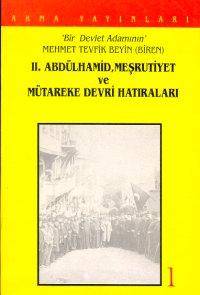
MEHMED TEVFIK BEY [BIREN], (Ottoman / Turkish governor, minister and last chief of the Council of the State), (1867-1956).
II. Abdülhamid Mesrutiyet ve Mütareke devri hatiralari. 2 volumes set. Prep. by F. Rezan Hürmen.
Istanbul: Arba Yayinlari 1993. Soft cover. Very Good. 8vo - over 7¾ - 9¾" tall. Paperback. Cr. 8vo. 20 x 14 cm. In Turkish. 2 volumes set: 1048 p. ills. II. Abdülhamid Mesrutiyet ve Mütareke devri hatiralari. 2 volumes set. Prep. By F. Rezan Hürmen. Memoirs of a Turkish / Ottomaan statesman in the period of Abdülhamit II Second Constitution and the Truce. <br/> <br/> Arba Yayinlari paperback
Referentie van de boekhandelaar : 047899 ISBN : 975391007x 9789753910071
|
|
|
MEHMED TEVFIK BEY [BIREN], (Ottoman / Turkish governor, minister and last chief of the Council of the State), (1867-1956).
THE LAST OTTOMAN CHIEF OF THE STATE COUNCIL Autograph document signed 'Sûrâ-yi Devlet reisi Tevfik'.
Istanbul: Manuscript - Autograph letter / Letterhead 'Sura-yi Devlet'. H.: 1338 1922. Soft cover. Very Good. 4to - over 9¾ - 12" tall. Original manuscript autograph document signed by Mehmed Tevfik Biren. 335x20 cm. Folded. 1 p. In Ottoman script. Dated 25 Saban 1338 AH. Letterhead of 'Sûrâ-yi Devlet' addressed to 'Bâb-i Âlî Teshilât Sandigi Komisyonu'. Biren served as a high-ranking statesman such as the Minister and the Governor in the last period of the Ottoman Empire. Also he was last chief of the council of the state i.e. Shûrâ al-Devlet. Mehmet Tevfik Bey was born in 1867 in Istanbul. His father was a high-ranking statesman in the Ministry of Education. After graduating from Mekteb-i Mulkiye in 1885 at the age of 18 he started his first duty as the clerk of Abdulhamid II at Yildiz Palace. From 1897 to 1901 he served as the Governor of Jerusalem. After that he was appointed as the Governor of Thessaloniki. He was the governor of Yemen between 1904-1905. He became the Minister of Finance in the last years of the Ottoman Empire. He participated in the negotiations of the Treaty of Sevres signed in 1920. He was last appointed on 19 August 1921 as the 'Sûrâ re'isi'. He continued this duty until the abolition of the Sultanate on 4 November 1922. Thus he was the last 'al-Shura' of the Ottoman Empire. After the proclamation of the Republic he left the state. Wikipedia. <br/> <br/> Manuscript - Autograph letter / Letterhead 'Sura-yi Devlet'., [H.: 1338] paperback
Referentie van de boekhandelaar : 052114
|
|
|
MEHMED TEVFIK BEY [BIREN], (Ottoman / Turkish governor, minister and last chief of the Council of the State), (1867-1956).
[THE LAST OTTOMAN CHIEF OF THE STATE COUNCIL] Autograph document signed 'Sûrâ-yi Devlet reisi Tevfik'.
Very Good Turkish, Ottoman (1500-1928) Original manuscript autograph document signed by Mehmed Tevfik Biren. 33,5x20 cm. Folded. 1 p. In Ottoman script. Dated 25 Saban [1]338 [AH]. Letterhead of 'Sûrâ-yi Devlet' addressed to 'Bâb-i Âlî Teshilât Sandigi Komisyonu'. Biren served as a high-ranking statesman such as the Minister and the Governor in the last period of the Ottoman Empire. Also he was last chief of the council of the state [i.e. Shûrâ al-Devlet]. Mehmet Tevfik Bey was born in 1867 in Istanbul. His father was a high-ranking statesman in the Ministry of Education. After graduating from Mekteb-i Mulkiye in 1885, at the age of 18, he started his first duty as the clerk of Abdulhamid II at Yildiz Palace. From 1897 to 1901 he served as the Governor of Jerusalem. After that he was appointed as the Governor of Thessaloniki. He was the governor of Yemen between 1904-1905. He became the Minister of Finance in the last years of the Ottoman Empire. He participated in the negotiations of the Treaty of Sevres signed in 1920. He was last appointed on 19 August 1921 as the 'Sûrâ re'isi'. He continued this duty until the abolition of the Sultanate on 4 November 1922. Thus, he was the last 'al-Shura' of the Ottoman Empire. After the proclamation of the Republic, he left the state. (Wikipedia).
|
|
|
MEHMED TEVFIK BEY [BIREN], (Ottoman / Turkish governor, minister and last chief of the Council of the State), (1867-1956).
II. Abdülhamid, Mesrutiyet ve Mütareke devri hatiralari. 2 volumes set. Prep. by F. Rezan Hürmen.
Very Good Turkish Paperback. Cr. 8vo. (20 x 14 cm). In Turkish., 2 volumes set: (1048 p.), ills. II. Abdülhamid, Mesrutiyet ve Mütareke devri hatiralari. 2 volumes set. Prep. By F. Rezan Hürmen. Memoirs of a Turkish / Ottomaan statesman in the period of Abdülhamit II, Second Constitution and the Truce.
|
|
|
MEHMED TEVFIK, (Ottoman / Turkish hafiz), (Active between 1875-1955).
[AUTOGRAPH MANUSCRIPT MEMOIRS of a TURKISH 'HAFIZ'] Târihçe-i hayâtim.
Very Good Turkish, Ottoman (1500-1928) Original wrappers. Slightly split on margins. Otherwise a very good copy. Cr. 8vo. (20 x 14,5 cm). In Ottoman script. 212 p. It's written with a legible hand script. Mehmed Tevfik was a 'Hafiz'. Hafiz is a term used by Muslims for someone who has completely memorized the Quran. His name is not figured out in the literature. Manuscript starts with that he describes to started of neighborhood school in Tosya, Kastamonu and his first teacher Ismail Efendi. We learned that his father was professor in Abdurrezzak Madrasa in Tosya which was first and only madrasa in Tosya. After that he mentions his brother Ali, his primary school was in Çankiri. He describes their family journeys from Çankiri to Tosya in a very bright style which was a day and night and eventful journey. They crossed Devrez Baglari by a horse carriage. He gave some examples from Tosya (Kastamonu) local dialect like 'Kadinine' to 'Nine' [i.e. Grandmother]. He cited in very detail that his father's hajj and Hejaz journey with his grandfather. After that he talked about his first special lessons from a hafiz in 1309 [Hegira]. After two years of that, he started to High School in September of 1311 [Hegira]. His daughter's birth (Fatma Hayriye) and he traveled to Istanbul. He describes his military memoirs in Istanbul and when he saw who cursed to Sultan (Abdulhamid II) he was very surprised. After that confusions and difficulties in the last period of the Ottoman Empire, press in the Ottoman Empire, political events, murders and crimes in Istanbul city was told by Tevfik. All kind of events, according to him, a betrayal to the empire and Islamic culture. Based on his memoirs, he was a conservative person. A fine manuscript is not only describing which is an autobiography as well, showing a person who has passion to be an Islamic scholar, but also reflecting thoughts of an anti-revolutionary and the last period of the Ottoman Empire besides events in Istanbul city which was heart of an empire. It's unpublished. Extremely rare.
|
|
|
MEHMED ZIHNI EFENDI, (1845-1913).
Mesâhirü'n-nisâ. Vol. 1.
Very Good Turkish, Ottoman (1500-1928) Contemporary 1/4 black leather bdg. Demy 8vo. (22 x 14 cm). In Ottoman script. 371 p. Mesâhirü'n-nisâ. Vol. 1. Biographies of women from Islamic and Turkish world. "Mesahiru'n Nisa" Mehmed Zihni Efendi's is one of the most important works in the tradition of Islamic historiography. Within this tradition, a partial examination has been carried out on books written on social classes to determine on how much emphasis has been given on the "type and number" of women. The most important difference that separates "Mesahiru'n-Nisa" from previous traditional books on social classes is the reason it was written. The author wrote his work at the request of "Maarif Nezareti" ( Ministry of Education) to be read to young girl students at "Darulmuallimat" at that time. Zihni Efendi portrayed a "model Muslim woman profile" in his study. Within this framework, the author tried to realize three aims: Women who have become noted in different artistic, social, scientific and occupational areas not because of their gender but because they provide as an example with what they have done to young girl students. On the other hand, the moral side of a woman was given importance and very many moral women introduced in their various aspects were given as an example of their eminent personalities. In particular, emphasis was given on being a "good wife" and a "good mother.". (Source: Sükriye Akgül: The Mesahiru'n-Nisa (Successful Women) Tradition in Islamic Historiography and the Examination of Mehmed Zihni Efendi's Work on Mesahiru'n Nisa). First Edition. Vol. 1 of 2. Özege . OCLC: 756462292.
|
|
|
MEHMED ÂRIF BEY.
Hadisleri anlamada toplumsal boyut; Son dönem Osmanli toplumu ve Ilmiye sinifina yönelik elestiriler. Translated by Ibrahim Hatiboglu.
Fine English Paperback., Fine., 20 x 14 cm., 219 p., "Hadisleri anlamada toplumsal boyut; Son dönem Osmanli toplumu ve Ilmiye sinifina yönelik elestiriler.", Mehmed Ârif Bey, Darülhadis, Ist., 2000.
|
|
|
MEHMED ÂTIF.
Kasgar tarihi. Bâis-i hayret ahvâl-i garibesi.
Fine English Paperback. Pbo. Roy. 8vo. (24 x 17 cm). In Turkish. [viii], [v], 379 p. Kasgar tarihi. Bâis-i hayret ahvâl-i garibesi. History of Kashgar.
|
|
|
MEHMED ÇAVUSOGLU.
Bâki ve divânindan örnekler.
Fine English Paperback. Roy. 8vo. (23 x 16 cm). In Turkish. 157 p. Bâki ve divânindan örnekler. TURKISH LITERATURE Classical Ottoman & Turkish literature Divan poetry Baki Poet Traditional literature 15th century Biography.
|
|
|
MEHMED ÇAVUSOGLU.
Necati Bey Divani'nin tahlili.
Fine English Paperback., Fine., 23 x 16 cm., 304 p., "Necati Bey Divani'nin tahlili.", Mehmed Çavusoglu, Kitabevi, Ist., 2001.
|
|
|
MEHMET AKAN, TIMUR KURAN.
Microhistory of the Turkish posts, 1920-2015. Vol. 1: 1920-1950.= Türkiye'de postanin mikrotarihi, 1920-2015. Cilt 1: 1920-1950.
New English Original bdg. HC. 4to. (30 x 22 cm). In English and Turkish. 816 p., color ills. Microhistory of the Turkish posts, 1920-2015 - Volume 1: 1920-1950.= Türkiye'de postanin mikrotarihi, 1920-2015. Cilt 1: 1920-1950. Postal history and collecting bring to mind stamps and cancellations. Few people think of forms issued by the post office, even though these are used as commonly and show as much variety. When two collectors decided to focus on postal forms, they noticed the near absence of informative sources. Thus began the first broad study of the postal forms issued by the Ottoman Empire and Republic of Turkey. Microhistory of the Turkish Posts identifies and catalogues various types of postal forms rooted in the Ottoman era. Going well beyond technical information, the authors interpret the physical objects as well as the messages they carry. This enables them to draw intriguing linkages to political, economic, cultural, and social developments, opening new windows into Turkish history. This first volume reviews the emergence of postal forms during the Ottoman era, then covers the thirty-year period beginning in 1920 the year when a nationalist government in Ankara started challenging the authority of the Istanbul-based monarchy. The War of Independence saw the conversion of Ottoman postal forms to nationalist postal matter through either hand- or machine-made overprints; ne types were also produced. Highlighting usages of such rare items, the investigation continues with fascinating series produced up to the onset of bona fide multi-party governance in 1950.
|
|
|
MEHMET AKGÜL.
Mürekkep zamanlar. 700 yillik süreçte kalem medeniyeti. Mehmet Akgül Koleksiyonu. Edited by Sennur Sentürk. Designed by Savas Çekiç.
New Turkish Paperback. 4to. (29 x 23 cm). In Turkish. 112, [1] p., color ills. Mürekkep zamanlar. 700 yillik süreçte kalem medeniyeti. Mehmet Akgül Koleksiyonu. Edited by Sennur Sentürk. Designed by Savas Çekiç. One of 1000 copies.
|
|
|
MEHMET AKIF ERDOGDU.
1466 tarihli Aksehir mufassal defteri. (Metin ve inceleme).
New English Original bdg. HC. Roy. 8vo. (24 x 17 cm). In Turkish and English abstract. [xvi], 456 p., ills. 1466 tarihli Aksehir mufassal defteri. (Metin ve inceleme). OTTOMANIA Local history Aksehir City Urban history Ottoman tax and state system.
|
|
|
MEHMET AKIF ERSOY.
Firakli nâmeler. Akif'in gurbet mektuplari. [With CD]. Prep. by Ömer Hakan Özalp.
New New English Original bdg. Dust wrapper. Roy. 8vo. (23 x 16 cm). In Turkish. 168 p. B/w ills. and documents. Ersoy's letters from Egypt. Firakli nâmeler. Akif'in gurbet mektuplari. [With CD]. Prep. by Ömer Hakan Özalp.
|
|
|
MEHMET AKIF ERSOY.
Firakli nâmeler. Akif'in gurbet mektuplari. [With CD]. Prep. by Ömer Hakan Özalp.
New English Paperback. Pbo. Roy. 8vo. (23 x 16 cm). In Turkish. 168 p. B/w ills. and documents. Ersoy's letters from Egypt. Firakli nâmeler. Akif'in gurbet mektuplari. [With CD]. Prep. by Ömer Hakan Özalp.
|
|
|
MEHMET AKIF SARIKAYA, MEHMET ALI KÖSEOGLU.
Konya'nin tarihi çesmeleri. Edited by Mehmet Akif Sarikaya.
New New English Original bdg. HC. 4to. (29 x 25 cm). In Turkish. 315 p., color ills. Konya'nin tarihi çesmeleri. Edited by Mehmet Akif Sakikaya. Historical Ottoman fountains in Konya City. Including their artistic styles (baroque etc), importance in architectural and art history, and their inscriptions with translations.
|
|
|
MEHMET AKIF SARIKAYA.
Konya'nin tarihi çesmeleri.
New New English Original bdg. Dust wrapper. 4to. In Turkish. Color and b/w ills. 282 p. Ottoman fountains in Konia City. Konya'nin tarihi çesmeleri.
|
|
|
MEHMET AKIF TERZI, AHMET ERGÜN, MEHMET ALI ALACAGÖZ.
Osmanli belgeleri isiginda Osmanli-Endonezya iliskileri.
New Turkish Original bdg. HC. In special box. 4to. (29 x 22 cm). In Turkish. 591 p., b/w ills., Ottoman documents. Osmanli belgeleri isiginda Osmanli - Endonezya iliskileri. Indonesian - Turkish / Ottoman international relations in the light of the Ottoman documents.
|
|
|
MEHMET AKIF TERZI, AHMET ERGÜN.
Kinet'ten Ümraniye'ye Osmanli belgelerinde Dörtyol.
New English Original bdg. HC. 4to. (28 x 20 cm). In Turkish. 430 p., b/w ills. and Ottoman archival documents. Kinet'ten Ümraniye'ye Osmanli belgelerinde Dörtyol.
|
|
|
MEHMET AKIF TERZI, AHMET ERGÜN.
Osmanli belgeleri isiginda Antakya.
New English Original bdg. HC. 4to. (31 x 24 cm). In Turkish. 375 p., b/w ills. and Ottoman archival documents. Osmanli belgeleri isiginda Antakya.
|
|
|
MEHMET AKIF TERZI, AHMET ERGÜN.
Osmanli belgelerinde Adana 1831.
New Turkish Original bdg. HC. 4to. (31 x 24 cm). 416 p., b/w and color ills., Ottoman documents. Osmanli belgelerinde Adana. Adana city based on Ottoman archival documents.
|
|
|
MEHMET ALAADDIN YALÇINKAYA.
The first permanent Ottoman Embassy in Europe. The Embassy of Yusuf Agah Efendi to London, 1793-1797.
New English Paperback. Pbo. Roy. 8vo. (24 x 17 cm). In English. 212, [1] p. Acknowledgements., Notes on Transliteration and Spelling., Introduction., 1. Ottoman Sefaretnames (Ambassadors' Report) Ottoman Ambassadors before the establishment of the permanent embassies - Sefaretnames and their style and format - Sefaretnames as source of diplomatic history - Research on the Sefaretnames 2. The Way to London The antecedents - The preparations - The journey - The embassy in London - The conduct of the embassy 3. The Diplomatic Activities of the Ambassador Reasons for Ottoman neutrality - Yusuf Agah's defence of Ottoman interests against Russian propaganda - The Mikonos affair - The Nemesis affair - Yusuf Agah' account on the Anglo-Russian treaty - Yusuf Agah's reports on Denmark and Sweden - Yusuf Agah's report on Jackson's appointment - Yusuf Agah's account of the Tunisian envoy - The last phase of his diplomatic activities 4. The Commercial and other Activities of the Ambassador Trade - Recruitment of western experts for service in the Ottoman Empire - Social activities - The reactions of the British public - Journey back to Istanbul 5. Britain and British Institutions viewed by the Ottomans The view of Yusuf Agah Efendi - The view of Mahmud Raif Efendi Conclusion Appendices 1. British officials whose correspondence has been consulted - 2. The itinerary of Yusuf Agah Efendi to and back from London - 3. Journal du voyage de Mahmoud Raif Efendi en Angleterre, écrit par luy même. Abbreviations, Bibliography, Index. OTTOMANIA Embassy European / British - Turkish international relations Memoirs 18th Century Politic history Yusuf Agah Efendi, (1744-1824) Biography Ambassador Sefaret book.
|
|
|
MEHMET ALI AKKAYA.
Türk besikdevri basmalarinda yazma kitap geleneginin etkileri ve içkapagin gelisimi.
New Turkish Paperback. Pbo. Demy 8vo. (21 x 14 cm). In Turkish. [ix], 356 p., color and b/w plts. Türk besikdevri basmalarinda yazma kitap geleneginin etkileri ve içkapagin gelisimi. A study on Turkish incunabula, Turkish and Islamic style of serlevhas, titles, calligraphic covers as an effect of old manuscripts.
|
|
|
MEHMET ALI AYBAR.
TIP (Türkiye Isçi Partisi) tarihi I.
Fine Turkish Paperback. Cr. 8vo. (20 x 14 cm). In Turkish. 306, [6] p. TIP (Türkiye Isçi Partisi) tarihi I. First Edition.
|
|
|
MEHMET ALI KAYA.
Anadolu'da Galatlar ve Galatya tarihi.
Fine English Paperback. Pbo. Roy. 8vo. (23 x 14 cm). In Turkish. Anadolu'da Galatlar ve Galatya tarihi. Galatia and Galatian history in Anatolia.
|
|
|
MEHMET ALI KAYA.
Anadolu'daki Galatlar ve Galatya tarihi.
Fine English Paperback. Pbo. Roy. 8vo. (24 x 17 cm). In Turkish. [vi], 289 p., b/w ills. Anadolu'daki Galatlar ve Galatya tarihi. Galatia and Galatian history in Anatolia. First Edition.
|
|
|
MEHMET ALI SANLIKOL.
The Musician Mehters. With a CD.
New English Paperback. Pbo. Roy. 8vo. (24 x 17 cm). In English. 132 p. PREFACE. INTRODUCTION. PART I 1. ORGANIZATION a. THE MULTIPLE MEANINGS OF THE WORD MEHTER b. THE MULTIPLE ROLES OF MEHTERS c. THE INCLUSION OF THE MUSICIANS IN THE MEHTERHANE: From Nevbethane to Mehterhane 2. LEGACY a. THE MEHTERS ANDTHE JANISSARIES: Problems in the Reconstruction of the Musician Mehters b. THE EUROPEAN LEGACY OF THE MUSICIAN MEHTERS: Mendelssohn's Cymbals 3. MUSIC a. THE COLORFUL WORLD OF THE MUSICIAN MEHTERS 1. The Official Musician Mehters 2. The Unofficial Musician Mehters b. STYLE, MELODY, POLYPHONY AND MODERNISM 1. Harbi 2. Zurna 3. Boru 4. New Techniques for New Mehter Music PART II a. STYLES SPECIFIC TO OFFICIAL MEHTER MUSIC b. COMPOSERS OF OFFICIAL MEHTER MUSIC c. THE MEVLEVIYYE AND THE MEHTERAN d. THE UNOFFICIAL MUSICIAN MEHTERS e. CONTEMPORARY MEHTER MUSIC f. CD CONTENT 1- Neva Taksim 2- Neva Çeng-i Harbi 3- Çeng-i Harbi 4- Tahir Semai-i Harbi 5- Pisrev-i Hammali (Fahte-i Harbi 6- Pisrev-i Benefsezar (Düyek-i Harbi) 7- Segah Karabatak Pisrev 8- Neva Pisrev 9- Ferahfeza Mevlevi Ayini Son Pisrev 10- Ferahfeza Mevlevi Ayini Son Yürük Semai 11- Hünkar Pisrevi 12- Irak Semai 13- Yayla Karsilamasi 14- Beyati Türkü 15- Pehlivan Havasi 16- Ey Gaziler 17- Ottomanist (Ussak Saz Semai-i Harbi) 18- Rast Fantezi BIBLIOGRAPHY ILLUSTRATIONS AND MUSICAL SCORES MEHTERHANE-I HAKANI NOTALARI INDEX.
|
|
|
MEHMET ALI SEVKI.
Osmanli tarihinin sosyal bilimle açiklanmasi ve öteki makaleleri. Preface by Nurettin Sazi Kösemihal.
Very Good English Paperback. Pbo. Cr. 8vo. (19 x 11 cm). In Turkish. 364, [2] p. Osmanli tarihinin sosyal bilimle açiklanmasi ve öteki makaleleri. Preface by Nurettin Sazi Kösemihal.
|
|
|
MEHMET ALTAY KÖYMEN.
Selçuklu Devri kaynaklari olarak vakfiyeler: Studi PreOttomani e Ottomani. Atti del Covegno di Napoli (24-26 Settembre 1974). Estratto.
Very Good English Paperback. Pbo. Roy. 8vo. (24 x 17 cm). In Turkish. 153-163 pp. Selçuklu Devri kaynaklari olarak vakfiyeler: Studi PreOttomani e Ottomani. Atti del Covegno di Napoli (24-26 Settembre 1974). Estratto.
|
|
|
MEHMET ALTUN.
Osmanli'dan günümüze hayallerin gerçeklestigi 100 yil. I.E. Ulagay Ilaç Sanayii Türk AS 100 yasinda.
Fine English Paperback. Pbo. 4to. (30 x 22 cm ). 247 p. In Turkish. Color and b/w ills. Corporate history of I.E. Ulagay pharmaceuticals company. Osmanli'dan günümüze hayallerin gerçeklestigi 100 yil. I.E. Ulagay Ilaç Sanayii Türk AS 100 yasinda.
|
|
|
MEHMET ARSLAN.
Türk edebiyatinda manzum surnâmeler. Osmanli saray dügünleri ve senlikleri.
Fine English Paperback. Pbo. Roy. 8vo. [x], 838 p. In Turkish. Color and b/w ills. Books of festivals in verse in Turkish and Ottoman literature. Türk edebiyatinda manzum surnâmeler. Osmanli saray dügünleri ve senlikleri.
|
|
|
MEHMET ARSLAN.
Türk edebiyatinda manzum surnâmeler. Osmanli saray dügünleri ve senlikleri.
New English Paperback. Pbo. Roy. 8vo. [x], 838 p. In Turkish. Color and b/w ills. Books of festivals in verse in Turkish and Ottoman literature. Türk edebiyatinda manzum surnâmeler. Osmanli saray dügünleri ve senlikleri.
|
|
|
MEHMET BAHATTIN ADIGÜZEL.
Hayallerini uçuran adam: Nuri Demirag. With CD.
New New English Original bdg. Dust wrapper. Mint. 4to. (31 x 22 cm). In Turkish. 255, [1] p. Color and b/w ills. Nuri Demirag (born 1886 in Divrigi - died 1957 in Istanbul) was an early Turkish industrialist. He was one of the first millionaires of the Turkish Republic. His first enterprise was the production of cigarette paper. Demirag then invested his capital in the development of the Turkish railway network. Because of this investment, Mustafa Kemal Atatürk gave him the surname Demirag, which translates as "Network of iron". In 1936 he started an aircraft factory employing 500 people at Besiktas, Istanbul (later nationalized by the government and now occupied by the Istanbul Naval Museum). Construction of the Nu D.38 twin engine high wing light transport followed. In 1946 he founded the first opposition party, which was named Milli Kalkinma Partisi (National Development Party), but his party was dissolved in 1958. He was elected deputy of Sivas for the Democratic Party as an independent candidate in 1954. Demirag donated his aircraft to his flying school (Gök Okulu) in Yesilköy, created to interest young Turks in aviation. The land upon which the school was built was later nationalized by the Turkish government and is now the Atatürk International Airport. Demirag died in 1957 from diabetes.
|
|
|
MEHMET BAS.
Tarihi belgelerle Bor (Bor'un 500. Kurulus Yili hatirasina, 1518-2018).
New Turkish Original bdg. HC. 4to. (30 x 21 cm). In Turkish with Ottoman documents. 98 p., ills. Tarihi belgelerle Bor (Bor'un 500. Kurulus Yili hatirasina, 1518-2018). Social history of Bor district of Nigde city with examples from Ottoman archival documents.
|
|
|
MEHMET BEHÇET [PERIM], (Turkish poet and writer), (1896-1965).
[Autograph letter signed 'M. Behçet' sent to Sefik Refik Soyer (Governor of Izmir)].
Very Good Turkish, Ottoman (1500-1928) Original manuscript autograph letter signed. 30 x 10 cm. In Ottoman script. 1 p. Dated 10/11/1933. It's a 'condolences' letter which has also one poem (verse). Important item for Turkish literary history. Sent to Izmir governor Sefik Refik Soyer, (1889-1962). Formerly known as Panakoglu Mehmet Behçet, he was given the name Perim later. A graduate of High School, upon the outbreak of the First World War, he was drafted into the army. Returning to his hometown after the war, he served as teacher, school director and journalist. In 1927 he settled in Turkey afterwards he served as governor in the sub-districts of Hatay and Afyon provinces and as the Director of Civilian Defense in Izmir. He had the great majority of his articles and poems published in journals and reviews in Bulgaria such as Altinkalem (Rahva, 8 issues, 1924), Hali (Sofia, 1920-1924), Koca Balkan (26 issues, 1925), Bulgaristan (1926), Tuna Boyu, and Mücadele. He also worked as a reporter for the review Bulgaristan Türk Muallimler Mecmuasi and other reviews published in Turkish. Works: Situation of the Bulgarian Turks, 1923; Hatay, the Region of Waterfalls, 1943; On the Way to Motherland, in verse, 1923; A Man Stands Up Where He Falls, 1933; Old Leaves, memoir-story, 1942...
|
|
|
MEHMET BEHÇET [YAZAR].
Kastamonu eski eserleri. (Kastamonu âsâr-i kadîmesi 1925). Prep. by Musa S. Cihangir.
Fine English Paperback. Pbo. Roy. 8vo. (23 x 16 cm). Turkish transcription of Behçet's book published in 1925 with Arabic letters. [xiv], 194 p. Kastamonu eski eserleri. (Kastamonu âsâr-i kadîmesi 1925). Prep. by Musa S. Cihangir.
|
|
|
MEHMET BULUT.
Osmanli dönemi Rumeli para vakiflari. 12 volumes set [With CD / DVDs].
New English Original bdg. HC. 4to. (28 x 21 cm). In Turkish with summary in English and Arabic. 12 volumes set: (448 p.; 458 p.; 466 p.; 536 p.; 560 p.; 496 p.; 467 p.; 490 p.; 514 p.; 552 p.; 573 p.; 191 p., color figures, facsimile pages + CD-ROM / DVD. Osmanli dönemi Rumeli para vakiflari. 12 volumes set [With CD / DVDs]. Roumelia waqfs in the period of the Ottoman Empire. Vol. 1: Introduction and Edirne (Adrianople). Vol. 2-3: Kirklareli, Tekirdag. Vol. 4-6: Arnavutluk, Bosna-Hersek (Albania, Bosnia and Herzegovina). Vol. 7-8: Kosova, Bulgaristan (Kosovo, Bulgaria). Vol. 9: Makedonya, Romanya, Sirbistan (Macedonia, Romania, Serbistan). Vol. 10-11: Yunanistan (Greece).
|
|
|
MEHMET BÜLBÜL et alli.
Türkiye ile Misir Arap Cumhuriyeti'nde tarim isletmelerinin arazi genislikleri ve degisimi, (1952-1986).
Fine Turkish Paperback. Roy. 8vo. (23 x 16 cm). In Turkish. [8], 40 p. Türkiye ile Misir Arap Cumhuriyeti'nde tarim isletmelerinin arazi genislikleri ve degisimi (1952-1986).
|
|
|
MEHMET CANATAR.
Istanbul vakiflari tahrîr defteri. (1009 = 1600 tarihli).
New English Paperback. Pbo. 4to. (32 x 23 cm). 824 p. In Turkish. Istanbul vakiflari tahrîr defteri. (1009 = 1600 tarihli).
|
|
|
MEHMET CEMAL TOLLU, (1899-1968).
Talimgâh'tan Güzel Sanatlar'a, 1921-1923. Prep. by Servet Avsar.
New Turkish Paperback. Cr. 8vo. (20 x 14 cm). In Turkish. 164 p. Talimgâh'tan Güzel Sanatlar'a, 1921-1923. Prep. by Servet Avsar. Memoirs of painter Cemal Tollu between the years of 1921-1923.
|
|
|
MEHMET CORAL.
The lost diaries of Constantinople. Historical novel.
As New English Paperback. Pbo. Mint. Demy 8vo. (22 x 14 cm). In English. 121, [1] p. "The Lost Diaries of Constantinople frames faded pictures of Constantinople's past lives in the breathless Ottoman centuries".
|
|
|

 De zoekresultaten per email ontvangen
 Zoekresultaten downloaden als PDF
 RSS feed
 Permanente link


