|
OTTIN Merry
Terre des Empereurs et des Sultans
Editions du Pont Royal / Del Duca-Laffont, 1962, 292 p., in-4 cartonnage toile (30x24), préface de Jacques Benoist-Méchin, 264 photos n. et b. et coul., bon état
Referenz des Buchhändlers : QWA-5863

|
|
|
OTTIN Merry
Terre des empereurs et des sultans. Les grands siècles d'Asie Mineure. Abondamment illustré. Préface de Jacques Benoist-Méchin.
Reliure toile de l'éditeur. 303 pages. 24x30cm.
|
|
|
OTTO HERSING.
Çanakkale denizalti savasi. [= U-21, rettet die Dardanellen]. Translated by Bülent Erdemoglu.
New English Paperback. Cr. 8vo. (20 x 14 cm). In Turkish. [xLii], 133 p., b/w ills. Çanakkale Denizalti Savasi. [= U 21 rettet die Dardanellen]. GALLIPOLI, 1915 Anzacs Ottoman history Military history Çanakkale World War 1.
|
|
|
OTTO KURZ.
Sultan için bir saat: Yakindogu'da Avrupa saat ve saatçileri. Translated by Ali Özdamar.
As New English Paperback. Pbo. Mint. Demy 8vo. (21 x 15.5 cm). In Turkish. 136 p., b/w ills. Turkish Edition of Kurz's 'European clocks and watches in the Near East.'. Sultan için bir saat: Yakindogu'da Avrupa saat ve saatçileri. Translated by Ali Özdamar.
|
|
|
OTTO MORKHOLM.
The Ptolemaic coins of an uncertain era. [Separatum Scandinavian Numismatic Journal Nordisk Numismatisk Arsskrift 1975-76].
Very Good English Paperback. Pbo. Roy. 8vo. (24 x 17 cm). In English. 23-58 pp., b/w plates. The Ptolemaic coins of an uncertain era. [Separatum Scandinavian Numismatic Journal Nordisk Numismatisk Arsskrift 1975-76].
|
|
|
OTTO WEBER, (1877-1928).
L'art Hittite. Collection 'Orbis Pictus'. Traduction de Georges Taboulet.
Very Good French Original bdg. HC. Spine is repaired. Large roy. 8vo. (25 x 18 cm). In French. 18 p., 48 numerous b/w plates. L'art Hittite. Collection 'Orbis Pictus'. Traduction de Georges Taboulet. First French Edition.
|
|
|
OTTO-DORN Katharina
Türkische Keramik
Ankara, Turk Tarih Kurumu Basimevi 1957 viii + 194pp.+ 91 plates out-of-text, binding in black cloth, 27cm., in the series "Veröffentlichungen der Philosophischen Fakultät der Universität Ankara" Nr.119 (Schriften der Kunsthistorisches Institutes der Universität, nr.1)
Referenz des Buchhändlers : X56913
|
|
|
OTTO-DORN Katharina
Türkische Keramik
viii + 194pp.+ 91 plates out-of-text, binding in black cloth, 27cm., in the series "Veröffentlichungen der Philosophischen Fakultät der Universität Ankara" Nr.119 (Schriften der Kunsthistorisches Institutes der Universität, nr.1)
|
|
|
OTTOMAN
Ottoman Empire in Drawings
Istanbul: Historical Research 1987. hardcover. near fine. 67 full page plates. 156pp. thin 4to blue cloth. Istanbul: The Historical Research Foundation 1987. A near fine copy.<br/> <br/> Historical Research unknown
Referenz des Buchhändlers : 279055
|
|
|
OTTOMAN
Ottoman Empire in Drawings
Istanbul: Historical Research 1987. hardcover. near fine. 67 full page plates. 156pp. thin 4to blue cloth. Istanbul: The Historical Research Foundation 1987. A near fine copy.<br/><br/> Historical Research unknown books
Referenz des Buchhändlers : 279055
|
|
|
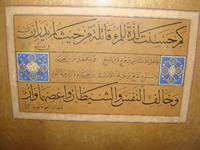
Ottoman art of calligraphy
Calligraphic panel by Reis ul Hattatin Chief Calligrapher Ahmed Kamil Akdik consists of a part of Qasidat al Burda
32x25 cm. Thuluth and Naskhi in black ink on paper illustrated and fexed on illustrated paper in golden flworal shapes. Signed in wite ink in Thuluth: Katabahu al Hajj Kamil. Ahmed Kamil Akdik is one of the last great Ottoman calligraphers. Born in the Fındıklı neighborhood of Istanbul in 1861 Ahmed Kâmil displayed an interest in the art of calligraphy from his earliest years in primary school. In 1879 he began to study thuluth sülüs and naskhi nesih scripts with the most renowned calligrapher of the era Sami Efendi 1838-1912 and after earning his certificate in 1884 with the approval of Şevki Efendi he became one of the foremost Ottoman calligraphers. His certificate icazet is preserved in the Library of the Topkapı Palace Museum.After beginning to work for the Divan-ı Hümayun the Ottoman Imperial Council in 1894 he learned from his teacher Sami Efendi the divani and celi divani scripts as well as the inscription of the tuğra or imperial monogram and replaced his teacher after the latter's retirement.He taught the thuluth and naskhi script at the Medresetü'l-Hattatin school of calligraphy that was established in 1915 and in 1918 gave lessons in rik'a script at the Galatasaray Secondary School. In 1915 he was honored by Sultan Reşad r. 1909-1918 with the title of Reisü'l-Hattatin Chief Calligrapher for his standing and success in his profession.Ahmed Kâmil began to teach calligraphy in 1936 at the State Academy of the Fine Arts and continued doing so until his death; he experienced all the changes that took place during the transition from Arabic script to the Latin alphabet conforming to the changes brought about by this language revolution in all the schools in which he taught and becoming one of the leaders of this last generation of calligraphers. Ahmed Kâmil Akdik is the father of painter Şeref Akdik 1899-1972. Sakib Sabanci collection note.
Referenz des Buchhändlers : 000079
|
|
|
OTTOMAN AUTHORITY OF SULTAN MUHAMMAD RASHAD
MADINE I MUNEVVERE HEJINLI TABURU TESHKILATINE DAIR NIZAMNAME CAMEL CORPS FORMATION SYSTEM AT AL MEDINA
<p>Suleymaniye Istanbul: Military press 1913 Book. Very Good. No Binding. 12mo - over 6¾ - 7¾" tall. 12 PP OTTOMAN SCRIPT ON CAMEL CORPS SYSTEM ESTABLISHED BY THE OTTOMAN AUTHORITY IN THE DYNASTY OF SULTAN MEHMED RESHAD IN 1911 WITH HEADING TUGHRA IN THE FIRST PAGE OF HIM . CONTAINS FIVE CHAPTERS WHICH CONTAINS 50 ARTICLES . CAMEL CORPS CREATION WAS ORGANIZED FROM BEDOUINS IN AL QASEEM AND ENVRONS IN NEJD UNDER PATRONAGE OF OTTOMAN OFFICERS . SOME OF ARAB SEPARATERS LATER CAME FROM THIS FOUNDATION LIKE RAMAZAN SHELASH WHO TOOK AN IMPORTANT ROLE IN THE ARAB REVOLUTION IN SYRIA .</p> Military press
Referenz des Buchhändlers : 000275
|
|
|
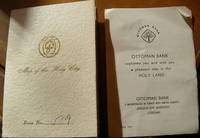
Ottoman Bank; Intercontinental Hotels
Holy Land Ephemera: Map Of The Holy City and a brochure from Ottoman Bank.
Jerusalem Israel: Greek Convent Press ca. 1955. Folded Card 9.5 x 16.8 cm Very Good. Scarce. Jerusalem, Israel: Greek Convent Press, [ca. 1955]. unknown
Referenz des Buchhändlers : 68-2877
|
|
|
OTTOMAN DIAMONDS SALES CATALOGUE].
Ottoman diamonds.= Osmanli elmaslari: Osmanli saray elmaslari.
Istanbul: Osmanli Saray Elmaslari. c. 2018. Soft cover. New. 8vo - over 7¾ - 9¾" tall. Paperback. Large 8vo. 25 x 22 cm. In English and Turkish. 72 p. fully color ills. Ottoman diamonds.= Osmanli elmaslari: Osmanli saray elmaslari. "The rose-cut diamond jewellery which had been the favorites of Ottoman sultans and their Harem for more than 700 years are still alive thanks to the endless hard works of Mr. Abdurrahman and Evren Sapçi the father and son. Diamonds because of their endless brightly shine had been the source of attraction for centuries and thus become the favorite jewelery adornment of Ottoman sultans and their combines. Thanks to the excellent craftmanship of Mr. Abdurrahman and Evren Sapçi the nearly ending classical style processed hand-made rose-cut diamonds are still a luxurious way of adornment of contemporary women.". <br/> <br/> Osmanli Saray Elmaslari., [c. 2018] paperback
Referenz des Buchhändlers : 051025
|
|
|
OTTOMAN DIAMONDS SALES CATALOGUE].
Ottoman diamonds.= Osmanli elmaslari: Osmanli saray elmaslari.
New English Paperback. Large 8vo. (25 x 22 cm). In English and Turkish. 72 p., fully color ills. Ottoman diamonds.= Osmanli elmaslari: Osmanli saray elmaslari. "The rose-cut diamond jewellery, which had been the favorites of Ottoman sultans and their Harem for more than 700 years, are still alive, thanks to the endless hard works of Mr. Abdurrahman and Evren Sapçi, the father and son. Diamonds because of their endless brightly shine had been the source of attraction for centuries, and thus, become the favorite jewelery adornment of Ottoman sultans and their combines. Thanks to the excellent craftmanship of Mr. Abdurrahman and Evren Sapçi, the nearly ending classical style processed hand-made rose-cut diamonds, are still a luxurious way of adornment of contemporary women.".
|
|
|
OTTOMAN DOCUMENT].
[OTTOMAN SERBIA / BOSNIA - TRAVNIK CITY - OTTOMAN RULE IN BOSNIA - RARE DOCUMENTS] Bilingual huge document in Serbian and Ottoman Turkish about farm land in Travnik city of Bosnia and Herzegovina.
Very Good Serbian Original early manuscript Ottoman huge bilingual document of the last period of Imperial Ottoman, prepared for a Serbian noble, in Serbian and Ottoman Turkish about farmland in Travnik city of Bosnia and Herzegovina. 55x39 cm. Bilingual in Serbian and Ottoman Turkish. 1 p., with some annotated notes on margins. On special paper with 'ahar' in early Ottoman / Turkish style with one of the rarest Ottoman watermarks. A printed vertical line of the document divides into two parts of the document is for early bilingual ones of especially the Imperial periods of Turks. The document includes the earliest printed form of moon and star. Split on middle, restored. A very good paper. Rare.
|
|
|
OTTOMAN EMPIRE UPHAM, Edward
History of the Ottoman Empire
Constable Edinburgh. 1829. First edition. Issued as vols XL and XLI in Constable's Miscellany of Original and Selected Publications. 12mo. pp viii 297; vi 390. Folding map in second volume. Extra engraved title-page in each volume. Period binding of quarter black calf with raised bands gilt marbled boards red morocco title labels.Foxing to the engraved title-pages. Very good indeed. Constable, Edinburgh. hardcover
Referenz des Buchhändlers : OTTOMANE015684
|
|
|
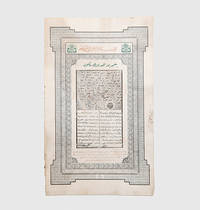
OTTOMAN ENDOWMENTS
Peygamberimiz efendimizin mektubu "The Letter of Our Prophet and Master".
Istanbul: Evkaf matbaas 1928 CE / 1344. A lithographed reproduction of the famous letter from the Prophet Muhammad to al-Muqawqis commonly identified as the Patriarch of Alexandria at the time of the Arab conquest of Egypt. Discovered in 1850 in a Coptic monastery in the Egyptian village of Akhmim the letter calls on al-Muqawqis and his followers to accept Islam. After its discovery it was taken to the imperial capital at Istanbul and its publication was sponsored by the Ottoman government's department of Endowments. The reproduction is accompanied here by Arabic and Ottoman transcriptions and by an Ottoman description of the circumstances in which the document was discovered. According to scholars the letter itself "has been recognised almost from the beginning as a fake on both historical as well as palaeographical grounds" Oehrnberg. Single leaf folio 340 x 205 mm. Extremities a bit chipped or creased minor soiling or foxing in places one small hole affecting printed area in lower left corner. A very good example. K. Oehrnberg "al-Mukawkis" Encyclopaedia of Islam New Edition Online Brill. unknown
Referenz des Buchhändlers : 172580
|
|
|
OTTOMAN MAP OF PALESTINE].
MAP OF OTTOMAN PALESTINE AND JERUSALEM Filistin - Kudüs.
The Ottoman Empire: Ottoman Directorate of Mapping. c. 1910 1910. No Binding. Very Good. Original lithograph map with brown white and blue tons. 81x57 cm. In Ottoman script Old Turkish with Arabic letters. All toponyms are in Ottoman Turkish and Arabic. Scale: 1:500000. Shows Mediterranean shores on the north Bahr-i Lût i.e. the Dead Sea Aqaba Bay areas of Arabic tribes in very detail in addition special huge lands like 'Al-Hism Land'. Also it shows holy places antiquities fortresses rivers; and Turkish Sanjaks Qazas Nahiyes Qariyes based on the Ottoman administrative system. Cartographer is not indicated but it's composed for military purposes in the last period of the Imperial Ottoman especially for showing Arabian tribes spreading over vast areas in its period just before World War 1 date of the printing of this map such as 'Houtat Tribe'. A very detailed and attractive map of Palestine and Quds area and their topography. Following the Muslim conquest of Palestine in 636-640 several Muslim ruling dynasties succeeded each other as they wrestled control of Palestine: the Rashiduns; the Umayyads who built the Dome of the Rock and the al-Aqsa Mosque in Jerusalem; the Abbasids; the semi-independent Tulunids and the Ikhshidids; the Fatimids; and the Seljuks. In 1099 the Crusaders established the Kingdom of Jerusalem in Palestine which the Ayyubid Sultanate conquered in 1187. The Crusaders failed to retake Palestine despite further attempts. The Egyptian Mamluks took Palestine from the Mongols who had conquered the Ayyubid Sultanate in 1260. The Ottomans captured Palestine in 1516 and ruled it until Egypt took it in 1832. Eight years later the United Kingdom intervened and returned the region to the Ottomans. Considerable demographic changes happened during the 19th century and with the regional migrations of Druze Circassians and Bedouin tribes. The emergence of Zionism also brought many Jewish immigrants from Europe and the revival of the Hebrew language. Arabs in Palestine both Christian and Muslim settled and Bedouin were historically split between the Qays and Yaman factions. These divisions had their origins in pre-Islamic tribal feuds between Northern Arabians Qaysis and Southern Arabians Yamanis. The strife between the two tribal confederacies spread throughout the Arab world with their conquests subsuming even uninvolved families so that the population of Palestine identified with one or the other. Their conflicts continued after the 8th-century Civil war in Palestine until the early 20th century and gave rise to differences in customs tradition and dialect which remain to this day. Beit Sahour was first settled in the 14th century by a handful of Christian and Muslim clans hamula from Wadi Musa in Jordan the Christian Jaraisa and the Muslim Shaybat and Jubran who came to work as shepherds for Bethlehem's Christian landowners and they were subsequently joined by other Greek Orthodox immigrants from Egypt in the 17th-18th centuries. Due to the legacy of the Ottoman period the ethnic origins of some rural and urban Palestinians are either Albanian Circassian or from other non-Arab populations. <br/> <br/> [Ottoman Directorate of Mapping]., [c. 1910] unknown
Referenz des Buchhändlers : 053731
|
|
|
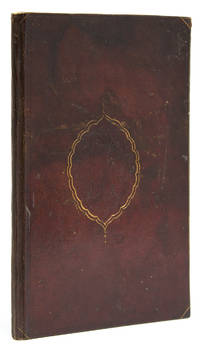
Ottoman Manuscript
Bena'yi Hadratlari Diwani Cover title Manuscript Book of Verse
Istanbul 1570. Text in Ottoman Turkish and Persian mostly in double columns. Ornamental headpiece. Nastaliq in black and red on colored leaves ruled in black and in gold. 39 ff. Dated on last leaf. 1 vols. Large 8vo. Red leather with gilt mandorlas with floral motif tooled in blind. Collectors' stamps on first and last leaves: Hilmi Hassan Tahsin 1306 1888; 'Uthman bin Hassan Tahsin and two others. Some staining. Text in Ottoman Turkish and Persian mostly in double columns. Ornamental headpiece. Nastaliq in black and red on colored leaves ruled in black and in gold. 39 ff. Dated on last leaf. 1 vols. Large 8vo. unknown books
Referenz des Buchhändlers : 311740
|
|
|
OTTOMAN MANUSCRIPT LAND REGISTER].
[MANUSCRIPT - OTTOMAN BALKANS - SANJAK OF GORICE - QAZA OF KASTORIA] Manuscript Ottoman deed / land register with "Tayyare" postal stamp dated 25 Zilkadde 1288 = 1872.
Very Good Turkish, Ottoman (1500-1928) Original manuscript deed / land register. [Balkans - Greece - Albania]. 40x25,5 cm. With a "Tayyare Cemiyeti" postal stamp. "Sebeb-i tahrir-i tevkii' humâyûn oldur ki; Defterhâne-yi Hâkânî'ye vürûd eden. Görice Sancagi, Kesriye Kazasi, Kermeni Karyesinde...". Dated fî 25 Zilkadde [1]288 [1872]. Bureaucratic cnfirmations. [MANUSCRIPT - OTTOMAN BALKANS - SANJAK OF GORICE - QAZA OF KASTORIA] Manuscript Ottoman deed / land register with "Tayyare" postal stamp dated 25 Zilkadde 1288 = 1872.
|
|
|
OTTOMAN MURUR TEZKIRESI: DAHILE MAHSUSDUR
OTTOMAN TRAVEL DOCUMENT- PRE-PASSPORT PERIOD Travel permission / internal passport given to 'Kayikçi kethüdasi Hidayetzâde Osman' for his travel to Rize. 'Mürûr tezkîresi: Dahile mahsusdur'.
Trabzon: Trabzon Nüfus Dairesi. AH: 1322 1906. No Binding. Very Good. Original autograph 'Mürûr tezkîresi' given to Kayikçi kethüdasi Hidayetzâde Osman' for his travel to Rize by the Ottoman Census Directorate of Trebizond. 4327 cm. In Ottoman script. With special Ottoman period-stamp '2 Kurus'. Two seals on paper dated 'fî sene 5 Haziran 1322' and '1324'. i.e. AH 1906 and 1908. Folded. Some stains on paper and minimal holes. Otherwise a good copy. There were several restrictions upon the travelling inside the state during the Ottoman Period. Both local residents and foreigners had to get some official documents called as "yol hükmü hereafter the route pass" in 16th century and "Mürur Tezkiresi hereafter the trip permission" in the 19th century to travel inside the state. The administrators of the settlements in which the visitors would pass were assigned with authorities in the route passes. In this regard administrators were ordered to help the ambassadors of the foreign states traders religious people to protect them and not to disturb them with such reasons as collecting taxes as well as to assist them in getting food and drinks. In the trip permissions the information on the name of the father nationality address and travelling route of the travellers were included. During the period in which the photos didn't exist or weren't prevalent some information on the age height and physical descriptions beard moustache eye color etc. were included in the document. The owners of the trip permissions would show the documents to the local administrators or officers upon their arrival and the authorities would stamp signed and dated the back of the documents while they were leaving the settlement. In those regions where epidemics were occuring the back of the travellers' documents were written that they didn't have any diseases while leaving the state. The "mürur" trip permission was redesigned along with the modern state organization structured by II. Mahmud period. Passport regulations inside the country were institutionalized thanks to "Mürur Nizamnameleri" in this period in which there weren't official passport regulations in practice. The Rum Riots in 1820s and the abolition of Janissary corps of the Ottoman Empire in 1826 affected the mürur practices and its supervision. Following the Rum Riots there were some claims that several spies existed among the Rums in Istanbul so the Rums who lived in the settlements of Istanbul were made to pay bail after their numbers were determined. It was especially declared that those without the trip permission couldn't enter Istanbul and even couldn't go to Anatolia. In addition to the Rum Riotsan emergency state was declared due to the start of Janissary corps' riot and a great number of Janissary were killed or exiled. On the other hand it was thought that those exiled out of the state might try to come back as they were accustomed to earning their life in Istanbul and so "Mürur Nizami" practices were put into effect. Those using ferries or sailing ships on the other hand needed to submit their passports to the captains in order to get a permission form pusula in return for it. After the captains delivered the passports to the officers those who came to Istanbul would get their passports back in 24 hours while those outside Istanbul would submit the permission form and take their passports. If they intended to stay they had to predicate where and how long they will stay. When the visitors couldn't submit their passports or give a reasonable excuse they would be deported from the Ottoman territories. In the event of determining a fake passport or travel document those would be deported following the contacting with the diplomatic representatives of the other countries. Those who showed their passports wished to stay in the Ottoman Territories needed to get a residence permit from the diplomatic representatives . Source: UNEARTHING THE PAST: PASSPORT REGULATIONS IN THE OTTOMAN EMPIRE Burak Eryilmaz <br/> <br/> Trabzon Nüfus Dairesi., [AH: 1322] unknown
Referenz des Buchhändlers : 052696
|
|
|
Ottoman official report
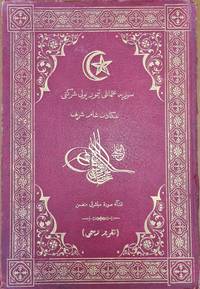
The Syria Ottoman Railway Company Acre - Damascus شركة السكة الØديدية العثمانية السورية ØŒ خط عكا Ùˆ ØÙŠÙا Ùˆ Øوران Ùˆ الشام
Very rare report in English Arabic and Ottoman Turkish. Binding tooled in gold with Ottoman Tughra of the Sultan Abdul Hamid II . Marbled inner paper and edges sprinkled in gold. Privately prepared for the high level officials in the Ottoman state. Gilbert and Rivington Limited hardcover
Referenz des Buchhändlers : 000167
|
|
|
OTTOMAN QUR'AN COPIED IN BULGARIA
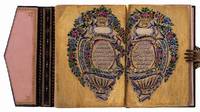
An illuminated Qur'an copied by Isma'il Najib Shumen Bulgaria.
Ottoman Empire dated 1266 AH/1849-50 AD. Arabic manuscript on paper 308 leaves plus 4 fly-leaves 15 lines to the page written in naskh in black ink verses separated by gold and polychrome illuminated rosettes within gold and black rules hizb sajda and juz' marked by illuminated floral marginal devices surah headings in white thuluth on gold and polychrome illuminated panels f.1b and 2a illuminated in gold and polychrome with rococo floral decoration against a gold ground pin-pricked with cintamani motifs the colophon within similarly illuminated panels in Ottoman gilt dark brown leather binding with flap with fitted box. Text panel: 8 by 5.1cm. Leaf: 12.5 by 8.2cm. Isma'il Najib is recorded as a pupil of Ahmed Zarifi and teacher to Tentene-zade Seyyid Hasan Vehbi Stanley 2009 p.248. Further Qur'ans by the scribe have sold in Christie's London 26 April 2018 lot 177; 26 October 2017 lot 229 and 12 October 1978 lot 7 and another was sold at Sotheby's London 21 November 1985 lot 390. The latter example is illuminated in a very similar manner to the present lot in a fully Rococo style unlike the typical Shumen style of illumination. In the 19th century one of the most important places of Ottoman manuscript production was Shumen a strategically-important fortress in what is today Bulgaria. Tim Stanley and Süheyl Ünver have independently worked on the corpus of manuscripts there identifying more than fifty Qur'anic scribes from the town apparently divisble into three groups according to their original teacher: Seyyid Mehmed Nuri Ahmed Zarifi and Ahmed Nazifi Tim Stanley The Decorated Word volume II. Oxford 2009 p.226. By the 1850s Qur'ans from Shumen had come to be remarkably homogenous: all observe the principle of ayet ber kenar in which every page ends with a completed Qur'anic verse; all are written with 15 lines of text to a page; all have between 300 and 310 pages. The dimensions of these manuscripts are also fairly constant. Although these manuscripts were produced in quantities to make them available to many relatively prosperous subjects of the Ottoman Empire Shumen Qur'ans were presented by Ottoman sultans to important figures including Ali Rif'at Pasha the Khedive of Egypt and al-Husayn Sharif of Mecca. The production of Qur'ans in Shumen came under increasing pressure with the rise of lithographic printing and came to a complete stop with Bulgarian indepedence in 1878. For a fuller discussion of the Shumen school of calligraphy see Tim Stanley "The Shumen Phenomenon" The Decorated Word volume II. Oxford 2009 pp.222-51. The illumination of Shumen manuscripts - though united by a Baroque idiom and a bright pastel colour palette - exhibits some variety suggesting that there were several different schools of illumination in the city alongside the numerous calligraphers. Ottoman Empire, dated 1266 AH/1849-50 AD. hardcover
Referenz des Buchhändlers : 63854
|
|
|
OTTOMAN VENETIAN WAR Balthasar JENICHEN engraver
Warhafftige Conterfettung der Turckischen Armata von Galleen und andern Schiffen Dreihundert wie solche dess 1570 Jars in Ordnunge wider die Venedische Lendt ist aussgefahren
Nuremberg 1571. Engraving printed on two sheets of laid paper joined. Engraver's monogram at the lower left. Early manuscript caption in English in the lower margin. Plate mark: 11 x 16 inches. Sheet size: 14 5/8 x 18 3/8 inches. Tear extending from the right margin closed with small void in excellent facsimile small worm hole within the image. Very rare German news-sheet map depicting the Turkish fleet invasion of Cyprus in 1570.<br/> <br/>Exceptionally scarce engraved German broadside map depicting the Ottoman fleet sailing to Venetian-controlled Cyprus in 1570. The early English manuscript caption in ink just below image reads: "The representation of the Turkish Navall Army in ye year 1570 going forth to meet the Venetian fleet." Cyprus then under Venetian rule was a strategic point for controlling shipping and trade in the Eastern Mediterranean. The Ottomans ruled by Sultan Selim II had long desired the island. Following a series of warnings and demands the Ottoman fleet commanded by Müezzinzade Ali Pasha and Lala Mustafa Pasha sailed for Cyprus in late June 1570. Depicted here the Turkish fleet was composed of an estimated 350-400 ships and upwards of 100000 men. Following sieges and massacres at Nicosia Kyrenia and Famagusta the island was taken by August 1571. Although the invasion was long-heralded the Venetian fleet failed to prevent the invasion or the subsequent fall of Cyprus to the Turks. However they subsequently raised the support of the "Holy League" of the Catholic maritime states in the Mediterranean and defeated the Ottoman fleet at the Battle of Lepanto in October 1571 off the western coast of Greece. The victory of the Holy League prevented the Ottoman Empire expanding further along the European side of the Mediterranean though did not end their possession of Cyprus. Jenichen who signed the map with his monogram 'BI' was the leading German publisher of news-sheet maps. Jenichen and compatriot Matthias Zündt took particular interest in the conflict and produced views and maps of it that equaled and surpassed those of their Italian counterparts. Given their ephemeral nature all are rare and desirable. We can locate only one other example of this engraving appearing at auction in recent times Sotheby's London 29 April 2014 lot 157 £60000.<br/> <br/>Hollstein XL B 128; G.K. Nagler Die Monogrammisten v. 1 p. 818-819; Andresen II Nr. 276; Drugulin II 364; s.a. Meurer Jenichen S. 50. unknown books
Referenz des Buchhändlers : 28345

|
|
|
Ottoman, D C
The Greatest Achievements of the Negro Race
paperback. Good. Access codes and supplements are not guaranteed with used items. May be an ex-library book. paperback
Referenz des Buchhändlers : 0464937655.G ISBN : 0464937655 9780464937654
|
|
|
Ottoman, EE E E
Blood and Lipstick
paperback. Good. Access codes and supplements are not guaranteed with used items. May be an ex-library book. paperback
Referenz des Buchhändlers : 162757025X.G ISBN : 162757025X 9781627570251

|
|
|
Ottoman, Gouvernement Imperial
Arbitrage Entre le Gouvernement Imperial Ottoman Et la Compagnie des Chemins de Fer Orientaux: Demandes Nos. 1-22 de la Compagnie d'Exploitation Classic Reprint French Edition
hardcover. Good. Access codes and supplements are not guaranteed with used items. May be an ex-library book. hardcover
Referenz des Buchhändlers : 0364201460.G ISBN : 0364201460 9780364201466
|
|
|
OUDRY (Jean-Baptiste) - PREVOST (Benoît-Louis, gravée par).
[Eau-forte aquarellée :] Le Bassa et le marchand.
S.l., s.é., s.d. [Paris, Desaint et Saillant, 1756]. Dimensions : 416 x 283 mm (marges incluses).
Referenz des Buchhändlers : 16100

|
|
|
Ouseley William, Sir
TRAVELS IN VARIOUS COUNTRIES OF THE EAST; MORE PARTICULARLY PERSIA. A Work Wherein the Author has Described, as Far as His Own Observations Extended, the State of Those Countries in 1810, 1811 and 1812, . 3 Volumes in 5 Tomes.
3 volumes in 5 tomes, 8vo, with illustr. and maps in pockets. pp. xxvi, (2), 455; (2), 544; (2), 600 . full title: TRAVELS IN VARIOUS COUNTRIES OF THE EAST; MORE PARTICULARLY PERSIA. A Work Wherein the Author has Described, as Far as His Own Observations Extended, the State of Those Countries in 1810, 1811 and 1812, And Has Endeavoured to Illustrate Many Subjects of Antiquarian Research, History, Geography, Philology and Miscellaneous Literature, with Extracts from Rare and Valuable Manuscripts.
|
|
|
ouvrage collectif
REVUE DES DEUX MONDES - 1858 tome 14
Paris Bureau de la Revue des Deux Mondes 1858 -in-8 demi-Maroquin un fort volume, reliure demi-maroquin cerise grand in-octavo à coins (binding half morocco with corners), reliure d'époque signée "PETIT" successeur de "SIMIER", dos 4 nerfs (spine with raised bands) décoré "or" et à froid (gilt and blind stamping decoration), titre et tomaison frappés "or" (gilt title and volume numbering) dans un encadrement d'un double filet fin "or", triple filets fins "or" en place des nerfs avec un filet à froid de part et d'autre des nerfs, plats décorés or (gilt decoration on the cover) avec 3 filets fins "or" aux mors et aux coins (joints and corners with three gilt line), papier marbré aux plats (cover with marbled paper), toutes tranches lisses (all edges smoothes) peignées (painting edges) rouge et bleu, sans illustrations (nop illustration), 992 pages, 1858 Paris Bureau de la Revue des Deux Mondes Editeur,
Referenz des Buchhändlers : 11173
|
|
|
ouvrage collectif
REVUE DES DEUX MONDES - 1867 tome 69
Paris Bureau de la Revue des Deux Mondes 1867 -in-8 demi-Maroquin un fort volume, reliure demi-maroquin cerise grand in-octavo à coins (binding half morocco with corners), reliure d'époque signée "PETIT" successeur de "SIMIER", dos 4 nerfs (spine with raised bands) décoré "or" et à froid (gilt and blind stamping decoration), titre et tomaison frappés "or" (gilt title and volume numbering) dans un encadrement d'un double filet fin "or", triple filets fins "or" en place des nerfs avec un filet à froid de part et d'autre des nerfs, plats décorés or (gilt decoration on the cover) avec 3 filets fins "or" aux mors et aux coins (joints and corners with three gilt line), papier marbré aux plats (cover with marbled paper), toutes tranches lisses (all edges smoothes) peignées (painting edges) rouge et bleu, sans illustration (no illustration), 1040 pages, 1867 Paris Bureau de la Revue des Deux Mondes Editeur,
Referenz des Buchhändlers : 11212
|
|
|
Ouvrage collectif
Sur les Champs de Bataille
PARIS, P. Ollendorff - 1911 - Préface de Jules CLARETTE V à XII - 337 pages Envoi de l'un des collaborateurs Gaston LEMAY : " a Madame et monsieur MUEL, hommage de leur vieil ami" juillet 1911.
|
|
|
Ouvrage collectif;
Sur les Champs de Bataille
PARIS, P. Ollendorff - 1911 - Préface de Jules CLARETTE V à XII - 337 pages
Referenz des Buchhändlers : 1606
|
|
|
Owner: A. BANOGLU.
Yeni tarih dünyasi. Onbes günde bir çikar [Periodical]. 17 Eylül 1953 - 1 Temmuz 1954. Issues: 1-20. SET.
Very Good English Original publisher's cloth bdg. All fascicles' covers are saved. Roy. 8vo. (24 x 17 cm). In Turkish. Full set. Yeni tarih dünyasi. Onbes günde bir çikar [Periodical]. 17 Eylül 1953 - 1 Temmuz 1954. Issues: 1-20. SET.
|
|
|
Owner: GEORGES DUMEZIL.
Anatolia Moderna VIII.= Yeni Anadolu VIII. Edites sous la direction de Stephane Yerasimos, avec la collaboration de Jean-Louis Bacque-Grammont, Aksel Tibet.
New French Paperback. 4to. (29 x 21 cm). Articles in French. 274 p., b/w ills. Anatolia Moderna VIII.= Yeni Anadolu VIII. Edites sous la direction de Stephane Yerasimos, avec la collaboration de Jean-Louis Bacque-Grammont, Aksel Tibet. Contents: DOSSIER : RECHERCHES SUR LE QUARTIER DE TOPHANE ET L'ARTILLERIE OTTOMANE. Avant-propos / Jean-Louis BACQUE-GRAMMONT et Stephane YERASIMOS. LA FONDERIE DE CANONS ET LE QUARTIER DE TOPHANE. TEXTES ET IMAGES. COMMENTES: I. La description de Tophane par Evliya Çelebi / Jean-Louis BACQUÉ-GRAMMONT, Textes et images commentés, II. Mosquees, mescid et monuments remarquables situés entre la limite de Galata et le centre de Findikli, d'après Hüseyn Ayvasaray" et Mehmed Raif / Jean-Louis BACQUE-GRAMMONT, Textes et images commentés, III. Recherches sur l'histoire du quartier de Findikli / Cengiz ORHONLU, Textes et images commentés, IV. Autres témoignages / Ela GÖNEN, Sur la réhabilitation et l'avenir de la Fonderie Impériale d'Istanbul (Tophane-I Amire). Index de Textes et Images. Commentés, Textes et images commentés / Jean-Louis BACQUÉ-GRAMMONT, PROGRAMMES: Une famille de notables de la région d'Aydin : les Cihanoglu et l'architecture / Ayda AREL.
|
|
|
Owner: ISMAIL SOYSAL.
Studies on Turkish-Arab relations. Annual 1986. Foreword: Vahit Halefoglu.
Very Good English Paperback. Roy. 8vo. (24 x 17 cm). Articles in English, French, Turkish, and Arabic. [5], 411 p. Studies on Turkish-Arab relations. Annual 1986. Foreword: Vahit Halefoglu.
|
|
|
Owner: MUHAMMAD AMIN ISLAMI.
Azâd Türkistan. Ilmî, dinî, edebî, tarihî, içtimaî, tevcimî aylik mecelledür. Owner: Muhammed Emin Islâmi. Rüb'u-evvel- Rüb'u üs-sânî 1374. Numero: 2954.
Very Good Turkmen Paperback. .Roy. 8vo. (24 x 17 cm). In Turkmen and Turkish with Arabic letters and Arabic. 64, [2] p., b/w plates, 1 photographic portrait of King Faisal. Azâd Türkistan. Ilmî, dinî, edebî, tarihî, içtimaî, tevcimî aylik mecelledür. Owner: Muhammed Emin Islâmi. Rüb'u-evvel- Rüb'u üs-sânî 1374. Numero: 2954. Extremely rare. Not in Duman. Not in National Library of Turkey. Just 1 issue in OCLC: 949620891.
|
|
|
Owner: SABAN GÜLBAHAR, ALI KENAN ERBULAN.
Armenian studies. A quarterly journal of history, politics and international relations.= Ermeni arastirmalari. Üç aylik tarih, politika ve uluslararasi iliskiler dergisi. Mart-Nisan-Mayis 2001 - Ekim-Kasim-Aralik 2016. 1-54. Edited by Ömer Engin Lütem.
Fine English Paperback. Pbo. Roy. 8vo. (24 x 17 cm). Articles in English, Turkish. 54 issues set. Armenian studies. A quarterly journal of history, politics and international relations.= Ermeni arastirmalari. Üç aylik tarih, politika ve uluslararasi iliskiler dergisi. Mart-Nisan-Mayis 2001 - Ekim-Kasim-Aralik 2016. 1-54. Edited by Ömer Engin Lütem.
|
|
|
OYA DAGLAR MACAR, ELÇIN MACAR.
Beyaz Rus ordusu Türkiye'de.
New English Paperback. Pbo. Demy 8vo. (21 x 14 cm). In Turkish. 312 p. Beyaz Rus ordusu Türkiye'de. Army of White Russians in Turkey. 500 copies were printed.
|
|
|
OYA DAGLAR.
War, epidemics and medicine in the late Ottoman Empire, (1912-1918).
New English Paperback. Roy. 8vo. (24 x 17 cm). In English. [xLiii], 331 p. War, epidemics and medicine in the late Ottoman Empire, (1912-1918). The Ottoman Empire spent its last century with wars coming one after another and as a consequence had to suffer many physical as well as demographic casualties. With a significant decrease in the population, one of the main factors that had kept the Empire up disappeared and therefore the 600 year-old Empire collapsed at the end of the First World War. This study focuses on the period of Balkan Wars and the First World War, which affected the political history of the 20th century deeply and caused the collapse of the Ottoman Empire, and examines the concerned period in terms of the epidemic diseases. Taking into account that wars are important contributors in the emergence of epidemic diseases, I have attempted to evaluate the destruction caused by the epidemic diseases during the war years and effects of these diseases on the results of the wars in a historical framework.
|
|
|
OYA PANCAROGLU.
The great mosque and hospital of Divrigi.
New English Paperback. Pbo. 12mo. (18 x 11 cm). In English. 168 p., ills. The great mosque and hospital of Divrigi.
|
|
|
OYA SENYURT.
Istanbul Rum cemaatinin Osmanli mimarisindeki temsiliyeti.
New English Paperback. Pbo. Roy. 8vo. (23 x 16 cm). In Turkish. Ills. 246 p. Representation of Istanbul Rum community in Ottoman architecture. Istanbul Rum cemaatinin Osmanli mimarisindeki temsiliyeti.
|
|
|
OYA SENYURT.
Osmanli mimarisinin temel ilkeleri. Resim ve insa üzerinden gelistirilen farkli bir yaklasim.
New English Paperback. Pbo. Demy 8vo. (24 x 17 cm). In Turkish. 436 p. Osmanli mimarisinin temel ilkeleri. Resim ve insa üzerinden gelistirilen farkli bir yaklasim. ARCHITECTURE Turkish and Islamic arts Ottoman architectural culture Painting Buildings.
|
|
|
OYA SENYURT.
Osmanli mimarlik örgütlenmesinde degisim ve dönüsüm.
New English Paperback. Pbo. Roy. 8vo. (24 x 16 cm). In Turkish. 367 p. Change and transformation of Ottoman architecture. Osmanli mimarlik örgütlenmesinde degisim ve dönüsüm.
|
|
|
OZAN SAGDIÇ, (Turkish photographer), (1934-).
[MIDDLE EAST] Original photograph showing little ballerinas bowing to the audience including Ismet and Mevhibe Inönü
Very Good Turkish Original photograph taken by Ozan Sagdiç. 18x24 cm. Stamped on verso by Ozan Sagdiç. A fine and artistic photo of little ballerinas bowing to the audience including Ismet and Mevhibe Inönü after a ballet show in Ankara city. Sagdiç made very important contributions to Turkey's visual memory, especially in his career, which he started in Hayat Magazine in the second half of the 20th century.
|
|
|
OZBEK Sait Emin
La Sümer Bank et l'industrialisation de la Turquie sous la République
Lyon, Imp. du Salut Public 1938 184pp., cm., texte en français, Thèse présentée à l'Ecole des Hautes Etudes Commerciales de l'Université de Lusanne pour l'obtention du grade de Docteur ès Sciences commerciales et économiques, br.orig., cachet au verso de la p.d.t., texte frais et en bon état, X112267
Referenz des Buchhändlers : X112267
|
|
|
OZBEK Sait Emin
La Sümer Bank et l'industrialisation de la Turquie sous la République
184pp., cm., texte en français, Thèse présentée à l'Ecole des Hautes Etudes Commerciales de l'Université de Lusanne pour l'obtention du grade de Docteur ès Sciences commerciales et économiques, br.orig., cachet au verso de la p.d.t., texte frais et en bon état, X112267
|
|
|
P ART MAGAZINE.
P. Art and culture magazine. Medicine in art. Issue: 14 Spring 2007.
Fine English Paperback. Pbo. 4to. (31 x 23 cm). 91, [1] p. Several color and b/w ills. In English. P. Art and culture magazine. Medicine in art. Issue: 14 Spring 2007.
|
|
|
P Magazine.
P sanat, kültür, antika dergisi. Üç ayda bir yayimlanir. Güz '99 No.15. Portre sanati.
Fine English Paperback. Pbo. Mint. In Turkish. [26], 151, [1] p. Color and b/w ills. Subject: The art of portrait. P sanat, kültür, antika dergisi. Üç ayda bir yayimlanir. Güz '99 No.15. Portre sanati.
|
|

 Per e-mail erhalten
 Als pdf-Dokument herunterladen
 RSS feed
 Permanenter link


