|
|
|
Arnakis, George G Ottoman Empire Balkan States Near East
THE NEAR EAST IN MODERN TIMES VOLUME ONE THE OTTOMAN EMPIRE AND THE BALKAN STATES TO 1900
Pemberton Press TX 1969. Fine in gray buckram with brown print with light foxing to top edge of text block. First edition first printing hardcover SIGNED INSCRIBED TO by Mrs George Arnakis Pemberton Press, TX hardcover
Riferimento per il libraio : 832
|
|
|
OTTOMAN ENDOWMENTS
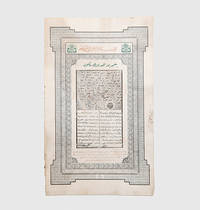
Peygamberimiz efendimizin mektubu "The Letter of Our Prophet and Master".
Istanbul: Evkaf matbaas 1928 CE / 1344. A lithographed reproduction of the famous letter from the Prophet Muhammad to al-Muqawqis commonly identified as the Patriarch of Alexandria at the time of the Arab conquest of Egypt. Discovered in 1850 in a Coptic monastery in the Egyptian village of Akhmim the letter calls on al-Muqawqis and his followers to accept Islam. After its discovery it was taken to the imperial capital at Istanbul and its publication was sponsored by the Ottoman government's department of Endowments. The reproduction is accompanied here by Arabic and Ottoman transcriptions and by an Ottoman description of the circumstances in which the document was discovered. According to scholars the letter itself "has been recognised almost from the beginning as a fake on both historical as well as palaeographical grounds" Oehrnberg. Single leaf folio 340 x 205 mm. Extremities a bit chipped or creased minor soiling or foxing in places one small hole affecting printed area in lower left corner. A very good example. K. Oehrnberg "al-Mukawkis" Encyclopaedia of Islam New Edition Online Brill. unknown
Riferimento per il libraio : 172580
|
|
|
[WORLD WAR I -- OTTOMAN EMPIRE & MIDDLE EAST]. PYE, Ernest
Prisoner of War 31163 Bedros M. Sharian Bedros Kirkyasharian.
New York NY: Fleming H. Revell Co. 1938. 12mo. 202 pp. Photo frontisp. photo plates map printed letter facsimile. Dark green publisher’s cloth yellow lettering on spine minor shelfwear w/ d.j. photo cover art of captured artillery minor scuffing couple very minor closed tears slight tear upper right corner still VG/VG- copy. First edition of this very uncommon World War account of an Armenian-American who was forced into the Ottoman Empire’s Army participated in the 10-month Gallipoli campaign at Aru Burnu against the Anzacs and as a medical orderly burying the 3000 Turkish dead during a nine-hour truce. Following the withdrawal of the British from the Dardanelles his 16th Division was transferred to Syria fights General Allenby at the capture of Jerusalem and was taken prisoner and interned in Egypt. Subsequently he served with the British as an interpreter for British Intelligence and then returned as a POW at Belbeis until July 12 1920 when discharged eventually immigrating to the U.S. attending and earning degrees before opening businesses in Georgia. Very scarce in original dustjacket. Fleming H. Revell Co., hardcover
Riferimento per il libraio : 63875
|
|
|
[ART & TEXTILES -- OTTOMAN]. [AGOPIAN, O]; KIRBY, Thomas E & BERNET, Otto [Auctioneers].
Beautiful productions of ancient looms and other oriental treasures. Illustrated catalogue of antique oriental weaves of rare and distinctive quality: fine old Persian faiences Persian lacquers arms Imperial jewes and other oriental treasures. . . First afternoon’s sale Tuesday January 6 1914 including Catalogue Nos. 1 to 106; Second afternoon’s sale. . . including Catalogue nos. 107 to 208; Third afternoon’s sale. . . including Catalogue Nos. 209 to 308; Fourth and last afternoon’s sale Friday January 9 1914. . . including Catalogue nos. 309 to 500c; duplication of day three.
New York NY: American Art Galleries American Art Association 1914. Five parts in one vol. Thick 8vo. 486 pp unpaginated - duplication of 110 pp. Day 3. Titles in red & black photo illustrations and plates throughout many double-page annotated w/ realized prices in ink manuscript throughout for every item placeholder slips also present. Contemporary flexible dark brown calf rebacked inner hinges repaired still a VG- copy from the library of Tom Atiyeh w/ Atiyeh Bros. Inc. 604 SW 10th Ave. Portland Oregon ownership stamp on ffep. First edition of this lavishly illustrated catalogue of the historic liquidation of the collection of Persian Oriental and Chinese rugs held and brokered by the Constantinople-based Armenian firm of O. Agopian & Son who appear to have sold out just after the forced emigration and anti-Armenian campaign by the Ottoman Committee of Union and Progress following the 1912-1913 Balkan Wars. The rugs offered from sale ranged from Beluchistan weave Turkoman rugs to Antique Caucasian prayer rugs with Kazak weaves; giant 18th-Century Turkoman carpets to Persian Khorassan Triclinium rugs realizing $ 1300.00 over $ 43000 today Many of the rugs textiles and antiquities from this sale found their way not only to the hands of collectors but also to such museum collections as the Detroit Institute of Arts the Frick Collection and others. American Art Galleries, American Art Association, unknown
Riferimento per il libraio : 63974
|
|
|
MEHMED EMIN ALI PACA; OTTOMAN RAILWAYS
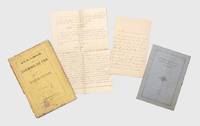
Documents relating to Baron Maurice de Hirsch's concessions to build and operate the Ottoman Empire's railway lines from Constantinople to Vienna.
Turkey: 1874-86. Constantinople to Vienna Fascinating group of documents relating to Baron Maurice de Hirsch's concessions to build and operate the Ottoman Empire's railway lines from Constantinople to Vienna dating to the time the agreements were revised 1872 to when he was seeking to extricate himself 1887: 1. Covering letter to the annotated Actes 1874 document addressed to Baron Hirsch 1887 2. Actes 1874 covering the revised 1872 agreements annotated in 1887 for Baron Hirsch 3. Further amendments from the Ottoman Minister of Works for Hirsch c1887-88 4. Agreement to advance funds to the Sublime Porte to finance a military response to Bulgarian annexation of Eastern Rumelia 1885-86 The Ottoman rail network was constructed to boost trade maintain imperial control and facilitate Hajj and relied to a great extent on foreign private finance and expertise. First ventures in the 1860s included the Chernovoda to Constanza line connecting the Danube to the Black Sea and the Rustchuk to Varna line taking cargo to the Danube and Black Sea. The latter built by a British group was owned by the Rustchuk-Varna Railway Company under a 99 year concession which leased it in 1873 to Austrian banker Baron Maurice de Hirsch 1831-1896. In 1869 the Porte granted its most important concession to Hirsch to build 2 500 km of main and branch lines connecting Constantinople and Vienna; and in 1870 Hirsch founded the Societe Imperiale des Chemins de Fer de la Turquie d'Europe to build the lines and Compagnie pour l'exploitation des Chemins de Fer de la Turquie d'Europe to operate them. The venture was financed by the Turkenlose 3% Turkish Lottery Bond designed by Hirsch himself and German and Austrian bank loans. Over the 99 year concession Societe Imperial would receive 14000 francs rent per completed kilometre from the Porte and 8000 from the Compagnie. Grand Vizir Mehmed Emin Ali Paca 1815-71 a moderniser who wanted closer ties with Western Europe signed the agreement for the Porte. However he died in 1871 and his successor Mahmoud Nedim Paça 1818-83 whose appointment was influenced by General Nikolai Ignatieff Russia's ambassador at Constantinople preferred a link with Russia via Romania. Mahmoud Paca's efforts to cancel the concession were however unsuccessful due partly to Hirsch's appointment of Ralph Earle former British MP and secretary to Lord Beaconsfield who renegotiated the agreements signed off on 18 May 1872 item 2. By 1872 four disconnected lines "stumps" had been built and the Turkenlose had not raised sufficient funds. Under the new agreements the Porte took back the building concession including the most difficult and costly parts in the process reducing the distance to 1250km with the Societe Imperial as its contractor and cutting the Compagnie's concession from 99 to 50 years. Small archive of original documentation as above. Overall in very good condition. unknown
Riferimento per il libraio : 141678
|
|
|
SULEYMAN TEVFIK [OZZORLUOGLU], (Turkish / Ottoman journalist, war reporter, translator, lexicographer and intellectual), (1861-1
BALKANS / TRAVEL / THE 1897 GRECO-TURCO WAR Tesalya'da bir cevelân ve dört aylik seyahâtim. i.e. A tour in Thessaly and my four-month voyage.
Istanbul: Mahmud Bey Matbaasi. AH 1315 1898. 1st Edition . Leather. Very Good. 8vo - over 7¾ - 9¾" tall. In contemporary handsome 1/3 leather bdg. Raised five bands to the spine. The third and fourth compartments have a lettered gilt title and a personal name Fikri in Ottoman script. Other ones have decorated gilts. Cr. 8vo. 20 x 14 cm. In Ottoman script Old Turkish with Arabic letters. 359 p. First and only edition of Süleyman Tevfik's eyewitness travel account to Thessaly who participated in the Turco-Greco War in 1897 as a war correspondent in the Thessaly Front between April 27 - May 20 1897. The Greco-Turkish War of 1897 or the Ottoman-Greek War of 1897 also called the Thirty Days' War and known in Greece as the Black '97. It was a war fought between the Kingdom of Greece and the Ottoman Empire. Its immediate cause was the question over the status of the Ottoman province of Crete whose Greek majority had long desired union with Greece. Despite the Ottoman victory on the field an autonomous Cretan State under Ottoman suzerainty was established the following year because of the intervention of the Great Powers after the war with Prince George of Greece and Denmark as its first High Commissioner. This was the first war effort in which the military and political personnel of Greece were put to test in an official open war since the Greek War of Independence in 1821. For the Ottoman Empire this was also the first war effort in which the reorganized military personnel were put to the test. The Ottoman army was under the guidance of a German military mission led by Colmar Freiherr von der Goltz who had reorganized it after the defeat in the Russo-Turkish War 1877-1878. In Thessalian Front war was declared on 18 April when the Ottoman ambassador in Athens Asim Bey met with the Greek foreign minister announcing the cutting of diplomatic ties. Heavy fighting occurred between the 21-22 April outside the town of Tyrnavos but when the overwhelming Ottoman forces converged and pushed together the Greek general staff ordered a general withdrawal spreading panic among soldiers and civilians alike. Larissa fell on 27 April while the Greek front was being reorganized behind the strategic lines of Velestino in Farsala. Nevertheless a division was ordered to head for Velestino thus cutting Greek forces in two 60 km apart. Between 27 and 30 April under the command of Col. Konstantinos Smolenskis Greek forces checked and halted the Ottoman advance. On 5 May three Ottoman divisions attacked Farsala forcing an orderly withdrawal of Greek forces to Domokos while on the eve of those events Smolenskis withdrew from newly recaptured Velestino to Almyros. Volos fell into Ottoman hands on 8 May. At Domokos the Greeks assembled 40000 men in a strong defensive position joined by about 2000 Italian "Redshirt" volunteers under the command of Ricciotti Garibaldi son of Giuseppe Garibaldi. The Ottoman Empire had a total of about 70000 troops of whom about 45000 were directly engaged in the battle. On 16 May the attackers sent part of their army around the flank of the Greeks to cut off their line of retreat but it failed to arrive in time. The next day the rest of their army made a frontal assault. Both sides fought ferociously. The Ottomans were held at bay by the fire of the defending infantry until their left flank defeated the Greek right. The Ottoman formation broke through forcing a renewed withdrawal. Smolenskis was ordered to stand his ground at the Thermopylae passage but on 20 May a ceasefire went into effect. Özege 20762.; OCLC 65794449 / 775132812. <br/> <br/> Mahmud Bey Matbaasi., [AH 1315] hardcover
Riferimento per il libraio : 055584
|
|
|
BEKIR SIDKI, (Ottoman - Turkish lieutenant), (19th-20th century).
BALKAN WARS 1912-1913 Garb Ordusu Harekâti Cavid Pasa Kolu ve Vardar Ordusu. i.e. Western Army Operation Cavid Pasha Branch and Vardar Army in the Balkan War.
Istanbul: Kitabhane-i Islâm ve Askerî Çigiraçan Ibrahim Hilmi - Balkan Harbi Külliyati Aded: 4. AH 1331 1915. 1st Edition . Soft cover. Very Good. 8vo - over 7¾ - 9¾" tall. Original wrappers. Foolscap 8vo. 18 x 12 cm. In Ottoman script Turkish with Arabic letters. 158 p. 4 plans. Occasionally stains on cover pages and edges; chipped on extremities of front cover and spine. Overall a good copy. Some uncut pages. First and only edition of this rare first-hand account of the failures and deficiencies of the Ottoman army in the Balkan War 1912-1913 and the conflicts between Turkish commanders during the war. Bekir Sitki or Sidki participated in the war with the rank of lieutenant. The wars and struggles fought by the Vardar army a branch of the Western army called Câvîd Pasha branch affiliated with it are explained day by day with four plans in this work in plain language and information is given about the situation of the Ottoman army its deficiencies the difficulties experienced during the war. As of 2023 September only one paper copy could be traced in the OCLC: 283477138 Universitatsbibliothek der Eberhard Karls Universitat.; Özege 6039.; TBTK 5822.; Not in ATYB. <br/> <br/> Kitabhane-i Islâm ve Askerî Çigiraçan, Ibrahim Hilmi - Balkan Harbi Külliyati, Aded: 4., [AH 1331] paperback
Riferimento per il libraio : 055604
|
|
|
FERIK EBU SAID AHMED RASID PASHA, (Ottoman Lieutenant General), (?-1891).
FIRST HAND ACCOUNT OF YEMEN AND THE 1871-1874 OTTOMAN EXPEDITION Tarih-i Yemen ve San'a. 2 volumes set.
Kostantiniyye Constantinople - Istanbul: Basiret Matbaasi. AH 1291 1874. 1st Edition . Leather. Very Good. 8vo - over 7¾ - 9¾" tall. Contemporary fine half and quarter calf. The title "Tarih-i Yemen" lettered gilt on spine of the first volume with volume no and four decorative elements gilt on the compartments; the second volume's spine is decorated fully. Bindings are not homogeneous. Roy. 8vo. 24 x 17 cm. In Ottoman script Old Turkish with Arabic letters. 2 volumes set: 3 322 20 p.; 6 374 p. no illustrations and maps. Occasional foxing on pages a very good set. Extremely rare first edition of this two-volume set including Lieutenant General Ahmed Rashid Pasha's firsthand account of a fourteen-month expedition of Yemen he participated in with the Ottoman army between 1871-1874. The book also enlarged with the author's detailed eyewitness descriptions of the South Arabian Peninsula's agricultural and natural resources geographical structure climate various sects and beliefs of the region as well as a history of the Ottoman rule in Yemen from the beginning in 1495. This exceptional book starts with the author's reason for writing the book sebeb-i telîf and a list of the Arabic sources he used. In addition to the author's diary in the form of a travelogue Isa ibn Lütfullah's Rawha al-Rûhad which has detailed information about the Zaydis and includes the history of Yemen between 1494 and 1620 as well as Tekmilet al-Ravha al-Rûh Tibb al-Kesâ Jami al-mutun bi Ahbari Yemen al-Maymun and Al-Deyba's Qurrat al-'Uyûn fî Akhbâr al- Yemeni'l-Maymûn were used as sources. The first volume is published in AH 1291 Cemâziyelâhir i.e. July-August 1874 and the second volume is published in AH 1291 Zilhicce i.e. January-February 1875 in Basiret Publishing House in Constantinople. After the publishing first volume the author presented it to the Ottoman Sultan Abdülaziz and he was awarded the Medjidi Order of the third rank. In the book the activities of the Ottoman Empire in the region since 1495 the region's becoming a province the governors who ruled the land the important rebellions and wars in Yemen as well as the 14-month Ottoman Expedition between 1871-1874 which also the author participated in are explained in detail. At the end of this operation the division of the Yemen Province into four liwâs named Sana'a Taizz Hudayda and Asir and their restructured administrative organization with the situation of peoples and Arab tribes in the region are also valuable firsthand details in the work. Ahmed Rashid Pasha collected the historical documents of the events between 1680-1844 related to Yemen and Arabia during his duty in Yemen. In the second volume the author presented himself as "Mirliva" i.e. Brigadier General three years later 3 July 1877 he was promoted to the rank of "Ferîk" i.e. Lieutenant General. Ahmed Rashid Pasha was promoted to the rank of Major in 1870 when he was the Clerk of the fourth battalion of chefs in Medina in 1862. While he was under the command of Muhtar Ahmed Pasha as a Major he was given the rank of district governor of the first "Ihtiyât" army of the Hejaz Firkasi due to his activities in Benî Teym. OTTOMAN RULE IN YEMEN Since the Ottoman conquest of Yemen in 1517 it has been known as the Yemen Eyalet. After the Tanzimat reforms in the Ottoman Empire Yemen Vilayet was established from most of the former Eyalet in 1872. In the 1830s aided by the collapse of the Zaidi Imamate due to internal division and the adoption of modern weaponry after the Crimean War the Ottomans moved into northern Yemen eventually taking San'a and making it the capital of the Yemen Vilayet in 1872. Even then Ottoman control was largely confined to cities and the Zaidi imam's rule over Upper Yemen was formally recognized. Starting in 1872 after the Sana'a region was firmly under control Ahmed Muhtar Pasha set about restructuring the administration of the Yemen vilayet dividing it into four sanjaks with San'a city serving as the capital of the vilayet. Asir became a sanjak of Yemen in 1872. Tu <br/> <br/> Basiret Matbaasi., [AH 1291] hardcover
Riferimento per il libraio : 055638
|
|
|
[KATIRCIOGLU], GAZI AHMED MUHTAR [PASHA], (Ottoman astronomer, statesman, author, intellectual, commander), (1839-1919).
THE REFORM OF CALENDAR: BOOK THAT SUGGESTED A UNIFORM HIJRI CALENDAR FOR ALL MUSLIM NATIONS Islahü't-takvim = Islâh al-taqwîm. Together with the Arabic translation of Shafîq Bey Mansûr Yagan.
Cairo: Matbaa-i Muhammed Efendi Mustafa. AH 1307 1890. 1st Edition . Hardcover. Very Good. 4to - over 9¾ - 12" tall. Contemporary black cloth title-lettered gilt on spine. 4to. 28 x 20 cm. In Ottoman script and Arabic. 72 p. 45 tables on 79 p. Covers are preserved inside foxing on the front cover and chippings on extremities. Otherwise a good/fair copy. Extremely rare first and only edition printed in Cairo suggesting a uniform Hegira calendar for all Muslim nations including an early guide to converting between the Hegira and Gregorian calendars written by the Ottoman scientist and military leader Ahmed Muhtar Pasha. Ahmed Muhtar was born on 1 November 1839 to a Turkish family in Bursa in the Ottoman Empire and was educated at the Ottoman Military College in Istanbul. His father was merchant Halil Efendi. He eventually became a professor and then governor of the school. In 1856 he served as an adjutant during the Crimean War. In 1862 he was a staff officer in the disastrous Montenegrin campaign. Between 1870 and 1871 he quelled rebellions in Yemen. He gained the titles of Pasha and Marshal and in 1873 was made commander of the Second Army Corps holding the position until 1876. During the 1875 uprisings in Bosnia and Herzegovina he assumed control of the Turkish forces there. On the outbreak of the Russo-Turkish War 1877-1878 he was sent to take charge of operations in Erzurum. Although the Russians ultimately defeated the Ottomans in the war Muhtar's victories against them on the eastern front won him the title Gazi "The Victorious". In 1879 Ahmed Muhtar Pasha was appointed the commander of the Ottoman Empire's frontier with Greece before being sent in 1885 to serve as the Ottoman High Commissioner in Egypt. The rare bilingual first edition of work on chronology. It advocates a uniform solar Hijri year from all Muslim nations. The well-known diplomat and scholar Ahmed Muhtar Pasha first High Commissioner of the Porte in Egypt. Özege 8163.; TBTK 1886.; Sarkis 399 & 1950.; Not in GAL.; GOW 378.; Tahir III 300. OCLC 464314041 283797987 745305373 956980987. <br/> <br/> Matbaa-i Muhammed Efendi Mustafa., [AH 1307] hardcover
Riferimento per il libraio : 055735
|
|
|
MACKA SAIRI (Pseudonym of a poet from Trabzon who is against Ottoman Sultan).
31 MARCH INCIDENT / TRABZON IMPRINT Trabzon kahramani sehid-i muhterem Ilyas: Istanbul'da Otuzbir Mart vakâ-yi irticasinda köprü basinda Abdülhamid'in zâlîm askerlerine karsi durup din ve millet yolunda fedâ-yi can eden Yüzbasi Ilyas Bey'in vatan kardeslerine yadigâridir. i.e. Trabzon's hero esteemed martyr Ilyas: This work is a tribute to Captain Ilyas Bey who stood against Sultan Abdülhamid's oppressive forces at the bridgehead during the reactionary March 31 Incident in Istanbul sacrificing his life in defense of his faith and nation. It remains a legacy for his patriotic brothers.
Trabzon: Mesveret Matbaasi. AH 1325 1909. 1st Edition . Soft cover. Very Good. 8vo - over 7¾ - 9¾" tall. Original wrappers. Cr. 8vo. 20 x 11 cm. In Ottoman script Old Turkish with Arabic letters. 15 p. Restored spine by special tape chippings on extremities of the front cover uncut pages. Overall a good copy. The first and only edition of this epic poem written in memory of Turkish Unionist Captain Ilyas from Trabzon one of the first to fall when the sultan's supporters opened fire at the bridgehead in Galata Istanbul during the outbreak of the March 31 Incident. The poem which can also be regarded as an elegy for the Captain contains severe accusations against Sultan Abdulhamid II. The book was published by the Mesveret Printing House sharing its name with the Unionist and anti-sultan newspaper that had been published in Trabzon since the 1890s. It was written in 66 verses using an 11-syllable meter. The identity behind the pen name "Maçka Sairi" which appears at the end of the poem remains undetermined. He was likely a member of the Mesveret newspaper staff a close acquaintance of Captain Ilyas and a staunch opponent of Sultan Abdülhamid as well as a supporter of the Committee of Union and Progress. According to historical sources Captain Ilyas from Trabzon was the first person killed during the March 31 Incident. Due to this significant distinction an extensive poem was composed in his honor. While detailed information about Captain Ilyas is scarce it is believed that he was either a native of Trabzon or became affiliated with Mesveret while serving there. He was likely an Ottoman soldier who shared the same political views as the poem's author. Özege 25512. As of February 2025 we couldn't trace any copies in the OCLC. <br/> <br/> Mesveret Matbaasi., AH 1325 paperback
Riferimento per il libraio : 055883
|
|
|
ABDURRAHMAN b ABDULLAH BAGDADI EFENDI, (Ottoman qadi -judge-), (Early 19th century).
FIRST ACCOUNT OF MUSLIMS IN BRAZIL Tercüme-i seyahatnâme-i Brezilya sic. Brazilya. Prep. by Serif Efendi. i.e. Voyage to Brazil.
Istanbul: Matbaa-i Âmire. 1288 AH 1871. 1st Edition . Soft cover. Very Good. 8vo - over 7¾ - 9¾" tall. An extremely rare first edition of the earliest account of Muslims in Brazil documenting the second voyage to the American continent ever undertaken by the Ottoman navy and by any Muslim seafarers or travelers following Piri Reis in the 15th-16th century. The travel log that Abdurrahman Efendi wrote in Arabic after he came back to Istanbul from Brazil was translated into Ottoman Turkish by Antepli Mehmed Serif Efendi and published in 1288/1871. In this account the transit to Brazil is mentioned briefly since the writer's main focus was not on the voyage but rather on the situation of the Muslims in Brazil a group formed mostly by African slaves and their descendants who were enslaved by Portuguese and British colonists. Abdurrahman Efendi describes the lessons he gave a booklet in Portuguese with Arabic letters he prepared to outline the basics of Islam the city of Rio de Janeiro the plantations near the port some tropic fruits in Brazil vast forests from Brazil to the south of the continent the city of Ebaiye i.e. Salvador and Marnempugo diamond mining area called Lugabiryanti besides the daily life of Muslims in 19th-century Brazil such as the students' houses of worship tribal chiefs whom they call "Fa" or "Imam" etc. His Brazil travel log gives his route of return and the main points he visited like Lisbon Cordoba Gibraltar Tanca Jeddah and Mecca on his way back to Istanbul. With regard to this account two Ottoman warships bearing the names "Bursa" and "Izmir" left Istanbul en route to their new duty station in the Persian Gulf on 12 September 1865. The ships passed through the Mediterranean Sea and the Strait of Gibraltar into the Atlantic Ocean planning to follow the African shoreline to Basra. After visiting Cadiz and the Canary Islands they set sail from the Cape Verde Islands but on 19 May they encountered a storm that threw them in the Atlantic and this 17-day voyage of uncertainty ultimately brought them to the shores of Brazil where they laid anchor at the port of Rio de Janeiro. Original wrappers. Red cover. Foolscap 8vo. 18 x 12 cm. In Ottoman script. 44 p. Occasionally foxing on cover and pages. Otherwise a very good copy. Hegira: 1288 = Gregorian: 1871. OCLC 805941733. Özege 20671. <br/> <br/> Matbaa-i Âmire., [1288 AH] paperback
Riferimento per il libraio : 055863
|
|
|
[OTTOMAN JUDGE, "Ed-dai maa'ldem Sadi].
SLAVERY / THE OTTOMAN EMPIRE A law manuscript in Ottoman Turkish including the case on slavery.
Edirne Adrianople: Manuscript Edirne Adrianople fî 11 Rebiü'levvel sene AH 1321 = 7 June 1903 1903. No Binding. Very Good. Folio - over 12 - 15" tall. Highly uncommon and exceedingly rare law manuscript documenting the slavery continued during the last period of the Ottoman Empire at the beginning of the 20th century recording the dispute between the defendant and the plaintiff in Edirne on June 7 1903. The document recorded and certified by the Ottoman judge of the time contains the records of a lawsuit between the plaintiff Ahmed Efendi Ibn Salih and the defendant Süleyman Aga Ibn Fülan in the Fülan neighbourhood of the city of Edirne. The document includes the petition and ruling regarding the case in which the plaintiff demands that Süleyman Aga pay 500 kurus for a mule purchased by his "Abd-i Mecrûh" a slave without the right to engage in trade. The judge of Edirne at the time ruled in favor of the defendant Süleyman Aga on the grounds that a slave classified as "Abd-i Mecrûh" was not legally permitted to engage in trade and therefore the owner could not be held responsible for the transaction. The ruling stated: "taleb ser'an iltifâta sayan olmayin ser'i muarizdan menine ilâm" i.e. The request is not legally admissible and the claim is dismissed according to Sharia law. By the early 20th century slavery in the Ottoman Empire was in significant decline due to legal reforms and international pressure. The empire had a long history of slavery particularly involving African and Circassian slaves but efforts to abolish it gained momentum in the 19th century. Empire formally abolished the slave trade in the mid-19th century under British pressure issuing decrees in 1847 banning the trade of Circassian women and 1857 outlawing the African slave trade. However enforcement was inconsistent. The final legal abolition of slavery came in 1909 under the Young Turk government with 1909 Decree formally ending the practice. Despite legal bans domestic slavery especially of women in harems and household service persisted informally into the early 20th century particularly in remote areas. With the collapse of the Ottoman Empire after World War I and the founding of the Republic of Turkey in 1923 slavery was completely eradicated under the new legal system. In the Ottoman Empire hüccet ujjat was a legally binding document issued by a kadi Islamic judge to certify and record various legal matters such as contracts property transactions debts inheritance claims and disputes. Serving as official proof of a legal act or decision hüccets were widely used as evidence in court to confirm rights and obligations. These documents followed a formal structure detailing the parties involved the legal matter at hand the judge's ruling and in some cases witness testimonies. They played a crucial role in the Ottoman legal system by ensuring the documentation and enforcement of civil and commercial laws making them essential records of legal and social history. <br/> <br/> Manuscript, Edirne [Adrianople], fî 11 Rebiü'levvel sene [AH] [1]321 = [7 June 1903] unknown
Riferimento per il libraio : 055899
|
|
|
ADMINISTRATION SANITAIRE DE L'EMPIRE OTTOMAN = OTTOMAN EMPIRE HEALTH ADMINISTRATION
WHO DIED FROM WHICH DISEASE IN OTTOMAN ISTANBUL / THE FIRST DATA OF THE DEATHS IN THE CITY Statistique de la mortalite dans la ville de Constantinople et la banlieue & du department de Constantinople. 4 volumes: Vol. 1: Pendant l'annee financiere 1316 / 1900-1901. Vol. 2: 1317 / 1901-1902. Vol. 3: 1318 / 1902-1903. Vol. 4: 1907.
Constantinople: Daire-yi Umûr-i Sihhiyye = Administration Sanitaire de l'Empire Óttoman Matbaa-i Osmaniye Imprimerie Osmanié & Imprimerie F. Loeffler Lithographie de S. M. I. le Sultan. 1902-1907 1902. 1st Edition . Soft cover. Very Good. 4to - over 9¾ - 12" tall. Original greenish and yellowish wrappers and hardcover 1317/1901-1902 vol. Folio. 335 x 235 cm. In Ottoman script and French. 4 volumes: 144 p.; 4 150 p.; 12 p. 6 folded statistical tables. The third volume lacks its back cover and has a detached front cover with some staining present; the fourth volume shows wear and tear along the edges. First and only editions of these four exceedingly rare volumes form an invaluable collection presenting the earliest statistical tables that shed light on the diseases most commonly and least frequently encountered in early twentieth-century Ottoman Istanbul the causes of death resulting from illness and other factors average life expectancy and the overall health conditions of the city's population. The registers constitute an exceptional data source as the information is systematically disaggregated by religious affiliation Muslim and non-Muslim age and gender and further classified by neighbourhood and season. The statistical data contained in these registers documenting the causes of death in Istanbul and its surrounding districts is based on information compiled from ten divisions of the Department of Health Affairs as well as from major medical institutions including the Sixth Department Hospital Darü'l-Aceze Haseki Nisa Hospital Gümüssuyu Hospital Gureba-yi Müslimîn Hospital Toptasi Bîmârhâne the French Hospital the Jérémie Hospital established by the French Lazarists the Yedikule Armenian Hospital the Russian Hospital and the Italian British and German hospitals. According to these statistics tuberculosis organic heart failure and pneumonia were among the leading causes of death in Istanbul. Infant and child mortality also occupies a prominent place in the records largely attributable to poverty lack of education and inadequate hygienic conditions. Rare surviving copies from the statistical registers known to have been published between 1899 and 1907 specifically those for the years 1902 two issues 1903 and 1907. All these statistical bulletins are extremely rare; according to WorldCat only three copies are recorded worldwide in institutional holdings. <br/> <br/> Daire-yi Umûr-i Sihhiyye = Administration Sanitaire de l'Empire Óttoman, Matbaa-i Osmaniye, Imprimerie Osmanié & Imprimer paperback
Riferimento per il libraio : 056055
|
|
|
DIMITRIADIS EFENDI [G A DEMETRIADES], (Ottoman / Turkish Cartograph and Chief Engineer), (1850-1917).
The panorama of the Marmara Sea Walls by Dimitriadis Efendi. Texts & The Panorama.= Dimitriadis Efendi'nin Marmara Sahil Surlari panoramasi. Yazilar & Panorama. Foreworded by Zeynep Kiziltan. Preface by Engin Akyürek. Texts by Üzeyir Altekin Nisa Semiz.
Istanbul: Koç Üniversitesi Stavros Niarchos Vakfi Geç Antik Çag ve Bizans Arastirmalari Merkezi / Istanbul Arkeoloji Müzeleri / TC Kültür Bakanligi 2019. Hardcover. New. 4to - over 9¾ - 12" tall. In one slip-case two volumes set: One is HC One is PB. 4to. 29 x 22 cm. Parallel text in English and Turkish. 2 volumes set: 93 1 p.; 1 folded huge reprinted color panorama. The panorama of the Marmara Sea Walls by Dimitriadis Efendi. Texts & The Panorama.= Dimitriadis Efendi'nin Marmara Sahil Surlari panoramasi. Yazilar & Panorama. Foreworded by Zeynep Kiziltan. Preface by Engin Akyürek. Texts by Üzeyir Altekin Nisa Semiz. "The 28-metre-long depiction of Marmara Sea Walls rendered in watercolour by the Istanbulite Chief Engineer Dimtriadis Effendy in 1875 has been preserved at he Istanbul Archaeological Museums since it was donated to Müze-i Hümâyûn The Imperial Museum in 1917. This publication was prepared in order to introduce this important document which has been available to be studied by scholars to a wider audience. Also within the scope of the project to be able to allow the preservation of the original document a one to one scale copy of the scroll was produced and presented to the Museum.". Dimitriadis Efendi is the son of Dimitri Efendi ofthe Ottoman Greeks. He studied at the Greek school in Beyoglu and later at the French Missionary Schools and received lessonsin mathematics from a private teacher. He was speaking Turkish and able to read and write in French and Greek. In 1871 he joined the Greek Philosophical Syllogos of Constantinople. He acted as a permanent member of the Archaeological Committee of the Society between 1871 and 1876 and as a member of the Science Committee of the Society from 1876 to 1882. He gave lectures on Practical Geometry Applied Geometry and Applied Engineering. On 31 May 1882 he was appointed as the Umûr-u Nâfia Mühendisi of the Province of Thessaloniki. In consideration of his services he was later decorated with the Fourth class of the Order of Medjidie on 22 September 1890 and to being promoted to the rank of assistant chief engineer he was also appointed as the structural ccommissioner of waterworks. His Marmara Sea Walls is a drawing and watercolour on paper with a size of 477x2800 cm. The lower righthand corner bears the signature of G. A. Demetriades dated 1875. The scroll contains the Marmara Sea façade of the Istanbul Walls starting from the Seraglio Point and reaching all the way to the section located just before Yedikule. It could be observed that the names of some doors mosques pavilions and piers were marked on the scroll with a pencil sometimes in Arabic and at other times in Latin letters. The expressions written in pencil on certain parts of the walls and bastions.". Contents: The panorama of the Marmara Sea Walls by Dimitriadis Efendi.; Foreword by Zeynep Kiziltan.; Preface by Engin Akyürek.; Chief Engineer Dimitridis Efendi by Üzeyir Altekin.; Evaluations on the panorama of the Marmara Sea Walls by DImitriadis Efendi by Nisa Semiz.; And the Panorama volume including the folded color original huge panorama in its wrapper. <br/> <br/> Koç Ãœniversitesi Stavros Niarchos Vakfi Geç Antik Çag ve Bizans Arastirmalari Merkezi / Istanbul Arkeoloji Müzeleri / TC Kà hardcover
Riferimento per il libraio : 052883 ISBN : 9751743001 9789751743008
|
|
|
ERKAN-I HARBIYE MEKTEBI [OTTOMAN MILITARY SCHOOL].
Erkân-i Harbiye Mektebi Tedrisâti vesâit-i muhâbere fenni ve ta'biyesi eskâli. 127 sekil ve bir levhayi hâvîdir.
Istanbul: Erkân-i Harbiye Mektebi Matbaasi. AR 1341 1925. 1st Edition . Soft cover. Very Good. Folio - over 12 - 15" tall. Paperback. Oblong folio. 24 x 32 cm. In Ottoman script Turkish with Arabic letters. 22 p. 22 b/w plates. Some autograph notes with a pencil on several pages. Chipped extremities faded on pages and cover spine is damaged. Otherwise a good copy. TBTK 10129.; Not in Özege.; Not in OCLC. <br/> <br/> Erkân-i Harbiye Mektebi Matbaasi., [AR 1341] paperback
Riferimento per il libraio : 053174
|
|
|
SAHABEDDIN SULEYMAN, (Turkish / Ottoman writer, member of Fecr-i Ati movement), (1885-1921).
The Bosphorus steamers of the Sirket-i Hayriye.= Sirket-i Hayriye'nin Bogaziçi vapurlari.
Istanbul: Denizler Kitabevi 2006. 1st Edition . Dust jacket. New/New. 8vo - over 7¾ - 9¾" tall. Original bdg. Dust wrapper. Oblong folio. 23 x 33 cm. In English and Turkish. 207 p. B / w and color ills. The Bosphorus steamers of the Sirket-i Hayriye. = Sirket-i Hayriye'nin Bogaziçi vapurlari. The Bosphorus has always been a subject that occupied an extraordinary place both in the Turkish and in the World literatures. With its natural. <br/> <br/> Denizler Kitabevi unknown
Riferimento per il libraio : 053052 ISBN : 9750005163 9789750005169
|
|
|
SEMAVI EYICE, (Turkish art historian and archaeologist, who specialized in the study of Byzantine and Ottoman art in Istanbul),
Typescript letter signed 'Semavi Eyice' sent to Dr. Cemal Kozanoglu 1927-2001.
Istanbul: TC Istanbul Üniversitesi Edebiyat Fakültesi Bizans Sanati Tarihi Kürsüsü Letterhead 1981. No Binding. Fine. Original typescript letter signed by Semavi Eyice. Some autograph corrections as well by Eyice. 31x225 cm. In Turkish. Twenty lines. 7.5.1981 dated. He mentions Fatih Mosque in Silivri which transformed from an old Byzantine church. The letter includes very interesting information Silivri and Selimbria with its ancient name. For instance in the 1960s the district governor of Silivri sold the land of this church/mosque for five Turkish Lira per square meter. In addition to this he says that Silivri is a Turkish district were always destroyed its own historical artifacts. In the continuation of the letter he indicates that he adds to this sending an off-print including his article related to the Byzantine monuments in Thrace and containing mentioned church in Silivri. <br/> <br/> TC Istanbul Üniversitesi Edebiyat Fakültesi Bizans Sanati Tarihi Kürsüsü Letterhead unknown
Riferimento per il libraio : 053241
|
|
|
BAFRALI YANKO, (Ottoman / Turkish doctor and author in Greek origin), (?-1936).
Autograph manuscript prescription signed 'Yanko'.
Istanbul: Bafrali Yanko. ca. 1910 1910. Soft cover. Very Good. Original autograph manuscript prescription signed by Yanko. 19 x 12 cm. Latin script medicines with partly print letterhead and addresses are in Ottoman script. 2 p. Pharmacy stamp on verso. Chipped on margins weak extremities slight stains on paper. A good paper. 1311 AH dated and then dated 1937 in another stamp. It's written Yanko's surgery clinic opposite the Kanaat Publishing House at the Sublime Port. Dr. Yanko of Bafrais one of the Ottoman / Turkish historians who carried out political essays literary stories and translations as well as books and manuscripts he wrote about medicine as a physician. Also known as Bafrali Orduluoglu Dr. Yanko worked at the Bab-i Vâlâ-yi Seraskerî Hospital and he was a member of the Cemiyet-i Tibbiye-i Osmaniye which was established in 1867 and operated as a medical association of the period. Turkey Association is now known as the Academy of Medicine. The name Yanko of Bafra is mentioned in the 1867/1911 records of this organization. He was in the publishing board of the first pediatrics magazine published in Turkey titled 'Emraz-i Pediatri' and who agreed his patients at the number 22 in Mahmudiya Street office retired from being a doctor lieutenant colonel and died in Istanbul on 28 December 1936. In addition he wrote his travel memories titled 'Yozgat Seyahatnamesi' published in 1889 AH 1306. Source: DR. YANKO OF BAFRA AND HIS YOZGAT JOURNEY BOOK by Ulutürk Muammer. <br/> <br/> Bafrali Yanko., [ca. 1910] paperback
Riferimento per il libraio : 053412
|
|
|
YAVUZ SULTAN SELIM [= Selim I the Steadfast; Pseudonym: Selimi], (9th Ottoman sultan, 88th Islamic Caliph), (1470-1520).
ROYAL LITERATURE / SULTAN'S POETRY Bârika. Yavuz Sultan Selim'in es'ariyla tercümeleri. Translation from Persian by Seyh Vasfi. Sultan Yavuz's portrait by Mikaeloglu Antranik Efendi 1850-.
Istanbul: Artin Asaduryan Sirket-i Mürettibiye Matbaasi. AH 1308 1891. 1st Edition . Soft cover. Very Good. 8vo - over 7¾ - 9¾" tall. Paperback. Foolscap 8vo. 18 x 125 cm. In Ottoman script. 1 b/w Selim's portrait engraving 67 p. Selim I nicknamed Yavuz "the Stern" or "the Steadfast" but often rendered in English as "the Grim" October 10 1465/1466/1470 - September 22 1520 was the Sultan of the Ottoman Empire from 1512 to 1520. His reign is notable for the enormous expansion of the Empire particularly his conquest between 1516-1517 of the entire Mamluk Sultanate of Egypt which included all of Sham Hejaz Tihamah and Egypt itself. With the heart of the Arab World now under their control the Ottomans became the dominant power in the region and in the Islamic world. Upon conquering Egypt Selim took the title of Caliph of Islam being the first Ottoman sultan to do so. He was also granted the title of "Khâdim ül Haramain ish Sharifain" Servant of the Holy Cities of Mecca and Medina by the Sharif of Mecca in 1517. Selim was also a distinguished poet who wrote both Turkish and Persian verse under the pseudonym =mahlas Selimi; collections of his Persian poetry are extant today. In one of his poems he wrote as 'A carpet is large enough to accommodate two Sufis but the world is not large enough for two kings'. Sultan Selim who spoke Arabic and Persian very fluently wrote Persian poems cursively under the nickname Selimî. Those poems are extant today at the Imperial Archives at The Topkapi Palace Museum. He had Turkish poems as well and his Persian Divân T.N. poetry book was printed in 1306 in Istanbul and was published in 1904 by Paul Horn in Berlin by the order of Wilhelm II the German Emperor. During his eight years of ruling he didn't have any time to rest he slept four hours a day and spent the rest of the day writing and reading. Sultan Selim has many powerful poems with deep meaning and artistic style. Translation from Persian by Seyh Vasfi. Mikaeloglu Antranik Efendi 1850- was a Turco-Armenian painter who worked for the Ottoman court notably regarded for his sultan portraits during the reigns of Sultan Abdülhamid II 1876-1909 Sultan Mehmed Resad 1908-1918 and Sultan Vahdeddin 1918-1922. During the administration of the last two sultans in particular he received a number of orders from the palace and while Abdülhamid II was on the throne in the 1890s he sketched gravures for Servet-i Fûnun Wealth of Sciences journal. A vast body of these gravures depicts leading names of the age -Egypt's Khedive Tevfik Pasha Abbas Pasha Sultan Abdülaziz etc. and portraits illustrating the photographs of preceding sultans as well as architectural drawings such as Süleymaniye Mosque and Ayasofya-Santa Sophia. Another record testifying to the fact that Antranik Efendi received commissions during the reign of Sultan Mehmed Resad and worked for the royal family is a 1916-dated document in Dolmabahçe Palace Museum Archive. Hegira: 1308 = Gregorian: 1891. Özege 1679. First and only edition. Extremely rare. <br/> <br/> A[rtin] Asaduryan Sirket-i Mürettibiye Matbaasi., [AH 1308] paperback
Riferimento per il libraio : 053328
|
|
|
MUHTAR HALID, (Late period Ottoman / Turkish typographer, the elder brother of the famous typographer of Ahmed Ihsan Tokgoz, and
TURKISH LETTER REVOLUTION - NEW ALPHABET PRINTING IN THE EARLY REPUBLICAN TURKEY Autograph letter / document signed 'Muhtar Halid' to the presidency of the Republican Party of Turkey.
Istanbul: Servet-i Fünûn - Ahmed Ihsan Matbaasi i.e. Printing House" Letterhad 1928. No Binding. Very Good. 8vo - over 7¾ - 9¾" tall. Original manuscript autograph letter/document signed by Muhtar Halid sent to the presidency of the Republican Party of Turkey in Ankara. 205x135 cm. In Ottoman script. Dated September 23 1928. Six lines. Two punching holes out of text on the paper. The document says that 26.000 alphabets 57.000 brochures and pamphlets and 100.000 are printed and will be sent to the 'Cumhuriyet Halk Firkasi' i.e. Republican Party CHF - CHP in Ankara city. This rare autograph documents how widespread and comprehensive work was done to switch from Arabic letters to Latin letters during the Letter Revolution in 1928. "Muhtar Halid Kitabhanesi i.e. Printing House of Muhtar Halid was located on Bâb-i Alî i.e. The Sublime Port main street number 17; a place where is located old Izmir Terzihanesi i.e. Old Smyrna Taylor Shop. Muhtar Halid was the Late period Ottoman / Turkish typographer the elder brother of the famous Turkish typographer and translator of Ahmed Ihsan Tokgöz 1868-1942 and the owner of 'Muhtar Halid Kitabhanesi'. He worked together with his brother's printing and publishing house especially when he was publishing 'Servet-i Fün'un' periodicals. Servet-i Fünûn i.e. The Wealth of Knowledge was a long-running and an avant-garde literary and sometimes political periodical and journal or magazine. It's published to support the Ittihat ve Terakki Cemiyeti i.e. The Union and Progress Society later Party initially by Ahmed Ihsan Tokgöz. Source: Tanzimat'tan Cumhuriyet'e Tarihi Kentsel Çevrede Mekânlar Üzerinden Bir Semt Okumasi: Cagaloglu Semti Örnegi by Melek Yalvaç Ph.D. Thesis. <br/> <br/> Servet-i Fünûn - Ahmed Ihsan Matbaasi [i.e. Printing House]" Letterhad unknown
Riferimento per il libraio : 053485
|
|
|
VEDAT NEDIM TOR, (Turkish politician, publisher of La Turquie Kemaliste), (1897-1985).
Typescript letter in French signed 'Dr. Vedat Nedim' mentioned to Monsieur Nasit Hakki Ulug 1902-1977's voyage to Hungary who was depute of Kütahya and redactor of Hakimiyet-i Milliye journal.
Ankara: Letterhead 'TC Dahiliye Vekâleti Matbuat Umum Müdürlügü' i.e. Turkish Ministry of Internal Affairs Directorate of the Press 1934. No Binding. Very Good. Original typescript letter in French signed 'Dr. Vedat Nedim' mentioned to Monsieur Nasit Hakki Ulug 1902-1977's voyage to Hungary who was depute of Kütahya and redactor of Hakimiyet-i Milliye journal. Dated 9 Juillet 1934. 275x18 cm. In Turkish. 1 p. 'TC Hükümeti' watermarked paper. Text: "Excellence Monsieur Nasit Hakki depute de Kütahya et redacteur du Journal officiel Hakimiyeti Milliye entre-prendra prochainement un voyage d'etude en Europe Centrale Il visitera egalement Voltre beau pays. Serait-il possible de lui accorder l'assistance bienveillante de Voss autorites gouvernementales lors de son sejour en Hongrie Nous apprecierons beaucoup si Vous voulez bien intervenir favorablement aupres de Voss bureaux competents pour lui obtenir le permis de Vos chemins de fer comme nous le faisons a l'egard de Vos Journalistes qui visitent la Turquie. Veuillez agreer Excellence l'assurance de ma tres haute consideration. Le Directeur Generale de le Presse.". Vedat Nedim Tör was born in the city of Istanbul in 1897. He was the son of Ahmet Nedim Servet Tör. He attended Galatasaray High School and completed his higher education at the University of Berlin. Having taken his Ph.D. in economics he returned to Turkey. He served as the director at the Ankara State Radio and Directorate General of Press and Information. His writings were published in the newspapers Cumhuriyet and Vatan. Vedat Nedim among the founders of Istanbul and Ankara State Radios also served as a culture and art consultant for Yapii Kredi Bank and Akbank. Among the stage plays he scripted were Issizler 1924 Kör 1935 Degisen Adam 1941 Hep ve Hiç 1951 and Halici Kiz 1975. Many of his theatre scripts were staged by several theater companies. Further his play Halici Kiz was adapted to the silver screen by Muhsin Ertugrul in 1953. Vedat Nedim Tör passed away on April 8 1985 in Istanbul. <br/> <br/> Letterhead 'TC Dahiliye Vekâleti Matbuat Umum Müdürlügü' [i.e. Turkish Ministry of Internal Affairs Directorate of the Pres unknown
Riferimento per il libraio : 053697
|
|
|
[OTTOMAN BIRTH CERTIFICATE - GREEK MINORITY].
GREEK MINORITY "Devlet-i Aliyye Nüfus Tezkîresi" Early Ottoman birth certificate of Kostaniniyye'li Yorgi Papa oglu Hedezgâr Mihail stamped by Sehremâneti in 1298 AH 1882 AD with the tughra of Sultan Abdülhamid II.
Ottoman Manuscript Document. 1298 AH 1882. No Binding. Very Good. Original Ottoman birth certificate. 31x18 cm. In Ottoman script. 2 p. Faded on paper. A good paper. On verso some handwritten annotations in Ottoman Turkish and Greek. GREEK MINORITY "Devlet-i Aliyye Nüfus Tezkîresi" Early Ottoman birth certificate of Kostaniniyye'li Yorgi Papa oglu Hedezgâr Mihail stamped by Sehremâneti in 1298 AH 1882 AD with the tughra of Sultan Abdülhamid II. <br/> <br/> Ottoman Manuscript Document., [1298 AH] unknown
Riferimento per il libraio : 053643
|
|
|
IBRAHIM HAKKI PASHA, (Ottoman ambassador and statesman Ottoman statesman, who served as Grand Vizier of the Ottoman Empire betwe
Typescript letter signed 'I. Hakky' in French sent to the Minister of Switzerland etc. etc.
Berlin: TLS - Letterhead 'Ambassade Imperiale Ottomane' 1918. Soft cover. Very Good. 8vo - over 7¾ - 9¾" tall. Original TLS by Ibrahim Hakki Pasha in French sent to the Minister of Switzerland etc. etc. in French sent to the Minister of Switzerland etc. etc. 26x19 cm. In French. 1 p. 16 lines. Foxing on paper minimal stains. A good paper. Text: "Monsieur le Ministre Naim Bey directeur d'une societe coommerciale a Constantinople et son epouse Mevhibe Hanem ainsi que le medecin Ibrahim Bey directeur et medecin en chef de l'hôpital militaire Chehid Mouhtar desirant se rendre en Suisse pour une dizaine de jours en vue de regler certaines affaires particulieres qui les concernent. Je prie Votre Excellence de vouloir bien donner a qui de droit les ordres necessaires pour que leur passeport soit vise. Veuillez agreer Monsieur le Ministre l'assurance de ma haute cconsideration. Son Excellence Monsieur Mercier Minisre de Suisse etc. etc. etc.". Dated 'Berlin le 13 Juillet 1918'. i.e. Naim Bey director of a trading company in Constantinople and his wife Mevhibe Hanem as well as the doctor Ibrahim Bey director and chief doctor of the military hospital Chehid Mouhtar wishing to go to Switzerland for ten days in order to settle certain specific cases which concern them. I beg Your Excellency to be good enough to give to whom it may concern the necessary orders for their passport to be stamped. Please accept Mr. Minister the assurance of my high consideration. His Excellency Monsieur Mercier Minister of Switzerland etc. etc. etc. ". Dated 'Berlin July 13 1918'. Ibrahim Hakki Pasha 1862-1918 was an Ottoman statesman who served as Grand Vizier of the Ottoman Empire between 1910-1911. He served as Ottoman ambassador to Germany and to the Kingdom of Italy. Hakki Pasha also spent considerable amounts of time in London between February 1913 and the outbreak of World War I working on negotiations concerning the Berlin-Baghdad Railway and a settlement for the Second Balkan War. During that visit Hakki Pasha met with King George VI. He was awarded the Order of Karadorde's Star. <br/> <br/> TLS - Letterhead 'Ambassade Imperiale Ottomane' paperback
Riferimento per il libraio : 053722
|
|
|
[OTTOMAN BIRTH CERTIFICATE - GREEK MINORITY].
GREEK MINORITY "Devlet-i Aliyye Nüfus Tezkîresi" Early Ottoman birth certificate of Kostaniniyye'li Mihail oglu Areti stamped 'Adana' in 1311 AH 1895 AD with the tughra of Sultan Abdülhamid II.
Ottoman Manuscript Document. 1311 AH 1895. No Binding. Very Good. Original Ottoman birth certificate. 31x18 cm. In Ottoman script. 2 p. Faded on paper. A good paper. On verso some handwritten annotations in Ottoman Turkish and Greek. With a printed stamp of "Dahiliye Nezâret-i Umûmiyyesi". GREEK MINORITY "Devlet-i Aliyye Nüfus Tezkîresi" Early Ottoman birth certificate of Kostaniniyye'li Mihail oglu Areti stamped 'Adana' in 1311 AH 1895 AD with the tughra of Sultan Abdülhamid II. <br/> <br/> Ottoman Manuscript Document., [1311 AH] unknown
Riferimento per il libraio : 053644
|
|
|
OTTOMAN MAP OF PALESTINE].
MAP OF OTTOMAN PALESTINE AND JERUSALEM Filistin - Kudüs.
The Ottoman Empire: Ottoman Directorate of Mapping. c. 1910 1910. No Binding. Very Good. Original lithograph map with brown white and blue tons. 81x57 cm. In Ottoman script Old Turkish with Arabic letters. All toponyms are in Ottoman Turkish and Arabic. Scale: 1:500000. Shows Mediterranean shores on the north Bahr-i Lût i.e. the Dead Sea Aqaba Bay areas of Arabic tribes in very detail in addition special huge lands like 'Al-Hism Land'. Also it shows holy places antiquities fortresses rivers; and Turkish Sanjaks Qazas Nahiyes Qariyes based on the Ottoman administrative system. Cartographer is not indicated but it's composed for military purposes in the last period of the Imperial Ottoman especially for showing Arabian tribes spreading over vast areas in its period just before World War 1 date of the printing of this map such as 'Houtat Tribe'. A very detailed and attractive map of Palestine and Quds area and their topography. Following the Muslim conquest of Palestine in 636-640 several Muslim ruling dynasties succeeded each other as they wrestled control of Palestine: the Rashiduns; the Umayyads who built the Dome of the Rock and the al-Aqsa Mosque in Jerusalem; the Abbasids; the semi-independent Tulunids and the Ikhshidids; the Fatimids; and the Seljuks. In 1099 the Crusaders established the Kingdom of Jerusalem in Palestine which the Ayyubid Sultanate conquered in 1187. The Crusaders failed to retake Palestine despite further attempts. The Egyptian Mamluks took Palestine from the Mongols who had conquered the Ayyubid Sultanate in 1260. The Ottomans captured Palestine in 1516 and ruled it until Egypt took it in 1832. Eight years later the United Kingdom intervened and returned the region to the Ottomans. Considerable demographic changes happened during the 19th century and with the regional migrations of Druze Circassians and Bedouin tribes. The emergence of Zionism also brought many Jewish immigrants from Europe and the revival of the Hebrew language. Arabs in Palestine both Christian and Muslim settled and Bedouin were historically split between the Qays and Yaman factions. These divisions had their origins in pre-Islamic tribal feuds between Northern Arabians Qaysis and Southern Arabians Yamanis. The strife between the two tribal confederacies spread throughout the Arab world with their conquests subsuming even uninvolved families so that the population of Palestine identified with one or the other. Their conflicts continued after the 8th-century Civil war in Palestine until the early 20th century and gave rise to differences in customs tradition and dialect which remain to this day. Beit Sahour was first settled in the 14th century by a handful of Christian and Muslim clans hamula from Wadi Musa in Jordan the Christian Jaraisa and the Muslim Shaybat and Jubran who came to work as shepherds for Bethlehem's Christian landowners and they were subsequently joined by other Greek Orthodox immigrants from Egypt in the 17th-18th centuries. Due to the legacy of the Ottoman period the ethnic origins of some rural and urban Palestinians are either Albanian Circassian or from other non-Arab populations. <br/> <br/> [Ottoman Directorate of Mapping]., [c. 1910] unknown
Riferimento per il libraio : 053731
|
|
|
[OTTOMAN NAVAL FORCES COMMISSION OF ENGINES].
OTTOMAN NAVAL FORCES / PAMPHLET FOR THE LIQUID FUEL Yag-i mâyi' mahrûkâti ve tertîbâti. i.e. Liquid oil fuel and its assembly. Translated into Ottoman Turkish by Bahriye Nezâreti Çarhçi sic. Çarkçi Komisyonu.
Istanbul: Matbaa-yi Bahriyye. AH 1328 1912. 1st Edition . Soft cover. Very Good. 8vo - over 7¾ - 9¾" tall. Paperback in original wrappers. Demy 8vo. 21 x 14 cm. In Ottoman script Turkish with Arabic letters. 16 p. Rear cover is missing. This pamphlet mostly prepared in the form of questions and answers describes the technical infrastructure required for the use of liquid oil fuel in warships. It was prepared for officers studying at the navy schools of the Imperial Ottoman in the early 20th century. On the cover it's indicated to be translated by the Ottoman Naval Forces Commission of Engines but no information on which source to be used to translate it. It's printed after the Second Constitutional Regime in 1908 and Tripoli War in 1911 probably during the Balkan Wars 1912-1913. Following the Young Turk Revolution in 1908 the Committee of Union and Progress which effectively took control of the country sought to develop a strong Ottoman naval force. The poor condition of the fleet became evident during the Ottoman Naval Parade of 1910 and the Ottoman Navy Foundation was established in order to purchase new ships through public donations. Those who made donations received different types of medals according to the size of their contributions. In 1910 the Ottoman Navy purchased two pre-dreadnought battleships from Germany: SMS Weissenburg and her sister ship SMS Kurfürst Friedrich Wilhelm. These ships were renamed Turgut Reis and Barbaros Hayreddin respectively. The Italo-Turkish War of 1911-1912 and the Balkan Wars of 1912-1913 proved disastrous for the Ottoman Empire. In the former the Italians occupied Ottoman Tripolitania present-day Libya and the Dodecanese Islands in the Aegean Sea and the Regia Marina defeated Ottoman light naval forces in the battles of Preveza Beirut and Kunfuda Bay. In the latter a smaller Greek fleet successfully engaged with Ottoman battleships in the naval skirmishes of Elli and Lemnos. The better condition of the Greek fleet in the Aegean Sea during the Balkan Wars led to the liberation of all Ottoman-held Aegean islands other than those in the Italian-occupied Dodecanese. It also prevented Ottoman reinforcements and supplies to the land battles on the Balkan peninsula where the Balkan League emerged victoriously. The only Ottoman naval successes during the Balkan Wars were the raiding actions of the light cruiser Hamidiye under the command of Rauf Orbay. For this reason the Naval Ministry on the one hand tried to train a large number of sailor officers by printing technical booklets like this in order to close the gap. Faded on the cover chipped on extremities and spine. Otherwise a good and rare copy. Not in Özege.; Only one copy in OCLC: 949520567 Bogaziçi Uni. Library. <br/> <br/> Matbaa-yi Bahriyye., [AH 1328] paperback
Riferimento per il libraio : 053689
|
|
|
LUTFULLAH VEHBI, (Ottoman scholar, deputy of Erzurum), (1850-1919?).
Autograph letter sealed 'Lütfullah Vehbi' as 'Erzurum müftüsü' to an unnamed friend.
Erzurum: ALS. Dated AH Fî 24 Tesrînisânî 1322 1906. No Binding. Very Good. Original autograph letter sealed by Lütfullah Vehbi as'Erzurum müftüsü' to an unnamed friend. 20x13 cm. In Ottoman script. 1 p. 12 lines. Dated November 24 1906 AH 1322. Signed as 'Erzurum müftîsi' i.e. The cleric of Erzurum. Lütfullah Vehbi Efendi was born in 1850 AH 1266 in Erzurum. He was an Arabic teacher at the Military School of Erzurum in 1878 and he was the müftü i.e. cleric of Erzurum in 1897. After his retirement he was a deputy of Erzurum city in he Osmanli Meclis-i Mebûsân i.e. Ottoman parliamentary. He is famous with his annotation to 'Cilâu'r-Ruh' by Molla Abdurrahman Camî titled 'Feyzü's-sünûh'. <br/> <br/> ALS., [Dated AH Fî 24 Tesrînisânî [1]322] unknown
Riferimento per il libraio : 053711
|
|
|
[OTTOMAN BIRTH CERTIFICATE - GREEK MINORITY].
GREEK MINORITY "Devlet-i Aliyye Nüfus Tezkîresi" Early Ottoman birth certificate of Ayasuluglu Papa Istefani in 1310 AH 1894 AD; with the tughra of Sultan Abdülhamid II.
Ottoman Manuscript Document. 1310 AH 1894. No Binding. Very Good. Original Ottoman birth certificate. 31x18 cm. In Ottoman script. 2 p. Faded on paper. Otherwise a good paper. On verso added a Greek translation of script plate beside the Ottoman Turkish. GREEK MINORITY "Devlet-i Aliyye Nüfus Tezkîresi" Early Ottoman birth certificate of Ayasuluglu Papa Istefani in 1310 AH 1894 AD; with the tughra of Sltan Abdülhamid II. <br/> <br/> Ottoman Manuscript Document., [1310 AH] unknown
Riferimento per il libraio : 053645
|
|
|
ABDURRAHMAN b ABDULLAH BAGDADI EFENDI, (Ottoman qadi -judge-), (Early 19th century).
Os muçulmanos no Brasil: A diversao do Estrangeiro em Tudo que e Incrivel.= Los primeros Musulmanes en Brasil: Cronica de un viaje a Brasil.= Brezilya'da ilk müslümanlar: Brezilya seyahatnâmesi. Translated by Antepli Mehmed Serif. Prep. by N. Ahmet Özalp.
Ankara: Diyanet Isleri Baskanligi 2014. 1st Edition . Leather. Fine. 8vo - over 7¾ - 9¾" tall. Original imitation brown leather bdg. Gilded titles in Turkish Spanish and Portuguese on the front board. Roy. 8vo. 23 x 16 cm. In Spanish Portuguese Arabic and modern and old Ottoman Turkish with Arabic letters. 238 192 2 p. pp. 192 facsimile in Ottoman script and Arabic translation; pp. 1-238 translations into Portuguese Spanish and Turkish with Latin alphabet. The first Ottoman travel account and ocean voyage into Brazil. This book has Spanish and Portuguese translations of this voyage as well as modern Turkish with facsimile of original text printed in 1871 AH 1288 in Ottoman script. Ottoman qadi judge Abdurrahman Effendy's voyage to Brazil. First Edition thus in this edition including multiple translations. <br/> <br/> Diyanet Isleri Baskanligi hardcover
Riferimento per il libraio : 053816 ISBN : 9751962692 9789751962690
|
|
|
SULEYMAN FAIK PASHA, (Ottoman general and admiral, Naval historian), (1845-1909).
EARLY NAVAL GUIDE TO THE MEDITERRANEAN SHORES AND THE ARCHIPELAGO FOR SEAFARERS AND MARINERS Rehber-i derya: Sevâhil ve Cezâyir-i Bahr-i Sefîdin ta'rifatini havîdir. i.e. A guide to sea: Including an account and guide to the Mediterranean and Aegean shores.
Istanbul: Mihran Matbaasi. AH 1299 1882. 1st Edition . Hardcover. Very Good. 8vo - over 7¾ - 9¾" tall. Paperback with original wrappers. Restored wrappers and spine masterfully. Roy. 8vo. 24 x 17 cm. In Ottoman script Turkish with Arabic letters. 171 1 p. Maps are missing. First and Only Edition of this early naval guide to the Mediterranean and Aegean Islands and shores prepared by Ottoman Admiral Süleyman Faik. Süleyman Faik 1845-1909 was a general after admiral and Chairman of the Turkish / Ottoman Navy General Staff divisional. A comprehensive early printed guide to the Cezâyir-i Bahr-i Sefid i.e. Ottoman Province of Archipelago including the Aegean shores the Archipelago the Dardanelles Rhodes Cyprus et alli. Only six copies in OCLC: 773143926 67075343.; Özege 16579.; Not in ATYB: Askerî Tarih Yayinlari Bibliyografyasi = Bibliography of Turkish History of Military Books. <br/> <br/> Mihran Matbaasi., [AH 1299] hardcover
Riferimento per il libraio : 054004
|
|
|
KAZIM KARABEKIR, (The commander of the Eastern Army of the Ottoman Empire at the end of World War I and served as Speaker of the
A LIFE GUIDE FOR CHILDREN / BAKU IMPRINT Ögüdlerim. i.e. My advices.
Baku: P. V. CH. Hükümet Matbaasi i.e. Government Presss. AH 1336 1920. 1st Edition . Soft cover. Very Good. Original wrappers. Demy 8vo. 21 x 14 cm. In Ottoman script Turkish with Arabic letters. 3 158 p. Occasionally minor age-toning on pages and cover. Spine restored. Uncut and untrimmed copy with sensitive extremities. Otherwise a good copy. First Edition and extremely rare Baku imprint of Karabekir's book including his advices to children printed in Baku in the same year when the Red Army captured Azerbaijan. Printing types are peculiar to the Caucasus imprints. The author wrote this book in his own words to teach children "the first facts of life". Kâzim Karabekir Pasha who took care of thousands of children who lost their parents during the First World War is a statesman and soldier who was also closely interested in the education of these children. "My Advice" book purposes to reach teachers and parents as well as primary and secondary school students. The rights and wrongs that every child should know about life are explained in a sweet way. The book contains more than a hundred moral and other advices on issues such as the importance of being friendly how to spend money hospitality rules spies paying attention to cleanliness helping each other and respecting elders. Musa Kazim Karabekir Pasha was a Turkish general and politician. He was the commander of the Eastern Army of the Ottoman Empire at the end of World War I and served as Speaker of the Grand National Assembly of Turkey before his death. Karabekir was appointed commander of the 2nd Corps on the Caucasian front Erzurum Kars and Baku and fought bitterly against the Russian and Armenian forces for almost ten months. In September 1917 he was promoted to brigadier general by a decree of the Sultan. OCLC 13180947.; Özege 16062. <br/> <br/> [P. V. CH.] Hükümet Matbaasi [i.e. Government Presss]., [AH 1336] paperback
Riferimento per il libraio : 054028
|
|
|
AYANDAN MUSTAFA NURI PASHA, (Ottoman governor of Mosul between 1902-1905).
THE SONS OF THE DEVIL: FIRST SEPARATE BOOK ON YEZIDIS Abede-i Iblis: Yezîdî taifesinin itikâdâti a'dâti evsâfi. i.e. The sons of Satan: Yezidi society's beliefs customs and characteristics.
Istanbul: Matbaa-i Ijtihad. AH 1328 1912. 1st Edition . Soft cover. Very Good. 8vo - over 7¾ - 9¾" tall. Paperback. 8vo. 18 x 12 cm. In Ottoman script Old Turkish with Arabic letters. 80 p. Probably taken from a volume. Minor wear on spine. Light fading on pages. Otherwise a very good copy. This interesting very rare and also pseudo-historical first book penned specifically on the Yezîdî people by an Ottoman statesman initially prepared as a report and then published in 1912 before WWI in Ottoman Cairo. One of only three written Eastern sources about this interesting community that has been subject to extremely controversial approaches throughout history. The first is the travel corpus of Evliya Çelebi the second is 'Abede-i Iblis' and the third is "Al-Yazidiyya Kadîmen wa Hadisen" which was published in Arabic in Beirut in 1934. Yezîdîs a member of a Kurdish religious minority found primarily in northern Iraq southeastern Turkey northern Syria the Caucasus region and parts of Iran. The Yezîdî religion includes elements of ancient Iranian religions as well as elements of Judaism Nestorian Christianity and Islam. Although scattered and probably numbering merely between 200000 and 1000000 the Yezîdîs have a well-organized society with a chief sheikh as the supreme religious head and an emir or prince as the secular head. The origins of the Yezîdî faith can be traced to areas of the Kurdish mountains of northern Iraq where pockets of devotion to the fallen Umayyad dynasty persisted long after the death of the last Umayyad caliph the half-Kurdish Marwan II in 750. Some descendants of the dynasty settled in the area further encouraging the development of mystical traditions in which the Umayyad lineage was prominently figured. In the early 12th century Sheikh 'Adî ibn Musâfir a Sufi and a descendant of the Umayyads settled in Lâlish north of Mosul and began a Sufi order known as the Adwiyyah. Although his own teachings were strictly orthodox the beliefs of his followers soon blended with local traditions. A distinct Yezîdî community living in the environs of Mosul appears in historical sources as early as the middle of the 12th century. This book includes descriptions of the Yezîdîs albeit all the prejudices within it on their geography origins mythology religions cosmogony etc. The book has a long chapter on Yezîdîs' chief divine Malak âûs or Tavus "Peacock Angel". Malak Taus has often been identified by outsiders with the Judeo-Christian figure of Satan causing the Yezîdîs to be inaccurately described as "Devil worshippers" as seen in this pseudo-historical book as well. Özege 24.; OCLC 83228795. <br/> <br/> Matbaa-i Ijtihad., [AH 1328] paperback
Riferimento per il libraio : 054651
|
|
|
SULEYMAN FAIK PASHA, (Ottoman general and admiral, Naval historian), (1845-1909).
EARLY NAVAL GUIDE TO THE MEDITERRANEAN SHORES AND THE ARCHIPELAGO FOR SEAFARERS AND MARINERS WITH COMPLETE MAPS Rehber-i derya: Sevâhil ve Cezâyir-i Bahr-i Sefîdin ta'rifatini havîdir. i.e. A guide to sea: Including an account and guide to the Mediterranean and Aegean shores.
Istanbul: Mihran Matbaasi. AH 1299 1882. 1st Edition . Hardcover. Very Good. 8vo - over 7¾ - 9¾" tall. Contemporary handsome quarter leather binding raised four bands and gilt lettering to spine. Roy. 8vo. 24 x 17 cm. In Ottoman script Old Turkish with Arabic letters. 171 1 p. 15 folded maps. First and only edition of this early naval guide to the Mediterranean and Aegean Islands and shores prepared by the Ottoman Admiral Süleyman Faik. A comprehensive early printed guide to the Cezâyir-i Bahr-i Sefid i.e. Ottoman Province of the Archipelago including the descriptions of all islands in the Archipelago such as Patmos Peraka Paros Delos Ipsara Acina Sekino Mikonos Bozcaada Tenedos Istanköy Kos Imroz Crete Anti Paros Alosis Islands with West and East of the Archipelago and Edremit Bay Doris Bay Rafti Port Aynaroz Bay; and Anatolian shores such as Izmir Smyrna Kusadasi Gallipoli. This rare book has 15 folded portolan maps of Marmaris Port Makri Port Naghos Port Karaagach Ptelea Evros in Greece Port Kakuve and Tertumos Ports portolan of Iskenderun Alexandrietta portolan of Lazkiye Al-Lazkiyya in Syria portolan of Avret Island and Trablus-Sam and portolan of Beirut and Sida. Süleyman Faik 1845-1909 was a general and afterwards an admiral and a Chairman of the Turkish / Ottoman Navy General Staff divisional. Only six copies in OCLC: 773143926 67075343.; Özege 16579.; Not in ATYB: Askerî Tarih Yayinlari Bibliyografyasi = Bibliography of Turkish History of Military Books. <br/> <br/> Mihran Matbaasi., [AH 1299] hardcover
Riferimento per il libraio : 054723
|
|
|
SUKRIYE SERAFEDDIN, (Ottoman princess, The daughter of Prince Yusuf Izzeddin Efendi), (1906-1972).
Autograph letter signed 'Sükriye Serafeddin' to an unnamed recipient.
N. p.: 20 July 1924 1924. No Binding. Very Good. Original autograph letter signed ALS by Ottoman princess 'Sükriye Serafeddin'. 175x145 cm. In Ottoman script Turkish with Arabic letters. 1 p. in four. Bifolium. The letter starts with 'Huve' and it has 12 lines. She mentions a letter that was sent by this unnamed recipient to 'Serafeddin' who is probably from the Ottoman dynasty. Sükriye Sultan was an Ottoman princess the daughter of the heir to the throne Sehzade Yusuf Izzeddin son of Sultan Abdulaziz and Leman Hanim. Sükriye Sultan was born on 24 February 1906 in Çamlica Palace. Her mother was Leman Hanim. She was the second child and eldest daughter born to her father and the eldest child of her mother. She had two younger siblings a brother Sehzade Mehmed Nizameddin two years younger than her and a sister Mihrisah Sultan ten years younger than her. She was the granddaughter of Abdulaziz and Dürrünev Kadin. <br/> <br/> 20 July 1924 unknown
Riferimento per il libraio : 054927
|
|
|
HADJI KHALIFA [HACI ABDULLAH HALIFE KATIP CELEBI], (Ottoman historian), (1609-1657).
WORLD HISTORY BY HADJI KHALIFA Fezleke-i Kâtib Chelebi. i.e. The report of Hadji Khalifa. 2 volumes set.
Istanbul: Ceride-i Havadis Matbaasi. AH 1286-1287 = AD 1869-1870 1869. 1st Edition . Leather. Very Good. 8vo - over 7¾ - 9¾" tall. Original handsome 1/3 leather bdgs. with attractive decorations at spines. A chipped on the second and a period label on the first volume's spines. Spines are not homogeneous in their artistic style. Roy. 8vo. 24 x 17 cm. In Ottoman script Old Turkish with Arabic letters. 2 volumes set: 412 p.; 398 p. Extremely rare first printed Turkish edition of this first-hand account with a compilation of period sources of 150 dynasties from 1000 AH to c. 1655 self-translated from Arabic by the author of his Arabic work titled "Fadhlakat al-Tawarîh" i.e. The report of history with an addendum for the Ottoman readers by adding what he had seen since 1653. In the book the events starting from 1592 are told in accordance with the classical Islamic historiography tradition and short biographies of the viziers scholars sheikhs poets and famous people who died in that year are given at the end of each year. Hadji Khalifa influenced the Arab and Turkish historiographers who succeeded him in terms of methodology. Hadji Khalifa was the celebrated Ottoman-Turkish polymath and leading literary author of the 17th-century Ottoman Empire. Franz Babinger hailed him "the greatest encyclopaedist among the Ottomans." OCLC lists only three sets: 1030930786 1030930787 One is complete in Orient-Institut in Istanbul; 634635343 634635657 Two are complete in Berlin and München.; Özege 5707. <br/> <br/> Ceride-i Havadis Matbaasi., [AH 1286-1287] = [AD 1869-1870] hardcover
Riferimento per il libraio : 055007
|
|
|
HALID ZIYAEDDIN, (Ottoman intellectual, author and traveler), (19th-20th century).
DESCRIPTION OF THE MODERN EGYPT Musavver Misir hâtirâti. i.e. Illustrated memoirs from Egypt.
Istanbul: Agob Matyosyan Printing House. AH 1327 1910. 1st Edition . Leather. Very Good. 8vo - over 7¾ - 9¾" tall. In modern aesthetic full leather bdg. in Ottoman style. Roy. 8vo. 24 x 17 cm. In Ottoman script Old Turkish with Arabic letters. 184 p. numerous b/w plates. First and only edition of this scarce travelogue which was planned for fifteen days on January 19 1909 but took about forty days containing a first-hand travel account of Egypt in 1909 an Islamic country that began to modernize at the beginning of the 20th century written by an Ottoman intellectual one year after the Second Constitutional Regime. This rare book contains early descriptions of the Egyptian municipality the Red Crescent gardens and parks urbanism zoo and botanic gardens tramps bridges social life folkloric customs Mahmil Alays cemeteries music and history of art hotels Nile and many historical heritages architecture etc. Agop or Agob Matyosyan was one of the first Armenian printers to apply during the inspections of printing houses that were done in accordance with the Nizam-name-i Cedid Jareeda-i Mahakim No. 429 13 Jamazia al-awwal 1305 in the late Imperial Ottoman period. Hegira: 1327 = Gregorian: 1910. Özege: 14459. OCLC: 476243661 / 16347814. <br/> <br/> Agob Matyosyan Printing House., [AH 1327] hardcover
Riferimento per il libraio : 055042
|
|
|
TAKVIM-I VEKAYI [THE FIRST OFFICIAL NEWSPAPER OF THE IMPERIAL OTTOMAN].
"WEIRD ART OF A FRENCH NAMED DAGUERRE": DAGUERRE'S INVENTION IN THE FIRST OTTOMAN OFFICIAL NEWSPAPER Takvim-i Vekâyi: Def'a 186 fî 19 Saban sene 1255 i.e. Calendar of events: No 186 October 28 1839.
Kostantiniyye Constantinople - Istanbul: Takvîm-i Vekâyi. AH 1255 1839. Soft cover. Very Good. Original newspaper taken from a volume. Folio. 425 x 28 cm. In Ottoman script Old Turkish with Arabic letters. 5 p. Extremely rare early issue of this first official newspaper of the Ottoman Empire after the proclamation of Reform Tanzîmât in 1839 informed Daguerre's new and weird invention "photography" as it would be called in the 1850s to the Ottoman peoples and readers. The article reads: "It is the talk of the town steam engines have been able to run on rails in factories in recent years. Meanwhile a man carefully focused on his thoughts so much and the craft turned into a strange art and finally a coquettish mirror surface appeared. This skillful Frenchman named Daguerre drew the lines of objects by reflecting the sunlight with the methods of the different science of art he learned drew the contours of the objects and gave 20 years secretly and openly to the formation of this strange art. Finally he reached the goal and this event won the appreciation and admiration of everyone. This is to say the image of the object in the form of a large or small box free from light is pictured inside by passing through the glass in front of it. In order for the reflected picture to be captured on a surface some chemicals must be prepared. Daguerre has achieved this mix based on his experience. This substance applied on the plate is called iodine. After the plate is kept in the vapor of the iodine for a few minutes it is immediately placed in the dark box and the image passing through the window of the box is pictured for five minutes. Considering that some of the things that should be hidden are captured like this it will be understood what a valuable invention this is.". In the continuation of the article it is written that an Englishman named Talbot Henry Fox Talbot found the same thing with almost the same processes ! but Daguerre had taken pictures before. Takvim-i Vekâyi was the first fully Turkish-language newspaper. It was launched in 1831 by Sultan Mahmud II taking over from the Moniteur ottoman as the Official Gazette of the Ottoman Empire. With the beginning of the Tanzimat reform period Takvim-i Vekayi produced versions in multiple language editions. It ceased publication in 1878 resuming in 1891-2 before being closed again. It resumed in 1908 until around 1922. In the 1831-1878 period it published a total of 2119 issues - an average of slightly less than one a week. <br/> <br/> Takvîm-i Vekâyi., [AH 1255] paperback
Riferimento per il libraio : 055027
|
|
|
IBRAHIM EDHEM BEY [PASHA], (Ottoman statesman), (1819-1893).
THE MEASURE OF THE OVERSEAS TOWNS: GUIDE FOR THE MARINERS FROM BATUMI TO AFRICA Eb'ad-i buldân cedveli: Bahr-i Siyah'da kâin Batum'dan Ingiltere'ye kadar Avrupa Asya ve Afrika sevâhillerinde bulunan mesâhir-i beledânin arz ve tûlleriyle birbirlerine olan bu'd-i mesafelerini hâvi eb'ad-i beledân cetvelidir.
Istanbul: Mekteb-i Bahriye Matbaasi i.e. The Naval School Printing House. AH 1288 1871. 1st Edition . Hardcover. Very Good. 8vo - over 7¾ - 9¾" tall. Original cloth bdg. with marbled boards. Cr. 8vo. 20 x 135 cm. In Ottoman script Old Turkish with Arabic letters. 176 1 p. Lithographed edition. Extremely rare first and only edition of this guide to the distances and meridian calculations of some cities from Batumi located on the shores of Black Sea Europe until Great Britain Asia and Africa shores prepared for Turkish naval officers mariners and vessels describing the shores of the countries located on these routes. ABOUT THE AUTHOR: Ibrahim Edhem Pasha was an Ottoman statesman who held the office of Grand Vizier at the beginning of Abdul Hamid II's reign between 5 February 1877 and 11 January 1878. He resigned from that post after the Ottoman chances of winning the Russo-Turkish War 1877-1878 had decreased. He furthermore served in numerous administrative positions in the Ottoman Empire including minister of foreign affairs in 1856 then ambassador to Berlin in 1876 and to Vienna from 1879 to 1882. He also served as a military engineer and as Minister of Interior from 1883 to 1885. In 1876-1877 he represented the Ottoman Government at the Constantinople Conference. He was born in Chios of Greek ancestry in a Christian Greek Orthodox village on the island of Chios. Strangely his connection to Chios is not well-documented: his son Osman Hamdi Bey claimed that he was a member of the Scaramanga family but Edhem Pasha himself tried to efface his Greek connections. As a young boy in 1822 he was orphaned and captured by Ottoman soldiers during the massacre of the Greek population of Chios. He was sold into slavery brought to Constantinople and adopted by the later grand vizier Hüsrev Pasha. Lacking his own children and family Hüsrev Pasha raised about ten children who had been orphaned or bought as slaves many of whom ascended to important positions. The child now named Ibrahim Edhem quickly distinguished himself with his intelligence and after having attended schools in the Ottoman Empire he was dispatched along with a number of his peers and under the supervision of his father then grand vizier and of the sultan Mahmud II himself to Paris to pursue his studies under state scholarship. There he returned with a Bachelor of Arts and was one of the top pupils at the École des Mines. He was a classmate and a friend of Louis Pasteur. He thus became Turkey's first mining engineer in the modern sense and he started his career in this field. Edhem Pasha was the father of Osman Hamdi Bey a well-known archaeologist and painter as well as the founder of the Istanbul Archaeology Museum and the Mimar Sinan Fine Arts University. Another son Halil Edhem Eldem took up the archaeology museum after Osman Hamdi Bey's death and has been a deputy for ten years under the newly founded Turkish Republic. Yet another son Ismail Galib Bey is considered the founder of numismatics as a scientific discipline in Turkey. Later generations of the family also produced illustrious names. The architect Sedat Hakki Eldem a cousin is one of the pillars of the search for modern architectural styles adopted by the Republic of Turkey called the Republican style in the Turkish context in its early years and which marks many important buildings dating from the period of the 1920s and the 1930s. A great-grandson Burak Eldem is a writer while another Edhem Eldem is a renowned historian. More names include Erol Eldem Tiana Eldem Levent Eldem and Ercan Eldem an architect. Source: Wikipedia. Özege 4522.; Only one copy in OCLC: 162837008 Bayerische Staatsbibliothek. <br/> <br/> Mekteb-i Bahriye Matbaasi [i.e. The Naval School Printing House]., [AH 1288] hardcover
Riferimento per il libraio : 055210
|
|
|
ARISTIDE COUMBARY, (The director of the Imperial Ottoman Internal Meteorological Observatory in Constantinople), (1826-1896).
THE LAW OF STORMS: FRENCH METEOROLOGIST IN THE OTTOMAN EMPIRE / FORECAST / TELEGRAPH Lois des tempêtes avec dessins et cartes des tempêtes = Firtinalarin kavanîni ve bunlarin denizlerde müstelzim oldugu mehalik ve muhatirattan ihtiraz için ittihazi iktiza eden suver ve tedâbîr-i fiiliyeden bâhis risâle. i.e. It is a tractate that talks about the laws of storms and the actual measures and figures and the protection from their dangers and damages their causing at the seas.
Constantinople Istanbul: Neologos Litografyasi - Votîra ve Sürekasi Matbaasi. AH 1292 1875. 1st Edition . Leather. Very Good. 8vo - over 7¾ - 9¾" tall. Contemporary 1/4 leather bdg. with marbled boards. Small 4to. 27 x 19 cm. 23 p. 11 p. in Ottoman script Old Turkish with Arabic letters; 12 p. in French with rare 4 folded maps. A very good copy. First and only edition of this extremely rare bilingual book in French and Ottoman Turkish including the first records on the formation and characteristics of storms to explain how storms and hurricanes occurred which route they followed and how they were conveyed to the regions that need to be warned by telegraph for the vessels sailing in the seas by French expert Coumbary who was founded the Rasathâne-i Âmîre i.e. Ottoman Imperial Observatory. Both the original French and Turkish translations of the work were published together in one volume. The work also included four maps which were drawn for this work only. The first map shows the movement of a storm that occurred on March 8 1865 the second one shows the occurrence between the Tropic Cancer and Capricorn whirlwinds storms in the Atlas and Indian oceans the movements in the Bay of Bengal the storms in different directions in the China Sea the Gulfstream Grönland and Azores. The second observatory in the Ottoman era was established for meteorology. Before this center was established beginning from the Reformation 1839 many meteorological observatories were built by foreigners in various cities such as Istanbul Smyrna Trebizond Tekirdag and Merzifon both as private and public establishments. The very first known temperature readings are the meteorological observations made by the Priest Dalmas at the St. Benôit monastery between 1839-1847. Later William Lane an Englishman who came to Istanbul during the Crimean War made observations at the British Cemetery at Haydarpasa. W. Noe director of the Mekteb-i Fünûn-u Sahane made observations at the house in Kalyoncukulluk where he lived until the Beyoglu Fire in 1848; and finally it is known that French engineer Ritter who was invited by the government for waterworks in Kuruçesme 1856-1860 also conducted meteorological observations. Observations on precipitation and humidity conducted between 1875-1892 by an amateur observer on the Thomson Farm in Erenköy are invaluable on the subject of Istanbul's climate. These observations have been published in Budapest in 1928. Excellent observations on heat pressure and humidity made in the summer residence of the Russian ambassador on Büyükada have also been published in Annales St. Petersburg. In 1858 the French government established the first observatory communicating data over the telegraph and in 1863 by compiling meteorological data in France the French National Meteorological Network started operations. In 1868 upon the recommendation of the French government the Rasathane-i Âmire was founded to convey meteorological forecasts to certain centers by telegraph. Instruments were purchased from leading European factories and operations started on top of a hill 74 meters high on Pera. The first director was Mr. Aristide Coumbray who came to Istanbul to renovate the telegraph network. Instruments commissioned from France were set up at Mr. Coumbary's home which stood at the garden of the Swedish Embassy. The observatory was later moved after its offices were prepared. Coumbary represented Turkey in the first international meteorology congress convened in Wien five years later in 1873. Rasathane-i Âmire worked by the same system as the National Meteorology Center in France. In the observation books of 1868 August-November names of affiliated stations are given to us Soulina Köstence Constantia Varna Burgaz Valona Elbasan Durazzo and Beirut. Later stations in Izmir Diyarbakir Baghdad and Fao were also added. The observatory founded by Aristide Coumbary in 1868 in Istanbul operated until the end of the First World War. Özege 5735.; TBTK 7688 10862.; Not in OCLC. <br/> <br/> Neologos Litografyasi - Votîra ve Sürekasi Matbaasi., [AH 1292] hardcover
Riferimento per il libraio : 055260
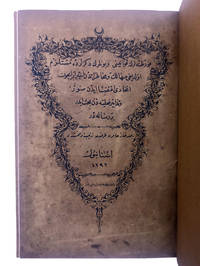
|
|
|
SPYRIDON MAVROGENIS, (The physician of Abdul Hamid II, Sultan of the Ottoman Empire), (1817-?).
GREEK PHYSICIAN OF THE SULTAN / PARIS IMPRINT Physiologikai pragmateiai: Upo tou tis sunolou iatrikis didaktoros epitimou tautis kathigitou. Dilphoron epistimonon te kai philologon etairion te kai sullogon imedapon te kai allodapon epitimou melous i proedrou. Tis autou A. Megaleiotitos tou Soultanou.
Paris: Ek Tis Typographias "O Aesthir". ca. 1890 1890. 1st Edition . Soft cover. Very Good. 8vo - over 7¾ - 9¾" tall. Original wrappers. Demy 8vo. 21 x 14 cm. In Modern Greek. 244 p. Some stains on margins spine slightly loosened with minor marginal chippings on the pages. An untrimmed and unopened copy in good condition. First and only Greek edition of this rare medical book printed in Paris on physiology by Mavrogenis. He was one of the most influential professors of medicine at the Constantinople Medical School where he taught internal medicine. In this book Mavrogenis clearly presents the state of the art in physiology at the time distinguishes between physiology and psychology in terms of their methodologies and offers an accurate description of the contemporary views on the "Brain-Mind Problem" George Anogianakis Reflections of Western Thinking on Nineteenth Century Ottoman Thought: A Critique of the 'Hard-Problem' by Spyridon Mavrogenis a Nineteenth Century Physiologist. Spyridon Mavrogenis a prominent Phanariot Greek doctor played a key role in the medical field of the Ottoman Empire during the 19th century. He served as the personal physician to Sultan Abdul Hamid II. His lineage traced back to the Mavrogenis family who were of Venetian heritage. Mavrogenis's father passed away when he was young prompting him to live with his uncle Ioannis Mavrogenis in Vienna where his uncle served as the chargé d'affaires for the Ottoman mission. Mavrogenis initially studied at the Chalcis Commercial School and later attended medical studies in Vienna from 1835 to 1843. After completing his studies he worked as an auxiliary doctor in a city-owned hospital in Vienna. Returning to Constantinople in 1845 Mavrogenis served as a doctor at the Artillery Hospital and in 1848 became a professor at the Imperial Medical School. He initially taught hygiene and later pathology advocating for the use of French as the medium of instruction. In addition to his professional achievements Mavrogenis was involved in the cultural sphere hosting meetings of the Greek Literary Society at his home starting in 1861. OCLC locates only two copies 261976425 at Stanford University Lane Medical Library and Utrecht University Library both with 317 pages. However our presented copy has 244 pages with "Telos" i.e. Finish and is complete without missing pages. <br/> <br/> Ek Tis Typographias "O Aesthir"., [ca. 1890] paperback
Riferimento per il libraio : 055279
|
|
|
SUNBULZADE VEHBI, (Ottoman diwan poet), (1718-1809).
EARLY COLLECTION OF POEMS / BULAQ IMRPINT Dîvân-i Vehbi. i.e. Vehbi's poems.
Bulak Egypt: Bulaq Printing House / Matba'at Sâhib al-Sa'âdah al-Abadîyah. AH 1253 1837. 1st Edition . Leather. Very Good. 4to - over 9¾ - 12" tall. Contemporary quarter brown leather. Marbled boards. The title of the book is written at the bottom of the pages. Small 4to. 26 x 17 cm. In Ottoman script Old Turkish with Arabic letters. 20 1 blank page 17 2 blank pages 43 2 blank pages 131 2 blank pages 16 1 blank page 97 61 3 blank pages p. Fading and foxing on some pages and edges. Slight chippings on the boards' extremities. The front pastedown and the first blank page are glued. Overall a fresh copy in near fine condition. First edition of this remarkable collection of Vehbi's poems in Arabic Persian and Turkish including his "Lotfiyyah" posthumously printed in Bulaq Printing House as an early Bulaq imprint presented to Sultan Selim III written under his patronage in Istanbul besides other important Ottoman statesmen and clerics in the 18th century such as Shaikh al-Islam Esadefendizâde Mehmed Serif Efendi Râghib Pasha and Halil Hamîd Pasha. This book is one of the 259 Turkish books published from the establishment of the printing house in 1820 to 1851. The voluminous divan consists of six sections respectively titled Sebeb-i Telîf i.e. the reason for writing Farsî i.e. Persian Ibtidâ-yi Kasâîd i.e. Qasidahs Ibtidâ-yi Tevârîh i.e. Histories Ibtidâ-yi Gazeliyyât i.e. Ghazals Lütfiyye-i Vehbi i.e. Lotfiyyah. After the introductory part of the work there are Arabic odes and couplets respectively Persian divancha including a eulogy written for Sultan Mustafa III and other eulogies dates and ghazals under separate headings. Lotfiyyah is a verse book of 1181 couplets that the poet wrote for his son. The Bulaq or El-Amiriya Press is the first official and governmental printing press to be established in Egypt and functions according to an industrial printing basis causing not just a qualitative but also a quantitative and knowledgeable leap in science throughout the Arab region. It was established in 1820 by Muhammad Ali Pasha of Egypt and Sudan 1769-1849 and it was part of Muhammad Ali's inclusive development plans for the modernization of Egypt. Özege 4242.; Ipekten & Isen pp. 106.; OCLC 644318943 & 602407077. <br/> <br/> Bulaq Printing House / Matba'at Sâhib al-Sa'âdah al-Abadîyah., [AH 1253] hardcover
Riferimento per il libraio : 055364
|
|
|
SEYDI ALI REIS, (Ottoman admiral), (1498-1563).
SOUTH & CENTRAL ASIA Mir'âtü'l-memâlik. i.e. The mirror of the countries.
Istanbul: Ikdam Matbaasi. AH 1313 1895. 1st Edition . Leather. Very Good. 8vo - over 7¾ - 9¾" tall. Original handsome brown quarter leather binding with Ottoman lettered gilt to spine. Five raised bands to spine separated from each other with lined gilt. Slight stains on the title page. Else a fine copy. Roy. 8vo. 23 x 16 cm. In Ottoman script Old Turkish with Arabic letters. 99 p. Hegira: 1313 = Gregorian: 1895. Extremely rare first printed edition of this one of the earliest travel accounts of an Ottoman admiral's early expeditions to the Indian Ocean Arabian Sea Red Sea and Persian Gulf to counter Portuguese piracy and attacks on Muslim pilgrim ships which describes the lands he has seen during his voyage from India to Constantinople by Sidi Seydi Ali Reis 1498-1563 sent by Sultan Suleiman the Magnificent covering the years 1553-1556. During these naval wars after two marine battles against the Portuguese fleet and a great storm named The Elephant Typhoon Tufan-i Fil by the locals Reis' remaining six galleys drifted to India. The fleet was unserviceable resulting in his return home overland with 50 men. Reis then arrived at the royal court of the Mughal Emperor Humayun in Delhi where he met the future Mughal emperor Akbar who was twelve years old at the time. He returned to the Ottoman Land over Muslim states in South Asia; Afghanistan Central Asia and Iran. But he delayed his return because of the war between the Ottoman and the Safavid Empires in Iran. Finally following the treaty of Amasya in 1555 he was able to return home and present his book of this narrative journey to the Sultan in 1557. This work offers an extensive insight into the Muslim situation in 16th century South and Central Asia and the Middle East Islamic navigation and Turkish - Portuguese relations as well as Persian Afghan and Indian geography naval routes flora and fauna. Seydi Ali Reis formerly also written Sidi Ali Reis and Sidi Ali Ben Hossein was an Ottoman admiral and navigator. Known also as Katib-i Rumi Galatali or Sidi Ali Çelebi he commanded the left wing of the Ottoman fleet at the naval Battle of Preveza in 1538. He was later promoted to the rank of fleet admiral of the Ottoman fleet in the Indian Ocean and as such encountered the Portuguese forces based in the Indian city of Goa on several occasions in 1554. Seydi was able to unite several Muslim countries on the coast of the Arabian Sea such as the Makran Kingdom Gujarat Sultanate and Adal Sultanate against the Portuguese. He is famous today for his books of travel such as the Mir'ât ül Memâlik i.e. The Mirror of Countries and his books of navigation and astronomy such as the Mir'ât-i Kâinât Mirror of the Universe and the Kitâb ül Muhit: El Muhit fî Ilmi'l Eflâk ve'l Buhûr i.e. Book of the Regional Seas and the Science of Astronomy and Navigation which contain information on navigation techniques methods of determining direction calculating time using the compass information on stars sun and moon calendars wind and sea currents as well as portolan information regarding the ports harbours coastal settlements and islands in the various regions of the Ottoman Empire. His books are translated into numerous languages including English French Italian German Greek Arabic Persian Urdu Russian and Bengali and are considered among the finest literary works dating from the Ottoman period. "When Sultan Suleiman had taken up his winter residence in Aleppo I the author of these pages was appointed to the Admiralship of the Egyptian fleet and received instructions to fetch back to Egypt the ships 15 galleys which some time ago had been sent to Basrah on the Persian Gulf. But 'Man proposes God disposes.' I was unable to carry out my mission and as I realized the impossibility of returning by water I resolved to go back to Turkey by the overland route accompanied by a few tried and faithful Egyptian soldiers. I traveled through Gujarat Hind Sind Balkh Zabulistan Bedakhshan Khotlan Turan and Iran <br/> <br/> Ikdam Matbaasi., [AH 1313] hardcover
Riferimento per il libraio : 055453
|
|
|
AHMED TEVFIK PASHA [OKDAY], (1845-1936), (The Ottoman statesman and the last Ottoman grand vizier).
ENVELOPE of THE OTTOMAN MEDAL BERAT Azm-i ricâl Devlet-i Âliye'den Atina sefiri Tevfik Bey Efendi hazretlerine. mecidiye nisaninin berat-i aliyesi.
Post-1883 1883. Hardcover. Very Good. 4to - over 9¾ - 12" tall. Original gold gilt envelope hand-written description. Framed. Extremities chipped slightly repaired and framed. Frame size: 30x36 cm; paper size: 17x23 cm. Hand-written text in Ottoman Turkish with Arabic letters. Envelope of Turkish medal issuance order by state sultan to Ahmed Ahmet Tevfik Pasha. He was the Ottoman statesman and the last Ottoman grand vizier. After serving 14 years as the Minister of Foreign Affairs of the period of Abdülhamid II. Abdulhamid II and the continuation of the reign of Mehmed V between April 13 1909 and May 5 1909 during the reign of Mehmed VI and during the occupation of Istanbul between November 11 1918 - March 3 1919 and between 21 October 1920 and 4 November 1922 he served as a grand vizier for two years four months and twenty nine days in three periods mainly five terms. The son of the Crimean Tatari who was based on the Giray Dynasty was the son of Ferik Ismail Hakki Pasha. He left the military officer and entered the Babiâli The Sublime Porte Translation Chamber. After 1872 he served in various foreign missions and after serving in Rome Vienna St. Petersburg and Athens he served as an ambassador for 18 years in Berlin. This medal mejidie order was given to him while he was serving as ambassador in Athens. <br/> <br/> [Post-1883] hardcover
Riferimento per il libraio : 047387
|
|
|
DAMAT MEHMED SERIF [CAVDAROGLU] PASHA, (Turkish statesman, Ottoman Minister of Interior, author, translator and the groom of Sul
Autograph letter signed 'Mehmed Serif'.
Istanbul 1945. Soft cover. Very Good. Original autograph letter. 2 p. No letterhead on paper. In Ottoman script. Sent to Hayri Bey Efendi. Dated February 25 1945. A fine script. Sent from abroad to Turkey before one year of his return. Damat Mehmet Serif was a Turkish statesman Ottoman Minister of Interior author translator and the groom of Sultan Abdulaziz. He graduated Mulkiye School and worked in various government services. In 1901 he married Emine Sultan who was the daughter of Sultan Abdülaziz. Therefore he was groom Damat of Ottoman Court in the last period of the Ottoman Empire. He was translator of 'Voyages of Ibn-i Battuta' into Turkish from Arabic language and 'The Prince' by Machiavelli. from French. Source: Türk meshurlari -1946- Ibrahim Alaettin Gövsa. He's known with his a negative attitude towards the Turkish War of Independence. After that he became one of the people disrupting the national unity in the Speech by Mustafa Kemal Atatürk. When the War of Independence was successful he was fled and banished. He returned from exile to Turkey in 1946. <br/> <br/> paperback
Riferimento per il libraio : 049571
|
|
|
SAMIPASAZADE SEZAI, (1859-1936), (Turkish writer, intelligent, pioneer of novel and short story in the Ottoman Turkey).
Autograph letter signed 'Sezai' sent to Türkgeldi family.
Istanbul. Soft cover. Very Good. Original autograph letter signed as 'Sezai' by Samipasazade Sezai to Türkgeldi family. In Ottoman script. 4 p. last page has Ali Fuat Türkgeldi's autograph note on Samipasazade Sezai's death as: "Samipasazade Sezai Bey; 26 Nisan 1936 Pazar aksami saat dokuzu yirmi geçe 21:20 ölmüstür.". Sezai's letter starts as 'Pek muhterem kardesim'. Used blue ink with a fountain pen. Ali Fuat Türkgeldi 1867-1935 was an Ottoman historian and politician. He is the son of Celâl Bey the undersecretary of the Ministry of Interior and the son of Cemal Bey in the Reform period Tanzimat - Westernization period the director of Translation Chamber. Sezai Turkish realist storyteller novelist. He is the author of Sergüzest Adventure which is one of the first realistic novels of Turkish literature. Also he was pioneer of the modern short story in Turkish literature with Küçük seyler 'Little things' he wrote in 1892. Between 1885 and 1901 he lived in Istanbul this letter dated probably in that period and had a literary period. He was close friends with Abdülhak Hamit and Recaizade Ekrem. He met with Namik Kemal whom he met when he was 17-18. He did not produce many works like other Tanzimat writers; wrote one novel two small story books and travel memoirs. In 1888 he published a novel called Sergüzest A story about a Pasazade and his love story after which he became one of the first writers of Turkish literature after Semseddin Sami Namik Kemal and Ahmet Mithat Efendi. He translated Alphonse Daudet's 'Jak' into Turkish. For thinking that he was being held under 'surveillance' for his novel he went to Paris in 1901 and stayed there until the declaration of the Constitutional Monarchy in 1908. He met the Young Turks in Paris; He joined the Committee of Union and Progress and came to a respected place in the community in a short time. Upon the declaration of the Constitutional Monarchy he returned to Istanbul and was appointed as ambassador to Madrid. As WW 1 began he moved from Madrid to Switzerland where he stayed until the end of the war. His only novel Serguzest was the first novel in Turkish literature to deal entirely with captivity; the novel in which the system of concubinance and slavery was criticized was his most famous work. It was translated into French by Besim Ömer Pasha. e combined romance and realism in her writings. He combined romanticism and realism in his writings. He gave works with the motto of "l'art pour l'art". <br/> <br/> paperback
Riferimento per il libraio : 049456
|
|
|
MEHMED TEVFIK BEY [BIREN], (Ottoman / Turkish governor, minister and last chief of the Council of the State), (1867-1956).
II. Abdülhamid Mesrutiyet ve Mütareke devri hatiralari. 2 volumes set. Prep. by F. Rezan Hürmen.
Istanbul: Arba Yayinlari 1993. Soft cover. Very Good. 8vo - over 7¾ - 9¾" tall. Paperback. Cr. 8vo. 20 x 14 cm. In Turkish. 2 volumes set: 1048 p. ills. II. Abdülhamid Mesrutiyet ve Mütareke devri hatiralari. 2 volumes set. Prep. By F. Rezan Hürmen. Memoirs of a Turkish / Ottomaan statesman in the period of Abdülhamit II Second Constitution and the Truce. <br/> <br/> Arba Yayinlari paperback
Riferimento per il libraio : 047899 ISBN : 975391007x 9789753910071
|
|
|
MUZAFFER KAMIL GORDUYSUS, (Turkish Consul of Komotini, 1943-1947).; ISMAIL HAKKI OKDAY, (Son of last Ottoman vizier Ahmet Tevfik
Autograph dedicated business card of Muzaffer K. Görduysus to Ismail H. Okday.
Ankara: 1940s 1940. Soft cover. Very Good. Original business card with autograph dedication. In Turkish. Muzaffer Görduysus was Turkish consul of Komotini Gümülcine between the years of 1943-1947. Dedicated to Ismail Hakki Okday 1881-1977 who was son of last Ottoman vizier Ahmet Tevfik Pasha groom of the last Ottoman sultan Vahdeddin soldier diplomat and philatelist. <br/> <br/> [1940s] paperback
Riferimento per il libraio : 049547
|
|
|
KHEDIVE ABBAS HILMI PASHA II of EGYPT, (The last Khedive (Ottoman viceroy) of Egypt and Sudan, ruling from 8 January 1892 to 19
LE KHEDIVE - Business card of Abbas II of Egypt Khedive.
Egypt: ca. 1905 1905. Soft cover. Very Good. Original business card. 7x11 cm. Written 'Le Khedive'. Abbas Hilmi Pasha was the last Khedive Ottoman viceroy of Egypt and Sudan ruling from 8 January 1892 to 19 December 1914. In 1914 after Turkey joined the Central Powers in World War I the nationalist Khedive was removed by the British then ruling Egypt in favor of his more pro-British uncle Hussein Kamel marking the de jure end of Egypt's four-century era as a province of the Ottoman Empire which had begun in 1517. Extremely rare. See. 'Tamga pençe tugra imza' by Kologlu Orhan. p. 98. <br/> <br/> [ca. 1905] paperback
Riferimento per il libraio : 049551
|
|
|
SALAH CIMCOZ, (Turkish politician and lewyer), (1875-1947).; SEYHULISLAM MUSA KAZIM EFENDI, (Ottoman Seyhulislam), (1858-1920).
Photograph of Salâh Cimcoz and Shaikh-al-Islam Musa Kazim Efendi in a community.
Istanbul: 1920's. No Binding. Very Good. Original b/w photograph of Salah Cimcoz and Musa Kazim Efendi with another 13 people in a community. They sit and look to camera. Cimcoz with his 'fez' and Musa Kâzim with his traditional 'qavuq'. Musa Kazim was shaikh-al-islam between 1910-1911 and his second time was between 1916-1918 during the World War I. Cimcoz graduated from Istanbul Law School. He was also a member of Union and Progress deputy of Meclis-i Mebusan Ottoman Parliament and owner 'Kalem' humorist periodical. Both these figures which are very important in terms of Turkey's history and last Ottoman period also were "150 personae non-gratae" and exiled to Malta in 1919. Extremely rare. <br/> <br/> 1920's unknown
Riferimento per il libraio : 049718
|
|
|
RUKIYE SABIHA SULTAN, (1891-1971), (Ottoman princess, the daughter of Sultan Mehmed VI)
OTTOMAN DYNASTY PHOTOGRAPH Autograph photo signed Sabiha Sultan.
New York: Rukiye Sabia Sultan 1940. Soft cover. Very Good. 4to - over 9¾ - 12" tall. Original color photograph hand-colored. 4to. 26 x 20 cm. A portrait. Signed and inscribed as 'To my dear uncle and mother Fatma Sultana New York August 1940'. Sabia Sultan was born on 2 April 1894 in her father's palace in Ortaköy. Her mother was Nazikeda Kadin daughter of Hasan Marshan and Fatma Horecan Aredba. She was the third daughter born to her father and mother. She had two sisters Fenire Sultan six years elder than her and Ulviye Sultan one year elder than her. When her father asecended the throne in 1918 Sabiha was still unmarried but had several admirers. Those who knew her always said that she was not like the other women of the Ottoman family. "Sabiha Sultan was different" said the Turkish poet Yahya Kemal. Her first suiter is thought to be Rauf Orbay. He was followed by Mahmud Kemal Pasha. Another was Fuad Bey of the Babanzade clan. Captain Safvet Arikan Lieutinant Suphi Bey from Damascus were other suitors but none of them were accepted. Her betrothal to Ahmad Shah Qajar the last ruling member of the Qajar dynasty and Mustafa Kemal Atatürk was forfeited in favor of her second cousin Sehzade Ömer Faruk thus missing her chance of becoming the first "First Lady" of the nascent Turkish Republic. Sabiha and Sehzade Ömer Faruk the son of Abdulmejid II the last Caliph of the Ottoman Caliphate and Sehsuvar Hanim were in love with each other. When Abdulmejid asked Sabiha's hand in marriage for his son Mehmed flatly refused as there was no such thing as a marriage between cousins. Sehsuvar Hanim the prince's mother called on Nazikeda and succeeded in convincing her. The marriage took place on 5 December 1919 in the pavilion of the sacred relics Topkapi Palace. The marriage was performed by Seyhülislam Hayrizade Ibrahim Efendi. Sabiha Sultan's deputy was Baskatip Ali Fuad Bey and Ömer Faruk's deputy was Ömer Yaver Pasha. The wedding reception took place four months later on 29 April 1920 at the Yildiz Palace. The couple were given the Nisantasi Palace as their residence. Fatma Neslisah Osmanoglu was a granddaughter of the last Ottoman Caliph Abdulmejid II and his first wife Sehsuvar Hanim and granddaughter of the last Ottoman Sultan Mehmed VI and his first wife Nazikeda Kadin. She was the daughter of Sehzade Ömer Faruk 1898-1969/1971 and his first wife and cousin Sabiha Sultan 1894-1971. Extremely rare. <br/> <br/> Rukiye Sabia Sultan paperback
Riferimento per il libraio : 050218
|
|
|

 Ricevere i risultati per e-mail
 Scaricare i risultati in PDF
 RSS feed
 Link
Link


